Family VIREONIDÆ.—The Vireos.
Reading edition
The essential features of this family appear to consist in the combination of the dentirostral bill, notched in both mandibles; the ten primaries (except Vireosylvia), of which the outer is usually from one fourth to one half the second; the rather short, nearly even tail, with narrow feathers, and the great amount of adhesion of the anterior toes,—the whole basal joint of the middle being generally united on both sides to the adjacent joints, and decidedly shorter than the basal of inner or two basal of outer. The outer lateral toe is generally appreciably longer than the inner, reaching considerably beyond the base of the middle claw. The tarsi are always distinctly scutellate anteriorly. The young are never spotted, or streaked as in the Thrushes; nor, indeed, do the adults exhibit such markings.
The Vireonidæ are peculiar to the New World, and are widely distributed, although but one genus belongs to the United States.
Genus VIREO, Vieill.
Vireo, Vieill. Ois. Am. Sept. I, 1807, 83. (Type, Muscicapa noveboracensis, Gm.)
No great violence will be done by considering all the American Vireos as belonging to one genus, divisible into three subgenera, as, however different the extremes of the series may be from each other, the gradation is quite complete.
The North American species take a wide range during their southern winter migration, only paralleled in this respect by the Sylvicolidæ; they do not visit the West Indies, save as very rare stragglers to Cuba (V. olivaceus, solitarius, flavifrons, and noveboracensis). They all have a melodious song, and, so far as known, make a deep nest, suspended by its upper edge between the forks of a horizontal twig. The eggs are white, generally with a few reddish or brown blotches.
Quite a number are characterized by having the eyes white, red, or yellow.
Subgenera.
Vireosylvia. Bill compressed, narrow; culmen and commissure straight, the tip abruptly curved (or, if this is not the case, there is no trace of light bands on the wing; see section “b”). Superciliary stripe continued back to the occiput. No trace of light bands on the wing. No conspicuous ring round the eye.
a. No spurious primary. Bill compressed, its tip abruptly hooked; culmen and commissure straight. Crown decidedly more ashy than the back … Sp. flavoviridis, barbatulus, olivaceus, philadelphicus.
b. An acute spurious primary. Bill depressed, the tip only slightly hooked; culmen slightly curved. Crown scarcely more ashy than back … Sp. gilvus.
Lanivireo. Bill compressed, stout; culmen arched from the base, commissure curved. Superciliary stripe stopping at posterior angle of the eye and curving under it, enclosing the eye in a conspicuous orbital ring, interrupted only in front. Two conspicuous white bands on the wing.
a. No spurious primary … Sp. flavifrons.
b. With an acute spurious primary … Sp. solitarius, plumbeus.
Vireo. Bill stout, scarcely compressed, sub-cylindrical. First primary not spurious, or, if so, not acute.
a. Two conspicuous light bands on wing … Sp. atricapillus, noveboracensis, huttoni.
b. One distinct light band on wing, and this not sharply defined, the anterior one being almost obsolete … Sp. belli, pusillus, vicinior.
Subgenus VIREOSYLVIA, Bon.
Vireosylvia, Bon. Geog. Comp. List, 1838. (Type, Muscicapa olivacea, Lin.)
Phyllomanes, Cab. Arch. 1847, I, 321. (No type mentioned; name proposed as substitute for Vireosylvia.)
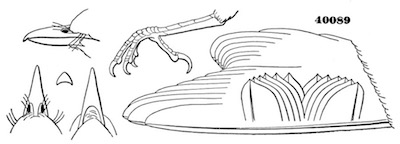
Vireo olivaceus. 40089
Gen. Char. Wings long and pointed, one third or one fourth longer than the nearly even or slightly rounded tail. First quill very small (less than one third the second), sometimes apparently wanting. Second quill longer than the seventh, much longer than the secondaries. Tarsi short (scarcely exceeding .70 of an inch); toes rather long. Body slender and elongated. Bill slender, narrow, straight; the culmen straight for its basal half, the commissure quite straight; light horn-color, paler beneath. Feet weak. Type, V. olivaceus.
Species and Varieties.
Common Characters. All species olive above, white or yellowish beneath. An ashy or brownish cap, contrasting more or less abruptly with the olive back. A whitish superciliary stripe extending to the nape, and a dusky one to and behind the eye. No light bands on the coverts. Inside of wings (flanks sometimes) and crissum yellowish, otherwise usually white beneath.
No spurious primary Series I.
A spurious primary Series II.
Series I. (No spurious primary.)
A. A dusky “mustache” or cheek stripe along each side of the throat.
1. V. calidris. Eyes red?
a. No distinct dusky line along side of the crown.
Light stripes of the head dingy brownish-buff; crown scarcely ashy; back olive-brown; crissum and lining of the wing pure pale yellow. Wing, 3.20; tail, 2.25; bill, .42. Hab. Jamaica; Santo Domingo, Porto Rico, Santa Cruz, St. Thomas, and Sombrero. … var. calidris.[70]
Light stripes of the head dingy grayish-white; crown distinctly ashy; back grayish-olive; crissum and lining of the wing scarcely yellow. Wing, 3.20; tail, 2.35; bill, .42. Hab. Cuba, Bahamas, and South Florida … var. barbatulus.
b. A distinct dusky line along each side of crown.
Colors as in barbatula, but “mustache” broader and more conspicuous, and crown much purer ash. Wing, 3.30; tail, 2.50; bill, .48. Hab. Barbadoes … var. barbadense.[71]
B. No “mustache.”
a. A dusky line along each side of crown.
2. V. olivaceus. Grayish olive-green above; beneath white, tinged laterally with dull olive; crissum and lining of wing scarcely yellow; inner edges of quills white. Eyes red.
1. Wing, 3.30; tail, 2.40; bill, .38. Hab. Eastern Province of North America, south to Northern South America … var. olivaceus.
2. Wing, 2.50; tail, 1.80; bill, .33. Hab. Eastern South America. … var. chivi.[72]
3. V. flavoviridis. Yellowish olive-green above; beneath white medially, bright greenish olive-yellow laterally; crissum, lining of wings, and inner edges of quills, light yellow. Eyes yellow.
1. Wing, 3.15; tail, 2.55; bill, .41. Hab. Middle America north of Panama … var. flavoviridis.
2. Wing, 2.80; tail, 2.25; bill, .36. Hab. South America, from Buenos Ayres northward; Guatemala … var. agilis.[73]
b. No dusky line on side of crown.
4. V. magister.[74] Large. Above sooty-olive, more virescent posteriorly; crown without ashy tinge. Beneath similar, but lighter, whitish medially. Crissum and lining of wing very faintly yellow; inner edges of quills white. Eyes? Wing, 3.05; tail, 2.40; bill, .45. Hab. Honduras (Belize).
5. V. philadelphicus. Small. Above grayish-green; crown ashy. Beneath light yellow, deepest on the jugulum, whitish on belly. Eyes? Wing, 2.70; tail, 1.95; bill, .27. Hab. Eastern Province of North America; in winter south to Costa Rica.
Series II. (A spurious primary.)
C. No dusky line along side of crown. No “mustache.”
6. V. gilva. Eyes hazel (in all?).
a. Crown nearly like the back.
Above olive-gray, rump more virescent; crown more ashy. Beneath dingy whitish, with a strong tinge of dingy buff from bill along sides and across breast. Bill, .14 deep, .30 long; wing, 2.85; tail, 2.05. Hab. Eastern Province of United States … var. gilvus.
Similar, but above more grayish, and beneath with the buff tinge almost absent. Bill, .11 deep, and .22 long; wing, 2.80; tail, 2.15. Hab. Western Province of United States … var. swainsoni.
b. Crown very different from the back (dark brown).
Above olive-brown; rump more virescent; crown dark snuff-brown. Beneath uniform light yellow, throat whitish. Bill, .15 deep, .30 long; wing, 2.60; tail, 2.10. Hab. Middle America, from Ecuador to Honduras … var. josephæ.[75]
Vireosylvia calidris, var. barbatulus, Baird.
FLORIDA GREENLET.
Phyllomanes barbatulus, Cab. Jour. III, 1855, 467 (Cuba).—Gundlach, Cab. Jour. 1861, 324 (Cuba).—Ib. Repertorio, Cuba, 1865. Vireosylvia barbatula, Baird, Rev. Am. B. 1864, 331. Vireo altiloquus, Gambel, Pr. A. N. Sc. 1848, 127 (Florida).—Baird, Birds N. Am. 1858, 354 (Florida). Vireosylvia altiloqua, Cassin, Pr. A. N. Sc. 1851, 152.—Ib. Illust. 1854, 8, and 221, pl. xxxvii (Florida).—Bryant, Pr. Bost. Soc. V, 1859, 113 (Bahamas).—Lawrence, Ann. N. Y. Lyc. 1860 (Cuba).
Sp. Char. (No. 25,958 ♂, Cuba.) Proportion of quills as in var. calidris, 2 = 3, 4, 1, 5, but the tips of the quills closer together, and the first quill about half or a little less than half the distance between fifth and fourth; the quills narrower.
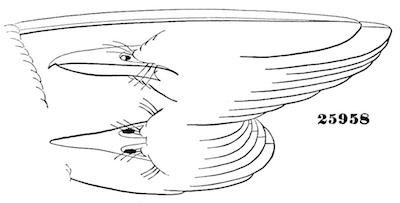
Vireosylvia barbatulus. 25958
Colors similar to those of var. calidris, but of a purer and paler olive above; the back tinged with ash; the cap purer ash, and better defined, without olivaceous wash, its dusky edge more distinct. The superciliary stripe whitish or grayish, with the cheeks paler, and both, as well as the chin, without the buff tinge. Under parts nearly pure white, very faintly tinged across the breast with ashy; the sides olivaceous; the crissum and axillars pale sulphur-yellow. Total length, 5.50; wing, 3.15; tail, 2.50; difference of first and second quills, .18; of fifth and second, .22; length of bill from forehead, .82, from nostril, .46, along gape, .89; tarsus, .72; middle toe and claw, .60; claw alone, .21; hind toe and claw, .50; claw alone, .23.
Hab. Cuba; the Bahamas; and Charlotte Harbor, Florida. (Western Coast.)
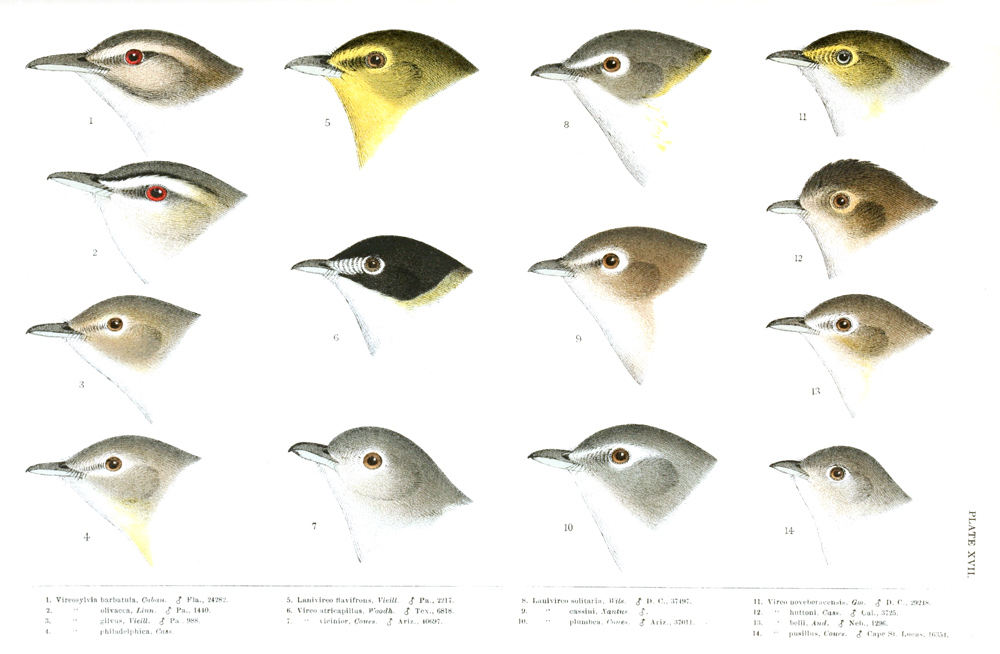
PLATE XVII.
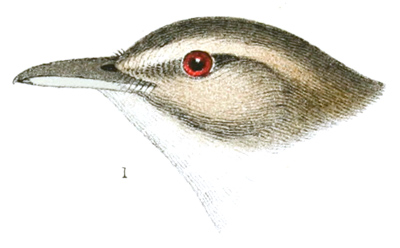
1. Vireosylvia barbatula, Caban. ♂ Fla., 24282.
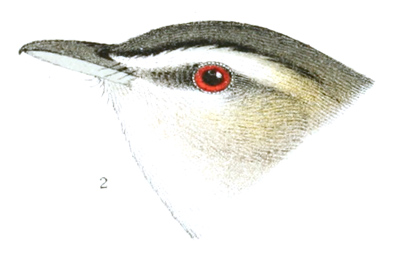
2. Vireosylvia olivacea, Linn. ♂ Pa., 1440.
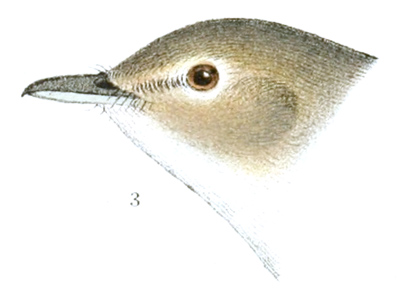
3. Vireosylvia gilvus, Vieill. ♂ Pa., 988.
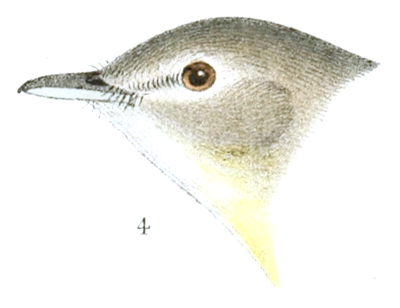
4. Vireosylvia philadelphica, Cass.
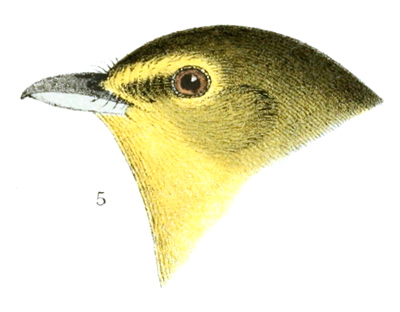
5. Lanivireo flavifrons, Vieill. ♂ Pa., 2217.
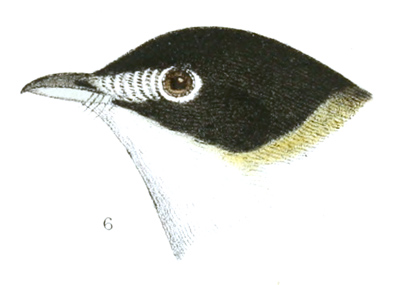
6. Vireo atricapillus, Woodh. Tex., 6818.
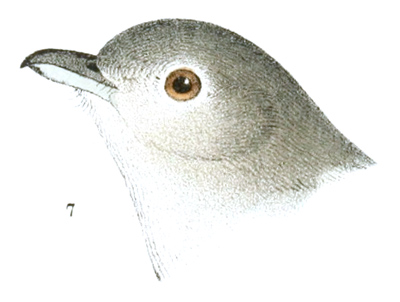
7. Vireo vicinior, Coues. ♂ Ariz., 40697.
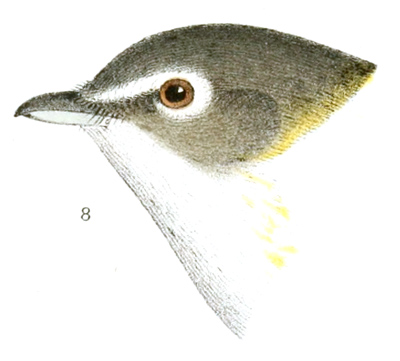
8. Lanivireo solitaria, Wils. ♂ D. C., 37497.
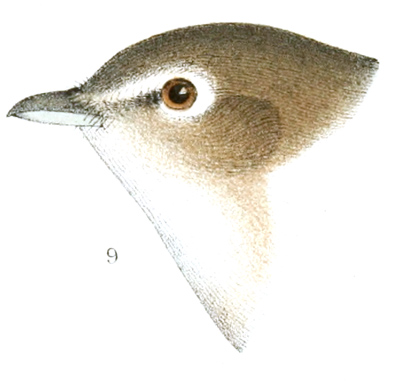
9. Lanivireo cassini, Xantus. ♂.
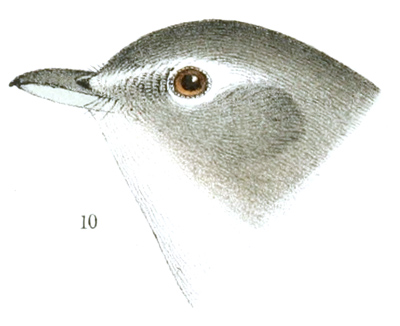
10. Lanivireo plumbea, Coues.♂ Ariz., 37011.
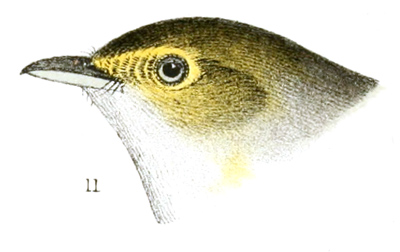
11. Vireo noveboracensis, Gm. ♂ D. C., 29248.
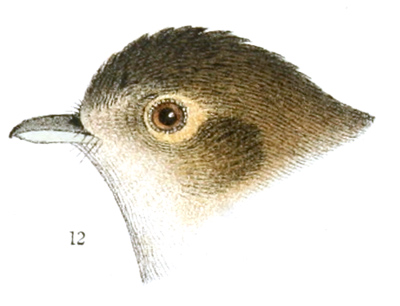
12. Vireo huttoni, Cass. ♂ Cal., 3725.
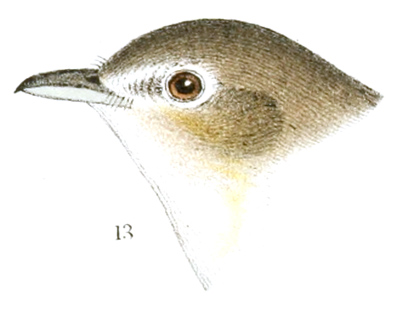
13. Vireo belli, Aud. ♂ Neb., 1296.
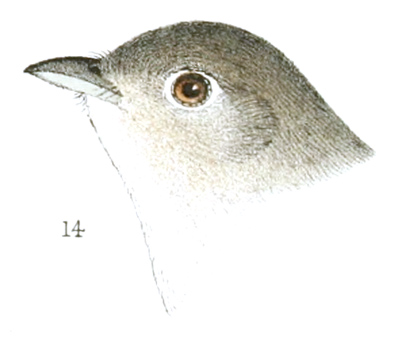
14. Vireo pusillus, Coues. ♂ Cape St. Lucas, 16354.
This Vireo has been taken several times at Charlotte Harbor, in Florida, and is thus entitled to a place in our fauna. Its distinction from a closely allied race in Jamaica, Hayti, etc., var. calidris, is shown on page 359.
A specimen belonging to Mr. Salvin (“No. 187.), from “Isthmus of Panama,” we cannot distinguish satisfactorily from typical examples of the present race, with which it is to be compared, and not with calidris. The colors are quite identical with those of barbatulus. In size it is slightly larger, the wing measuring 3.25 instead of 3.15; the tail 2.50, instead of 2.35 (from exposed base of feathers); the bill is thicker, being .20 instead of .18 deep; the third quill is longest, the second intermediate between it and the fourth; the first intermediate between the fourth and fifth. In barbatulus the second is longest, the third and fourth successively a little shorter. It is not improbable that other specimens from that locality may show greater differences, as the specimen under examination is in rather worn plumage, and has the tip of the bill broken off.
Habits. This species only claims a place in our avifauna on the ground of its presence in Florida. How abundant it is there is not determined, further than it has been observed within a restricted locality by Dr. Heermann. This was at Charlotte Harbor, on the southwestern coast. They appeared to be visitors only, from a more southern clime. They reached Florida in their northern migrations, remaining only for a short season, but evidently staying long enough to breed. Dr. Heermann states that this species resembles, in manners and in appearance, the common Red-eyed Vireo of the more northern States. He describes its song as clear and musical, and very distinctly uttered. It was constantly on the search for insects, and appeared even more active than any of the northern species, darting among the foliage, peering into crevices and cobwebs, suspended from branches with its back downward, and occasionally chasing a flying insect in the manner of a true Flycatcher. These movements were usually accompanied by a song. This species was not abundant, though Dr. Heermann saw it frequently, and obtained several specimens.
Dr. Bryant found this species very abundant at the Bahamas, arriving there about the first of May. All the specimens he obtained were males, the females not arriving there until after the 13th of May. The notes of these birds, he states, vary, though the most common one resembles whīp tom kĕllȳ pheūū, pronouncing the first word distinctly.
This bird,[76] in Brown’s History of Jamaica, is called “Whip-tom-kelly,” from the supposed resemblance of its notes to these articulate sounds, and this popular appellation has been given it by various other writers. Mr. Gosse, however, in his Birds of Jamaica, calls this bird “John-to-whit,” and can find no resemblance in its notes to the words referred to. He describes its song as uttered with incessant iteration and untiring energy, and as resembling Sweet-John! John to whit! sweet John to whit! After July the notes change to to-whit-to-whoo, and sometimes to a soft, simple chirp, whispered so gently as scarcely to be audible. The name of Whip-tom-kelly Mr. Gosse never heard applied to it in Jamaica. Yet it is a bird often heard, and one whose notes have a similarity to articulate sounds, and naturally suggest a common appellation. It is very vociferous and pertinacious in its calls, repeating them with energy every two or three seconds.
This species, he states, does not ordinarily sit on a prominent twig, or dart out after insects, though it has been seen in eager pursuit of a butterfly. It seems to live in the centre of thick woods. It does not pass the winter in Jamaica, but leaves at the beginning of October, returning as early as the 20th of March. Its food he states to be both animal and vegetable, as he found in its stomach the seeds of the tropical plants and berries. In April, Mr. Gosse observed it hunting insects by the borders of the Bluefields River, and so intent upon its occupation as to allow of a very near approach. It sought insects among the grass and low herbage, perching on the stalks of weeds, and darting out after both vagrant and stationary prey. They incubate in June and July.
Like all this genus the Long-billed Vireo builds a pensile nest of great architectural ingenuity and beauty. It is a deep cup, usually about two thirds of a sphere in shape, truncated at the top. The materials of which it is made are often somewhat coarse. Mr. Gosse describes it as about as large as an ordinary teacup, narrowed at the mouth, composed of dry grasses, silk, cotton, lichens, and spiders’-web. It is usually suspended from the fork of two twigs, the margin very neatly overwoven to embrace them. The materials are well interwoven, and the walls firm and close, though not very thick. The whole is smoothly lined with slender vegetable fibres resembling human hair. One nest had its cavity nearly filled with a mass of white cotton, interwoven with the other materials, which, being picked cotton, had evidently been taken from some yard or building.
The eggs of this species are three in number, of a brilliant white, delicately tinted with pink, and marked with a few fine red and red-brown spots, usually about the larger end.
An egg of the variety from Cuba is of an oblong-oval shape, slightly pointed at one end, and the markings of faint purple and of dark purplish-brown, in bold dashes, are all about the larger end. Another from the same locality is more distinctly rounded at one and pointed at the other end, and is marked with fine brown dots distributed over the whole egg. These eggs measure, one .825 by .55 of an inch, and the other .78 by .55. An egg from Jamaica is of an extremely oblong-oval, measuring .88 by .55 of an inch, and is boldly marked more or less over the entire egg with large blotches of purplish-brown.
The Messrs. Newton describe the nest of the calidris of St. Croix as a beautiful structure, shaped like an inverted cone, composed outwardly of dried blades of grass, dried leaves, and wool, woven round the twigs, to which it was attached with spiders’-webs, lined inside with finer blades of grass, and about three inches and a half in diameter, and five in height. The eggs, three in number, were white, with a few black spots, chiefly disposed about the larger end.
Vireosylvia olivaceus, Bonap.
RED-EYED GREENLET.
Muscicapa olivacea, Linn. Syst. Nat. I, 1766, 327 (based on Edwards, tab. 253, and Catesby, pl. liv).—Wils. Lanius olivaceus, Licht. Verz. 1823, 49 (N. Amer.). Vireo olivaceus, Vieill.; Bon.; Swains. II.—Aud.—Baird, Birds N. Am. 1858, 331.—Samuels, Birds N. Eng. 270. Vireosylvia oliv. Bon. Geog. Comp. List, 1838.—Ib. Consp. 1850, 329.—Reinhardt, Vid. Med. f. 1853, 1854, 82 (Greenland).—Ib. Ibis, III, 7.—Sclater, P. Z. S. 1855, 151 (Bogota); 1859, 137, 363 (Xalapa).—A. & E. Newton, Ibis, 1859, 145.—Sclater & Salvin, Ibis, 1859, 12 (Guatemala).—Lawrence, Ann. N. Y. Lyc. VII, 1860, 246 (Cuba).—? Ibis, 1864, 394 (Derby, Engl. May, 1859).—Baird, Rev. Am. B. 1864, 333. Phyllomanes oliv. Cab. Mus. Hein. 1850-51, 63.—Ib. Jour. 1860, 404 (Costa Rica).—Gundl. Cab. Jour. 1861, 324 (Cuba; very rare). ? Vireo virescens, Vieill. Ois. Am. Sept. I, 1807, 84, pl. liii (Penna.).—? Gray, Genera, I, 267, pl. lxv. Vireo bogotensis, Bryant, Pr. Bost. Soc. VII, 1860, 227 (Bogota).—Lawrence, Ann. N. Y. Lyc. 1863 (Birds Panama, IV, No. 378).
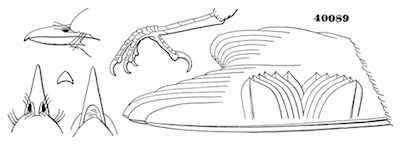
Vireo olivaceus. 40089
Sp. Char. (No. 1,418 ♂, Carlisle, Penn., May, 1844.) Upper parts olive-green. Top of head, from bill to nape, ash-color. A white line from nostrils above and beyond the eye, bordered above by a dusky line forming the edge of the ashy cap, and below by a similar, perhaps paler, loral and post-ocular cheek-stripe. Beneath, including tibiæ, white, with perhaps a tinge of olivaceous-ash across the breast; the sides of the neck like the back; sides of the body with a faint wash of olive. Axillars and crissum faintly tinged with sulphur-yellow; lining of wings and its edge, the latter especially, nearly white. Quills blackish-brown, edged externally, except at ends of primaries, with olive, internally with white. Tail-feathers lighter brown, edged externally like the back, internally with pale olivaceous-white. Bill dusky above, pale below; tarsi plumbeous; iris red. Length, 6.33; extent of wings, 10.25; wing, 3.33; tail, 2.50.
Female similar, but duller in plumage.
Hab. Whole of Eastern North America (Greenland, Halifax, Fort Simpson), west to base of Rocky Mountains, reaching Fort Bridger, and still farther northward to Bitterroot Mountains and Kootenay; south to Panama and Bogota, in winter (Xalapa only in Mexico); very rare in Cuba (only West Indian locality). Accidental in England. Trinidad. (Finsch.)
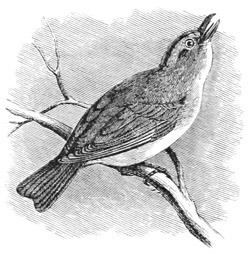
Vireo olivaceus.
Habits. The common Red-eyed Vireo is an abundant species throughout Eastern North America, from Florida to Nova Scotia on the northeast, to Lake Winnepeg on the northwest, and as far west as the Rocky Mountains. It apparently breeds wherever found, and in especial abundance in the Central States. It is a familiar and fearless species, often found, like the Warbling Vireo, in the very midst of crowded cities, and making its lively and pleasant notes heard in their public squares and private gardens, amid the ruder sounds of the neighboring streets. It breeds in Texas and Louisiana, at the Southwest, and also in abundance, at least as far as Halifax, in the opposite direction. At Fort Resolution, at the Cumberland House, and at Fort Simpson, the nests and eggs of this species were procured by Kennicott and Ross. A single specimen of the bird has been procured in Greenland, and another accidental specimen was shot in England. Specimens have also been procured in Central America.
This Vireo, like all of its peculiar and well-marked genus, prefers the forests or the tops of large and shady trees, obtains its food usually among, their upper branches, and very rarely approaches the ground. It is not exclusively sylvan, as at times it may be found around dwellings, hunting for insects and spiders; and although it hunts for food among the tree-tops, its nest is not always in such high situations, often not more than four or five feet from the ground.
In their migrations these birds enter the United States early in March, but do not make their appearance in Pennsylvania until the last of April, or in New England until the middle of May.
The Vireos procure their food, for the most part, by moving about and along branches, and among the twigs of trees, hopping from one position to another, and securing their prey without the click of a Flycatcher. The insects they capture are usually not in motion, though occasionally they will take them on the wing. They also feed on several kinds of ripe berries in the autumn.
The song of this Vireo is loud, musical, simple, and pleasing. It is uttered in short, emphatic bars, and at times has a very marked resemblance to the melodious chant of the Robin, though without its volume and power. This Vireo is one of the earliest of our spring musicians, as it is also one of the most constant and untiring in its song, continuing to sing long after most of the other vocalists have become silent, and even until it is about to leave us, at the close of September. The tender and pathetic utterances of this Vireo, uttered with so much apparent animation, to judge from their sound, are in striking contrast to the apparent indifference or unconsciousness of the little vocalist who, while thus delighting the ear of the listener, seems to be all the while chiefly bent on procuring its daily supply of food, which it pursues with unabated ardor.
This Vireo builds the neat pensile nest of its race, suspending it from the fork of two or more twigs of a forest tree, at various heights of from five to fifty feet from the ground. It is cup-like in shape, and always dependent from small twigs, around which its upper edges are firmly bound. Externally it is woven of various materials, fine strips of bark, the hempen fibres of vegetables, and webs of spiders and of various caterpillars. These are compactly pressed and woven, and, as some suppose, agglutinated by the saliva of the builder. Sometimes the unmanageable materials give to the outside of the nest a rude and unfinished appearance, at others they are evenly and smoothly wrought. They are very strong, uninjured by the storms of winter, and are often made use of by other birds, by mice, and even by the same bird a second season.
A nest of this bird (S. I. Coll., 3,353) was obtained at the Cumberland House by Mr. Kennicott. It is pensile, like all others, but is composed almost exclusively of pine-needles,—a dry and hard material, difficult of management in making such a nest. With these are intermingled a few bits of moss, fine strips of bark, and flax-like vegetable fibres. Within this rude basket is an inner nest, made up of fine dry grasses, strips of bark, and pine leaves. The external fabric is loosely put together,—an unusual feature,—but the inner portion, in the firmness and strength with which it was made, is in remarkable contrast.
The Red-eyed Vireo’s nest is often chosen by the Cowbird for the deposition of her parasitic eggs, and these foster-parents are singularly devoted in the care of their alien guests, whom they tenderly nurture, even to the neglect of their own offspring. In one instance three eggs of a Cowbird were deposited in the nest of the Vireo before any of her own, and, without laying any, the female Vireo proceeded to sit upon and hatch the intruders. In another case, where two of the Vireo’s had been laid, two Cowbird’s eggs were added. The Vireo stopped laying, and proceeded to incubate. In each instance the female Vireo seemed to forego her own natural aspirations, and at once conform to the new situation.
The male Vireo often evinces great courage and spirit in the defence of his nest, when the young are hatched driving away intruders, and even flying in the face of a man who approaches too near.
Mr. Nuttall states that the young of the Red-eyed Vireo feed eagerly upon the berries of the cornel and the Viburnum dentatum, and other shrubs. A young bird kept in confinement soon became very gentle, and readily ate flies and grasshoppers from his hand, and viburnum berries. A tame Kingbird in the same room was very jealous of and tyrannized over him, so as to compel him to seek protection from his captor. The Vireos, like Flycatchers, have the power to regurgitate by the bill pellets of indigestible portions of their food.
The eggs of this Vireo vary greatly in size, according to the locality; the farther south the smaller they are found. One, marked on the shell East Tennessee, June 1, 1858, Alex. Gerhardt, measures .78 by .52 of an inch, while one from Halifax, Nova Scotia, measures .95 by .65. The ground-color of all is a clear crystal-white, and they are marked chiefly at the larger end with spots and finer dots of red-brown.
Mr. Robert Kennicott, in his notes, speaks of finding a nest of the Red-eyed Vireo at the Cumberland House, Saskatchewan, June 28. Incubation had not yet commenced. The pensile and neatly built nest was suspended about four feet from the ground, upon a hazel-bush. The parent, when scared from it, remained near until she was killed.
Vireosylvia flavoviridis, Cassin.
YELLOW-GREEN VIREO.
Vireosylvia flav. Cassin, Pr. A. N. Sc. V, Feb. 1851, 152.—Ib. VI. pl. ii (Panama).—Sclater, P. Z. S. 1856, 298 (Cordova).—Ib. 1859, 375 (Oaxaca; April).—Ib. Catal. 1861, 44, No. 264.—Sclater & Salvin, Ibis, I, 1859, 12 (Guatemala).—Baird, Rev. 336. Vireo flav. Baird, Birds N. Am. 1858, 332. Phyllomanes flav. Cab. Jour. 1861, 93 (Costa Rica).
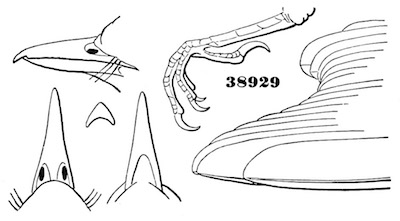
Vireo flavoviridis. 38929
Sp. Char. (No. 3,976 ♂.) Above olive-green; the whole top of head and nape ash-color, the edges of this cap and a loral line dusky, but not very decidedly so. A grayish-white line from nostrils over the eye. Beneath white, the sides of the neck, breast, and body bright olivaceous-yellow; the axillars and crissum rich sulphur-yellow. On the breast the yellow extends almost to the median line, the color of opposite sides separated by a narrow interval. Quills dusky-brown; margined externally, except at ends of primaries, with olive-green, internally with grayish-white of a decided yellow shade. Tail-feathers dark olivaceous-brown, bright olive externally, internally olivaceous-yellow. Iris yellow or “red.”
Bill horn-color, paler below. Legs plumbeous. Wings long and pointed. Second and third quills nearly equal; fourth a little less; first about intermediate between fourth and fifth. Total length, 6.00; wing, 3.20; tail, 2.60.
Hab. From northern border of Mexico to Isthmus of Panama, especially on west side.
This species has not yet been recorded as taken within the limits of the United States, but it comes so near to our southern border that it doubtless sometimes crosses the line. Nothing distinctive appears to be known of its habits.
Vireosylvia philadelphicus, Cassin.
PHILADELPHIA GREENLET.
Vireosylvia philadelphica, Cassin, Pr. A. N. Sc. V, Feb. 1857, 153.—Ib. VI, pl. i, fig. 1 (Philadelphia).—Sclater & Salvin, Ibis, I, 1859, 12 (Guatemala).—Baird, Rev. Am. Birds, 340. Vireo philadelphicus, Baird, Birds N. Am. 1858, 335, pl. lxxviii, fig. 3. Vireosylvia cobanensis, Sclater, P. Z. S. 1860, 463 (Coban).—Ib. Ann. Mag. N. H. 1861, 328.
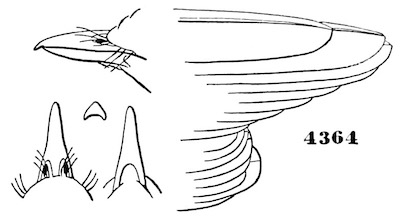
V. philadelphicus. 4364
Sp. Char. (No. 20,643 ♂.) Above dark olive-green, tinged with plumbeous-ash except on the rump; top of head and nape purer plumbeous-ash, not edged with dusky, the line of demarcation indistinct. Beneath light sulphur-yellow, paler and almost white on chin and middle of abdomen; sides more olivaceous. A whitish stripe from bill over eye, as also a patch beneath it and the eyelids. A dusky loral and post-ocular spot. Quills and rectrices brown, edged externally with olive, internally with whitish; the larger coverts with paler outer edges. Bill blackish, paler plumbeous below. Legs plumbeous. Spurious outer or first quill (seen in gilva) wanting; the outer about equal to fifth; third longest; second and fourth not much shorter. Total length, 4.80; wing, 2.60; tail, 2.25.
Hab. Eastern North America to Hudson’s Bay and Maine, south (in winter) to Costa Rica and Guatemala. Veragua (Salvin). Not recorded from Mexico or West Indies.
Specimens vary somewhat in purity of tints, and especially in intensity of yellow of under parts, which color is deeper in autumnal skins.
Specimens from Costa Rica and Guatemala, being merely winter visitors to that region, are quite identical with North American examples.
Habits. This but little known species was first described by Mr. Cassin, in 1851, from a specimen shot by him in some woods near Philadelphia nine years previously, which was then unique, and remained so for some time after. This fact, and its resemblance to V. gilva, led to the impression that it might be only a variety of that species. Since the publication of the description other specimens have been procured from different localities,—Moose Factory, Maine, Ohio, Wisconsin, Costa Rica, and Guatemala. But little is as yet known in regard to its habits or its distribution. It is quite abundant in the spring in Southern Wisconsin, where it appears only as a migrant passing north, none remaining to breed. As it makes its appearance late in May, and usually passes rapidly on, it seems natural to infer that it cannot be far from its breeding-place at the period of its appearance. The specimen obtained by Mr. Cassin was shot in September, on its southward journey. It was in the upper branches of a high tree, capturing insects; and his attention was drawn to it by its slow and deliberate movements.
Mr. Thure Kumlien, of Dane County, Wis., informs me that he has been familiar with this Vireo since 1849, and has collected it every year since that period, finding it both in the spring and fall. It appears occasionally as early as the 10th of May, the time varying with the season from the 10th to the 27th. In 1857, when the season was very backward and May very cold, they did not arrive until June 2. They were unusually numerous, and remained only a day or two. So far as he has been able to ascertain, none stop to breed. They are very quiet, have no song at the time they are passing, and seem only intent on collecting their food and in proceeding on their way. They are very tame and unsuspecting, and one can readily get to within a few feet of them. In the fall they are returning south from the 7th to the 19th of September.
The nest and eggs remain to be obtained.
Vireosylvia gilvus, Cassin.
WARBLING GREENLET.
Muscicapa gilva, Vieill. Ois. I, 1807, 65, pl. xxxiv. Vireo gilvus, Bon. Obs. Wils. 1825, No. 123.—Aud. Orn. Biog. II, pl. cxviii.—Ib. Birds Am. IV, pl. ccxli.—Baird, Birds N. Am. 1858, 335.—Samuels, Birds N. Eng. 273. Vireosylvia gilva, Cassin, Pr. A. N. Sc. 1851, 153.—Sclater, P. Z. S. 1856, 298 (Cordova); (?) 1858, 302 (Oaxaca; June) (perhaps V. swainsoni).—Baird, Rev. Am. B. 342. Muscicapa melodia, Wils. Am. Orn. V, 1812, 85, pl. xlii, fig. 2.
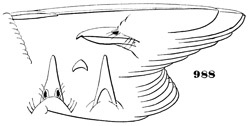
Vireo gilvus. 988
Sp. Char. (No. 1,017 ♀) Above olive-green, strongly glossed with ashy; the head and nape above more distinctly ashy, but without decided line of demarcation behind, and without dusky edge; rump pure olive. Stripe from nostrils over eye to nape, eyelids, and space below eye, creamy-white. A rather dusky post-ocular and loral spot, the latter not extending to the bill. Under parts white, with tinge of greenish-yellow (occasionally of creamy fulvous or buff), especially on breast; sides more olivaceous. Crissum and axillars scarcely more yellowish. Quills and rectrices wood-brown, edged internally with whitish, externally with olivaceous, except perhaps on longer primaries. Edge of wing white. Larger wing-coverts grayish-brown, with paler edges, and no trace of olivaceous. Bill horn-color above, paler below.
First quill very short or spurious; second about equal to, generally rather longer than sixth; third longest; fourth, then fifth a little shorter.
Fresh specimen: Total length, 5.33; expanse of wings, 8.35; wing from carpal joint 2.85. Prepared specimen: Total length, 4.80; wing, 2.75; tail, 2.25. Sexes alike. Iris brown.
Hab. Eastern North America to Fort Simpson. Cordova and Oaxaca only southern localities recorded. Not West Indian.
A very young bird has a very cottony plumage, and differs in tints, having the top of the head and the nape a soft whitish isabella-color, this tingeing the back; the lower parts are wholly unsoiled white; the middle and secondary coverts are obscurely tipped with light brown, forming two indistinct bands across the wing.
A specimen (No. 54,262) from Orizaba is, in positively every respect, exactly intermediate between this species and V. josephæ of Costa Rica, Ecuador, etc. (See footnote on page 360.) The crown is brown, decidedly darker than, and different in tint from, the back, but less so than in josephæ; the back is less olive than in the latter, and less gray than in the former. The lower parts are more yellow than in gilvus, and less so than in josephæ, the superciliary stripe whiter and extending farther back than in the former, and less pure white and shorter than in the latter, etc.
Habits. The Warbling Vireo has only a slightly less extended distribution than the Red-eyed, being found throughout all Eastern North America, as far north as Fort Simpson and Selkirk Settlement, and west to the Missouri River, and breeding as far south as Louisiana. It is stated by Audubon to be found on the Columbia River, but in this he probably referred to the Western race, V. swainsoni. That writer never observed this species in Louisiana or Kentucky, nor in the maritime part of Georgia, and its manner of entering the United States he was unable to ascertain. Where it moves to in the winter is also unknown, none having been met with in the West Indies, and only at a few points in Mexico, Cordova, Oaxaca, and the State of Vera Cruz. It was, however, found breeding at Calcasieu, Louisiana, by Mr. Würdemann.
It breeds abundantly from Virginia to Nova Scotia, and throughout the Northwestern States. West of the Rocky Mountains it is replaced by a closely allied species, the V. swainsoni. This Vireo, more than any other of its genus, if not exclusively, is to a large extent a resident of villages, towns, and even cities. It is by far the sweetest singer that ventures within their crowded streets and public squares,—although Mr. Cassin gives his preference to the notes of the Red-eyed,—and the melody of its song is exquisitely soft and beautiful. It is chiefly to be found among the tall trees, in the vicinity of dwellings, where it seems to delight to stay, and from their highest tops to suspend its pensile nest. It is especially abundant among the elms on Boston Common, where at almost any hour of the day, from early in the month of May until long after summer has gone, may be heard the prolonged notes of this, one of the sweetest and most constant of our singers. Its voice is not powerful, but its melody is flute-like and tender. Throughout the last of May, and in June and July, their charming song may be heard amid the din of the city from earliest dawn till nightfall, and rarely ceases even in the noontide heat, when all other birds are silent. It is ever in motion, while thus singing; and its sweetest notes are given forth as it moves among the tree-tops in search of insects. It is not only one of our most constant singers, but it remains musical almost until its departure for the South in October.
The Warbling Vireo appears in the Middle States about the 15th of April, and reaches New England early in May. The path of its northern migrations, and of its return, is somewhat in doubt. It is abundant in winter, according to Sumichrast, about Orizaba, and probably enters Texas and passes north and east along the Mississippi and the Ohio Rivers. In certain portions of the country this species is evidently on the increase, becoming more and more common as the country is settled, and towns and villages spring up.
The Warbling Vireo builds its nest usually in more elevated positions than any others of this family. For the most part in the vicinity of dwellings, often over frequented streets, they suspend their elaborately woven and beautiful little basket-like nest, secure from intrusion from their human neighbors, and protected by the near presence of man from all their more dreaded enemies. Audubon narrates, in an interesting manner, the building of their nest by a pair of these birds on a poplar-tree, near his window, in Camden, N. J. It was suspended between the body of the tree and a branch coming out at an acute angle. The pair were at work, morning and evening, eight days, first attaching slender blades of grass to the knots on the branch and the bark of the trunk, and thence working downward and outward. They varied their materials, from time to time, until at last he traced them, after a prolonged absence, to a distant haystack, from which they brought fine, slender, dry grasses, with which they completed and lined their nest.
The nests of the Warbling Vireo, while they resemble closely those of the other species in all the characteristics of this well-marked family, are yet, as a rule, more carefully, neatly, and closely built. They are usually suspended at the height of from thirty to fifty feet, in the fork of twigs, under and near the extremity of the tree-top, often an elm, protected from the sun and storm by a canopy of leaves, and quite out of reach of most enemies. They vary little in size, being about two inches in height and three and a half in their greatest diameter, narrowing, toward their junction with the twigs, to two inches. They are all secured in a very firm manner to the twigs from which they are suspended by a felting of various materials, chiefly soft, flexible, flax-like strips of vegetable fibres, leaves, stems of plants, and strips of bark. With these are interwoven, and carried out around the outer portions of the nest, long strips of soft flexible bark of deciduous trees. They are softly and compactly filled in and lined with fine stems of plants.
The eggs are usually five in number, and, like those of all the Vireos, are of a brilliant crystal-white, sparingly spotted at the larger end with markings of dark brown, and others of a lighter shade. They are less marked with spots than usual in the genus, and are often entirely unspotted, and pure white. Occasionally, however, they are found with well-marked blotches of reddish-brown. They vary in length from .75 to .70 of an inch, and average about .55 in their breadth.
Vireosylvia gilvus, var. swainsoni, Baird.
WESTERN WARBLING GREENLET.
Vireo swainsoni, Baird, Birds N. Am. 1858, 336 (Pacific coast).—Elliot, Illust. Birds N. A. I, vii. Vireosylvia swainsoni, Baird, Rev. Am. B. 343. Vireosylvia gilva, var. swainsoni, Cooper, Orn. Cal. 1, 1870, 116. Vireo bartramii, Swainson, F. B. A. II, 1831, 235 (in part; spec. from Columbia River?).
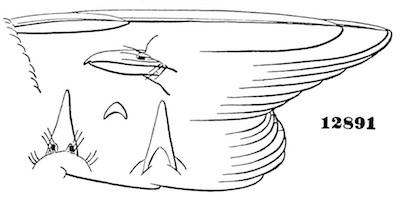
Vireo swainsoni. 12891
(No. 5,321 ♂.) Similar to V. gilva, but smaller; colors paler. Bill more depressed. Upper mandible almost black. Second quill much shorter than sixth. Total length, 4.75; wing, 2.71; tail, 2.35; difference between tenth quill and longest, .58; exposed portion of first primary, .58, of second, 1.82, of longest (measured from exposed base of first primary), 2.10; length of bill from forehead, .56, from nostril, .29, along gape, .65; depth of bill, .13; tarsus, .70; middle toe and claw, .56; hind toe and claw, .43.
Hab. United States, from Rocky Mountains to Pacific coast.
In the present bird the bill is darker in color, much smaller, and more depressed, the depth at the base being less than the width, instead of being equal to it as in var. gilvus. The wing is more rounded, the second quill much shorter than the sixth, generally shorter or but little longer than the seventh. In var. gilvus, the second quill is about equal to the sixth. The second quill is about .30 of an inch (or more) shorter than the longest in swainsoni, while in gilvus it is only about .20 shorter. The feet of swainsoni are weaker, and the colors generally paler and grayer. The iris, according to Coues, is dark brown.
Young birds in autumnal plumage have the crown decidedly ash, the sides more greenish; the wing-coverts pass terminally into a light brownish tint, producing an inconspicuous band.
Habits. This Western representative of the Warbling Vireo is found throughout the western portions of our Union, from the Great Plains to the Pacific, and from Arizona to the extreme northern boundary of Washington Territory.
Dr. Cooper characterizes this as a lively and familiar songster. It arrives, he states, at San Diego about April 10, and reaches Puget Sound toward the middle of May, occupying nearly all the intermediate country throughout the summer. It frequents the deciduous trees along the borders of streams and prairies, coming into gardens and orchards with familiar confidence, wherever cultivation has reclaimed the wilderness. Like its Eastern prototype, its cheerful and varied song is heard all day long until quite late in the autumn. They too build their nests in the shade-trees of the parks of busy cities, singing ever their delightful strains, unconscious of the busy and noisy crowd that throngs the neighboring streets.
Dr. Cooper states that its nests are pendent from the forks of a branch high above the ground, sometimes to the height of a hundred feet.
Mr. Ridgway, who observed the habits of this species in Utah and Nevada, speaks of it as the characteristic Vireo of the West. It was found by him in all the fertile localities, and was one of the most common birds in the wooded regions. He found it very generally distributed through the summer, inhabiting the copses along the streams of the mountain cañons, and the open groves of the parks, as well as the cottonwoods and willows of the river valleys. In the fall the berries of a species of the cornel that grows along the mountain streams constitute its principal food. Its notes and manners are identical with those of the Eastern species.
The nests of this species are not distinguishable, except in the necessarily varying materials, from those of the Eastern birds. In position, size, and shape they are the same. The eggs, four or five in number, are white, spotted with brown and reddish-brown, and measure .78 by .58 of an inch. The spots are somewhat darker than those of the V. gilvus, and the shape more of an oblong-oval, in all that I have seen. But this difference may disappear in the examination of a larger number.
A nest found by Mr. Ridgway near Fort Churchill, Nevada, June 24, was suspended from the extremity of a twig of a sapling of the cottonwood, in a copse of the same growing in a river-bottom. It has a height of two and a half inches, and a diameter of three. It is composed externally of an elaborate interweaving of spiders’-webs, willow and cottonwood down, and strong cord-like strips of fine inner bark. These are strongly bound around the twigs from which the nest is suspended. It is one of the most elaborately interwoven, homogeneous, and well-felted nests of this bird I have ever met with. Another nest, from Parley’s Park, Utah, obtained June 28, differs in having the external portion woven almost exclusively of fine strips of bleached bark, and is lined with fine wiry grasses. In each of these the eggs were four in number, all oblong-oval in shape, but much more pointed at one end in the latter nest.
This species was found breeding in Napa Valley, Cal., by Mr. A. J. Grayson, and at Fort Tejon by Mr. Xantus.
Subgenus LANIVIREO, Baird.
Char. Body stout, head broad. Bill short and stout, broad at the base, the culmen curved from the base, the commissure considerably arched. Bill blue-black. Feet stout. Type, V. flavifrons. For figure, see page 379.
Species and Varieties.
Common Characters. A broad stripe from bill to and around, but not beyond, the eye. Two broad white bands across the wings. Bill plumbeous-blue, black toward culmen. Iris brown in all species?
1. L. solitarius. Spurious primary exposed. Throat and orbital ring white.
a. Spurious primary well developed,—.60 or more long, .10 broad.
Nape and side of neck plumbeous; upper tail-coverts olive-green. Crissum tinged with yellow, but none on side of throat, nor across breast. Wing, 3.05; tail, 2.40; bill, from nostril, .27; tarsus, .66. Hab. Eastern Province of United States, straggling westward to the Pacific Coast, especially in its migration southward into Mexico, where it penetrates in winter as far as Guatemala … var. solitarius.
Above continuous olive-brown; below ochraceous-white, with a buffy tinge across breast, and deeply olivaceous along sides. Crissum tinged with yellow. Wing, 2.80; tail, 2.15; bill, 30; tarsus, 66. Hab. Pacific Province of United States, straggling in autumn eastward into the Middle Province … var. cassini.
Above continuous ashy-plumbeous. Beneath pure white, ashy along sides, and very slightly so across breast. Wing, 3.25; tail, 2.50; bill, .30; tarsus, .66. Hab. Middle Province of United States, south, in winter, through Western Mexico to Colima … var. plumbeus.
b. Spurious primary very minute,—about .30 long by .04 wide.
Nape and side of neck olive-green; upper tail-coverts plumbeous. Crissum not tinged with yellow, but sides of the throat and across the breast are. Wing, 3.10; tail. 2.20; bill, .29; tarsus, .64. Hab. Coban, Vera Cruz, Guatemala; resident? … var. propinquus.[77]
2. L. flavifrons. Spurious primary concealed. Throat and orbital ring yellow.
Anterior half of body olive-green above, lemon-yellow below; posterior half plumbeous-ash above, white below. Wing, 3.00; tail, 1.90; bill, .32; tarsus, .70. Hab. Eastern Province of United States, south, in winter, to Costa Rica, and very rare in Cuba.
Lanivireo solitarius, Baird.
BLUE-HEADED VIREO.
Muscicapa solitaria, Wils. Am. Orn. II, 1810, 143, pl. xvii, fig. 6. Vireo solitarius, Vieill.—Aud. I.—Cassin, Sc.—Sclater, P. Z. S. 1856, 298 (Cordova); 1859, 363 (Xalapa); 375 (Oaxaca?).—Sclater & Salvin, Ibis, 1860, 31 (Guatemala).—Cab. Jour. III, 468 (Cuba).—Gundlach, Cab. Jour. 1861, 324 (Cuba; very rare).—Samuels, Birds N. Eng. 277. Vireo (Lanivireo) sol. Baird, Birds N. Am. 1858, 329. Vireosylvia (Lanivireo) solitaria, Baird, Rev. Am. B. 1864, 347.
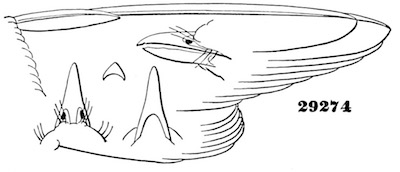
Lanivireo solitarius. 29274
Sp. Char. (No. 300 ♂.) Above olive-green, including upper tail-coverts; the top and sides of head and nape ashy-plumbeous; sides of the neck plumbeous-olive. Broad line from nostrils to and around eye, involving the whole lower eyelid, white. A loral line involving the edge of the eyelid, and a space beneath the eye, dusky plumbeous. Beneath white; the sides yellow, overlaid with olive, this color not extending anterior to the breast. Axillars and base of crissum pale sulphur-yellow, the long feathers of the latter much paler or nearly white. Wings with two bands and outer edges of innermost secondaries olivaceous-white; the quills dark brown, edged externally with olive-green, internally with white; tail-feathers similarly marked, except that the lateral feather is edged externally also with white, the central without internal border. Bill and legs blackish-plumbeous. Iris brown.
First quill spurious, rather more than one fifth the second, which is intermediate between the fifth and sixth; third longest.
Fresh specimen: Total length, 5.40; expanse of wing, 9.00. Prepared specimen: Total length, 5.25; wing, 2.95: tail, 2.35.
Hab. United States, from Atlantic to Pacific; Cape St. Lucas. Not recorded from Southern Rocky Mountains, where replaced by L. plumbeus. South to Mexico and Guatemala. Vera Cruz (winter, Sumichrast). Very rare in Cuba.
Spring specimens show sometimes a gloss of plumbeous on the back, obscuring the olive, the contrast of colors being greater in the autumnal and young birds. Sometimes the crissum appears nearly white. The length of the spurious primary varies considerably, from .45 to .75 of an inch.
In autumn the colors are similar, but slightly duller and less sharply defined, while the back is considerably tinged with ashy.
Habits. The Solitary Vireo appears to be found, irregularly, throughout the United States. Nowhere abundant, so far as I am aware, it seems to be more common in California than on the Atlantic, while there are also large tracks of intervening territory in which we have no knowledge of its presence. On the Atlantic it has been met with from Georgia to the Bay of Fundy. In Massachusetts it has been found in a few restricted localities; in one or two of them, they are as abundant as the White-eyed. Mr. Dresser found it in Texas, near San Antonio, late in the autumn, and early in spring, but none remained to breed. Mr. Boardman gives them as a summer visitant at Calais, but not common, and Professor Verrill makes a similar statement for Western Maine, where it arrives in the second week of May. According to Mr. Allen, it reaches Western Massachusetts by May 1, but it is there quite rare. A few are presumed to stop and breed.
In California, Mr. Gambel states that it is quite abundant in the latter part of summer, and throughout the winter, frequenting low bushes and thickets. Dr. Heermann also frequently met with it. Both at the East and the West it is undoubtedly only migratory to about the 40th parallel, and does not, except in mountainous localities, breed south of that line. Professor Baird found it breeding in the South Mountains, near Carlisle, Penn., in May, 1844. It occurs in Guatemala in the winter.
Dr. Cooper states that it reaches Puget Sound by the first of May, and he has also observed it in the Colorado Valley, after the 14th, where they made themselves conspicuous by their song, but in a few days had all passed northward. He has met them nesting in May at the eastern base of the Coast Range, and has also found them quite common, in summer, on the Columbia River. Their favorite resorts are the deciduous oaks.
These birds were found breeding at Fort Tejon by Mr. Xantus, and at Vancouver by Mr. Hepburn.
Mr. Ridgway met with a few in September, in the thickets along the streams flowing from the Clover Mountains.
This species was taken in winter by Mr. Boucard, at Talew, in the State of Oaxaca, Mexico.
Mr. Audubon’s statement that this bird is rather abundant, and that it breeds in Louisiana, is undoubtedly incorrect, and his description of its nest and eggs belongs rather to the Yellow-throated, and agrees with none that I have ever seen of this species. That he found them abundant in Maine, and traced them as far north as Pictou, Nova Scotia, is more probable. Dr. Bachman speaks of this species becoming each year more abundant in South Carolina, coming in February and remaining through March.
Mr. Nuttall, who met with this species on the Columbia, about the beginning of May, describes its song as a plaintive, deliberate warble, intermediate between the song of the olivaceus and the flavifrons. Mr. Burroughs describes the love-notes of these birds as being inexpressibly sweet and tender in both sexes. The song of the male, as I have heard it, bears no resemblance to that of any other Vireo. It is a prolonged and very peculiar ditty, repeated at frequent intervals and always identical. It begins with a lively and pleasant warble, of a gradually ascending scale, which at a certain pitch suddenly breaks down into a falsetto note. The song then rises again in a single high note, and ceases. For several summers the same bird has been heard, near my house in Hingham, in a wild pasture, on the edge of a wood, always singing the same singular refrain, during the month of June.
Mr. Nuttall found a nest of this species suspended from the forked twig of a wild crab-tree, about ten feet from the ground. The chief materials were dead and withered grasses, with some cobwebs agglutinated together, externally partially covered with a few shreds of hypnum, assimilating it to the branch on which it hung, intermingled with a few white paper-like capsules of the spiders’ nests, and lined with a few blades of grass and slender root-fibres.
Seven nests of this species, found in Lynn and Hingham, Mass., exhibit peculiarities of structure substantially identical. In comparison with the nests of other Vireos, they are all loosely constructed, and seem to be not so securely fastened to the twigs, from which they are suspended. One of these nests, typical of the general character, obtained in Lynn, May 27, 1859, by Mr. George O. Welch, was suspended from the branches of a young oak, about twelve feet from the ground. The external depth of this nest was only two and a half inches, the diameter three and a quarter, and its cavity one and three quarters inches deep, and two inches wide at the rim. It was constructed externally of strips of yellow and of gray birch-bark, intermingled with bits of wool and dry grasses. The external portion was quite loosely put together, but was lined, in a more compact manner, with dry leaves of the white pine, arranged in layers. Another nest, found in Hingham, was but two feet from the ground, on a branch of a hickory sapling. In its general structure it was the same, only differing in shape, being made to conform to its position, and being twice as long as it was broad. It contained four young, when found, about the 10th of June. One nest alone, built on a bush in Lynn, exhibits even an average degree of compactness in its external structure. This is largely composed of cocoons, which are woven together into a somewhat homogeneous and cloth-like substance. Within, decayed stems of grasses take the place of the usual pine-needles.
In the summer of 1870 a pair built their nest in a dwarf pear-tree, within a few rods of my house. They were at first very shy and would not permit themselves to be seen at their work, and suspended all labor when any one was occupied near their chosen tree. Soon after the construction of the nest two Cowbird’s eggs were deposited, which I removed, although the female only laid two of her own before she began to sit upon them. By this time she became more familiar, and would not leave her nest unless I attempted to lay hands upon her. She made no complaints in the manner of the White-eyed, nor sought to attack like the Yellow-throated, but kept within a few feet, and watched me with eager eyes, until I left her. Unfortunately, her nest was pillaged by a Black-billed Cuckoo, and I was unable to observe her feed her young, as I had hoped to do.
The eggs are of an oblong-oval shape, moderately pointed at one end, and of a white ground, less crystalline than in the other species of its kind. They are spotted pretty uniformly over the entire egg with dots of dark red and reddish-brown. They are usually five in number.
Lanivireo solitarius, var. cassini, Baird.
CASSIN’S VIREO.
Vireo cassini, Xantus, Pr. A. N. S. Phil. May, 1858, 117.—Baird, Birds N. Am. 1858, 340, pl. lxxviii, fig. 1; Review Am. B. I , 1865, 347 (sub V. solitaria), Ridgway.
Sp. Char. Third and fourth quills nearly equal, fifth shorter, second longer than seventh. Spurious primary very narrow, falcate, acute; less than one third the second quill, and a little more than one fourth the third. Above, including edges of wing and tail-feathers, clear olive-green, becoming dusky ashy on the top and sides of head. Beneath fulvous-white, tinged with ill-defined olive-green on the sides (scarcely on the crissum). Two broad bands on the wing-coverts and the outer edges of the innermost secondaries greenish-white; the outer edge of outer tail-feather, with a broad ring round the eye, extending to a frontal band, dull white. Length about 5 inches; wing, 2.75; tail, 2.30.
Hab. Fort Tejon, Cal. (Xantus); West Humboldt Mountains, Nevada (Ridgway).
Since the type of this variety was obtained, two other specimens (Nos. 53,418 ♀ and 53,419 ♂, September, 1867; R. Ridgway) have been secured by the United States Geological Survey of the 40th Parallel, in command of Mr. Clarence King, in the West Humboldt Mountains, Nevada. These specimens are even more different from true solitarius than is the type of this race, showing that it is really distinct, as a variety. In the same thickets at the same season, perfectly typical specimens of V. solitarius were obtained; the latter having, no doubt, come from their more northern summer home on their passage southward into Mexico.
In the Humboldt Mountain specimens the crown shows no trace of ash, and is even darker and more brownish than the back. In fact, the relation of the V. cassini to V. solitaria is an almost exact parallel to that of V. josephæ to V. gilvus, as far as coloration is concerned, in each case the extreme being widely different, but connected by specimens showing intermediate characters.
Nothing is known of the habits of this race.
Lanivireo solitarius, var. plumbeus, Coues.
LEAD-COLORED VIREO.
Vireosylvia plumbea, Coues, Pr. A. N. Sc. Phila. 1866 (Fort Whipple, near Prescott, Arizona).—Cooper, Orn. Cal. 1, 1870, 119.—Elliot, Illust. Birds N. A. I, vii. V. (Lanivireo) plumbea, Baird, Rev. 349.
Sp. Char. (No. 37,011.) Whole upper parts and sides of head uniform plumbeous; the lower part of the back with a faint wash of olivaceous. A white line from bill to and around eye; a dusky line from corner of eye to bill. Sides of breast and flanks plumbeous, paler than the back; the flanks very slightly tinged with olive-green. Rest of under parts white; the axillars ashy, edged with white. Wings above with two conspicuous white bands; the innermost quills edged externally and the longer ones internally with white, the latter edged externally with light ash. Bill and legs dark plumbeous, “Iris hazel.” Tail-feathers narrowly edged all round with white, narrowest internally, and increasing from central to lateral feathers. Upper tail-coverts clear ash.
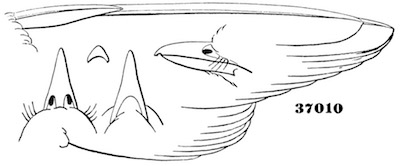
Vireosylvia plumbea. 37010
As the specimen in finest plumage (described above) is moulting the quills, the measurements are taken from another (37,010). In this the first quill is not quite one third the second, which equals the sixth, the third and fourth longest.
(No. 37,010.) Fresh specimen: Total length, 6.10; expanse of wings, 10.80. Prepared specimen: Total length, 5.75; wing, 3.25; tail, 2.70; difference between tenth and longest quill, .95; exposed portion of first primary, .75, of second, 2.34, of longest, third (measured from exposed base of first primary), 2.54; length of bill from forehead, .55, from nostril, .31, along gape, .70; tarsus, .75; middle toe and claw, .60, claw alone, .21; hind toe and claw, .50, claw alone, .23.
Hab. Southern Rocky Mountains; East Humboldt Mountains, Nevada (Ridgway). In winter to Colima, Mexico.
While the pattern of coloration is precisely similar to that of Lanivireo solitarius, the difference in the colors appears to be occasioned merely by removing, as it were, the yellow stain, which on the plumbeous produces the olive-green tinge, and exists in a purer tint along the sides, leaving, essentially, only clear plumbeous and pure white; there is, however, in the most typical specimens, always a faint tinge of green on the rump, and a stain of yellow along the side. Though identical with solitarius in most of its proportions, the wings and tail are considerably longer than in the average of that form.
There are many specimens from the Rocky Mountains and westward that are so decidedly intermediate between solitarius and plumbeus, that, considering also the lack of essential difference in form and coloration between the two, we do not hesitate to consider them, along with cassini and propinquus (see page 373), as races of a single species, of which each is the representative in a particular region. Thus, V. solitarius breeds in the Eastern Province of the United States (and possibly in the Western, following the same route far to the northward that many Eastern birds pursue in straggling westward), and migrates in winter into Middle America as far as Guatemala; those which breed in the Northwest pass directly southward, thus crossing the region where cassini and plumbeus breed, which accounts for their being obtained together. V. cassini is the representative on the opposite side of the continent; but the history of its migrations is yet obscure. V. plumbeus is the Middle Province and Rocky Mountain representative, breeding alone in that region, and in winter migrating southward through Western Mexico as far as Colima. V. propinquus is another permanent race, but a local one, being resident in the country where found, though mixed in winter with visitors of solitarius from the North.
Habits. Of this very recently discovered race, very little is at present known. It was first described by Dr. Coues, who met with it in Arizona, near Fort Whipple. He says it is especially abundant in the northern part of that Territory. It was by far the most common Vireo at Fort Whipple, where it is a summer resident, arriving there about the 15th of April and remaining until October.
It was found to be common about Laramie Peak, by Dr. R. Hitz, and was also met with in winter on the plains at Colima, Mexico, by Xantus.
It was seen in the summers of 1868 and 1869, by Mr. Ridgway, among the cedar and nut-pine woods on the slopes and among the brushwood in the cañons of the East Humboldt Mountains, being most partial to the former situations. There, too, it undoubtedly breeds, as in the latter part of July young birds, unable to fly, were met with by him. He also states that the common notes of this Vireo very closely resemble those of the Western Wood Wren (Troglodytes parkmanni).
Lanivireo flavifrons, Baird.
YELLOW-THROATED VIREO.
Vireo flavifrons, Vieill. Ois. Am. Sept. I, 1807, 85, pl. liv.—Aud. Orn. Biog. II, 1834, pl. cxix.—Ib. Birds. Am. IV, pl. ccxxxviii.—Cassin, Pr. A. N. Sc. 1851, 149.—Sclater, P. Z. S. 1857, 227 (Vera Cruz); 1860, 257 (Orizaba).—Sclater & Salvin, Ibis, I, 1859, 12 (Guatemala).—Cab. Jour. III, 468 (Cuba; winter).—Gundlach, Cab. Jour. 1861, 324 (Cuba; rare).—Cab. Jour. 1860, 405 (Costa Rica). Vireo (Lanivireo) flav. Baird, Birds N. Am. 1858, 341. Vireosylvia (Lanivireo) flavifrons, Baird, Rev. 346. Muscicapa sylvicola, Wils. Am. Orn. II, 1810, 117, pl. vii, f. 3.
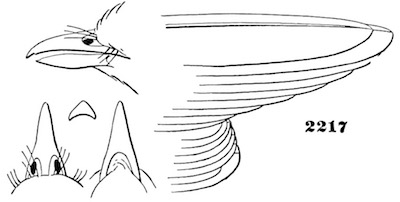
Vireosylvia flavifrons. 2217
Sp. Char. (No. 28,390.) Head and neck above and on sides, with interscapular region, bright olive-green. Lower back, rump, tail, and wing-coverts ashy. Wings brown, with two white bands across the coverts, the outer edges of inner secondaries, and inner edges of all the quills, with inside of wing, white. Outer primaries edged with gray, the inner with olive. Tail-feathers brown, entirely encircled by a narrow edge of white. Under parts to middle of body, a line from nostrils over eye, eyelids, and patch beneath the eye (bordered behind by the olive of neck) bright gamboge-yellow; rest of under parts white, the flanks faintly glossed with ashy. Lores dusky. Bill and legs plumbeous-black.
No spurious primary evident: second quill longest; first a little shorter than third.
Length, 5.80; wing, 3.00; tail, 2.00; difference of longest and innermost quills, .90; tarsus, .73.
Hab. Eastern United States, south to Costa Rica. Veragua (Salvin). Very rare in Cuba.
Autumnal birds, perhaps more especially the young, are more glossed with olivaceous, which invades the ashy portions, and tinges the white.
Habits. All the older ornithological writers, in speaking of the Yellow-throated Vireo, repeat each other in describing it as peculiarly attracted to the forest, seeking its solitudes and gleaning its food chiefly among its topmost branches. Such has not been my experience with this interesting and attractive little songster. I have found no one of this genus, not even the gilva, so common in the vicinity of dwellings, or more familiar and fearless in its intercourse with man. All of its nests that I have ever met with have been built in gardens and orchards, and in close proximity to dwellings, and they have also been exclusively in comparatively low positions. In one of the most recent instances a pair of these birds built one of their beautiful moss-covered nests in a low branch of an apple-tree that overhung the croquet-ground, within a few rods of my house. It was first noticed in consequence of its bold little builder flying in my face whenever I approached too near, even before its nest contained any eggs. The grounds were in frequent use, and the pair were at first a good deal disturbed by these constant intrusions, but they soon became reconciled to their company, and would not leave their position, even though the game was contested immediately under their nest, which was thus often brought within a foot of the heads of the players. Before this nest was quite finished, the female began her duties of incubation. Her assiduous mate was constantly engaged at first in completing the external ornamentation of the nest with lichens and mosses, and then with a renewal of his interrupted concerts of song. These duties he varied by frequent captures of insects, winged and creeping, most of which he duly carried to his mate. His song was varied, sweet, and touchingly beautiful. Less powerful than the notes of several others of its family, except those of the Warbling, I know of none more charming.
These birds reach New England about the 10th of May, and usually have their nests constructed early in June. Their habits, in all essential respects, are the same as those of all its family. They are somewhat confiding and trustful of man, are readily approached, and soon become so well acquainted with those among whom they have a home as to fearlessly come to the windows of the house in pursuit of spiders or flies, and even to enter them. In the latter case they cannot readily make their exit, and soon lose their self-possession, beating their heads against the walls and ceiling in vain attempts to get out, unless caught and released. In one instance a young bird, that had entered my barn-chamber, became so entangled in cobwebs, around his wings and feet, as to be unable to escape again. When taken in the hand, and his meshes one by one picked out from about his feet and quills, he was very docile, made no resistance or outcry, nor any attempt to escape, until he was entirely freed from his bonds, although it required some time and care to accomplish it. When entirely freed from these clogs, and permitted to go, he flew away very deliberately to a short distance, and occupied himself with dressing his disordered plumage.
The nest of this species is also a pendent structure, and hemispherical in shape. It may always be readily distinguished from any other nest of this family by the profusion of lichens and mosses with which its outer portion is adorned and covered, giving it the appearance of a large moss-covered knot.
In most of the towns in the vicinity of Boston this species, though not abundant, is quite common. Their nests, built usually in low and rather conspicuous positions for birds of this kind, occur most frequently in gardens and orchards. One of these, found suspended from a moss-covered branch of an apple-tree in Roxbury, may be taken as typical of its kind. Its rim was firmly bound around the fork of a branch by a continuation of the materials that form the outside of the nest itself. These are an interweaving of spiders’-webs, and silky threads from insect cocoons, largely intermingled with mosses and lichens, and thus made to conform closely in appearance to the moss-grown bark of the tree. The under portion of the nest is strengthened by long strips of the inner bark of the wild grape. Within is an inner nest made of fine grassy stems and bark. It forms exactly a half-sphere in shape, is symmetrical, and is very thoroughly made. Its diameter is four, and its height two and one fourth inches.
Mr. Nuttall describes a nest of this bird, found by him suspended from the forked twig of an oak, near a dwelling-house, as coated over with green lichens, attached very artfully by a slender string of caterpillars’ silk, the whole afterwards tied over by almost invisible threads of the same, so nicely done as to appear to be glued on. The whole fabric was thus made to resemble an accidental knot of the tree, grown over with moss. Another nest, observed by the same writer, was fixed on the depending branches of a wild cherry, and was fifty feet from the ground. So lofty a position as this is probably very unusual. I have never met with any higher than ten feet from the ground.
The food of this Vireo is chiefly insects, and in the breeding-season is altogether so. Later in the season they mingle with these various kinds of small berries.
The eggs of this species vary from .95 to .88 of an inch in length, and from .65 to .60 in breadth. Their ground-color is white, often with a very perceptible tint of roseate when fresh. In this respect they differ in a very marked manner from the eggs of any other of this genus, except, perhaps, the barbatula, and may thus always be very easily recognized. They are more or less boldly marked with blotches of a dark roseate-brown, also peculiar to the eggs of this species, though varying greatly in their size and depth of color.
This Vireo winters, in great numbers, in Central America, and was largely represented in the collection of Dr. Van Patten from Guatemala. It was also found at Pirico, in Colombia, South America, by Mr. C. W. Wyatt. It occurs in abundance as far to the west as Grinnell, Iowa, where Mr. W. H. Parker found it to be a very common summer resident.
Subgenus VIREO, Vieill.
Vireo, Vieill., Ois. Am. Sept. I, 1807, 83. (Type, Muscicapa noveboracensis, Gm.)
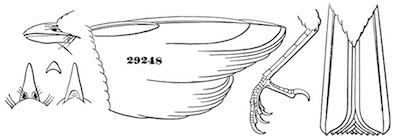
Vireo noveboracensis. 29248
Char. Wings short and rounded, a little longer than the tail, equal to it, or shorter. First primary distinct and large, from two fifths to half or more the length of the second, shorter or not longer than the eighth.
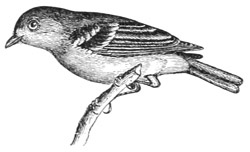
Vireo noveboracensis.
The characters of Vireo are essentially those of Vireosylvia; the bill, however, is shorter; the first quill always present, better developed, sometimes more than half the second. The wings are shorter, and more rounded; the tarsi usually longer. The, sections are as follows:—
Vireo. Wings pointed; first quill less than half the second, which is about equal to seventh or eighth, and decidedly longer than the tenth primary and the secondaries. Type, V. noveboracensis.
Vireonella. Wings rounded, scarcely longer than the tail; the first quill half as long as the second (or more than half), which is not longer than the tenth primary and secondaries, or even less. Bill and feet generally much stouter than the preceding. Type, V. gundlachi.
None of the species of Vireonella are found in the United States.
Species.
Common Characters. All the species olivaceous or ashy above, beneath whitish, or olivaceous-yellow. Wings with light bands. A light stripe from bill over the eye, but not beyond it, except in carmioli. Iris brown, as far as known, except in V. noveboracensis, where it is white.
A. Two conspicuous light bands on wing.
a. Sexes different. Whole lore white.
1. V. atricapillus. Above olive-green, outer edges of tail-feathers bright yellowish-green; wing-bands greenish-white. Sides olivaceous-yellow. Male. Head and neck (except lore, orbital ring, chin, and throat) deep black; lower parts pure white medially. Female with the black replaced by dull slate; lower parts ochraceous-white medially. Wing, 2.30; tail, 1.80; tarsus, .68; bill, from nostril, .24. Hab. Southern Texas; Mazatlan, Mexico.
b. Sexes alike. Lore dusky, with light mark above it.
2. V. carmioli.[78] Above brownish olive-green. Beneath, with supra-loral stripe, orbital ring, and light markings on the wings, light ochrey-yellow more whitish on the throat. Wing, 2.55; tail, 2.00; tarsus, .66; bill, .26. Hab. Costa Rica.
3. V. noveboracensis. Above olive-green, ashy across the nape. Supra-loral stripe and orbital ring deep yellow. Beneath ashy-white on throat, purer white on abdomen; sides, and a tinge across the breast, light yellow. Iris white. Wing, 2.40; tail, 2.00; tarsus, .63; bill, .26. Hab. Eastern Province of United States, south (in winter) to Guatemala (and Bogota?); very rare in Cuba; abundant and resident in Bermuda.
4. V. huttoni. Above grayish-olive, more olive-green toward tail. Below pale grayish-buff. Orbital ring very broad, yellowish-white. Wing, 2.50; tail, 2.05; tarsus, .67; bill, .24. Hab. California; in winter, Western Mexico to Oaxaca.
B. Only one band on wing, and this indistinct.
5. V. belli. Above ashy-olive, more virescent posteriorly. Markings on side of head not well defined. Below dull white, with a slight buffy tinge, strongly stained with yellow on sides and flanks. Upper feathers of middle row of wing-coverts passing into paler at tip, producing an indication of an anterior band. Wing, 2.20; tail, 1.80; tarsus, .69; bill, .25. Hab. Plains between the Mississippi Valley and the Rocky Mountains, from Dakota to Texas; in winter south to Tehuantepec, Mexico.
6. V. pusillus. Above grayish-ash, very slightly tinged with olive on rump. Below dull white, ashy laterally, the flanks with the slightest possible tinge of yellow. Wing, 2.30; tail, 2.20; tarsus, .69; bill, .24, .13 deep. Hab. Arizona; Cape St. Lucas, Lower California; California north to Sacramento City.
7. V. vicinior. Above bluish-ash, below ashy-white, scarcely more ashy laterally. Lores entirely ashy-white. Wing, 2.60; tail, 2.40; tarsus, .67; bill, .26, .18 deep. Hab. Fort Whipple, Arizona.
Vireo atricapillus, Woodhouse.
BLACK-CAPPED VIREO.
Vireo atricapillus, Woodhouse, Pr. A. N. Sc. 1852, 60 (San Pedro, Tex.).—Ib. Sitgreaves’s Rep. 1853, 75, pl. i, Birds.—Cassin, Illust. 1854, 153, pl. xxiv.—Baird, Birds N. Am. 1858, 337; Rev. 353.—Cooper, Orn. Cal. 1, 1870, 121.
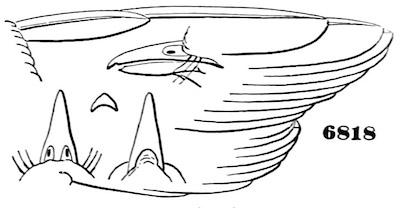
Vireo atricapillus. 6818
Sp. Char. (No. 6,818.) Top and sides of head and neck black; rest of upper parts olive-green. Wing and tail feathers almost black on their upper surface, the quills and rectrices edged with olive (paler on the exterior primaries), the wing-coverts with two greenish-white bands on a blackish ground. Broad line from bill to and around eye (not meeting on forehead) with under parts white; the sides of body olivaceous; the axillars and inner wing-coverts (perhaps crissum) yellowish. Bill black; feet plumbeous; iris bright red. First quill less than half the second, which about equals the tenth; third little shorter than fourth (longest).
Female. With the black replaced by dull slate; lower parts ochraceous-white medially. Possibly a distinct species (Mazatlan).
(No. 6,818.) Fresh specimen: Total length, 4.75; expanse of wings, 7.25; wing from carpal joint, 2.12. Prepared specimen: Total length, 4.10; wing, 2.25; tail, 1.95.
Hab. Southern border of Western Texas; Mazatlan.
The black head of this species, as far as known, makes it unique in the genus. It is extremely rare, but three or four specimens being known.
We refer to this species a specimen—probably a female—obtained at Mazatlan, on the western coast of Mexico, in April, by Colonel Grayson (S. I., No. 55,046). This specimen differs from those from Texas in having the black of the head replaced by a dull dark slate-color, the olive above rather less virescent, and the lower parts not pure white, but somewhat buffy. As all the other essential characters are identical, there being in both the white space covering the whole lore, and orbital ring interrupted on top,—features not seen in any other species,—we have little hesitation in considering them the same species; which opinion is moreover strengthened by the fact, that among the Texas specimens, all with black caps, there are no females.
Habits. Of the general history and habits of this rare species very little is known. It was first met with by Dr. Woodhouse, on the 26th of May, 1851, in Western Texas. This was on the Rio San Pedro, within ten miles of its source. He found it among some cedars, and was attracted by its very singular notes. It was in continual motion, like a Wood Warbler, and was by him at first supposed to be one of those birds. He obtained two specimens, both of which proved to be males.
Mr. John H. Clark, the naturalist of the Mexican Boundary Commission, likewise found this species in Texas, and not far from the same locality in which it was discovered by Dr. Woodhouse. His attention also was drawn to the bird by its shrill discordant chirp, which it uttered incessantly in its pursuit of insects. Three specimens only were seen, and all of them at one locality, the valley of the Rio San Pedro, to which it seemed to be confined. It was not at all shy, and showed no concern when Mr. Clark approached within a few rods. Its constant motion, hopping incessantly from branch to branch, made it a matter of some difficulty to procure specimens. It was found in June, and the single specimen shot by Mr. Clark was also a male.
Vireo noveboracensis, Bonap.
WHITE-EYED VIREO.
Muscicapa noveboracensis, Gm. Syst. Nat. I 1788, 947 (Green Flycatcher, Pennant, Arctic Zoöl. II, 389). Vireo noveb. Bon. Obs. Wilson, 1825.—Aud.; Cassin.—Baird, Birds N. Am. 1858, 338; Rev. 354.—Max.—Sclater, P. Z. S. 1857, 204 (Xalapa); 228 (Vera Cruz).—Sclater & Salvin, Ibis, II, 1860, 274 (Coban, Guat.).—Jones, Nat. Bermuda, 1859, 71 (resident).—Cab. Jour. III, 469 (Cuba).—Gundlach, Cab. Jour. 1861, 324 (Cuba; rare).—Samuels, Birds N. Eng. 275. Vireo musicus, Vieill. Ois. Am. Sept. I, 1807, 83, pl. liii. Muscicapa cantatrix, Wils. II, 1810, 266, pl. xviii.
Figures: Aud. Orn. Biog. pl. lxiii.—Ib. Birds N. A. IV, pl. ccxl.
Sp. Char. (No. 10,193 ♂, Illinois.) First primary about half the length of second, which is longer than secondaries, and about equal to the eighth; the fourth longest; third and fifth little shorter.
Above quite olive-green; sides of neck, and a gloss on its upper surface, ashy. The middle concealed portion of feathers of lower back and rump pale sulphur-yellowish. Beneath white; the chin and lower cheeks with a grayish tinge; the sides of breast and body, with axillars and base of crissum (more faintly), bright yellow; the inner wing-coverts and rest of crissum much paler, almost white. A broad yellow line from nostrils to and continuous with a yellow ring round the eye, which is encircled exteriorly by olivaceous; a dusky loral, but no post-ocular spot. Wings with two covert-bands and innermost secondaries externally, broadly yellowish-white; rest of quills edged externally with olive, except the two outer and tips of other primaries, which are grayish. Rectrices edged externally with olive, except outermost, which is bordered by grayish. All the long quills bordered internally by whitish. Bill blue-black, paler on the edges; legs dark plumbeous. Iris white. Total length, 4.90; wing, 2.40; tail, 2.20.
Hab. United States, west to base of Rocky Mountains; south to Guatemala; Bogota? Very rare in Cuba. Abundant and resident in the Bermudas.
Specimens vary slightly in a greater amount of ashy on the head, and less brilliancy of the yellow of head and sides. Sometimes there is a decided ashy shade in the white of throat and jugulum, which again has a very faint tinge of yellowish.
Habits. The White-eyed Vireo is one of the most common and one of the most widely diffused of its genus in all parts of the United States east of the Rocky Mountains. It apparently breeds in all parts of the Union, from Texas and the Indian Territory on the southwest to Iowa and Wisconsin, and as far to the northeast as Massachusetts. In the last-named State it becomes exceedingly rare, and beyond it is apparently not found, none having been met with either by Messrs. Verrill or Boardman in any part of Maine. In Western Massachusetts it was not found by Mr. Allen, though it occurs in the eastern part, along the coast. Mr. Dresser found it common in Western Texas, many remaining there to breed, and Dr. Woodhouse also found it abundant in Texas, New Mexico, and the Indian Territory, where it frequented the thickets bordering on the streams. It breeds abundantly in the Northwest States of Illinois, Iowa, and Wisconsin. It also breeds in the islands of Bermuda.
In the winter months this species retires to the more southern States, and to Mexico and Central and South America, though Sumichrast does not give it as occurring in the Department of Vera Cruz. Nuttall found it in South Carolina in the middle of January, and Wilson met with them in full song in Georgia in February. The fact that it was seven weeks after this before they made their appearance in Pennsylvania is given by that writer as evidence of the gradual progression made by this species in its movements northward, regulated by the development of the season. Audubon, however, states the first of March as about the time of its first appearance in Louisiana. He also mentions that this species is a constant resident in the Floridas during winter, and also in the lower portions of Alabama and Georgia. A large number also pass farther south, as is shown by the abundance of the arrivals in early spring on the coast of Texas. Mr. Audubon states also that Townsend met with them on the Columbia River, and that he himself found them along the coast in Maine, Nova Scotia, and Labrador. This, however, I am inclined to consider a misstatement, as they have not since been detected either west of Dakota or north of the 42d parallel.
This Vireo is one of the most conspicuous singers of this family. Its songs are more earnest and louder than those of any of our Eastern species, and exhibit the greatest variations, beginning in the earlier part of the season with a simple low whistle, but changing in May into a very quaint and peculiar succession of irregular notes. Some of these are very softly and sweetly whistled, while others are uttered with a vehemence and shrillness that seem hardly possible in so small a bird.
This is an unsuspecting and familiar bird, permitting a near approach, and when whistled to will often stop and eye you with marked curiosity, and even approach a little nearer, as if to obtain a better view, entirely unconscious of any danger. This is not so, however, when they have a nest. On this occasion they exhibit great uneasiness when their nest is visited, approaching very near to the intruder, looking down upon him with marked expressions of uneasiness, and scolding all the while with great earnestness, and with a hoarse mewing that is very peculiar. This display is continued even after the fledglings are full grown and able to take care of themselves.
The food of this species in early summer is almost exclusively small insects, which it gleans with great assiduity. In Eastern Massachusetts, like all its kindred, it feeds eagerly upon the young larvæ of the destructive canker-worm, and doubtless, in the wilder portions of the country, is of considerable service in restricting the increase of this scourge.
The White-eyed Vireo may usually be found in wild, swampy, open grounds, near the edges of woods, and where there are small thickets of smilax and other briers and wild vines, in the midst of which it often builds its pensile nest. These nests are rarely, if ever, more than three or four feet from the ground. Two nests of this bird, one from Neosho Falls, Kansas, the other from Lynn, Mass., may be taken as characteristic of the species. They are almost exactly hemispherical in shape, their height and diameter being the same,—three inches. They were suspended from low bushes, hanging from the extreme ends of the twigs, among which the nests were fastened by fine impacted masses of wood-mosses, which are very nicely and elaborately interwoven with the lower portions of the outer covering of the nest. The latter is composed of a singular medley of various materials, among which may be noticed broken fragments of dry leaves, bits of decayed wood and bark, coarse blades of grass, various vegetable fibres, lichens, fragments of insects, mosses, straws, stems, etc. These are all wrapped round and firmly bound together with strong hempen fibres of vegetables. Within this outer envelope is an inner nest, made of the finer stems of grasses and dry needles of the white pine, firmly interwoven. For the size of the bird, these nests are proportionally larger and deeper than any others of the common kinds. The cavity is two or two and a half inches deep.
The eggs are usually five in number. One from Georgia measures .77 by .55 of an inch, and is of an oblong-oval shape; another, from Massachusetts, is much more broadly ovate, measuring .80 by .62. Their greatest breadth is .65 of an inch, and their length .80. They have a clear crystal-white ground, spotted about the larger end with fine dark-purple and reddish-brown dots.
This species is one of the most common foster-parents of the Cowbird, the eggs of which are always tenderly cared for, and the offspring nurtured by them, always to the destruction of their own nestlings.
Vireo huttoni, Cassin.
HUTTON’S VIREO.
Vireo huttoni, Cassin, Pr. A. N. Sc. Phila. 1851, 150 (Monterey, Cal.).—Ib. 1852, pl. i, fig. 1.—Baird, Birds N. Am. 1858, 339, pl. lxxviii, fig. 2; Rev. 357.—Sclater, P. Z. S. 1858, 302 (Oaxaca); 1862, 19 (La Parada).—Ib. Catal. 1861, 358, No. 256.—Cooper, Orn. Cal. 1, 1870, 121.
Sp. Char. (No. 3,725.) First quill rather less than half second, which about equals the tenth; third a little longer than seventh; fourth and fifth nearly equal, and longest. Tail slightly rounded, shorter than wings. Bill very small.
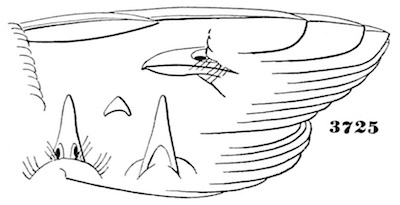
Vireo huttoni. 3725
Above olive-green; brightest behind, especially on rump and edging of tail, duller and more ashy towards and on top and sides of head and neck. Wings with two bands on coverts, and outer edges of innermost secondaries rather broadly olivaceous-white; other quills edged externally with olive-green, paler towards outer primary; internally with whitish. Lateral tail-feather edged externally with yellowish-white. Feathers of rump with much concealed yellowish-gray.
Under parts pale olivaceous-yellowish; purest behind, lightest on the throat and abdomen; the breast more olivaceous, the sides still deeper olive-green, the breast soiled with a slight buffy tinge. Axillars and crissum yellowish; the inside of wings whitish. Loral region and a narrow space around eye dull-yellowish, in faint contrast to the olive of head. Bill horn-color above, paler below; legs dusky.
Total length, 4.70; wing, 2.40; tail, 2.05; difference between tenth and longest quills, .43; exposed portion of first primary, .72, of second, 1.52, of longest, fourth, and fifth (measured from exposed base of first primary), 1.90; length of bill from forehead, .45, from nostril, .29, along gape, .60; tarsus, .72; middle toe and claw, .50, claw alone, .16; hind toe and claw, .45, claw alone, .22.
Hab. California and Western Mexico, to Oaxaca; La Parada (Scl.); Orizaba (alpine region, resident, Sumichr.).
The description just given is based upon the type specimen, probably in winter plumage. Spring specimens do not vary materially except in greater purity of white edgings of the feathers. Two Mexican specimens are rather larger, the wing measuring 2.50, the tail 2.30. No other differences are appreciable. In general the first primary is about half the second, sometimes rather less.
This species is readily distinguished from other Vireos, excepting V. modestus, which it greatly resembles in the small bill, form, coloration, and size; nor indeed is it easy to separate them. In modestus, however, the first quill is usually more than half the second, not less; the wing shorter, and less pointed; the tail longer. The upper parts are more uniform, not much brighter towards rump.
Habits. This species is one of comparatively recent origin, and of its history but little is as yet known. It was first described by Cassin, in 1851, from a specimen obtained in Monterey, Cal. It has been found in various parts of California, in the valley of the Gila, and in the northern and eastern portions of Mexico. Mr. Sumichrast gives it as a resident of the alpine region of the Department of Vera Cruz.
Dr. Cooper has observed this bird near San Diego, late in February, where he at first mistook it for the Ruby-crowned Wren, a bird that winters there in abundance, and which he states resembles this species closely in appearance and habits. Two of them came to within a few feet of where he sat, scolding in a harsh tone. He recognized then their larger size and different plumage, as well as their remarkably large eyes, and a peculiar slowness and deliberation in their movements as they searched the foliage for insects.
Dr. Cooper has since found them wintering plentifully up to latitude 38°. Having observed but few of them in the Coast Range, in May, he thinks that most of them go farther north in summer. At San Diego, however, he shot a female, on the 9th of March, containing an egg nearly ready to be laid. He had not been able to find the nest, which is presumed to be built in the dense shade of the evergreen oaks (Quercus agrifolia). Their song is said to consist of a few short and quaint notes. Among the memoranda of Mr. Xantus, made at Fort Tejon, I find the following: (No. 1,827.) Nest and eggs of Vireo huttoni, found May 8, one foot from the ground, under high trees, suspended from three high stems of weeds, fastened to them, but very loosely put together. The eggs had been incubated. He furnished no further description of nest or eggs.
Vireo belli, Aud.
BELL’S VIREO.
Vireo belli, Aud. Birds Am. VII, 1844, 333, pl. cccclxxxv (Missouri River).—Cassin, Pr. A. N. Sc. Phila. 1851, 150.—Baird, Birds N. Am. 1858, 337; Rev. 358.—Sclater, Catal. 1861, 42, No. 258.—Bon. Consp. 1850, 330.—Cooper, Orn. Cal. 1, 1870, 123.
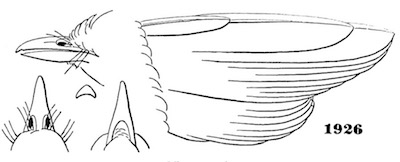
Vireo belli. 1926
Sp. Char. (No. 1,926.) Above olive-green, brightest on the rump; tinged anteriorly with ashy; the top and sides of head ashy, in faint contrast. A line from nostrils to eye (scarcely beyond it), and eyelids very pale yellowish-white; lores dusky. Under parts, including inner wing-coverts, and edge of wing, creamy-white; the sides, axillars, and crissum pale yellow (sides of lower neck and of breast glossed with olivaceous, faintest on the longer feathers of the latter). Two rather narrow bands on the wing-coverts, and the outer edges of innermost secondaries white; the other quills edged with faded olivaceous. Inner edges of quills whitish. Tail-feathers brown, edged externally with olive; internally fading into paler brown. Median portion of rump feathers concealed with pale yellowish. Bill horn-color above, pale below. Legs plumbeous. “Iris brown.”
First quill spurious; not quite half the second, which is about equal to the eighth; third and fourth quills longest; fifth scarcely shorter. Tail nearly even, or a little rounded, the feathers narrow.
Total length, 4.20; wing, 2.18; tail, 1.90; tarsus, .75.
Hab. United States, from Missouri River to base of Rocky Mountains; Tehuantepec, Mexico (October, Sumichrast); Missouri (Hoy); Iowa (Allen); Southeast Illinois (Ridgway).
The above description is taken from a type specimen received from Mr. Audubon, and represents the average spring plumage. Autumnal skins are rather brighter, and there is occasionally an ochraceous tinge on the white of the under parts.
This species at first sight appears like a miniature of V. gilvus, the head being almost exactly similar. The back is, however, much brighter olive, the sides and crissum deeper yellow. The superciliary light stripe is shorter. The white markings of the wings are wanting in gilvus. The wing, tail, and feet are entirely different in their proportions.
Habits. This species was first procured by Mr. Audubon’s party in the excursion to the Yellowstone River, in what is now known as Dakota Territory. In his account of it Mr. Audubon states that it is usually found in the bottom-lands along the shores of the Upper Missouri River, from the neighborhood of the Black Snake Hills, as far as they ascended that river. In its habits he describes it as more nearly allied to the White-eyed Vireo than any other.
Dr. Woodhouse, in his report of the Zuñi River Expedition, mentions finding this species abundant in Texas. Mr. Dresser also speaks of it as not uncommon, during the summer, near San Antonio, and remaining there to breed. He mentions finding a nest on the 2d of July in a wesatche bush near the San Pedro, containing three eggs of this species and one of the Cow-Bunting. Being anxious to procure the parent bird he left it, but on his return the nest had been torn and the Vireo’s eggs smashed. Dr. Heermann found a nest on the Medina about the same time. He describes this nest as beautifully formed of fine grasses, and hung from the small twigs of a tree. The eggs, four in number, were very small, white, with an occasional reddish dot at the larger end. The nest found by Dr. Heermann was attached to the pendent twigs of a willow. The stomachs of these Vireos were found to contain small green caterpillars.
Dr. Coues met with this species near Fort Riley, May 23. It appeared to be quite common, and was found inhabiting thickets and clumps of bushes, like V. noveboracensis, but having a very different song, the peculiarity of which first attracted his attention. Mr. Ridgway found it to be a common summer resident in the thickets and copses of Southern Illinois, especially in the prairie districts. He first met with it on the 8th of June, 1871, on Fox Prairie, in Richland County. His attention was drawn to it by its peculiar song, which has a general resemblance to that of the White-eyed Vireo, having the same odd delivery, but being more sputtering, reminding one somewhat of the song of Troglodytes ædon.
This Vireo appears to have quite an extended distribution during the breeding-season, or from Texas to the Upper Missouri, and even as far as the eastern edge of Southern Illinois. It breeds also as far to the east as Eastern Kansas. Its western limits are not so clearly defined. It was not found by Mr. Ridgway in Nevada or Utah, nor by Dr. Coues in Arizona.
A nest of this species, found in June, near Neosho Falls, Kansas, by Mr. B. F. Goss (S. I. Coll., 1,875), is pensile; suspended from two small twigs, which make the basis of three fourths of its rim. Over these is strongly bound a finely felted webbing of the flax-like fibres of plants, interwoven with slender stems. With these are connected and interwoven also the materials that make up the periphery of the nest itself. This is composed of long and slender strips of bark, fragments of dry leaves, bits of wood, and various other fragmentary substances. The nest, unlike others of this family, is lined with down, and the fine long hair of some animals, instead of with vegetable stems. The diameter as well as the height of this nest is about two and a half inches.