Family FRINGILLIDÆ.—The Finches. (continued 3)
Reading edition
Plectrophanes nivalis, Meyer.
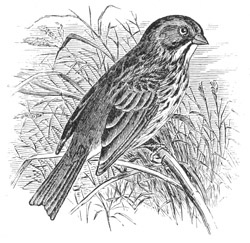
SNOW-BUNTING.
Emberiza nivalis, Linn. Syst. Nat. I, 1766, 308 (not Fringilla nivalis, L.).—Forster, Phila. Trans. LXII, 1772, 403.—Wilson, Am. Orn. III, 1811, 86, pl. xxi.—Aud. Orn. Biog. II, 1834, 575; V, 1839, 496, pl. 189. Emberiza (Plectrophanes) nivalis, Bon. Obs. 1825, No. 89. “Plectrophanes nivalis, Meyer.”—Bon. List, 1838.—Aud. Syn. 1839, 103.—Ib. Birds Am. III, 1841, 55, pl. 155.—Max. Cab. J. VI, 1858, 345 (Spitzbergen).—Baird, Birds N. Am. 1858, 432.—Newton, Ibis, 1865, 502.—Dall & Bannister, Tr. Ch. A. S. I, 1869, 282 (Alaska).—Cooper, Orn. Cal. 1, 177.—Samuels, 296. Emberiza montana, Gmelin, Syst. I, 1788, 867, 25. Emberiza mustelina, Gmelin, Syst. I, 1788, 867, 7. Emberiza glacialis, Latham, Ind. Orn. I, 1790, 398.
Sp. Char. Male. Colors, in spring plumage, entirely black and white. Middle of back between scapulars, terminal half of primaries and tertiaries, and two innermost tail-feathers, black; elsewhere pure white. Legs black at all seasons. In winter dress white beneath; the head and rump yellowish-brown, as also some blotches on the side of the breast; middle of back brown, streaked with black; white on wings and tail much more restricted. Length about 6.75; wings, 4.35; tail, 3.05; first quill longest. Female. Spring, continuous white beneath only; above entirely streaked, the feathers having blackish centres and whitish edges; the black streaks predominate on the back and crown. Young. Light gray above with obsolete dusky streaks on the back; throat and jugulum paler gray, the latter with obsolete streaks; rest of lower parts dull white. Wing-coverts, secondaries, and tail-feathers broadly edged with light ochraceous-brown.
Hab. Northern America from Atlantic to Pacific; south into the United States in winter, as far as Georgia and Southern Illinois.
Specimens from North America and Europe appear to be quite identical; there is, however, a great amount of variation among individuals.
Habits. The common Snow Bunting is found throughout northern North America to the shores of the Arctic Sea, and in the winter months extends its migrations into the United States as indicated above.
Mr. Dall states that in Alaska, when observed, they went altogether in flocks. It was at times excessively common, and at others entirely absent. It builds its nests on the hillside, generally on the ground, under the lee of a stone. He obtained a large number of these birds at Nulato, in the winter of 1867-68. It was much more common there than the P. lapponicus, which was only seen in the spring, while this bird was there all the year round. Mr. Dall also met with these birds on St. George’s Island, and Mr. Bischoff obtained them at Sitka. According to Mr. Bannister’s observations it was altogether less abundant than the P. lapponicus, and seemed to prefer rather different situations. On St. Michael’s Island he never saw one of this species far from the shore, while the other species was abundant everywhere in the interior of the island. During the summer he never saw more than one or two of these birds at once, nor anywhere except on rocky points or on small rocky islands near the shore. These localities they seemed to share with the Ravens and Puffins. In the autumn they are more gregarious, but still seem to prefer the vicinity of water. Mr. Bannister also observed this bird at Unalaklik, where it is common.
Wilson was of the opinion that these birds derive a considerable part of their food from the seeds of certain aquatic plants, and this he supposed one of the principal reasons why they prefer remote northern regions intersected with streams, ponds, lakes, and arms of the sea, abounding with such plants. On Seneca River, near Lake Ontario, in October, he met with a large flock feeding on the surface of the water, supported on the close tops of weeds that rose from the bottom. They were running about with great activity, and the stomachs of those he shot were filled not only with the seeds of that plant, but also with minute shell-fish that adhered to the leaves.
Richardson states that this species breeds in the most northern of our Arctic islands, and on all the shores of the continent, from Chesterfield’s Inlet to Behring Strait. The most southerly of its breeding-places known to him was Southampton Island, in the 62d parallel, where Captain Lyons found a nest on the grave of an Esquimaux child. Its nest was usually made of dry grass, neatly lined with deer’s hair and a few feathers, and is generally fixed in the crevice of a rock, or in a loose pile of timbers or stones. The eggs are described as of a greenish-white, with a circle of irregular umber-brown spots round the larger end, with numerous blotches of subdued lavender-purple. July 22, in removing some drift timber on a beach at Cape Parry, he discovered a nest on the ground, containing four young Snowbirds. Care was taken not to injure them, and while they were seated at breakfast, at a distance of only two or three feet, the parent birds made frequent visits to their offspring, each time bringing grubs in their bills. The Snowbirds are in no apparent haste to leave for the South on the approach of winter, but linger about the forts and open places, picking up seeds, until the snow becomes too deep. It is not until December or January that they retire to the south of the Saskatchewan. It returns to that river about the middle of February, by April it has reached the 65th parallel, and by the beginning of May it is found on the shores of the Polar Sea. At this period it feeds on the buds of the Saxifraga oppositifolia, one of the earliest of the Arctic plants. The young are fed with insects.
The Snow Bunting is also an inhabitant, during the breeding-season, of the Arctic regions of Europe and Asia, and the islands of the Arctic Sea. Scoresby states that it resorts in large flocks to the shores of Spitzbergen, and Captain Sabine includes it among the birds of Greenland and the North Georgian Islands, where it is among the earliest arrivals. Mr. Proctor, who visited Iceland in 1837, found the Snowbird breeding there in June. He found their nests placed among large stones or in the fissures of rocks, composed of dry grass lined with hair and feathers. The eggs were from four to six in number. The male attends the female during incubation. Mr. Proctor states that he has seen this bird, when coming from the nest, rise up in the air and sing sweetly, with its wings and tail spread in the manner of the Tree Pipit. Linnæus, in his Tour in Lapland, mentions seeing these birds in that country about the end of May, and also in July. He also mentions that this bird is the only living thing that has been seen two thousand feet above the line of perpetual snow in the Lapland Alps. This bird also breeds on the Faroe Islands. Mr. Hewitson found its nest in Norway. It contained young, and was built under some loose stones. Young birds have also been noticed early in August among the Grampians, in Scotland, rendering it probable that they breed in that locality, and perhaps in considerable numbers. As the severity of winter increases, they leave the heaths where they have fed upon the seeds of grasses, and descend to the lowlands, frequenting the oat-stubbles, and, when the snow is deep, approaching the coast. Their call-note is pleasing, and is often repeated during their flight, which they make in a very compact body. Before settling on the ground they make sudden wheels, coming almost into collision with each other, uttering at the same time a peculiar guttural note. They run on the ground with all the ease of Larks, and rarely perch. Temminck states that they are very abundant in winter along the sea-coast of Holland.
Their appearance in Massachusetts is usually with the first heavy falls of snow, in December and January. They are most abundant in the open places near the sea-coast, and formerly were very numerous in the marshes between Boston and Brookline. A wounded male in full adult plumage was taken by me, in 1838, and kept some time in confinement. It would not accustom itself to a cage, and a large box was prepared in which it could run more at large. It fed readily on grain and cracked corn, delighted to bathe itself several times in the day, but would not be reconciled to my near presence. On my approach it would rush about its prison, uttering its peculiar call-notes, blending with them a loud guttural cry of alarm. As the spring approached, it warbled occasionally a few notes, but uttered from time to time such mournful cries, as if bewailing its captivity, that it would have been released, had its crippled condition permitted it to take care of itself. It was given in charge of a friend, but did not live through the heat of the ensuing summer.
It is stated that a nest of this bird was found among the White Mountains by Mr. Kirk Boott, of Boston, in the summer of 1834. It contained young birds. This, if the identification was correct, was probably an accidental occurrence. None have been noticed there since, nor have I ever been able to find any of the permanent residents among the mountains that have met with these birds in that region, except in winter.
The only authenticated nest and eggs (10,433) in the Smithsonian collection were received from Mr. R. MacFarlane, with the parent, taken on the Arctic coast east of Fort Anderson, and having on the label, “Nest situated in a cave in a sand-bank.” The nest is deeply saucer-shaped, and composed of wiry grass-stems, with a few feathers in the lining; external diameter 3.75 inches, internal about 3.00; depth, 2.50 externally and 1.50 internally. The eggs, five in number, are of a dull white, with perhaps a faint bluish cast, sprinkled and spattered with dilute yellowish-rufous, the markings most numerous toward the larger end; they measure .95 of an inch in length by .64 in breadth.
Plectrophanes lapponicus, Selby.
LAPLAND LONGSPUR.
“Fringilla lapponica, Linn. Fauna Suecica, 1761, sp. 235.”—Ib. Syst. Nat. I, 1766, 317. Forster, Phil. Trans. LXII, 1772, 404. Emberiza (Plectrophanes) lapponica, Sw. F. B. Am. II, 1831, 248, pl. xlviii. Emberiza lapponica, Aud. Orn. Biog. IV, 1838, 473, pl. 365. Plectrophanes lapponicus, “Selby,” Bon. List, 1838.—Aud. Syn. 1839, 98.—Ib. Birds Am. III, 1841, 50, pl. 152.—Baird, Birds N. Am. 1858, 433.—Dall & Bannister, Tr. Ch. A. S. I, 1869, 283 (Alaska).—Cooper, Orn. Cal. 1, 178.—Samuels, 300. “Centrophanes lapponicus, Kaup, Entw. Gesch. Europe Thierw. 1829.”—Cabanis, Mus. Hein. 1851, 127. “Fringilla calcarata, Pall. Itin. 710, sp. 20,” French ed. III, 1793, 464, pl. i. Centrophanes calcaratus, Gray, List Gen. 1841, App. 1842, 11.
Sp. Char. Male. Head all round, and neck black, extending on the jugulum in a crescentic patch; a broad line from above and behind the eye, sides of neck, a patch in the black of hind head, and whole under parts, white; the sides of body streaked broadly with black. A broad half-collar of chestnut on back of neck, separated from the hood narrowly, and from the auriculars and throat broadly, by the white stripe from the eye. Above brownish-black, the feathers sharply edged with brownish-yellow. Outer tail-feathers white, except the basal portion of inner web, and a shaft streak at end; next feather with a white streak in end, rest black. Legs black; bill yellow, tipped with black. In winter plumage the black and other markings overlaid by rusty and fulvous; beneath by whitish. Female with the black feathers of head edged with yellowish-rusty; the throat white, bordered on the sides and behind by blackish; feathers edged with grayish-white, the rufous of nape obscure, and streaked with blackish. Length of male, 6.25; wing, 3.90; tail, 2.80.
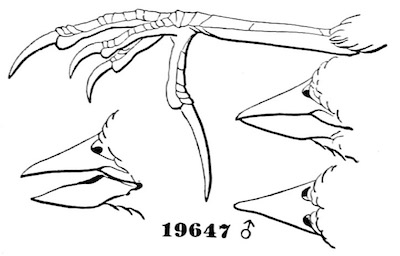
19647 ♂
Hab. Northern portions of the Old and the New World; breeding in arctic and subarctic regions, and in winter descending southward, as far at least as New York, Southern Illinois, and Fort Garland, New Mexico.
Autumnal specimens, of both sexes, differ in having the pattern of coloration obscured by ochraceous borders to the feathers, and a general rusty cast to the plumage.
There appears to be no difference between North American and European specimens of this bird.
Habits. The Lapland Longspur is an Arctic resident, belonging equally to the two continents, rarely descending even in winter to temperate regions, and then chiefly in its immature plumage. In Europe, according to Yarrell, only a few specimens have been found in the British Islands, and these were single individuals, mostly found in company with Larks. They have also been taken in France, in Belgium, and in different parts of Germany. Degland states that these birds are occasionally snared on the coast at Dunkirk, and in the neighborhood of Antwerp, but these are always young males in their winter plumage.
Pennant states that it is found in Siberia, and near the Ural Mountains, migrating in the winter as far south as Switzerland; and, according to Necker, they have also been taken, always in company with Larks, in the vicinity of Geneva. It inhabits Norway, Sweden, the Faroe Islands, Spitzbergen, Iceland, and Greenland, in the summer.
Richardson mentions that the Lapland Bunting is common in the fur regions, wintering on the coast of Hudson’s Bay. During its stay it feeds on grass-seed, the fruit of the juniper, and the pines. As he never met with these birds during the winter, he suspects that their principal retreats are on the borders of Lakes Huron and Superior, and the country westward. In 1827 they appeared on the plains, at the Carlton House, about the middle of May, in very large flocks, in company with Shore Larks and the P. picta, frequenting the open spots where the fires had destroyed the grass. In the same season they came a few days later to the Cumberland House, and kept constantly about the furrows of the new-ploughed fields. The year before they had been, in smaller flocks, in the vicinity of Fort Franklin, latitude 65°, in the beginning of May. Their crops were found filled with seeds of the alpine arbutus.
Mr. Audubon met with them in enormous flocks in Kentucky, about February 15, 1819. They were in company with the Shore Larks and the Snow Buntings. None of these were in perfect plumage.
Mr. Ridgway cites this as a common winter visitant in Southern Illinois, abundant in unusually severe winters, either in large flocks by itself, or a few individuals mixed up in flocks of Shore Larks.
Mr. Dall gives May 12 as the date of the first arrival of these birds at Nulato, and adds that it is not at any time a very common bird. He was not able to find its nest at Nulato, but was informed by the Indians that it builds on the bare hillsides, in hillocks of grass, and that it does not leave the nest when any one approaches, but sits perfectly still, and thus often escapes detection. He considers it a very fine singer. Specimens were received from Sitka, obtained by Bischoff. To this account Mr. Bannister adds that it is by far the most abundant of the land-birds found at St. Michael’s. It appeared on that island about the 6th of May, and from that time until about the middle or latter part of September they were observed in great numbers all over the island. He, too, was not successful in finding its nest, though the birds were started up by hundreds on every walk over the island. From this he infers that they must be very carefully concealed. He often searched for them, but always with the same result. Mr. Bannister regarded this species as decidedly the best songster of its family.
In the far North it is an extremely abundant species from one ocean to the other, in the winter moving farther south, to the United States, in large flocks. It has not been found in California, but in the central and eastern regions has been obtained as far south as Leavenworth, Kan., Racine, Wis., Boston, and New York. It is stated by different observers, that, like the Lark, it sings only while in motion in the air, or while suspended, and that its notes are agreeable and melodious.
According to Richardson, they breed in moist meadows on the shores of the Arctic Sea, the nest being placed in a small hillock, among moss and stones. It is composed externally of dry stems of grass, interwoven to a considerable thickness, and lined very neatly and compactly with deer’s hair. The eggs, seven in number, he describes as pale ochre-yellow, spotted with brown. Sir James Ross found them by no means numerous in the higher northern latitudes, and obtained one nest, containing five eggs, in July.
According to Holböll, this bird is common along the shores of both North and South Greenland. They reach Godhaab in the beginning of May, and Godhaven a month later. Their migrations do not take place all at once, but they are constantly arriving during the month. It remains in South Greenland until the beginning of September, and longer if the deep snows do not drive it away. This bird is never met on shipboard until the vessels are in Davis Strait, proving that their migrations must be from America. The Greenlanders call it Narksamatak (inhabitant of the plains),—an appropriate name, as it only lives on the lowlands near the sea-shore, where it builds its nest in the manner of the Lark, in the grass, or among the lichens. Its five eggs, of a dirty olive-color spotted with brown, are smaller than those of P. nivalis. The song of the male bird, as it hovers in the air or rocks on a swaying twig, is very clear and melodious. It is even known as the Greenland Nightingale. Its food is seeds, and it is not known to seek insect-larvæ on the houses of the Greenlanders, as does the P. nivalis. In their winter dress they all resemble the female in her summer plumage, only in the male some black is seen in the head-feathers.
Fabricius describes its eggs as five or six in number, of a reddish-gray with brownish spots. Degland describes their ground-color as an ashy-gray, covered with spots of light brown, with lines and spots of deep brown, and also of clear black.
Eggs from Anderson River exhibit great variations in their appearance, more from the difference in the distribution of their spots than from variations in colors. Where distinctly visible, the ground-color appears to be of yellowish-gray, frequently so thickly spotted as not to be recognizable. The blotches are of various shades of brown, with shadings of olive, purple, or red, and at times almost black. In some, fine olive-brown dots cover the egg so completely as to make it appear as of one uniform deep color. In others the brown is lighter and more of a reddish hue, and again in others the markings are in irregular distribution, and of different shades. They measure .80 by .60 of an inch.
Nest with eggs (7414), collected on Anderson River, Franklin Bay, June 27, by R. MacFarlane, was built on the ground, and is deeply saucer-shaped, measuring 3.75 in external and 2.30 in internal diameter; the depth 2.75 exteriorly and 1.50 interiorly. It is composed of coarse wiry grass-stems, and softly lined with feathers of Lagopus. The eggs, five in number, have the ground-color light umber-drab, this faintly blotched with deeper livid slate, and with a few straggly black lines, much as in certain Icteridæ and in Chondestes. They measure .86 of an inch in length by .63 in breadth.
Plectrophanes pictus, Swainson.
SMITH’S BUNTING; PAINTED LONGSPUR.
Emberiza (Plectrophanes) picta, Sw. F. B. Am. II, 1831, 250, pl. 49 (spring).—Nutt. Man. II, 589. Plectrophanes pictus, Aud. Syn. 1839, 99.—Ib. Birds Am. III, 1841, 52, pl. cliii (Richardson’s specimen).—Baird, Birds N. Am. 1858, 434.—Dall & Bannister, Tr. Ch. A. S. I, 1869, 283 (Alaska). Emberiza picta, Aud. Orn. Biog. V, 1839, 91, pl. cccc. Centrophanes pictus, Cab. Mus. Hein. 1851, 127. Plectrophanes smithi, Aud. Birds Am. VII, 1844, 337, pl. cccclxxxvii (winter).
Sp. Char. Male. Spring. Top and sides of head black. A line from bill over the eye, lores, lower and posterior border of the black cheeks, ears (encircled by black), and a small patch in the nape, white. Entire under parts, and extending round neck to nape (where it bounds abruptly the black of head), buff or light cinnamon-yellow; the under tail-covert paler; the inside of wings, white. Feathers of upper surfaces black, edged with yellowish-gray; shoulders or lesser coverts and the greater black; middle white, forming a conspicuous patch. Quills edged externally with white, this involving the whole outer web of outermost primary. Whole of outer and most of second tail-feather white. Bill dusky; lower mandible and legs yellowish. Length, 5.50; wing, 3.50; tail, 2.75; bill, .45.
Female. The markings of male faintly indicated, but the black and buff wanting. Head above brown, streaked centrally with paler. A narrow dark line on each side the throat, and brownish streaks across the jugulum, and along sides of body. Traces visible of the white marks of the head. Bill and feet as in the male.
Hab. Prairies of Illinois and Missouri Plains, in winter; in summer north to the Arctic Ocean.
This species is quite similar in form to P. lapponicus, although with slenderer bill, and perhaps longer hind claw. While the colors of adult males are very different, the females have a decided resemblance; they may, however, be distinguished in all stages by the black or dusky legs of lapponicus and the yellow of pictus, and perhaps by the more dusky upper mandible of the latter.
Habits. This species was first obtained by Sir John Richardson’s party, and described by Swainson in the Fauna Boreali-Americana. It was observed associating with the Lapland Buntings on the banks of the Saskatchewan, but no information was obtained in regard to its breeding-habits. No specimens in the mature plumage are known to have been obtained in the United States, but birds in the immature plumage are not unfrequent, in early spring, throughout Illinois. Mr. Audubon, in company with Mr. Harris and Mr. Bell, obtained specimens of these birds near Edwardsville, and described them as a new species. Mr. Bell states, in regard to these birds, that he found them very abundant on the low prairie near a lake, a few miles from Edwardsville. They were generally in large flocks, and when once on the ground they began to separate. They ran very nimbly, in a manner resembling that of the Grass Finch, and when they arose, which they rarely did unless they were nearly approached, they uttered a sharp click, repeated several times in quick succession, and moved with an easy undulating motion for a short distance and then alighted very suddenly, seeming to fall perpendicularly several feet to the ground. They preferred the spots where the grass was shortest. When in the air they flew in circles, to and fro, for a few minutes, and then alighted, keeping up a constant chirping or call, somewhat like that of the Red-Poll.
These birds were observed in large numbers at Fort Anderson, and on the Lower Anderson River, by Mr. MacFarlane, and a large number of their nests obtained. These were all on the ground, and usually in open spaces, but also in the vicinity of trees. The usual number of eggs found in a nest appears to have been four. The nests, for the most part, were constructed of fine dry grasses, carefully arranged, and lined with down, feathers, or finer materials similar to those of the outer portions. In a few there were no feathers; in others, feathers in different proportions; and in a few the down and feathers composed the chief portion of the nest, with only a few leaves as a base to the nest. They were sometimes sunk in excavations made by the birds, or placed in a tussock of grass, and, in one instance, placed in the midst of a bed of Labrador tea.
They were also obtained at Fort Yukon, at the mouth of Porcupine River, by Strachan Jones. They were much more abundant in the Mackenzie River district.
Specimens of this bird, in the fall plumage, were obtained from Fort Simpson, where Mr. B. R. Ross states that it appears on its way north in May. They resort to the fields around the fort in search of grain. Although these birds keep entirely apart from the P. nivalis, Mr. Ross has frequently observed several P. lapponicus associating with them.
When their nests are approached, the female quietly slips off, while the male bird may be seen hopping or flying from tree to tree in the neighborhood of the nest, and will at times do all he can to induce intruders to withdraw from the neighborhood.
The eggs, five in number, have a light clay-colored ground, are marked with obscure blotches of lavender and darker lines, dots, and blotches of dark purplish-brown. They measure .80 by .65 of an inch.
Plectrophanes ornatus, Towns.
CHESTNUT-COLLARED BUNTING; BLACK-BELLIED LONGSPUR.
Plectrophanes ornatus, Townsend, J. Ac. Nat. Sc. VII, 1837, 189.—Ib. Narrative, 1839, 344.—Aud. Syn. 1839, 99.—Ib. Birds Am. III, 1841, 53, pl. cliv.—Nutt. Man. I, (2d ed.,) 1840, 537.—Baird, Birds N. Am. 1858, 435. Emberiza ornata, Aud. Orn. Biog. V, 1839, 44, pl. cccxciv, f. 1. Centrophanes ornatus, Cabanis, Mus. Hein. 1851, 127.
Sp. Char. Bill dark plumbeous. Male. Crown, a narrow crescent on the side of the head, with a line running into it from behind the eye, entire breast and upper part of belly all round, black; throat and sides of the head, lower part of belly and under tail-coverts, with bases of the tail-feathers, white. The white on the tail-feathers runs forward as an acute point. A chestnut band on the back of the neck extending round on the sides. Rest of upper parts grayish-brown, streaked with darker. Middle coverts with a white patch. Lesser wing-coverts like the back. Legs dusky, bill blue, darker at tip. Length about 5.25 inches; wing, 3.20; tail, 2.30; tarsus, .75.
Female lacking the black and chestnut colors; the black of the breast indicated by dusky streaks and a line of streaks each side of the throat.
Hab. Plains of the Upper Missouri. San Antonio, Texas, spring (Dresser, Ibis, 1865, 486).
Habits. This species was first discovered by Mr. Townsend, who procured a single specimen, a male, on the Upper Missouri River. He describes it as by no means a common bird, keeping in pairs and living exclusively on the ground. It was remarkably shy, and Mr. Townsend was not able to procure more than a single specimen.
Mr. Nuttall states that he met with this bird early in May, on the wide grassy plains of the Platte. The birds were already paired for the season. He heard them utter no notes other than a chirp, as they kept busily foraging for their subsistence.
Mr. J. A. Allen (American Naturalist, May, 1872) speaks of this bird and the Lark Bunting as by far the most interesting species seen by him in Western Kansas. They were not only characteristic of the region, but were also among the few birds strictly confined to the arid plains. They were quite abundant, but were only met with on the high ridges and dry plateaus, where they seemed to live somewhat in colonies. At a few localities they were always numerous, but elsewhere would be frequently not met with in a whole day’s drive. They were very wary and tenacious of life, often flying a long distance after having been shot through vital parts. Most of the specimens had to be killed on the wing, at a long range. They are strong fliers, and seem to delight in flying in the strongest gales, when all the other birds appear to move with difficulty, and to keep themselves concealed among the grass. This bird sings while on the wing.
Mr. H. E. Dresser, in his paper on the birds of Southern Texas, mentions finding the Chestnut-collared Bunting in flocks early in the spring, on the prairies near San Antonio, but it was not a common bird there.
Dr. Woodhouse found this species quite rare in the Indian Territory, where he was only able to secure a single specimen.
Captain Blakiston met with this species on the Saskatchewan Plains on the 15th of May, 1858,—a higher range than has been noticed by any one else.
Dr. Heermann, while on a trip to the Rocky Mountains in 1843, met with this species in small flocks and pairs, scattered over the prairies of the Platte River, and was so fortunate as to meet with one of its nests. It was built on the ground, and was made of an interweaving of fine grasses and lined with hair. He describes the eggs, which were four in number, as having a white ground, with black lines at the larger end, and a few faint blotches of a neutral tint scattered over their whole surface.
This description does not quite correspond with the eggs collected by Mr. Audubon on the Upper Missouri. These have a clay-colored ground with the slightest possible tinge of green, and are marked with fine dots of purplish-brown, and larger markings, blotches, and short lines of dark brown. They measure .70 by .55 of an inch, and have a strong resemblance to the eggs of both P. pictus and P. maccowni.
Five eggs of this species, obtained at Fort Hays, Kansas, June 1, 1871, by Mr. J. A. Allen, measure .75 of an inch in length by .58 in breadth. They are small in proportion to the bird, and are somewhat pointed at one end. Their ground is a gray or grayish-white shade of stone-color, and this is somewhat sparingly marked with blotches of dark brown, almost black, and lighter markings of purplish-brown. The nest was placed on the ground, and was composed altogether of fine stems of grasses.
Plectrophanes ornatus, var. melanomus, Baird.
BLACK-SHOULDERED LONGSPUR.
Plectrophanes melanomus, Baird, Birds N. Am. 1858, 436, pl. lxxiv, f. 2.—Heermann, X, c, 13.
Sp. Char. Bill yellowish, dark brown along the culmen. Male. Crown, a short stripe behind the eye, and a short crescent behind the ear-coverts, entire breast as far back as the thighs, and the lesser wing-coverts, black. The black on the breast margined with dark cinnamon. Sides of head, chin, throat, and region behind the black of the belly, white. A broad half-collar of dark cinnamon-brown on the back of the neck. Tail-feathers mostly white; the innermost tipped with dark brown; the white ending in an acute angle. Length, 5.30; wing, 3.40; tail, 2.60. (No. 6,290.)
Hab. Eastern slope of the Rocky Mountains, Mexico, on the table-lands, north to Upper Missouri. Orizaba (Sclater, 1860, 251); San Antonio, Texas, spring (Dresser, Ibis, 1865, 486); Fort Whipple, Arizona (Coues, P. A. N. S. 1866, 84); Vera Cruz, plateau, breeding (Sumichrast, I, 551).
As already stated, this bird is very similar to P. ornatus. It appears to be a very little larger, or, at any rate, with considerably longer wings. The bill, however, is shorter and stouter; the hind claw decidedly longer. The chestnut of the back of the neck is darker. The white on the outer web of the tertiaries and secondaries is much purer and wider. The rufous margins of the pectoral feathers we have never seen in P. ornatus. The most striking peculiarity, however, is in having the shoulders black, instead of brown like the rest of the wing-feathers, edged with paler. Both have the white posterior row of lesser wing-coverts.
An immature male (6,291) has the black of the head mixed with brown, and a maxillary series of spots on each side of the throat. A female has a similar series of spots; the under parts generally being brownish-white, the shafts across the breast and along the sides streaked with brown, the concealed portions of the feathers light brown, fading out to the whitish exterior. There is no black on the shoulder, nor chestnut on the nape.
Fully mature specimens of this bird and of ornatus are so rare in collections as to render it difficult to decide positively as to their true relationship. It is by no means impossible that they merely represent different conditions of plumage of one species, but for the present, at least, we prefer to consider them as distinct. The P. melanomus is resident on the table-lands of Mexico.
Habits. Of the habits and general history of this species, very little is known. Its close resemblance to P. ornatus is suggestive of its probably equally close similarity in nesting, eggs, and manner of feeding. Specimens have been received from Mexico, from Fort Thorn, from New Mexico, Pole Creek, and the Black Hills. From the last-named places they were obtained in August and September.
Dr. Heermann, in his Report on the birds observed in Lieutenant Parke’s route near the 32d parallel, mentions having met with these birds, which he calls the Black-shouldered Longspur, at a large prairie-dog village some miles west of Puerto del Dado. They were in flocks, and were associated with P. maccowni. From that point to the Rio Grande he found both of these species abundant wherever they struck isolated water-holes, these being the only places for miles around where drink can be procured. When shot at, they rise as if to go away, but are forced to return, after describing a few curves, to the only spot where they can procure their necessary drink. They may thus be killed in great numbers. Dr. Heermann states that he has seen from a hundred to a hundred and fifty thus brought down in four or five discharges of a gun.
Mr. Dresser states that on the 4th of April a small flock of what was at first supposed to be the P. ornatus was noticed near the town of San Antonio. They were pursued, and found on the banks of the San Pedro. They were not very shy, and specimens were procured which proved to be of this species. This is the only time that they have been observed in that part of the country, though they may have been mistaken for other species.
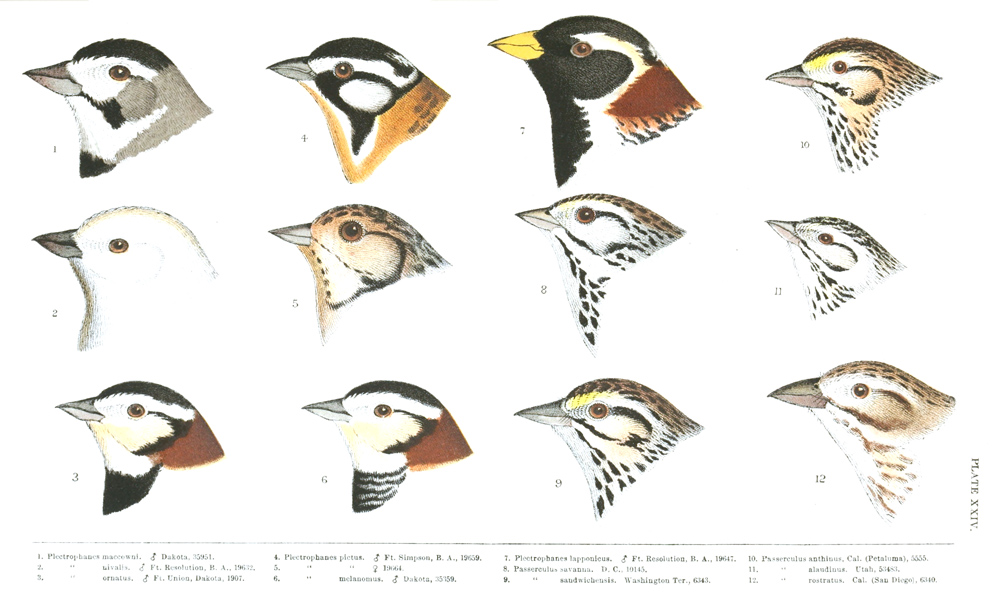
PLATE XXIV.
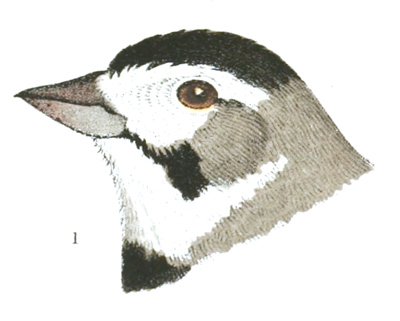
1. Plectrophanes maccowni. ♂ Dakota, 35951.
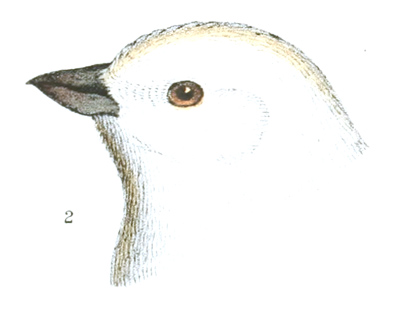
2. Plectrophanes nivalis. ♂ Ft. Resolution, B. A., 19632.
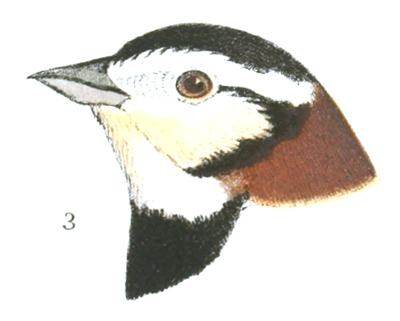
3. Plectrophanes ornatus. ♂ Ft. Union, Dakota, 1907.
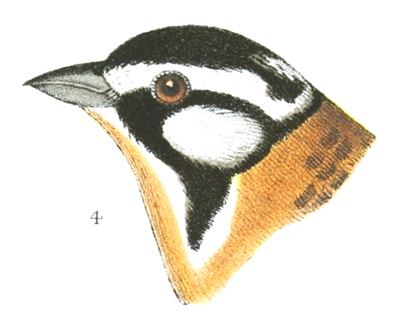
4. Plectrophanes pictus. ♂ Ft. Simpson, B. A., 19659.
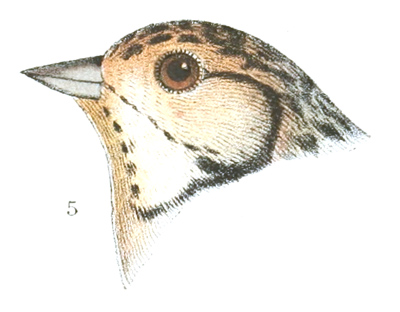
5. Plectrophanes pictus. ♀ 19664.
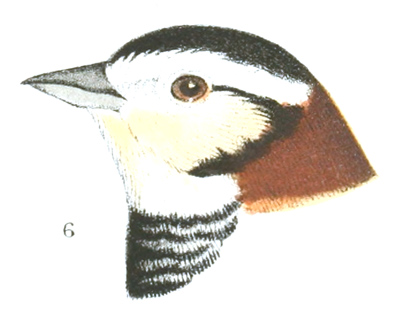
6. Plectrophanes melanomus. ♂ Dakota, 35359.
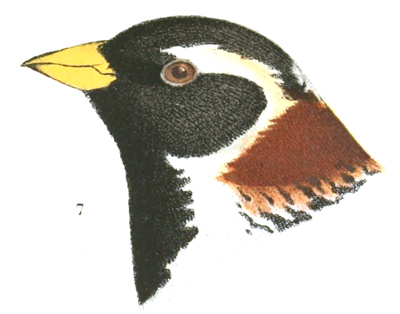
7. Plectrophanes lapponicus. ♂ Ft. Resolution, B. A., 19647.
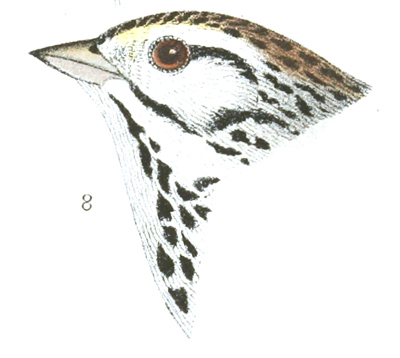
8. Passerculus savanna D. C., 10145.
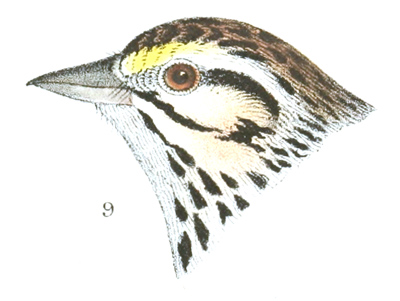
9. Passerculus sandwichensis. Washington Ter., 6343.
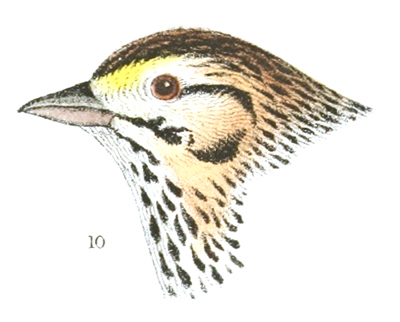
10. Passerculus anthinus. Cal. (Petaluma), 5555.
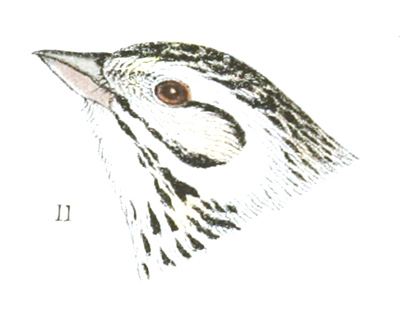
Passerculus alaudinus. Utah, 53483.
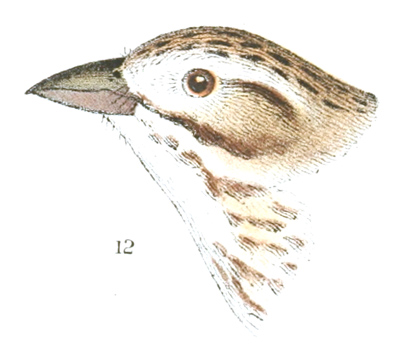
12. Passerculus rostratus. Cal. (San Diego), 6340.
Dr. Coues mentions the taking of a single specimen of this species, October 17, on the open grassy plains of Arizona.
This species is also given by Mr. Sumichrast as a resident throughout the year of the great plains of the plateau of Mexico. From them it occasionally descends to the distant intervals, as far as Orizaba, or at the elevation, above the gulf-level, of 1,220 metres.
Plectrophanes maccowni, Lawrence.
CHESTNUT-SHOULDERED LONGSPUR; MACCOWN’S BUNTING.
Plectrophanes maccowni, Lawrence, Ann. N. Y. Lyc. V, Sept. 1851, 122. Western Texas.—Cassin, Illust. I, viii, 1855, 228, pl. xxxix.—Heerm. X, c, p. 13.—Baird, Birds N. Am. 1858, 437.
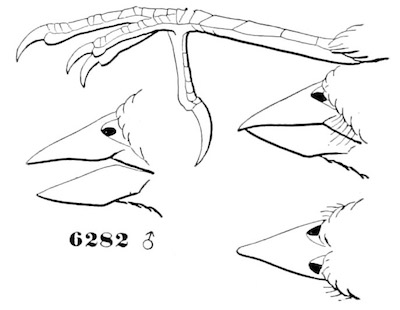
Plectrophanes maccownii, Lawr. 6282 ♂
Sp. Char. Male in spring. Top of head, a broad stripe each side the throat from lower mandible, and a broad crescent on jugulum, black; side of head including lores and band above the eye, throat, and under parts, ashy-white; ear-coverts bordered above and behind by blackish, running out at the maxillary stripe. Breast just behind the black crescent and sides, showing dark bases of feathers. Upper parts ashy, tinged with yellowish on the mandible, and streaked with dusky; least so on nape and rump. Lesser wing-coverts ashy; median chestnut-brown, with blackish bases sometimes evident; the quills all bordered broadly externally with whitish, becoming more ashy on secondaries. Tail-feathers white except at the concealed bases and the ends, which have a transverse (not oblique) tip of blackish; the outermost white to the end; the two central like the back. Bill dark plumbeous; legs blackish. In winter the markings more or less obscured; the bill and legs more yellowish.
Female lacks the black markings, which, however, are indicated obsoletely as in other Plectrophanes; there is no trace of chestnut on the wings, no streaks on the breast. Length, 5.50; wing, 3.60; tail, 2.50; bill, .46.
Hab. Eastern slopes of Rocky Mountains, from Texas to Upper Missouri.
This species varies considerably in markings, but is readily recognized among other Plectrophanes in all stages by short hind toe, very stout bill, and the transverse dark bar at the end of all tail-feathers except the inner and outer.
Habits. Maccown’s Lark Bunting is yet another of the various species of our birds whose history is very little known, and in regard to which the most we are able to state, at present, is that they appear in different parts of the interior plains of the United States, between the Rocky Mountains and the Missouri River and the lower tributaries of the Mississippi, extending from New Mexico and Texas northward, during the breeding-season, to the northern boundary of the United States. It was first discovered by Captain Maccown, who obtained it in Texas, where he found it in company with a flock of Shore Larks, and where it winters in considerable numbers. Mr. Dresser afterward met with it in small flocks, early in April, on the prairies near San Antonio. It was not very common, and he was only able to obtain two specimens during his stay in that section.
Dr. Heermann found this species congregated in large flocks, in company with the Black-shouldered Bunting. They were engaged in gleaning the seeds from the scanty grass, on the vast arid plains of New Mexico. Insects and berries formed also a part of their food; in search of these they showed great activity, running about with celerity and ease. In the spring, large flocks were seen at Fort Thorn, having migrated thither from the North the previous fall. With the return of mild weather they again departed for the North for the purposes of incubation. Among these large flocks Dr. Heermann noticed also the Shore Lark, but they formed only a small proportion of the whole number.
In a letter to Mr. Cassin, Dr. Heermann states that he found this species congregated with large numbers of other birds about the isolated water-holes in the barren plains of New Mexico.
Mr. J. A. Allen states (Am. Nat., May, 1872) that, during a few weeks’ stay near Fort Hays in midwinter, he found Maccown’s Longspur tolerably frequent in that vicinity.
An egg of this species, in the collection of the late Dr. Henry Bryant, measures .80 by .60 of an inch. Its ground-color is a light bluish clay-color, marbled, dotted, blotched, and lined with light neutral tints of lavender and darker markings of purplish and reddish brown. The nest was placed on the ground, and is composed entirely of coarse grass-stems (No. 3,521, J. Pearsall, Fort Benton).
Subfamily PYRGITINÆ.
The introduction into the United States, at so many distant points, of the European House Sparrow (Pyrgita domestica) renders it necessary to introduce it with any work treating of the birds of North America, although totally different in so many features from our own native forms. I follow Degland and Gerbe in placing the genus Pyrgita in a separate subfamily (Pyrgitinæ, see page 446), without any distinct idea of its true affinities, as it does not come legitimately within any of the subfamilies established for the American genera. In some respects similar to certain Coccothraustinæ, in the short tarsi and covered nostrils, the wings are shorter and more rounded, the sides of the bill with stiff bristles, etc. The much larger, more vaulted bill, weaker feet, and covered nostrils, distinguish it from Spizellinæ.
Genus PYRGITA, Cuvier.
Pyrgita, Cuvier, R. A. 1817. (Type, Fringilla domestica, Linn.)
Passer, Brisson, Orn. 1760. Same type. Degland & Gerbe, Orn. Europ. I, 1867, 239.
Gen. Char. Bill robust, swollen, without any distinct ridge; upper and under outlines curved; margins inflexed; palate vaulted, without any knob; nostrils covered by sparse, short, incumbent feathers; side of bill with stiff, appressed bristles. Tarsi short and stout, about equal to or shorter than the middle toes; claws short, stout, and considerably curved. Wings longer than tail; somewhat pointed. Tail nearly even, emarginated, and slightly rounded.
Pyrgita domestica, Cuv.
THE HOUSE SPARROW.
Fringilla domestica, Linn. Syst. Nat. 12th ed. 323, 1766. Pyrgita domestica, Cuv. Reg. An. 2d ed. (1829), I, 439. Passer domesticus, Degland & Gerbe, Ornith. Europ. I, 1867, 241.
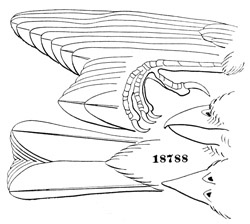
Pyrgita domestica. 18788
Sp. Char. Male. Above chestnut-brown; the interscapular feathers streaked by black on inner webs; the top of head and nape, lower back, rump, and tail-coverts plain ashy; narrow frontal line, lores, chin, throat, and jugulum black; rest of under parts grayish, nearly white along median region. A broad chestnut-brown stripe from behind eye, running into the chestnut of back; cheeks and sides of neck white; outside of closed wing, pale chestnut-brown, with a broad white band on the middle coverts, and behind showing the brown quills; the lesser coverts dark chestnut like the head stripe. Tail dark brown, edged with pale chestnut. Bill black; feet reddish. Iris brown.
Female. Duller of color, and lacking the black of face and throat; breast and abdomen reddish-ash; cheeks ashy; a yellow-ochre band above and behind the eyes, and across the wings. Head and neck above brownish-ash; body above reddish-ash, streaked longitudinally with black.
Male in winter. The colors generally less distinct. Length, 6.00; wing, 2.85; tail, 2.50; tarsus, .70; middle toe and claw, .60.
The House Sparrow of Europe has been introduced into so many parts of the United States as to render it probable that at no distant day it will have become one of our most familiar species. Brought over to the New World within a comparatively few years, it has commenced to multiply about the larger cities, especially in the environs of New York, as also about Portland, Boston, Newark, and Philadelphia. The first effort made to naturalize it about Washington failed in consequence of the death of three hundred individuals imported by the Smithsonian Institution. A second, however, in 1871, was more successful. One thousand birds were let loose in the public squares of Philadelphia in the spring of 1869. In and about Havana it is said to be common, as also about Great Salt Lake, where it was recently introduced by the Mormons, according to Mr. J. A. Allen.
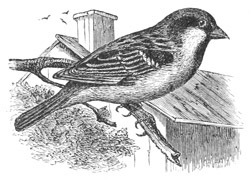
Pyrgita domestica.
Habits. The common House Sparrow of Europe has, within the past few years, achieved a right to a place in the avi-fauna of North America by its complete introduction, and its reproduction in large numbers, in various parts of the country, from Portland, Me., to Washington City, as also about Salt Lake.
The first attempt to introduce these birds, within my knowledge, was made by a gentleman named Deblois, in Portland, Me., in the fall of 1858. Six birds were set at liberty in a large garden in the central part of the city. They remained in the neighborhood through the winter, and in the sheltering porch of a neighboring church they found places of shelter and security. In the following spring three nests were built in dwarf pear-trees in the garden in which they were first set at liberty. One, at least, of these nests, was successfully occupied, and six young birds were reared from it. A second nest, with four young, was also hatched by the same pair. Neither of these nests was globular in shape, but open and coarse, built of hay and straws. These nests were taken, after their use, and came into my possession. Since then I have been informed that these birds increased and multiplied, and for a while were quite abundant in that portion of the city, and a large colony of this Sparrow appeared in the winter of 1871 in Rockland, Me.
Two years later, Mr. Eugene Schieffelin, of New York, imported and set at liberty, near Madison Square, in that city, twelve of these birds, and this he repeated for several successive summers. In 1864, fourteen birds were set at liberty in Central Park, by the Commissioners. Other birds were also brought from England, by different parties, in the Cunard steamers, and released at Jersey City. These have increased very largely, and have spread to the adjoining cities, until these birds have become familiar and social residents in all the large cities and towns within an extended area around New York, as well as in all parts of that city.
They were introduced into Boston by the City Government in 1868. Two hundred birds were purchased in Germany, but unfortunately all died on their passage except about a score. These were set at liberty in June, but, weakened by their sea-voyage, several of them were found dead in the deer-park, and the rest disappeared. The following summer more were imported, but all died except ten. These were well cared for, and only released when in excellent condition. For some months nothing was seen of these birds, and the experiment was supposed to be a failure, when it was ascertained that they had betaken themselves to the vicinity of stables in the southern part of the city, had increased and multiplied in large numbers, reappearing in the winter to the number of one hundred and fifty. They were regularly fed by the city forester each day in the deer-park, and roosted at night in the thatch of the roofs of the buildings. Since then they have very largely increased. About twenty, that same summer, were set at liberty in Monument Square, Charlestown.
In 1869 about one thousand birds were imported, by the City Government, into Philadelphia. Fortunately they came in good condition, and being released early in May immediately separated into scattered parties and prepared for themselves new homes. Some appeared in Morristown and other distant towns in New Jersey. Others wandered to Germantown, and the remoter suburbs of Philadelphia, where they found the cherry-trees in full blossom, and where their exploits in stripping the blooms from the trees gave a not very favorable first impression of these new-comers.
It has been exceedingly interesting to watch the manners and habits of these strangers in their new homes. They have become quite tame, are fearless and gentle, and as they have been very kindly treated live in a condition of semi-domestication. At first they built their nests, and passed their winters, in New York, among the thick ivies that cover the walls of so many churches, in such cases building globular nests. As soon, however, as suitable boxes were prepared for them in sufficient quantities, these were taken possession of in preference to anything else.
At the time of their introduction the shade-trees in the parks and squares of New York, Philadelphia, Brooklyn, Newark, and other places, were greatly infested with the larvæ of the measure-worms that destroyed their foliage. Since then these worms have almost entirely disappeared. A doubt has been expressed whether the Sparrows destroy these insects. That they eat them in the larvæ form I do not know, but to their destruction of the chrysalis, the moth, and the eggs, I can testify, having been eye-witness to the act.
Apprehensions have been expressed lest these new-comers may molest and drive away our own native birds. How this may be when the Sparrows become more numerous cannot now be determined, but so far they manifest no such disposition. Since their introduction into Boston the Chipping Sparrows appear to have increased, and to associate by preference with their European visitors, feeding with them unmolested. I have been unable to detect a single instance in which they have been molested, in any manner, by their larger companions. Their predatory aggressions, however, upon the rights of the common Robin have been noticed, and deserve mention. The Sparrows appear to be extravagantly fond of earthworms, but not able to hunt for them themselves. They have learned to watch the Robin as it forages for these worms, keeping around, at a respectful distance, and as soon as one, with much toil, has dragged a worm from its place of concealment, down swoops the bird and impudently carries it off. The poor bewildered and plundered Robin essays a late and vain attempt to protect its food. The Sparrow is too nimble, and the worm is gone before its rightful owner can turn to face the robber.
The Sparrows endure the severest of the winter weather without any apparent inconvenience, appearing as cheerful, contented, and noisy with the thermometer at zero as at any other time. They are quite fearless, especially in New York, running about under the feet of the passers-by with perfect indifference and confidence. In Boston I have noticed their nests in convenient places, a few feet above crowded sidewalks. In winter they come regularly about the houses to be fed.
The House Sparrow has also been introduced into Australia, where it has become acclimated, and was, at the last accounts, rapidly increasing in that quarter. It is likewise very common about Havana, Cuba.
In the Old World this bird has a widely extended area of distribution, and is resident wherever found. It is very abundant in the British Islands and throughout the northern and central portions of Europe. In Spain and in Italy it is replaced by two closely allied species or races. This bird, however, is also found in North Africa, in the Levant, at Trebizonde, and among the mountains of Nubia. Specimens have also been received from the Himalayas, from Nepaul, and the vicinity of Calcutta.
Both in Europe and in this country the Sparrows pair early in the season. I have known them sitting on their eggs, in Boston, in March. They are very prolific, have broods of five, six, and even seven at a time, three or four times in a season. They are full of life and animation, somewhat disposed to brief and noisy quarrels, which are always harmless.
Their great attachment and devotion to their young is dwelt upon by all English writers as quite remarkable. They evince a great partiality for warmth, and even in midsummer line their nests with all the feathers they can pick up. In New York it is a favorite amusement with the children to carry with them to the public parks quantities of feathers, which they throw, one by one, to the Sparrows, to witness their amusing contests for possession.
The eggs of this bird are oval in shape, pointed at one end, with a ground of a light ashen color, blotched, dotted, and streaked with various shades of ashy and dusky brown. They measure from .85 to .95 of an inch in length, and from .60 to .65 in breadth.
Subfamily SPIZELLINÆ.—The Sparrows.
Char. Bill variable, usually almost straight; sometimes curved. Commissure generally nearly straight, or slightly concave. Upper mandible wider than lower. Nostrils exposed. Wings moderate; the outer primaries not much rounded. Tail variable. Feet large; tarsi mostly longer than the middle toe.
The species are usually small, and of dull color, though frequently handsomely marked. Nearly all are streaked on the back and crown, often on the belly. None of the United States species have any red, blue, or orange, and the yellow, when present, is as a superciliary streak, or on the elbow edge of the wing.
In the arrangement of this subfamily, as of the others belonging to the Fringillidæ, we do not profess to give anything like a natural system, but merely an attempt at a convenient artificial scheme by which the determination of the genera may be facilitated.
A. Tail small and short; considerably or decidedly shorter than the wings, owing either to the elongation of the wing or the shortening of the tail. Lateral toes shorter than the middle without its claw. Species streaked above and below. (Passerculeæ.)
a. Thickly streaked everywhere above, on the sides, and across the breast. Wing pointed; longest primaries considerably longer than the secondaries. Tail forked.
Centronyx. Hind claw very large; rather longer than its digit. The hind toe and claw, together, as long as or longer than the middle toe and claw. Other toes as in Passerculus. Claws gently curved. Tertials shorter than the secondaries. Tail forked, but the lateral feathers shorter.
Passerculus. Hind claw as long as its digit; the toe equal to the middle one without its claw; lateral toes falling considerably short of the middle claw. Wings very long; first primary longest. Tertials as long as the primaries. Tail forked; feathers acute.
Poocætes. Hind claw shorter than its digit; the whole toe less than the middle toe without its claw. Lateral toes nearly equal to the middle one, without its claw. Tertials but little longer than secondaries. Tail stiffened, forked; feathers acute, outer ones white.
b. Moderately streaked above, on the sides, and on the breast, the latter sometimes unstreaked; the dorsal streaks broader, the others fainter than in the last. Wings short, reaching a little beyond the base of the tail. Not much difference between the primaries and secondaries. Tail short, graduated, and the feathers lanceolate, acute.
Coturniculus. Bill short; thick. Tertials almost equal to the primaries; truncate at the end. Claws small, weak; hinder one shorter than its digit. Outstretched feet not reaching the tip of the tail. Tail-feathers not stiffened. (In one species tail nearly equal to the wing.)
Ammodromus. Bill slender, small at base, and elongated. Tertials not longer than the secondaries; rounded at the tip. Claws large, hinder one equal to its digit. Outstretched toes reaching considerably beyond the end of the stiffened, almost scansorial tail.
B. Tail longer and broader; nearly or quite as long as, sometimes a very little longer than, the wings, which are rather lengthened. The primaries considerably longer than the secondaries. None of the species streaked beneath, and the back alone streaked above. (Spizelleæ.)
a. Tail rounded or slightly graduated.
Chondestes. Tail considerably graduated, not emarginated. Lateral toes considerably shorter than the middle toe, without its claw. Wings very long, decidedly longer than the tail, reaching the middle of the tail. First quill longest. Head striped. Back streaked. White beneath. A white blotch on the end of the tail-feathers.
Zonotrichia. Tail moderately graduated. Wings moderate, about as long as the tail, reaching about over the basal fourth of the tail; first quill less than the second to fourth. Feet large. Head striped with black and white, or with brown and ochraceous. Back streaked.
Junco. Tail very nearly equal to the wings, slightly emarginate, and decidedly rounded. Outer toe rather longer than inner, reaching the middle claw. No streaks anywhere except in young; black or ash-color above; belly white; with or without a rufous back and sides. Outer tail-feathers white.
Poospiza. Tail lengthened, slightly graduated; the feathers unusually broad to the end. Bill slender. Wings about as long as the tail, reaching but little beyond its external base. Tertials broad, and, with the secondaries, rather lengthened. Second to fifth quills nearly equal, and longest. Bill dark lead-color. Tail black. Uniform ashy-brown above; white beneath. Sides of head with stripes of black and white.
b. Tail decidedly forked; a little shorter than the wing, sometimes a little longer.
Spizella. Size rather small. Wings long. Lower mandible largest. Uniform beneath, or with a pectoral spot or the chin black.
C. Tail lengthened and graduated; decidedly longer than the wings, which are very short, scarcely extending beyond the external base of the tail. Feet reaching but little beyond the middle of the tail. Species all streaked above; streaked or nearly unicolor beneath. No white on wings or tail. Outer lateral toe the longer. First quill not the shortest of the primaries. (Melospizeæ.)
Melospiza. Culmen and commissure nearly straight. Claws stout; hinder one as large as its digit. Tail-feathers rather broad. Body streaked beneath.
Peucæa. Culmen and commissure curved. Claws weak; hinder one not much curved, decidedly shorter than its digit. Tail-feathers narrow. Without streaks beneath, excepting a narrow maxillary stripe.
D. Tail rather short, and much graduated; longer than the wings; the midrib more median. Culmen curved. Tarsus considerably longer than middle toe. Outer toe longer. But little difference in the length of the quills; the outer ones much rounded; even the second quill is shorter than any other primary except the first.
Embernagra. Color, olive-green above.
Genus CENTRONYX, Baird.
Centronyx, Baird, Birds N. Am. 1858, 440. (Type, Emberiza bairdi, Aud.)
Gen. Char. Bill elongated; the lower mandible smaller; outlines nearly straight. Tarsus lengthened, considerably exceeding the middle toe. Lateral toes equal, not reaching the base of the middle claw. Hind toe very large; the claw rather longer than its digit, and in its elongation resembling Plectrophanes, but more curved; the digit and claw together rather longer than the middle toe and claw. Wings very long, reaching beyond the middle of the tail, and beyond the end of the coverts. Tertials shorter than the primaries, and but little longer than the secondaries. Tail short, much less than from the carpal joint to end of secondaries; little more than two thirds the entire wing. It is slightly forked, and moderately rounded laterally; the feathers all acute. Color somewhat as in Passerculus.
This genus differs from Passerculus, as stated in the description of the species farther on. It would be taken for Plectrophanes on account of its lengthened hind claw, which, however, is more curved than in that genus; the tarsi are much longer, the tertials less elongated, and the coloration different, though closely resembling that of the female Plectrophanes. But one species has thus far been recognized.
Centronyx bairdi, Baird.
BAIRD’S BUNTING.
Emberiza bairdi, Aud. Birds Am. VII, 1843, 359, pl. d., Coturniculus bairdi, Bon. Syn. 1850, 481. Centronyx bairdi, Baird, Birds N. Am. 1858, 441.
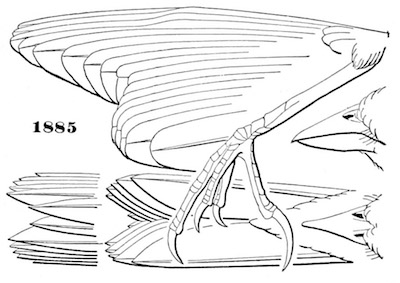
Centronyx bairdi, Baird. 1885
Sp. Char. Somewhat similar in general appearance to Passerculus savanna. Back grayish, streaked with dusky. Crown nearly covered by black streaks, but divided by a broad median band of brownish-yellow. Eyelids and a faint superciliary stripe yellowish-white. Beneath white, with a maxillary blackish stripe and some narrow streaks on the upper part of the breast, and sides of the throat and body. Outer edges and tips of tail-feathers white; the two outer feathers obsoletely white. Bend of wing white. Length, 4.75; wing, 2.80; tail, 2.20.
Hab. Mouth of the Yellowstone River. One specimen only known.
This species has somewhat of the general appearance of Passerculus savanna, but with important differences both of form and color. The bill is much longer, and more slender in proportion. The wings are quite unusually long; the primaries more than half an inch longer than the tertiaries; the first quill as long as the fourth, and but little less than the second and third. The tail is very short; the feathers narrow and pointed. The feet are large; the hind claw very long and considerably curved, as are the other claws generally.
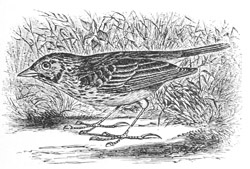
Centronyx bairdi.
The species was based by Mr. Audubon on a skin brought by him from the mouth of the Yellowstone River, in 1843, in rather defective and worn plumage. This has hitherto served as the basis of all the descriptions of the species which is justly considered one of the rarest in the North American fauna.
Habits. In regard to the habits, distribution, or general history of this very rare species, but little is known, only one specimen having been met with. This was procured by Mr. Audubon’s party to the Yellowstone River, in Dakota, on the last day of July, 1843. That it is a resident where obtained, certainly during the breeding-season, is a natural inference from the circumstances of its capture. That it may be a common bird in certain other portions of the region, immediately north of Dakota, is quite probable. Its close habits, as described by Mr. Audubon, favor its escaping notice wherever it may exist.
The specimen was met with in a wet place, overgrown closely by a kind of slender rush-like grass, from the midst of which the notes of these birds were heard, and at first mistaken for those of the Marsh Wren. A search was immediately instituted for the singers, which Mr. Bell soon ascertained could not be the Wren in question, the notes being much softer and more prolonged. Much difficulty was encountered in the endeavor to raise them from the long close grass to which they closely confined themselves, and they were several times nearly trodden on before they would take wing, almost instantaneously realighting within a few steps, and running like mice through the grass. After a while two were shot while on the wing, and proved to be adult male and female. The party found this species quite abundant in all such situations, and there seems to have been no doubt that it was breeding.
Genus PASSERCULUS, Bonap.
Passerculus, Bonap. Comp. List Birds, 1838. (Type, Fringilla savanna.)
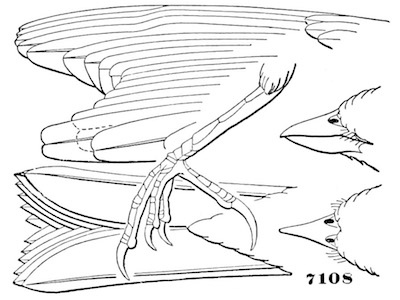
Passerculus savanna. 7108
Gen. Char. Bill moderately conical; the lower mandible smaller; both outlines nearly straight. Tarsus about equal to the middle toe. Lateral toes about equal, their claws falling far short of the middle one. Hind toe much longer than the lateral ones, reaching as far as the middle of the middle claw; its claws moderately curved. Wings unusually long, reaching to the middle of the tail, and almost to the end of the upper coverts. The tertials nearly or quite as long as the primaries; the first primary longest. The tail is quite short, considerably shorter than the wings; as long as from the carpal joint to the end of the secondaries. It is emarginate, and slightly rounded; the feathers pointed and narrow.
The essential characters of this well-marked genus lie in the elongated wings, longer than the tail, the tertiaries equal to the primaries, the first quill almost longest. The legs are long, the outstretched toes reaching to the end of the tail; the lateral toe considerably shorter than the middle, which is not much longer than the hinder. The tail is short, narrow, and emarginate; the feathers acute.
Species and Varieties.
Common Characters. Above grayish-brown, beneath white; whole upper surface, as well as the breast and sides, streaked with dusky. A light superciliary stripe, and a whitish maxillary one, the latter bordered above and below by stripes of coalesced dusky streaks.
A. Bill small, the culmen slightly concave in the middle portion; a median light stripe on the crown.
1. P. savanna. Superciliary stripe yellow anteriorly; streaks on the back blackish, sharply defined.
Throat and upper part of abdomen unstreaked; vertex-stripe without yellow tinge.
Bill .34 from forehead and .25 in depth at the base; wing, 2.85; tail, 2.30. Colors deep; outer surface of wing (in spring) decidedly reddish. Hab. Eastern Province of North America … var. savanna.
Bill, .32 and .20, or less; wing, 2.75; tail, 2.10. Colors very pale; outer surface of wing (in spring) pale ashy. Hab. Western Province of North America, except coast of California, where replaced by var. anthinus … var. alaudinus.
Bill, .37 and .27, or considerably more; wing, 3.10; tail, 2.40. Colors as in savanna. Hab. Northwest coast of North America. … var. sandwichensis.
Throat and upper part of abdomen streaked; vertex-stripe strongly tinged with yellow.
Bill, .33 and .19; wing, 2.50; tail, 1.90. Colors darker than var. savanna, the ground-color more uniform, and the black streaks heavier and more numerous. Hab. Coast of California. … var. anthinus.
2. P. princeps. Superciliary stripe white anteriorly; streaks on the back sandy-brown, badly defined. Wing, 3.25; tail, 2.60; bill, .45 and .23; tarsus, .95; middle toe, .80. Hab. Eastern Massachusetts (northern regions in summer?).
B. Bill robust, the culmen arched; no median light stripe on the crown. Superciliary stripe white anteriorly; streaks on the back sandy-brown, obsolete.
3. P. rostratus.
Bill, .43 and .30; wing, 2.90; tail, 2.25. Ground-color above fulvous-gray, beneath white; the streaks, above and below, sandy-brown. Colors much as in P. princeps. Hab. Coast of California, to the mouth of the Colorado River; Cape St. Lucas in winter … var. rostratus.
Bill, .33 and .22; wing, 2.55; tail, 2.00. Ground-color above plumbeous-gray; beneath white; streaks blackish-brown. Hab. Cape St. Lucas (resident?) … var. guttatus.
Passerculus savanna.
A careful examination of the very large series of Passerculus allied to savanna in the museum of the Smithsonian Institution, recently made, brings us to the same conclusion as that reached in 1858, namely, that, granting a single species extending over the whole of North America, there are several geographical races in different regions. Thus, taking the eastern bird as the standard, with its dark colors, reddish wings, and deep yellow superciliary stripe, and the comparative or entire absence of spots on the lower part of breast, we have in the middle province, and to some extent in the western, a race rather smaller, with more attenuated and longer bill, and paler colors; the wings grayish, the yellow of head being scarcely appreciable (var. alaudinus). On the coast of California, another series of the size and proportions of the last, but with dark yellow superciliary stripe,—the vertex-stripe even yellowish,—dark colors, and the lower part of breast, as well as the throat, decidedly streaked, as well as the jugulum (var. anthinus); and finally on the northwest coast, from Puget Sound to Kodiak, a fourth race, much larger than typical P. savanna, but absolutely undistinguishable in color, proportion of bill, etc. (var. sandwichensis). P. anthinus is not found north of California, but the other two of the western race may occur together at any point of the coast north, perhaps, of the Columbia River.
Passerculus savanna, Bonap.
SAVANNA SPARROW.
Fringilla savanna, Wilson, Am. Orn. III, 1811, 55, pl. xxii, f. 2.—Ib. IV, 1811, 72, pl. xxxiv, f. 4.—Aud. Orn. Biog. II, 1834, 63; V, 1839, 516, pl. cix. Passerculus savanna, Bon. List, 1838.—Ib. Conspectus, 1850, 480.—Cab. Mus. Hein. 1851, 131.—Baird, Birds N. Am. 1858, 442.—Coues, P. A. N. S. 1861, 223.—Samuels, 301. Emberiza savanna, Aud. Syn. 1839, 103.—Ib. Birds Am. III, 1841, 68, pl. clx. ? Fringilla hyemalis, Gm. I, 1788, 922.—Licht. Verzeichniss, 1823, No. 250. Gmelin’s description, based on Pennant Arctic Zoöl. II, 376 (winter Finch), applies equally well to a large number of species. Linaria savanna, Richardson, List, 1837.
Sp. Char. Feathers of the upper parts generally with a central streak of blackish-brown; the streaks of the back with a slight rufous suffusion laterally; the feathers edged with gray, which is lightest on the scapulars, and forms there two gray stripes. Crown with a broad median stripe of yellowish-gray. A superciliary streak from the bill to the back of the head, eyelids, and edge of the elbow, yellow, paler behind. A yellowish-white mandibular stripe curving behind the ear-coverts, and margined above and below by brown. The lower margin is a series of thickly crowded spots on the sides of the throat, which are also found on the sides of the neck, across the upper part of the breast, and on the sides of body, a dusky line back of the eye, making three on the side of head (including the two mandibular). A few faint spots on the throat and chin. Rest of under parts white. Outer tail-feathers and primaries edged with white. Length, 5.50; wing, 2.70; tail, 2.10.
Young. Ground-color of the upper parts (except wings and tail) light ochraceous, more brownish on top of head, upper part of back, and on upper tail-coverts; the streaks blacker and more conspicuous than in the adult. Beneath with an ochraceous tinge anteriorly, the streaks broader, and deeper black, than in the adult, though less sharply defined. The infra-maxillary streak expanded into a broad blackish elongated blotch.
Hab. Eastern North America to the Missouri plains, and northwest to Alaska. Cuba, winter (Cab. Jour. IV, 6).
Specimens vary considerably in size, color, and shape of bill, but the average is as described. Spring birds have the markings sharper and clearer, the dark streaks with little or no suffusion of rufous.
Habits. The Savanna Sparrow is an abundant species throughout North America, from the Atlantic sea-board to the Great Plains. It is, however, everywhere much less common in the interior than nearer the shore. The Smithsonian specimens are from points as far south as Georgia and Louisiana, and as far west as the Black Hills of Wyoming. It passes north through Massachusetts, from the first to the middle of April, and some remain to breed in the eastern part of the State. Mr. Maynard speaks of it as a common summer resident. This, however, is true only of a few restricted maritime localities, but is not so of the entire eastern portion of the State. It occurs both in the salt marshes of Charles River and in the vicinity of Fresh Pond, but I could never trace it in any of the neighboring towns. It is occasionally met with in inland situations where we would not naturally look for it. In the summer of 1869, Mr. William Brewster found quite a colony of these birds in an open field near the Glen House, at the foot of Mt. Washington. They had nests with eggs the last of July and the first of August.
In Western Massachusetts, according to Mr. Allen, it rarely or never stops to breed. In Western Maine, Mr. Verrill mentions it as a common summer visitant, and as breeding there in the latter part of May. In the vicinity of Eastport, and in all the islands of the Grand Menan group, I found these Sparrows very abundant. They almost invariably built their nests in depressions on the edge or just under the projecting tops of high bluffs of land near the sea. They were by far the most abundant of the land-birds, and it was quite common to find their nests in close proximity one to another. They arrive there in April, and leave in September, passing slowly south more in reference to the abundance of their food than the severity of the season, until the weather becomes very severe, when they all disappear. They winter in the Southern States, from Virginia to Georgia, and are especially abundant in the Carolinas. Dr. Coues states that they were very common about Columbia from October to April, moving in large flocks and associating with other species. Wilson states that he met with this species, from Savannah to New York, in all the low country, and regarded it as resident in those places, but rarely found at a distance from the sea-shore. He found them especially numerous at Great Egg Harbor, N. J.
Dr. Coues, in his visit to Labrador, in 1860, found this Sparrow abundant in that region in low moist meadows and marshy tracts near the sea-shore, but never noticed it in any other situations. He frequently observed it there feeding on the beds of dried eel-grass along the rocky shores, searching for food in company with the Titlarks and small Sandpipers.
During my visits to the islands of the Bay of Fundy, in one of which I remained a number of days, I had a good opportunity to notice these birds. In many respects their habits undergo noticeable changes during the breeding-season. As they pass north or south in their migrations, they are not particularly shy or difficult to approach, but when they had nests they seemed to become particularly cautious and mistrustful. The male and female sat by turns upon their eggs, but generally one remained within hailing distance, and always gave promptly a signal of danger when the nest was approached, at which the other would glide from the nest, running off on the ground like a mouse. I found it impossible to identify by shooting the parent on the nest, and only accomplished its identification by means of snares. When once lost in the tall grass, it was impossible to find it again, or if it reappeared it was impossible to tell which of the many chirping Sparrows, all of them out of reach of shot, and keeping a sharp lookout on my movements, had any connection with the nest. This manœuvre was gone through with in every nest I found, but I soon learned to distinguish them without the need of gun or snare.
This Sparrow is eminently terrestrial, confining itself almost entirely to the ground, and rarely alighting on anything even so high as a fence. Though frequenting low moist grounds, its nest is always in a dry spot and usually somewhat elevated. The nest is almost always sunk into the ground, is made very simply and loosely of dry grasses, with a lining of softer materials of the same. I have never found any other material than this in the many nests I have examined, although nests of var. alaudinus, in the vicinity of Fort Anderson, are frequently lined with feathers or deers’ hair, according to MacFarlane.
The eggs, five or six in number, vary considerably in their appearance. In shape they are a rounded oval, one end being much more pointed than the other. They measure .68 by .55 of an inch. In some the ground-color, which is of a greenish-white, is plainly visible, being only partially covered by blotches of brown, shaded with red and purple. These blotches are more numerous about the larger end, becoming confluent and forming a corona. In others, the ground-color is entirely concealed by confluent ferruginous fine dots, over which are darker markings of brown and purple and a still darker ring of the same about the larger end.
Passerculus savanna, var. alaudinus, Bonap.
WESTERN SAVANNA SPARROW.
Passerculus alaudinus, Bp. Comptes Rendus, XXXVII, Dec. 1853, 918, California.—Ib. Notes Ornithologiques Delattre, 1854, 18 (reprint of preceding).—Baird, Birds N. Am. 1858, 446, pl. xlvi.—Cooper & Suckley, 197, pl. xxviii, f. 2.—Elliot, Illust. Am. B. III.—Dall & Bannister, Tr. Ch. Ac. I, 1869, 284 (Alaska).—Cooper, Orn. Cal. 1, 181. Passerculus savanna and P. anthinus, Dall & Bannister, Tr. Ch. Ac. I, 1869, pp. 283, 284.
Sp. Char. Similar to P. savanna, but smaller; the bill slenderer and more elongated. Little of yellow in the superciliary stripe (most distinct anteriorly); the rest of the head without any tinge of the same. General color much paler and grayer than in P. savanna. Breast with only a few spots. Length, 5.25; wing, 2.75; tail, 2.30.
Hab. Middle and Western Provinces of North America; south to Orizaba, north to Alaska (Kodiak) and the Arctic coast. Oaxaca (Scl. Oct.); Vera Cruz (winter, Sumichrast).
This western race of P. savanna is smaller, considerably paler in general colors, the superciliary stripe with little yellow in it, and the bill more slender, and longer. In coloration, some Atlantic coast specimens often exhibit an approximation, especially in the pale tint of the superciliary stripe; but the bill is always decidedly more attenuated in alaudinus.
The Western Savanna Sparrow is a common species throughout the Western Province of North America, from the plains to California, and from Alaska to Mexico. In California it appears to be replaced along the Pacific coast by the variety anthinus, a quite different and very local form. In Alaska, specimens were obtained by the naturalists of the Russian Telegraph Expedition at various localities, chiefly in the interior, and on the Yukon it was obtained by Mr. Lockhart. Dr. Cooper found it at Fort Steilacoom, in Washington Territory, where it was in company with P. sandwichensis, in the wet meadows. In California this species inhabits chiefly, according to Dr. Cooper, the dry plains of the interior of the State. The statement of the occurrence of this form anywhere along the coast of California should be received with considerable doubt, since in the large series of these birds all specimens from this region are of the variety anthinus, an exclusively littoral type.
Habits. The Western Savanna Sparrow was found throughout the Great Basin, by Mr. Ridgway, in all wet, grassy situations, in which preference it is like its eastern relative. It was very abundant at Carson City, inhabiting exclusively the meadows. At Salt Lake City it was also very abundant, frequenting the wet meadows near the Jordan.
This bird was also obtained at Sitka by Bischoff, and was found on the Yukon by Mr. Lockhart. It is the only species found in the Valley of the Mackenzie, up to the Arctic coast.
Dr. Cooper also met with it among the low meadows of Washington Territory, where they arrived in March, and remained until late in October. They were usually found among the grass, from which they rarely rise, except to sing their faint and lisping trill from a weed or some low bush. Mr. Ridgway represents this song as corresponding with the syllables witz-witz-wih´-tzull. This, he states, is uttered in a weak and lisping manner, as the bird perches on a bush beside the brook, or on a fence, or as it nestles among the grass on the ground.
Dr. Cooper speaks of them as only winter visitants in California, and there residing only on the dry interior plains, as far south as San Diego, where they remain in large flocks until April. He has never met with this bird during the summer months, though some are supposed to remain and breed in the high prairies. He did not meet with any about the summits of the Sierra Nevada, in September. They appeared to prefer the dry rolling prairies to marshes, though they were occasionally found in the latter.
This species is also a migratory visitant to the Department of Vera Cruz, Mexico, where they are said by Sumichrast to pass the winter.
Their nests are built upon the ground, and are composed almost entirely of the dry stems of grasses, and are lined with finer materials of the same. Their eggs measure .75 of an inch in length by .52 in breadth, have a greenish-white ground, over which are distributed numerous markings, spots, and blotches of various sizes, of a light purplish-brown and a deeper red-brown, confluent about the larger end, where they form a crown.
Near Fort Anderson nests were found in great numbers, no less than two hundred and four having been obtained during four summers in that locality. These nests were all taken on the ground, under low grass, in dry spots in a large marshy prairie, and it is stated that they were never found in any other situation or locality.
Passerculus savanna, var. sandwichensis, Baird.
NORTHWESTERN SAVANNA SPARROW.
Emberiza sandwichensis, Gm. I, 1788, 875. Emberiza arctica, Latham, Ind. Orn. I, 1790, 414. Fringilla arctica, Vigors, Zoöl. of Blossom, 1839, 20 (perhaps one of the smaller species).—“Brandt, Icon. Ross. 2, 6.” Euspiza arctica, Bp. Conspectus, 1850, 469. Zonotrichia arctica, Finsch, 1872. Emberiza chrysops, Pallas, Zoög. Rosso-As. II, 1811, 45, tab. xlviii, fig. 1 (Unalaska). Sandwich Bunting, Lath. Syn. II, 1783, 202. Unalaska Bunting, Pennant, Arctic Zoöl. II, 363, 320, No. 229.(not of p. 364, No. 233). Passerculus sandwichensis, Baird, Birds N. Am. 1858, 444.—Dall & Bannister, Tr. Ch. Ac. I, 1869, 284.—Cooper, Orn. Cal. 1, 180. Passerculus savanna, Dall & Bannister, Tr. Ch. Ac. I, 1869, 283.
Sp. Char. Almost exactly like P. savanna, but half an inch longer, with much larger bill. Length, 6.12 inches; wing, 3.00; tail, 2.55. Bill above, .50; below, .36; gape, .56; depth, .27.
Hab. Northwestern coast from the Columbia River to Russian America.
Specimens of this race from Sitka are absolutely undistinguishable from eastern P. savanna except in size; the colors and proportion of bill being the same. A young bird (from Kodiak) differs from that of savanna in larger size, and a bright reddish-fulvous tinge to upper parts, and a deep yellowish-fulvous tinge on jugulum and along the sides.
Habits. This variety is the northwest-coast form of the common Savanna Sparrow, and is found during the summer from Oregon to Alaska. Dr. Suckley states that he found this species an abundant spring visitor at Fort Steilacoom. Dr. Cooper, in his Zoology of Washington Territory, states it to be only a passenger through that section, migrating northward, at the end of April, in pairs, and not returning until the end of September. They come back in flocks, and frequent the shores and prairies along the sea-coast. Their plumage seems to be the same at all seasons. Nothing is known of their note. They are supposed to spend their winters in Southern Oregon and California, though their actual presence has not been detected in either State. They do not remain during the summer near the Columbia, but pass to the north, or to the interior plains east of the Cascade Range. Dr. Cooper states that their habits closely resemble those of P. anthinus.
Mr. Dall states that two specimens of this species were taken at Sitka by Mr. Bischoff.
Passerculus savanna, var. anthinus, Bonap.
CALIFORNIA SHORE SPARROW.
Passerculus anthinus, Bonap. Comptes Rendus, XXVII, Dec. 1853, 919, Russian America.[115]—Ib. Notes Ornith. Delattre, 1854, 19.—Baird, Birds N. Am. 1858, p. 445.—Cooper, Orn. Cal. 1, 1870, 183.
Sp. Char. Similar to P. savanna, but smaller. Beneath tinged with reddish. Breast and upper part of belly thickly spotted with sharply defined sagittate brown spots, exhibiting a tendency to aggregation on the middle of the belly. Superciliary stripe and one in the middle of the crown decided greenish-yellow, the head generally tinged with the same, as also the back and sides of the neck. Under tail-coverts somewhat streaked. Length, 5.00; wing, 2.66; tail, 2.24.
Hab. Coast of California, near San Francisco; “Russian America, Kodiak” (Bonaparte).
This is the most strongly marked of the several races of P. savanna, differing from all the others in several important respects. The markings beneath are more generally dispersed, extending back upon the lower part of the breast, and forward over the throat; the lower tail-coverts have distinct medial blackish streaks, though they are somewhat concealed. The median stripe on the crown is decidedly greenish-yellow, not pale ashy; the whitish edges to the interscapular feathers, so conspicuous in the other races, are more concealed, presenting a more uniformly brown surface above, with broader black stripes. The broad lateral stripes of the crown are deep olive or hair-brown, with narrow, sharply defined, intense black streaks, instead of pale grayish as in alaudinus (spring dress), or light brown as in savanna (spring), with broader, less deep, black streaks.
Habits. The Shore Sparrow of California is said to be, to a remarkable degree, the peculiar marsh species of the Pacific coast of that State. Dr. Cooper states that he very rarely met with these birds out of the salt marshes, where they lie so close and run so stealthily among the weeds that they are flushed with difficulty. They rise only to fly a few rods, and drop again into their covert. They are not at all gregarious, except when migrating, and are found singly or by pairs. They are abundant about San Francisco in the winter, though Dr. Cooper is not sure that any are found so far south in the summer. Near San Diego, in February, they had already begun to utter their short and pleasant song, as they perched on the top of some tall weed. Dr. Cooper observed them in that neighborhood into April, but did not succeed in finding any of their nests, nor was he ever able to meet with this species at San Pedro in summer.
Dr. Coues speaks of (Ibis, 1866, p. 268) finding three species of the difficult group of Passerculi, and all of them very abundant, in Southern California in November. These were P. rostratus, P. alaudinus, and P. anthinus. The anthinus seemed confined to the moist salt grass and sedgy weeds of the sea-shore itself. It was flushed with great difficulty, and then its flight was very rapid and irregular. It would alight again almost immediately, and run with great celerity among the roots of the thick grasses, and was therefore exceedingly difficult to procure. P. alaudinus was common two or three miles away from the coast, but Dr. Coues did not find one mixing with P. anthinus. It was a brush and weed, rather than a grass, species, associating with Anthus ludovicianus and Zonotrichia coronata.
Passerculus princeps, Maynard.
IPSWICH SPARROW.
Centronyx bairdi, Maynard, Naturalist’s Guide, 1870, 117, frontispiece (Ipswich, Mass.). Passerculus princeps, Maynard, American Naturalist, 1872.
Sp. Char. Bill small, exactly the same in form and size as that of Centronyx bairdi; but proportionally smaller; tertials scarcely exceeding the secondaries; tail emarginate, the feathers acute, the intermediæ attenuated terminally. Outstretched feet reaching about half-way to the end of the tail. In color almost exactly like P. rostratus, but different in markings. Above light ashy, the dorsal feathers light sandy-brown centrally, producing an obsoletely spotted appearance; shafts of dorsal feathers black. Outer surface of the wings pale sandy-brown, the feathers darker centrally; tertials with their outer webs whitish, and with a conspicuous black central area. Crown becoming darker brown anteriorly, where it is divided by a rather indistinct line of ochraceous-white; an indistinct superciliary stripe, and a very conspicuous maxillary stripe of the same; the latter bordered above, from the rictus to the end of the auriculars, by a narrow stripe of dusky; lores and sub-orbital region like the superciliary stripe; auriculars pale brownish like the crown, bordered along the upper and lower edge with a dusky narrow stripe. Beneath white, slightly tinged with ashy on the flanks; sides of the throat, whole breast, sides, and flanks, with narrow streaks of sandy-brown, more blackish toward the shaft; abdomen, crissum, and lining of the wing, immaculate; throat with a few minute specks, but along each side bordered by a “bridle” of suffused streaks.
♂. (Collector’s No. 1,744, Ipswich, Mass. Dec. 4, 1868; C. J. Maynard.) Wing, 3.25; tail, 2.60; culmen, .45; tarsus, .95; middle toe, .80; hind claw, .40.
♀. (Collector’s No. 6,245, Ipswich, Oct. 15, 1871; C. J. M.) Wing, 2.90; tail, 2.40; culmen, .50; tarsus, .85; middle toe, .65; hind claw, .30.
(Collector’s No. 6,224, Ipswich, Oct. 14, 1871; C. J. M.) Wing, 3.00; tail, 2.30; culmen, .50; tarsus, .85; middle toe, .60; hind claw, .30.
The specimens described above were at first supposed to be Centronyx bairdi, having several points of resemblance to that species, a comparison with the type in Professor Baird’s collection at first failing to establish a difference, as it was in faded and much worn summer plumage, while the Massachusetts specimens were in perfect, blended fall dress, so that a satisfactory comparison was almost impossible. A more recent examination, however, with the advantage of two additional specimens of the Massachusetts bird, has fully convinced Mr. Maynard that his specimens are not Centronyx bairdi, and that, indeed, they are referrible in all respects to the genus Passerculus.
In carefully examining the type of Centronyx bairdi, it is seen that its characteristic features are the following: Outstretched feet reaching beyond the end of the tail; hind claw as long as its digit, and much curved;—whereas in Mr. Maynard’s specimens the outstretched feet reach to only about the middle of the tail, while the hind claw is much shorter than its digit, and only slightly curved. With a wing .10 to .45 of an inch longer, they have the tarsus not any longer, and proportionally more slender. In coloration they are still more different. The most striking feature in C. bairdi is a broad and very conspicuous median stripe of ochraceous-buff on the crown, bordered on each side by an aggregation of black streaks, which form the predominating color of the lateral stripes; of this median stripe there is scarcely any trace in the specimens under consideration, while the crown generally is grayish-brown, with small dusky streaks; C. bairdi has broad, conspicuous, black stripes on the back, while P. princeps has obsolete sandy-brown ones; in C. bairdi there are only a few small streaks of black across the jugulum and along the sides and flanks, while in P. princeps the whole breast, as well as the sides and flanks, are thickly streaked with broader marks of sandy-brown.
In point of coloration, as well as in the feet, there is in reality a much closer resemblance to Passerculus rostratus; but in this the very different bill and different arrangement of markings are sufficient distinctive characters.
Upon the whole, therefore, there can be little doubt that the present birds are well entitled to the name which Mr. Maynard has given them; for after making all possible allowance for seasonal differences in coloration, we have found it impossible to reconcile them with the C. bairdi.
In this species there is a slight superficial resemblance to Poocætes gramineus; but upon comparison it will be found to be entirely different: thus, P. gramineus lacks the median light stripe on the crown, has the lesser wing-coverts rufous and the lateral tail-feathers white, while the streaks are all blackish and the ground-color different; the generic details, too, are quite different.
Habits. This species has been obtained only in Eastern Massachusetts, where, in the neighborhood of Ipswich, it was found among the sand-hills by the sea-shore. The place where the individuals taken were met with is a rather remarkable tract, three miles in length and nearly one in breadth. It is as treeless as the Great Plains, and as bleak and barren, with no vegetation except a scant growth of coarse grass. Mr. Maynard obtained his first specimen early in December, 1868. Although others were seen, yet this was all he was then able to obtain. He has since taken others in the same place and season. Nothing is known as to its habits. It uttered, as it rose, a short chirp of alarm.
Passerculus rostratus, Baird.
SAN DIEGO SPARROW.
Emberiza rostrata, Cassin, Pr. A. N. Sc. VI, 1852, 348. Ammodramus rostratus, Cassin, Ill. I, 1855, 226, pl. xxxviii. Passerculus rostratus, Baird, Birds N. Am. 1858, 446.—Cooper, Orn. Cal. 1, 1870, 184.
Sp. Char. Bill very long (.55 of an inch above). Whole upper parts and sides of head and neck pale brownish-gray (almost fulvous), nearly every feather with a darker central blotch, darkest along the shaft. A scarcely appreciable central stripe in the crown, an obscure yellowish-white superciliary, and a whitish maxillary one. Under parts pure white; streaked on the breast and the sides of throat and body with dark brown (the streak paler externally). Under tail-coverts unspotted white. Tail and wing feathers and wings margined with the color of the back; the edges of tertiaries rather paler. Length, 5.30; wing, 2.90; tail, 2.30.
Hab. Coast of California, south to Cape St. Lucas; mouth of Colorado River (Dr. Palmer).
The bill of this species is very long and conical, the cutting edge nearly straight. The wings are rather long, the tertiaries nearly as long in the closed wing as the primaries; the second, third, and fourth quills longest, the first rather longer than the fifth. The tail is short and emarginate, the feathers narrow, acute, and moderately stiff. The tarsi are long; the claws little curved.
This species resembles the Passerculus savanna rather more than any of the other sparrows with spotted breasts; the bill is, however, very much longer and larger, exceeding any of our American species of its size, the upper outline more convex. Its colors are much paler, and it lacks the yellow on the head and wing. The much shorter tail and entire absence of rufous distinguish it from the spotted Melospizas. In shape the bill is like that of Ammodromus caudacutus, but it is larger; the head lacks the yellow, etc.
In some specimens the streaks on the back are almost obsolete.
Habits. So far as is known, this bird seems to have a somewhat restricted habitat, being apparently confined to the sea-coast of Southern California. There it was first met with by Dr. Heermann, in the neighborhood of San Diego, and was described by Mr. Cassin as an Ammodromus, with which genus of birds it seemed to have many peculiarities in common. Dr. Heermann first met with this bird in 1851, on the shores of the bay of San Diego, in company with other species, apparently in search of grass-seed. Afterwards, in the Pacific Railroad Survey, with Lieutenant Williamson, he again met with these birds in considerable numbers at Santa Barbara and San Pedro. In all the places in which he met with it he found it frequenting low sandy beaches, and the heavy sedge-grass which abounds on the shores. On the former it seemed to be feeding on marine insects and seeds thrown up by the tide, and in the latter to find places for easy and immediate concealment when alarmed or pursued. Naturally it appeared to be a quiet and unsuspicious bird. He heard it utter no other note than a short sharp chirp.
Dr. Cooper thinks this species has a much greater affinity to the Ammodrami than to the Passerculi, both in its bill and claws, as well as in its habits. He found them very abundant, both at San Pedro and San Diego, at all seasons, and he does not think that they migrate at all from those localities. He found them frequenting the shores of the bays and the sea-beaches. They also came confidently and familiarly about the buildings near the water, feeding on any seeds or insects they could find. On the beach they run along the sand, in the rows of drifted sea-weeds, seeking their food, and rarely take to flight unless surprised, and then only fly a short distance. Dr. Cooper has never known them to alight on any bush, nor does he think that they have any song. The only note he has ever heard them utter is a short chirp. At San Pedro he saw them, in July, feeding their young, but he has never found a nest that he was certain belonged to this species.
Dr. Coues found this bird abundant in Southern California, where it kept among the thick weeds of the dry plain, and was much on the ground, where it ran as easily as a Pipilo, often flying up into the bushes and resting there quietly. They were to be seen also in great numbers sunning themselves and catching flies on the piles of lumber on the wharf, so tame as to be almost liable to be struck by a cane.
It is a winter resident at Cape St. Lucas, where Mr. Xantus found them abundant. They were not seen there in summer, though it is probable they reside on the shores in its neighborhood. Their nest and eggs remain unknown.
Passerculus rostratus, var. guttatus, Lawr.
ST. LUCAS SPARROW.
Passerculus guttatus, Lawrence, Ann. N. Y. Lyc. VIII, 1867, 473.—Cooper, Orn. Cal. 1, 185.
Sp. Char. Above plumbeous-gray; the feathers of the back with dusky centres and paler edges; the top of head also streaked with dusky and with an almost inappreciable median stripe of lighter. Upper tail-coverts slightly darker in the centre. No rufous edgings to the feathers. Head with a pale yellowish-white band from bill over the eye; and a mandibular one, nearly white, bordered above and below by the dusky line of other Passerculus. Under parts white, thickly streaked on jugulum, breast, and flanks with dusky, faintly on under tail-coverts. Bill and legs rather dusky; iris brown. Length, 5.00; wing, 2.50; tail, 1.95; tarsus, .80; middle toe and claw, .75; bill above, .51; gape, .56; greatest height, .25.