Family SYLVICOLIDÆ.—The Warblers. (continued 4)
Reading edition
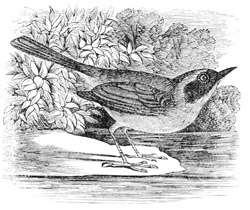
Dendroica palmarum, Baird.
YELLOW RED-POLL WARBLER.
Motacilla palmarum, Gmel. Syst. Nat. I, 1788, 951 (based on Palm Warbler, Latham, Syn. II, p. 498, No. 131. St. Domingo). Sylvia p. Lath.; Vieillot, II, pl. lxxiii.—Bon.; D’Orb. Sagra’s Cuba, Ois. 1840, 61, pl. viii. Sylvicola p. Sallé, P. Z. S. 1857, 231 (St. Domingo). Dendroica p. Baird, Birds N. Am. 1858, 288; Rev. 207.—Sclater, Catal. 1861, 33, No. 199.—Ib. P. Z. S. 1861, 71 (Jamaica; April).—Bryant, Pr. Bost. Soc. VII, 1859 (Bahamas).—Ib. 1867, 91 (Hayti).—Brewer, Pr. Bost. Soc. 1867, 139.—Gundlach, Cab. Jour. 1861, 326 (Cuba; very common).—Samuels, 240. Sylvia petechia, Wils. VI, pl. xxviii, fig. 4.—Bon.; Nutt.; Aud. Orn. Biog. II, pl. clxiii, clxiv. Sylvicola petechia, Swains.; Aud. Birds Am. II, pl. xc. Sylvicola ruficapilla, Bon. Rhimanphus ruf. Cab. Jour. III, 1855, 473 (Cuba; winter).
Sp. Char. Adult in spring. Head above chestnut-red; rest of upper parts brownish olive-gray; the feathers with darker centres, the color brightening on the rump, upper tail-coverts, and outer margins of wing and tail-feathers, to greenish-yellow. A streak from nostrils over the eye, and under parts generally, including the tail-coverts, bright yellow; paler on the body. A maxillary line; breast and sides finely but rather obsoletely streaked with reddish-brown. Cheeks brownish (in highest spring plumage chestnut like the head); the eyelids and a spot under the eye olive-brown. Lores dusky. A white spot on the inner web of the outer two tail-feathers, at the end. Length, 5 inches; wing, 2.42; tail, 2.25. Sexes nearly alike.
Autumnal males are more reddish above; under parts tinged with brown, the axillars yellow.
Hab. Eastern Province of North America to Fort Simpson and Hudson’s Bay; Bahamas, Jamaica, Cuba, and St. Domingo in winter. Not noted from Mexico or Central America.
This species varies considerably in different stages, but can generally be recognized. Immature specimens resemble those of P. tigrina, but differ in the chestnut crown, browner back, less bright rump, brighter yellow of under tail-coverts, smaller blotches on tail, no white bands on the wings, etc., as well as in the shape of the bill.
Habits. The Red-Poll Warbler belongs, in its geographical distribution, to that large class of birds which visit high northern latitudes to breed, passing back and forth over a wide extent of territory, from the West India Islands to the extreme northern portions of the continent. Specimens have been procured from Cuba, Jamaica, St. Domingo, and the Bahamas, in fall, winter, and spring, where, at such times, they seem to be generally quite common. It has not been observed in Mexico or in Central or South America. It has been met with on the western shore of Lake Michigan, but nowhere farther to the west. It has been found in the Red River Settlement, Fort George, Fort Simpson, and Fort Resolution, in the Hudson Bay Territory. It is not known, so far as I am aware, to breed south of latitude 44°. Wilson and Nuttall both state that this bird remains in Pennsylvania through the summer, but they were probably misinformed; at least, there is no recent evidence to this effect. Wilson also states that he shot specimens in Georgia, near Savannah, early in February, and infers that some pass the entire winter in Georgia, which is not improbable, as this bird can endure severe weather without any apparent inconvenience.
There are several marked peculiarities in the habits of this Warbler which distinguish it from every other of its genus. Alone of all the Dendroicæ, so far as is known, it builds its nest on the ground, and is quite terrestrial in its habits, and, notwithstanding the statements of earlier writers, these are quite different from all others of this genus. It has very little of the habits of the Creeper and still less of the Flycatcher, while it has all the manners of the true Ground Warbler, and even approximates, in this respect, to the Titlarks.
My attention was first called to these peculiarities by Mr. Downes of Halifax, in the summer of 1851; and I was surprised to find it nesting on the ground, and yet more to note that in all its movements it appeared fully as terrestrial as the Maryland Yellow-Throat, or the Towhee Finch. Since then Mr. Boardman and other naturalists have found its nest, which is always on the ground.
Mr. MacCulloch, in the fourth volume of the Journal of the Boston Natural History Society, has given an interesting paper upon the terrestrial peculiarities of this species, showing them to be nearly identical with those of the seiuri, with whom he thinks it should be classed. In its terrestrial movements this bird is shown to be quite at home, while other Warblers, when driven by necessity to feed upon the ground, are awkward, and manifest a want of adaptation.
Dr. Henry Bryant, another very close and accurate observer, in his notes on the birds of the Bahamas, referring to this Warbler, speaks of it as extremely abundant, but confined to the sea-shore. “Its habits,” he adds, apparently with some surprise, “are decidedly terrestrial, and it approaches, in this respect, to the Titlarks. They were constantly running along the edges of the road, or else hopping amongst the low branches in the pastures. I did not see a single individual seeking for food amidst the large trees. These birds could be constantly seen running up and down in the market in search of small flies. These they caught either on the ground or else by hopping up a few inches, scarcely opening the wings, and alighting directly.”
Mr. J. A. Allen, in his Birds observed in Western Massachusetts, shows that these peculiarities of habits in this Warbler had not escaped his notice. He speaks of it as “frequenting, in company with D. pinus, the edges of thickets, orchards, and open fields, and is much on the ground.”
Mr. George A. Boardman, writing me from St. Stephen, March, 1867, says: “The Yellow Red-Poll is one of our most common Warblers, and, unlike most other Warblers, spends much of its time feeding upon the ground. It is no uncommon thing to see a dozen or two on the ground in my garden at a time, in early spring. Later in the season they have more of the habits of other Warblers, and are in summer expert flycatchers. In the fall we again see them mostly upon the ground, feeding with the Blue Snowbirds (Junco hyemalis) and the Chipping Sparrow. They breed in old brushy pastures, and very early, nesting alongside of some little knoll, and, I think, always upon the ground. The nest is very warmly lined with feathers.”
Mr. MacCulloch, in the paper already referred to, states that during their autumnal migrations they seem invariably to exhibit the habits of true Sylvicolidæ, gleaning among branches of trees for the smaller insects, and not unfrequently visiting the windows of dwellings in search of spiders and insects.
In their migrations through Massachusetts these Warblers are everywhere quite abundant in the spring, but in their return in autumn are not observed in the eastern part of the State, though very common in the western from September into November, remaining long after all the other Warblers are gone. None remain during the summer.
In Western Maine, Mr. Verrill states, it is quite common both in spring and in fall, arriving in April, earlier than any other Warbler, and again becoming abundant the last of September.
I found it plentiful in the vicinity of Halifax, where it occurs throughout the summer from May to September.
Mr. Ridgway gives this species as perhaps the most numerous of the transient visitants, in spring and fall, in Southern Illinois. It is very terrestrial in its habits, keeping much on the ground, in orchards and open places, and its movements are said to be wonderfully like those of Anthus ludovicianus.
In the vibratory motions of its tail, especially when upon the ground, these birds greatly resemble the Wagtails of Europe. They have no other song than a few simple and feeble notes, so thin and weak that they might almost be mistaken for the sounds made by the common grasshopper.
The Red-Poll usually selects for the site of its nest the edge of a swampy thicket, more or less open, placing it invariably upon the ground. This is usually not large, about three and a half inches in diameter and two and a half in depth, the diameter and depth of the cavity each averaging only half an inch less. The walls are compactly and elaborately constructed of an interweaving of various fine materials, chiefly fine dry grasses, slender strips of bark, stems of the smaller plants, hypnum, and other mosses. Within, the nest is warmly and softly lined with down and feathers.
Mr. Kennicott met with a nest of this bird at Fort Resolution, June 18. It was on the ground, on a hummock, at the foot of a small spruce, in a swamp. When found, it contained five young birds.
Their eggs are of a rounded-oval shape, and measure .70 of an inch in length by .55 in breadth. Their ground-color is a yellowish or creamy-white, and their blotches, chiefly about the larger end, are a blending of purple, lilac, and reddish-brown.
Dendroica discolor, Baird.
PRAIRIE WARBLER.
Sylvia discolor, Vieill. Ois. Am. Sept. II, 1807, 37, pl. xcviii.—Bon.; Aud. Orn. Biog. I, pl. xiv; Nutt.—Lembeye, Aves Cuba, 1850, 32, pl. vi, fig. 2. Sylvicola discolor, Jard.; Rich.; Bon.; Aud. Birds Am. II, pl. xcvii.—Gosse, Birds Jam. 1847, 159. Rhimanphus discolor, Cab. Jour. III, 1855, 474 (Cuba; winter). Dendroica discolor, Baird, Birds N. Am. 1858, 290; Rev. 213.—Newton, Ibis, 1859, 144 (St. Croix).—Bryant, Pr. Bost. Soc. VII, 1859 (Bahamas).—Ib. 1866 (Porto Rico); 1867, 91 (Hayti).—Gundlach, Cab. Jour. 1861, 326 (Cuba; very common).—Samuels, 241. Sylvia minuta, Wilson, III, pl. xxv. fig. 4.
Sp. Char. Spring male. Above uniform olive-green; the interscapular region with chestnut-red centres to feathers. Under parts and sides of the head, including a broad superciliary line from the nostrils to a little behind the eye, bright yellow, brightest anteriorly. A well-defined narrow stripe from the commissure of the mouth through the eye, and another from the same point curving gently below it, also a series of streaks on each side of the body, extending from the throat to the flanks, black. Quills and tail-feathers brown, edged with white; the terminal half of the inner web of the first and second tail-feathers white. Two yellowish bands on the wings. Female similar, but duller. The dorsal streaks indistinct. Length, 4.86; wing, 2.25; tail, 2.10.
First plumage of the young not seen.
Hab. Atlantic region of United States, north to Massachusetts; South Illinois; in winter very abundant throughout all the West India Islands, as far, at least, as the Virgin Islands. Not recorded from Mexico or Central America.
Autumnal specimens have the plumage more blended, but the markings not changed. A young male in autumnal dress is wholly brownish olive-green above, the whole wing uniform; the forehead ashy, the markings about the head rather obsolete, the chestnut spots on the back and the black ones on the sides nearly concealed.
Habits. The Prairie Warbler, nowhere an abundant species, is pretty generally, though somewhat irregularly, distributed through the eastern portion of the United States from Massachusetts to Georgia during its breeding-season. The Smithsonian Museum embraces no specimens taken west of Philadelphia or Washington. I have had its nest and eggs found in Central New York. Mr. Audubon speaks of its occurring in Louisiana, but his accounts of its nesting are so obviously inaccurate that we must receive this statement also with misgivings. Wilson, however, obtained specimens in Kentucky, and gave to it the inappropriate name of Prairie Warbler. Nuttall regarded it as rare in New England, which opinion more careful observations do not confirm. They certainly are not rare in certain portions of Massachusetts. In Essex County, and, according to Mr. Allen, in the vicinity of Springfield, they are rather common. The Smithsonian possesses specimens from the Bahamas, Jamaica, St. Croix, St. Thomas, and other West India islands. Dr. Gundlach speaks of it as common in Cuba. In the Bahamas, Dr. Bryant found these Warblers more abundant than he had ever known them in the United States. In January all the males were in winter plumage, some not having changed by April to their summer costume. He regarded them as constant residents of those islands. They had all paired off by the middle of April.
In the island of St. Croix, Mr. Edward Newton observed these Warblers from the 10th of September to the 27th of March. They were present on the island about two thirds of the year, and while they were found were very common.
In Jamaica, according to Mr. March, they are numerous throughout the entire year, though less abundant during the summer months. They were always plentiful in the gardens about the Malpighia glabra, capturing small insects from the ripe fruit.
Mr. Gosse, on the contrary, regarded it as only a winter visitant of that island, appearing by the 18th of August, and disappearing by the 11th of April. He observed them among low bushes and herbaceous weeds, along the roadside, near the ground, examining every stalk and twig for insects. Others flew from bushes by the wayside to the middle of the road, where, hovering in the air, a few feet from the ground, they seemed to be catching small dipterous insects. Their stomachs were filled with fragments of insects.
Wilson found them usually in open plains and thinly wooded tracts, searching most leisurely among the foliage, carefully examining every leaf or blade of grass for insects, uttering, at short intervals, a brief chirr. They did not appear to be easily alarmed, and he has known one of these birds to remain half an hour at a time on the lower branch of a tree, and allow him to approach the foot, without being in the least disturbed. He found their food consisted of winged insects and small caterpillars.
In 1858, Mr. John Cassin wrote me: “The Prairie Warbler certainly breeds in New Jersey, near Philadelphia. I have seen it all summer for the last twelve years, and have seen the young just able to fly, but never found the nest. It has a very peculiar note, which I know as well as I do the Catbird’s, having often followed and searched it out. It frequents cedar-trees, and I suspect breeds in and about them.”
Dr. Coues found the Prairie Warbler mostly a spring and autumn visitant in the vicinity of Washington, being quite abundant during those seasons. A few were observed to remain during the breeding-season. They arrive earlier than most of this family of birds, or about the 20th of April. He found them frequenting, almost exclusively, cedar-patches and pine-trees, and speaks of their having very peculiar manners and notes.
Both Wilson and Audubon were evidently at fault in their descriptions of the nest and eggs. These do not correspond with more recent and positive observations. Its nest is never pensile. Mr. Nuttall’s descriptions, on the other hand, are made from his own observations, and are evidently correct. He describes a nest that came under his observation as scarcely distinguishable from that of the D. æstiva. It was not pensile, but fixed in a forked branch, and formed of strips of the inner bark of the red cedar, fibres of asclepia, and caterpillars’ silk, and thickly lined with the down of the Gnaphalium plantagineum. He describes the eggs as having a white ground, sharp at one end, and marked with spots of lilac-purple and of two shades of brown, more numerous at the larger end, where they formed a ring. He speaks of their note as slender, and noticed their arrival about the second week of May, leaving the middle of September.
At another time Mr. Nuttall was attracted by the slender, filing notes of this bird, resembling the suppressed syllables ’tsh-’tsh-’tsh-’tshea, beginning low and gradually growing louder. With its mate it was busily engaged collecting flies and larvæ about a clump of locust-trees in Mount Auburn. Their nest was near, and the female, without any precautions, went directly to it. Mr. Nuttall removed two eggs, which he afterwards replaced. Each time, on his withdrawal, she returned to the nest, and resorted to no expedients to entice him away.
Several nests of this Warbler have been obtained by Mr. Welch in Lynn. One was built on a wild rose, only a few feet from the ground. It is a snug, compact, and elaborately woven structure, having a height and a diameter of about two and a half inches. The cavity is two inches wide and one and a half deep. The materials of which the outer parts are woven are chiefly the soft inner bark of small shrubs, mingled with dry rose-leaves, bits of vegetables, wood, woody fibres, decayed stems of plants, spiders’ webs, etc. The whole is bound together like a web by cotton-like fibres of a vegetable origin. The upper rim of this nest is a marked feature, being a strongly interlaced weaving of vegetable roots and strips of bark. The lining of the nest is composed of fine vegetable fibres and a few horse-hairs. This nest, in its general mode of construction, resembles all that I have seen; only in others the materials vary,—in some dead and decayed leaves, in others remains of old cocoons, and in others the pappus of composite plants, being more prominent than the fine strips of bark. The nests are usually within four feet of the ground. The eggs vary from three to five, and even six.
The late Dr. Gerhardt found this bird the most common Warbler in Northern Georgia. There its nests were similar in size, structure, and position, but differed more or less in the materials of which they were made. The nests were a trifle larger and the walls thinner, the cavities being correspondingly larger. The materials were more invariably fine strips of inner bark and flax-like vegetable fibres, and were lined with the finest stems of plants, in one case with the feathers of the Great Horned Owl. In that neighborhood the eggs were deposited by the 15th of May.
In Massachusetts the Prairie Warbler invariably selects wild pasture-land, often not far from villages, and always open or very thinly wooded. In Georgia their nests were built in almost every kind of bush or low tree, or on the lower limbs of post-oaks, at the height of from four to seven feet. Eggs were found once as early as the 2d of May, and once as late as the 10th of June. The birds arrived there by the 10th of April, and seemed to prefer hillsides, but were found in almost any open locality.
In Southern Illinois, Mr. Ridgway cites this species as a rather rare bird among the oak barrens where it breeds. He also met with it in orchards in the wooded portions, in April, during the northward migration of the Sylvicolidæ.
The eggs are of an oval shape, pointed at one end, and measure .68 by .48 of an inch. They have a white ground, marked with spots of lilac and purple and two shades of umber-brown.
Subfamily GEOTHLYPINÆ.
Section SEIUREÆ.
The diagnosis of the subfamily will be found on page 178. The Seiureæ, as there stated, have the wings pointed, and rather longer than the nearly even tail, which is unspotted. The genera differ in proportion rather than absolutely, Oporornis having longer wings and larger claws. The coloration, however, is always distinctive, as follows:—
Under part white or whitish, thickly streaked … Seiurus.
Beneath yellow, without spots … Oporornis.
Genus SEIURUS, Swainson.
Seiurus, Swainson, Zoöl. Jour. III, 1827, 171. (Sufficiently distinct from Sciurus.) (Type, Motacilla aurocapilla, L.)
Henicocichla, Gray, List of Genera, 1840.
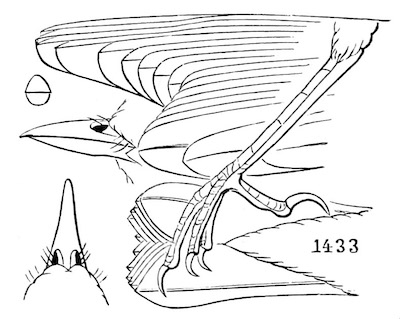
Seiurus aurocapillus. 1433
Gen. Char. Bill rather sylvicoline, compressed, with a distinct notch. Gonys ascending. Rictal bristles very short. Wings moderate, about three quarters of an inch longer than the tail; first quill scarcely shorter than the second. Tail slightly rounded; feathers acuminate. Tarsi about as long as the skull, considerably exceeding the middle toe. Under tail-coverts reaching within about half an inch of the end of the tail. Color above olivaceous; beneath whitish, thickly streaked on the breast and sides. Wings and tail immaculate. Nests on the ground, often arched or sheltered by position or dry leaves. Eggs white, marked with red, brown, and purple.
This genus is decidedly sylvicoline in general appearance, although the spots on the breast resemble somewhat those of the Thrushes. The three species may be grouped as follows:—
A. Middle of crown brownish-orange, bordered by blackish. No white superciliary streak … S. aurocapillus.
B. Crown like the back. A well-defined superciliary light stripe.
Thickly streaked beneath, including crissum. Ground-color and superciliary stripe yellowish. Bill small … S. noveboracensis.
Sparsely streaked beneath; throat and crissum immaculate. Ground-color and superciliary stripe white. Bill very large … S. ludovicianus.
Seiurus aurocapillus, Swains.
GOLDEN-CROWNED THRUSH.
Motacilla aurocapilla, Linn. S. N. I, 1766, 334. Turdus aur. Lath.; Wils. Am. Orn. II, pl. xiv, fig. 2.—Aud. Orn. Biog. II, pl. cxliii. Sylvia aur. Bon. Seiurus aur. Swainson, Zoöl. Jour. III, 1827, 171.—Baird, Birds N. Am. 1858, 260; Rev. 214.—Moore, P. Z. S. 1859, 55 (Honduras).—Max. Cab. Jour. 1858, 177.—Jones, Nat. Bermuda, 27. Henicocichla aur. Sclater, Catal. 1861, 25, No. 159.—Gundlach, Cab. Jour. 1861, 326 (Cuba). Seiurus aur. D’Orb. Sagra’s Cuba, 1840, 55.—Dall & Bannister, Tr. Chic. Ac. I, 1869, 278 (Alaska).—Samuels, 218. Turdus coronatus, Vieill. Ois. II. 1807, 8.
Other localities quoted: Cordova, Sclater, P. Z. S. 1856, 293. St. Domingo, Sallé, P. Z. S. 1857, 231. Guatemala, Sclater & Salvin, Ibis, I, 1859, 10. Santa Cruz (winter), Newton, Ibis, 1859, 142. Cuba (winter), Cab. Jour. III, 471. Jamaica, Gosse, Birds, 152.—Sclater, P. Z. S. 1861, 70. Costa Rica, Cab. Jour. 1861, 84. Orizaba (winter), Sumichrast. Yucatan, Lawr. Chiriqui, Salv.
Sp. Char. Above uniform olive-green, with a tinge of yellow. Crown with two narrow streaks of black from the bill, enclosing a median and much broader one of brownish-orange. Beneath white; the breast, sides of the body, and a maxillary line, streaked with black. The female and young of the year are not appreciably different. Length, 6.00; wing, 3.00; tail, 2.40.
Hab. Eastern Province of North America, north to English River, H. B. T., and Alaska; west to mouth of Platte, and Denver City, Colorado; Mazatlan; whole West Indies; Eastern Mexico; Honduras, Guatemala, and Costa Rica; Bermuda in autumn and winter (Jones).
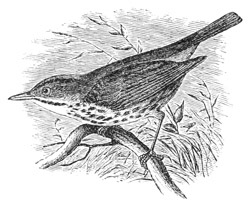
Seiurus aurocapillus.
Habits. The Golden-crowned Thrush, or Oven-Bird, as in some portions of the country it is exclusively called, inhabits the whole of eastern North America, as far to the west as the Great Plains, and to the north at least as far as English River. In the winter season it has been found in Mexico, St. Domingo, Jamaica, Cuba, and other West India islands, and in Central America is also very common. Mr. Sumichrast also speaks of it as common at Orizaba during the same season, and it has been found in the Bermudas and the Bahamas. In all these places it usually appears early in the autumn and remains until the ensuing spring. It breeds as far to the north as it has been known to go. Richardson met with its nest on the banks of the Saskatchewan, and was convinced that it bred at even still higher latitudes. Among some memoranda I received from the late Mr. Kennicott is one stating that he met with this Thrush breeding near English River, July 15. These birds arrive in the fur country about the first of May. How far to the south they breed we have no positive information. I have never received its eggs from any point south of Philadelphia, nor did I ever meet with it or hear its notes in summer in the vicinity of Washington. Audubon was of the opinion that a few remain to breed even in Louisiana, and states that he found them abundant in Texas in the middle of May, but he may have confounded this species with the Louisiana Thrush.
In Jamaica, where its habits have been carefully studied by Mr. Gosse, it arrives in September and leaves about the 20th of April. Mr. Würdemann obtained specimens at Cape Florida, September 24 and 25. Mr. Audubon mentions their appearing in Louisiana as early as the first of March. Wilson never noticed it in Louisiana before the last of April, nor after September. The Smithsonian possesses no specimen obtained earlier than May 1, except some procured April 25 from the mouth of Platte River. Mr. Allen notes its arrival in Western Massachusetts May 10. Mr. Verrill gives the early part of May as the time of its reaching Western Maine, and Mr. Boardman May 1 for the vicinity of Calais.
Though not found on the California coast, specimens of this bird have been taken in winter near Mazatlan, Mexico, showing probably that in their migrations they cross the mountains of Northern Mexico, as do the Mniotilta varia and a few other of our Eastern species.
In Eastern Massachusetts it usually appears from the 1st to the 10th of May, just as the first leaves of the trees are expanding, and is to be found only in thick woods, often near their edges. Occasionally found perched on the low limbs of trees, it is quite terrestrial in its habits, keeps a good deal on the ground, running about among the fallen leaves, more in the manner of a small quadruped than a bird. Mr. Audubon speaks of its frequenting shady woods, watered by creeks and rivulets. I have found them rather more abundant in woods upon high and dry ground, usually upon slopes of wooded hillsides. In this respect it appears to differ in a marked manner from its near of kin, the Water Thrush (S. noveboracensis).
This bird, and indeed all of this genus, have the peculiar vibratory motions of the tail noticed in the Wagtail of Europe, and also observed in our own Red-poll Warbler, and in the Titlarks. In consequence of these peculiarities this species is known, in Jamaica, as Land Kickup, and the noveboracensis as the Water Kickup. Mr. Gosse found in its stomach gravel, various seeds, mud-insects, caterpillars, and small turbinate shells.
The usual and more common song of this species is a very peculiar and striking one, unlike that of any other of our birds. It is said to somewhat resemble the song of the Accentor modularis of Europe. It is loud and clear, enunciated with great rapidity, and uttered with great emphasis at its close. It is characterized by energy and power, rather than variety or sweetness, yet it is not unpleasing. Audubon calls it a “simple lay,” and again “a short succession of simple notes,”—expressions that would give one who had never heard its song an altogether incorrect idea of its true character. Wilson is still more in error when he states that this bird has no song, but an energetic twitter, when, in fact, it has two very distinct songs, each in its way remarkable. Nuttall describes its song as “a simple, long, reiterated note, rising from low to high, and shrill”; Richardson speaks of it as “a loud, clear, and remarkably pleasing ditty”; and Mr. Allen calls it “a loud, echoing song, heard everywhere in the deep woods.” In reference to the songs of this bird, and the injustice that has been done by writers to this and other species of our birds, Mr. Boardman of St. Stephen has written me the following just observations.
“Many of our common Warblers, Thrushes, and other birds, have rare songs they reserve for some extra occasions, and many of our common birds do not get credit for half their real power of song. Once last spring, as I was watching for some birds, I heard a new and very pretty warble, something like the trill of a Winter Wren, and found that it came from our common slate-colored Snowbird (Junco hyemalis), a bird that I see every day that I go to the woods, and yet these notes I had never heard before. It is the same with the Golden-crowned Thrush. When it gets into the top of a tall tree, its strain is so rare and beautiful that but few know it as from that bird. The same is true of the Water Thrush, and also of both Turdus pallasi and Turdus swainsoni.”
The Oven-Bird always nests on the ground, and generally constructs nests with arched or domed roofs, with an entrance on one side, like the mouth of an oven, and hence its common name. This arched covering is not, however, universal. For a site this species usually selects the wooded slope of a hill, and the nests are usually sunk in the ground. When placed under the shelter of a projecting root, or in a thick clump of bushes, the nest has no other cover than a few loose leaves resting on, but forming no part of it.
A nest from Racine, Wis., obtained by Dr. Hoy, is a fine typical specimen of the domed nests of this species. The roof is very perfect, and the whole presents the appearance of two shallow nests united at the rim, and leaving only a small opening at one side. This nest was five inches in diameter from front to back, six inches from side to side, and four inches high. The opening was two and a quarter inches wide, one and three quarters high. The cavity was two inches deep, below the brim. At the entrance the roof recedes about an inch, obviously to allow of a freer entrance and exit from the nest. Externally this nest is made of wood, mosses, lichens, and dry leaves, with a few stems and broken fragments of plants. The entrance is strongly built of stout twigs, and its upper portion is composed of a strong framework of fine twigs, roots, stems, mosses, dry plants, etc., all firmly interwoven, and lined with finer materials of the same.
On the 7th of June, 1858, I came accidentally upon a nest of this bird of a very different style of structure. It was in a thick wood in Hingham. The nest was built in a depression in the ground at the foot of some low bushes, and its top was completely covered by surrounding vines and wild flowers. It would probably have escaped notice had not my daughter, then a child of four years, attempted to gather some wild flowers growing directly over its entrance. This flushed the mother, who until then had remained quiet, although we were standing with our feet almost upon the nest, and the bird fluttered and tumbled about at our feet with well-feigned manœuvres to distract our attention. The child in great glee sought to catch it, but it eluded her grasp, and, running off like a mouse, disappeared. The nest contained six eggs, was entirely open, and with no other cover than the wild plants that clustered above it. As to its identity there was no doubt, as the parent was afterwards snared upon its nest. This nest was somewhat loosely constructed of skeleton leaves, dry slender stalks, grasses, and pine-needles, and was lined with a few slender grasses and leaves. It had a diameter of six inches, and was two and a half inches deep. The cup had a diameter of three and a half inches and a depth of two, being very large for the size of the bird, probably owing to the shape of the cavity in which it was sunk.
The nest of this bird seems to be a favorite place of resort for the Cow Blackbird to deposit its egg. In one nest, found by Mr. Vickary in Lynn, no less than three eggs of these parasites had been placed.
The eggs of the Golden-crowned Thrush are subject to considerable variations. Their markings differ in their colors and shades, and yet more in number, size, and manner of distribution. The eggs are oval in shape, one end being but very slightly smaller than the other. Their average length is .82 of an inch, and their breadth is .55 of an inch. Their ground-color is a beautiful creamy-white. They are marked, usually principally about the larger end, with dots and blotches, intermingled, of red, reddish-brown, lilac, darker purple, and ferruginous. Occasionally these make a beautiful crown around the larger end, leaving the rest of the surface nearly free from spots.
Seiurus noveboracensis, Nutt.
SMALL-BILLED WATER THRUSH.
Motacilla noveboracensis, Gmelin, S. N. I, 1788, 958. Sylvia nov. Lath.; Vieillot, Ois. Am. Sept. II, pl. lxxxii. Seiurus nov. Nutt.; Bon.; Aud. Birds Am. III, pl. cxcix.—Baird, Birds N. Am. 1858, 261, pl. lxxx, fig. 1; Rev. 215.—Max. Cab. Jour. 1858, 121.—Dall & Bannister (Alaska).—Samuels, 220. Henicocichla nov. Cab. Schom. Guiana, III, 666; Jour. 1860, 324 (Costa Rica).—Sclater (Tobago).—Gundlach, Cab. Jour. 1861, 326 (Cuba). Mniotilta nov. Gray. ?? Motacilla fuscescens, Gmelin, S. N. 984 (based on Ficedula jamaicensis, Brisson, III, 512, Jamaica). Turdus aquaticus, Wils.; Aud. Orn. Biog. 1839, 284, pl. ccccxxxiii. Sylvia anthoides, Vieillot, Nouv. Dict. XI, 1817, 208. Seiurus tenuirostris, Sw. 1827; Gamb. Seiurus sulfurascens, D’Orbigny, Sagra’s Cuba, 1840, 57, pl. vi. Seiurus gosse, Bon. Consp. 1850, 306 (Jamaica). ? Anthus l’herminieri, Less. Rev. Z. 1839, 101 (Colombia).
Other localities quoted: Xalapa, Sclater. Guatemala, Sclater & Salvin. Panama, Lawrence. Carthagena, Cassin. Santa Cruz (winter), Newton. Cuba, Cab. Jamaica, Gosse.; Scl. Venezuela, Scl. & Salv. Yucatan, Lawr. St. Bartholemy, Sund. Veragua, Salv.
Sp. Char. Bill, from rictus, about the length of the skull. Above olive-brown, with a shade of green; beneath pale sulphur-yellow, brightest on the abdomen. Region about the base of the lower mandible, and a superciliary line from the base of the bill to the nape, brownish-yellow. A dusky line from the bill through the eye; chin and throat finely spotted. All the remaining under parts and sides of the body, except the abdomen, and including the under tail-coverts, conspicuously and thickly streaked with olivaceous-brown, almost black on the breast. Length, 6.15; wing, 3.12; tail, 2.40. Bill, from rictus, .64. Sexes similar.
Hab. Eastern Province of North America, north to Arctic Ocean and Yukon (westward along northern border of United States to Cascade Mountains); Fort Bridger, (Drexler); Arizona (Coues); whole West Indies; Southeastern Mexico; all Central America; Panama and Eastern South America (Bogota; Carthagena; Brazil).
A very young bird (22,619, Fort Simpson, August 10) is very different from the adult in coloration. The upper parts are fuliginous-black, each feather with a broad terminal bar of pale ochraceous, wing-coverts tipped with the same, forming two distinct bands; streaks below as in the adult, but broader and less sharply defined.
Habits. This species has a general distribution, at certain seasons, throughout the whole of eastern North America as far to the north as the Arctic Ocean. North of the United States it is also found on the Pacific coast as far south as the Cascade Mountains. In the winter it is quite common in all the West India Islands, in Southeastern Mexico, Central America, Panama, and the eastern part of South America to Brazil. From about latitude 43° northward it breeds throughout all North America. Sir John Richardson met with it at the Carlton House, where it was found frequenting the moist and thickly wooded banks of the river. These birds made their first appearance in May, and the greater portion soon after disappeared, as if proceeding still farther north to breed.
Among other memoranda given me by the late Mr. Kennicott was one furnished him by Mr. Lockhart, to the effect that, at Yukon River, June 21, 1859, he had shot a female Water Thrush as she flew from her nest. This contained five eggs, and was concealed under a small pile of drift, close to the river, but under large willow-trees. This was not lined with down. At the same locality another nest with six eggs was also obtained. This also was on the ground at the foot of some willows near the water. It was made of moss, and lined with very fine grass.
All that has been given by our earlier authors as to the habits of this species must be received with more or less uncertainty. The difference between this bird and that known as the Louisiana Thrush has not been sufficiently clear to these writers to enable us always to determine which of the two they had in view. And even now the distribution in summer of the ludovicianus is hardly definable with precision.
Wilson describes the habits of those he observed in Pennsylvania as evincing a remarkable partiality for brooks, rivers, ponds, and the vicinity of water generally, wading in shallow pools in search of aquatic insects, and giving, as it moves it along, an almost continuously vibratory motion to its tail. He speaks of it as very shy, darting away with signs of alarm whenever approached, and uttering a sharp cry. In all other respects his account of this bird probably refers to the Louisiana species.
This is also, without doubt, true of nearly all Audubon gives in connection with the history of this Thrush, which in all probability does not breed in Louisiana, nor remain there through April, being at that time well on its way to more northern regions.
Mr. Gosse, in his notes on the birds of Jamaica, states that this bird reappears in that island about the end of August. He noticed them about the muddy margins of ponds, and they soon became abundant. Individuals were also to be seen running on the road, especially near the sea-shore, and by the edges of morasses. They ran rapidly, often waded up to their tibiæ in water, or ran along the twigs of a fallen tree at the brink, and now and then flew up into the branches of a pimento or an orange-tree. Whether running or standing, they were continually flirting up their tails, after the manner of the European Wagtail. During its winter residence in Jamaica it has no song, only a monotonous cry, a sharp chip. Its stomach was found to contain water-insects and shells. Mr. March has noticed their arrival in Jamaica as early as August 5. They all leave by the first of April.
Mr. Allen found these birds not uncommon both in spring and in fall in the vicinity of Springfield. He thinks a few breed there, as he has met with them in the months of June, July, and August, very sparingly however. They arrive about the 12th of May. I have once, at least, met with its nest and eggs near Boston.
Dr. Coues says this bird is quite common, both in the spring and fall, near Washington, and breeds sparingly, having been found there in July. They arrive about the first of May, are eminently aquatic, frequent swampy thickets and thick dark woods interspersed with pools, where they associate with the Solitary Tatler.
In Southern Illinois this species, Mr. Ridgway states, is found only during its migrations and in mild winters. He never met with it in the breeding-season, when the S. ludovicianus is so abundant. But it returns early from the North, and he has shot numbers of them in August. During the whole fall they are common about all swampy places, or the margin of creeks in the woods; and in mild winters a few are found in the swamps of the bottom-lands, where the dense forest affords them comfortable shelter. On warm days in December and January, he has heard them singing with all the vigor of spring in such localities. In notes, as well as in manners, Mr. Ridgway has noticed little difference between this species and S. ludovicianus. The song, however, is decidedly weaker, though scarcely less sweet, and the two are very easily distinguished at sight by one familiar with them.
These birds breed, though they are not very abundant, in the vicinity of Calais, and also in the western part of Maine. Professor Verrill states that they reached the neighborhood of Norway, Me., about the first of May, a fortnight earlier than Mr. Allen noted their arrival in Springfield. Mr. Verrill demonstrated the fact of their breeding in Western Maine, by finding, June 8, 1861, a nest and eggs in a dense cedar swamp near Norway. This was built in an excavation in the side of a decayed moss-covered log, the excavation itself forming an arch over the nest in the manner of, yet different from, that of the Golden-crowned. The nest itself was an exceeding beautiful structure, four and a half inches in diameter, but only an inch and a half in depth, being very nearly flat, the cavity only half an inch deep. The entire base was made of loose hypnum mosses, interspersed with a few dead leaves and stems. The whole inner structure or lining was made up of the fruit-stems of the same moss, densely impacted. The outer circumference was made up of mosses and intertwined small black vegetable roots.
This nest contained five eggs, the brilliant white ground of which, with their delicately shaded spots of reddish-brown, contrasted with the bright green of the mossy exterior, and set off to advantage by the conspicuous and unique lining, produce a very beautiful effect.
Mr. George A. Boardman of Calais, Me., an observing and accurate naturalist, has furnished me with the following interesting account of the habits of this species and its congener, the aurocapillus, in a letter dated St. Stephen, March 23, 1867. “Did you ever notice their walk on the ground? You know that most of our birds are hoppers. These two, S. noveboracensis and S. aurocapillus, have a beautiful gliding walk, and of all our other birds I only remember two that are not hoppers, the Anthus ludovicianus and Molothrus pecoris. I do not think that a naturalist should ever say, as Wilson was constantly doing, that any bird has no note or song whatever, unless he is well acquainted with them, at all times, especially while breeding. Many birds seem really to have nothing to say except when mating. I think that our little walker, the Water Thrush, has been particularly ill used by writers in this respect, for I regard him as one of our liveliest singers. Its note is very high and clear, begins with a sudden outburst of melody, so as almost to startle you, is very clear and ringing, as if the bird had just found its mate after a long absence. It then keeps falling until you can hardly hear it. Its note is very sweet, and can be heard when you are in a canoe or boat a very long ways. Like most of our Warblers and Thrushes, when singing, they do not like intrusion, and it was a long while before I could make out the bird that uttered these notes. I could only do it by going in a boat or canoe. They hide in thick trees, over the water, where it is impossible to walk up to them. I almost always find them on some island, in a river, that, has been overflowed, and always very near the water.”
Their eggs vary in length from .81 to .87 of an inch, and in breadth from .65 to .69. They have an oblong-oval shape, tapering to a point at one end and rounded at the other. Their ground is a clear crystal-white, and they are more or less marked with lines, dots, and dashes of varying shades of umber-brown. These markings are more numerous around the larger end, and are much larger and bolder in some than in others, in many being mere points and fine dots, and in such cases equally distributed over the whole egg. In others a ring of large confluent blotches is grouped around the larger end, leaving the rest of the egg nearly unmarked.
Seiurus ludovicianus, Bonap.
LOUISIANA WATER THRUSH.
Turdus ludovicianus, Aud. Orn. Biog. I, 1832, 99, pl. xix. Seiurus ludovicianus, Bon.—Baird, Birds N. Am. 1858, 262, pl. lxxx, fig. 2; Rev. 217.—Sclater, P. Z. S. 1859, 363 (Xalapa); 373 (Oaxaca); 1861, 70 (Jamaica).—Sclater & Salvin, Ibis, 1860, 273 (Guatemala).—Samuels, 579. Henicocichla lud. Sclater, Catal. 1861, 25, no. 161 (Orizaba). ? Turdus motacilla, Vieill. Ois. Am. Sept. II, 1807, 9, pl. lxv (Kentucky). Seiurus motacilla, Bon. 1850. Henicocichla mot. Cab. Jour. 1857, 240 (Cuba).—Gundlach, Jour. Orn. 1861, 326. Henicocichla major, Cab. Mus. Hein. 1850 (Xalapa).
Sp. Char. Bill longer than the skull. Upper parts olive-brown with a shade of greenish. A conspicuous white superciliary line from the bill to the nape, involving the upper lid, with a brown one from the bill through the eye, widening behind. Under parts white, with a very faint shade of pale buff behind, especially on the tail-coverts. A dusky maxillary line; the forepart of breast and sides of body with arrow-shaped streaks of the same color. Chin, throat, belly, and under tail-coverts, entirely immaculate. Length, 6.33; wing, 3.25; tail, 2.40; bill, from rictus, .75. Sexes similar. Young not seen.
Hab. Eastern Province of United States as far north as Carlisle, Penn., and Michigan; Cuba and Jamaica; Southern Mexico (Colima) to Guatemala.
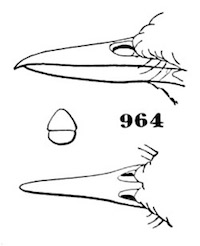
Seiurus ludovicianus, Bonap. 964
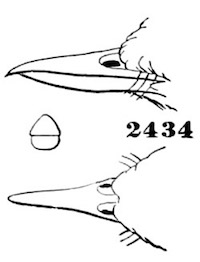
Seiurus noveboracensis, Nutt. 2434
Autumnal specimens have a more or less strong wash of ochraceous over the flanks and crissum, and the brown above rather darker and less grayish than in spring birds.
This species is very similar to S. noveboracensis, although readily distinguishable by the characters given in the diagnoses. The differences in the bill there referred to are illustrated in the accompanying diagram.
Habits. The Water Thrush described by Wilson as most abundant in the lower part of the Mississippi Valley, as well as that given by Audubon as the Louisiana Water Thrush, though its position as a genuine species was afterwards abandoned, are undoubtedly referable to a closely allied but apparently distinct Seiurus, now known as the Louisiana Water Thrush. This bird has a very close resemblance to the noveboracensis, differing chiefly in size and in having a larger bill. Although its distribution is not yet fully determined, it seems to belong rather to the South and Southwestern States, and only accidentally to be found north of the Middle States. Still a single specimen has been obtained in Massachusetts, and it has been several times found in Michigan and Missouri. Specimens of this bird have also been procured in Pennsylvania, Georgia, Tamaulipas, Mexico, Cuba, Jamaica, and Guatemala.
Its recognition as a distinct species from the common Water Thrush is so recent, and the two species so closely resemble each other, that as yet its habits and history are imperfectly known. Wilson refers to the birds he had met with in Mississippi and Louisiana, which we presume to have been the same, as being there in abundance, and eminently distinguished by the loudness, sweetness, and expressive vivacity of their notes. These he describes as beginning very high and clear, and as falling with an almost imperceptible gradation until they are scarcely articulated,—a description that would also answer very well for the song of the true Water Thrush. During their song, he adds, they are perched on the middle branches of a tree over the brook or river-bank, pouring out a charming melody, so loud and distinct that it may be heard at the distance of nearly half a mile. The voice of this bird appeared to him so exquisitely sweet and expressive that he was never tired of listening to it.
It is also quite probable that nearly all of Audubon’s accounts of the habits of the Water Thrush were derived from his observation of this species, and not of its Northern congener. He describes its song as fully equal to that of the Nightingale, its notes as powerful and mellow, and at times as varied. He states that it is to be found at all seasons in the deepest and most swampy of the canebrakes of Mississippi and Louisiana. Its song is to be heard even in the winter, when the weather is calm and warm.
He describes its flight as easy and continued, just above the brakes, or close to the ground. When on the ground, it is continually vibrating its body, jerking out its tail and then closing it again. It walks gracefully along the branches or on the ground, but never hops. He states that it feeds on insects and their larvæ, and often pursues the former on the wing.
He describes the nest as placed at the foot and among the roots of a tree, or by the side of a decayed log, and says they are often easily discovered. They are commenced the first week of April. The outer portions are formed of dry leaves and mosses, the inner of fine grasses, with a few hairs or the dry fibres of the Spanish moss.
The eggs, four in number, are described as flesh-colored, sprinkled with dark red at the larger end. They are hatched in fourteen days. The young leave the nest in about ten days, and follow the parent on the ground from place to place. When disturbed on her nest in the earlier periods of incubation, she merely flies off; but later, or when she has young, she tumbles about on the ground, spreads her wings and tail, utters piteous cries, and seems as if in the last agonies of despair. This species Mr. Audubon never met with farther east than Georgia, nor farther north than Henderson, Ky.
Of late years, or since attention has been more drawn to the specific difference between this species and the Water Thrush, it has apparently become more numerous, and has been obtained in considerable numbers in the vicinity of Washington. In that neighborhood, once considered so rare, it was found by Dr. Coues to be not at all uncommon at certain seasons and in particular localities. From the 10th of April to the 20th of May it was always to be met with among the dense laurel-brakes that border the banks of and fill the ravines leading into Rock Creek and Piney Branch. He believes they breed there, but they were not observed in the fall. They were usually very shy, darting at once into the most impenetrable brakes, but were at other times easily approached. He always found them in pairs, even as early as the 20th of April. Their call-note was a sparrow-like chirp, as if made by striking two pebbles together. They also had a loud, beautiful, and melodious song, the singularity of which first drew his attention to the bird.
Mr. Ridgway informs me that in the Wabash Valley this bird, familiarly known as the “Water Wagtail,” is an abundant summer sojourner. It inhabits the dampest situations in the bottom-lands, the borders of creeks, lagoons, and swamps, living there in company with the Prothonotary Warbler (Protonotaria citrea). In its movements it is one of the quickest as well as the most restless of the Sylvicolidæ, though it is eminently terrestrial in its habits. It is usually seen upon the wet ground, in a horizontal position, or even the posterior part of its body more elevated, and its body continually tilting up and down; if it fancies itself unobserved, it runs slyly beneath the brushwood overhanging the shore; but if startled, it flies up suddenly with a sharp and startling chatter. He adds that in early spring (from the latter part of February to the beginning of April) its rich loud song may be heard before the trees are in leaf, for it is one of the earliest of the Warblers to arrive. When singing, it is usually perched upon the lower branches of a tree overhanging the water, but he has frequently seen it among the topmost branches. Wilson and Audubon have not exaggerated the merits of the song of this bird, for among all its family there is certainly not one of our North American species that compares with it. In richness and volume of its very liquid notes it is almost unrivalled, though the song itself may not be considered otherwise remarkable.
Mr. Salvin met this species in different portions of Guatemala in the months of August, September, and November, 1859. A dry watercourse in the forest, or in the bottom of a barranco, seemed to be its favorite resort, while its near congener, the noveboracensis, was observed to seek rather the more open streams.
Genus OPORORNIS, Baird.
Oporornis, Baird, Birds N. Am. 1858, 246. (Type, Sylvia agilis, Wils.)
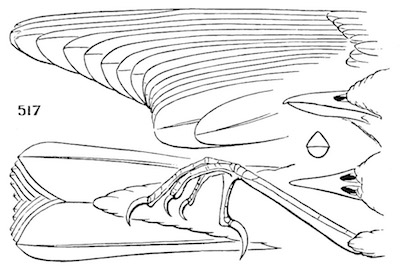
Oporornis formosus. 517
Gen. Char. Bill sylvicoline, rather compressed; distinctly notched at tip; rictal bristles very much reduced. Wings elongated, pointed, much longer than the tail; the first quill nearly or quite the longest. Tail very slightly rounded; tail-feathers acuminate, pointed; the under coverts reaching to within less than half an inch of their tip. Tarsi elongated, longer than the head; claws large, the hinder one as long as its digit, and longer than the lateral toes. Above olive-green; beneath yellow; tail and wings immaculate. Legs yellow.
This group of American Warblers is very distinct from any other. The typical species is quite similar in color to Geothlypis philadelphia, but is at once to be distinguished by much longer wings, more even tail, and larger toes and claws. It is also very similar to Seiurus, differing chiefly in the longer wings, larger claws, and absence of spots beneath.
Throat and crown ash-color; a white ring round the eye. No black on the side of the head … O. agilis.
Throat and superciliary stripe yellow; top of the head and a streak beneath the eye black … O. formosus.
Oporornis agilis, Baird.
CONNECTICUT WARBLER.
Sylvia agilis, Wils. Am. Orn. V, 1812, 64, pl. xxxix, fig. 4.—Aud. Orn. Biog. II, pl. cxxxviii; Bon. Sylvicola ag. Jard.; Aud. Birds Am. II, pl. xcix. Trichas ag. Nutt. Oporornis ag. Baird, Birds N. Am. 1858, 246, pl. lxxix, fig. 2: Rev. 218. ? Trichas tephrocotis, Nutt. Man. 2d ed. 1840, 462 (Chester Co., Penn.; top of head pure ash).—Samuels, 208.
Sp. Char. Spring male. Upper parts and sides of the body uniform olive-green, very slightly tinged with ash on the crown. Sides of the head ash, tinged with dusky beneath, the eye. (Entire head sometimes ash.) Chin and throat grayish-ash, gradually becoming darker to the upper part of the breast, where it becomes tinged with dark ash. Sides of the neck, breast, and body olive, like the back; rest of under parts light yellow. A broad continuous white ring round the eye. Wings and tail-feathers olive (especially the latter), without any trace of bars or spots. Bill brown above. Feet yellow. Length, 6 inches; wing, 3.00; tail, 2.25. Female. The olive-green reaching to the bill, and covering sides of head; throat and jugulum pale ashy-buff. Young not seen. Nesting unknown.
Autumnal specimen nearly uniform olive above; the throat tinged with brownish so as to obscure the ash.
Hab. Eastern Province of United States.
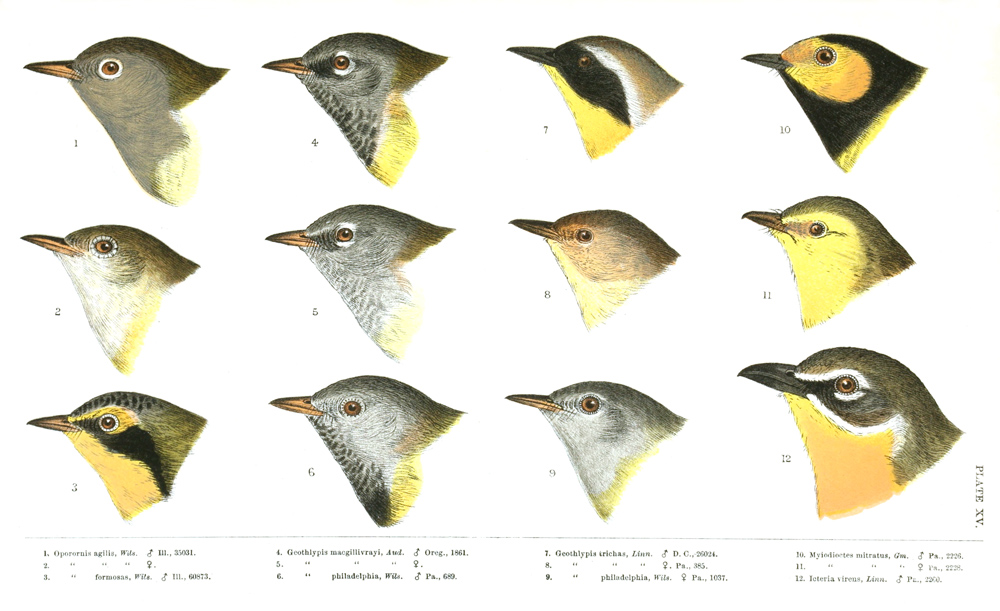
PLATE XV.
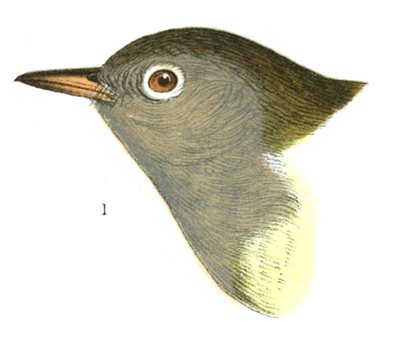
1. Oporornis agilis, Wils. ♂ Ill., 35031.
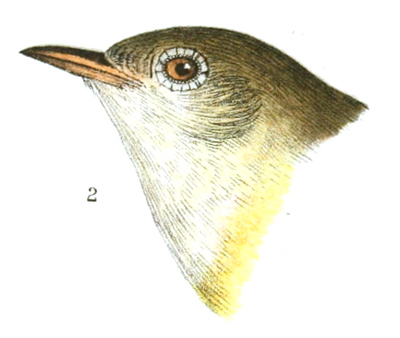
2. Oporornis agilis, Wils. ♀.
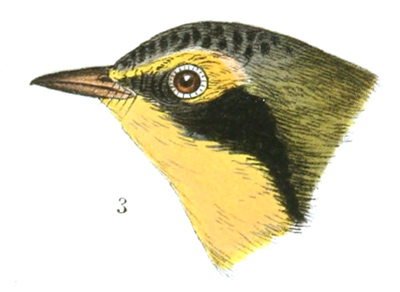
3. Oporornis formosas, Wils. ♂ Ill., 60873.
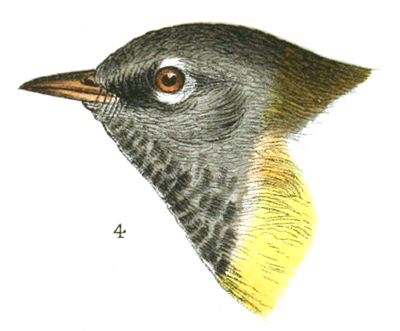
4. Geothlypis macgillivrayi, Aud. ♂ Oreg., 1861.
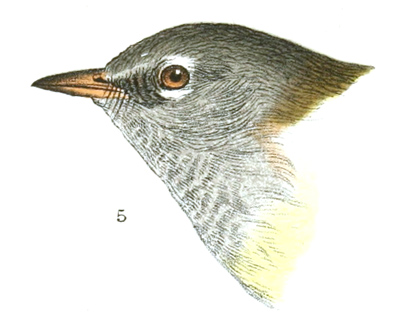
5. Geothlypis macgillivrayi, Aud. ♀.
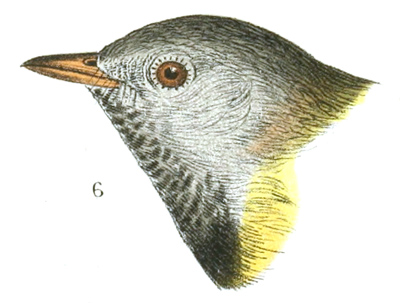
6. Geothlypis philadelphia, Wils. ♂ Pa., 689.
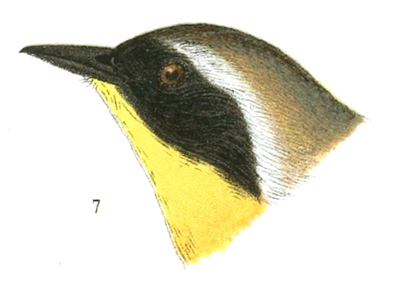
7. Geothlypis trichas, Linn. ♂ D. C., 26024.
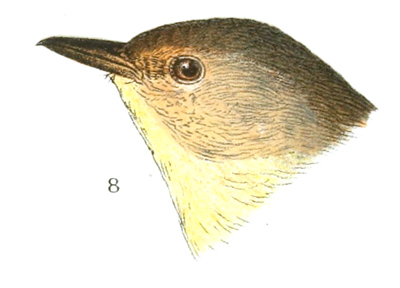
8. Geothlypis trichas, Linn. ♀ Pa., 385.
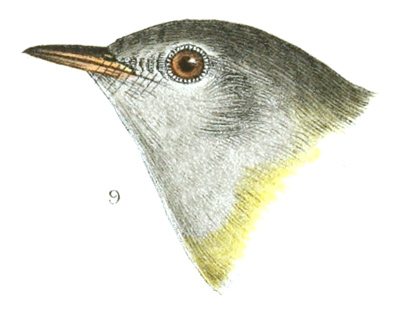
9. Geothlypis philadelphia, Wils. ♀ Pa., 1037.
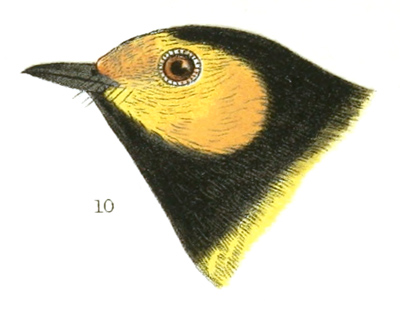
10. Myiodioctes mitratus, Gm. ♂ Pa., 2226.
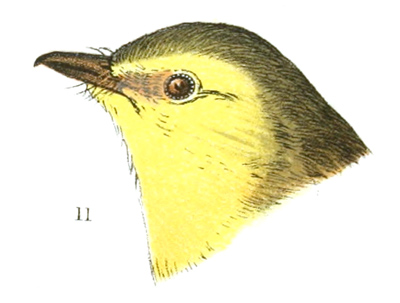
11. Myiodioctes mitratus, Gm. ♀ Pa., 2228.
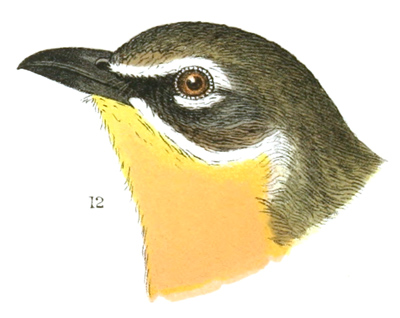
12. Icteria virens, Linn. ♂ Pa., 2260.
A specimen in the collection of the Philadelphia Academy, killed by Mr. Krider, has the darker ash of the jugulum of a decided sooty tinge.
A peculiarity in the history of this species is shown in the fact that it is quite abundant in Illinois, Wisconsin, etc., in the spring, and very rare in the autumn; precisely the reverse being the case near the Atlantic border, where only two or three spring specimens have been announced as captured by collectors. It is possible that they go north in spring, along the valley of the Mississippi, and return in autumn through the Atlantic States. Their summer abode and breeding-place are as yet unknown.
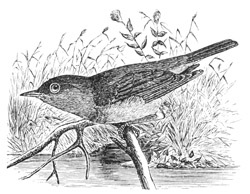
Oporornis agilis.
Habits. Of the history of this rare and beautiful species but little is as yet known. It was first met with by Wilson, in the State of Connecticut, and he afterwards obtained two other specimens near Philadelphia. Others have since been procured at Carlisle, Penn., at Washington, Loudon County, Va., near Chicago, Racine, and in Southern Illinois. September 25 to October 1, and May, from the 15th to the 28th, appears to be the epoch of their fall and spring occurrence. They are more frequently noticed in the autumn. It is supposed to be a migratory bird, going north to breed.
It was found by Wilson, in every case, among low thickets, and seemed to be more than commonly active, not remaining for a moment in the same position. Mr. Audubon obtained only two specimens, a pair, opposite Philadelphia in New Jersey. When he first observed them they were hopping and skipping from one low bush to another, and among the tall reeds of the marsh, emitting an oft-repeated tweet at every move. They were chasing a species of spider that ran nimbly over the water, and which they caught by gliding over it. Upon dissecting them, he found a number of these spiders in their stomachs, and no other food. These two birds were not at all shy, and seemed to take very little notice of him, even when close to them.
Mr. Trumbull, in his list of the birds of Eastern Pennsylvania, marks it as a summer resident of that State, which is probably not the fact. Mr. Lawrence includes it in his list of birds found near New York City. It is not given by Mr. Verrill or Mr. Boardman as occurring in any part of Maine, and has not been detected in Western Massachusetts by Mr. Allen, though it has been occasionally met with in the eastern part of the State by Dr. Cabot, Mr. Maynard, and others. More recently, in the fall of 1870, and again in that of 1871, this species has been found quite abundant in a restricted locality in the eastern part of that State. It was first observed by Mr. H. W. Henshaw, a promising young naturalist, in the early part of September, 1870, among the Fresh Pond marshes in Cambridge. They appeared to be quite numerous, and several specimens were obtained. He communicated the discovery to his friend, Mr. William Brewster, and more than fifty specimens of this rare Warbler were obtained during that season. In the following autumn, in September and during the first few days of October, these birds were observed in the same locality, apparently in greater numbers, and more specimens were obtained.
Mr. Henshaw writes me that he first saw this species, September 7, 1870, when he obtained a single specimen. From that time until September 27 it was very common throughout the Fresh Pond swamps, to which locality it seemed to be restricted. It again made its appearance in 1871, and at about the same time, and remained until October 5. It was in even greater numbers than during the preceding year.
Their habits, while with us in the fall, appear to be very different from those of the individuals observed by Wilson and Audubon, which were described as being of a remarkably lively disposition, and hence the name of agilis. Mr. Henshaw found them almost constantly engaged in seeking their food upon the ground. When startled, they would fly up to the nearest bush, upon which they would sit perfectly motionless, in a manner closely resembling the Thrushes. If not further disturbed, they immediately returned to the ground and resumed the search for food among the leaves. If greatly startled, they took a long flight among the bushes, and could rarely be found again. The only note he heard them utter was a single sharp chirp, emitted occasionally, when surprised. They were all remarkably fat, so much so as to make it difficult to obtain a good specimen.
About sunset, standing on the skirts of the swamp, he has repeatedly observed these birds alight, in great numbers, on the edge, and immediately pass in, evidently intending to remain there over night. He judged that they migrate entirely by day. On only one or two occasions did he observe these birds feeding in the tops of willow-trees. At such times they appeared equally lively in their movements with the Dendroica striata, in company with which they were associated. The birds he saw were nearly all in immature plumage, adults being comparatively rare.
Dr. Coues states that the Connecticut Warbler is found near Washington in the month of October, but that it is rather uncommon. He did not meet with it in spring. He speaks of its frequenting old buckwheat and corn fields, searching for food among the dry, rank weeds, and also in swampy places among low thickets.
Oporornis formosus, Baird.
KENTUCKY WARBLER.
? Sylvia æquinoctialis, Vieill. Ois. Am. Sept. II, 1807, 26, pl. lxxxi, Penn. (not of Gmelin). Sylvia formosa, Wils. Am. Orn. III, 1811, 85, pl. xxv, fig. 3.—Nutt.; Aud. Orn. Biog. I, pl. xxxviii. Sylvicola formosa, Jard.; Rich.; Bon.; Max. Myiodioctes formosus, Aud. Syn.—Ib. Birds Am. II, pl. lxxiv.—Lembeye, Av. Cuba, 1850, 37. Gundlach, Cab. Jour. 1861, 326 (Cuba). Oporornis formosus, Baird, Birds N. Am. 1858, 247; Rev. 218.—Sclater & Salvin, Ibis, I, 1859, 10 (Guatemala).
Other localities cited: Mexico, Sclater. Isthmus Panama, Lawrence. Veragua, Salv. Costa Rica, Lawr.
Sp. Char. Adult male. Upper parts and sides dark olive-green. Crown and sides of the head, including a triangular patch from behind the eye down the side of the neck, black, the feathers of the crown narrowly lunulated at tips with dark ash. A line from nostrils over the eye and encircling it (except anteriorly), with the entire under parts, bright yellow. No white on the tail. Female similar, with less black on the head. Length, 5 inches; wing, 2.95; tail, 2.25. Young not seen.
The adults in autumn are exactly the same as in spring.
Hab. Eastern Province of United States, north to Washington and Chicago; west to Republican Fork of Kansas River (Coues). Cuba, Guatemala, and Isthmus Panama. Not recorded from West Indies except Cuba.
Habits. The Kentucky Warbler is an abundant species in the Southern and Southwestern States, and has been found, though more rarely, as far to the north as Southern New York in the east and to Southern Wisconsin in the west. It has also been obtained at Fort Riley, in Kansas. Its nest and eggs have been procured near Cleveland, O., by Dr. J. P Kirtland, and also in Chester County, Penn., by Mr. Norris. It is a winter inhabitant in Mexico, Panama, Guatemala, and Cuba.
Wilson speaks of having met with this bird in abundance from Kentucky to the mouth of the Mississippi, everywhere quite common, but most especially so in the States of Tennessee and Kentucky. At the Balize he several times heard it twittering among the high rank grass of those solitary morasses. He found it frequenting low damp woods, and building its nest either in the middle of thick tufts of rank grass, in the fork of a low bush, or on the ground. The materials of which these nests were made were loose dry grass, mixed with the pith of wood, and lined with hair. He found the eggs from four to six in number, pure white, sprinkled with reddish specks. He met with the female sitting upon her eggs as early as May. These birds, he adds, are seldom seen among high branches, but prefer to frequent low bushes and canebrakes. In their habits they are very lively and sprightly. The song is loud, comprising three notes, and resembles tweedle-tweedle-dweedle. It makes its appearance in Kentucky from the South about the middle of April, and leaves the region about New Orleans on the approach of cold weather. Wilson was assured that it never remains there during the winter.
Wilson characterizes these birds as a reckless fighting species, almost always engaged in pursuing its fellows.
Mr. Audubon states that this Warbler is the most common and abundant species that visits the State of Louisiana and the whole region about the Mississippi River, but is not so common in Kentucky or Ohio. He describes it as an extremely lively and active bird, found in all the low grounds and damp places near watercourses, and generally among the tall rank weeds and low bushes growing in rich alluvial soil. It is continually in motion, hopping from stalk to stalk, and from twig to twig, preying upon insects, larvæ, or small berries, rarely pursuing an insect on the wing. He describes its song as agreeable and emphatic. He has never known this species fly farther than a few yards at a time. Its flight is low, and is performed in a gliding manner. It makes its first appearance about the middle of March, and remains until the middle or last of September. He states that it rears two broods in a season. His description of its nest, as “small, beautifully constructed, and attached to several stems of rank weeds,” etc., does not agree in position, size, or appearance with any that I have ever seen.
According to Mr. Audubon, it feeds largely upon spiders, which it obtains by turning over the withered leaves on the ground. The young birds resemble their mother until the following season, when the males attain the full beauty of their plumage. They remain with their parents until they migrate.
The late Dr. Alexander Gerhardt, an accurate and observing naturalist of Northern Georgia, informed me, by letter, that the nest of the Kentucky Warbler is usually built on the ground, under a tuft of grass, often on a hillside and always in dry places. The eggs are deposited from the 4th to the 15th of May. Nearly all the nests he met with were made externally of a loose aggregation of dry oak and chestnut leaves, so rudely thrown together as hardly to possess any coherence, and requiring to be sewed to be kept in place. The interior or inner nests were more compactly interwoven, usually composed of fine dark-brown roots. Instead of being small, they are large for the bird, and are inelegantly and clumsily made. They measure four inches in their diameter, three in height, and two in the depth of their cavity. One nest, the last received from Dr. Gerhardt, obtained by him at Varnell’s Station, in Northern Georgia, June 5, 1860, is large and peculiar in its construction. It is nearly spherical in shape, with an entrance partially on one side and nearly arched over. The periphery of this nest is composed exclusively of partially decayed deciduous leaves, impacted together, yet somewhat loosely. Within this outer covering is a fine framework of stems, twigs, and rootlets, and within this a snug, compact lining of hair and finer rootlets and fibres. This nest is six inches in diameter and five in height. It contained four eggs.
These eggs have an average length of .69 of an inch and a breadth of .56 of an inch. They have an oblong-oval shape, a crystalline-white ground, and the entire surface is sprinkled over with fine dots of red and reddish-brown. These, though most abundant about the larger end, are nowhere confluent, and do not form a crown.
A nest of this bird from Chester County, Penn., is a very flat structure, evidently built in a bed of fallen leaves. It has a diameter of six inches and a height of only two. The cup is a mere depression only half an inch in depth. Its base is loosely constructed of dried leaves, upon which is interwoven a coarse lining of long, dry, and wiry rootlets and stems of plants. It was given to Mr. J. P. Norris, from whom I received it, and it is now in the Boston collection.
Mr. Robert Ridgway furnishes the following valuable information in regard to the abundance and general habits of this species as observed in Southern Illinois: “It is a very common summer bird in Southern Illinois, where it arrives in the Wabash Valley towards the last of April. It is a wood-loving species, and of terrestrial habits, like the Seiurus aurocapillus, but generally frequents rather different situations from the latter bird, liking better the undergrowth of ‘bottom’ woods than that of dry forests. In all its manners it closely resembles the Seiuri, especially the two aquatic species, ludovicianus and noveboracensis, having the same tilting motion of the body, and horizontal attitude when perching, so characteristic of these birds. The nest I have never found, though well aware of its actual situation. I knew of one somewhere among the ‘top’ of a fallen tree, but it was so well concealed that the closest search did not enable me to discover it. In most cases the nest is probably on the ground, among the rubbish of fallen tree-tops, or low brushwood.
“The usual note of this Warbler is a sharp tship, almost precisely like that of the Pewee (Sayornis fuscus), uttered as the bird perches on a twig near the ground, continually tilting its body, or is changed into a sharp rapid twitter as one chases another through the thicket. Their song is very pretty, consisting of a fine whistle, delivered very much in the style of the Cardinal Grosbeak (Cardinalis virginianus), though finer in tone, and weaker.”
Dr. Coues found this Warbler rare at Washington, and chiefly in low woods with thick undergrowth, and in ravines. They were very silent, but not shy, and a few breed there.
Section GEOTHLYPEÆ.
Genus GEOTHLYPIS, Caban.
Trichas, Swainson, Zoöl. Journ. III, July, 1827, 167 (not of Gloger, March, 1827, equal to Criniger, Temm.).
Geothlypis, Cabanis, Wiegmann’s Archiv, 1847, I, 316, 349.—Ib. Schomburgk’s Reise, Guiana, 1848.
Gen. Char. Bill sylvicoline, rather depressed, and distinctly notched; rictal bristles very short or wanting. Wings short, rounded, scarcely longer than the tail; the first quill shorter than the fourth. Tail long; much rounded or graduated. Legs stout; tarsi elongated, as long as the head. Olive-green above, belly yellow. Tail-feathers immaculate. Legs yellow.
Synopsis of Species.
Throat yellow … Series I.
Throat ash … Series II.
Series I.
A. Black mask extending beneath the eye and on the auriculars.
1. G. trichas. Black mask bordered along its posterior edge with pale ashy or whitish; maxillæ black. Sexes dissimilar. ♀. Olive-brown above; throat only, distinctly yellow; no black mask. Juv. Without either black or pure yellow; above olive-brown, like ♀, beneath pale ochraceous-buff.
Abdomen almost always whitish; occiput russet-olive. Bill, from nostril, .30;. tarsus, .70; wing, 2.25; tail, 2.15. Hab. Whole of United States; in winter most of West Indies, and Middle America, north to Guatemala … var. trichas.
Colors similar; abdomen yellow. Bill, .45; tarsus, .90; wing, 2.50; tail, 2.50. Hab. Nassau; New Providence; Bahamas … var. rostrata.[52]
Abdomen bright yellow; occiput whitish-ash tinged with yellow. Bill, .32; tarsus, .75; wing, 2.45; tail, 2.50. Hab. Eastern Mexico (Jalapa?) … var. melanops.[53]
2. G. æquinoctialis. Black mask not bordered posteriorly by ashy or whitish; much narrower on forehead than on auriculars; maxillæ yellow. Sexes similar.
Black of the auriculars bordered posteriorly by the olive-green of the neck. Bill, .17 deep; wing, 2.50; tail, 2.35. Hab. Northeast South America (Cayenne, Trinidad, etc.) … var. æquinoctialis.[54]
Black of the auriculars bordered posteriorly by the ash of the crown. Bill, .14 deep; wing, 2.40; tail, 2.50. Hab. Brazil … var. velata.[55]
B. Black mask not extending underneath the eye, but confined to lores and frontlet.
3. G. poliocephala. Bill much as in Granatellus. Above olive-green; the crown light ash; beneath yellow. Sexes dissimilar.
Eyelids white; nape and auriculars olive-green; abdomen whitish. Bill, .30, .15 deep; wing, 2.20; tail, 2.50. Hab. West Mexico (Mazatlan) … var. poliocephala.[56]
Eyelids black; nape and auriculars ashy; abdomen wholly yellow. Bill, .35, .18 deep; wing, 2.40; tail, 2.50. Hab. Guatemala (Retaluleu) … var. caninucha.[57]
Series II.
4. G. philadelphia. Head all round ashy; lores only, black. Sexes nearly similar.
Eyelids dusky (except in ♀); a black patch on jugulum of ♂. ♀. Throat tinged with yellow. Hab. Eastern Province of North America; in winter south to Panama … var. philadelphia.
Eyelids white; no black patch on jugulum. ♀. Throat not tinged with yellow. Hab. Western and Middle Province of United States; in winter south to Costa Rica (Western Coast) … var. macgillivrayi.
Geothlypis trichas, Caban.
MARYLAND YELLOW-THROAT; BLACK-MASKED GROUND WARBLER.
Turdus trichas, Linn. S. N. 1766, 293. Sylvia trichas, Lath.; Aud., etc. Geothlypis trichas, Cab. Mus. Hein. 1850, 16.—Baird, Birds N. Am. 241; Rev. 220.—Gundlach, Cab. Jour. 1861, 326 (Cuba).—Sclater, Catal. 1861, 27, No. 167.—March, Pr. A. N. Sc. 1863, 293.—Lord, Pr. R. Art. Inst. Woolwich, IV, 1864, 115 (N. W. Boundary).—Jones, Nat. Bermuda, 29.—Samuels, 205.—Cooper, Orn. Cal. 1, 1870, 95. Sylvia marilandica, Wilson. Trichas mar. Bon. Regulus mystaceus, Stephens. Trichas personatus, Swainson. Sylvia roscoe, Aud. Trichas brachydactylus, Swains.
Other localities quoted: Xalapa, Oaxaca, Cordova, Scl. Guatemala, Scl. & Salv. Bahamas, Bryant. Costa Rica, Cab.; Lawr. Orizaba (autumn), Sum. Yucatan, Lawr.
Figures: Vieill. Ois. II, pl. xxviii, xxix.—Aud. Orn. Biog. I, II, V, pl. xxiii, cii, ccxl.—Wils. I, pl. vi, fig. 1.—Buffon, Pl. enl. 709, fig. 2.
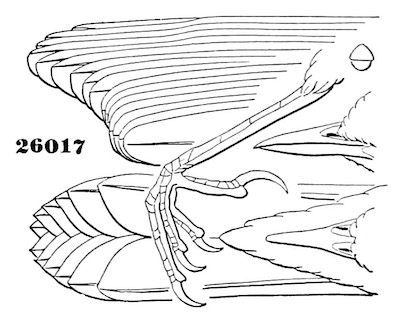
Geothlypis trichas. 26017
Sp. Char. (No. 26,024 ♂.) Wings a little shorter than the somewhat graduated tail. Bill slender, the depth contained about two and a half times in distance from nostrils to tip. First quill about equal to seventh. Forehead to above the anterior edge of the eye, and across the entire cheeks, ears, and jaws, and ending in an angle on sides of neck, black, with a suffusion of hoary bluish-gray behind it on the crown and sides of neck; the occipital and nuchal region grayish-brown, passing insensibly into the olive-green of the upper parts. Chin, throat, jugulum, edge of wing and crissum rich yellow (the latter paler); rest of under parts, with lining of wings, yellowish-white, the sides tinged with brownish; outer primary edged with whitish, the others with olive-green. Bill black; legs yellowish. Total length, 4.40; wing, 2.15; tail, 2.30; graduation, .25; width of outer tail-feather, .28; difference between first and third quills, .15; length of bill from forehead, .52; from nostril, .30; along gape, .60; tarsus, .75; middle toe and claw, .66; claw alone, .18; hind toe and claw, .48; claw alone, .26.
Male in winter, and the female, without the black mask; the forehead tinged with brown, the yellow of the throat less extended, the eyelids whitish, and a yellowish superciliary line.
Hab. The whole United States, from Atlantic to Pacific, and south to Costa Rica; Bermuda (October); Bahamas; Cuba; Jamaica.
The young bird is brownish-olive above, becoming more virescent on the rump and tail; eyelids, and whole lower parts, soft light buff, with a faint tinge of yellow on the breast and lower tail-coverts.
Geothlypis trichas.
There is very much variation manifested in a large series (containing more than one hundred and thirty specimens, principally North American), though but very little that accords with any distinctions of habitat. As a rule, however, those from the Atlantic States are the smallest of the series, and have most white on the abdomen, the yellow being restricted to the throat and jugulum, and the lower tail-coverts. In most specimens from the Mississippi Valley the yellow beneath is quite continuous, and the size considerably larger than in the series above mentioned, in these respects approaching the G. melanops from Eastern Mexico, in which the yellow pervades the whole surface beneath; but in this the whitish border above the black mask is extended over the whole crown, leaving the nape only distinctly brownish, and the size larger than the average of the series alluded to. However, No. 61,135 ♂, Liberty County, Ga., has even more white on top of the head, the whole occiput being of this color; while No. 7,922 ♂, from Racine, Wis., is quite as long as the type of melanops (the tail only, shorter), and there is nearly as much yellow beneath. The Georgia specimen, however, in other respects, is most like the Atlantic style. Specimens from the Pacific coast have just appreciably longer tails than Eastern ones, and the olive-green above is brighter. Jamaican and Guatemalan specimens are identical with many from the United States. The G. rostratus of Bryant, from the Bahamas, appears to be merely a gigantic insular race of the common species.
Habits. This well-known and beautiful little Ground Warbler is a common, abundant, and widely diffused species, occurring throughout the United States from ocean to ocean, and from the Gulf of Mexico to Canada and Nova Scotia. It is found, during the winter months, in Cuba, Jamaica, Mexico, Yucatan, Guatemala, Costa Rica, the Bahamas, and, in the fall, in Bermuda. On the Pacific coast it has been found from Cape St. Lucas to the British territories. It breeds from Northern Georgia to Halifax, inclusive.
In Central America, Mr. Salvin states that this Warbler is by far the most common of the Mniotiltidæ, but is wholly migratory. It was usually found in the neighborhood of water, frequenting the reeds that surrounded Lake Duenas, and the bushes on the banks of its outlet. It was also taken by Mr. Boucard at Totontepec, among the mountains of Oaxaca, Mexico.
It was observed as far to the north as Lake of the Woods, by Mr. Kennicott. Several were there observed, both males and females, May 29. It is everywhere quite common, and is, I think, as numerous in New England as in the Middle States.
For the most part it seems to prefer wild lands, especially those overgrown with briers and low bushes, to open or cultivated grounds. Yet this preference is not exclusive, as I have known a pair, or their offspring, to visit the same garden nine or ten successive summers. It is also more generally found in low lands than in high, and is probably attracted to moist thickets of briers and underbrush by the greater abundance of its favorite food. This Warbler is eminently terrestrial in its habits, never being found among higher limbs, but always either on the ground or among the lower branches of bushes, vines, and weeds. It is a diligent rather than an active or nimble bird, is always on the move, and incessantly in search of its food. This consists of insects in all their forms, but more particularly of larvæ, small beetles, and spiders. They are of great service in the destruction of several forms of injurious grubs, and but that their mode of life exposes them to destruction by prowling cats, I doubt not they would readily adapt themselves to living in our gardens. Occasionally they are found in fields of grain, where their presence is due to the abundance of destructive insects.
The Yellow-Throat appears shy and retiring because it prefers to move back and forth among low shrubs and brambles, where it most readily procures its food, but it is not a timid bird. They are unsuspecting, and will as readily permit as fly from the near presence of man. I have frequently had them approach within a few feet, especially when at rest; and even when in motion they will continue their lively song, as they move about from twig to twig. Though able to capture an insect on the wing, they are not expert fly-catchers, and chiefly take their prey when it is at rest.
Their song is a very lively and agreeable refrain, easily recognized, though exhibiting at times marked differences, and occasionally closely resembling the song of the Summer Yellow-Bird. The same brief series of notes, usually sounding like whi-ti-tēē-tēē, is constantly repeated at short intervals, while the singer continues his perpetual hunt for insects.
The male is very affectionate and devoted to both mate and offspring. The pair are never far apart, and during incubation the male is assiduous in the collection of food, feeding its mate, and afterwards assisting in collecting for their young. They rely upon concealment for the protection of their nest, and rarely show any open solicitude until it is discovered. Then they will make the most vehement demonstrations of alarm and distress, flying about the intruder and fearlessly approaching him to within a few feet. In Massachusetts they rarely, if ever, have more than one brood in a season. The young are able to take care of themselves early in July. At that time the song of the male ceases, or is abbreviated to a single whit, and parents and young form a family group and together hunt in the more secluded thickets, the edges of woods, and other retired places, for their food. Early in September they take their departure.
The Yellow-Throat is distributed, in suitable localities, over a large area, and wherever found is apparently equally common. Dr. Gerhardt found it quite abundant in Northern Georgia. Wilson and Audubon thought it more common in the Middle States than farther north, but I have found it quite as numerous about Halifax and Eastport as I have at Washington. Dr. Cooper speaks of it as “very common” in Washington Territory, though not so abundant as MacGillivray’s Warbler. The same writer also states it to be a “very common bird” in California. Their earliest arrival at San Diego was on the 17th of April, about the time they reach Pennsylvania. They appear in New England early in May.
Their nest is almost invariably upon the ground, usually in a thick bed of fallen leaves, a clump of grass or weeds, at the roots of low bushes or briers, or under the shelter of a brush-pile. Occasionally it has been found among high weeds, built in a matted cluster of branches, four or five feet from the ground. Sometimes it is sunk in a depression in the ground, and often its top is covered by loose overlying leaves. I have never found this top interwoven with or forming any part of the nest itself.
The nest is usually both large and deep for the size of the bird, its loose periphery of leaves and dry sedges adding to its size, and it often has a depth of from five to six inches from its rim to its base. The cavity is usually three inches deep and two and a quarter wide. Generally these nests are constructed on a base of dry leaves. An external framework, rudely put together, of dry grasses, sedge leaves, strips of dry bark, twigs, and decaying vegetables, covers an inner nest, or lining, of finer materials, and more carefully woven. At the rim of the nest these materials sometimes project like a rude palisade or hedge. Usually the lining is of fine grasses, without hair or feathers of any kind.
In some nests the outer portion and base are composed almost entirely of fine dry strips of the inner bark of the wild grape.
The eggs vary from four to six in number, and also differ greatly in their size, so much so that the question has arisen if there are not two species, closely resembling, but differing chiefly in their size. Of this, however, there is no evidence other than in these marked variations in the eggs.
In the Great Basin, Mr. Ridgway found this bird abundant in all the bushy localities in the vicinity of water, but it was confined to the lower portions, never being seen high up on the mountains, nor even in the lower portions of the mountain cañons.
Their eggs exhibit a variation in length of from .55 to .72 of an inch, and in breadth from .48 to .58 of an inch; the smallest being from Georgia, and the largest from Kansas. They are of a beautiful clear crystalline-white ground, and are dotted, blotched, and marbled around the larger end with purple, reddish-brown, and dark umber.
Geothlypis philadelphia, Baird.
MOURNING WARBLER.
Sylvia philadelphia, Wils. Am. Orn. II, 1810, 101, pl. xiv; Aud.; Nutt. Trichas philadelphia, Jard.—Reinhardt, Vidensk. Meddel. for 1853, and Ibis, 1861, 6 (Greenland). Geothlypis phila. Baird, Birds N. Am. 1858, 243, pl. lxxix, fig. 3; Rev. 226.—Sclater, Catal. 1861, 27 (Orizaba).—Lawrence, Ann. N. Y. Lyc. 1861, 322 (Panama).—Samuels, 207.—Dresser, Ibis, 1865, 476.
Figures: Wils. Am. Orn. II, pl. xiv.—Aud. Birds Am. II, pl. ci.
Sp. Char. Wings but little longer than the tail, reaching but little beyond its base. Adult male. Head and neck all round, with throat and forepart of breast, ash-gray, paler beneath. The feathers of the chin, throat, and fore breast in reality black, but with narrow ashy margins more or less concealing the black, except on the breast. Lores and region round the eye dusky, without any trace of a pale ring. Upper parts and sides of the body clear olive-green; the under parts bright yellow. Tail-feathers uniform olive; first primary, with the outer half of the outer web, nearly white. Female with the gray of the crown glossed with olive; the chin and throat paler centrally, and tinged with fulvous; a dull whitish ring round the eye. Length, 5.50; wing, 2.45; tail, 2.25. Young not seen.
Hab. Eastern Province of United States to British America; Greenland; Southeastern Mexico, Panama R. R., and Colombia. Not recorded from West Indies or Guatemala. Costa Rica (Lawr.).
Specimens vary in the amount of black on the jugulum, and the purity of the ash of the throat. The species is often confounded with Oporornis agilis, to which the resemblance is quite close. They may, however, be distinguished by the much longer and more pointed wings, and more even tail, shorter legs, etc., of agilis. The white ring round the eye in the female philadelphia increases the difficulty of separation.
The adult male in autumn is scarcely different from the spring bird, there being merely a faint olive-tinge to the ash on top of the head, and the black jugular patch more restricted, being more concealed by the ashy borders to the feathers; the yellow beneath somewhat deeper.
Habits. The Mourning Warbler was first discovered and described by Wilson, who captured it in the early part of June, on the borders of a marsh, within a few miles of Philadelphia. This was the only specimen he ever met with. He found it flitting from one low bush to another in search of insects. It had a sprightly and pleasant warbling song, the novelty of which first attracted his attention. For a long while Wilson’s single bird remained unique, and from its excessive rarity Bonaparte conjectured that it might be an accidental variety of the Yellow-Throat. At present, though still of unfrequent occurrence, it is by no means a doubtful, though generally a comparatively rare species. Audubon mentions having received several specimens of this Warbler, procured in the neighborhood of Philadelphia, New York, and Vermont, all of which were obtained in the spring or summer months. He met with a single specimen in Louisiana, and thinks its habits closely resemble those of the Maryland Yellow-Throat.
Nuttall met with what he presumes to have been one of these birds in the Botanical Garden at Cambridge. It had all the manners of the Yellow-Throat, was busy in the search of insects in the low bushes, and, at intervals, warbled out some very pleasant notes, which partly resembled the lively chant of the Trichas, and in some degree the song of the Summer Yellow-Bird.
Professor Reinhardt states that two individuals of this species have been taken in Greenland,—one in Fiskenæsset, in 1846, and the other at Julianhaab, in 1853.
Mr. Turnbull gives it as still quite rare in Eastern Pennsylvania, arriving there in the middle of May on its way farther north. Mr. Lawrence includes it in his list of the birds of New York. Mr. Dresser obtained five specimens early in May, in Southern Texas.
It has been met with as far to the north as Greenland by Reinhardt, and in Selkirk Settlement by Donald Gunn. It has been procured in Eastern Mexico, in Panama, in Carlisle, Penn., Southern Illinois, Missouri, Nova Scotia, and various other places. It has been known to breed in Waterville, Me., and is not uncommon in Northwestern and Northern New York. A single specimen of this bird was obtained at Ocana, in Colombia, South America, by Mr. C. W. Wyatt.
Late in May, 1838, I have a note of having met with this species in Mount Auburn. The bird was fearless and unsuspecting, busily engaged, among some low shrubbery, in search of insects. It suffered our near presence, was often within a few feet, and was so readily distinguishable that my companion, with no acquaintance with birds, at once recognized it from Audubon’s plates. Its habits were the exact counterpart of those of the Yellow-Throat. We did not notice its song.
Mr. Maynard states that, May 21, 1866, Mr. William Brewster shot a male of this species in Cambridge, on the top of a tall tree. Another specimen was taken at Franconia Mountains, New Hampshire, August 3, 1867. It was in company with four fully fledged young, which it was feeding. The young were shy, and could not be procured. The old bird was catching flies, after the manner of Flycatchers. Mr. Maynard has met this species but once in Massachusetts, and then in May, among low bushes and in a swampy place. He has since found it rather common at Lake Umbagog, Maine, in June, where it breeds. He states that it frequents the bushes along fences, stone walls, and the edges of woods. The male often perches and sings in the early morning on the top rail of a fence, or the dead branch of a tree. Its song he speaks of as loud and clear, somewhat resembling that of the Seiurus noveboracensis.
Mr. Paine considers this Warbler to be very rare in Vermont. He once observed a pair, with their young, at Randolph. The male was singing a quite pleasing, though somewhat monotonous song.
Mr. George Welch met with these birds in the Adirondack region, New York, in June, 1870. They seemed rather abundant, and were evidently breeding there. He obtained a single specimen.
Mr. John Burroughs, of Washington, was so fortunate as to obtain the nest and eggs of this Warbler near the head-waters of the Delaware River, in Roxbury, Delaware County, N. Y. “The nest,” he writes me, “was in the edge of an old bark-peeling, in a hemlock wood, and was placed in some ferns about one foot from the ground. The nest was quite massive, its outer portions being composed of small dry stalks and leaves. The cavity was very deep, and was lined with fine black roots. I have frequently observed this Warbler in that section. About the head of the Neversink and Esopus, in the northwest part of Ulster County, New York, they are the prevailing Warbler, and their song may be heard all day long. Their song suggests that of the Kentucky Ground Warbler, but is not so loud and fine.” Mr. Burroughs states elsewhere that “the eggs, three in number, were of light flesh-color, uniformly speckled with fine brown specks. The cavity of the nest was so deep that the back of the sitting bird sank below the edge.”
Their eggs are of an oblong-oval shape, pointed at one end. They measure .75 by .55 of an inch. Their ground-color is a pinkish-white, and they are marked with dots and blotches, of varying size, of dark purplish-brown.
Geothlypis macgillivrayi, Baird.
MACGILLIVRAY’S GROUND WARBLER.
Sylvia macgillivrayi, Aud. Orn. Biog. V, 1839, 75, pl. cccxcix. Trichas macg. Aud. Geothlypis macg. Baird, Birds N. Am. 1858, 244, pl. lxxix, fig. 4; Rev. 227.—Sclater, Catal. 1861, 27 (Jalapa and Guat.).—Ib. P. Z. S. 1859, 363, 373 (Xalapa, Oaxaca).—Cab. Jour. 1861, 84 (Costa Rica).—Cooper & Suckley, P. R. R. Rep. XII, II, 1859, 177.—Cooper, Orn. Cal. 1, 1870, 96. Sylvicola macg. Max. Cab. Jour. VI, 1858, 118. Sylvia tolmiæi, Towns. J. A. N. Sc. 1839. Trichas tolmiæi, Nutt. Man. I. Trichas vegeta (Licht.), Bp. Consp. 1850, 310; fide Cab. Jour. 1861, 84 (Mexico).
Sp. Char. Adult male. Head and neck all round, throat and forepart of the breast, dark ash-color; a narrow frontlet, loral region, and space round the eye (scarcely complete behind), black. The eyelids above and below the eye (not in a continuous ring) white. The feathers of the chin, throat, and fore breast really black, with ashy-gray tips more or less concealing the black. Rest of upper parts dark olive-green (sides under the wings paler); of lower, bright yellow. Female with the throat paler and without any black. Length of male, 5 inches; wing, 2.45; tail, 2.45. Young not seen.
Hab. Western and Middle Provinces of United States, to northern boundary; east to Fort Laramie; south to Costa Rica.
The white eyelids of this species distinguish its males from those of G. philadelphia, in which there is a black jugular patch not seen in the present species. The females can only be known by the slenderer bill and more rounded wing, the first quill being intermediate between the fifth and sixth, instead of being considerably longer than the fifth.
The autumnal adult male is as described above, except that there is a faint tinge of green on the crown, and the ashy borders to feathers of throat and jugulum broader, concealing more the black. The adult female in autumn is considerably more dully colored than in spring.
Habits. This comparatively new Warbler was first met with by Townsend, and described by Audubon in the last volume of his Ornithological Biography. It has since been found to have a wide range throughout the western portion of North America, from Cape St. Lucas to British America, and from the Plains to the Pacific. It has also been obtained at Choapan in the State of Orizaba, Mexico, by Mr. Boucard, and in Guatemala by Mr. Salvin, who states that throughout the district between the volcanoes of Agua and Fuego this was a common species, frequenting the outskirts of the forests and the edges of the clearings. It breeds in abundance in Utah, Montana, Idaho, Oregon, Washington Territory, and probably also in Northern California.
Townsend first met with it on the banks of the Columbia. He states that it was mostly solitary and extremely wary, keeping chiefly in the most impenetrable thickets, and gliding through them in a cautious and suspicious manner. Sometimes it might be seen, at midday, perched upon a dead twig, over its favorite places of concealment, at such times warbling a very sprightly and pleasant little song, raising its head until its bill is nearly vertical.
Mr. Nuttall informed Mr. Audubon that this Warbler is one of the most common summer residents of the woods and plains of the Columbia, where it appears early in May, and remains until the approach of winter. It keeps near the ground, and gleans its subsistence among the low bushes. It is shy, and when surprised or closely watched it immediately skulks off, often uttering a loud click. Its notes, he states, resemble those of the Seiurus aurocapillus. On the 12th of June a nest was brought to Mr. Nuttall, containing two young birds quite fledged, in the plumage of the mother. The nest was chiefly made of strips of the inner bark of the Thuja occidentalis, lined with slender wiry stalks. It was built near the ground in the dead, moss-covered limbs of a fallen oak, and was partly hidden by long tufts of usnea. It was less artificial than the Yellow-Throat’s nest, but was of the same general appearance. On his restoring the nest to its place, the parents immediately approached to feed their charge.