Family FRINGILLIDÆ.—The Finches. (continued 2)
Reading edition
Chrysomitris lawrencii, Bonap.
LAWRENCE’S GOLDFINCH.
Carduelis lawrencii, Cassin, Pr. A. N. Sc. V, Oct. 1850, 105, pl. v (California). Chrysomitris lawrencii, Bon. Comptes Rendus, Dec. 1853, 913.—Baird, Birds N. Am. 1858, 424.—Heerm. X, S, 50 (nest).—Elliot, Illust. Am. B. I, pl. viii.—Cooper, Orn. Cal. 1, 171.
Sp. Char. Male. Hood, sides of head anterior to the middle of the eye, chin, and upper part of throat, black. Sides of head, neck, and body, upper part of neck and the back, and upper tail-coverts, ash-color. Rump and lesser wing-coverts yellowish-green. Throat below the black, breast, and outer edges of all the quills (except the first primary, and passing into white behind), bright greenish-yellow. Wings black. Tail-feathers black, with a white square patch on the inner web, near the end; outer edges grayish; quills black. Female similar, with the black of the head replaced by ash. Length, about 4.70; wing, 2.75; tail, 2.30. Young like the female, but wing-bands pale fulvous, instead of yellow.
Hab. Coast of California; Fort Whipple, Arizona (Coues, P. A. N. S. 1866, 83).
Habits. This species, now known to be so common throughout the greater portion of California, was first described by Mr. Cassin in 1850. Dr. Heermann afterwards found them very abundant throughout the northern mining regions of California, frequenting the hillsides covered with brush, the seeds and buds of which they eat with great avidity. Later in the season he found them at San Diego, in quest of grass-seeds on the level plains. They were in large flocks, and so closely packed that he shot thirteen at one discharge. Their nests, he states, are built in the fork of a bush or stunted oak, and are composed of fine grasses, lined with hair and feathers. They contain four or five pure white eggs.
Mr. Ridgway only met with this Goldfinch near the foot of the western slope of the Sierra Nevada.
Dr. Cooper met with a few of this species at Fort Mohave, on the Colorado, but found them more numerous near the coast as far north as San Francisco, at least, and also in the more northern mining regions. He has seen them about San Francisco in December, and has no doubt that they remain all the winter throughout the lower country. They seem to avoid the mountainous regions, and have not been met with in Oregon.
Their habits and their song are, in general respects, similar to those of the Goldfinch (C. tristis), but their voice is much weaker, and is higher in its pitch. Their nests, Dr. Cooper thinks, are placed, in preference, on the live-oaks; at least, he has never met with them in any other situation. They are built very much in the style of those of the Goldfinch, but are much smaller, the cavity measuring only an inch in depth and one and a half in breadth. The eggs he describes as four or five in number, pure white, and measuring .80 by .46 of an inch. He adds that they sometimes feed on the ground, on grass-seeds, as well as on buds and seeds of various weeds and trees. They were regarded by him as more of a sylvan species than the Goldfinch, and not so fond of willows and other trees growing along streams and in wet places. In the Colorado Valley they feed on the seeds of the artemisia. He did not notice any there after the middle of April. Eggs, in my own cabinet, from Monterey, identified by Dr. Canfield, are of a uniform greenish-white, exactly similar to those of C. psaltria and tristis, and measure only .58 by .45 of an inch, or less in length by .22 than as given by Dr. Cooper.
Three nests of this species obtained at Monterey, Cal., by Dr. Canfield, all exhibit more or less variations as to material and style of make. They are all more or less felted, and beautifully wrought, fully equal in artistic skill to the nests of the Goldfinch. They are about one and a half inches in height and three in diameter, and the cavity is an inch in depth and one and three quarters in diameter. The walls of these nests are soft, warm, and thick, composed of wool, both vegetable and animal, fine stems of grasses, down, feathers, and other materials, all closely matted together, and lined with the long hair of the larger animals. One of these nests is made up entirely of the finer grasses, strongly matted together.
Chrysomitris pinus, Bonap.
PINE GOLDFINCH.
Fringilla pinus, Wilson, Am. Orn. II, 1810, 133, pl. xvii, f. 1.—Aud. Orn. Biog. II, 1834, 455; V, 509, pl. clxxx. Fringilla (Carduelis) pinus, Bon. Obs. Wils. 1825, No. 103. Linaria pinus, Aud. Synopsis, 1839, 115.—Ib. Birds Am. III, 1841, 125, pl. clxxx. Chrysomitris pinus, Bonap. Consp. 1850, 515.—Baird, Birds N. Am. 1858, 425.—Cooper & Suckley, 197.—Cooper, Orn. Cal. 1, 172.—Samuels, 290. ?? Chrysomitris macroptera, Dubus, Esq. Orn. tab. 23 (Mexico).—Bp. Conspectus, 1850, 515.
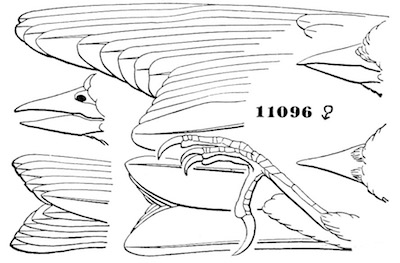
Chrysomitris pinus. 11096 ♀
Sp. Char. Tail deeply forked. Above brownish-olive. Beneath whitish, every feather streaked distinctly with dusky. Concealed bases of tail-feathers and quills, together with their inner edges, sulphur-yellow. Outer edges or quills and tail-feathers yellowish-green. Two brownish-white bands on the wing. Length. 4.75; wing, 3.00; tail, 2.20. Sexes alike. Young similar, but the white below tinged with yellow, the upper parts with reddish-brown, and there are two pale ochraceous bands on the wing.
Hab. North America from Atlantic to Pacific; Vera Cruz, plateau and alpine region (Sumichrast, I, 550).
Specimens from all parts of North America appear to be the same, but there is a great deal of variation among individuals. No. 10,225 ♂, Fort Tejon, California, and 51,636, Colorado Territory, are almost entirely white beneath, the streaks being hardly observable. 32,765, Mexico, and 9,524, Washington Territory, are unstreaked medially. No. 11,096, Fort Bridger, has the streaks on the sides unusually broad, and very black.
In autumn and winter a reddish-brown tinge overspreads the upper parts.
Habits. Though classed with the Goldfinches of this country, the Pine Finch, in many respects more nearly resembles, in its habits and nidification, the Carpodaci. It is found throughout the United States, from the Atlantic to the Pacific. In the winter it extends its irregular migrations into the Central States, as far as Northern California on the Pacific, and Southern Pennsylvania on the Atlantic. It breeds throughout the British Provinces, Northern Maine, New Hampshire, Vermont, New York, Michigan, and thence to Washington Territory, in all the evergreen forests.
At Calais, Me., it is resident throughout the year, and breeds there, but is much more common in the winter than in the summer. In Western Maine, Professor Verrill observed it very common, both in the spring and in the fall, but never found it breeding. He found it very abundant about the Umbagog lakes in July, where it was evidently breeding. It breeds also abundantly among the White Mountains.
Mr. Ridgway first saw the Pine Finch on the East Humboldt Mountains, where, through July and August, it was quite common, and where undoubtedly it breeds, as a young bird unable to fly was obtained. On the Wahsatch Mountains it was a very abundant species, inhabiting the pines as well as the groves of aspens in the alpine regions. It is gregarious at all times, flying in roving, screeching flocks. The notes it utters on all occasions resemble a very peculiar pronunciation of swe-er, given in a very sharp tone. When the flock suddenly takes to flight, this is changed to a more rattling outcry. A nest, containing no eggs, was found in an aspen-tree; and another, containing one egg, similar to those described elsewhere, was found in a fir-tree (Abies) situated near the extremity of a horizontal branch about twenty feet from the ground.
The Pine Finch is also a very common and resident bird in the plateau of Mexico and in the alpine regions of the State of Vera Cruz. Its common name there is Dominiguito montero. In the alpine regions Sumichrast states that it is found to the height of six thousand five hundred feet, and does not, to his knowledge, descend below three thousand feet. It most especially frequents the plateau.
Captain Blakiston met with this species on the plains of the Saskatchewan, near the Rocky Mountains, August 6, 1858.
In the eastern portion of Massachusetts it is somewhat irregular in its movements and appearance, which are supposed to be affected by the abundance or scarcity of its food elsewhere. Here it feeds chiefly on seeds of grasses and weeds, probably only after the seeds of the hemlock and other forest trees have failed it. They are usually most abundant late in the season and after heavy falls of snow farther north have diminished their means of subsistence. Mr. Maynard found it very numerous in the winter of 1859-60, remaining until quite late in the season, and again in the winter of 1868-69, remaining until the last week in May. In Western Massachusetts, according to Mr. Allen, it is a regular winter visitant, but never abundant. It arrives early in October, and may be seen in small flocks from that time to the third week in May. It sometimes frequents the apple-orchards, where it feeds on the Aphides. According to Dr. Coues, this species occasionally strays as far to the south as the Carolinas, but it is not common there.
Wilson observed these birds near Philadelphia, where they were feeding on the seeds of the alder. Later in the season they collected in larger flocks and took up their abode among the pine woods. In one particular locality, he states, a flock of two or three hundred of these birds regularly wintered, for many years in succession, where noble avenues of pines furnished them with abundant food throughout the season. Early in March they all disappeared. While there, they were so tame as to allow a person to approach within a few yards. They fluttered among the branches, frequently hanging from the cones, at the same time uttering notes closely resembling those of the Goldfinch.
In severe winters Mr. Audubon has met with the Pine Finch as far south as Henderson, Ky., and Charleston, S. C., but such visits were always brief. In August, 1832, he met with flocks of these birds in Labrador. They were in company with the Crossbill, and were feeding on the seeds of the fir-trees, and also on those of the thistle. When at the Magdalen Islands he frequently saw flocks moving from various directions. At Bras d’Or, towards the end of July, they were in great numbers, and the old birds were accompanied by their young. They frequented thickets of willows and elders in the vicinity of water, and were very fearless and gentle. According to his account they sing while on the wing, and their notes are sweet, varied, clear, and mellow, and, while somewhat resembling the song of the C. tristis, are perfectly distinct from it. Its flight is exactly similar, both gliding through the air in graceful and deep curves.
In Washington Territory Dr. Cooper found this Finch an abundant and constant resident, migrating to the coast in winter, where it feeds on the seeds of the alder. In summer they were gregarious, even when occupied with their nests and young. He has never met with any in California, not even in the Sierra Nevada, though they have been found by others along its whole western slope, as far south as Fort Tejon. They feed on the seeds of both coniferous and deciduous trees.
Early in May, 1859, a pair of these birds built their nest in the garden of Professor Benjamin Peirce, in Cambridge, Mass., near the colleges. It was found on the 9th by Mr. Frederick Ware, and already contained its full complement of four eggs, partly incubated. This nest was three inches in height and four in diameter. The depth of the cavity, as well as its diameter at the rim, was two inches. The base of this nest was a mass of loose materials, and the lower portions of the sides were hardly different. The upper and the inner portions of this fabric were much more compactly and neatly woven, or rather felted together. The outer layers consisted of small twigs of the Thuja, dried stems and ends of pine twigs, grasses, sedges, stalks of small vegetables, fine roots, bits of wool, and coarse hair. The whole was very closely lined with fine dry roots of herbaceous plants and the hair of small quadrupeds.
The eggs are of an oblong-oval shape, of a light green ground-color, spotted, chiefly at the larger end, with markings of a light rusty-brown. They measure .71 by .50 of an inch. They have a marked resemblance to the eggs of the Linariæ, but the ground-color is of a slightly lighter shade.
A nest of this species, found May 15, 1868, at Brunich, Canada, was composed almost entirely of pine twigs interlaced in a very neat and artistic manner. Its diameter was three and a half inches, and its height two inches. It was lined with hair. The cavity was one and a half inches deep and two inches wide.
Genus LOXIA, Linnæus.
Loxia, Linnæus, Syst. Nat. ed. 10, 758. (Type, Loxia curvirostra, L.)
Curvirostra, “Scopoli, 1777.” (Type, L. curvirostra.)
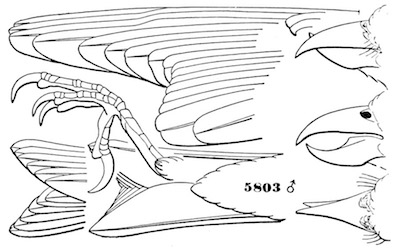
Loxia americana. 5803 ♂
Gen. Char. Mandibles much elongated, compressed and attenuated; greatly curved or falcate, the points crossing or overlapping to a greater or less degree. Tarsi very short; claws all very long, the lateral extending beyond the middle of the central; hind claw longer than its digit. Wings very long and pointed, reaching beyond the middle of the narrow, forked tail.
Colors reddish in the male.
The elongated, compressed, falcate-curved, and overlapping mandibles readily characterize this genus among birds. This feature, however, only belongs to grown specimens, the young having a straight bill, as in other Finches.
The United States species of Loxia are readily distinguished by the presence of white bands on the wing in leucoptera and their absence in americana. Neither form, however, is to be considered as specifically distinct from their European allies. The differences are as follows:—
Species and Varieties.
L. curvirostra. Wings dusky, without white bands.
1. Bill from forehead, .74; wing, 3.90; tail, 2.40. Lower mandible much weaker than the upper. Hab. Europe … var. curvirostra.[110]
2. Bill from forehead, .80 or more; wing, 4.00; tail, 2.50. Lower mandible as strong as the upper. Hab. Rocky Mountains of United States, and mountainous regions of Mexico … var. mexicana.
3. Bill from forehead, .60 or less; wing, 3.30; tail, 2.20. Hab. North America generally … var. americana.
L. leucoptera. Wings deep black, with two broad white bands.
1. Body and head pomegranate-red; black of scapulars nearly meeting across lower back. Hab. Northern North America; “Himalayas”; “Japan” … var. leucoptera.
2. Body, etc., cinnabar-red; back nearly wholly red. Hab. Europe … var. bifasciata.[111]
Loxia curvirostra var. americana, Baird.
RED CROSSBILL.
Curvirostra americana, Wils. Am. Orn. IV, 1811, 44, pl. xxxi, f. 1, 2.—Baird, Birds N. Am. 1858, 426.—Cooper & Suckley, 198.—Dall & Bannister, Tr. Ch. Ac. I, 1869, 281 (Alaska).—Cooper, Orn. Cal. 1, 148.—Samuels, 291. Loxia americana, Bon. List, 1838.—Bon. & Schlegel, Mon. Loxiens, 5, tab. vi.—Newberry, Zoöl. California and Oregon Route, P. R. R. Rep. VI, IV, 1857, 87.—Bon. & Schlegel, Mon. Lox. 5, pl. vi. Loxia curvirostra, Forster, Phil. Trans. LXII, 1772, No. 23. Aud. Biog. II, 1834, 559; V, 511, pl. cxcvii.—Ib. Birds Am. III, 1841, 186, pl. cc. "Loxia pusilla, Illiger” (Bp.). “Loxia fusca, Vieillot” (Bp.).
Sp. Char. Old male dull red (the shade differing in the specimen, sometimes brick-red, sometimes vermilion, etc.); darkest across the back; wings and tail dark blackish-brown. Young male yellowish. Female dull greenish-olive above, each feather with a dusky centre; rump and crown bright greenish-yellow. Beneath grayish; tinged, especially on the sides of the body, with greenish-yellow. Young olive above; whitish beneath, conspicuously streaked above and below with blackish. Male about 6 inches; wing, 3.30; tail, 2.25.
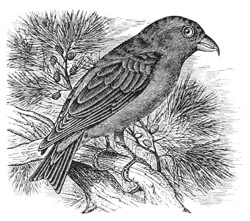
Loxia americana.
Hab. Northern America generally, coming southward in winter. Resident in the Alleghany and Rocky Mountains.
There are considerable differences both in color and size, especially of bill, in specimens from various parts of North America, and to a less degree from the same locality. While those of the Atlantic and Pacific coast have bills of much the same size, in skins from the mountains of California this member is much stouter; in this character approaching the L. mexicana of Strickland, in which the bill presents its maximum of the North American form.
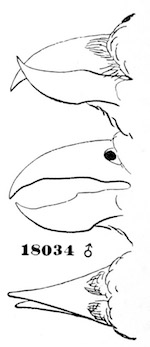
18034 ♂ California.
It would not probably be far out of the way to consider the European and all the American common Crossbills as the same species, differing only as races, and perhaps including L. himalayana, which is smaller even than americana.
We have not observed any American Crossbills with two reddish bands across the wing-coverts, corresponding to the variety rubrifasciata of Europe.
L. pytiopsittacus of Europe is much the largest of all the species, measuring seven inches in length, and with the bill seven lines high at base.
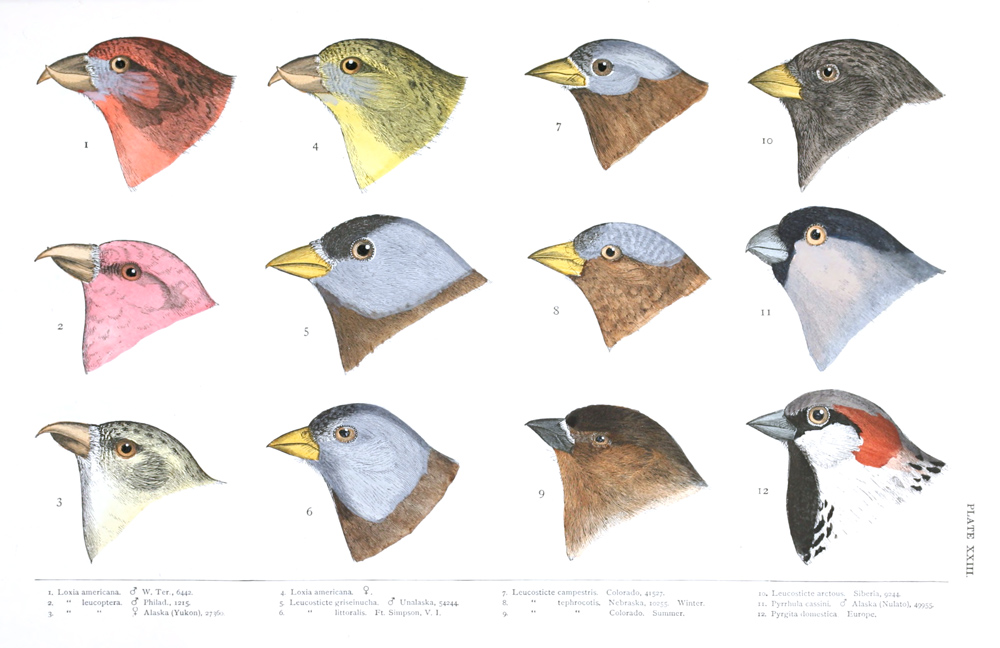
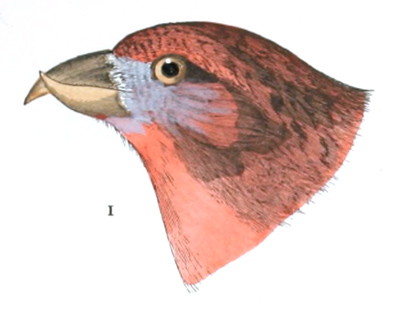
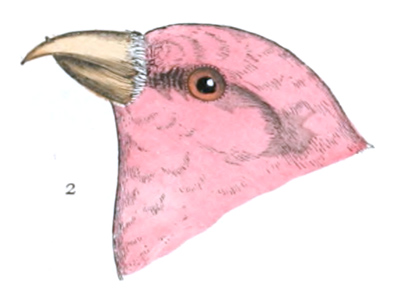
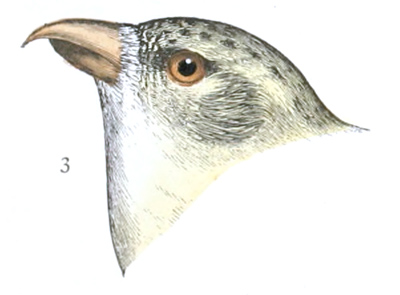
PLATE XXIII.
1. Loxia americana. ♂ W. Ter., 6442.
2. Loxia leucoptera. ♂ Philad., 1215.
3. Loxia leucoptera. ♀ Alaska (Yukon), 27360.
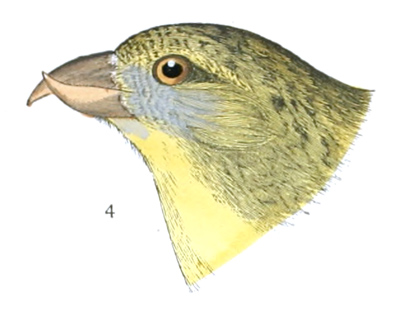
4. Loxia americana. ♀.
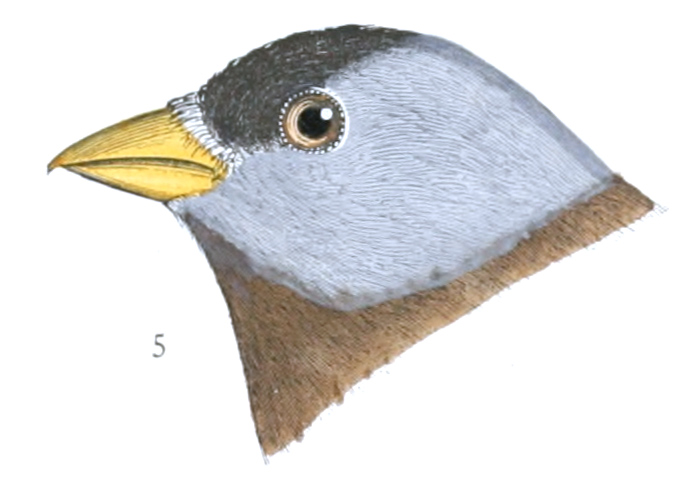
5. Leucosticte griseinucha. ♂ Unalaska, 54244.
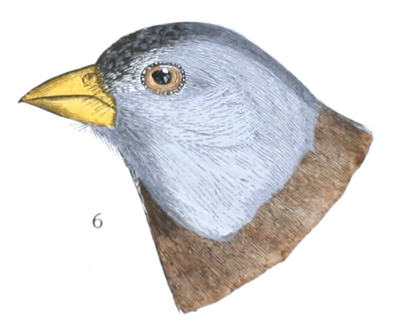
6. Leucosticte littoralis. Ft. Simpson, V. I.
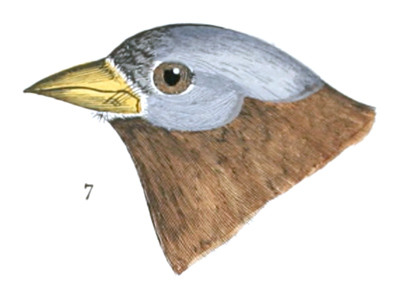
7. Leucosticte campestris. Colorado, 41527.
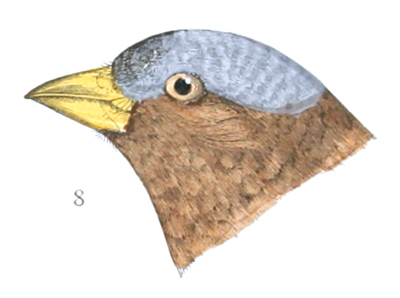
8. Leucosticte tephrocotis. Nebraska, 10225. Winter.
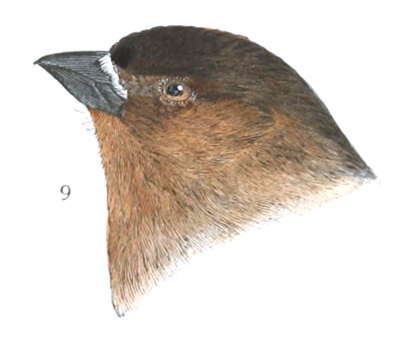
9. Leucosticte tephrocotis. Colorado. Summer.
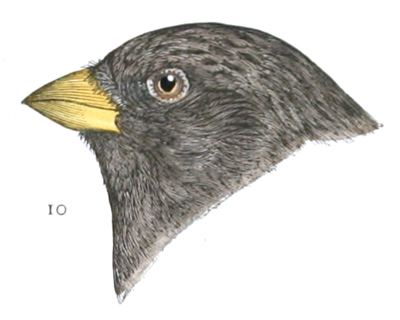
10. Leucosticte arctous. Siberia, 9244.
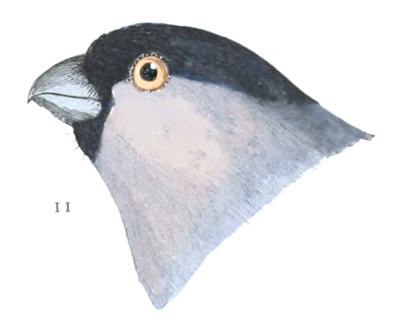
11. Pyrrhula cassini. ♂ Alaska (Nulato), 49955.
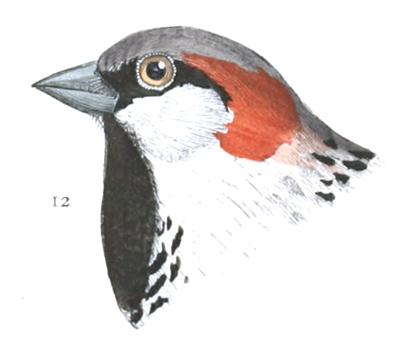
12. Pyrgita domestica. Europe.
In the intensity, as well as the shade of the red in the males, there is a great range of variation. Generally it is of a tint almost precisely like that of L. curvirostra, though deeper. The most highly colored specimen is 54,795, Philadelphia (J. H. McIlvaine), which is entirely continuous deep tile-red, approaching vermilion on the rump. The abdomen and crissum are light pinkish. In No. 31,459, Fort Rae, April, the red is of a curious and very unusual purplish wine-red shade.
The average of western specimens, particularly those from the northwest coast of the United States, have bills scarcely larger than in the average of eastern examples; thus, 18,037, Fort Crook, N. Cal., has the bill of the same size as No. 5,803, Philadelphia, while No. 53,482, East Humboldt Mountains, has the bill smaller than any other in the collection.
In color, there are scarcely any tangible differences between the European Loxia curvirostra and the two American varieties, the distinctive character being in the form of the bill and the size; the C. mexicana is the largest of the three, and the bill is quite peculiar in form, the lower mandible almost equalling the upper in length, and exceeding it in thickness. L. curvirostra is slightly smaller, and has the lower mandible much smaller and less, powerful than the upper, being inferior to it both in length, breadth, and thickness. The colors also appear to be rather less intense than in C. mexicana.
The C. americana is in every way, the bill especially, smaller than either of the preceding. The lower mandible, although but slightly shorter than the upper, is still much weaker, as in the European bird. The majority of western birds have the bill but slightly larger than eastern, and most of those with large bills are only intermediate between americana and mexicana. In some specimens the bill, although almost equalling in length that of the latter, has yet the form of the former; on the other hand, there are specimens with the proportions of the mandibles as in mexicana, while the size is intermediate.
The following figures will illustrate the differences in the size of the bills of the different races.
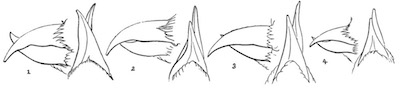
1 Var. mexicana. 29703 ♂, Mexico. 2 Var. curvirostra. 17010 ♂, Europe. 3 Var. americana. 18036 ♂, California. 4 Var. americana. 5803 ♂, Philadelphia.
Specimens from the Columbia River region and northwest coast of the United States appear to have the red more rosaceous and the bill more slender than the typical style. One specimen (No. 31,459, Fort Rae) is altogether a very peculiar one; the shade of red is different from that of any other specimen, being a dark maroon-carmine, with a clear ash suffusion on the back. There are two distinct dusky stripes on the cheek, one over the upper edge of the ear-coverts, the other along the lower edge. The lining of the wing is without any red tinge, seen in all specimens of the true americana and mexicana; the wings and tail are pure sepia-brown, quite different from the others; and the feathers show no red margins. The lower mandible is very much curved. (May not this be like some Siberian style?)
No 21,868, from Washington Territory, has the bill nearly as slender as in C. leucoptera, but there is nothing else peculiar.
Habits. The common Red Crossbill of America is a bird of very irregular distribution, abundant in some places at certain seasons, and again rarely seen for several years. It is a Northern species, found in summer chiefly in the more northern portions of the United States, and also found throughout the year in the Alleghanies, in Pennsylvania, Maryland, and Virginia, to Georgia. A closely allied variety is also found in the alpine regions of Vera Cruz and other departments of Mexico.
Dr. Suckley found this species quite abundant at Puget Sound, in certain seasons. This was especially so in the spring of 1854, though afterwards he met with but few. He noticed a pair on the ground near a pool of rain-water. They were very tame, and allowed a near approach. Dr. Cooper found it very abundant near the coast, where it feeds, in winter, on the seeds of the black spruce, retiring in summer to the mountains to breed, but returning in September. He never observed any in the fir forests of the Coast Range. In the Sierra Nevada, latitude 39°, Dr. Cooper found these birds in considerable numbers, September, 1863, and in winter they have been obtained about San Francisco. They seem to be most attracted to the forests of spruces, cypresses, and red-woods, the cones of which are most readily broken. They occasionally descend to the ground, in the Rocky Mountains, in search of the seeds of small plants, and also for water.
Mr. Bischoff obtained specimens of this species at Sitka, but it was not noticed in the territory of the Yukon River by Mr. Dall, or any of his party, and it was met with by Mr. Ridgway on the East Humboldt Mountains only. There they were occasionally seen among the willows and small aspens bordering the streams. Their common note was a fine and frequently repeated chick-chick-chick, very different from the plaintive notes of the C. leucoptera.
In New England they are of somewhat irregular occurrence, though in Maine and in the northern portions of Vermont and New Hampshire they are more or less resident. In Eastern Massachusetts they are comparatively rare, excepting that, at irregular intervals, they come in large flocks during the winter. This was so to a remarkable degree in the winter of 1832, and more recently in 1862, when, Mr. Maynard states, they remained until April. They were then in their summer plumage, and also in full song. In August 1868, they again became quite numerous, and had just before appeared in large numbers in Western Maine, doing great damage to the oats, and disappearing as soon as these had been harvested. Mr. Maynard thinks that these birds were the same with those afterwards so numerous in Massachusetts.
The same peculiarities of irregular appearance have been observed by Mr. Allen, in Springfield, where it is often a very abundant visitor, but generally not so common. In the winter of 1859-60 the pine woods in the vicinity of that city abounded with them, and in February they were already in full song. They are at all times gregarious, and are sometimes seen in large flocks.
They have, as they fly, a loud, peculiar, and not unmusical cry. This call-note they do not utter when at rest or when feeding. Their song in the spring and summer is varied and pleasing, but is not powerful, or in any respect remarkable. This song is especially noticeable in caged birds, who soon become very tame, and feed readily from the hand, even when taken at an adult age. Their manners in confinement are very like those of the Parrots, clinging to the top of the wires with their claws, hanging with their heads downward, and, when feeding, holding their food in one claw. On the trees, their habits and manner are also said to be similar to those of Parrots.
Mr. Audubon has found these birds, in August, in the pine woods of Pennsylvania, and inferred that they breed there. This does not necessarily follow. They breed so early at the north as to give ample time for their migrations, even in midsummer, to remote places. Professor Baird, however, informs me that during a summer spent in the mountains of Schuylkill County, Penn., in the coal region, he saw them nearly every day, moving about or feeding, in pairs.
The Crossbills are extremely gentle and social, are easily approached, caught in traps, and even knocked down with sticks. Their food is chiefly the seeds of the Coniferæ, and also those of plants. Audubon’s statement that they destroy apples merely to secure the seeds is hardly accurate. They are extravagantly fond of this fruit, and prefer the flesh to its seeds. Their flight is undulating, somewhat in the manner of the Goldfinch, firm, swift, and often protracted. As they fly, they always keep up the utterance of their loud, clear call-notes. They move readily on the ground, up or down the trunks and limbs of trees, and stand as readily with their heads downward as upright.
Wilson states that in the interior of Pennsylvania this species appears in large flocks in the winter, and during the prevalence of deep snows they keep about the doors of dwellings, pick off the clay with which these huts are plastered, and are exceedingly tame and not easily driven off.
So far as is known, these Crossbills breed in midwinter, or very early in the spring, when the weather is the most inclement. The nest and eggs of this species were procured by Mr. Charles S. Paine, in East Randolph, Vt., early in the month of March. The nest was built in an upper branch of an elm,—which, of course, was leafless,—the ground was covered with snow, and the weather severe. The birds were very tame and fearless, refusing to leave their eggs, and had to be several times taken off by the hand. After its nest had been taken, and as Mr. Paine was descending with it in his hand, the female again resumed her place upon it, to protect her eggs from the biting frost. The eggs were four in number, and measured .85 by .53 of an inch. They have a greenish-white ground and are beautifully blotched, marbled, and dotted with various shades of lilac and purplish-brown.
Loxia curvirostra, var. mexicana, Strickland.
MEXICAN CROSSBILL.
Loxia mexicana, Strickland, Jardine Contrib. Orn. 1851, 43.—Sclater, P. Z. S. 1859, 365.—Ib. 1864, 174, City of Mexico.—Salvin, Ibis, 1866, 193 (Guatemala).
Sp. Char. Colors of americana, but red brighter, more scarlet. Bill very large, the lower mandible nearly or quite equal to the upper in strength and length. Wing, 4.00; tail, 2.50; bill (from forehead) .82.
Hab. Mountainous regions of Southern North America, from Guatemala, north into Rocky Mountains of United States; Mexico, Orizaba.
This bird is quite as well marked as any of the plain-winged “species,” differing from curvirostra and americana quite as much as they do from each other.
All specimens from Mexico, as well as from the Central Rocky Mountains of the United States, are referrible to this form, though in winter the americana may also be found in the latter region, as a migrant from the north.
Habits. The occurrence of this well-marked race among the mountainous districts of Mexico is a very interesting and suggestive fact in regard to the distribution of birds, demonstrating, as it does, the close connection between high latitudes and high elevations as favoring similar forms. It was first described by Strickland from specimens obtained on the plateau near the city of Mexico. Another specimen is referred to by Mr. Sclater as having been received from Jalapa, Mexico; and Mr. Sumichrast obtained also a single specimen of this species at Moyoapam, in the alpine region of Orizaba, where it is known as the Pico cruzado. It was taken at an elevation of about 7,500 feet. Mr. Sumichrast was unable to determine whether this bird was resident, or only a migratory visitant in the winter. I can find no reference to any distinctive peculiarities of habits.
Loxia leucoptera, Gmelin.
WHITE-WINGED CROSSBILL.
Loxia, leucoptera, Gm. Syst. Nat. I, 1788, 540.—Aud. Orn. Biog. IV, 1838, 467, pl. ccclxiv.—Ib. Birds Am. III, 1841, 190, pl. cci.—Bon. & Schl. Mon. Loxiens, 1850, 8, pl. ix.—Gould, B. Gt. Britain, V, 1864 (killed England, Sept. 17). Curvirostra leucoptera, Wils. Am. Orn. IV, 1811, 48, pl. xxxi, f. 3.—Baird, Birds N. Am. 1858, 427.—Dall & Bannister, Tr. Ch. Ac. I, 1869, 281 (Alaska).—Cooper, Orn. Cal. 1, 149.—Samuels, 293. Crucirostra leucoptera, Brehm, Naumannia, I, 1853, 254, fig. 20. Loxia falcirostra, Lath. Index, Orn. I, 1790, 371.
Sp. Char. Bill greatly compressed, and acute towards the point. Male carmine red, tinged with dusky across the back; the sides of body under the wings streaked with brown; from the middle of belly to the tail-coverts whitish, the latter streaked with brown. Scapulars, wings, and tail black; two broad bands on the wings across the ends of greater and median coverts; white spots on the end of the inner tertiaries. Female brownish, tinged with olive-green in places; feathers of the back and crown with dusky centres; rump bright brownish-yellow. Length about 6.25; wing, 3.50; tail, 2.60.
Hab. Northern parts of North America generally; Greenland (Reinh. Ibis, III, 1861, 8); England, (September 17, Gould, Birds Great Britain).
The white bands on the wings distinguish this species from the preceding, although there are some other differences in form of bill, feet, wing, etc. There is less variation in form and color among specimens than in the preceding. It differs from the European analogue, L. bifasciata, according to authors, in the more slender body and bill, and in having the body pomegranate-red, with blackish back, instead of cinnabar-red, as in curvirostra and americana, Bonaparte and Schlegel quote the American species as occurring in the Himalaya Mountains, and perhaps Japan, but throw doubts on the supposed European localities.
Habits. Both the distribution and habits of this species are probably, in all essential respects, the same with those of the preceding. It is, if anything, a more northern bird, and it has not been detected anywhere on the Pacific coast south of British America. It was found in the Arctic regions by Sir John Richardson, where the other species was not observed. He found it inhabiting the dense white-spruce forests of the fur country, feeding principally on the seeds of their cones. Up to the sixty-eighth parallel he found them ranging through the whole breadth of the continent. It is supposed to go as far as these woods extend, though it has not been traced farther than the sixty-second degree. It was found feeding on the upper branches, clinging to them when wounded, and remaining suspended even after death. In September they collected in small flocks, and flew from tree to tree with a chattering noise. In the depth of winter they retire from the coast to the thick woods of the interior.
A few individuals of this species are recorded by Professor Reinhardt as having been taken in South Greenland.
In Pennsylvania this species is much more rare than the americana, and Wilson only met with a few specimens. Since his day it has been found more abundantly, occasionally in the neighborhood of Philadelphia.
Mr. Dall states that these birds were not uncommon near Nulato in the winter. Several specimens were obtained in February and April. None were found there in the summer. He speaks of their great expertness in opening the spruce cones with their curved bills, and extracting the seeds.
Its appearance in Eastern Massachusetts is much more irregular both as to numbers and time than that of the other species. In the fall and winter of 1868 and 1869 they were uncommonly abundant, appearing early in the fall, and remaining until quite late in the spring. They were even more fearless and tame than the americana, and in one instance a pair were taken by the hand, and afterwards kept in confinement. They appeared around Boston in large flocks, and remained through April. One was shot in Newton by Mr. Maynard, June 13. It was found in an apple-tree, and its crop was full of canker-worms. In Eastern Maine it is resident throughout the year, and, like the other species, breeds in winter. In Western Maine Professor Verrill has found it a common winter visitant, but it is not known to be resident.
Near Springfield Mr. Allen considered this species a much less frequent visitor than the preceding. In the winters of 1854 and 1860 he found them very abundant, occurring in large flocks.
Mr. Audubon, on his way to Labrador in 1833, found these birds quite common, in May, among the islands of the Bay of Fundy, evidently migrating, on their way to more northern regions. I, however, observed none there during my visits in the summers of 1850 and 1851, although a specimen was afterwards obtained on the Murre Islands, on the 30th of June.
So far as they are known, the habits of this species are exactly similar to those of the preceding. They feed in the same manner and upon like food. Their flight is undulating and well sustained, and their movements in the trees are not perceptibly different.
In the spring of 1869, Mr. Jillson, of Hudson, Mass., sent me a pair of these birds which he had captured the preceding autumn. They were very tame, and were exceedingly interesting little pets. Their movements in the cage were like those of caged parrots in every respect, except that they were far more easy and rapid. They clung to the sides and upper wires of the cage with their feet, hung down from them, and seemed to enjoy the practice of walking with their head downward. They were in full song, and both the male and the female were quite good singers. Their songs were irregular and varied, but sweet and musical. They ate almost every kind of food, but were especially eager for slices of raw apples. An occasional larch cone was also a great treat to them. Although while they lived they were continually bickering over their food, yet when the female was accidentally choked by a bit of eggshell her mate was inconsolable, ceased to sing, refused his food, and died of grief in a very few days.
The White-winged Crossbill was seen more frequently by Mr. Ridgway among the East Humboldt Mountains than the other species. It was first noticed on the 12th of August among the cedars on the mountains. Its fine plaintive cry of “wēēk” was entirely different from the hurriedly uttered notes of the C. americana.
Several specimens of this Crossbill have been taken in Europe, where their occurrence is of course accidental, irregular, and rare.
A nest of this species (S. I., 13,452), taken at Fredericton, New Brunswick, by Dr. A. Adams, in 1868, is deeply saucer-shaped, and composed of a rather thin wall of fibrous pale-green lichens, encased on the outside with spruce twigs, and thinly lined with coarse hairs and fine shreds of inner bark. Its external diameter is a little less than four inches, the rim being almost perfectly circular; the cavity is an inch and a half deep by two and a half broad.
The one egg is pale blue, the large end rather thickly spattered with fine dots of black and ashy-lilac; is regularly or rather slightly elongate-oval, the small end rather obtuse. It measures .80 of an inch in length by .56 in breadth.
Genus ÆGIOTHUS, Caban.
Acanthis, Bonap. Conspectus, 1850, not of Bechstein, 1802, nor of Keys. & Blas. 1840.
Ægiothus, Cabanis, Mus. Hein. 1851, 161. (Type, Fringilla linaria, Linn.)—Coues, Pr. Acad. Nat. Sc. Phil. 1861, 373; 1863, 40; 1869, 180.
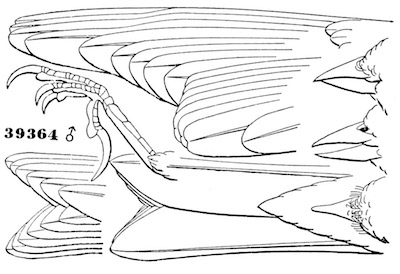
Ægiothus linarius. 39364 ♂
Sp. Char. Bill very short, conical, acutely pointed, the outlines sometimes concave; the commissure straight; the base of the upper mandible and the nostrils concealed by stiff, appressed bristly feathers; middle of the mandible having several ridges parallel with the culmen. Inner lateral toe rather the longer, its claw reaching the middle of the middle claw; the hind toe rather longer, its claw longer than the digital portion. Wings very long, reaching the middle of the tail; second quill a little longer than the first and third. Tail deeply forked.
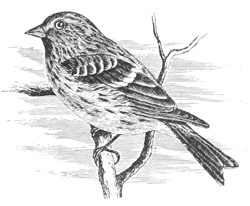
Ægiothus linarius.
Difficult as it sometimes is to define with precision the characters of closely allied species of birds, there are few genera where this is the case more strikingly than in Ægiothus. Leaving out of view the peculiar European species, it has been a mooted question whether North America, including Greenland, possesses one, two, or six species, owing to the strictly boreal distribution of these birds, and the fact that their summer resorts are seldom invaded by the naturalist. The necessary means of determining the proper distribution of the forms and the variations with season, locality, and sex, are scarcely to be met with in any public museum, that of the Smithsonian Institution, however, being the most complete in this respect.
To Dr. Coues, as quoted above, we owe the most satisfactory indications of the different species and varieties, his papers in the Proceedings of the Philadelphia Academy of Natural Sciences (1861, 375; 1863, 40; and 1869, 180) being models of ornithological criticism and discussion. His labors have enabled us to define with precision the various forms, both European and American, found in the genus, and have brought us to satisfactory conclusions in reference to their limitations.
Mr. Ridgway has lately made a careful revision of the specimens of Ægiothus in the Smithsonian collection, and with a general concurrence in the conclusions of Dr. Coues in regard to the differences observable, he suggests, as an application of the laws more recently verified by him and myself in our examination of the North American land-birds, that we may best consider the actual species to be two in number, namely, canescens and linarius, ranging the other forms under these, either as geographical races or as seasonal stages. Bearing in mind the general law that the more boreal or Greenland-born specimens should be larger than the more southern or Continental, and that the peculiar dark plumage of fuscescens and rostratus only occurs in summer breeding specimens, he considers these as identical with linarius and holbölli; the winter plumages respectively of the same two races of one species, linarius; the latter race, holbölli, being the larger or Greenland form. If fuscescens be darker than summer linarius from Europe, it is simply another instance of the darker tints of Arctic American birds as compared with European.
Ægiothus canescens and exilipes Mr. Ridgway considers as the Greenland (larger) and Continental (smaller) races of one species, which perhaps do not differ so much with season as do those of linarius. The differences in the size and proportions of bill, and perhaps of feet, Mr. Ridgway does not think of much importance, as great variations are observable in this respect in specimens from the same locality, and the actual differences of the bill are obscured by the greater length of the bristly feathers around its base in winter, making it appear considerably shorter. Indeed, Professor Alfred Newton maintains that the same bird will have the bill considerably longer in summer, after living on soft insect food, and shorter in winter when worn down by use on hard seeds. Mr. Ridgway finds, too, that specimens of linarius from Kodiak differ in a much longer and more slender bill than usual, in this respect resembling Alaska specimens of several other Fringillidæ.
The following synopsis expresses Mr. Ridgway’s views as indicated above: a critical examination of a series of more than two hundred specimens, in the collection of the Smithsonian Institution, being the basis of his conclusions.—S. F. B.
Species and Varieties.
Common Characters. Adult. Above streaked with dusky upon a brownish, or brown and whitish, ground; wing-coverts tipped with whitish or pale brown. Beneath whitish, streaked on the sides with dusky. An indistinct, lighter superciliary stripe. Male. Rump tinged with rose-pink. Female. Rump not tinged with pinkish. Juv. Without any red, and with the whole lower parts thickly streaked.
A. Crown with a quadrate patch of crimson, in adult; throat and chin with a dusky spot; quills and tail-feathers not edged conspicuously with white. ♂ with the breast tinged with red.
1. A. canescens. Rump unstreaked white (both sexes, at all seasons); the lower tail-coverts with white shafts; the red tinge on the breast in the ♂, of a delicate pale rosaceous pink tint.
Bill very short and thick, its height through the base nearly equalling the length of the culmen. Wing, 3.20; tail, 2.65. Bill: culmen, .35; height, .30. Hab. Greenland … var. canescens.
Bill much smaller, more acute, its height through the base much less than the length of the culmen. Wing, 3.00; tail, 2.50. Bill: culmen, .30; height, .22. Hab. Continental arctic America … var. exilipes.
2. A. linarius. Rump always streaked; lower tail-coverts with dusky shaft-streaks; the red tinge on the breast of the ♂ of a rosaceous-carmine tint.
Bill about .35 in length by .22 in height; wing, 2.80; tail, 2.40. Hab. Continental arctic and cold temperate North America … var. linarius.
Bill about .40, or more, in length, by .30 in height; wing, 3.20; tail, 2.60. Hab. Greenland in summer, and Continental arctic and cold temperate North America in winter … var. holbölli.
B. Crown without any red; throat and chin without any dusky spot; quills and tail-feathers of adult male edged conspicuously with white. ♂ without red tinge on the breast.
3. A. flavirostris. Rump rose-pink in the ♂, brown streaked with dusky in ♀. No red on crown or breast.
♀. Above umber-brown streaked with dusky; ground-color of rump light brown; throat and jugulum strongly ochraceous-buff. Hab. Europe … var. flavirostris.
♀. Above olive-brown streaked with dusky; ground-color of rump sulphur-yellow; throat and jugulum faintly sulphur-yellow, tinged with buff. Hab. North America … var. brewsteri.
Ægiothus linarius, Cabanis.
LESSER RED-POLL.
Fringilla linaria, Linn. Syst. Nat. I, 1766, 322.—Aud. Orn. Biog. IV, 1838, 538, pl. ccclxxv. Fringilla (Acanthis) linaria, Keys. & Blas. Wirb. Europ. 1840, No. 115. page 161.—Acanthis linaria, Bp. Conspectus, 1850, 541. Ægiothus linaria, Cabanis, Mus. Hein. 1851, 161.—Baird, Birds N. Am. 1858, 428.—Coues, Pr. A. N. S. Nov. 1861, 382.—Cooper & Suckley, 198.—Samuels, 294.—Maynard, B. E. Mass. 1870, 110.—Dall & Bannister, Tr. Chic. Acad. I, 1869, 281.—Cooper, Orn. Cal. 1, 159. Linaria minor, Sw. F. Bor. Am. II, 1831, 267.—Aud. Syn. 1839, 114.—Ib. Birds Am. III, 1841, 122, pl. clxxix. ? Linaria holbölli, Brehm, Vögel Deutschlands. Acanthis holbölli, Bp. & Schlegel, Mon. Loxiens, 1850, 50, pl. liii. Ægiothus holbölli, Coues, Pr. A. N. Sc. 1861, 385. Linaria americana, Max. Cab. Journ. VI, 1858, 338. Ægiothus fuscescens, Coues, P. A. N. S. Aug. 1861, 222 (Labrador; breeding dress).—Ib. p. 380. Ægiothus rostratus, Elliot, Illust. B. Am. I, pl. ix.—Coues, P. A. N. S. Nov. 1861, 378 (Greenland).—Elliot, Illust. Birds N. A. I, pl. x.
I. Spring and Winter Plumage.
Sp. Char. Adult. Ground-color of the occiput, nape, scapulars, and interscapulars, brownish-white, each feather with medial streak of dusky-brown; rump and upper tail-coverts white, with the streaks in sharper contrast. Wings clear brownish-dusky with two conspicuous white bands, formed by tips of middle and secondary coverts; tertials broadly, and secondaries narrowly, edged with white; tail-feathers narrowly edged with white, this broader on inner webs. A narrow frontal band (tinged with brownish), an obscure superciliary stripe, and the lower parts in general, white; sides streaked with dusky, and lower tail-coverts each with a medial streak of the same. On the forehead and vertex a somewhat quadrate patch of intense carmine. Nasal plumuli, lores, and a small, somewhat quadrate, gular spot, dark silky-brown. Bill yellow, the culmen and gonys black.
♂. Throat, jugulum, and breast, rosaceous-carmine (extending upward over the maxillæ, and backward over the sides almost to the flanks); rump tinged with the same.
Var. linarius (21,577, Philadelphia). Wing, 2.80; tail, 2.35; bill, .35 and .22; tarsus, .55; middle toe, .30.
Var. holbölli (39,263, Quebec). Wing, 3.00; tail, 2.40; bill, .42 and .29; tarsus, .60; middle toe, .37.
Var. holbölli? (52,457, Kodiak). Wing, 3.00; tail, 2.40; bill, .47 and .25; tarsus, .55; middle toe, .35.
♀. No red except on the crown, where its tint is less intense; dusky gular spot larger, extending farther on to the throat.
Var. linarius (902, Penn.). Wing, 2.70; tail, 2.30; bill, .32 and .23; tarsus, .55; middle toe, .32.
Var. holbölli (39,362, Quebec). Wing, 3.10; tail, 2.50; bill, .42 and .29; tarsus, .61; middle toe, .39.
Var holbölli? (52,460, Kodiak). Wing, 2.80; tail, 2.30; bill .39 and .23;. tarsus, .54; middle toe, .32.
II. Summer or Breeding Plumage.
The pattern the same as above, but the dark tint intensified and spread so as to almost entirely obliterate any lighter markings, except the streaks on the rump; the wing-bands as well as the dorsal streaks obsolete; streaks on the sides broader; frontal band dusky like the occiput. Red tints slightly intensified. Bill wholly dusky.
♂. Throat, jugulum, breast, and tinge on sides and rump, rosy-carmine.
Var. linarius (type of “fuscescens”). Wing, 2.80; tail, 2.30; bill, .36 and .25; tarsus, .53; middle toe, .33.
Var. holbölli (type of “rostratus”). Wing, 3.00; tail, 2.35; bill, .41 and .30; tarsus, .60; middle toe, .40.
Var. holbölli? (54,477, Kodiak, July). Wing, 2.90; tail, 2.20; bill, .40 and .25; tarsus, .56; middle toe, .32.
♀. No red except on the crown.
Var. linarius (♀ type of “fuscescens”). Wing, 2.80; tail, 2.30; bill, .35 and .25; tarsus, .52; middle toe, .34.
Young (first plumage). (54,478, Kodiak, July.) Streaks covering whole head, neck, and breast; no red (Ridgway).
Hab. Circumpolar regions. In North America breeding in the sub-arctic regions, and in winter descending into the northern United States.
The two races of Æ. linarius are quite differently colored in summer and in winter. In the latter season the plumage is softer and more lax, and the markings better defined, though in autumn with a considerable ochraceous suffusion. In spring the colors are purer, and the markings most sharply defined; in the breeding-season the plumage assumes a burnt appearance, the dark tints intensify and spread, so that sometimes the upper parts appear almost uniformly dusky; the bill appears larger, in consequence of the less development of its basal tufts, than in winter. In this dusky summer condition these birds form the Æ. fuscescens and Æ. rostratus of Coues, the latter being the summer plumage of var. holbölli, the former that of var. linarius. In the series of over two hundred examples examined, all midsummer specimens are in the plumage of fuscescens or rostratus, while the latter is not seen in any autumnal, winter, or spring birds.
Specimens of the var. holbölli have been received from Quebec, collected by Mr. W. Couper.
Habits. Accepting as variations due either to locality, latitude, or season the differences already referred to in the plumage of this species, it is not necessary to consider the question of races in connection with our story of their habits. We possess but very little information as to their peculiarities as races in these respects. Treating, then, the Lesser Red-Poll, though appearing in four differing phases, as one species, we claim it to be common to the northern portions of both hemispheres.
It is found throughout northern North America from the Atlantic to the Pacific, is abundant in the boreal regions of Europe, and probably of Asia also. On the Pacific coast, Dr. Cooper has observed it only as far south as Washington Territory. Farther north it is much more abundant. Mr. Bannister found it common at St. Michaels, both in summer and in winter. At Nulato Mr. Dall found this species very common in winter, and very little less so in summer. He states that the nest is usually lined with hair, and covered externally with moss, dry grass, and like materials, built in bushes, near the ground. They begin to build the 15th of May. The eggs are laid about the 1st of June, and the young are flying near the end of July. The young of the first year are dark, with a small patch of brown on the breast. After their second year the males increase the amount of rose-color on the head and breast, and the very old birds are quite brilliant in the breeding-season. At St. Michaels, where there are no trees and very few bushes; these birds frequently build their nests in the grass.
Mr. Dall states that this bird has no song, but that their cheerful twittering and chirping, their fearless and sociable ways, their bright plumage and elegant nests, are quite enough to make them general favorites.
Richardson found this neat and hardy little bird one of the few permanent residents of the fur countries, where it was seen, in the coldest weather, on the banks of lakes and rivers, hopping among the reeds or clinging to their stalks.
Mr. Lord found this species a rare bird in British Columbia. It was found in swampy places, where the alders grew thickly, and where there were large water-plants. To these it clings, pecking at their seed-pods, or, searching the remaining flowers, feeds upon any insects they may contain. Their song he describes as a soft and pretty warble, coming in bursts, the singer perching himself boldly on the top of a plant, as if to be more plainly heard by his companions. In early spring they feed on the catkins of the alder and hazel. They winter in small flocks in Vancouver’s Island.
Holböll states that this species is found irregularly distributed over Greenland, coming always in the first half of April, a little later than the Snow-Bunting. It migrates to Greenland from America, and is much rarer in Iceland. In June it is found nesting near the shore, and, contrary to the usual nature of birds, is very wild, though at all times else it is very fearless. At this time the male loses its beautiful crimson breast, resembles the female, and is much less gorgeous than in winter. It nests in birches, alders, or willows, and lays five bluish-white eggs, spotted with clear brown. Towards the end of August and in September they are seen in small flocks about the settlements, the male resuming its red breast, and all, both old and young, being very fearless. In confinement they soon became very tame, and in a few days would perch upon his hand and struggle with each other for the hemp-seed that he held to them, though there was plenty of food in their cage. They feed on seeds and the tops of lichens. By October they all disappear, and are not seen in Greenland in the winter.
Wilson states that, in his day, these birds were very common in Northwestern New York, where they appeared always with the first deep snow, and were, on that account, called Snow-Birds. In severe winters they were occasionally, though very rarely, seen in the neighborhood of Philadelphia, where they were very fond of the seeds of the common alder, and hung head downwards while feeding, in the manner of our Goldfinch. They were very unsuspicious, and permitted a near approach without manifesting any signs of alarm. Mr. Ord, in a subsequent edition of Wilson, states that these birds rarely visit Philadelphia, and that it was many years before he could procure specimens. In the winter of 1813-14 they appeared in a flock of nearly a hundred, and were so intent in feeding upon the seeds of the Atriplex hastata that they could be closely approached. Their call exactly resembled that of the Goldfinch. These birds lingered in that neighborhood until about the middle of April.
Their migration southward in winter is evidently caused more by want of food than by the state of the temperature. They remain in high northern regions in the most inclement weather, and often appear among us in seasons not remarkably cold, and remain until late in the spring. In 1833, by the 7th of November, the weather still being quite mild, Nuttall states, they appeared in Massachusetts in considerable flocks. They regularly assembled in the birch-trees every morning to feed on the seeds, and were so intent on their employment that it was often possible to approach the slender trees on which they were feeding, and strike them off, before they would take wing. They hung on the twigs with great tenacity, and moved about in reversed positions, in the manner of the Chickadees. They are described by him as having a quailing call, similar to that of the Goldfinch, and when crowding together, in flight, as making a confused chirping, with a rattling noise, and moving off with a simultaneous twitter. They were attracted to the pines by the Crossbills, and were busily employed in collecting the seeds, dropped from the cones as the Crossbills opened them. They at times fed on the buds of fruit-trees. They were always found to be fat, even on their first arrival, and there were no obvious reasons for their movements.
Mr. Boardman speaks of them as common at Calais by the first of the winter. At Norway, Me., Professor Verrill found them very common in fall, winter, and spring, and most abundant in March and April. In Springfield they are, according to Mr. Allen, an irregular and occasional visitant, coming in very large flocks one year, and again not seen for several years. In a more recent paper (1870) Mr. Allen states that during the preceding five years these birds have been several times very numerous in Massachusetts, appearing in quite large flocks.
Mr. Audubon met with these birds in Labrador the last of July, and obtained specimens of different ages. He thinks their notes more like those of the Siskin of Europe than of our Goldfinch, uttered both when the birds are on the wing and when they have alighted. They were in small parties of seven or eight, evidently members of the same family. They were tame and familiar, and fearlessly returned to the same spot after having been shot at. They were also remarkably affectionate, and he frequently observed them passing seeds one to the other in the most loving manner.
Dr. Coues also observed this bird in Labrador, and described it as Æ. fuscescens. He found it abundant along the coast, and was struck with its resemblance, in habits, to the Chrysomitris tristis. It was remarkably unsuspicious and familiar, and showed no signs of fear even when very closely approached. It frequented, almost exclusively, the scrubby junipers that grow everywhere in open places in thick impenetrable patches. He describes its flight as irregular, rising and falling in curves, and seldom protracted to any great distance. While passing overhead, it uttered a peculiar rattling chirp. He thinks it has no song.
Dr. Kirtland informs me that early in the winter of 1868 his grandson picked up a wing-broken male Red-Poll, and placed it in his greenhouse. It began at once to feed on crumbs of bread and hay-seed, and rapidly recovered. It soon acquired the habit of leaping from shelf to shelf, among the plants, and was finally seen climbing up some stately Pelargonium shrubs, and suspending itself, parrot-like, by its feet from the limbs, capturing aphides. From that time it took no other food, living exclusively on the parasitic insects of the plants. So active was it in capturing these, that for two months it was not necessary to fumigate the greenhouse to destroy them. From day to day a female Red-Poll hovered over the building, and her calls were responded to by the invalid. Later in the season he escaped from his confinement, and was seen to rejoin his faithful mate, which had remained near him all the winter. As in Europe, this species in the Arctic regions of America has been found nesting in low trees and bushes, from two to six feet from the ground.
The habits and appearance of the birds observed in Europe appear identical with those of our own. Mr. Yarrell states that of all birds these are the most easily tamed, and can be readily made to breed in confinement. In Scotland and in parts of England it is resident throughout the year, in the summer retiring to the bases of the mountains, and there breeding in the underwood that skirts the banks of the mountain streams. It nests in bushes or low trees, such as the alder and the willow. These are constructed of mosses and the stems of dry grasses, intermingled with down from the catkins of the willow, and lined with the same, making them soft and warm. The young are produced late in the season, and are seldom able to fly before the first of July. The parent birds are devoted in their attachment. Pennant relates that in one instance where this bird was sitting on four eggs, she was so tenacious of her nest as to suffer him to take her off with his hand, and after having been released she still refused to leave it. In the winter they descend to the lower grounds, and there feed on the buds of the birch and alder, to reach which they are obliged, like the Titmice, to hang from the ends of the branches, with their backs downward. So intent are they on their work that they are easily taken alive by means of a long stick smeared with birdlime. Mr. Selby states that its notes during the breeding-season, though not delivered in a continuous song, are sweet and pleasing. Captain Scoresby relates that in his approach to Spitsbergen several of these birds alighted on his ship. They were so wearied with their long journey as to be easily caught by the hand. The distance of the nearest point of Norway renders it difficult to imagine how so delicate a bird can perform this journey, or why it should seek such a cold and barren country. European eggs are five in number, of a pale bluish-green, spotted with orange-brown, principally about the larger end. They measure .65 by .50 of an inch.
American eggs of this species average .65 by .53 of an inch. Their color is a light bluish-white, which varies considerably in the depth of its shading, and this tinge is exceedingly fugitive, it being difficult to preserve it even in a cabinet. The eggs are generally and finely dotted with a rusty-brown, and are of a rather rounded oval shape.
Ægiothus canescens, Cabanis.
MEALY RED-POLL.
Linaria canescens, Gould, “Birds Europe, pl. cxciii.” Linota canescens, Bonap. List, 1838. Acanthis canescens, Bon. Conspectus, 1850, 541.—Bon. & Schlegel, Mon. Loxiens, 1850, 47, tab. li.—Ross, ed. Phil. Jour. 1861, 163. Ægiothus canescens, Cabanis, Mus. Hein. 1851, 161.—Baird, Birds N. Am. 1858, 429.—Coues, P. A. N. S. 1861, 388.—Samuels, 295. “Fringilla borealis, Temminck, 1835. Not of Vieillot.” Bonaparte. ? Fringilla borealis, Aud. Orn. Biog. V, 1839, 87, pl. cccc. ? Linaria borealis, Aud. Birds Am. III, 1841, 120, pl. clxxviii. “Linaria hornemanni, Holböll, Kroyer Nat. Tidskr. 1843.” Ægiothus exilipes, Coues, Pr. A. N. Sc. Nov. 1861, 385.—Elliot, Illust. N. Am. Birds, I, pl. ix.
Sp. Char. Autumnal female. Greenland race (canescens). (23,377, Greenland, Univ. Zoöl. Mus. Copenhagen.) In general appearance like the corresponding plumage of Æ. linarius, but the whole rump immaculate white; frontal band more than twice as wide as in linarius, and better defined; lower tail-coverts without streaks, their shafts even being white. Carmine vertical patch only a little wider than the whitish frontal patch; head with a strong ochraceous suffusion. Wing, 3.30; tail, 2.90; bill, .35 and .30; tarsus, .60; middle toe, .32. Wing-formula, 1, 2, and 3.
Hab. Greenland. Variations with season probably as in smaller Continental race.
Adult of both sexes in spring. Continental race (exilipes). As described for the Greenland form, but without the ochraceous suffusion. Sides very sparsely streaked.
Male in spring. Breast only tinged with delicate peach-blossom-pink, this extending farther back medially than laterally,—just the reverse of Æ. linarius; a very faint tinge of the same in the white of the rump. Measurements (No. 19,686, Fort Simpson, April 30, 1860; B. R. Ross, Coues’s type): Wing, 3.00; tail, 2.55; bill, .29 and .25; tarsus, .52; middle toe, .30; wing-formula, 2, 1, 3, 4.
Female in spring. Similar, but lacking all red except that of the pileum, which is less intense, though not more restricted, than in the male. Measurements (No. 19,700, Fort Simpson, April 28; B. R. Ross): Wing, 2.80; tail, 2.35; bill, .25 and .22; tarsus, .51; middle toe, .30.
Both sexes in autumn. (♀, Fort Rae.) The white of the whole plumage, except on the rump, overspread by a wash of pale ochraceous, this deepest anteriorly; on the anterior upper parts a deep tint of ochraceous entirely replacing the white; wing-markings broader and more ochraceous than in the spring plumage. Wing, 2.85; tail, 2.50; bill, .30 and .25; tarsus, .51; middle toe, .30.
Hab. Continental arctic America. In winter south into the United States (as far as Mount Carroll, Illinois).
Though Æ. canescens is nearly identical with Æ. linarius in size, these two species may always be distinguished from each other by certain well-marked and constant differences in coloration; the principal of these have been mentioned in the synoptical table, but a few other points may be noted here. In spring males of canescens the delicate rosaceous-pink of the breast does not extend up on to the cheeks, and backward it extends farther medially than laterally, scarcely tingeing the sides at all; while in Æ. linarius the intensely rosaceous, almost carmine, tint covers the cheeks, and extends backward much farther laterally than medially, covering nearly the whole sides.
Though the weakness, or shortness, of the toes compared with the tarsus, is a feature distinguishing, upon almost microscopical comparison, the Æ. canescens in its two races from the races of Æ. linarius, it will not by any means serve to distinguish canescens and exilipes, since, as will be seen by the measurements given, the proportion of the toes to the tarsus is a specific, and not a race, character. (Ridgway.)
Habits. The history of the Mealy Red-Poll can only be presented with some doubts and uncertainties. We cannot always determine how far the accounts given by others may have belonged to this species, and we can only accept, with some reserve, their statements.
This form, whether species or race, is known to inhabit Greenland, where, according to Dr. Reinhardt, it is constantly resident, and I have received its eggs from that country, where its identification was apparently complete. Whether this bird is resident in, regularly migratory to, or only accidental in, Europe, is as yet a question by no means fully settled. Degland gives it as resident in Greenland only, and as accidental in Germany, Belgium, and the north of France. He states that it is known to nest in shrubs and in low trees, and that, in all essential respects, its manners are identical with the common Red-Poll. One of these birds was taken alive in a snare in the vicinity of Abbeville, and kept in a cage, making part of the collection of M. Baillon.
Yarrell thought that sufficient evidence existed of its specific distinctness, but Mr. Gould regarded it as a matter of doubt whether the birds found in Europe were natives, or only arrivals from northern America. He states that among the London dealers this bird, called by them the Stone Red-Poll, is well known, and is considered distinct, but that its occurrence is very rare. Occasionally, at great intervals, they are said to have been abundant.
Mr. Doubleday, of Epping, procured several specimens of this bird in Colchester, in January, 1836, and afterwards obtained a living pair, which he kept for some time. Their notes were much sharper than those of the linarius. Its occurrence was most frequent in winter, many specimens having been obtained in England, and some also in Scotland. Its habits throughout the year are supposed to be very similar to those of the common Red-Poll. Its food is said to be chiefly the seeds of various forest trees.
Mr. Temminck describes what is undoubtedly this species, under the title of borealis. If this supposition be admitted to be correct, its geographical distribution becomes much more clearly defined. He states that it is found during the summer in Norway and Sweden, and is resident of the Arctic Circle throughout the year, and is also found in Northern Asia, as well as in America and in other parts of Europe. He has received specimens from Greenland, and also from Japan, differing in no respect from those found in Europe.
Audubon states that he procured four specimens of this bird in Newfoundland. In their habits he could see no difference between them and the common Red-Poll, but did observe a noticeable difference in their song. He also states that one was shot by Mr. Edward Harris near Moorestown, N. J.
Mr. John Wolley, in his expeditions to Lapland, found there only one species of this genus which was clearly referrible to the Mealy Red-Poll, and was a common resident bird. One of these eggs from Lapland is larger, and a much lighter-colored egg, than any of the common linarius. The ground is a greenish-white, sparingly spotted with dark reddish-brown about the larger end. Its measurement is .80 by .58 of an inch. An egg from Greenland is not perceptibly different in size, color, or markings.
Holböll, in his papers on the fauna of Greenland, demonstrates very distinctly the specific differences between this bird and the linarius. These are its stronger and broader bill, the difference in colors at every age, its much greater size, its very different notes, and its quite different modes of life, the canescens being a strictly resident species, and the linarius being migratory.
In the summer this species is found to the extreme north of Greenland, and has never been known to nest farther south than the 69th parallel. It is more numerous in North Greenland than the linarius, which is rare at the extreme north, while this is very common even at latitude 73°. This bird builds its nests in bushes in the same manner with linarius, and its eggs closely resemble those of that bird. Its notes, he adds, do not at all resemble those of the Red-Poll, but are like those of the Ampelis garrulus.
It is a resident of Greenland throughout the year, and in the winter keeps on the mountains in the interior, but is much more numerous at latitude 66° than farther south. In February, 1826, Holböll saw many flocks on the mountains between Ritenbank and Omanak, and in the journey taken in 1830 by a merchant from Holsteinborg into the interior of the country a great many flocks were observed. They are also frequently met with by reindeer-hunters, who go far into the interior. It is rarely found in South Greenland at any time, and never in the summer. In mild winters they sometimes come about the settlements, as happened in the winter of 1828-29, and again in 1837-38. In the intervening winters it was not seen at Godhaab, and in severe winters it is never to be found near the coast, only single specimens occurring there in spring and autumn.
Mr. MacFarlane thinks this species spends the winter at Fort Anderson, as he has met with it as late as December and as early as February, and believes it to have been present in the vicinity in the interval. It nests in May. Mr. Harriott found one of its nests on the branch of a tree, about five feet from the ground. It contained five eggs.
The egg of this species resembles that of the linarius except in size and its lighter ground-color. The ground is a bluish or greenish white, dotted with a tawny-brown. The egg is of a more oval shape, and measures .75 by .60 of an inch.
Ægiothus flavirostris,[112] var. brewsteri, Ridgway.
BREWSTER’S LINNET.
Sp. Char. General appearance somewhat that of Æ. linarius, but no red on the crown, and the sides and rump tinged with sulphur-yellow; no black gular spot. ♀ ad. Ground-color above light umber, becoming sulphur-yellow on the rump, each feather, even on the crown, with a distinct medial streak of dusky. Beneath white, tinged with fulvous-yellow anteriorly and along the sides; sides and crissum streaked with dusky. Wings and tail dusky; the former with two pale fulvous bands; the secondaries, primaries, and tail-feathers narrowly skirted with whitish sulphur-yellow. A dusky loral spot, and a rather distinct lighter superciliary stripe. Wing, 3.00; tail, 2.50; tarsus, .50; middle toe, .30. Wing-formula, 1, 2, 3, etc.
Hab. Massachusetts.
As the present article on Ægiothus is going to press, we have received, through the kindness of Dr. Brewer, a specimen of what appears to be a third species of Ægiothus, allied to the Æ. flavirostris of Europe, obtained in Waltham, Mass., by Mr. William Brewster, of Cambridge. This bird was killed in a flock of Æ. linarius, of which five were also shot at the same discharge. None of the others, nor indeed of any of ninety specimens prepared by Mr. Brewster during the winter, were at all like the present one, which is entirely different from anything we have ever seen from North America.
The relationship of this bird appears to be nearest to the Æ. flavirostris of Europe, with the ♀ of which it agrees in many respects, as distinguished from linarius and canescens. The European bird, however, lacks the sulphur-yellow tinge (which gives it somewhat the appearance of Chrysomitris pinus), has the throat and jugulum strongly reddish-buff, instead of dingy yellowish-white, and is much browner above; besides which the tail is longer and less deeply forked, with narrower feathers.
Habits. Nothing distinctive was observed by Mr. Brewster in regard to the habits of the specimen killed by him.
Genus LEUCOSTICTE, Swainson.
Leucosticte, Swainson, Fauna Bor. Am. II, 1831, 265. (Type, Linaria tephrocotis, Sw.)
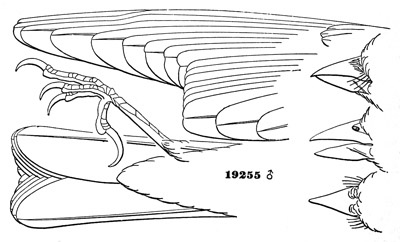
Leucosticte tephrocotis. 19255 ♂
Gen. Char. Bill conical, rounded, rather blunt at the tip; the culmen slightly convex; the commissure slightly concave; the nostrils and base of commissure concealed by depressed bristly feathers; a depressed ridge extending about parallel with the culmen above the middle of the bill. Another more conspicuously angulated one extending forward from the lower posterior angle of the side of the lower mandible, nearly parallel with the gonys. Tarsus about equal to the middle toe and claw. Inner toe almost the longer, its claw not reaching beyond the base of the middle one. Hind toe rather longer, its claw longer than the digital portion. Wings very long; first quill longest; all the primaries longer than the secondaries. Tail forked.
This genus differs from Ægiothus in the more obtuse and curved bill, the less development of bristly feathers at the base, the ridge on the lower mandible, the lateral toe not reaching beyond the base of the middle one, and possibly a longer hind toe. Its relationship to the other allies will be found expressed in the synoptical table of Coccothraustinæ.
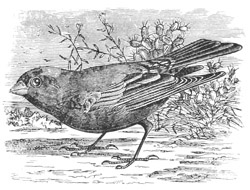
Leucosticte tephrocotis.
The number of American species, or at least races, of this genus has been increased considerably since the publication of Birds of North America, five now belonging to the American fauna, instead of the three there mentioned. Of the species usually assigned to the genus, one, L. arctoa, is quite different in form, lacking the ridge of the mandible, etc., and in having the ends of the secondaries graduated in the closed wing, instead of being all on the same line. The colors, too, are normally different; in arctoa being dusky, with silvery-gray wings and tail, without rose tips to the feathers of the posterior part of body; and in Leucosticte proper, the wings and tail being dark-brown narrowly edged with whitish, or more broadly, like the ends of the feathers of the body behind, with rose-color. For the present, however, we shall combine the species, not having before us any American specimens of L. arctoa.
From the regular gradation of each form into the other—the extremes being thus connected by an unbroken chain of intermediate forms—it seems reasonable to consider all the North American forms as referable to one species (L. tephrocotis, Sw., 1831) as geographical races. They may be distinguished as follows:—
Common Characters. Body anteriorly chocolate-brown; posteriorly tinged with rose-red. Wing-coverts (broadly) and quills edged with the same. Head above light ashy or silvery-gray, as are also the feathers around the base of upper mandible; the forehead and a patch on crown blackish. Throat dusky.
Additional Characters. The chocolate-colored feathers and the secondary quills, sometimes the tail-feathers and greater wing-coverts, edged with pale brownish-white or fulvous; the interscapulars with darker centres. Rose of rump and upper tail-coverts in form of transverse bands at end of feathers, that of abdomen more a continuous wash. Lining of wings and axillars white, tinged with rose at ends of feathers. Feathers of crissum dark brown, edged with whitish, sometimes tinged with rose. Bill generally reddish or yellowish, with blackish tip.
A. Auriculars chocolate-brown.
1. Whole side of head below the eye, including the auriculars, chocolate-brown. Chin not bordered anteriorly with ash. In the breeding-season, head darker and ash wanting. Wing, 4.35; tail, 3.00; bill, .44; tarsus, .72. Hab. Interior regions of North America. … var. tephrocotis.
2. Cheeks, lores, and anterior border of the chin ash-color. Wing, 4.00; tail, 2.80; bill, .44; tarsus, .70. Hab. Colorado and Wyoming Territories … var. campestris.
B. Auriculars ash-color.
3. Wing, 4.30; tail, 3.00; bill, .40; tarsus (?). Chocolate of the breast, etc., light, exactly as in tephrocotis; rose beneath restricted to the abdomen; lores and chin light ash. Hab. Northwest coast from Kodiak to Fort Simpson, east to Wyoming Territory … var. littoralis.
4. Wing, 4.60; tail, 3.40; bill, .40; tarsus, .78. Chocolate very dark, inclining to sepia; rose extending forward on to the breast; lores blackish; chin dusky gray. Hab. Aleutian Islands (St. George’s, Unalaschka, and Kodiak) … var. griseinucha.
A closely allied species[113] from Kamtschatka and the Kurile Island differs mainly in having the nasal feathers as well as the head blackish, but without distinct patch on the top, and the nape rusty, in contrast with the back. It is about the size of L. tephrocotis. This species may yet be detected in the westernmost Aleutians.
Leucosticte tephrocotis,[114] Swainson.
GRAY-CROWNED FINCH.
Linaria (Leucosticte) tephrocotis, Sw. F. Bor. Am. II, 1831, 255, pl. 1. Leucosticte tephrocotis, Sw. Birds II, 1837.—Bon. Consp. 1850, 536.—Baird, Stansbury’s Salt Lake, 1852, 317.—Ib. Birds N. Am. 1858, 430.—Cooper, Orn. Cal. 1, 164. Erythrospiza tephrocotis, Bon. List, 1838.—Aud. Syn. 1839.—Ib. Birds Am. III, 1841, 176, pl. cxcviii. Fringilla tephrocotis, Aud. Orn. Biog. V. 1839, 232, pl. ccccxxiv.
Sp. Char. (No. 19,255.) Male in winter. General color dark chocolate-brown or umber, lighter and more chestnut below; the feathers to a considerable degree with paler edges (most evident in immature specimens), those of back with darker centres. Nasal bristly feathers, and those along base of maxilla, and the hind head to nape ash-gray, this color forming a square patch on top of head, and not extending below level of eyes. A frontal blackish patch extending from base of bill (excepting the bristly feathers immediately adjacent to it), and reaching somewhat beyond the line of the eyes, with convex outline behind, and extending less distinctly on the loral region. Chin and throat darker chestnut, not grayish anteriorly. Body behind dusky; the feathers of abdomen and flanks washed, and of crissum, rump, and upper tail-coverts tipped, with rose-red; wing-coverts, and to some extent quills, edged with the same; otherwise with white. Bill yellowish, with dusky tip; feet black. Length before skinning, 6.50; extent, 11.50. Skin: Length, 6.50; wing, 4.30; tail, 3.00.
Young. Pattern of coloration as in the adult of L. tephrocotis; ash similarly restricted, but with the black frontal patch badly defined. The brown of the plumage, however, is of an entirely different shade from that of adult specimens of tephrocotis, being of a blackish-sepia cast, much darker, even, than in griseinucha; each feather also broadly bordered terminally with paler, these borders being whitish on the throat and breast, brownish on the nape and back, and light rose (broadly) on the scapulars. The whole abdomen, flanks, and crissum are nearly continuously peach-blossom pink, which, with that of the lesser and middle wing-coverts and rump, is of a finer and brighter tint than in adults. The other edgings to wings are pale ochraceous; under side of wing pure white. Bill dull yellow, dusky toward tip. Wing, 4.20; tail, 3.80. (60,638, Uintah Mountains, Utah, September 20, 1870; Dr. F. V. Hayden.)
The young specimen described was obtained during the summer of 1871 in the Uintah Mountains; and were it not unmistakably a bird of the year, it would be considered almost a distinct species, so different is it from adult specimens of tephrocotis.
Habits. Of the history and habits of this well-marked and strikingly peculiar bird, but little is known. It was first described by Swainson from a single specimen, obtained on the Saskatchewan Plains, in May, by Dr. Richardson’s party. Specimens were afterwards procured in Captain Stansbury’s expedition, near Salt Lake City, Utah, in March, 1850. Dr. Hayden found them very abundant on the Laramie Plains during the winter season, and Mr. Pearsall obtained numbers about Fort Benton. Dr. Cooper has also seen one specimen brought from somewhere east of Lake Tahoe, in Washoe, by Mr. F. Gruber. They were said to be plentiful there in the cold winter of 1861-62. Dr. Cooper thinks it probable that they visit the similar country east of the northern Sierra Nevada, in California.
A single flock of what is presumed to have been this species was seen by Mr. Ridgway, on the 5th of January, in the outskirts of Virginia City, Nevada. The flock was flitting restlessly over the snow in the manner of the Plectrophanes.
Nothing has been ascertained, so far as we are now informed, as to its nest, eggs, or general distribution during the breeding-season.
Mr. J. K. Lord states that he met with a flock of these rare and beautiful birds on the summit of the Cascade Mountains. It was late in October, and he observed a flock of nine or ten birds pecking along the ground, and feeding somewhat in the manner of Larks. Puzzled to know what birds they could be at such an altitude so late in the year, he fired among them and secured three, a female and two males in fine plumage. (Perhaps var. littoralis.)
In July of the following summer, on the summit of the Rocky Mountains, near the Kootanie Pass, he again saw these birds feeding on the ground. He shot several, but they were all young birds of the year. It is therefore rendered probable that these Finches breed on the Cascade and Rocky Mountains, in both at about the same altitude, or seven thousand feet, coming into the lowlands during the winter, as it is not likely that they could endure the cold of the summits, or find there a sufficiency of food, the winter being very severe, and the snow three feet, or more in depth.
Mr. Charles N. Holden, a promising young ornithologist of Chicago, who observed these birds among the Black Hills, near Sherman, at an altitude of eight thousand feet above the sea, has furnished me with interesting observations in regard to them. He informs me that he did not meet with these birds there in summer. They came in small flocks in the coldest part of winter. Their food consisted of small seeds and insects. In some instances he found the crops so distended with seeds as to distort their shape. They become very fat, and are excellent eating. In one specimen, a young male, the plumage was almost black, as described at the beginning of this article. These birds were quite numerous, and nearly forty specimens were secured. He was not able to learn anything in reference to their breeding-places. Except by dissection, he found it difficult to distinguish between a young male of the first year and a female.
If the specimen referred to in the foot-note at the beginning of this article as collected by Mr. Allen on Mount Lincoln be really this species, an important advance in its history will have been reached, showing that their summers are spent in the high mountain summits, and that the rest of the year is passed lower down on the plains.
Leucosticte tephrocotis, var. campestris, Baird.
THE GRAY-CHEEKED FINCH.
Leucosticte campestris, Baird, Cooper, Orn. Cal. 1, 163, 1870.
Sp. Char. Body light chocolate-brown, the feathers edged with paler, those of the back with rather darker centres. Feathers of anal region, flanks behind, crissum, rump, and upper tail-coverts, wing-coverts, and primary quills, edged with rose-red; secondary quills and tail-feathers with pale fulvous; little or no trace of rose on under wings. Forehead and patch on crown blackish; the hind head to nape, cheeks immediately under the eye (but not including the auriculars, except, perhaps, the most anterior) and base of lower mandible all round, ashy-gray. Throat dusky. Bill yellowish, with dusky tip. Legs dusky.
No. 41,527, near Denver City, Col., January, 1862 (Dr. C. Wernigk). Length, 7.00; wing, 4.00; tail, 3.00; exposed portion of first primary, 3.10. Bill from forehead, .60; from nostril, .40; tarsus, .75; middle toe and claw, .80; claw alone .24; hind toe and claw, .80; claw alone, .37.
Hab. Colorado Territory (Dr. Wernigk); Wyoming Territory (Mr. H. R. Durkee).
This form bears a close resemblance to L. tephrocotis, and may, indeed, be a variety of it; but as it differs in the characters that appear generally to be those most constant in Leucosticte, and as, in fifty skins of the tephrocotis from one locality, we have seen nothing like it, we are inclined to consider them distinct. The size and general appearance are much the same, the difference being that in tephrocotis the whole cheeks are chocolate below the level of the eye, the chin without any gray; while in campestris the sides of head below the eye, but not including the ears, with a narrow border of the chin, are of this color.
From littoralis this form may be distinguished by the less extent of ash on the cheeks, which in littoralis covers the whole ears, and extends back farther on the head all round. L. griseinucha is marked like littoralis, and is much larger than either. Possibly it may be well to entertain the idea of its being a hybrid between tephrocotis and littoralis or griseinucha.
The specimen described was presented to the Smithsonian Institution by Dr. Wernigk, and at the time was supposed to be L. tephrocotis.
Of this form, nothing as to its habits is known with certainty. It probably does not differ in any important respect from the allied races.
Leucosticte tephrocotis, var. littoralis, Baird.
HEPBURN’S FINCH.
Leucosticte griseinucha, Elliot, Illust. Birds Am. X. Leucosticte littoralis, Baird, Tr. Ch. A. S. I, 1869, 318, pl. xxviii, f. 1.—Dall & Bannister, Ib. p. 282.—Cooper, Orn. Cal. 1, 162.
Sp. Char. Body chocolate-brown, the feathers narrowly margined with paler, those of the back with rather darker centres. Abdomen, flanks, crissum, rump, upper tail-coverts, wing-coverts, and quills edged with rose-red, more or less continuous (least so on the rump); the outer edges of secondaries and tail-feathers pale fulvous, the latter with a rosy shade. Head silvery-gray; the forehead and patch on crown black; the chin gray, continuous with that of cheek; the throat dark brown, shading into the chocolate of breast. Bill yellowish, the extreme tip dusky. Nasal feathers white. Length, 7.10; wing. 4.30; tail, 3.10; exposed portion of first primary, 3.40. Length of bill from forehead, .60; from nostril, .35. Tarsus, .76.
Hab. Kodiak (Bischoff); Sitka (Bischoff); Fort Simpson, British Columbia (Hepburn); Gilmer, Wyoming (Durkee).
This race, which we believe to be the Southern coast representative of griseinucha, bears much resemblance to that bird, but is considerably smaller; the colors are brighter and lighter, more like those of tephrocotis, and the bill is shorter and more conical, the dark patch on the head more restricted, the chin more ashy, and the brown of the head not so far forward. From tephrocotis it is distinguished by the extension of the ash of head below the eye; and from campestris by having the ear-coverts ashy, instead of the anterior portion of the cheeks only; and there is apparently a greater extent of gray on the chin.
Specimens obtained at Kodiak in February are distinguishable from specimens of griseinucha, obtained with them at the same place, only by their much smaller size, and lighter chocolate tints. The occurrence of both these races at the same place, at the same time, is a subject for speculation. A perfectly typical specimen (No. 59,906) is in the collection from Gilmer, Wyoming Territory, obtained by Mr. H. R. Durkee, a frequent contributor to the collections of the Smithsonian Institution, and sent by him along with numerous specimens of L. tephrocotis, with which it appears to have been mixed.
Leucosticte tephrocotis, var. griseinucha, Baird.
THE GRAY-EARED FINCH.
Passer arctous, var. γ, Pallas, Zoög. Rosso-Asiat. II (1831), 23. Fringilla (Linaria) griseinucha, Brandt, Bull. Acad. St. Petersburg, Nov. 1841, 36. Montifringilla (Leucosticte) griseinucha, Bon. & Schl. Mon. Loxiens (1850), 35, pl. xli. Leucosticte griseinucha, Baird, Birds N. Am. 430.—Kittlitz, Denkwürdigkeiten (1858), I, 291.—Dall & Bannister, Tr. Ch. Ac. Sc. I, 1869, 282.—Baird, Ib. p. 317, pl. xxviii, f. 2.—Elliot, Illust. Am. B. pl. xi.—Cooper, Orn. Cal. 1, 161. Leucosticte griseigenys, Gould, Voy. Sulphur.
Sp. Char. Description of specimen No. 54,246: General color dark brownish-chocolate anteriorly, the feathers of back rather darker in the centre, and with paler edges. Forehead and crown black; rest of the head, including the cheeks and ears, of a rather silvery gray; throat blackish, shading off insensibly into the chocolate of breast. Feathers of abdomen (and hinder part of breast to a less degree), flanks and crissum, with the rump and upper tail-coverts, and lesser and middle wing-coverts, tipped with dark pomegranate or rose-red, allowing more or less of thin dusky bases to be seen, especially above, where there is an appearance of bars. Wing and tail feathers brown, nearly all, including the greater wing-coverts, edged with pale yellowish-gray with only a faint tinge of rose. Bill dusky; darkest at tip. Legs black.
Dimensions: Total length, 7.50; wing, 4.80; tail, 3.50. Exposed portion of first primary, 3.50. Bill, from forehead, .69; from nostril, .42. Legs: tarsus, .95; middle toe and claw, .92; claw alone, .35; hind toe and claw, .69; claw alone, .38.
Hab. Aleutian Islands (St. George’s and Unalaschka).
This is considerably the largest of the American species of Leucosticte, and has a longer bill. It also has the chocolate and rose color darker, and the rose extending farther forward on the breast than in other species. It could only be confounded with C. littoralis as to color, both having the head above, and on the sides, ashy, covering the whole ear-coverts; but the dusky patch on the crown is more extended, the ash of chin more restricted, and the throat darker. The rose extends farther along the breast, and the tints are different. The size is much larger.
A specimen, apparently young, perhaps a female, differs in duller tints, and a tinge of ochreous-yellow on the middle of the abdomen and crissum. The lining of the wings is without any rose-color.
Bonaparte and Schlegel describe the young of this species as without rose-color.
Specimens of this bird were obtained at St. George’s Island, with the eggs (which are white), by Mr. W. H. Dall. Dr. Minor found it at Unalaschka.
Habits. The Gray-eared Finch is the largest species of this remarkable genus known to inhabit North America. Thus far, except in one instance, it has been met with only in the Aleutian Islands and Unalaschka. In the latter place they were met with by Dr. T. T. Minor, and in the former by Mr. Dall.
Mr. R. Brown (Ibis, 1868, p. 432) states that a single specimen of this very rare bird was taken at Fort Rupert, Vancouver Island, in June, 1862, by Mr. P. M. Compton, the officer in charge of that station. This, however, may have belonged to the var. littoralis.
Mr. Dall states that they abound on the Pribylow and the other Aleutian Islands. A number of specimens were obtained on the St. George’s in August, though at that time they were moulting. At that season this bird had no song except a clear chirp, sounding like wéet-a wèet-a-wée-weet. It was on the wing a great part of the time, rarely alighting on the ground, but darting rapidly in a series of descending and ascending curves. At one time it would swing on the broad top of an umbelliferous plant, and at another alight on some ledge of the perpendicular bluff, jumping from point to point, as if delighting to test its own agility. Mr. Dall adds that its nest is a simple hollow on one of the ledges, provided with a few straws or a bit of moss. They deposit their eggs in May, and these are four in number. In August their young were fully fledged.
They feed on the seeds of grasses and other small plants, but in the crop of one Mr. Dall found two or three small beetles. They were also received from Kodiak, through Mr. Bischoff.
Their eggs are of a grayish-white, with a slight tinge of yellowish, and measure .95 by .70 of an inch.
Genus PLECTROPHANES, Meyer.
Plectrophanes, Meyer, “Taschenbuch, 1810.” Agassiz. (Type, Emberiza nivalis.)
Centrophanes, Kaup, “Entw. Gesch. Europ. Thierwelt, 1829.” Agassiz. (Type, E. lapponica.)
Gen. Char. Bill variable; conical; the lower mandible higher than the upper; the sides of both mandibles (in the typical species) guarded by a closely applied brush of stiffened bristly feathers directed forwards, and in the upper jaw concealing the nostrils; the outlines of the bill nearly straight, or slightly curved; the lower jaw considerably broader at the base than the upper, and wider than the gonys is long. Tarsi considerably longer than the middle toe; the lateral toes nearly equal (the inner claw largest), and reaching to the base of the middle claw. The hinder claw very long, moderately curved and acute, considerably longer than its toe; the toe and claw together reaching to the middle of the middle claw, or beyond its tip. Wings very long and much pointed, reaching nearly to the end of the tail; the first quill longest; the others rapidly graduated; the tertiaries a little longer than the secondaries. Tail moderate, about two thirds as long as the wings; nearly even, or slightly emarginated.
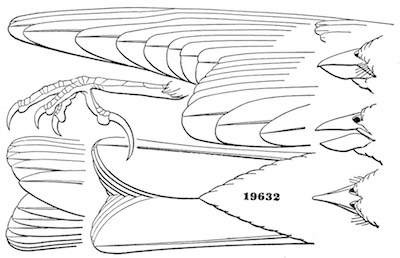
Plectrophanes nivalis. 19632
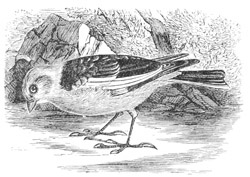
Plectrophanes nivalis.
The species of this genus are essentially boreal and cosmopolitan, although America possesses four species not found, like her two others, in the Old World. They are all ground-birds, collecting in large flocks, in autumn and winter, on prairies and plains, some of the species passing far to the southward. There is much variation in the color, and in the details of structure of bill and feet. In P. nivalis alone is the fringe of bristly feathers along the side of the bill very distinct. The gonys also is exceptionally short, being less than half the length of the culmen.
The females are less strongly marked than the males, lacking the distinct patches of black (which, however, are nearly always faintly indicated), and other characters, and are streaked like the Spizellinæ.
Species and Varieties.
A. Prevailing color white.
1. P. nivalis. ♂. Back, scapulars, ends of tertials, alula, terminal half of primaries and the middle tail-feathers, deep black; otherwise pure white. ♀. The black replaced by grayish with black spots; crown grayish spotted with black. Young considerably tinged with ochraceous. Hab. Circumpolar regions; south in winter into the United States.
B. Above brown, spotted with black. ♂. Crown black.
a. Six to ten middle tail-feathers almost wholly black; the rest without black ends. ♂ with a nuchal collar of rufous or buff, and without rufous on the wings.
2. P. lapponicus. ♂. Head, all round, and jugulum, deep black; a post-ocular stripe, running downward behind the black jugular patch, and entire lower parts from the jugulum, white. Nuchal collar chestnut-rufous. ♀ with the black areas merely indicated by a dusky clouding, and merely a tinge of rufous round the nape. Hab. Circumpolar regions; south in winter into the United States.
3. P. pictus. ♂. Head above and laterally deep black, bordered anteriorly and below with white; a post-ocular stripe, and an ovate auricular spot of the same. Nuchal collar and entire lower surface bright buff. ♀. Pale grayish-buff, darker above; above distinctly, and on the jugulum obsoletely, streaked with black. Hab. Interior plains of North America, north to Arctic Ocean.
4. P. ornatus. ♂ Head above, and whole breast and abdomen, black; a superciliary stripe, side of head, chin, throat, anal region and crissum, white; nuchal collar rufous. ♀ hardly distinguishable from that of P. pictus.
a. Lesser wing-coverts brownish-gray; black feathers of breast, etc., without rufous edges. Hab. Interior plains of United States. … var. ornatus.
b. Lesser wing-coverts black; black feathers of breast, etc., with rufous edges. Hab. Southern plains of North America, and table-land of Mexico … var. melanomus.
b. Only two middle tail-feathers almost wholly black; the rest with black ends. ♂ without a nuchal collar of rufous or buff, and with rufous on the wings.
5. P. maccowni. ♂. Crown, and a broad crescent on the jugulum, black; rest of head and neck ashy, approaching white on the throat and over the eye; beneath white, above grayish-brown, streaked with black; middle wing-coverts rufous. ♀. Above yellowish-umber, beneath yellowish-white; thickly streaked above, unstreaked beneath. No rufous on wings, and no black on head or jugulum. Hab. Plains, from Texas, northward.
There seems to be no special reason for subdividing this genus, although this has been done,—P. nivalis being alone retained in Plectrophanes; P. maccowni forming the type and sole member of the genus Rhyncophanes (Baird, 1858), and the rest coming under Centrophanes (Kaup). The characters upon which these are based are very trivial, being mainly the varying degree of size of the bill and length of the hind claw. In this latter respect there is too much individual variation in the same species to admit of this being available as a specific, much less as a subgeneric character, while the size of the bill is not of more than specific importance.