Family SYLVICOLIDÆ.—The Warblers. (continued 2)
Reading edition
The nests of this Warbler, so far as has fallen under my observation, have always been made of long gray lichens still attached to the trees on which they grow. With great skill do these tiny architects gather up, fasten together, and interweave, one with the other, the hanging ends and longer branches. By an elaborate intertwining of these long fibres they form the principal part, sometimes the whole, of their nests. These structures are at once simple, beautiful, ingenious, and skilfully wrought. When first made, they are somewhat rude and unfinished, but as their family are gathered, the eggs deposited, incubated, and hatched, a change has been going on. Little by little has the male bird busied himself, when not procuring food for his mate, in improving, strengthening, and enlarging the nest. These same acts of improvement upon the original nests are noticed with Humming-Birds, Vireos, and a few other birds.
The nests are sometimes constructed on the sides of trunks of trees, when covered with the long gray lichens, but are more frequently found hanging from branches usually not more than six or eight feet from the ground. Thus surrounded by long hanging mosses in clumps not distinguishable from the nests themselves, they would not be readily recognized were it not that those familiar with the habits of the bird may be readily guided to the spot by the artless movements of the unsuspecting parents.
These birds are confiding, easily approached, and rarely exhibit any signs of alarm. Even when their nest is disturbed they make but little complaint, and do not manifest any very great signs of emotion. When built against a trunk these nests consist only of an interweaving of the moss above and below a very small opening, within which a small cup-shaped flooring has been made of the same material, and usually cannot be removed without destroying all semblance of a nest. When pensile they are imperfectly circular in shape, with an entrance on one side, and rarely with any lining. Occasionally they are models of symmetry and beauty.
The eggs, four or five in number, have a clear white ground, and are sparingly spotted with markings of reddish-brown, slate, purple, and lilac. In some the first predominate, in other the last three shades are more abundant, and usually form a confluent ring around the larger end. They measure from .62 to .65 of an inch in length, and from .49 to .50 in breadth.
Section SYLVICOLEÆ.
This section has been already characterized as having a distinctly notched bill, well provided with bristles. Of the two genera one, Perissoglossa, has the bill slender, acute, something like Helminthophaga, and with the tongue lengthened and much lacerated at end; the other, Dendroica, with less acute bill and tongue shorter, merely notched at tip, and a little fringed only.
Genus PERISSOGLOSSA, Baird.
Perissoglossa, Baird, Rev. Am. Birds, 1864, 181. (Type, Motacilla tigrina, Gm.)
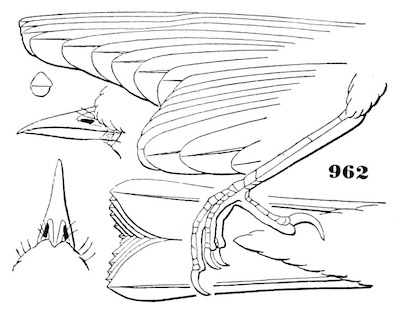
Perissoglossa tigrina, Baird. 962
Gen. Char. Form of Dendroica, but bill slender, acute, with very obsolete notch; the commissure gently arched or curved from the base; the gonys also straight, or even slightly concave. Tongue lengthened, narrow, deeply bifid (for one third), and deeply lacerated or fringed externally at the end; the edge along the median portion folded over on the upper surface, but not adherent.
The curvature of the bill in Perissoglossa tigrina is quite peculiar among the Sylvicolidæ with notched bills. Some Helminthophagas (without notch) approximate this character, though in none, excepting H. bachmani, is it in equal amount,—all the others having the gonys very slightly convex, instead of straight, or even slightly concave.
It is most probable that the Helinaia carbonata of Audubon belongs here, as it appears very closely allied to the type of this genus. The two species may be distinguished as follows:—
Common Characters. Male. Top of head black. Above olive, becoming yellowish on rump. Head, neck, and lower parts bright yellow, becoming whitish posteriorly. Dorsal feathers with black centres; breast and sides streaked with black. A black streak through the eye.
P. tigrina. Large white patches on inner webs of tail-feathers.
Sides of head and middle of throat tinged with chestnut. One large white patch on wing, covering both rows of coverts. Outer web of lateral tail-feather blackish.
P. carbonata. No white patches on tail-feathers.
No chestnut about head. Two bands on the wing, the anterior one white, the posterior yellow. Outer web of lateral tail-feather whitish.
Perissoglossa tigrina, Baird.
CAPE MAY WARBLER.
Motacilla tigrina, Gmelin, Syn. Nat. I, 1788, 985. Sylvia tig. Lath. Dendroica tig. Baird, Birds N. Am. 1858, 286.—Sclater, Catal. 1861, 33, No. 198. P. Z. S. 1861, 71 (Jamaica, April).—March, Pr. An. Sc. 1863, 293 (Jamaica; breeds).—A. & E. Newton, Ibis, 1859, 144 (St. Croix. Notes on anatomy of tongue).—Gundlach, Cab. Jour. 1861, 326 (Cuba; not rare).—Samuels, 240. Perissoglossa tigrina, Baird, Rev. Am. Birds, 1864, 181. Sylvia maritima, Wilson, Am. Orn. VI, 1812, 99, pl. liv, fig. 3.—Bon.; Nutt.; Aud. Orn. Biog. V, pl. ccccxiv.—D’Orb. La Sagra’s Cub. 1840, 70, pl. x. Sylvicola mar. Jard., Bon., Aud. Birds Am. II, pl. lxxxv. Certhiola mar. Gosse, Birds Jam. 1847, 81.—Ib. Illust. Rhimamphus mar. Cab. Jour. III, 1855, 474 (Cuba.)
Sp. Char. Bill very acute, conical, and decidedly curved. Bill and feet black. Upper part of head dull black, some of the feathers faintly margined with light yellowish-brown. Collar scarcely meeting behind; rump and under parts generally rich yellow. Throat, forepart of breast, and sides, streaked with black. Abdomen and lower tail-coverts pale yellow, brighter about the vent. Ear-coverts light reddish-chestnut. Back part of a yellow line from nostrils over the eye of this same color; chin and throat tinged also with it. A black line from commissure through the eye, and running into the chestnut of the ear-coverts. Back, shoulder, edges of the wing and tail, yellowish-olive; the former spotted with dusky. One row of small coverts, and outer bases of the secondary coverts, form a large patch of white, tinged with pale yellow. Tertials rather broadly edged with brownish-white. Quills and tail dark brown, the three outer feathers of the latter largely marked with white on the inner web; edge of the outer web of the outer feathers white, more perceptible towards the base. Length, 5.25; wing, 2.84; tail, 2.15.
Female. Above olivaceous-ash, most yellowish on rump; no black nor chestnut on head. Wing-coverts inconspicuously edged with whitish. Tail-spots very inconspicuous. Beneath dull white tinged with yellowish on the breast, and streaked as in the male, but with dusky grayish instead of black.
Hab. Eastern Province of United States, north to Lake Winnipeg and Moose Factory; all the West Indies to St. Croix. Breeds in Jamaica. Not recorded from Mexico or Central America.
The chestnut about the head in adult males varies in amount with the individual; sometimes (as in 20,633, May, Moose Factory, Hudson’s Bay Territory) there is an oblong spot of chestnut in the middle of the crown, but generally this is absent. Very frequently the chestnut tinges the throat. All variations in these respects appear, however, to be individual, and not dependent at all on locality. West Indian specimens appear to be absolutely identical with those from North America.
Autumnal specimens are browner, the chestnut markings much obscured.
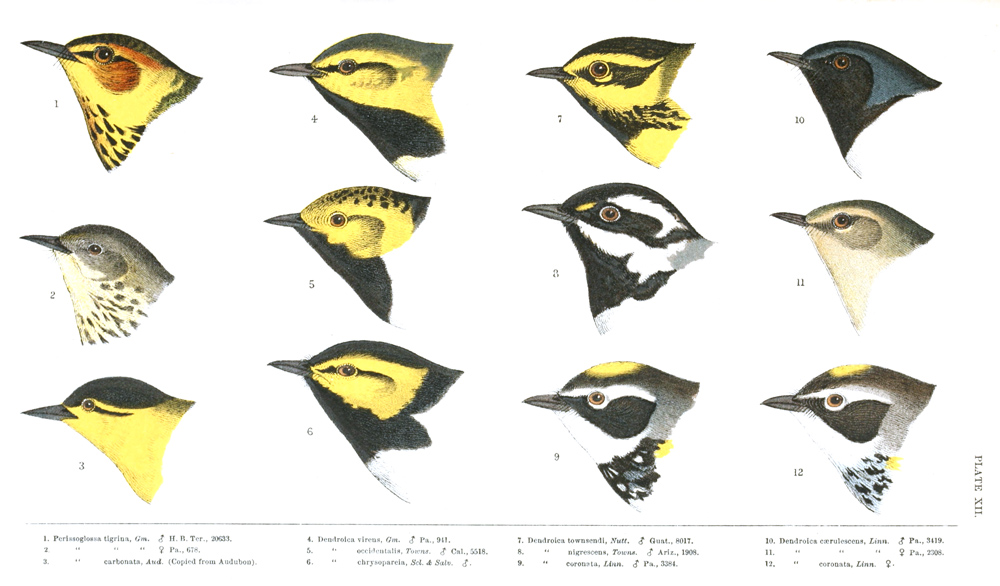
PLATE XII.
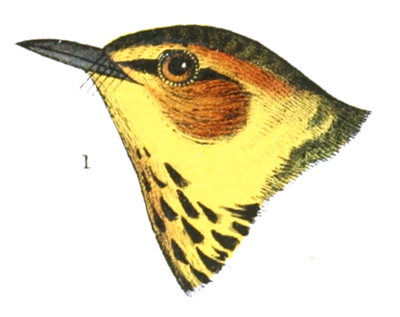
1. Perissoglossa tigrina, Gm. ♂ H. B. Ter., 20633.
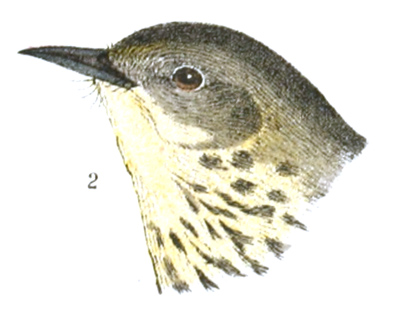
2. Perissoglossa tigrina, Gm. ♀ Pa., 678.
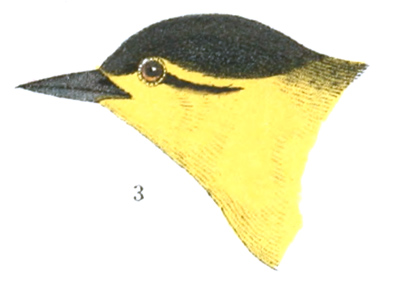
3. Perissoglossa carbonata, Aud. (Copied from Audubon).
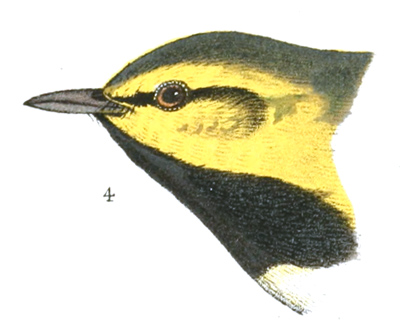
4. Dendroica virens, Gm. ♂ Pa., 941.
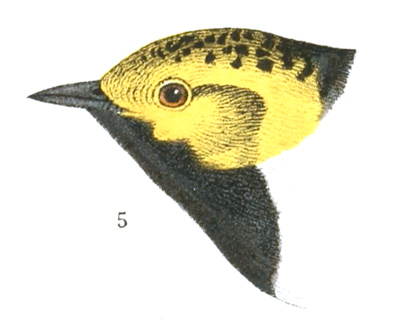
5. Dendroica occidentalis, Towns. ♂ Cal., 5518.
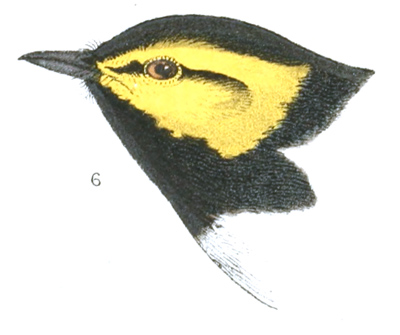
6. Dendroica chrysopareia, Scl. & Salv. ♂ .
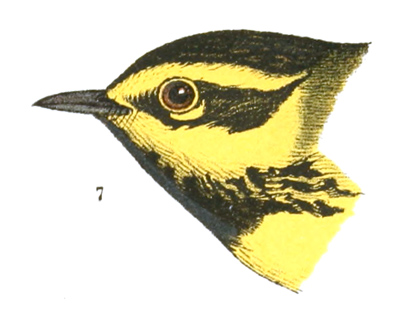
7. Dendroica townsendi, Nutt. ♂ Guat., 8017.
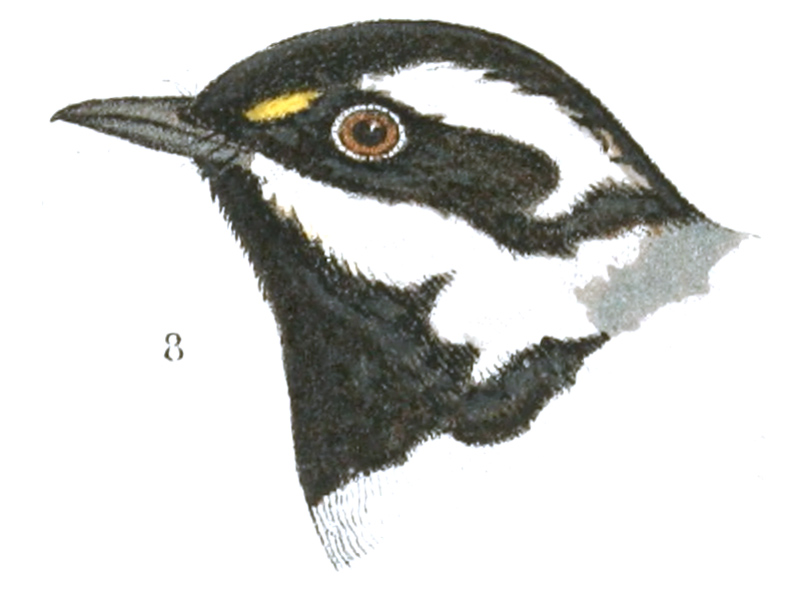
8. Dendroica nigrescens, Towns. ♂ Ariz., 1908.
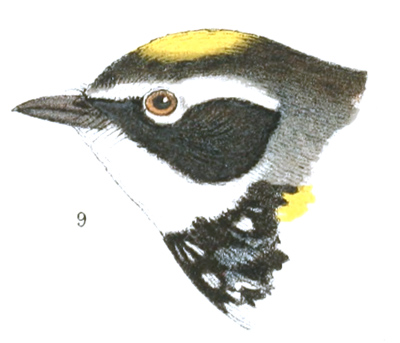
9. Dendroica coronata, Linn. ♂ Pa., 8384.
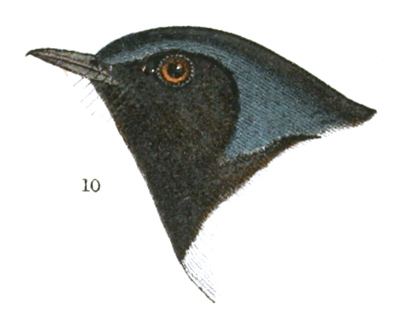
10. Dendroica cærulescens, Linn. ♂ Pa., 3419.
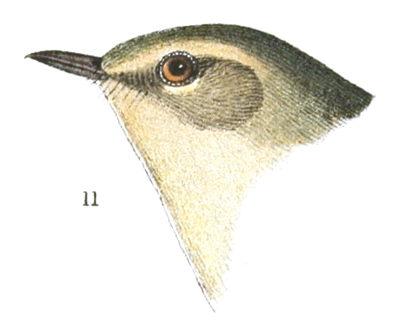
11. Dendroica cærulescens, Linn. ♀ Pa., 2308.
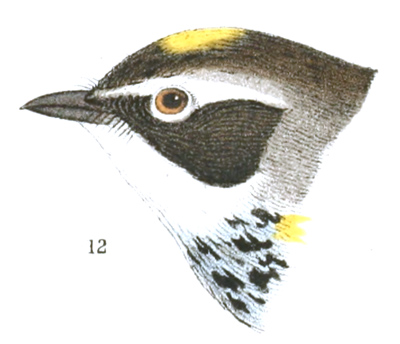
12. Dendroica coronata, Linn. ♀.
Habits. This somewhat rare species, so far as its history and distribution are known with certainty, is migratory in the principal portions of the United States, in the spring and fall passing to the north of the 42d parallel to breed. The first specimen was obtained near the extreme southern point of New Jersey by George Ord, in 1811, and described and figured by Wilson. From this accidental circumstance it derives its inappropriate name of Cape May Warbler. Wilson never met with a second specimen, and Mr. Nuttall was wholly unacquainted with it. Mr. Audubon also never met with a specimen in all his wanderings, and was able to add nothing to its history. Those figured by him were procured by Mr. Edward Harris, near Philadelphia, through which region these birds appear to pass rapidly in their northern migrations.
Mr. J. A. Allen obtained a specimen near Springfield, Mass., May 15, 1863, and specimens have also been procured at East Windsor Hill, Conn., by Dr. Wood. It was not met with in Western Maine by Mr. Verrill, but in Eastern Maine and in New Brunswick Mr. Boardman has found it a not uncommon summer visitant, though of irregular frequency. He has no doubt that they remain there to breed. They reach Calais as early as the second week in May, or as early as their appearance usually in the neighborhood of Philadelphia has been noticed. Mr. Kumlien has also obtained specimens from year to year, about the middle of May, in Southern Wisconsin, where they do not remain to breed, and Mr. Ridgway has taken them in the beginning of May in Southern Illinois.
It is also by no means uncommon in Cuba; was met by the Newtons as a migrant in St. Croix, and is not only one of the birds of Jamaica, but is resident and breeds in the highlands of that island. It is not known to occur in Central America, Mexico, or west of the Mississippi River. Specimens were procured at Moose Factory about May 28.
Its nests and eggs have not been, with certainty, obtained in the United States, though an egg obtained in Coventry, Vt., in 1836, and attributed at the time to this bird, closely resembles its identified eggs from Jamaica. Specimens of the bird, as well as its nests and eggs, have also been received from St. Domingo by Mr. Turnbull of Philadelphia. In the summer of 1871 a nest of this species was found by Mr. H. B. Bailey on the Richardson Lakes, in the extreme northwestern part of Maine. The nest was in a low spruce-tree, less than five feet from the ground, and when found contained only a single egg. Unfortunately it was left until more eggs were deposited, and in the mean while the tree was cut, and the nest and eggs were destroyed.
Mr. W. T. March of Jamaica, in his notes on the birds of that island, states that this species may always be found, in its various changes of plumage, about the mangrove swamps and river-banks. During the summer months it was common about Healthshire and Great Salt Pond, and at other times very generally distributed over the island. He also met with several specimens of its nests and eggs, but their position was not stated. The nests had apparently been taken from a bush or tree, were three and one fourth inches in diameter by two and one half in height, with cavities unusually large and deep for the size of the nests. They were wrought almost entirely of long strips of thin flexible bark, strongly and firmly interwoven. The outer portions consisted of coarser and longer strips, the inner being much finer and more delicate. With the outer portions were also interwoven bits of mosses, lichens, and the outer bark of deciduous trees. The entire fabric was a remarkable one.
The eggs measure .70 by .55 of an inch, have a pinkish-white ground, blotched with purple and brown of various shades and tints. They are disposed chiefly about the larger end, usually in a ring. The eggs are oval in shape and slightly pointed at one end.
Perissoglossa carbonata, Baird.
CARBONATED WARBLER.
Sylvia carbonata, Aud. Orn. Biog. I, 1831, 308, pl. lx (Kentucky).—Nutt. Helinaia carbonata, Aud. Syn.—Ib. Birds Am. II, 1841, 95, pl. cix. Dendroica carbonata, Baird, Birds N. Am. 1858, 287; Rev. Am. Birds, 207.
Sp. Char. Bill brownish-black above, light blue beneath. Iris hazel. Feet light flesh-color. Upper part of the head black. Forepart of the back, lesser wing-coverts, and sides dusky, spotted with black. Lower back dull yellowish-green, as is the tail, of which the outer web of the outer feather is whitish. Tip of the second row of coverts white, of the first row yellow; quills dusky, their outer webs tinged with yellow. A line from the lore over the eye; sides of the neck and the throat bright yellow. A dusky line behind the eye. The rest of the under parts dull yellow, excepting the sides. Length, 4.75 inches; bill above, 4.42; tarsus, .75. (Audubon).
Hab. Kentucky.
This species continues to be known only by the description and figure of Audubon.
Judging from the description, this species is closely related to P. tigrina, but seems to be distinct in the pure black of the top of the head, the absence of orange-brown on the cheeks, the white of the wing being on the middle coverts instead of the greater, and the tail-feathers being yellowish-green; the outer web of outer feather white, instead of a large spot on the inner web, etc. The back appears more distinctly streaked.
Habits. Two specimens of this Warbler, obtained near Henderson, Ky., May, 1811, by Mr. Audubon, are all its claim to be recognized as a good species. None have since been seen. These birds are described as having been busily engaged in collecting insects among the branches of a dogwood tree. Their motions were like those of other Warblers. This is all we as yet know as to the history of this species, and its claims to be regarded as a good and distinct species are involved in doubt.
Genus DENDROICA, Gray.
Sylvicola, Gray, Genera Birds, 2d ed. 1841, 32. (Not of Humphreys nor Swainson.)
Dendroica, Gray, Genera Birds, Appendix, 1842, 8.
Rhimamphus, Hartlaub, Rev. Zool. 1845, 342. (Not of Rafinesque, Am. Monthly Mag. 1818, and Jour. de Phys. 1819.)
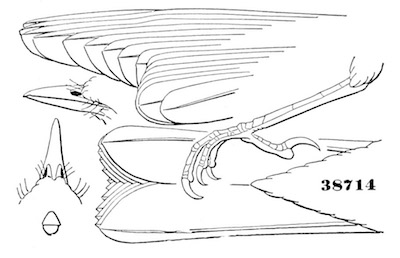
Dendroica coronata. 38714
Gen. Char. Bill conical, attenuated, depressed at the base, where it is, however, scarcely broader than high, compressed from the middle. Culmen straight for the basal half, then rather rapidly curving, the lower edge of upper mandible also concave. Gonys slightly convex and ascending. A distinct notch near the end of the bill. Bristles, though short, generally quite distinct at the base of the bill. Tarsi long; decidedly longer than middle toe, which is longer than the hinder one; the claws rather small and much curved; the hind claw nearly as long as its digit. The wings long and pointed; the second quill usually a very little longer than the first. The tail slightly rounded and emarginate.
Colors. Tail always with a white or yellow spot; its ground-color never clear olive-green. In D. æstiva edged internally with yellow.
Eggs usually with a white or a bluish-white ground, marked with purplish-brown and obscure lilac; in some, mingled with varying shades of sienna-brown. Nest, so far as known, in bushes and trees, except D. palmarum, which is on the ground.
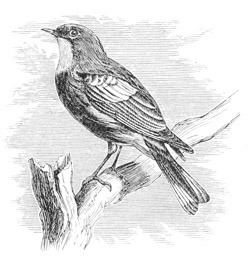
Dendroica auduboni.
The genus Dendroica is one of the most extensive as to species of any in North America, and scarcely admits of any subdivision. There is a little variation in the bill, wings, etc., the chief peculiarities being in D. castanea and pennsylvanica, in which the bill is broader, and more depressed, with longer bristles; in D. striata, where the bill is narrow with scarcely any bristles; and in D. palmarum and kirtlandi, where the wings are very short, scarcely longer than the tail. D. palmarum has the tarsus unusually long. The colors in all are strongly marked, and the species are among the most beautiful of all belonging to our fauna, and are the most conspicuous for their numbers and in their migrations.
The difference in manners between certain members of this genus is remarkable; thus, the D. palmarum is very terrestrial in its habits, walking upon the ground with the ease and grace of a Titlark (Anthus), and, like these birds, it has a wagging motion of the tail. On the other hand, the Dendroica dominica is as much a Creeper as is the Mniotilta varia; creeping not only along the branches, but the cornices and lattices of buildings, with the facility of a Nuthatch (Sitta). Both these species, however, may often be seen hopping among the foliage of the trees, now and then snapping an insect on the wing, in the manner of others of the family.
Species and Varieties.
Inner webs of tail-feathers with a large patch, or broad edge, of yellow Group A.
Inner webs of tail-feathers with a large patch, or broad edge, of white.
Wings with conspicuous white markings Group B.
Wings without conspicuous white markings[37] Group C.
Group A.—Golden Warblers.
Rump and crissum without rufous markings Series I.
Rump and crissum with rufous markings Series II.
Series I.
Prevailing color rich yellow, shaded on upper parts with olive-green. ♂ with streaks of chestnut across the breast and along the sides, and with or without a greater or less tinge of the same on the crown. ♀ with the streaks beneath obsolete or entirely wanting; no rufous on crown. Juv. paler and duller than the ♀, sometimes quite ashy.
A. Tarsus less than .65 of an inch. Outer webs of tail-feathers with yellow predominating.
1. D. æstiva. Crown generally pure yellow, sometimes with only a tinge of rufous; lower webs of wing-coverts and tertials pure yellow; rump and upper tail-coverts much mixed with the same. Wing-formula,[38] 1 = 2, 3; wing, 2.60; tail, 2.05; bill, from nostril, .30; tarsus, .62. Hab. Entire continent of North America; in winter south to Bogota and Cayenne; Trinidad (only locality in West Indies).
B. Tarsus not less than .70 of an inch. Outer webs of tail-feathers with dusky predominating.
a. Crown without any rufous, or with only a tinge.
2. D. petechia. Nape olive-green (except in juv.); sides streaked (except in juv.). Crown greenish, sometimes tinged with orange-rufous anteriorly; lower webs of wing-coverts, etc., not pure yellow, and rump and upper tail-coverts without any admixture of yellow. Hab. West Indies (except Barbadoes and Trinidad); not on the Continent.
Lower part of throat streaked; outer webs of wing-coverts hardly appreciably different from the general surface. Above golden yellowish-olive; crown generally without a trace of rufous. Wing-formula, 2 = 3, 4, 1, 5; wing, 2.55; tail, 2.10; bill, .30; tarsus, .80. Hab. Cuba and the Bahamas … var. gundlachi.[39]
Lower part of throat not streaked; outer webs of wing-coverts decidedly yellowish, and quite different from the general surface. Above greenish yellow-olive; crown almost always strongly tinged with rufous. Wing-formula, 4, 3, 2, 5, 1, 6; wing, 2.70; tail, 2.25; bill, .35; tarsus, .79. Hab. Jamaica and Hayti? … var. petechia.[40]
Whole throat sometimes streaked; back also sometimes with streaks of dark castaneous; green above lighter than in var. petechia, the rump sometimes tinged with yellow. Wing-formula, 2, 3, and 4 equal, 5 = 1; wing, 2.50; tail, 2.00; bill, .34; tarsus, .78. Hab. Porto Rico, St. Thomas, St. Croix, and St. Bartholomew. … var. ruficapilla.[41]
3. D. aureola.[42] Nape always ashy; sides never streaked. Abdomen, anal region, and axillars nearly white; forehead and crown strongly tinged with rufous; nape dark ashy. Wing-formula, 2, 3, and 4 equal, 5, 1 = 6; wing, 2.55; tail, 2.00; bill, .32; tarsus, .75. Hab. Galapagos Islands.
b. Crown with only a sharply defined ovate patch of dark purplish-rufous.
4. D. capitalis.[43] A broad superciliary stripe of pure yellow; wing-formula, 3 = 4, 2, 1 = 5; wing, 2.30; tail, 2.00; bill, .30; tarsus, .70. (♀ distinguishable from that of the varieties of petechia by the distinctly yellow upper eyelid, and considerably shorter tarsus.) Hab. Barbadoes Island, West Indies.
c. Head all round rufous.
5. D. vieilloti. (♀ not distinguishable from that of other species.) Hab. Continental Middle America.
Breast and sides with broad streaks of rufous; outer webs of wing-coverts and tertials pure yellow.
Rufous of the throat with the posterior outline sharply defined against yellow of jugulum. Wing-formula, 3, 4, 2, 1, 5; wing, 2.75; tail, 2.10; bill, .34; tarsus, .75. Hab. New Granada (Carthagena, etc.) … var. vieilloti.[44]
Rufous of the throat covering the jugulum and blending with the streaks of the breast. Wing-formula, 3, 2, 4, 1, 5; wing, 2.45; tail, 2.05; bill, .27; tarsus, .64. Hab. Isthmus of Panama. … var. rufigula.[45]
Breast and sides with only very narrow or scarcely appreciable streaks of rufous; outer webs of wing-coverts, etc., scarcely different from general surface.
Rufous of the head confined to it, and abruptly defined all round. Wing-formula, 3, 2 = 4, 1, 5; wing, 2.70; tail, 2.25; bill, .31; tarsus, .72. Hab. Mexico (from Honduras and Yucatan to Mazatlan) … var. bryanti.[46]
Series II.
Prevailing color yellow; crown, rump, and crissum with spots of rufous; a band of the same on the side of the head, from bill (meeting both on forehead and on chin) around eye and over ear-coverts.
6. D. eoa.[47] Hab. Jamaica (Gosse).
Group B.
Base of primaries with white patch.
Two white bands on wing Series I.
No white bands on wing Series II.
Base of primaries without white patch.
Rump yellow.
Crown with a yellow spot Series III.
Crown without a yellow spot Series IV.
Rump not yellow.
Throat white (with black streaks in striata and pharetra) Series V.
Throat yellow or orange Series VI.
Throat black, or mixed with black Series VII.
Series I.
7. D. olivacea. ♂. Head and neck, all round, fine light orange-rufous; a broad black “spectacle” along side of the head. ♀. Head yellowish, dusky on top; spectacle obsolete. Hab. Whole of Eastern Mexico; Guatemala.
Series II.
8. D. cærulescens. ♂. Head dark blue above and black underneath; a black patch covering whole lateral and under side of head and lateral lower parts. Rest of upper parts dark blue; bases of primaries and abdomen pure white. ♀. Above olive, with a light superciliary stripe; beneath wholly light greenish-buff; base of primaries white. Hab. Eastern Province of United States; in winter south into Cuba, Jamaica, and St. Domingo.
Series III.
9. D. coronata. A yellow patch on each side of the breast; above ashy streaked with black; belly white. ♂. Breast more or less black; upper parts ash with a bluish tinge. ♀. Breast only streaked with black; ash of upper part grayish or brownish.
Throat white; a white superciliary streak; two white bands on wing. Hab. Eastern Province of North America, north to Alaska and Greenland; in winter south to Panama and West Indies (resident in Jamaica!) … var. coronata.
Throat yellow; no white superciliary streak; one white patch formed by the fusion of the two bands on the wing. Hab. Western Province of North America from British Columbia, south to Cape St. Lucas and Jalisco, Western Mexico; east to Rocky Mountains. … var. auduboni.
Series IV.
10. D. maculosa. Whole lower parts bright yellow; black streaks across breast and along sides; crown ash; lores, auriculars, and back black. ♀ scarcely different. Hab. Eastern Province of North America, from Fort Simpson to Panama; Cuba and Bahamas.
Series V.
A. Above ashy-blue, or soft bluish-green.
11. D. cærulea. Lower parts pure white or greenish-white; with or without a narrow band across the breast; above fine ashy-blue, or soft bluish-green; if blue (♂), the back and crown streaked with black; if green (♀ and juv., these streaks obsolete. Hab. Eastern Province of United States (rare northward except in Mississippi Valley), south to Bogota in winter; Cuba.
B. Above not ashy-blue nor bluish-green, but streaked with black upon an ashy greenish-olive or yellowish ground, or else bright olive-green.
a. Sides more or less rufous, and without black or dusky streaks on under surfaces.
12. D. pennsylvanica. ♂. Crown pure yellow; throat and auriculars pure white; ♀ ad. similar, but crown greenish, and more or less streaked. Juv. Above bright olive-green, nearly grass-green, without streaks except on the back; side of head, and sides, clear ashy, the latter with or without a trace of chestnut; eyelids and medial lower parts pure white. Hab. Eastern Province of United States, south to Panama; Bahamas.
13. D. castanea. ♂. Crown reddish-chestnut; throat and sides rufous; auriculars black. ♀ similar, but crown thickly streaked, sometimes without a trace of rufous; jugulum and throat only tinged with rufous. Juv. Above greenish-olive, streaks obsolete; beneath, including lower tail-coverts, pale greenish-buff, or whitish-buff, and without any trace of streaks on the sides (distinction from ♀ of D. striata) the sides usually with a tinge of chestnut. Hab. Eastern Province of North America, from Hudson’s Bay Territory to New Granada.
b. Sides without any rufous, and with black or dusky streaks.
Medial lower parts not streaked; inner webs of tail-feathers with broad patch of white.
14. D. striata. ♂. Crown deep black; auriculars and lower parts white; throat with two series of black streaks, converging and forming an angle on the chin. Above ashy streaked with black. ♀ similar, but crown greenish streaked with black; lower parts tinged with greenish. Juv. Above greenish-olive, the streaks obsolete; beneath pale greenish-yellow; the lower tail-coverts pure white. Hab. Eastern Province of North America, north to Greenland and Kodiak, south to Bogota, Cuba, and Bahamas.
Medial lower parts streaked with black; inner webs of tail-feathers merely edged with white.
15. D. pharetra.[48] ♂. Above grayish-white, with broad streaks of black; posteriorly, plain brownish-gray; lower parts with cuneate spots of black. Hab. Jamaica.
Series VI.
A. A black “mask” around the eye and on auriculars, and extending down the side of the throat; a light superciliary stripe continued back into a large space, of similar color, on side of neck.
16. D. blackburniæ. Crown with an orange or yellowish spot (exposed or concealed); superciliary stripe, side of neck and throat, intense orange-red (♂ ad.), or varying from this to pale buff (juv.). ♀ intense black above; back streaked with white or yellowish. ♀ olive-gray above, streaked with black. Juv. olive-gray above without distinct streaks. Hab. Eastern Province of United States, south to Ecuador; Bahamas.
17. D. dominica. Crown without an orange or yellowish spot; superciliary stripe and side of neck pure white; throat gamboge-yellow; above ash, without streaks.
Superciliary stripe bright yellow anterior to the eye. Bill, .45; tarsus, .60; wing, 2.60; tail, 2.00. Hab. Atlantic United States and West Indies … var. dominica.
Superciliary stripe pure white anterior to the eye. Bill, .35; tarsus, .60; wing, 2.70; tail, 2.20. Hab. Mississippi region of United States; Mexico (Yucatan on east coast, and Colima on west coast); Guatemala and Honduras … var. albilora.
B. No black “mask.” Superciliary stripe scarcely reaching behind the eye. Sides of neck ashy like the back.
18. D. graciæ. Auriculars, neck, crown, and upper parts generally, ashy; a supra-loral stripe, a crescent on the lower eyelid, and the anterior lower parts gamboge-yellow. Crissum white.
Back and sides streaked with black; abdomen white.
Yellow of throat terminating abruptly at the jugulum; supra-loral stripe extending about .20 of an inch past the eye, this portion of it white; dorsal streaks broad. Wing, 2.60; tail, 2.20. Hab. Arizona (Fort Whipple) … var. graciæ.
Yellow of throat covering whole jugulum, and not ending abruptly; supra-loral stripe scarcely passing the eye, and wholly yellow; dorsal streaks narrow. Wing, 2.20; tail, 1.95. Hab. British Honduras (Belize) … var. decora.
Back and sides not streaked with black; abdomen yellow.
Yellow of throat extending back to the crissum; supra-loral stripe as in the last; dorsal streaks wanting. Wing, 2.10; tail, 1.95. Hab. Porto Rico … var. adelaidæ.[49]
Series VII.
Throat black in ♂, mixed with black in ♀.
A. Sides streaked; black of throat with its posterior outline concave.
a. Side of head white and black.
19. D. nigrescens. A small yellow spot over the lore; above ash; beneath white. ♂. Whole crown, uniform glossy black; back streaked with black. ♀. Crown ash streaked with black; throat mixed with white anteriorly. Juv. Crown and cheeks ashy; throat mostly white; back without streaks. Hab. Western and Middle Province of United States, south, in winter, into Western Mexico (Oaxaca).
b. Side of head yellow and black, or yellow and olive.
Black of throat covering jugulum; a hidden yellow spot in middle of forehead.
20. D. chrysopareia. Black above, pure white below; no tinge of yellow behind the black jugular patch. Hab. Eastern Middle America, from Guatemala to Texas (San Antonio).
21. D. virens. Olive-green above, the crown and back without streaks; beneath white, the breast and anal region tinged with black. Hab. Eastern Province of North America, from Greenland to Panama; Cuba; Oaxaca; Heligoland, Europe!
Black of throat confined anteriorly to the jugulum; no yellow spot on forehead.
22. D. townsendi. Above olive-green, the crown and back with conspicuous black streaks; beneath yellow anteriorly, and white posteriorly. ♀, black of throat mixed with yellow; juv., no black on throat, and streaks on back obsolete. Hab. North and Middle Province of United States, south, in winter, into Guatemala.
B. Sides not streaked; black of throat with its posterior outline convex.
23. D. occidentalis. Above ash tinged with olive; beneath white. Head nearly all yellow. ♂. Top of head yellow with a few small black spots; nape black; back streaked with black; sides pure white. (♀ not seen.) Juv. Yellow of crown overlaid by olive; above greenish-plumbeous, without any black on nape or back; throat yellowish-whitish; sides tinged with ashy. Hab. Western and Middle Province of United States, south to Guatemala.
Group C.
A. Above ash; no supra-loral stripe; eyelids not yellow.
24. D. kirtlandi. Above, including side of head and neck, bluish-ash; crown and back streaked with black; beneath (except crissum) pale yellow; breast speckled, and sides streaked with black; lores and orbital region, black; eyelids white. Hab. Eastern Province of United States (Cleveland, Ohio), and Bahamas.
25. D. pityophila.[50] Above, including side of head and neck, dull ash; the forehead and crown olive-green; crown and back not streaked; beneath white; the throat and jugulum yellow; sides ashy; no specks on breast, nor streaks on sides, but a few along side of neck, between the ash and yellow. Hab. Cuba.
B. Olive-green or brown above; a supra-loral stripe of yellow; eyelids yellow.
a. Above olive-green, without streaks; crissum white; sides of breast with obsolete grayish streaks.
26. D. pinus. Forehead and ear-coverts olive; abdomen white; yellow supra-loral stripe not continued behind the eye. ♀ more grayish; juv. above umber, beneath light grayish-brown, tinged with yellow. Hab. Eastern Province of United States; Bahamas.
? 27. D. montana. Forehead and ear-coverts yellow; abdomen yellow; yellow supra-loral stripe continued past the eye into the yellow of the auriculars. (♀ and other stages unknown.) Hab. “Blue Mountains of Virginia.”
b. Above olive-green, the back streaked with chestnut; crissum yellow; streaks of black on sides.
28. D. discolor. Bright gamboge-yellow beneath; streak on lores and along side of neck, as well as along sides and flanks, deep black; dorsal feathers chestnut medially. ♀ duller, but similar; juv. not seen. Hab. Eastern Province of United States: in winter, throughout West Indies.
c. Above olive-brown, the back not streaked; crissum gamboge-yellow; streaks of reddish-chestnut on sides.
29. D. palmarum. Ad. Forehead and crown deep rufous; superciliary stripe bright yellow, continued back over auriculars; sexes alike. Juv. and ad. in winter. Crown brownish, streaked with dusky; streaks on sides more dusky. Hab. Eastern Province of North America, north to Fort Simpson and Hudson’s Bay; Bahamas; Cuba, St. Domingo, and Jamaica, in winter.
Dendroica æstiva, Baird.
YELLOW WARBLER; SUMMER YELLOW-BIRD.
Motacilla æstiva, Gm. Syst. Nat. I, 1788, 996.—Sylvia æstiva, Lath.; Vieill. II, pl. xcv.—Aud. Orn. Biog. I, pl. xxxv. 93. Sylvicola æst. Swains.—Aud. Birds. Am. II, pl. lxxxviii. Rhimamphus æst. Bon.; Cab. Jour. III, 472 (Cuba). Dendroica æst. Baird, Birds N. Am. 1858, 282; Rev. 195.—Sclater, Catal. 1861, 32, No. 194.(Ecuador, Cayenne, N. Granada).—Taylor, Ibis, 1864, 81 (Trinidad).—Cooper & Suckley, P. R. R. XII, II, 1859, 181 (N. W. coast).—Samuels, 237.—Dall & Bannister, (Alaska).—Cooper, Orn. Cal. 1, 1870, 87. Sylvia carolinensis, Lath. Ind. Orn. II, 1790, 551. ? Sylvia flava, Vieillot, II, 1807, 31, pl. lxxxi. Sylvia citrinella, Wils. II, pl. xv, fig. 5. Sylvia childreni, Aud. Orn. Biog. I, 1831, pl. xxxv (young). ? Sylvia rathbonia, Aud. Orn. Biog. I, 1831, pl. lxv. Sylvicola r. Aud. Birds Am. II, pl. lxxxix. Motacilla rubiginosa, Pallas, Zoög. Rosso-Asiat. I, 1831, 496 (Kodiak). Rhimamphus chryseolus, Bon. Bull. Soc. Linn. Caen, II, 1851, 32 (D. æstiva, from South America; Cayenne).
Other localities: Xalapa, Sclater, P. Z. S. 1859, 363. Guatemala, Sclater & Salvin, Ibis, 1859, page 11. Panama, winter, Lawr. Ann. N. Y. Lyc. 1861, 322. Turbo, N. Granada, Cass. Pr. A. N. Sc. 1860, 191. Bogota, Sclater, Pr. 1855, 143. City of Mexico, Ib. 1864, 172.
Sp. Char. Bill lead-color. Head all round, and under parts generally, bright yellow; rest of upper parts yellow-olivaceous, brightest on the rump. Back with obsolete streaks of dusky reddish-brown. Fore breast and sides of the body streaked with brownish-red. Tail-feathers bright yellow; the outer webs and tips, with the whole upper surfaces of the innermost one, brown; extreme outer edges of wing and tail-feathers olivaceous like the back; the middle and greater coverts and tertials edged with yellow, forming two bands on the wings. Female similar, with the crown olivaceous like the back, and the streaks wanting on the back, and much restricted on the under parts. Tail with more brown. Length of male, 5.25; wing, 2.66; tail. 2.25. (No. 940.) Young. Dull brownish-olive above; pale ochraceous-yellow beneath, with the throat more whitish; the yellow of tail restricted to inner half of inner webs. The latter feature will serve to distinguish it from any other North American species.
Hab. Entire North America, and in winter into South America as far as Ecuador, Cayenne, and Trinidad. Not recorded from West Indies, where replaced by allied species.
In the great abundance of this species and its wide range of distribution, there are many variations in size and color, though none that are not readily understood. In young birds the yellow of the tail-feathers is more restricted, sometimes confined to the edge of the inner webs. In adults there is occasionally a tinge of orange in the forehead.
Sylvia rathbonia of Audubon is described with even tail, and the tail-feathers brown, edged externally with yellow; the reverse of æstiva. It is generally, however, considered a synonyme.
Birds of this type (“Golden Warblers”) of six or eight additional species are known to occur in the West Indies, the Galapagos, and in Middle America; one of them, D. bryanti, possibly to be met with in Southern Arizona. (See Baird, Review Am. Birds, 193.)
After comparing a series of about one hundred and twenty North and Central American specimens (the latter being winter visitors to the region where obtained), nothing really characteristic of any particular region can be detected. Specimens from the Pacific coast of the United States are perfectly identical in colors with those from the Atlantic States; and they agree in size and proportions, except of the bill, which is appreciably longer and broader in the Eastern than in the Western birds. The most highly colored examples are from the interior regions, along the Mississippi Valley from Louisiana to Northern Illinois, and over the plains north to Fort Simpson. The majority of the specimens from this region are just appreciably different from others, in having the yellow more intense and prevalent, almost subduing the olive shades above; the crown more tinged with orange. Sometimes (as in No. 4,301, Calcasieu Pass, La.) the rump and upper tail-coverts are absolutely pure yellow, only a medial stripe on the feathers being olivaceous like the back. The orange-rufous tinge on the crown is deepest in Nos. 4,665, Fort Lookout, and 4,300, Calcasieu Pass.
Three adult summer males from Alaska (Nos. 54,429, Kodiak; 54,425, Yukon River; and 27,267, Fort Yukon), as well as one from Maine (52,378, Calais), differ from others in having the olive pervading the whole surface above, even to the bill, the forehead being only tinged with yellow, and the edges of wing-coverts merely inclining to this color. The lower parts are much as in Southern specimens, though the yellow is less intense.
Females from Arizona (as 49,712, Camp Grant, May; 40,664, Fort Whipple, May; and 34,340, Los Pinos, New Mexico, June) differ from others in very bleached plumage, the lower parts being almost white, and the upper surface quite ashy. But this is, in fact, an actual bleaching, frequently to be seen in birds from that region.
Habits. The geographical range of the common Summer Yellow-Bird is very nearly coextensive with North America. In its northern distribution it is found as far toward the arctic shores as any of our land birds. Richardson speaks of it as well known throughout the fur countries as far as the woods extend, and mentions meeting with it among the earliest arrivals in spring, coming in company with the equally well-known Robin and the Grakle. At Fort Franklin, latitude 66°, he saw it the 15th of May, about the time of its first appearance in New England. This was supposed to be the limit of its northern range, but more recent observations give abundant evidence of its presence, in considerable numbers, to the very shores of the Arctic Ocean. The late Mr. Hepburn, in manuscript notes, states it to be a common summer visitant both of California and Vancouver’s Island, and that along the coast he has traced it as far north as the frontier line of 54° 40′, where it arrives at the beginning of May, but does not nest until the end of the month.
Mr. Dall, in his notes on the birds of Alaska, states that this Warbler is a rather common bird all through that territory, and gives its arrival as about the 10th of May.
Its extreme southern limit is not so distinctly traced, but is at least as far as the northern portions of South America, inclusive of Cayenne and Ecuador. In all of the West Indies except Trinidad it is replaced by several closely allied species or local races. In Trinidad, Mr. E. C. Taylor states that he found this species common, and could perceive no difference from North American specimens. In Guatemala it is abundant in the winter.
Dr. Coues found this Warbler abundant in Arizona, where it is a summer resident, from April 25 to the middle of September. There, as elsewhere, its preference for watercourses was noticed. Wherever found, it is always most abundant in alluvial meadows, and more rare in other localities.
Dr. Samuel Cabot found this Warbler common in Central America, and Dr. Cragin, of Surinam, sent the Boston Society several specimens from Guiana. Dr. Woodhouse found it abundant in Texas and New Mexico, as did Drs. Suckley and Cooper in Washington Territory and California. It breeds over the whole area of North America, from Georgia on the southeast and from Mexico, northward. Dr. Sumichrast found it, only as a migratory bird, abundant on the plains of Mexico.
The notes of Mr. Kennicott and the memoranda of Messrs. McFarlane, Ross, and Lockhart attest the extreme abundance of this species in the farthest Arctic regions. In nearly every instance the nests were placed in willows from two to five feet from the ground, and near water. In one instance Mr. Ross found the eggs of this species in the nest of Turdus swainsoni, which had either been deserted or the parent killed, as the eggs were in it, and would probably have been hatched by the Warbler with her own.
Dr. Cooper found this Warbler very abundant in Washington Territory, and noticed their arrival in large numbers at the Straits of Fuca as early as April 8.
The Summer Yellow-Bird arrives in New England with great uniformity from the first to the middle of May. Its coming is usually the harbinger of the opening summer and expanding leaves. Unlike most of its family, it is confiding and familiar, easily encouraged, by attention to its wants, to cultivate the society of man. It confidingly builds its nest in gardens, often in close vicinity to dwellings, and in the midst of large villages and cities, among the shrubbery of frequented parks. This Warbler, soon after its arrival, begins the construction of its nest. It is usually placed in low bushes, three or four feet from the ground. Occasionally very different positions are chosen. Hedges of buckthorn and hawthorn, barberry-bushes, and other low shrubs, are their favorite places of resort. On one occasion the nest was placed some forty feet from the ground, in the top of a horse-chestnut tree overhanging the main street of a village. Such high positions are, however, not very common.
The nest is invariably fastened to several twigs with great firmness, and with a remarkable neatness and skill. A great variety of materials is employed in the construction of their nests, though not often in the same nest, which is usually quite homogeneous. The more common materials are the hempen fibres of plants, fibrous strips of bark, slender stems of plants and leaves, and down of asclepias. Interwoven with these, forming the inner materials, are the down from willow catkins, the woolly furze from fern-stalks and the Eriophorum virginicum, and similar substances. These are lined with soft, fine grasses, hair, feathers, and other warm materials. Cotton, where procurable, is a favorite material; as also is wool, where abundant. I have known instances where nests were built almost exclusively of one or the other material. A pair of these birds, in 1836, built their nest under a parlor window in Roxbury, where all their operations could be closely watched. When discovered, only the framework, the fastening to the supporting twigs, had been erected. The work of completion was simple and rapid. The female was the chief builder, taking her position in the centre of the nest and arranging the materials in their places as her mate brought them to her. Occasionally, with outstretched wings and expanded tail, she would whirl herself round, giving to the soft and yielding materials their hemispherical form. At intervals she arrested her revolutions to stop and regulate with her bill some unyielding portion. When her mate was dilatory, she made brief excursions and collected material for herself, and when the materials brought her were deemed unsuitable, they were rejected in a most summary and amusing manner. The important part of the tail-feathers in shaping the nest and placing the materials in position was a striking feature in this interesting performance. The greater portion of the nest was thus constructed in a single day.
The wonderful sagacity displayed by this Warbler in avoiding the disagreeable alternative of either having to abandon its own nest or of rearing the young of the intrusive Cow Blackbird, when one of these eggs is dropped in her nest, was first noticed by Mr. Nuttall. The egg of the parasite, being too large for ejectment, is ingeniously incarcerated in the bottom of the nest, and a new lining built over it. Occasionally, either by accident or design, the intrusive egg has been fractured. Mr. Nuttall states that where the parasitic egg is laid after her own, the Summer Yellow-Bird acts faithfully the part of a foster-parent. This, however, is not according to my observations. In several instances I have known the Summer Yellow-Bird utterly refuse to act the part of a foster-parent, and, rather than do so, sacrifice her own eggs. So far as I know, this Warbler will never sit upon or hatch out the egg of the Cowbird, under any circumstances. Some powerful instinct, bordering closely upon reason, seems to teach these intelligent Warblers the character of the intruder, and they sacrifice their own eggs rather than rear the parasite. In this dilemma they will always, so far as I know, incarcerate their own eggs with the Cowbird’s and reconstruct the nest above them. In one instance the same pair of Yellow-Birds twice, in the same nest, covered up alien eggs in this manner, building, in fact, three nests one above the other, between the walls of which had been successively included two eggs of the Cowbird. This three-storied nest measured seven inches in length, and was built almost exclusively of raw cotton. The covering of the imprisoned eggs was about two thirds of an inch thick. In both instances the Cowbird’s eggs had been broken, apparently by design.
So far as I am aware this Warbler raises but one brood in Massachusetts in a season. In Pennsylvania it is said to raise two, and even three. The eggs are usually five and occasionally six in number.
This Warbler is conspicuous in its devotion to its young, evincing a strong attachment and an anxiety in regard even to an unoccupied nest, and betraying the site by this solicitude. They will also resort to various expedients to draw one away from their nest, by feigned lameness and other stratagems and manœuvres.
The song of the Summer Yellow-Bird is simple but pleasing, and is easily recognized when once known, though liable to be confounded with that of the Maryland Yellow-Throat, and also said to resemble the song of several other Warblers.
In confinement they usually become very tame, confiding, and reconciled to their imprisonment, and have been known to perch on an outstretched finger, and to catch flies in a room.
Their eggs vary in length from .61 to .70 of an inch, and in breadth from .49 to .52. They have a ground-color of a light green. Their dots and blotches vary greatly in number, size, and manner of distribution. Their colors are light purple, darker purplish-brown, and other shades of brown and lilac.
Dendroica coronata, Gray.
YELLOW-RUMP WARBLER; MYRTLE WARBLER.
Motacilla coronata, Linn. Syst. Nat. I, 1766, 333. Sylvia coronata, Lath.; Vieillot; Wils.; Nutt.; Aud. Orn. Biog. II, pl. cliii. Sylvicola coronata, Swains.; Bon.; Aud. Birds, Am. II, pl. lxxvi.—Jones, Nat. Bermuda, 59 (abundant in April). Dendroica coronata, Gray, Genera, 1842, 2.—Baird, Birds N. Am. 1858, 272; Rev. 187.—March, P. A. N. Sc. 1863, 292 (Jamaica, in summer; breeding).—Gundl. Cab. Jour. 1861, 326 (Cuba; common).—Cooper & Suckley, P. R. R. XII, II, 1859, 180 (Puget Sound).—Samuels, 226.—Dall & Bannister (Alaska).—Cooper, Orn. Cal. 1, 1870, 89. Rhimanphus cor. Cab. Jour. 1855, 473 (Cuba). Motacilla canadensis, Linn. 12th ed. 1766, 334 (Ficedula canadensis cinerea, Br. III, 524, pl xxvii, fig. 1). Parus virginianus, Linn. 12th ed. Syst. Nat. I, 1766, 342. Motacilla umbria, cincta, pinguis, Gm. Sylvia xanthopygia, Vieill. Sylvia xanthoroa, Vieill.
Localities quoted: S. Greenland, Reinhardt, Ibis, 1861, 5. Cordova, Scl. P. Z. S. 1856, 291. Xalapa, Ib. 1859, 363. Guatemala, Scl. & Salv. 1859, 11. Panama, Lawr. Ann. N. Y. Lyc. VIII, 63. Cuba, winter, Cab. Jour. III, 473. Bahamas, winter, Bryant, Bost. Pr. VII, 1859. Jamaica, Gosse, Birds Jam. 155. St. Domingo, Sallé, P. Z. S. 1857, 231. Costa Rica, Lawr. Orizaba, winter, Sumichrast.
Sp. Char. Above bluish-ash, streaked with black. Under parts white. The forepart of breast and the sides black, the feathers mostly edged narrowly with white. Crown, rump, and sides of breast yellow. Cheeks and lores black. The eyelids and a superciliary stripe, two bands on the wing and spots on the outer three tail-feathers, white. Female of duller plumage and browner above. Length, 5.65; wing, 3.00; tail, 2.50.
Hab. Eastern Province of North America, and northward, extending sparsely along United States boundary to Pacific Ocean; Denver City, Colorado; Fort Yukon; Greenland; Eastern Mexico to Panama R. R.; Western West Indies and Bermuda. Breeds in Jamaica!
Autumnal and winter birds are very much duller and more obscurely colored, the upper parts of an umber cast with the streaks almost obsolete; the black of the breast wanting or but just indicated, and the yellow patches on crown almost concealed by the brown tips to the feathers, and those on side of breast quite dull.
A spring male (52,283) from Washington is remarkable in having the adjoining series of feathers down the middle of the back with their inner webs broadly edged with yellow. In this respect it differs from all others that we have noticed.
Habits. The Yellow-crowned Wood Warbler is one of the most common species of this genus, as well as one of the most widely distributed. It is found, at different seasons, throughout the eastern part of the continent, as far west as the Great Plains, extending at the far north to the Pacific Ocean. It has been found in Greenland, three specimens having been taken within twenty years, and on the shores of the Arctic Ocean, and during the winter in the West India Islands, Mexico, and Central America. Specimens from Florida and Fort Steilacoom, Panama, Guatemala, and Jamaica, and from Fort Rae, Anderson River, and the Yukon, in the collection of the Smithsonian Institution, attest its wide distribution. In Jamaica, in the neighborhood of Spanishtown, this species has been known to breed. In view of the fact that this bird is regarded, with good reason, as one of our most northern species, breeding to the very shores of the frozen seas, the occurrence seems erratic and remarkable. Yet it is not without corresponding vagaries in other species, the cærulescens breeding in Cuba and the tigrina in St. Domingo and Jamaica.
Mr. Paine, of East Randolph, Vt., states that these Warblers arrive in his vicinity about the first of May, and remain there nearly two weeks, and then all pass north. They do not return on their southern flight until the last of September, when they remain about three weeks. It is a very active, restless bird, chirping continually and very sharply as it flies around in search of insects, but has not, so far as he knows, any song.
In Southern Illinois, as Mr. Ridgway informs me, this bird is a common winter sojourner, remaining late in spring with the migratory species. It is very abundant throughout the winter in woods, orchards, and door-yards.
Mr. Salvin found this species frequenting the more open districts about Duenas, Guatemala, apparently preferring scattered bushes to the denser underwood, and was an abundant species there throughout the winter season.
It is but quite recently that we have known with certainty its place and manner of breeding. Neither Wilson, Nuttall, nor Audubon appear to have met with its nest, though the latter received one from Professor McCulloch of Halifax.
In the summer of 1855, early in July, I obtained a nest of this species in Parsboro’, Nova Scotia. It was built in a low bush, in the midst of a small village, and contained six eggs. The parents were very shy, and it was with great difficulty that one of them was secured for identification. Though late in the season, incubation had but just commenced.
The nest was built on a horizontal branch, the smaller twigs of which were so interlaced as to admit of its being built upon them, though their extremities were interwoven into its rim. The nest was small for the bird, being only two inches in depth and four and a half in diameter. The cavity is one and a half inches deep and two and a half wide. Its base and external portions consist of fine, light, dry stalks of wild grasses, and slender twigs and roots. Of the last the firm, strong rim of the nest is exclusively woven. Within, the nest is composed of soft, fine grasses, downy feathers, and the fine hair of the smaller mammals.
Mr. Audubon, who observed very closely the habits of these birds during a winter in Florida, describes them as very social among themselves, skipping along the piazza, balancing themselves in the air opposite the sides of the house in search of spiders and insects, diving through the low bushes of the garden after larvæ and worms, and at night roosting among the orange-trees. In his visit to Maine he found them very abundant in early May. The woods seemed alive with them, and wherever he landed, on his way to Labrador, he found them in great numbers.
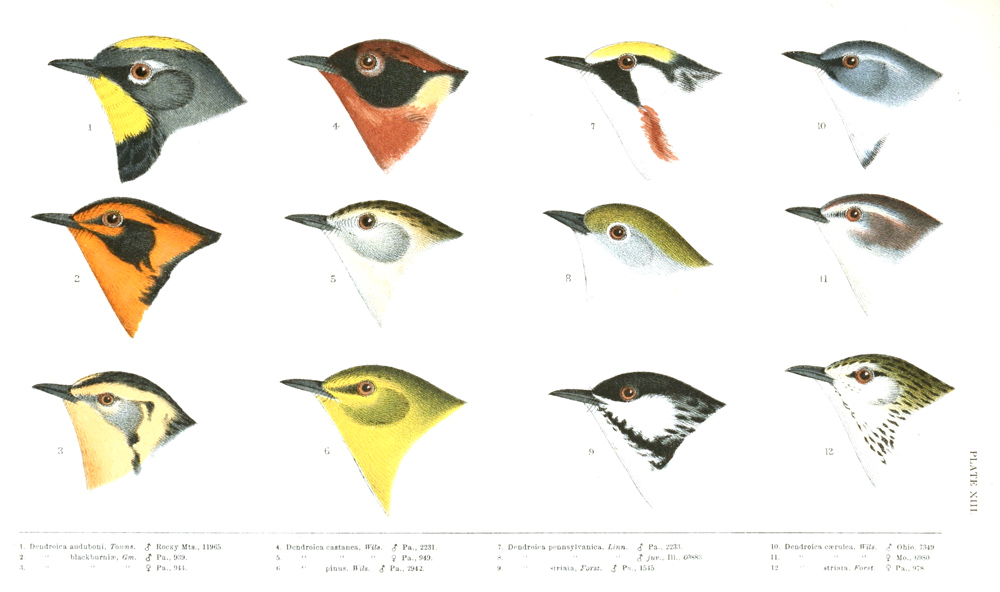
PLATE XIII.
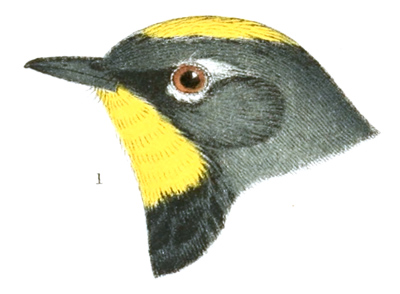
1. Dendroica auduboni, Towns. ♂ Rocky Mts., 11965.
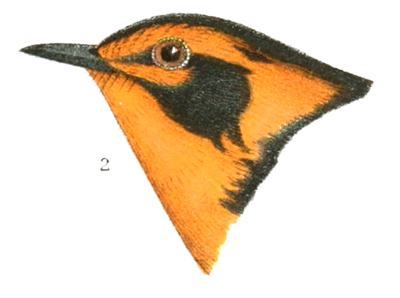
2. Dendroica blackburniæ, Gm. ♂ Pa., 939.
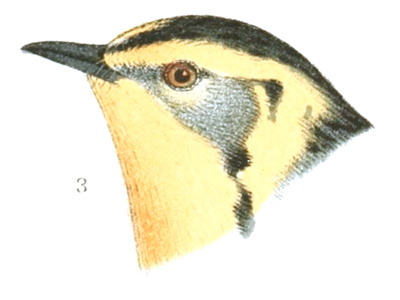
3. Dendroica blackburniæ, Gm. ♀ Pa., 944.
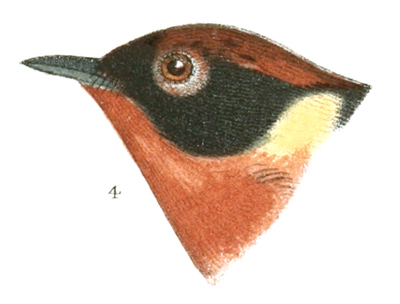
4. Dendroica castanea, Wils. ♂ Pa., 2231.
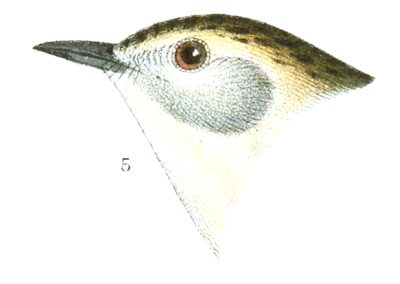
5. Dendroica castanea, Wils. ♀ Pa., 949.
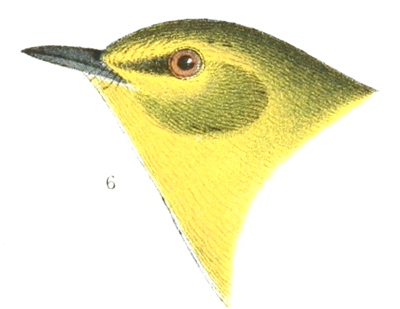
6. Dendroica pinus, Wils. ♂ Pa., 2942.
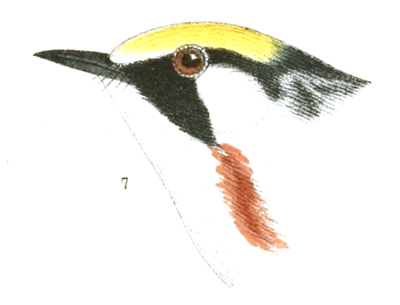
7. Dendroica pennsylvanica, Linn. ♂ Pa., 2233.
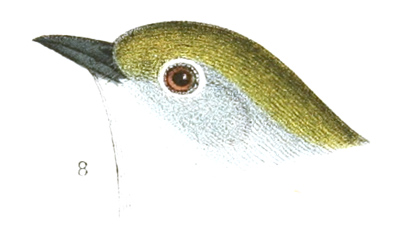
8. Dendroica pennsylvanica, Linn. ♂ juv., Ill., 60883.
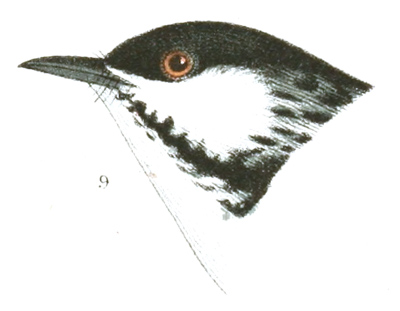
9. Dendroica striata, Forst. ♂ Pa., 1545.
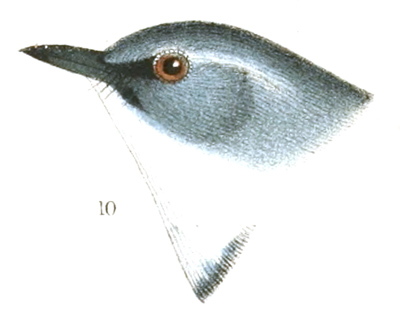
10. Dendroica cærulea, Wils. ♂ Ohio, 7349.
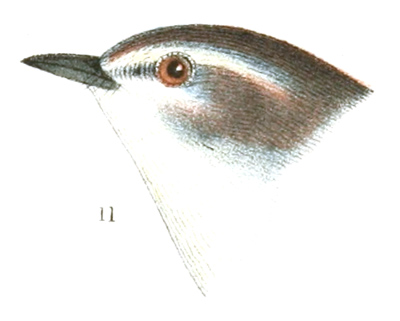
11. Dendroica cærulea, Wils. ♀ Mo., 6980.
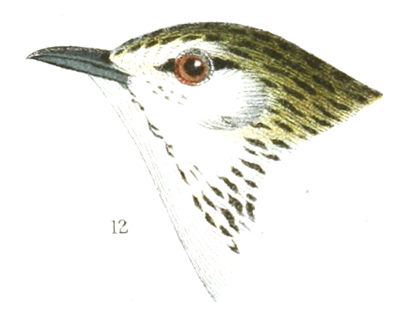
12. Dendroica striata, Forst. ♀ Pa., 978.
This Warbler is an expert flycatcher, feeds chiefly on insects, and is a great devourer of small caterpillars; but in the winter its food is largely composed of berries, especially those of the Myrica cerifera. It will also feed on grass-seeds. In the warmer wintry days in Florida, when insects are abundant, Mr. Audubon states that these birds are particularly active in their pursuit, and the trees seem full of them. At this time they emit, at each movement, a single note, twēēt, so very peculiar that they may be at once recognized by the cry.
Wilson states that these Warblers appear in Pennsylvania, from the North, early in October, and stay there several weeks. Some of them remain in the Southern States all winter. They feed with great avidity upon the berries of the red cedar.
In Western Massachusetts it is a very abundant spring and autumn visitant, making but a brief stay in spring, but passing northward in large numbers. In autumn it remains longer, and passes south more leisurely. Mr. B. P. Mann found its nest and eggs in Concord, but this was probably an exceptional instance. In Eastern Maine it arrives May 25, and, as Mr. Boardman thinks, remains to breed. Both Dr. Suckley and Dr. Cooper met with this species in Washington Territory, where it is very rare.
No writers have observed or noted the song of this bird, except Mr. T. M. Trippe (American Nat., II. p. 171), who states that during its spring migrations it has a very sweet song or warble, uttered at short intervals.
It reaches the high northern latitudes late in May, and leaves that region in September. The observations of Mr. McFarlane show that the nests of this bird are moderately common at Anderson River, and are generally built in low spruce-trees four or five feet from the ground. In one or two instances it was placed on the ground.
The eggs of this Warbler vary from .72 to .80 of an inch in length, and from .50 to .55 in breadth. Their ground-color is white, often tinged with a bluish shade, and blotched and spotted with reddish-brown, purple, and darker shades of brown. They are of a rounded oval shape.
Dendroica auduboni, Baird.
AUDUBON’S WARBLER; WESTERN YELLOW-RUMP.
Sylvia auduboni, Townsend, J. A. N. Sc. VII, II, 1837.—Ib. Narrative, 1839, 342.—Aud. Orn. Biog. V, 1839, 52, pl. cccxcv. Sylvicola auduboni, Bon. List. 1838.—Aud. Birds Am. II, 1841, 26, pl. lxxvii. Dendroica auduboni, Baird, Birds N. Am. 1858, 273; Rev. 188.—Sclater, P. Z. S. 1858, 298 (Oaxaca; October); 1860, 250 (Orizaba).—Sclater & Salvin, Ibis, 1860, 273 (San Geronimo, Guat.).—Cooper & Suckley, P. R. R. Rep. XII, II, 1859, 181.—Sclater, P. Z. S. 1864, 172 (City of Mexico).—Cooper, Orn. Cal. 1, 1870, 88.
Sp. Char. Above bluish-ash, streaked with black, most marked on the middle of the back; on the head and neck bluish-ash. Middle of crown, rump, chin, and throat, and a patch on the side of the breast, gamboge-yellow; space beneath and anterior to the eyes, forepart of breast and sides, black; this color extending behind on the sides in streaks. Middle of belly, under tail-coverts, a portion of upper and lower eyelids, and a broad band on the wings, with a spot on each of the four or five exterior tail-feathers, white; rest of tail-feathers black. Female brown above; the other markings less conspicuous and less black. Length, 5.25; wings, 3.20; tail, 2.25. Young, first plumage, whole body, including head all round and rump, conspicuously streaked with slaty-black upon an ashy ground above and white below. No yellow on crown, rump, breast, or throat. Wings and tail as in autumnal adult.
Hab. Western and Middle Provinces of the United States; Cape St. Lucas; Western Mexico and Orizaba? Oaxaca (cold regions, October, Sclater); Guatemala (Salvin).
This bird is very closely allied to D. coronata, but is distinguished by the yellow (not white) throat; the absence of a superciliary white stripe (the eyelids white, however); the restriction of the black of the face to the lores, and to a suffusion round the eye; and the presence of one broad band on the wings, instead of two narrow ones.
Habits. This beautiful Warbler, so strikingly simulating the D. coronata in the character of its markings, and now so well known as a common species on the Pacific coast, was first met with by Mr. Townsend near the Columbia River, where he found it very abundant. His account of its habits is inconsistent, and probably not reliable. Mr. Nuttall, who was with Mr. Townsend, differs, also, essentially in his account. He states that he first saw them about the middle of April, and that their song bore a very close resemblance to that of the D. æstiva, but was delivered in a much superior style. They remained his summer companions, breeding among the shady firs on the borders of prairie openings, where there was an abundant supply of insect food. By the 8th of June he found their young already out, in small and busy flocks, solicitously attended by their parents. They greatly resembled the young of the coronata. These birds frequented large trees, particularly the water-oaks, and the lower branches of gigantic firs.
Dr. Cooper found this Warbler one of the most abundant species of Washington Territory, and believed them to be, to some extent, a resident species, as he met them about the Straits of Fuca in March. He speaks of its song as lively, and heard everywhere on the borders of the woods, even near the coast, where few of the smaller species ever visit. In the fall he noticed straggling flocks of the young wandering about the low shrubbery in large numbers. The same writer also states that this species is in winter a very abundant bird in the southern part of California, flitting about among the bushes and low trees. The males are then in the dull plumage of the females, and do not put on their richer hues until March or April. He saw none south of San Francisco after May 1, but they began to reappear in September. As he found newly fledged young near Lake Tahoe, he thinks they breed throughout the higher Sierra Nevada. At the sea level in latitude 37° they appear late in September, and remain until March 20.
Dr. Suckley regarded this bird as the most abundant species visiting the western portion of Washington Territory. Near Fort Steilacoom it was found principally among the oak-trees on the plains.
Dr. Woodhouse found it abundant in New Mexico, confining itself to the timbered and mountainous districts, and especially plentiful among the San Francisco Mountains, feeding among the tall pines. Dr. Coues found it exceedingly common in Arizona, where some spend the winter, and a few possibly remain in the summer to breed.
Dr. Heermann found them remaining in the Sacramento Valley throughout the winter, and quotes Dr. Kennerly as finding these birds on the Boca Grande and at different points in Sonora. Mr. Gambel found these Warblers on all his route from New Mexico to California in great abundance, their habits greatly resembling those of the D. coronata. They display a great deal of familiarity, entering the towns, resorting to the gardens and hedge-rows, and even the corrals of the houses, descending also to the ground in company with Blackbirds and Sparrows.
This Warbler is thus shown to have a very extended distribution. It is now known to be found, at different seasons, from Central America to British Columbia, and from New Mexico to the Pacific.
We are indebted to the late Mr. Hepburn for all the knowledge we possess in reference to its nests, eggs, and breeding-habits. He procured their nests and eggs in Vancouver’s Island. They were built in the forked branches of small shrubs. Around these the materials of which they were built were strongly bound, and to it the nests were thus securely fastened. They were quite long and large for the bird, being four inches in height, and three and a half in diameter. The cavity is small, but deep. The external periphery of the nest is made of coarse strips of bark, long dry leaves of wild grasses, and strong stalks of plants, intermingled with finer grasses, pieces of cotton cloth, and other materials. The inner nest is also a singular combination of various materials, yet carefully and elaborately put together. It is made up of fine grasses, feathers, lichens, mosses, fine roots, etc., all felted together and lined with a warm bedding of fur and feathers. Mr. Hepburn’s observations, so far as they go, seem to show that this bird does not usually build in such lofty positions as Nuttall and others conjectured.
According to Mr. Hepburn, they arrive in Vancouver’s Island in the middle of April, and generally frequent high trees, constructing their nests in the upper branches, though also frequently building in low bushes, a few feet from the ground. The number of their eggs is four. These, he states, have a pure white ground, and are spotted, usually chiefly about the larger end, with red markings.
Mr. Salvin met with both this species and the D. coronata at San Geronimo, November, 1859. They congregated together on the ground, where they principally obtained their food.
Dr. Cooper, in his paper on the fauna of Montana, mentions this Warbler as the only one of the genus seen by him between Fort Benton and Fort Vancouver. It was very common throughout the mountains, and he found it in every portion of the country west of them, even where scarcely a bush was to be seen.
According to the careful observations of Mr. Robert Ridgway, this Warbler, during the summer months, in the Great Basin, chiefly inhabits the pines of the high mountain ranges, as well as the cedar and piñon woods of the desert mountains. In winter it descends to the lower portions, being then found among the willows, or, in small roving companies, hopping among the tree-tops in the river valleys. In manners it is said by him to resemble the coronata, but in their notes they differ very widely. A nest, containing three young, was found by Mr. Ridgway near the extremity of a horizontal branch of a pine-tree, about ten feet from the ground.
The eggs of the Audubon Warbler do not resemble those of any Dendroica with which I am acquainted, but are most like those of the Hooded Warbler. They measure .70 by .50 of an inch, have a reddish or pinkish white ground, and are sparingly marked with fine brown markings, tinted with a crimson shading.
Dendroica maculosa, Baird.
BLACK AND YELLOW WARBLER.
Motacilla maculosa, Gm. Syst. Nat. I, 1788, 984. Sylvia m. Lath.; Vieill.; Bon.; Nutt.; Aud. Orn. Biog. I, II, V, pl. 1. 123. Sylvicola m. Swains.; Bon.; Aud. Birds Am. II, pl. xcvi. Rhimanphus m. Cab. Jour. III, 1855, 474 (Cuba). Dendroica m. Baird, Birds N. Am. 1858, 284; Review, 206.—Sclater, P. Z. S. 1859, 363, 373 (Xalapa).—Bryant, Pr. Bost. Soc. VII, 1859 (Bahamas).—Sclater & Salvin, Ibis, 1859, 11 (Guatemala).—Lawrence, Ann. N. Y. Lyc. 1861, 322 (Panama; winter).—Gundlach, Cab. Jour. 1861, 326 (Cuba; very rare).—Samuels, 238. Sylvia magnolia, Wils. III, pl. xxiii, fig. 3.
Sp. Char. Male, in spring. Bill dark bluish-black, rather lighter beneath. Tail dusky. Top of head light grayish-blue. Front, lore, cheek, and a stripe under the eye, black, running into a large triangular patch on the back between the wings, which is also black. Eyelids and a stripe from the eye along the head white. Upper tail-coverts black, some of the feathers tipped with grayish. Abdomen and lower tail-coverts white. Rump and under parts, except as described, yellow. Lower throat, breast, and sides streaked with black; the streaks closer on the lower throat and fore breast. Lesser wing-coverts, and edges of the wing and tail, bluish-gray, the former spotted with black. Quills and tail almost black; the latter with a square patch of white on the inner webs of all the tail-feathers (but the two inner) beyond the middle of the tail. Two white bands across the wings (sometimes coalesced into one) formed by the middle and secondary coverts. Part of the edge of the inner webs of the quills white. Feathers margining the black patch on the back behind and on the sides tinged with greenish. Length, 5 inches; wing, 2.50; tail, 2.25. Autumnal males differ in absence of black of back, front, sides of head, and to a considerable degree beneath, and in much less white on the wings and head.
Female in spring. Similar, but all the colors duller. Black of the back restricted to a central triangular patch.
Hab. Eastern Province of North America to Fort Simpson; Eastern Mexico to Guatemala and Panama; Bahamas; Cuba (very rare).
Habits. The Black and Yellow Warbler, one of the most beautiful of this attractive family, was supposed by our earlier writers to be exceedingly rare. Wilson never met with more than two specimens,—one in Ohio, the other on the Mississippi,—and spoke of it as a very scarce species. In regard to its song he was quite at fault, denying to it any notes deserving the name of song. Nuttall, who had only seen it occasionally in Massachusetts, in the middle of May, regarded it as rare, and was unacquainted with its notes. Its history is now much better known, and neither its great rarity nor its deficiency as to melody can any longer be admitted.
At certain seasons and in particular places it is a very common species. It may be found during the breeding-season throughout North America east of the Great Plains, between latitude 44° and Fort Simpson in the fur country. During its migrations it may be met with in most of the Eastern States, in Eastern Mexico, and the northern portions of South America. It has been found in the Bahamas, and also in Cuba, where it is not common. Specimens have been received from Mexico, Guatemala, and Panama, and from Fort Resolution, Rupert House, and Fort Simpson, in Arctic America, and as far to the west as the mouth of Vermilion River. Dr. Bryant met with it in the Bahamas as early as the 15th of March, where it was quite common. M. Boucard found it at Playa Vicente, in the hot portion of the State of Oaxaca, Mexico.
In Western Massachusetts, Mr. Allen found it a common spring and autumn visitor, occurring in its northern flights from the middle of May to the first of June, and in the autumn as late as September 20. Professor Verrill found it in Western Maine, but not common, both in spring and fall, but had no reason to believe that it bred there. Mr. Boardman does not include it in his list of Calais birds, and I did not find it among the islands in the Bay of Fundy. In the vicinity of Halifax, during the months of June and July, it is one of the most common of the Warblers, occurring in every direction.
Mr. Audubon observed these Warblers in Louisiana, in their migrations, as early as the middle of March; but its appearance there, as well as in Kentucky and Ohio, appeared to be occasional and accidental. In autumn he has met with them in large numbers among the mountains of Northern Pennsylvania, They were passing southward with their young. While on his way to Labrador he noticed them in Maine, near Eastport, in May, very abundant along the roads, the fields, and the low woods, as well as in the orchards and gardens. The season was then not advanced, the weather cold; and these birds sheltered themselves by night among the evergreens, and were often so chilled as to be readily taken by the hand. He also met them wherever he landed in the neighboring islands in the Bay of Fundy and at Labrador.
The song of this Warbler is clear and sweetly modulated, and surpasses that of most of this family. It seems to prefer the interior of low woods, where its notes may chiefly be heard during the early summer, as it sings while it is searching for its food among the branches, in the manner of the Vireos.
Like nearly all the members of this family, in its search for food it blends the habits of the Creepers with those of the Flycatchers, feeding upon insects in their every form, running up and down the trunks for the ova, larvæ, and pupæ, expertly catching the insect on the wing, and equally skilful in hovering over the expanded bud and searching the opening leaves.
Mr. Audubon found its nest placed deep among the branches of low fir-trees, supported by horizontal twigs, constructed of moss and lichens, and lined with fibrous roots and feathers. One found in Labrador, in the beginning of July, contained five eggs, small and rather more elongated than is common in this genus. They were white, and sprinkled with reddish dots at the larger end. The female fluttered among the branches, spreading her wings and tail in great distress, and returning to her nest as soon as the intruders were a few yards off. In August he saw a number of their young already following their parents and moving southward. In his expedition to Texas, Mr. Audubon again met this bird, in considerable numbers, early in April. Their eggs, he states, measure three fourths of an inch in length by nine sixteenths in breadth. In some the ground-color, instead of pure white, is of a yellowish tinge.
The writer found this Warbler abundant near Halifax in the early summer of 1850, frequenting the thick hemlock woods, confiding in its habits, unsuspicious, and easily approached. The distress, as described by Audubon, manifested in behalf of its own young, it is as ready to exhibit when the nest of a feathered neighbor is disturbed. A pair of Hudson’s Bay Titmice, protesting against the invasion of their home, by their outcries brought a pair of these Warblers to their sympathetic assistance; and the latter manifested, in a more gentle way, quite as much distress and anxiety as the real parents. With expanded tail and half-extended wings they fluttered overhead among the branches, approaching us almost within reach, uttering the most piteous outcries.
Sir John Richardson found this Warbler as common and as familiar as the D. æstiva on the Saskatchewan, and greatly resembling it in habits, though gifted with a much more varied and agreeable song.
Mr. Kennicott met this Warbler on Great Slave Lake, June 12, 1860, where he obtained a female, nest, and five eggs. The nest, loosely built, was placed in a small spruce about two feet from the ground, and in thick woods. The bird was rather bold, coming to her nest while he stood by it. This nest was only one and a half inches deep, with a diameter of three and a half inches; the cavity only one inch deep, with a diameter of two and a half inches. It was made almost entirely of fine stems of plants and slender grasses, and a few mosses. The cavity was lined with finer stems, and fine black roots of herbaceous plants.
The eggs of this Warbler are, in shape, a rounded oval, one end being but slightly more pointed than the other. They measure .62 of an inch in length and .49 in breadth. Their ground-color is a light ashen hue, or a dull white, and this is more or less sprinkled with fine dots and blotches of a light brown. For the most part these are grouped in a ring about the larger end.
Mr. R. Deane, of Cambridge, found this bird breeding near Lake Umbagog. Its nest was in the fork of a low spruce about three feet from the ground. The nest contained four eggs, and was made of dry grasses, spruce twigs, and rootlets. It was lined with fine black roots, being a rather coarse structure for a Warbler. The eggs were nearly spherical, averaging .62 by .51 of an inch. Their ground-color was a creamy-white, sparsely marked with a few large blotches of lilac and umber.
Dendroica cærulea, Baird.
CÆRULEAN WARBLER; WHITE-THROATED BLUE WARBLER.
Sylvia cærulea, Wils. Am. Orn. II, 1810, 141, pl. xvii, fig. 5. Sylvicola c. Swains.; Jard.; Rich.; Bon.; Aud. Orn. Biog. I, pl. xlix; Nutt. Dendroica c. Baird, Birds N. Am. 1858, 280; Rev. 191.—Gundl. Cab. Jour. 1861, 326 (Cuba; very rare).—Samuels, 579. Sylvia rara, Wilson, II, pl. xxvii, fig. 2.—Bon.; Aud. Orn. Biog. I, pl. xlix. Sylvia azurea, Steph. Shaw, Zoöl. X, 1817.—Bon. Am. Orn. II, 1828, pl. xxvii (♀).—Aud. Orn. Biog. I, pl. xlviii, xlix; Nutt. Sylvia bifasciata, Say, Long’s Exped. I, 1823, 170. Sylvia populorum, Vieill. Encyc. Méth. II, 1823, 449 (from Wilson).
Other localities: Bogota, Sclater, P. Z. S. 1857, 18. Panama R. R., Lawrence, Ann. N. Y. Lyc. 1861, 322. Yucatan, Lawr. Veragua, Salv.
Sp. Char. Male. Above bright blue, darkest on the crown, tinged with ash on the rump; middle of back, scapulars, upper tail-coverts, and sides of the crown, streaked with black. Beneath white; a collar across the breast, and streaks on the sides, dusky-blue. Lores, and a line through and behind the eye (where it is bordered above by whitish), dusky-blue; paler on the cheeks. Two white bands on the wings. All the tail-feathers except the innermost with a white patch on the inner web near the end. Female, greenish-blue above, brightest on the crown; beneath white, tinged with greenish-yellow, and obsoletely streaked on the sides; eyelids and a superciliary line greenish-white. Length, 4.25; wing, 2.65; tail, 1.90.
Hab. Eastern United States, north to Niagara Falls; Cuba (very rare); Guatemala; Veragua, Panama, and Bogota. Not recorded from Mexico (except Yucatan), or West Indies (except Cuba).
The autumnal adult plumage of both sexes is, in every respect, exactly like the spring dress. Young males in late summer are very similar to adult females, but are purer white below, and less uniform greenish-blue above, the dark stripes on sides of the crown and black centres to scapulars being quite conspicuous; the young female, at the same season, is similar in pattern to the adult, but is dull green above, without any tinge of blue, and light buffy-yellow below.
There is considerable variation in adult males, especially in the width of the pectoral collar; one (No. 60,877, Mt. Carmel, Wabash Co., Ill., Aug. 9) has this entirely interrupted. In this individual there is no trace of a whitish supra-auricular streak; while others from the same locality, and obtained at the same date, have the band across the jugulum continuous, and a quite distinct white streak over the ear-coverts.
Habits. Of this somewhat rare Warbler very little is as yet well known. Its habits and distribution during the breeding-season need more light than we now possess to enable us to give its story with any degree of exactness. Its appearance in Pennsylvania, Ohio, Illinois, and Missouri early in May, when Warblers that go north to breed are on their way, at first suggested its belonging to that class. It is not known to proceed any farther north, except in accidental instances; though the writer has been assured, and has no reason to doubt the fact, that it abounds and breeds in the neighborhood of Niagara Falls. I can find no good evidence that it ever occurs in Massachusetts. Individuals have been obtained in northern South America, Panama, and Cuba. Dr. Woodhouse describes it as quite common in Texas and in the Indian Territory, where it breeds, as he obtained both the old and the young birds. It was also abundant among the timbered lands of the Arkansas and its tributaries. It was not obtained in any other of the government expeditions, nor was it found in Arizona by Dr. Coues. Mr. T. M. Trippe noticed a single individual near Orange, N. Y. Wilson supposed them to breed in Pennsylvania, though he was never able to find their nests. He usually met with these birds in marshes or on the borders of streams among the branches of poplars. Their habits were those of the Flycatchers. He saw none later than the 20th of August. Describing this species as the Blue-green Warbler, as met with by him on the banks of the Cumberland early in April, he mentions its gleaning for food among the upper branches of the tallest trees, rendering it difficult to be procured. Its resemblance, in habits, to Flycatchers, he again remarks. Its only note was a feeble cheep.
According to Audubon, this Warbler appears in Louisiana, where it also breeds early in spring, and leaves the first of October. Like all its family, it is quite lively, has a similar flight, moves sideways up and down the branches, and hangs from the ends of the twigs in its search for insects.
Mr. Audubon also states that the liveliness of the notes of this Warbler renders it conspicuous in the forests, the skirts of which it frequents. Its song, though neither loud nor of long continuance, he speaks of as extremely sweet and mellow. He found it as numerous in the State of Louisiana as any other Warbler, so that he could sometimes obtain five or six in a single walk.
The nest he describes as placed in the forks of a low tree or bush, partly pensile, projecting a little above the twigs to which it is attached, and extending below them nearly two inches. The outer part is composed of the fibres of vines and the stalks of herbaceous plants, with slender roots arranged in a circular manner. The nest is lined with fine dry fibres of the Spanish moss. The eggs are five in number, of a pure white with a few reddish spots about the larger end. When disturbed during incubation, the female is said to trail along the branches with drooping wings and plaintive notes, in the manner of D. æstiva. After the young have left the nest, they move and hunt together, in company with their parents, evincing great activity in the pursuit of insects. They are also said to have a great partiality for trees the tops of which are thickly covered with grapevines, and to occasionally alight on tall weeds, feeding upon their seeds.
In his visit to Texas, Mr. Audubon met a large number of these birds apparently coming from Mexico. On one occasion he encountered a large flock on a small island.
Mr. Nuttall mentions finding these birds very abundant in Tennessee and also in West Florida.
In only a single instance has the writer met with this Warbler. This was about the middle of June, at the Fairmount Water Works in the city of Philadelphia, where, among the tops of the trees, a single individual was busily engaged in hunting insects, undisturbed by the large numbers and vicinity of visitors to the grounds. It kept in the tops of the trees, moving about with great agility.
Mr. Ridgway gives the Cærulean Warbler as the most abundant species of its genus in the Lower Wabash Valley, not only during the spring and fall migrations, but also in the summer, when it breeds more plentifully even than the D. æstiva. It inhabits, however, only the deep woods of the bottom lands, where it is seldom seen, and only to be distinguished by the naturalist. Inhabiting, mostly, the tree-tops, it is an inconspicuous bird, and thus one that easily escapes notice. In its habits it is perhaps less interesting than others of its genus, being so retired, and possessing only the most feeble notes.
Dendroica blackburniæ, Baird.
BLACKBURNIAN WARBLER; ORANGE-THROATED WARBLER.
Motacilla blackburniæ, Gmelin, Syst. Nat. I, 1788, 977. Sylvia bl. Lath.; Wilson, III, pl. xxiii.—Nutt.; Aud. Orn. Biog. II, V, pl. cxxxv, cccxcix. Sylvicola bl. Jard.; Rich.; Aud. Birds Am. II, pl. lxxxvii. Rhimanphus bl. Cab. Mus. Hein. 1850, 19. Dendroica bl. Baird, Birds N. Am. 1858, 274; Rev. 189.—Sclater & Salvin, Ibis, 1859, 11 (Guatemala).—Sclater, P. Z. S. 1859, 363 (Xalapa); Ib. 1860, 64 (Ecuador).—Ib. Catal. 1861, 30, No. 187. (Pallatanga and Nanegal, Ecuador).—Samuels, 227.—Sundevall, Ofv. 1869, 611.—Dresser, Ibis, 1865, 478. ? Motacilla chrysocephala, Gmelin, I, 1788, 971 (Figuier orangé et F. étranger, Buff. V, 313, pl. lviii, fig. 3, Guiana). Sylvia parus, Wils. V, pl. xliv, fig. 3.—Aud. Orn. Biog. II, pl. cxxxiv. Sylvicola parus, Aud. Birds Am. II, pl. lxxxiii. Sylvia lateralis, Steph. ? Motacilla incana, Gmel. I, 1788, 976. Sylvia incana, Lath.; Vieill. ? Sylvia melanorhoa, Vieill. Nouv. Dict. XI, 1817, 180 (Martinique).—Ib. Encycl. Méth. II, 444.
Localities quoted: Bogota, Sclater, P. Z. S. 1855, 143. Panama, Lawr. Ann. N. Y. Lyc. VII, 62. Costa Rica, Cab. Jour. 1860, 328. Bahamas, Bryant, Bost. Pr. VII, 1859. Veragua, Salvin. Orizaba (winter; rare), Sumichrast.
Sp. Char. Upper parts nearly uniform black, with a whitish scapular stripe and a large white patch in the middle of the wing-coverts. An oblong patch in the middle of the crown, and the entire side of the head and neck (including a superciliary stripe from the nostrils), the chin, throat, and forepart of the breast, bright orange-red. A black stripe from the commissure passing around the lower half of the eye, and including the ear-coverts; with, however, an orange crescent in it, just below the eye, the extreme lid being black. Rest of under parts white, strongly tinged with yellowish-orange on the breast and belly, and streaked with black on the sides. Outer three tail-feathers white, the shafts and tips dark brown; the fourth and fifth spotted much with white; the other tail-feathers and quills almost black. Female similar; the colors duller; the feathers of the upper parts with olivaceous edges. Length, 5.50; wing, 2.83; tail, 2.25.
Hab. Eastern Province of United States; Eastern Mexico, and south to Bogota and Ecuador; Bahamas alone of West Indies with certainty.
Autumnal males resemble the females. They have two white bands instead of one; the black stripes on the sides are larger; under parts yellowish; the throat yellowish, passing into purer yellow behind.
Autumnal young birds have the same pattern of coloration, but the dark portions are dull grayish-umber, with the streaks very obsolete, and the light parts dull buffy-white, tinged with yellow on the jugulum; there is neither clear black, bright yellow, nor pure white on the plumage, except the latter on the wing-bands and tail-patches.
Habits. This somewhat rare and very beautiful Warbler requires additional investigation into its habits before its history can be regarded as satisfactorily known. Save in reference to its wider distribution during its southern migrations, little more is known as to its habits than where Audubon left its history nearly thirty years since. The Smithsonian collection has specimens from Pennsylvania, Ohio, Wisconsin, Missouri, Illinois, and from Central America. Mr. Sclater has received specimens from Mexico, and from Ecuador in South America. Other writers mention having specimens from Guiana, Martinique, and Panama, and Dr. Bryant found it in the Bahamas. It is thus known to have a wide distribution from the Atlantic to the Mississippi River, as far to the north probably as Labrador. Its area of reproduction is not known with exactness, but the southern limit is supposed to be the high wooded districts of Pennsylvania, New York, and New England. A young bird was taken by Holböll, October 16, 1845, at Frederikshaab, Greenland. In 1837 an egg was sent me from Coventry, Vt., which purported to belong to this bird; and in the following summer its nest and eggs were procured in a wild, secluded part of Roxbury, Mass. In neither case was the identification entirely free from doubt.
Dr. Bachman states that when a resident of Lansingburg, N. Y., in 1833, he saw a pair of these birds in the act of constructing their nest. Mr. Allen has no doubt that a few breed in the vicinity of Springfield, Mass., as he has obtained them as late as June 24. He found it most common in mixed or hard-wood forests. It arrives about the middle of May. Professor Verrill gives it as a summer resident of Western Maine, though rarely seen on account of its habit of keeping concealed among the dense foliage. Mr. Boardman gives the same account of its residence in summer in the neighborhood of Calais.
Mr. Audubon did not regard this bird and his “Hemlock Warbler” as the same species, but gave distinct and different accounts of their habits. We have therefore to receive with caution these records of peculiarities. He found the Blackburnian Warbler breeding in Northeastern Maine, in New Brunswick, in the Magdaleine Islands, and in Labrador and Newfoundland. He states, correctly, that it has a very sweet song of five or six notes, much louder than seemed possible from the size of the bird. It pursues its insect prey among the branches of the fir-trees, moving along after the manner of the common Redstart.
Mr. McCulloch, of Halifax, gave Mr. Audubon a nest of this bird with three eggs. The nest was formed externally of different textures, lined with fine delicate strips of bark and a thick bed of feathers and horse-hair. The eggs were small, conical, with a white ground spotted with light red at the larger end. The nest was in the small fork of a tree five feet from the ground, and near a brook.
The nest obtained in Roxbury was in a bush, a few feet from the ground, in a very wild region of forest and rocks. Externally, except in its length, which was less, it resembled a nest of the G. trichas, being made of coarse, dry grasses. Internally it was much more warmly lined with feathers and soft fur than is the case in nests of the Yellow-Throat. The eggs were of a crystal whiteness, marked at their larger end with dark purple, and but for their smaller size might have been mistaken for those of G. trichas. The position of the nest, however, was conclusive in regard to this point. The egg from Coventry was substantially similar, except that reddish-brown dots were mingled with the purple markings, in the form of a wreath around the larger end.
Wilson describes this Warbler as songless, but attributes to its counterpart, the Hemlock Warbler, a very sweet song of a few low notes,—a very different account from that given by Audubon of the song of the Blackburnian.
Mr. Paine states that this species is resident during the summer months in Randolph, Vt. It is, he says, a very close companion of the D. virens, arriving at the same time with it even to a day, or about the 10th of May. Its dry chirping song may then be heard in striking contrast with the sweet notes of the virens. He was not able to find its nest.
Mr. C. W. Wyatt met with this species as a winter resident at Alto, in Colombia, South America. Its upward range seemed to be terminated only by the paramos. Among the oaks on the Pamplona road he found it very common just under the paramo, the bright orange throat of the male making it a very conspicuous bird. He was led to believe that they were not found there at a lower elevation than five thousand feet.
Dendroica dominica, Baird.
YELLOW-THROATED GRAY WARBLER.
Motacilla dominica, L. Syst. Nat. 12th ed. 1766, 334 (Ficedula dominica cinerea, Briss. III, 520, pl. xxvii, fig. 3). Dendroica dominica, Baird, Rev. Am. Birds, 209. Motacilla superciliosa, Boddært, Tableau Pl. enl. 686, fig. 1, 1783. Dendroica superciliosa, Baird, Birds N. Am. 1858, 289.—Sclater (Xalapa, Oaxaca, Jamaica, Mexico).—Sclater & Salvin, Ibis, 1860, 274 (Duenas, Guat.; Sept.).—March, Pr. A. N. Sc. 1863, 293 (Jamaica).—Gundlach, Cab. Jour. 1861, 326 (Cuba; very common). Motacilla flavicollis, Gmelin, Syst. Nat. I, 1788, 959. Sylvia fl. Lath.; Wils. II, pl. xii, fig. 6. Motacilla pensilis, Gmelin, Syst. Nat. I, 1788, 960. Sylvia p. Lath.; Vieill. (St. Domingo).—Bon.; Aud. Orn. Biog. I, pl. lxxxv; Nutt. Sylvicola pens. Rich. Bon.; Aud. Birds Am. II, pl. lxxix.—Gosse, Birds Jam. 1847, 156 (Jamaica). Rhimanphus pens. Cab. Jour. III, 474 (Cuba).
Other localities: Cordova, Sclater, P. Z. S. 1856, 291. St. Domingo, Sallé, P. Z. S. 1857, 231. Jamaica, Gosse, Birds Jam. 156.
Sp. Char. Upper parts uniform grayish-blue. Chin and throat bright yellow; under parts white. Forehead, and sometimes most of crown, lores and cheeks, sides of throat, and numerous streaks on the sides of the breast, black. A stripe from the nostrils over and behind the eye, a crescent on the lower eyelid, the sides of the neck behind the black cheekpatch, and two conspicuous bands on the wings, white. Terminal half of the outer webs of the outer two, and terminal third of the third tail-feathers, white. Female almost precisely similar. Length, 5.10; wing, 2.60; tail, 2.30. (3,322.)
Hab. Eastern Province of United States, north to Washington and Cleveland; in winter abundant in Cuba; St. Domingo and Jamaica; Mexico (Colima on west coast), and Guatemala. Resident in Jamaica?
An autumnal male (No. 1,098, Washington, D. C.) has the bluish-ash above obscured by a wash of brown; the black “mask” less sharply defined, the streaks on forehead wanting; the yellow paler and duller, and the white beneath soiled with brownish.
In general pattern of coloration this species resembles two others; one from Arizona, the other from Porto Rico. The diagnoses are as follows:—
Common Characters. Upper parts ash-gray, the forehead and sides of vertex black. A line from nostril to above eye (passing into white behind), chin, and throat, yellow, margined laterally with blackish; crissum, inside of wings, axillars; and two bands on wings, white.
Superciliary line extending to the nape, and white, excepting sometimes anterior to the eye. Cheeks black, separated from the ash of the neck by a white patch. Eyelids and infra-ocular crescent white. Back not streaked. Bill lengthened, gonys almost concave.
Yellow confined to jugulum; rest of under parts white; the sides streaked with black … dominica.
Superciliary line scarcely extending beyond the eye, and yellow, excepting at extreme end. Cheeks ashy, like sides of neck; dusky only near the eye, and not bordered on side of neck behind by white. Eyelids and infra-ocular crescent yellow. Back streaked. Bill short, gonys slightly convex.
Yellow of under parts confined to jugulum; rest of under parts white; the sides streaked with black … graciæ.
Yellow of under parts extending to crissum. Sides scarcely streaked. … adelaidæ.[51]
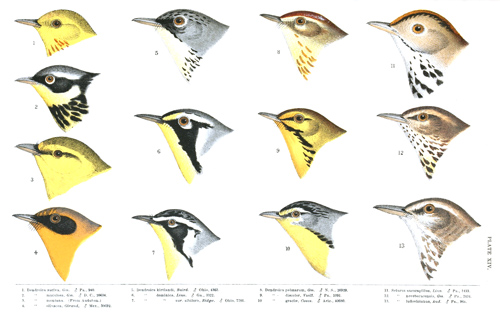
PLATE XIV.
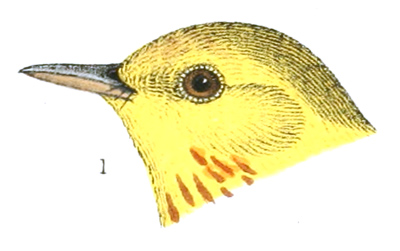
1. Dendroica æstiva, Gm. ♂ Pa., 940.
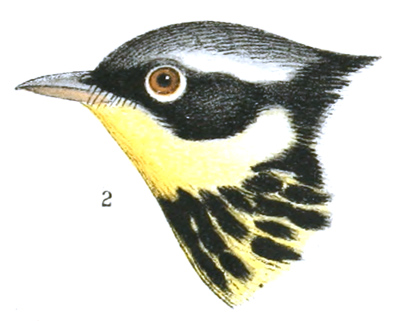
2. Dendroica maculosa, Gm. ♂ D. C., 20634.
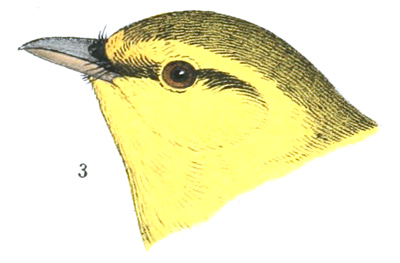
3. Dendroica montana. (From Audubon.)
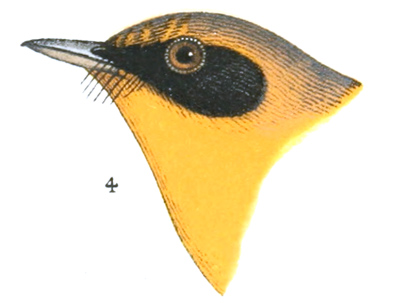
4. Dendroica olivacea, Giraud. ♂ Mex., 30692.
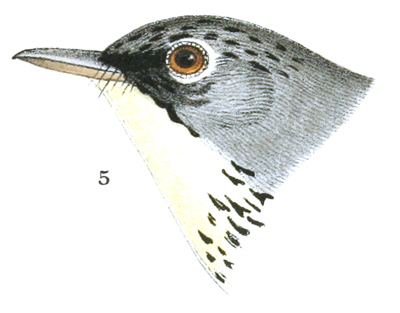
5. Dendroica kirtlandi, Baird. ♂ Ohio, 4363.
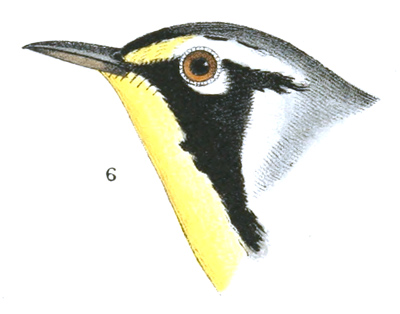
6. Dendroica dominica, Linn. ♂ Ga., 3322.
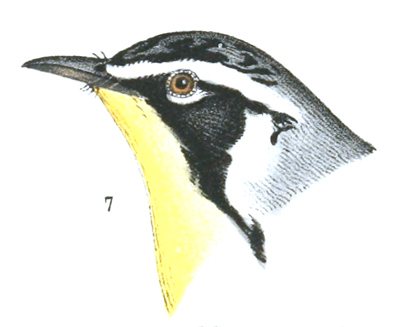
7. Dendroica dominica var. albilora, Ridgw. ♂ Ohio, 7701.
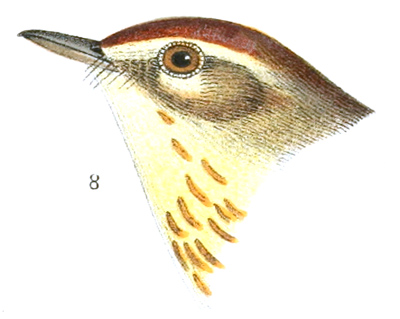
8. Dendroica palmarum, Gm. ♂ N. S., 26929.
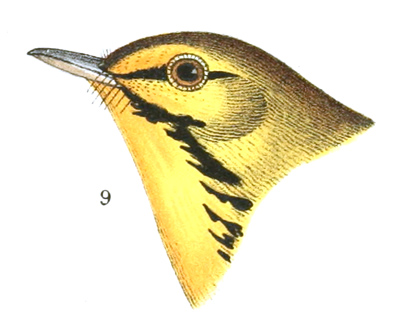
9. Dendroica discolor, Vieill.♂ Pa., 1091.
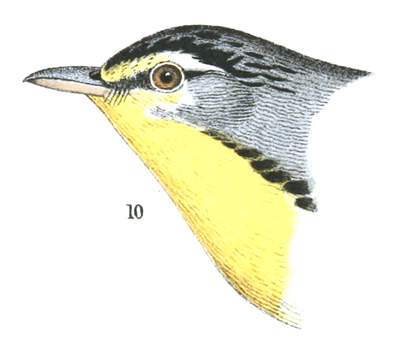
10. Dendroica graciæ, Coues. ♂ Ariz., 40680.
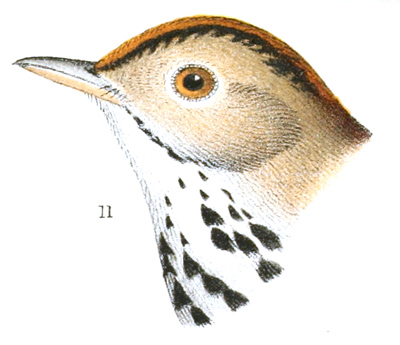
11. Seiurus aurocapillus, Linn. ♂ Pa., 1433.
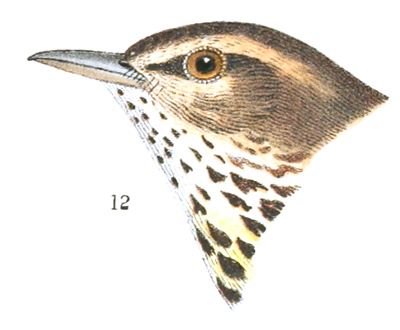
12. Seiurus noveboracensis, Gm. ♂ Pa., 2434.
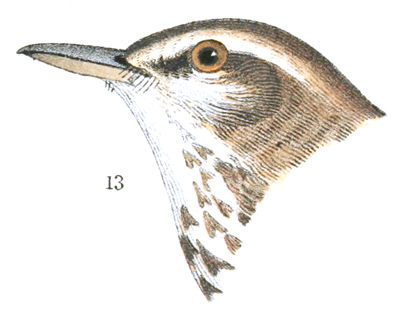
13. Seiurus ludovicianus, Aud. ♂ Pa., 964.
In the Review (p. 209) several variations in this species are noted; but at that time there was not a sufficient number of specimens to warrant our coming to a conclusion as to their value. Now, however, we have better material before us, and upon the examination of about thirty specimens, including two series of nearly equal numbers,—one from the Atlantic States and the West Indies, the other from the Mississippi region and Middle America,—find that there are two appreciably different races, to be distinguished from each other by points of constant difference. All birds of the first series have the bill longer than any of the latter, the difference in a majority of the specimens being very considerable; they also have the superciliary stripe bright yellow anteriorly, while among the latter there is never more than a trace of yellow over the lores, and even this minimum amount is discernible only in one or two individuals. The West Indian form is, of course, the true dominica, and to be distinguished as var. dominica; as none of the synonymes of this species were founded upon the Mexican one, however, it will be necessary to propose a new name; accordingly, the term var. albilora is selected as being most descriptive of its peculiar features.
The following synopsis, taken from typical specimens, shows the differences between these two races:—
(No. 3,322, ♂, Liberty County, Georgia.) Bill (from nostril), .45; tarsus, .60; wing, 2.60; tail, 2.00. Superciliary stripe, anterior to eye, wholly bright yellow; yellow of chin and maxillæ extending to the bill. Hab. In summer, Atlantic States of United States, north to Washington. In winter, and possibly all the year, in Cuba, Santo Domingo, and Jamaica … var. dominica.
(No. 61,136, ♂, Belize, Honduras.) Bill (from nostril), .35; tarsus, .60; wing, 2.70; tail, 2.20. Superciliary stripe wholly white; yellow of chin and maxillæ bordered narrowly next the bill with white. Hab. In summer, the Mississippi region of United States, north to Lake Erie; common in South Illinois. In winter, and possibly all the year, in Mexico, south to Guatemala, Yucatan on the Atlantic, and Colima on the Pacific side … var. albilora.
Habits. The history of the Yellow-throated Warbler is very imperfectly known. Its geographical distribution is irregular and apparently eccentric. Found occasionally, rather than frequently, in the Southern Atlantic and Gulf States, it occurs irregularly as far north as Washington, New York City, Cleveland, O., Union County, Ill., and Kansas. In the last place it is supposed also occasionally to breed. West of this it has not been traced in any portion of the United States. It was obtained in Tamaulipas, Mexico, by Lieutenant Couch, and on the western coast Mr. Xantus found it at Colima. Mr. Sclater has also procured it from other portions of Mexico, and M. Boucard took it at Oaxaca. It has been obtained in Guatemala and Jamaica. In the latter place it is found the entire season. In Cuba, in the winter, it is quite common. It has also been found in St. Domingo, and probably in the other West India Islands. Mr. Gosse states that these birds do not appear in Jamaica before the 16th of August, and that they leave by the first of April. On the other hand, Mr. March, in his notes on the birds of that island, states that on the 8th of August he obtained an old bird and two young, the latter of which he was confident had been hatched on the island, and his son had met with the birds all through the summer, and had procured a specimen on the 4th of June.