Family FRINGILLIDÆ.—The Finches. (continued 5)
Reading edition
Among the White Mountains I have repeatedly found its nests. They were always on the ground, usually sheltered by surrounding grass, and at the foot of bushes or a tree, or in the woods under a fallen log. In that region it retained all its wild, shy habits, rarely being found in the neighborhood of dwellings or in cultivated grounds. But at Halifax this was not so. There I found them breeding in gardens, on the edge of the city, and in close proximity to houses, apparently not more shy than the common Song Sparrow.
Wilson states that these birds winter in most of the States south of New England, and he found them particularly numerous near the Roanoke River, collecting in flocks on the borders of swampy thickets, among long rank weeds, the seeds of which formed their principal food. He gives the 20th of April as the date of their disappearance, but I have observed them lingering in the Capitol grounds in Washington several weeks after that date. They pass through Eastern Massachusetts from the 10th to the 20th of May, and repass early in October. A few stragglers sometimes appear at earlier dates, but irregularly. In Western Maine, where it is quite common, Professor Verrill states that it sometimes arrives by the middle of April. Near Springfield, Mass., Mr. Allen noted their appearance between the last of April and the 20th of May; in fall, from the last of September through October. Their favorite haunts are moist thickets. The young males do not acquire their full plumage until the second spring, but sing and breed in the plumage of the females, as Mr. Allen ascertained by dissection. Mr. Hildreth observed a pair near Springfield during three successive summers, and although he could not find the nest, he saw them feeding their scarcely fledged young birds.
At Columbia, S. C., Dr. Coues found these Sparrows very abundant, from October through April. They sing, more or less, all winter, and during the last few weeks of their stay are quite musical. Many hundreds pass the months of March and April in the gardens of that city, though during the winter they were mostly to be found in thickets and fields, in company with many other species.
A single specimen of this bird was killed in Aberdeenshire, August 17, 1867, and a second was lately captured alive near Brighton (P. Z. S., June 4, 1872).
Mr. Audubon says that this bird visits Louisiana and all the Southern districts in winter, remaining from November to March, in great numbers. They form groups of from thirty to fifty, and live together in great harmony, feeding upon small seeds. At this time they are plump to excess, and are regarded as a great delicacy.
When kept in confinement these birds become quite tame, and in the spring will sing at all hours of the day or night.
The nest of this bird is usually, if not always, on the ground, but in various situations, as I have found them on a hillside, in the midst of low underbrush, in a swampy thicket, at the foot of some large tree in a garden, as at Halifax, by the edge of a small pond, or in a hollow and decaying stump. Their nest is large, deep, and capacious, with a base of moss or coarse grasses, woven with finer stems above and lined with hair, a few feathers, fine rootlets of plants or soft grasses. The eggs vary from four to seven in number. Their ground-color is of a pale green or a greenish-white, marked over the entire egg with a fox-colored or rusty brown. Occasionally these markings are sparsely scattered, permitting the ground to be plainly visible, but generally they are so very abundant as to cover the entire egg so closely as to conceal all other shade, and give to the whole a deep uniform rufous-brown hue, through which the under color of light green is hardly distinguishable. They measure .90 by .68 of an inch.
Zonotrichia querula, Gambel.
HARRIS’S SPARROW; BLACK-HOODED SPARROW.
Fringilla querula, Nuttall, Man. I, (2d ed.,) 1840, 555 (Westport, Mo.). Zonotrichia querula, Gambel, J. A. N. Sc. 2d Ser. I, 1847, 51.—Bonap. Consp. 1850, 478.—Baird, Birds N. Am. 1858, 462.—Allen, Amer. Naturalist, May, 1872. Fringilla harrisi, Aud. Birds Am. VII, 1843, 331, pl. cccclxxxiv. Fringilla comata, Pr. Max. Reise II, 1841.—Ib. Cab. Jour. VI, 1858, 279. Zonotrichia comata, Bp. Consp. 1850, 479.
Sp. Char. Hood and nape, sides of head anterior to and including the eyes, chin, throat, and a few spots in the middle of the upper part of the breast and on its sides, black. Sides of head and neck ash-gray, with the trace of a narrow crescent back of the ear-coverts. Interscapular region of back with the feathers reddish-brown streaked with dark brown. Breast and belly clear white. Sides of body light brownish, streaked. Two narrow white bands across the greater and middle coverts. Length about 7 inches; wing, 3.40; tail, 3.65.
Hab. Missouri River, above Fort Leavenworth. Chillicothe, Mo. (Hoy). Very common in Eastern Kansas (Allen). San Antonio, Texas, spring (Dresser, Ibis, 1865, 488).
The bill of this species appears to be yellowish-red. More immature specimens vary in having the black of the head above more restricted, the nape and sides of the head to the bill pale reddish-brown, lighter on the latter region. Others have the feathers of the anterior portion of the hood edged with whitish. In all there is generally a trace of black anterior to the eye.
This species has a considerably larger bill than Z. leucophrys, the mandible especially.
Habits. This species was first described in 1840, by Mr. Nuttall, from specimens obtained by him near Independence, Mo., near the close of the month of April. He again met with them on the following 5th of May, when not far from the banks of the Little Vermilion River, a branch of the Kansas. He found them frequenting thickets, and uttering, chiefly in the early morning, but also occasionally at other parts of the day, a long, drawling, faint, solemn, and monotonous succession of notes, resembling tē-dē-dē-dē.
Since then but little additional information has been obtained in regard to their general habits, their geographical distribution, or their mode of breeding, single specimens only having been taken at considerable intervals in the valley of the Missouri and elsewhere until 1872. Two specimens were secured by Mr. Dresser, near San Antonio, in Western Texas, occurring on the Medina River during their spring migrations. More recently this bird was taken twice by Mr. H. W. Parker, in Jasper County, Iowa. The latest of these was secured May 19.
Professor F. H. Snow, in his List of Kansas Birds, published April, 1872, enumerates this species as a bird frequently taken in Kansas in the winter, and probably resident; and Mr. J. A. Allen (American Naturalist, May, 1872) states that Harris’s Finch was, next to the Cardinal, the most abundant species of the family of Sparrows and Finches in the vicinity of Leavenworth, as it was also one of the largest and handsomest. He found it almost exclusively frequenting the damper parts of the woods, associating with the White-throated Sparrow, much resembling it both in habits and in song. Nothing has so far been published respecting the nest and eggs.
Genus JUNCO, Wagler.
Junco, Wagler, Isis, 1831. (Type, Fringilla cinerea, Sw.)
Niphæa, Audubon, Syn. 1839. (Type, Emberiza hyemalis, Gm.)
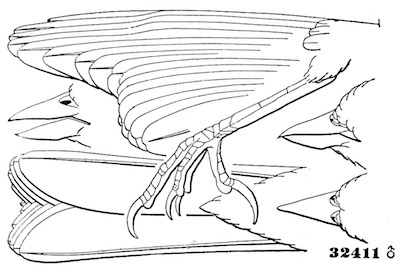
Junco oregonus. 32411 ♂
Gen. Char. Bill small, conical; culmen curved at the tip; the lower jaw quite as high as the upper. Tarsus longer than the middle toe; outer toe longer than the inner, barely reaching to the base of the middle claw; hind toe reaching as far as the middle of the latter; extended toes reaching about to the middle of the tail. Wings rather short; reaching over the basal fourth of the exposed surface of the tail; primaries, however, considerably longer than the secondaries and tertials, which are nearly equal. The second quill longest, the third to fifth successively but little shorter; first longer than sixth, much exceeding secondaries. Tail moderate, a little shorter than the wings; slightly emarginate and rounded. Feathers rather narrow; oval at the end. No streaks on the head or body; color above uniform on the head, back, or rump, separately or on all together. Belly white; outer tail-feathers white. Young birds streaked above and below.
The essential characters of this genus are the middle toe rather shorter than the short tarsus; the lateral toes slightly unequal, the outer reaching the base of the middle claw; the tail a little shorter than the wings, slightly emarginate. In Junco cinereus the claws are longer; the lower mandible a little lower than the upper.
Species and Varieties.
Common Characters. Prevailing color plumbeous; abdomen, crissum, and lateral tail-feathers white.
A. Bill entirely light flesh-colored, dusky only at extreme point. Color of jugulum (deep ash or plumbeous-black) abruptly defined against the pure white of the abdomen.
a. Posterior outline of the dark color of the jugulum convex; sides pinkish.
1. J. oregonus. Back and wings more or less tinged with dark rusty, in sharp contrast with the black (♂) or ash (♀) of the head and neck. Hab. Pacific Province of North America, from Sitka southward; east across the Middle Province of United States, to the Rocky Mountains (where mixed with J. caniceps[116]) occasionally to the Plains (where mixed with J. hyemalis[117]).
b. Posterior outline of the dark color of the jugulum concave; sides ashy.
2. J. hyemalis. Back and wings without rusty tinge.
Wing without any white; three outer tail-feathers only, marked with white. Bill, .40 and .25; wing, 3.10; tail, 2.80; tarsus, .80. Hab. Eastern Province North America. Straggling west to Arizona (Coues); in the northern Rocky Mountains, mixed with J. oregonus … var. hyemalis.
Wing with two white bands (on tips of middle and greater coverts); four outer tail-feathers marked with white. Bill, .50 and .30; wing, 3.40; tail, 3.20. Hab. High mountains of Colorado (El Paso Co., Aiken) … var. aikeni.
3. J. caniceps. Back (interscapulars) rufous; scapulars and wings uniform ashy. Hab. Central Rocky Mountains of United States. (Along southern boundary mixed with J. cinereus.[118])
B. Bill with the upper mandible black, the lower yellow. Ash of the jugulum fading gradually into the grayish-white of the abdomen.
4. J. cinereus. Whole back, scapulars, wing-coverts, and tertials rufous.
Throat and jugulum pale ash; back bright rufous. Wing, 3.10; tail, 3.00; bill, .34 and .25; tarsus, .80. Hab. Tablelands and mountains of Mexico … var. cinereus.[119]
Throat and jugulum deep ash; back dull, or olivaceous-rufous. Wing, 3.15; tail, 3.10; bill, .44 and .34; tarsus, .90. Hab. High mountains of Guatemala … var. alticola.[120]
Junco hyemalis, Sclater.
SNOWBIRD.
Fringilla hyemalis, Linn. Syst. Nat. I, (10th ed.,) 1758, 183 (not of Gmelin or Latham).—Aud. Orn. Biog. I, 1831, 72; V, 505, pl. xiii.—Max. Cab. Jour. VI, 1858, 277. Fringilla (Spiza) hyemalis, Bon. Syn. 1828, 109. Emberiza hyemalis, Linn. Syst. Nat. I, 1766, 308. Struthus hyemalis, Bon. List, 1838.—Ib. Consp. 1850, 475. Niphæa hyemalis, Aud. Synopsis, 1839, 106.—Ib. Birds Am. III, 1841, 88, pl. clxvii. Junco hyemalis, Sclater, Pr. Zoöl. Soc. 1857, 7.—Baird, Birds N. Am. 1858, 468.—Coues, P. A. N. S. 1861, 224.—Dall & Bannister, Tr. Ch. Ac. I, 1869, 284.—Samuels, 314. Fringilla hudsonia, Forster, Philos. Trans. LXII, 1772, 428.—Gmelin, I, 1788, 926.—Wilson’s Index, VI, 1812, p. xiii. Fringilla nivalis, Wilson, II, 1810, 129, pl. xvi, f. 6.
Sp. Char. Everywhere of a grayish or dark ashy-black, deepest anteriorly; the middle of the breast behind and of the belly, the under tail-coverts, and first and second external tail-feathers, white; the third tail-feather white, margined with black. Length, 6.25; wing, about 3. Female paler. In winter washed with brownish. Young streaked above and below.
Hab. Eastern United States to the Missouri, and as far west as Black Hills. Stragglers at Fort Whipple, Arizona, and mountains of Colorado.
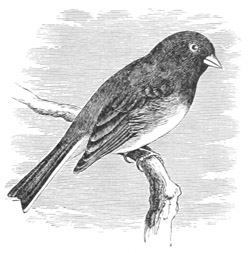
Junco oregonus.
The wing is rounded; the second quill longest; the third, fourth, and fifth, successively, a little shorter; the first longer than the sixth. Tail slightly rounded, and a little emarginate. In the full spring dress there is no trace of any second color on the back, except an exceedingly faint and scarcely appreciable wash of dull brownish over the whole upper parts. The markings of the third tail-feather vary somewhat in specimens. Sometimes the whole tip is margined with brown; sometimes the white extends to the end; sometimes both webs are margined with brown; sometimes the outer is white entirely; sometimes the brownish wash on the back is more distinct.
Some specimens (No. 52,702 and 52,701, males) from Sun River, Dakota, appear to be hybrids with oregonus. They have the general appearance of hyemalis, the back being nearly uniform with the head (with a wash of sepia-brown, however), and the head and neck of the same dark plumbeous; the sides, however, are pinkish, and the plumbeous on the jugulum has its posterior outline convex, as in oregonus. If, as there is every reason to believe, these specimens are really hybrids, then we have the two extreme forms of the genus connected by specimens of such a condition; thus, hyemalis with oregonus, oregonus with caniceps (= annectens, Baird), and caniceps with cinereus (= dorsalis, Henry). It may perhaps be considered a serious question whether all (including alticola) are not, in reality, geographical races of one species. However, as there is no possibility of ever proving this, it may be best to consider them as representative species, and these specimens of intermediate characters as hybrids.
Habits. The common familiar Snowbird of the Eastern States is found throughout all North America, east of the Black Hills, from Texas to the Arctic regions. Wherever found, it is at certain seasons a very abundant and an equally familiar bird.
It nests as far south, in mountainous regions, as Virginia, and thence to New York and the northern parts of the New England States, breeding only in the highlands, but descending more and more into the plains as we proceed north. As it is a very hardy bird, its migrations are irregular and uncertain. In some seasons I have observed but few at irregular intervals; and in others, in which the spring was cold and backward, I have met with them in every month except July and August.
Mr. Kennicott found but few birds of this species breeding as far south as Fort Resolution or Slave Lake, and was unable to find any of their nests, though he met with a few birds that were evidently breeding there. He found it afterwards nesting in the greatest abundance about latitude 65°. They were very numerous on the Yukon, and Mr. MacFarlane found them breeding plentifully on the Anderson River, at the edge of the barren-ground region.
The nests found by Mr. Kennicott were all on the ground, more or less concealed in tufts of grass, dry leaves, or projecting roots. Some were in thick woods, others in more open regions, and were lined with moose-hair.
Mr. Ross states that this species frequents all the Mackenzie River region in summer, arriving about the 20th of April, and leaving about the 10th of October. Besides its call-note, or chirp, it has a very pretty song.
Mr. Dall also remarks that they were quite common at Nulato in the spring, not arriving there, however, until about the first of June.
According to Mr. Dresser, it is found occasionally about San Antonio in winter, and Dr. Woodhouse says that it is also common in the Indian Territory in fall and winter. According to Mr. Audubon, it makes its appearance in Louisiana in November, and remains there until early spring. It is also abundant in South Carolina, arriving there in October and leaving in April.
This species was observed by Mr. Aiken in Colorado Territory for about three weeks following March 20, after which they were seen no more.
It breeds more or less abundantly in the northern and eastern portions of Maine. About Calais and in all the islands of the Bay of Fundy, and throughout New Brunswick and Nova Scotia, I found this by far the most common and familiar species, especially at Pictou, where it abounded in the gardens, in repeated instances coming within the outbuildings to build its nests. In a woodshed connected with the dwelling of Mr. Dawson, my attention was called to the nests of several of these birds, built within reach of the hand, and in places where the family were passing and repassing throughout the day. In Pictou they were generally called the Bluebird by the common people. On my ride from Halifax to Pictou, I also found these birds breeding by the roadside, often under the shelter of a projecting bank, in the manner of the Passerculus savanna. I afterward found them nesting in similar situations among the White Mountains, the roadsides seeming to be a favorite situation. In habits and notes, at Pictou, they reminded me of the common Spizella socialis, but were, if anything, more fearless and confiding, coming into the room where the family were at their meals, and only flying away when they had secured a crumb of sufficient size.
In Western Massachusetts they breed in all parts of the range of Green Mountains, from Blandford to North Adams. They appear about Springfield in October and November, and are for a while abundant, and are then gone until March, when they return in full song, and remain numerous into April, and less common until into May. In the eastern part of the State they are found from October to late in May, with some irregularity and in varying numbers. Mr. Audubon did not meet with any on the coast of Labrador, and Dr. Coues did not find them so abundant as he expected, and did not observe any until the latter part of July, at which time the young were already hatched, and they were associated in small companies. They kept entirely in the thick woods, and seemed rather timid.
Their food is small berries, seeds of grasses and small plants, insects, and larvæ. They seek the latter on the ground, and in the winter are said to frequent the poultry-yards, and avail themselves of the services of the fowls in turning up the earth. On the ground they hop about in a peculiar manner, apparently without moving their feet. At night and during storms they shelter themselves in the thick branches of evergreens, and also in stacks of hay and piles of brushwood.
During the winter the Snowbird appears to be rather more numerous in the Middle and Southern States than in New England. In the former they appear late in October, at first on the borders of woods, searching for food among the fallen and decaying leaves. Later in the season, as the weather becomes colder, and the snow deprives them of this means of feeding, they resort to the roadsides and feed on the seeds of the taller weeds, and to the farm-houses and farm-yards, and even enter within the limits of large cities, where they become very tame and familiar. They are much exposed to attacks from several kinds of Hawks, and the apparent timidity they evince at certain times and places is due to their apprehensions of this danger. The sudden rustle of the wings of a harmless fowl will cause the whole flock to take at once to flight, returning as soon as their alarm is found to be needless, but repeated again and again when the same dreaded sounds are heard.
Neither Wilson, Nuttall, nor Audubon appear to have ever met with the nests or eggs of this bird, though the first met with them breeding both among the Alleghanies, in Virginia, and the highlands of Pennsylvania and New York. In Otsego County, in the latter State, Mr. Edward Appleton was the first to discover and identify their nest and eggs, as cited by Mr. Audubon in the third volume of his Birds of America. They were found in considerable numbers in the town of Otsego. Their nests were on the ground in sheltered positions, some of them with covered entrances. Their complement of eggs was four. One of their nests was sent me, and was characteristic of all I have since seen, having an external diameter of four and a half inches and a depth of two. The cavity was deep and capacious for the bird. The base and periphery of the nest were made of slender strips of bark, coarse straws, fine roots, and horsehair, lined with fine mosses and the fur of smaller animals. The eggs were of a rounded-oval shape; their ground-color is a creamy yellowish-white, marked with spots and blotches of a reddish-brown confluent around the larger portion of the egg, but rarely covering either end. They measure .75 by .60 of an inch, not varying in size from those of J. oregonus.
Junco hyemalis, var. aikeni, Ridgway.
WHITE-WINGED SNOWBIRD.
Sp. Char. Generally similar to J. hyemalis, but considerably larger, with more robust bill; two white bands on the wing, and three, instead of two, outer tail-feathers entirely white. No. 61,302 ♂, El Paso Co., Colorado, December 11, 1871, C. E. Aiken: Head, neck, jugulum, and entire upper parts clear ash; the back with a bluish tinge; the lores, quills, and tail-feathers darker; middle and secondary wing-coverts rather broadly tipped with white, forming two conspicuous bands. Lower part of the breast, abdomen, and crissum pure white, the anterior outline against the ash of the jugulum convex; sides tinged with ash. Three lateral tail-feathers entirely white, the third, however, with a narrow streak of dusky on the terminal third of the outer web; the next feather mostly plumbeous, with the basal fourth of the outer web, and the terminal half of the inner, along the shaft, white. Wing, 3.40; tail, 3.20; culmen, .50; depth of bill at base, .30; tarsus, .80.
Hab. El Paso County, Colorado.
At first sight, this bird appears to be a very distinct species, being larger than any other North American form, and possessing in the white bands on the wing characters entirely peculiar. Its large size, however, we can attribute to its alpine habitat, agreeing in this respect, as compared with J. hyemalis, with the J. alticola of Guatemala, which we can only consider an alpine or somewhat local form of J. cinereus. That the white bands on the wing do not constitute a character sufficiently important to be considered of specific value is proved by the fact that in many specimens of J. oregonus, and occasionally in J. hyemalis, there is sometimes quite a distinct tendency to these bands in the form of obscure white tips to the coverts.
Habits. But little is known as to the habits of this variety; probably they do not differ from those of its congeners. It was met with by Mr. C. E. Aiken, near Fountain, El Paso County, in Colorado Territory, in the winter of 1871-72. They were rare in the early winter, became rather common during the latter part of February and the first of March, and had all disappeared by the first of April. During winter only males were seen, but, in the spring, the females were the most numerous. They were usually seen singly, or in companies of two or three, and not, like the others, in larger flocks.
Junco oregonus, Sclater.
OREGON SNOWBIRD.
Fringilla oregona, Townsend, J. A. N. Sc. VII, 1837, 188.—Ib. Narrative, 1839, 345.—Aud. Orn. Biog. V, 1839, 68, pl. cccxcviii. Struthus oregonus, Bon. List, 1838.—Ib. Consp. 1850, 475.—Newberry, Zoöl. Cal. & Or. Route; Rep. P. R. R. VI, iv, 1857, 88. Niphœa oregona, Aud. Syn. 1839, 107.—Ib. Birds Am. III, 1841, 91, pl. clxviii.—Cab. Mus. Hein. 1851, 134. Junco oregonus, Sclater, Pr. Zoöl. Soc. 1857, 7.—Baird, Birds N. Am. 1858, 466.—Lord, Pr. R. A. Inst. IV, 120 (British Columbia).—Cooper & Suckley, 202.—Coues, Pr. Phil. Ac. 1866, 85 (Arizona).—Dall & Bannister, Tr. Ch. Ac. I, 1869, 284.—Cooper, Orn. Cal. 1, 199. Fringilla hudsonia, Licht. Beit. Faun. Cal. in Abh. Akad. Wiss. Berlin, for 1838, 1839, 424 (not F. hudsonia, Forster). “Fringilla atrata, Brandt, Icon. Rosso-As. tab. ii, f. 8” (Cab.).
Sp. Char. Head and neck all round sooty-black; this color extending to the upper part of the breast, but not along the sides under the wings, and with convex outline behind. Interscapular region of the back and exposed surface of the wing-coverts and secondaries dark rufous-brown, forming a square patch. A lighter, more pinkish tint of the same on the sides of breast and belly. Rest of under parts clear white. Rump brownish-ash. Upper tail-coverts dusky. Outer two tail-feathers white; the third with only an obscure streak of white. Bill flesh-color, dusky at tip. Legs flesh-color. Length about 6.50 inches; wing, 3.00.
Hab. Pacific coast of the United States to the eastern side of the Rocky Mountains, and north to Alaska. Stragglers as far east as Fort Leavenworth in winter and Great Bend of Missouri.
Sitka and Oregon specimens have the back of a darker rufous than those from California and the Middle Province, in which this portion of the body, as well as the sides, is paler, and in more abrupt contrast with the head.
Immature and the majority of winter specimens do not have the black of the head and neck so well defined, but edged above more or less with the color of the back, below with light ashy.
The Oregon Snowbird in full plumage is readily distinguishable from the eastern species by the purer white of the belly; the more sharply defined outline of the black of the head passes directly across the upper part of the breast, and is even convex in its posterior outline, without extending down the side of the breast, with its posterior outline strongly concave, as in hyemalis. The absence of black or ashy-brown under the wings, with the rufous tinge, are highly characteristic of oregonus. The head and neck are considerably blacker; the rufous of the back and wings does not exist in the other. The wings and quills are more pointed; the second quill usually longest, instead of the third, etc. The dusky of the throat reaches in J. oregonus only to the upper part of the breast; to its middle region in hyemalis.
Sometimes, in adult males, the middle and greater wing-coverts are faintly tipped with white, indicating two inconspicuous bands.
In a large series of Juncos collected at Fort Whipple, Arizona, by Dr. Coues, are several specimens so decidedly intermediate between J. oregonus and J. caniceps as to suggest the probability of their being hybrids; others, from Fort Burgwyn and Fort Bridger, are exactly like them. With the ashy head and jugulum, and black lores, as well as bright rufous back, of the latter, the sides are pinkish as in the former; while, as in this too, the posterior outline of the ash on jugulum is convex, not concave, and the rufous of the back has a tendency to tinge the wings, instead of being confined to the interscapulars. (See foot-note to synoptical table, p. 579.)
Habits. Dr. Suckley found this bird extremely abundant in Oregon and Washington Territory, where it holds about the same position that the hyemalis does in the Eastern States. Dr. Cooper states it to be a very common bird in Washington Territory, especially in the winter, when it comes about the houses and farms with precisely the same habits as the common Atlantic species. In the summer it is seen about Puget Sound, in which neighborhood it breeds. He met with young fledglings as early as May 24. At that season they were not gregarious, and were found principally about the edges of woods.
Mr. Ridgway also regards the western Snowbird as, in all appreciable respects, an exact counterpart of the eastern hyemalis. In summer he found it inhabiting the pine woods of the mountains, but in winter descending to the lowlands, and entering the towns and gardens in the same manner with the eastern species.
Dr. Cooper states this species to be numerous in winter in nearly every part of California. In the summer it resides among the mountains down to the 32d parallel. On the coast he has not determined its residence farther south than Monterey. The coolness of that locality, and its extensive forests of pines extending to the coast, favor the residence of such birds during the summer. At San Diego he observed them until the first of April, when they retired to the neighboring mountains. A few also were found in the Colorado Valley in the winter. On the Coast Mountains south of Santa Clara he found them breeding in large numbers in May, 1864. One nest contained young, just ready to fly, as early as May 13. This was built in a cavity among the roots of a large tree on a steep bank. It was made of leaves, grasses, and fine root-fibres. On the outside it was covered with an abundant coating of green moss, raised above the surface of the ground. The old birds betrayed the presence of the nest by their extreme anxiety. On the 20th he found another nest on the very summit of the mountains, supposed to be a second laying, as it contained but three eggs. It was slightly sunk in the ground under a fern, and formed like the other, but with less moss around its edge. It was lined with cows’ and horses’ hair. The eggs were bluish-white, with blackish-brown spots of various sizes thickly sprinkled around the larger end, and measuring .74 by .60 of an inch.
The only song Dr. Cooper noticed, of this species, was a faint trill much like that of the Spizella socialis, delivered from the top of some low tree in March and April. At other times they have only a sharp call-note, by which they are distinguishable from other Sparrows. While some migrate far to the south in winter, others remain as far north as the Columbia River, frequenting, in large numbers, the vicinity of barns and houses, especially when the snow is on the ground. They raise two broods in a season.
Dr. Coues found this species a very common winter resident in Arizona, arriving at Fort Whipple about October 10, soon becoming very abundant, and continuing so until the second week in April. Stragglers were seen until May 10.
Dr. Woodhouse also observed numbers of the western Snowbird on the San Francisco Mountains, in the month of October, where they were very abundant. Many specimens were obtained in Sitka by Mr. Bischoff. None have so far been recorded from the Aleutian Islands.
Dr. Kennerly frequently saw these birds near the Pueblo of Zuñi in New Mexico; in the months of October and November they were very abundant among the cedars to the westward of that settlement as far as the Little Colorado. Dr. Heermann also met with them near Fort Yuma in December, having previously noticed them during the fall, migrating in large flocks.
Mr. Aiken frequently found this species throughout the winter in Colorado. It was very common during March and the first of April. By May only a few straggling females were seen, and then they all disappeared.
The nests of this species have a general resemblance in structure to those of the common hyemalis. They are well constructed and remarkably symmetrical, made externally of mosses and other coarse materials, within which is very nicely woven an inner nest of fine, bent stems of grasses, lined with hair. The eggs, four or five in number, resemble those of the hyemalis, but are lighter. They have a ground-color of greenish-white, marked about the larger end with fine dots of reddish-brown. Their measurement is .75 by .60 of an inch.
Junco caniceps, Baird.
RED-BACKED SNOWBIRD.
Struthus caniceps, Woodhouse, Pr. A. N. Sc. Phila. VI, Dec. 1852, 202 (New Mexico and Texas).—Ib. Sitgreaves’s Report Zuñi & Colorado, 1853, 83, pl. iii. Junco caniceps, Baird, Birds N. Am. 1858, 468, pl. lxxii, f. 1.—Cooper, Orn. Cal. 1, 201.
Sp. Char. Bill yellowish; black at the tip. Above ashy (of the same shade before and behind); the head and neck all round of this color, which extends (paling a little) along the sides, leaving the middle of the belly and crissum quite abruptly white. Lores conspicuously but not very abruptly darker. Interscapular region abruptly reddish chestnut-brown, which does not extend on the wings, and makes a triangular patch. Two outer tail-feathers entirely white; third with a long white terminal stripe on the inner web. Young streaked with blackish above and below, except along middle of belly and behind. Length, 6.00; wing, 3.23; tail, 3.04.
Hab. Rocky Mountains; from Black Hills to San Francisco Mountains, Arizona. Wahsatch and Uintah Mountains (Ridgway).
This species is similar to the common J. hyemalis in color, though paler; the tint of the under parts and sides is not quite so dark, and is less abruptly defined against the white. The conspicuous chestnut patch on the back and the dusky lores will distinguish them. The edge of the outer web of the third tail-feather is brown, not white. It differs from oregonus and cinereus in having no chestnut on the wings, especially the tertials, and from the former in the extension of the ash of the neck along the sides and much lighter head.
Young birds are streaked above and below as in other species; they may be distinguished from those of cinereus by the rufous being confined to the interscapular region, the same as in the adult.
The type skin of Junco dorsalis of Dr. Henry (see foot-note to synoptical table, p. 580) differs mainly in having the whole upper mandible entirely black, as in J. cinereus; and, as in the latter, the jugulum is pale ash, fading gradually into the white of the abdomen, instead of deep ash abruptly defined. It is very probably, as suggested by Mr. Ridgway, a hybrid with J. cinereus.
Habits. This species was first discovered and described by Dr. Woodhouse from specimens obtained by him among the San Francisco Mountains in Arizona. When procured, it was feeding in company with the Junco oregonus and various species of Parus. Its habits appeared to be very similar to those of the western Snowbird, as well as to those of the common J. hyemalis.
Dr. Coues states that he found this bird a not very common winter resident at Fort Whipple, where its times of arrival and departure, as well as its general habits, were identical with those of J. oregonus, with which it very freely associated. From this we may naturally infer that in New Mexico and Arizona it appears only as a winter visitant, and that in summer it goes elsewhere to breed. Its summer resorts, as well as our knowledge of its breeding-habits, nest, and eggs, remain to be determined, or are only imperfectly known. It evidently retires to the highlands and to mountain regions to breed, and probably has a much more extended habitat than that of which we now have any knowledge. Upon this problem Mr. Ridgway’s observations have already shed some valuable and suggestive light. He met with this bird only among the pine woods of the Wahsatch Mountains, where, however, it was a very common bird, and where it was also breeding. Its manners and notes were scarcely different from those of J. oregonus. It is, however, a shyer bird than the latter, and its song, which is only a simple trill, is rather louder than that of either the hyemalis or the oregonus.
Dr. Coues writes me that both “the Gray-head and the Oregon Snowbirds are common species about Fort Whipple in winter, arriving about the middle of October, and remaining in numbers until early in April, when they thin off, although some may usually be observed during the month, and even a part of the next. Oregonus far outnumbers caniceps. So far as I could see, their habits are precisely the same as those of the eastern Snowbird. During snow-storms they used to come familiarly about our quarters, and I once captured several of both species, enticing them into a tent in which some barley had been strewn, and having the flap fixed so that it could be pulled down with a string in a moment. They always associated together, and once, on firing into a flock, I picked up a number of each kind, and one Junco hyemalis. The latter can only be considered a straggler in this region, although I secured three specimens one winter.”
This species was very rare in Colorado, according to Mr. Aiken, in the winter of 1871-72, but became common in March, and a few remained up to the 3d of May. No females of this species were observed by him.
Mr. J. A. Allen mentions first meeting with this species at an elevation of seven thousand feet, and from that height it was common, on the slopes of Mount Lincoln, to the extreme limit of the timber line.
Genus POOSPIZA, Cabanis.
Poospiza, Cabanis, Wiegmann’s Archiv, 1847, I, 349. (Type, Emberiza nigro-rufa, D’Orb., or Pipilo personata, Sw.)
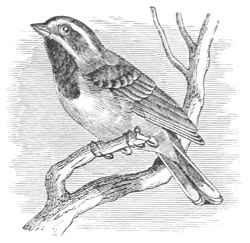
Poospiza bilineata.
Gen. Char. Bill slender, conical, both outlines gently curved. Under jaw with the edges considerably inflected; not so high as the upper. Tarsi elongated, slender; considerably longer than the middle toe. Toes short, weak; the outer decidedly longer than the inner, but not reaching to the base of the middle claw. Hind toe about equal to the middle without its claw. All the claws compressed and moderately curved. Wings rather long, reaching about over the basal fourth of the exposed portion of the rather long tail. Tertiaries and secondaries about equal, and not much shorter than the lengthened primaries; the second to fifth about equal and longest; the first considerably shorter, and longer than the seventh. Tail long, slightly emarginate, graduated; the outer feather abruptly shorter than the others. Feathers broad, linear, and rather obliquely truncate at the ends, with the corners rounded.
Color. Uniform above, without streaks. Beneath white, with or without a black throat. Black and white stripes on the head.
We are by no means sure that the two North American specimens here indicated really belong to the genus Poospiza, but we know no better position for them. They may be distinguished as follows:—
Common Characters. Lores and beneath the eye black, a white orbital ring, white spot above the lore (in bilineata continued back in a superciliary stripe); a white maxillary stripe. Lateral tail-feathers, with outer web, and terminal border of inner, hoary or pure white.
A. Throat black in adult; sides not streaked.
A continuous white superciliary stripe.
1. P. bilineata. Black patch of throat covering jugulum, with a convex outline behind. Crown and back without streaks, concolored. Wing-coverts without white bands; lesser coverts ash. Wing, 2.75; tail, 2.85; bill, from nostril, .37; tarsus, .65.
No white superciliary stripe.
2. P. mystacalis. Black patch of throat not extending on jugulum; its posterior outline truncated. Crown and back with distinct black streaks. Back scapulars and rump rufous in contrast with the ash of head and neck. Wing-coverts with two narrow, sharply defined white bands; lesser coverts black. Wing, 2.80; tail, 3.30; bill, .40; tarsus, .80. Hab. Mexico.
B. Throat white; sides streaked.
3. P. belli. No white superciliary stripe. A dusky spot in middle of the breast. Upper parts ashy, concolored, with indistinct streaks on the back. Wings somewhat more brownish, the coverts with two indistinct light (not white) bands.
α. Wing, 2.50; tail, 2.50; bill, .31; tarsus, .74. Dorsal streaks obsolete. Hab. California … var. belli.
β. Wing, 3.20; tail, 3.20; bill, .35; tarsus, .76. Dorsal streaks distinct. Hab. Middle Province of United States. … var. nevadensis.
Poospiza bilineata, Sclater.
BLACK-THROATED SPARROW.
Emberiza bilineata, Cassin, Pr. A. N. Sc. Ph. V, Oct. 1850, 104, pl. iii, Texas.—Ib. Illust. I, v, 1854, 150, pl. xxiii. Poospiza bilineata, Sclater, Pr. Zoöl. Soc. 1857, 7.—Baird, Birds N. Am. 1858, 470.—Ib. Mex. Bound. II, Birds, 15.—Heerm. X, c. 14.—Cooper, Orn. Cal. 1, 1870, 203.
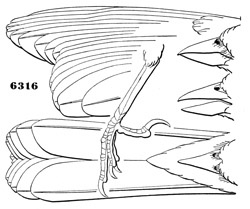
Poospiza bilineata. 6316
Sp. Char. Above uniform unspotted ashy-gray, tinged with light brown; purer and more plumbeous anteriorly, and on sides of head and neck. Under parts white, tinged with plumbeous on the sides, and with yellowish-brown about the thighs. A sharply defined superciliary and maxillary stripe of pure white, as also the lower eyelid, the former margined internally with black. Loral region black, passing insensibly into dark slate on the ears. Chin and throat between the white maxillary stripes black, ending on the upper part of the breast in a rounded outline. Tail black, the lateral feathers edged externally and tipped on inner web with white. Bill blue. Length, 5.40; wing, 2.75; tail, 2.90. Sexes alike.
Hab. Middle Province of United States north to 40°, between Rocky Mountains and Sierra Nevada. (As far west as Janos and the Mohave villages.) Matamoras (rare at San Antonio; Dresser, Ibis, 1865, 488).
This species in external form is very similar to P. belli, and will probably fall in the same genus. The cutting edges of the bill are much inflexed. The first quill is shorter than the sixth. The tail is a good deal rounded; the feathers broad.
The white maxillary stripe does not come quite to the base of the under jaw, which there is black. There is a hoary tinge on the forehead. The white superciliary stripes almost meet on the forehead.
In the immature bird the throat is white with a dusky clouding along each side; the upper part of the breast streaked with brown.
Habits. The Black-throated Sparrow, generically associated with Bell’s Finch, has several well-marked distinctive peculiarities in habits. Their eggs are also totally unlike those of the present species, being much more like those of the Peucæa and of Leucosticte griseinucha, and, like them, white and unspotted.
This species was first described by Mr. Cassin from specimens obtained in Western Texas by John W. Audubon, and its habitat was at first supposed to be restricted to the valleys of the Rio Grande and the Gila, but more recent explorations show it to have a much wider distribution. It is found from Western Texas through part of Mexico, New Mexico, the Indian Territory, and Arizona, to Southern California, and towards the north throughout the region of the Great Basin to an extent not yet fully determined. In portions at least of this territory it is migratory, and only resident in the summer months.
Mr. Dresser found this Sparrow very abundant during July and August in the mesquite thickets in the town of Matamoras. In December it was equally common at Eagle Pass, but at San Antonio it was quite a rare bird. He only observed it on two or three occasions at a rancho on the Medina River, and late in June a nest and four eggs were obtained. Between Laredo and Matamoras, after crossing the Nueces, he found these birds very numerous, and near Laredo met with several nests, some containing young and some eggs nearly hatched. One taken on the 20th of July contained three fresh eggs, probably indicating a second laying. This nest was in a low bush, carefully concealed. It was composed of straws and lined with fine roots. The eggs, when fresh, were nearly white, with a delicate bluish tinge. On his journey down the river he found many nests, all empty or containing young. Some of these were partially lined with cotton. Though not wild, the birds were so restless that he found it difficult to shoot them. Dr. Woodhouse obtained one specimen on the Rio Pedro, in Texas.
In Mexico this Sparrow was found by Lieutenant Couch to be numerous in parts of Tamaulipas, Nueva Leon, Coahuila, and other States on the Rio Grande, immediately south and west of the limits of the territory of the United States. It was first seen at Santa Rosalio, and specimens obtained, though none were noticed at Brownsville, only twenty miles east, during a month’s residence. At Charco Escondido, forty miles farther in the interior, it was very plentiful, and although it was early in March, had already reared a brood of young, one specimen appearing to be a young bird only a few weeks old. Its favorite home appeared to be the scattered mesquite, on the plains east of the Sierra Madre. During the warm hours of the day it does not seek the shade, but may always be found chirping and hopping from one bush to another. South of Cadoreita the birds disappeared, but after a month’s loss of their company he again met with them among some flowering Leguminosa, between Pesquieria and Rinconada. He thus found it several times entirely absent from districts of considerable extent, but always reappearing again throughout his journey. The usual note of this bird, at the season in which he met with it, was a simple chirp; but on one occasion, having halted during a norther in Tamaulipas, he heard a “gay little black-throated fellow,” regardless of the bitter wind, from the top of a yellow mimosa then in bloom, give utterance to a strain of sprightly and sweet notes, that would compare favorably with those of many more famed songsters.
Dr. Coues found this Sparrow very abundant in the southern and western portions of Arizona, though rare at Fort Whipple, where the locality was unsuited to it, as it seemed to prefer open plains, grassy or covered with sagebrush.
Mr. J. H. Clarke, who met with these birds in Tamaulipas, Texas, and New Mexico, speaks of them as abundant and widely distributed. He found them on the lower Rio Grande, but more abundantly in the interior, seeming to prefer the stunted and sparse vegetation of the sand-hills and dry plains to the cottonwood groves and willow thickets of the river valleys, where they were never seen. They would be very inconspicuous did not the male occasionally perch himself on some topmost branch and pour forth a continuous strain of music. In the more barren regions they were the almost exclusive representatives of the feathered tribes.
Dr. Heermann first remarked this Finch near Tucson, in Arizona, where he found it associated with other Sparrows in large flocks. They were flying from bush to bush, alighting on the ground to pick up grass-seeds and insects. They were quite numerous, and he traced them as far into Texas as the Dead Man’s Hole, between El Paso and San Antonio.
Dr. Cooper found a few of these birds on the treeless and waterless mountains that border the Colorado Valley, in pairs or in small companies, hopping along the ground, under the scanty shrubbery. In crossing the Providence Range, in May, Dr. Cooper found their nest, containing white eggs.
Both species of Poospiza, the belli and the bilineata, according to Mr. Ridgway, are entirely peculiar in their manners, habits, and notes. Both, he states, are birds characteristic of the arid artemisia plains of the Great Basin, and, with the Eremophila cornuta, are often the only birds met with on those desert wastes. The two species, he adds, are quite unlike in their habits and manners. They each have about the same extent of habitat, and even often frequent the same locality. While the P. bilineata is partial to dry sandy situations, inhabiting generally the arid mesa extending from the river valleys back to the mountains, the P. belli is almost confined to the more thrifty growth of the artemisia, as found in the damper valley portions. The P. belli is a resident species, and even through the severest winters is found in abundance. The P. bilineata is exclusively a summer bird, one of the latest to come from the South, and much the more shy of the two; its manners also are quite different.
Both birds have one common characteristic, which renders them worthy of especial remark. This is the peculiar delivery and accent, and the strange sad tone of their spring song, which, though unassuming and simple, is indeed strange in the effect it produces. This song, so plaintive and mournful, harmonizes with the dull monotony of the desert landscape.
Mr. Ridgway states that the P. bilineata is not so abundant as the other species, and is more retiring in its habits. It principally frequents the desert tracts and sandy wastes, on which are found only the most stunted forms of sage-brush. Its song, though quite simple, is exceedingly fine, its modulation being somewhat like wut´-wut´-ze-e-e-e-e-e, the first two syllables being uttered in a rich metallic tone, while the final trill is in a lower key, and of the most liquid and tremulous character imaginable. This simple chant is repeated every few seconds, the singer being perched upon a bush. He adds that this bird arrives on the Truckee Reservation about the 13th of May. The nest is built in sage-bushes, and the eggs are found from the 7th to the 21st of June. The nests are usually about one foot from the ground, or thereabouts.
The eggs vary in size from .70 by .55 of an inch to .75 by .60. They are of a rounded-oval shape, and of a pure white with a slight tinge of blue, somewhat resembling the eggs of the Bachman Finch.
Poospiza belli, Sclater.
BELL’S SPARROW.
Emberiza belli, Cassin, Pr. A. N. Sc. Phila. V, Oct. 1850, 104, pl. iv (San Diego, Cal.). Poospiza belli, Sclater, Pr. Zoöl. Soc. 1857, 7.—Baird, Birds N. Am. 1858, 470.—Heerm. X, s. p. 46. Zonotrichia belli, Elliot, Illust. Birds N. Am. I, pl. xiv.—Cooper, Orn. Cal. 1, 204.
Sp. Char. Upper parts generally, with sides of head and neck, uniform bluish-ash, tinged with yellowish-gray on the crown and back, and with a few very obsolete dusky streaks on the interscapular region. Beneath pure white, tinged with yellowish-brown on the sides and under the tail. Eyelids, short streak from the bill to above the eye, and small median spot at the base of culmen, white. A stripe on the sides of the throat and spot on the upper part of the breast, with a few streaks on the sides, with the loral space and region round the eyes, plumbeous-black. Tail-feathers black; the outer edged with white. Wing-feathers all broadly edged with brownish-yellow; the elbow-joint tinged with yellowish-green. Bill and feet blue. Length, 5.70; wing, 2.80; tail, 2.90. (Largest specimen, 6,338 ♂, Cosumnes River).
Hab. Southern California.
The colors are softer and more blended in the autumn; the young are obsoletely streaked on the breast.
Habits. Bell’s Finch has apparently a more restricted distribution than the Black-throated species, and is resident wherever found. It has been met with at Posa Creek, Cal., by Dr. Heermann, at Fort Thorn by Dr. T. C. Henry, and along the Colorado River by Drs. Kennerly and Möllhausen. It has likewise been found in Southern California, as far north as Sacramento Valley, and in the valley of the Gila.
Dr. Cooper states that all the extensive thickets throughout the southern half of California are the favorite resorts of this bird. There they apparently live upon small seeds and insects, indifferent as to water, or depending upon what they obtain from dews or fogs. They reside all the year in the same localities, and were also numerous on the island of San Nicolas, eighty miles from the mainland. In spring the males utter, as Dr. Cooper says, a low monotonous ditty, from the top of some favorite shrub, answering each other from long distances. Their nest he found about three feet from the ground, composed of grasses and slender weeds, lined with hair and other substances. The eggs, four in number, he describes as pale greenish, thickly sprinkled over with reddish-brown dots. At San Diego he found the young hatched out by May 18, but thinks they are sometimes earlier. It is also a common bird in the chaparral of Santa Clara Valley, and also, according to Dr. Heermann, along the Cosumnes River.
In Arizona, according to Dr. Coues, it is rather uncommon about Fort Whipple, owing to the unsuitable nature of the locality, but is abundant among the sage-brush of the Gila Valley, where it keeps much on the ground, and where its movements are very much like those of a Pipilo.
Drs. Kennerly and Möllhausen met with these Sparrows on the Little Colorado River, in California, December 15. They were found during that month along the banks of the river wherever the weeds and bushes were thick. It was never observed very far from the water, and its food, at that season, seemed to consist of the seeds of various kinds of weeds. Its motions were quick, and, when started up, its flight was short, rapid, and near the earth.
Dr. Heermann states that in the fall of 1851 he found this species in the mountains bordering the Cosumnes River, and afterwards on the broad tract of arid land between Kerr River and the Tejon Pass, and again on the desert between that and the Mohave River. He often found them wandering to a great distance from water. With only a few exceptions, these were the only birds inhabiting the desolate plains, where the artemisia is the almost exclusive vegetation. When undisturbed, it chants merrily from some bush-top, but, at the approach of danger, drops at once to the ground and disappears in the shrubbery or weeds. Its nest he found built in a bush, composed of twigs and grasses, and lined with hair. The eggs, four in number, he describes as of a light greenish-blue, marked with reddish-purple spots, differing in intensity of shade.
Poospiza belli, var. nevadensis, Ridgway.
ARTEMISIA SPARROW.
Poospiza belli, var. nevadensis, Ridgway, Report on Birds of 40th Parallel.
Sp. Char. Resembling P. belli, but purer ashy above, with the dorsal streaks very distinct, instead of almost obsolete. Wing, 3.20 (instead of 2.50); tail, 3.20 (instead of 2.50); bill (from forehead), .35; tarsus, .76. (Type, No. 53,516 ♂, Western Humboldt Mountains, Nev., United States Geol. Expl. 40th Par.)
Young. Streaked above, the crown obsoletely, the back distinctly. Whole breast and sides with numerous short dusky streaks upon a white ground. Markings about the head indistinct, wing-bands more distinct than in the adult.
Hab. Middle Province of United States, north to beyond 40° (resident).
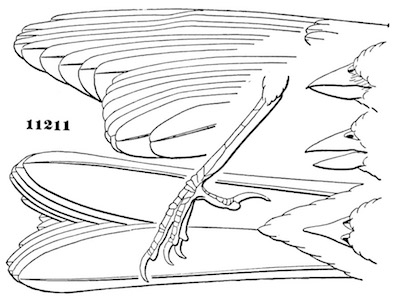
Poospiza belli var. belli 11211
The difference in size between the race of the Great Basin and that of the southern Pacific Province, of this species, is quite remarkable, being much greater than in any other instance within our knowledge. This may, perhaps, be explained by the fact that the former is not migratory, but resident even in the most northern part of its range; while the California one is also resident, and an inhabitant of only the southern portion of the coast region, not reaching nearly so far north as the race of the interior.
The coloration of the two races is quite identical, though in all specimens of var. belli the dorsal streaks are obsolete, sometimes even apparently wanting, while in the var. nevadensis they are always conspicuous. The former appears to be more brownish above than the latter.
Habits. These birds, Mr. Ridgway states, have a very general distribution, extending as far west as the eastern base of the Sierra Nevada. At Carson City, February 27, he heard for the first time their sweet sad chant. A week later he found the sage-brush full of these birds, the males being in full song and answering one another from all directions. In walking through the sage-brush these Sparrows were seen on every side, some running upon the ground with their tails elevated, uttering a chipping twitter, as they sought to conceal themselves behind the shrubs. Some were seen to alight upon the tops of dead stalks, where they sit with their tails expanded almost precisely after the manner of the Kingbird. The song of this bird is feeble, but is unsurpassed for sweetness and sadness of tone. While its effect is very like the song of a Meadow Lark singing afar off, there is, besides its peculiar sadness, something quite unique in its modulation and delivery. It is a chant, in style somewhat like the spring warbling of the Shore Lark.
On the 24th of March, at Carson City, he found these Sparrows very abundant and everywhere the predominating species, as it was also the most unsuspicious and familiar. It was even difficult to keep them from under the feet. A pair would often run before him for a distance of several rods with their unexpanded tails elevated, and when too nearly approached would only dodge in among the bushes instead of flying off.
On the 9th of April, walking among the sage-brush near Carson City, Mr. Ridgway found several nests of this Sparrow, the female parent in each instance betraying the position of her nest by running out, as he approached, from the bush beneath which it was concealed. With elevated tail, running rapidly and silently away, they disappeared among the shrubbery. In such cases a careful examination of the spot was sure to result in finding an artfully concealed nest, either embedded in the ground or a few inches above it in the lower branches of the bush. He did not find this species east of the northern end of Great Salt Lake, nor was it seen in the neighborhood of Salt Lake City, where the other species was so abundant.
The eggs of this species differ very essentially from those of the P. bilineata. They are oblong in shape, have a light greenish ground, marked all over the egg with very fine dots of a reddish-brown, and around the larger end with a ring of confluent blotches of dark purple and lines of a darker brown, almost black. They measure .80 by .60 of an inch. They resemble very closely a not uncommon variety of the eggs of the Spizella pusilla.
Footnotes:
INDEX TO PLATES OF LAND BIRDS.
Ægiothus brewsteri, I. 501, pl. 22, fig. 6
exilipes, ♂ “ 498, “ “ 2
fuscescens, ♂ “ 493, “ “ 3
“ “ “ “ “ 5
Agelaius gubernator (shoulder), ♂ II. pl. 33, “ 4
gubernator, ♀ “ 163, “ “ 8
phœniceus, ♂ “ 159, “ “ 1
“ ♀ “ “ “ “ 2
“ (shoulder), ♂ “ “ “ “ 3
tricolor (shoulder), ♂ “ 165, “ “ 5
“ ♂ “ “ “ “ 6
“ ♀ “ “ “ “ 7
Alauda arvensis, “ 136, pl. 32, “ 3
Ammodromus caudacutus, I. 557, pl. 25, “ 7
maritimus, “ 560, “ “ 8
Ampelis cedrorum, ♂ “ 401, pl. 18, “ 2
garrulus, ♂ “ 396, “ “ 1
Antenor unicinctus, III. 250.
Anthus ludovicianus, I. 171, pl. 10, “ 3
pratensis, “ 173, “ “ 4
Antrostomus carolinensis, ♂ II. 410, pl. 46, “ 1
nuttalli, ♂ “ 417, “ “ 3
vociferus, ♂ “ 413, “ “ 2
Aquila canadensis, III. 314.
Archibuteo ferrugineus, “ 300.
sancti-johannis, “ 304.
Astur atricapillus, “ 237.
Asturina plagiata, “ 246.
Atthis heloisa, ♂ II. 465, pl. 47, “ 6
Auriparus flaviceps, I. pl. 7, “ 11
Bonasa sabinei, III. 454.
umbelloides, “ 453, pl. 61, “ 10
umbellus, “ 448, “ “ 3
“ “ “ “ “ 9
Bubo arcticus, “ 64.
pacificus, “ 65.
virginianus, “ 62.
Budytes flava, I. 167, pl. 10, “ 2
Buteo borealis, III. 281.
calurus, “ 286.
cooperi, “ 295.
elegans, “ 277.
harlani, “ 292.
krideri, “ 284.
lineatus, “ 275.
lucasanus, “ 285.
oxypterus, “ 266.
pennsylvanicus, “ 259.
swainsoni, “ 263.
zonocercus, “ 272.
Calamospiza bicolor, ♂ II. 61, pl. 29, “ 2
“ ♀ “ “ “ “ 3
Callipepla squamata, ♂ III. 487, pl. 63, “ 6
Calypte anna, ♂ II. 454, pl. 47, “ 7
costæ, ♂ “ 457, “ “ 8
Campephilus principalis, ♂ “ 496, pl. 49, “ 1
“ ♀ “ “ “ “ 2
Campylorhynchus affinis, I. 133, pl. 8, “ 6
brunneicapillus, “ 132, “ “ 5
Canace canadensis, III. 416, pl. 61, “ 5
“ ♀ “ “ pl. 59, “ 6
“ ♂ “ “ “ “ 5
franklini, ♂ “ 419, “ “ 3
fuliginosus, “ 495.
obscurus, ♂ “ 422, “ “ 1
“ ♀ “ “ “ “ 2
richardsoni, ♂ “ 427, “ “ 4
Cardinalis coccineus, ♂ II. pl. 30, “ 8
igneus, ♂ “ 103, “ “ 10
phœniceus, “ “ “ “ 9
virginianus, ♀ “ 100, “ “ 6
“ ♂ “ “ “ “ 7
Carpodacus californicus, ♂ I. 465, pl. 21, “ 10
“ ♀ “ “ “ “ 11
cassini, ♂ “ 460, “ “ 4
“ ♀ “ “ “ “ 5
frontalis, ♂ “ 465, “ “ 3
“ ♀ “ “ “ “ 6
hœmorrhous, ♂ “ “ “ “ 12
rhodocolpus, ♂ “ 468, “ “ 9
purpureus, ♂ “ 462, “ “ 7
“ ♀ “ “ “ “ 8
Catharista atrata, III. 351.
Catherpes mexicanus, I. 139, pl. 8, “ 4
Centrocercus urophasianus, ♂ III. pl. 60, “ 2
“ ♂ “ “ “ 4
“ “ 429, pl. 61, “ 6
Centronyx bairdi, I. 531, pl. 25, “ 3
Centurus aurifrons, ♂ II. 557, pl. 52, “ 3
“ ♀ “ “ “ “ 6
carolinus, ♂ “ 554, “ “ 1
“ ♀ “ “ “ “ 4
uropygialis, ♂ “ 558, “ “ 2
“ ♀ “ “ “ “ 5
Certhia americana, I. 125, pl. 8, “ 11
mexicana, “ 128.
Certhiola bahamensis, ♂ “ 428, pl. 19, “ 5
Ceryle alcyon, ♂ II. 392, pl. 45, “ 6
cabanisi, ♂ “ 396, “ “ 9
Chætura pelagica, ♂ “ 432, pl. 45, “ 7
vauxi, ♀ “ 435, “ “ 8
Chamæa fasciata, I. 84, pl. 6, “ 8
Chamæpelia passerina, ♂ III. 389, pl. 58, “ 6
Chondestes grammaca, ♂ II. 562, pl. 31, “ 1
Chordeiles henryi, ♂ “ 404, pl. 46, “ 4
popetue, “ 407.
texensis, ♂ “ 406, “ “ 5
Chrysomitris lawrenci, ♂ I. 478, pl. 22, “ 14
“ ♀ “ “ “ “ 15
arizonæ, ♂ “ 476, “ “ 11
mexicana, “ “ “ 12
“ ♀ “ “ “ 13
pinus, ♂ “ 480, “ “ 16
psaltria, ♂ “ 474, “ “ 9
“ ♀ “ “ “ “ 10
tristis (summer), ♂ “ 471, “ “ 7
“ (winter), ♂ “ “ “ “ 8
Cinclus mexicanus, “ 56, pl. 5, “ 1
Circus hudsonius, III. 214.
Cistothorus palustris, I. 161, pl. 9, “ 6
stellaris, “ “ “ “ 7
Coccygus americanus, ♂ II. 477, pl. 48, “ 3
erythrophthalmus, “ 484, “ “ 5
minor, “ 482, “ “ 4
Colaptes auratus, ♂ “ 575, pl. 55, “ 1
“ ♀ “ “ “ “ 2
chrysoides, ♂ “ 583, pl. 54, “ 1
“ ♀ “ “ “ “ 2
hybridus, ♂ “ 582, “ “ 3
mexicanus, ♂ “ 578, pl. 55, “ 3
“ ♀ “ “ “ “ 4
Collurio borealis, ♂ I. 415, pl. 19, “ 1
“ (Juv.) “ “ “ “ 2
excubitoroides, ♂ “ 421, “ “ 3
ludovicianus, ♂ “ 418, “ “ 4
robustus, “ 420.
Columba fasciata, ♂ III. 360, pl. 57, “ 2
flavirostris, ♂ “ 366, “ “ 3
leucocephala, ♂ “ 363, “ “ 4
Contopus borealis, ♂ II. 353, pl. 44, “ 1
pertinax, ♂ “ 356, “ “ 2
richardsonii, ♂ “ 360, “ “ 4
vireus, ♂ “ 357, “ “ 3
Conurus carolinensis, (Ad.) “ 587, pl. 56, “ 1
“ (Juv.) “ “ “ “ 2
Corvus americanus, ♂ “ 243, pl. 37, “ 5
carnivorus, ♀ “ 234, “ “ 6
caurinus, ♂ “ 248, “ “ 3
cryptoleucus, “ 242, “ “ 8
floridanus, “ 247, “ “ 9
mexicanus, ♂ “ 233, “ “ 4
ossifragus, “ 251, “ “ 7
Coturniculus henslowi, ♀ I. 553, pl. 25, “ 5
leconti, ♀ “ 552, “ “ 6
ochrocephalus, II. pl. 46, “ 6
passerinus, I. 553, pl. 25, “ 4
perpallidus, “ 556.
Cotyle riparia, ♂ “ 353, pl. 16, “ 14
Crotophaga ani, ♀ II. 488, pl. 48, “ 2
Cupidonia cupido, III. 440, pl. 61, “ 1
“ “ “ “ “ 7
pallidicincta, “ 446.
Cyanocitta arizonæ, II. 292, pl. 41, “ 2
californica, ♂ “ 288, pl. 40, “ 1
couchi, “ 293.
floridana, ♂ “ 285, “ “ 4
sordida, “ 292, pl. 41, “ 1
sumichrasti, ♂ “ pl. 40, “ 2
woodhousei, ♂ “ 291, “ “ 3
Cyanospiza amœna, ♂ “ 84, pl. 29, “ 11
“ ♀ “ “ “ “ 12
ciris, ♂ “ 87, “ “ 7
“ ♀ “ “ “ “ 8
cyanea, ♂ “ 82, “ “ 13
“ ♀ “ “ “ “ 14
parellina, ♂ “ “ “ 6
versicolor, ♂ “ 86, “ “ 9
“ ♀ “ “ “ “ 10
Cyanura coronata, ♂ “ pl. 39, “ 4
cristata, ♂ “ 273, pl. 42, “ 3
frontalis, ♂ “ 279, pl. 39, “ 2
macrolopha, ♂ “ 281, “ “ 3
stelleri, ♂ “ 277, “ “ 1
Cyrtonyx massena, III. 492, pl. 61, “ 2
“ ♂ “ “ pl. 64, “ 3
“ ♀ “ “ “ “ 6
Dendroica æstiva, I. 222, pl. 14, “ 1
albilora, ♂ “ 240, “ “ 7
auduboni, “ 229, pl. 13, “ 1
blackburniæ, ♂ “ 237, “ “ 2
“ ♀ “ “ “ “ 3
cærulea, ♂ “ 235, “ “ 10
“ ♀ “ “ “ “ 11
cærulescens, ♂ “ 254, pl. 12, “ 10
“ ♀ “ “ “ “ 11
castanea, ♂ “ 251, pl. 13, “ 4
“ ♀ “ “ “ “ 5
chrysopareia, ♂ “ 260, pl. 12, “ 6
coronata, ♂ “ 227, “ “ 9
“ ♀ “ “ “ “ 12
discolor, ♂ “ 276, pl. 14, “ 9
dominica, ♂ “ 240, “ “ 5
graciæ, ♂ “ 243, “ “ 10
kirtlandi, ♂ “ 272, “ “ 5
maculosa, ♂ “ 232, “ “ 2
montana, “ 271, “ “ 3
nigrescens, ♂ “ 258, pl. 12, “ 8
occidentalis, ♂ “ 266, “ “ 5
olivacea, ♂ “ pl. 14, “ 4
palmarum, ♂ “ 273, “ “ 8
pennsylvanica, ♂ “ 245, pl. 13, “ 7
“ (Juv.) ♂ “ “ “ “ 8
pinus, ♂ “ 268, “ “ 6
striata, ♂ “ 248, “ “ 9
“ ♀ “ “ “ “ 12
townsendi, ♂ “ 265, pl. 12, “ 7
virens, ♂ “ 261, “ “ 4
Dolichonyx orizyvorus, ♂ II. 149, pl. 32, “ 4
“ ♀ “ “ “ “ 5
Ectopistes migratoria, ♂ III. 368, pl. 57, “ 5
Elanus leucurus, “ 198.
Embernagra rufivirgata, II. 47, pl. 28, “ 3
Empidonax acadicus, ♂ “ 374, pl. 44, “ 11
difficilis, “ 380.
flaviventris, ♂ “ 378, “ “ 12
hammondii, ♂ “ 383, “ “ 7
minimus, ♂ “ 372, “ “ 10
obscurus, ♂ “ 381, “ “ 6
pusillus, ♂ “ 366, “ “ 9
traillii, ♂ “ 369, “ “ 8
Eremophila cornuta, ♂ “ 141, pl. 32, “ 1
“ (Juv.) “ “ “ “ 2
Euspiza americana, ♂ “ 65, pl. 28, “ 11
“ ♀ “ “ “ “ 12
townsendi, ♀ “ 68, “ “ 13
Falco anatum, III. 132.
candicans, “ 111.
columbarius, “ 144.
femoralis, “ 155.
isabellinus, “ 171.
islandicus, “ 113.
labradora, “ 117.
pealei, “ 137.
polyagrus, “ 123.
richardsoni, “ 148.
sacer, “ 115.
sparverius, “ 169.
suckleyi, “ 147.
Galeoscoptes carolinensis, I. 52, pl. 3, “ 5
Geococcyx californianus, ♂ II. 492, pl. 48, “ 1
Geothlypis macgillivrayi, ♂ I. 303, pl. 15, “ 4
“ ♀ “ “ “ “ 5
philadelphia, ♂ “ 301, “ “ 6
“ ♀ “ “ “ “ 9
trichas, ♂ “ 297, “ “ 7
“ ♀ “ “ “ “ 8
Glaucidium californicum, III. 81.
ferrugineum, “ 85.
Guiraca cærulea, ♂ II. 77, pl. 29, “ 4
“ ♀ “ “ “ “ 5
Gymnokitta cyanocephala, ♂ “ 260, pl. 38, “ 2
Haliaëtus albicilla, III. 324.
leucocephalus, “ 326.
Harporhynchus cinereus, I. 40, pl. 4, “ 2
crissalis, “ 47, “ “ 1
curvirostris, “ 41, pl. 3, “ 3
lecontei, “ 44, pl. 4, “ 3
longirostris, “ 39, pl. 3, “ 2
palmeri, “ 43.
redivivus, “ 45, pl. 4, “ 4
rufus, “ 37, pl. 3, “ 1
Hedymeles ludovicianus, ♂ II. 70, pl. 30, “ 4
“ ♀ “ “ “ “ 5
melanocephalus, ♂ “ 73, “ “ 1
“ ♀ “ “ “ “ 2
Heliopædica xantusi, ♂ “ 467, pl. 47, “ 3
Helminthophaga bachmani, ♂ I. 194, pl. 11, “ 3
celata (var. Cape Lucas), “ 204, “ “ 4
“ (var. Florida), “ “ “ 6
“ (var. Rocky Mts.), “ 202, “ “ 5
chrysoptera, ♂ “ 192, “ “ 2
luciæ, “ 200, “ “ 9
peregrina (in spring), “ 205, “ “ 10
“ (in autumn), “ “ “ “ 11
pinus, ♂ “ 195, “ “ 1
ruficapilla, “ 196, “ “ 7
“ (var. Calif.), “ “ “ 8
virginiæ, “ 199, “ “ 12
Helmitherus swainsoni, “ 190, pl. 10, “ 9
vermivorus, “ 187, “ “ 10
Hesperiphona montana, “ 449, pl. 22, “ 4
vespertina, ♂ “ “ “ “ 1
Hirundo horreorum, ♂ “ 339, pl. 16, “ 9
Hylotomus pileatus, ♀ II. 550, pl. 56, “ 4
“ ♂ “ “ “ “ 5
Icteria longicauda, I. 309.
virens, ♂ “ 307, pl. 15, “ 12
Icterus auduboni, ♂ II. 186, pl. 35, “ 1
baltimore, ♂ “ 195, “ “ 5
bullocki, ♂ “ 199, pl. 34, “ 3
bullocki, ♀ “ “ “ “ 7
cucullatus, ♂ “ 193, pl. 35, “ 6
parisorum, ♂ “ 188, “ “ 7
spurius, ♂ “ 190, pl. 34, “ 4
“ (Juv.) ♂ “ “ “ “ 5
“ ♀ “ “ “ “ 6
wagleri, ♂ “ pl. 35, “ 2
Ictinia mississippiensis, III. 203.
Junco aikeni, ♂ I. 584, pl. 26, “ 6
caniceps, ♂ “ 587, “ “ 3
hyemalis, ♂ “ 580, “ “ 5
oregonus, ♂ “ 584, “ “ 2
Lagopus albus, III. 457, pl. 61, “ 8
“ (summer), ♂ “ “ pl. 62, “ 1
“ (winter), ♂ “ “ “ “ 3
“ (summer), ♀ “ “ “ “ 2
leucurus (summer), ♂ “ 464, “ “ 6
rupestris (winter), ♂ “ 462, “ “ 4
“ (summer), ♀ “ “ “ “ 5
Lanivireo cassini, ♂ I. 376, pl. 17, “ 9
flavifrons, ♂ “ 379, “ “ 5
plumbea, ♂ “ 377, “ “ 10
solitaria, ♂ “ 373, “ “ 8
Leucosticte arctous, “ pl. 23, “ 10
australis, “ “ “ 9
campestris, “ 507, “ “ 7
griseinucha, ♂ “ 508, “ “ 5
littoralis, “ 507, “ “ 6
tephrocotis, “ 504, “ “ 8
Lophophanes atricristatus, “ 90, pl. 6, “ 2
bicolor, “ 87, “ “ 1
inornatus, “ 91, “ “ 3
wollweberi, “ 93, “ “ 4
Lophortyx californicus, III. 479, pl. 61, “ 4
“ ♂ “ “ pl. 64, “ 1
“ ♀ “ “ “ “ 2
gambeli, ♂ “ 482, “ “ 4
“ ♀ “ “ “ “ 5
Loxia americana, ♂ I. 484, pl. 23, “ 1
“ ♀ “ “ “ “ 4
leucoptera, ♂ “ 488, “ “ 2
“ ♀ “ “ “ “ 3
mexicana, “ “
Melanerpes angustifrons, ♂ II. 573, pl. 53, “ 3
“ ♀ “ “ “ “ 4
erythrocephalus, ♂ “ 564, pl. 54, “ 4
formicivorus, ♂ “ 566, pl. 53, “ 1
“ ♀ “ “ “ “ 2
torquatus, ♂ “ 561, pl. 54, “ 5
Meleagris gallopavo, III. 404.
mexicana, “ 410.
Melopeleia leucoptera, ♂ “ 376, pl. 58, “ 4
Melospiza fallax, ♀ II. 22, pl. 27, “ 10
guttata, “ 27, “ “ 12
heermanni, ♂ “ 24, “ “ 9
insignis, “ 30, “ “ 8
lincolni, “ 31, “ “ 13
melodia, “ 19, “ “ 6
palustris, ♂ “ 34, pl. 28, “ 1
“ ♀ “ “ “ “ 2
rufina, “ 29, pl. 27, “ 11
samuelis, “ 26, “ “ 7
Micrathene whitneyi, III. 87.
Milvulus forficatus, ♂ II. 311, pl. 43, “ 1
tyrannus, “ 309.
Mimus polyglottus, I. 49, pl. 3, “ 4
Mitrephorus pallescens, ♂ II. 386, pl. 44, “ 13
Mniotilta varia, ♂ I. 180, pl. 10, “ 6
Molothrus pecoris, ♀ II. 154, pl. 32, “ 6
“ ♀ “ “ “ “ 7
obscurus, ♂ “ “ “ 8
Motacilla alba, I. 165, pl. 10, “ 1
Myiadestes townsendi, ♂ “ 409, pl. 18, “ 5
“ (Juv.) “ “ “ “ 6
Myiarchus cinerascens, ♂ II. 337, pl. 43, “ 8
crinitus, ♂ “ “ “ 7
lawrencii, ♂ “ “ “ 9
Myiodioctes canadensis, ♂ I. 320, pl. 16, “ 6
minutus, “ 316, “ “ 2
mitratus, ♂ “ 314, pl. 15, “ 10
“ ♀ “ “ “ 11
pileolatus, “ 319.
pusillus, ♂ “ 317, pl. 16, “ 3
“ ♀ “ “ “ “ 4
Nauclerus forficatus, III. 192.
Neocorys spraguei, ♀ I. 175, pl. 10, “ 5
Nephœcetes niger, ♀ II. 429, pl. 45, “ 4
Nisus cooperi, III. 230.
fuscus, “ 224.
mexicanus, “ 231.
Nyctale richardsoni, “ 40.
acadica, “ 43.
Nyctea scandiaca, “ 70.
Onychotes gruberi, “ 254.
Oporornis agilis, ♂ I. 290, pl. 15, “ 1
“ ♀ “ “ “ “ 2
formosa, ♂ “ 293, “ “ 3
Oreopeleia martinica, ♂ III. 393, pl. 58, “ 1
Oreortyx pictus, ♂ “ 475, pl. 63, “ 5
Oreoscoptes montanus, I. 32, pl. 3, “ 6
Ortalida macalli, III. 398, pl. 57, “ 1
Ortyx texanus, ♀ “ 474, pl. 63, “ 4
“ ♂ “ “ “ “ 3
virginianus, ♂ “ 468, “ “ 1
“ ♀ “ “ “ “ 2
Otus brachyotus, “ 22.
wilsonianus, “ 18.
Pandion carolinensis, “ 184.
Panyptila melanoleuca, ♂ II. 424, pl. 45, “ 5
Parula americana, ♂ I. 208, pl. 10, “ 7
Parus atricapillus, “ 96, pl. 7, “ 1
carolinensis, “ 102, “ “ 4
hudsonicus, “ 105, “ “ 7
montanus, “ 95, “ “ 5
occidentalis, “ 101, “ “ 3
rufescens, “ 104, “ “ 6
septentrionalis, “ 99, “ “ 2
Passerculus alaudinus, “ 537, pl. 24, “ 11
anthinus, “ 539, “ “ 10
caboti, II. pl. 46, “ 9
guttatus, I. 544, pl. 25, “ 1
princeps, “ 540, “ “ 2
rostratus, “ 542, pl. 24, “ 12
sandwichensis, “ 538, “ “ 9
savanna, “ 534, “ “ 8
Passerella iliaca, II. 50, pl. 28, “ 7
megarrhyncha, “ 57, “ “ 10
schistacea, “ 56.
townsendi, ♀ “ 53, “ “ 8
Pediœcetes columbianus, III. 434, pl. 60, “ 1
phasianellus, “ 436, “ “ 3
Perisoreus canadensis, ♂ II. 299, pl. 41, “ 3
“ (Juv.) “ pl. 42, “ 4
capitalis, ♂ “ 302, pl. 41, “ 4
obscurus, “ “
Perissoglossa carbonata, I. 214, pl. 12, “ 3
tigrina, ♂ “ 212, “ “ 1
“ ♀ “ “ “ “ 2
Petrochelidon lunifrons, ♂ “ 334, pl. 16, “ 13
Peucæa æstivalis, II. 39, pl. 28, “ 4
arizonæ, “ 41.
carpalis, “ pl. 46, “ 8
cassini, “ 42, pl. 28, “ 5
ruficeps, “ 45, “ “ 6
Phainopepla nitens, ♂ I. 405, pl. 18, “ 3
“ ♂ “ “ “ 4
Phonipara zena, ♂ II. 93, pl. 29, “ 15
“ ♀ “ “ “ “ 16
Phyllopneuste borealis, I. pl. 5, “ 5
Pica hudsonica, ♂ II. 266, pl. 38, “ 1
nuttalli, ♂ “ 270, “ “ 3
Picicorvus columbianus, “ 255, “ “ 4
Picoides americanus, ♂ “ 532, pl. 50, “ 2
arcticus, ♂ “ 530, “ “ 1
Picus albolarvatus, ♂ “ 526, “ “ 7
“ ♀ “ “ “ “ 8
borealis, ♂ “ 524, pl. 49, “ 8
gairdneri, “ 512.
harrisi, “ 507.
lucasanus, “ 519.
nuttalli, ♂ “ 521, pl. 50, “ 3
“ ♀ “ “ “ “ 6
pubescens, ♂ “ 509, pl. 49, “ 6
“ ♀ “ “ “ “ 7
scalaris, ♂ “ 515, pl. 50, “ 4
“ ♀ “ “ “ “ 5
villosus, ♂ “ 503, pl. 49, “ 3
“ ♀ “ “ “ “ 4
“ (Juv.) ♂ “ “ “ “ 5
Pinicola enucleator, ♂ I. 453, pl. 21, “ 1
“ ♀ “ “ “ “ 2
Pipilo aberti, ♂ II. 128, pl. 31, “ 7
albigula, ♂ “ 127, “ “ 11
alleni, “ 112.
arcticus, ♂ “ 119, “ “ 5
“ ♀ “ “ “ “ 6
chlorura, ♂ “ 131, “ “ 4
crissalis, ♂ “ 122, “ “ 8
erythrophthalmus, ♂ “ 109, “ “ 2
“ ♂ “ “ “ “ 3
megalonyx, ♀ “ 113, “ “ 9
mesoleucus, ♂ “ 125, “ “ 10
oregonus, ♀ “ 116, “ “ 12
Plectrophanes lapponicus, ♂ I. 515, pl. 24, “ 7
maccowni, ♂ “ 523, “ “ 1
melanomus, ♂ “ 521, “ “ 6
nivalis, ♂ “ 512, “ “ 2
ornatus, ♂ “ 520, “ “ 3
pictus, ♂ “ 518, “ “ 4
“ ♀ “ “ “ “ 5
Polioptila cærulea, “ 78, pl. 6, “ 5
melanura, “ 81, “ “ 7
plumbea, “ 80, “ “ 6
Polyborus auduboni, III. 178.
Poocætes gramineus, II. 545, pl. 29, “ 1
Poospiza belli, I. 593, pl. 26, “ 9
bilineata, ♂ “ 590, “ “ 8
nevadensis, “ 594.
Progne cryptoleuca, “ 332.
subis, ♀ “ 329, pl. 16, “ 7
“ ♂ “ “ “ “ 10
Protonotaria citrea, “ 184, pl. 10, “ 8
Psaltriparus melanotis, I. 108, pl. 7, “ 8
minimus, “ 109, “ “ 9
plumbeus, “ 110, “ “ 10
Pseudogryphus californianus, III. 338.
Psilorhinus morio, ♀ II. 304, pl. 42, “ 2
Pyranga æstiva, ♂ I. 441, pl. 20, “ 5
“ ♀ “ “ “ “ 6
cooperi, ♂ “ 444, “ “ 1
“ ♀ “ “ “ “ 2
hepatica, ♂ “ 440, “ “ 9
“ ♀ “ “ “ “ 10
ludoviciana, ♂ “ 437, “ “ 3
“ ♀ “ “ “ “ 4
rubra, ♂ “ 435, “ “ 7
“ ♀ “ “ “ “ 8
Pyrgita domestica, “ 525, pl. 23, “ 12
Pyrocephalus mexicanus, ♂ II. 387, pl. 44, “ 5
Pyrrhula cassini, ♂ I. 457, pl. 23, “ 11
Pyrrhuloxia sinuata, ♂ II. 95, pl. 30, “ 3
Quiscalus æneus, “ 218.
aglæus, ♂ “ 221, pl. 37, “ 2
macrourus, ♂ “ 225, pl. 36, “ 1
“ ♀ “ “ “ “ 2
major, ♂ “ 222, “ “ 3
“ ♀ “ “ “ “ 4
purpureus, ♂ “ 214, pl. 37, “ 1
Regulus calendula, I. 75, pl. 5, “ 9
cuvieri, “ “ “ “ 7
satrapa, “ 73, “ “ 8
Rhinogryphus aura, III. 344.
Rostrhamus sociabilis, “ 209.
Salpinctes obsoletus, I. 135, pl. 8, “ 3
Saxicola œnanthe, “ 60, pl. 5, “ 6
Sayornis fuscus, ♂ II. 343, pl. 45, “ 2
nigricans, ♂ “ 340, “ “ 1
sayus, ♂ “ 347, “ “ 3
Scardafella inca, ♂ III. 387, pl. 58, “ 7
Scolecephalus cyanocephalus, ♀ II. 206, pl. 35, “ 3
ferrugineus, ♂ “ 203, “ “ 4
Scops asio, III. 49.
flammeola, “ 58.
floridana, “ 57.
kennicotti, “ 53.
maccalli, “ 52.
Seiurus aurocapillus, I. 280, pl. 14, “ 11
ludovicianus, ♂ “ 287, “ “ 13
noveboracensis, ♂ “ 283, “ “ 12
Selasphorus platycercus, ♂ II. 462, pl. 47, “ 5
rufus, ♂ “ 459, “ “ 4
Setophaga picta, ♂ “ pl. 46, “ 7
“ ♂ “ pl. 56, “ 3
ruticilla, ♂ I. 322, pl. 16, “ 1
“ ♀ “ “ “ “ 5
Sialia arctica, “ 67, pl. 5, “ 4
mexicana, “ 65, “ “ 2
sialis, “ 62, “ “ 3
Sitta aculeata, “ 117.
canadensis, ♂ “ 118, pl. 8, “ 7
“ ♀ “ “ “ “ 8
carolinensis, ♂ “ 114, “ “ 1
“ ♀ “ “ “ “ 2
pusilla, “ 122, “ “ 9
pygmæa, “ 120, “ “ 10
Spheotyto hypogæa, III. 90.
Spermophila moreleti, ♂ II. 91, pl. 29, “ 17
Sphyropicus nuchalis, ♂ “ 542, pl. 51, “ 3
“ ♀ “ “ “ “ 4
ruber, ♂ “ 544, “ “ 6
thyroideus, ♂ “ 547, pl. 56, “ 6
varius, ♂ “ 539, pl. 51, “ 1
“ ♀ “ “ “ “ 2
williamsoni, ♀ “ 545, “ “ 5
Spizella arizonæ, “ 11.
atrigularis, ♂ I. 15, pl. 26, “ 11
“ ♂ “ “ “ “ 12
breweri, II. 13, pl. 27, “ 4
monticola, “ 3, “ “ 5
pallida, “ 11, “ “ 3
pusilla, ♀ “ 5, “ “ 2
socialis, “ 7, “ “ 1
Starnœnas cyanocephala, ♂ III. 395, pl. 58, “ 5
Stelgidopteryx serripennis, ♂ I. 350, pl. 16, “ 12
Stellula calliope, ♂ II. 445, pl. 47, “ 9
Strix pratincola, III. 13.
Sturnella magna, ♂ II. 174, pl. 34, “ 2
neglecta, ♂ “ 176, “ “ 1
Sturnus vulgaris, ♂ “ 229, pl. 35, “ 8
Surnia ulula, III. 75.
Syrnium cinereum, “ 30.
nebulosum, “ 34.
occidentale, “ 38.
Tachycineta bicolor, ♂ I. 344, pl. 16, “ 8
thalassina, ♂ “ 347, “ “ 11
Thaumatias linnæi, II. 468.
Thryothorus berlandieri, I. 144, pl. 9, “ 2
bewicki, ♂ “ 145, “ “ 3
“ “ “ “ “ 4
leucogaster, “ 147.
ludovicianus, “ 142, “ “ 1
spilurus, “ 147.
Trochilus alexandri, ♂ II. 450, pl. 47, “ 1
colubris, ♂ “ 448, “ “ 2
Troglodytes ædon, I. 149, pl. 9, “ 5
alascensis, “ 157, “ “ 8
hyemalis, “ 155, “ “ 9
pacificus, “ “ “ 10
parkmanni, “ 153.
Turdus aliciæ, “ 11, pl. 1, “ 3
auduboni, “ 21, “ “ 8
confinis, “ 27, pl. 2, “ 1
fuscescens, “ 9, pl. 1, “ 5
iliacus, “ 23, pl. 2, “ 4
migratorius, “ 25, “ “ 3
mustelinus, “ 7, pl. 1, “ 1
nævius, “ 29, pl. 2, “ 2
nanus, “ 20, pl. 1, “ 7
pallasi, “ 18, “ “ 6
swainsoni, “ 14, “ “ 4
ustulatus, “ “ “ 2
Tyrannus carolinensis, ♂ II. 316, pl. 43, “ 2
couchi, ♂ “ 329, “ “ 6
dominicensis, ♂ “ 319, “ “ 3
verticalis, ♂ “ 324, “ “ 4
vociferans, ♂ “ 327, “ “ 5
Vireo atricapillus, ♂ I. 383, pl. 17, “ 6
belli, ♂ “ 389, “ “ 13
huttoni, ♂ “ 387, “ “ 12
noveboracensis, ♂ “ 385, “ “ 11
pusillus, ♂ “ 391, “ “ 14
vicinior, ♂ “ 393, “ “ 7
Vireosylvia barbatula, ♂ “ 360, “ “ 1
flavoriridis, “ 366.
gilva, ♂ “ 368, “ “ 3
olivacea, ♂ “ 363, “ “ 2
philadelphica, “ 367, “ “ 4
swainsoni, “ 371.
Xanthocephalus icterocephalus, ♂ II. 167, pl. 32, “ 9
“ ♀ “ “ pl. 33, “ 9
Xanthoura luxuosa, “ 295, pl. 42, “ 1
Zenaida amabilis, ♂ III. 379, pl. 58, “ 3
Zenaidura carolinensis, ♂ “ 383, “ “ 2
Zonotrichia albicollis, ♂ I. 574, pl. 26, “ 10
coronata, ♂ “ 573, “ “ 1
gambeli, ♂ “ 569, pl. 25, “ 11
“ (Juv.) “ “ “ “ 12
leucophrys, (Juv.) ♂ “ 566, “ “ 9
“ ♂ “ “ “ “ 10
querula, (Ad.) ♂ “ 577, pl. 26, “ 4
“ (autumn) “ “ “ “ 7
INDEX OF ENGLISH NAMES.
Ani, II. 488.
Bee Martin, II. 316.
Bird of Paradise (Texas), II. 311.
Birds of Prey, III. 1.
Blackbird, Brewer’s, II. 206. Cow, II. 154. Crimson-shouldered, II. 163. Crow, II. 214. Red and White shouldered, II. 165. Redwing, II. 159. Rusty, II. 203. Savanna, II. 488. Swamp, II. 159. White-winged, II. 61. Yellow-headed, II. 167.
Black Warrior, III. 292.
Bluebird, Eastern, I. 62. California, I. 65. Rocky Mountain, I. 67.
Bobolink, II. 149.
Bob-White, III. 468.
Bull-Bat, II. 401.
Bullfinch, Cassin’s, I. 457.
Bunting, Arctic, II. 119. Baird’s, I. 531. Bay-winged, I. 545. Black-crowned, I. 573. Black-throated, II. 65. Blue, II. 82. Cañon, II. 125. Chestnut-collared, I. 520. Green-tailed, II. 131. Henslow’s, I. 550. Indigo, II. 82. Lark, II. 61. Leconte’s, I. 552. Long-clawed, II. 113. Maccown’s, I. 523. Painted, II. 87. Seaside, I. 560. Sharp-tailed, I. 557. Smith’s, I. 518. Townsend’s, II. 68. Varied, II. 86. Western Yellow-winged, I. 556. Yellow-winged, I. 553.
Burion, I. 465, 466, 468.
Bush-Titmouse, Black-eared, I. 108. Lead-colored, I. 110. Least, I. 109. Yellow-headed, I. 112.
Butcher-Bird, I. 415.
Buzzard, Harris’s, III. 250. Turkey, III.
Cardinal, Cape, II. 103. Grosbeak, II. 100. Texas, II. 95.
Catbird, I. 52.
Cedar-Bird, I. 401.
Chacalacca, Texas, III. 398.
Chaparral Cock, II. 472.
Chat, Long-tailed, I. 309. Yellow-breasted, I. 390.
Chatterer, Bohemian, I. 396.
Chewink, II. 109. Florida, II. 112. White-eyed, II. 112.
Chickadee, Brown-capped, I. 105. Chestnut-backed, I. 104. Eastern, I. 96. Hudson’s Bay, I. 105. Long-tailed, I. 99. Mountain, I. 95. Southern, I. 102. Western, I. 101. White-browed, I. 95.
Chippy, II. 7.
Chuck-Will’s Widow, II. 410.
Cock of the Plains, III. 429.
Condor, California, III. 338.
Cowbird, II. 154.
Creepers, I. 124, 425.
Creeper, Bahama, I. 428. Brown, I. 125. Mexican, I. 128.
Crossbill, Mexican, I. 488. Red, I. 484. White-winged, I. 488.
Crow, Carrion, III. 351. Clarke’s, II. 255. Common, II. 243. Fish, II. 251. Florida, II. 247. Northwestern Fish, II. 248. White-necked, II. 242.
Cuckoos, II. 470.
Cuckoo, Black-billed, II. 484. Mangrove, II. 482. Yellow-billed, II. 477.
Curassows, III. 397.
Dipper, American, I. 56.
Dove, Carolina, or Common, III. 383. Ground, III. 389. Red-billed, III. 363. Scaly, III. 387. White-winged, III. 376. Zenaida, III. 379.
Eagle, American, III. 326. Bald, III. 326. Caracara, III. 178. Golden, III. 314. Ring-tailed, III. 314. Emerald, Linnæus’s, II. 468.
Falcons, III. 103.
Falcon, American Peregrine, III. 132. Aplomado, III. 155. Black Peregrine, III. 137. Prairie, III. 123.
Finches, I. 466.
Finch, Black-faced, II. 93. Blanding’s, II. 131. California Purple, I. 465. Cañon, II. 122. Cassin’s Purple, I. 460. Crimson-fronted, I. 465, 466. Eastern Purple, I. 462. Gray-cheeked, I. 507. Gray-crowned, I. 504. Gray-eared, I. 508. Hepburn’s, I. 507. Lazuli, II. 84. Lincoln’s, II. 31. Mountain, II. 3. Painted, II. 87. Summer, II. 39. Yellow-throated, II. 65.
Flicker, II. 575. Cape, II. 583. Hybrid, II. 582. Red-shafted, II. 578.
Flycatcher, Arkansas, II. 324. Ash-throated, II. 337. Buff-breasted Least, II. 386. Canada, I. 320. Cassin’s, II. 327. Crested, II. 334. Fork-tailed, II. 309. Great-crested, II. 334. Green Black-capped, I. 317. Hammond’s, II. 383. Least, II. 372. Little, II. 366. Mexican Olive-sided, II. 356. Olive-sided, II. 353. Red, II. 387. Shining-crested, I. 405. Small-headed, I. 316. Small Green-crested, II. 374. Swallow-tail, II. 311. Traill’s, II. 369. Western Yellow-bellied, II. 380. Wright’s, II. 381. Yellow-bellied, II. 378.
Gerfalcon, Black, III. 117. Iceland, III. 113. McFarlane’s, III. 115. White, III. 111.
Gnatcatcher, Arizona, I. 80. Black-capped, I. 81. Blue-gray, I. 78. Eastern, I. 78. Lead-colored, I. 80.
Goatsuckers, II. 398.
Goatsucker, Long-winged, II. 401. Short-winged, II. 410.
Goldfinch, Arizona, I. 476. Arkansas, I. 474. Black, I. 478. Lawrence’s, I. 478. Mexican, I. 478. Pine, I. 480. Rocky Mountain, I. 474.
Goshawk, American, III. 237.
Grakle, Boat-tailed, II. 222. Bronzed, II. 218. Florida, II. 221. Great-tailed, II. 225. Purple, II. 215.
Greenlet, Florida, I. 360. Philadelphia, I. 367. Red-eyed, I. 363. Warbling, I. 368. Western Warbling, I. 371.
Grosbeak, Black-headed, II. 73. Blue, II. 77. Evening, I. 449. Pine, I. 453. Rose-breasted, II. 70.
Ground-Tits, I. 83, 84.
Grouse, III. 414. Canada, III. 416. Dusky, III. 422. Franklin’s, III. 419. Oregon, III. 454. Oregon Dusky, III. 425. Pinnated, III. 440. Richardson’s Dusky, III. 427. Ruffled, III. 448. Sharp-tailed, III. 434. Shoulder-knot, III. 448. Spotted, III. 416. Willow, III. 457.
Gyrfalcon. See Gerfalcon.
Hang-Nest, II. 195.
Harrier, American, III. 214.
Hawk, American Sparrow, III. 169. Baird’s, III. 263. Band-tail, III. 272. Black, III. 304. Broad-winged, III. 259. California Squirrel, III. 300. Cooper’s, III. 230. Cooper’s Red-tailed, III. 295. Duck, III. 132. Fish, III. 184. Gruber’s, III. 254. Harlan’s, III. 292. Marsh, III. 214. Mexican, III. 246. Mexican Blue-backed, III. 231. Pigeon, III. 144. Red-bellied, III. 277. Red-shouldered, III. 275. Red-tailed, III. 281. Rough-legged, III. 304. Sharp-shinned, III. 224. Sharp-winged, III. 266. Swainson’s, III. 263. Swallow-tailed, III. 192.
Heathcock, Black-spotted, III. 416.
High-Holder, II. 575.
Hoot-Owl, III. 34.
House-Finch, California, I. 468.
Hummer, Ruffed, II. 457.
Humming-Birds, II. 437.
Humming-Bird, Anna, II. 454. Black-chinned, II. 450. Broad-tailed, II. 462. Calliope, II. 445. Costa’s, II. 457. Heloisa’s, II. 465. Ruby-throated, II. 448. Rufous-backed, II. 459. Xantus’s, II. 467.
Indigo-Bird, II. 82.
Jackdaw, II. 222.
Jay, Alaskan Gray, II. 302. Blue, II. 273. Brown, II. 304. California, II. 288. Canada, II. 299. Florida, II. 285. Green, II. 295. Long-crested, II. 281. Maximilian’s, II. 260. Rocky Mountain Gray, II. 302. Sierra, II. 279. Steller’s, II. 277. Ultramarine, II. 293. Woodhouse’s, II. 291.
Kestrel, American, III. 169.
Kingbird, II. 316. Couch’s, II. 329. Gray, II. 319.
King-Buzzard, III. 178.
Kingfishers, II. 391.
Kingfisher, Belted, II. 392. Green, II. 396. Texas, II. 396.
Kinglet, Cuvier’s, I. 75. Golden-crowned, I. 73. Ruby-crowned, I. 75.
Kite, Black-shouldered, III. 198. Blue, III. 203. Everglade, III. 203. Fork-tailed, III. 192. Hook-bill, III. 203. Mississippi, III. 203. White-tailed, III. 198.
Lanner, American, III. 123.
Lark, Meadow, II. 174. Old Field, II. 174. Western, II. 176.
Linnet, Brewster’s, I. 501. House, I. 465. Red-headed, I. 468.
Log-Cock, II. 550.
Loggerhead, I. 418. Western, I. 421.
Longspur, Black-bellied, I. 520. Black-shouldered, I. 521. Chestnut-shouldered, I. 523. Lapland, I. 515. Painted, I. 518.
Magpie, II. 266. Yellow-billed, II. 270.
Martin, Cuban, I. 332. Purple, I. 329. Sand, I. 353.
Marsh-Wren, Long-billed, I. 161. Short-billed, I. 159.
Merlin, American, III. 144. Black, III. 147. Richardson’s, III. 148.
Mocking-Bird, I. 49.
Moose-Bird, II. 299.
Night-Hawk, II. 401. Texas, II. 406. Western, II. 404.
Nonpareil, II. 87.
Nuthatch, Brown-headed, I. 122. Pygmy, I. 120. Red-bellied, I. 118. Slender-billed, I. 117. White-bellied, I. 114.
Orioles, II. 147.
Oriole, Audubon’s, II. 186. Baltimore, II. 195. Bullock’s, II. 199. Hooded, II. 193. Orchard, II. 190. Red-winged, II. 159. Scott’s, II. 188.
Osprey, American, III. 184.
Owls, III. 4.
Owl, American Barn, III. 13. American Hawk, III. 75. American Snowy, III. 70. American Sparrow, III. 40. Barred, III. 34. Burrowing, III. 90. California Pygmy, III. 81. Feilner’s, III. 58. Great Gray, III. 30. Great Horned, III. 62. Kennicott’s, III. 53. Kirtland’s, III. 43. Lesser-horned, III. 18. Little Red, III. 49. Long-eared, III. 18. Marsh, III. 22. Mottled, III. 49. Red-tailed, III. 85. Richardson’s, III. 40. Saw-whet, III. 43. Short-eared, III. 22. Spotted, III. 38. Western-barred, III. 38. Western Great-horned, III. 64. Western-mottled, III. 52. White-fronted, III. 43. Whitney’s, III. 87.
Paisano, II. 472.
Parakeet, II. 587.
Parrots, II. 585.
Parrot, Carolina, II. 587. Illinois, II. 587. Orange-headed, II. 587.
Partridge, III. 448, 466, 468. Massena, III. 492. Mountain, III. 453. Plumed, III. 475. Scaled or Blue, III. 487. Spruce, III. 416.
Pewee, II. 343. Black, II. 340. Say’s, II. 347. Short-legged, II. 360. Western Wood, II. 360. Wood, II. 357.
Pheasant, III. 448.
Phœbe-Bird, II. 343.
Pigeons, III. 357.
Pigeon, Band-tailed, III. 360. Blue-headed, III. 395. Key West, III. 393. Passenger, III. 368. White-headed, III. 363. Wild, III. 368.
Pipit, American, I. 171. European, I. 173. Sprague’s, I. 175.
Poor-Will, II. 417.
Prairie-Chicken, III. 440.
Prairie-Hen, III. 440. Texas, III. 446.
Ptarmigan, White, III. 457. Rock, III. 462. White-tailed, III. 464.
Quail, III. 468. California, III. 479. Gambel’s, III. 482. Mountain, III. 475.
Raven, American, II. 234.
Redbird, II. 100. Summer, I. 441.
Redbreast, American, I. 25.
Red-Poll, Lesser, I. 493. Mealy, I. 498.
Redstart, American, I. 322.
Red-Tail, Eastern, III. 282. St. Lucas, III. 285. White-bellied, III. 284.
Reedbird, II. 149.
Ricebird, II. 149.
Road-Runner, II. 472.
Robins, I. 25.
Robin, Cape St. Lucas, I. 27. Golden, II. 195. Ground, II. 109. Oregon, I. 29. Oregon Ground, II. 116.
Sage-Cock, III. 429.
Sapsucker, Larger, II. 503. Lesser, II. 509.
Scissor-Tail, II. 311.
Screech-Owl, III. 49.
Sea-Eagle, Gray, III. 324.
Seed-Eater, Little, II. 91.
Sharp-Tail, Columbia, III. 436.
Shore-Lark, II. 141.
Shrikes, I. 412.
Shrike, Great Northern, I. 415. Southern, I. 418. White-rumped, I. 421. White-winged, I. 420.
Skylark, II. 136. Missouri, I. 175.
Snowbirds, I. 580.
Snowbird, Oregon, I. 584. Red-backed, I. 587. White-winged, I. 584.
Snow-Bunting, I. 512.
Solitaire, Townsend’s, I. 409.
Sparrows, I. 528.
Sparrow, Arizona, II. 41. Artemisia, I. 594. Bachman’s, II. 39. Bell’s, I. 593. Black-chinned, II. 15. Black-hooded, I. 577. Black-throated, I. 590. Brewer’s, II. 13. California Shore, I. 539. Cassin’s, II. 42. Chipping, II. 7. Clay-colored, II. 11. Field, II. 5. Fox-colored, II. 50. Golden-crowned, I. 573. Grass, I. 545. Harris’s, I. 577. Heermann’s Song, II. 24. House, I. 525. Ipswich, I. 540. Kodiak Song, II. 30. Lark, I. 562. Little Brown, II. 5. Northwest Savanna, I. 538. Oregon Song, II. 27. Rufous-crowned, II. 45. Rusty Song, II. 29. St. Lucas, I. 544. Samuel’s Song, II. 26. San Diego, I. 542. Savanna, I. 534. Song, II. 19. Swamp, II. 34. Texas, II. 47. Thick-billed, II. 57. Townsend’s, II. 53. Tree, II. 3. Western Chipping, II. 11. Western Savanna, I. 537. Western Song, II. 22. Western White-crowned, I. 569. White-crowned, I. 566. White-throated, I. 574.
Starlings, II. 228.
Starling, II. 229.
Swallows, I. 326.
Swallow, Aculeated, II. 432. Bank, I. 353. Barn, I. 339. Chimney, II. 432. Cliff, I. 334. Eave, I. 334. Rough-winged, I. 350. Violet-green, I. 347. White-bellied, I. 344.
Swifts, II. 421.
Swift, Black, II. 429. Oregon Chimney, II. 435. White-throated, II. 424.
Tanagers, I. 431.
Tanager, Louisiana, I. 437. Scarlet, I. 435.
Thistle-Bird, I. 471.
Thrasher, Brown, I. 37. California, I. 45. Cape St. Lucas, I. 40. Gray Curve-Bill, I. 41. Leconte’s, I. 44. Palmer’s, I. 43. Red-vented, I. 47. Sage, I. 32. Texas, I. 39.
Thrushes, I. 1.
Thrush, Alice’s, I. 11. Dwarf Hermit, I. 20. Golden-crowned, I. 280. Gray-cheeked, I. 11. Hermit, I. 18. Louisiana Water, I. 287. Rocky Mountain Hermit, I. 21. Olive-backed, I. 14. Oregon, I. 16. Red-wing, I. 23. Rufous-tailed, I. 18. Small-billed Water, I. 283. Swainson’s, I. 14. Tawny, I. 9. Varied, I. 29. Wilson’s, I. 9. Wood, I. 7.
Titlark, I. 171.
Titmice, I. 86.
Titmouse, Black-capped, I. 96. Black-fronted, I. 87. Black-tufted, I. 90. California, I. 91. Gray-tufted, I. 91. Striped-headed, I. 93. Texas, I. 90. Tufted, I. 87. Wollweber’s, I. 93.
Towhees, II. 109.
Towhee, Abert’s, II. 128. Brown, II. 122. Cape, II. 127.
Troupial, II. 184.
Turkey-Buzzard, III. 344.
Turkeys, III. 402.
Turkey, Mexican, III. 410. Wild, III. 404.
Tyrant Flycatchers, II. 306.
Vireo, Arizona, I. 393. Bell’s, I. 389. Black-capped, I. 383. Blue-headed, I. 373. Cassin’s, I. 376. Hutton’s, I. 387. Lead-colored, I. 377. Least, I. 391. White-eyed, I. 385. Yellow-green, I. 366. Yellow-throated, I. 379.
Vultures, III. 335, 338.
Vulture, Black, III. 351. Red-headed, III. 344.
Wagler, I. 578.