Family SYLVICOLIDÆ.—The Warblers.
Reading edition
The Sylvicolidæ are essentially characterized among the Oscines with nine primaries, by their small size, the usually slender and conical insectivorous bill, shorter than the head, without angle in the gape near the base; the toes deeply cleft so as to leave the inner one free almost to its very base (except in Mniotiltæ), etc. The shallow notch at the end of the tongue, instead of a deeply fissured tip, distinguishes the family from the Cærebidæ, to some of which there is otherwise so great a resemblance. The absence of abrupt hook and notch in both mandibles separates it from such of the Vireonidæ as have nine primaries.
The American Motacillidæ are distinguished from the Sylvicolidæ by the emargination of the outer and the great elongation of the inner secondaries, as well as by other features referred to under that family. Anthus, in particular, differs in the lengthened and slightly curved hind claw. There is little difficulty in distinguishing the Sylvicolidæ, however, from any families excepting the slender-billed forms of the Tanagridæ, as Chlorospingus, Nemosia, Chlorochrysa, etc., and the conirostral Cœrebidæ. In fact, some ornithologists are inclined to include all three of the families thus mentioned in one, from the difficulty of marking their boundaries respectively.
In fact, we are of the opinion that no violence would be done by adopting this view, and would even include with the above-mentioned families the Fringillidæ also. The order of their relation to one another would be thus: Fringillidæ, Tanagridæ, Sylvicolidæ, Cœrebidæ; there being scarcely any break in the transition between the two extremes, unless there are many genera referred to the wrong family, as seems very likely to be the case with many included in the Tanagridæ. The fringilline forms of the latter family are such genera as Buarremon and Arremon, they being so closely related to some fringilline genera by so many features—as rounded concave wing, lax plumage, and spizine coloration—as to be scarcely separable. Either these two families are connected so perfectly by intermediate forms as to be inseparable, or the term Tanagridæ covers too great a diversity of forms. With the same regularity that we proceed from the Fringillidæ to the typical forms of the Tanagridæ (Pyranga, Tanagra, Calliste, etc.), we pass down the scale from these to the Sylvicolidæ; while between many genera of the latter family, and others referred to the Cærebidæ, no difference in external anatomy can be discovered, much less expressed in a description.
In the following synopsis we attempt to define the higher groups of the Sylvicolidæ, although in the large number of species and their close relationships it is very difficult to express clearly their distinctive features.
Subfamilies.
A. Bill conical, its bristles very weak, or wanting.
a. Bill sub-conical, the culmen and commissure nearly straight.
Sylvicolinæ. Feet weak, not reaching near the end of the tail. Wing pointed, considerably longer than the nearly even or slightly emarginated tail. Feet dark-colored (except in Helmitherus, Helinaia, and Parula). Arboreal.
Geothlypinæ. Feet strong, reaching nearly to end of the tail. Wing rounded. Feet pinkish-white. Terrestrial.
b. Bill high and compressed, the culmen and commissure much curved.
Icterianæ. Bill without notch or rictal bristles; wing much rounded, shorter than the tail.
B. Bill depressed, its bristles strong.
Setophaginæ. Bill, tyrannine, considerably broader than high, the tip more or less hooked, and with a distinct notch. Rictal bristles reaching half-way, or more, to the tip.
Sections and Genera.
SYLVICOLINÆ.
1. Middle toe, with claw, longer than tarsus.
Mniotilteæ. Bill much compressed for terminal half, the lateral outline decidedly concave; culmen and gonys decidedly convex; commissure moderately concave. Rictal bristles very inconspicuous; notch just perceptible … Mniotilta.
2. Middle toe, with claw, not longer than tarsus.
Vermivoreæ. Bill without a distinct notch, or lacking it entirely; rictal bristles wanting, or very minute; culmen and gonys nearly straight; bill only very moderately compressed.
a. Middle toe and claw about equal to tarsus.
Bill not acute; culmen and gonys decidedly convex; notch just perceptible; bristles apparent … Protonotaria.
Bill moderately acute, robust; no notch; culmen straight, its base elevated and slightly arched; bristles not apparent … Helinaia.
Bill moderately acute; robust; no notch; culmen convex, its base not elevated; bristles apparent … Helmitherus.
b. Middle toe and claw considerably shorter than tarsus.
Bill very acute, its outlines nearly straight; notch not perceptible; bristles not apparent … Helminthophaga.
Bill very acute, its outlines nearly straight; notch just perceptible; bristles strong … Parula.
Sylvicoleæ. Bill distinctly notched; rictal bristles strong; outlines generally slightly curved.
Bill acute, gonys slightly concave … Perissoglossa.
Bill not acute, gonys convex … Dendroica.
GEOTHLYPINÆ.
3. Wings pointed, longer than the nearly even tail.
Seiureæ.
Above olive-brown; beneath white with dark streaks … Seiurus.
Above olive-green; beneath yellow without streaks … Oporornis.
4. Wings rounded, shorter than the graduated tail.
Geothlypeæ.
Above olive-green; beneath yellow, without streaks … Geothlypis.
ICTERIANÆ.
5. Bill very deep and compressed; tail graduated; outer toe deeply cleft.
Icterieæ.
Olive-green above; bright yellow anteriorly beneath. Upper mandible deeper than the lower … Icteria.
Plumbeous-blue above; red, black, and white beneath. Upper mandible not so deep as the lower … Granatellus.
6. Bill slender, sub-conical, but curved; tail nearly even; outer toe adherent for basal half.
Teretristeæ.
Above olive-gray; beneath whitish posteriorly, and yellow anteriorly … Teretristis.
SETOPHAGINÆ.
7. Bill tyrannine. Tail broad, equal to or longer than the wing, and much rounded.
Setophageæ. Colors mainly black, red, and white.
Tail not longer than the wing. Above black, wing variegated … Setophaga.
Tail longer than the wing. Above plumbeous, wing unvariegated … Myioborus.
8. Bill sylvicoline. Tail narrow, almost even; shorter than the wing.
Myiodiocteæ. Colors yellow beneath, olive-green or ashy above.
Black markings about the head in the ♂ … Myiodioctes.
9. Bill somewhat parine. Tail equal to the wing, almost even.
Cardellineæ. Colors mainly red, or red, ashy, and white.
Bill weak, almost cylindrical; wings rounded, the quills broad and soft at ends. Tail slightly rounded, the feathers soft. Colors mainly red. … Ergaticus.
Bill stout, the culmen and gonys very convex; wings pointed, the quills emarginated and hard at ends. Tail even, the feathers hard. Color ashy above; rump and beneath white. Head red and black. … Cardellina.
Of the above, Granatellus, Myioborus, Ergaticus, and Cardellina belong to Central and South America, Teretristis to Cuba.
Subfamily SYLVICOLINÆ.
Section MNIOTILTEÆ.
Char. Bill slightly notched some distance from the tip. Rictal bristles minute. Hind toe considerably developed, longer than the lateral toe; its claw decidedly longer than its digit. First quill nearly or quite as long as the second. Wings long, pointed; much longer than the tail, which is nearly even. Tail-feathers with white spots. Bill much compressed for terminal half, the commissure and lateral outlines decidedly concave; the culmen and gonys convex.
Genus MNIOTILTA, Vieillot.
Mniotilta, Vieillot, Analyse, 1816, 45. (Type, Motacilla varia, L.)
Gen. Char. General form sylvicoline; bill rather long, compressed, shorter than the head, with very short rictal bristles and a shallow notch. Wings considerably longer than the tail, which is slightly rounded; first quill shorter than second and third. Tarsi rather short; toes long, middle one equal to the tarsus; hind toe nearly as long, the claw considerably shorter than its digit. Color white, streaked with black. Nest on ground; eggs white, blotched with red.
This genus differs from other Sylvicolines in the elongation of the toes, especially the hinder one, by means of which the species is enabled to move up and down the trunks of trees, like the true Creepers. But one species is recognized as North American, although Nuttall describes a second.
Mniotilta varia, Vieill.
BLACK AND WHITE CREEPING WARBLER.
Motacilla varia, Linn. S. N. I, 1766, 333. Certhia varia, Vieillot; Audubon. Mniotilta varia, Vieillot, Gal. Ois. I, 1834, 276, pl. clxix.—Audubon.—Baird, Birds N. Am. 1858, 235; Rev. 167.—Sclater, P. Z. S. 1858, 298 (Oaxaca, Xalapa); 1859, 363 (Xalapa); 1855, 143 (Bogota); 1856, 291 (Cordova); 1864, 172 (City of Mex.)—Ib. Catal. 1861, 25, No. 162.—Scl. & Salv. Ibis, 1859, 10 (Guatemala).—Newton, Ibis, 1859, 143 (Santa Cruz; winter).—Cab. Jour. III, 475 (Cuba; winter).—Bryant, Pr. Bost. Soc. 1859 (Bahamas; April 20).—Gosse, Birds Jam. 134 (Jamaica; winter).—Jones, Nat. Bermuda, 1859, 29 (October).—Cab. Jour. 1860, 328 (Costa Rica).—Lawrence, Ann. N. Y. Lyc. 1861, 322 (Panama R. R.; winter).—Gundl. Cab. Journ. 1861, 326 (Cuba; very common). Certhia maculata, Wils. Mniotilta borealis, Nutt. Mniotilta varia, var. longirostris, Baird, Birds N. Am. 1858, xxxi, No. 167.—Ib. Catal. in 8vo, 1869, No. 167.
Figures: Aud. Orn. Biog. V, pl. xc; Birds Am. II, pl. cxiv.—Wilson, Am. Orn. III, pl. xix.
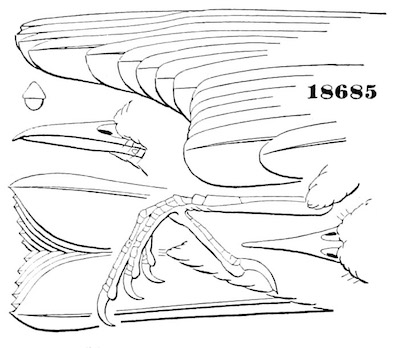
Mniotilta varia, Vieill. 18685
Sp. Char. Bill with the upper mandible considerably decurved, the lower straight. General color of the male black, the feathers broadly edged with white; the head all round black, with a median stripe in the crown and neck above, a superciliary and a maxillary one of white. Middle of belly, two conspicuous bands on the wings, outer edges of tertials and inner of all the wing and tail feathers, and a spot on the inner webs of the outer two tail-feathers, white. Rump and upper tail-coverts black, edged externally with white. Female similar; the under parts white, obsoletely streaked with black on the sides and under tail-coverts. Length, 5 inches; wing, 2.85; tail, 2.25.
Hab. Eastern Province of North America, and north to Fort Simpson. Both coasts of Mexico (as far north as Mazatlan, on west side), and southward to Bogota. Whole of West Indies and Bermuda.
Localities quoted. Bahamas; Bermuda; Cuba; Jamaica; Santa Cruz; West Indies; Cordova, Xalapa, Oaxaca, Mex.; Guatemala; Panama R. R.; Bogota.
Specimens breeding in the Southern States differ in rather longer bill and less amount of black, but are otherwise undistinguishable.
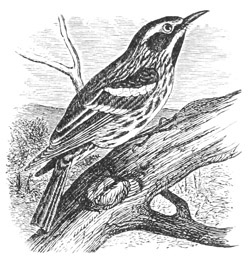
Mniotilta varia.
Habits. The Black and White Creeper, nowhere an abundant species, is met with in various sections of the country. It occurs in all parts of New England and New York, and has been found in the interior as far north as Fort Simpson. It has been met with on the Pacific coast only at Mazatlan, is common in the Bahamas and most of the West India Islands, generally as a migrant. It has also been found in Texas, in the Indian Territory, and in Mexico, and throughout Central America. In the last-named region Mr. Salvin states it to be pretty equally and generally spread over the whole country. It is there migratory, leaving in spring. It was also detected in Colombia, South America, by Mr. C. W. Wyatt. Mr. Newton also met with it as a winter visitant in St. Croix, leaving that island at the end of March. He regards this species as almost a thorough Creeper in habits. In Jamaica a few are resident throughout the year, according to the observations of Mr. March, and though its nests have never been found there, a son of Mr. March saw a pair carrying materials with which to construct one.
Dr. Coues states that this Warbler is a very common summer resident near Washington, but is more abundant there in the spring and in the fall, the greater number going farther north to breed. They arrive in Washington during the first week in April, and are exceedingly numerous until May. He adds that they are generally found in high open woods, and that they “breed in holes in trees.” This is probably an error, or, if ever known to occur, an entirely exceptional case.
Our bird is also a common summer visitant at Calais, arriving there about the 1st of May, and by the 10th becoming rather abundant. Mr. Boardman has frequently found their nests there, and always on the ground, in rocky places and usually under small trees.
It does not appear to have been met with on the Pacific coast north of Mazatlan, nor in any portion of Western North America, beyond the valleys of the Mississippi and the Rio Grande.
In its habits this bird seems to be more of a Creeper than a Warbler. It is an expert and nimble climber, and rarely, if ever, perches on the branch of a tree or shrub. In the manner of the smaller Woodpeckers, the Creepers, Nuthatches, and Titmice, it moves rapidly around the trunks and larger limbs of the trees of the forest in search of small insects and their larvæ. It is graceful and rapid in movement, and is often so intent upon its hunt as to be unmindful of the near presence of man.
It is found chiefly in thickets, but this is probably owing to the fact that there its food is principally to be obtained. It is occasionally seen in more open country, and has been known to breed in the immediate vicinity of a dwelling.
Wilson regarded this bird as a true Creeper, and objected to its being classed as a Warbler. He even denied to it the possession of any song. In this he was quite mistaken. Though never loud, prolonged, or powerful, the song of this Warbler is very sweet and pleasing. It begins to sing from its first appearance in May, and continues to repeat its brief refrain at intervals almost until its departure in August and September. Nuttall speaks of it as being at first a monotonous ditty, and as uttered in a strong but shrill and filing tone. These notes, he adds, as the season advances, become more mellow and warbling, and, though feeble, are pleasing, and are similar to those of the Redstart. But this statement does not do full justice to the varied and agreeable notes with which, in early spring, these birds accompany their lively hunt for food among the tops of the forest trees. They are diversified and sweet, and seem suggestive of a genial and happy nature.
These birds make their appearance in New England early in May, and remain there, among the thick woods, until the middle of October, and in the Southern States until the verge of winter.
Their movements in search of food are like those of the Titmice, keeping the feet together and moving in a succession of short rapid hops up the trunks of trees and along the limbs, passing again to the bottom by longer flights than in the ascent. They make but short flights from tree to tree, but are apparently not incapable of more prolonged ones.
So far as I know, these birds always build their nests on the ground. Mr. Nuttall found one in Roxbury containing young about a week old. The nest was on the ground, on the surface of a shelving rock, made of coarse strips of the inner bark of the Abies canadensis externally, and internally of soft decayed leaves and dry grasses, and lined with a thin layer of black hair. The parents fed their young in his presence with affectionate attention, and manifested no uneasiness, creeping, head downward, about the trunks of the neighboring trees, carrying large smooth caterpillars to their young. The nests of this bird are strongly and compactly built, externally of coarse strips of various kinds of bark, and lined within with hair and fine stems of grasses. In several instances I have known them to be roofed over at the top, in the manner of the Golden-crowned Thrush. They measure about three inches in their external diameter, and are equally deep.
The nests appear to be a favorite receptacle for the parasitic eggs of the Cow-Bunting. Mr. Robert Ridgway obtained a nest at Mt. Carmel, Ill., in which were four eggs of the Molothrus and only two of the parent birds; and Mr. T. M. Trippe, of Orange, N. Y., also found a nest of this Creeper in which were but three of its own and five of the parasite.
The eggs vary in shape from a rounded to an oblong oval, and in size from .69 to .75 of an inch in length, and from .51 to .53 of an inch in breadth. Their ground-color is a creamy-white, to which the deep red markings impart an apparently pinkish tinge. They are marked more or less profusely with bright red dots, points, and blotches. These vary in number and in distribution. In some they are very fine, and are chiefly confined to the larger end. In others they are larger, more diffused, and occasionally there are intermingled marks and blotches of slate-color. The effect of these variations is, at times, to give the appearance of greater differences to these eggs than really exists, the ground-color and the shade of the red markings really presenting but little modifications.
The color of the young nestlings is closely assimilated to that of the objects that usually surround the nest, and helps to conceal them. Mr. Burroughs once came accidentally upon a nest with young of this species. He says: “A Black and White Creeping Warbler suddenly became much alarmed as I approached a crumbling old stump in a dense part of the forest. He alighted upon it, chirped sharply, ran up and down its sides, and finally left it with much reluctance. The nest, which contained three young birds nearly fledged, was placed upon the ground at the foot of the stump, and in such a position that the color of the young harmonized perfectly with the bits of bark, sticks, etc., lying about. My eye rested upon them for the second time before I made them out. They hugged the nest very closely, but as I put down my hand they all scampered off with loud cries for help, which caused the parent birds to place themselves almost within my reach.”
Section VERMIVOREÆ.
Genus PROTONOTARIA, Baird.
Protonotaria, Baird, Birds N. Am. 1858, 239. (Type, Motacilla citrea, Bodd.)
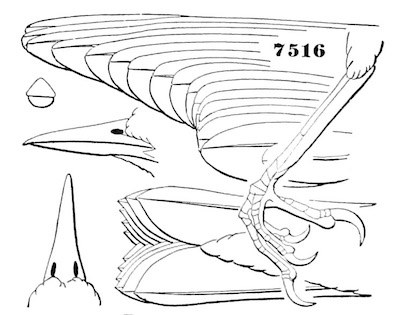
Protonotaria citrea, Baird. 7516
Gen. Char. Characterized by its long, distinctly notched bill, and long wings, which are an inch longer than the slightly graduated tail (the lateral feathers about .12 of an inch shorter). The under tail-coverts are very long, reaching within half an inch of the tip of the tail. The tarsi and hind toe are proportionally longer than in the true Warblers. The notch and great size of the bill distinguish it from the Swamp Warblers. Nest in holes; eggs much blotched with reddish.
The only North American species belonging to the group appears to be the old Sylvia protonotaria of Gmelin.
Protonotaria citrea, Baird.
PROTHONOTARY WARBLER; GOLDEN SWAMP WARBLER.
Motacilla citrea, Bodd. Tabl. 1783 (Pl. enl. 704, fig. 2). Protonotaria citrea, Baird, Birds N. Am. 1858, 239; Rev. 173.—Sclater, Catal. 1861, 26, No. 166.—Gundl. Cab. Jour. 1861, 324 (Cuba; very rare). Helminthophaga citrea, Cab. Jour. 1861, 85 (Costa Rica). Motacilla protonotarius, Gm. Sylvia prot. Lath.—Vieill. Ois. Am. Sept. II, pl. lxxxiii.—Wilson, Am. Orn. III, pl. xxiv. fig. 2.—Aud. Orn. Biog. II, pl. iii. Vermivora prot. Bon. Helinaia prot. Aud. Helmitherus prot. Bon. Compsothlypis prot. Cab. Jour. Motacilla auricollis, Gmel. I, 1788, 984. Sylvia aur. Lath., etc. (based on Le Grand Figuier du Canada, Brisson, Ois. III, 1760, 508, pl. xxvi, fig. 1). Female. Sylvicola aur. Nutt. Man. I, 1840, 431.
Sp. Char. Bill very large; as long as the head. Head and neck all round, with the entire under parts, including the tibiæ, rich yellow, excepting the anal region and under tail-coverts, which are white. Back dark olive-green, with a tinge of yellow; rump, upper tail-coverts, wings, and tail above, bluish ash-color. Inner margin of quills and the tail-feathers (except the innermost) white; the outer webs and tips like the back. Length, 5.40; wing, 2.90; tail, 2.25.
Hab. Eastern Province of United States (Southern region); Cuba, Costa Rica, and Panama R. R. Not recorded from Mexico or Guatemala. Accidental in New Brunswick (G. A. Boardman in letter). Yucatan (Lawrence).
This is one of the very handsomest of American Warblers, the yellow of the head and lower parts being of a pureness and mellowness scarcely approached by any other species. In a highly colored male from Southern Illinois (No. 10,111, Mississippi Bottom, Union Co., April 23; R. Kennicott) it is stained in spots, particularly over the eyes and on the neck, with a beautiful cadmium-orange.
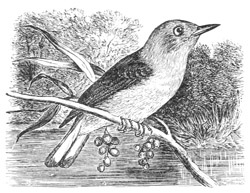
Protonotaria citrea.
Habits. In regard to the habits of this beautiful and interesting Warbler we receive but little light from the observations of older ornithological writers. Its geographical distribution is somewhat erratic and irregular. It does not appear to be distributed over a very wide range. It occurs as a migrant in the West Indies and in Central America. In the United States it is found in the Southern region, but farther west the range widens, and in the Mississippi Valley it is found as far north as Kansas, Southern and Central Illinois, and Missouri. Accidental specimens have been obtained as far to the northeast as Calais, though unknown to all the Eastern States as far south as Southern Virginia. It was met with by none of the government parties except by Dr. Woodhouse, who found it abundant in Texas.
Mr. Audubon observed them, near Louisville, Kentucky, frequenting creeks and lagoons overshadowed by large trees. These were their favorite places of resort. They also preferred the borders of sheets of water to the interior of the forest. They return in spring to the Southern States early in March, but to Kentucky not before the last of April. They leave in October, and raise but a single brood in a season. Audubon describes their nest, but it differs so essentially from their known mode of breeding, that he was evidently in error in regard to his supposed identification of the nest of this species.
Dr. Bachman, who often met them on the borders of small streams near Charleston, was confident that they breed in that State, and noticed a pair with four young birds as early as June 1, in 1836.
Recently more light has been thrown upon their habits by Mr. B. F. Goss, who, in May, 1863, found them breeding near Neosho Falls, in Kansas. The nest was built within a Woodpecker’s hole in the stump of a tree, not more than three feet high. The nest was not rounded in shape, but made to conform to the irregular cavity in which it was built. It was of oblong shape, and its cavity was deepest, not in the centre, but at one end, upon a closely impacted base made up of fragments of dried leaves, broken bits of grasses, stems, mosses, and lichens, decayed wood, and other material, the upper portion consisting of an interweaving of fine roots of wooded plants, varying in size, but all strong, wiry, and slender. It was lined with hair.
Other nests since discovered are of more uniform forms, circular in shape, and of coarser materials, and all are built with unusual strength and care for a nest occupying a sheltered cavity.
In one instance their nest was built in a brace-hole within a mill, where the birds could be closely watched as they carried in the materials, and the parent was afterward taken by hand by Mr. Goss from its nest. It was quite tame, and approached within two yards of him.
Since then Mr. Ridgway has obtained a nest at Mt. Carmel, Ill. It was built in a hollow snag, about five feet from the ground, in the river bottom. So far from being noisy and vociferous, as its name would seem to imply, Mr. Ridgway describes it as one of the shyest and most silent of all the Warblers.
The eggs of this Warbler have an average breadth of .55 of an inch and a length varying from .65 to .70 of an inch. They are of a rounded-oval form, one end being but slightly less rounded than the other. Their ground-color is a yellowish or creamy white, more or less profusely marked over their entire surface with lilac, purple, and a dark purplish-brown.
Mr. Ridgway states that it is always an abundant summer bird in the Wabash bottoms, where it inhabits principally bushy swamps and the willows around the borders of stagnant lagoons or “ponds” near the river, and in such localities, in company with the White-bellied Swallow (Hirundo bicolor), takes possession of the holes of the Downy Woodpecker (Picus pubescens) and Chickadee (Parus carolinensis), in which to build its nest.
Mr. Ridgway adds that in its movements this Warbler is slow and deliberate, like the Helmitherus vermivorus, strikingly different in this respect from the sprightly, active Dendroecæ. Its common note is a sharp piph, remarkably like the winter note of the Zonotrichia albicollis.
It has been taken as far north as Rock Island, Ill., and Dr. Coues mentions the occurrence of one individual near Washington, D. C., seen in a swampy brier-patch, May 2, 1861. This was perhaps only an accidental visitor. If regularly found there, it is probably exceedingly rare. It has not been met with between Washington and St. Stephens, New Brunswick, where its occurrence was unquestionably purely accidental.
Genus HELMITHERUS, Raf.
Helmitherus, Rafinesque, Journal de Physique, LXXXVIII, 1819, 417. (Type, Motacilla vermivora.)
Vermivora, Swainson, Zoöl. Jour. IV. 1827, 170 (not of Meyer, 1822).
Helinaia, Aud. Synopsis, 1839, 66. (Type, Sylvia swainsoni, Aud.)
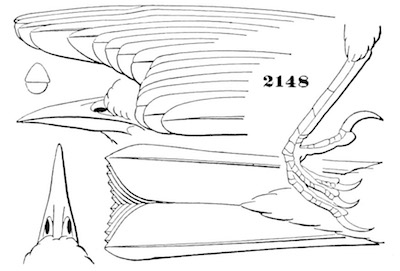
Helmitherus vermivorus, Bonap. 2148
Gen. Char. Bill large and stout, compressed, almost tanagrine; nearly or quite as long as the head. Culmen very slightly curved; gonys straight; no notch in the bill; rictal bristles wanting. Tarsi short, but little longer, if any, than the middle toe. Tail considerably shorter than the wings; rather rounded. Wings rather long, the first quill a little shorter than the second and third.
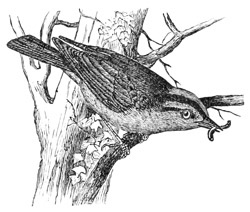
Helmitherus vermivorus.
The birds of this division are very plain in their colors, more so than any other American Warblers. There are but two species referable to the genus, of which the H. swainsoni differs from the type in having a considerably longer and more compressed bill, the ridge of which is compressed, elevated, and appears to extend backwards on the forehead, as well as to be in a straight line with the upper part of the head. The wings are longer; the tail forked; not rounded; the feathers narrower and more pointed; the tarsi shorter than in the type. It appears to be at least a distinct subgenus to which the name Helinaia, Aud., is to be applied.
Species.
Common Characters. Colors plain. Above olivaceous, beneath nearly white. No spots or bands on wing or tail.
H. vermivorus. Above olive-green. Head yellowish, with a black stripe above and one behind each eye. Tail rounded. Hab. Eastern Province of United States; south to Costa Rica; Cuba. (Helmitherus.)
H. swainsoni. Above dull olive-green, tinged with brown. Stripes on the head somewhat as in the last, but reddish-brown; the median light stripe on the crown scarcely visible. Tail slightly forked. Hab. South Carolina and Georgia; Cuba (very rare). (Helinaia.)
Helmitherus vermivorus, Bonap.
WORM-EATING SWAMP WARBLER.
Motacilla vermivora, Gmel. Syst. Nat. I, 1788, 951. ? Sylvia vermivora, Lath. Ind. Orn. II, 1790, 499.—Wils. III, pl. xxiv, fig. 4.—Aud. Orn. Biog. I, pl. xxxiv. Sylvicola vermivora, Rich. Helinaia vermivora, Aud. Birds Am. II, pl. cv.—Lembeye, Av. Cuba, 1850, 35, pl. vi, fig. 4. Helmitherus vermivorus, Bon.; Cab.; Baird, Birds N. Am. 1858, 252; Rev. 179.—Sclater, P. Z. S. 1859, 363 (Xalapa).—Ib. Catal. 1861, 28, No. 175.—Sclater & Salvin, Ibis, I, 1859, 11 (Guatemala); Cab. Jour. 1860, 329 (Costa Rica); Ib. 1856 (Cuba).—Gundlach, Cab. Jour. 1861, 326 (Cuba; somewhat rare). Vermivora pennsylvanica, Bon., Gosse, B. Jamaica, 1847, 150. Helmitherus migratorius, Raf. J. de Phys. 88, 1819, 417.—Hartlaub; Vermivora fulvicapilla, Swainson, Birds, II, 1837, 245.
Sp. Char. Bill nearly as long as the head; upper parts generally rather clear olive-green. Head with four black stripes and three brownish-yellow ones, namely, a black one on each side of the crown and one from behind the eye (extending, in fact, a little anterior to it), a broader median yellow one on the crown, and a superciliary from the bill. Under parts pale brownish-yellow; tinged with buff across the breast and with olivaceous on the sides. Tail unspotted. Female nearly similar. Length, 5.50; wing, 3.00; tail, 2.35.
In autumnal specimens the light stripes on the head are deeper buff than in spring.
Hab. Eastern Province of United States (rather Southern); Southeastern Mexico; Guatemala; Cuba; Costa Rica; Veragua; Orizaba (winter, Sumichrast); Yucatan (Lawrence).
Habits. Much remains to be ascertained in regard to the history, habits, and distribution of this interesting species. So far as is now known it is hardly anywhere very common during the breeding-season. Yet its abundance and wide distribution as a migrant during the winter months in various extended localities appear to warrant the belief that it must be correspondingly abundant in summer in localities that have escaped our attention. It has been occasionally met with in the Central and Southern States, as far west as Eastern Mexico, and as far to the north as Southeastern New York. Specimens have been procured from Cuba, Mexico, Central America, and the northern portions of South America. It is a regular winter visitant of Jamaica, whither it goes in the autumn in considerable numbers, and is very widely diffused.
It reaches Pennsylvania about the middle of May, and leaves in September. Wilson noticed a pair feeding their young about the 25th of June. He supposed this bird to have a more northern distribution than belongs to it. In the interior they are met with, according to Audubon, as far north as the southern shores of Lake Erie, where he found them in the autumn. Mr. Audubon found them more numerous in New Jersey than anywhere else. In Ohio and Kentucky they are comparatively rare. Mr. Ridgway informs me that this is a rather common species in Southern Illinois in the thickest damp woods in the bottom-lands along the Wabash River.
According to Wilson, these birds are among the nimblest of its family, and are remarkably fond of spiders, darting about wherever there is a probability of finding these insects. Where branches are broken and the leaves withered, it searches among them in preference, making a great rustling as it hunts for its prey. Their stomachs are generally found full of spiders and caterpillars.
These birds are arboreal in their preferences, residing in the interior of woods, and are seldom seen in the open fields. They resort to the ground and turn over the dry leaves in quest of insects. They are very unsuspicious and easy of approach.
Nuttall describes their notes and their habits as resembling the common Parus atricapillus, and remarks that they are constantly uttering a complaining call, sounding like tshe-dē-dē.
Until quite recently, nothing has been positively known in regard to its nesting. Audubon has described its nest as made of dry mosses and the fallen bloom of the hickory and the chestnut, and as built in bushes several feet from the ground. He describes the eggs as cream-colored, marked about the larger end with reddish-brown. These descriptions have not been confirmed, and all our information has led us to look for its nest on the ground.
Mr. Trippe states that it is found, but is not at all common, near Orange, N. Y., where it arrives about the middle of May. It has, at that time, a rapid, chattering note, and it always, he says, keeps near the ground, and, besides its chattering song, has in June a series of odd notes, much like those of the White-breasted Nuthatch, but more varied and musical, yet hardly entitled to be called a song.
Mr. T. H. Jackson of Westchester, Penn., in the American Naturalist for December, 1869, mentions finding the nest and eggs of this bird. We give his account in his own words: “On the 6th of June, 1869, I found a nest of this species containing five eggs. It was placed in a hollow on the ground, much like the nests of the Oven-Bird (Seiurus aurocapillus), and was hidden from sight by the dry leaves that lay thickly around. The nest was composed externally of dead leaves, mostly those of the beech, while the interior was prettily lined with the fine, thread-like stalks of the hair-moss, (Polytrichium). Altogether it was a very neat structure, and looked to me as though the owner was habitually a ground nester. The eggs most nearly resemble those of the White-bellied Nuthatch (Sitta carolinensis), though the markings are fewer and less distinct. So close did the female sit that I captured her without difficulty by placing my hat over the nest.”
The same observing ornithologist informs me that this Warbler arrives in Pennsylvania early in May, and makes the most solitary part of the woods its home, outside of which it is rarely seen. True to its name, it is ever busy hunting out and devouring the worms that lurk among the forest foliage, pursuing its avocation in silence, with the exception of a faint note uttered occasionally. This species is not as shy as many of our Warblers that frequent the woods. Towards the latter part of May they commence constructing their nests. Mr. Jackson adds that the nest above referred to was found on a thickly wooded hillside, a few yards above a running stream. So neatly was it embedded in the ground and covered with dry leaves, that discovery would have been impossible had not the female betrayed its position. Both birds exhibited the greatest alarm at his presence, but on his retiring to a short distance the female returned to the nest, where she was easily captured. The base and periphery of the nest were composed of dry beech-leaves, while the inner lining was made of fine hair-mosses (Polytrichium).
In the latter part of June, 1871, Mr. Jackson found another nest of this species, containing five young birds about half grown. He was seated on a log, resting after a hard tramp, when a Worm-eating Warbler alighted near him, having a large green worm in its beak. After at first manifesting much uneasiness, and scolding as well as she could, she suddenly became silent and flew to the ground. On his going to the spot both parents flew from the nest. It was in all respects, in regard to materials, manner of construction, and situation, the exact counterpart of the other. Both were placed on steep, wooded hillsides, facing the east.
Two of the eggs of this Warbler thus identified by Mr. Jackson, and kindly loaned to me by him, are of a somewhat rounded-oval shape, less obtuse at one end. They have a clear, crystal-white ground, and are spotted with minute dottings of a bright red-brown. These are much more numerous in one than in the other, and in both are confluent at the larger end, where they are beautifully intermingled with cloudings of lilac-brown. These eggs measure, the one .78 by .60 of an inch; the other, .70 by .56 of an inch.
Another nest of this species, found by Mr. Joseph H. Batty of New York, on the side of a hill near Montclair, N. J., was also built on the ground, in a part of the woods where there was no underbrush, and was placed in a slight hollow, with dry oak-leaves collected around it, and partly covering it. The nest was made of dry leaves, and lined with grasses and fine roots. It contained four eggs, alike in their marking, and corresponding exactly with those obtained by Mr. Jackson. Mr. Batty nearly stepped on the bird without her leaving the nest.
Dr. Coues found the Worm-eating Warbler a rather uncommon summer resident near Washington, breeding there but sparingly. It arrives there during the first week in May, and remains until the third week in September. He describes it as slow and sedate in its movements.
Helmitherus swainsoni, Aud.
SWAINSON’S SWAMP WARBLER.
Sylvia swainsoni, Aud. Orn. Biog. II, 1834, 563, pl. cxcviii. Sylvicola sw. Rich. Vermivora sw. Bon. Helinaia sw. Aud. Birds Am. II, 1841, pl. civ (type of genus). Helmitherus sw. Bon.; Cab.; Baird, Birds N. Am. 1858, 252; Rev. 180.
Sp. Char. Bill as long as the head. Upper parts dull olive-green, tinged with reddish-brown on the wings, and still more on the crown and nape; a superciliary stripe and the under parts of the body are white, tinged with yellow, but palest on the tail-coverts; the sides pale olive-brown. There is an obscure indication of a median yellowish stripe on the forehead. The lores are dusky. No spots nor bands on wings or tail. Length, 5.60; wing, 2.85; tail, 2.20.
Hab. Coast of South Carolina and Georgia; Cuba (very rare).
A young bird (No. 32,241 Liberty Co., Georgia) is very similar to the adult described, but differs in the following respects: the lower parts have a decided soiled, sulphur-yellow tinge, while the brown of the upper parts is much more reddish, there being no difference in tint between the crown and back; also the superciliary stripe is more sharply defined.
Habits. This species is comparatively rare, and, so far as is known, has a very restricted distribution. It was first discovered by Rev. Dr. Bachman, in the vicinity of Charleston, S. C., near the banks of the Edisto River. This was in the spring of 1832. He was first attracted by the novelty of its notes, which were four or five in number and repeated at intervals of a few minutes. These notes were loud and clear, and more like a whistle than a song. They resembled the sounds of some extraordinary ventriloquist,—so much so that he at first supposed the bird to be much farther off than it really was. He was so fortunate as to secure it. The shape of the bill he at once noticed as being different from that of any other American bird then known to him. In the course of that season he obtained two other specimens. Toward the close of the same season he saw an old female, accompanied by its four young. One of the latter, which he procured, did not differ materially from the old birds.
He met with them only in swampy and muddy places, and when opened, he always found their stomachs filled with fragments of coleopterous insects, as well as small green worms, such as are common on water-plants. The habits of this species most resemble those of the Prothonotary Warbler, as the latter skips among the low bushes growing about ponds or in marshy places. It is seldom seen on high trees. Nothing is known as to their nesting or eggs.
Genus HELMINTHOPHAGA, Caban.
Helminthophaga, Cabanis, Mus. Hein. 1850, 1851, 20. (Type, Sylvia ruficapilla, Wils.)
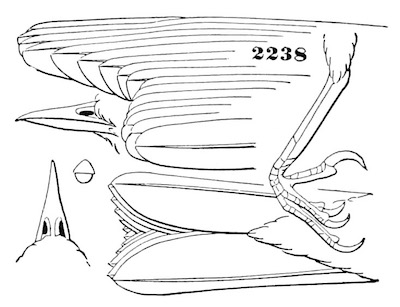
Helminthophaga ruficapilla. 2238
Gen. Char. Bill elongated, conical, very acute; the outlines very nearly straight, sometimes slightly decurved; no trace of notch at the tip, nor of bristles on the rictus. Wings long and pointed; the first quill nearly or quite the longest. Tail nearly even or slightly emarginate; short and rather slender. Tarsi longer than the middle toe and claw.
The species of this section are well characterized by the attenuation and acuteness of the bill, and the absence of any notch. There are, however, considerable subordinate differences in the different species. In some the bill is larger and more acute than others; in one species, the H. peregrina, the wings are unusually lengthened, the tail being only about seven twelfths as long.
Species and Varieties.
Common Characters. Iris brown. Length about 5.00. Nest on the ground, in grass or dead leaves. Eggs clear white, thickest at end, with minute dots of brown of various shades and faint purple.
A. Tail with a conspicuous patch of white.
a. A black patch covering throat and breast.
1. chrysoptera. Above ash, beneath white. Forehead and a patch on the wing yellow. Hab. Eastern Province of United States, south to Bogota; Cuba.
2. bachmani. Above olive-green; beneath, with forehead, yellow; crown ash, bounded anteriorly with a black bar. No yellow on wing. Hab. South Carolina and Georgia. Cuba in winter.
b. No black on throat or breast.
3. pinus. Above olive-green; beneath, with forehead, yellow; wings ash, with two white bands; lores black. Hab. Eastern Province of United States, south into Guatemala.
B. Tail without a conspicuous white patch.
c. Crown with a concealed patch of rufous (obsolete in ♀).
4. ruficapilla. Above olive-green; head ashy; beneath continuous yellow; a light orbital ring. Hab. North America (very rare in Middle and Western Provinces); Greenland. South to Southern Mexico (Oaxaca, Cordova, Orizaba).
Yellow of throat spreading over cheeks, and staining lores and eyelids. Atlantic States. (Carlisle, Penn., specimens.) … var. ruficapilla.
Yellow of throat confined within the maxillæ; lores and eyelids clear white. Mississippi Valley. (Chicago specimens.) … var. ocularis.
Yellow of throat restricted to a medial stripe, leaving its sides ashy. Middle Province. (Specimen from Fort Tejon, Cal., and East Humboldt Mountains, Nevada.) … var. gutturalis.
5. virginiæ. Above ash to the rump, beneath white. A patch on the jugulum, with the upper and lower tail-coverts, yellow. Hab. Rocky Mountains of United States, west to East Humboldt Mountains.
6. luciæ. Above ash, beneath continuous white. Upper tail-coverts chestnut. Hab. Colorado region of Middle Province.
7. celata. Above continuous olive-green, below continuous pale yellow. (Orange on crown in ♂ only?)
Above ashy-olive, beneath yellowish olivaceous-white; inner webs of tail-feathers broadly edged with white. (Middle regions of North America; Mexico.) … var. celata.
Above greenish-olive, beneath bright greenish-yellow; white edges to inner webs of tail-feathers obsolete. (Pacific Province of North America.) … var. lutescens.
Similar to var. celata, but plumage darker and more dingy. No white edgings to tail-feathers, and apparently no rufous on the crown in either sex. (Georgia, Florida, etc.) … var. obscura.
d. No rufous on crown.
8. peregrina. Above olive-green; head and neck pure ash; beneath continuous white. Hab. Eastern Province of North America north to Fort Simpson, H. B. T. south to Panama. Cuba (rare).
Helminthophaga chrysoptera, Caban.
GOLDEN-WINGED WARBLER.
Motacilla chrysoptera, Linn. S. Nat. I, 1766, 333. Sylvia chr. Lath.—Wils. Am. Orn. II, pl. xv. fig. 5.—Bon. Sylvicola chr. Bon. Helinaia chr. Aud. Birds Am. II, pl. cvii. Helmitherus chr. Bon.—Sclater, P. Z. S. 1855, 143 (Bogota). Helminthophaga chrysoptera, Cab. Mus. Hein.; Journ. f. Orn. 1860, 328 (Costa Rica).—Baird, Birds N. Am. 1858, 255; Rev. 175.—Sclater & Salvin, Ibis, II, 1860, 397 (Choctum, Guatemala).—Salvin, 1867, 135.—Dresser, Ibis, 1865, 477 (San Antonio).—Lawrence, Ann. N. Y. Lyc. VII, 1861, 293 (Panama).—Gundl. Cab. Journ. 1861, 326 (Cuba, rare). Motacilla flavifrons, Gmelin. Sylvia flavifrons, Lath.
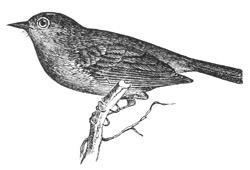
Helminthophaga celata.
Sp. Char. Upper parts uniform bluish-gray; the head above and a large patch on the wings yellow. A broad streak from the bill through and behind the eye, with the chin, throat, and forepart of the breast, black. The external edge of the yellow crown continuous with a broad patch on the side of the occiput above the auriculars, a broad maxillary stripe widening on the side of the neck, the under parts generally, with most of the inner webs of the outer three tail-feathers, white; the sides of the body pale ash-color. Female similar, but duller. Length about 5 inches; wing, 2.65; tail, 2.25.
Hab. Eastern Province of United States, San Antonio (Dresser); Cuba (rare); Guatemala; Costa Rica; Panama; Bogota. Recorded in West Indies from Cuba only; not from Mexico. Veragua; Chiriqui (Salvin).
Habits. So far as our present knowledge of this Warbler extends, it is nowhere a common species, and is distributed over a comparatively small extent of territory. Wilson met with it in Pennsylvania during the last of April and the first of May, believing it to be only a migrant species on its way to more northern regions. Nuttall was sceptical of these conclusions, as he never met with the species in the New England States. Audubon observed these birds in their migrations through Louisiana, which State they entered from Texas in the month of April. He procured several specimens in Louisiana and Kentucky, and one in New Jersey. He knew nothing as to its breeding, and seems to have accepted Wilson’s inferences in regard to its northern migrations. He never met with this bird in the fall, when, if a Northern species, it should be returning south, and thence inferred that it migrated by night.
Professor Baird has obtained this bird near Carlisle, Penn., in July, rendering probable its breeding in that vicinity. W. S. Wood met with it near St. Louis, May 13, 1857, and two days previously in the same year Mr. Kennicott procured an individual in Southern Illinois. Occasionally specimens have been obtained in Massachusetts, and of late these occurrences have become more frequent or more observed. It was first noticed near Boston by J. Eliot Cabot, Esq., who shot one in May, 1838, near Fresh Pond. This was, he thinks, on the 20th of that month. Since then Mr. J. A. Allen has known of several specimens taken within the State. Mr. Jillson has observed it spending the summer in Bolton, and evidently breeding, as has also Mr. Allen at Springfield, and Mr. Bennett at Holyoke. In the summer of 1870, Mr. Maynard obtained its nest and eggs in Newton.
The late Dr. Gerhardt found it breeding among the high grounds of Northern Georgia. It has also been taken at Racine, Wis., by Dr. Hoy, and in Ohio. These data seem to show that it is sparingly found from Georgia to Massachusetts, and from New Jersey to Missouri and Wisconsin. Its western limits may be more extended. It was not met with by any of the exploring parties beyond St. Louis, but its retiring habits and its sparse distribution may account for this.
Dr. Samuel Cabot was the first naturalist to meet with the nest and eggs of this bird. This was in May, 1837, in Greenbrier County, Va. The nest was constructed in the midst of a low bush on high ground, and contained four eggs.
The late Dr. Alexander Gerhardt found the nest and eggs of this Warbler in the spring of 1859, in Whitfield County, Ga. It contained four eggs, and was built on the ground. It was very large for the bird, being five inches in height and four in diameter. The cavity was also quite large and deep for so small a bird, exceeding three inches both in depth and in diameter. The outer and under portions of this nest were almost entirely composed of the dry leaves of several kinds of deciduous trees. These were interwoven with and strongly bound together by black vegetable roots, dry sedges, and fine strips of pliant bark, and the whole lined with a close network of fine leaves, dry grasses, and fibrous roots. Dr. Gerhardt informed me that these birds usually build on or near the ground, under tussocks of grass, in clumps of bushes, or pine-brush, and that they lay from four to five eggs, from the 6th to the 15th of May.
The eggs of this species are of a beautiful, clear crystal-white, with a few bright reddish-brown spots around the larger end. Eggs from Racine, Wis., and from Northern Georgia, differ greatly in their relative size. The former measure .70 of an inch in length and .53 in breadth; the latter, .63 by .49.
A single specimen of this species was obtained by Mr. Salvin, at Choctum, in Guatemala.
Helminthophaga bachmani, Caban.
BACHMAN’S WARBLER.
Sylvia bachmani, Aud. Orn. Biog. II, 1834, 483, pl. clxxxiii. Sylvicola b. Rich. Vermivora b. Bon. Helinaia b. Aud. Syn. Birds Am. II, 1841, 93, pl. cviii.—Lembeye, Av. Cuba, 1850, 36, pl. vi. fig. 1. Helmitherus b. Bon. Helminthophaga b. Cab. Jour. III, 1855, 475 (Cuba, in winter).—Baird, Birds N. Am. 1858, 255; Rev. 175.—Gundlach, Cab. Jour. 1861, 326 (Cuba, rare); Repert. 65, 232.
Sp. Char. Above olive-green, as also are the sides of the head and neck. Hind head tinged with ash. A broad patch on the forehead, bordered behind by black; chin, stripe from this along the side of the throat, and the entire under parts, deep yellow. Throat and forepart of breast black. A patch on the inner web of the outer two tail-feathers near the end white. Length, 4.50; wing, 2.35; tail, 2.05. Female with merely a patch of dusky on the jugulum, and with the black bar on vertex obsolete.
Hab. Coast of South Carolina and Georgia; Cuba in winter.
Habits. Bachman’s Warbler is a comparatively new and but little known species of this interesting group. It was first discovered, July, 1833, by Rev. Dr. John Bachman, a few miles from Charleston, S. C., and in the same vicinity he afterwards discovered a few others of both sexes. He described it as a lively, active bird, gliding among the branches of the thick bushes, occasionally mounting on the wing and seizing insects in the air, in the manner of a Flycatcher. The individual first obtained was an old female which had, to all appearances, just reared a brood of young. With this partial exception, nothing is known in relation to its habits. As all the species of this genus, without any at present known exception, construct their nests upon the ground, it is a natural inference that it probably nests in a similar situation.
The Smithsonian Institution possesses but a single specimen of this bird, obtained near Charleston, S. C. It was not observed by any naturalist of the several governmental exploring expeditions, and, so far as we are at present informed, its only known places of abode are South Carolina and Cuba, where it is extremely rare. Its nest and eggs still remain unknown.
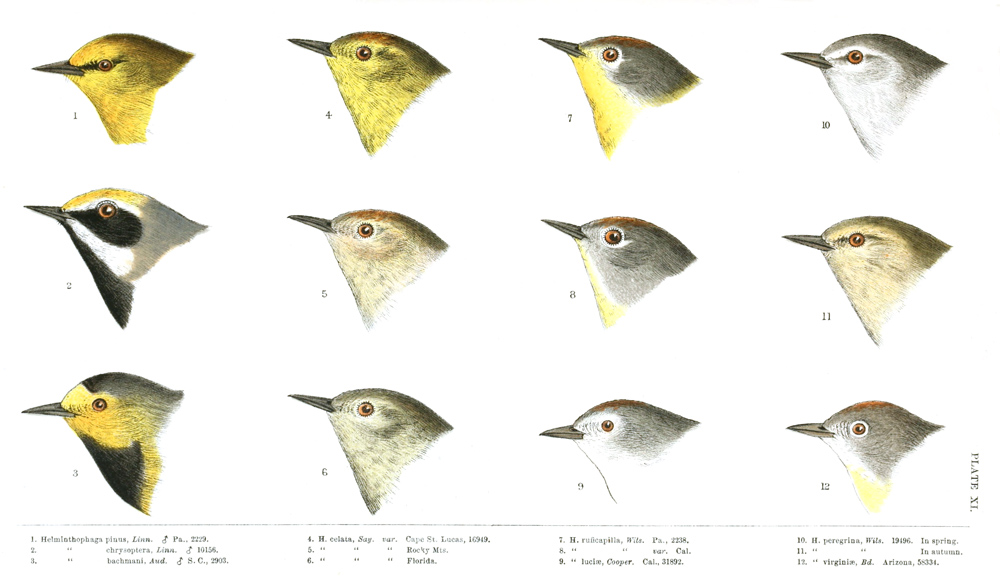
PLATE XI.
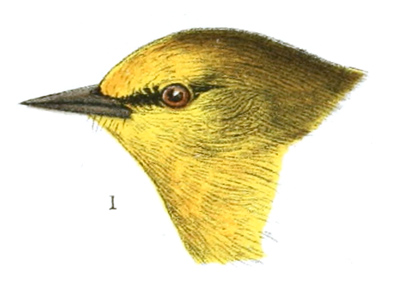
1. Helminthophaga pinus, Linn. ♂ Pa., 2229.
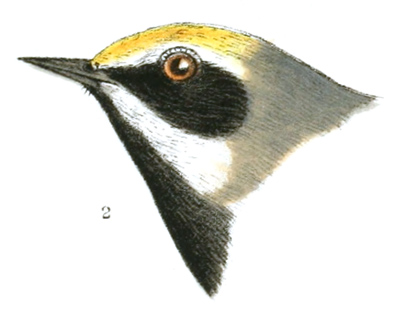
2. Helminthophaga chrysoptera, Linn. ♂ 10156.
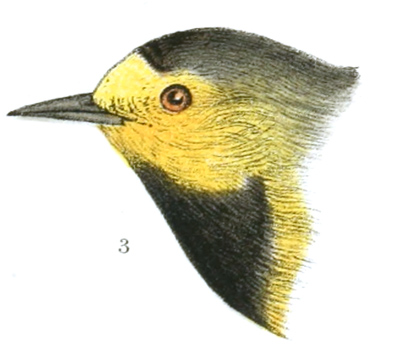
3. Helminthophaga bachmani, Aud. ♂ S. C., 2903.
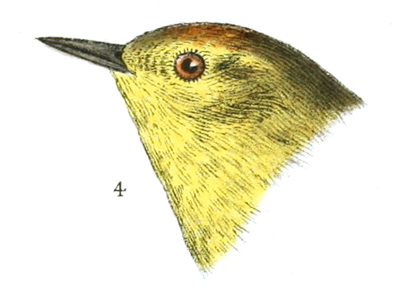
4. Helminthophaga celata, Say. var. Cape St. Lucas, 16949.
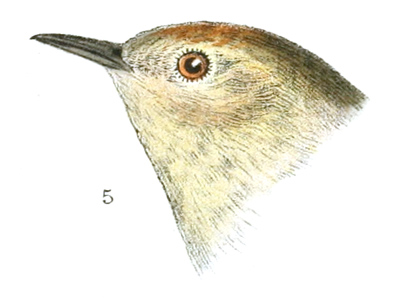
5. Helminthophaga celata, Say. var. Rocky Mts..
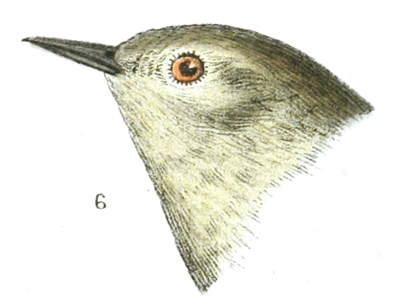
6. Helminthophaga celata, Say. var. Florida.
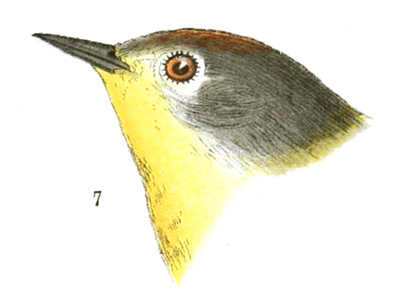
7. Helminthophaga ruficapilla, Wils. Pa., 2238.
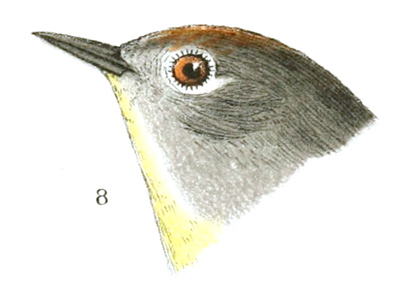
8. Helminthophaga ruficapilla, Wils. var. Cal.
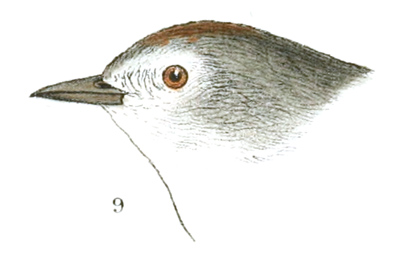
9. Helminthophaga luciæ, Cooper. Cal., 31892.
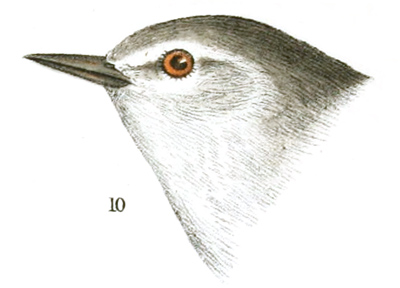
10. Helminthophaga peregrina, Wils. 19496. In spring.
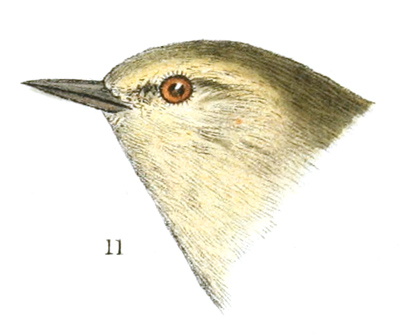
11. Helminthophaga peregrina, Wils. In autumn.
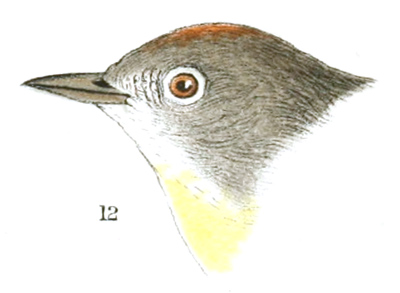
12. Helminthophaga virginiæ, Bd. Arizona, 58334.
Helminthophaga pinus, Baird.
BLUE-WINGED YELLOW WARBLER.
Certhia pinus, Linn. Syst. Nat. I, 1766, 187. Sylvia pinus, Lath., Vieill. (not of Wilson). Helminthophaga pinus, Baird, Birds N. Am. 1858, 254; Rev. 174.—Sclater & Salvin, Ibis, 1, 1859, 11 (Guatemala).—Sclater, Catal. 1861, 28, No. 176. Sylvia solitaria, Wilson, Am. Orn. II, pl. xv.—Aud. Orn. Biog. I, pl. xx. Sylvicola sol. Rich. Vermivora sol. Sw. Helinaia sol. Aud. Birds Am. II, pl. cxi. Helmitherus sol. Bon.—Sclater, P. Z. S. 1856, 291 (Cordova). Helminthophaga sol. Cab.
Sp. Char. Upper parts and cheeks olive-green, brightest on the rump; the wings, tail, and upper tail-coverts, in part, bluish-gray. An intensely black patch from the blue-black bill to the eye, continued a short distance behind it. Crown, except behind, and the under parts generally, rich orange-yellow. The inner wing and under tail-coverts white. Eyelids, and a short line above and behind the eye, brighter yellow. Wing with two white bands. Two outer tail-feathers with most of the inner web, third one with a spot at the end, white. Female and young similar, duller, with more olivaceous on the crown. Length, 4.50; wing, 2.40; tail, 2.10.
Hab. Eastern United States and Mexico to Guatemala (Cordova; Coban). Not noted from West Indies.
Habits. The Blue-winged Yellow Warbler is not known so far to the north as New England, and is rare even in Eastern and Southern New York. It seems to be distributed through the United States from Pennsylvania to Florida, and from the Mississippi Valley eastward. It has also been taken in Central America. Mr. Trippe states that it breeds in the vicinity of Orange, N. Y. Mr. Audubon found it abundant in the barrens of Kentucky, and as far north on the Mississippi as St. Genevieve.
In regard to the song of this bird, Mr. Trippe states that its notes are very forcible and characteristic. Once heard, they will always be remembered. He describes them as a rapid chirrup resembling chūūchich, k´-a-re-r´r´r´r´r, uttered very quickly. According to Mr. Ridgway, they are wonderfully similar to the rude lisping chirrup of the Coturniculus passerinus.
Wilson says that these Warblers come from the South early in May, frequenting thickets and shrubberies in search of insects, which they seek in the branches. They are also fond of visiting gardens and orchards, gleaning for insects among the low bushes. They generally build their nests on the edge of sequestered woods. These Mr. Wilson states to have been, in every instance observed by him, fixed on the ground, in a thick tussock of long grass, and built in the form of an inverted cone, the sides being formed of the dry bark of strong fibrous weeds lined with fine dry grasses. These materials, he remarks, are not arranged in the usual circular manner, but shelve downward from the top, the mouth being wide and the bottom narrow. He describes the eggs as five in number, pure white, with a few faint dots of reddish near the larger end. The young appear the first week in June. The nests were always in an open but retired part of the woods, and were all as thus described.
According to Mr. Audubon its song consists of a few weak notes that are by no means interesting. His description of its nest agrees with that of Wilson. He states that it usually has two broods in the season, one in May, the other in July. The young disperse as soon as they are able to provide for themselves.
He describes them as of solitary habits, and adds that they leave Louisiana for the South early in October. Its flight is short, undetermined, and performed in zigzag lines. It will ascend twenty or thirty yards in the air as if about to go to a greater distance, when, suddenly turning round, it will descend to the place from which it set out. It rarely pursues insects on the wing, feeding chiefly on the smaller kind of spiders, and seizing other insects as they come within its reach.
The above accounts of its breeding, and especially of its nest, do not correspond with the observations of Mr. Ridgway, near Mt. Carmel, Ill., where the bird is abundant. A nest collected by him is a very loose open structure, composed chiefly of broad, thin, and flexible strips of the inner bark of deciduous trees, chiefly the bass-wood. It contained five eggs, and was obtained May 8. It was first discovered by noticing the bird with materials in her bill. The situation of this nest “was in no wise,” says Mr. Ridgway, “as described by Wilson, not having any covered entrance.” The nest was very bulky, and so loosely made that only the inner portion could be secured. “I have found other nests,” adds Mr. Ridgway, “all corresponding with this one. There can be no doubt as to its identity, as the birds were seen building the nest, and were closely watched in their movements. Both male and female were seen several times.” (No. 10,140, Smith. Coll.)
The eggs of this species measure .70 of an inch in length by .53 in breadth. Their aground-color is white, sprinkled with a few reddish-brown spots.
Helminthophaga ruficapilla, Baird.
NASHVILLE WARBLER.
Sylvia ruficapilla, Wils. Am. Orn. III, 1811, 120, pl. xxvii, fig. 3.—Aud. Orn. Biog. I, 1832, 450, pl. lxxxix. Helminthophaga ruficapilla, Baird, Birds N. Am. 1858, 256; Rev. 175.—Sclater, P. Z. S. 1859, 373 (Xalapa).—Dresser, Ibis, 65, 477 (Texas).—Cooper, Orn. Cal. 1, 1870, 82. Sylvia rubricapilla, Wils. Am. Orn. VI, 1812, 15, General Index.—Nutt., Bon. Sylvicola rub. Rich. Vermivora rub. Bon.—Reinhardt, Vid. Med. for 1853, 1854, 82 (Greenland).—Brewer, Pr. Bost. Soc. N. H. VI, 1856, 4 (nest and eggs). Helinaia rub. Aud. Birds Am. II, pl. cxiii. Helmitherus rub. Bon.—Scl. P. Z. S. 1856, 291 (Cordova); 1859, 363 (Xalapa). Helminthophaga rub. Cab.—Sclater, P. Z. S. 1858, 298 (Oaxaca; Feb. and Aug.). Mniotilta rub. Reinhardt, Ibis, 1861, 6 (Greenland). Sylvia leucogastra, Shaw, Gen. Zoöl. X, II, 1817, 622. “Sylvia nashvillei,” Vieillot.—Gray. Sylvia mexicana, Holböll.
Sp. Char. Head and neck above and on sides ash-gray, the crown with a patch of concealed dark brownish-orange hidden by ashy tips to the feathers. Upper parts olive-green, brightest on the rump. Under parts generally, with the edge of the wing, deep yellow; the anal region paler; the sides tinged with olive. A broad yellowish-white ring round the eye; the lores yellowish; no superciliary stripe. The inner edges of the tail-feathers margined with dull white. Female similar, but duller; the under parts paler, and with more white; but little trace of the red of the crown. Length, 4.65; wing, 2.42; tail, 2.05.
Hab. Eastern Province of North America; rare in the Middle Province (Fort Tejon, Cal., and East Humboldt Mountains, Nev.); Greenland (Reinhardt); Oaxaca (February and August, Sclater); Xalapa and Cordova (Sclater); Orizaba (winter, Sumichrast). Not recorded from West Indies.
It is an interesting fact, that, in this species, we find in the yellow a tendency to become more and more restricted as we pass westward. In adult spring males from the Atlantic States this color invades the cheeks, and even stains the lores and eyelids. In two adult spring males from Chicago it is confined within the maxillæ, the cheeks being clear ash, and the loral streak and orbital ring pure white; while in an adult male (autumnal, however) from the East Humboldt Mountains (Nevada, No. 53,354, U. S. Geol. Expl., 40th par.) the yellow is restricted to a medial strip, even the sides of the throat being ashy; the ash invades the back too, almost to the rump, while in Eastern specimens it extends no farther back than the nape. A male (No. 10,656, J. Xantus) from Fort Tejon, Cal., is much like the Nevada specimen, though the peculiar features of the remote Western form are less exaggerated; it is about intermediate between the other specimen and the specimens from Chicago. As there is not, unfortunately, a sufficiently large series of these birds before us, we cannot say to what extent these variations with longitude are constant.
Habits. The Nashville Warbler appears to be a species of somewhat irregular occurrence; at one time it will be rather abundant, though never very numerous, and at another time comparatively rare. For a long while our older naturalists regarded it as a very rare species, and knew nothing as to its habits or distribution. Wilson, who first met with it in 1811, never found more than three specimens, which he procured near Nashville, Tenn. Audubon only met with three or four, and these he obtained in Louisiana and Kentucky. These and a few others in Titian Peale’s collection, supposed to have been obtained in Pennsylvania, were all he ever saw. Mr. Nuttall at first regarded it as very rare, and as a Southern species. In that writer’s later edition he speaks of it as a bird having a Northern distribution as far as Labrador. Dr. Richardson records the occurrence of a single straggler in the fur country. So far as known, it occurs as a migrant in all the States east of the Missouri, and is a summer resident north of the 40th parallel. It probably breeds in the high ground of Pennsylvania, though this fact is inferred rather than known. It breeds in Connecticut and Massachusetts, and in Maine in the vicinity of Calais, being more abundant there than anywhere else, as far as has been ascertained.
Two individuals of this species have been taken in Greenland: one at Godthaab, in 1835; and the other at Fiskenæsset, August 31, 1840.
In Massachusetts it has so far been found in only a few restricted localities, Andover, Lynn, and Hudson, though it undoubtedly occurs elsewhere. About the time Wilson obtained his first specimen, a living bird of this species flew into the parlor of the late Colonel Thomas H. Perkins of Brookline, and is now in the collection of his grandson, Dr. Cabot. The latter gentleman states that when he first began making collections this Warbler was a very rare visitant to his neighborhood, but has of late become much more common, though varying greatly in this respect in different seasons. Specimens have been obtained in Western Iowa by Mr. H. W. Parker, of Grinnell.
A few instances of its occurrence west of the Mississippi Valley are known. One of these was by Xantus near Fort Tejon; another near Lake Tahoe, in the Sierra Nevada, by Mr. Gruber; and in the East Humboldt Mountains, Nevada, by Mr. Ridgway. Specimens of this Warbler were obtained in the winter by M. Boucard at Oaxaca, Mexico.
In the summer of 1854, Mr. Charles S. Paine found it breeding in Randolph, Vt., but was unable to discover the nest. “They spend the summer,” he wrote, “among low bushes, and probably build their nests among the thickets. I have watched their movements on several occasions. Once I detected an old bird with food in her bill about to feed her young. I could hear the young birds, yet was unable to find the nest.” Two years later, Mr. George O. Welch, of Lynn, found the nest of this Warbler on the ground in a small thicket. It contained young partially fledged, and one egg unhatched. The nest was built in a slight depression, in a dry place, among fallen leaves and in the shelter of a thicket of young oak-trees. This egg in shape was of a rounded oval, and measured .59 by .50 of an inch; one end was slightly more pointed than the other. The ground-color was white, slightly tinged with pink, and marked over the entire surface with purplish-brown dots. Around the larger end these spots form a beautiful wreath of confluent markings. Since then other nests have been found in the same locality, all on the ground and built in like situations. They have a diameter of four and a height of two inches. The cavity has a diameter of two and a depth of one and a quarter inches. The outer portions are built of dry mosses, intermingled with strips of the bark of the wild grape and the red cedar and a few herbaceous twigs, and lined with a thick layer of dried carices, small leaves of the white pine, and fine grasses. The whole structure is loosely put together. The nests are generally concealed by overarching leaves, which, however, form no part of the nest itself.
The late Elijah P. Barrow, of Andover, Mass., a young naturalist of much promise, found several nests of this rare Warbler, all of which were concealed by grass. The eggs he found varied in length from .59 to .61 of an inch, and in breadth from .50 to .51 of an inch. Both parents, as observed by him, were entirely silent.
The Nashville Warbler has been said to be a comparatively silent and songless bird, rarely giving forth any sounds, and these are compared by Dr. Richardson to the creaking noise made by the whetting of a saw. Wilson compares these sounds to the cracking of dry twigs or the striking together of small pebbles. Mr. J. A. Allen speaks of its song as being similar to that of the Chestnut-sided Warbler, which latter bird, as is well known, has notes so closely resembling those of the Summer Yellow-Bird that it is difficult to distinguish one from the other by their notes. Mr. T. M. Trippe states, also, that this Warbler has a very fine song, resembling that of the Summer Yellow-Bird more nearly than any other.
These Warblers arrive in Massachusetts about the first of May, and remain about three weeks, when the larger portion move farther north.
More recently Mr. Paine writes me that the Nashville Warbler has of late years become a common bird in certain localities in Central Vermont. They come and keep company with the Canada Warbler, but are more restless than that species at the time of their first appearance. They always in the breeding-season take up their abode in thickets, where there are also tall trees. Mr. Paine adds that their song consists of repetitions of single notes, the last terminating somewhat abruptly. Their song ceases by the 10th of June. After their young are ready to fly, they disperse about the woods and fields, and are then not readily discovered.
Helminthophaga virginiæ, Baird.
ROCKY MOUNTAIN WARBLER; VIRGINIA’S WARBLER.
Helminthophaga virginiæ, Baird, Birds N. Am. under explanation of plates, 1860, xi, pl. lxxix, fig. I (Fort Burgwyn, N. M.); Rev. 177.—Cooper, Orn. Cal. 1, 1870, 85.
Sp. Char. Somewhat like H. ruficapilla. Male. Top and sides of head, back, and wings light ashy-plumbeous; quills and tail-feathers brown, edged with pure ashy-plumbeous, the latter indistinctly and narrowly margined with whitish internally and at the end. Rump, with upper and lower tail-coverts, bright yellow, in vivid contrast with the rest of the body. Crown with a concealed patch of rich chestnut. Rest of under parts brownish-white, with a patch of rich yellow on the jugulum. Inside of wings and axillars pure white. A white ring round the eye. Bill and legs dusky. The colors much duller in autumn.
Female, spring. Similar to the male, but chestnut spot on crown obsolete, the yellow jugular patch less distinct, the upper tail-coverts more greenish, and the lower less rich yellow.
Length, 5.00; extent, 7.25; wing, 2.50 when fresh. Dried skin: length, 4.90; wing, 2.50; tail, 2.20; tarsus, .67.
Hab. Southern Rocky Mountains (Middle Province of United States); East Humboldt, Wahsatch, and Uintah Mountains.
A young bird (No. 53,355, East Humboldt Mountains, Nevada, August 5) is olive-gray above, becoming green on the rump and upper tail-coverts; the middle and secondary coverts narrowly tipped with pale grayish-buff, producing two indistinct bands. The lower parts are pale dirty-buff, except the lower tail-coverts, which are lemon-yellow; there is scarcely a tinge of yellow on the jugulum, and not a trace of chestnut on the crown.
Habits. But little is as yet known in regard to the habits and distribution of this somewhat rare and recently discovered species. It was first met with by Dr. W. W. Anderson, at Fort Burgwyn in New Mexico, and described by Professor Baird in 1860, in a note to the explanation of Vol. II. of the Birds of North America. It was named in honor of Mrs. Virginia Anderson, the wife of its discoverer. An immature individual of this species was obtained August 15, 1864, by Dr. Coues, at Fort Whipple, near Prescott, in the Territory of Arizona. As it bears a close resemblance to the Helminthophaga ruficapilla, it is not improbable that its habits bear a very close resemblance to those of that species.
In the summer of 1869, Mr. Robert Ridgway was so fortunate as to meet with the nest and eggs of this bird near Salt Lake, Utah (Smith. Coll. 15,239). This was June 9. The nest was embedded in the deposits of dead or decaying leaves, on ground covered by dense oak-brush. Its rim was just even with the surface. It was built on the side of a narrow ravine at the bottom of which was a small stream. The nest itself is two inches in depth by three and a half in diameter. It consists of a loose but intricate interweaving of fine strips of the inner bark of the mountain mahogany, fine stems of grasses, roots, and mosses, and is lined with the same with the addition of the fur and hair of the smaller animals.
The eggs were four in number, and measure .64 by .47 of an inch. They are of a rounded-ovoid shape, have a white ground with a slightly roseate tinge, and are profusely spotted with numerous small blotches and dots of purplish-brown and lilac, forming a crown around the larger end.
This bird was first observed by Mr. Ridgway among the cedars and pines of the East Humboldt Mountains, where in July it was quite common. It was very abundant in the Wahsatch Mountains near Salt Lake City, throughout the summer chiefly inhabiting the thickets of scrub-oak on the slopes of the cañons in which they nested, and where they were daily seen, but where, owing to the thickness of the bushes, they were with difficulty obtained. He describes its song as almost exactly like that of Dendroica æstiva. The usual note is a soft pit, quite different from the sharp chip of H. celata.
Helminthophaga luciæ, Cooper.
LUCY’S WARBLER.
Helminthophaga luciæ, Cooper, Pr. Cal. Acad. July, 1861, 120 (Fort Mohave).—Baird, Rev. Am. B. 1864, 178.—Elliot, Illust. Birds N. Am. I, v.—Cooper, Orn. Cal. 1, 1870, 84.
Sp. Char. General form and size that of H. ruficapilla. Above light-cinereous; beneath white, having a soiled, very pale buff, almost white tinge on the throat, breast, and flanks. A patch on the vertex, as in H. ruficapilla, and the upper tail-coverts, dark chestnut-brown. Lores to nostrils and region round the eye, like the throat, in rather decided contrast to the ash of the crown. Quills and tail-feathers brown, narrowly edged externally with gray. An obsolete terminal white patch on the inner web of the outer feather; this web in most of the other tail-feathers likewise narrowly edged with white. Axillars and inner face of wings white. Iris brown. Tarsi blue. Length, in life, 4.40; extent, 6.90; wing, 2.40. Length of skin, 3.90; wing, 2.33; tail, 1.86; tarsus, .64; middle toe and claw, .50; bill above, .35; gape, .50.
Hab. Fort Mohave, Colorado River (Middle Province of United States); Fort Whipple, Arizona.
Habits. This is also a new or recently discovered species of this interesting group of Warblers. In regard to its nest and eggs nothing is positively ascertained, yet as all the birds of this genus are known to build on the ground, and to have a great uniformity in the characteristics of their eggs, it seems to be a matter of natural inference that this species also is a ground builder, and has eggs similar to those of the Nashville Warbler. For the little we know in regard to its habits and distribution, we are indebted to the observations of Dr. J. G. Cooper of California, who first discovered it, and to Dr. Coues, who has since met with it in Arizona.
Dr. Cooper first observed this species near Fort Mohave, where it made its appearance about the last of March. His attention was called to it by its peculiar notes, resembling those of some Dendroicæ, but fainter. After considerable watching and scrambling through dense mezquite thickets in its pursuit, he succeeded in shooting one, and found it to be a new species. Afterwards they became more numerous, frequenting the tops of the mezquite-trees in pursuit of insects, and constantly uttering their short but pleasing notes. About ten days after the first appearance of the males, Dr. Cooper obtained the first female, and thinks that without doubt they are much later in their migrations, as is the case with other Warblers. He was not able to discover their nest, having to leave the valley late in May.
Mr. Holden obtained other specimens of this bird, near the 34th parallel, in March of 1863.
Dr. Coues met with three individuals of this species near Fort Whipple, where it is a summer resident. It arrives there between the 15th and the 20th of April, and remains until the latter part of September. It mates about the last of April, and the young birds appear early in June.
Dr. Coues regards its habits as more like those of the true Ground Warblers than those of the other species of this group. It shows a decided preference for thickets and copses, rather than for high open woods, and is also an exceedingly shy and retiring species. To the extreme difficulty of observing or procuring it Dr. Coues attributes its having so long remained unnoticed.
It is described as exceedingly active in all its motions, and quite as restless as a Polioptila, to which class, in its colors, it also bears a close resemblance. The only note Dr. Coues ever heard it utter was a quick and often repeated tsip, as slender and as wiry as that of a Gnatcatcher. Dr. Cooper, however, has described its song as rich and pleasing, the little performer being mounted on the top of some mezquite or other bush. Dr. Cooper supposes this species to breed, not in the Colorado Valley, but in the more mountainous regions.
Dr. Coues hazards the conjecture that this bird builds in low bushes. Should it prove so, it would in this respect differ from all the other members of this well-marked group, and from the other Ground Warblers, which, in its general habits, it so much resembles.
Helminthophaga celata, var. celata, Baird.
ORANGE-CROWNED WARBLER.
Sylvia celata, Say, Long’s Exp. R. Mts. I, 1823, 169.—Bon. Am. Orn. I, pl. v, fig. 2.—Aud. Orn. Biog. II, pl. clxxviii. Sylvicola cel. Rich. Vermivora cel. Jard. Helinaia cel. Aud. Birds Am. II, pl. cxii. Helmitherus cel. Bon.—Sclater, P. Z. S. 1857, 212 (Orizaba). Helminthophaga cel. Baird, Birds N. Am. 1858, 257; Rev. Am. Birds, I, 1865, 176 (in part).—Dall & Bannister (Alaska).—Sclater, P. Z. S. 1858, 298 (Oaxaca, December); 1859, 373; 1862, 19 (La Parada). H. celata, var. celata, Ridgw. Rept. U. S. Geol. Expl. 40th Par.
Sp. Char. Above grayish olive-green, rather brighter on the rump. Beneath entirely greenish yellowish-white, except a little whitish about the anus; the sides tinged with grayish-olivaceous. A concealed patch of pale orange-rufous on the crown, hidden by the grayish tips to the feathers. Eyelids and an obscure superciliary line yellowish-white, a dusky obscure streak through the eye. Inner webs of tail-feathers broadly edged with white. Female with little or none of the orange on the crown, and the white edgings to inner webs of tail-feathers. Young lacking the orange entirely, and with two fulvous-whitish bands on the wing. Length, 4.70; wing, 2.25; tail, 2.00.
Hab. Middle Province of North America; Yukon and McKenzie River district. Very rare in the Eastern Province of United States; Mexico in winter; Oaxaca, La Parada, (Sclater); Orizaba, winter (Sumichrast).
This variety inhabits the interior regions of North America, from the Yukon southward into Mexico; westward, its range meets that of the var. lutescens at about the meridian of 116°, while eastward it extends beyond the Mississippi, though rare east of the latter region. Specimens from Southern Illinois (where it is abundant in its migrations) and from Wisconsin are precisely like Rocky Mountain examples; but several in the collection before us from the South Atlantic States (Florida, Georgia, etc.) are so different as almost to warrant their separation as a different variety. These individuals are most like the style of the interior,—var. celata,—but are even less yellowish, and the whole plumage is very dark and dingy; all of them, too, lack any trace whatever of orange on the crown. Should all specimens from this region agree in the latter respect, the series from the Southeastern States is certainly entitled to recognition as a variety, for which we propose the name obscura.
Habits. The geographical distribution of H. celata is involved in some doubt, owing probably to its irregularity of migration. In a few occasional instances this species has been observed in the Atlantic States. Several have been obtained near Philadelphia. Mr. Audubon affirms to having seen it in the Middle States about the 10th of May, and in Maine later in the month. Beyond that he did not trace it. Mr. J. A. Allen procured one specimen of this bird in Springfield, Mass., May 15, 1863. There were quite a number among the fruit-trees of the garden and orchard, then in bloom, and, mistaking them for Helminthophaga ruficapilla, he at first neglected to shoot any, until, being in doubt, he procured one, and found it the Orange-Crown. The group passed on, and one was all he obtained. It is not given by Mr. Turnbull as one of the birds of New Jersey and Pennsylvania, nor by Mr. Boardman or Professor Verrill as occurring in Maine. I am informed by Mr. Ridgway that it is a regular spring and autumn migrant in Southern Illinois, and in some seasons is quite common.
It was taken as a migratory species at Oaxaca, Mexico, during the winter months, by M. A. Boucard.
Mr. Audubon’s account of the habits and movements of this species must be received with much caution. His description of its nest is entirely inaccurate, and much that he attributes to this species we have reason to believe relates to the habits of other birds.
On the Pacific coast it seems to be quite abundant, at different seasons, from Cape St. Lucas to the arctic regions, where it breeds. Mr. Kennicott obtained several specimens at Fort Yukon and at Fort Resolution, and Mr. Boss met with them at Fort Simpson. Xantus obtained these birds both at Fort Tejon and at Cape St. Lucas. It is common in Southern California during the winter, frequenting low bushes and the margins of streams. Dr. Gambel met with it in early spring on the island of Santa Catalina, where he had an opportunity of listening to its simple and lively song. This he describes as commencing in a low, sweet trill, and ending in tshe-up. It is sometimes considerably varied, but is described as generally resembling er-r,r,r,r-shè-up.
Dr. Cooper speaks of this Warbler as an abundant and constant resident of California, near the coast, and found in summer throughout the Sierra Nevada. In March they begin to sing their simple trill, which, he says, is rather musical, and audible for a long distance.
Dr. Coues met with this Warbler in Arizona, at Fort Yuma, September 17, at Fort Mohave, October 1, and also at the head-waters of Bill Williams River. Lieutenant Couch found it at Brownsville, Tex., seeking its food and making its home among the low shrubbery.
Dr. Suckley found it very abundant at Fort Steilacoom, in Washington Territory, where it kept in shady places among thick brush, generally in the vicinity of watercourses. Dr. Heermann found a few pairs incubating near the summits of the highest mountains on the Colorado River. The nests of this species, seen by Mr. Kennicott, were uniformly on the ground, generally among clumps of low bushes, often in the side of a bank, and usually hidden by the dry leaves among which they were placed. He met with these nests in the middle of June in the vicinity of Great Slave Lake. They were large for the size of the bird, having an external diameter of four inches, and a height of two and a half, and appearing as if made of two or three distinct fabrics, one within the other, of nearly the same materials. The external portions of these nests were composed almost entirely of long, coarse strips of bark loosely interwoven with a few dry grasses and stems of plants. Within it is a more elaborately interwoven structure of finer dry grasses and mosses. These are softly and warmly lined with hair and fur of small animals.
Nests from more arctic regions are of a different style of structure, homogeneous in materials,—which are chiefly stems of small plants and the finer grasses,—and are of a more compact make and smaller in size.
Their eggs are from four to six in number, and vary in length from .70 to .60 of an inch, and in breadth from .50 to .45 of an inch. They have a clear white ground, marked with spots and small blotches of reddish-brown and fainter marking of purplish-slate. The number of spots varies greatly, some eggs being nearly unspotted, others profusely covered.
Mr. Ridgway met with this Warbler in great abundance during its autumnal migration among the shrubbery along the streams of the Sierra Nevada, at all altitudes. In summer it was only seen among the high aspen woods on the Wahsatch Mountains. Fully fledged young birds were numerous in July and August. Their usual note was a sharp chip.
This bird was found breeding near Fort Resolution, on the Yukon, at Fort Rae, and at Fort Anderson.
The notice of geographical distribution of the different races, at the beginning of the article, will serve to show to what varieties the preceding remarks severally belong.
Helminthophaga celata, var. lutescens, Ridgway.
PACIFIC ORANGE-CROWNED WARBLER.
Helminthophaga celata, Cooper & Suckley, P. R. R. XII, ii, 1859, 178.—Lord, Pr. R. Art. Inst. Woolwich, IV, 1864, 115.—Baird, Rev. Am. Birds, I, 1865, 176 (in part).—Cooper, Orn. Cal. 1, 1870, 83. H. celata, var. lutescens, Ridgway, Report U. S. Geol. Expl. 40th Par.
Sp. Char. Male. Upper surface continuous bright olive-green. Whole lower parts, including superciliary stripe and eyelids, bright yellow, almost gamboge; abdomen somewhat whitish. Inner webs of tail-feathers just perceptibly edged with white. Whole crown bright orange-rufous, scarcely concealed. Wing, 2.40; tail, 1.90; bill, .40; tarsus, .67; middle toe, .45. Wing-formula, 2, 3, 1, 4. Female. Similar, but orange of crown almost obsolete. Wing, 2.30; tail, 1.90. Young of the year. Similar to adult, but with a brownish tinge above; middle and secondary coverts tipped with dull fulvous, furry, inconspicuous bands. No trace of orange on the crown.
Hab. Pacific Province of North America, from Alaska to Cape St. Lucas. Straggling eastward to about the 116th meridian. Not found in Mexico?
The differences between the Pacific coast specimens of the H. celata and those from the interior regions—first pointed out in the Review of American Birds—are very readily appreciable upon a comparison of specimens. The present bird is a coast variety, entirely replacing the true celata (var. celata) in the region above indicated.
Helminthophaga peregrina, Caban.
TENNESSEE WARBLER.
Sylvia peregrina, Wils. Am. Orn. IV, 1811, 83, pl. xxv, fig. 2.—Aud. Orn. Biog. II, pl. cliv. Sylvicola per. Rich. Vermivora per. Bon. Helinaia per. Aud. Birds Am. II, pl. cx. Helmitherus per. Bon. Helminthophaga per. Cab. Mus. Hein.—Ib. Jour. Orn. 1861, 85 (Costa Rica).—Baird, Birds N. Am. 1858, 258; Rev. 178.—Sclater & Salvin, Ibis, 1860, 31 (Guatemala).—Sclater, P. Z. S. 1859, 373 (Oaxaca); Catal. 1861, 29, No. 180.—Lawrence, Ann. N. Y. Lyc. 1861, 322 (Panama).—Gundlach, Cab. Jour. 1861, 326 (Cuba, very rare). Sylvia tennessæi, Vieillot, Encycl. Méth. II, 1823, 452. ? Sylvia missuriensis, Max. Cab. Jour. VI, 1858, 117.
Sp. Char. Top and sides of the head and neck ash-gray; rest of upper parts olive-green, brightest on the rump. Beneath dull white, faintly tinged in places, especially on the sides, with yellowish-olive. Eyelids and a stripe over the eye whitish; a dusky line from the eye to the bill. Outer tail-feather with a white spot along the inner edge near the tip. Female with the ash of the head less conspicuous; the under parts more tinged with olive-yellow. Length, 4.50; wing, 2.75; tail, 1.85.
Hab. Eastern Province of North America; Calais, Me.; north to Fort Simpson, H. B. T.; Mexico; Oaxaca? Guatemala; Costa Rica; Panama R. R. Very rare in Cuba. Veragua (Salvin). Chiriqui (Lawrence).
Autumnal specimens and young birds are sometimes so strongly tinged with greenish-yellow as to be scarcely distinguishable from H. celata. The wing is, however, always longer, and the obscure whitish patch on the inner edge of the exterior tail-feather, near its tip, is almost always appreciable. In celata this edge is very narrowly and uniformly margined with whitish.
A young bird of the year, from Port Simpson (27,228), has two distinct greenish-white bands on the wings, and the forehead and cheeks greenish-yellow. A corresponding age of H. celata has the wing-bands more reddish-brown, the wings shorter, and no white patch on the outer tail-feather.
Habits. Like the Nashville Warbler the present species has received a name inappropriate to one with so northern a distribution. It was first obtained on the banks of the Cumberland River by Wilson, and has since been known as the Tennessee Warbler. But two specimens were ever obtained by him, and he regarded it as a very rare species. He found them hunting nimbly among the young leaves, and thought they possessed many of the habits of the Titmice. Their notes he described as few and weak, and in their stomachs he found, upon dissection, small green caterpillars and a few winged insects.
Mr. Audubon also regarded it as a rare species, and only three specimens ever fell within his observations. These were obtained in Louisiana and at Key West. He describes them as appearing to be nimble, active birds, expert catchers of flies, and fond of hanging to the extremities of branches, uttering a single mellow tweet as they fly from branch to branch in search of food, or while on the wing.
Mr. Nuttall appears not to have met with it. Dr. Richardson procured only a single specimen at Cumberland House, in the latter part of May. This was in a dense thicket of small trees, and was flying about among the lower branches. He was unable to discover its nest, or to learn anything in regard to its habits.
A little more light has since then been given both as to its geographical distribution and its mode of nesting. Specimens of this species have been obtained in Costa Rica, Guatemala, Oaxaca, Mexico, and Panama. A specimen of this species was also taken in Colombia, S. A., by Mr. C. W. Wyatt. Dr. Gundlach mentions it as occasionally found in Cuba. Mr. Drexler secured specimens of it at Moose Factory and at Fort George in the arctic regions. Specimens were taken by Mr. Bernard R. Ross at Fort Simpson. Mr. Robert Kennicott met with it on the northern shores of Lake Winnipeg, June 6. They were then abundant, and had already mated. He again met with them at Fort Resolution, and Mr. Clarke found them at Fort Rae, Mr. W. F. Hall in Maine, Mr. Bell on the Upper Missouri, and Professor Baird in Pennsylvania. Mr. Ridgway has obtained it both in spring and in fall in Southern Illinois, where it is abundant in some seasons. It does not appear to occur on the Pacific coast.
Mr. Boardman writes that the Tennessee Warbler is, in the summer time, quite a common bird in St. Stephens and vicinity. Its notes, he adds, resemble the low, subdued whistle of the common Summer Yellow-Bird.
Mr. Maynard found this Warbler very common near Lake Umbagog during the breeding-season. It was found in all the wooded localities in the regions north of the neighboring mountains. Its song, he states, resembles that of H. ruficapilla, the notes of the first part being more divided, while the latter part is shriller.
A nest of this Warbler (Smith. Coll., 3476), obtained on the northern shore of Lake Superior by Mr. George Barnston, is but little more than a nearly flat bed of dry, matted stems of grass, and is less than an inch in thickness, with a diameter of about three inches. It is not circular in shape, and its width is not uniform. Its position must have been on some flat surface, probably the ground. The eggs resemble those of all the family in having a white ground, over which are profusely distributed numerous small dots and points of a reddish-brown, and a few of a purplish-slate. They are of an oblong-oval shape, and measure .68 by .50 of an inch.
A nest from near Springfield, Mass., obtained by Professor Horsford, the parent bird having been secured, was built in a low clump of bushes, just above the ground. It is well made, woven of fine hempen fibres of vegetables, slender stems of grass, delicate mosses, and other like materials, and very thoroughly lined with hair. It measures two and three fourths inches in diameter and two in height. The cavity is two inches wide and one and three fourths deep. The eggs measure .60 by .50 of an inch, are oblong-oval in shape, their ground-color a pearly white, marked in a corona, about the larger end, with brown and purplish-brown spots.
Genus PARULA, Bonap.
Chloris, Boie, Isis, 1826, 972 (not of Moehring, 1752). (Type, Parus americanus.)
Sylvicola, Swainson, Zoöl. Journ. III, July, 1827, 169. (Not of Humphrey, Mus. Calonnianum, 1797, 60; genus of land mollusks.) (Same type.)
Parula, Bonap. Geog. & Comp. List, 1838. (Same type.)
Compsothlypis, Cabanis, Mus. Hein. 1850, 1851, 20. (Same type.)
Gen. Char. In the species of this genus the bill is conical and acute; the culmen very gently curved from the base; the commissure slightly concave. The notch when visible is further from the tip than in Dendroica, but usually is either obsolete or entirely wanting. Bristles weak. The tarsi are longer than the middle toe. The tail is nearly even, and considerably shorter than the wing. Color, blue above, with a triangular patch of green on the back; anterior lower parts yellow.
Two species—one with three varieties—of this genus, as lately restricted, are known in America, only one, however, has as yet been detected within the limits of the United States. They may be distinguished as follows:—
P. americana. Eyelids white. Yellow beneath restricted to anterior half.
Two white bands on wing; a dusky collar across the jugulum. Hab. Eastern Province of United States, south to Guatemala; Bahamas; Cuba; Jamaica; St. Croix; St. Thomas.
P. pitiayumi. Eyelids dusky. Yellow beneath, extending back along sides to the crissum.
Two white bands on wing.
Above plumbeous-blue; lores and eyelids deep black. Abdomen wholly yellow. Wing, 2.20; tail, 1.75. Hab. South America from Bogota to Paraguay … var. pitiayumi.[34]
Above ashy-blue; lores and eyelids scarcely darker. Abdomen wholly white. Wing, 2.35; tail, 2.05. Hab. Tres Marias Islands, Western Mexico … var. insularis.[35]
Only a trace of white on wings, or none at all.
Above indigo-blue. Wing, 2.10; tail, 1.70. Hab. Costa Rica and Guatemala … var. inornata.[36]
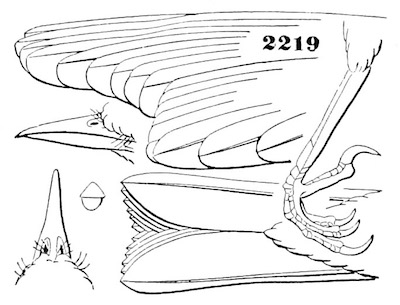
Parula americana Bonap. 2219
Compsothlypis gutturalis, Cabanis (Parula gut., Baird, Rev. Am. B.), and Conirostrum superciliosum, Hartlaub (Parula superciliosa, Baird, Rev.), have been referred by later systematists to this genus; but they are much more closely related to Conirostrum,—a genus usually assigned to the Cærebidæ. The “P.” gutturalis is confined to Costa Rica; but “P.” superciliosa is a species of the table-lands of Mexico, and likely to be detected in Arizona or New Mexico. The characters of this species are as follows:—
Conirostrum superciliosum, Hartl. R. Z. 1844, 215. Whole dorsal region, including rump, olive-green; rest of upper parts ashy. Anterior half beneath yellow, with a crescentic bar of chestnut-brown across the jugulum; posterior lower parts white, ashy laterally. A conspicuous superciliary stripe of white. Wing, 2.60; tail, 2.10.
Parula americana, Bonap.
BLUE YELLOW-BACKED WARBLER.
Parus americanus, Linn. Syst. Nat. 10th ed. I, 1758, 190. Motacilla am. Gmelin. Sylvia am. Lath., Aud. Sylvicola am. Rich., Aud.—Jones, Nat. in Bermuda, 1839, 59. Parula am. Bon. List Birds N. Am. 1838.—Gosse, Birds Jam. 1847, 154 (Jamaica).—Baird, Birds N. Am. 1858, 238; Rev. 169.—Sclater, P. Z. S. 1857, 202 (Xalapa).—Ib. Ibis, 1859, 10 (Guatemala).—Ib. Catal. 1861, 26, 163.—Newton, Ibis, 1859, 143 (Santa Cruz; winter).—Cassin, Pr. A. N. S. 1860, 376 (St. Thomas).—Gundlach, Cab. Jour. 1861, 326 (Cuba; very common). Compsothlypis am. Cab. Mus. Hein. 1850, 20.—Ib. Jour. III, 1855, 476 (Cuba). Ficedula ludoviciana, Brisson. Motacilla lud. Gm. Motacilla eques, Bodd. Sylvia torquata, Vieill. Thryothorus torq. Stephens. Sylvia pusilla, Wils. Sylvicola pus. Swains.
Figures: Aud. Orn. Biog. I, pl. xv.—Ib. Birds Am. II, pl. xci.—Vieill. Ois. Am. II, pl. xcix.—Wils. Am. Orn. IV, pl. xxviii.—Buffon, pl. enl. dccxxxi, fig. 1; dccix, fig. 1.
Sp. Char. Above blue, the middle of the back with a patch of yellowish-green. Beneath yellow anteriorly, white behind. A reddish-brown tinge across the breast. Lores and space round the eye dusky; a small white spot on either eyelid; sides of head and neck like the crown. Two conspicuous white bands on the wings. Outer two tail-feathers with a conspicuous spot of white. Female similar, with less brown on the breast. Length, 4.75; wing, 2.34; tail, 1.90. Nest of long moss.
Hab. Eastern Province of United States, north to the Lakes (“Greenland”), west to the Missouri Valley; in winter, south to Guatemala (not seen on the west coast of Mexico). West Indies; Bahamas; Cuba; Jamaica; St. Croix; St. Thomas; Jalapa, Guatemala (Sclater); Orizaba, winter (Sumichrast); Yucatan (Lawrence); Porto Rico and Inagua (Bryant).
Autumnal males are browner on the chin, yellower on the throat and jugulum. Head tinged with greenish; secondaries edged with greenish-yellow. Autumnal females are light greenish-olive above, dirty-white beneath.
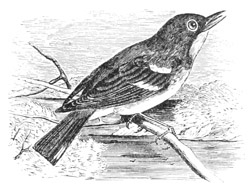
Parula americana.
In very brightly colored spring males, there is frequently (as in 58,335, Philadelphia) a well-defined, broad blackish band across the jugulum, anterior to an equally distinct and rather broader one across the breast, of a brown tint, spotted with black, while the sides are much spotted with chestnut-brown; the blue above is very pure, and the green patch on the back very sharply defined.
Habits. The Blue Yellow-Back is one of our most interesting and attractive Warblers. Nowhere very abundant, it has a well-marked and restricted area within which it is sparingly distributed. It is found from the Mississippi Valley to the Atlantic, and from Canada southward. In its winter migrations it visits the West Indies, the Bahamas, and Central and South America. Halifax on the east, and Platte River on the west, appear to be the northern limit of its distribution. Dr. Woodhouse met with it in the Indian Territory during the breeding-season. Mr. Alfred Newton found this species, apparently only a winter visitant, in the island of St. Croix. Most of the birds left about the middle of March, though a few remained until early in May.
A single specimen of this species was taken at South Greenland in 1857.
This Warbler has been found breeding as far to the south as Tuckertown, N. J., by Mr. W. S. Wood; and at Cape May, in the same State, by Mr. John Krider. At Washington, Dr. Coues found it only a spring and autumn visitant, exceedingly abundant from April 25 to May 15. Possibly a few remained to breed, as he met with them in the first week of August. In the fall they were again abundant from August 25 to the second week in October. He found them inhabiting exclusively high open woods, and usually seen in the tops of the trees, or at the extremities of the branches, in the tufts of leaves and blossoms.
Even where most common it is not an abundant species, and is to be found only in certain localities, somewhat open and swampy thickets, usually not of great extent, and prefers those well covered with the long gray lichens known as Spanish moss. In such localities only, so far as I know, do they breed.
This Warbler has also been ascertained to breed in Southern Illinois, where Mr. Ridgway found it in July, engaged in feeding fully fledged young birds. It is there most common in spring and fall.
A true Warbler in most of its attributes, this bird has many of the habits of Titmice. Like these it frequents the tops of the taller trees, feeding on the small winged insects and caterpillars that abound among the young leaves and blossoms. It has no song, properly so called, its notes are feeble and few, and can be heard only a short distance.
The song of this species is said by Mr. Trippe, of Orange, N. Y., to be a somewhat sharp and lisping, yet quite varied and pleasing, series of notes.
Mr. Audubon speaks of this species as breeding in Louisiana, but his description of the nest differs so entirely from such as are met with in Massachusetts as to suggest doubts as to the correctness of the identification. He describes them as flitting over damp places, the edges of ponds and streams, and pursuing their prey with great activity. They resort to the woods as soon as the foliage appears on the forest trees, and glean among the leaves for the smaller winged insects.