Family FRINGILLIDÆ.—The Finches.
Reading edition
Char. Primaries nine. Bill very short, abruptly conical, and robust. Commissure strongly angulated at base of bill. Tarsi scutellate anteriorly, but the sides with two undivided plates meeting behind along the median line, as a sharp posterior ridge. Eyes hazel or brown, except in Pipilo, where they are reddish or yellowish. Nest and eggs very variable as to character and situation.
I still labor under the inability expressed in Birds of North America (p. 406), in 1858, to satisfactorily define and limit the subfamilies and genera of the Fringillidæ of North America, and can only hope that by the aid of the figures of the present work no material difficulty will be experienced in determining the species. The distinctions from the allied families are also difficult to draw with precision. This is especially the case with the Tanagridæ, where we have much the same external anatomy, including the bill, nearly all the varying peculiarities of this member in the one being repeated in the other.—S. F. B.
All the United States species may be provisionally divided into four subfamilies (the European House-Sparrow forming a fifth), briefly characterizable as follows:—
Coccothraustinæ. Bill variable, from enormously large to quite small; the base of the upper mandible almost always provided with a close-pressed fringe of bristly feathers (more or less conspicuous) concealing the nostrils. Wings very long and pointed, usually one half to one third longer than the forked or emarginate tail. Tarsi short.
Pyrgitinæ. Bill robust, swollen, arched above without distinct ridge. Lower mandible at base narrower than upper. Nostrils covered; side of maxilla with stiff appressed bristles. Tarsi short, not longer than middle toe. Tail shorter than the somewhat pointed wings. Back streaked; under parts not streaked.
Spizellinæ. Embracing all the plain-colored sparrow-like species marked with longitudinal stripes. Bill conical, always rather small; both mandibles about equal. Tarsi lengthened. Wings and tail variable. Lateral claws never reaching beyond the base of the middle claw.
Passerellinæ. Sparrow-like species, with triangular spots beneath. Legs, toes, and claws very stout; the lateral claws reaching nearly to the end of the middle ones.
Spizinæ. Brightly colored species, usually without streaks. Bill usually very large and much curved; lower mandible wider than the upper. Wings moderately long. Tail variable.
Subfamily COCCOTHRAUSTINÆ.—The true Finches.
Char. Wings very long and much pointed; generally one third longer than the more or less forked tail; first quill usually nearly as long as or longer than the second. Tertiaries but little longer, or equal to the secondaries, and always much exceeded by the primaries. Bill very variable in shape and size, the upper mandible, however, as broad as the lower; nostrils rather more lateral than usual; and always more or less concealed by a series of small bristly feathers applied along the base of the upper mandible; no bristles at the base of the bill. Feet short and rather weak. Hind claw usually considerably longer than the middle anterior one; sometimes nearly the same size.
In the preceding diagnosis I have combined a number of forms, all agreeing in the length and acuteness of the wing, the bristly feathers along the base of the bill, the absence of conspicuous bristles on the sides of the mouth, and the shortness of the feet. They are all strongly marked and brightly colored birds, and usually belong to the more northern regions.
The bill is very variable, even in the same genus, and its shape is to a considerable extent of specific rather than of generic importance. The fringe of short bristles along the base of the bill, concealing the nostrils, is not appreciable in Plectrophanes (except in P. nivalis), but the other characteristics given above are all present.
Genera.
A. Bill enormously large and stout; the lateral outline as long as that of the skull. Culmen gently curved.
Colors green, yellow, and black.
Hesperiphona. First quill equal to the second. Wings one half longer than the tail. Lateral claws equal, reaching to the base of the middle claw. Claws much curved, obtuse; hinder one but little longer than the middle.
B. Bill smaller, with the culmen more or less curved; the lateral outline not so long as the skull. Wings about one third longer than the tail, or a little more; first quill shorter than the second. Claws considerably curved and thickened; hinder most so, and almost inappreciably longer or even shorter than the middle anterior one. Tarsus shorter than the middle toes. Lateral toes unequal.
a. Colors red, gray, and black, never streaked.
Pyrrhula. Bill excessively swollen; as broad and as high as long, not half length of head; upper outline much curved. Tail-coverts covering two thirds the tail, which is nearly even, middle and hinder claws about equal.
b. Colors red and gray, or streaked brown and white.
Pinicola. Bill moderately swollen; longer than high or broad, upper outlines much curved; the tip hooked. Tail-coverts reaching over basal half of tail, which is nearly even. Middle claw longer than hind; outer lateral claw extending beyond base of middle (reaching to it in Pyrrhula and Carpodacus). ♀ and juv. not streaked.
Carpodacus. Bill variable, always more or less curved and swollen; longer than high or broad; the tip not hooked. Tail-coverts reaching over two thirds the tail, which is decidedly forked. Middle and hind claw about equal. ♀ and juv. streaked.
c. Colors black and yellow.
Chrysomitris. Bill nearly straight. Hind claw stouter and more curved, but scarcely longer than the middle anterior one. Outer lateral toe reaching a little beyond the base of the middle claw; shorter than the hind toe. Wings longer and more pointed. Tail quite deeply forked.
C. Hind claw considerably longer than the middle anterior one, with about the same curvature; claws attenuated towards the point, and acute. Lateral toes about equal. Wings usually almost one half longer than the tail, which is deeply forked. Tarsus shorter than middle toe.
a. Points of mandibles overlapping.
Curvirostra. Tarsus shorter than middle toe. Bill much compressed, elongate falcate, with the points crossing like the blades of scissors. Claws very large; lateral extending beyond the base of the middle. Colors red or gray. Streaked in juv.
b. Points of mandibles not overlapping.
Ægiothus. Tarsus equal to the middle toe. Bill very acutely conical; outlines and commissure perfectly straight. Lateral toes reaching beyond the base of the middle one. No ridge on the side of the lower mandible. Streaked; a crimson pileum (except in one species).
Leucosticte. Culmen slightly decurved; commissure a little concave. Bill obtusely conical; not sharp-pointed. A conspicuous ridge on the side of the lower mandible. Claws large; the lateral not reaching beyond the base of the middle one. Colors red and brown.
D. Hind claw much the largest; decidedly less curved than the middle anterior one. Tarsus longer than the middle toe. Lateral toes equal; reaching about to the base of the middle claw. Hind toe as long or longer than the middle one. Bill very variable; always more or less curved and blunted. Palate somewhat tuberculate; margins of lower jaw much inflexed. Tail slightly emarginate or even. Wings one half longer than the tail. First quill as long as the second.
Plectrophanes. Colors black and white. With or without rufous nape or elbows. Much white on tail.
Genus HESPERIPHONA, Bonap.
Hesperiphona, Bonap. Comptes Rendus, XXXI, Sept. 1850, 424. (Type, Fringilla vespertina.)
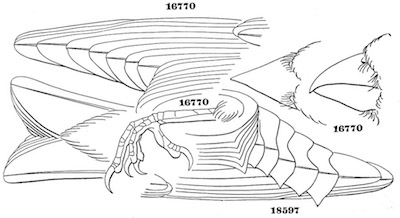
16770, Hesperiphona vespertina. 18597, Coccothraustes vulgaris.
Gen. Char. Bill largest and stoutest of all the United States fringilline birds. Upper mandible much vaulted; culmen nearly straight, but arched towards the tip; commissure concave. Lower jaw very large, but not broader than the upper, nor extending back, as in Guiraca; considerably lower than the upper jaw. Gonys unusually long. Feet short; tarsus less than the middle toe; lateral toes nearly equal, and reaching to the base of the middle claw. Claws much curved, stout, and compressed. Wings very long and pointed, reaching beyond the middle of the tail. Primaries much longer than the nearly equal secondaries and tertials; outer two quills longest; the others rapidly graduated. Tail slightly forked; scarcely more than two thirds the length of the wings, its coverts covering nearly three fourths of its extent. Nest and eggs unknown.
This genus is allied to the European Coccothraustes, but differs in wanting the curious expansion of the inner secondaries, as shown in Fig. 18,597. Species are said to occur in Asia, but we have only two in America,—one peculiar to Mexico (H. abeillii), the other H. vespertina.
The American species may be thus distinguished:—
Species and Varieties.
Common Characters. Wings and tail black, the tertials with more or less whitish; body concolored, with more or less of a yellowish tinge. ♂. Body yellowish, more olivaceous above; no white at base of primaries. ♀. Body grayish, merely tinged with yellow; a white spot at base of primaries. Nest and eggs unknown.
1. H. vespertina. ♂. Head olivaceous-sepia, with a yellow frontal crescent and a black occipital patch. ♀. Crown plumbeous-brown; a dusky “bridle” down side of the throat; upper tail-coverts tipped with a white spot.
Yellow frontal crescent broad, as wide as the black behind it; inner webs of tertials partially black; secondaries and inner webs of tail-feathers tipped with white. Hab. Northern mountain regions of United States and interior of British America … var. vespertina.
Yellow frontal crescent narrow, less than half as wide as the black behind it; inner webs of the tertials without any black; secondaries and inner webs of tail-feathers without white tips. Hab. Southern Rocky Mountains of United States, and mountains of Mexico. … var. montana.
2. H. abeillii.[108] ♂. Head entirely black, sharply defined. ♀. Crown (only) black; no dusky “bridle” on side of throat; upper tail-coverts without white tips. Hab. Mountains of Guatemala and Southern Mexico.
Hesperiphona vespertina, Bonap.
EVENING GROSBEAK.
Fringilla vespertina, Cooper, Annals New York Lyceum, N. H. I, ii, 1825, 220 (Sault St. Marie).—Aud. Orn. Biog. IV, 1838, 515; V, 235, pl. ccclxxiii, ccccxxiv. Fringilla (Coccothraustes) vespertina, Bon. Syn. 1828, 113.—Ib. Am. Orn. II, pl. xv. Coccothraustes vespertina, Sw. F. Bor. Am. II, 1831, 269.—Aud. Birds Am. III, 1841, 217, pl. ccvii. Hesperiphona vespertina, Bon. Comptes Rendus, XXXI, Sept. 1850, 424.—Baird, Birds N. Am. 1858, 409.—Cooper & Suckley, 195.—Cooper, Orn. Cal. 1, 174. Coccothraustes bonapartii, Lesson, Illust. de Zoöl. 1834, pl. xxxiv. ♀ (Melville Island). Loxia bonapartii, Less. Bull. Sc. tab. xxv. Hesperiphona vespertina, var. vespertina, Ridgway (new variety from Mexico and the southern Rocky Mountains).
Sp. Char. Bill yellowish-green, dusky at the base. Anterior half of the body dusky yellowish-olive, shading into yellow to the rump above, and the under tail-coverts below. Outer scapulars, a broad frontal band continued on each side over the eye, axillaries, and middle of under wing-coverts yellow. Feathers along the extreme base of the bill, the crown, tibiæ, wings, upper tail-coverts, and tail black; inner greater wing-coverts and tertiaries white. Length, 7.30; wing, 4.30; tail, 2.75.
The female differs in having the head of a dull olivaceous-brown, which color also glosses the back. The yellow of the rump and other parts is replaced by a yellowish-ash. The upper tail-coverts are spotted with white. The white of the wing is much restricted. There is an obscure blackish line on each side of the chin.
Hab. (var. vespertina.) Pacific coast to Rocky Mountains; Northern America east to Lake Superior. (var. montana.) Southern Rocky Mountains of United States into Mexico; Orizaba! (Sclater, 1860, 251); Vera Cruz (alpine regions, breeding) Sumichrast, Pr. Bost. Soc. I, 550; Guatemala, Salvin.
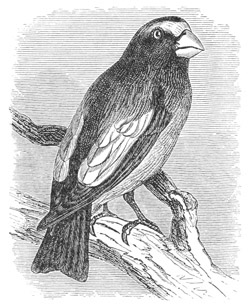
Hesperiphona vespertina.
The variety with broad frontal band and increased amount of white appears to characterize Northern specimens, while that with narrow frontlet and the greatest amount of black is found in Guatemala, Mexico, and the southern Rocky Mountains, and may be called montana.
In size it is also a little smaller. Specimens from Mirador (where breeding) and those from New Mexico are nearly identical in size, proportions, and colors.
Habits. This remarkable Grosbeak was first described by Mr. William Cooper, from specimens obtained by Mr. Schoolcraft in April, 1823, near the Sault Sainte Marie, in Michigan. Sir John Richardson soon after found it to be a common inhabitant of the maple groves on the plains of the Saskatchewan, where it is called by the Indians the “Sugar-Bird.” He states that it frequents the borders of Lake Superior also, and the eastern declivity of the Rocky Mountains, in latitude 56°.
Captain Blakiston did not find this Grosbeak on the Saskatchewan during the summer, but only noticed it there during the winter. He saw none after the 22d of April, and not again until the middle of November. They were seen in company with the Pine Grosbeak, feeding on the keys of the ash-leaved maple. He adds that it has a sharp clear note in winter, and is an active bird.
Dr. Cooper, in his Notes on the Zoölogy of Washington Territory, states that this species is a common resident in its forests, but adds that as it frequents the summits of the tallest trees, its habits have been but little observed. In January, 1854, during a snow-storm, a flock descended to some low bushes at Vancouver, and began to eat the seeds. Since then he had only seen them flying high among the tops of the poplars, upon the seeds of which they feed. They were uttering their loud, shrill call-notes as they flew.
The same writer, in his Report on the birds of California, makes mention of the occurrence of this Grosbeak at Michigan Bluffs, in Placer County, in about latitude 39°. Specimens were obtained by Mr. F. Gruber, and were probably the variety designated as montana. The same form doubtless occurs along the summits of the Sierra Nevada, and they have been traced among the Rocky Mountains to Fort Thorn in New Mexico.
These birds do not come down near the sea-coast even at the mouth of the Columbia, and in California have not been met with in the Coast Range. They are said to feed chiefly on the seeds of the pine, spruce, and cottonwood trees, occasionally seeking other seeds near the ground. They are silent when feeding, but utter a loud call-note as they fly from place to place. In spring, Dr. Cooper states, they have a short but melodious song, resembling that of the Robin or Black-headed Grosbeak. He afterwards met with a flock in the winter near Santa Cruz, where they remained until the end of April. Their favorite resort was a small grove of alders and willows, close to the town, where their loud call-notes could be heard at all times of the day, though he never heard them sing. In the early spring their favorite food was the young leaves of various wild plants that grew under the trees. They also fed on the buds of the Negundo, and frequented the large pear-trees in the old mission garden. They were very tame, and allowed an approach to within a few yards, when feeding. Mr. Townsend, in 1836, found this Grosbeak abundant about the Columbia River. Late in May they were quite numerous in the pine woods. They were very unsuspicious and tame. Under the impression that these birds were only musical towards night, they have been styled the Evening Grosbeak. But this, according to Mr. Townsend, is a misnomer. He also contraverts several other statements made in reference to their habits. He found them remarkably noisy from morning until night, when they quietly retire like other birds, and are not heard from until the next day-dawn. They go in large flocks, and are rarely met with singly. As they feed upon the seeds of the pine and other trees, they proceed by a succession of hops to the extremities of the branches. They also feed largely on the larvæ of the large black ant, for which object they frequent the tops of the low oaks on the edges of the forests. Their ordinary voice is said to be a single screaming note, uttered while feeding. At times, about midday, the male attempts a song, which Mr. Townsend describes as a miserable failure. It is a single note, a warbling call like the first note of the Robin, but not so sweet, and suddenly checked, as if the performer were out of breath.
Mr. Sumichrast met with the variety of this species designated as montana, May, 1857, in the pine woods of Monte Alto, about twelve leagues from Mexico; and although he has never found it in the alpine region of Vera Cruz, he thinks it probable it will be found to be a resident of that district.
Lake Superior has been stated to be its most eastern point of occurrence, but, though this may be true as a general rule, several instances of the accidental appearance of this nomadic species much farther to the east are known. On February 14, 1871, Mr. Kumlien, while out in the woods with his son, saw a small flock of these birds in Dane County, Wisconsin. There were six of them, but, having no gun, he did not procure any. Later in the season he again met with and secured specimens. In the following March, Dr. Hoy of Racine also obtained several near that city. He also informs me that during the winter of 1870-71 there were large flocks of these birds near Freeport, Ill. One person procured twenty-four specimens. One season he noticed them as late as May. They frequent the maple woods, and feed on the seeds fallen on the ground. They also eat the buds of the wild cherry. Their visits are made at irregular intervals. In some years not a single individual can be seen, while in others they make their appearance in December and continue through the whole winter.
Specimens have also been obtained near Cleveland, Ohio, and at Hamilton, Canada; and Mr. Thomas McIlwraith states that Mr. T. J. Cottle of Woodstock, Ontario, shot several of these birds in his orchard in the month of May. They were quite numerous, and remained about the place several days.
Genus PINICOLA, Vieill.
Pinicola, Vieillot, Ois. Am. Sept. I, 1807, 4, pl. i, f. 13.
“ Strobilophaga, Vieillot, Analyse, 1816.”
“ Corythus, Cuvier, R. An. 1817.”
Char. Bill short, nearly as high as long; upper outline much curved from the base; the margins of the mandibles rounded; the commissure gently concave, and abruptly deflexed at the tip; base of the upper mandible much concealed by the bristly feathers covering the basal third. Tarsus rather shorter than the middle toe; lateral toes short, but their long claws reach the base of the middle one, which is longer than the hind claw. Wings moderate; the first quill rather shorter than the second, third, and fourth. Tail rather shorter than the wings; nearly even.
Of this genus one species is found in northern America, and is now considered as identical with that belonging to the northern regions of the Old World.
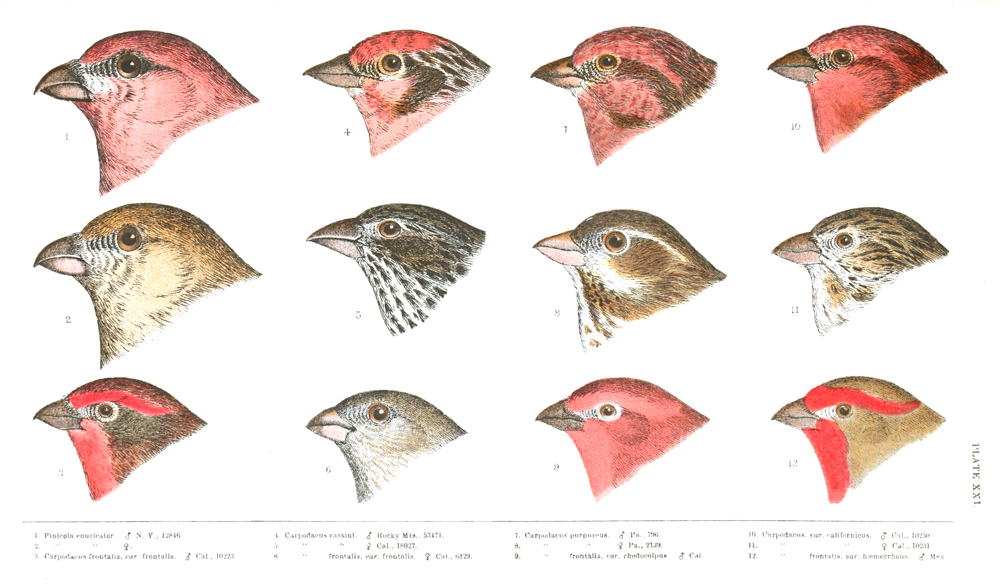
PLATE XXI.
1. Pinicola enucleator. ♂ N. Y., 12846.
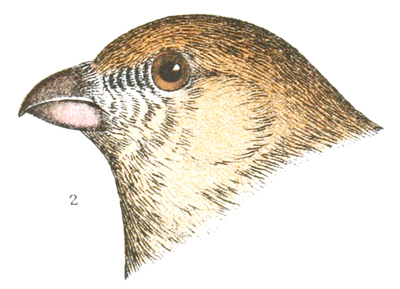
2. Pinicola enucleator. ♀.
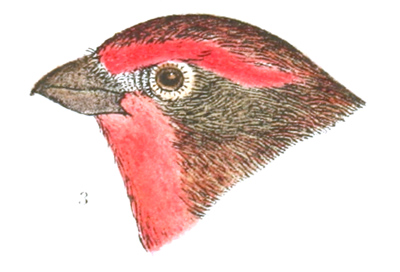
3. Carpodacus frontalis., var. frontalis. ♂ Cal., 10223.
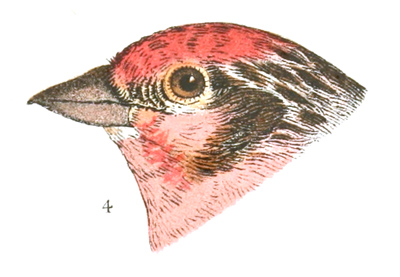
4. Carpodacus cassini. ♂ Rocky Mts., 53471.
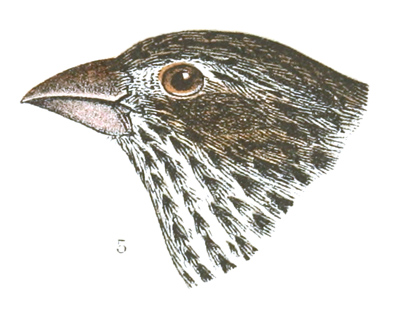
5. Carpodacus cassini. ♀ Cal., 18027.
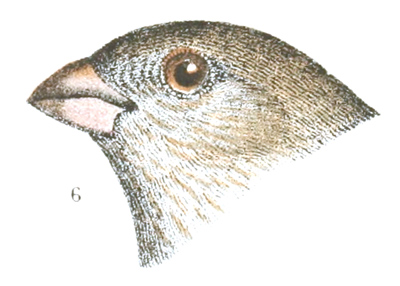
6. Carpodacus frontalis, var. frontalis. ♀ Cal., 6429.
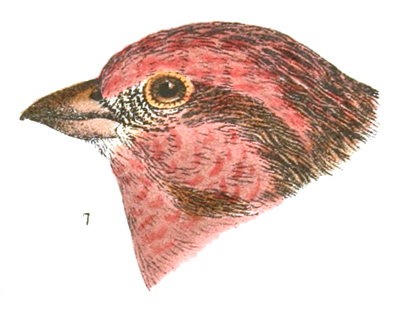
7. Carpodacus purpureus. ♂ Pa., 796.
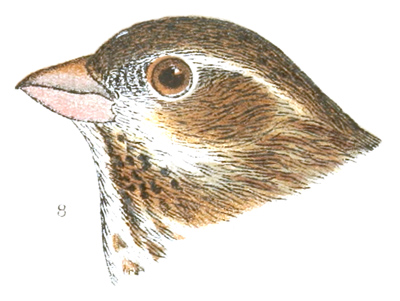
8. Carpodacus purpureus. ♀ Pa., 2139.
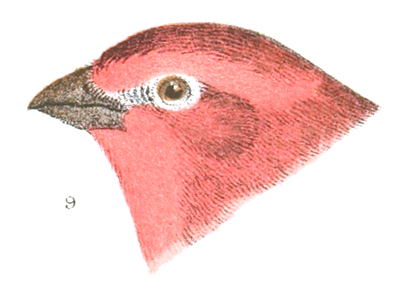
9. Carpodacus frontalis, var. rhodocolpus. ♂ Cal.
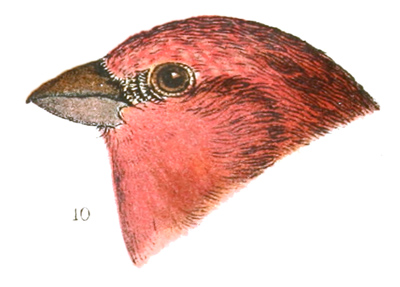
10. Carpodacus var. californicus. ♂ Cal., 10230.
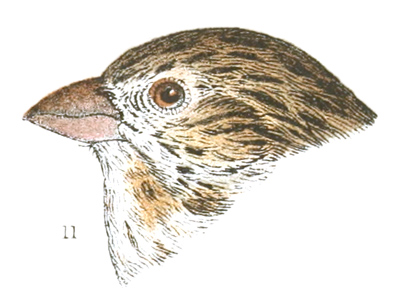
11. Carpodacus var. californicus. ♀ Cal., 10231.
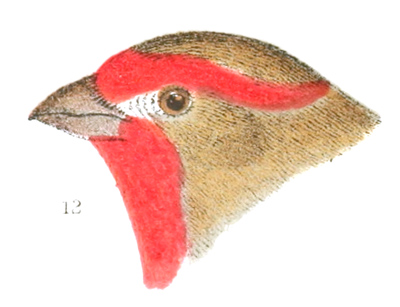
12. Carpodacus frontalis, var. hæmorrhous. ♂ Mex.
Pinicola enucleator, Cabanis.
THE PINE GROSBEAK.
Coccothraustes canadensis, Brisson, Orn. III, 1760, 250, pl. xii, f. 3. “Corythus canadensis, Brehm, Vögel Deutschlands” (1831?). Pinicola canadensis, Cabanis, Mus. Hein. 1851, 167.—Baird, Birds N. Am. 1858, 410.—Dall & Bannister, Tr. Chic. Ac. Sc. I, 1869, 281 (Alaska).—Cooper, Orn. Cal. 1, 151.—Samuels, Birds N. Eng. 283. Pinicola americana (Cab. MSS.), Bp. Consp. 1850, 528. Loxia enucleator, Linn. Syst. Nat. I, 299.—Forst. Phil. Trans. LXII, 1772, 383.—Wils. Am. Orn. I, 1808, 80, pl. v. Pyrrhula enucleator, Aud. Orn. Biog. IV, 1838, 414, pl. ccclviii. Corythus enucleator, Bonap. List. 1838.—Aud. Syn. 127.—Ib. Birds Am. III, 1841, 179, pl. cxcix.—Bon. & Schlegel, Mon. des Loxiens, 1850, 9, pl. ix, xi, xii.—Degland & Gerbe, Orn. Europ. I, 258. Pinicola enucleator, Cabanis, Mus. Hein. I, 1851, 167.
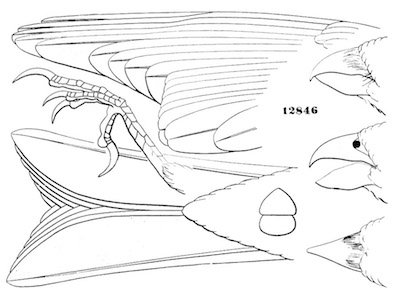
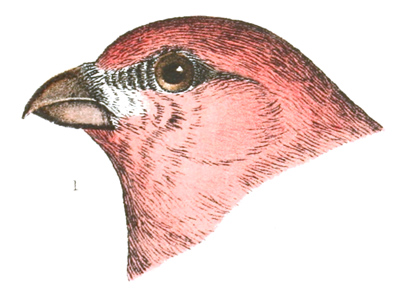
Pinicola enucleator. 12846
Sp. Char. Bill and legs black. Male. General color light carmine-red or rose, not continuous above, however, except on the head; the feathers showing brownish centres on the back, where, too, the red is darker. Loral region, base of lower jaw all round, sides (under the wing), abdomen, and posterior part of the body, with under tail-coverts, ashy, whitest behind. Wing with two white bands across the tips of the greater and middle coverts; the outer edges of the quills also white, broadest on the tertiaries, on secondaries tinged with red. Female ashy, brownish above, tinged with greenish-yellow beneath; top of head, rump, and upper tail-coverts brownish gamboge-yellow. Wings much as in the male. Length about 8.50; wing, 4.50; tail, 4.00. Young like female, but more ashy.
Hab. Arctic America, south to United States in severe winters.
A careful comparison of American with European specimens of the Pine Grosbeak does not present any tangible point of distinction, and it appears inexpedient to preserve the name of canadensis for the bird of the New World. There is considerable difference in the size, the proportions of the bill, and the color of different specimens, but none of appreciable geographical value.
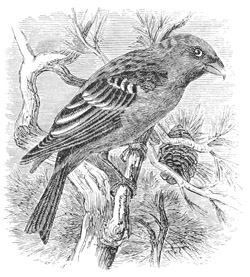
Pinicola enucleator.
A considerable number of specimens from Kodiak (perhaps to be found in other localities on the northwest coast) compared with eastern have conspicuously larger bills, almost equal to cardinalis in this respect. In No. 54,465 the length from forehead is .80; from nostril, .50; from gape, .66; gonys, .40; greatest depth, .51. In a Brooklyn skin (12,846) the same measurements are from forehead, .60; from nostril, .44; from gape, .60; gonys, .34; greatest depth, .40. A Saskatchewan skin is intermediate. A European specimen has the bill as long as that from Kodiak, but less swollen. A Himalayan species (C. subhimachalus) is much smaller, and differently colored.
These Kodiak specimens approach the European bird more nearly in form of the bill, in which there is a tendency to a more abruptly hooked upper mandible than in the birds from the eastern portions of British America. As a general thing, the red tint is brighter in American than in European birds.
Habits. The Pine Grosbeak is, to a large extent, a resident of the portions of North America north of the United States. In the northern parts of New York, Vermont, New Hampshire, and Maine, as well as in western America, it is found throughout the year in the dark evergreen forests. In the winter it is an irregular visitant as far south as Philadelphia, being in some seasons very abundant, and again for several winters quite rare.
Mr. Boardman mentions it as abundant, in the winter, about Calais, and Mr. Verrill gives it as quite common in the vicinity of Norway. It is found every winter more or less frequently in Eastern Massachusetts, though Mr. Allen regards it as rare in the vicinity of Springfield. It is not cited by Dr. Cooper as a bird of Washington Territory, but he mentions it as not uncommon near the summits of the Sierra Nevada, latitude 39°, in September. It probably breeds there, as he found two birds in that region in the young plumage. They were feeding on spruce seeds when he first saw them, and lingered even after their companions had been shot, and allowed him to approach within a few feet of them.
Mr. R. Brown (Ibis, 1868) states that during the winter of 1866, while snow was lying on the ground, two pairs of this species were shot at Fort Rupert, Vancouver Island.
Wilson met with occasional specimens of these birds in the vicinity of Philadelphia, generally in immature plumage, and kept one several months, to note any change in its plumage. In the summer it lost all its red colors and became of a greenish-yellow. In May and June, its song, though not so loud as that of some birds, was extremely clear, mellow, and sweet. This song it warbled out for the whole morning, and also imitated the notes of a Cardinal, that hung near it. It became exceedingly tame and familiar, and when in want of food or water, uttered a continual melancholy and anxious note.
In the winter of 1835, and for several following seasons, these birds were exceedingly abundant in the vicinity of Boston. They appeared early in December, and remained until quite late in March, feeding chiefly on the berries of the red cedar. They were so unsuspecting and familiar that it was often possible to capture them alive in butterfly-nets, and to knock them down with poles. Large numbers were destroyed and brought to market, and many were taken alive and caged. They were tame, but unhappy in confinement, uttering mournful cries as the warm weather approached. In the winter of 1869-70 they again made their appearance in extraordinary numbers, in a few localities on the sea-coast of Massachusetts, where they did considerable damage to the fruit-buds of the apple and pear.
Sir John Richardson states that this bird was not observed by his expedition higher than the 60th parallel. It lives, for the most part, a very retired life, in the deepest recesses of the pine forests, where it passes the entire year, having been found by Mr. Drage, near York Fort, on the 25th of January, 1747. Richardson adds that it builds its nest on the lower branches of trees, and feeds chiefly on the seeds of the white spruce.
Dr. Coues speaks of it as not at all rare along the coast of Labrador, where he obtained several specimens. It was confined entirely to the thick woods and patches of scrubby juniper. A female remained unconcernedly on a twig after he had shot her mate, uttering continually a low soft shep, like that of the Fox-colored Sparrow. Another note was a prolonged whirring chirrup, uttered in a rather low tone, apparently a note of recognition.
A lady resident in Newfoundland informed Mr. Audubon that she had kept several of these Grosbeaks in confinement, that they soon became very familiar, would sing during the night, feeding, during the summer, on all kinds of fruit and berries, and in the winter on different seeds. Mr. Audubon also often observed that, when firing at one of their number, the others, instead of flying away, would move towards him, often to within a few feet, and remain on the lower branches of the trees, gazing at him in curiosity, entirely unmingled with any sense of their own danger. Mr. Audubon quotes from Mr. McCulloch, of Pictou, an interesting account of the habits of one of these birds, kept in confinement. The winter had been very severe, the storms violent, and, in consequence of the depth of snow, many birds had perished from hunger and cold. The Grosbeaks, driven from the woods, sought food around the barns and outhouses, and crowded the streets of Pictou. One of these, taken in a starving condition, soon became so tame as to feed from his hand, lived at large in his chamber, and would awaken him early in the morning to receive his allowance of seed. As spring approached, he began to whistle in the morning, and his notes were exceedingly rich and full. As the time came when his mates were moving north, his familiarity entirely disappeared, and he sought constantly, by day and by night, to escape by dashing against the window-panes, and during the day filled the house with his piteous wailing cries, refusing his food, so that in pity he was let out. But no sooner was he thus released than he seemed indifferent to the privilege, and kept about the door so persistently that he had at last to be driven away, lest some accident should befall him.
The Pine Grosbeaks were found by Bischoff at Sitka and at Kodiak, and are said by Mr. Dall to be extremely common near Nulato, and wherever there are trees throughout the Yukon Territory. They frequent groves of willow and poplar, near open places, and especially the water-side in winter, and in summer seek more retired places for breeding. Their crops, when opened, were always found to contain the hearts of the buds of poplars, with the external coverings carefully rejected, and were never found to include anything else. Mr. Dall noticed no song, only a twitter and a long chirp. He found them excellent as an article of food. European eggs of this bird, taken by Mr. Wolley in Finland in 1858, are of an oblong-oval shape, and have a light slate-colored ground with a marked tinge of greenish, broadly marked and plashed with faint, subdued cloudy patches of brownish-purple, and sparingly spotted, chiefly at the larger end, with blackish-brown and dark purple. They measure 1.02 inches in length by .70 in breadth.
No positively identified eggs of the American Pine Grosbeak are as yet known in collections, but Mr. Boardman has found a nest, near Calais, about which there can be little doubt, although the parent was not seen. This was placed in an alder-bush in a wet meadow, and was about four feet from the ground. It was composed entirely of coarse green mosses. The eggs were two, and were not distinguishable from those of the European enucleator.
Genus PYRRHULA, Pallas.
Pyrrhula, “Brisson, Orn. 1760.” Pallas.
Gen. Char. Bill very short and thick, higher than long, swollen. Lower jaw broader at base than upper jaw, and broader than length of gonys. Nostrils and base of mandible concealed by a thick tuft of rather soft feathers. Tail nearly even, shorter than the pointed wings; upper coverts reaching over nearly two thirds the tail. Middle and hind claws about equal.
This genus is closely related to Pinicola, but has a more swollen and much shorter bill, the lower jaw disproportionately larger, and wider than long along gonys, instead of being about equal. The nasal tuft is thicker and more feathery and less bristly than in Pinicola. The upper tail-coverts are much longer, the tail less emarginate. Other differences exist in the grooves and ridges of the palate, which need not be here referred to. The middle claw is about equal to hind claw; not longer, as in Pinicola.
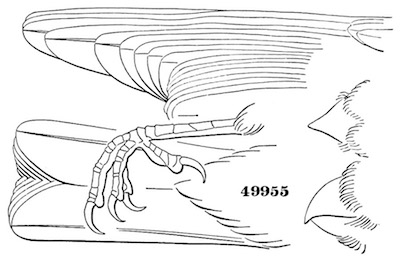
Pyrrhula cassini. 49955
The genus Pyrrhula is an Old World one; extending across from the Atlantic to the Pacific, six or eight species or varieties being recognized by naturalists. All have the back ash-colored; the wings and tail, with top of head, lustrous black; the under parts ash, generally with vermilion on the cheeks and chin, sometimes extending over the whole under surface; the rump and crissum white: the females similar, but lacking the vermilion. Its introduction into the North American fauna rests on the collecting by the naturalists of the Russian Telegraph Expedition in Alaska of a specimen which—if a full-plumaged male, as stated—differs from all of its congeners in the entire absence of any vermilion tint.
Pyrrhula cassini, Baird.
CASSIN’S BULLFINCH.
P. coccinea, var. cassini, Baird, Trans. Chicago, Ac. Sc. I, 1869, ii, p. 316.—Dall & Bannister, Tr. Chic. Ac. I, 1869, 281 (Alaska). P. cassini, Tristram, Ibis, 1871, 231.—Finsch, Ornith. N. W. Amerikas, 1872, 54.
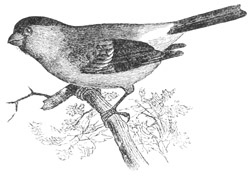
Pyrrhula cassini.
Sp. Char. Description of specimen No. 49,955: Upper parts clear ash-gray, as are the alula, and the lesser and middle secondary and the primary wing-coverts. Under parts and the sides of head cinnamon-gray; the inside of wings and axillars, anal region, tibia, crissum, and rump white; wings and tail, including upper tail-coverts, the entire top of head (to level of eyes), the base of bill all round, and the chin, lustrous violet-black. Greater wing-coverts black, with a broad band of ashy-white across the ends; outer primaries, externally, with a narrow border of grayish-white near the ends; inner edges suffused with the same. Outer tail-feathers with an elongated patch of white in the terminal half, along the shaft, but not reaching the tip. Bill black; feet dusky.
Dimensions (prepared specimen): Total length, 6.50; wing, 3.55; tail, 3.25. Exposed portion of first primary, 2.65. Bill: Length from forehead, .44; from nostril, .34. Legs: Tarsus, .75; claw alone, .26; hind toe and claw, .45; claw alone, .25.
No. 49,955, adult male. Nulato, Yukon River, Alaska. January 10, 1867. W. H. Dall (No. 553).
The specimen referred to above is the first record of the occurrence in America of a genus heretofore considered as belonging exclusively to the Old World.
This bird was described in 1869 as a possible variety of P. coccinea of Europe. On submitting the typical specimens to Mr. H. B. Tristram of England, it was decided to be a well-marked and distinct species, as explained in the following extract from a letter received from him.
“The coloration of the back is the same as in males of P. coccinea and P. rubicilla, and differs from the coloration of the ♀ in all three species. In all the ♀ has the back brown instead of slate-colored. Your bird, however, differs from P. coccinea in having the under parts of the same color as the ♂ of P. griseiventris with a slightly redder hue on the flanks, while P. coccinea is a brilliant blazing red. In this your bird is like P. murina of the Azores, but that has no white on the rump.
“Nor can it be ♂ juv. of P. coccinea, because it has the black head, and the young assumes the black head and red breast simultaneously, or rather the red begins first. It differs from P. nipalensis in having a black head and broad white rump, as well as in size.”
Dr. O. Finsch, of Bremen, agrees with Mr. Tristram in considering it as specifically distinct, and says that the long white shaft-streak on the outermost tail-feather is to be considered as one of the peculiar characters, and that in general it resembles the female of P. griseiventris, Lafr., but differs in having the back beautiful ash-gray.
Habits. This new species of Bullfinch, having a close resemblance to the P. coccinea of Europe, was obtained by Mr. Dall, near Nulato, Alaska, January 10, 1867. An Indian brought it in alive, but badly wounded, having shot it from a small tree near the fort. He had never seen anything like it before, nor had any of the Russians. Captain Everett Smith had, however, met with several flocks of the same species near Ulukuk. This specimen was a male, with black eyes, feet, and bill, and was the only bird of the kind met with by Mr. Dall.
In size it is about equal to P. coccinea, which is now quite generally considered to be simply a large race of the common Bullfinch (P. vulgaris), and the habits of the American bird are doubtless similar to those of its congeners. The European races inhabit the mountainous regions of Northern and Central Europe, appearing in large flocks in December and January in the more southern regions. In their return in spring to their summer quarters, they move in smaller numbers. They nest in the mountain forests, on trees or bushes. Their nest is usually but a few feet from the ground, is beautifully wrought in a cup shape, made externally of small twigs, blades of grass, and rootlets, lined with coarse hair. They lay five eggs, the ground-color of which shades from a light blue to a bluish or a greenish white, with brown and violet-colored spots, that usually form a ring around the larger end. Their food is grain and small seeds, and, in spring, the buds of certain trees.
The Bullfinch is a favorite cage-bird, soon reconciled to confinement, and capable of being taught to whistle whole airs of opera music with wonderful exactness and beauty.
Genus CARPODACUS, Kaup.
Carpodacus, Kaup, “Entw. Europ. Thierw. 1829.” (Type, Loxia erythrina, Pall.)
Erythrospiza, Bonaparte, Saggio di una dist. met. 1831.
Hæmorrhous, Swainson, Class. Birds, II, 1837, 295. (Type, Fringilla purpurea, Gmelin.)
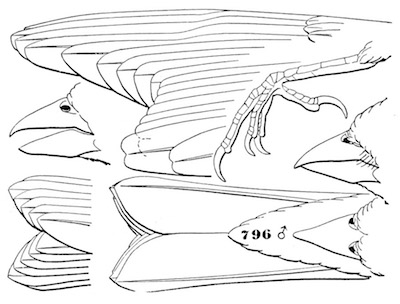
Carpodacus frontalis. 796 ♂
Char. Bill short, stout, vaulted; the culmen decurved towards the end; the commissure nearly straight to the slightly decurved end. A slight development of bristly feathers along the sides of the bill, concealing the nostrils. Tarsus shorter than the middle toe; lateral claws reaching to the base of the middle one. Claw of hind toe much curved, smaller than the middle one, and rather less than the digital portion. Wings long and pointed, reaching to the middle of the tail, which is considerably shorter than the wing, and moderately forked. Colors red, or red and brown. Female with the red replaced by brown.
The genus Carpodacus, including the American Purple Finches, is composed of species the males of which are more or less red in full plumage, while the females are brown-streaked. They are spread over North America, and species also occur in considerable numbers in Northern Europe and Asia.
Species and Varieties.
A. Culmen only slightly curved. Tail and wing feathers edged with reddish in the male.
a. ♂. Crown much brighter purple than the rump or throat. ♀. Without lighter superoral and maxillary stripes, the whole head being pretty uniformly streaked.
1. C. cassini. ♂. Crown bright crimson; rest of head, breast, rump, etc., much lighter purple-pink; lower tail-coverts with a shaft line of dusky. Hab. Mountain regions of the Middle Province, south, through the table-lands and alpine regions of Mexico, to Mirador.
b. ♂. Crown scarcely brighter purple than the rump or throat. ♀. With conspicuous superoral and maxillary stripes.
2. C. purpureus. Crown purple; rest of head, breast, rump, etc., nearly similar in tint; lower tail-coverts without dusky shaft-lines.
Purple tints of a rosy carmine cast; first quill longer than the fourth. Hab. Eastern Province of North America … var. purpureus.
Purple tints of a darker purplish-rose cast; first quill shorter than the fourth. Hab. Pacific Province of North America … var. californicus.
B. Culmen much curved. Tail and wing feathers edged with grayish in the male.
3. C. frontalis. ♂. A frontal and superciliary band of crimson; a patch of same on the rump, and another on the throat and jugulum; abdomen and crissum streaked with dusky.
♂. Red restricted to the portions mentioned above.
Red of an intense carmine tint, sharply defined, and strictly restricted within the limits indicated. Hab. Plateau of Mexico. … var. hæmorrhous.[109]
Red of a lighter carmine, and with a greater or less tendency to escape its boundaries. Hab. Middle Province of the United States … var. frontalis.
♂. Red not restricted, but spread over the crown, tingeing the back and other portions, excepting wings and tail.
Red tint varying from scarlet to wine-red. Hab. Pacific Province of United States, including the peninsula of Lower California … var. rhodocolpus.
Carpodacus cassini, Baird.
CASSIN’S PURPLE FINCH.
Carpodacus cassini, Baird, Pr. A. N. S. Philad. VII, June, 1854, 119; Birds, N. Am. 1858, 414, pl. xxvii, f. 1.—Lord, Pr. R. A. Inst. iv, 1864, 119 (Br. Col. between Rocky Mts. and Cascades).—Kennerly, P. R. R. X, pl. xxvii, f. 1.—Cooper, Orn. Cal. 1, 155.
Sp. Char. Larger than C. purpureus. Bill, .55 of an inch above. Second and third quills longest; first longer than fourth. Male. Above pale grayish-brown, the feathers streaked with darker brown, and with only an occasional gloss of reddish, except on the crown, which is uniform deep crimson, and on the rump. Sides of the head and neck, throat, and upper part of breast with rump, pale rose-color; rest of under parts white, very faintly and sparsely streaked with brown. Female without any red, and streaked on the head and under parts with brown. Length, 6.50; wing, 3.60; tail, 2.60.
Hab. Mountainous regions of Middle Province of United States, from Rocky Mountains to Sierra Nevada. British Columbia (Lord). City of Mexico (Sclater & Salvin, 1869, 362). Breeds in pine region of Mt. Orizaba.
This species, though somewhat resembling C. purpureus, may be easily distinguished from it by the streaked lower tail-coverts (of both sexes), and by the pileum being much more intensely red than any other portion in the male. The female resembles more in markings that of frontalis, but has an entirely different shaped bill, and is much larger; the streaks above very conspicuous, instead of nearly obsolete. The side of the head lacks the conspicuous light and dark longitudinal areas observable in purpureus.
The young of both sexes resemble the adult female, but the streaks are less sharply defined, and the wing-feathers are broadly edged with light earth-brown.
In autumn and winter, as in all the other species, the red tints are softer and more purplish than in spring and summer.
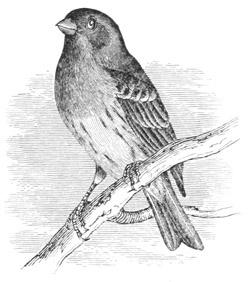
Carpodacus frontalis.
Habits. Cassin’s Purple Finch is the largest of the American birds of this genus, and is not only conspicuously different from all in size, but also in other respects. It is found between the great Central Plains and the coast range of mountains, being one of the common birds of Colorado, Utah, Nevada, and Eastern California. Dr. Cooper found these birds in large numbers about Lake Tahoe in California. They were all in their brown plumage, and seemed so much like the C. californicus in their habits that he mistook them for that species. He noticed in them a very peculiar call-note as they flew, reminding him of that of Pyranga, and quite different from the other Carpodaci. The song of these birds, as he afterwards heard it, was much louder and finer than that of C. californicus, and more original in style. He is not familiar with their other habits, and has never met with them in the Colorado Valley. They have been procured from Fort Thorne, Pueblo Creek, and Alberquerque, New Mexico. Mr. Ridgway met with these birds in the Wahsatch Mountains, June 26, 1869, in Parley’s Park, Utah, where he found them breeding. Their nest was in the top of a cottonwood-tree near the cañon stream, about forty feet from the ground. It is a soft homogeneous structure, flattened in shape, and with only a slight depression. It is composed principally of roots and twigs, lined with softer materials of the same, interspersed with moss, cotton, and other soft substances. It is two inches in height with a width of four and a half inches. The cavity is about an inch deep.
In his Report on the birds of Mr. King’s survey, Mr. Ridgway states that he found this Linnet in the greatest abundance among the pines of the Sierra Nevada, near Carson City. It was next seen among the cedars and nut-pines of the East Humboldt Mountains, and again in the pine woods and cottonwood-trees along the streams on the Wahsatch Mountains. It breeds in all these localities, and is in its habits essentially, though not exclusively, resident among the pines. March 21, 1868, Mr. Ridgway observed flocks of these birds near Carson City. They were found in every portion of the woods, feeding among the branches of the pine-trees. They were all in full song, the females as well as the males. A week later he again found them common among the isolated pines in the fields at the foot of the Sierras, alighting on the trees in companies. Their notes resemble the song of the C. purpureus, but are finer and more musical. They have a great resemblance to the warblings of the Vireo flavifrons, but the passages in its song as much excel those of the Vireo in sweetness as they are surpassed in richness by the warblings of the latter. When one of two females of this species had been killed, the survivor, missing her companion, returned immediately to the tree and hopped from branch to branch, and then alighted on the ground by the side of her dead associate, lamenting her in sweet and plaintive cries.
By the 4th of April the pine-trees about Carson City were alive with these handsome birds, all of whom were in full song. So many were singing simultaneously that the chorus was almost deafening, yet was most exquisitely pleasing.
The nests of this bird were found by Mr. Ridgway in various situations, such as a box-elder bush, the tops of cottonwood and aspen trees, and similar situations. The eggs, four in number, are in size .82 by .63 of an inch, oval in shape, pointed at the smaller end, of a light bluish-green ground, dotted around the larger end with slate, lilac, and a blackish-brown.
Specimens were obtained by Dr. Sartorius, during the breeding-season (June, 1864), in the pine forests of Mt. Orizaba. A careful comparison shows no difference from birds procured in the same month in Nevada.
Carpodacus purpureus, Gray.
EASTERN PURPLE FINCH.
Fringilla purpurea, Gmelin, Syst. Nat. I, 1788, 923.—Wilson, Am. Orn. I, 1808, 119, pl. vii, f. 4.—Ib. V, 1812, 87, pl. xlii, f. 3.—Aud. Orn. Biog. I, 1831, 24; V, 200, pl. iv. Hæmorrhous purpurea, Swainson, Birds, II, 1837, 295. Erythrospiza purpurea, Bp. List, 1838.—Aud. Birds Am. III, 1841, 170, pl. cxcvi. Carpodacus purpureus, Gray’s Genera, 1844-49.—Bon. & Schlegel, Mon. des Loxiens, 14, tab. xv.—Baird, Birds N. Am. 1858, 412.—Samuels, Birds N. Eng. 285. ? Loxia violacea, Linn. Syst. Nat. 1766, 306, 43. (Very uncertain.) Purple Finch, Catesby, Pennant, Lath. Hemp-Bird, Bartram.
Sp. Char. Second quill longest; first shorter than third, considerably longer than the fourth. Body crimson, palest on the rump and breast, darkest across the middle of back and wing-coverts, where the feathers have dusky centres. The red extends below continuously to the lower part of the breast, and in spots to the tibiæ. The belly and under tail-coverts white, streaked faintly with brown, except in the very middle. Edges of wings and tail-feathers brownish-red; lesser coverts like the back. Two reddish bands across the wings (over the ends of the middle and greater coverts). Lores dull grayish. Length, 6.25 inches; wing, 3.34; tail, 2.50; bill above, .46. Female. Olivaceous-brown above; brighter on the rump. Beneath white; all the feathers everywhere streaked with brown, except on the middle of the belly and under coverts. A superciliary light stripe.
Hab. North America, from Atlantic to the high Central Plains.
Habits. The Purple Finch is a common species from Georgia to the plains of the Saskatchewan, and as far west as the Great Plains, beyond which it seems to be replaced by another race, or closely allied species. It breeds from about latitude 40° to perhaps 60°, and in most parts between these parallels is a rather common bird in suitable localities. A few are occasionally found during the winter in Massachusetts, but usually they all pass farther south. In the State of South Carolina they are especially abundant throughout the winter, or from October until April.
Dr. Coues states that the Purple Finch is a very abundant winter resident near Washington, arriving early in October and remaining until May, being eminently gregarious. Stragglers were seen until nearly June, but the majority had departed as the leaves expanded. They were most common in high open woods, and were observed to feed chiefly on tender young buds of trees. They were in full song before they took their departure.
They make their first appearance in regular migrations, in Massachusetts, from the 10th to the 20th of May, and occasionally a few are seen earlier. They are often unwelcome visitors to the fruit-growers, having a great fondness for the blossoms of the peach, cherry, plum, and apple. They will also feed upon other kinds of buds and blossoms. They have a great predilection for evergreen trees, especially the fir, the spruce, and the red cedar, and most generally build their nests in these trees. In summer they feed on seeds, insects, and berries of the honeysuckle and other shrubs.
The Purple Finch, or, as it is generally known in New England, the Linnet, is one of our sweetest, best, and most constant songsters, and is often trapped and sold as caged birds. They soon become accustomed and partially reconciled to their confinement, but sing only during a small part of the year. When one of these birds, confined in a cage, is hung outside the house, in the country, he is sure to draw around him quite a number of his species, and this furnishes the dealer a ready means of capturing them.
This Finch was once regarded as quite rare in the vicinity of Boston, so much so that during a four years’ residence in Cambridge, when collections of nests and eggs had many votaries, not a single nest of this species was obtained by any one. Since then, from some cause, probably the increase of gardens, groves of evergreens, and other localities favorable for their preservation and reproduction, these graceful little Finches have become quite abundant in places propitious for their residence. No less than seven pairs of these favorite songsters took up their abode in my grounds at Hingham in a single summer, and two had nests in the same tree, one of which was at least sixty feet from the ground, on the very top of a tall fir. These several pairs, as a general thing, lived together very harmoniously, save only when one would approach too near the favorite station of another, when the latter would begin to bristle up his crest, and give very evident hints that his near presence was not agreeable. The extreme southern end of the ridge-pole of the house had been, for several summers, the favorite post for the patriarch of the flock, from which at morning and at evening he made the neighborhood vocal with his melody. If in his absence any other of these birds ventured to occupy his position, there was always sure to be a disturbance on his return, if it was not instantly vacated. These encounters were frequent, and always very amusing. Discretion usually took the place of valor on the part of the intruder.
The song of the Purple Finch resembles that of the Canary, and though less varied and powerful, is softer, sweeter, and more touching and pleasing. The notes of this species may be heard from the last of May until late in September, and in the long summer evenings are often continued until after it is quite dark. Their song has all the beauty and pathos of the Warbling Vireo, and greatly resembles it, but is more powerful and full in tone. It is a very interesting sight to watch one of these little performers in the midst of his song. He appears perfectly absorbed in his work, his form dilates, his crest is erected, his throat expands, and he seems to be utterly unconscious of all around him. But let an intruder of his own race appear within a few feet of the singer, and the song instantly ceases, and in a violent fit of indignation he chases him away.
The flight of the Purple Finch is said by Mr. Audubon to resemble that of the Green Finch of Europe. They fly in compact flocks, with an undulating motion, alighting all at once, and then instantly, as if suddenly alarmed, take again to flight only to return to the same tree. They then immediately make each his separate way to the ends of the branches, and commence eating the buds. The food they take to their young is juicy berries and the softer portions of the young cones of the fir and spruce.
They nest generally in firs, spruces, or cedar-trees, though occasionally on the upper branches of a high apple-tree. Their nests are usually placed upon a branch, rather than interlaced between its forked twigs. I have known them not more than five feet from the ground, and at other times on the highest point of a lofty fir-tree. The nests are, for the most part, somewhat flat and shallow structures, not more than two and a half inches in height, and about three and a half in breadth. The walls of the nest average less than an inch, and the cavity corresponds to its general shape and form. The framework of the nest is usually made of small denuded vegetable fibres, stems of grasses, strips of bark, and woody fragments. The upper rim of the nest is often a curious intertwining of dry herbaceous stems, the ends of which project above the nest itself in the manner of a low palisade. The inner nest is made up of minute vegetable fibres, closely interwoven. There is usually no other lining than this. At other times these nests are largely made up of small dark-colored rootlets of wooded plants, lined with finer materials of the same, occasionally mingled with the down of birds and the fur of small animals.
The eggs of the Purple Finch vary greatly in size, and somewhat in shape. Generally they are of an oblong oval, pointed considerably at one end. Their length varies from .92 to .81 of an inch, and their breadth from .70 to .60. Their color is a pale shade of emerald-green, spotted with dark brown, almost black, chiefly about the larger end. The ground-color is much brighter when the eggs are fresh, and soon fades upon exposure to light, and even when kept in a close drawer.
Carpodacus purpureus, var. californicus, Baird.
THE CALIFORNIA PURPLE FINCH.
Carpodacus californicus, Baird, Birds N. Am. 1858, 413, pl. lxxii, f. 23.—Cooper & Suckley, 196.—Cooper, Orn. Cal. 1, 154.
Sp. Char. Similar to purpureus. Third quill longest; first shorter than the fourth. Purple of head and rump much darker than in C. purpureus; the head with a broad supra-orbital lateral band of lighter purple. Length 6.20; wing, 3.20; tail, 2.60.
Hab. Pacific Province of United States.
The female of the western type differs from that of the eastern in being more olivaceous above, and in having the streaks below rather larger, and not so well defined. There appears to be a difference in the marking of the wings. In eastern C. purpureus there is usually a well-marked whitish band across the ends of the middle coverts, while the greater coverts, though margined externally by paler, have a still lighter bar across the posterior extremity, which is not seen in the western bird.
Habits. The Californian Purple Pinch is found throughout the Pacific coast, from the Straits of Fuca to California, as far south as Monterey. Dr. Cooper states that this species is rather a northern bird, being common at the Columbia River, and even farther north, while in California it has not been found south of Monterey on the coast, and Fort Tejon in the Sierra Nevada. In summer they frequent the mountain forests, especially those in part composed of Coniferæ. In winter they descend to the valleys, where they are found associating with the more common and familiar C. frontalis. He met with them in May on the summits of the coast range toward Santa Cruz, but they were not very numerous. They then had nests, though he did not succeed in finding them.
The song of the California Linnet is quite loud and varied, often resembling that of other birds, especially Vireos and Dendroicæ, for which Dr. Cooper has often mistaken it. Their food consists of seeds, berries, and the buds of trees. Their nest and eggs are unknown, but probably resemble those of C. purpureus.
Carpodacus frontalis, Sclater.
HOUSE LINNET; CRIMSON-FRONTED FINCH; BURION.
Fringilla frontalis, Say, Long’s Exped. R. Mts. II, 1824, 40. (For other synonymes see under the different varieties.)
Sp. Char. Bill short, nearly as deep as broad; culmen much curved, commissure arched; lower mandible nearly as deep as the upper. Tail more than three fourths as long as wing, slightly emarginated. Wing and tail feathers without reddish edges; lower tail-coverts and abdomen with broad streaks of dusky. General color above, including wings, tail, and upper tail-coverts, brownish-gray, the feathers with lighter edges. Beneath white, each feather with a medial streak of dusky. Male. A broad frontal crescent, extending back in a superciliary stripe to the occiput, a patch on the rump (not the upper tail-coverts), and an area covering cheeks, chin, throat, and jugulum red,—bright scarlet in spring, rosy in fall. Female without the red, which is replaced by a uniform streaking. Young resembling the female, but streaks less sharply defined; those above more distinct. Wing-coverts broadly edged with light earth-brown.
This species inhabits the western regions of North America, from the Rocky Mountains to the Pacific; and Mexico, except, perhaps, the eastern portion. In this range of distribution it occurs in three races, which, taking extreme examples, are well marked, but when a large series is examined are found to grade insensibly into each other.
The above description is general, being modified only by additional characters in the several races. The normal plumage is perhaps represented in the central race,—the true frontalis, as restricted,—which inhabits the Middle Province of the United States, and is nearly as described above; the red of the male of this style is of a bright scarlet tint, and in nearly all specimens shows a tendency to escape the boundaries above indicated. As we go south into Mexico, we find the red strictly confined within those limits, very sharply defined; and, under the tropical influence, intensified into a very bright carmine tint; this latter is the C. hæmorrhous of authors. Following the var. frontalis westward, we find it gradually changing, the red invading more and more the other portions, until, in specimens from the coast of California and from Cape St. Lucas, it is spread over all portions, except the anal region, wing, and tail,—though always brightest within those outlines which confine it in the two preceding varieties. In extreme examples of the latter race,—the C. rhodocolpus of Cabanis,—the red even obliterates the streaks on the abdomen. The spreading of the red is seen in other birds of the Pacific region, this case being exactly paralleled by the Sphyropicus ruber, in its relation to S. nuchalis or S. varius.
The females and young of the three races are quite difficult to distinguish from each other, the locality being the best means of identifying them.
Carpodacus frontalis, var. frontalis, Gray.
CRIMSON-FRONTED FINCH; BURION.
Fringilla frontalis, Say, Long’s Exp. II, 1824, 40.—(?) Aud. Orn. Biog. V, 1839, 230, pl. ccccxxiv. Pyrrhula f. Bonap. Am. Orn. I, 1825, 49, pl. vi. Erythrospiza f. Bon. List, 1838.—Ib. P. Z. S. 1837, 112.—(?) Aud. Syn. 1839, 125.—Ib. Birds Am. III, 1841, 175, pl. cxcvii.— Gamb. J. A. N. S. 2d series, I, 1847, 53. Fringilla (Pyrrhula) f. Gamb. P. A. N. S. I, 1843, 262. Carpodacus f. Gray, Gen. 1844-49.—McCall, P. A. N. S. V, 1851, 219.—Baird, Birds N. Am. 1858, 415. ? Carpodacus obscurus, McCall, P. A. N. S. V, June, 1851, 220, Santa Fé, N. M. Carpodacus familiaris, McCall, P. A. N. S. VII, April, 1852, 61, Santa Fé, N. M.
Sp. Char. (♂ 58,589, Great Salt Lake City, Utah, June 1, 1869.) Above brownish-gray, faintly glossed with red on the nape and back; wing and tail feathers passing into lighter on their edges, and dorsal feathers with obsolete shaft-streaks of darker. A frontal band, about as wide as the length of the culmen, continuing back in a superciliary stripe to the occiput, throat, jugulum, and a patch on the lower part of the rump (but not on upper tail-coverts) carmine-scarlet. Rest of lower parts white, each feather with a medial streak of brown like the back. Wing, 3.10; tail, 2.60; culmen, .38; tarsus, .65; middle toe, .52.
(♀ 58,590, Salt Lake City, June 21, 1869.) Similar, but red entirely absent, the throat and jugulum being white streaked with brown, and the front, rump, etc., grayish, obsoletely streaked with darker. Wing, 3.00; tail, 2.40.
(Juv. 40,799, Fort Whipple, Arizona, June 5, 1865.) Generally similar to the ad. ♀, but more brownish, and the wing-feathers passing into dull buffy-ochraceous on their edges; streaks beneath narrower and less distinct.
In winter the red is softer and less sharply defined, and usually of a more purplish tint; the markings generally more blended.
Hab. Middle Province of the United States, from Rocky Mountains to the interior valleys of California.
Habits. This form of the House Finch appears to be a very common bird throughout the interior region of the United States, extending to New Mexico and Arizona on the south and southeast, and probably to Mexico. On the Pacific coast it is replaced by another and closely allied variety.
Dr. Woodhouse states that his attention was first called to this interesting little songster while at Sante Fé. It was there known to the American residents as the “Adobe Finch.” By the Mexicans they were called Buriones. He found them exceedingly tame, building about the dwellings, churches, and other buildings, in every nook and corner, and even entering the houses to pick up crumbs. They are never disturbed by the inhabitants. He adds that at the first dawn of the morning they commence a very sweet and clear warble, which he was quite unable to do justice to by any verbal description. He has often in the early morning listened with admiration and gratification to the song of this bird, which is deservedly a great favorite. He found it throughout New Mexico, and beyond. He did not distinguish it from the coast variety.
Dr. Coues also found this bird very abundant in Arizona, where it is a permanent resident, but most abundant in spring and fall. He describes it as eminently gregarious. He found it in all situations, but most common in the spring among the groves of willows and poplars, on the buds of which it feeds. He met with this species all the way from the Rio Grande through New Mexico and Arizona to California, and appears to have noted no differences between this form and the coast variety. He also mentions finding, during a few days’ stay in the New Mexican village of Los Pinos, near Alberquerque, on the Rio Grande, this pretty little Finch the most common and characteristic of the local birds. It was there breeding indifferently in the courtyards, sheds, under porticos or eaves, and also in the forks of trees in the streets. It had sharp conflicts with the Barn Swallows, whose nests it often took possession of, and was a lively and most agreeable feature in the dirty towns which it honored with its presence; and its songs were at once sweet, clear, and exquisitely melodious.
Dr. Cooper met with these birds among the barren and rocky hills near the Colorado.
Mr. Ridgway, who found these birds breeding in large numbers at Pyramid Lake, informs me that their nests were usually placed in clefts in rocks, or in a cave. Near Salt Lake City they were also very common, building their nests among the shrubs known as the wild mahogany, on the hills, but never frequenting the higher regions of the mountains.
The eggs of this bird, which are not distinguishable from those of the Pacific coast form, have a delicate pale-blue ground-color, which is very fugitive, and fades even in the drawers of a cabinet. They are sparingly marked, chiefly around the more obtuse end, with spots and lines of black and a dark brown. They are of oval shape, elongate and pointed at one end, and measure .80 of an inch in length by .60 in breadth.
Carpodacus frontalis, var. rhodocolpus, Caban.
CALIFORNIA HOUSE-FINCH; RED-HEADED LINNET; BURION.
? Pyrrhula cruentata, Lesson, Rev. Zoöl. 1839, 101. Carpodacus rhodocolpus, Cabanis, Mus. Hein. 1851, 166.—Sclater, P. Z. S. 1856, 304. Carpodacus frontalis, Bon. & Schleg. Mon. des Lox. 1850, tab. xvi, f. 1.—Ib. Consp. 1850, 533.—Baird, Birds N. Am. 1858, 415 (in part).—Cooper, Orn. Cal. 1, 156. House Finch, Grayson, Hesperian, II, 1859, 7, plate. Carpodacus familiaris, Heermann, X, 50 (nest).
Sp. Char. (♂ 12,973, Cape St. Lucas.) Head, neck, jugulum, breast, upper part of abdomen and sides, and rump, bright carmine-scarlet, dullest on the centre of the crown and auriculars; rest of the upper parts brownish-gray, glossed with red except on the wings, which have the feathers with distinctly lighter edges. Anal region, flanks, and crissum white, the feathers with shaft-streaks of brown. Wing, 3.00; tail, 2.60; culmen, .45; tarsus, .62; middle toe, .50.
Female and Juv. similar to var. frontalis, but colors darker.
Hab. Coast region of Pacific Province, and peninsula of Lower California.
The male described above represents about the average plumage of this form; an extreme example is No. 26,546, Cape St. Lucas, which is almost entirely of a wine-red color, this covering the whole lower parts, except the anal region, and obliterating the streaks; the wings even are tinged with red. Still, on the head the red (a wine-purple tint) is brightest within those limits to which it is confined in the normal plumage.
Habits. This variety of the House Finch is a very common bird throughout the Pacific coast, from Oregon to Mexico. Mr. Ridgway states that he found this species the most common and familiar of all the birds of the Sacramento Valley. It is a very common cage-bird, being highly prized for its song, which in power is hardly inferior to that of the Canary, while it far surpasses it in sweetness. Its beautiful plumage also renders it still more attractive. The peculiarly soft and musical tweet of this bird is also very similar to that of the Canary, and is very different from the common note of the Purple Finch. This bird breeds very numerously among the shade-trees in the streets of Sacramento, as well as among the oak groves on the outskirts of that city. The males are very shy, but the females, when their nest is disturbed, keep up a lively chirping in an adjoining tree. The nest is generally situated near the extremity of a horizontal branch of a small oak, usually in a grove, occasionally in an isolated tree. In one instance it made use of an abandoned nest of a Bullock’s Oriole, and in another of that of a Cliff Swallow.
Dr. Cooper speaks of this bird as being especially abundant in all the southern portions of California, and also, according to Dr. Newberry, throughout all the valleys northward into Oregon. It is a species that is everywhere peculiar to the valleys, while the others of this genus are equally confined to the wooded mountains. Dr. Cooper also met with this species in the plains near the coast, where there are no plants higher than the wild mustard, on the seeds of which they feed. They also frequent the groves and the open forests on the summits of the coast range, but in small numbers, in company with the C. californicus. They at times feed on buds of trees, and seeds of the cottonwood and other plants. It is most abundant among ranches and gardens where, Dr. Cooper states, it does much mischief by destroying seeds and young plants, fruit and buds. For these depredations even its cheerful and constant song is not regarded as an adequate compensation; and unlike the New-Mexicans in their treatment of its kindred race, the California cultivators wage an unrelenting war upon these birds.
At San Diego, Dr. Cooper found them building as early as the 15th of March, and even a little earlier. Both the situation and the materials of their nest vary. He has found them nesting in trees, on logs and rocks, on the top rail of a picket fence, inside a window-shutter, in the holes of walls, under tiles, on the thatch of a roof, in barns and haystacks, and even between the interstices in the sticks of which the nest of a Hawk had been made, and once in the old nest of an Oriole. About dwellings they always seek the protection of man, and seem to be quite unconscious of having deserved or incurred his enmity. The materials of their nests are usually coarse grasses and weeds, with a lining of hair and fine roots. They raise two, sometimes three, broods in a season, and in the autumn assemble in large flocks, but migrate very little, if any, to the south.
Dr. Cooper states that their songs are very different from those of the other species. They are very varied and very lively, and are heard throughout the year. They are easily kept as cage-birds, but soon lose the beauty of their plumage in confinement, their bright purple colors changing to a dirty yellow.
Nuttall did not observe any of this species in Oregon.
The eggs of this bird vary from four to six in number, and are of a pale blue which readily fades into a bluish-white, and are marked with spots and lines of a dark brown or black. They are of an elongate-oval shape, and measure from .82 to .75 of an inch in length, with an average breadth of .60.
Genus CHRYSOMITRIS, Boie.
Chrysomitris, Boie, Isis, 1828, 322. (Type, Fringilla spinus, Linn.)
Astragalinus, Cab. Mus. Hein. 1851, 159. (Type, Fringilla tristis, Linn.)
Hypacanthus, Cab. Mus. Hein. 1851, 161. (Type, Carduelis spinoides.)
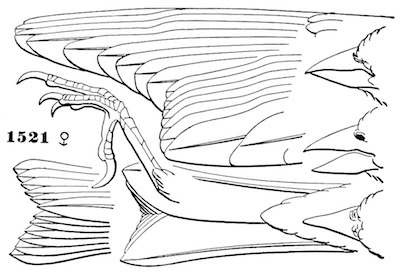
Chrysomitris tristis. 1521 ♀
Gen. Char. Bill rather acutely conic, the tip not very sharp; the culmen slightly convex at the tip; the commissure gently curved. Nostrils concealed. Obsolete ridges on the upper mandible. Tarsi shorter than the middle toe; outer toe rather the longer, reaching to the base of the middle one. Claw of hind toe shorter than the digital portion. Wings and tail as in Ægiothus.
The colors are generally yellow, with black on the crown, throat, back, wings, and tail, varied sometimes with white.
The females want the bright markings of the male.
This genus differs from Ægiothus in a less acute and more curved bill, a much less development of the bristly feathers at the base of the bill, the claw of the hind toe shorter than its digital portion, the claws shorter and less curved and attenuated, and the outer lateral toes not extending beyond the base of the middle claw.
The species exhibit many differences among themselves, especially in the size and shape of the bill, which have been made the basis of generic distinctions. They may be distinguished as follows:—
Species and Varieties.
A. No streaks anywhere on plumage; base of tail-feathers black or white. Sexes dissimilar. (Chrysomitris.)
a. No yellow on the wings.
1. C. tristis. Inner webs of tail-feathers always whitish terminally (except in Juv.). ♂. Forehead and crown, wings and tail, deep black; rest of plumage, including the back, rich lemon-yellow; tail-coverts white. ♀. Body grayish above, dingy whitish beneath, stained with yellow; no black on head; wings and tail duller black. Juv. Fulvous-umber above, with markings of reddish-ochraceous on the wings; beneath, dilute-yellow washed with fulvous. Hab. Whole of temperate and warm North America.
2. C. psaltria. Inner webs of tail-feathers never whitish terminally. ♂. Beneath yellow, including the lower tail-coverts; above black, with or without olive-green on the back. ♀. Without any black, the yellow duller.
Tail with white on inner webs; tertials with large white spots.
♂. Auriculars, nape, back, and rump olive-green. Hab. Rocky Mountains of United States … var. psaltria.
♂. Auriculars black; nape, back, and rump green clouded with black. Hab. Arizona … var. arizonæ.
♂. Auriculars, nape, back, and rump entirely black. Hab. Middle America … var. mexicana.
Tail without any white on inner webs; tertials without white spots.
♂. Auriculars, nape, back, and rump wholly black. Hab. Panama and New Granada … var. columbiana.
b. Terminal half of outer webs of wing-coverts and secondaries yellow.
3. C. lawrencii. Prevailing color ashy, lighter beneath. ♂. A large patch on the breast, the rump, and most of the outer surface of the wing, yellow; forehead, crown, lores, all round base of bill, chin, wings (beneath the yellow), and tail black. ♀. Lacking the black, and with the yellow only indicated. Hab. California and Southwestern Arizona.
B. Whole body and head thickly streaked; bases of tail-feathers yellow. Sexes alike. (Astragalinus.)
4. C. pinus. Above brownish-gray, beneath white, with conspicuous dusky streaks everywhere; two light bands on the wing; bases of secondaries and primaries yellow. Hab. Whole of North America.
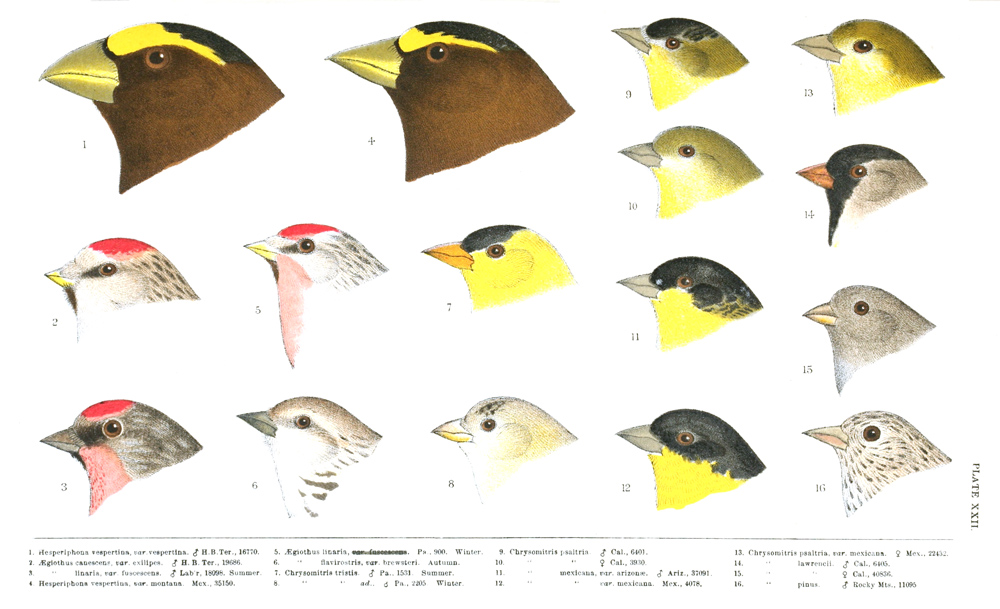
PLATE XXII.
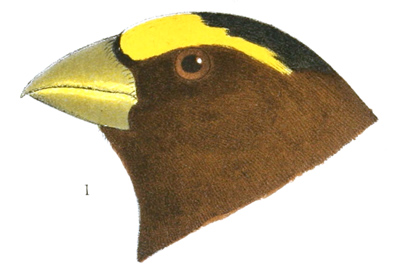
1. Hesperiphona vespertina, var. vespertina. ♂ H. B. Ter., 16770.
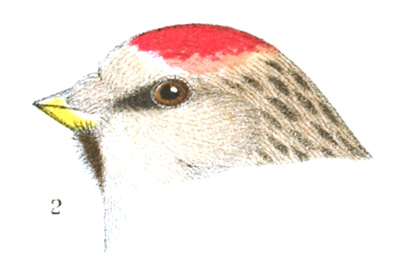
2. Ægiothus canescens, var. exilipes. ♂ H. B. Ter., 19686.
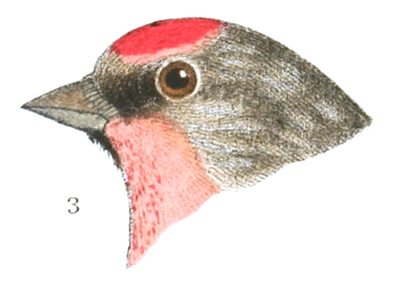
3. Ægiothus linaria, var. fuscescens. ♂ Lab’r, 18098. Summer.
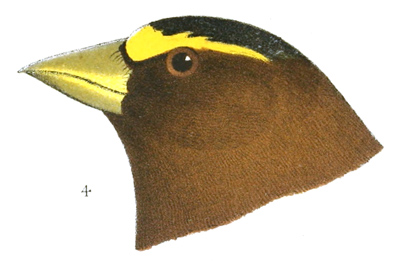
4. Hesperiphona vespertina, var. montana. Mex., 35150.
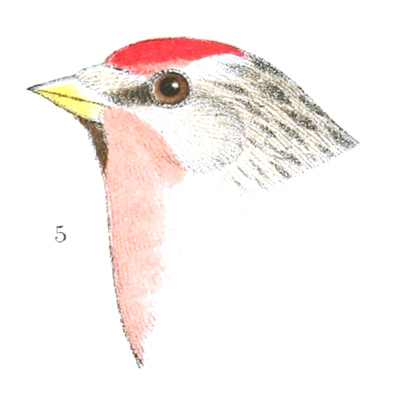
5. Ægiothus linaria, var. fuscescens. Pa., 900. Winter.
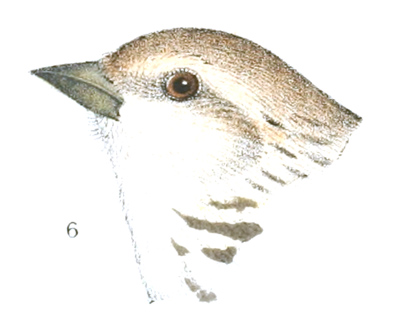
6. Ægiothus flavirostris, var. brewsteri. Autumn.
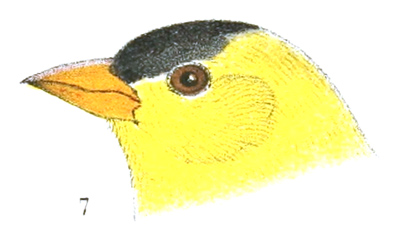
7. Chrysomitris tristis., ♂ Pa., 1531. Summer.
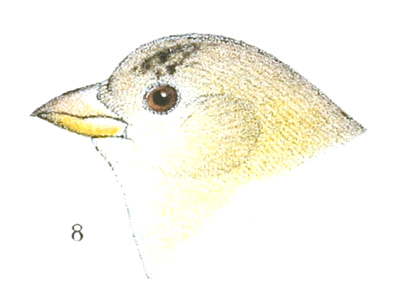
8. Chrysomitris tristis., ad., ♂ Pa., 2205. Winter.
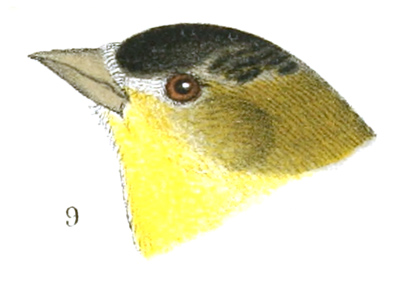
9. Chrysomitris psaltria. ♂ Cal., 6401.
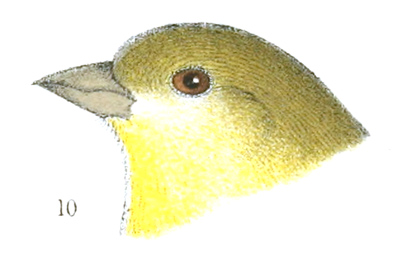
20. Chrysomitris psaltria. ♀ Cal., 3930.
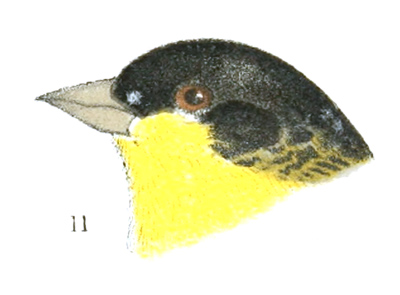
11. Chrysomitris mexicana, var. arizonæ. ♂ Ariz., 37091.
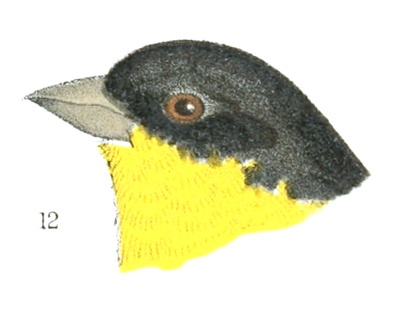
12. Chrysomitris mexicana, var. mexicana. Mex., 4078.
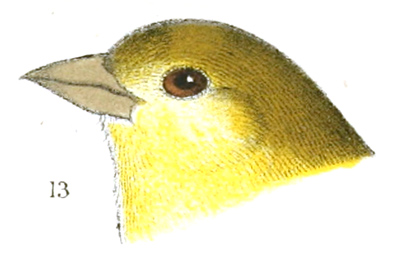
13. Chrysomitris psaltria, var. mexicana. ♀Mex., 22432.
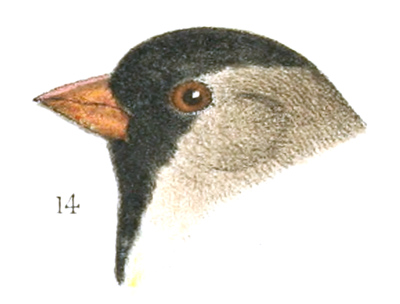
14. Chrysomitris lawrencii. ♂ Cal., 6405.
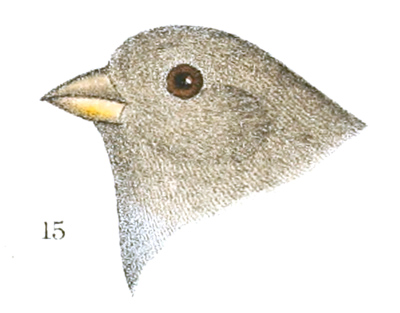
15. Chrysomitris lawrencii. ♀ Cal., 40836.
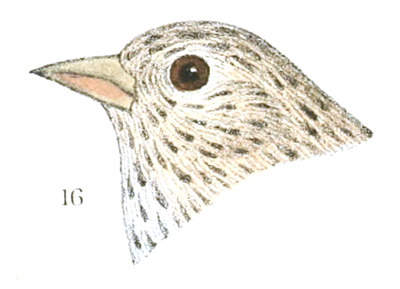
16. Chrysomitris pinus. ♂ Rocky Mts., 11095.
Three species of Chrysomitris, given by Mr. Audubon, are to be erased from the list: C. stanleyi, C. yarrelli, and C. magellanica. If, as he states, he killed specimens of the latter in Kentucky, they must have belonged to the C. notata of Dubus, a Mexican species, not since met with in our limits. The other two were given him as coming from California,—a statement we now know to be incorrect, both belonging to South America.
Chrysomitris tristis, Bon.
YELLOW-BIRD; THISTLE-BIRD.
Fringilla tristis, Linn. Syst. Nat. I, 1766, 320.—Wils. Am. Orn. I, 1808, 20, pl. i, f. 2.—Aud. Orn. Biog. I, 1831, 172; V,, 510, pl. xxxiii. Carduelis tristis, Bon. Obs. Wils. 1825, No. 96.—Aud. Birds Am. II, 1841, 129, pl. clxxxi.—Max. Cab. Journ. vi, 1858, 281. Chrysomitris tristis, Bon. List, 1838.—Newberry, Zoöl. Cal. & Or. Route; Rep. P. R. R. Surv. VII, IV, 1857, 87.—Baird, Birds N. Am. 1858, 421.—Cooper & Suckley, 197.—Cooper, Orn. Cal. 1, 167. Astragalinus tristis, Cabanis, Mus. Hein. 1851, 159 (type). Carduelis americana, (Edwards,) Sw. & Rich. F. B. A. II, 1831, 268. Golden Finch, Pennant. American Goldfinch, Edwards. Chardonneret jaune; Chardonneret du Canada; Tarin de la Nouvelle Yorck, Buffon.—Ib. Pl. enl., pl. ccii, f. 2, pl. ccxcii, f. 1.—Samuels, Birds N. Eng. 288.
Sp. Char. Male. Bright gamboge-yellow; crown, wings, and tail black. Lesser wing-coverts, band across the end of greater ones, ends of secondaries and tertiaries, inner margins of tail-feathers, upper and under tail-coverts, and tibia white. Length, 5.25 inches; wing, 3.00. Female. Yellowish-gray above; greenish-yellow below. No black on forehead. Wing and tail much as in the male. Young. Reddish-olive above; fulvous-yellow below; two broad bands across coverts, and broad edges to last half of secondaries pale rufous.
Hab. North America generally.
In winter the yellow is replaced by a yellowish-brown; the black of the crown wanting, that of wings and tail browner. The throat is generally yellowish; the under parts ashy-brown, passing behind into white.
There are no observable differences between eastern and western specimens.
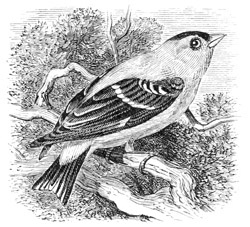
Chrysomitris tristis.
Habits. The common American Goldfinch is found throughout the greater portion of North America, from the Atlantic to the Pacific. Sir John Richardson met with it in the fur regions, where it is one of the tardiest of the summer visitors, and whence it departs early in September. The specimen described by him was taken June 29. At the extreme South it is not uncommon, according to Dresser, around San Antonio, and Dr. Woodhouse found it abundant both in Texas and in the Indian Territory. Dr. Coues did not find it in Arizona, nor does Sumichrast give it as a bird of Vera Cruz. Dr. Newberry found this Finch quite common throughout his route to the Columbia, this sweet songster, he states, having been a constant source of pleasure in the interior both of California and Oregon, far from the haunts of men, where everything else was new and strange. But Dr. Suckley, though he looked carefully for this species about Puget Sound, in the most appropriate situations, was unable to find any, and did not believe that any existed there. Dr. Cooper states that it is, however, quite abundant on the Columbia and along the coast near its mouth.
The last-named writer states that this species is a constant resident in all the western parts of California, but he met with none on the Colorado. They become rare on the coast at the Columbia, but farther in the interior are found as far north as latitude 49°. They breed as far south as San Diego, but seem to avoid the hot interior valleys, as well as the mountains. Their favorite resorts are where thistles and other composite plants abound, and also groves of willow and cottonwood, upon the seeds of which they feed largely. In winter the seeds of the buttonwood supply their chief subsistence.
The common Goldfinch was seen in abundance by Mr. Ridgway only in the vicinity of Sacramento City, associated with the Carpodacus frontalis, and often nesting in the same tree. In the interior this species was rarely seen, and only one specimen was secured in the Truckee Valley in May, and not noticed afterwards. It was, however, found breeding in the Uintah Mountains, where its nest and eggs were obtained. The nests procured by Mr. Ridgway were all found about June 6, except one, ten days later, showing that these birds are four or five weeks earlier in their breeding on the Pacific than on the Atlantic coast. In the Uintah Mountains they were breeding, as at the East, in July.
The Goldfinch is to a large extent gregarious and nomadic in its habits, and only for a short portion of the year do these birds separate into pairs for the purposes of reproduction. During at least three fourths of the year they associate in small flocks, and wander about in an irregular and uncertain manner in quest of their food. They are resident throughout the year in New England, and also throughout the greater portion of the country, their presence or absence being regulated to a large extent by the abundance, scarcity, or absence of their favorite kinds of food. In the winter, the seeds of the taller weeds are their principal means of subsistence. In the summer, the seeds of the thistle and other plants and weeds are sought out by these interesting and busy gleaners. They are abundant in gardens, and as a general thing do very little harm, and a vast amount of benefit in the destruction of the seeds of troublesome weeds. As, however, they do not always discriminate between seeds that are troublesome and those that are desirable, the Goldfinches are unwelcome visitors to the farmers who seek to raise their own seeds of the lettuce, turnip, and other similar vegetables. They are also very fond of the seeds of the sunflower.
Owing possibly to the scarcity of proper food for their young in the early summer, the Goldfinches are quite late before they mate and raise their single brood. It is usually past the 10th of July before their nests are constructed, and often September before their broods are ready to fly.
The song of the Goldfinch—very different from their usual plaintive cry or call-note, uttered as they are flying or when they are feeding—is very sweet, brilliant, and pleasing; most so, indeed, when given as a solo, with no other of its kindred within hearing. I know of none of our common singers that excel it in either respect. Its notes are higher and more flute-like, and its song is more prolonged than that of the Purple Finch. Where large flocks are found in the spring or early summer, the males often join in a very curious and remarkable concert, in which the voices of the several performers do not always accord. In spite of this frequent want of harmony, these concerts are varied and pleasing, now ringing like the loud voices of the Canary, and now sinking into a low soft warble.
During the warm summer weather the Goldfinch is very fond of bathing, and the sandy shelving margins of brooks are always their favorite places of resort for this purpose. I do not think they ever raise more than a single brood in a season in New England, and are in this somewhat irregular, depositing their eggs from July 10 to September, as it may happen.
They usually select a small upright tree, such as a young elm, apple, or pear, or a tall shrub, for their nest, which they rarely place higher than ten feet from the ground. Than the nest of our Goldfinch we have no more beautiful specimen either of the basket in shape or the felted in structure. Symmetrical in form, delicately and beautifully woven, and ingeniously and firmly fastened around the forked twigs with which it is interlaced, it is an exquisite example of architectural beauty and finish. A beautiful specimen from Wisconsin may be taken as typical. It measures three inches in diameter and two in height. The cavity is one and a half inches wide at the rim, and the depth is the same. The base of this nest is a commingling of soft vegetable wool, very fine stems of dried grasses, and fine strips of bark, all being in very fine shreds. The sides, rim, and general exterior of the nest is made up, to a large extent, of fine slender vegetable fibres, interwrought with white and maroon-colored vegetable wool. These materials are closely and densely felted together. The inner nest is softly and thoroughly lined with a softer felting made of the plumose appendages or pappus of the seeds of composite plants.
The eggs, usually five, rarely six in number, are of a uniform bluish-white, sharply pointed at one and rounded at the other end. They measure from .65 to .67 of an inch in length and from .50 to .55 in breadth. Dr. Cooper gives their measurement as .60 by .50; but of the contents of seven nests before me not an egg is less than .65 in length, and but one so small as .50 in breadth.
A nest of this Finch, built in a young elm-tree in Hingham, eight feet from the ground, was begun July 27, finished and the first egg laid August 1. By the 4th five eggs had been deposited, and on the 16th they had all been hatched.
Chrysomitris psaltria, var. psaltria, Bonap.
ROCKY MOUNTAIN GOLDFINCH; ARKANSAS GOLDFINCH.
Fringilla psaltria, Say, Long’s Exped. R. Mts. II, 1823, 40.—Aud. Orn. Biog. V, 1839, 85, pl. cccxciv. Fringilla (Carduelis) psaltria, Bon. Am. Orn. I, 1825, 54, pl. vi, f. 3. Carduelis psaltria, Aud. Syn. 1839, 117.—Ib. Birds Am. III, 1841, 134, pl. clxxxiii. Chrysomitris psaltria, Bp. List, 1838.—Ib. Consp. 1850, 516.—Gambel, Jour. A. N. S. 2d series I, 1847, 52 (female).—Baird, Birds N. Am. 1858, 422.—Cooper, Orn. Cal. 1, 168.
Sp. Char. Male. Upper parts and sides of head and neck olive-green. Hood, but not sides of head below eyes, lores (or auriculars?), upper tail-coverts, wings, and tail black. Beneath bright yellow. A band across the tips of the greater coverts, the ends of nearly all the quills, the outer edges of the tertiaries, the extreme bases of all the primaries except the outer two, and a long rectangular patch on the inner webs of the outer three tail-feathers near the middle, white. Female with the upper parts generally, and the sides olive-green; the wings and tail brown, their white marks as in the male. Length, 4.25; wing, 2.40; tail, 1.85. Young like the female, but wing-bands more fulvous.
Hab. Southern Rocky Mountains to the coast of California; north to Salt Lake City (June 19; Ridgway), and Siskiyou Co., Cal. (Vuille); south to Sonora (Arispe, Feb. 26; E. S. Wakefield).
With quite a small series of specimens, a perfect transition can be shown from the typical C. psaltria, as above described, to the C. columbianus, the opposite extreme (see table, page 471). The former is the most northern, the latter the most southern form; arizonæ and mexicana, intermediate in habitat, are also as strikingly so in plumage. The difference is in the quantity of the black, this color predominating over the olive of the back and the white of wings and tail, in proportion as we go southward. There cannot, upon the whole, be any doubt that they are all specifically the same. The females can scarcely be distinguished.
Habits. The Arkansas Finch was first discovered in Long’s expedition to the Rocky Mountains, and described by Say in 1823. It has since been met with in New Mexico and in various parts of California. Dr. Cooper did not find this species in the Colorado Valley, although Dr. Kennerly met with it along Williams Fork, in New Mexico. Dr. Woodhouse did not see it in his route to the Zuñi River, either in New Mexico or the Indian Territory.
Dr. Kennerly met with these birds in the month of February. He found them very abundant all along the banks of the Bill Williams Fork. They were feeding on the young buds of the cottonwood trees. At that season they were in small flocks, and the only note he heard from them was a short chirp, as they hopped from twig to twig, or flew from one tree to another.
Dr. Heermann states that he found these Finches abundant in the northern mining regions of California, frequenting and feeding in the same localities with the C. lawrencii, and often associated with the Pine Finch. He adds that, while thus associated, he shot a large number of both species. They seemed to be employed, at the time, in picking out the fine gravel mixed in the mud used as mortar for a chimney, flying away at each discharge of the gun, but returning, in a few minutes, to the same place.
Mr. Audubon regarded this species as accidental in Louisiana, having procured individuals a few miles from Bayou Sara.
The Arkansas Goldfinch was found by Mr. Ridgway among the Wahsatch Mountains, his attention being at once drawn to it by its curious notes. He first met with it in “City-Creek Cañon,” near Salt Lake City, where individuals of it were frequently found mixed in with flocks of C. pinus. The note of this bird is remarkable for its power and very sad tone. The ordinary note is a plaintive, mellow, whistling call, impossible to describe, and so inflected as to produce a very mournful effect. When the bird takes to flight, it is changed to a simple cheer, similar to the anxious notes of the male Agelaius phœniceus, uttered when its nest is disturbed. This species was quite rare, not being so common as either C. pinus or C. tristis. Its nest was found in Parley’s Park, Wahsatch Mountains, June 22, in the top of a willow-bush near a stream.
At San Diego, and along the whole coast border of California, Dr. Cooper thinks that this Finch is rather rare. In the interior valleys they seem to be quite common. They also breed in small numbers in the Coast Range, near Santa Cruz. He states that their habits are very similar to those of the C. tristis, though they feed more on the ground, and more upon weeds than on trees, and are even more gregarious, remaining associated in flocks up to the first of June. Their song greatly resembles that of the common Goldfinch, but is much fainter.
Dr. Cooper never met with their nest, nor has he received any description of it. Mr. Xantus found one, containing four eggs, on the branch of an Obione, about ten feet from the ground. This was at Fort Tejon, the first of May. Dr. Canfield has also found their nests, in considerable numbers, near Monterey. They are built in the forks of trees, in the same manner with the tristis, are structures of remarkable beauty, and evince great skill in the architects. They contain usually four or five eggs. Except in size, their eggs greatly resemble those of the C. tristis, being of a uniform greenish-white, unspotted, of a rounded-oval shape, sharply pointed at one end. They measure .60 by .50 of an inch.
Chrysomitris psaltria, var. arizonæ, Coues.
ARIZONA GOLDFINCH.
Chrysomitris mexicana, var. arizonæ, Coues, P. A. N. S. 1866.—Cooper, Orn. Cal. 1, 170.
Sp. Char. (♂ 37,092, Fort Wingate, Arizona, June 28, 1864.) Above, including auriculars, glossy black, with a faint bluish reflection; nape, back, and rump much mixed with olive-green, this rather predominating; larger coverts broadly tipped with grayish-white; tertials, with almost the entire exposed portion of the outer webs, white; a patch on base of primaries, and the inner webs of the tail-feathers, except the ends, white. Beneath entirely lemon-yellow. Wing, 2.50; tail, 1.70; culmen, .35; tarsus, .50.
Hab. Southern boundary of Arizona and New Mexico, extending southward into Mexico, and gradually changing into mexicana, and northward into psaltria.
The specimen described above is from a series collected in Arizona by Dr. Coues: these examples vary in the relative amount of black and olive on the back, some having one, and others the other color predominating; the type selected is one which represents about the average plumage of this species from Arizona.
Habits. Dr. Coues found these birds abundant summer residents of Arizona, where they are said to arrive the last of April and to remain until the middle of September. In August the males are stated to assume the dull plumage of the females. In autumn they become decidedly gregarious, and feed almost exclusively upon buds and seeds. He thinks they are not so numerous in the southern portions of the Territory. In a letter received from him he remarks:—
“This bird was found to be common in New Mexico near Fort Wingate, at the eastern base of the main chain of mountains. I first observed it on the 28th of June, when I found quite a number together, and secured several specimens. They were in small troops on a rugged hillside covered with a sparse growth of junipers and stunted pines, feeding in company with the Poospiza bilineata. Judging from their actions, and from the fact that none but males were taken, I presume they were breeding in the vicinity. I found some difficulty in securing specimens, partly owing to the broken nature of the locality, and partly to the birds’ timidity in the unaccustomed presence of man. Those that were shot were all found to have the æsophagus as well as the gizzard crammed with seeds. They constantly uttered a plaintive lisping whistle as they gathered food, or as they flew from one tree to another, but their song did not strike my ear as precisely the same as that of the Goldfinch. These specimens were all in what I take to be perfect plumage, although the back was mixed with olive and black in nearly equal proportions, and the black of the pileum did not reach below the eyes to cut off the yellow under eyelid from the other yellowish parts of the head; thus closely resembling true psaltria.
“Upon my arrival at Fort Whipple in July, I found birds of this type abundant, and took a good many during the two following months, when they disappeared, and I saw none until about the first of May. A small ravine close by the fort, choked with a rank growth of weeds, was a favorite resort; there the birds could be found at nearly all times in season, in large troops, feeding in company with Chipping Sparrows, and the Spizella atrigularis. They were very tame during the latter part of the summer, would only rise when very closely approached, when they flew in a hesitating manner a short distance, and then pitched down again among the weeds to resume their busy search for food. In their undulating flight they utter their peculiar note, generally with each impulse of the wings, and keep up a continual chirping when feeding; but I did not hear their true song at this season. Some of the specimens taken were very young birds, and the species unquestionably breeds here, although I never succeeded in finding a nest.
“I should not omit to add, that whilst at Santa Fé, New Mexico, I saw caged birds that were thriving well, and apparently reconciled to confinement.”
A nest of this bird, obtained near Camp Grant, Arizona, by Dr. Palmer, is a flat and shallow structure, having a diameter of three inches, and a height of one and a quarter. The cavity is only a slight depression. This nest is made of a felting of various materials, chiefly the cotton-like down of the cottonwood-tree and other soft vegetable matter, fine stems of grasses, fragments of mosses, and various other similar materials, lined with finer materials of the same. Except in their slightly smaller size, the eggs are not distinguishably different from the preceding.
Chrysomitris psaltria, var. mexicana, Bonap.
BLACK GOLDFINCH; MEXICAN GOLDFINCH.
Carduelis mexicanus, Swains. Syn. Birds Mex. Phil. Mag. 1827, 435.—Wagler, Isis, 1831, 525. Chrysomitris mexicanus, Bp. Consp. Av. 1850, 516 (quotes Aud. tab. 427).—Baird, Birds N. Am. 1858, 423, pl. liv, f. 1. Astragalinus mexicanus, Cab. Mus. Hein. 1851, 159.—Ib. Journ. für Orn. 1861, 7 (with synonymy).—Coues, P. A. N. S. 1866, 82. Fringilla melanoxantha (Licht.), Wagler, Isis, 1831, 525. ? Fringilla catotol, Gm. Syst. Nat. I, 1788, 914. Fringilla texensis, Giraud, 16 Sp. Birds Tex. 1841, pl. v. f. 1 (gives white belly).—Cooper, Orn. Cal. 1, 169.
Sp. Char. Upper parts continuously and entirely black; the feathers of the rump white subterminally, and showing this through the black; a few of the feathers with greenish-yellow between the white and the black; a few, perhaps, without black tips. The bases of the third to seventh primaries, and the ends of the tertiaries externally white. The tail is black, except the outer three feathers, in which the outer webs and tips only are this color; the rest white. Inside of wing black. Under parts of body pale yellow. Female with the black of the head and body replaced by olive-green. Length, 4.12 inches; wing, 2.25; tail, 2.00.
Hab. Mexican side of the valley of the Rio Grande, southward; Oaxaca, June (Scl. 1858, 302); Cordova (Scl. 1856, 303); Guatemala (Scl. Ibis I, 19); Costa Rica (Cab. J. 1861, 7); Panama (Lawr. N. Y. Lyc. 1861, 331; winter).
Habits. The Mexican Goldfinch is distributed from the western side of the Rio Grande, through Mexico and Central America, to Panama. Sumichrast mentions it as found throughout the State of Vera Cruz, but most abundant in the temperate region. It breeds in the vicinity of Orizaba. It was taken in Central America, by Mr. Skinner, and has been reported from Costa Rica, and from Panama in the winter. Of its distinctive peculiarities we have no information, but they probably do not differ from those of the other forms of C. psaltria.