Family HIRUNDINIDÆ.—The Swallows.
Reading edition
Char. Bill short, triangular, very broad at base (nearly as wide as long) and much depressed, narrowing rapidly to a compressed, notched tip; mouth opening nearly to the eyes. Primaries nine, graduating rapidly less from the exterior one; tail-feathers twelve. Feet weak; tarsi scutellate, shorter than middle toe and claw. Number of joints in toes normal; basal joint of middle toe partially or entirely adherent to lateral toes. Wings long, falcate. Tail forked. Eyes small. Plumage compact, usually lustrous. All the American species with a white patch on the sides under the wing, and with the irids hazel or brown.
The Hirundinidæ form a very well marked group of birds easily distinguished from all others. They exhibit a close resemblance, in external appearance and habits, to the Cypselidæ; from which, apart from the internal structure, they are readily distinguished by the possession of nine, instead of ten primaries; twelve, instead of ten tail-feathers; scutellate tarsi, toes with normal number of joints (1, 2, 3, and 4, respectively, exclusive of ungual phalanges), instead of a different proportion; differently shaped nostrils, etc. In both families the wings are developed to an extraordinary degree; the outer primary nearly twice or more than twice the length of the inner, and enabling its possessor to sustain flight almost indefinitely. The relations of the family among the Oscines appear closest to the Old World Muscicapidæ.
In comparing the wings of the Hirundinidæ with those of the Cypselidæ we readily notice one of the essential characters of the Oscines, namely, that the greater wing-coverts hide only half or less than half of the secondary quills, instead of reaching much beyond their middle, or nearly to the end. (See Sundevall, Ornith. Syst.)
The precise character of scutellation of tarsus is somewhat difficult to make out, owing to a tendency to fusion of the plates, although not essentially different from most Oscines. There is a series of scutellæ along the anterior face of the tarsus, and a longitudinal plate on each side, meeting, but not coalescing, behind. The anterior scutellæ sometimes appear to fuse into the outer lateral plate; or sometimes the latter is more or less subdivided; the inner plate is generally more distinct from the anterior scutellæ, and usually entire, except perhaps at the lower extremity.
Genera of North American Hirundinidæ.
A. Nostrils broadly oval, or circular; opening upwards and forward, and exposed; without overhanging membrane.
a. Edge of wing smooth. Tarsus short, stout; equal to middle toe without claw; feathered on the inner side above. Nostrils almost or entirely without membrane.
Bill stout; culmen and commissure much curved. Frontal feathers without bristles. Tail deeply forked. Color lustrous-black; belly and crissum sometimes white … Progne.
Bill rather weaker; commissure and culmen nearly straight to near tip. Frontal feathers bristly. Tail nearly even. Throat, rump, and crissum, and usually forehead, rufous; belly white … Petrochelidon.
b. Edge of wing smooth. Tarsus longer than in last; equal to middle toe and half the claw. Nostrils bordered along posterior half by membrane, but not overhung internally. Bill very small. Tail forked. Crissum dusky except in Neochelidon fucata. Various genera and subgenera, none North American, as Atticora, Notiochelidon, Neochelidon, and Pygochelidon.
c. Edge of wing armed with stiff recurved hooks. Tarsus as in preceding (tarsus and toes much as in Pygochelidon). Bill larger and more depressed. Tail emarginate only. Crissum white … Stelgidopteryx.
B. Nostrils lateral; bordered behind and inside, or overhung by membrane, the outer edge of which is straight, and directed either parallel with axis of bill or diverging from it.
a. Tarsus short; about equal to middle toe without claw. Tibial joint feathered; feathers extending along inside of upper end of tarsus.
Tarsus bare at lower end. Lateral claws reaching only to base of middle.
Tail very deeply forked, much longer than closed wings; lateral feathers linear and very narrow at end, twice the length of central. Upper parts and pectoral collar steel-blue; front and throat, sometimes under parts, rufous. Tail-feathers with large spots … Hirundo.
Tail with shallow fork, not exceeding half an inch, shorter than closed wings. Feathers broad. Color blue or green above, with or without white rump; white beneath. Tail-feathers without spots … Tachycineta.
Tarsus with a tuft of feathers at lower end. Lateral claws lengthened, reaching beyond base of middle claw.
Tail slightly forked. Color dull-brown above; beneath white, with brown pectoral collar … Cotyle.
b. Tarsus long; equal to middle toe and half claw; entirely bare. Tail considerably forked, about equal to closed wing. Color green above; white beneath … Callichelidon.[62]
Genus PROGNE, Boie.
Progne, Boie, Isis, 1826, 971. (Type, Hirundo purpurea vel subis, L.)—Baird, Birds N. Am. 1858, 314.
Gen. Char. Body stout. Bill robust, lengthened; lower or commissural edge of maxilla sinuated, decidedly convex for basal half, then as concave to the tip, the lower mandible falling within its chord. Nostrils superior, broadly open, and nearly circular, without any adjacent membrane, the edges rounded. Legs stout. Tarsus equal to middle toe without claw; the joint feathered; lateral toes about equal; the basal joint of the middle toe half free internally, rather less so externally. Claws strong, much curved. Nest in hollow trees. Eggs white.
The species of this genus are the most powerful and robust of the Swallows. Some are entirely glossy-black, others whitish below. The following diagnosis will show the relationship of the several forms usually recognized as distinct species:—
Species and Varieties.
P. subis. Above lustrous blue-black; beneath lustrous blue-black or brownish-gray, uniform, or with the abdomen and crissum white, or whitish. Females always with the throat and jugulum gray.
A. Adult males entirely steel-blue.
a. Females and young males with the abdomen pure white.
Feathers about the anus smoky-gray beneath the surface.
Wing about 6.00; fork of tail, .80 deep. ♀ and Juv. Abdominal and crissal feathers always with dusky shafts, and with the concealed portion grayish. Forehead and nape hoary grayish. Hab. Continental North America, south into Northern Mexico … var. subis.
Wing, 5.25; fork of tail considerably less. ♀ and Juv. unknown. Hab. Galapagos … var. concolor.[63]
Wing, 5.80; fork of tail, 1.10 deep. ♀ and Juv. unknown. Hab. Chili … var. furcata.[64]
Feathers about the anus snowy-white beneath the surface.
Wing. 5.50; fork of tail, .90 deep. ♀ and juv. Abdominal and crissal feathers entirely snowy-white,—never with dusky shafts (except ♂ juv. in transition). Forehead dusky grayish-brown; nape steel-blue. Hab. Cuba and Florida Keys … var. cryptoleuca.
b. Females and young with the abdomen dusky grayish-brown.
Wing, 5.50; fork of tail, .80. ♀. Lower parts dusky grayish-brown, the feathers bordered with lighter grayish, producing a squamate appearance. Juv. similar, but feathers of the upper parts bordered with whitish. Hab. Paraguay (Vermejo River) … var. elegans.[65]
B. Adult males with the abdomen and crissum pure white.
a. Lower tail-coverts with the shafts pure white. ♂ (adult) with the throat, jugulum, and sides steel-blue.
♀ and juv. scarcely distinguishable from those of cryptoleuca. Hab. Porto Rico and Jamaica (St. Domingo also?) … var. dominicensis.[66]
b. Lower tail-coverts with their shafts dusky. ♂ (adult) with throat, jugulum, and sides brownish-gray.
Sides of the jugulum with a blue-black patch in the ♂. Wing, 5.50; fork of tail, .70 deep. Hab. Bolivia … var. domestica.[67]
Sides of the jugulum without a blue-black patch in the ♂. Wing, 5.20; fork of tail, .55 deep. Hab. Middle America, from Southern Mexico to New Granada … var. leucogaster.[68]
Progne subis, Baird.
PURPLE MARTIN.
Hirundo subis, Linn. S. N. 10th ed. 1758, 192 (Hirundo cœrulea canadensis, Edwards, Av. tab. 120, Hudson’s Bay). Progne subis, Baird, Rev. Am. Birds, 1864, 274. H. purpurea, Linn. S. N. 12th ed. 1766, 344 (H. purpurea, Catesby, Car. tab. 51).—Aud. Orn. Biog. I, pl. xxiii.—Ib. Birds Am. I, pl. xlv.—Yarrell, Br. Birds, II, 232, 274 (England and Ireland, Sept. 1842).—Jones, Nat. Bermuda, 34 (Sept. 22, 1849). Progne purpurea, Boie, Isis, 1826, 971.—Brewer, N. Am. Ool. I, 1857, 103, pl. iv, fig. 47 (eggs).—Baird, Birds N. Am. 1858, 314.—Cooper & Suckley, P. R. R. Rep. XII, 2, 186 (Fort Steilacoom).—Blakiston, Ibis, 1863, 65 (Saskatchewan)—Cooper, Orn. Cal. 1, 1870, 113.—Samuels, 260. Hirundo violacea, Gm. H. cœrulea, Vieill. H. versicolor, Vieill. H. ludoviciana, Cuv.
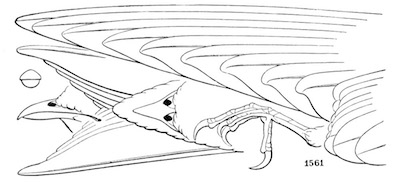
Progne subis. 1561
Sp. Char. (No. 1,561 ♂.) Entirely lustrous steel-blue, with a purplish gloss; the tail-feathers and the wings, except the lesser and middle coverts, and edge inside, dull black scarcely glossed. Tibiæ dark brownish. A concealed patch of white on the sides under the wings. Concealed central portion of anal feathers light whitish-gray.
(No. 1,129 ♀.) Above somewhat similar, but much duller. Beneath smoky brownish-gray, without lustre, paler behind, and becoming sometimes quite whitish on belly and crissum, but all the feathers always with dusky shafts, and more or less clouded with gray centrally, even though fading into whitish to the edges. This is particularly appreciable in the longer crissal feathers. The edges of the dark feathers of throat and jugulum are usually paler, imparting somewhat of a lunulated appearance, their centres sometimes considerably darker, causing an appearance of obsolete spots. There is a tendency to a grayish collar on sides of neck, and generally traceable to the nape; this, in one specimen (5,492) from California, being hoary gray, the forehead similar.
The young male of the second year is similar to the female, with the steel-blue appearing in patches.
Total length (of 1,561), 7.50; wing, 6.00; tail, 3.40; difference between inner and outer feather, .75; difference between first and ninth quills, 2.88; length of bill from forehead, .55; from nostril, .34; along gape, .94; width of gape, .74; tarsus, .61; middle toe and claw, .80; claw alone, .25; hind toe and claw, .54; claw alone, .27.
Hab. The whole of the United States and the Provinces; Saskatchewan; Cape St. Lucas and Northern Mexico (winter); Orizaba (Sumichrast); Bermuda. Accidental in England. South American and West Indian birds apparently belong to other races.
Many Western adult males are considerably less violaceous than any Eastern one; but there is so much variation in this respect among specimens from one locality, that this difference in lustre does not seem of much importance.
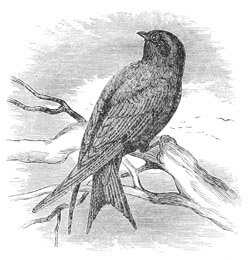
Progne subis.
An adult female (No. 61,361, G. A. Boardman) from Lake Harney, Florida, is so unlike all other specimens in the collection as to almost warrant our considering it as representing a distinct local race. It differs from females and young males of all the other races (except elegans, from which it differs in other striking particulars) in the following respects: Above, the lustrous steel-blue is uninterrupted, the forehead and nape being uniform with the other portions; beneath, dark smoky-gray, inclining to whitish on the middle of the abdomen; the jugulum and crissum have a faint gloss of steel-blue, the feathers of the latter bordered with grayish-white. The chief difference from elegans is in lacking the conspicuous grayish-white border to the feathers of the whole lower part, the surface being uniform instead of conspicuously squamated. Wing, 5.60; tail, 3.00; fork of tail, .80 deep.
Habits. The Purple Martin is emphatically a bird common to the whole of North America. It breeds from Florida to high northern latitudes, and from the Atlantic to the Pacific. It is very abundant in Florida, as it is in various other parts of the country farther north, and the large flocks of migrating birds of this species which pass through Eastern Massachusetts the last of September attest its equal abundance north of the latter State. It occurs in Bermuda, is resident in the alpine regions of Mexico, and is also found at Cape St. Lucas. Accidental specimens have been detected in England and in Ireland. It is abundant on the Saskatchewan. Burmeister states that this species is common in the vicinity of Rio de Janeiro, and that it is distributed in moderate abundance through the whole of tropical South America. Von Pelzeln also cites it as occurring on the Rio Negro and at Manaqueri through the three winter months, nesting in old buildings and in holes in the rocks. It is, however, quite possible that they refer to an allied but distinct species.
In a wild state the natural resort of this species, for nesting and shelter, was to hollow trees and crevasses in rocks. The introduction of civilized life, and with it of other safer and more convenient places, better adapted to their wants, has wrought an entire change in its habits. It is now very rarely known to resort to a hollow tree, though it will do so where better provision is not to be had. Comfortable and convenient boxes, of various devices, in our cities and large towns, attract them to build in small communities around the dwellings of man, where their social, familiar, and confiding disposition make them general favorites. There they find abundance of insect food, and repay their benefactors by the destruction of numerous injurious and noxious kinds, and there, too, they are also comparatively safe from their own enemies. These conveniences vary from the elegant martin-houses that adorn private grounds in our Eastern cities to the ruder gourds and calabashes which are said to be frequently placed near the humbler cabins of the Southern negroes. In Washington the columns of the public buildings, and the eaves and sheltered portions of the piazzas, afford a convenient protection to large numbers around the Patent Office and the Post-Office buildings.
The abundance of this species varies in different parts of the country, from causes not always apparent. In the vicinity of Boston it is quite unusual, though said to have been, forty years since, quite common. There their places are taken by the H. bicolor, who occupy almost exclusively the martin-houses, and very rarely build in hollow trees.
Sir John Richardson states that it arrives within the Arctic Circle earlier than any other of its family. It made its first appearance at Great Bear Lake as early as the 17th of May, when the ground was covered with snow, and the rivers and lakes were all icebound.
In the Southern States it is said to raise three broods in a season; in its more northern distribution it raises but one. Their early migrations expose the Martins to severe exposure and suffering from changes of weather, in which large numbers have been known to perish. An occurrence of this kind is said to have taken place in Eastern Massachusetts, where nearly all the birds of this species were destroyed, and where to this day their places have never been supplied.
Within its selected compartment the Martin prepares a loose and irregular nest. This is composed of various materials, such as fine dry leaves, straws, stems of grasses, fine twigs, bits of string, rags, etc. These are carelessly thrown together, and the whole is usually warmly lined with feathers or other soft materials. This nest is occupied year after year by the same pair, but with each new brood the nest is thoroughly repaired, and often increased in size by the accumulation of new materials.
The Martins do not winter in the United States, but enter the extreme Southern portions early in February. Audubon states that they arrive often in prodigious flocks. On the Ohio their advent is about the 15th of March, and in Missouri, Ohio, and Pennsylvania about the 10th of April. About Boston their appearance is from the 25th of April to the middle of May. Mr. Audubon states that they all return to the Southern States about the 20th of August, but this is hardly correct. Their departure varies very much with the season. In the fall of 1870 they were to be found in large flocks, slowly moving southward, but often remaining several days at a time at the same place, and then proceeding to their next halt. Their favorite places for such stops are usually a high and uninhabited hillside near the sea.
The Martin is a bold and courageous bird, prompt to meet and repel dangers, especially when threatened by winged enemies, never hesitating to attack and drive them away from its neighborhood. It is therefore a valuable protection to the barnyard. Its food is the larger kinds of insects, especially beetles, in destroying which it again does good service to the husbandman. The song of the Martin is a succession of twitters, which, without being musical, are far from being unpleasant; they begin with the earliest dawn, and during the earlier periods of incubation are almost incessantly repeated. The eggs of the Purple Martin measure .94 of an inch in length by .79 in breadth. They are of an oblong-oval shape, are pointed at one end, are of a uniform creamy-white, and are never spotted. They are quite uniform in size and shape. Eggs from Florida are proportionally smaller than those from the Northern States.
Progne subis, var. cryptoleuca, Baird.
CUBAN MARTIN.
Progne cryptoleuca, Baird, Rev. Am. Birds, 1864, 277. Hirundo purpurea, D’Orb. Sagra’s Cuba, Ois. 1840, 94 (excl. syn.). Progne purpurea, Cab. Jour. 1856, 3.—Gundlach, Cab. Jour. 1861.
Sp. Char. (No. 34,242, ♂). Color much as in P. subis,—rich steel-blue, with purple or violet gloss; the wings and tail, however, much more decidedly glossed, and with a shade of greenish. The feathers around the anus and in the anterior portion of crissum with dark bluish down at base, pure snowy-white in the middle, and then blackish, passing into the usual steel-blue. The white is entirely concealed, and its amount and purity diminish as the feathers are more and more distant, until it fades into the usual gray median portion of the feather. The usual concealed white patch on the sides under the wings. Total length, 7.60; wing, 5.50; tail, 3.40; perpendicular depth of fork, .86; difference between first and ninth primary, 2.75; length of bill from forehead, .55; from nostril, .34; along gape, .86; width, .58; tarsus, .53; middle toe and claw, .79; claw alone, .24; hind toe and claw, .52; claw alone, .25.
Female (17,730, Monte Verde, Cuba, May 2; C. Wright). Above steel-blue, less glossy than in the male, and becoming lustreless dark smoky-brown on the forehead. Head, laterally and beneath, with jugulum and sides, uniform brownish-gray (without darker shafts or lighter borders to feathers, as in subis); whole abdomen, anal region, and crissum snowy-white, including the shafts. Wing, 5.40; tail, 2.80; fork of tail, .70 deep.
Young male (10,368, Cape Florida, May 18, 1858; G. Wurdemann). Similar to the female, but the steel-blue above more brilliant and continuous, the forehead and wings being nearly as lustrous as the back; throat and jugulum mixed with steel-blue feathers, and crissum with some feathers of steel-blue bordered with whitish. Wing. 5.40; tail, 2.90; fork of tail, .80 deep.
Hab. Cuba, and Florida Keys? (Perhaps Bahamas.)
This species has a close external resemblance to P. subis, for which it has usually been mistaken. It is of nearly the same size, but the feet are disproportionately smaller and weaker; while the wings are shorter, the tail is as long and more deeply forked; the feathers considerably narrower, and more attenuated (the outer .40 wide, instead of .46). The colors above are more brilliant, and extend more over the greater wing-coverts and lining of wings, while the quills and tail-feathers have a richer gloss of purplish, changing to greenish. An apparently good diagnostic feature is the concealed pure white of the feathers about the anal regions, replaced in subis by grayish, rarely approximating to whitish.
A Progne collected by Mr. Wright, at Monte Verde, is duller in color than that from Remedios, but has still more concealed white below, in the median portion, not only of the anal feathers, but of those of the entire crissum and of the belly. A female bird, which I presume to be the same species, can scarcely be distinguished from the female of dominicensis, except in the brownish shafts of the longer crissal feathers, and an almost imperceptible tinge of brownish in the webs of the same feathers. It is almost exactly like the P. leucogaster of Mexico and Central America.
This species is included in the North American fauna in consequence of the capture of a specimen (No. 10,368 ♂ juv., May 18, 1858) at Cape Florida, which is with scarcely a doubt referable to it. This specimen is a young male in its second year, so that it is difficult to ascertain positively its relationship to the two allied species; but as it agrees perfectly in its proportions with cryptoleuca, and its plumage differs from the corresponding one of subis in essential respects, we have little hesitation in referring it to the former.
Nothing distinctive is recorded as to the habits of this bird.
Genus PETROCHELIDON, Cabanis.
Petrochelidon, Cab. Mus. Hein. 1850, 1851, 47. (Type, Hirundo melanogaster, Swains. = P. swainsoni, Scl.)
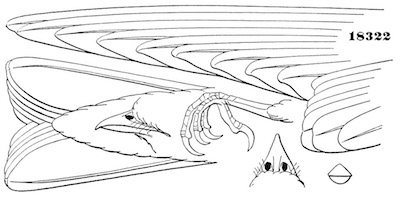
Petrochelidon lunifrons. 18322
Gen. Char. Bill stout and deep, somewhat as in Progne. Nostrils entirely superior, open, without overhanging membrane on the inner (or upper) side, but somewhat overhung by short bristles, seen also along base of inner mandible and in chin. Legs stout; the tarsi short, not exceeding the middle toe exclusive of its claw; feathered all round for basal third or fourth, though no feathers are inserted on the posterior face. Tail falling short of the closed wings, nearly square or slightly emarginate; the lateral feathers broad to near the ends, and not attenuated.
Of this genus as restricted we have but one species in North America, although several others occur in the West Indies and the southern parts of the continent. All have the back steel-blue, with concealed streaks of white; the rump, crissum, and a narrow nuchal band, and usually the forehead, chestnut.
Petrochelidon lunifrons, Baird.
CLIFF SWALLOW; EAVE SWALLOW.
Hirundo lunifrons, Say, Long’s Exp. II, 1823, 47 (Rocky Mts.).—Cassin; Brewer, N. A. Ool. I, 1857, 94, pl. v, No. 68.73 (eggs).—Baird, Birds N. Am. 1858, 309.—Lawrence, Ann. N. Y. Lyc. 1861, 317 (Panama R. R.; winter).—Verrill, Pr. Bost. N. H. Soc. 1864, 276 (migration and history).—Lord, Pr. R. A. Inst. Woolwich, IV, 1864, 16 (Br. Col.; nesting).—Cooper & Suckley, P. R. R. XII, II, 184 (Wash. Terr.).—Dall & Bannister, 279 (Alaska).—Cooper, Orn. Cal. 1, 1870, 104.—Samuels, 256. Petrochelidon l. Baird, Review, 1864, 288. H. opifex, Clinton, 1824. H. respublicana, Aud. 1824. H. fulva, Bon. (not of Vieillot).—Aud. Orn. Biog. I, pl. lviii.—Ib. Birds Am. I, pl. xlvii.—Maxim. Cab. Jour. VI, 1858, 100.
Sp. Char. (No. 18,322 ♂.) Top of head glossy black, with greenish lustre; back and scapulars similar, but rather duller, and somewhat streaked by the appearance of the white sides of the feathers,—the bases of the feathers, however, being plumbeous. Chin, throat, and sides of head, chestnut-brown, this extending round on the nape as a distinct continuous collar, which is bounded posteriorly by dull grayish. The chestnut darkest on the chin, with a rich purplish tinge. Rump above and on sides paler chestnut (sometimes fading into whitish). Upper tail-coverts grayish-brown, edged with paler, lighter than the plain brown of the wings and tail. Forehead, for the length of the bill, creamy-white, somewhat lunate, or extending in an acute angle, a little over the eye; a very narrow blackish frontlet; loral region dusky to the bill. A patch of glossy black in the lower part of the breast, and a few black feathers in the extreme chin, the latter sometimes scarcely appreciable. Under parts dull white, tinged with reddish-gray on the sides and inside of the wings. Feathers of crissum brownish-gray, edged with whitish, with a tinge of rufous anteriorly (sometimes almost inappreciable). Nest of mud, lined; built against rocks or beams; opening sometimes circular, on the side; sometimes open above; eggs spotted.
Total length, 5.10; wing, 4.50; tail, 2.40, nearly even; difference of primary quills, 2.10; length of bill from forehead, .38, from nostril, .25, along gape, .60, width, .50; tarsus, .48; middle toe and claw, .72; claw alone, .22; hind toe and claw, .44; claw alone, .20.
Hab. Entire United States from Atlantic to Pacific, and along central region to Arctic Ocean and Fort Yukon; Panama in winter. Not noted at Cape St. Lucas, in Mexico, or in West Indies.
There is no difference between the sexes, but the young bird is very different from the adult in the following particulars: the steel-blue above is replaced by a lustreless dusky-brown, the feathers (except on head) being margined with a creamy tint; the neck merely tinged with rufous; the throat has only a dusky suffusion, and the chin is much mixed with white; the frontal patch is obsolete.
A closely allied species from Mexico, P. swainsoni (see Baird, Rev. Am. Birds, 1865, 290), possibly yet to be found near our southern border, differs as follows:—
Frontlet reddish-white, with narrow band of black along upper mandible lunifrons.
Frontlet chestnut-brown, without black at base of upper mandible. Size smaller swainsoni.
Sometimes (as in 11,027 ♀ and 11,025 ♂, Fort Bridger) the black patch extends upward, somewhat broken, however, to the bill.
Habits. The early history of the Cliff Swallow must always remain involved in some obscurity, so far as concerns its numbers and distribution before the first settlement of the country, and even down to the early portion of the present century. Its existence was unknown to Mr. Wilson, and it was unknown to other naturalists until obtained by Say, in Long’s expedition to the Rocky Mountains in 1820. It is now known to occur nearly throughout North America, and to breed from Pennsylvania to the Arctic regions, and from the Atlantic to the Pacific. Yet to many parts of the country it is a new-comer, where, a few years since, it was entirely unknown. It seems to be probable that at first this species was to be found only in certain localities that offered favorable places whereon to construct their nests. Where high limestone cliffs abound, these birds may have always occurred, although escaping observation.
In the same year that Long discovered this species among the Rocky Mountains (1820), Sir John Franklin’s party also met with it between the Cumberland House and Fort Enterprise, and on the banks of Point Lake, in latitude 65°. In June, 1825, a number of these birds made their first appearance at Fort Chippewyan, and built their nests under the eaves of the house. This fort had then existed many years, and trading-posts had been in existence a century and a half, and yet this was the first instance of its placing itself under the protection of man throughout that wide extent of territory. Mr. Audubon met with this species at Henderson, on the Ohio, in 1815. Two years later he found a colony breeding in Newport, Ky., which dated back to the same year. Several other colonies in that neighborhood also first appeared in the same year. In 1837 I received their eggs from Coventry, Vt., at which time they were a new species to me. They were there known as the “Eave Swallow,” and the time of their first appearance could not be determined. I first met with them in 1839, at Jaffrey, N. H., where they had made their first appearance the year before, and were not then known to be anywhere else in that vicinity. The same year I afterwards found them in Burlington, Vt., where they had been known only for three years. When or where they first appeared in Massachusetts is not known. I first observed a large colony of them in Attleborough in 1842. Its size indicated the existence of these birds in that place for several years. The same year they also appeared, apparently for the first time, in Boston, Hingham, and in other places in the neighborhood.
In 1824, De Witt Clinton read a paper to the New York Lyceum, stating that he had met with these birds at Whitehall, N. Y., at the southern end of Lake Champlain, in 1817, about the time of their first appearance on the Ohio; and Rev. Zadock Thompson met with them in Randolph, Vt., at about the same period. General Dearborn noticed them for the first time in Winthrop, Me., in 1830. They first appeared at Carlisle, Penn., in 1841.
Professor Verrill discovered, in 1861, a large colony of these birds breeding on the high limestone cliffs of Anticosti, apparently in their original condition, and entirely removed from the influences of man. This suggested an inquiry as to their early presence in Northeastern America. From the information he received, he was led to conclude that this Swallow was known to certain parts of Maine earlier than its first discovery anywhere in the West. Whether these birds were indigenous to the West or not cannot now be determined. That they were discovered there only so recently as 1820 proves nothing. We only know that in certain localities—such as Rock River on the Mississippi, and at Anticosti on the St. Lawrence—their occurrence in large numbers in their former normal condition of independence suggests in either locality an equally remote beginning. It is possible, and even probable, that in favorable localities in various parts of the country they existed in isolated colonies. The settlement of the country, and the multiplication of convenient, sheltered, and safe places for their nests, gradually wrought a change in their habits, and greatly multiplied their numbers. At St. Stephen, N. B., and in that neighborhood, Mr. Boardman found this species as abundant in 1828 as they have been at any time since. They were then very plentiful under the eaves of several old barns in that part of the country. Yet twelve years afterward they were entirely unknown on the lower Kennebeck.
Dr. Cooper found this to be an abundant species in California, on the coast, where they breed on the cliffs, and have all the appearance of being indigenous. They appear at San Diego as early as March 15, a week before the Barn Swallow, and do not leave until October. They build even in the noisy streets of San Francisco. Dr. Cooper observed them catching young grasshoppers, which is certainly unusual food for Swallows, and one that has proved fatal to young Barn Swallows when fed to the latter in confinement. At Santa Cruz they bred as early as April 12, and had second broods July 5.
The nests of this Swallow, when built on the side of a cliff or in any exposed position, are constructed in the shape of a retort, the larger portion adhering to the wall, arched over at the top and projecting in front, with a covered passage-way opening at the bottom. The normal original nest, in a state of nature, is an elaborate and remarkably ingenious structure, sheltering its inmates from the weather and from their many enemies. Since they have sought the shelter of man and built under the eaves of barns and houses, the old style of their nests has been greatly changed, and the retort-like shape has nearly disappeared.
In building and in repairing their nests they work with great industry, and often complete their task with wonderful celerity. Where they exist in a large colony, it is not an uncommon thing to see several birds at work upon the same nest,—one bird, apparently the female owner, always assisting and directing the whole. After the work of construction has gone so far as to permit the occupation of the nest, it is often to be observed that the task of completing and improving the structure is kept up by the male. In a large colony of these Swallows, whose nests were built under the projecting roof of a barn in a small island in the Bay of Fundy, every nest was as open as are those of the Barn Swallow. These birds had been encouraged to build by the owner, and boards had been placed above and below their nests, of which they at once took advantage to build an unusual nest. These nests are made of various kinds of adhesive earth and mud. They are neatly and warmly lined with fine dry grasses and leaves, intermingled with feathers, wool, and other soft, warm substances. It has been thought that the mud of which these nests are composed is agglutinated by the saliva of the birds; but of this I have never been able to detect any evidence in the nests themselves, the crumbling nature of which when dry is against this supposition; and the birds themselves are often to be seen about puddles of water, apparently gathering materials.
When the nests of a large colony are invaded, the birds manifest great uneasiness, collecting in a swarm over the head of the intruder, wheeling around in circles, uttering loud outcries, and even flying close to his head, as if to attack him, with loud snapping of the bills.
The song of this Swallow is an unmusical creak, rather than a twitter, frequent rather than loud, and occasionally harsh, yet so earnest and genial in its expression that its effect is far from being unpleasant.
The ground-color of their eggs is white, and they are marked with dots, blotches, and points of reddish-brown. These markings vary greatly in size, number, and distribution. They are usually chiefly about the larger end. In shape they are usually less elongated than those of the Barn Swallow, and their markings are larger. This is not, however, invariable, and the two kinds are not always distinguishable. In length they vary from .875 of an inch to .75, and their average breadth is .60.
Genus HIRUNDO, Linn.
Hirundo, Linn. Syst. Nat. I, 10th ed. 1758, 191. (Type, H. rustica, Linn.)
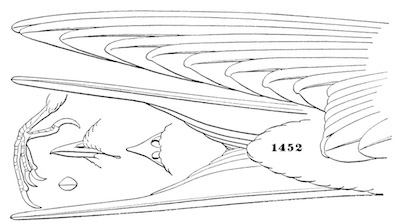
Hirundo horreorum. 1452
Under the generic head of Hirundo I propose to combine several groups of American Swallows agreeing in moderate, depressed bill, with straight commissure, and lateral nostrils overhung by membrane; the tarsi feathered only at the upper end, or else entirely bare; the lateral claws moderate, not extending beyond the base of the median; the edge of the outer primary without hooks; the tail variable in character, from a very deep fork to a slight emargination only.
Subgenera.
Tarsi slightly feathered on inner face at upper end; equal in length to middle toe without claw.
Tail very deeply forked … Hirundo.
Tail slightly forked or emarginate … Tachycineta.
Tarsi entirely naked; lengthened equal to middle toe and half its claw.
Tail considerably forked … Callichelidon.[69]
Subgenus HIRUNDO, Linn.
Gen. Char. Nostrils lateral. Tarsi short, not exceeding middle toe without its claw; the upper joint covered with feathers, which extend a short distance along the inner face of tarsus. Tail very deeply forked; the lateral feather much attenuated, twice as long as the middle. Basal joint of middle toe free for terminal fourth on outside, for half on inside. Nest partly of mud, and lined with feathers; eggs spotted.
In type, and in American species, the forehead and throat rufous; a black pectoral collar; tail-feathers with large light spots on inner webs.
But one species, so far as known, of this subgenus as restricted, belongs to America. There are, however, quite a number known in the Old World.
Hirundo horreorum, Barton.
BARN SWALLOW.
Hirundo horreorum, Barton, Fragments N. H. Penna. 1799, 17.—Baird, Birds N. Am. 1858, 308; Rev. 294.—A. & E. Newton, Ibis, 1859, 66 (Sta. Cruz; transient).—Sclater & Salvin, Ibis, 1859, 13 (Guatemala).—Sclater, P. Z. S. 1864, 173 (City of Mex.)—Lawrence, Ann. N. Y. Lyc. 1861, 316 (Panama).—Cooper & Suckley, P. R. R. Rep. XII, II, 184 (south of Columbia River).—Dall & Bannister, 279 (Alaska).—Cooper, Orn. Cal. 1, 1870, 103.—Samuels, 254. Hirundo rufa, Vieill.—Cassin, Ill.—Brewer, N. Am. Ool. I, 1857, 91, pl. v, fig. 63-67 (eggs).—Cab. Jour. IV, 1856, 3 (Cuba; spring and autumn).—Reinhardt, Ibis, 1861, 5 (Greenland; two specimens).—Gundlach, Cab. Jour. 1861, 328 (Cuba; common). Hirundo americana, Wilson; Rich.; Lembeye, Aves de Cuba, 1850, 44, lam. vii, fig. 2. Hirundo rustica, Aud. Orn. Biog. II, pl. clxxiii.—Ib. Birds Am. I, pl. xlviii.—Jones, Nat. Hist. Bermuda, 34 (Bermudas; Aug. and Sept.).
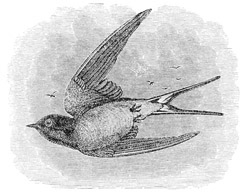
Hirundo horreorum.
Sp. Char. Tail very deeply forked; outer feathers several inches longer than the inner, very narrow towards the end. Above glossy blue, with concealed white in the middle of the back. Throat chestnut; rest of lower part reddish-white, not conspicuously different. A steel-blue collar on the upper part of the breast, interrupted in the middle. Tail-feathers with a white spot near the middle, on the inner web. Female with the outer tail-feather not quite so long. Length, 6.90 inches; wing, 5.00; tail, 4.50.
Hab. Whole of the United States; north to Fort Rae, Slave Lake; Greenland; south in winter to Central America and West Indies; Panama (Lawr.); Plateau of Mexico (breeds, Sumichrast); Veragua, Chiriqui (Salvin). Not found at Cape St. Lucas. South America?
In young birds, the frontal chestnut band is maller and less distinct.
It is still a question whether a South American resident species (H. erythrogaster) is identical or not. The only two specimens of the latter (21,007 and 21,008, Vermejo, Feb., 1860; C. Wood) have a very much less violaceous upper plumage than North American examples, the blue above having even a greenish tinge. They are moulting, unfortunately, so that they cannot be satisfactorily compared; except in the respect pointed out, however, they appear to be identical with North American examples.
The European H. rustica is perfectly distinct, though closely allied. It differs essentially from the American H. horreorum in much longer outer tail-feathers, and in having a very broad, continuous collar of steel-blue across the jugulum, entirely isolating the chestnut of the throat; the abdomen appears to be much more whitish than in the American species.
Many specimens of H. horreorum show a continuous collar, but then the two lateral crescents are but just barely connected. In No. 2,191 ♀, Carlisle, Penn., May, there is an indication of as broad a collar as in the European species; but the area, though sharply bounded, is not uniformly black, being much mixed centrally with light rufous.
Specimens of H. horreorum from both coasts of North America appear to be perfectly identical.
Habits. No one of all our North American birds is more widely diffused, more generally abundant, wherever found, or better known, than the graceful and familiar Barn Swallow. And no one is more universally or more deservedly a favorite. Found throughout North America from Florida to Greenland and from ocean to ocean, and breeding nearly throughout the same wide extent, its distribution is universal. Venturing with a confiding trust into our crowded cities, and building their elaborate nests in the porches of the dwellings, as well as entering in greater numbers the barns and farm-buildings of the agriculturists and placing themselves under the protection of man, they rarely fail to win for themselves the interest and good-will they so well deserve. Innocent and blameless in their lives, there is no evil blended with the many benefits they confer on man. They are his ever-constant benefactor and friend, and are never known, even indirectly, to do him any injury. For their daily food, and for that of their offspring, they destroy the insects that annoy his cattle, injure his fruit-trees, sting his fruit, or molest his person. Social, affectionate, and kind in their intercourse with each other; faithful and devoted in the discharge of their conjugal and parental duties; exemplary, watchful, and tender alike to their own family and to all their race; sympathizing and benevolent when their fellows are in any trouble,—these lovely and beautiful birds are bright examples to all, in their blameless and useful lives.
This Swallow passes the winter months in Central and South America as far south as Brazil and Paraguay, and the West Indies, and is found throughout the year in the Plateau of Mexico. It appears in the Southern States in March, and in the Central States early in April. In the latter part of this month it reaches New York and New England, becoming abundant near Boston about the first of May. Sir John Richardson found them breeding as far north as latitude 67° 30′. They reached Fort Chippewyan, latitude 57°, as early as the 15th of May, taking possession of their nests. It has been found throughout Canada and in all the British Provinces, has been met with in New Mexico, and is common in certain portions of Texas and the Indian Territory. Dr. Cooper states it to be less abundant on the Pacific than on the Eastern coast,—a fact attributable to the lack of suitable places in which to build. As settlements have multiplied, these birds have gradually increased about farms near the coast. In the wild districts they build in the caves that abound in the bluffs along the sea-shore from San Domingo to Columbia River. Dr. Suckley found them also moderately abundant about the basaltic cliffs, near Fort Dalles, Oregon. They are much more abundant about the coast than farther inland.
Mr. Ridgway found this Swallow a very common species in all the rocky localities in the vicinity of water, but not so numerous as the lunifrons.
In May it was particularly numerous in the neighborhood of Pyramid Lake, where its nests were built among the “tufa domes,” attached to the roofs of the caves. It was seldom that more than one or two pairs were found together.
In July he found a nest that contained young, in a cave among the limestone cliffs of the cañons of the East Humboldt Mountains, at an altitude of about eight thousand feet. Many of their nests were found in May, in the caves of the tufa rocks, on the shores of Pyramid Lake, as well as on the islands in the lake.
Mr. Hepburn writes that he found this Swallow widely diffused along the Pacific coast, as far to the north as Sitka. In California he found it very local, common near the coast, rare inland. Its earliest appearance is March 26, the great bulk leave in August, and the last stragglers are gone before the last of September. They breed in caves and crevices of rocks, and also under the sides of the wooden bridges that span the gullies at San Francisco. Two broods are hatched in a year. The earliest egg was found on the 30th of April, but they are usually a fortnight later. The second laying is about the first of July, and no eggs were found later than the 4th of August. It is at all times quite common to find nests with fresh eggs close to others with half-grown young.
Mr. J. K. Lord publishes an interesting account of a visit made by a solitary pair of Barn Swallows to his party when encamped at Schyakwateen, in British Columbia. A small shanty, loosely built of poles, and tightly roofed, was in constant use as a blacksmith’s shop. Early one summer morning late in June, a pair of Swallows perched on the roof of this shed, without exhibiting the slightest fear of the noise made by the bellows or the showers of sparks that flew all around. Presently they entered the house and carefully examined the roof and its supporting poles, twittering to each other all the while in the most excited manner. At length the important question appeared to be settled, and the following day they commenced building on one of the poles immediately over the anvil. Though the hammer was constantly passing close to their structure, these birds kept steadily at their work. In about three days the rough outline of the nest had been constructed. Curious to see from whence they procured their materials, Mr. Lord tracked them to the stream where, on its edge, they worked up the clay and fine sand into a kind of mortar with their beaks. They worked incessantly, and in a few days their nest was finished, the mud walls having finally been warmly lined with soft dry grasses and the feathers and down of ducks and geese. This trustful pair seemed to know no fear. The narrator often stood on a log to watch them, with his face so near that their feathers frequently brushed against it as they toiled at their work. Soon the nest was completed. Five eggs were laid, which were never left once uncovered until they were hatched, the female sitting the greater part of the time. They were fed with great assiduity by the parents, and grew rapidly. In leaving the nest, two of the young birds fell to the ground, but were picked up by the blacksmith, and placed with the others on their roosting-place. A few days’ training taught them the use of their wings, and they soon after took their departure.
Professor Reinhardt records its occurrence in Greenland, at Fiskenæsset and at Nenontalik.
The natural breeding-places of these birds, before the settlement of the country, were caves, overhanging rocky cliffs, and similar localities. Swallow Cave, at Nahant, was once a favorite place of resort, and in the unsettled portions of the country they are only found in such situations. As the country is settled they forsake these places for the buildings of the farm, and their numbers rapidly increase. In the fur countries and in all the Pacific coast, they still breed in and inhabit caves, chiefly among limestone rocks.
Where the opportunity offers, they prefer to place their nests on the horizontal rafters of barns. Built in this situation, the nests have an average height and a breadth of about five inches. The cavity is two inches deep and three inches wide, at the rim. The nests are constructed of distinct layers of mud, from ten to twelve in number, and each separated by strata of fine dry grasses. These layers are each made up of small pellets of mud, that have been worked over by the birds and placed one by one in juxtaposition until each layer is complete. These mud walls are an inch in thickness. When they are completed, they are warmly stuffed with fine soft grasses and lined with downy feathers. When built against the side of a house, a strong foundation of mud is first constructed, upon which the nest is erected. In this case the nest is much more elongate in shape and more strongly made.
A striking peculiarity of these nests is frequently an extra platform, built against, but distinct from the nest itself, designed as a roosting-place for the parents, used by one during incubation at night or when not engaged in procuring food, and by both when the young are large enough to occupy the whole nest. One of these I found to be a separate structure from the nest, but of similar materials, three inches in length and one and a half in breadth. This nest had been for several years occupied by the same pair, though none of their offspring ever returned to the same roof to breed in their turn. Yet in some instances as many as fifty pairs have been known to occupy the rafters of the same barn.
In one instance Mr. Allen has known a pair of these Swallows to take possession of the nest of a pair of Cliff Swallows, placed under the eaves of a barn, driving off the rightful owners. The next year they built a nest in the same place, the old one having fallen down. But such instances are rare, and the attempt is often a failure.
The wonderful activity of this bird, its rapidity and powers of flight, are too striking a peculiarity of this species not to be mentioned. During their stay with us, from May to September, from morn to night they seem to be ever in motion, especially so before incubation, or after their young have flown. The rapidity of their tortuous evolutions, their intricate, involved, and repeated zigzag flights, are altogether indescribable, and must be witnessed to be appreciated. Wilson estimated that these birds fly at the rate of a mile a minute, but any one who has witnessed the ease and celerity with which they seem to delight in overtaking, passing, and repassing a train of cars moving at the rate of thirty miles an hour must realize that this estimate is far from doing full justice to their real speed.
The song of this Swallow, especially when on the wing, is very pleasing and sprightly. It is a succession of twittering notes uttered with great rapidity and animation. When alighted, their notes are delivered more slowly and with much less animation.
The attention of these birds to each other when sitting upon the nest, and to their young when hatched, is unremitting. The estimated numbers of small insects they collect for their own consumption and that of their nestlings is almost incredible. When the young are old enough to leave their nests the manœuvres of the parents to draw them out, and their assistance to them when practising their first short flights, are among the most curious and interesting scenes one can witness in his ornithological experiences; but space would fail me were I to attempt their details.
The number of the young is from four to six, and there are often two broods in a season. As soon as the second brood can fly, or early in September, they all prepare to leave. They usually collect in flocks of from one to several hundred, and depart within a few days of their first assembling. Large flocks pass along the coast of Massachusetts, from the north and east, early in September, often uniting as they meet, and passing rapidly on.
Their eggs have a ground-color of clear white, with a roseate tint when unblown. They are marked with spots of reddish and purplish-brown, varying in size and number, and chiefly at the larger end. They are smaller and more elongate than those of the lunifrons, and the markings are usually finer. Their greatest length is .94 of an inch, their least .75, and their mean .78. Their mean breadth is .56 of an inch, the greatest .62, and the least .50.
Subgenus TACHYCINETA, Cab.
Tachycineta, Cab. Mus. Hein. 1850, 1851, 48. (Type, H. thalassina, Sw.)
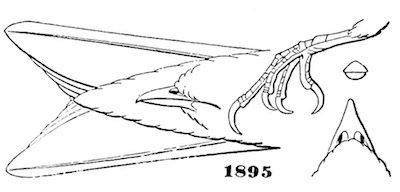
Hirundo thalassina. 1895
Gen. Char. Nostrils lateral, overhung or bordered internally by incumbent membrane. Tarsi with the tibial joint covered by overhanging feathers, adherent a short distance along inner face, about equal to middle toe without claw. Lateral toes equal. Adhesion of basal joint of middle toe variable. Tail emarginate only, or slightly forked; fork not exceeding half an inch in depth. Color blue or green above, with or without metallic gloss; with or without white rump. Entirely white beneath. Nest usually in holes of trees or rocks; eggs pure white, unspotted.
Of this section there are two North American species, differing as follows, both being green above and white beneath:—
Species.
Plumage above soft and velvety without metallic gloss. Sides of head, space around eyes, and whole under parts, white; with the feathers all plumbeous at base. Female duller in plumage. Young with bases of throat-feathers gray to roots.
T. thalassina. Above velvety-green, with various shades and tinges of violet and purple.
Plumage above compact, and with rich green metallic gloss. Sides of head to line with eyes like its upper part. Beneath white; the feathers of chin and throat, and generally of crissum, white to base. A concealed spot in jugulum. Female duller. Young with bases of throat-feathers pure white to roots.
T. bicolor. Above metallic-green. Inside of wings and axillars ash-color.
Hirundo bicolor, Vieill.
WHITE-BELLIED SWALLOW.
Hirundo bicolor, Vieill. Ois. Am. Sept. I, 1807, 61, pl. xxxi.—Aud. Orn. Biog. I, pl. xcviii.—Ib. Birds Am. I, pl. xlvi.—Cassin.—Brewer, N. Am. Oöl. I, 1857, 100, pl. iv, fig. 47 (eggs).—Lembeye, Aves de Cuba, 1850, 46, lam. vii, fig. 2.—Baird, Birds N. Am. 1858, 310.—Lord, Pr. R. A. Inst. Woolwich, IV, 1864, 15 (Br. Columbia; nesting).—Jones, Bermudas, 34 (Sept. 22, 1849).—Cooper & Suckley, P. R. R. Rep. XII, II, 184.—Dall & Bannister, 279 (Alaska).—Samuels, 257.—Cooper, Orn. Cal. 1, 1870, 106. Petrochelidon bicolor, Sclater, P. Z. S. 1857, 201.—Ib. 1859, 364 (Xalapa).—Sclater & Salvin, Ibis, 1859, 13 (Guatemala). Tachycineta bicolor, Cab. Mus. Hein. 1850, 48; Jour. Orn. 1856, 4 (Cuba).—Gundlach, JJour. Orn. 1861, 330 (common in Cuba). Hirundo (Tachycineta) bicolor, Baird, Rev. Am. B. 1864, 296. Hirundo viridis, Wils. Hirundo leucogaster, Stephens.
Sp. Char. Glossy metallic bluish-green above; entirely white beneath. Female duller in color. Length, 6.25 inches; wing, 5.00; tail, 2.65.
Young bird dull sooty-gray above, much like that of H. thalassina; but may readily be distinguished by the feathers of the throat being pure white to their roots, instead of having the concealed bases grayish as in that species.
Hab. Whole United States, and north to Slave Lake, south to Guatemala; Bermuda; Cuba, common in winter. Breeds on table-lands of Mexico.
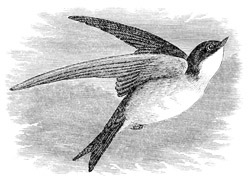
Hirundo bicolor.
Habits. This Swallow has quite an extended distribution. Found throughout North America in the seasons of its migrations, or breeding, it is only a little less restricted in its area of nesting than the preceding species. It breeds from latitude 38° to high Arctic regions, and is also resident throughout the year in the Plateau of Mexico. It is abundant in winter in the West Indies, in Central America, and in Northern South America. It is a common bird about Boston, where it replaces the Purple Martin, and is even more abundant in the British Provinces. Dr. Cooper also found it a very common species in the western portions of Washington Territory, where it was invariably found to breed in hollow trees. In California he states it to be a more or less constant resident, a few wintering in the southern portion of the State. He met with it both at San Diego and at Stockton, in February. He regards them as the hardiest of the Swallows, preferring the coast and the mountain-tops for their residence in that State. At Santa Cruz five or six pairs in 1866 were resident through the winter, where he saw them in January during the coldest of the season. They roosted in the knot-holes in the houses in which they had previously raised their young.
This Swallow, in the more thickly settled portions of the country in which it breeds, exhibits a marked departure in many of its habits from those observed in wilder regions. In the latter places we find it a comparatively wild species, avoiding the society of man, and breeding exclusively in hollow trees and stumps, and deserving the name by which it is known in the British Provinces, of the “Wood Swallow.” In the islands of Grand Menan, in 1851, where repeated attempts had been made to induce these birds to build in martin-boxes, the endeavor had been entirely unsuccessful. Yet the birds were so abundant that hardly a hollow tree or stump, on certain of the smaller islands, could be found, that did not contain a nest of this species. This is still the case on the Pacific coast, though not exclusively so. It was not until after the publication of his Ornithological Biography that Audubon was aware of any departure from this mode of nesting on the part of this Swallow, although it had not escaped the notice of Wilson.
In Eastern Massachusetts these birds have undergone an entire change of habit, breeding there exclusively in martin-boxes, and rarely, if ever, nesting in hollow trees,—a fact perhaps attributable to the scarcity of these opportunities along the sea-coast, where this bird is principally found. In Western Massachusetts, Mr. Allen states them to be not very common and the least abundant of the Swallows. Any sheltered and accessible box, however rough it may be, will answer its purpose, whether the more elaborate martin-house, or a mere candle-box with an open end. Mr. Audubon has known them to drive away a Barn Swallow from its nest, and to take possession, but this was probably exceptional. In one case, two small houses for birds put up in the same yard were taken possession of by a single pair of Swallows, and nests built in each; only one, however, of these was made use of. Whether this freak was the result of indecision or from a grasping selfishness, it is not possible to conclude, but apparently the former.
In the rural districts, even on the coast, these birds are not so abundant as in the cities, as in the latter they are less annoyed by other birds. The common Robin is often especially aggressive, seeking to drive them off his assumed premises. In one instance the Robin has been known to station himself on a platform in front of its nest for hours, and persistently refuse to permit its visits. Assistance was sought, and all the Swallows in the neighborhood came to the rescue. They sailed with angry cries over the head of the offender, at times darting down upon him as if to strike at him, but accomplishing nothing. The besieger maintained his ground until the writer intervened and drove him away, when the Swallows once more took possession, and fed their hungry nestlings in peace.
This species breeds from about latitude 38° to the extreme northern regions, and along the Arctic seas, wherever facilities for nesting are found. Richardson found them breeding in hollow trees on the Mackenzie River, in latitude 65°. Everywhere on both coasts they are very common, but are less numerous in the interior. Mr. Dall found it in Alaska from Fort Yukon to the sea. It was known to the Russians as the River Swallow. It was also met with in Sitka, by Bischoff. It has not been observed in Greenland.
During the breeding-season this species is more quarrelsome than any of its kindred, and is often more than a match for larger birds. Coming earlier in the season than the Purple Martin, it will often intrude itself into its premises and maintain possession. They are devotedly attached to their offspring, and bewail any accidents to them or any threatened peril. The same pair will return year after year to the same premises, and they soon become on familiar terms with the members of a family they frequently meet, so much so as to watch, when they have received materials for their nests, for a further supply, and will fly close to the person from whom they receive them. A pair which had thus, year after year, received supplies of feathers for their nests from the younger members of the family in whose yard their nest was built, would almost take them from the hands of their providers. This pair sat so close as to permit themselves to be taken from their nest, and when released would at once fly back to their brood. They build a loose, soft, and warm nest of fine soft leaves and hay, abundantly lined with down and feathers, with which the eggs are not unfrequently covered. The addition of soft and warm materials is often made during incubation, and the nest is thoroughly repaired before it is used for a second brood, of which they usually have two in a season.
The eggs are of a uniform pure white, and are never spotted. They have a delicate pinkish shade before they are blown. They are of an oblong-oval shape, one end more pointed than the other, and they vary considerably in size. They vary in length from .75 to .875 of an inch, and in breadth from .50 to .56.
Mr. Hepburn states that the great mass of these birds leave California in August, but that a few are resident during the winter. The principal accession to their numbers takes place about the end of February, and they become quite abundant by the end of March. In Vancouver they are a month later. In 1853 Mr. Hepburn states that a pair constructed their nest in a piece of canvass at the end of the yard-arm of a store-ship that lay off the levee at Sacramento. He first noticed them on the 28th of April, when the nest had already made some progress. By the 19th of May there were seven eggs in it which were slightly incubated. The nest was a great mass of hay and dried grasses, in the midst of which was a cup-shaped depression very neatly lined with feathers, some of which bent over, forming a slight dome.
Hirundo thalassina, Swains.
VIOLET-GREEN SWALLOW.
Hirundo thalassina, Swainson, Phil. Mag. I, 1827, 365 (Mexico).—Aud.—Brewer, N. A. Oöl. I, 1857, 102 (the fig. pl. v, fig. lxxiv of egg belongs to another species).—Baird, Birds N. Am. 1858, 311.—Lord, Pr. R. A. Inst. Woolwich, IV, 1864, 115 (Vancouver Isl.; nests in holes of trees).—Cooper & Suckley, P. R. R. Rep. XII, II, 185 (W. T.).—Cooper, Orn. Cal. 1, 1870, 107. Chelidon thalassina, Boie, Isis, 1844, 171. Tachycineta thalassina, Cab. Mus. Hein. 1850, 48. Hirundo (Tachycineta) thalassina, Baird, Rev. Am. B. 1864, 299. Petrochelidon thalassina, Sclater & Salvin, Ibis, 1859, 13 (Guatemala).—Ib. P. Z. S. 1864, 173 (City of Mex.).
Sp. Char. Tail acutely emarginate. Beneath pure white. Above soft velvety-green, with a very faint shade of purplish-violet concentrated on the nape into a transverse band. Rump rather more vivid green; tail-coverts showing a good deal of purple. Colors of female much more obscure. Length, 4.75; wing, 4.50; tail, 2.00.
Hab. Western and Middle Provinces of United States., south to Guatemala, east to the Upper Missouri. Breeds on Plateau of Mexico (Sumichrast).
Young birds are of a dull velvety grayish-brown, not unlike the shade of color of Cotyle riparia, but may be distinguished by the absence of the tuft of feathers at base of toes, and the gray (not white) bases of the feathers of under parts. There is only an ashy shade across the breast, not a pectoral band.
There is much variation among individuals regarding the distribution of the semi-metallic tints of the upper parts; generally the whole dorsal region is overlaid by a “dusting,” as it were, of soft brownish-purple; in specimens colored thus, the upper tail-coverts are pure dark-green, without a tinge of purple. In other specimens, on the contrary, the dorsal region is nearly pure green, that of the upper tail-coverts less golden, and mixed with a very beautiful rich soft violet.
Winter specimens from Guatemala and Mexico have the upper secondaries very sharply and broadly bordered terminally with pure white.
Habits. The Violet-green Swallow is a common bird, from the central plains of North America to the Pacific coast, and is found at different seasons from Washington Territory to South America. It has been found as far east as Nebraska, and in abundance at Fort Bridger, in Utah.
As observed, in Washington Territory, by Drs. Suckley and Cooper, it is said to arrive at Puget Sound early in May, and to frequent entirely the high prairies bordered with oak and other deciduous trees, in the knot-holes of which, or in deserted Woodpeckers’ holes, it breeds. Its song is described as pleasing and varied, but rather weak. They found it to be quite abundant in the interior of Oregon and of Washington Territory, and in its habits and mode of flight hardly distinguishable from the bicolor.
In California, according to the observations of Dr. Cooper, it arrives in Santa Clara Valley as early as March 15, where it chiefly frequents the groves of oaks along the sides of the valleys, across the whole Coast Range, excepting in the immediate neighborhood of the sea. Their nest, so far as known, is always in the knot-holes of oaks, and they have never been known to breed in the immediate vicinity of dwellings, excepting only when their favorite trees were so situated. It is generally in an inaccessible place, and their eggs are not often obtained. These are pure white, resembling those of the bicolor and the riparia. Townsend states that he found them nesting in the deserted nests of the H. lunifrons, but in this he may have been mistaken. The eggs he gave to Mr. Audubon as those of this species undoubtedly belonged to the lunifrons. They leave California for the south in September.
Dr. Coues also found this Swallow in Arizona, where it was the most abundant and characteristic Swallow of the pine regions of that Territory. It is a summer resident at Fort Whipple, where it arrives about March 20, and remains until late in September.
In the Province of Vera Cruz, Mr. Sumichrast found this Swallow resident, not only in the hot belt of the coast, but also in the temperate region and throughout the plateau, at almost all heights, and was almost everywhere very common.
Mr. Salvin also states that early in March great numbers occur near Duenas, Guatemala, where they remain for a short time. During that time they are to be found flying over the open land to the south of the Lake of Duenas.
Mr. Hepburn states that this Swallow has quite an extensive range along the Pacific coast, but is restricted as to the localities it inhabits. At the Pulgas Ranche, near San Francisco, it is even more common than the bicolor, while a few miles from thence not one is to be seen. He has also seen it on the banks of the Fresno, near its junction with the San Joaquin River, and again in the Yosemite Valley, without meeting with a single specimen in the intervening country. About Victoria this was the prevailing species. These Swallows, so far as Mr. Hepburn observed, always build in holes of trees. Their nest, he states, is formed of a few fine dry stems of grass, placed at the bottom of the hole, covered over with a thick mass of feathers. The eggs, he adds, are pure white, large for the size of the bird, measuring .81 of an inch in length by .50 in breadth. These Swallows have two broods in a season. In 1864 he noted their arrival in San Mateo County on the 28th of March.
Mr. Ridgway writes that he first met with the Violet-green Swallow in May, on the islands in Pyramid Lake. He there found it very abundant among the cliffs of calcareous tufa of which the island was composed. They were seen to enter the fissures of the rock to their nests within, which it was found impossible to reach. They were again seen in July among the limestone cliffs along the cañons of the East Humboldt Mountains, associated with the White-throated Swift, building like them in the small horizontal crevices or fissures on the face of the precipice. He was not able to get at more than two of their nests, the first in a horizontal fissure just wide enough to admit the hand, and about eight inches from the entrance. It contained five young. The nest was similar to that of the Bank Swallow, and was composed of sticks, straws, and feathers. In the other the female was dead on her nest, and the eggs were broken. They were white, like those of the H. bicolor.
In its flight this bird is said to greatly resemble the White-bellied Swallow, but is distinguishable by the contrast of the three colors of its upper plumage. These two species are rarely to be seen in the same localities, the bicolor preferring wooded, and this species rocky localities.
Mr. Lord states that this beautiful Swallow was common from the coast along the entire course of the boundary line, to the summit of the Rocky Mountains. They were among the earliest visitors at Colville, arriving in small flocks in March, but in greater numbers in May and June. They build in June, making their nests in holes in dead trees as high as they can get, and lay four or five eggs. The nest is made of feathers and soft hair. They assemble in large flocks before migrating in September. Mr. Lord felt pretty sure their nesting-holes were excavated in the soft wood by themselves, though their soft beak seems ill adapted to perform such labor.
Genus STELGIDOPTERYX, Baird.
Stelgidopteryx, Baird, Birds N. Am. 1858, 312. (Type, Hirundo serripennis, Aud.)
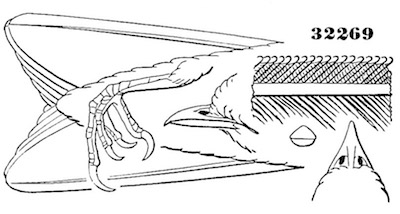
Cotyle serripennis. 32269
Gen. Char. Bill rather small; nostrils oval, superior, margined behind, but scarcely laterally by membrane, but not at all overhung; the axes of the outline converging. Frontal feathers soft, and, like chin, without bristles. Tarsi equal to middle toe without claw; the upper end covered with feathers all round, none at lower end. Basal joint of middle toe adherent externally nearly to end; internally, scarcely half. Lateral toes about equal, their claws not reaching beyond base of middle claw. Tail slightly emarginate; the feathers broad, and obliquely rounded at end. Edge of the wing rough to the touch; the shafts of the fibrillæ of outer web of outer primary prolonged and bent at right angles into a short stiff hook. Nest (of S. serripennis) in holes in banks; eggs pure white, unspotted.
Color dull brown above.
The great peculiarity of this genus consists in the remarkable roughness of the edge of the wing, said to occur also in Psalidoprocne, Cab. The object is uncertain, but is probably to enable the bird to secure a foothold on vertical or inclined rocks, among or on which it makes its nest. A favorite breeding-place of S. serripennis is in the piers and abutments of bridges, and these hooks might render essential aid in entering into their holes.
The birds of this genus have usually been referred to Cotyle, which, however, they resemble only in color. The nostrils are exposed, instead of being overhung; the tarsus is bare below, not feathered, and the lateral claws are considerably curved, and not reaching beyond the base of the lateral, as in Cotyle. The structure of the wing is very different.
There are at least five species or races of this genus in America, although only one belongs with certainty to the United States. A second, however, (S. fulvipennis), Mexican and Guatemalan, is not unlikely to occur in Arizona or New Mexico. This differs in having the chin and throat reddish-fulvous, not mouse-gray; the belly tinged with yellow.
Stelgidopteryx serripennis, Baird.
ROUGH-WINGED SWALLOW.
Hirundo serripennis, Aud. Orn. Biog. IV, 1838, 593.—Ib. Birds Am. I, 1840, 193, pl. li. Cotyle s. Bon. Consp. 1850, 342.—Cassin.—Brewer, N. Am. Oöl. I, 1857, 106, pl. iv, fig. 50 (eggs):—Baird, Birds N. Am. 1858, 313.—Lord, Pr. R. A. Inst. IV, 1864, 116 (Br. Columbia).—Cooper & Suckley, P. R. R. Rep. XII, II, 186 (W. Terr.).—Heermann, P. R. R. X; Williamson’s Rep. 36 (San Antonio, Tex.; breeding).—Cooper, Orn. Cal. 1, 1870, 110. Stelgidopteryx s. Baird, Birds N. Am. 1858, 312; Rev. 314.
Sp. Char. (No. 32,269 ♂.) Above smoky-brown, rather deeper on the head, perhaps a little paler on the rump. Larger quills and tail-feathers dusky-brown; the secondaries and greater coverts sometimes lighter along their external edges. The under parts (for about half the total length) from bill to and including breast, with the sides of body and lining of wings, mouse-gray, rather lighter along the throat; the rest of under parts, including crissum, white, the latter with the shafts sometimes dusky, and very rarely with dusky blotches at the ends of the longer feathers.
Young birds (as in 1,120) differ in a tinge of reddish-fulvous on the upper parts; the wing-coverts, secondaries, and inner primaries margined more or less broadly with a brighter shade of the same. The gray of the under parts is also washed with this color, especially on the chin and across the breast. The hooks of the edge of the wing have not yet become developed.
(No. 32,269 ♂, fresh specimen before being skinned.) Total length, 5.40; expanse of wings, 12.20; wing from carpal joint, 4.50.
(No. 32,269 ♂, prepared specimen.) Total length, 5.20; wing, 4.50; tail, 2.25, depth of fork, .15; difference of primaries, 2.28; length of bill from forehead, .40, from nostril, .24, along gape, .56, width of gape, .43; tarsus, .45; middle toe and claw, .57; claw alone, .19; hind toe and claw, .41; claw alone, .16.
Hab. Whole United States (exclusive of Northeastern States?) south to Central Mexico.
Habits. The Rough-winged Swallow was first met with by Audubon, in Louisiana, but described by him from specimens afterwards procured near Charleston, S. C. He knew nothing in regard to its habits, and its distribution was equally unknown to him. It has since been found, but nowhere very abundantly, in various parts of the United States. It has not been met with on the Atlantic coast farther to the north than New Jersey and Pennsylvania. On the Pacific coast it is more common. Dr. Suckley speaks of it as quite abundant both in Oregon and in Washington Territory. Dr. Cooper, in his Zoölogy of Washington Territory, speaks of it as common about the sandy cliffs of the bays and inlets of that coast, arriving near the Columbia in May, and remaining only until the middle of August, when all these Swallows go southwards, though their last brood is hardly able to fly. He says that they burrow holes in the soft sandy banks near the tops of cliffs, and have generally the same habits as the common Bank Swallow. They have no song, only a few chirping calls.
Dr. Cooper, in his Report on the birds of California, further states that this Swallow, in summer, is found throughout the lower portions of that State. He saw them at Fort Mojave as early as the 27th of February, and as he has met with them at San Diego in November, and also in January, he thinks they may winter within the State. He describes their burrows in the sandy banks of rivers as being to the depth of three feet, crowded very near together, and near the upper edge of the bank, in no wise different from the nesting of the common C. riparia. The nests are composed chiefly of dry grasses, with a few feathers, and contain five white eggs. Occasionally, however, they resort to natural clefts in the bank or in buildings, and to knotholes in trees. In the fall they congregate in great numbers about certain favorite spots, and keep much together in flocks. At night they roost in their burrows. In Arizona, according to Dr. Coues, they are summer residents, breeding abundantly, arriving late in April and remaining until nearly the last of September.
At Eagle Pass, Mr. Dresser met these birds, arriving from the South, on the 21st of February. There, and also at San Antonio, they were very common, breeding in the towns, making their nests under the eaves and in holes in the old walls, depositing their eggs by the 25th of April. Dr. Kennerly also found this Swallow very abundant along the Colorado River in February. Its flight seemed to him to be like that of the common Barn Swallow. Dr. Heermann frequently met with this species during the journey from the junction of the Gila and Colorado Rivers through Mexico, New Mexico, and Texas, to San Antonio. In the latter place he found them breeding almost entirely in crevices in the walls of houses.
In the vicinity of Washington, Dr. Coues found this Swallow a summer resident, but rather rare, arriving in the third week of April, and leaving about the middle of September.
Mr. Ridgway speaks of this bird as one of the most abundant Swallows of the West, inhabiting the river valleys, and breeding in holes in the banks of the rivers. He says that in Southern Illinois it is much more abundant than the C. riparia, though both nest in the same banks.
This species was first found breeding in Carlisle, Penn., by Professor Baird, in the summer of 1843. The following year I visited this locality early in June, and had an opportunity to study its habits during its breeding-season. We found the bird rather common, and examined a number of their nests. None that we met with were in places that had been excavated by the birds, although the previous season several had been found that had apparently been excavated in banks in the same manner with the Bank Swallow. All the nests (seven in number) that we then met with were in situations accidentally adapted to their need, and all were directly over running water. Some were constructed in crevices between the stones in the walls and arches of bridges. In several instances the nests were but little above the surface of the stream. In one, the first laying had been flooded, and the eggs chilled. The birds had constructed another nest above the first one, in which were six fresh eggs, as many as in the other. One nest had been built between the stones of the wall that formed one of the sides of the flume of a mill. Two feet above it was a frequented footpath, and, at the same distance below, the water of the mill-stream. Another nest was between the boards of a small building in which revolved a water-wheel. The entrance to it was through a knot-hole in the outer partition, and the nest rested on a small rafter between the outer and the inner boardings.
The nests were similar in their construction to those of the Bank Swallow, composed of dry grasses, straws, and leaves, and lined with a few feathers; but a much greater amount of material was made use of, owing, perhaps, to the exposed positions in which they were built.
The eggs, six in number, in every instance that we noticed, were pure white, about the size of those of the riparia, but a little more uniformly oblong in shape and pointed at one end. Their length varies from .78 to .69 of an inch, the average being .75. Their average breadth is .53 of an inch.
Genus COTYLE, Boie.
Cotyle, Boie, Isis, 1822, 550. (Type, Hirundo riparia, L.)
Gen. Char. Bill small; nostrils lateral, overhung by a straight-edged membrane. Tarsus about equal to middle toe without claw; feathered at upper end, especially on inner face, and having also a small tuft of feathers attached to posterior edge near the hind toe. Middle toe with basal joint adherent externally to near the end, half-way internally, the claws comparatively little curved, the lateral reaching beyond the base of the middle. Tail slightly forked. Color dull lustreless brown above, in riparia white beneath with gray pectoral band. Nests in holes in banks; eggs white.
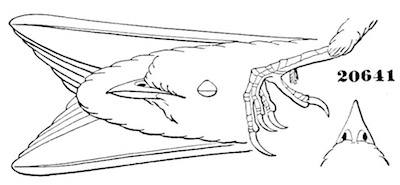
Cotyle riparia. 20641
Many American birds have been referred to Cotyle, but the only one really belonging to the genus is the cosmopolitan C. riparia. The peculiarity of the genus consists essentially in the tuft of tarsal feathers at the base of the hind toe, and the unusual length of the lateral claws, combined with the lateral nostrils overhung by membrane. By these characters the genus is very easily distinguished from Stelgidopteryx.
Cotyle riparia, Boie.
BANK SWALLOW; SAND MARTIN.
Hirundo riparia, Linn. S. N. I, 1766, 344.—Wils.; Aud.—Lembeye, Aves de Cuba, 1850, 47, lam. vii, fig. 3.—Jones, Nat. Hist. Bermuda, 34 (occasional, Aug. and Sept.). Cotyle riparia, Boie, Isis, 1822, 550.—Cassin.—Brewer, N. A. Oöl. I, 1857, 105, pl. iv, fig. 49 (eggs).—Cab. Jour. 1856, 4 (Cuba).—Baird, Birds N. Am. 1858, 313; Rev. 1864, 319.—Ib. 1861, 93 (Costa Rica [?]).—Gundlach, Cab. Jour. 1861, 330 (very rare in Cuba).—March, Pr. A. N. Sc. 1863, 297 (Jamaica; very rare). Heermann, P. R. R. X, 36 (California; abundant?).—Dall & Bannister, 280 (Alaska).—Cooper, Orn. Cal. 1, 1870, 110.—Samuels, 258. Hirundo cinerea, Vieill. Hirundo riparia americana, Max.
Sp. Char. Adult. Above grayish-brown, somewhat fuliginous, with a tendency to paler margins of the feathers. Beneath pure white, with a band across the breast and the sides of the body like the back. Length, 4.75; wing, 4.00; tail, 2.00.
Young birds have less emarginate tails, and the feathers of back, rump, and wings edged with whitish.
Hab. The whole of North America; Bermudas; Greater Antilles; Costa Rica; Western Brazil (Pelz.). Also found in the northern parts of the Old World.
A critical examination has failed to reveal any difference between European and American specimens of this bird.
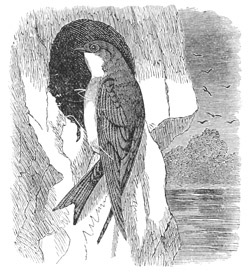
Cotyle riparia.
Habits. The common Bank Swallow as we know it, or Sand Martin as it is called in England, is nearly or quite cosmopolitan in its distribution. Found throughout Europe in the season of reproduction, and in portions of Africa in the winter months, it is equally common throughout North America in the summer, and probably winters in Mexico and in Central and South America, though it is not mentioned by Sumichrast as a bird of Vera Cruz. It is said to occur in various parts of the continent of Africa, and in Europe it extends its migrations to the extreme northern regions. It has also been met with in India and in Siberia. Mr. Salvin obtained several specimens at Duenas, Guatemala, in September, 1861, having previously observed it about the Lake of Yzabah.
On both continents it is somewhat local in its distribution, in favorable localities being quite abundant, and in others not known to exist. It is an early spring visitant wherever found, appearing in England by the 24th of March, and even in our high Arctic regions early in May, often in such inclement weather that it is obliged to take refuge in holes. Mr. Dall met with this species in Alaska, in favorable situations, in immense numbers. He counted on the face of one sand-bluff over seven hundred nest-holes made by these birds, and all of them apparently occupied, so that the bluff presented the appearance of an immense honeycomb alive with bees. He states that it takes the bird four days to excavate its nest. Rev. F. O. Morris, on the other hand, who has closely watched their operations in England, says that it requires a fortnight, and that the weight of sand a pair of these birds removes is twenty ounces in a day. Pebbles of more than two ounces in weight have been known to be taken out by them.
The flight of this species is rapid, but unsteady and flickering. In searching for their food they skim low over the surface of both land and water, dropping upon the latter, as they fly, to drink or to bathe. Their food consists of the smaller kinds of winged insects, which they pursue and capture, dashing at them at times even on the water. They usually feed their young with larger kinds than they eat themselves.
It has not been observed in Greenland, but Richardson found it in colonies of thousands at the mouth of Mackenzie’s River, in the 68th parallel. It is a very social bird, usually breeding together in large communities, and is more independent of man than most of its family, owing him no other favors than those incident to excavations through sand-banks, of which it avails itself. The nests of these Swallows are placed in excavations made by them in the banks of rivers, cliffs by the sea-shore, and similar favorable situations. These are usually as near the surface of the ground as the nature of the soil permits to be readily penetrated, though the bird has been known to work its way even through hard gravel. Their depth varies from fourteen inches to four feet, though two feet is the usual distance.
Mr. Augustus Fowler mentions a remarkable instance of sagacity and provident forethought in these birds, not easily separable from reason. In the town of Beverly, in a stratum of sandy loam, he observed each season a colony of some twenty or thirty pairs of these birds. In this place these birds never burrowed more than two or three feet. Within a mile of this place another colony excavated a bank in which the layer of loam was mixed with small stones. In this bank they excavated to the depth of five, seven, and even nine feet. Why was there this extraordinary difference in the length of burrows made by the same species, in situations not more than a mile apart? The reason for this difference, upon examination, became very obvious. We give the explanation in Mr. Fowler’s own words: “In one bank, where the earth was of a fine sandy loam, easily perforated, from the entrance to the extremity the burrows did not exceed three feet in length; while in the other bank, with harder loam to work in, one burrow was found nine feet in length. After examining six holes of nearly equal length, it appeared that these little birds had sufficient reason for extending their labors so far into the earth. In every instance, where they met with a spot free from stones they finished their burrows; thus showing great care for the welfare of their eggs or young by avoiding, in the stony soil, a catastrophe so great as would befall their treasures if by accident one of these stones should fall upon them.”
The work of perforation they perform with their closed bill, swaying the body round on the feet, beginning at the centre and working outwards. This long and often winding gallery gradually expands into a small spherical apartment, on the floor of which they form a rude nest of straw and feathers. The time occupied in making these excavations varies greatly with the nature of the soil, from four or five days to twice that number.
Their eggs are five in number, pure white, and when unblown have a fine roseate hue. They are oval in shape, larger at one end, and pointed at the smaller. Their average length is .72 of an inch, and their average breadth .47.
We now come to the consideration of three families of Oscine birds, of pre-eminently dentirostral type, having certain common characters by which they are distinguishable, with but little difficulty, from all others. In their close relationship it has been questioned by many whether they do not all belong under one head, but they are more generally considered distinct. The common characters, and those peculiar to each, are as follows:—
Common Characters. Bill stout, and considerably hooked at tip, or with the point bent abruptly downward; with a deep notch, and sometimes a tooth or lobe just behind the notch; the tip of the lower mandible likewise frequently bent up, and with a notch behind it. The nostrils lateral, the bristles of the mouth generally well developed. The primaries are ten (except in a few Vireos), the outer from one fourth to one half the second. Tail variable. Tarsi scutellate anteriorly; sometimes with a tendency to division on the lateral plates; hitherto not met with. Basal joints of toes more adherent. Separated from Turdidæ by greater adhesion of toes; from Troglodytidæ by notched and hooked bill, etc.
A. Basal phalanx of anterior toes abbreviated; that of median toe decidedly shorter than the basal of inner, or the two basal of outer, and adherent for its whole length on both sides to the lateral (i. e. not free at all). Lateral plates of tarsus undivided, except at extreme lower end.
Vireonidæ. Gonys more than half the length of lower jaw (from tip to angle of mouth), usually longer than width of mouth, which is narrow. Bill conical, much compressed, decurved at end and notched, but scarcely toothed. Frontal feathers bristly and erect, or bent but slightly forward. Nostrils overhung by membrane. Tarsus longer than middle toe and claw. Lateral toes generally unequal; outer claw reaching half-way along middle claw.
B. Basal phalanx of middle toe about as long as the basal of inner, or the two basal of outer; free externally, at least for about one third its length, internally for about one half. Lateral plates of tarsus with decided tendency to subdivision (except in Myiadestinæ).
Ampelidæ. Gonys decidedly less than half the length of lower jaw, or than width of mouth, which is very broad and deeply cleft. Bill triangular, much depressed, decurved at end and notched, with moderate though decided tooth. Frontal feathers rather soft, scarcely bristly or erect. Nostrils overhung by membrane. Tarsus equal to or shorter than middle toe and claw. Lateral toes nearly equal; outer claw reaching only to base of middle claw.
Laniidæ. Gonys about half the length of lower jaw; about equal to width of mouth. Bill very powerful and raptorial, much compressed, with a strongly marked hook, notch, and tooth at end. Frontal feathers very bristly, and directed forwards, so as to conceal nostrils and base of bill. Nostrils with bony walls, except behind. Tarsus longer than middle toe and claw, sometimes much scutellate on sides. Lateral claws nearly equal; outer claw reaching a little beyond base of middle claw.