Family VIREONIDÆ.—The Vireos. (continued 2)
Reading edition
Another nest from West Texas, obtained by Captain Pope, is essentially different in its general characteristics. It is three inches in diameter, and but one inch and three quarters high. The opening is circular, but only one and a half inches wide. Below the rim the cavity widens until it is two and a half inches in diameter. The outer nest is made up of an interweaving of fine strips of bark and dry leaves, intermixed with and firmly bound around by strong flax-like fibres of different plants. Within, it is lined with fine flexible grasses and stems of plants.
The eggs of this species are from .73 to .76 of an inch in length, and from .52 to .56 in breadth. They are pure white, sparingly spotted with fine red dots distributed around the larger end.
Vireo pusillus, Coues.
LEAST VIREO.
Vireo pusillus, Coues, Pr. A. N. Sc. Phila. 1866.—Baird, Rev. Am. B. 360.—Elliot, Illust. Birds N. A. I, vii.—Cooper, Orn. Cal. 1, 1870, 124. ? Vireo belli, Cooper, Pr. Cal. Acad. 1861, 122 (Fort Mohave).
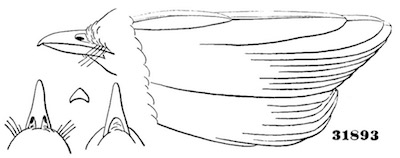
Vireo pusillus. 31893
Sp. Char. Somewhat similar in general appearance to Vireosylvia gilva and swainsoni, but smaller. Bill very small; tarsi lengthened. Wings about equal to the tail, which is lengthened, graduated, and with the feathers narrow and pointed. Exposed part of first primary about half that of the second, which is intermediate between seventh and eighth; the fourth and fifth longest.
Above grayish-ash, with a tinge of olive behind. Beneath, including the inside of the wings, white, with a soiled tinge on the sides of the throat and across the breast. Axillars and flanks exhibiting a faint trace of greenish-yellow. Eyelids and a short line from the nostrils to the eye whitish; no other stripe apparent. A dusky loral spot. Primary coverts edged indistinctly with whitish, producing an obscure band (a second on the middle coverts hardly appreciable). Quills and tail-feathers edged externally with pale grayish-olive, the innermost secondaries with whitish. Bill dusky above, whitish beneath. Legs plumbeous. Iris of two specimens marked as “light brown,” of another as “rufous.”
The details of structure taken from No. 23,785, of color from No. 23,788: Length, of 23,785 ♂, 4.80 when fresh, of skin, 4.25; wing, 2.25; tail, 2.25; bill above, .37; tarsus, .73; middle toe and claw, .50; hind toe and claw, .42. First quill, .70; second, 1.40; longest (fifth), 1.64. (Cape St. Lucas.)
Hab. Cape St. Lucas; San Diego; Fort Mohave, and Arizona; Sacramento, California (Ridgway).
This species scarcely needs comparison with any other, except, perhaps, V. pallens of Middle America, which, however, besides belonging to Vireonella, and not Vireo, as restricted, differs in many minor, but no less essential points. The coloration of the two is remarkably similar, but pusillus has only one indistinct band on the wing, instead of two sharply defined ones. The bill is much smaller, and the tail longer, than in pallens. V. belli is less ashy above and less pure white beneath, the sides much more yellowish; the wing is also longer, and the tail much shorter. V. vicinior is much larger, with the wing longer than the tail, instead of shorter; the ash above has a bluish instead of a greenish cast; the lores are wholly grayish-white, etc.
Habits. The Least Vireo is a recently described species of its genus, and one in regard to whose history comparatively little has been ascertained. It was first met with at Cape St. Lucas by Mr. Xantus, and described by Dr. Coues in 1866. Dr. Coues assigns as its habitat Lower and Southern California, Sonora, and Arizona, at least as far north as Fort Whipple. Dr. Cooper also found it at Fort Mohave. Dr. Coues met with it fifty miles south of Fort Whipple, where he found it breeding abundantly. He gives no information in regard to its habits. Dr. Cooper states that he found it rather common along the upper part of Mohave River, in June, 1861; and in the following spring, about April 20, they began to arrive at San Diego in considerable numbers. In its habits Dr. Cooper thinks it greatly resembles V. gilvus, though it differs entirely in its song. The notes of those that he heard singing resembled very much those of the Polioptilas uttering a quaint mixture of the notes of the Wrens, Swallows, and Vireos. They also seem to possess more or less of imitative powers. At Sacramento he saw and heard, in the willows along the river, individuals which, from their peculiar notes, he had no doubt were of this species, but he did not verify his conjectures. His suppositions were confirmed later by the observations of Mr. Ridgway, who states that he found these birds the most abundant as well as the most characteristic Greenlet in the vicinity of Sacramento. It is a species, he adds, easily recognized, being in all respects quite distinct from any other. The character of its notes, as well as its habits, show it to be a true Vireo. Its song, though weaker, bears a great resemblance to that of the White-eyed. A nest of this species was found by him near Sacramento. It was placed about three feet from the ground, in a low bush in a copse of willows. Like all the nests of this genus it was pensile, being attached to and suspended from the twigs of a branch.
Two nests of this interesting species were also obtained near Camp Grant, Arizona, in 1867, by Dr. E. Palmer. They are wrought like all the nests of this kind, below the small forked branches of a tree, suspended from the extremity of its twigs. They each have a diameter of about three and a half inches, a height of two, with a cavity an inch and a half deep and two wide. The external portion, like the nests of the V. belli, is wrought with woven hemp-like vegetable fibres, strongly bound around the ends of the twigs and covering the entire exterior. Within this is placed a strong, firmly made basket, composed of slender strips of bark and long, fine, and flexible pine-needles, with a lining of finer materials of the same. In one of these nests there were three eggs of the Vireo, and one of a Molothrus (obscurus?). The former were of a bright crystalline whiteness, marked with very minute and hardly discernible spots of red, and measure .69 by .56 of an inch. The egg of the Molothrus, except in its much smaller size, is hardly distinguishable from those of the common M. pecoris, and measures .75 by .56 of an inch.
In the other nest were also three eggs of the Vireo. They correspond in size, but are much more distinctly marked with larger spots of a dark red and reddish-brown. In this nest there is a somewhat larger proportion of fine strips of inner bark, and mixed with these are also a few silky insect cocoons, by means of which the nest is firmly bound around the twigs from which the whole is suspended.
Vireo vicinior, Coues.
ARIZONA VIREO.
Vireo vicinior, Coues, Pr. A. N. Sc. Phila. 1866.—Baird, Rev. Am. B. 361.—Elliot, Illust. Birds N. A. I, vii.—Cooper, Orn. Cal. 1, 1870, 125.
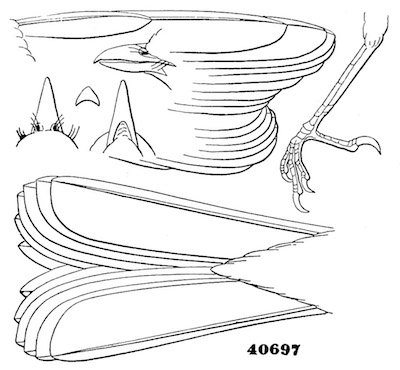
Vireo vicinior. 40697
Sp. Char. (No. 40,697 ♂.) Bill stout, considerably compressed and deep. Wings moderately pointed, about equal to tail, which is decidedly graduated; first quill rather more than half the second, which about equals ninth and the secondaries; the fourth and fifth longest. Tarsus considerably longer than middle toe and claw; lateral toes quite conspicuous for their disproportion, the inner claw reaching only to base of outer, and falling short of base of middle; the terminal digit of inner toe reaching only to end of second joint of middle toe.
Upper parts, with sides of head and neck, ashy or light plumbeous, faintly olivaceous on rump. Beneath white; slightly ashy on sides of breast. Flanks and inside of wings showing a faint trace of yellow, only appreciable on raising the wings. An obsolete line from bill to eye, and a more distinct ring round the eye, white. No bands on the wing, except a faint edging of whitish on the greater coverts; the quills edged internally with white. Bill and legs plumbeous. “Iris brown. Mouth livid, bluish-white.” (Coues.)
Fresh specimen: Total length, 5.60; expanse of wings, 8.60. Prepared specimen: Total length, 5.10; wing, 2.50; tail, 2.60, its graduation, .22; difference of tenth and longest quills, .40; exposed portion of first primary, .85, of second, 1.65, of longest (measured from exposed base of first primary), 1.95; length of bill from forehead, .50, from nostril, .32, along gape, .61; depth of bill, .18; tarsus, .72; middle toe and claw, .51, claw alone, .16; hind toe and claw, .40, claw alone, .19.
Hab. Prescott, Arizona.
This species might at first sight be taken for a small specimen of V. plumbeus, the colors, character of bill, etc., being very similar, except that the white of lores and around eye is much less distinct, the lore without any blackish before the eye, and there is only one faint band on wing, instead of two conspicuous ones; the tail-feathers, too, lack the distinct white edgings. The much more rounded wing, and the first primary half the second or more, will, however, readily distinguish them. The form of the bird is very much that of V. pusillus, which it resembles considerably also in color. The outer quill is, however, longer, the bill deeper and more compressed, the inner lateral toe considerably shorter, and the size larger. The colors are purer, without the olive of the back or the yellowish of the under parts; the bill, too, is entirely dark plumbeous, instead of horn-color, whitish beneath. From V. pallens it is distinguished by a smaller, darker bill; longer tail and wing; one wing-band, not two; and purer colors.
Habits. In regard to the habits of this well-marked but very rare species but little is as yet known. It was first described, in 1866, by Dr. Coues, from a single specimen obtained by him near Fort Whipple, Arizona. It was shot May 4, 1865, and is supposed by Dr. Coues to be a summer resident of Arizona wintering in the Gila and the Lower Colorado Valleys, or in Sonora.