Family FRINGILLIDÆ.—The Finches. (continued 4)
Reading edition
Hab. Cape St. Lucas (Dec., 1859).
This bird, of which a single specimen only is so far known, is very closely related to P. rostratus, though very easily distinguished from it. It is considerably smaller than rostratus, the bill more slender, the upper parts much darker, being plumbeous, not sandy-colored; the stripes beneath darker; the bill and legs more dusky. These differences may not indicate a distinct species, but as the specimen here described differs entirely from all the specimens of a large number of P. rostratus, it is yet entitled to consideration as a marked variety,—probably the resident race at Cape St. Lucas, where the var. rostratus is merely a winter visitor.
Habits. The St. Lucas Finch is a new species, in regard to the habits of which nothing whatever is as yet known. It was obtained at San José, in Lower California, by Mr. John Xantus, in December, 1859. It was found in company with a flock of Passerculus rostratus, and the presumption is that its habits may resemble those of that little-known species.
Genus POOCÆTES, Baird.
Poocætes, Baird, Birds N. Am. 1858, 447. (Type, Fringilla graminea, Gm.)
Gen. Char. Bill rather large; upper outline slightly decurved towards the end, lower straight; commissure slightly concave. Tarsus about equal to the middle toe; outer toe a little longer than the inner, its claw reaching to the concealed base of the middle claw; hind toe reaching to the middle of the middle claw. Wings unusually long, reaching to the middle of the tail as far as the coverts, and pointed; the primaries considerably longer than the secondaries, which are not much surpassed by the tertiaries; second and third quills longest; first little shorter, about equal to the fourth, shorter than the tail; the outer feathers scarcely shorter; the feathers rather stiff; each one acuminate and sharply pointed; the feathers broad nearly to the end, when they are obliquely truncate. Streaked with brown above everywhere; beneath, on the breast and sides. The lateral tail-feather is white. Shoulder chestnut-brown.
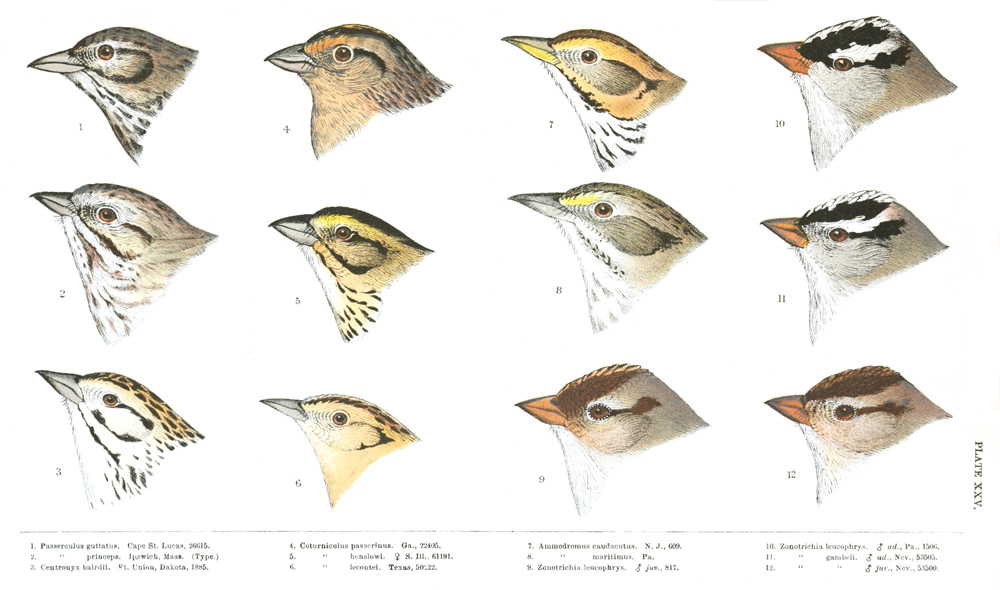
PLATE XXV.
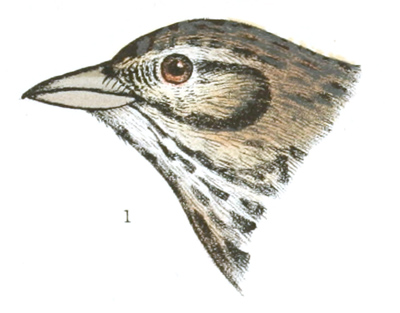
1. Passerculus guttatus. Cape St. Lucas, 26615.
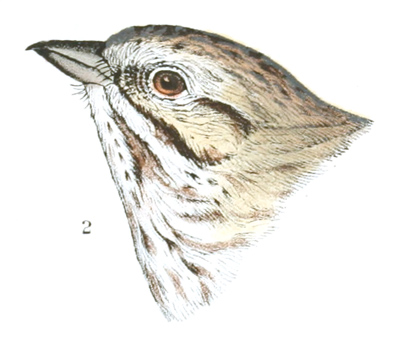
2. Passerculus princeps. Ipswich, Mass. (Type.)
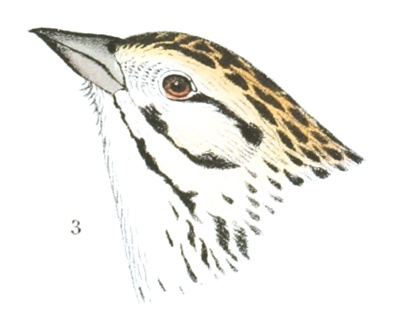
3. Centronyx bairdii. Ft. Union, Dakota, 1885.
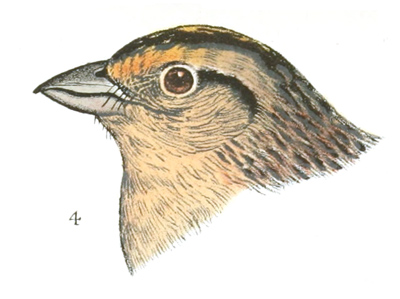
4. Coturniculus passerinus. Ga., 22405.
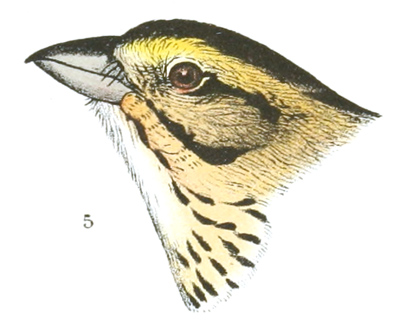
5. Coturniculus henslowi. ♀ S. Ill., 61191.
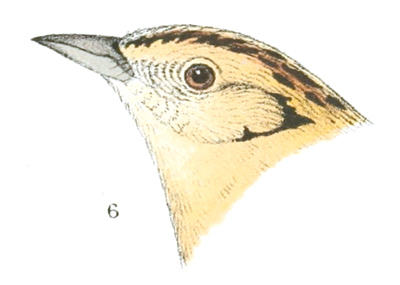
6. Coturniculus lecontei. Texas, 50222.
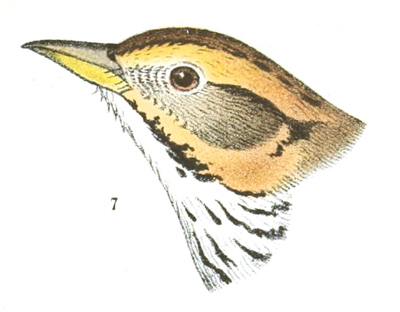
7. Ammodromus caudacutus. N. J., 609.
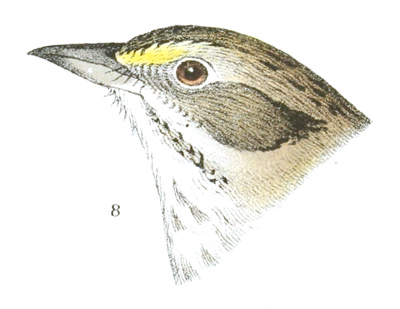
8. Ammodromus maritimus. Pa.
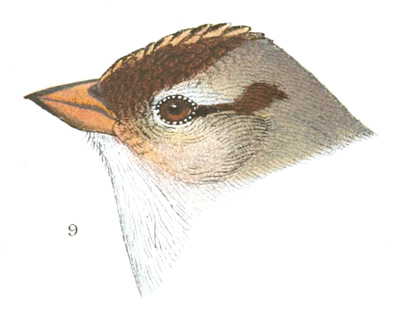
9. Zonotrichia leucophrys. ♂ juv., 817.
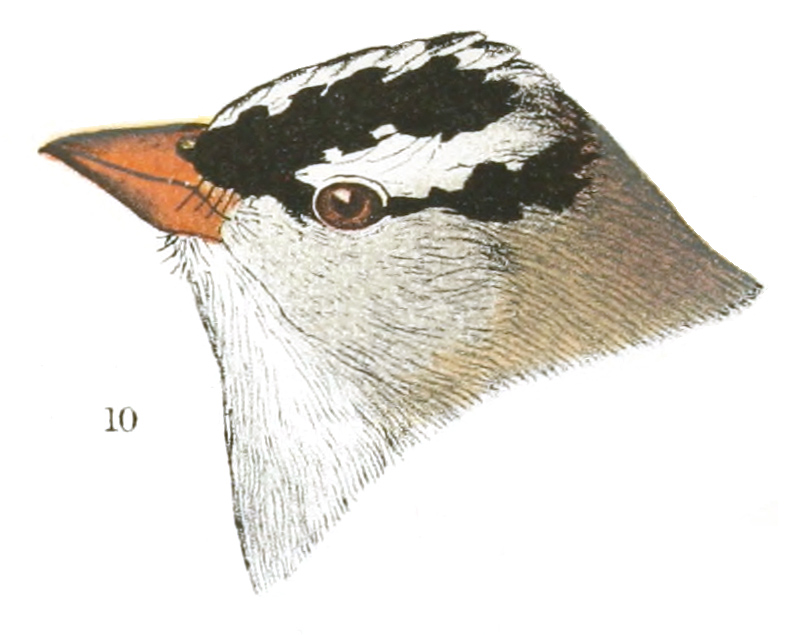
10. Zonotrichia leucophrys. ♂ ad. Pa., 1506.
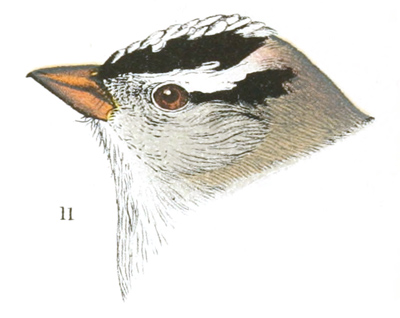
11. Zonotrichia gambeli. ♂ ad. Nev., 53505.
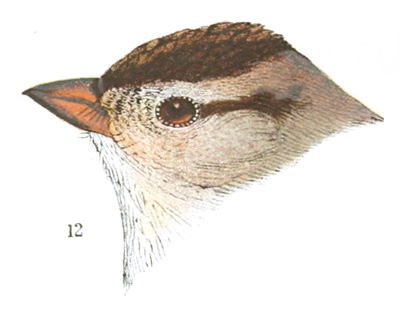
12. Zonotrichia gambeli. ♂ juv. Nev., 53500.
The essential character of the genus consists in the long and pointed wings, longer than the tail and without long tertials; and the rather stiff, forked tail, with its acute feathers. But one species is recognized at present.
Poocætes gramineus, Baird.
GRASS SPARROW; BAY-WINGED BUNTING.
Var. gramineus.
Fringilla graminea, Gm. Syst. Nat. I, 1788, 922.—Aud. Orn. Biog. I, 1831, 473; V, 502, pl. xc. Emberiza graminea, Wilson, Am. Orn. IV, 1811, 51, pl. xxxi, f. 5.—Aud. Syn. 1839, 102.—Ib. Birds Am. III, 1841, 65, pl. clix.—Max. Cab. Jour. vi, 1858, 342. Fringilla (Zonotrichia) graminea, Swainson, F. B. Am. II, 1831, 254. Zonotrichia graminea, Bon. List, 1838.—Ib. Conspectus, 1850, 478. Poocætes gramineus, Baird, Birds N. Am. 1858, 447.—Samuels, 303.
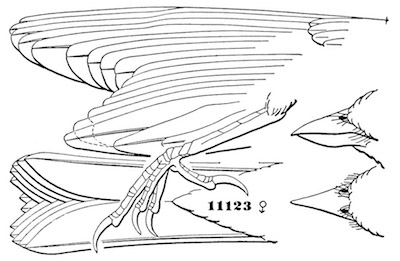
Poocætes gramineus 11123 ♀
Sp. Char. Tail-feathers rather acute. Above light yellowish-brown; the feathers everywhere streaked abruptly with dark brown, even on the sides of the neck, which are paler. Beneath yellowish (sometimes reddish) white; on the jugulum and sides of neck and body streaked with brown. A faint light superciliary and maxillary stripe; the latter margined above and below with dark brown: the upper stripe continued around the ear-coverts, which are darker than the brown color elsewhere. Wings with the shoulder light chestnut-brown, and with two dull whitish bands along the ends of the coverts; the outer edge of the secondaries also is white. Exposed portion of outer tail-feather, and edge and tip of the second, white. Length, about 6.20; wing, 3.10; tail, 2.50; bill, .33 from frontal feathers to point, by .33 in depth at base; tarsus, .72. Bill yellow, dusky above; legs yellow. (Measurement of No. 10,147 ♀, Washington, D. C.)
Hab. Eastern Province of United States.
Var. confinis.
Poocætes gramineus, var. confinis, Baird, Birds N. Am. 1858, p. 448 (in text under P. gramineus). Poocætes gramineus, Cooper & Suckley, 200.—Cooper, Orn. Cal. 1, 186.
Sp. Char. Resembling P. gramineus, but colors paler, the dark streaks narrower. Bill more slender, tarsi longer. (Measurement of 40,803 ♂, Fort Whipple, Arizona: Bill, .36 from point of frontal feathers by .25 in depth through base; tarsus, .78; wing, 3.35; tail, 2.80).
Hab. Western and Middle Provinces of United States, south into Mexico; Oaxaca (Scl. 1859, 379; March).
This species is readily identified by the absence of a median stripe on the head, the chestnut-brown of the shoulder, and the white lateral tail-feathers. The young birds have the ground-color above more whitish, the streaks blacker, in sharper contrast; the streaks on jugulum, etc., less sharply defined; the general appearance, however, is not different from the adult. Sometimes there is a decided cinnamon wash beneath. Western specimens (var. confinis) appear to be paler, with longer wings, and longer and more slender bills, in this respect resembling other Finches (Melospiza, Passerculus, etc.).
All specimens from west of the Rocky Mountains are to be referred to var. confinis.
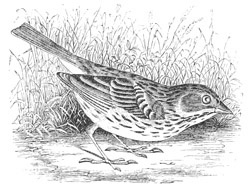
Poocætes gramineus.
Habits. The Bay-winged or Grass Finch is a very abundant species wherever found, and has a very extended distribution. Accepting as one species the slightly variant races above indicated, this bird extends from Florida and Mexico, on the south, to the 57th parallel of latitude, and from the eastern to the western shores. It was found by Richardson frequenting the plains of the Saskatchewan, where it arrives early in May and leaves in September, and where it nests abundantly in the short withered grass of that sterile region. Richardson did not trace it farther north than the 57th parallel, and it was not obtained on the Yukon or Anderson Rivers by Mr. MacFarlane or Mr. Lockhart. It breeds from Northern Virginia north.
In the Middle States it is partially resident, a portion remaining all the winter. South of Washington it is chiefly migratory, only found, in any numbers, from November to March, and probably but few remaining to breed. Audubon states that he never saw any of this species in any portion of Louisiana, Missouri, Kentucky, or Ohio. Mr. Dresser, on the other hand, found them common about San Antonio in August and September, and also in May and June, and had no doubt that some remain to breed.
It is very abundant throughout New England, arriving in some seasons as early as March 11, and remaining until quite late in the fall, often through November. It is found chiefly in dry open fields and pastures, where it nests, with no pains at concealment, on the ground, in depressions made by its own work. It is an unsuspicious and fearless species, neither seeking nor avoiding the companionship of man. It does not usually build near houses, yet is not unfrequently known to do so. It may be often found perched on fences along the roadside, chanting its simple and pleasing lay, and quite as frequently in the road feeding and dusting itself. The latter operation it is very fond of practising, and almost any day in the summer these birds may be found in such situations.
West of the Great Plains is found a marked variety of this species, differing in many respects from the eastern. The western species or race of this Finch, Mr. Ridgway states, is an abundant summer bird in all the elevated grassy portions of the West. It is especially characteristic of the higher grassy slopes of the elevated mountains, particularly in the Rocky Mountain regions, and its sweet and simple song is one of the pleasant associations of those regions. It descends, in the autumn, to the lower districts, having been observed during September in the greatest abundance among the “rye-grass” meadows of Senot Valley, at the northern end of the East Humboldt Range. It nests on the ground in grassy banks, in various situations.
Dr. Suckley found this bird abundant on the Nisqually Plains, about Puget Sound; and Dr. Cooper says it is common, in summer, on the prairies of the interior of Washington Territory. Dr. Cooper also found it wintering in the Colorado Valley, in considerable numbers, but all disappeared in April. He thinks they breed in Northern California, though he has never found them doing so. Dr. Newberry states that they are common in the Sacramento Valley, both in the summer and in the fall. It was found by Mr. Boucard, in winter, near Oaxaca, Mexico.
Their song is a very simple and pleasant succession of soft notes, resembling that of the Canary, but thinner and feebler. It is begun early in the morning and continued a few hours, and then renewed at sunset and kept up often until after dark. It is also not unlike the song of the Song Sparrow, but is neither so varied nor so loud and strong. It continues to sing until late in the season.
They feed in the road, eating insects, seeds, and grain. They are fond of searching also in ploughed fields, and keep principally upon the ground, exclusively so when they are searching for their food.
Although as unsuspicious as the Song Sparrow or the Chipping Sparrow, this Finch rarely, like them, comes about the house for crumbs of bread, but seems to prefer to forage for itself in the fields and by the roadside. Taken from the nest, these birds may be readily tamed, and soon become very interesting and familiar little pets, though Nuttall states that where several are thus kept they become very jealous of each other, and quarrelsome.
Their nest is always placed upon the ground, and is very simply constructed of dry stems of grasses, with no other lining than soft fine materials of the same. They have two, and sometimes three, broods in a season. When their nest is approached, they make use of various artifices to draw away the intruder, and often vary their devices in a very striking manner. In May, 1836, crossing a field within a few rods of my home in Roxbury, I nearly stepped upon a female sitting upon her nest. She immediately tumbled forward towards me, counterfeiting the most extraordinary lameness, so much so that I supposed that I had really stepped upon and severely injured her. I stooped to pick up what I supposed to be a wounded bird, and found her nest and four eggs. Visiting her nest again, as I approached she flew from it quietly and silently, and immediately began the same manœuvres, at some little distance from her nest, which she discontinued as soon as she noticed that I was examining her treasures. These devices she varied several times in a very remarkable manner. In Massachusetts I have known this species to have its complement of eggs by the 15th of April.
The eggs of this species are usually five, often four, and rarely six in number. They are of an oblong-oval shape, the smaller end but slightly more pointed than the other. They vary greatly in size, ranging from .90 to .80 of an inch in length, and averaging about .65 in breadth. Their ground-color is a pale greenish-white, marked with spots, lines, dots, and blotches of various shades of reddish and purplish brown. In some eggs the spots are few and small, chiefly confluent in a ring about the larger end, while the ground-color is very plainly distinguishable. In others the ground is nearly concealed by the abundance of the spots.
Genus COTURNICULUS, Bonap.
Coturniculus, Bonap. Geog. List, 1838. (Type, Fringilla passerina, Wils.)
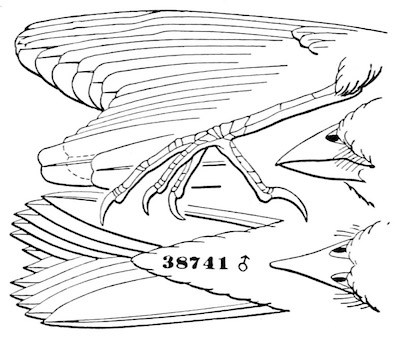
Coturniculus passerinus. 38741 ♂
Gen. Char. Bill very large and stout, (except in C. lecontei); the under mandible broader, but lower than the upper, which is decidedly convex at the basal portion of its upper outline. Legs moderate, apparently not reaching to the end of the tail. The tarsus appreciably longer than the middle toe; the lateral toes equal, and with their claws falling decidedly short of the middle claw; the hind toe intermediate between the two. The wings are short and rounded, reaching to the base of the tail; the tertiaries almost as long as the primaries; not much difference in length in the primaries, although the outer three or four are slightly graduated. The tail is short and narrow, shorter than the wing (except in C. lecontei), graduated laterally, but slightly emarginate; the feathers all lanceolate and acute, but not stiffened, as in Ammodromus.
This genus agrees with Passerculus in the short and narrow tail. The wings are much shorter and more rounded; the feet shorter, especially the middle toe, which is not as long as the tarsus. The tail-feathers are more lanceolate. The bill is much larger, and more swollen at the base.
The essential characters of this genus consist in the swollen convex bill; the short toes, compared with the tarsus; the short and rounded wings; and the very small, narrow, slightly graduated tail, with its lanceolate acute feathers (except in the South American C. manimbe).
In some respects there is a resemblance to Ammodromus, in which, however, the bill is very much more slender; the wings still shorter, and more rounded; the tail-feathers much stiffer, and even more lanceolate; the toes extending beyond the tip of the tail; the middle toe rather longer than the tarsus, instead of considerably shorter.
C. lecontei has the same general form, but a much smaller bill.
Synopsis of Species.
Common Characters. Crown and back streaked with black upon an ashy, olive, or chestnut ground; beneath whitish, tinged across the breast with ochraceous or ashy, plain, or with blackish streaks on the breast. A light superciliary stripe.
A. Tail-feathers attenuated, acute at ends, much graduated. On the crown a median light stripe.
a. A dusky streak on each side of the throat, and one above the light ochraceous maxillary stripe.
1. C. henslowi. Bill very robust, .35 along culmen by .30 deep at base. Wing, 2.25; tail, 2.20. Head ochraceous or greenish olive, lighter on the throat; a blackish stripe on each side of the crown. Breast streaked with black at all ages. Hab. Eastern Province of United States.
b. No dusky streak on side of throat nor above the maxillæ.
2. C. lecontei. Bill very narrow, only .16 broad by .20 deep at base. Median stripe of the crown ochraceous for anterior third, the remaining part ashy-white; superciliary stripe wholly ochraceous; edge of wing white; breast sparsely streaked in the adult. Wing, 2.15; tail, 2.20. Hab. Plains west of the Missouri, from Texas to Dakota.
3. C. passerinus. Bill robust, .23, or more, broad, by .24, or more, deep at base. Median stripe of the crown ochraceous throughout; superciliary stripe yellow anteriorly, ashy posteriorly; edge of wing bright yellow, breast unstreaked in the adult, streaked in the young, in which the head stripes are ashy, with no yellow on wing or over lore.
Colors dark, the black markings predominating above. Ad. Anterior lower parts deep buff at all seasons. Juv. Dusky streaks on breast very distinct. Bill, .33 and .30; wing, 2.60; tail, 1.90. Hab. Eastern Province of United States, and West Indies … var. passerinus.
Colors pale, the light markings predominating above. Ad. Buff of the breast scarcely observable in summer. Juv. Dusky streaks on breast scarcely appreciable. Bill, .33 and .24; wing, 2.60; tail, 1.90. Hab. Western Province of United States … var. perpallidus.
B. Tail-feathers broad, rounded at ends; only slightly rounded. Crown not divided by a median stripe.
4. C. manimbe. Head clear ashy, whitish on throat; crown uniformly streaked with black. Supra-loral streak and edge of wing bright yellow. No streaks on breast in adult.
Breast tinged with ashy; black streaks on upper parts much narrower than the intervening ones of the ashy ground-color; dorsal feathers rufescent-umber medially, edged with ashy, and with a shaft-streak of black. Wing, 2.35; tail. 2.00. Hab. Brazil … var. manimbe.
Breast tinged with ochraceous; black streaks on upper parts much broader than the ashy ones of the ground-color; dorsal feathers black, edged with ashy; wing, 2.25; tail, 1.90. Hab. Buenos Ayres and Uruguay … var. dorsalis.
Coturniculus henslowi, Bonap.
HENSLOW’S BUNTING.
Emberiza henslowi, Aud. Orn. Biog. I, 1831, 360, pl. lxxvii.—Ib. Syn. 1839, 104.—Ib. Birds Am. III, 1841, 75, pl. clxiii.—Nuttall, Man. I, 1832, App. Coturniculus henslowi, Bon. List, 1838.—Ib. Conspectus, 1850, 481.—Baird, Birds N. Am. 1858, 451.—Maynard, Birds E. Mass. 1870, 117.—Samuels, 306. Fringilla henslowi, Nuttall, Man. I, (2d ed.,) 1840, 571.
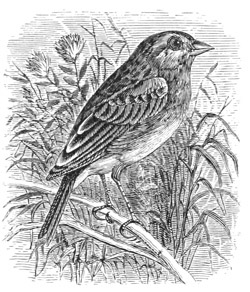
Coturniculus passerinus.
Sp. Char. Upper parts yellowish-brown, the hood, neck, and upper parts of back tinged with greenish-yellow. Interscapular feathers dark brown, suffused externally with bright brownish-red; each feather with grayish borders. Tertiaries, rump, and tail-feathers abruptly dark chestnut-brown, darkest centrally, paler externally, and narrowly margined with gray. Crown with a broad black spotted stripe on each side; these spots continued down to the back. Two narrow black mandibular stripes and one post-ocular on each side of the head, and an obscure black crescent or spot behind the auriculars. Under parts light brownish-yellow, paler on the throat and abdomen. The jugulum, upper part of the breast, and the sides of the body, conspicuously streaked with black. Edge of wing yellow. A strong tinge of pale chestnut on the wings and tail. The median tail-feathers and upper coverts chestnut or rufous brown, with sharply defined shaft-streaks of black. Length, 5.25; wing, 2.15; tail, 2.15.
Hab. Eastern United States as far north as Massachusetts; westward to the Loup Fork of Platte.
This species is related to C. passerinus, but readily distinguished by the well-marked stripes on breast and sides, the greenish-yellow, not chestnut-brown, of head and nape, and the two mandibular dusky stripes. The middle tail-feathers are reddish with only a very narrow sharply defined median shaft-streak of black, instead of having the greater portion of the centre dusky with scalloped edges. I have not seen young birds, but they probably differ little from the adults.
Habits. The history and general distribution of Henslow’s Bunting is still somewhat imperfectly known. Mr. Audubon first met with it, in 1820, in Kentucky, nearly opposite to Cincinnati. It was seen on the ground, amongst the tall grass, and is said to have exhibited all the peculiarities of this tribe. He was afterwards informed that this bird is abundant in the State of New Jersey, and that it breeds there; and in evidence of this he mentions receiving a specimen from Dr. Trudeau, obtained by that gentleman himself. Mr. Audubon also mentions that both Dr. Bachman and he have procured a great number in South Carolina, where they abound, in the latter part of autumn, and where, also, a portion remain during the winter. In Florida, Mr. Audubon again met with these birds in the winter. They were in great numbers in all the pine barrens of that State, in light and sandy soil, and in woods but thinly overgrown by tall pines. They never alight on trees, but spend their time on the ground, running with great rapidity through the grass, in the manner of a mouse.
In New Jersey they were found in ploughed fields, where they are presumed to have been overlooked and mistaken for the Yellow-winged Sparrow. Mr. Audubon supposed that they were not found farther eastward than that State.
Specimens in the Smithsonian collection have been procured in Georgia in December; in Maryland in July; at Fort Riley, Kansas, Southern Illinois, and in Nebraska, in June.
In Massachusetts they are regular summer visitants, though as yet they have been met with in only a few instances and in a somewhat restricted locality. They are now met with nearly every year, and several nests have been taken. Mr. Maynard obtained two specimens, May 10, in a wet meadow in Newton. Their song-note he describes as like the syllables see-wick, the first syllable prolonged, the latter given quickly. This bird was first obtained in Berlin, in that State, by Mr. E. S. Wheeler, who discovered its nest and eggs. It was mistaken for Bachman’s Finch, and was at first so placed on the record, though the error was immediately corrected. Since then, in that town, and in one or two others in its neighborhood, other nests have been met with. Mr. William Brewster obtained several specimens in Lexington, May 14, 1872. It is quite probable that it has been confounded with C. passerinus, and it is now supposed to be more common in the eastern part of the State than that bird.
One specimen of this Bunting was taken near Washington, during the summer season, from which circumstance Dr. Coues gives it as an exceedingly rare summer resident of the District of Columbia.
In 1871, Mr. Ridgway ascertained that, so far from being rare, Henslow’s Bunting is very abundant on the prairies of Southern Illinois, as well as the Yellow-winged species, but far exceeding the latter in numbers. Though entirely similar to that bird in habits and manners, it may be readily distinguished by its note, which is said to be an abrupt pil-lut, much more like the common summer-call of the Shore Lark than the lisped grasshopper-like chirp of the C. passerinus, and to be uttered as the bird perches on the summit of a tall weed, the tail being depressed, and the head thrown back at each utterance. A number of unidentified eggs were sent to me several years since, by Mr. Kennicott, from near Chicago. They resembled somewhat the eggs of C. passerinus, but were not the eggs of that species. I have now no doubt they belonged to this bird.
The nest is built in the ground, in a depression, or apparently an excavation scratched out by the bird itself, and is a well-made structure of coarse, dry, and soft reeds and grasses, well lined with finer materials of the same description. The eggs, five or six in number, somewhat resemble those of the C. passerinus. Their ground-color is a clear bright white, and they are spotted with well-defined reddish-brown markings, and more subdued tints of purple. The markings, so far as I have seen their eggs, are finer and fewer than those of C. passerinus, and are distributed more exclusively around the larger end. The eggs measure .78 by .60 of an inch, and are of a more oblong-oval than those of the common Yellow-Wing.
Coturniculus lecontei, Bonap.
LECONTE’S BUNTING.
Emberiza lecontei, Aud. Birds Am. VII, 1843, 338, pl. cccclxxxviii.—Max. Cab. Jour. VI, 1858, 340. Coturniculus lecontei, Bon. Conspectus, 1850, 481.—Baird, Birds N. Am. 1858, 452.
Sp. Char. Bill much more slender than in C. henslowi. First quill the longest, the rest diminishing rapidly. Tail emarginate and rounded, with the feathers acute. Upper parts light yellowish-red, streaked with brownish-black; the margins of the feathers and scapulars pale yellowish-white. Tail-feathers dusky, margined with light-yellowish. Lower parts, with the cheeks and a broad band over the eyes, fine buff. Medial line yellowish anteriorly, nearly white behind. The buff extending to the femorals and along the sides, streaked with brownish-black. Throat, neck, and upper parts of the breast, without any streaks, and plain buff. Length, 4.40; wing, 2.13; bill along ridge, .37; edge, .50. Legs flesh-color; bill dark blue.
Hab. Mouth of Yellowstone, to Texas.
Since the regret expressed in the Birds of North America (1858) at the loss of the single specimen known of this species, another has been received by the Smithsonian Institution from Washington Co., Texas, collected by Dr. Lincecum. It is in very poor condition, having been skinned for an alcoholic preparation, and does not admit of a satisfactory description of the colors. In its unspotted breast, the rufous feathers of the hind neck, the absence of maxillary stripes, and apparently in the markings of the wings, it is most like C. passerinus. Although the inner tail-feathers have the narrow stripe of henslowi, the bill is much smaller, as stated by Audubon, than in the others, and is apparently bluish, not yellow. The vertical stripe is deep buff anteriorly, and pale ashy posteriorly, instead of buff throughout, and the superciliary stripe is continuously buff, instead of yellow anterior to, and ashy behind, the eye. In the comparative length of wing and tail, it is most nearly related to henslowi, but the bill is very much narrower than in either. Upon the whole, there can be no doubt of its actual specific distinctness from both its allies.
Habits. Leconte’s Sharp-tailed Sparrow was procured by Audubon in his expedition to the Yellowstone. He speaks of its having very curious notes, which he describes as of a sharp, querulous nature, and a general habit of keeping only among the long, slender green grasses that here and there grew up in patches along the margins of the creeks. So closely did it keep in the coverts to which it resorted, that it was very difficult to force it to rise on the wing, when only it could be procured. Mr. Audubon did not meet with its nest or young, and they remain unknown.
This type specimen was presented by Audubon to Professor Baird. A second was sent to the Smithsonian Institution, from Texas, by Dr. Lincecum.
Coturniculus passerinus, Bonap.
YELLOW-WINGED BUNTING.
Fringilla passerina, Wilson, Am. Orn. III, 1811, 76, pl. xxvi, f. 5.—Aud. Orn. Biog. II, 1834, 180; V, 497, pl. cxxx. Fringilla (Spiza) passerina, Bon. Obs. Wils. 1825, No. 111. Coturniculus passerina, Bon. List, 1838.—Ib. Conspectus, 1850, 481.—Baird, Birds N. Am. 1858, 450.—Samuels, 305. Emberiza passerina, Aud. Syn. 1839.—Ib. Birds Am. III, 1841, 73, pl. clxii. Fringilla savanarum, (Gm.) Nuttall, Man. I, 1832, 494.—Ib. (2d ed.) 1840, 570.—(Gmelin, Syst. Nat. I, 1788, 921?) ?? Fringilla caudacuta, Lath. Ind. Orn. I, 1790, 459.—Nutt. Man. I, 1832, 505. ? Passerina pratensis, Vieillot. Coturniculus tixicrus, Gosse.
Localities: Oaxaca, March (Scl. 1859, 379). Guatemala (Scl. Ibis, I, 18). Cuba (winter, common, Cab. Journ. IV, 7). Costa Rica (Cab. Journ. VIII, 1860, 411; Lawr. IX, 103). Vera Cruz (winter, Sum. Mem. Bost. Soc. I, 552).
Sp. Char. Feathers of the upper parts brownish-rufous or chestnut-brown, margined narrowly and abruptly with ash-color; reddest on the lower part of the back and rump; the feathers all abruptly black in the central portion; this color visible on the interscapular region, where the rufous is more restricted. Crown blackish, with a central and superciliary stripe of yellowish tinged with brown, brightest in front of the eye. Bend of the wing bright yellow; lesser coverts tinged with greenish-yellow. Quills and tail-feathers edged with whitish; tertiaries much variegated. Lower parts brownish-yellow or buff, nearly white on the middle of the belly, darkest on the jugulum. The feathers of the upper breast and sides of the body with obsoletely darker centres, these sometimes wanting. Sides of breast against bend of wing with a few black streaks, usually concealed. Length about 5 inches; wing, 2.40; tail, 2.00.
Hab. Eastern United States; south to Guatemala; Jamaica, resident; Porto Rico.
The young of this species have the jugulum and sides of the breast streaked with black, much more distinct than in the adult, and exhibiting a slight resemblance to C. henslowi. The upper parts are less varied.
Specimens from the Far West have the bill more slender, the reddish of the back considerably paler, the dark markings of the back restricted, the light stripe on the head with scarcely any yellow, a decided spot in front of the eye quite yellow, and little or no ochraceous on the breast.
The young bird, with streaked jugulum, may be most readily distinguished from C. henslowi by the grayer plumage without any shade of chestnut or greenish-yellow, the sparseness of streaks on the side, the absence of the two mandibular dusky stripes, and the broad dusky centres of the middle tail-feathers.
Quite a fine series of specimens from Jamaica and other West India Islands affords ample material to judge of the validity of the C. tixicrus of Gosse. It is scarcely possible to distinguish these Jamaican specimens from examples from the Eastern Province of the United States, though minute differences are observable. Their size is somewhat smaller, but they are resident in the region where obtained; and the shades of color are just appreciably darker. There are, however, no differences sufficient to justify retaining the name tixicrus, to designate even a variety.
All the specimens in the collection from Mexico and Guatemala are in the autumnal or winter dress, so that it is probable that they are not resident there; they appear to be identical with North American specimens, and referrible to the variety passerinus as restricted.
Between summer and winter specimens great differences are observable; in the former season the edges of the feathers become worn, so that often the chestnut spots disappear entirely, while the other markings become poorly defined, leaving the black blotches predominant.
Habits. The common Yellow-winged Sparrow appears to be a bird of irregular and unequal distribution, found in certain localities in great abundance, and not seen in the intervening districts. According to some writers, it is partial to sandy places near the sea, and this is certainly true of the neighborhood of New York City, and also of a large portion of the New Jersey coast. It is likewise the case in certain portions of Eastern Massachusetts, as, according to Mr. Maynard, this species is very numerous in Nantucket, where it breeds abundantly. I have never met with this Sparrow in Massachusetts, except in a single instance, near Boston, nor in any collections of eggs have I seen any that I supposed could be those of this species; yet in the western part of the State, according to Mr. Allen, it is an abundant summer visitant, arriving there about the first week in May, and leaving early in September, breeding in dry fields and pastures, and raising two broods in a season. According to Mr. Boardman, it is an occasional visitant in the neighborhood of Calais, yet rare; arriving there the first of April, five weeks earlier than it shows itself in Springfield. Yet that this bird has ever been met with between Boston and Calais does not appear. It was not seen in Western Maine by Professor Verrill.
In the vicinity of Hartford, Conn., this bird appears also to be a not uncommon summer resident. In 1860, I received from Mr. T. S. Brandigee several nests found in that neighborhood. They were all constructed on the ground, in a field of thin grass, and their tops were all nearly covered over.
Dr. Heermann states that he found this bird a not uncommon species, in the summer season, near San Antonio; and Mr. Dresser also procured a specimen there in the early summer. Dr. Lincecum mentions it as a common resident in Washington County, in the same State. He describes it as a close-hiding Grass Sparrow, running on the ground in the manner of a mouse, and never seen to alight on trees. Dr. Coues speaks of it as a resident species in South Carolina, especially abundant during the period of migration.
It has been found quite common, during the winter months, in Central America, specimens having been procured there by Señor Constancia, Mr. Skinner, and Dr. Van Patten. It was also found at Oaxaca, Mexico, by Mr. Boucard.
Mr. Nuttall and Mr. Audubon speak of it as occurring in Oregon, but Dr. Cooper did not meet with it on the Pacific coast. Dr. Kennerly obtained a single specimen on one of the forks of the Colorado, in February. Mr. Ridgway met with the western form of this species, in suitable places, in the Sacramento Valley and the Great Basin, and proposes for it the name of perpallidus.
In the vicinity of Newark, N. J., I have found this species apparently one of the most abundant in that neighborhood, having obtained there in the month of June more eggs of this than of any other species.
In Northfield, Ill., near the lake shore, Mr. Robert Kennicott met with the nests of these birds in great abundance. From these facts I infer that it is not necessarily or exclusively a bird of the sea-shore, but that in certain favorable localities it is as abundant in the interior as on the coast, and that at intervals it may be met with from Texas to Maine, and from the Atlantic to the interior, nearly or quite to the Pacific coast.
In Jamaica, Mr. March states, this species is not uncommon in the savannas and grass lands near Spanish Town. It is a resident in that island, and breeds there in considerable numbers, nesting in tufts of grass-roots. It is only common in certain localities.
I have never heard its note to know it. Wilson speaks of it as a short, weak, interrupted chirp. According to Mr. Ridgway, it bears a close resemblance to the note of a grasshopper. Nuttall says they sing in an agreeable voice, something like that of the Purple Finch, though less vigorously; and Audubon characterizes it as an unmusical ditty, composed of a few notes weakly enunciated at intervals.
It is terrestrial in its habits, living, nesting, and feeding on or near the ground. It subsists on larvæ, insects, and the seeds of grasses and small weeds.
This bird builds its nest on the ground, usually in a small tuft of grass or in a cluster of plants. It is made of dry grasses, and is lined with fine bent and horsehair. The young are said to follow their parents for a short time, but soon separate, and learn to take care of themselves. This species is not gregarious, and is never seen in flocks, not even when just about to migrate.
Wilson and Nuttall describe the eggs as grayish-white, sprinkled with brown. Audubon says they are dingy-white, sprinkled with brown spots. This is not accurate. The ground-color is a clear crystalline white, beautifully dashed and marbled with bold markings of an almost golden brown. These spots vary in size, are often quite large, and occasionally make a corona about the larger end. The eggs are of a rounded oval, almost spherical, shape, measuring .75 by .63 of an inch.
Coturniculus passerinus, var. perpallidus, Ridgway.
WESTERN YELLOW-WINGED BUNTING.
Coturniculus passerinus, var. perpallidus, Ridgway, Report of U. S. Geol. Expl. 40th Par. Coturniculus passerinus, Cooper, Orn. Cal. 1, 189.
Sp. Char. Adult (No. 58,605 ♂, Antelope I., Great Salt Lake, June 4, 1869; U. S. Geol. Expl. 40th parallel) similar to var. passerinus, but the light tints above prevailing, the ground a pale ash-color, and the chestnut spots in excess of the black ones. Specks on the nape very minute. Buff tinge to cheeks, throat, and jugulum so faint as to be scarcely appreciable. Wing, 2.60; tail, 1.90; bill, .33 from frontal feathers by .24 in depth at base; tarsus, .70. Young (No. 53,942 Ruby Valley, Nev., July 22, 1868) differing from young of var. passerinus in a predominance of the light, instead of the dark, markings on upper surface, streaks across breast so faint as to be just appreciable, instead of distinct, and nearly black.
Hab. Western Province of United States, from eastern base of Rocky Mountains to the Pacific.
This very appreciably different race replaces the restricted var. passerinus, in the Western Province of the United States. In its paler colors and much more slender bill than its eastern representative, it agrees with Passerculus alaudinus, Poocætes confinis, etc., as compared with P. savanna, P. gramineus, etc. It is to this race that the biographical notes in the preceding article refer, as far as based on western specimens.
Genus AMMODROMUS, Swainson.
Ammodromus, Swainson, Zoöl. Jour. III, 1827. (Type, Oriolus caudacutus, Gm.)
Gen. Char. Bill very long, slender, and attenuated, considerably curved towards the tip above. The gonys straight. A decided lobe in middle of cutting edge of upper bill. The legs and toes are very long, and reach considerably beyond the tip of the short tail. The tarsus is about equal to the elongated middle toe; the lateral toes equal, their claws falling considerably short of the base of the middle one; the hind claw equal to the lateral one. Wings short, reaching only to the base of the tail; much rounded; the secondaries and tertials equal, and not much shorter than the primaries. The tail is rather shorter than the wings, and graduated laterally; each feather stiffened, lanceolate, and acute.
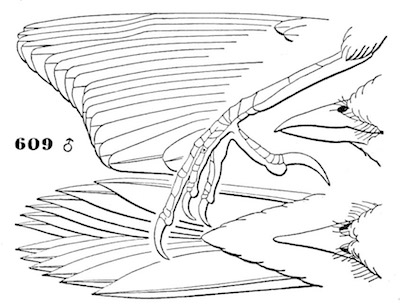
Ammodromus caudacutus. 609 ♂
Color. Streaked above and across the breast; very faintly on the sides.
The essential characters consist in the slender and elongated bill; the long legs reaching considerably beyond the tail, with the lateral claws falling considerably short of the middle one; and the very short rounded wings, rather longer than the cuneate tail, with its stiffened and lanceolate feathers.
Common Characters. Above olivaceous or ashy, the crown washed with brown laterally, the dorsal feathers darker centrally; beneath white, tinged across the jugulum with ochraceous or ashy; jugulum streaked; a dusky “bridle” on each side of throat; above it a maxillary stripe of ochraceous or white.
1. A. caudacutus. Ad. Above olive, the dorsal feathers darker and edged with whitish-ochraceous; superciliary and maxillary stripes deep ochraceous; jugulum and sides tinged with the same, and sharply streaked with black. Juv. Wholly ochraceous, darker above; crown and back streaked with black, the former divided medially by a pale-brown stripe; breast and sides streaked with black. Hab. Atlantic coast of United States.
2. A. maritimus. Ad. Above ashy, the dorsal feathers obsoletely darker centrally; superciliary stripe yellowish-ashy, bright yellow over the lores; maxillary stripe white; jugulum and sides tinged with ashy, the former obsoletely streaked with dark ashy. Juv. Above olivaceous, the crown and back streaked with black, the former not divided by a lighter median line; breast and sides washed with ochraceous and distinctly streaked with black. Hab. Atlantic coast of United States.
Ammodromus caudacutus, Swainson.
SHARP-TAILED BUNTING.
Oriolus caudacutus, Gmelin, I, 1788, 394.—Latham, Ind. Orn. I, 1790, 186 (not Fringilla caudacuta, Lath.). Fringilla caudacuta, Wilson, Am. Orn. IV, 1811, 70, pl. xxxiv, f. 3.—Aud. Orn. Biog. II, 1834, 281; V, 499, pl. cxlix. Fringilla (Spiza) caudacuta, Bon. Syn. 1828, 110. Passerina caudacuta, Vieillot. Ammodramus caudacutus, Swainson, Birds, II, 1837, 289.—Aud. Synopsis, 1839, 111.—Ib. Birds Am. III, 1841, 108, pl. clxxiv.—Bonap. Conspectus, 1850, 482.—Baird, Birds N. Am. 1858, 453.—Samuels, 307. Fringilla littoralis, Nuttall, Man. I, 1832, 504 (2d ed. 1840, 590). Sharp-tailed Oriole, Pennant, Arctic Zoöl. II, 261, New York.
Sp. Char. Upper parts brownish-olivaceous. Head brownish, streaked with black on the sides, and a broad central stripe of ashy. Back blotched with darker; edges of interscapular feathers and inner secondaries whitish, just exterior to a blackish suffusion. A broad superciliary and maxillary stripe, meeting behind the ashy ear-coverts, and a band across the upper breast, buff-yellow. The sides of the throat with a brown stripe; the upper part of the breast and the sides of the body streaked with black; rest of under parts whitish. Edge of wing yellowish-white. Bill yellowish below; dusky above. The female appears to have more buff on the breast than the male. Length, 5 inches; wing, 2.30.
Hab. Atlantic coast of the United States.
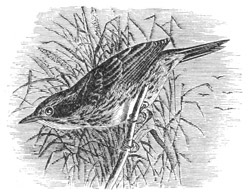
Ammodromus caudacutus.
The young is of a more yellowish tinge above and below; the streaks on the back more conspicuous; the scapular feathers without the whitish edging.
In autumnal and winter specimens the buff tints are much deeper than in spring; the sides of the crown, as well as the dark markings on the back, more intensified, and in greater contrast with the lighter ashy and olive tints.
Habits. The Sharp-tailed Finch is one of the most striking and well-characterized of land-birds, and as peculiar to the sea-shore as the Tringæ. In habits it very closely resembles the whole family of Waders in many striking respects. Like them it feeds upon small crustaceans and minute marine insects, keeping about the water’s edge, walking upon the floating weeds and other substances raised by the tide, preferring this mode of life to a more inland residence, and only resorting to the uplands to feed upon the seeds of grasses and sedges when their food fails them at the water’s edge.
Dr. Coues is of the opinion that this bird does not breed in the neighborhood of Beaufort, N. C., and that it leaves for the North in May, having a more northern habitat than A. maritima. He does not coincide with those who detect a resemblance between the actions of the Ammodrami and of the Sandpipers. He thinks the manner in which they climb the reeds, slide up and down, and hang from them in various attitudes, is more like that of Nuthatches and Titmice. On the ground they seem to him unmistakably sparrow-like.
This Sharp-tailed Finch is abundant along the coasts of Connecticut and Rhode Island, and is also found in Massachusetts, though sparingly, and only in a few congenial localities. In the marshes of Charles River, near Boston, this species is occasionally common in the breeding-season. In the summer of 1869, Mr. H. W. Henshaw found quite a number of their nests. Mr. Maynard has also taken it among the marshes of Ipswich, which is probably about its extreme northern limit. It has not, so far as I am aware, been traced to Maine. In these localities it probably raises two broods in a season, as it appears there in May, and remains until into October. They are eminently terrestrial, run on the ground like mice, are difficult to flush, and can only be shot while on the wing. They lie close to the ground, and conceal themselves in the grass.
They are also very numerous in the marshes in the neighborhood of New York, and especially so in New Jersey, breeding along that coast to Cape May. How much farther south than this they are found I cannot state, but I did not meet with any at Cape Charles, where the maritimus was very abundant.
In the winter this species is found in large flocks along the shores of South Carolina and Georgia. Mr. Audubon, however, did not find any in Florida. In the marshes near Charleston they are found in immense flocks, so much so that Audubon has known of forty being killed at a single shot. They search in the sedgy marshes for their food when the tide is out, and, on the approach of the returning waters, retreat to the higher shores and to the rice embankments.
The flight of this species is quite different from that of any other bird, and by it they may at once be recognized. In flying, they also drop their tails very low.
Mr. Audubon states that during the winter the Sharp-tailed Finch is furnished with an extra quantity of feathers on the rump, for which he finds it difficult to account.
These birds are essentially maritime, are found only in the vicinity of the sea, and always keep immediately about the water, except when the inclemency of the weather drives them to the high grass of the uplands for shelter. They walk and run, or remain feeding on the floating weeds and other substances raised by the tide, with all the ease and fearlessness with which they move on the land. They are gregarious in the winter, and in the Southern marshes are found feeding in companies. During the breeding-season they keep more in pairs, and are found more isolated. At this time they are also shy, and difficult to detect. Their usual call-note is only a single tweet, and in the love-season their series of twitters Mr. Audubon thinks hardly worthy to be called a song. They feed indiscriminately on seeds, insects, small crustaceans, and various forms of refuse matter floated or thrown up by the tides.
On the coast of New Jersey, where these birds are found in the greatest abundance, they have at least two broods in a season. Their nest is on the ground, in a small tussock of grass or sedges, but little removed from the reach of the tide, and is placed in a depression apparently excavated for the purpose. They are loosely made of soft and slender grasses, arranged in a circular form. The nest is large for the bird, spacious and deep, and is softly lined with finer and similar materials.
Their eggs, five or six in number, are of a somewhat rounded oval shape, having an average breadth of .59 of an inch, and vary in length from .78 to .70. Their ground-color is a light green, occasionally a dull white, with hardly a perceptible tinge of greenish, thickly sprinkled equally over the entire egg, with fine rusty-brown dots. These are of various sizes, but all fine. In a few the larger dots are confluent in a ring around the larger end; in others, the finer dots are so small as to be only distinguishable under a glass, concealing the ground-color, and giving to the egg an almost uniform rusty color. These eggs vary but little in shape, and are nearly equally rounded at either end, though never entirely so.
Ammodromus maritimus, Swainson.
SEASIDE BUNTING.
Fringilla maritima, Wilson, Am. Orn. IV, 1811, 68, pl. xxxiv, f. 2.—Aud. Orn. Biog. I, 1831, pl. xciii. Ammodromus maritimus, Sw. Zoöl. Jour. III, 1827, 328.—Bonap. List, 1838.—Ib. Consp. 1850, 482.—Aud. Synopsis, 1839, 110.—Ib. Birds Am. III, 1841, 103, pl. clxxii.—Baird, Birds N. Am. 1858, 454.—Samuels, 308. Fringilla (Ammodromus) maritima, Nutt. Man. I, (2d ed.,) 1840, 592. Fringilla macgillivrayi, Aud. Orn. Biog. II, 1834, 285; IV, 1838, 394; V, 1839, 499, pl. ccclv. Ammodromus macgillivrayi, Bon. List, 1838.—Ib. Conspectus, 1850, 482.—Aud. Syn. 1839.—Ib. Birds Am. III, 1841, 106, pl. clxxiii. Fringilla (Ammodromus) macgillivrayi, Nuttall, Man. I, (2d ed.,) 1840, 593.
Sp. Char. Above olivaceous ashy-brown; nearly uniform, but with the centres of interscapular feathers darker and edged faintly with paler; very obsoletely, almost inappreciably streaked elsewhere, especially on the head, which has a faintly defined median stripe of purer ashy. Beneath white; the breast and sides and under tail-coverts with rather indistinct streaks of dark ashy-brown, tending to form a large spot in centre of breast; an ashy mandibular stripe continued into the ashy sides of neck, and cutting off and enclosing a white stripe above it. A spot of yellow anterior to eye, continued over it as an almost inappreciable grayish stripe. Edge of wing sulphur-yellow. Bill lead-color; feet dusky. Length about 6 inches; wing, 2.50. In autumn the breast and sides tinged with fulvous; the back with rufous.
Young birds (A. macgillivrayi?) have markings much more distinct, and closely resemble A. caudacuta, though larger. They will be most readily distinguished by the absence of the fulvous superciliary stripe.
Hab. Atlantic sea-coast of United States, northward to Long Island Sound.
The same seasonal differences in coloration are observable in this species as in A. caudacutus.
Habits. The Seaside Finch has very nearly the same distribution, habits, and manners of life, as the Sharp-tailed species, and the description of these in one would answer almost equally well for the other. There are, however, certain shades of difference in several respects to be observed.
This bird is, if anything, more southern in its distribution than the other, and does not extend its visits in summer so far north. While the Sharp-tailed Finch is not an uncommon bird on the shores of the New England States, as far to the north as Ipswich, the Seaside Finch is comparatively rare, much more so now than it was formerly. Mr. Maynard states that he has searched carefully for it from the Merrimack to the extreme southern shores of Massachusetts without finding any specimens, nor could he find any on the island of Nantucket, a very natural and congenial locality. Dr. Coues states that it is abundant on the New Hampshire coast, but recent endeavors have failed to detect it. In 1836 and 1837 a few isolated pairs built in the marshes of Stony Brook, near Boston, above tide-water, nesting not on the ground, but in low bushes. They were identified by Mr. Audubon.
In the summer of 1852 I found this species very abundant on the low sandy islands of Cape Charles, Va. There, in every instance, their nests were in low bushes, about a foot from the ground. They were the only land-birds found on these islands.
Rev. C. M. Jones informs me that at Madison, Conn., on the coast, the Seaside and the Sharp-tailed Finches occur in about equal numbers in the salt marshes. He was not able to observe any specific difference in their mode of nesting, except that the maritimus seemed to be more common in that part of the marsh nearest the shore, while the caudacutus was more abundant farther back towards the highlands, though this was not the invariable rule. He sometimes found the nests suspended in the salt grass, the latter being interwoven with the other materials. In all such cases the entrance was on the side of the nest, in the manner of the Marsh Wren. At other times he found the nest placed under a quantity of lodged grass, but resting on a portion still lower. In such cases it is generally open at the top. He has also found them on the ground, and, when thus placed, always much more bulky than when built as above, a considerable quantity of dead grass being laid down to keep the nest above the wet, though not always with success. On Cobb’s Island, Va., Mr. Jones only found the maritimus, the nests of which were in bushes, from one foot to eighteen inches from the ground.
The call-note of this species is said to be a monotonous chirp, and its song hardly to deserve that name. The notes of which it is composed are few, and have neither variety, emphasis, nor attractiveness.
Dr. Coues states that this Finch begins to sing when mating, and is afterwards, during the incubating, particularly earnest and persevering about it. Each pair usually claims some particular copse, and the male usually has his favorite singing-post, to which it continually resorts. He adds that its simple song is something like that of the Yellow-shouldered Sparrow, beginning with a few slow notes, then a rapid trill, finally slurred, till it sounds like the noise made by some of the grasshoppers.
These birds are at all times shy and difficult to be approached. When their nest is visited, the parents leave it and secrete themselves, and cannot be traced without great difficulty. When thus hidden, they will almost suffer themselves to be trodden upon before they will fly up.
Mr. Audubon thinks they have two broods, their first being hatched out early in June. Their nests, he states, are usually placed next to the ground, but not sunk in it. Their food consists of marine insects, small crabs, and snails, as well as small sand-beetles and seeds. Their flesh has a rank, unsavory flavor, so much so that, having had some made into a pie, he could not eat it. He states also that they are resident in the Southern States, and are found along the Gulf coast as far as Texas.
The nest is strongly but coarsely woven of dry sedges, stems, and grasses, and is lined with similar but finer materials. The eggs are five in number, have a grayish-white ground, and are spotted and blotched with reddish-brown. The blotches are distributed over the entire egg, and are much larger than in the caudacutus. There is, indeed, no similarity between the two eggs. They measure .88 by .68 of an inch.
Genus CHONDESTES, Swainson.
Chondestes, Swainson, Phil. Mag. I, 1827, 435.—Ib. Fauna Bor.-Am. II, 1831. (Type, Chondestes strigatus, Sw., equal to Fringilla grammaca, Say.)
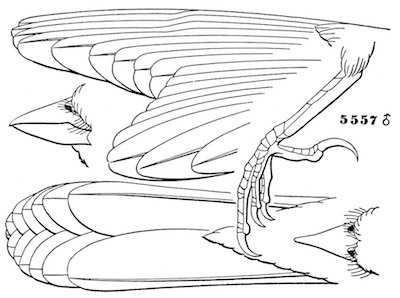
Chondestes grammaca. 5557 ♂
Gen. Char. Bill swollen; both outlines gently curved; the lower mandible as high as the upper; the commissure angulated at the base, and then slightly sinuated. Lower mandible rather narrower at the base than the length of the gonys; broader than the upper. Tarsi moderate, about equal to the middle toe; lateral toes equal and very short, reaching but little beyond the middle of the penultimate joint of the middle toe, and falling considerably short of the base of middle claw. Wings, long, pointed, reaching nearly to the middle of the tail; the tertials not longer than the secondaries; the first quill shorter than the second and third, which are equal. The tail is moderately long, considerably graduated, the feathers rather narrow, and elliptically rounded at the end.
Streaked on the back. Head with well-defined large stripes. Beneath white, with a pectoral spot. Only one species recognized.
Chondestes grammaca, Bonap.
LARK SPARROW.
Fringilla grammaca, Say, in Long’s Exped. R. Mts. I, 1823, 139.—Bon. Am. Orn. I, 1825, 47, pl. v, f. 3.—Aud. Orn. Biog. V, 1839, 17, pl. cccxc. Chondestes grammaca, Bon. List, 1838.—Ib. Conspectus, 1850, 479.—Baird, Birds N. Am. 1858, 456.—Cooper & Suckley, 200.—Maynard, Birds E. Mass. 1870, 112 (Massachusetts).—Cooper, Orn. Cal. 1, 193. Emberiza grammaca, Aud. Synopsis, 1839, 101.—Ib. Birds Am. III, 1841, 63, pl. clviii.—Max. Cab. Jour. VI, 1858, 343. Chondestes strigatus, Swainson, Philos. Mag. I, 1827, 435.
Sp. Char. Hood chestnut, tinged with black towards the forehead, and with a median stripe and superciliary stripe of dirty whitish. Rest of upper parts pale grayish-olive, the interscapular region alone streaked with dark brown. Beneath white, a round spot on the upper part of the breast, a broad maxillary stripe cutting off a white stripe above, and a short line from the bill to the eye, continued faintly behind it, black. A white crescent under the eye, bordered below by black and behind by chestnut, on the ear-coverts. Tail-feathers dark brown, the outermost edged externally and with more than terminal third white, with transverse outline; the white decreasing to the next to innermost, tipped broadly with white. Length, 6 inches; wing, 3.30.
Hab. From Wisconsin and Illinois (also in Michigan and Ohio) to the Pacific coast; Cape St. Lucas, south to Texas and Mexico. Oaxaca (Scl. 1859, 379); Vera Cruz (winter, Sumichrast, 552); Eastern Massachusetts, accidental (Maynard).
The colors of the female are duller than in the male, the chestnut less bright, the black not so intense; the pattern, however, is the same.
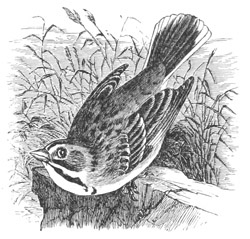
Chondestes grammaca.
The young bird has the breast and throat with a good many spots of dark brown instead of the single large one on the breast. The other markings are more obscure.
Habits. The Lark Finch is found from Eastern Illinois to the Pacific, and from Oregon to Texas. Within this wide area of distribution it is everywhere abundant in the open prairies and plains. It is not found in wooded regions. This bird was described by Say, and was first met with by Long’s expedition to the Missouri River. It was not known to either Wilson or Audubon, and its habits were very imperfectly known to Nuttall.
Mr. Dresser found this bird very abundant in Texas throughout the summer, arriving in the neighborhood of San Antonio in March, and leaving there early in October. He found their nests quite common, and usually built in a mesquite tree or bush, of fine roots and grasses. Dr. Heermann also found it abundant in New Mexico. In Arizona, Dr. Coues found it, chiefly in spring and autumn, a migrant, and, at those seasons, very numerous. Many remain during the summer to breed, and a few are found in the winter. It was met with near New Leon, Mexico, by Lieutenant Couch, but was not obtained in Vera Cruz by Sumichrast. It was taken near Oaxaca, Mexico, by Mr. Boucard. A single specimen was obtained at Fort Dalles in Oregon, by Dr. Suckley, but it was not met with by him west of the Cascade Mountains. Mr. Townsend states that he also found it in that region.
Dr. Cooper did not find this species in the Colorado Valley, though it has been obtained at Fort Yuma in December; and, as he has met with them in large flocks in the valleys of San Diego in February, he concludes that they winter in the southern part of California. They breed from San Diego throughout California, and as far north as the Columbia, where they arrive early in May. Dr. Cooper has never found their nest in California, but has frequently met with it in Kansas and Nebraska in May and June. He found them on the ground, and their nests were constructed chiefly of grass.
He speaks of them as singing very sweetly, and states that in their song they resemble the Canary more than any other bird. They frequent the open plains, usually in the neighborhood of trees, upon which they often alight in flocks. Their food consists of the seeds of grass and other small plants, which they collect on the ground.
A single specimen of this bird was shot in Massachusetts in 1845, by Mr. Samuel Jillson. It was taken in Gloucester, on the coast, where its appearance was, of course, purely accidental.
We are indebted to the careful observations of Mr. Ridgway for the principal portion of our knowledge of the manners and mode of life of this species, which he has recently ascertained to be an abundant summer resident in Southern Illinois. It is probably equally abundant throughout the State, and is found as far east as Ohio, where it becomes rare.
The Prairie Lark-Finch was found by that accurate observer very abundant at Sacramento, Cal., where it frequented alike the oak groves, the cottonwood and willow copses, and the weedy fields and meadows. At Sacramento it was eminently arboreal, quite in contrast with its habits as observed in Illinois. It was also met with in the interior, wherever the locality was suited to it. Near Salt Lake City it is one of the most numerous of the birds inhabiting the artemisia grounds, in the outskirts of the town, in company with Poospiza bilineata and Spizella breweri. It is called by the Utah boys the Snake-Bird, from the supposed resemblance of its striped head to that of a snake. At Sacramento it is greatly prized as a cage-bird, and young birds readily sell there for four dollars a pair. He states that the delightful song of this bird has no parallel among the North American Fringillidæ, and claims that in this respect it is pre-eminently superior to that of all the other members of this family. As it perches upon the summit of a small tree, on the telegraph wire, or upon a fence, its notes may be heard throughout the day, in the morning before those of any others, and late in the evening, when all except for this irrepressible songster is silence.
The song of this species is described as composed of regularly divided parts, almost perfect in compass, in vigor and continuity unsurpassed, if not unequalled, by any other North American species. It begins with a series of chants, the style reminding one somewhat of the Cyanospiza cyanea, but each syllable loud, rich, and clear, and uttered with a peculiar emotional trill, the whole seemingly delivered in a hurried manner, in one continuous gush of sprightly silvery notes, each accompanied by a metallic tremolo. As if exhausted, the singer falters, and the notes become scarcely audible, then suddenly reviving, as if in great joy, the song is resumed in all its vivacity, until the bird at last really appears to be overcome by its efforts.
Dr. Coues met with this species in Arizona in the winter. He writes me as follows: “The most eastern point where I observed this species was at St. Louis, Mo. I saw a good many in the suburbs of that city in May, 1865. It is one of the most abundant Sparrows about Fort Whipple, particularly during the migrations; the majority pass northward in April and May, but many breed in the vicinity, and some pass the winter in sheltered situations. It is generally seen in companies, frequenting the skirts of woods, the underbrush along mountain rivulets, and similar situations, where the seeds of various plants are procurable; its general habits resemble those of the species of Zonotrichia.”
The nests were found by Mr. Ridgway in various situations; the larger number were upon the ground, but several were in trees varying in height from six to twenty feet from the ground. They were found from the latter part of May through June. A nest obtained in Southern Wisconsin by Mr. Thure Kumlien is very homogeneous in structure, consisting entirely of loosely intertwined stems of dry grasses, sedges, and carices. It was built on the ground, is nearly flat, and has only a very shallow cavity. Its entire height is less than two inches, and the depth of its depression not half an inch. The diameter of the nest is three and a half inches, and that of the cavity at the rim three inches.
The maximum number of their eggs is five. Their average measurement is .85 by .65 of an inch. The ground-color is usually a grayish-white, rarely a light brown, marbled and streaked with waving lines, and a few dots of black or a blackish-brown.
Genus ZONOTRICHIA, Swainson.
Zonotrichia, Swainson, Fauna Bor.-Am. II, 1831. (Type, Emberiza leucophrys.)
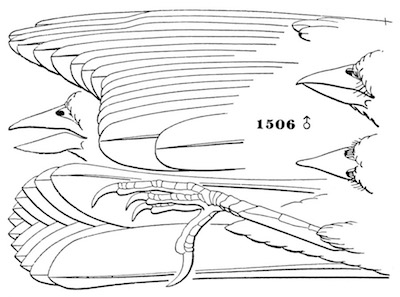
Zonotrichia leucophrys. 1506 ♂
Gen. Char. Body rather stout. Bill conical, slightly notched, somewhat compressed, excavated inside; the lower mandible rather lower than the upper; gonys slightly convex; commissure nearly straight. Feet stout; tarsus rather longer than middle toe; the lateral toes very nearly equal. Hind toe longer than the lateral ones; their claws just reaching to base of middle one. Inner claw contained twice in its toe proper; claws all slender and considerably curved. Wings moderate, not reaching to the middle of the tail, but beyond the rump; secondaries and tertials equal and considerably less than longest primaries; second and third quills longest; first about equal to the fifth, much longer than tertials. Tail rather long, moderately rounded; the feathers not very broad.
Back streaked. Rump and under parts immaculate, except in young. Head black, or with white streaks, entirely different from the back.
This genus embraces some of the most beautiful of American Sparrows, all of the largest size in their subfamily.
All the species properly belonging to this genus are North American; several South American species, have, however, been assigned to it; but they are none of them strictly congeneric with those given below.
Common Characters. Feathers of interscapular region blackish centrally, passing into rufous-brown and edged with paler. Rump and upper tail-coverts uniform olivaceous-ashy brown. Two white bands on the wings; the tertials edged with rufous. Beneath without streaks. Head above marked with black, and generally with white. Cheeks plumbeous.
A. Black of the crown divided by a median light stripe. Jugulum ashy.
a. Throat ashy, uniform with the breast.
1. Z. leucophrys. Median stripe of the crown white. A black stripe from behind the eye, and a white superciliary stripe.
α. A black stripe from the eye to forehead, across lore. Hab. Eastern Province of North America, west throughout Rocky Mountains; Cape St. Lucas in winter … var. leucophrys.
β. No black streak in front of eye, the lores being wholly ashy. Hab. Western Province North America, east to Rocky Mountains … var. gambeli.
2. Z. coronata. Median stripe of crown yellow for anterior and ash for posterior half. Black of crown coming down to eye and ear coverts, leaving no light superciliary stripe. Hab. Pacific Province of North America; accidental east of Sierra Nevada.
b. Throat pure white, in sharp contrast with the dark ash of cheeks and jugulum.
3. Z. albicollis. Median stripe of crown white. A light superciliary stripe, yellow anterior to the eye, and white behind it; a black streak along upper edge of ear-coverts. Hab. Eastern Province of North America.
B. Black of the crown not divided, but continuous. Jugulum white.
4. Z. querula. Lores, forepart of cheeks, with the chin and throat, deep black; whole side of head behind the eye, ashy. Lower parts pure white. Hab. Missouri Plains.
Zonotrichia leucophrys, Swainson.
WHITE-CROWNED SPARROW.
Emberiza leucophrys, Forster, Philos. Trans. LXII, 1772, 382, 426.—Gmelin, Syst. Nat. I, 1788, 874.—Wilson, Am. Orn. IV, 1811, 49, pl. xxxi, f. 4. Fringilla (Zonotrichia) leucophrys, Sw. F. B. Am. II, 1831, 255. Zonotrichia leucophrys, Bon. List, 1838.—Ib. Consp. 1850, 478.—Baird, Birds N. Am. 1858, 458, pl. lxix, f. 2.—Coues, P. A. N. S. 1861, 224.—Maynard, Birds E. Mass. 1870, 118.—Cooper, Orn. Cal. 1, 196.—Samuels, 309. Fringilla leucophrys, Aud. Orn. Biog. II, 1834, 88; V, 515, pl. cxiv.—Ib. Syn. 1839, 121.—Ib. Birds Am. III, 1841, 157, pl. cxcii. ? Spizella maxima, Bonap. Comp. Rend. 1853 (either this or Z. gambeli). White-crowned Sparrow, Pennant.
Figured in Buffon, Ois. IV, 192, pl. ccxxiii, f. 2. Winter.
Sp. Char. Head above, upper half of loral region from the bill, and a narrow line through and behind the eye to the occiput, black; a longitudinal patch in the middle of the crown, and a short line from above the anterior corner of the eye, the two confluent on the occiput, white. Sides of the head, forepart of breast, and lower neck all round, pale ash, lightest beneath, and shading insensibly into the whitish of the belly and chin; sides of belly and under tail-coverts tinged with yellowish-brown. Interscapular region streaked broadly with dark chestnut-brownish. Edges of the tertiaries brownish-chestnut. Two white bands on the wing.
Female similar, but smaller; immature birds in first winter, with the black and white stripes on the crown replaced by dark chestnut-brown and brownish-yellow. Length, 7.10 inches; wing, 3.25. Young of the year thickly streaked with dusky on the breast. The lateral stripes of the crown dull brown, the median one streaked whitish.
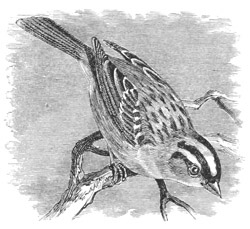
Zonotrichia leucophrys.
Hab. United States from the Atlantic to the Rocky Mountains, where they become associated with Z. gambeli. Cape St. Lucas; Greenland (Reinhardt, Ibis, III, 7). Breed in Wahsatch Mountains (Ridgway).
The white of the crown separates two black stripes on either side, rather narrower than itself. The black line behind the eye is continued anterior to it into the black at the base of the bill. The lower eyelid is white. There are some obscure cloudings of darker on the neck above. The rump is immaculate. No white on the tail, except very obscure tips. The white on the wings crosses the ends of the middle and greater coverts.
The character distinguishing the western representative (Z. gambeli) of leucophrys is apparently very trifling, but is very constant.
Habits. The White-crowned Sparrow is found from the Rocky Mountains eastward to the Atlantic, and in all the intervening territory, from the Southern States to the Arctic regions. In the high meadows of the Wahsatch Mountains, Mr. Ridgway found this bird very abundant, and one very characteristic, breeding there quite as numerously as any other species. In all that region Mr. Ridgway did not meet with a single individual of Z. gambeli, its western representative. At the encampment at Parley’s Park these birds soon became on very familiar terms with the party. They were very sociable, and paid frequent visits to the cook’s tent, and picked up, without the slightest signs of fear, the crumbs from the ground. Their sweet morning carol was, he states, delightful to the ear, and they were held in great favor by all. A nest of these birds was found on the ground, at Parley’s Park, June 26. It was built in a bunch of Geranium. Specimens of this species were obtained, in winter, at Cape St. Lucas, Lower California, by Mr. Xantus.
Although an eastern species, passing, in its migrations, through the Southern Atlantic States to Labrador in the spring and returning in the fall, it is a rare species in all New England. Mr. Boardman says that it is not common in Eastern Maine, and Mr. Verrill that it is rare in the western part of that State. In Eastern Massachusetts it is very rare. Mr. Maynard mentions obtaining a single specimen, May 27, and regards it as quite a rare migrant. I have never met with the bird near Boston, and do not believe that it is found there, except singly and rarely. In the western part of the State, though less rare, it is very far from being common. It is found there in the spring, from the 20th to the 30th of May, and in October from the 1st to the 15th. Mr. Allen met with it from May 7 to June 6, in 1861, when these birds were more common than usual. At this period, farther west, in Ohio, Western Pennsylvania, and New York, these birds are very abundant. From April 10 to the latter portion of May, in 1852, they were abundant in the neighborhood of Washington, the Capitol grounds being full of them. They were familiar and fearless, and seemed to delight to search for food under the large Norway spruces, branching down to the ground. Their abundance that spring may have been exceptional, as Wilson appears to have met with but very few specimens.
Mr. Audubon found these Sparrows very abundant in Labrador, where they were apparently late in breeding. It was not until the 6th of July that he found one of their nests. This was placed among the moss at the foot of a low fir. It was made externally of dry hypnum mosses, matted in bunches like the coarse hair of some quadruped, and internally of fine dry grasses, arranged with great neatness, to the thickness of half an inch, with a full lining of the delicate yellow fibrous roots of the Coptis trifolia. The nest was five inches in its external diameter, and two in depth, the cavity two and a quarter wide and one and three quarters deep. The eggs, five in number, he describes as of a light sea-green color, mottled towards the larger end with brownish spots and blotches, a few spots of a lighter tint being dispersed over the whole. All the nests found were placed on the ground or among the moss, and all were alike in their construction. By the beginning of August the party met with young that were able to fly. By the middle of that month they had commenced their southern migrations.
Dr. Coues also found this Sparrow breeding in great numbers along the entire coast of Labrador. Found in all situations, it seemed to be particularly fond of deep, thickly wooded, and secluded ravines, surrounded by high precipitous cliffs, and, when in more open districts, confining itself to tangled patches of juniper and scrubby firs. He describes it as a very active and sprightly bird, almost continually in motion. It seldom alights without rapidly jerking and flirting its tail, and uttering its loud chirpings. While the female is incubating, the male usually mounts to the top of the cliff or a neighboring tree, and repeats his loud and not unpleasing, though somewhat monotonous, notes for the space of half an hour or more. He describes its song as very similar to that of the White-throated Sparrow, consisting of two long-drawn syllables with a rising intonation, then three more in a quick, hurried manner, with a falling cadence,—pēé-dēé-dē-dē-dē; the whole is delivered in a mellow whistle. If approached while thus engaged, the performer becomes instantly silent, and dives hastily into the nearest cover. The nest was always placed on the ground, and usually in little patches of low heath, abundant wherever the ground was dry. He found a nest on the 23d of July, containing young just hatched. The female flutters off in silence when her nest is disturbed, but the male bird vociferates his angry remonstrance, flirting his tail and jerking his body in an energetic manner.
The food of this bird, in Labrador, was found to consist of small coleopterous insects, grass-seeds, a variety of berries, as well as minute shell-fish, for which they searched the margins of ponds near the sea-shore. They were also seen to pursue insects on the wing. Mr. Audubon speaks of its song as consisting of six or seven notes, and describes it as loud, clear, and musical, although of a plaintive nature, diminishing in power to the last note. Its flight he describes as low, swift, and protracted.
Dr. Coues did not find this bird abundant in South Carolina during the winter, and conjectures that it does not go so far to the south. Its migrations do not appear to be well defined, and nowhere is it known to be abundant during this season. Lieutenant Couch met with it at Brownville, Texas, and Tamaulipes, Mexico, and at Charco Escondido, in March, at which time they were in flocks, indicating a more southern migration than is generally supposed.
It extends its northern migrations to the extreme northern and northeastern portions of the continent, and also to Greenland. On the Yukon and Anderson Rivers it is replaced by the Z. gambeli. It is not abundant in Greenland. Holböll obtained a single specimen only in August; and afterwards met with a flock of young birds. He infers that they breed in the interior, but are restricted to a very narrow strip of territory.
Eggs of this species, from Wyoming Territory, measure from .90 to .95 of an inch in length by .70 in breadth, and are of an oblong-oval shape. The ground-color is a light greenish-white, thickly marked with reddish-brown and lighter markings of an obscure purplish-brown. The intensity, depth of coloring, and size of the darker brown markings, vary. They are principally disposed about the larger end.
Zonotrichia leucophrys var. gambeli, Gambel.
WESTERN WHITE-CROWNED SPARROW.
Fringilla gambeli, Nutt. Man. I, (2d ed.,) 1840, 556.—Gambel, Pr. A. N. Sc. Phila. I, 1843, 262 (California.) Zonotrichia gambeli, Gambel, J. A. N. Sc. 2d series, I, Dec. 1847, 50.—Baird, Birds N. Am. 1858, 460, pl. lxix, f. 1.—Lord, Pr. R. A. Inst. IV, 1864, 119 (British Columbia).—Cooper & Suckley, 201.—Dall & Bannister, Tr. Ch. Ac. I, 1869, 284 (Alaska).—Cooper, Orn. Cal. 1, 195. Zonotrichia leucophrys, Newberry, Zoöl. Cal. & Or. Route; Rep. P. R. R. VII, iv, 1857, 87.
Sp. Char. Precisely similar to Z. leucophrys, but rather smaller; the lores are gray throughout, this color continuous with a white superciliary stripe along the side of the head. Length, 6.25; wing, 2.83; tail, 3.08.
Hab. Rocky Mountains to the Pacific coast, north to Nulato and Fort Kenai, east through the valley of the Mackenzie River, and south to Jalisco and Mazatlan, Mexico.
As stated in the previous article, the only appreciable and constant difference between this race and Z. leucophrys is found in the character of the black stripe on the side of the crown. In leucophrys the black passes down over the upper half of the lores, and in front of the eye, to a line continuous with the cutting edge of the bill, and sends back a short branch to the eye, which cuts off the white superciliary stripe. In gambeli the superciliary stripe passes continuously forward to the ashy lores, cutting off the black from the eye. The lower edge of the black anteriorly is much higher than in leucophrys, and nearly on a line with the nostrils.
We cannot give any positive character by which immature specimens of leucophrys and gambeli may be distinguished, unless that the short dark line from forehead to eye of the former is indicated by a greater amount of dusky at the base of the feathers of that region.
The young of this species, like that of leucophrys, is streaked with blackish on side of the throat, across the breast, and on the sides of body, instead of being entirely unmarked beneath, as in the adult.
One specimen, collected in the West Humboldt Mountains, connects this form with leucophrys, and may possibly be a hybrid. In this there is a black spot in front of the eye, but separated from the black of the crown by the usual light superciliary stripe of gambeli.
Some specimens from the coast region of California have the ash of head and breast duller, and with a brownish cast, and the spots on the back black instead of deep dark brown.
Habits. The Western White-crowned Sparrow is found in great abundance, from Mexico to the Arctic Ocean, between the Rocky Mountains and the Pacific. Dr. Suckley found this bird very abundant at Fort Dalles and at Puget Sound, at both of which places it is a constant summer resident. It was always found in excellent condition. He states that it makes its nest in low bushes, among the stalks of lupins and other shrub-like weeds. Dr. Cooper also mentions that this bird is very abundant in all the prairie districts of Washington Territory, especially where there are low bushes. Unlike most of the Sparrows, it was also common on the coast prairies, where he found it breeding. They arrive at the Straits of Fuca at the end of March in large numbers, and leave for the South in October. He afterwards found them at Fort Mohave, in the Colorado Valley, quite common throughout the winter, some remaining until the 15th of May, but he does not think that any remain there to breed. They are also abundant, in winter, from San Francisco south, through all the inhabitable country. In summer they are found in the Sierra Nevada, to their summits, and are also plentiful in the regions north of the Columbia. A few remain, during the summer, in the cool district about San Francisco. In June, 1854, Dr. Cooper met with its nest near the mouth of the Columbia. It was built in a bush, about a foot from the ground, formed of neatly interwoven grasses, and lined with softer materials. He describes its song as loud, but short and melancholy, heard at intervals during the whole year, and frequently at night.
The Western White-crowned Sparrow was first met with by Mr. Ridgway, at the Summit Meadows, near the summit of Donner Lake Pass of the Sierra Nevada, at an altitude of about seven thousand feet. It was there an abundant and characteristic bird. The males were in full song in all parts of the meadow, and were nesting in such numbers that on the evening of July 9, on halting for the night, in a hurried search no less than twenty-seven of their eggs were obtained within about fifteen minutes. In every instance the nests were embedded under a species of dwarf-willow, with which the ground was covered. The birds were extremely unsuspicious, the male often sitting on a bush within a few feet of the collector, and chanting merrily as the eggs were being blown. In one instance, having occasion to repass a spot from which a nest had been taken, the female was found sitting in the cavity from which its nest had been removed. This species is only a winter visitant of the lower country, but is there universally distributed, and always found in bushy localities.
Mr. Bannister states that this bird was tolerably abundant among the alder-bushes in certain parts of St. Michael’s Island. Mr. Dall found it common at Nulato, and especially so at Fort Yukon. It arrived at Nulato about May 20. Its nests and eggs were obtained from Indians at Nowikakat, on the Yukon River. Dr. Kennerly met with these birds, in February, at White Cliff Creek, New Mexico. They were first observed on approaching the Big Sandy, and from thence to the Colorado they were found in abundance. They were mostly in flocks, and were generally found among the bushes, in the vicinity of water. He also met with it in the valley of the Rio Grande, Corralitos, and Janos Rivers. It seemed to prefer the vicinity of settlements, where it was always seen in greater numbers than elsewhere.
Mr. Dresser found these birds common about San Antonio, Texas, during the winter, arriving late in September. Some may remain and breed, as several were observed there in June. Dr. Coues also found them abundant in Arizona, where he first observed them September 15. After this they became exceedingly numerous, and remained so until January. Later than this only a few stragglers were seen, until April, when they again became abundant. By far the greater part left, and proceeded north to breed.
These Sparrows were found breeding on the Yukon and at Fort Anderson in great numbers by Messrs. MacFarlane, Lockhart, and Ross. Their nests were in nearly all cases found upon the ground, often in tufts of grass, clumps of Labrador tea, or other low bushes. They were composed of hay, and, in nearly every instance, were lined with deer’s hair, and in a few with feathers. A few were without any lining. In selecting a situation for their nests, they seemed generally to give the preference to open or thinly wooded tracts. The male bird was usually seen, or its note heard, in the immediate vicinity of the nest. The eggs were obtained from the 4th of June to the 1st of July. Their maximum number was six; the most common, four.
Mr. B. R. Ross states that this species arrives at the Arctic Circle from about the 15th to the 20th of May, and at Slave Lake only a few days earlier. They are then no longer in flocks, but have already paired. They commence nesting almost immediately upon their arrival at the Yukon and at Fort Good Hope. Mr. Ross found nests made as early as May 20 to 25, while there was still considerable snow upon the ground. They mostly nest, however, in the first half of June, the young usually hatching between the 15th and 30th, and leaving the nests when less than a month old. They all leave the Arctic Circle about the middle of September. A few were seen at Fort Simpson in the latter part of that month. When starting, they gather in small flocks. The nest is built on high ground, among low, open bushes, always at the foot of some shrub or bush, and more or less protected and concealed by grass. It is never placed in the edges of marshes, like Melospiza lincolni; nor on small prairies, like the Passerculus savanna; nor in thick woods, as does sometimes the Z. albicollis. The nest is neatly built, is more compact and of finer materials than that of the latter. It is large and deep, formed externally of coarse grass, and lined with finer materials.
When started from her nest, the female flies off a few yards and flutters silently along the ground to divert attention. If unsuccessful, she flies about her nest uttering sharp, harsh notes of anxiety. The male is less bold on such occasions. Their favorite habitat is light open bushes, affecting neither open plains nor deep woods and never perching so high as twenty feet from the ground, and usually, in all their movements, keeping close to the earth.
Its food, so far as could be observed, consisted almost wholly of seeds, sought mostly on the ground. It hatches only a single brood in a year.
Mr. B. R. Boss adds that this is the most abundant Sparrow throughout the Mackenzie River region, and also the most interesting. Through the spring and summer its melodious song, which strongly calls to mind the first notes of the old air, “O Dear! what can the Matter be?” may be heard from every thicket, both night and day. When sleeping in the woods, Mr. Boss states that he has often been awakened by several of these birds singing near him, answering each other, throughout the short night, when all the other birds were silent. On this account, but for the richness and melody of its song the bird would have made itself quite disagreeable.
The Cree Indians name this Sparrow Wah-si-pis-chan, because they think this resembles its notes, the last of which are supposed to imitate the sound of running water. It sings long after the breeding-season is past, and its notes may be heard even into August.
The eggs measure .85 of an inch in length by .65 in breadth, and have a ground of a greenish-white marked with a rusty-brown. They are of a rounded-oval shape.
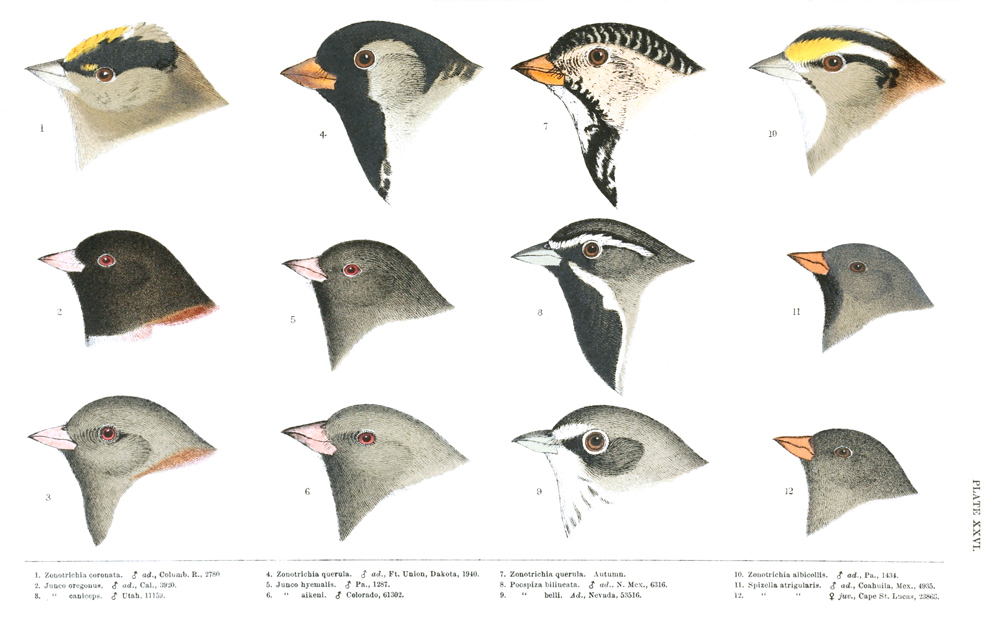
PLATE XXVI.
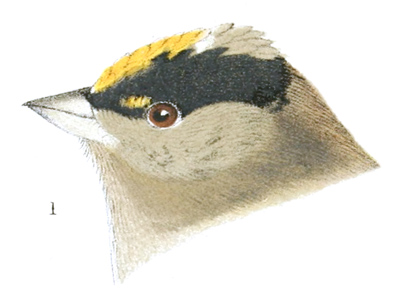
1. Zonotrichia coronata. ♂ ad., Columb. R., 2780.
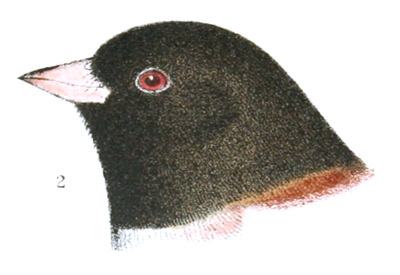
2. Junco oregonus. ♂ ad., Cal., 3920.
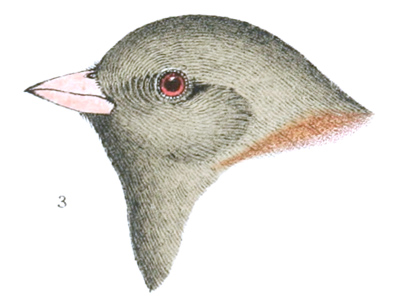
3. Junco caniceps. ♂ Utah, 11159.
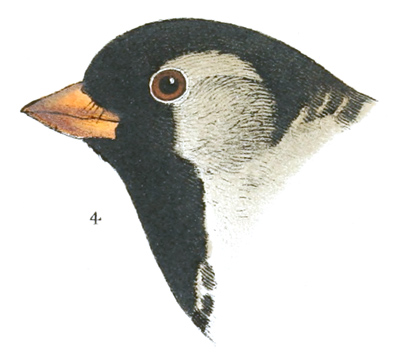
4. Zonotrichia querula. ♂ ad., Ft. Union, Dakota, 1940
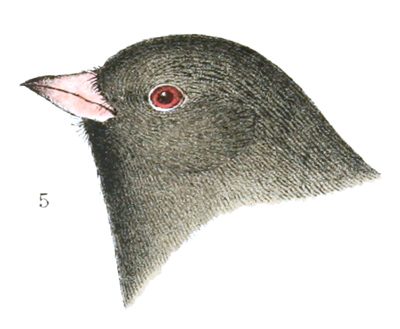
5. Junco hyemalis. ♂ Pa., 1287.
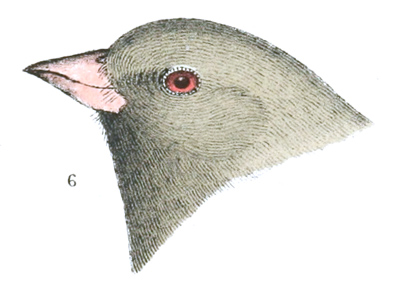
6. Junco aikeni. ♂ Colorado, 61302
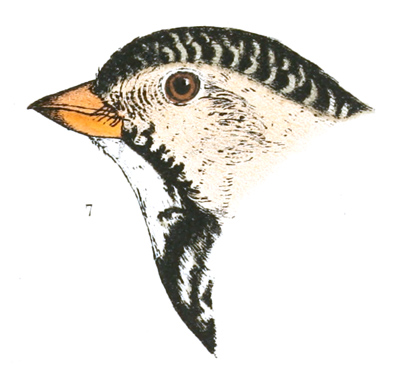
7. Zonotrichia querula. Autumn.
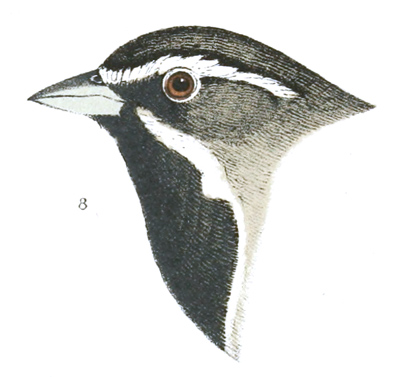
8. Poospiza bilineata. ♂ ad., N. Mex., 6316.
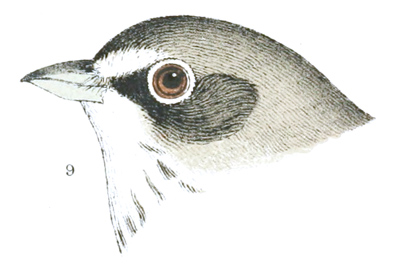
9. Poospiza belli. Ad., Nevada, 53516.
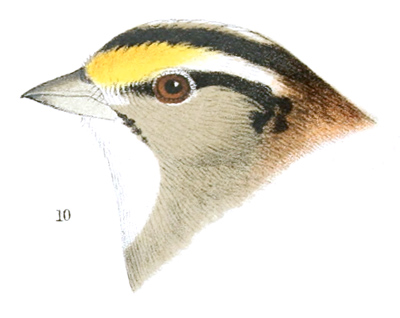
10. Zonotrichia albicollis. ♂ ad., Pa., 1434.
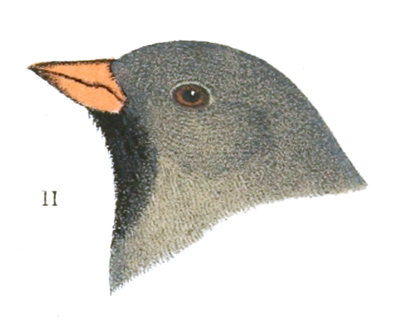
11. Spizella atrigularis. ♂ ad., Coahuila, Mex., 4935.
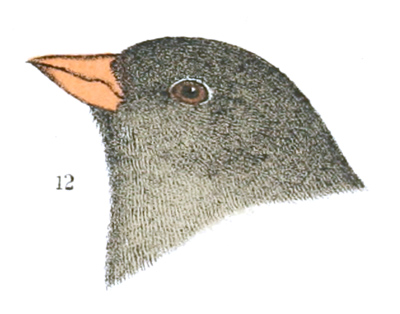
12. Spizella atrigularis. ♀ juv., Cape St. Lucas, 23866.
Zonotrichia coronata, Baird.
GOLDEN-CROWNED SPARROW.
Emberiza coronata, Pallas, Zoög. Rosso-Asiat. II, 1811, 44, plate. Zonotrichia c., Baird, Birds N. Am. 1858, 461.—Heerm. X, S, 48 (nest).—Cooper & Suckley, 201.—Dall & Bannister, Tr. Ch. Ac. I, 1869, 284 (Alaska).—Cooper, Orn. Cal. 1, 197. Emberiza atricapilla, Aud. Orn. Biog. V, 1839, 47, pl. cccxciv (not of Gmelin). Fringilla atricapilla, Aud. Synopsis, 1839, 122.—Ib. Birds Am. III, 1841, 162, pl. cxciii. Fringilla aurocapilla, Nuttall, Man. I, (2d. ed.,) 1840, 555. Zonotrichia aurocapilla, Bon. Consp. 1850, 478.—Newberry, Zoöl. Cal. & Or. Route, Rep. P. R. R. VI, IV. 1857, 88. Emberiza atricapilla, Gm. I, 1788, 875 (in part only).—Lath. Ind. 415. Black-crowned Bunting, Pennant, Arc. Zoöl. II, 364.—Lath. II, I, 202, 49, tab. lv.
Sp. Char. Hood, from bill to upper part of nape, pure black, the middle longitudinal third occupied by yellow on the anterior half, and pale ash on the posterior. Sides and under parts of head and neck, with upper part of breast, ash-color, passing insensibly into whitish on the middle of the body; sides and under tail-coverts tinged with brownish. A yellowish spot above the eye, bounded anteriorly by a short black line from the eye to the black of the forehead. This yellow spot, however, reduced to a few feathers in spring dress. Interscapular region, with the feathers, streaked with dark brown, suffused with dark rufous externally. Two narrow white bands on the wings. Bill dusky above, paler beneath; legs flesh-color.
Autumnal specimens have more or less of the whole top of head greenish-yellow; the feathers somewhat spotted with dusky; the black stripe of the hood reduced to a narrow superciliary line, or else to a spot anterior to the eye. Length about 7 inches; wing, 3.30.
Hab. Pacific coast from Russian America to Southern California; West Humboldt Mountains, Nev. Black Hills of Rocky Mountains?
Habits. This species, described and figured by Mr. Audubon as the Fringilla atricapilla, is found in western North America, from Alaska to Southern California and Cape St. Lucas, and is almost entirely confined to the Pacific Province, being known east of the Cascade Mountains and Sierra Nevada only as stragglers. In its general habits it is said to greatly resemble the Z. gambeli. In the vicinity of Fort Dalles, and also in the neighborhood of Fort Steilacoom, Dr. Suckley found it quite abundant in the summer.
Dr. Cooper says that it is only a straggler in the forest regions west of the Cascade Mountains, but that it probably migrates more abundantly to the open plains eastward of them. He met with them but once near Puget Sound, May 10, when they were apparently migrating. Dr. Cooper found a few of this species wintering as far south as San Diego, associating with Z. gambeli. They were much less familiar, did not come about the houses, but kept among the dense thickets. They were then silent, nor has he ever heard them utter any song. He met with none near the summit of the Sierra Nevada.
Dr. Newberry found these birds abundant in the vicinity of San Francisco in winter.
Mr. Nuttall met with the young birds of this species on the central tablelands of the Rocky Mountains, in the prairies. They were running on the ground. He heard no note from them. He afterwards saw a few stragglers, in the early part of winter, in the thickets of the forests of the Columbia River, near Fort Vancouver. He also met with them, in the winter and until late in the spring, in the woods and thickets of California.
Dr. Heermann found this species very abundant in the fall season, generally associated with the California Song Sparrow and the Z. gambeli. It resorts to the deep shady thickets and woods, where it passes the greater part of its time. In the mountainous districts it prefers the hillsides, covered with dense undergrowth. It occasionally breeds in California, as Dr. Heermann found its nest in a bush near Sacramento City. It was composed of coarse stalks of weeds, and lined internally with fine roots. The eggs were four in number, and are described as having been of an ashy-white ground, with markings of brown umber, at times appearing almost black from the depth of their shade. They were marked also with a few spots of a neutral tint.
Many of these birds were obtained in Sitka and in Kodiak, by Bischoff, and also in British Columbia by Elliot.
Only one specimen of this species was met with by Mr. Ridgway in his explorations with Mr. Clarence King’s survey. This was taken October 7, 1867, in the West Humboldt Mountains, in company with a flock of Z. gambeli.
Zonotrichia albicollis, Bonap.
WHITE-THROATED SPARROW.
Fringilla albicollis, Gmelin, Syst. Nat. I, 1788, 926.—Wilson, Am. Orn. III, 1811, 51, pl. xxii, f. 2.—Licht. Verz. Doubl. No. 247.(1823). Zonotrichia albicollis, Bp. Consp. 1850, 478.—Cab. Mus. Hein. 1851, 132.—Baird, Birds N. Am. 1858, 463.—Samuels, 311. Passer pennsylvanicus, Brisson, 1760, Appendix, 77. Fringilla pennsylvanica, Lath. Index, I, 1790, 445.—Aud. Orn. Biog. I, 1831, 42; V, 497, pl. viii.—Ib. Syn. 1839, 121.—Ib. Birds Am. III, 1841, 153, pl. cxci.—Max. Cab. Jour. VI, 1858, 276. Fringilla (Zonotrichia) pennsylvanica, Sw. F. B. Am. II, 1831, 256. Zonotrichia pennsylvanica, Bon. List, 1838.
Sp. Char. Two black stripes on the crown, separated by a median one of white. A broad superciliary stripe from the base of the mandible to the occiput, yellow as far as the middle of the eye and white behind this. A broad black streak on the side of the head from behind the eye. Chin white, abruptly defined against the dark ash of the sides of the head and upper part of the breast, fading into white on the belly, and margined by a narrow black maxillary line. Edge of wing and axillaries yellow. Back and edges of secondaries rufous-brown, the former streaked with dark brown. Two narrow white bands across the wing-coverts. Length, 7 inches; wing, 3.10; tail, 3.20. Young of the year not in the collection.
Hab. Eastern Province of North America to the Missouri. Breeding in most of the northern United States and British Provinces, and wintering in the United States almost to their southern limit. Aberdineshire, England, August 17, 1867 (Zoölogist, Feb., 1869, 1547; P. Z. S. 1857, 52). Scotland (Newton, Pr. Zoöl. Soc. 1870, 52).
Female smaller, and the colors rather duller. Immature and winter specimens have the white chin-patch less abruptly defined, the white markings on the top and sides of the head tinged with brown. Some specimens, apparently mature, show quite distinct streaks on the breast and sides of throat and body.
Habits. The White-throated Sparrow is, at certain seasons, an abundant bird in all parts of North America, from the Great Plains to the Atlantic, and from Georgia to the extreme Arctic regions. A few breed in favorable situations in Massachusetts, especially in the extreme northwestern part of the State. It breeds abundantly in Vermont, New Hampshire, and Maine, and in all the British Provinces.
Sir John Richardson states that they reach the Saskatchewan in the middle of May, and spread throughout the fur countries, as far, at least, as the 66th parallel, to breed. He states that he saw a female sitting on seven eggs near the Cumberland House, as early as June 4. The nest was placed under a fallen tree, was made of grass, lined with deer’s hair and a few feathers. Another, found at Great Bear’s Lake, was lined with the setæ of the Bryum uliginosum. He describes the eggs as of a pale mountain-green, thickly marbled with reddish-brown. When the female was disturbed, she ran silently off in a crouching manner, like a Lark. He describes the note of this bird as a clear song of two or three notes, uttered very distinctly, but without variety,—a very incomplete description.
Mr. Kennicott states that this species does not extend its migrations as far to the north as Z. gambeli, and is even much less numerous on the south shores of the Slave Lake, where he did not observe half so many of this as of the other. It also nests later, as he found the first nest observed on the 22d of June, with the eggs quite fresh, incubation not having commenced, and found others after that date. On English River he found two nests with eggs on the 9th and 17th of July, and one near the Cumberland House on the 30th of June. Two of these were in low swampy ground among large trees, the other on high ground among small bushes. They were constructed on large bases of moss, and lined with soft grasses. When startled from her nest, the female always crept silently away through the grass.
He met with this species in considerable flocks, accompanied by small numbers of Z. leucophrys, on the north shore of Lake Superior, on the 11th of May. He saw individuals on the 29th of May, near the Lake of the Woods, and it doubtless breeds as far south as that region. In the fall it was not seen at Fort Simpson later than the last of September. As it is a much more eastern bird than Z. gambeli, it is probably in greater abundance on the eastern end of Slave Lake. Its song he regards as by no means so attractive as that of Z. gambeli or of Z. leucophrys. Its general habits are very much like those of the former, and though by no means a strictly terrestrial bird, it rarely perches high on trees, and generally flies near the ground, except in its long migratory flights.
Notwithstanding the slighting manner in which the song of this bird is spoken of by some writers, in certain parts of the country its clear, prolonged, and peculiar whistle has given to it quite a local fame and popularity. Among the White Mountains, where it breeds abundantly, it is known as the Peabody Bird, and its remarkably clear whistle resounds in all their glens and secluded recesses. Its song consists of twelve distinct notes, which are not unfrequently interpreted into various ludicrous travesties. As this song is repeated with no variations, and quite frequently from early morning until late in the evening, it soon becomes quite monotonous.