S. (continued 2)
Reading edition
This plan was very popular on the Continent, and almost universally adopted; and so much importance was attached to it that Messrs. Didot and Sons took out an English patent for it, which they attempted to enforce against the letter founders of this country a few years afterwards, but which was resisted, and the claim to invention abandoned.
Since 1820 the English letter founders have produced a variety of beautiful Scripts of different sizes, but generally a modification of the French rhomboidal body plan; still the difficulty of composition remained to a great extent, and materially detracted from its general utility.
Within the last five years a further improvement has been made by the introduction of a new square-bodied Script, for which we are also indebted to French artists, Messrs. Laurent and Deberney, who have given it the name of Américain, which is so beautifully cut, and managed, that the effect of the whole, when well worked, is excellent.
The kern, instead of being unsupported, is protected by the shank of the letter, having two angles thus thrown out at the head of the two opposite corners of the body, so as to give support to both ascenders and descenders; the opposite angles of the letters are cast with a corresponding slope to receive the hanging over letters without their incurring any danger of riding upon each other.

This plan obviates all the difficulties of the two former ones, and requires only a pair of common cases. It is easily composed, and there is not more risk of damage than attends the working of any other description of delicate type. The sizes of this Script at present in the trade are, Canon, Two Lines English, Two Lines Pica, Great Primer, and Pica.
SCRIPT UPPER CASE.—Slanting body.
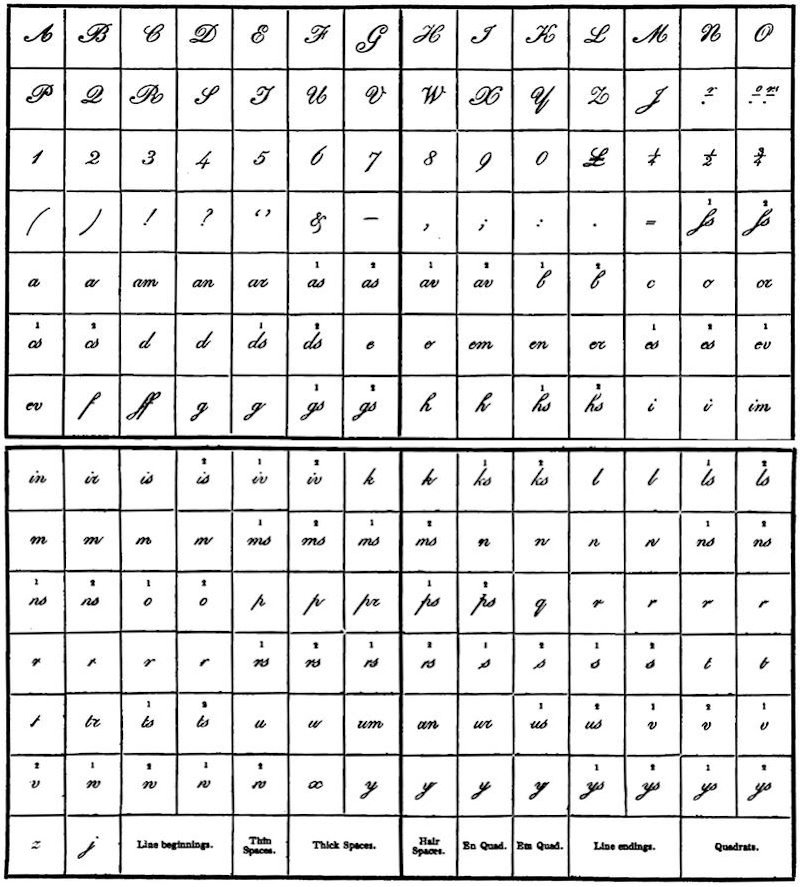
SCRIPT LOWER CASE.—Slanting body.
The sorts marked with 1 are cast thin, for joining with the letters which commence with a junction stroke, as m, n, r, v, w, x, y, z, and the compounds commencing with those letters. Those marked with 2, and distinguished by an extra nick, are cast thick, to go before a, b, c, d, e, f, g, h, i, k, l, o, p, q, t, u, &c.
Scytho-Gothic. See Runic.
Second at the Press. See First.
Second Pull. See First Pull.—M.
SECTION.
A section, marked thus §, is the division of a discourse, or chapter, into less parts or portions.—Murray. It is also used in printing as a reference to notes.
Seditious Libels. See Libels.
Semicolon. See Punctuation.
SERVIEN.
“The alphabets of the nations descended from the Scythians established in Europe, namely, the Servien, the Russian, the Sclavonian, and the Bulgarian, are all derived from the Greek. The Servien letters are called the Cyrillitan characters, from St Cyril, who converted the Moravians to Christianity; smaller characters were afterwards introduced, called Glogolitici. The Russian letters are immediately derived from those used by St. Cyril.”—Astle.
SET AT RANDOM.
When compositors cannot make up their matter into pages as they compose it, either by reason of their working in companionship, or from other causes, they put it in galleys till they can make up; this is termed Setting at Random. When a compositor is obliged to set a great quantity at random, so that it becomes inconvenient, on account of the number of galleys it occupies, and the room it takes up on the cases, he ties it up in moderate-sized pieces and puts it on page papers under his frame, with a bit of paper stuck in each with a number, to mark the order; if it be a work in quarto or folio, too large for page papers, he ties a cord round the matter in each galley and keeps it on the slices of his slice galley under his frame, till he makes up.
SET MATTER.
Matter that is composed, but not worked off, whether it be made up into pages or at random, is called set matter, to distinguish it from matter for distribution.
SET-OFF SHEETS.
Sheets of waste paper that are used upon the tympan sheet, to prevent the ink setting-off on the sheets that are successively printed when the reiteration is working; they are changed as soon as any setting-off is perceptible. They are slipped under the points at their edges, and are quickly changed, or turned, which is always done to economize the use of paper.
Set-off Sheets are also used upon the cylinders of machines that perfect, for the same purpose.
A sheet of thin paper is interleaved between every impression of fine work, particularly if it be large heavy paper and large type, to prevent setting-off in the heap; the work is hung up to dry with these sheets in, which are taken out by the warehouseman before the work is piled away, who then knocks them up, folds them in quires, and takes care of them till they are wanted again by the Pressmen.
Paper for these purposes is supplied by the warehouseman, who gives for the first waste or spoiled impressions; for the other tissue paper is generally used, and with care it will last a long time.
SET OUT PAPER.
Counting out the proper quantity by the warehouseman, to wet—M. We now term it Giving out Paper, which see.
Sets Clean. See Clean Proof.
Sets Close. See Get In.—M. The phrase is now used for close spacing.
Sets Foul. See Foul Proof.—M.
SETS OFF.
Work that is newly wrought off at the press often sets off, especially if it be fat beaten with soft ink: for when it comes to be beaten, or sometimes only hard pressed, by the Bookbinder, the moist ink spreads and delates itself round about the face of every letter, and sullies and stains the whole white paper.—M. We do not now include this spreading and delating of the ink in the meaning of setting off, but use the term only when one printed sheet parts with some of its ink to the sheet on which it is laid, or in the press, or in the process of binding, which it will do with large letter, which requires much ink, or when a book is pressed, or bound, before the ink is sufficiently dry: the Bookbinder’s hammer is a severe test; and where a book is required to be bound as soon as printed, the best plan, perhaps, is to have it cold pressed, which flattens the impression of the types, and renders it unnecessary to beat so much as when this mode of proceeding is not adopted. In printing fine work at press set-off sheets are used to prevent one sheet defacing another.—See Set-off Sheets.
SET THE ROUNCE.
Fixing the girts so that the Rounce stand in the most advantageous position to run the carriage in easily.—M.
SETS UP TO HIMSELF.
When a compositor has received the making-up from a companion, and has composed the intermediate matter, he has set up to himself; that is, he has composed the matter that followed his companion’s last page and preceded the part he commenced with, and has joined the two parts, so as to enable him to make up. See Join, and Making-up, to give the.
Sets Wide. See Drive out.—M. We now use the term for wide spacing.
SET UP CLOSE.
When two or more companions are on the same piece of work, and when any one of them composes all his copy, so that there is none intermediate between the close of his and the beginning of the companion’s that follows him, it is said, he has set up close, or, he has set close up.
SEVENTY-TWOMO.
A sheet of paper folded into seventy-two leaves or one hundred and forty-four pages is termed seventy-twos or seventy-twomo.
SHANK.
The square metal the face of a letter stands on, is called the Shank of a Letter.—M.
SHARP IMPRESSION.
This expression is used two ways by printers: some say it is a sharp impression when much blanket is used, and the impression of the types on the paper is deep: others hold, and I am of the opinion, that it is a sharp impression when no more than the face of the types appears on the paper, with the lines clear and smooth, and of a full colour, with as little indention as possible on the paper. Pressmen and their employers should know in which sense they each use the term, otherwise it may cause a serious mistake in work, as the two meanings embrace the best as well as the commonest work.
SHEARS.
Something similar to those used by tailors; they are employed to cut brass rule, scaleboard, thin reglet, &c. to proper lengths. The shears best adapted to this purpose have blades short in proportion to their handles.
SHEEP’S FOOT.
Is all made of iron, with an hammer head at one end, to drive the ball nails into the ball stocks, and a claw at the other end, to draw the ball nails out of the ball stocks.—M. It is customary to have one for each press, which in a wooden press is suspended by the head from two nails driven into the near cheek of the press, just below the cap. It is a very useful article to the pressman; but is often applied instead of the mallet and shooting stick, to tighten or to loosen quoins, though it occasionally makes a batter by slipping; I do not like to see it used for this purpose.
Shekesteh. See Persian.
Shelf. See Till.
SHERWIN AND COPE’S PRESS.
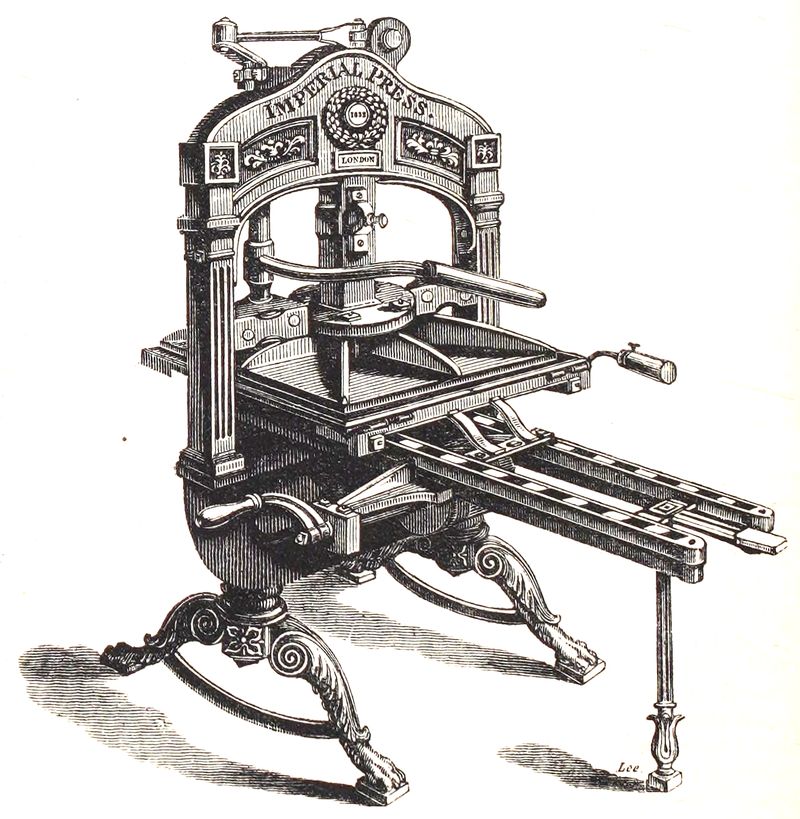
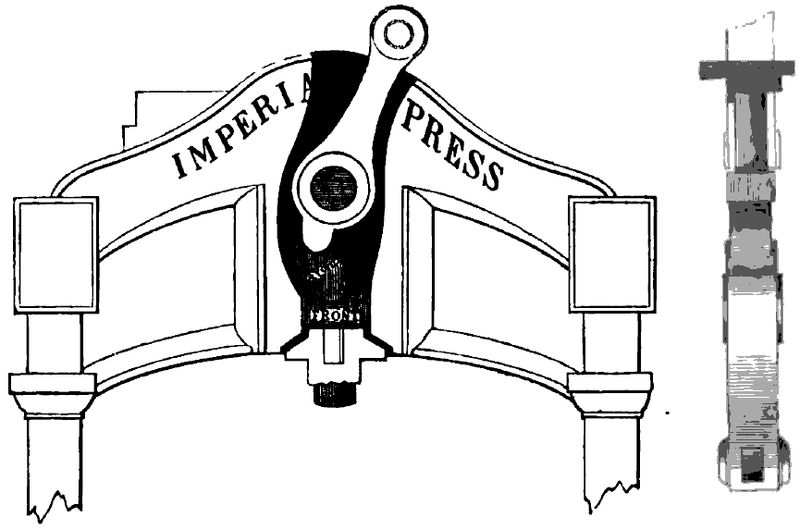
The Imperial Press. Dr. Lardner thus describes this press:—In this beautiful and compact machine, the works upon which the power depends are almost wholly concealed within the head of the press, and are in themselves extremely few and simple. The leverage connected with the bar is similar in principle to that of the Stanhope press; and the distinguishing peculiarity of this press consists in the manner in which the lever, called the chill, is made to act upon the piston, as represented in the engraving of the working parts. The stout cast-iron lever or chill terminates in a sort of polished toe or point. This last-mentioned projection of the lever is made to act on a cup or knuckle acting upon the head of a stout iron bolt, which simply drops down a perforation of the piston, so as to rest upon the uppermost of two steel wedges, one of which, by its connexion with a screw in the front, admits of being pushed forward or drawn back, so as to elevate or lower the bolt, and thus regulate, by altering the length of the piston, the bearing of the platen upon the types. The head-bolt passes through a hole perforated somewhat obliquely; by which ingenious contrivance, a side twist, which would otherwise be occasioned by the motion of the head gear is avoided. It will now easily be perceived how, by the operation of the bar, the toe is made to act upon the inside bolt, and thus force down the piston, which, after the impression has been taken, is carried back again, by means of two stout steel springs attached to the insides of the cheeks of the press, and thus on the return of the bar lift the platen from the face of the types and allow the carriage with the form to be run out. These springs, operating uniformly, cause the action of the piston to be very smooth. The Imperial press, is, I believe, in high estimation for easiness in the pull, which gives it speed in working, and for evenness of impression.
On the first introduction of this press the toe of the lever or chill worked on a flat surface on the top of the bolt; the introduction of the cup or knuckle is a subsequent improvement.
They are made of different sizes, from foolscap folio to double royal.
SHOE.
An old shoe with the hind quarter cut away, hung upon a nail through the heel at the end of the imposing stone, into which to put bad letters when correcting. When full, the person who has the care of the materials empties it into the old metal box.
SHOOTING STICK.
Is a perfect wedge about six inches long, and its thicker end two inches broad, and an inch and an half thick; and its thin end about an inch and an half broad, and half an inch thick; made of box wood.—M. They are not now made so thick.
The use of a shooting stick is to drive the quoins with a mallet, both in locking-up and unlocking a form; they are 8½ inches long.
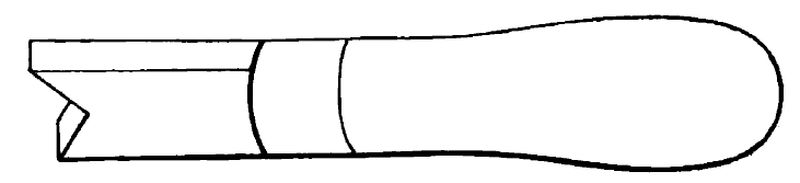
As the thin end of a wooden shooting stick always wears down rapidly, or splits, some houses have adopted metal ones, made of brass, well secured in a strong wooden handle, with a square piece cut out of the end, leaving one side a little longer than the other, with a more acute angle; these are very useful where the quoining room is small, and the quoins are of course thin.
SHORT CROSS.
See Chase.—M. The shortest and also the broadest bar that divides a chase into quarters; there is a groove in the upper side of it to admit the spurs of the points to be pressed into it without injuring their points. This cross is dovetailed in the middle of the sides of the chase, for folios, quartos, and octavos, without the long cross for folios; there is another dovetail in the rim of the chase, leaving about two thirds of the chase on one side of the short cross and one third on the other; the cross is fitted into these dovetails for twelves, and separates the offcut from the other part of the sheet. I would always place the short cross in the middle of the chase for eighteens, where the margin will admit it, as it divides the pages more equally, and makes the form safer when locked up; in this case the cross occupies the place of a gutter instead of a back.
SHORT PAGE.
A page that is not full of matter; as the end of a chapter, a book, or a volume. Though it is termed a short page, yet the term only applies to what appears when printed, for in reality the page is, or ought to be, made up to the exact length of the other pages in the sheet, the blank part being filled up with furniture. I would always put a lead at the least after the last line of the matter, and next to that a piece of thick reglet cut to the measure, to prevent any letters dropping down, and a line of quotations, or large quadrats, at the bottom, which will keep the other pages in register; the vacancy between these may then be filled up with furniture to make the page of a proper length, and if they be not so long as the exact width of the page it will not be material; but if it be made up entirely with furniture, the adjoining pages will be twisted and out of register, when the form is locked up, for it is not possible to cut the pieces so accurate to the width as a line of quadrats, for the gutter to rest against. If the page be very short, it will be better to have an additional line of quadrats or quotations in the middle.
SHORT PULL.
When the pull is so justified, that a sufficient pressure is produced when the bar is brought about half way over, or a little more; this pull is adopted in small light forms, where despatch is required.
Short Ribs. See Cramp Irons.
SHUFFLING.
This is a term used in the Warehouse; and is part of the process of Knocking-up, when the paper is laid in heaps, after having been taken down from the poles, to make it lie even at the edges. It is performed by taking hold of a few quires of the paper loosely at the sides, and holding the far side a little lower than that next the body, upon the table, when, shaking both hands, it gradually projects the lower sheets; then lifting it up and bending it a little, it is let drop on its edge upon the table; by repeating this process two or three times, the parcel becomes even at the edges, and is in a fit state to be piled away. It is a process in which expertness can only be acquired by practice, and observation.
Side Notes. See Marginal Notes.
SIDE STICK.
The same as foot stick, except that they are placed against the side of the page, as their name signifies. See Foot Stick.
SIGLA.
By this term are meant, notes, breviatures, letters set for words, characters, short hand.
We find sigla in the most ancient MSS.: some specimens of such as were used in the sixth, seventh, and eighth centuries, are here given. Some of these sigla were made by the Antiquarians who wrote the book, and others afterwards for the illustration of the text The annexed sigla may be explained thus:—
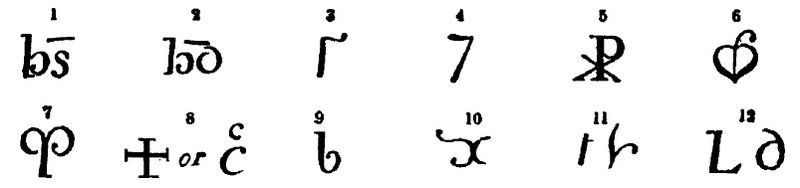
1. H. S. i. e. Hic suppleas, or hæc supplenda. 2. H. D. i. e. Hic deficit, or hæc deficiunt. 3. Paragraphus, a note of division. 4. Diple, to mark out a quotation from the Old Testament. 5. Crisimon, being composed of X and P, which stands for Christ. 6. Hederacei folii Figura, an ivy leaf, the ancient mark of division. 7. Ancora superior. To denote a very remarkable passage. 8. Denotes, the beginning of a lesson. 9. Signifies good. 10. Stands for something very kind, or benevolent. 11. Points out a fine or admirable passage. 12. L. D. lepide dictum. Finely said.
Many writers have employed their pens in elucidating the sigla on coins and medals; among others, Octavius de Strada in Aurea Numismata, &c. where we read C. Cæsar. Divi. F. IMP. Cos. III. Vir R. P. C. that is, Caii Cæsaris Divi filius imperator consul Triumvir reipublicæ constituendæ. A number of similar examples may be found in the same author, and in Æneas Vicus Parmensis de Augustarum imaginibus.
As to epitaphs or sepulchral inscriptions, it was common to begin them with these literary signs, D. M. S. signifying Diis Manibus Sacrum, and, as still is customary with us, on such occasions, the glorious actions, praises, origin, age, and rank of the deceased, with the time of his death, were set forth.
It is a fact too well known to require any particular elucidation, that it was customary with the ancients to burn the bodies of the dead, and to deposit the remains in urns or vessels, as appears from the funeral obsequies of Patroclus and Achilles in Homer.
Altars erected to the Supreme Being are of the highest antiquity, but by the ambition and corruption of mankind were afterwards prostituted to flatter both the living and the dead. Inscriptions, or literary signs, frequently appeared on those altars; as Ar. Don. D. that is, Aram dono dedit, and such like.
Public Statues were erected to Kings, Emperors, and others, both before and after their death, on which the names of the dedicators were frequently inscribed in literary signs. As in this inscription, Civ. Interamnanæ Civ. Utriusque Sex. Aer. Coll. Post Ob. H. P. D. that is, Cives Interamnanæ civitatis utriusque sexus ære collato post obitum hujus patronæ dedicarunt.
The Hebrews, Greeks, and Romans used forms of saluting or complimentary expressions at the beginning of their letters, and then proceeded to the subject of the letters themselves.
The Latin method was to place the name of the writer first, afterwards that of the person to whom the letter was addressed. The names were either put simply without any epithet in literary signs, as C. Att. S. that is Cicero Attico Salutem; or the dignity or rank of the person was added, as, C. S. D. Planc. Imp. Cos. Des. that is, Cicero Salutem dicit Planco Imperatori Consuli designato. The epistolary writings of the Romans abound with examples of this kind.
The Military Sigla amongst the Romans are treated of by Vegetius and Frontinus.
See John Nicholaus, who hath written professedly upon the Sigla of the Ancients;—J. Nicolai Tractatus de Siglis Veterum. Lugd. Bat. 1703, 4to.
A competent knowledge of these literary signs, or verbal contractions used by the ancients, is of the utmost importance to those who wish to be familiarly acquainted with ancient history. These Sigla or Signs frequently appear on marbles, coins, and medals, and occur in those inestimable volumes of antiquity, which have transmitted to us the most important truths relative to the religion, manners, customs, arts and sciences, of ancient nations. These are keys, as it were, to unlock the most precious volumes of antiquity; they introduce us to a more speedy acquaintance with all the various works of ancient artists and writers. The instruction to be derived from this branch of polite learning is of itself a sufficient spur to stimulate attention and industry; but its utility, which is no less obvious, is an additional incentive to augment our application and desires, when we consider, that there are no ancient documents, either on metals, marbles, precious stones, bark, parchment, paper, or other materials, which do not abound with these literary contractions, and that it will be very difficult to understand them without this necessary knowledge.—Astle. See Records.
SIGNATURE.
A letter of the alphabet placed at the bottom of the first page of each sheet of a work, to denote, alphabetically, the order of the sheets.
It is customary to commence with B on the first sheet of the body of the work, and to go regularly through the alphabet, with the exception of the letters J, V, and W, which are never used as signatures; and which had, in fact, no existence in the alphabet at the time of the invention of printing; [J] expressing both I and J; [U], both U and V; and [UU] the double letter W. If the work extend to more sheets in number than there are letters in the alphabet, the succeeding sheets go on with a second alphabet, which commences with A, and both the letters are usually given, in this manner, A A, or Aa, and sometimes, to avoid the repetition, thus, 2 A; if a third alphabet be necessary it is always, at the present day, placed with the number before it, as 3 A. The printer’s first alphabet consists of twenty-two letters, and the second and succeeding ones of twenty-three.
As a guide to the bookbinder there are other signatures used in a sheet besides the first—in a sheet of octavo the first page has B, the third has B 2, the fifth has B 3, and the seventh has B 4: in a sheet of twelves they are carried to B 6; B 5 being the first page of the offcut; and however numerous the pages may be in a sheet with one signature, when they are all inserted, they are continued to the last odd page before the middle of the sheet, but never carried beyond the middle. In general they are all omitted except the two first, to show the first fold of the paper, and the first on the offcut. Small capitals are more frequently used for signatures than large capitals, as disfiguring the foot of the page in a slighter manner.
Sometimes figures are used instead of letters, but not often; the Gentleman’s Magazine is an instance.
Key to Column Headers— No. = No. of Sheets Sig. = Signature Fol. = Folio
TABLE OF SIGNATURES AND FIRST FOLIO OF EACH SHEET.
FOLIO.
No. Sig. Fol. No. Sig. Fol. No. Sig. Fol. No. Sig. Fol.
23 2 A 89 46 3 A 181 69 4 A 273
1 B 1 24 B 93 47 B 185 70 B 277
2 C 5 25 C 97 48 C 189 71 C 281
3 D 9 26 D 101 49 D 193 72 D 285
4 E 13 27 E 105 50 E 197 73 E 289
5 F 17 28 F 109 51 F 201 74 F 293
6 G 21 29 G 113 52 G 205 75 G 297
7 H 25 30 H 117 53 H 209 76 H 301
8 I 29 31 I 121 54 I 213 77 I 305
9 K 33 32 K 125 55 K 217 78 K 309
10 L 37 33 L 129 56 L 221 79 L 313
11 M 41 34 M 133 57 M 225 80 M 317
12 N 45 35 N 137 58 N 229 81 N 321
13 O 49 36 O 141 59 O 233 82 O 325
14 P 53 37 P 145 60 P 237 83 P 329
15 Q 57 38 Q 149 61 Q 241 84 Q 333
16 R 61 39 R 153 62 R 245 85 R 337
17 S 65 40 S 157 63 S 249 86 S 341
18 T 69 41 T 161 64 T 253 87 T 345
19 U 73 42 U 165 65 U 257 88 U 349
20 X 77 43 X 169 66 X 261 89 X 353
21 Y 81 44 Y 173 67 Y 265 90 Y 357
22 Z 85 45 Z 177 68 Z 269 91 Z 361
92 5 A ;365 115 6 A 457 138 7 A 549 161 8 A 641
93 B 369 116 B 461 139 B 553 162 B 645
94 C 373 117 C 465 140 C 557 163 C 649
95 D 377 118 D 469 141 D 561 164 D 653
96 E 381 119 E 473 142 E 565 165 E 657
97 F 385 120 F 477 143 F 569 166 F 661
98 G 389 121 G 481 144 G 573 167 G 665
99 H 393 122 H 485 145 H 577 168 H 669
100 I 397 123 I 489 146 I 581 169 I 673
101 K 401 124 K 493 147 K 585 170 K 677
102 L 405 125 L 497 148 L 589 171 L 681
103 M 409 126 M 501 149 M 593 172 M 685
104 N 413 127 N 505 150 N 597 173 N 689
105 O 417 128 O 509 151 O 601 174 O 693
106 P 421 129 P 513 152 P 605 175 P 697
107 Q 425 130 Q 517 153 Q 609 176 Q 701
108 R 429 131 R 521 154 R 613 177 R 705
109 S 433 132 S 525 155 S 617 178 S 709
110 T 437 133 T 529 156 T 621 179 T 713
111 U 441 134 U 533 157 U 625 180 U 717
112 X 445 135 X 537 158 X 629 181 X 721
113 Y 449 136 Y 541 159 Y 633 182 Y 725
114 Z 453 137 Z 545 160 Z 637 183 Z 729
No. Sig. Fol. No. Sig. Fol. No. Sig. Fol. No. Sig. Fol.
184 9 A 733 207 10 A 825 230 11 A 917 253 12 A 1009
185 B 737 208 B 829 231 B 921 254 B 1013
186 C 741 209 C 833 232 C 925 255 C 1017
187 D 745 210 D 837 233 D 929 256 D 1021
188 E 749 211 E 841 234 E 933 257 E 1025
189 F 753 212 F 845 235 F 937 258 F 1029
190 G 757 213 G 849 236 G 941 259 G 1033
191 H 761 214 H 853 237 H 945 260 H 1037
192 I 765 215 I 857 238 I 949 261 I 1041
193 K 769 216 K 861 239 K 953 262 K 1045
194 L 773 217 L 865 240 L 957 263 L 1049
195 M 777 218 M 869 241 M 961 264 M 1053
196 N 781 219 N 873 242 N 965 265 N 1057
197 O 785 220 O 877 243 O 969 266 O 1061
198 P 789 221 P 881 244 P 973 267 P 1065
199 Q 793 222 Q 885 245 Q 977 268 Q 1069
200 R 797 223 R 889 246 R 981 269 R 1073
201 S 801 224 S 893 247 S 985 270 S 1077
202 T 805 225 T 897 248 T 989 271 T 1081
203 U 809 226 U 901 249 U 993 272 U 1085
204 X 813 227 X 905 250 X 997 273 X 1089
205 Y 817 228 Y 909 251 Y 1001 274 Y 1093
206 Z 821 229 Z 913 252 Z 1005 275 Z 1097
276 13 A 1101 299 14 A 1193 322 15 A 1285 345 16 A 1377
277 B 1105 300 B 1197 323 B 1289 346 B 1381
278 C 1109 301 C 1201 324 C 1293 347 C 1385
279 D 1113 302 D 1205 325 D 1297 348 D 1389
280 E 1117 303 E 1209 326 E 1301 349 E 1393
281 F 1121 304 F 1213 327 F 1305 350 F 1397
282 G 1125 305 G 1217 328 G 1309 351 G 1401
283 H 1129 306 H 1221 329 H 1313 352 H 1405
284 I 1133 307 I 1225 330 I 1317 353 I 1409
285 K 1137 308 K 1229 331 K 1321 354 K 1413
286 L 1141 309 L 1233 332 L 1325 355 L 1417
287 M 1145 310 M 1237 333 M 1329 356 M 1421
288 N 1149 311 N 1241 334 N 1333 357 N 1425
289 O 1153 312 O 1245 335 O 1337 358 O 1429
290 P 1157 313 P 1249 336 P 1341 359 P 1433
291 Q 1161 314 Q 1253 337 Q 1345 360 Q 1437
292 R 1165 315 R 1257 338 R 1349 361 R 1441
293 S 1169 316 S 1261 339 S 1353 362 S 1445
294 T 1173 317 T 1265 340 T 1357 363 T 1449
295 U 1177 318 U 1269 341 U 1361 364 U 1453
296 X 1181 319 X 1273 342 X 1365 365 X 1457
297 Y 1185 320 Y 1277 343 Y 1369 366 Y 1461
298 Z 1189 321 Z 1281 344 Z 1373 367 Z 1465
No. Sig. Fol. No. Sig. Fol. No. Sig. Fol. No. Sig. Fol.
368 17 A 1469 391 18 A 1561 414 19 A 1653 437 20 A 1745
369 B 1473 392 B 1565 415 B 1657 438 B 1749
370 C 1477 393 C 1569 416 C 1661 439 C 1753
371 D 1481 394 D 1573 417 D 1665 440 D 1757
372 E 1485 395 E 1577 418 E 1669 441 E 1761
373 F 1489 396 F 1581 419 F 1673 442 F 1765
374 G 1493 397 G 1585 420 G 1677 443 G 1769
375 H 1497 398 H 1589 421 H 1681 444 H 1773
376 I 1501 399 I 1593 422 I 1685 445 I 1777
377 K 1505 400 K 1597 423 K 1689 446 K 1781
378 L 1509 401 L 1601 424 L 1693 447 L 1785
379 M 1513 402 M 1605 425 M 1697 448 M 1789
380 N 1517 403 N 1609 426 N 1701 449 N 1793
381 O 1521 404 O 1613 427 O 1705 450 O 1797
382 P 1525 405 P 1617 428 P 1709 451 P 1801
383 Q 1529 406 Q 1621 429 Q 1713 452 Q 1805
384 R 1533 407 R 1625 430 R 1717 453 R 1809
385 S 1537 408 S 1629 431 S 1721 454 S 1813
386 T 1541 409 T 1633 432 T 1725 455 T 1817
387 U 1545 410 U 1637 433 U 1729 456 U 1821
388 X 1549 411 X 1641 434 X 1733 457 X 1825
389 Y 1553 412 Y 1645 435 Y 1737 458 Y 1829
390 Z 1557 413 Z 1649 436 Z 1741 459 Z 1833
460 21 A 1837 483 22 A 1929 506 23 A 2021 529 24 A 2113
461 B 1841 484 B 1933 507 B 2025 530 B 2117
462 C 1845 485 C 1937 508 C 2029 531 C 2121
463 D 1849 486 D 1941 509 D 2033 532 D 2125
464 E 1853 487 E 1945 510 E 2037 533 E 2129
465 F 1857 488 F 1949 511 F 2041 534 F 2133
466 G 1861 489 G 1953 512 G 2045 535 G 2137
467 H 1865 490 H 1957 513 H 2049 536 H 2141
468 I 1869 491 I 1961 514 I 2053 537 I 2145
469 K 1873 492 K 1965 515 K 2057 538 K 2149
470 L 1877 493 L 1969 516 L 2061 539 L 2153
471 M 1881 494 M 1973 517 M 2065 540 M 2157
472 N 1885 495 N 1977 518 N 2069 541 N 2161
473 O 1889 496 O 1981 519 O 2073 542 O 2165
474 P 1893 497 P 1985 520 P 2077 543 P 2169
475 Q 1897 498 Q 1989 521 Q 2081 544 Q 2173
476 R 1901 499 R 1993 522 R 2085 545 R 2177
477 S 1905 500 S 1997 523 S 2089 546 S 2181
478 T 1909 501 T 2001 524 T 2093 547 T 2185
479 U 1913 502 U 2005 525 U 2097 548 U 2189
480 X 1917 503 X 2009 526 X 2101 549 X 2193
481 Y 1921 504 Y 2013 527 Y 2105 550 Y 2197
482 Z 1925 505 Z 2017 528 Z 2109 551 Z 2201
No. Sig. Fol. No. Sig. Fol. No. Sig. Fol. No. Sig. Fol.
552 25 A 2205 575 26 A 2297 598 27 A 2389 621 28 A 2481
553 B 2209 576 B 2301 599 B 2393 622 B 2485
554 C 2213 577 C 2305 600 C 2397 623 C 2489
555 D 2217 578 D 2309 601 D 2401 624 D 2493
556 E 2221 579 E 2313 602 E 2405 625 E 2497
557 F 2225 580 F 2317 603 F 2409 626 F 2501
558 G 2229 581 G 2321 604 G 2413 627 G 2505
559 H 2233 582 H 2325 605 H 2417 628 H 2509
560 I 2237 583 I 2329 606 I 2421 629 I 2513
561 K 2241 584 K 2333 607 K 2425 630 K 2517
562 L 2245 585 L 2337 608 L 2429 631 L 2521
563 M 2249 586 M 2341 609 M 2433 632 M 2525
564 N 2253 587 N 2345 610 N 2437 633 N 2529
565 O 2257 588 O 2349 611 O 2441 634 O 2533
566 P 2261 589 P 2353 612 P 2445 635 P 2537
567 Q 2265 590 Q 2357 613 Q 2449 636 Q 2541
568 R 2269 591 R 2361 614 R 2453 637 R 2545
569 S 2273 592 S 2365 615 S 2457 638 S 2549
570 T 2277 593 T 2369 616 T 2461 639 T 2553
571 U 2281 594 U 2373 617 U 2465 640 U 2557
572 X 2285 595 X 2377 618 X 2469 641 X 2561
573 Y 2289 596 Y 2381 619 Y 2473 642 Y 2565
574 Z 2293 597 Z 2385 620 Z 2477 643 Z 2569
644 29 A 2573 667 30 A 2665 690 31 A 2757 713 32 A 2849
645 B 2577 668 B 2669 691 B 2761 714 B 2853
646 C 2581 669 C 2673 692 C 2765 715 C 2857
647 D 2585 670 D 2677 693 D 2769 716 D 2861
648 E 2589 671 E 2681 694 E 2773 717 E 2865
649 F 2593 672 F 2685 695 F 2777 718 F 2869
650 G 2597 673 G 2689 696 G 2781 719 G 2873
651 H 2601 674 H 2693 697 H 2785 720 H 2877
652 I 2605 675 I 2697 698 I 2789 721 I 2881
653 K 2609 676 K 2701 699 K 2793 722 K 2885
654 L 2613 677 L 2705 700 L 2797 723 L 2889
655 M 2617 678 M 2709 701 M 2801 724 M 2893
656 N 2621 679 N 2713 702 N 2805 725 N 2897
657 O 2625 680 O 2717 703 O 2809 726 O 2901
658 P 2629 681 P 2721 704 P 2813 727 P 2905
659 Q 2633 682 Q 2725 705 Q 2817 728 Q 2909
660 R 2637 683 R 2729 706 R 2821 729 R 2913
661 S 2641 684 S 2733 707 S 2825 730 S 2917
662 T 2645 685 T 2737 708 T 2829 731 T 2921
663 U 2649 686 U 2741 709 U 2833 732 U 2925
664 X 2653 687 X 2745 710 X 2837 733 X 2929
665 Y 2657 688 Y 2749 711 Y 2841 734 Y 2933
666 Z 2661 689 Z 2753 712 Z 2845 735 Z 2937
No. Sig. Fol. No. Sig. Fol. No. Sig. Fol. No. Sig. Fol.
736 33 A 2941 759 34 A 3033 782 35 A 3125 805 36 A 3217
737 B 2945 760 B 3037 783 B 3129 806 B 3221
738 C 2949 761 C 3041 784 C 3133 807 C 3225
739 D 2953 762 D 3045 785 D 3137 808 D 3229
740 E 2957 763 E 3049 786 E 3141 809 E 3233
741 F 2961 764 F 3053 787 F 3145 810 F 3237
742 G 2965 765 G 3057 788 G 3149 811 G 3241
743 H 2969 766 H 3061 789 H 3153 812 H 3245
744 I 2973 767 I 3065 790 I 3157 813 I 3249
745 K 2977 768 K 3069 791 K 3161 814 K 3253
746 L 2981 769 L 3073 792 L 3165 815 L 3257
747 M 2985 770 M 3077 793 M 3169 816 M 3261
748 N 2989 771 N 3081 794 N 3173 817 N 3265
749 O 2993 772 O 3085 795 O 3177 818 O 3269
750 P 2997 773 P 3089 796 P 3181 819 P 3273
751 Q 3001 774 Q 3093 797 Q 3185 820 Q 3277
752 R 3005 775 R 3097 798 R 3189 821 R 3281
753 S 3009 776 S 3101 799 S 3193 822 S 3285
754 T 3013 777 T 3105 800 T 3197 823 T 3289
755 U 3017 778 U 3109 801 U 3201 824 U 3293
756 X 3021 779 X 3113 802 X 3205 825 X 3297
757 Y 3025 780 Y 3117 803 Y 3209 826 Y 3301
758 Z 3029 781 Z 3121 804 Z 3213 827 Z 3305
828 37 A 3309 851 38 A 3401 874 39 A 3493 897 40 A 3585
829 B 3313 852 B 3405 875 B 3497 898 B 3589
830 C 3317 853 C 3409 876 C 3501 899 C 3593
831 D 3321 854 D 3413 877 D 3505 900 D 3597
832 E 3325 855 E 3417 878 E 3509 901 E 3601
833 F 3329 856 F 3421 879 F 3513 902 F 3605
834 G 3333 857 G 3425 880 G 3517 903 G 3609
835 H 3337 858 H 3429 881 H 3521 904 H 3613
836 I 3341 859 I 3433 882 I 3525 905 I 3617
837 K 3345 860 K 3437 883 K 3529 906 K 3621
838 L 3349 861 L 3441 884 L 3533 907 L 3625
839 M 3353 862 M 3445 885 M 3537 908 M 3629
840 N 3357 863 N 3449 886 N 3541 909 N 3633
841 O 3361 864 O 3453 887 O 3545 910 O 3637
842 P 3365 865 P 3457 888 P 3549 911 P 3641
843 Q 3369 866 Q 3461 889 Q 3553 912 Q 3645
844 R 3373 867 R 3465 890 R 3557 913 R 3649
845 S 3377 868 S 3469 891 S 3561 914 S 3653
846 T 3381 869 T 3473 892 T 3565 915 T 3657
847 U 3385 870 U 3477 893 U 3569 916 U 3661
848 X 3389 871 X 3481 894 X 3573 917 X 3665
849 Y 3393 872 Y 3485 895 Y 3577 918 Y 3669
850 Z 3397 873 Z 3489 896 Z 3581 919 Z 3673
No. Sig. Fol. No. Sig. Fol. No. Sig. Fol. No. Sig. Fol.
920 41 A 3677 943 42 A 3769 966 43 A 3861 989 44 A 3953
921 B 3681 944 B 3773 967 B 3865 990 B 3957
922 C 3685 945 C 3777 968 C 3869 991 C 3961
923 D 3689 946 D 3781 969 D 3873 992 D 3965
924 E 3693 947 E 3785 970 E 3877 993 E 3969
925 F 3697 948 F 3789 971 F 3881 994 F 3973
926 G 3701 949 G 3793 972 G 3885 995 G 3977
927 H 3705 950 H 3797 973 H 3889 996 H 3981
928 I 3709 951 I 3801 974 I 3893 997 I 3985
929 K 3713 952 K 3805 975 K 3897 998 K 3989
930 L 3717 953 L 3809 976 L 3901 999 L 3993
931 M 3721 954 M 3813 977 M 3905 1000 M 3997
932 N 3725 955 N 3817 978 N 3909 1001 N 4001
933 O 3729 956 O 3821 979 O 3913 1002 O 4005
934 P 3733 957 P 3825 980 P 3917 1003 P 4009
935 Q 3737 958 Q 3829 981 Q 3921 1004 Q 4013
936 R 3741 959 R 3833 982 R 3925 1005 R 4017
937 S 3745 960 S 3837 983 S 3929 1006 S 4021
938 T 3749 961 T 3841 984 T 3933 1007 T 4025
939 U 3753 962 U 3845 985 U 3937 1008 U 4029
940 X 3757 963 X 3849 986 X 3941 1009 X 4033
941 Y 3761 964 Y 3853 987 Y 3945 1010 Y 4037
942 Z 3765 965 Z 3857 988 Z 3949 1011 Z 4041
1012 45 A 4045 1035 46 A 4137 1058 47 A 4229 1081 48 A 4321
1013 B 4049 1036 B 4141 1059 B 4233 1082 B 4325
1014 C 4053 1037 C 4145 1060 C 4237 1083 C 4329
1015 D 4057 1038 D 4149 1061 D 4241 1084 D 4333
1016 E 4061 1039 E 4153 1062 E 4245 1085 E 4337
1017 F 4065 1040 F 4157 1063 F 4249 1086 F 4341
1018 G 4069 1041 G 4161 1064 G 4253 1087 G 4345
1019 H 4073 1042 H 4165 1065 H 4257 1088 H 4349
1020 I 4077 1043 I 4169 1066 I 4261 1089 I 4353
1021 K 4081 1044 K 4173 1067 K 4265 1090 K 4357
1022 L 4085 1045 L 4177 1068 L 4269 1091 L 4361
1023 M 4089 1046 M 4181 1069 M 4273 1092 M 4365
1024 N 4093 1047 N 4185 1070 N 4277 1093 N 4369
1025 O 4097 1048 O 4189 1071 O 4281 1094 O 4373
1026 P 4101 1049 P 4193 1072 P 4285 1095 P 4377
1027 Q 4105 1050 Q 4197 1073 Q 4289 1096 Q 4381
1028 R 4109 1051 R 4201 1074 R 4293 1097 R 4385
1029 S 4113 1052 S 4205 1075 S 4297 1098 S 4389
1030 T 4117 1053 T 4209 1076 T 4301 1099 T 4393
1031 U 4121 1054 U 4213 1077 U 4305 1100 U 4397
1032 X 4125 1055 X 4217 1078 X 4309 1101 X 4401
1033 Y 4129 1056 Y 4221 1079 Y 4313 1102 Y 4405
1034 Z 4133 1057 Z 4225 1080 Z 4317 1103 Z 4409
No. Sig. Fol. No. Sig. Fol. No. Sig. Fol. No. Sig. Fol.
1104 49 A 4413 1127 50 A 4505 1150 51 A 4597 1173 52 A 4689
1105 B 4417 1128 B 4509 1151 B 4601 1174 B 4693
1106 C 4421 1129 C 4513 1152 C 4605 1175 C 4697
1107 D 4425 1130 D 4517 1153 D 4609 1176 D 4701
1108 E 4429 1131 E 4521 1154 E 4613 1177 E 4705
1109 F 4433 1132 F 4525 1155 F 4617 1178 F 4709
1110 G 4437 1133 G 4529 1156 G 4621 1179 G 4713
1111 H 4441 1134 H 4533 1157 H 4625 1180 H 4717
1112 I 4445 1135 I 4537 1158 I 4629 1181 I 4721
1113 K 4449 1136 K 4541 1159 K 4633 1182 K 4725
1114 L 4453 1137 L 4545 1160 L 4637 1183 L 4729
1115 M 4457 1138 M 4549 1161 M 4641 1184 M 4733
1116 N 4461 1139 N 4553 1162 N 4645 1185 N 4737
1117 O 4465 1140 O 4557 1163 O 4649 1186 O 4741
1118 P 4469 1141 P 4561 1164 P 4653 1187 P 4745
1119 Q 4473 1142 Q 4565 1165 Q 4657 1188 Q 4749
1120 R 4477 1143 R 4569 1166 R 4661 1189 R 4753
1121 S 4481 1144 S 4573 1167 S 4665 1190 S 4757
1122 T 4485 1145 T 4577 1168 T 4669 1191 T 4761
1123 U 4489 1146 U 4581 1169 U 4673 1192 U 4765
1124 X 4493 1147 X 4585 1170 X 4677 1193 X 4769
1125 Y 4497 1148 Y 4589 1171 Y 4681 1194 Y 4773
1126 Z 4501 1149 Z 4593 1172 Z 4685 1195 Z 4777
1196 53 A 4781 1219 54 A 4873 1242 55 A 4965 1265 56 A 5057
1197 B 4785 1220 B 4877 1243 B 4969 1266 B 5061
1198 C 4789 1221 C 4881 1244 C 4973 1267 C 5065
1199 D 4793 1222 D 4885 1245 D 4977 1268 D 5069
1200 E 4797 1223 E 4889 1246 E 4981 1269 E 5073
1201 F 4801 1224 F 4893 1247 F 4985 1270 F 5077
1202 G 4805 1225 G 4897 1248 G 4989 1271 G 5081
1203 H 4809 1226 H 4901 1249 H 4993 1272 H 5085
1204 I 4813 1227 I 4905 1250 I 4997 1273 I 5089
1205 K 4817 1228 K 4909 1251 K 5001 1274 K 5093
1206 L 4821 1229 L 4913 1252 L 5005 1275 L 5097
1207 M 4825 1230 M 4917 1253 M 5009 1276 M 5101
1208 N 4829 1231 N 4921 1254 N 5013 1277 N 5105
1209 O 4833 1232 O 4925 1255 O 5017 1278 O 5109
1210 P 4837 1233 P 4929 1256 P 5021 1279 P 5113
1211 Q 4841 1234 Q 4933 1257 Q 5025 1280 Q 5117
1212 R 4845 1235 R 4937 1258 R 5029 1281 R 5121
1213 S 4849 1236 S 4941 1259 S 5033 1282 S 5125
1214 T 4853 1237 T 4945 1260 T 5037 1283 T 5129
1215 U 4857 1238 U 4949 1261 U 5041 1284 U 5133
1216 X 4861 1239 X 4953 1262 X 5045 1285 X 5137
1217 Y 4865 1240 Y 4957 1263 Y 5049 1286 Y 5141
1218 Z 4869 1241 Z 4961 1264 Z 5053 1287 Z 5145
No. Sig. Fol. No. Sig. Fol. No. Sig. Fol. No. Sig. Fol.
1288 57 A 5149 1311 58 A 5241 1334 59 A 5333 1357 60 A 5425
1289 B 5153 1312 B 5245 1335 B 5337 1358 B 5429
1290 C 5157 1313 C 5249 1336 C 5341 1359 C 5433
1291 D 5161 1314 D 5253 1337 D 5345 1360 D 5437
1292 E 5165 1315 E 5257 1338 E 5349 1361 E 5441
1293 F 5169 1316 F 5261 1339 F 5353 1362 F 5445
1294 G 5173 1317 G 5265 1340 G 5357 1363 G 5449
1295 H 5177 1318 H 5269 1341 H 5361 1364 H 5453
1296 I 5181 1319 I 5273 1342 I 5365 1365 I 5457
1297 K 5185 1320 K 5277 1343 K 5369 1366 K 5461
1298 L 5189 1321 L 5281 1344 L 5373 1367 L 5465
1299 M 5193 1322 M 5285 1345 M 5377 1368 M 5469
1300 N 5197 1323 N 5289 1346 N 5381 1369 N 5473
1301 O 5201 1324 O 5293 1347 O 5385 1370 O 5477
1302 P 5205 1325 P 5297 1348 P 5389 1371 P 5481
1303 Q 5209 1326 Q 5301 1349 Q 5393 1372 Q 5485
1304 R 5213 1327 R 5305 1350 R 5397 1373 R 5489
1305 S 5217 1328 S 5309 1351 S 5401 1374 S 5493
1306 T 5221 1329 T 5313 1352 T 5405 1375 T 5497
1307 U 5225 1330 U 5317 1353 U 5409 1376 U 5501
1308 X 5229 1331 X 5321 1354 X 5413 1377 X 5505
1309 Y 5233 1332 Y 5325 1355 Y 5417 1378 Y 5509
1310 Z 5237 1333 Z 5329 1356 Z 5421 1379 Z 5513
1380 61 A 5517 1403 62 A 5609 1426 63 A 5701 1449 64 A 5793
1381 B 5521 1404 B 5613 1427 B 5705 1450 B 5797
1382 C 5525 1405 C 5617 1428 C 5709 1451 C 5801
1383 D 5529 1406 D 5621 1429 D 5713 1452 D 5805
1384 E 5533 1407 E 5625 1430 E 5717 1453 E 5809
1385 F 5537 1408 F 5629 1431 F 5721 1454 F 5813
1386 G 5541 1409 G 5633 1432 G 5725 1455 G 5817
1387 H 5545 1410 H 5637 1433 H 5729 1456 H 5821
1388 I 5549 1411 I 5641 1434 I 5733 1457 I 5825
1389 K 5553 1412 K 5645 1435 K 5737 1458 K 5829
1390 L 5557 1413 L 5649 1436 L 5741 1459 L 5833
1391 M 5561 1414 M 5653 1437 M 5745 1460 M 5837
1392 N 5565 1415 N 5657 1438 N 5749 1461 N 5841
1393 O 5569 1416 O 5661 1439 O 5753 1462 O 5845
1394 P 5573 1417 P 5665 1440 P 5757 1463 P 5849
1395 Q 5577 1418 Q 5669 1441 Q 5761 1464 Q 5853
1396 R 5581 1419 R 5673 1442 R 5765 1465 R 5857
1397 S 5585 1420 S 5677 1443 S 5769 1466 S 5861
1398 T 5589 1421 T 5681 1444 T 5773 1467 T 5865
1399 U 5593 1422 U 5685 1445 U 5777 1468 U 5869
1400 X 5597 1423 X 5689 1446 X 5781 1469 X 5873
1401 Y 5601 1424 Y 5693 1447 Y 5785 1470 Y 5877
1402 Z 5605 1425 Z 5697 1448 Z 5789 1471 Z 5881
No. Sig. Fol. No. Sig. Fol. No. Sig. Fol. No. Sig. Fol.
1472 65 A 5885 1495 66 A 5977 1518 67 A 6069 1541 68 A 6161
1473 B 5889 1496 B 5981 1519 B 6073 1542 B 6165
1474 C 5893 1497 C 5985 1520 C 6077 1543 C 6169
1475 D 5897 1498 D 5989 1521 D 6081 1544 D 6173
1476 E 5901 1499 E 5993 1522 E 6085 1545 E 6177
1477 F 5905 1500 F 5997 1523 F 6089 1546 F 6181
1478 G 5909 1501 G 6001 1524 G 6093 1547 G 6185
1479 H 5913 1502 H 6005 1525 H 6097 1548 H 6189
1480 I 5917 1503 I 6009 1526 I 6101 1549 I 6193
1481 K 5921 1504 K 6013 1527 K 6105 1550 K 6197
1482 L 5925 1505 L 6017 1528 L 6109 1551 L 6201
1483 M 5929 1506 M 6021 1529 M 6113 1552 M 6205
1484 N 5933 1507 N 6025 1530 N 6117 1553 N 6209
1485 O 5937 1508 O 6029 1531 O 6121 1554 O 6213
1486 P 5941 1509 P 6033 1532 P 6125 1555 P 6217
1487 Q 5945 1510 Q 6037 1533 Q 6129 1556 Q 6221
1488 R 5949 1511 R 6041 1534 R 6133 1557 R 6225
1489 S 5953 1512 S 6045 1535 S 6137 1558 S 6229
1490 T 5957 1513 T 6049 1536 T 6141 1559 T 6233
1491 U 5961 1514 U 6053 1537 U 6145 1560 U 6237
1492 X 5965 1515 X 6057 1538 X 6149 1561 X 6241
1493 Y 5969 1516 Y 6061 1539 Y 6153 1562 Y 6245
1494 Z 5973 1517 Z 6065 1540 Z 6157 1563 Z 6249
1564 69 A 6253 1587 70 A 6345 1610 71 A 6437 1633 72 A 6529
1565 B 6257 1588 B 6349 1611 B 6441 1634 B 6533
1566 C 6261 1589 C 6353 1612 C 6445 1635 C 6537
1567 D 6265 1590 D 6357 1613 D 6449 1636 D 6541
1568 E 6269 1591 E 6361 1614 E 6453 1637 E 6545
1569 F 6273 1592 F 6365 1615 F 6457 1638 F 6549
1570 G 6277 1593 G 6369 1616 G 6461 1639 G 6553
1571 H 6281 1594 H 6373 1617 H 6465 1640 H 6557
1572 I 6285 1595 I 6377 1618 I 6469 1641 I 6561
1573 K 6289 1596 K 6381 1619 K 6473 1642 K 6565
1574 L 6293 1597 L 6385 1620 L 6477 1643 L 6569
1575 M 6297 1598 M 6389 1621 M 6481 1644 M 6573
1576 N 6301 1599 N 6393 1622 N 6485 1645 N 6577
1577 O 6305 1600 O 6397 1623 O 6489 1646 O 6581
1578 P 6309 1601 P 6401 1624 P 6493 1647 P 6585
1579 Q 6313 1602 Q 6405 1625 Q 6497 1648 Q 6589
1580 R 6317 1603 R 6409 1626 R 6501 1649 R 6593
1581 S 6321 1604 S 6413 1627 S 6505 1650 S 6597
1582 T 6325 1605 T 6417 1628 T 6509 1651 T 6601
1583 U 6329 1606 U 6421 1629 U 6513 1652 U 6605
1584 X 6333 1607 X 6425 1630 X 6517 1653 X 6609
1585 Y 6337 1608 Y 6429 1631 Y 6521 1654 Y 6613
1586 Z 6341 1609 Z 6433 1632 Z 6525 1655 Z 6617
Key to Column Headers— No. = No. of Sheets Sig. = Signature Fol. = Folio
SHEET OF QUARTO, AND HALF SHEET OF OCTAVO.
No. Sig. Fol. No. Sig. Fol. No. Sig. Fol.
23 2 A 177 46 3 A 361
1 B 1 24 B 185 47 B 369
2 C 9 25 C 193 48 C 377
3 D 17 26 D 201 49 D 385
4 E 25 27 E 209 50 E 393
5 F 33 28 F 217 51 F 401
6 G 41 29 G 225 52 G 409
7 H 49 30 H 233 53 H 417
8 I 57 31 I 241 54 I 425
9 K 65 32 K 249 55 K 433
10 L 73 33 L 257 56 L 441
11 M 81 34 M 265 57 M 449
12 N 89 35 N 273 58 N 457
13 O 97 36 O 281 59 O 465
14 P 105 37 P 289 60 P 473
15 Q 113 38 Q 297 61 Q 481
16 R 121 39 R 305 62 R 489
17 S 129 40 S 313 63 S 497
18 T 137 41 T 321 64 T 505
19 U 145 42 U 329 65 U 513
20 X 153 43 X 337 66 X 521
21 Y 161 44 Y 345 67 Y 529
22 Z 169 45 Z 353 68 Z 537
69 4 A 545 92 5 A 729 115 6 A 913
70 B 553 93 B 737 116 B 921
71 C 561 94 C 745 117 C 929
72 D 569 95 D 753 118 D 937
73 E 577 96 E 761 119 E 945
74 F 585 97 F 769 120 F 953
75 G 593 98 G 777 121 G 961
76 H 601 99 H 785 122 H 969
77 I 609 100 I 793 123 I 977
78 K 617 101 K 801 124 K 985
79 L 625 102 L 809 125 L 993
80 M 633 103 M 817 126 M 1001
81 N 641 104 N 825 127 N 1009
82 O 649 105 O 833 128 O 1017
83 P 657 106 P 841 129 P 1025
84 Q 665 107 Q 849 130 Q 1033
85 R 673 108 R 857 131 R 1041
86 S 681 109 S 865 132 S 1049
87 T 689 110 T 873 133 T 1057
88 U 697 111 U 881 134 U 1065
89 X 705 112 X 889 135 X 1073
90 Y 713 113 Y 897 136 Y 1081
91 Z 721 114 Z 905 137 Z 1089
SHEET OF OCTAVO.
No. Sig. Fol. No. Sig. Fol. No. Sig. Fol. No. Sig. Fol.
23 2 A 353 46 3 A 721 69 4 A 1089
1 B 1 24 B 369 47 B 737 70 B 1105
2 C 17 25 C 385 48 C 753 71 C 1121
3 D 33 26 D 401 49 D 769 72 D 1137
4 E 49 27 E 417 50 E 785 73 E 1153
5 F 65 28 F 433 51 F 801 74 F 1169
6 G 81 29 G 449 52 G 817 75 G 1185
7 H 97 30 H 465 53 H 833 76 H 1201
8 I 113 31 I 481 54 I 849 77 I 1217
9 K 129 32 K 497 55 K 865 78 K 1233
10 L 145 33 L 513 56 L 881 79 L 1249
11 M 161 34 M 529 57 M 897 80 M 1265
12 N 177 35 N 545 58 N 913 81 N 1281
13 O 193 36 O 561 59 O 929 82 O 1297
14 P 209 37 P 577 60 P 945 83 P 1313
15 Q 225 38 Q 593 61 Q 961 84 Q 1329
16 R 241 39 R 609 62 R 977 85 R 1345
17 S 257 40 S 625 63 S 993 86 S 1361
18 T 273 41 T 641 64 T 1009 87 T 1377
19 U 289 42 U 657 65 U 1025 88 U 1393
20 X 305 43 X 673 66 X 1041 89 X 1409
21 Y 321 44 Y 689 67 Y 1057 90 Y 1425
22 Z 337 45 Z 705 68 Z 1073 91 Z 1441
HALF SHEET OF 12mo.
No. Sig. Fol. No. Sig. Fol. No. Sig. Fol.
23 2 A 265 46 3 A 541
1 B 1 24 B 277 47 B 553
2 C 13 25 C 289 48 C 565
3 D 25 26 D 301 49 D 577
4 E 37 27 E 313 50 E 589
5 F 49 28 F 325 51 F 601
6 G 61 29 G 337 52 G 613
7 H 73 30 H 349 53 H 625
8 I 85 31 I 361 54 I 637
9 K 97 32 K 373 55 K 649
10 L 109 33 L 385 56 L 661
11 M 121 34 M 397 57 M 673
12 N 133 35 N 409 58 N 685
13 O 145 36 O 421 59 O 697
14 P 157 37 P 433 60 P 709
15 Q 169 38 Q 445 61 Q 721
16 R 181 39 R 457 62 R 733
17 S 193 40 S 469 63 S 745
18 T 205 41 T 481 64 T 757
19 U 217 42 U 493 65 U 769
20 X 229 43 X 505 66 X 781
21 Y 241 44 Y 517 67 Y 793
22 Z 253 45 Z 529 68 Z 805
SHEET OF 12mo.
No. Sig. Fol. No. Sig. Fol. No. Sig. Fol.
23 2 A 529 46 3 A 1081
1 B 1 24 B 553 47 B 1105
2 C 25 25 C 577 48 C 1129
3 D 49 26 D 601 49 D 1153
4 E 73 27 E 625 50 E 1177
5 F 97 28 F 649 51 F 1201
6 G 121 29 G 673 52 G 1225
7 H 145 30 H 697 53 H 1249
8 I 169 31 I 721 54 I 1273
9 K 193 32 K 745 55 K 1297
10 L 217 33 L 769 56 L 1321
11 M 241 34 M 793 57 M 1345
12 N 265 35 N 817 58 N 1369
13 O 289 36 O 841 59 O 1393
14 P 313 37 P 865 60 P 1417
15 Q 337 38 Q 889 61 Q 1441
16 R 361 39 R 913 62 R 1465
17 S 385 40 S 937 63 S 1489
18 T 409 41 T 961 64 T 1513
19 U 433 42 U 985 65 U 1537
20 X 457 43 X 1009 66 X 1561
21 Y 481 44 Y 1033 67 Y 1585
22 Z 505 45 Z 1057 68 Z 1609
SHEET OF 16mo.
No. Sig. Fol. No. Sig. Fol.
23 2 A 705
1 B 1 24 B 737
2 C 33 25 C 769
3 D 65 26 D 801
4 E 97 27 E 833
5 F 129 28 F 865
6 G 161 29 G 897
7 H 193 30 H 929
8 I 225 31 I 961
9 K 257 32 K 993
10 L 289 33 L 1025
11 M 321 34 M 1057
12 N 353 35 N 1089
13 O 385 36 O 1121
14 P 417 37 P 1153
15 Q 449 38 Q 1185
16 R 481 39 R 1217
17 S 513 40 S 1249
18 T 545 41 T 1281
19 U 577 42 U 1313
20 X 609 43 X 1345
21 Y 641 44 Y 1377
22 Z 673 45 Z 1409
HALF SHEET OF 18mo.
No. Sig. Fol. No. Sig. Fol.
23 2 A 397
1 B 1 24 B 415
2 C 19 25 C 433
3 D 37 26 D 451
4 E 55 27 E 469
5 F 73 28 F 487
6 G 91 29 G 505
7 H 109 30 H 523
8 I 127 31 I 541
9 K 145 32 K 559
10 L 163 33 L 577
11 M 181 34 M 595
12 N 199 35 N 613
13 O 217 36 O 631
14 P 235 37 P 649
15 Q 253 38 Q 667
16 R 271 39 R 685
17 S 289 40 S 703
18 T 307 41 T 721
19 U 325 42 U 739
20 X 343 43 X 757
21 Y 361 44 Y 775
22 Z 379 45 Z 793
SHEET OF 18mo.
No. Sig. Fol. No. Sig. Fol. No. Sig. Fol.
2 a 265 16 3 A 541
1 B 1 b 277 b 553
c 13 9 C 289 c 565
d 25 d 301 17 D 577
2 E 37 e 313 e 589
f 49 10 F 325 f 601
g 61 g 337 18 G 613
3 H 73 h 349 h 625
i 85 11 I 361 i 637
k 97 k 373 19 K 649
4 L 109 l 385 l 661
m 121 12 M 397 m 673
n 133 n 409 20 N 685
5 O 145 o 421 o 697
p 157 13 P 433 p 709
q 169 q 445 21 Q 721
6 R 181 r 457 r 733
s 193 14 S 469 s 745
t 205 t 481 22 T 757
7 U 217 u 493 u 769
x 229 15 X 505 x 781
y 241 y 517 23 Y 793
8 Z 253 z 529 z 805
I have extended these tables of Signatures and folios to 18mo., which is a size that has been much in use of late years; and in the table of 18mo. I have given it as usually imposed, as three half sheets of 12mo. with three signatures; the first signature in each sheet is with a capital letter, the intermediate signatures are small capitals.
SIXTEENMO.
—A sheet of paper folded into sixteen leaves or thirty-two pages is termed a sixteens or sixteenmo.
SIXTY-FOURMO.
—A sheet of paper folded into sixty-four leaves or one hundred and twenty-eight pages is termed sixty-fours or sixty-fourmo.
SLICE.
—The false bottom of a large galley, made to slide out, for the purpose of keeping a quarto or a folio page upon it, without disturbing it, as being safer than transferring it to a page paper. See Galley.
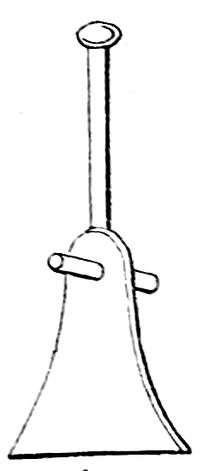
Slice is also the name of an iron implement used in the ink block to transfer the ink from the tub or other receptacle, and to scrape it together in a mass, clear of the balls when ink is taken with them; it has an iron pin through it near the bottom of the handle, so that if it falls flat on the ink block, it will rest on this pin, which prevents the handle from being smeared with ink.
SLIPS.
—In printing encyclopædias, dictionaries of arts or sciences, and similar works, which frequently undergo great alterations in the proofs, they are occasionally pulled on slips of paper, of the length and half the breadth of a demy leaf of paper. This is done on account of the facility of adding new subject matter, or taking some away, without having to overrun and to re-make up the sheet, after it has been imposed in pages.
SLUR
—When from any cause at press, the impression on the paper is smeared, it is said to Slur.
This may arise from many causes—if the tympan joints are loose, it will be produced by the least lateral movement of the tympan after it is turned down—if the ear of the frisket touches the inside of the cheek in running in, it will cause it—if the press runs close, so that the inner tympan touches the face of the platen, it is very likely to slur; and I have often observed this in wooden presses that had been altered to obtain the additional power, for the platen was brought so low and near to the face of the letter in the form, as not to allow room to run in clear. In presses where the tympans are large, if the slur pin does not act, that corner of the tympan will come in contact with the form first, and cause a slur, particularly if the tympans are in any way rickety, or twisted by drawing on the parchment. Where the winter has been justified with cards, to produce a greater spring in the pull, it has been known to produce slurring. The first step towards curing this defect is to ascertain from what cause it arises; and then it is not difficult: but it has often caused great trouble to discover the cause.
The following are my old Pressman’s directions “To prevent Slurring and Maculing;” and though it will be perceived that some of them apply only to wooden presses, yet the whole may be useful.
“1. Keep the face of the inner tympan and platen clean and dry.
“2. Be sure that the parchments are tight both on the inner and outer tympans; also that the tympans are not rickety, nor the joints slack.
“3. Guide cramps are a great preventive to slurring and maculing.
“4. The tenons in the head and winter must exactly fit the mortises in the cheeks.
“5. The short bolts must be screwed tightly up, to fix the nut or box firmly in the head, and must not have the least play.
“6. The garter must fit the spindle and hose, and the spindle must fit the hose, as exactly as possible.
“7. The hose must work perpendicularly, and steady in the shelves.
“8. The platen must be tightly and properly tied, or otherwise fixed, so that it shall come down upon the face of all the types in the form at the same moment.
“9. The wheel must be well justified on the spit.
“10. The railing of the inner tympan must not rub against the platen, in running in or out.
“11. The shanks of the points must not be so far over the outer part of the tympan as to rub against the cheeks of the press.
“12. If a clumsy smith has made the joints of the frisket so thick as to cause the tympan to rub against the face of the platen, he must alter them at his own expense.
“13. The shelves must be quite steady.
“14. The press stone must be worked down with hard pulling until it becomes a fixture.
“15. The frisket must be quite even, and fall flat on the form; and the paper which is pasted on it must not bag.
“16. Fix the winter as solid as possible.
“17. Let the tympans fall easily on the form, neither driving them from you, nor pulling them to you in letting them down; neither let the platen touch them till they are quite run in, nor run them out till the platen is quite clear of them.
“Exclusively of the aforesaid, there may be many other causes of slurring, which the pressman can only discover by close attention. I have often found cork bearers a great preventive.
“I have heard many complaints of the middle pages of a twelves form maculing at a two-pull press; but this is not always the fault of the press. The cause frequently is owing to blankets being in the tympan which have been used for folios, quartos, octavos, &c. &c.; and instead of its being a macule, it is nothing more than that part of the blanket which had covered the short cross of other work, and in the twelves form caused a deep and ugly impression, looking like a macule: this evil can only be remedied by new blankets, or confining the use of them to 12mo. forms.”
SLUR PIN.
—A flat-headed screw, that goes through the off side of the outer tympan, near the head band, so as to rest on the chase or furniture. Its use is to prevent the off corner of the tympan from coming down on the types before the other parts, which when it happens causes slurring.
SMALL CAPITALS.
—Capitals of a smaller size than the regular capitals of a fount, but cast on the same body; thus the small capitals of Double Pica are about the same height as English capitals. They bear off more from each other, and are stouter, in proportion to their size, than the capitals of the same fount. They are used for running titles; for heads of chapters; for emphatic words; and for subordinate lines in titles and jobs. Till of late years small capitals were only cast in England to founts of Roman letter; the type founders cast them now occasionally to Italic letter, and they form a useful sort.
Moxon does not mention small capitals; nor are they in the plan of the cases of Roman letter which he gives in his work. See Sorts.
SMALL NUMBERS.
—Under 1500 laid on, is accounted a small number. See Great Numbers; and see Lay on.—M. We now look on all numbers under 500 to be small numbers.
SMALL PICA.
—The name of a type, one size larger than Long Primer and one smaller than Pica. It is half the body of Double Pica in depth. Moxon does not enumerate it in his Table of the sizes of each body; but, after giving the names of the different types, he says, “These are the bodies most of use in England; but the Dutch have several other bodies: which because there is little and almost no perceivable difference from some of these mentioned, I think they are not worth naming. Yet we have one body more which is sometimes used in England; that is a Small Pica, but I account it no great discretion in a master printer to provide it: because it differs so little from the Pica, that unless the workmen be carefuller than they sometimes are, it may be mingled with the Pica, and so the beauty of both founts may be spoiled.” See Types.
This was published in 1683, and opinion has changed so much respecting this size, that at the present day there are perhaps more works printed with it than with any other size.
SMOUT.
Workmen when they are out of constant work, do sometimes accept of a day or two’s work, or a week’s work at another printing house: this by-work they call Smouting.—M. In fact we only term it smouting when the business of a house is slack, or, in other words, when work is insufficient to employ fully the workmen regularly employed, and they go to some other house for temporary employment, till such time as there is sufficient for them in their own house, when they return.
Soaking Pull. See Easy Pull.—M.
Sockets for the Gallows. See Gallows Sockets.
SOFT INK.
Ink or varnish moderately boiled.—M. It is now generally termed Weak Ink.
The varnish of soft or weak ink is not so strong as that for fine ink; it does not require so much time and labour to distribute it on the balls and rollers, and it more readily covers the face of the type: on these accounts, as well as the expense, it is used for common work, as it enables the pressman to make more riddance; it is also used for machine printing, as the rollers passing rapidly over the forms with their own weight only, are found not competent to coat the face of the type with strong ink.
Soft Pull. See Easy Pull.—M.
Solace. See Ancient Customs.—M.
Solid Dig. See Bad Work.
SOLID MATTER.
Matter that is composed without any leads between the lines, is termed solid matter; in the scale of prices of 1810 it is designated ‘without space lines.’ Previously to that time it was paid the same price as leaded matter, but then there was an advance allowed on it. See Scale.
SOP THE BALLS.
When a pressman has taken too much ink, he is said to sop the balls.—M.
SORTS.
The letters that lie in every box of the case are separately called Sorts in Printers and Founders language; thus, a is a sort, b is a sort, c is a sort, &c.—M.
In houses that have more founts than one of the same sized letter, it would preserve uniformity in the appearance of their work, if the following sorts were all of the same fount in the same sized type, particularly in lists of names, indexes, and articles that run on sorts, as by that means all the sorts in the office might be brought into use, when necessary, which would frequently be of great advantage, both for the convenience of the printer and the appearance of the work: under the present plan, where every fount varies in its proportions and appearance, the printer, in the before-mentioned cases, is put to a great inconvenience and expense, or else has to spoil the appearance of his work by mixing the founts. The adoption of this plan would also be of advantage to the type founder.
Capitals and small capitals.
Figures and fractions.
Metal rules and braces.
Points— , ; : . ! ? ( [ and references * † ‡ § ‖ ¶.
Superiors, and the pound £.
The following additional sorts would also be found useful, and conduce to the more regular appearance of printing.
Accented capitals and small capitals.
Capital and small capital Ç ç.
Points to superiors— , ; : . ’
The Spanish ñ.
SOUNDINGS.
When a pressman has got near the bottom of his heap, and, rapping his knuckles on it, the boards of the horse sound nearly as if he had struck the wood, he says, he is in soundings.
SPACE LINES,
generally called Leads by printers. Thin pieces of type metal, cast to different thicknesses, and different lengths, quadrat high, to put between the lines of matter to make it more open; they are also used to branch out titles, small jobs, and parts of a work where necessary.
SPACE RULES.
Fine lines, cast type high, in short thin pieces, to answer the purpose of brass rule in table work where a number of short pieces of a precise length are required. Two of them are generally equal to a pearl body.
SPACING.
The adjustment of the distance between the words in a line, so that there shall not be any glaring disproportion; also extending a word or a line of capitals by putting spaces between the letters. See Composing.
SPANISH.
Ñ has a peculiar nasal sound, like the French gn: the English have no sound like it, except in the last four letters of the word minion, which bear some resemblance to the last three of the word riñon, in Spanish: as niño, piña.
The note of interrogation is not only used at the conclusion of an interrogatory, but also placed, inverted, at the beginning, in order to warn the reader, unless the preceding words convey a sufficient warning; as ¿ Que es lo que vm. acostumbra? preguntó al enfermo.
The note of admiration is also inverted at the beginning of ejaculations, when the preceding words are not sufficient to prepare the reader; as ¡ Pastas dulces y viandas suculentas! exclamó suspenso y admirado el doctor.—M‘Henry’s Grammar.
SPANISH. [Query, Span-hitch.]
A slight kind of pull at a common wood-press.—Hansard.
SPECIMEN PAGE.
When a new work is put in hand, a specimen page, that is, a page of the proposed size and letter, is composed, and pulled in a neat manner on paper similar to that which is meant to be used. This is to show the effect of the work when printed. It sometimes occurs, that two or three pages are required, of different sizes, and of different letter, before the author or publisher decides in what way the work shall be done. These are called Specimen Pages.
If the work be not proceeded with, these specimen pages are charged by the master printer to his employer; if it goes on, they are included in the general charge.
Spelling. See Orthography.
SPINDLE.
The screw to which the bar of the press is affixed, and which produces the pressure on the platen.
The upper part of the spindle is round, on which a screw is cut, that works in the nut fixed in the head; the next part lower is square, with a square hole in it to receive the end of the bar; the lower part is round and tapering and goes through the hose, to which it is attached by the garter, the spindle having a groove cut round it, into which the two semicircular ends of the garter enter and encircle it, by which contrivance the platen is raised on the return of the bar; the lowest end of the spindle is called the toe, which is hardened steel, and works in the stud of the platen.
SPIRIT.
See Devil.—M. Every chapel is haunted by a spirit, called Ralph. When any man resists the decision of the chapel, and it is determined to enforce it, Ralph, or the spirit, is said to walk; and whatever mischief is done to the resisting party to enforce submission, which is always performed secretly, is invariably imputed to Ralph, or the spirit. See Chapel.
SPIT.
The iron spindle on which the drum or wheel and the rounce are fixed, to run the carriage in and out with. It is square in the middle part, where the wheel is fixed, and has a square end for the rounce to fit on: it works in two pieces of iron, screwed to the outsides of the frame of the wooden ribs.
SPONGE.
Sponge is used both by compositors and pressmen—by compositors, to wet matter that is tied up previous to distributing it—to wet matter that is not tied up, to prevent it going into pie—and in correcting to wet matter, particularly if it be small letter, when it is necessary to transpose it: by pressmen, to wet their tympans with.
SPOTTISWOODE PRESS.
This is a beautiful contrivance, and was, as I understand, the invention of Andrew Spottiswoode, Esq., who has several of them in action in his extensive establishment. It is moved by steam, and prints two forms at the same time, which pass alternately under the platen, producing at its average rate of working seven hundred impressions of each form in the hour.
The frisket is attached to the tympan at the bottom near the tympan joints, so that when the tympan is lifted from the form by the machinery they open at the upper end, contrary to the usual way in presses worked by manual labour, and the printed sheet is left by the tympan resting on the frisket, where the paper was previously laid on.
I believe this is the first successful application of steam, as a motive power, to printing presses with a platen and a perpendicular pressure. I heard the late Alexander Tilloch, Esq., say that he intended to apply it to the presses with which the Star newspaper was printed, but he never carried it into effect; and Mr. Koenig came to England solely for this purpose; but after some years passed in making experiments, assisted by English capital, he was completely foiled in the attempt, and afterwards worked upon Mr. Nicholson’s plan, and produced a machine to print with cylinders.—See Machine.
SPRING OF A FORM.
When a form has a great quantity of furniture in it, and is locked up very tight, it frequently springs up in the middle, so as to endanger its bursting upward; it is then said, the form springs, or it is termed the spring of the form.
In this case it is advisable to examine the furniture, for some pieces may not be planed square by the joiner, and to change them for others of the same size that appear perfect, and do not lock up very tight; tighten the quoins gradually, and frequently plane down while you are locking up; these measures will generally remedy the evil.
SPUR.
The point that pricks the hole in the paper at press, to make register with.
SQUABBLE.
A page or form is squabbled when the letters of one or more lines are got into any of the adjacent lines; or that the letter or letters are twisted about out of their square position.—M.
Stack of Books. See Pile of Books.
STACK OF PAPER.
When paper is received into the warehouse from the stationer, it is piled up in tiers of four, five, six, or eight bundles in each tier, and is called a stack of paper, or a pile of paper.
The warehouseman in piling his paper considers the height of his room, that he may not take up more of the floor than is absolutely necessary, to enable him to stow as much as possible: thus, if he receive one hundred reams, and has height, he will make a stack of six in preference to two or four or five. He crosses the joinings of the bundles in each tier to bind them together, as a bricklayer does in building a square pillar; and I have always found the stack strengthened by laying on every third or fourth tier a number of stout wrappers spread over the bundles.
Paper should never be stacked without interposing something between the bottom of it and the floor, to prevent any water that might accidentally be spilled coming in contact with it, which would certainly mildew and spoil it if it were not perceived at the first; and even then it would require a great deal of trouble to prevent it: where there are not regular stages made, some short pieces of old poling laid a little distance from each other upon the floor will answer very well.
STAGE.
A platform raised a few inches from the floor, to pile books or paper upon, for the purpose of preserving the bottom of the pile from injury, in case of water being spilt in the warehouse.
Where there are no regular stages in a warehouse, substitutes, which answer the purpose very well, may be easily provided, by taking an old paper board, or any pieces of board, and putting three pieces of an old pole under each of them on which to pile the books.
STAINING OF PAPER.
The master printers of the metropolis, till within a few years, dined together annually at some good coffee house or tea gardens in the vicinity of London; and one of the regular toasts after dinner was, “The well-staining of Paper.”
STAMPS.
3 & 4 W. 4. c. 97. s. 12. It is among other things enacted, That * * * * “if any Person shall fraudulently use, join, fix, or place for, with, or upon any Vellum, Parchment, or Paper any Stamp, Mark, or Impression which shall have been cut, torn, or gotten off or removed from any other Vellum, Parchment, or Paper; * * * * then and in every such Case every Person so offending, and every Person knowingly and wilfully aiding, abetting, or assisting any Person in committing any such Offence, and being thereof lawfully convicted, shall be adjudged guilty of Felony, and shall be liable, at the Discretion of the Court, to be transported beyond the Seas for Life, or for any term not less than seven Years, or to be imprisoned for any Term not exceeding four Years nor less than two Years.”
STAND STILL.
A compositor is said to stand still, if he be out of copy, or out of letter: a pressman, if he has not a form to lay on, or is prevented working by any other cause. A compositor says he is standing still for copy, or for letter—a pressman says he is standing still for a form, &c.
STANHOPE PRESS.
The merits of the Stanhope press, and its superiority, are so well established in the minds of printers, from long experience of its valuable properties, that any additional praise from me would be an act of supererogation; I shall therefore confine myself to giving engravings of it, and a rather full description.
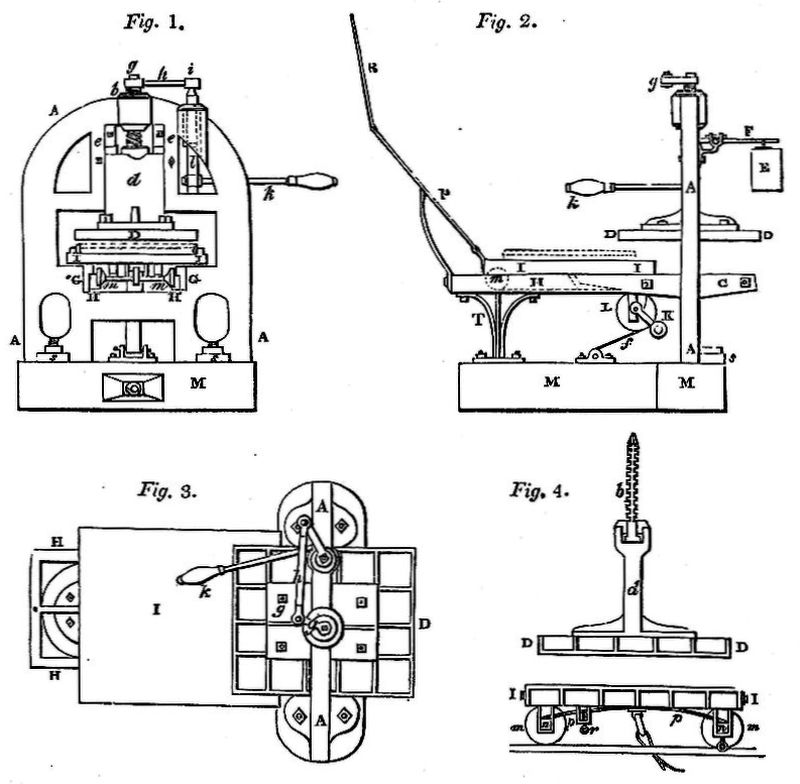
Fig. 1. Fig. 2.
Fig. 3. Fig. 4.
Figs. 1. and 2. are elevations, fig. 3. a plan, and fig. 4. a section. A A is a massive frame of cast iron, formed in one piece: this is the body of the press, in the upper part of which a nut is fixed for the reception of the screw b, and its point operates upon the upper end of a slider, d, which is fitted into a dovetail groove formed between two vertical bars, e, e, of the frame. The slider has the platen, D D, firmly attached to the lower end of it; and being accurately fitted between the guides e, e, the platen must rise and fall parallel to itself when the screw, b, is turned. The weight of the platen and slider are counterbalanced by a heavy weight, E, behind the press, which is suspended from a lever, F, and this acts upon the slider to lift it up, and keep it always bearing against the point of the screw. At G G are two projecting pieces, cast all in one with the main frame, to support the carriage when the pull is made; to these the rails, H H, are screwed, and placed truly horizontal for the carriage, I, to run upon them, when it is carried under the press to receive the impression, or drawn out to remove the printed sheet. The carriage is moved by the rounce or handle K, with a spit and leather girths, very similar to the wooden press. Upon the spit, or axle of the handle K, a wheel, L, is fixed, and round this leather girths are passed, one extending to the back of the carriage to draw it in, and the other, which passes round the wheel in an opposite direction, to draw it out. By this means, when the handle is turned one way it draws out the carriage, and by reversing the motion it is carried in. There is likewise a check strap, f, from the wheel down to the wooden base, M M, of the frame, and this limits the motion of the wheel, and consequently the excursion of the carriage. The principal improvement of Earl Stanhope’s press consists in the manner of giving motion to the screw, b, of it, which is not done simply by a bar or lever attached to the screw, but by a second lever; e. gr. the screw, b, has a short lever, g, fixed upon the upper end of it, and this communicates by an iron bar, or link, h, to another lever, i, of rather shorter radius, which is fixed upon the upper end of a second spindle, l, and to this the bar or handle, k, is fixed. Now when the workman pulls this handle, he turns round the spindle, l, and by the connexion of the rod, h, the screw, b, turns with it, and causes the platen to descend and produce the pressure. But it is not simply this alone, for the power of the lever, k, is transmitted to the screw in a ratio proportioned to the effect required at the different parts of the pull; thus at first, when the pressman takes the bar, k, it lies in a direction parallel to the frame, or across the press, and the short lever, i, (being nearly perpendicular thereto,) is also nearly at right angles to the connecting rod h; but the lever, g, of the screw makes a considerable angle with the rod, which therefore acts upon a shorter radius to turn the screw; because the real power exerted by any action upon a lever, is not to be considered as acting with the full length of the lever between its centres, but with the distance in a perpendicular drawn from the line in which the action is applied to the centre of the lever. Therefore, when the pressman first takes the handle, k, the lever, i, acts with its full length upon a shorter length of leverage, g, on the screw, which will consequently be turned more rapidly than if the bar itself was attached to it; but on continuing the pull, the situation of the levers change, that of the screw, g, continually increasing in its acting length, because it comes nearer to a perpendicular with the connecting rod, and at the same time the lever, i, diminishes its acting length, because, by the obliquity of the lever, the rod, h, approaches the centre, and the perpendicular distance diminishes; the bar or handle also comes to a more favourable position for the man to pull, because he draws nearly at right angles to its length. All these causes combined have the best effect in producing an immense pressure, without loss of time; because, in the first instance, the lever acts with an increased motion upon the screw, and brings the platen down very quickly upon the paper, but by that time the levers have assumed such a position as to exert a more powerful action upon each other, and this action continues to increase as the bar is drawn forwards, until the lever, i, and the connecting rod are brought nearly into a straight line, and then the power is immensely great, and capable of producing any requisite pressure which the parts of the press will sustain without yielding. The handle is sometimes made to come to rest against a stop, which prevents it moving further, and therefore regulates the degree of pressure given upon the work; but to give the means of increasing or diminishing this pressure for different kinds of work, the stop is made moveable to a small extent. Another plan is adopted by some makers of the Stanhope press, viz. to have a screw adjustment at the end of the connecting rod, h, by which it can be shortened; it is done by fitting the centre pin which unites it to the lever, g, in a bearing piece, which slides in a groove formed in the rod, and is regulated by the screw. This shortening of the connecting rod produces a greater or less descent of the platen, when the handle is brought to the stop.
The carriage of the press is represented with wheels, m, m, beneath, to take off the friction of moving upon the ribs, HH. These wheels are shown at fig. 4., which is a section of the screw and the platen, with the carriage beneath it: their axles, n, are fitted to springs, p, and these are adjustable by means of screws, r, so that the carriage will be borne up to any required height. This is so regulated, that when the carriage is run into the press, its lower surface shall bear lightly upon the solid cheeks, G, which are part of the body of the press, and these support it when the pressure is applied, the same as the winter of the old press: but the wheels by their springs act to bear up great part of the weight of the carriage with the types upon it, and diminish the friction, yet do not destroy the contact of the carriage upon the ribs, because this would not give the carriage that solidity of bearing which is requisite for resisting the pull. This is only at the time when the carriage is run into the press, because as it runs out, the ribs on which the wheels run rise higher, and therefore the wheels support the whole weight. The manner in which the wheels run in rebates or recesses in the edges of the ribs is shown at fig. 1. The carriage is made of cast iron, in the form of a box, with several cross partitions, which are all cast in one piece, and although made of thin metal, are exceedingly strong: the upper surface is made truly flat, by turning it in a lathe. The same of the platen, which is likewise a shallow box: the slider, d, has a plate formed on the lower end of it, which is fixed by four screws upon the top of the platen, and thus they are united. At the four angles of the carriage, pieces of iron are screwed on, to form bearings for the quoins or wedges which are driven in to fasten the form of types upon it in the true position for printing. The tympan, P, (fig. 2.) is attached to the carriage by joints, with an iron bracket or stop to catch it when it is thrown back: the frisket, R, is joined to the tympan, and when opened out, rests against a frame suspended from the ceiling. The register points are the same as in the wooden press, and all the operations of working are exactly the same. The iron frame, A, of the press is screwed down upon the wooden base, M, by bolts, which pass through feet, s s, projecting from the lower part of the iron frame. Another wooden beam is fixed into the former at right angles, so as to form a cross, which lies upon the floor. The ribs, H, for the carriage to run upon are supported from the wooden base by an iron bracket, T.