I. (continued 2)
Reading edition
Bond or other Security for Payment of Money;
Bill of Lading;
Policy of Insurance;
Letter of Attorney;
Deed or Agreement;
Transfer or Assignment of any Public Stocks, Funds, or other Securities;
Transfer or Assignment of the Stocks of any Public Corporation or Company, authorized or sanctioned by Act of Parliament;
Dividend Warrants of or for any such Public or other Stocks, Funds, or Securities;
Receipt for Money or Goods;
Proceeding in any Court of Law or Equity, or in any Inferior Court;
Warrant, Order, or other Papers printed by the Authority of any Public Board or Public Officer in the Execution of the Duties of their respective Offices;
2 Vict. c. 12. s. 4. All Informations and Actions for Penalties, &c. to be filed, &c. in the Name of Her Majesty’s Attorney or Solicitor General.
Imprisonment for Debt. See Debt.
INDENTURES.
5 Geo. 3. c. 46. s. 19. “And be it further declared and enacted by the Authority aforesaid, That all printed Indentures, Covenants, Articles, or Contracts, for binding Clerks or Apprentices in Great Britain, after the said fifth Day of July, one thousand seven hundred and sixty-five, shall have the following Notice or Memorandum printed under the same; videlicet,
“‘The Indenture, Covenant, Article, or Contract, must bear Date the Day it is executed; and what Money or other Thing is given or contracted for with the Clerk or Apprentice, must be inserted in Words at length; and the Duty paid to the Stamp Office, if in London, or within the Weekly Bills of Mortality, within one Month after the Execution, and if in the Country, and out of the said Bills of Mortality, within two Months, to a Distributor of the Stamps, or his Substitute; otherwise the Indenture will be void, the Master or Mistress forfeit fifty Pounds, and another Penalty, and the Apprentice be disabled to follow his Trade, or be made free.’
“And if any Printer, Stationer, or other Person or Persons, shall sell, or cause to be sold, any such Indenture, Covenant, Article, or Contract, without such Notice or Memorandum being printed under the same; then, and in every such Case, such Printer, Stationer, or other Person or Persons, shall, for every such Offence, forfeit the Sum of ten Pounds.”
INDEX,
or Hand ☞ points out a remarkable passage, or something that requires particular attention.—Murray.
INDIA PAPER.
This paper, which comes to us from China, is decidedly superior to any other paper for obtaining fine impressions from engravings. That which is used as the linings of tea chests is equal in quality to any, although some of it is coarse, and many persons object to the colour; a thicker and whiter sort comes over as wrappers for silk; both these sorts are injured by having been used as packages, but out of them good pieces may be selected, sufficiently large for octavo pages, and frequently for quarto. A perfect paper of a large size is imported in chests of two thousand sheets each. A sheet measures four feet three inches and one tenth in length, and two feet one inch and one tenth in width. This paper varies very much in quality, so that circumspection should be used in making a purchase.
All India paper contains particles of hard matter, like minute portions of stone, small pieces of the hard stalks of some vegetable, and lumps of the material from which it is made. Previously to its being printed on, the whole of it ought to be carefully examined, and these extraneous matters removed with a sharp knife, otherwise they will injure the surface of the engraving.
There is a smooth side and a rough side in white India paper, called by printers the right side and the wrong side: this India paper has the appearance of having been formed on a smooth surface of metal or stone, by being laid on with a brush, the rough side having the semblance of paint applied by an unskilful hand, exhibiting all the marks of the brush in irregular directions; the other side being flat and smooth. The smooth side is always used for the impression.
In all cases the best way of damping India paper is to put it, in separate pieces, into a heap of paper that is in a proper condition for printing, where after lying a few minutes it will be sufficiently damp for use. See Paper.
INK.
Printing Ink is a composition formed of two articles, namely, varnish and colouring matter.
The Rev. William Beloe, treating of early printed books in his Anecdotes of Literature, &c., says,—“It must have been immediately obvious that common writing ink, from its want of substance and viscosity, could by no means answer the purpose. But it must excite surprise, and indeed admiration, to perceive how soon the greatest perfection was attained in this particular. So very soon indeed, and so effectually, that very nearly at the same period books were printed at Mentz, at Rome, and at Venice, which may almost defy the competition of succeeding artists.—The Psalter of Fust and Guttenburg, at Mentz, the Lactantius of Sweynheym and Pannartz, at the Subiaco Monastery, and the Pliny of Jenson, at Venice, may be adduced as specimens of extraordinary beauty, with regard to the quality of the ink; not perhaps surpassed, or, if at all, in a very small degree, by the productions of Bodoni at Parma, or the most perfect examples of the London Presses. It is observable that this excellence of the ink is particularly apparent in all the early books printed upon vellum, and in Germany.”
This is strictly true, for the ink has, after a lapse of four hundred years, preserved its beautiful blackness, as I have myself witnessed, particularly in the large Bible printed by Faust and Schœffer, and generally known as the Mentz Bible without Date; but in the seventeenth century the quality had materially retrograded, and it was not till the latter part of the eighteenth century that it began to recover its character, when two or three of our most celebrated printers set about improving the ink of commerce for some very expensive splendid works, but the ingredients which they used they kept a profound secret.
As I believe that I am the only person who has written a practical work on the subject, I will give an extract from the preface of my work on Printing Ink, which will show the state in which this article was at that time.
“The process of making printing ink has never yet been treated of fully by any practical man, either printer or manufacturer, so that this work will come before the public on a subject as new as it is important.
“This assertion may perhaps appear to require some modification, as the following pages will present to the reader many receipts for making printing ink, by preceding authors; but when it is known that this subject is only treated of incidentally by some, and that others of them were not professionally printers, and therefore could scarcely be expected to know what was the desideratum, much less to attain it, we shall have little cause to wonder that all have failed. That they have failed, admits of no question: a long experience in the art of printing in all its branches enables and obliges me to say, that ink made from any one of these receipts could not be used in any printing office in the metropolis.
“Moxon, who wrote the first practical work on printing, gives a detailed method of preparing printing ink after the Dutch manner, which he highly praises; yet this ink would be deemed worthless at present, and although as good as the succeeding ones, he is never quoted on this subject; yet when types are treated of, his name appears in every subsequent work on printing. I believe few printers know his book, the title of which is, “Mechanick Exercises: or, the Doctrine of Handy-works. Applied to the Art of Printing. By Joseph Moxon, Member of the Royal Society, and Hydrographer to the King’s Most Excellent Majesty.” 2 vols. 4to. 1677, and which has served as the foundation of subsequent works on printing.
“M. le Breton, printer to the King of France, is the next author on this subject. He wrote the article on Printing in the French Encyclopédie, of which the method of making printing ink forms a part. He is continually quoted by succeeding writers, yet his ink would not rank higher than Moxon’s in a printing office.
“J. B. Papillon, a celebrated French engraver on wood, published a treatise on that subject, in which he gave a detailed account of making printing ink, which would not be in greater estimation than Moxon’s and Breton’s.
“Lewis, in his Philosophical Commerce of Arts, relates the results of many experiments on boiling oil, which are of little practical use, and gives the process of making ink from Breton.
“Nicholson, in his Dictionary of Chemistry, gives some passages which purport nothing, and then proceeds to a loose description of the process from Lewis.
“The Messrs. Aikin, in their Dictionary of Chemistry, give a short vague article on the subject, quoting Lewis as their authority.
“Rees’s Cyclopædia contains an article on the subject from Lewis.
“The Printer’s Manual, a French work, published in 1817, gives an account of the process, founded on Breton’s formula.
“The Encyclopædia Britannica is the only work to my knowledge which has broken through the trammels of obsolete authorities, and given a receipt by which a printing ink might be made that could be used; but the editor candidly acknowledges that the article produced would be of an inferior quality.—It is, however, the only real approximation to the knowledge of making an ink that could be worked with; and yet it is deficient in specifying the qualities of the different materials, and also of their due proportions, so that it would not produce a clean working ink, nor an ink of a good colour.
“The information given in the book is not theoretical, but deduced from my own practice; and there is not an article mentioned in the whole treatise but what I have repeatedly employed, nor a receipt given but what has undergone the strictest ordeal—that of being used in the regular way of business. The fine black ink has been pronounced by some of our first printers unrivalled; and the ink for general purposes has been allowed, by the most competent judges, to be fully equal to the high priced inks of the principal manufacturers.
“I have used them myself, and also superintended their use by others to the extent of thousands of impressions printed consecutively, without having found occasion to wash or clean the form or engraving, and this in producing fine work. I am, through this experience, enabled to assert, that I do not think it possible that inks could be produced that would work cleaner or more freely, produce finer impressions, and retain their freshness of colour without imparting stain to the paper, than the inks, both black and coloured, the receipts of which I have published in this work.
“The Society for the Encouragement of Arts showed their sense of my success in this pursuit, by awarding to me their large medal, and a sum of money, for my imitation of drawings printed from engravings on wood with inks of my own preparing; and by an invitation to furnish them with a paper on the preparation of printing ink.
“Knowledge of such a subject as this on which I am treating, must, to possess any value, be practical, not theoretical: without being so, there would not exist a possibility of accurately knowing the imperfections existing in the inks, of estimating the errors and deficiencies, and, least of all, of providing a remedy. Thirty-six years practice in the metropolis, with some previous ones in the country, spent in executing the most common as well as the most splendid works, may perhaps entitle me to feel competency to my undertaking, and encourage the belief of it in others.
“To printers generally, I feel that this work will be of great service, judging from the absolute want of information on the subject, a want that I have experienced in a very high degree during my practice. It will enable every printer to prepare a good ink himself, and to have it always of an uniform quality;—it will enable him to prepare the finest ink without any risk or danger;—it will enable him to prepare coloured ink of any hue at half an hour’s notice, that will work as clean as black ink, when any fancy work is required;—it will enable him to print bankers’ cheques, &c. with a changeable ink, to prevent fraudulent alterations:—it is in fact opening a door to the extension of the powers of the printing press which has hitherto been closed and sealed.”
This was written in 1832, and contains as faithful an account of the state of knowledge as could be acquired at that time on this subject; for the few manufacturers of the article then existing most scrupulously guarded the secret of its preparation, and no really fine ink could be purchased. The publication of my work on Decorative Printing, and of this work on Printing Ink, has effected a great revolution in the art; for previously it was impossible, even in the metropolis, to have any thing printed in a superior way except with black ink, whereas now, there is hardly a printer who would not feel ashamed to avow that he could not execute work in any colour whatever in the same style of workmanship as with black ink. For the method of preparing the different inks, both black and of every colour, with the ingredients and their proportions, I must refer the reader to the book itself.
For the qualities requisite in the best printing ink, see Engravings on Wood, and also Fine Presswork.
By the Act 6 G. 4. c. 111., the Customs Duty on the importation of ink for printers is 1l. 1s. the cwt.
INK BLOCK.
The block on which the ink is spread to supply the balls; in wooden presses, it is nailed to the upper near hind rail, and is supported at the bottom by a stay fastened to the lower rail.
It was generally made of a piece of elm wood, between two and three inches thick, with a ledge of fir wood at the back, at one end, and also at part of the front. A quantity of ink was kept in the farther corner, which was rubbed out on the bottom with the brayer, from which it was taken with a ball, and then distributed.
In fine printing that required strong ink, it being found very difficult, in cold weather, to distribute the ink properly, some offices adopted a small table having an iron plate for the top, with a shelf under it for a lamp, which warmed the ink and caused it to work more freely.
The introduction of rollers has superseded the use of the ink block, for which has been substituted an inking apparatus, which see.
INKING APPARATUS.
The substitution of rollers for balls required a different apparatus for the taking of ink.
Mr. Edward Cowper, of the late firm of Applegath and Cowper, claims the invention of the first apparatus, for which the firm took out a patent. Mr. Cowper kindly favoured me with drawings, and the following description, in the year 1818.
“The apparatus consists of an inking roller, a distributing table, and an ink trough.
“The inking roller is made of wood covered with the elastic composition, [treacle and glue,] it is about three inches diameter and eighteen or twenty inches long, according to the length of the form; it is furnished with two handles which are fixed to the spindle on which the roller turns; the spindle passes through the roller so that when one handle is moved the other is moved also; the handles stand over the roller at right angles to it, this position being from practice found most convenient; a small leg projects from one of the handles, which prevents them from falling on the table and becoming soiled.
“The distributing table is of wood covered with a sheet of lead as level as possible; and the frame on which it stands is of cast iron.
“The ink trough is fixed at one edge of the table, and is composed of a metal roller, turned true, and a thin plate of steel, the edge of the plate presses against the metal roller by means of levers and weights, the ink is placed between the steel plate and the metal roller.
“When the metal roller is turned round it becomes covered with a film of ink, the inking roller is then dabbed against it, and rolled backwards and forwards on the distributing table in different directions; it is then passed two or three times over the form.
“The advantages of this mode of inking are considerable; it is much easier to use than the balls, produces better work, and saves in balls and ink not less than five shillings per week. Its peculiar recommendation is the great regularity of colour which may be obtained, and the delicate manner in which the letter is touched, advantages which render it applicable to the finest specimens of typography.”
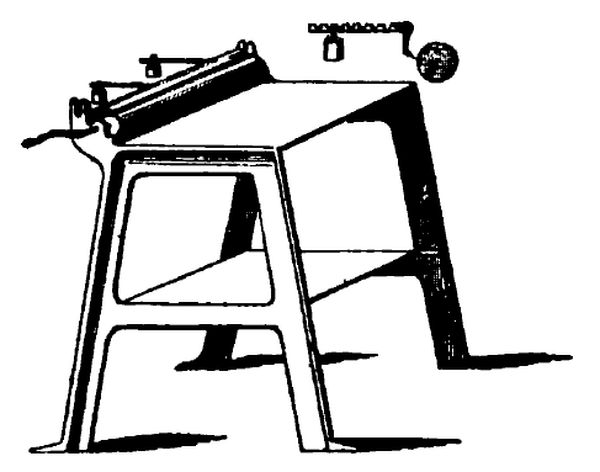
The following account is extracted from Hansard’s “Typographia.”
“A more simple and cheap apparatus for this purpose was immediately got up by Mr. Foster, the inventor of the composition balls. It is a stand having its two legs and feet of cast-iron; and its top, upon which the ink is distributed, instead of lead, as in the former apparatus just described, is mahogany. Behind this, elevated about two inches, is the stage for taking the ink on to the roller. At either end of the stage is a recess for receiving the contrivance which contains the ink. This is similar in shape to the brayer formerly used; but turned hollow, with the handle and top to screw on; at the bottom are holes, and when the ink is wanted on the stage, the workman, taking hold of this bottle-brayer, moves it from one recess to the other, drawing it slowly along the stage. In this movement the ink, by its own gravity, will issue out from the holes at the bottom, and leave a portion on the stage, more or less, according to the rapidity or frequency of its transit. [See figure, p. 421.]
“Mr. Arding soon improved upon Foster’s apparatus, by making the ink-stage of cast-iron, with circular recesses; and the whole table more of a solid form; both makers now adopt the same pattern: but the bottle-brayer has not been found to answer, as the ink soon clogs up the holes, and the wood is liable to be split by the screw at the top; and an old servant of the press-room, the common brayer, has again been found the most effective for this purpose.
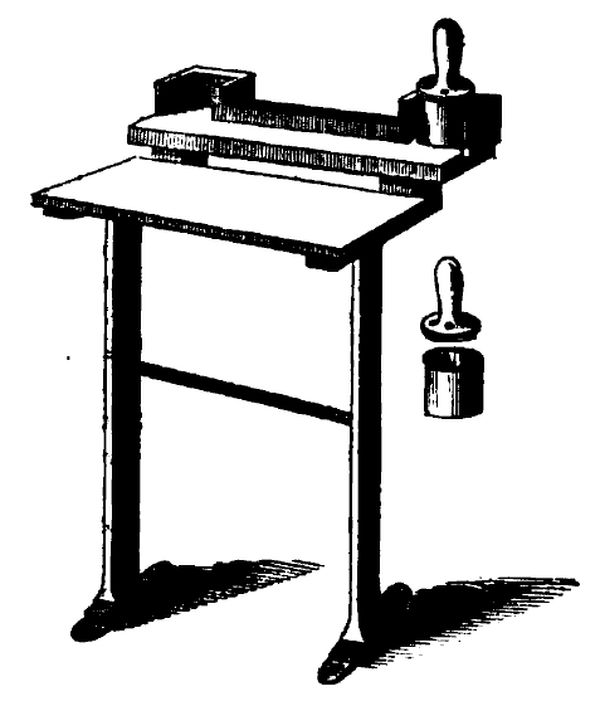
“I have had several of these inking tables at work, and find a decided preference due to the last described. The mahogany surface seems more congenial to the temperament of the ink and roller, than either the lead or iron. The ink is taken better, and distributes better. A line of colour is taken as perfectly from the stage as from a cylinder, since the roller, being cylindrical, can only touch the ink in a line, and it is only giving the roller a portion of a revolution on the stage to make it take a greater quantity of colour if necessary. More of the flue and dirt, inseparable from the working of paper, is held by the wood than by the lead; and consequently, the roller keeps cleaner, and the forme works better. The table is easily washed by the lye-brush, and no further waste of ink is occasioned.
“This apparatus has been further improved by substituting a box and cylinder for the stage and brayer. The advantage of which will be, that the quantity of ink on the cylinder to come in contact with the roller, is regulated by a pressure at the top, out of the body of the ink, instead of at the bottom against which the ink must rest.
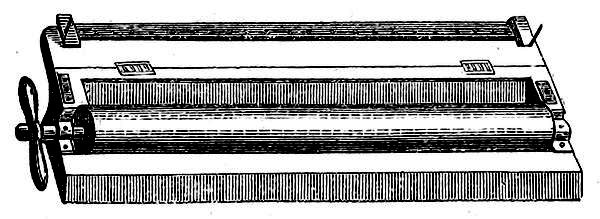
“The cylinder is of mahogany, and, as here shown, moves in a box or trough which contains the ink; and which has a lid moving on hinges coming nearly over the top of the cylinder. To the under edge of this top is nailed a slip of thick butt or sole leather. This, by its naturally elastic quality, will always press upon the cylinder according as the lid is more or less tightly screwed down by thumb-screws. This leather will also intercept in its way any filth which may arise from the depôt of ink before it can reach the cylinder: and which, when accumulated, may, by unscrewing the lid and throwing it open, as in the figure, be instantly scraped away with one stroke of the knife; and no further waste of the ink incurred. No part of the ink in this apparatus is exposed when the lid is down: and only a very small portion of the cylinder at the time of working.”
A wooden table after the pattern of Foster’s apparatus is now generally used, the top is covered with lead on which the ink is distributed on the rollers; the stage on which the ink is taken is not raised more than about a quarter of an inch, and at the two back corners are two recesses, one for the supply of ink, and the other for the brayer, when not in use. See Rollers.
INNER FORM.
The form that has the second page in it; it is always worked before the outer form, except there be some particular reason to the contrary. See Lay on.
INNER TYMPAN.
A frame covered with parchment, which fits into the outer tympan; two flat points slip under the head-band of the outer tympan, which secure that end in its place; and the sides are kept down by two hooks on each side of the outer tympan which turn into eyes screwed into the sides of the inner tympan; in iron presses the hooks turn round studs, under the heads.
In page. See Out page.
INSERTION.
If the compositor have left out words or lines, the corrector inserts it, and makes this mark ‸ where it is left out, which is called the mark for insertion.—M. This is now called an “Out;” an insertion is when the author makes any addition in the proof sent to him.
INSET.
The same as offcut: with printers it is called an offcut; when the work comes into the hands of the bookbinder, and the sheets are folded, it then becomes an inset, being inserted in the middle of the sheet, to complete the regular succession of pages.
INSIDE QUIRES.
The regular and perfect quires of paper, of twenty-four good sheets each; they are thus designated to distinguish them from the outside or corded quires.
Interrogation. See Punctuation.
INSOLVENT DEBTORS.
1 & 2 Vict. c. 110. “An Act for abolishing Arrest on Mesne Process in Civil Actions, except in certain Cases; for extending any Remedies of Creditors against the Property of Debtors; and for amending the Laws for the Relief of Insolvent Debtors in England.”
s. 115. “And be it enacted, That the Sum of Three Shillings, and no more, shall be paid to any Printer or Proprietor of any Newspaper for the Insertion of any Advertisement by this Act directed to be inserted in any Newspaper; and all Printers and Proprietors of Newspapers are hereby required to insert the same, on Payment of the said Sum of Three Shillings for the Insertion thereof, in such Form as the said Court or any Commissioner thereof shall from Time to Time direct.
s. 116. “And be it enacted, That no Letter of Attorney, Affidavit, Certificate, or other Proceeding, Instrument, or Writing whatsoever, before or under any Order of any Commissioner thereof, or before any Justice or Justices of the Peace acting in the Execution of this Act, nor any Copy thereof, nor any Advertisement inserted in any Newspaper by the Direction of the said Court, relating to Matters within the Jurisdiction of the said Court, shall be liable to or chargeable or charged with the Payment of any Stamp or other Duty whatsoever; and that no Sale of any Real or Personal Estate of any such Prisoner as aforesaid for the Benefit of his or her Creditors, under this Act, shall be liable to any Auction Duty.”
Upon a representation made in the House of Commons, that s. 115. bore hard on the proprietors of newspapers, it was modified by the Act of 2 & 3 Vict. c. 39. intituled, “An Act to amend an Act passed in the last Session of Parliament, for abolishing Arrest on Mesne Process in Civil Actions except in certain Cases, for extending the Remedies of Creditors against the Property of Debtors, and for amending the Laws for the Relief of Insolvent Debtors in England.
s. 1. “Whereas by an Act passed in the last Session of Parliament, intituled, ‘An Act for abolishing Arrest on Mesne Process in Civil Actions except in certain Cases, for extending the Remedies of Creditors against the Property of Debtors, and for amending the Laws for the Relief of Insolvent Debtors in England,’ it was amongst other things enacted, that the Sum of Three Shilling and no more shall be paid to any Printer or Proprietor of a Newspaper for the Insertion of any Advertisement by that Act directed to be inserted in any Newspaper, and all Printers and Proprietors of Newspapers were thereby required to insert the same, on Payment of the said Sum of Three Shillings for the Insertion thereof, in such Form as the Court for the Relief of Insolvent Debtors, or any Commissioner thereof, should from Time to Time direct: And whereas it is just and expedient that the said Act should be altered and amended as herein-after mentioned: Be it therefore enacted by the Queen’s most Excellent Majesty, by and with the Advice and Consent of the Lords Spiritual and Temporal, and Commons, in this present Parliament assembled, and by the Authority of the same, That so much of the said Act as is herein-before recited shall be and the same is hereby repealed; and that from and after the passing of this Act, all Printers and Proprietors of Newspapers shall and are hereby required to insert any Advertisement or Advertisements by the said recited Act directed to be inserted in any Newspaper, on Payment of a reasonable Compensation for the Insertion thereof, in such Form as the said Court, or any Commissioner thereof, shall from Time to Time direct.”
Insolvent Debtors, Ireland. 3 & 4 Vict. c. 107. “An Act to continue and amend the Laws for the Relief of Insolvent Debtors in Ireland.
s. 101. “And be it enacted, That all Printers and Proprietors of Newspapers shall and they are hereby required to insert any Advertisement or Advertisements by this Act directed to be inserted in any Newspaper, on Payment of such reasonable Compensation for the Insertion thereof, and in such Form, as the said Court, or any Commissioner thereof, shall from Time to Time direct.
s. 102. “And be it enacted, That no Letter of Attorney, Affidavit, Certificate, or other Proceeding, Instrument, or Writing whatsoever, before or under any Order of the said Court, or before or under any Order of any Commissioner thereof, nor any Copy thereof, nor an Advertisement inserted in any Newspaper by the Direction of the said Court or a Commissioner thereof, or the Chief Clerk of the said Court, relating to Matters within the Jurisdiction of the said Court, shall be liable to or chargeable or charged with the Payment of any Stamp or other Duty whatsoever; and that no Sale of any Real or Personal Estate of any such Prisoner as aforesaid for the Benefit of his or her Creditors, under this Act, shall be liable to any Auction Duty.”
IRISH.
“Mr. Innes, in his Essay on the Antiquities of Scotland and Ireland, delivers it as his opinion, that the Beth Louis Nion, or alphabet of the Irish, was nothing but an invention of the Irish Seanachies, who, since they received the use of Letters, put the Latin alphabet into a new arbitrary order, and assigned to each letter a name of some Tree; and that this was not a genuine alphabet of the Irish in ancient times, or peculiar to them; but was a bare inversion of the Latin alphabet.
“Colonel Vallancey, (in his Irish Grammar,) gives three different alphabets of the Irish language, which vary from each other in name, order, and number; the first consists of twenty-five letters, the second of twenty-six, and the last of seventeen. As for the Irish letters being different in power from those of other nations, it must be observed, that the powers of letters differ in every language, and the mode of pronouncing the same letters is various in different countries: the Irish characters are said to be of Asiatic original—granted.—But they appear to have been transmitted to the inhabitants of that country from those who had adopted the Roman letters.
“It is singular, but it is no less true, that the Norman characters were generally used in England from the coming of William the First, and that the Saxon characters were intirely disused in the very beginning of the twelfth century; but the Irish and Scots preserved the ancient forms of their characters till the end of the sixteenth century.”—Astle.
The most ancient grammar of the Irish language now extant, is the Uraiceact na Neigeas, or Primer of the Bards, written by Forchern some few years before our vulgar æra, transcribed and illustrated by Ceannfaolidh na foghlama, or Kinfaolidh the learned, an author of the seventh century. The alphabet, according to this author, was originally named bobel, loth, &c. from the names of certain masters who assisted in composing the Japhetan language soon after the confusion of tongues.
As the Grecians gave the name of alphabet to the table of their letters from the two initial letters, Alpha, Beta; and the Latins called their table Abcdarium from their three first letters, A, B, C. So the Irish gave the name of Bobel, Loth, to their ancient elements, from the two first letters B, L; and to their more modern alphabet, that of Bethluisnon, from B, L, N, which proves that N did formerly possess the third place; whereas in the present alphabet it takes up the fifth. The last and most modern name of the Irish alphabet, in conformity to the Abcdarium of the Romans, is Abgiter.
The Number, Order, and Names of the Letters, according to Forchern’s Uraiceact.
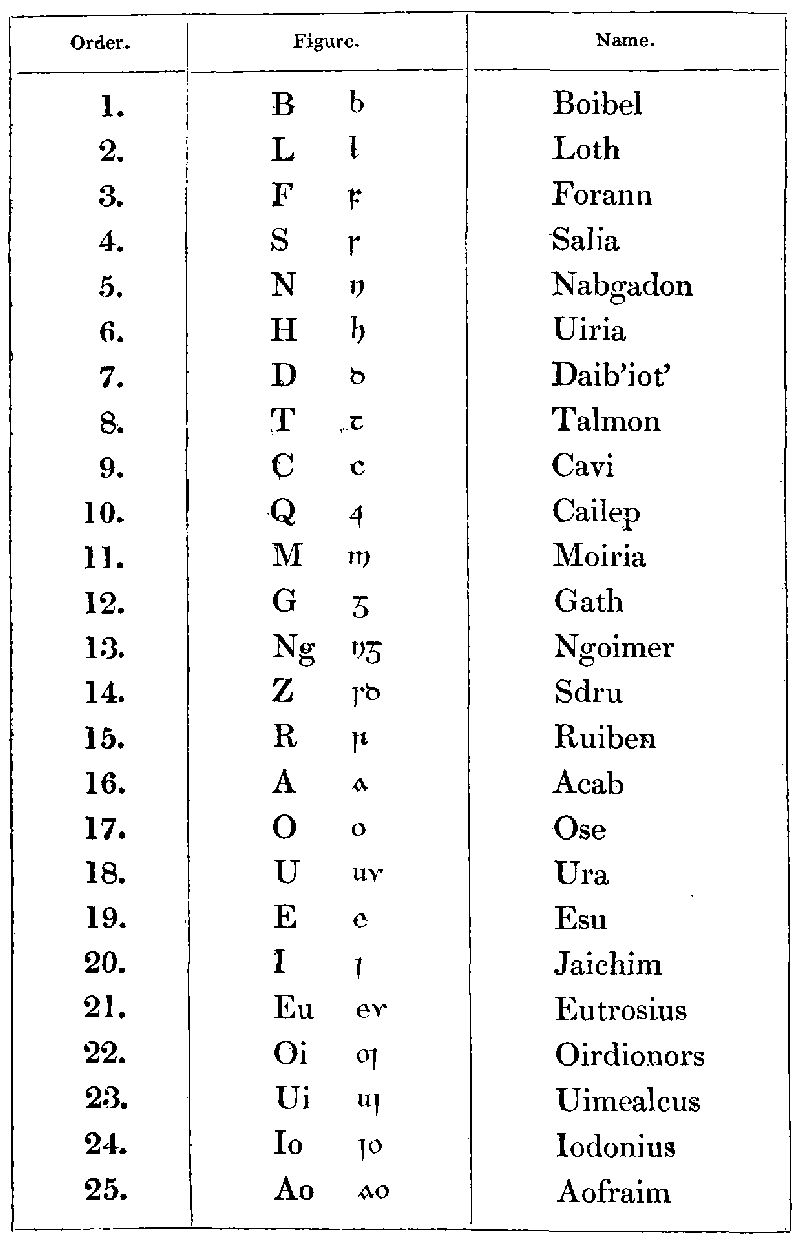
Order. Figure. Name.
1. B b Boibel
2. L l Loth
3. F f Forann
4. S s Salia
5. N n Nabgadon
6. H h Uiria
7. D d Daib’iot’
8. T t Talmon
9. C c Cavi
10. Q q Cailep
11. M m Moiria
12. G g Gath
13. Ng ng Ngoimer
14. Z z Sdru
15. R r Ruiben
16. A a Acab
17. O o Ose
18. U u Ura
19. E e Esu
20. I i Jaichim
21. Eu eu Eutrosius
22. Oi oi Oirdionors
23. Ui ui Uimealcus
24. Io io Iodonius
25. Ao ao Aofraim
It is remarkable in all the Irish alphabets, (except the modern one, the order of which is copied from the Roman, and introduced since Christianity,) that the vowels follow each other; an instance not known in any other language, yet the labials, dentals and linguals, are intermixed without order.
The Number, Order, and Names of the Letters, according to O’Flaherty, from the Book of Lecane.
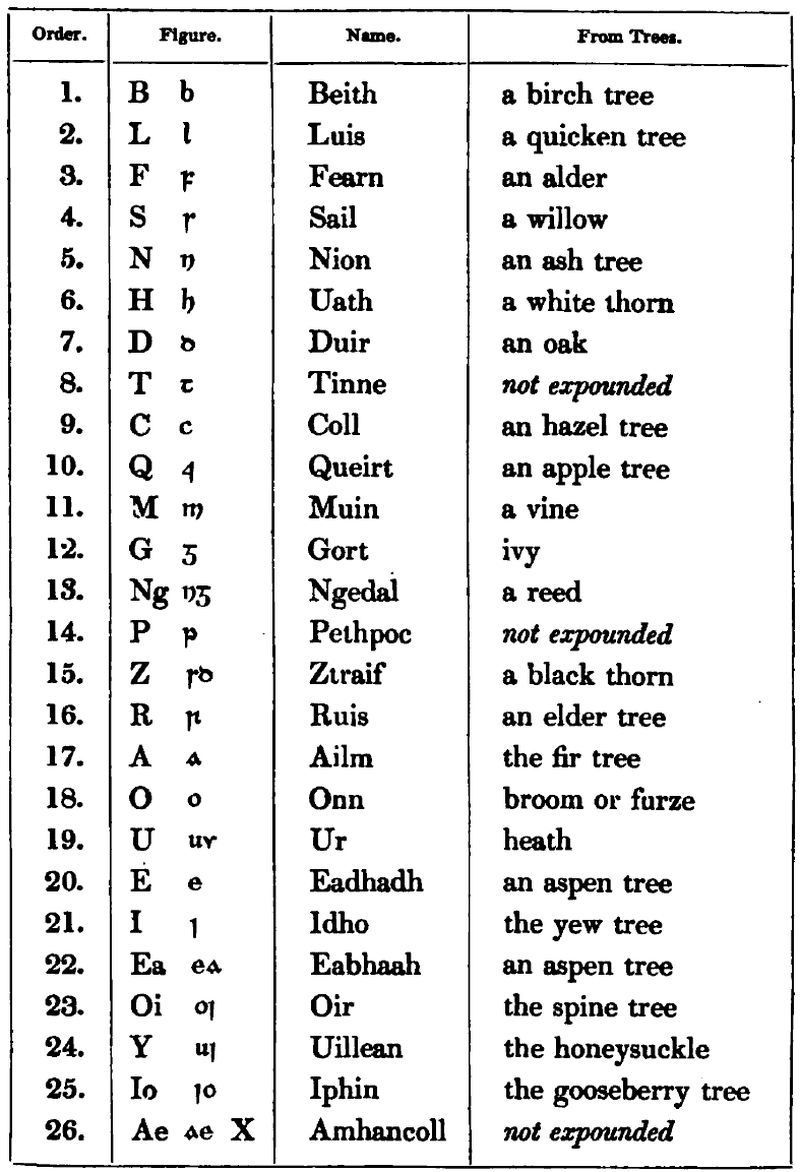
Order. Figure. Name. From Trees.
1. B b Beith a birch tree
2. L l Luis a quicken tree
3. F f Fearn an alder
4. S s Sail a willow
5. N n Nion an ash tree
6. H h Uath a white thorn
7. D d Duir an oak
8. T t Tinne not expounded
9. C c Coll an hazel tree
10. Q q Queirt an apple tree
11. M m Muin a vine
12. G g Gort ivy
13. Ng ng Ngedal a reed
14. P p Pethpoc not expounded
15. Z z Ztraif a black thorn
16. R r Ruis an elder tree
17. A a Ailm the fir tree
18. O o Onn broom or furze
19. U u Ur heath
20. E e Eadhadh an aspen tree
21. I i Idho the yew tree
22. Ea ea Eabhaah an aspen tree
23. Oi oi Oir the spine tree
24. Y y Uillean the honeysuckle
25. Io io Iphin the gooseberry tree
26. Ae ae X Amhancoll not expounded
Of these letters, the five last are diphthongs. Q, Ng, Z, are reckoned superfluous consonants, and are thrown out of the modern alphabet, so that the remaining letters are only 17, which compose the abgitur or alphabet now in use, and are placed in order as the Latin abcdarium.
The ancient grammarians called the alphabet Faoidh, or Faodh, i.e. a a voice, a sound or language; because such letters are expressive of the voice and language. The moderns, to support their hypothesis, have corrupted this word to Feadh, a wood; and from hence have denominated the letters after certain trees, three of which they are at a loss to expound. According to Neuman, the Hebrew letters do each separately signify the idea either of motion, space, or matter; hence each Hebrew word is at once a name, and a definition of the subject, and all objects in the natural and moral world must be known as soon as their names are known, and their separate letters considered. The proper names of men being borrowed from such ideas as Adam, i.e. red earth, it is more rational to suppose our learned ancestors named their letters according to Forchern, from men, rather than from trees.—A Grammar of the Iberno-Celtic, or Irish Language. By Major Charles Vallancey. 4to. Dublin, 1773.
The Modern Alphabet.
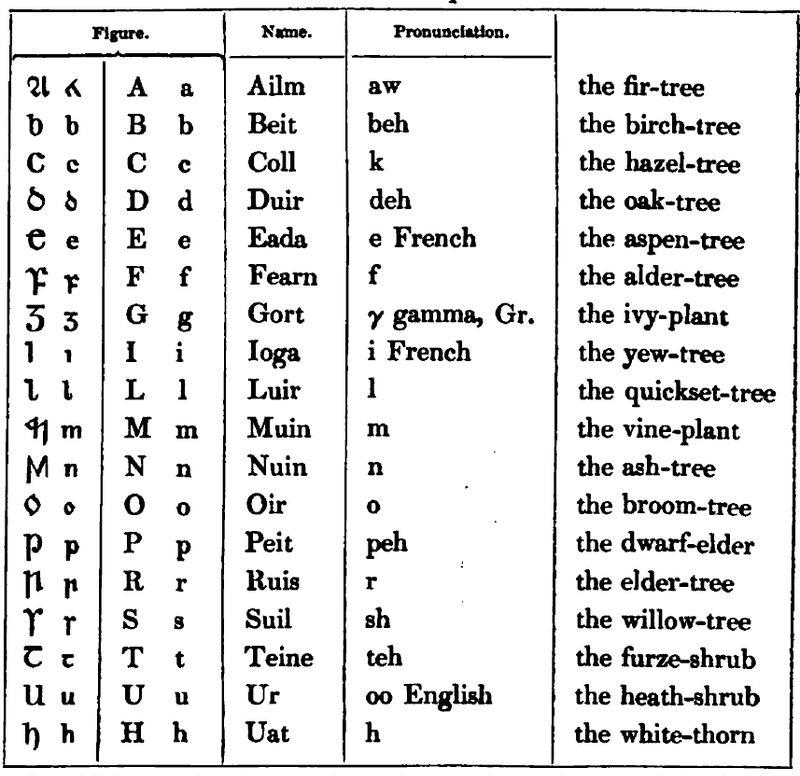
Figure. Name. Pronunciation.
A a A a Ailm aw the fir-tree
B b B b Beit beh the birch-tree
C c C c Coll k the hazel-tree
D d D d Duir deh the oak-tree
E e E e Eada e French the aspen-tree
F f F f Fearn f the alder-tree
G g G g Gort γ gamma, Gr. the ivy-plant
I i I i Ioga i French the yew-tree
L l L l Luir l the quickset-tree
M m M m Muin m the vine-plant
N n N n Nuin n the ash-tree
O o O o Oir o the broom-tree
P p P p Peit peh the dwarf-elder
R r R r Ruis r the elder-tree
S s S s Suil sh the willow-tree
T t T t Teine teh the furze-shrub
U u U u Ur oo English the heath-shrub
H h H h Uat h the white-thorn
In addition to the above eighteen letters, the ancients used the following in their alphabet:—
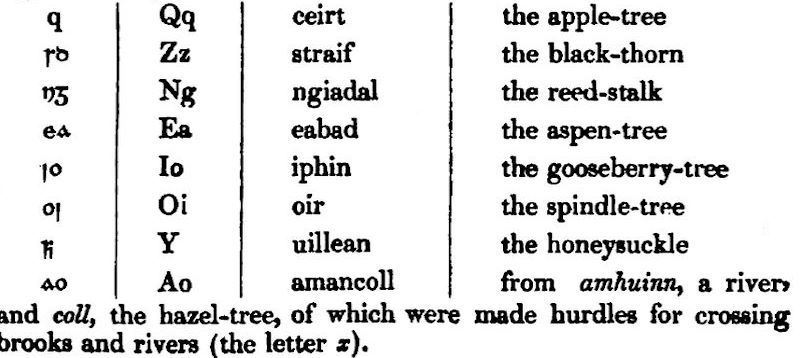
q Qq ceirt the apple-tree
z Zz straif the black-thorn
ng Ng ngiadal the reed-stalk
ea Ea eabad the aspen-tree
io Io iphin the gooseberry-tree
oi Oi oir the spindle-tree
y Y uillean the honeysuckle
ao Ao amancoll from amhuinn, a river,
and coll, the hazel-tree, of which were made hurdles for crossing brooks and rivers (the letter x).
Table of Mutable Consonants and of Eclipses.
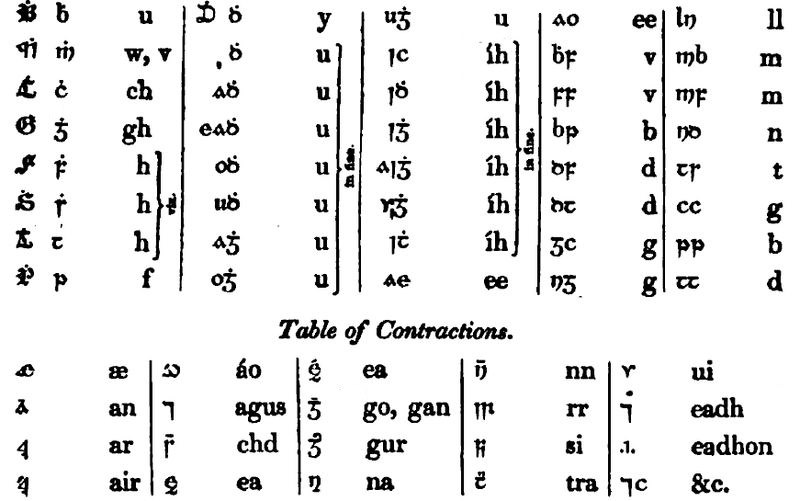
[Irish-English Guide to the Irish Language. By Thaddæus Connellan, 12mo. Lond. 1824.]
The vowels are five in number, a, o, u, e, i, whereof the three first, a, o, u, are broad, and the two last, e, i, are narrow.
In words of two or more syllables, regard must be had to the correspondence of the vowels, for when the last vowel of the former syllable is a broad vowel, the first vowel of the following syllable must be broad also; and when in some latter syllable the vowel is small, the last of the immediately preceding must be small also. Example, du-ne, a man, is false orthography, because the last syllable ending in a small vowel, the first must end in a small one also, as dui-ne.
No vowel is ever to be doubled as ee, oo, &c. in the same syllable.
The diphthongs, or union of two vowels, are thirteen.
Example.
{ao as y or i in bird saor
{æ or ae gaeth
{ai cail
{ea fear
{ei ceir
{eo ceol
{eu seud
ia cliar
io cior
oi coir
ua fuar
ui fuil
The triphthongs are five,
aoi caoin
eoi feoil
iai liaigh
iui sttiuir
uai cuaird
— Vallancey.
Vallancey, by omitting the letter R, reduces the modern alphabet to seventeen letters; Connellan, by admitting this letter, increases it to eighteen.
Hibernian or Irish Types in the British Founderies.
Pica.—Thorowgood and Besley; this was cut by Fry from drawings made by, and under the superintendence of Mr. Thaddæus Connellan.
Small Pica.—Thorowgood and Besley; this was also cut by Fry from drawings by Mr. Connellan, and under the same circumstances as the Pica. V. and J. Figgins; this was copied from the engravings in Vallancey’s Irish Grammar. I have given the modern alphabet in this character.
Long Primer.—Thorowgood and Besley; this was cut for Bagster’s edition of the New Testament in Irish, printed for the British and Foreign Bible Society.
ITS OWN PAPER.
When one, two, three, or more copies of a sheet of a work, or a job, are printed on the paper that the whole is intended to be worked on, it is said to be Pulled on its own Paper. This is frequently done at the commencement of a work, when a proof of the first sheet is sent to the author, or bookseller, or both; that they may see the effect produced before it is proceeded with.