H.
Reading edition
HALF A PRESS.
When but one man works at a press, it is called Half a Press.—M. It is still termed a Half Press. A man is said to be working Half Press.
HALF WORK.
He that works but three days in the week, does but Half work.—M.
Hangs. See Letter Hangs.—M.
HANG UP PAPER.
To hang the sheets upon the poles to dry after they have been printed.
For this purpose the warehouseman takes the peel in his hand, and lays it flat upon the heap that is to be hung up, so as to let the paper project beyond the left side of it; he turns over upon it from six to twelve or fourteen sheets of paper, with the wrapper, and then moves the peel two or three inches to the left, and goes on repeating the process, till he has got as many lifts on it as it will conveniently support; he then raises them above the pole on which they are to be placed, and holding the handle slanting the sheets open at the under side, so that when the peel is withdrawn the lifts are left suspended on the pole; he then inserts the end of the peel between the first and second lifts, which are undermost, where he shifted his peel in taking them up, lifts them a little, and moves them farther from each other on the pole, still letting the one overhang a little the other he leaves in its first place, and thus he proceeds till one by one he has separated all he had upon his peel; he then takes another peelful, repeating this process, and so he goes on till the whole heap is hung up.
He is guided by circumstances as to the number of sheets he should take in a lift: if the work is in a great hurry, or his vacant poles are not in a favourable situation for drying, or the weather be rainy and the atmosphere charged with moisture, he will hang the paper up thin; but if he is short of pole-room, and the work is not in a great hurry, if the situation is favourable for drying, and the weather dry and warm, he will make his lifts thicker; but I would caution him not to go to an extreme, as in that case the paper may mildew upon the poles, particularly in the fold.
Houses of extensive business have drying rooms fitted up with pipes, and heated either with steam or hot water, so that they can dry their printed paper expeditiously, without hinderance or drawback.
HANG THE PLATEN.
To tie the platen to the hose hooks, in a wooden press.
To perform this it is usual to lay on the press stone a form of solid type, and to turn the tympans down upon it, to place the platen in its place, square with the press, to pull the bar home, and to keep it in this situation by a letter board placed so as to take a bearing against the shoulder of the bar close to the handle, and also against the off cheek; but I prefer a piece of wide furniture with a notch cut in one end for the bar, and the other end against the off cheek, as it is more secure and less liable to be displaced; then to make a noose on a piece of laid cord, place this on one of the front hose hooks, and take a turn round the corresponding platen hooks, and continue these turns till a sufficient quantity of cord is wound round the hooks; take a hitch round one of the hooks to prevent the cord slipping, then begin to wind the cord round these layers, every two or three turns drawing it tight by taking a turn round a short piece of broad or narrow furniture, by means of which it may be drawn more forcibly, so as to bring the parts together, which makes it so firm that there is no danger of its giving way; the end may then be fastened to one of the hooks. The same process is repeated at the opposite angle, behind the press; then at the two other angles; the platen is then firmly hung, and is ready for work.
The same process is observed in iron presses, with the exception that the platen is not tied with cord; it is attached to the press by means of screws.
Hansard, Luke. See Donations.
HARD IMPRESSION.
When there is too much pull in working at press, particularly with engravings, and the lines come off strong which ought to be light and delicate, it is said the impression is hard.
HARD INK.
Ink very well boiled.—M. It is now called strong ink.
HARD JUSTIFYING.
If a compositor fills his stick very stiff with letters or spaces, they say it is hard justified.—M.
HARD PULL.
In justifying the head of a press for a short pull, which is done by putting solid blocks of wood into the mortises of the cheeks, it is called an Hard Pull.—M. This relates to wooden presses; but, instead of the blocks of wood, scaleboard is now used, additional pieces of which are put into the mortises, by lowering the head, which is again tightly screwed up: in the Stanhope Press, and in Clymer’s, it is accomplished by shortening the coupling bar, by means of a screw; in Cogger’s press, by a screw through the head; and in Cope’s press, by putting pieces of plate iron upon the crown of the platen. In Sherwin and Cope’s Imperial press, by turning a screw attached to a wedge placed in the front, above the spindle; Mr. Hopkinson has adopted the same method in Cope’s press, placed on the near side.
HARD WORK.
With compositors, ill written copy, much Italick, Latin or Greek, or marginal notes, or few breaks, &c. is called Bad, Heavy, Hard Work: with pressmen, small letter and a large form is called Hard Work.—M. See Bad Work.
There has been an alteration in the mode of paying for work since Moxon’s time, which is to the advantage of the workman: foreign languages, Greek, and marginal notes are now extra charges; and the Pressman has an additional price for his work, as the type decreases in size and the size of the page increases. See Prices.
HEAD.
That part of a wooden press in which the nut of the spindle is fixed; it has a tenon at each end which fit into long mortises in the cheeks, not tightly, but sufficiently so to prevent lateral motion; and it is suspended from the cap by two long iron bolts, which go through the head and the cap, above which are iron washers and screws by which to lower the head, or screw it up tighter. The head is usually made of elm. The whole of the pressure in the process of printing is between the head and the winter.
HEAD BAND.
A thin bar of iron that connects the two sides of the tympans at the top: it is made thin, to allow it to run under the platen without impediment. The half of the frisket joints are riveted to the head band. See Frisket Joints.
HEAD BOLTS.
Two long bolts that pass through the head and the cap, in wooden presses, with a screw at the upper end: the head of the press is supported upon the heads of the bolts, and their screw ends pass through the cap, upon which they are secured by washers and female screws that can be tightened by the fingers; these screws are for the purpose of screwing up the head, to justify the pull.
HEAD LINE.
The top line of a page in which is the running title and the folio, but sometimes only a folio: the divisions and subdivisions of a work, when they are set in lines, and chapters, are also called Head Lines.
HEAD OF A PAGE.
The top or beginning of a page.—M.
HEAD PAGE.
The first page of a work, and each page on which a new division of the subject commences, such as parts and chapters, provided they begin the page.
HEAD PIECES.
The same changes have taken place with regard to head pieces that I have described under the article Fac; from the beautiful drawings with which manuscripts and some of the first productions of the press were illuminated, they gradually descended to engravings on wood, which was the first step, then to cast metal ornaments, and then to the types called flowers, which were displayed in every variety of form that they were capable of, or that the ingenuity of the printer could devise; these gave place to a piece of double brass rule, that is now out of fashion; and head pieces at the present day are only spoken of as things that once existed. See Fac.
HEAD STICK.
Pieces of furniture put at the head of pages when a form is imposed, to make the margin at the head of the page; they are called reglets, if they exceed not an English thick.—M. See Bolts.
HEAP.
So many reams or quires as are set out by the warehouse-keeper for the pressman to wet, is called a Heap; but then it is called a dry heap, till the pressman have wet it, and then it is indeed called a Heap.—M.
When paper is given out for a work, and wetted, it is called a heap, and retains that name till it is made up into books.
In gathering the printed sheets in the warehouse, all the sheets of each signature are placed upon the gathering table, arranged in their regular order, except it be a long number, and then about a bundle of each; each signature in this situation is called a heap.
HEAP HOLDS OUT.
When it hath its full intended number of sheets.—M. At the present time, when accidents and other causes have not reduced the surplus so much as to prevent the warehouseman from delivering the proper number.
Heavy Work. See Bad Work and Hard Work.
HEBREW.
The Chaldaic letters are derived from the ancient Hebrew or Samaritan, which are the same, or nearly so, with the old Phenicien. The prophet Ezra, is supposed to have exchanged the old Hebrew characters, for the more beautiful and commodious Chaldee, which are still in use.
Hebrew has no capitals; and therefore letters of the same shape, but of a large body, are used at the beginning of chapters and other parts of Hebrew work.
The Hebrew Alphabet.
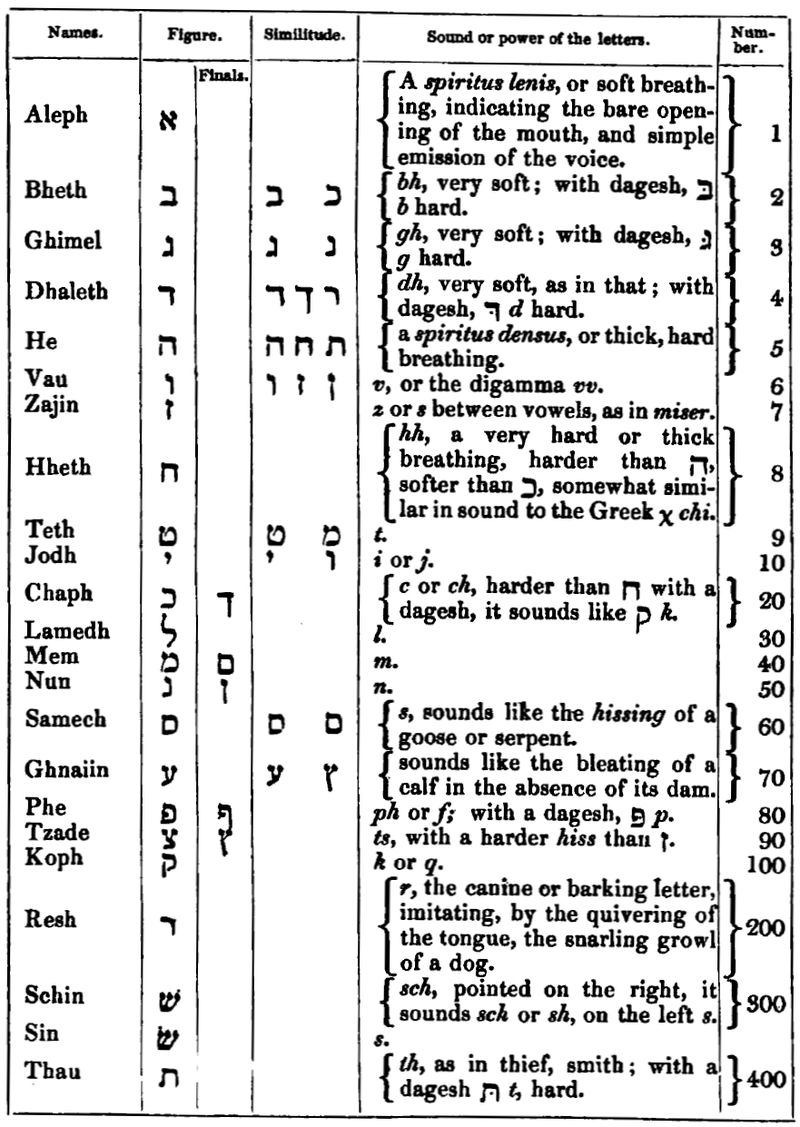
Names. Figure. Similitude. Sound or power of the letters. Number.
Finals.
Aleph א A spiritus lenis, or soft breathing, indicating the bare opening of the mouth, and simple emission of the voice. 1
Bheth ב כ ב bh, very soft; with dagesh, בּ b hard. 2
Ghimel ג נ ג gh, very soft; with dagesh, גּ g hard. 3
Dhaleth ד ר ך ד dh, very soft, as in that; with dagesh, דּ d hard. 4
He ה ת ח ה a spiritus densus, or thick, hard breathing. 5
Vau ו ן ז ו v, or the digamma vv. 6
Zajin ז z or s between vowels, as in miser. 7
Hheth ח hh, a very hard or thick breathing, harder than ה, softer than כ, somewhat similar in sound to the Greek χ chi. 8
Teth ט מ ט t. 9
Jodh י ו י i or j. 10
Chaph כ ך c or ch, harder than ח with a dagesh, it sounds like ק k. 20
Lamedh ל l. 30
Mem מ ם m. 40
Nun נ ן n. 50
Samech ס ם ס s, sounds like the hissing of a goose or serpent. 60
Ghnaiin ע ץ ע sounds like the bleating of a calf in the absence of its dam. 70
Phe פ ף ph or f; with a dagesh, פ p. 80
Tzade צ ץ ts, with a harder hiss than ז. 90
Koph ק k or q. 100
Resh ר r, the canine or barking letter, imitating, by the quivering of the tongue, the snarling growl of a dog. 200
Schin שׁ sch, pointed on the right, it sounds sch or sh, on the left s. 300
Sin שׂ s.
Thau ת th, as in thief, smith; with a dagesh תּ t, hard. 400
Particular attention should be paid to the letters in the column “Similitude” in the Table of the Alphabet, which are liable to be mistaken, one for the other, on account of their great resemblance one to another.
The vowels properly so called are ten in number, viz.:
Long. Short.
Kamets בָ ā Patach בַ ă
Tseri בֵ ē Segol בֶ ĕ
Great Chirek בִי ēī Little Chirek בִ ĭ
Hholem or Cholem וֹ ō Kamets Catuph, or short (בֳ) בָ ŏ
Shurek וּ ū, or ōō Kybbutz בֻ ŭ
Sheva (בְ) is sounded like very short e. 1. At the beginning of a word. 2. In the middle after a long vowel, or instead of a long vowel. 3. After a companion, i. e. another (וְ). 4. Under dagesh, also under dagesh understood.
(בְ) never follows (בְ) in the beginning of a word, or in the middle after a perfect syllable; but the first is changed into (בִ) (בַ) or (בֶ) chiefly on account of a guttural and ר: very seldom into (בֳ).
Dagesh, from the Chaldaic, he punctured, is a point in the body of a letter, and is either lene or forte.
Dagesh lene removes the aspiration from the six letters בְּגַדכְּפַת, and strengthens their pronunciation in some degree.
Dagesh forte doubles the letters in which it occurs. Regularly it follows a short vowel, and only a long one when accented.
Mappik is a point in הּ final only, but vanishes on an increase of the word.
Accents.
Hebrew accents are either mere points, or lines, or circles.
Those which are mere points or dots, consist of one, or two, or three such points, and are always placed above the middle of the accented letter, thus
That consisting of
One, called rebia, ב֗, i. e. sitting over.
Two, called royal zakeph katon, ב֔, or, the little elevator, from its figure which is composed of upright points.
Three, called royal segolta, ב֒, an inverted (∵).
The lines are either upright, inclined, or transverse.
The upright is either solitary or with points or dots.
The solitary is either
between two words ב׀ב, termed pesick, or musical pause, and terminating a song.
or under a word
Metheg בֽ, or bridle, an euphonic accent at the beginning of a word.
Royal silluk, בֽ, end, which is placed before (׃) sophpasuk, i. e. towards the end.
With points, namely
two, above the letter, royal zakeph gadhol ב֕, the great elevator, strains the sound.
one, below the letter, royal tebhir, ב֛, broken sound, from its figure and tone.
Inclined lines hang either above or below.
Above, towards the right
Leader pashta, ב֙, extension, extends the voice or sound, and is placed above the last letter of the word. Subservient kadma, ב֨, antecedent, to the leader geresh; and is placed above the penult or antepenult letter.
Above, towards the left
Leader geresh, ב֝, expulsion, is sung with an impelled voice.
Gereshajim, ב֞, two expellers, from the figure being doubled.
Below, towards the right—Leader tiphcha, ב֖, fatigue, from the song, or note.
Below, towards the left
Of subservient Merca, ב֥, lengthening out, from its lengthening out the song or note.
Merca kephula, ב֦, a double lengthening out from its music and figure.
The transverse line is either right or curved, thus: ֮־ .
The right line is placed between two words, connecting them together, thus, ב־ב, and is called maccaph, i. e. connexion.
The curved, or waved line, ב֮, is called leader, zarka, or, the disperser, from its modulation and figure.
Circles are either entire or semi.
The entire circle is placed always above, and has a small inclined line attached to it.
Either, on the left, when it is placed at the head of the word, ב֠, and is called leader telisha the greater, or, the great evulsion.
Or, on the right, when it is placed at the end, ב֩, and is called subservient telisha the less.
On both together, ב֟, called leader karne para, the horns of the heifer, from its modulation and figure.
The semicircle is either solitary or pointed.
The solitary is either angular or reflected.
The angular is on the right
Subservient hillui, ב֬, elevated, from the elevation of the voice.
Munach, ב֣, placed below, from its position.
The angular is on the left
Leader jethith, ב֚, drawing back, from its figure.
Subservient mahpach, ב֤, inverted, also from its figure.
The reflected is
either single subservient darga, ב֧, a degree.
or double, leader, shalsheleth, ב֓, a chain, from its figure and modulation.
When joined with other points, it is either above or below the letter.
When above the letter it has a small line attached to it on the left, ב֡, leader paser, the dispersor, from the diffusion of the note.
When below the letter, it is pointed either downwards, ב֑, called royal athnach, respiration, as the voice must rest on it, and respire; or upwards, ב֪, subservient, jerah-ben-jomo, the moon of its own day, from its figure.—Bythner’s Lyre of David, translated by the Rev. Thomas Dee, A.B. 8vo. Dublin, 1836.
The following observations are from Buxtorf’s Hebrew Grammar:
The finals are commonly called Camnephatz. But they are excepted in four places, namely, Isaiah ix. 6. where the final Mem is in the middle of a word; Nehemiah ii. 13. where the open Mem is at the end; and Job xxxviii. 1. and xl. 6. where נ is at the end.
These seven letters ﬡ ﬢ ﬣ ﬥ ﬦ ﬧ ﬨ are sometimes lengthened, either for the sake of elegance, or for filling out the line, which is never to be finished with a divided word.
The units are compounded with the tens and hundreds, as יא 11, קא 101, and so on: but for יה 15 is טו 9 and 6, lest the sacred name יָהּ Jah should be profaned.—Buxtorf.
Hebrew is read from the right to the left. In composing it, the general method is to place the nick of the letter downwards, and when the points are put to the top, to turn the line and arrange those points that come under the letter, taking care to place them in the following order; if the letter has but one leg, the point must be placed immediately under that leg, but otherwise the point must be placed under the centre.
Smith, in his Printer’s Grammar, has the following observations on Hebrew; I have not been able to ascertain upon what authority his reasoning is founded, but I have ascertained the fact of the variation in the types, that he speaks of, by an examination of a Hebrew Bible.
“But we must not pronounce it a fault, if we happen to meet in some Bibles with words that begin with a letter of a much larger Body than the mean Text; nor need we be astonish’d to see words with letters in them of a much less Body than the mean Text; or wonder to see final letters used in the middle of words; for such Notes shew that they contain some particular and mystical meaning. Thus in 2 Chron. I. 1. the word Adam begins with a letter of a larger size than the rest, thereby to intimate, that Adam is the father of all Mankind. Again, in Genes. I. 1. the great Beth in the word Bereschith stands for a Monitor of the great and incomprehensible work of Creation. Contrary to the first, in Prov. XXVIII. 17. the Daleth in the word Adam is considerably less than the Letter of the main text, to signify, that whoever oppresses another openly or clandestinely, tho’ of a mean condition; or who sheds innocent blood, is not worthy to be called Man.
“Sometimes the open or common Mem stands in the room of a final one; as in Nehem. II. 13. where the word hem has an open Mem at the end, in allusion to the torn and open walls of Jerusalem, of which there is mention made; and in Es. VII. 14. where the Prophet speaks of the Conception of the Virgin Mary, the Mem in the word haalma, or Virgin, is a close or final letter, to intimate the virginity of the mother of our Saviour. Such are the peculiarities of some Jewish Rabbis in Bibles of their publication; of which we have instanced the above, to caution compositors not to take them for faults, if such mystical writings should come under their hands.”—Smith.
The following is the date to an Hebrew and Spanish folio Bible, printed by Proops of Amsterdam in 5522 (i. e. 1762), showing the date as usual in a sentence, the letters by which the date is computed being larger.

בשנת וׅׄיקראו בספרׅׄ תוׅׄרת אלהיׅׄם מפורשׅׄ לפ׳ק Ao. 5522.
Rabbinical.—The language or dialect of the Rabbins is divided into two branches; one approaching nearer to the Hebrew, and the other to the Chaldee, yet each agrees with the other in many points, and both are generally used in conjunction in writing.
The letters agree with the Hebrew and Chaldee in regard to their number and power, but they differ as to the form; for although in the Talmudic text of the Holy Scriptures the Hebrew square character is used, yet in commentaries and elsewhere a rounder letter is adopted, better suited to promote facility in writing. Their points of agreement or difference are shown in the subjoined table:—
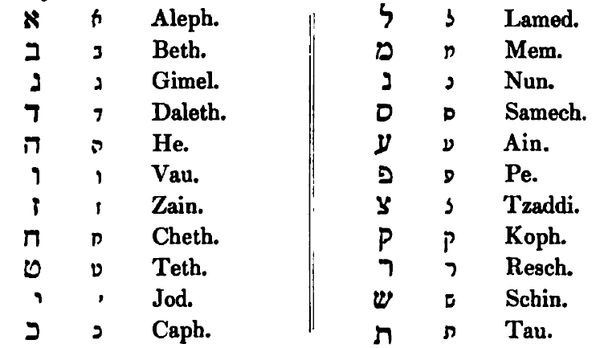
א א Aleph. ל ל Lamed.
ב ב Beth. מ מ Mem.
ג ג Gimel. נ נ Nun.
ד ד Daleth. ס ס Samech.
ה ה He. ע ע Ain.
ו ו Vau. פ פ Pe.
ז ז Zain. צ צ Tzaddi.
ח ח Cheth. ק ק Koph.
ט ט Teth. ר ר Resch.
י י Jod. ש ש Schin.
כ כ Caph. ת ת Tau.
The finals are the same as in Hebrew, the forms of which they also imitate, in this manner, ך ך, ם ם, ן ן, ף ף, ץ ץ.
There are no lengthened letters in printed books.
The two letters א and ל are often connected by the Rabbins in this manner, ﭏ; as, הﭏ for אֶלָּא Deus, ﭏא for אֶלָּא sed.
It is also to be remarked that they write the name of GOD in different ways; namely, the Tetragrammaton, or יְיָ with the Targumists, or יי, or האם and abbreviated ה׳, nomen illud, i.e. the most excellent; but in expressing the word אלהים, they change the letter ה into ד or ק, thus, אלדים or אלקים, which agrees with a general superstition of the Jews.
The vowel points are the same as in the Hebrew, but they are rarely expressed, except in books written for the use of students. When they are wanting, they must be gathered from analogy, in which much assistance may be gained from the frequent use and study of the Hebrew; but where conjecture may be difficult, the three letters י ו א, which are called the mothers of reading, are used in order to assist the reader. Thus (1.) א denotes Kamets in גנשי turpitudo, וודאי confessum, פדאם redemit eos, &c; (2.) Vau denotes Cholem, Kybbutz, and Kametscatuph; as, לקרוא vocare, פוקד visitans; כולם for כֻלָּם omnes illi, כהוכה for כְהֻכָּה sacerdotium, לפותרו for לְפָתְּרוֹ ad explicandum illud, &c; (3.) Jod denotes Chirek, Tseri, Segol, and occasionally in the Talmud both simple and compound Sheva; as, תפילה precatio, בישר annunciavit, איבר perdidit; also פירוש for פֵרוּש explicatio, אילי for אֵלַי ad me, שיני for שֵׁנִי secundus, ביה for בֵּהּ in eo, בריה for בְרֵהּ filius ejus, and so continually to mark the feminine affix בְּרָהּ.
The rules for the vowels, and for the Sheva, both simple and compound, and also for the diphthongs, are the same as in the Hebrew and Chaldee.
א is often absorbed by crasis, as, מצינא for מָצֵי אֲנָא possum, as if it were potens ego, ידענא scio, also of the feminine by an enallage frequent in this contraction, thus in לית and ליכא for לא אית and לא אינא non est. In the same manner ה is omitted by the Jews in תילם for תהילים psalmi. But many others are accustomed to be contracted in this manner by the Jews of Jerusalem, viz., א in נילו for כאילו quasi, ות for ואת et tu, דתfor דאת quod tu, דנא for דאנא quod ego, והיידינו for והיידא דין הוא quodnam est illud; ה in לון for להון illis; ח in תותי for תחותי sub; ד in קם, קום, or קותי, for קודם ante.
Apocope is frequent among the Talmudists, as, בי for בית domus, or בין inter. So in the pronouns both separate and suffixed, אתו for אתון vos, נו for נון vos, vester, הי for הון illis, suis; also in the feminine, ני for נין, הי for הין; and in the verbs, as, גרסי for גרסית docui, שקלתו sustulistis, קאיו stans, &c.
Aphæresis also occurs, though seldom, in חד for אחד unus, נא for אנא ego, נן for אנן nos, מר for אמר dixit.
They leave the Dagesh, both lene and forte, to be collected from analogy, but where it may be difficult to guess at, as in the preterite Pihel, the letter י indicates the little Chirek as well as the Dagesh forte, as, כיסה for כִסָּה texit; and in defectives the letter which had been thrown aside is sometimes restored, as, ינקם for יִקֹם ulciscetur, from נקם ulcisci.
A point at the end of a letter generally denotes a number, as, א׳ unum, ב׳ duo, ג׳ tria, &c; but at the end of two or more letters it signifies a word cut off by a certain abbreviation, as, את׳ for dixit, לות׳ for לותר dicere, ה׳ ית׳ for הַשֵׁ יִתְבָרֵךְ Deus benedictus, וגו׳ for וִגוֹמַר et cætera, in an abrupt passage of Scripture, וכו׳ for וְכֻלּוֹ et totum illud, in sacred or profane use. Also פי׳ for פֵרוּשׁ interpretatio, or פֵרֵשׁ interpretatus est, ר׳ for רבי Rabbi, Magister, שנ׳ for שֶׁנִּאֱמַר quia dictum est, &c.
A double point affixed to a letter indicates either compound numbers, as, י״ד 14, ט״ו 15, תמ״ד 444; or letters taken materially, as, א״לף Aleph, ב״ית Beth, גי״מל Gimel, &c.; or lastly abbreviations by initial letters alone, denoting entire words, which is called ראשי תיבות; the number of these is very great, as אי״ה, that is, (יעזור) אם ירצה השם si voluerit (or juverit) Deus, א״כ אִם כֵן si sic, si verum est, אע״פיש for אַף עַל פִי שֶׁ אף על פי ש etsi, quanquam, ה״בה or הק״בה for הברוך הוא or הקדוש ברוך הוא Deus benedictus, Deus sanctus benedictus; ה״שו for השם ימברך Deus benedictus, ז״ל for זכרונו לברכה memoria ejus sit in benedictione, or in the plural number זכרונם לברכה memoria eorum sit in benedictione; מ״ו for מס ושלום parce et pax sit, that is, absit; ״א for יש אמרים sunt qui dicunt; ״מ for מפרשים יש sunt qui interpretentur; י״ל for יַשׁ לוֹמַר est dicere, respondendum est; יצר׳ for ישמרהו צורו וגואלו custodiat eum petra ejus, et redemptor ejus; כ״א for כִּי אִם sed, nisi; כ״כ for כָל־כַךְ tantopere; נ״פ for כָל־פָנִים omnibus modis; כ״ש for כָל־שֶׁכֵּן quantò magis, quantò minus; ל״ש for לְשֵׁם שָׁמַֽיִם in honorem Dei; מ״מ for מִכָּל־מָקוֹם nihilominus, tamen; ע״ד for עַל דֶרֶךְ more, in modum; ע״ה for השלום super quo pax, ע״ז for עבודה זרה cultus alienus, idololatria; ע״פ for על פי ad formam, modum; ע״צ for עַל צַד ad latus, juxta; פ״א for פירוש אקר expositio alia; ר״ל for רוצה לומר vult dicere. Also ר״אבע Rabbi Aben-Ezra, ר״דק Rabbi David Kimchi, רל״בג Rabbi Levi Ben Gerson, רמ״בם Rabbi Moses Ben Maiemon, ר״שי Rabbi Salomon Iarchi, or Isaac, &c., which are also read abbreviated, and, as it were, figuratively, Raba, Radak, Ralbag, Rambam, Raschi, &c.
Accents are omitted in Rabbinical books; but in pronouncing words the Hebrew accent is transposed from the last syllable to the penultimate, thus, they read בראשית ברא אלהים Beréschith bóro Elóhim, עולם הבא aúlom hábbo; for Vau Cholem is generally pronounced as the diphthong au, and the vowel Kamets as an o.
There are also certain marks of distinction, by which the perfect sense of a sentence is shown; for an imperfect sentence is not pointed off, and often not even a perfect one. But for this purpose there is used, either two perpendicular points, like the Soph-pasuk in Hebrew, but which appears rarely, and indeed not at all in some books; or a single point at the top of the letter similar to the Greek colon; or lastly, a down stroke, either straight, or oblique like the Greek acute accent, which, although the most frequently used, is yet often neglected.
The purer Rabbins commonly use Hebrew words, but they have also some words peculiar to themselves, which are either borrowed from other languages, as, for example, from the Chaldee, אִילָן arbor, גַדָּא fortuna, חָזַר rediit, &c.; from the Greek, אויר, ἀὴρ, aër, זימן, σημεῖον, signum, דורון, δῶρον, donum, הדיוע, ἰδώτης, idiota, פרהסייא, παῤῥησία, בפרהסייא apertè, palàm, &c.; from the Latin, אושפיזא hospes and hospitium, פלעיו and פלעוריו palatium, &c.; and even from the Hebrew, but in a Syro-Chaldaic signification, as, פרע rependit, ultus est, שקל sustulit, פרח volavit, סמר destruxit, &c., or taken evidently in a new sense, as, חין hæreticus, טען argumentando objecit. Also these three, שמים cœlum, המקום locus, and גבורה fortitudo, are often put for Deus, God.
קָ, from the full particle קָא, prefixed to words expletively, and without any increase of signification, seems to be numbered with the serviles by the Talmudists, and which the more vulgar Rabbins, as Rabbi Lipman and the like, who are careless of a correct style, also imitate, as, דקאמר qui dixit, מאי קעביד משה quid fecit Moses? לא הווקא מעייליו ליה non introduxerunt eum, &c.
The preceding observations are translated from a small treatise intituled “Synopsis Institutionum Rabbinicarum,” by George Otho, Professor of the Greek and Oriental languages at the University of Marburg in Hesse, and who acknowledges to having derived his information from Cellarius, Buxtorf, and Hackspan; and bound in connexion with the “Fundamenta Punctationis Linguæ Sanctæ,” of Jacob Alting, printed at Frankfort-on-the-Maine, 2 vols. 1717.
Plan of a Pair of Hebrew Cases, as used in the Queen’s Printing Office.
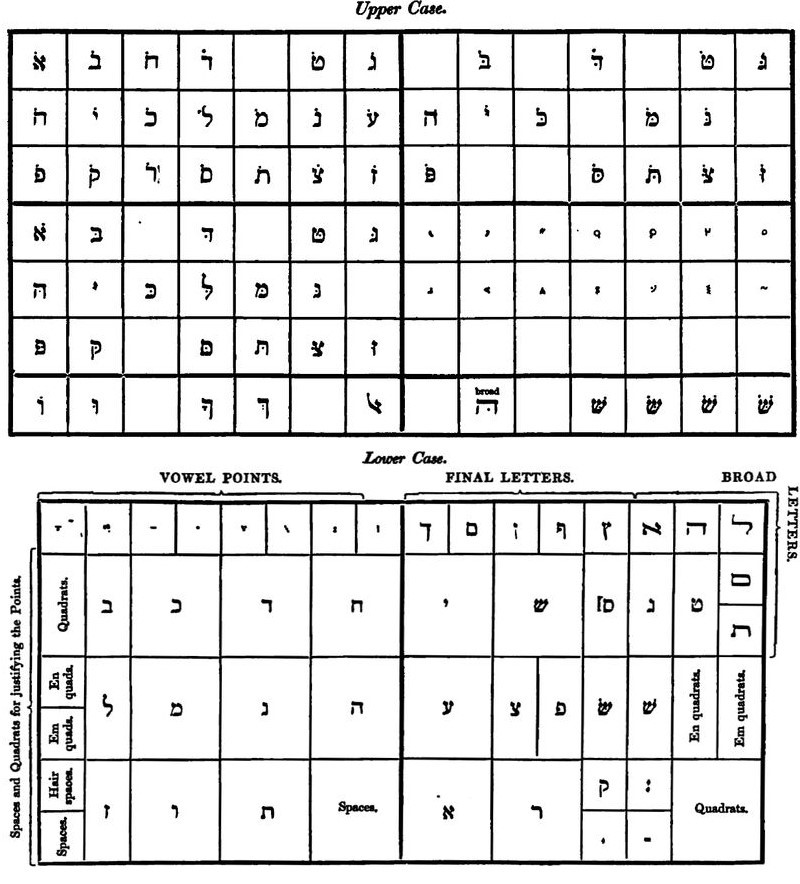
In the above plans the Hebrew Cases nearly resemble those of the English now in use. The alphabets have been classified and arranged so as to facilitate the composing of it; that is, the three different dotted alphabets in the upper case are quite distinct from each other, being separated by a thicker partition, to lead the eye of the compositor to it with greater certainty. The alphabet, with the dot over the letter, appears first in order, or left hand side of the case; the second alphabet, with the dot in the middle of the letter, under that of the first; and the third alphabet, with the dot over and in the middle of the letter, in the small capital, or right hand side of the case; and underneath, the points and accents required in composing Hebrew with points.
The lower case letters are also arranged as near to the English plan as is possible: the א (a) in the a box; the ב (b) in the b box, &c. so that the compositor can go from a pair of English cases to the Hebrew ones with very little perplexity, and a great saving of time, instead of looking over a wide surface of three cases, as is now the case, without any classification or arrangement whatever.
In composing Hebrew without points the lower case only is required, as the final letters and broad letters are brought into it, and quite under the hand of the compositor, which is desirable.
Hebrew in the British Founderies.
Two Line Great Primer. Caslon and Livermore. Thorowgood and Besley. Oxford.
Two Line Great Primer, with Points. Thorowgood and Besley.
Two Line English. Caslon and Livermore. Thorowgood and Besley. Wilson.
Two Line English, with Points. Thorowgood and Besley.
Double Pica. Caslon and Livermore. Thorowgood and Besley. Wilson.
Double Pica, with Points. Thorowgood and Besley.
Great Primer. Caslon and Livermore. Wilson.
Great Primer, with Points. Caslon and Livermore.
English. Caslon and Livermore. Thorowgood and Besley, formerly Bynneman’s. Oxford. Wilson.
English, with Points. Caslon and Livermore. Thorowgood and Besley. V. and J. Figgins. Wilson; this was cut after the classical and elegant type of Attias, for Mr. John Wertheimer of Leman Street, and is employed in printing the prayers of the Sphardim, edited by the Rev. D. A. De Sola. It may be cast on any body from English to Bourgeois.
Pica. Caslon and Livermore. Thorowgood and Besley. V. and J. Figgins. Wilson.
Pica, with Points. Caslon and Livermore.
Small Pica. Caslon and Livermore. Thorowgood and Besley, formerly Bynneman’s. V. and J. Figgins. Wilson.
Small Pica, with Points. V. and J. Figgins. This fount of Hebrew was cut for Bagster’s Polyglot Bible.
Long Primer. Caslon and Livermore. Thorowgood and Besley, formerly Bynneman’s. V. and J. Figgins. Oxford. Wilson.
Bourgeois. Caslon and Livermore. Thorowgood and Besley.
Brevier. Caslon and Livermore. Thorowgood and Besley, formerly Bynneman’s. Wilson.
Minion. Wilson.
Nonpareil. Caslon and Livermore; with points it is equal to a Long Primer body. V. and J. Figgins. Wilson.
Small Pica, Rabbinical. Thorowgood and Besley, formerly Bynneman’s.
Brevier, Rabbinical. Thorowgood and Besley, formerly Bynneman’s.
Nonpareil, Rabbinical. Thorowgood and Besley, formerly Bynneman’s.
HERALDRY.
The colours of the escutcheon, or of its ordinaries and charges, are:—
Yellow (the heraldic name of which is) Or.
White Argent.
Red Gules.
Blue Azure.
Black Sable.
Green Vert.
Purple Purpure.
Orange Tenne.
Dark Blood-red, inclining to purple Sanguine or Murrey, from mulberry.
The two first being ordinarily represented by gold and silver, are called metals, and named by heralds after the French.
The two last are rarely seen in English coats of arms. The heraldic colours are usually estimated as five,—red, blue, black, green, purple.
High Bearer. See Bearer.
HIND POSTS AND RAILS.
Two upright posts mortised and tenoned into the feet at the back of the wooden press; two rails connect these posts behind; and two rails on the off side and two on the near side connect them with the cheeks, by mortises and tenons; on the top rails a thin deal covering is laid loose, that it may be lifted off, to allow access to the long ribs, and to hang the platen when necessary; it prevents dirt and other matter from falling on the ribs, and serves for a temporary shelf. The ink block is attached to the near rails.
Hither Cheek. Same as Near Cheek, which see.
Holdfasts, for Stereotype Risers. See Risers.
HOLDS OUT, or Holds Not Out.
These terms are applicable to the quires of white paper, to wrought-off heaps, to gathered books, and to sorts of letter, &c. If quires of white paper have twenty-five sheets apiece in them, they say, the paper holds out five and twenties. Of wrought-off heaps, the heap that comes off first in gathering is said not to hold out. Of gathered books, if the intended number of perfect books are gathered, they say the impression holds out: but if the intended number of perfect books cannot be gathered off the heaps, they say the impression holds not out. And so for sorts of letter, either when it is in the founding house, or in the printing house.—M. There is no paper at the present day with twenty-five sheets in a quire, except that used for newspapers, on account of the stamps.
HOLE.
By a Hole, in printers dialect, is meant and understood a place where private printing is used, viz. the printing of unlicensed books, or printing of other men’s copies. Many printers for lucre of gain have gone into Holes, and then their chief care is to get a Hole private, and workmen trusty and cunning to conceal the Hole, and themselves.—M.
Holy-days. See Ancient Customs.
HOME.
This is a term used at Press, and means that the bar of the press is pulled over till it touches the near cheek; it is then said the bar is home, or it is cheeked. See Cheek the Bar.
HOOK-IN.
In poetry it occasionally happens that a line will not come into the measure, in which case, when it is not allowed to turn a line, if it be possible to avoid it, a syllable, or a word, is taken to the end of the preceding line, or, if that be full, to the end of the following one, and enclosed in a bracket; this is termed Hooking-in.
Hooks of Tympan. See Tympan Hooks.
Hopkinson, Mr. John. The Albion Press. See Cope’s Press.
HORSE.
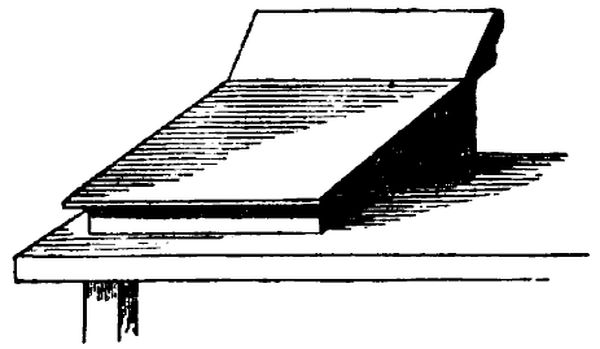
Form or bench pressmen set the heaps of paper on. See also Ancient Customs.—M. In Moxon’s time it appears the pressmen used what was then called a Horse, only, for the paper when working, which we now call a Bank; we have in addition what is termed a horse, set upon the bank; this horse is made sloping down to the fore edge, and the white paper is placed on it; the pressman is thus enabled to draw the sheets down with the nail of his thumb, or a piece of wood, bone, or ivory, with more facility than if it were laid horizontal, and it is more convenient to remove to the tympan, as the horse is raised near to it, and inclines in the same direction.
HORSE FLESH.
If any journeyman set down in his bill on Saturday night more work than he has done, that surplusage is called Horse-flesh; and he abates it in his next bill.—M. This surplusage of charge, as Moxon terms it, is now called Horse, and it is not always deducted in the next bill.
HORSE RACES.
By the Act of the 13th of George 2. cap. 19.
s. 2. it is enacted, “That from and after the said twenty-fourth Day of June one thousand seven hundred and forty, no Plate, Prize, Sum of Money, or other Thing, shall be run for by any Horse, Mare or Gelding, or advertised, published or proclaimed to be run for by any Horse, Mare or Gelding, unless such Plate, Prize or Sum of Money shall be of the full, real and intrinsick Value of fifty Pounds, or upwards; and in case any Person or Persons shall from and after the twenty-fourth Day of June one thousand seven hundred and forty enter, start or run any Horse, Mare or Gelding, for any Plate, Prize, Sum of Money, or other Thing of less Value than fifty Pounds, or shall make, print, advertise, publish or proclaim any Advertisement or Notice of any Plate, Prize, Sum of Money, or other Thing of less Value than fifty Pounds as aforesaid, to be run for by any Horse, Mare or Gelding; every such Person or Persons so entering, starting or running such Horse, Mare or Gelding for such Plate, Prize, Sum of Money, or other Thing of less Value than fifty Pounds as aforesaid, shall forfeit and lose the Sum of two hundred Pounds, to be sued for, recovered and disposed of in such Manner as is herein after prescribed and directed; and every Person or Persons who shall make, print, publish, advertise or proclaim any Advertisement or Notice of any Plate, Prize, Sum of Money, or other Thing of less Value than fifty Pounds aforesaid, to be run for by any Horse, Mare or Gelding, shall forfeit and lose the Sum of one hundred Pounds.”
So much of the act of 13 Geo. 2. c. 19. “as relates to the Subject of Horse Racing,” was repealed by 3 Vict. c. 5. s. 1.
HOSE.
Two upright bars of iron that connected the garter and the hose hooks, and went through the till. There were screws at each end, by which they could tighten the platen cords, if they became slack.—M.
The hose in wooden presses is now quite different: it is a wooden case for the spindle to work in, made hollow in the inside to fit it, and to which it is connected by the garter; it is square on the outside, and passes through an opening in the till, which it should fit accurately; and is tied to the platen by means of four iron hooks, one at each bottom corner. Its uses are, to guide the platen down to the form in a horizontal position, by its passing through the till; and also to lift the platen from off the form, which it does by the return of the press bar, and its connexion with the spindle by means of the garter.
HOSE HOOKS.
Four iron hooks at the bottom corners of the hose, to which the platen is tied. They are projections from an iron belt that embraces the bottom of the hose, and stand facing the platen hooks.
HOURS.
Pressmen reckon their works by hours, accounting every token to an hours work: and though it be the same effectually with tokens, yet they make their prices of different work by the hour; and it passes current for a token. If two men work at the press, ten quires is an hour; if one man, five quires is an hour.—M. The quires of paper at this time always contain twenty-four sheets, at least the inside quires do, which alone are used for bookwork; and a token is ten quires eighteen sheets, which is still called an Hour, whatever the price may be: thus, if two men at a press print twelve tokens of paper in a day, they say, they have done twelve hours; and if it be fine work, at which, through the care bestowed on it, they can only print three tokens, or four tokens, they say, they do three hours, or four hours, in a day; although it takes the same time in performing that the twelve tokens did.
HYDRAULIC PRESS.
This press was invented and introduced to the public by Mr. Joseph Bramah, of Piccadilly, Engineer. Mr. W. Nicholson, in his Journal of Natural Philosophy, Chemistry, and the Arts, vol. 1. April, 1797, gave an account of it, with engravings, from which the following observations are extracted, which will give a brief description of this powerful machine, that is superseding the common book press with a screw in all extensive establishments.
“Its action is as follows: when the lever or pump handle is raised, it brings up the piston, which would leave a vacuum beneath if the pressure of the atmosphere did not force the water in through a side valve. The lever is then to be pressed down, which causes the side valve to shut, and forces the water through a valve at the bottom, whence it passes through a pipe into the cavity of the great cylinder, and raises the piston or pressing rammer. A repetition of the same process forces more water in, and the pressure may in this manner be carried to a great extent.
“There is no difficulty in computing the force of this instrument. If the diameter of the pump barrel be one quarter of an inch, and that of the cylinder one inch, that is to say, four quarters of an inch; one pound lodged upon the piston rod of the pump will be in equilibrio with sixteen pounds lodged upon the table of the press; the weights of the parts of the engine attached to, and moving with each piston, being respectively included. And if the length of the pump lever be fifteen inches, and the distance between the centres of motion and of action be two inches, one pound at the end of the lever will gain an advantage of 7½ times when compared with that at the piston rod. Instead, therefore, of sixteen pounds upon the table being equal in effect to counterpoise this last action, there will be required upwards of 120 pounds. But a man in this action of pumping by a downward pressure, can without difficulty apply his whole weight, and with great ease one third or one fourth of his weight, suppose 50 pounds. In this case the pressure will be equivalent to fifty times 120 pounds, or 6000 pounds, that is to say, nearly three tons.
“To compare this engine with a screw, in theory, we must enquire what fineness of thread and length of lever would afford a purchase of 120 to one. Let us suppose the thread of a screw, substituted in the place of the cylinder, to be one tenth of an inch thick; the distance from the top of one thread to the top of the next will in this case be one fifth of an inch. This is the space through which the weight must rise in one revolution. The power must therefore move through 120 times that space, namely twenty-five inches; but a lever or radius four inches long will describe a circle somewhat larger than this, and consequently such an engine would in theory be equal in power to the hydraulic engine we have been contemplating.
“But when the subject is viewed practically, the difference between the two engines appears to be very remarkable. All practical men know how very large a part of the force operating by means of engines is employed in overcoming frictions. Every one is aware of the extreme friction between solids, and the very slight friction which takes place between the parts of fluids. This is seen in the common expedient of oiling the pivots of wheels, and in the very gradual decay of motion in fluid bodies; while solids moving on each other stop at once, as soon as the force is diminished to a certain degree. The screw is an organ peculiarly liable to friction, and this friction is always much greater than the whole of the reacting force; for there are few instances where a screw will return from extreme pressure, when the agency upon the lever is withdrawn. It is also to be considered, that the whole force of the weight or resistance acts directly upon the face of the screw, at which the motion is required to take place. It has not been appreciated in what degree this resistance or friction increases with the weight. In lighter actions the simple ratio has been inferred; but under more severe pressures the two metallic faces extrude the greater part of the half-fluid matter between them, and appear, by the magnitude of their resistance, to be attached to each other by a process of the nature of cohesive attraction. For these and other reasons, it appears nearly impracticable to form any comparison between two engines so different in principle, but such as shall be deduced from immediate experiment of their effects. I am not in possession of numerical data to indicate the actual power of screw-engines or presses; which are perhaps the less necessary, because those who are the most interested in the success of an improvement like the present, are for the most part able to come at these without difficulty.
“In an engine of this kind, the diameter of the great piston was four inches, and of the smaller three-eighths of an inch; and the advantage given by the lever or handle was twelve to one. Above the piston of the great cylinder was applied a long lever, at one end of which was an axis, and at the other end a large scale to hold weights; it contained twenty hundred weight. The distance between the axis of motion of this lever and the part where it acted on the piston was six inches; and the distance from the same axis to the extremity where the scale was hung was 126 inches. Every hundred weight in the scale consequently pressed upon the piston with a force equal to twenty-one hundred weight; whence the whole pressure was twenty-one tons. It was easy to work the lever briskly with one hand, and each stroke raised the scale near one-third of an inch. Forty-seven pounds hung at the end of the lever, carried it down with a moderate swiftness of working; but a weight of only forty-three pounds remained in equilibrio, and did not descend. Now, as the true weight in theory was thirty-two pounds, it follows that less than one-third of the actual power was employed to give velocity and overcome all friction.
“It may be remarked, that the principal frictions in these machines must be at the circumference of the pistons, and that these do not increase in the simple, but in less than the subduplicate, ratio of the power. For if the diameter of the great cylinder were double, every thing else remaining unchanged, the surface of its piston, and consequently the power, would be quadrupled. But the friction would be only doubled, and that merely at the leathering of the greater piston.
“As the pressure in the experiment last mentioned amounted to 47·040 pounds upon the great piston of four inches in diameter, or sixteen circular inches surface, it amounted to 2940 pounds upon each round inch. But the medium pressure of the atmosphere on a round inch is near twelve pounds, consequently the action was equal to 245 atmospheres: and as each of these corresponds with a column of 34 feet of fresh water at a medium, the water in the cylinder was pressed in the same manner as if the whole column had been 8330 feet, or 1⅔ mile, long.
“Large presses of this construction are made with two pumps of 1¼ inch bore, and a cylinder of seven inches. These have been used in pressing hay and cotton for package; and, as I am informed, are effective in producing a greater condensation on the material with a much less application of moving power and consumption of time.”
The following description and figures are taken from Dr. Ure’s Dictionary of Arts, Manufactures and Mines, 8vo. 1839.
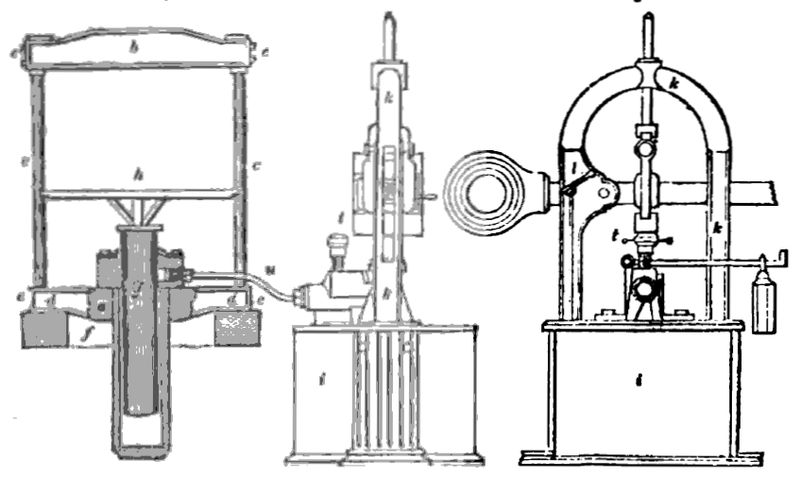
Fig. 1. Fig. 2.
“The framing consists of two stout cast-iron plates a, b, which are strengthened by projecting ribs, not seen in the section, fig. 1. The top or crown plate b, and the base plate a, are bound most firmly together by four cylinders of the best wrought iron, c, c, which pass up through holes near the ends of the said plates, and are fast wedged in them. The flat pieces e, e, are screwed to the ends of the crown and base plates, so as to bind the columns laterally. f is the hollow cylinder of the press, which, as well as the ram g, is made of cast iron. The upper part of the cavity of the cylinder is cast narrow, but is truly and smoothly rounded at the boring-mill, so as to fit pretty closely round a well-turned ram or piston; the under part of it is left somewhat wider in the casting. A stout cup of leather, perforated in the middle, is put upon the ram, and serves as a valve to render the neck of the cylinder perfectly water-tight, by filling up the space between it and the ram; and since the mouth of the cup is turned downwards, the greater the pressure of water upwards, the more forcibly are the edges of the leather valve pressed against the inside of the cylinder, and the tighter does the joint become. This was Bramah’s beautiful invention.
“Upon the top of the ram, the press-plate or table h, strengthened with projecting ridges, rests, which is commonly called the follower, because it follows the ram closely in its descent. This plate has a half-round hole at each of its four corners, corresponding to the shape of the four iron columns along which it glides in its up-and-down motions of compression and relaxation.
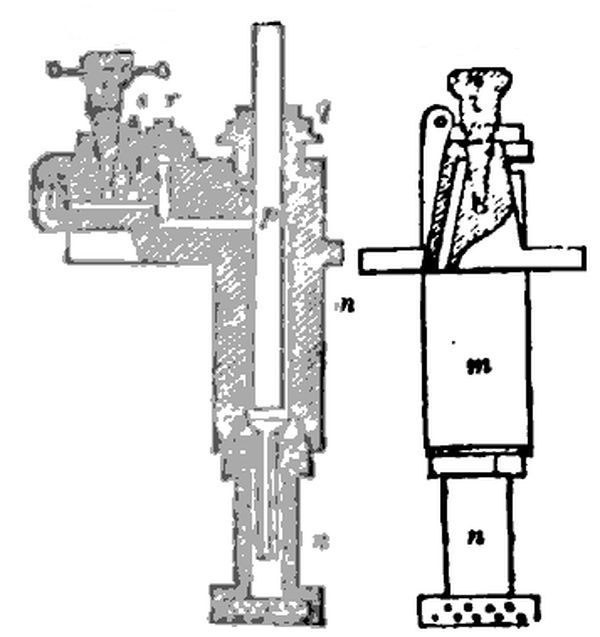
Fig. 3. Fig. 4.
“k, k, figs. 1. and 2., is the framing of a force pump with a narrow barrel; i is the well for containing water to supply the pump. To spare room in the engraving, the pump is set close to the press, but it may be removed to any convenient distance by lengthening the water-pipe u, which connects the discharge of the force pump with the inside of the cylinder of the press. Fig. 3. is a section of the pump and its valves. The pump m, is of bronze; the suction-pipe n, has a conical valve with a long tail; the solid piston or plunger p, is smaller than the barrel in which it plays, and passes at its top through a stuffing-box q; r is the pressure-valve, s is the safety-valve, which, in fig. 2., is seen to be loaded with a weighted lever; t is the discharge-valve, for letting the water escape, from the cylinder beneath the ram, back into the well. See the winding passages in fig. 4. u is the tube which conveys the water from the pump into the press-cylinder. In fig. 2. two centres of motion for the pump-lever are shown. By shifting the bolt into the centre nearest the pump-rod, the mechanical advantage of the workman may be doubled. Two pumps are generally mounted in one frame for one hydraulic press; the larger to give a rapid motion to the ram at the beginning, when the resistance is small; the smaller to give a slower but more powerful impulsion, when the resistance is much increased. A pressure of 500 tons may be obtained from a well-made hydraulic press with a ten-inch ram, and a two and a one inch set of pumps.”
In a Report addressed to the Commissioners of Her Majesty’s Woods, Forests, &c., in July 1839, as the result of an inquiry with reference to the selection of stone for building the new Houses of Parliament, it is stated the experiments relating to the cohesive strength of the stones, or their resistance to pressure, were made at the manufactory of Messrs. Bramah and Robinson, with a six-inch hydraulic press, the pump of which was one inch in diameter. According to trials previously made by Messrs. Bramah and Robinson, one pound weight at the end of the pump lever produced a pressure on the face of the cube [two inches square] equal to 2·53 cwt., or to 71·06 lbs. on the square inch; from this datum it may be estimated how immense the pressure is that can be obtained by this press, when the strength of a man is exerted at the pump. I have used the common book press with an iron screw to press printed paper, and I have also used a Hydraulic press of an estimated power of eighty tons: besides the greater expedition in pumping this press up than screwing the other down, I can state from my own observation, that the hydraulic press produced as great an effect upon the paper in three hours as the screw press did in a night, or at least fourteen hours. This may show the great superiority of this press over that which has been in general use in printing offices. The hydraulic press has fully accomplished in practice all that was expected from it, and has established for itself a high character, which it richly deserves.
HYPHEN.
A hyphen, marked thus (-), is employed in connecting compounded words; as, “Lap-dog, tea-pot, pre-existence, self-love, to-morrow, mother-in-law.”
It is also used when a word is divided, and the former part is written or printed at the end of one line, and the latter part at the beginning of another. In this case, it is placed at the end of the first line, not at the beginning of the second.—Murray.