R.
Reading edition
RACKS,
to hang paper on.—M. Now called poles. See Board Rack, Case Rack, Poles.
RAG.
When letter cast has a bur on any of its edges, that bur is called a Rag.—M.
Rails. See Hind Posts.
Ralph. See Spirit.
RANKS.
From the frames in a composing room being placed in a row, the Compositors are said to be in the ranks; thus, if a compositor has been selected for a reader, or overseer, and he afterwards works at case as a compositor, it is said, he is come to the ranks again.
RAT.
A compositor, or pressman, who executes work at less than the regular prices, or for less than the generality of the trade think it deserves, or for less than the chapel decides it ought to be paid, or for less than others are paid for it, becomes what is termed a rat; the most miserable situation, perhaps, that a workman can be placed in. He is hooted at and despised by the rest of the workmen in every house where he may obtain employment; and this feeling towards him does not subside, for the opprobrious epithet accompanies him for life.
READER.
A person whose duty it is to read proofs in a printing office, for the purpose of correcting the errors, that are unavoidable from the nature of the process of arranging the types into words, lines, and pages.
After the compositor has corrected these errors in the form, a clean proof is pulled by the pressman, which, with the first proof, comes, in the regular routine of the business, to the reader again, to revise; that is, to compare the two carefully, to see that the errors that were first marked have been corrected, and to notice such as may have escaped the compositor’s attention, as well as any additional ones that may have been made. The corrected proof is then sent to the author or editor, and if he makes many alterations, it is again corrected in the form; another proof is then pulled, which comes again to the reader, who revises the author’s corrections, and reads it very carefully for press, to detect any errors that may have escaped the first reading, and also the author’s notice; when it is laid on, the pressman pulls a revise, which is passed to the reader, who again carefully revises it, to see that all the errors are corrected, and that the margin and the workmanship are right, previous to the sheet being printed off.
This is the usual routine in printing books; but in small establishments, the duties of a reader are performed generally by the overseer.
In large establishments, where there are several readers, I would invariably have the first proofs of any given work read by one and the same reader, and the press proofs also by one and the same but a different reader; in this case there would be an arrangement made between the readers, either orally or tacitly, with regard to the use of capitals, the orthography, compound words, the division of words, and the punctuation; an experienced compositor would consequently very soon fall into the method, and, knowing how the work was to be done, would have very little trouble with his proofs; and the whole would proceed with regularity and uniformity, and be more correct, than if the proofs had been indiscriminately given to any of the readers who might happen to be disengaged at the moment.
If this plan were followed, much injury to the work as well as vexation to the compositor would be avoided; for where the second proofs fall into the hands of different readers, it must necessarily happen that marks will be multiplied, from the different views which men entertain on the same points where there are no positive laws to refer to, but where arbitrary private judgment decides instead: thus, one reader differs from another with respect to the use of the capitals, as to the division of words, the orthography, and the punctuation; thus harassing and teazing the compositor, who is never certain under these circumstances what plan to follow, for what is right to-day may be wrong to-morrow, and vice versá, besides the pecuniary loss he suffers in making these alterations, in addition to the deterioration of the work, from the want of uniformity and consistency.
Many readers betray a want of remembrance of the sensitiveness of authors, by endeavouring, with the best intentions, to improve their language, and thus making unauthorized alterations in the proofs: this causes an unpleasant feeling, and I have known the reader accused of hypercriticism, and the original words restored; in other instances I have known the reader to have been told that he did not understand the author’s meaning, with a request that for the future he would literally follow the copy, and leave it to the author to make any alterations he might think proper. After a long experience I have invariably found it the most satisfactory plan, when I perceived a mistake, or met with a passage that I did not understand, or that I thought incorrect, to draw a line under the words, and insert a query in the margin, thus drawing the author’s attention to the part; if he altered the passage, it was well, if he did not, the responsibility was his; thus the author’s feelings were not wounded, and in most cases he expressed his satisfaction at this method; but I never knew an instance where any censure was expressed.
In making these general observations, I am actuated only by the motive that printers should combine the desire to be correct with the principle of conciliating the kind feelings of the author or editor.
REAM.
A ream of paper consists of twenty quires, each of twenty-four sheets, with the exception of the two quires at the outside of each ream, called Outside Quires or Corded Quires, which consist of twenty sheets each, all damaged, torn, or imperfect, more or less: this is the state in which paper is uniformly delivered by the paper-maker from the mill. For private use it may be obtained from the stationers made up with twenty inside quires, that is, of quires of perfect paper; a ream in this state consists of 480 sheets. For the purpose of printing, it is always sent to printing offices in a state technically styled perfect, made up into bundles, each bundle containing forty-three quires; thus a ream will consist of twenty-one quires and a half, or 516 sheets; this surplus allows for accidents in wetting, at press, and in the warehouse, as well as waste, and enables the printer to deliver to the publisher the full count. The outside quires are generally sold to bookbinders, but those of writing-paper are used by stationers in making copy books and memorandum books.
RECORDS.
In the year 1800, the House of Commons voted an Address to His Majesty King George III. on the state of the Public Records of this kingdom, and the necessity of providing for the better arrangement, preservation, and more convenient use of the same; and humbly represented that the Public Records of the kingdom are in many offices unarranged, undescribed, and unascertained; that many of them are exposed to erasure, alteration, and embezzlement, and are lodged in buildings incommodious and insecure, and that it would be beneficial to the public service that the records and papers contained in many of the principal offices and repositories should be methodized, and that certain of the more antient and valuable amongst them should be printed; and humbly besought His Majesty, that He would be graciously pleased to give such directions thereupon, as He in His wisdom should think fit.
The first commission, bearing date the 19th of July 1800, states, “that We, considering the premises, and earnestly desiring more effectually to provide for the better arrangement, preservation, and more convenient use of the said records and papers, and reposing great trust and confidence in your fidelity, discretion, and integrity;—
“Have authorized and appointed, and by these presents do authorize and appoint you the said William Henry Cavendish Duke of Portland, William Windham Baron Grenville, Henry Dundas, Henry Addington, William Pitt, Sir Richard Pepper Arden, Frederick Campbell (commonly called Lord Frederick Campbell), Sylvester Douglas, Sir John Mitford, Sir William Grant, Robert Dundas, and Charles Abbot, and any three or more of you, to make a diligent and particular inquiry into the several matters which our faithful Commons have, in the above-mentioned report of their proceedings, represented as fitting to be provided for by our royal authority.
“And to the end that Our royal will and pleasure in the premises may be executed with the greater regularity and expedition, We farther by these presents will and command, and do hereby give full power and authority to you or any three or more of you, to nominate and appoint from time to time such person of ability, care, and diligence, as ye shall think fit, to be and act as your Clerk or Secretary, for the purpose of aiding you in the execution of these presents; and also to nominate and appoint in like manner such several persons of ability, care, and diligence, as ye may think fit, to be Sub-Commissioners, to be employed under your direction and controul in the premises; and more especially to methodize, regulate, and digest the records, rolls, instruments, books, and papers, in any of Our public offices and repositories; and to cause such of the said records, rolls, instruments, books, and papers as are decayed and in danger of being destroyed, to be bound and secured; and to make exact calendars and indexes thereof; and to superintend the printing of such calendars and indexes, and original records and papers as ye shall cause to be printed.”
The Commissioners have in consequence published several volumes of the Records, which contain documents of the highest importance to the owner of landed property, to the family historian, and to the topographical writer, as well as assist in the elucidation of the manners and customs of the times to which they belong; while to the general historian they are invaluable, as opening new sources of the most valuable and authentic information, which previously had been virtually closed against his researches.
The portions of the Records already published have been printed literally from the originals, with all their abbreviations and peculiarities preserved. This renders them difficult to be read by the inexperienced in ancient manuscripts; and since county historians and other topographical writers make frequent extracts from these ancient records, to establish facts concerning persons, places, and property, I have thought it useful to give a detailed article on this subject, which may be equally useful in the library as in the printing-office.
The Commissioners have also published several volumes of Calendars and Indexes to many classes of Records.
To enter into a history, however brief, of the various public Records, would be foreign to the objects of the present work: for such information the reader is referred to publications that treat especially upon the subject. It is sufficient for the purpose to state, that each of the King’s Courts of judicature registers its acts and proceedings upon rolls of parchment, which are called the Records of the court to which they belong; for instance, the Chancery Rolls, which contain the registration of all matters which pass under the great seal of England, are divided into classes; particular rolls being appropriated to the entry of particular matters. Thus, the Norman Rolls contain entries chiefly relating to Norman affairs; the Scotch Rolls comprehend those which regard Scotland generally; the Parliament Rolls embrace matters touching the Parliament; the Fine Rolls, entries respecting fines paid to the king for grants of liberties and privileges. The Close Rolls preserve copies of letters directed to individuals for their sole guidance and inspection, which, being private, are for this reason folded up, and closed with a seal; while the Patent Rolls, on the contrary, contain copies of letters which, though bearing a seal on their lower margin as a mark of authenticity, are not closed, but remain patent or open, to be shown to all men: these convey directions or commands of general obligation, or are given to individuals for their particular protection, profit, or personal advantage. A few only of the Chancery Records have been here enumerated; but sufficient has been stated to show the reader that each species of roll has its distinguishing characteristic.
A Chancery roll is composed of a number of skins of parchment so connected that the top of the second is attached to the bottom of the first, the top of the third to the bottom of the second, and so on; the whole being rolled up in the manner of a piece of cloth in a draper’s shop, or of carpet in the warehouse of the manufacturer.
The reader will, from this description, readily understand that the word “roll” (rotulus, à rotare, to turn round) is but a synonym of the word “volume” (volumen, à volvere, to roll), and that, from the longitudinal connexion of its component skins, a reference made from any entry upon it, to a preceding or succeeding one, will be literally and properly expressed by the words vide supra and vide infra. He will likewise clearly comprehend that not only the interior, or intus, of the roll, upon which the characteristic entries have been made, will necessarily be kept clean and free from atmospheric influence, but also the greater part of the exterior, which is denominated the dors. This circumstance afforded the scribes an opportunity, which they readily embraced, of using the dors for entries and memoranda that were frequently very different in their character from those contained on the intus of the roll.
The Rolls of the courts of King’s Bench, Common Pleas, and Exchequer, contain the proceedings of those Courts; and they differ from those of the Chancery, not only in the nature of their contents, but also in the form in which they are made up. A roll of these courts consists of an indefinite number of skins sewn or attached together with a strong ligature of parchment at the top, and the subject is written both on the intus and dors, precisely in the same way as a book or letter is written; after the intus is filled, the subject is continued on the dors. In using this kind of roll, each skin, when perused, is turned back over the head of the rest, and brought down immediately after that which just before had been the last of the series; until, the whole having been thus in their order revolved, the first skin is again brought into its original position. The entire mass, being unprotected by pasteboard or other unyielding covers, is perfectly flexible, and, having been rolled up in the manner of a quire of paper, which it is desired to reduce to its smallest compass, is confined in its position by a piece of tape or other adequate ligature.
For every regnal year of a King’s reign there is one or more of each class of rolls appropriated; according to the quantity of business done, so is the number of each class of rolls: for instance, the Patent Rolls of the 1st of Edward the Fourth, extending to six rolls or parts, as they are called, contain the enrolment of all the Letters Patent made during that year; the Charter Rolls of the same year, all the Charters granted in that year; as the Close Rolls do all the Letters Close issued in that year.
In quoting an entry from a roll, it is usual for writers to state first the name of the roll on which it is to be found: as, Rot. Pat. (Rotulus Patentium), Rot. Claus. (Rotulus Clausarum), the word “Litterarum” being understood in the two preceding cases; Rot. Fin. (Rotulus Finium), &c. Then follows the year of the king’s reign. Should the roll be divided into parts, the part also is specified; as, p. 1. or pars 1., p. 2. or pars 2. The next circumstance noticed is the particular skin or membrane on which the entry occurs; as, m. 23. If the entries on the skin have numbers attached to them, the number also (n. 1., &c.) is cited: and if the entry is made on the back or dors of the roll, that circumstance is expressed by adding d. or in dorso (i. e. “on the back”) to the quotation; for, should this be omitted, the entry will very naturally be sought for upon the intus of the roll. Citing, then, an entry, from the Patent Rolls for instance, we will suppose the quotation to run in the following form, “Rot. Pat. 13 Edw. III. p. 2. m. 23.;” which would be thus rendered in English: “On the twenty-third skin of the second part of the Patent Roll of the thirteenth year of Edward the Third.”
Before quitting this part of the subject, it may not be unimportant to state that, on examining a roll, it is not an unfrequent circumstance to meet with entries which are cancelled, or crossed out with the pen; but, to prevent suspicion that this has been unfairly done, the reason for the cancellation is generally added at the side: as, “Quia supra,”—“Because it has already been entered above;” “Quia alias inferius,”—“Because it has been re-entered in other words below;” “Quia in Rot. Fin.”—“Because it is entered on the Fine Roll” (to which roll it more properly belongs); &c. This kind of cancellation, which was performed, as of course, by the person who discovered the error, must not be confounded with a cancellation by judgment; which latter was a function of the Lord Chancellor, who, when Letters Patent or Charters were adjudged void, was the person who condemned or cancelled them.
The terms cancellation, erasure, expunging or expunction, obliteration, elision, and deletion,—words each employed to denote a different method adopted to prevent faulty passages or minor errors from standing as parts of a composition,—having been frequently used indiscriminately one for another, the reader may not be displeased to be here reminded of their original significations. To treat, then, of each in the order in which it has been named;—
Cancellation denotes the drawing a pen several times obliquely across a passage, first from right to left, and then from left to right, in the manner of lattice-work. (The word is derived from cancella, a lattice.)
Erasure implies the removal of a faulty portion by the application of the knife. (From erado, I scrape out.)
Expunging or expunction (both derivations from the same verb, expungo, I prick or dot out,) was a method by which the clerk neatly expressed that a word, or part of a word, was to be omitted; as “sentenṭẹṇce.” Leaving out, then, the under-dotted, or expuncted letters, the amended word will be sentence.
Obliteration is the slovenly method, still frequently employed, of completely covering the error with ink, so that not a letter thereof can be traced. (From oblitero, I blot out.)
Elision is the act of striking out the erroneous matter by a simple dash of the pen. (From elido, I strike or dash out.)
Deletion is the wiping away the ink while it is yet wet, and then continuing the writing over the space which had been in the first instance occupied by the error. (From deleo, I wipe out.)
After this short, but, it is hoped, satisfactory explanation of the nature and circumstances of a roll, the reader will proceed to an analysis of the contracted language in which records have been composed.
The marks placed above letters to denote omissions are either a right line (¯), or a circumflex (~). The former of these marks above a vowel denotes that an immediately subsequent m or n has been omitted; as, vēdāt for vendant, bonū for bonum, terrā for terram: the latter mark, when seen above or through a letter, whether in the middle or at the end of a word, signifies that some letter other than m or n is to be supplied, as ṽl for vel, ip̃e for ipse; or that more letters than one are required, as aĩa for anima, al̃r for aliter, Wintoñ for Wintonia, nob̃ for nobis, mand̃ for mandatum. The circumflex is sometimes continued over or through two letters; as, occo͠e for occasione, nll͠m for nullum. Some persons, however, employ the straight line through a consonant, instead of the circumflex, to denote the omission of one or more letters; as, vob̵ for vobis, qd̵ for quod.
A small letter placed above the line (hence called a superior letter) indicates an omission of which such letter forms a part; as, donc for donec, pius for prius, qos for quos, sa for supra, ti for tibi.
The four following double characters occur in Sir Francis Palgrave’s “Parliamentary Writs,” in each of which the superior immediately surmounts its subjacent letter, having been cast with it by the founder as if they had been but one character:—ṁ, for mihi; ṅ, for nisi; q̇, used for qui and quia; ṫ, for tibi.
The apostrophe is sometimes used as a mark of abbreviation, generally after an initial capital, but sometimes also in other parts of the word.
A point or dot, placed after a letter, is frequently used as a sign of final abbreviation; as, ass. no. diss, for assisæ novæ disseisinæ, di. t̃ fi. s. for dilecto et fideli suo, e. for est, plurib. for pluribus.
The signification of the following characters is fixed and positive:—
Ɂ This symbol, sometimes called the c cursive, or c reversed, denotes com or con: as, Ɂmitto, committo; Ɂtra, contra. Before the adoption of the present elegant type, this character was represented in printing by an old-fashioned figure of 9; as, 9mune, commune. In the “Parliamentary Writs,” a turned c supplies its place; as, ↄpetere, competere.
[#] This represents the es plural and is possessive in the termination of Old English nouns: in later times it was much used for the is final of Latin genitives. In the extract from Richard of Devizes, immediately to be given, it has been uniformly thus employed.
ę This character, which resembles the cedilla of the French (ç), is sometimes employed as the representative of the diphthong æ in particular records; as, terrę, terræ.
[#] or [#] Each of these characters represents est, simple or in composition; as, simple, [#] est; in composition, inter[#] interest.
ẽ or e̚ These also denote est: they sometimes stand for ess; as, ẽe, esse; e̚et, esset.
&, 7, and t̃ are abbreviated forms of the conjunction et. They were not, however, used indiscriminately, as in the subsequent praxis, but are peculiar to MSS. of very different periods of time.
t̃c̃. et cætera.
&̄ etiam.
ƪ This ascending recurved flourish, which is sometimes cast separately by the founder, that it may be placed after a simple consonant, but which is most frequently cast with it, both forming together one compound character, denotes the omission of er or re: as, cƪno or c̉no, cerno: gƪens or g̉ens, gerens: gƪgis or g̉gis, gregis: camƪa or cam̉a, camera: remunƪo or remun̉o, remunero: pƪter or p̉ter, præter (Note.—Per, which has its specific symbol, is never represented by this character): sƪviens or s̉viens, serviens: tƪra or t̉ra, terra: tƪmens or t̉mens, tremens: fuƪit or fủit, fuerit: vƪsus or v̉sus, versus: duxƪit or dux̉it, duxerit;—x̉ stands also for xor, as uxƪem or ux̉em, uxorem. When er is omitted after one of the ascending letters b, d, or h, its absence is generally denoted by the circumflex line drawn across the upright stem of the letter: as tab̃na, taberna; consid̃atum, consideratum; h̃es, hæres.
Đ This character, when alone, represents De, when the word begins a sentence.
đ The small đ, when alone, likewise denotes de; and in accounts it represents one of the cases of denarius. It may also be used arbitrarily; and then, like all letters standing alone, its meaning must be discovered by an examination of the context.
ɱ A contracted form of manucaptor or manerium. It is an arbitrary sign, and may represent other words, the sense of which must be sought from the context.
⅌ or p̵ This is the specific representative of per: but it sometimes also denotes par and por; as, p̵te, parte; temp̵e, tempore.
⅊ This character uniformly represents pro.
ɋ This, annexed to a word, denotes the postpositive conjunction que.
q̵ quod.
Q₂ or q₂ quia.
℞ Rex and its cases; also Regina and its cases.
ꝝ This character, which is found at the end only of a word, usually represents the rum of plural genitives: it is sometimes, however, used as a general termination; as, Alienoꝝ for Alienoram, Eboꝝ for Eborum or Eboracum, Windesoꝝ for Windesores.
ʄ This character, which occurs mostly in Old French, represents, in composition, the syllable ser; as, ʄvaunt, servaunt: alone it means sire; with a superior r, ʄr, seigneur.
þ th Saxon: as, þƪ, ther; þt, that.
ð Another form of the Saxon th.
ꝰ This symbol is the representative of the final us, except, as an almost general rule, when terminating datives: as, Augꝰti, Augusti; Deꝰ, Deus; mandamꝰ, mandamus; priꝰ, prius. It also denotes os or ost in the preposition post; thus, pꝰ or pꝰt
ʒ The usual function of this abbreviation is that of denoting the us final of datives; as, tribʒ, tribus; omnibʒ, omnibus: but it likewise represents the final et; as, debʒ, debet; habʒ, habet: and sometimes stands for a general termination; as, quilʒ, quilibet; scilʒ, scilicet. For the last purpose it is still in ordinary use, but under a disguised form; as viz. for viʒ.
Xp̃c Latin names derived from the Greek are usually printed with the Roman letters which most nearly resemble in their form those of the original language: thus X stands for the Greek chi (Χ), p for the rho (Ρ), and c for the sigma (Σ). Xp̃c consequently represent the word “Christus”: by substituting the required letter for the c, we shall have the various cases of the noun; as, Xp̃i, Xp̃o; Christi, Christo, &c.
✠ The cross is met with in some records and charters, and in such cases generally precedes the subscription of his name by a bishop. It is not used as a word, but apparently as a compendious profession of faith, or else as a silent invocation of the Divine aid. This was also the sign by which persons who could not write were accustomed to attest instruments, their names being added by those who could. An imitation of this mark is still in use among uneducated persons; as, “John [his X mark.] Thomas,”
The following points are met with in ancient MSS.
, the comma; sometimes also used as a period.
; the ancient colon, or semicolon: used frequently as a full stop.
[#] This character denotes the commencement of a paragraph in Domesday-book.
[#] and [#] These marks are, in some records, placed at the commencement of sections and of independent lines.
The necessity of printing records in the most literal manner having been for a long time generally admitted, Editors have been constrained to invent characters by which to denote erasures, cancellations, interlineations, and other peculiarities which occur upon the face of them. These characters, though strictly editorial, are nevertheless deserving of notice here.
Cancellations, using the term in a comprehensive sense, are denoted by Sir F. Palgrave, in his “Parliamentary Writs,” by placing an upright trefoil (trèfle—the club of the French playing-cards) at the commencement of the elided passage, the conclusion of which he indicates by a reversed trefoil: thus, T. ℞ ap̃ ♣ap̃d[#] Westm̃.
Interlineations are expressed by their being included between brackets: [ ].
Words written upon erasures, or apparently added to the text after it had been originally written, are placed between inverted commas: “ ”.
Sir Francis likewise employs critical marks, by which he directs attention to evident as well as apparent errors in the original, as also to the point at which an apparent deficiency exists.
Doubtful readings, and words which are apparently clerical errors, are preceded by the upright parallel, ‖.
Readings which are evidently erroneous are stigmatized by the obelisk or dagger, †.
And apparent deficiencies are denoted by the insertion of an asterisk, *, at the point where the omission appears to have taken place.
∿ and • These two characters occur also in the last-named work, the meaning of which is by no means clear. They appear to be imperfect imitations of private marks made by the writers of the documents.
Mr. Hardy, in his “Close Rolls,” has adopted a system somewhat different from that of Sir F. Palgrave.
All errors, whether of commission or omission, the first-named gentleman denotes by drawing a line under the wrong word, or under the interspace in which the omission should have been inserted; leaving the ascertainment of the kind of error to the discrimination of the reader.
Elisions of one or a few words are represented in his work by means of thin wire placed over the surface of these words, which are grooved by a file for the purpose of its reception, and which, when thus printed, have the appearance of having been dashed out with a pen. Cancellations of greater extent are indicated by including the cancelled matter between two thick perpendicular lines, curved at their extremities and formed like the printer’s brace, but without its receding middle. These, for convenience, are here exhibited in the horizontal position ╭╌╮ ╰╌╯.
Words written on an erasure are printed between these marks ` ´.
To assist the reader in comprehending the foregoing explanations, and as an exercise to his ingenuity, an interesting tale, of sufficient length for the purpose, has been selected from the History of Richard the First. This historiette, which was written by the monarch’s namesake, Richard of Devizes, and which abounds in very interesting particulars, was lately, for the first time, given to the public in a printed form by the “English Historical Society:” to their publication we are indebted for our text. The reader, having carefully studied the preceding symbols, may now proceed to an examination of the language of this story. This, which has been purposely contracted with every species of abbreviations common to the 9th, 10th, 11th, 12th, 13th, and 14th centuries, he will proceed to extend into full words, verifying his performance, when completed, by comparing it with what immediately follows, which he will find to be the same narrative in an uncontracted form. Having acquired some degree of facility in extending the contracted forms, he may then advantageously reverse the process, and proceed to a reduction of words at length to a contracted state. A little practice will soon enable him to apply his newly acquired knowledge in the elucidation of whatever form of record or of ancient document may come before him. This acquirement he may find extremely useful, and he may possibly thence derive a certain degree of distinction; since this has to the present time been a branch of knowledge entirely confined to a small portion of the learned, and to the few typographical readers whose employments have more immediately required its cultivation. A translation is added, followed by a few explanatory notes.
In conformity with a practice which has hitherto much obtained in Record printing, c has been substituted for t in the terminations tio and tia: this usage, the propriety of which has been questioned, has been here followed, in order that the student’s eye may be accustomed to its recurrence elsewhere. The diphthongs æ and œ have been also for the same reason represented by the simple e.
Story of a Boy killed by the Jews of Winchester.
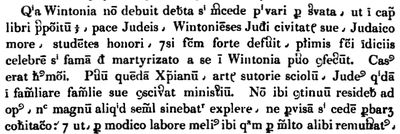
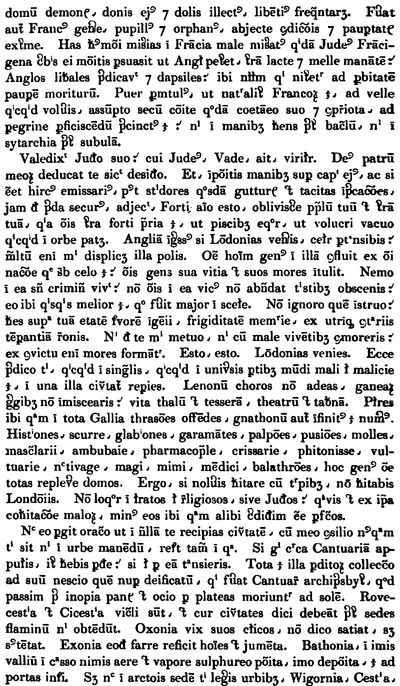
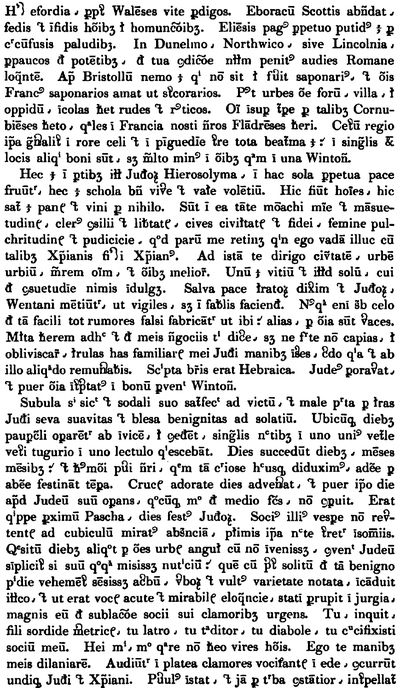
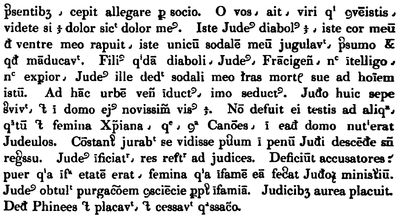
The preceding in words at length.
Quia Wintonia non debuit debita sibi mercede privari pro servata, ut in capite libri præpositum est, pace Judæis, Wintonienses Judæi civitatis suæ (Judaico more) studentes honori, etsi factum forte defuerit, plurimis facti indiciis celebrem sibi famam de martyrizato a se in Wintonia puero confecerunt. Casus erat hujusmodi. Puerum quemdam Christianum, artis sutoriæ sciolum, Judæus quidam in familiare familiæ suæ consciverat ministerium. Non ibi continuum residebat ad opus, nec magnum aliquid semel sinebatur explere, ne provisam sibi cædem probaret cohabitatio; et ut, pro modico labore melius ibi quam pro multo alibi remuneratus, domum dæmonis, donis ejus et dolis illectus, libentius frequentaret. Fuerat autem Francus genere, pupillus et orphanus, abjectæ conditionis et paupertatis extremæ. Has hujusmodi miserias in Francia male miseratus quidam Judæus Francigena, crebris ei monitis persuasit ut Angliam peteret, terram lacte et melle manantem; Anglos liberales prædicavit et dapsiles; ibi nullum, qui niteretur ad probitatem, pauperem moriturum. Puer promtulus, ut naturaliter Francorum est, ad velle quicquid volueris, assumpto secum comite quodam coætaneo suo et compatriots, ad peregrine proficiscendum præcinctus est; nihil in manibus habens præter baculum, nihil in sytarchia præter subulam.
Valedixit Judæo suo; cui Judæus, “Vade,” ait, “viriliter. Deus patrum meorum deducat te sicut desidero.” Et, impositis manibus super caput ejus, ac si esset hircus emissarius, post stridores quosdam gutturis et tacitas imprecationes, jam de præda securus, adjecit, “Forti animo esto, obliviscere populum tuum et terram tuam, quia omnis terra forti patria est, ut piscibus æquor, ut volucri vacuo quicquid in orbe patet. Angliam ingressus si Londonias veneris, celeriter pertransibis; multum enim mihi displicet illa polis. Omne hominum genus in illam confluit ex omni natione quæ sub cœlo est; omnis gens sua vitia et suos mores urbi intulit. Nemo in ea sine crimine vivit; non omnis in ea vicus non abundat tristibus obscenis; eo ibi quisquis melior est, quo fuerit major in scelere. Non ignoro quem instruo; habes supra tuam ætatem fervorem ingenii, frigiditatem memoriæ, ex utrinque contrariis temperantiam rationis. Nihil de te mihi metuo, nisi cum male viventibus commoreris; ex convictu enim mores formantur. Esto, esto! Londonias venies. Ecce! prædico tibi, quicquid in singulis, quicquid in universis partibus mundi mali vel malitiæ est, in una illa civitate reperies. Lenonum choros non adeas, ganearum gregibus non immiscearis; vita thalum et tesseram, theatrum et tabernam. Plures ibi quam in tota Gallia thrasones offendes, gnathonum autem infinitus est numerus. Histriones, scurræ, glabriones, garamantes, palpones, pusiones, molles, mascularii, ambubaiæ, pharmacopolæ, crissariæ, phitonissæ, vultuariæ, noctivagæ, magi, mimi, mendici, balathrones, hoc genus omne totas replevere domos.[1] Ergo, si nolueris habitare cum turpibus, non habitabis Londoniis. Non loquor in literatos vel religiosos, sive Judæos; quamvis et ex ipsa cohabitatione malorum, minus eos ibi quam alibi crediderim esse perfectos.
“Nec eo pergit oratio, ut in nullam te recipias civitatem, cum meo consilio nusquam tibi sit nisi in urbe manendum, refert tamen in qua. Si igitur circa Cantuariam appuleris, iter habebis perdere; si vel per eam transieris. Tota est illa perditorum collectio ad suum nescio quem nuper deificatum, qui fuerat Cantuariæ archipresbyter, quod passim præ inopia panis et ocio per plateas moriuntur ad solem. Rovecestria et Cicestria viculi sunt, et cur civitates dici debeant præter sedes flaminum nihil obtendunt. Oxonia vix suos clericos, non dico satiat, sed sustentat. Exonia eodem farre reficit homines et jumenta. Bathonia, in imis vallium in crasso nimis aere et vapore sulphureo posita, imo deposita, est ad portas inferi. Sed nec in arctois sedem tibi legeris urbibus, Wigornia, Cestria, Herefordia, propter Walenses vitæ prodigos. Eboracum Scottis abundat, fœdis et infidis hominibus vel homuncionibus. Eliensis pagus perpetuo putidus est pro circumfusis paludibus. In Dunelmo, Northwico, sive Lincolnia, perpaucos de potentibus, de tua conditione nullum penitus audies Romane loquentem. Apud Bristollum nemo est qui non sit vel fuerit saponarius, et omnis Francus saponarios amat ut stercorarios. Post urbes, omne forum, villa, vel oppidum, incolas habet rudes et rusticos. Omni insuper tempore pro talibus Cornubienses habeto, quales in Francia nosti nostros Flandrenses haberi. Ceterum regio ipsa generaliter in rore cœli et in pinguedine terræ tota beatissima est; in singulis etiam locis aliqui boni sunt, set multo minus in omnibus quam in una Wintonia.
“Hæc est in partibus illis Judæorum Hierosolyma, in hac sola perpetua pace fruuntur, hæc est schola bene vivere et valere volentium. Hic fiunt homines, hic satis est panis et vini pro nihilo. Sunt in ea tantæ monachi misericordiæ et mansuetudinis, clerus consilii et libertatis, cives civilitatis et fidei, feminæ pulchritudinis et pudicitiæ, quod parum me retinet quin ego vadam illuc cum talibus Christianis fieri Christianus. Ad istam te dirigo civitatem, urbem urbium, matrem omnium, et omnibus meliorem. Unum est vitium et illud solum, cui de consuetudine nimis indulget. Salva pace literatorum dixerim et Judæorum, Wentani mentiuntur, ut vigiles, sed in fabulis faciendis. Nusquam enim sub cœlo de tam facili tot rumores falsi fabricantur, ut ibi; alias, per omnia sunt veraces. Multa haberem adhuc et de meis negotiis tibi dicere, sed ne forte non capias, vel obliviscaris, literulas has familiaris mei Judæi manibus inseres, credo quia et ab illo aliquando remuneraberis.” Scripta brevis erat Hebraica. Judæus peroraverat; et puer, omnia interpretatus in bonum, pervenit Wintoniam.
Subula sibi sicut et sodali suo satisfecit ad victum, et male parta per literas Judæi sæva suavitas et blæsa benignitas ad solatium. Ubicumque diebus pauperculi operarentur ab invicem, vel comederent, singulis noctibus in uno unius vetulæ veteri tugurio in uno lectulo quiescebant. Dies succedunt diebus, menses mensibus; et hujusmodi pueri nostri, quem tam curiose hucusque diduximus, adesse per abesse festinant tempora. Crucis adoratæ dies advenerat, et puer ipso die apud Judæum suum operans, quocumque modo de medio factus, non comparuit. Erat quippe proximum Pascha, dies festus Judæorum. Socius illius vespere non revertentis ad cubiculum miratus absentiam, plurimis ipsa nocte terretur insomniis. Quæsitum diebus aliquot per omnes urbis angulos cum non invenisset, convenit Judæum simpliciter, si suum quoquam misisset nutritium; quem cum præter solitum de tam benigno pridie vehementer sensisset acerbum, verborum et vultus varietate notata, incanduit illico, et, ut erat vocis acutæ et mirabilis eloquentiæ, statim prorupit in jurgia, magnis eum de sublatione socii sui clamoribus urgens. “Tu,” inquit, “fili sordidæ meretricis, tu latro, tu traditor, tu diabole, tu crucifixisti socium meum. Hei mihi! modo quare non habeo vires hominis! Ego te manibus meis dilaniarem.” Audiuntur in platea clamores vociferantis in æde, concurrunt undique Judæi et Christiani. Puerulus instat, et jam pro turba constantior, interpellatis præsentibus, cœpit allegare pro socio. “O vos,” ait, “viri qui convenistis, videte si est dolor sicut dolor meus. Iste Judæus diabolus est, iste cor meum de ventre meo rapuit, iste unicum sodalem meum jugulavit, præsumo etiam quod manducavit. Filius quidam diaboli, Judæus, Francigena, nec intelligo, nec experior, Judæus ille dedit sodali meo literas mortis suæ ad hominem istum. Ad hanc urbem venit inductus, imo seductus. Judæo huic sæpe servivit, et in domo ejus novissime visus est.” Non defuit ei testis ad aliqua, quantum et femina Christiana, quæ, contra Canones, in eadem domo nutrierat Judæulos. Constanter jurabat se vidisse puerum in penum Judæi descendere sine regressu. Judæus inficiatur, res refertur ad judices. Deficiunt accusatores; puer quia infra ætatem erat, femina quia infamem eam fecerat Judæorum ministerium. Judæus obtulit purgationem conscientiæ propter infamiam. Judicibus aurea placuit. Dedit Phinees et placavit, et cessavit quassatio.
Translation.
As it would have been wrong that Winchester should be deprived of her due reward for having preserved peace with the Jews, as has been stated at the beginning of this book[2], the Winchester Jews, studious (after a Jewish fashion) of their city’s honour, although clear evidence of the deed was perhaps wanting, yet from several indications of its commission, gained for themselves a notorious celebrity by the martyrdom of a lad in Winchester. The circumstance was as follows: A certain Jew had engaged a Christian boy, who was a little acquainted with shoemaking, in the domestic service of his family. He did not remain permanently at work in the house, nor was he allowed to perform any great matter at once, lest cohabitation with the family should show him the destruction prepared for him; as also, that, being better remunerated for a little labour there than for much elsewhere, he should, enticed by his presents and deceit, the more willingly resort to the demon’s house. Now the boy was a native of France, a minor and an orphan; he was, too, of low condition and extreme poverty. A French Jew, hypocritically pitying this his state of wretchedness while in France, persuaded him by repeated exhortations to seek England, a land flowing with milk and honey: he extolled the English as liberal and munificent; adding, that no one who would struggle for an honest living in that country could die poor. The lad, rather ready, as is natural with the French, to conform his will to that of others, taking with him a companion of his own age and country, girt up his loins for a foreign journey; carrying nothing in his hand except a staff, nor anything in his scrip besides an awl.
He took leave of his friend the Jew, who thus addressed him. “Go thy way,” says he, “manfully. May the God of my fathers be thy leader, according to my desire.” And having laid his hands upon his head, as if he had been the scape-goat, being now certain of his prey, he added, after certain guttural croakings and silent imprecations, “Be of a stout heart: forget thy people and thy country, for every land is as his country to the brave, even as is the sea to fish, as to the bird whatever lies before it on the open globe. On landing in England, shouldst thou go to London, thou wilt pass through it quickly, for much doth that city displease me. Every kind of men from every nation under heaven flows into that place; into that town hath every people carried its vices and its habits. No one lives there untainted with crime; there is not a street within that place which abounds not with sad obscenity; a man is there accounted better in proportion as he has been a greater adept in iniquity. I am not ignorant of whom I instruct: thou hast a glow of genius beyond thy years, a coolness of reflection, and, as the result of these opposite qualities, a temperateness of the reasoning faculty. I have no fear for thee unless thou dwell with evil-livers, for from our associations are our morals formed. Amen! amen! thou wilt go to London. Lo! I tell thee beforehand, whatever there is of evil or of wickedness in particular parts of the world, whatever in all its parts together, in that one city wilt thou find. Go not among the multitude of the corrupters of youth; mix not with the crowds issuing from the stews; flee dice and chess, the playhouse and the pothouse. Thou wilt meet there more bullies than are in the whole of France, and yet the number of mean flatterers is infinite. Stage-players, buffoons, bald-pated reprobates, men living like wild Indians, parasites, infamous boys, effeminate and scandalous men, lewd music girls, quacks, wantons, fortune-tellers, harpies, night-walkers, conjurers, mimics, beggars, shabby scoundrels,—this is the sort of people with which each house is filled. If, then, thou wouldst not be a dweller with men of shame, thou wilt not abide in London. My observations are not directed against men of letters or the religious, nor against Jews; though, from their very cohabitation with the wicked, I should believe them to be farther from perfection there than anywhere else.
“Nor does my advice go the length of dissuading thee from betaking thyself to a city, since in my opinion thou shouldst tarry nowhere but in some large town; it is of consequence, however, in which. If then thou shouldst land near Canterbury, thou wilt be on the road to destruction; if even thou pass through it. All that collection of lost men is so devoted to the service of some lately deified person of their place (I know not whom)[3], who was archbishop of Canterbury, that they are dying everywhere in the sun, for want of bread and through indolence, in the very streets. Rochester and Chichester are mere villages and offer nothing for which they should be called cities except their being bishops’ sees. Oxford scarcely, I do not say satiates, but keeps her clerks alive. Exeter feeds men and beasts with the same meal. In the depths of valleys, in an exceedingly dense atmosphere and amid sulphurous vapours, Bath is posited, yea deposited, at the gates of hell. But neither wilt thou select for thyself an abode in the northern cities, in Worcester, Chester, or in Hereford, on account of the Welsh, men prodigal of human life. York abounds with Scots, who are filthy and deceitful men, or something less than men. From its surrounding marshes, the Isle of Ely is one eternal stench. In Durham, Norwich, or in Lincoln thou wilt hear very few of the higher orders speaking Latin; of thine own condition, not a soul. At Bristol there is not a man who is not, or has not been, a soap-boiler: now a Frenchman loves soap-boilers as well as he does nightmen.[4] Out of the large towns, every market-town, vill, or petty town has rude and clownish inhabitants. Thou mayst, moreover, at all times consider the Cornishmen to be such as thou knowest our Flemings to be esteemed in France. In fine, the country generally is in the highest degree blessed with the dews of heaven and with richness of soil: there are, too, some good men in every place within it, but fewer by far in all together than in Winchester alone.
“That city is the Jerusalem of the Jews in those parts: within her precincts alone do they enjoy perpetual peace; she is the school of those who wish to live well and to thrive. There men are produced; there thou mayst have a sufficiency of bread and wine for nothing. In that place there are monks of such mercy and meekness, a clergy so wise and tolerant, citizens of such probity and so regardful of their fellows’ rights, women so beautiful and modest, that little withholds me from going thither, and, among such Christians, myself becoming a Christian. To that city do I direct thee, the city of cities, the mother of all and better than all. There is one vice, and only one, in which she is accustomed to over-indulge. Asking pardon of the men of letters and the Jews, I must say (that thou mayst be upon thy guard) that the Winchester people are addicted to lying, yet only in inventing idle tales; for in no place under heaven, as there, are so many false reports fabricated with so much facility; in all other matters they are perfectly veracious. I had yet much to tell thee of my own affairs; but lest thou shouldst not comprehend all, or shouldst forget, thou wilt place this small letter in the hands of a Jewish friend, as I feel confident that thou wilt one day be rewarded by him.” This was a brief note written in Hebrew. The Jew had finished his oration; and the lad, putting the best construction upon everything, arrived at Winchester.
His awl provided food enough for his companion and himself; and the cruel kindness and stuttering civility so evilly obtained him by the Jew’s letter procured him comforts. Wherever these poor creatures might work separately in the day, or take their meals, they each night rested on a little bed in the ancient cottage of an aged woman. Day succeeds day, month month, and the last hours of this our youth, whom we have thus far so curiously traced, hasten, by their very escape, their arrival. The day of the Adoration of the Cross[5] had arrived; and the boy, working upon that day at his master the Jew’s, in whatever manner he was made away with, disappeared. Now the next day was the Passover, the great festival of the Jews. His companion, wondering at his absence, as he did not return in the evening to his bed, is terrified that night by many hideous dreams. Having for several days sought him in every corner of the city without finding him, he at once asked the Jew if he had sent the lad, who was his means of support, anywhere; whom when he perceived to become, contrary to his wont, from the particularly mild man of yesterday, outrageously bitter,—noticing this change in his language and his countenance, he immediately took fire, and as he had a piercing voice, and was gifted with a wonderful flow of words, he instantly broke out into reproaches, with loud outcries charging him, with making away with his friend. “Thou offspring of a filthy harlot!” he exclaims, “thou thief! thou traitor! thou devil! thou hast crucified my companion! Woe is me! why have I not yet the strength of a man! I could tear thee in pieces with my hands.” The cries of the boy vociferating within the house are heard in the public street; from all sides Jews and Christians hastily assemble. The boy presses; and, now become more confident from the presence of the crowd, he began, having gained their attention, to plead the cause of his companion. “O men,” he says, “who have here assembled, see if there be grief like my grief. This Jew is a devil; he hath torn my heart from within my breast; he hath murdered my only companion, I even think he hath devoured him. A son of the Evil One, a certain Jew,—whether he be French-born I neither understand nor know,—but that Jew gave to my friend a letter, which was the warrant for his death, directed to this man. Thus induced,—yea, seduced,—he came to this city. He was often engaged in the service of this Jew, and in his house was he last seen.” The boy was not without a witness to some portion of his tale; inasmuch as there was a Christian woman, who, contrary to the Canons, had nursed the Jewish children in the same house. She swore positively that she had seen the lad go down into the Jew’s store-room, but never return. The Jew denies it; the matter is referred to the Judges. The accusers fail; the boy because he was under age, the woman because her ministry to the Jews had rendered her infamous. The Jew offered a purgation[6] of his conscience with respect to the infamy. Gold was acceptable to the judges: Phinees gave it and appeased them, and the stir ceased.
[1] Some of these worthless characters are mentioned in the lines of Horace:
“Ambubaiarum collegia, pharmacopolæ, Mendici, mimi, balatrones.”—Sat. lib. i. 2.
Others are to be found in Juvenal.
[2] The atrocious massacre above referred to, is related in the following impious and inhuman terms:—“On that same day of the coronation, about the solemn hour in which the Son was immolated to the Father, they began in the city of London to sacrifice the Jews to their father the devil; and so long was the duration of this famous mystery, that the holocaust could scarcely be completed on the second day. Other cities and towns in the country emulated the faith of the Londoners, and with equal devotion dispatched their bloodsuckers in their blood to the infernal regions. Somewhat, but not to such an extent, was at that time enacted against those children of perdition everywhere throughout the kingdom: Winchester alone spared her vermin,—a people prudent and forecasting, and a city at all times respecting her citizens’ rights.”—“Eodem coronationis die, circa illam sollemnitatis horam qua Filius immolabatur Patri, incœptum est in civitate Londoniæ immolare Judæos patri suo diabolo; tantaque fuit hujus celebris mora mysterii, ut vix altera die compleri potuerit holocaustum. Æmulatæ sunt aliæ civitates regionis et urbes fidem Londoniensium, et pari devotione suos sanguisugas cum sanguine transmiserunt ad inferos. Aliquid, sed inæqualiter, ea tempestate contra perditos paratum est ubique per regnum: sola tantum suis vermibus pepercit Wintonia, populus prudens et providus, ac civitas semper civiliter agens.”
[3] Thomas à Becket, who had been murdered a few years antecedently.
[4] Soap was first made in London in 1524; prior to which time it had been supplied by Bristol.
[5] Good Friday.
[6] It was the custom, where sufficient testimony could not be had, to allow the accused to clear himself from the charge by his oath: this was sailed purgation. The oath having been made, twelve persons, called compurgators, were produced on the prisoner’s behalf, who swore, that, from what they knew of his general character, they believed his oath. This was deemed satisfactory.
Table of the principal Abbreviations used in Records.
ā ã an, am.
ã. a. annus and its cases.
aa aliqua.
am annum.
āte ante.
ãimus animus.
ao anno.
a’ aữ autem.
ã at aut.
Abb͞s Abb͞i Abb͞ibʒ Abbas and its cases.
Abb͞a Abb͞e Abb͞am Abbatia and its cases.
Abb͞issa Abbatissa.
acc̃ente accidente.
aca acra.
acam acram.
adm̉ciatꝰ am̉ciatꝰ admerciatus, amerciatus.
adm̉ciam̃tū am̉ciam̃tū admerciamentum, amerciamentum.
advõe advocate.
aĩa aĩe ãi aĩo anima, animæ, animi, animo.
aĩal animal.
aĩal̵ animalis.
aĩalia animalia.
aĩabus animabus.
aaꝝ aliarum, aliquarum.
aid aliquid.
al̵ alias, alius and its cases.
al̵r aliter.
al̵ci alicui.
alic̃ꝰ alicujus.
aliq̃ aliqua, aliquæ.
aliq̃ aliquem.
aliq̵ aliquod, aliquid.
aliqđ aliquod, aliquid.
aliqi aliqui.
aliq̵i aliquid.
aliqis aliqid aliquis, aliquid.
aliqā aliq̵ā aliquam.
abñia absentia.
ab́ne absolutione.
ã ap̃ ap̃d apud.
alt̉ alter.
alt̉a altera.
alt̉ut̉ alt̉utr̃ alteruter and its cases.
am̉als amerals (admirals).
amo amodo.
ampliꝰ āpliꝰ amplius.
añ ante.
aña antea.
añqā antequam.
añc̃ antecessor and its cases.
añcessores antecessores.
añcessoribȝ antecessoribus.
añia animalia.
añqā antequam.
antiqitꝰ antiquitus.
adh̵ adhuc.
agr agitur.
apƿpiar̃ appropriare.
ap̃loꝝ apostolorum.
aplici apostolici.
āpliꝰ amplius.
app̃ne appellatione.
appõita apposita.
appõitꝰ appositus.
appōitr apponitur.
aq̃ aqua and its cases.
aqā aq̵ā aqām aquam.
aqa aq̵a aqua.
Arcħep̃c̃ Arcħep̃m Archiep̃s Archiep̃i Archiep̃o Archiep̃m Ar̃ep̃c̃ Ar̃ep̃s Archiepiscopus and its cases.
arcħep̃tꝰ archiepiscopatus.
areto aretro.
artic̃lꝰ articulus.
arli articuli.
ass̃u assensu.
auc̃te auctoritate.
aṽnc̃lo avunculo.
b̵ b̴ ber, bis, as lib̃tate libertate, Merleb̴ge Merleberge, nob̵ nobis, vob̴ vobis.
b̴ b’ bte b̵te beatæ.
Bapt̃ Baptista and its cases.
b̴i b’ beati.
b̴m beatum.
bñ bene, bien.
b̴ns biens.
bñvołncia benevolentia.
bo. bonus and its cases.
br̃ breve and its cases.
br̃e br̃i breve, brevi.
br̃ia brevia.
c̉ cer, cre.
c̃ cum.
ca carta.
cata carta.
caci canonici.
caīo crastino.
canc̃ cancellarius and its cases.
cantav̉nt cantaverunt.
capietr capietur.
cap̃li capituli.
cap̃tłm capitulum.
ca c̃a causa.
cãs causas.
capus capitaneus.
carimo carissimo.
cħ chere.
cħun chacun.
cħre chartre.
cħłr chevalier.
cħres chartres.
cestasf̴ cestassavoir.
ci cui.
cilʒ cuiłt cuilibet.
cia cita citra.
cĩtas civitas.
clc̃s clericus.
cłico clerico.
claud̴t claudet, claudit, claudunt.
claudʒ claudet.
cło clero.
ciʒ cuique.
cicūq̧, cuicumque.
c̃ cõ contra.
conta contra.
ꝯta ꝯa ꝯta contra.
cõa cõe cõam communa, communæ, communam.
cõe cõis commune, communis.
cõer comuner.
cõi ꝯi communi.
cõit̉ communiter.
cõia communia.
ꝯaio contrario.
cõ ꝯp̃ computate, computabitur, comparendum, &c.
ꝯpobr̃ ꝯtobr̃ ꝯabr̃e ꝯobr̃ia controbreve, contrabreve, controbrevia.
cołł collector and its cases.
ꝯpʒ comparet.
com̃ comes and its cases.
comp̃o compositio.
ꝯa ꝯo contrabreve, controbreve.
ꝯi communi.
ꝯĩ ꝯi communi.
ꝯpełłe compellere.
ꝯp̃o compoto.
ꝯp̃m compotum.
ꝯput̃ computatio and its cases.
ꝯput̃ computabitur.
ꝯputabitr computabitur.
ꝯp̃one computatione.
ꝯp̃one compositione.
ꝯsiđaco͠em considerationem.
ꝯsuet̃ consuetus and its cases.
ꝯsuet̃ consuetudo and its cases.
ꝯtacto contracto.
ꝯtent̃onis contentionis.
ꝯtig̃ contingo and its tenses.
ꝯtu conventu.
ꝯvalủit convaluerit.
ꝯc̃ conc̃ concordia.
ꝯc̃ concessio and its cases.
ꝯc̃ concessum, &c.
ꝯfirmādā confirmandam.
cons̃ consilium.
conc̃ concessus and its cases.
conadco͠e contradictione.
contu ꝯtu contemptu, conventu.
conble constable.
cona ꝯa concessa.
cona contra.
concedimꝰ concedimus.
consu consensu.
cōvēco͠e conventione.
coqine coquine.
ꝯſ̴vet conservet.
ꝯs̃l conseil.
cōſ̴ consilium.
cr cur.
cra cura.
crca circa.
cꝰ c̃jꝰ cujus.
cꝰłʒ cujuslibet.
cꝰtodier̃t cꝰtodiƪnt custodierunt, custodierint.
Đ De, Deus and Dominus and their cases.
Đs Deus.
Dꝰ Deus, Dominus.
Đi đi Dei.
đ d̴ de, der, denarius and its cases.
dꝰ dicimus.
dāpnū dampnum.
darr̃ darrain.
Dd̴ David.
dc̃a dicta.
dc̃s dictus.
dc̃o dicto.
dc̃i dicti.
dc̃m dictum.
dr̃ d̴r dicitur.
dĩna divina.
diñr dicuntur, dinoscuntur.
dit d̴t dicit or dicunt.
dc̃nt dicunt.
dilõne diłone dilatione.
diłone dilectione.
di. dilectus and its cases.
dĩ dimidium.
đte dite.
dilc̃us dilectus.
dilc̃o dilecto.
đre dicere.
dic̃ dicit.
dic̃nt dicunt.
diebꝰ diebʒ diebus.
dilaco͠e dilat̃ōe dilatione.
dilc̃m dilectum.
dilc̃s dilectus.
dim̃ dimiđ dimidium and its cases.
dimiser̃t dimiserunt.
disp̃one dispositione.
diss̃ dissaisitus and its cases.
diss̃e dissaisinœ.
disticco͠e distict̃ōe districtione.
đd̴ dedit.
decr̃ decretum.
deſ̴d̴ desusdite.
dʒ debet, det.
đd̴it dederit.
deb̴ntr debentur.
deb̴ent debent.
deb̴t debet.
debʒ debet.
debủt debuerunt.
decet̉o decetero.
decem̃tū decrementum.
deñ denarius and its cases.
destruco͠e destructione.
detim̃tum detrimentum.
det̉īat̃ōe determinatione.
dñs dñe dñi dño dñm dominus and its cases.
đniū dominium.
doł dolium.
donc donec.
Dñica Dominica.
dñico dominico.
dñic̃s dominicus.
donat̃ōes donaco͠es donationes.
ducatꝰ ducatus.
duratram duraturam.
ẽ e̚ [#] [#] est.
eꝰ ejus.
ea ecclesia.
eā ecclesiam.
ead̴ eadem.
ec̃ eciam.
ecc̃a ecclesia.
eccłiam ecclesiam.
eccłiaꝝ eccłar̃ ecclesiarum.
eccłias ecclesias.
eccłie ecclesiæ.
e̚e esse.
e̚et esset.
e̚ẽt essent.
effc̃s effc̃u effectus, effectu.
eid̴ eidem.
eisđ eisd̴m eisdem.
eꝰd̴ ejꝰd̴ ejusdem.
eła ełīa elemosina.
ełariꝰ elemosinarius.
ẽm eum, sometimes enim.
ep̃c̃ ep̃s ep̃i ep̃o ep̃oꝝ ep̃m episcopus and its cases.
eq̃ū equum.
eqałr equaliter.
eođ eodem.
eoꝝđ eorumdem.
er̃ er̃t erit, erunt.
esp̃ale especiale.
escr̃ escript.
exa exta extra.
exāīat̃ examinatus and its cases.
exc̉cit̃ ex̉cit̃ excercitus and its cases.
excõĩa excommunicata.
excõĩcamꝰ excommunicamus.
exo exemplo, excepto.
exp̃ns̃ expensis.
f. f̴m festum.
f. f. fieri fecimus.
fac̃ faciendo.
facid’ faciendum.
fac̉e facere.
fc̃s fc̃a fc̃o fc̃m factus and its cases.
fara farina.
feĩa feĩe feĩas femina and its cases.
feođ feodum and its cases.
feodałr feodalit̉ feodaliter.
feud̴ feudum and its cases.
f̴i fĩa fia figura, feria.
f̴i fieri.
fidłr fidelit̉ fideliter.
fił f̴s filiꝰ filius.
firt’ firmiter.
fiłm filium.
fła fłas falsa, falsas.
f̴o festo, filio.
for̃ forum.
for̃ forisfactum, &c.
fora forma, foresta.
fr̃ fr̃ is fr̃ es fr̃ e fr̃ em fr̃ m frater and its cases.
fr̃ e facere and fratre, frere.
fr̃ m frumentum.
fr̃ e ferre.
f̴te faite.
fủnt fủūt fuerint, fuerunt.
futri futuri.
ga erga.
gace grace.
garr̃ garrant.
gat̃m gratum.
gavam̃ gravamen.
gat̃nt̉ gratanter.
gavit̉ graviter.
gi igitur.
gła gloria.
głiosꝰ gloriosus.
g̃nƪa genera.
g̃ƪal general.
g̃nƪałr g̃nƪalit̉ generaliter.
g̃nƪe genere.
go ergo.
gr̃a gr̃m gr̃as grat̃ gratia and its cases.
grat̃ gratus and its cases.
H. ħ hic, hæc, hoc.
ha hac.
habuer̃t habủnt habủūt habuerit, habuerint, habuerunt.
habuimꝰ habuimus.
harño harnesio.
ħat ħāt habeat, habeant.
hc huic, huc, hic, hinc.
hcꝰq̹̹ hucusque.
ħc hunc.
ħeat ħeāt habeat, habeant.
ħeb̴t habebit, habebunt.
ħebunt habebunt.
ħedes hœredes.
ħedit̃ ħeditar̃ hœreditarius and its cases.
ħedit̃ hœreditas and its cases.
ħedū hœredum.
ħeđ hœredes, habendum.
ħenđ habendum, &c.
ħeo habeo.
herb̴gag̃ herbergagium and its cases.
ħes hœres, habes.
ħet habet.
ħetr habetur.
hi hic.
ħꝰi hujusmodi.
ħit̃ habitus and its cases.
ħitu habitu.
ħjꝰmoi hujusmodi.
ħmõi hujusmodi.
h. l. n. f. ſ. p. has litteras nostras fieri fecimus patentes.
ħnibʒ hominibus.
Hñr̃ H’nr̃ Henricus and its cases.
ħnt habent.
ħniū ħniis hominium, hominiis.
ho. homo and its cases.
hoĩm hōiū hom̃ hominum.
hōiagiū hominagium.
hõibʒ hominibus.
hōies homines.
homag̃ homagium and its cases.
hr̃e ħre ħere habere.
hr̃i ħri haberi.
hr̃nt habuerunt.
ħt habet, habent.
ħuit ħuisti habuit, habuisti.
ħủit habuerit.
ħuisse habuisse.
ħuer̃t habuerit, habuerint.
ħủnt habuerint, habuerunt.
ħujꝰ hujusmodi.
hujꝰ hujus.
hujꝰeõi hujuscemodi.
hujꝰmoi hujusmodi.
hundr̃ hūdr̃ hundredum and its cases.
hundr̃is hundredis.
ħʒ ħt habet.
ħꝰ hujus, hujusmodi.
ī in.
ia infra, ita, illa.
ib̴ ib̴m ibidem.
ibiđm ibidem.
īcrrat incurrat.
id̴ idem, illud, ideo.
idcico idcirco.
iđm idem.
igr igitur.
ijb’ duobus.
ijꝰte injuste.
iłł ille and its cases.
im̄ete immediate.
imp̴p̃m īp̴p̃m imperpetuum.
illiꝰ illius.
iłłd illud.
iñ inde.
incrrat incurrat.
infa īfa infra.
inf̴ꝰ īf̴iꝰ inferius.
injꝰte ījꝰte injuste.
insp̃r insup̴ īsp̃r insuper.
intr intratur.
int̉ it̉ inter.
intege ītege integre.
ĩo iđo ideo.
ip̃a ipsa.
ip̃e ipse.
ip̃m ipsum.
ip̃o ipso.
ip̃os ipsos.
ip̃ius ip̃ꝰ ip̃iꝰ ipsius.
ip̃am ipsam.
ip̃as ipsas.
ip̃oꝝ ipsorum.
irr irrotulatur.
it̃ ia ita.
it̉ iter.
it̃ iterum.
īta intra.
īt̉ inter.
ite iste.
īt̉dc̃m interdictum.
īt̉e̚e interesse.
it̃m ĩm it̃ item.
it̉m iterum.
īt̉m īt̉ī interim.
itr itur.
ītr̃v̉t intrav̉īt intraverunt, intraverint.
ja. prima.
jā jam.
jamdc̃os jamdictos.
jo. primo.
jo.q̹o unoquoque.
jor jour.
jrat̃ jurat̃ juratores and its cases.
jũe jure.
jꝰ jre jra jribʒ jribꝰ jus, jure, jura, juribus.
jurata juramenta.
jusq̃s jusques.
jꝰtic̃ justicia.
jꝰticia justicia.
juxa juxta.
kł kalendœ, kalendas, &c.
km̃e charissime.
km̃o k̴mo charissimo.
ł vel.
ł. łi. łj. libra and its cases, libratas, &c.
latoñium latrocinium.
lẽi legitimi.
l’erc̃ l’ercevesque.
lĩ liberas, libratas.
łia licentia.
lib̴at̃ liberatio and its cases.
lib̴c̃ones liberationes.
libat̃ librata and its cases.
lib̴tat̃ libertates, &c.
lib̴nt̉ libenter.
lib̴ntr liberentur, liberantur.
lic̃ liña liñia licentia.
liq̹ liquet.
lo. locus and its cases.
lor lour.
loq̃la loquela.
łr libenter.
łra littera.
łras litteras.
łre lr̃e lettre, litteræ.
łris litteris.
łtt̃me łme legitime.
łʒ libet and licet.
m̉ mer.
m̃ m. ma. marca and its cases.
m̃a mea.
magñ magnus and its cases.
mag̃r magister.
mag̃ri magistri.
mag̃rissa magistrissa.
mag̃ros magistros.
mag̃roꝝ magistrorum.
magr̃m magistrum.
mag̃t̉iū magisterium.
mãm materiam.
mata materia.
mat̉ mat̉ mater.
matimōio matrimonio.
maxa maxima.
m̃am meam.
m̃br̃m membrum.
m̃broꝝ membrorum.
m̉cħ marchia and its cases.
m̃di mundi.
Mẽ M’e Marie.
me. memorie.
med’ memorandum.
medte medietate.
međtas medietas.
mem̃ memd memoꝝ memorandum.
mẽf̴ mensis.
mi mihi, mei.
mĩa misericordia, miseria.
mĩe misericordiæ.
mił miles and its cases.
mĩo matrimonio.
m̃is meis.
mĩis misericordiis.
mis̉c̃dia misericordia.
ml. mille.
młr mulier.
młr̃s mulieres.
młm multum.
m̃ltipłr multipliciter.
m̃lt̃m multum.
mo mod̴ modo.
mor monemur, movemur, &c.
m̃ltões multoties.
mołnđ molendinum and its cases.
mor moratur.
m̃os meos.
mr̃ mater, magister, martyr.
mr̃e matre.
mr̃is matris, martyris.
mr̃i matri.
n. enim.
ñ. n. nostri.
ñ enim, non.
ñ ne.
na nota.
nc nec, nunc.
nc̃ce necesse.
nc̃ nunc.
nec̃c̃ia nec̃ria necessaria.
neg̃m negotium.
neg̃o negotio.
neq̹ neque.
neqaqa nequaquam.
ñd̴ ñdū nondum.
ncñ necnon.
ni nisi, nemini.
nicħ nicħl nihil.
ñīatim nominatim.
nil nihil.
nimiū nimirum.
nl nihil.
nłła nulla.
nłłm nullum.
nłłs nullus.
nloꝰ nihilominus.
ñm nūƪum numerum.
nob̴ nobʒ nobis.
nob̴c̃ nobʒc̃ nobiscum.
noc’ nocumentum.
nocum̃tū nocumentum.
nōīa nomina.
nōīatī nominatim.
nōīe nomine.
nōīum nominum.
nost̉ noster.
nostis nostris.
ño nũo numero.
noꝰ nous.
nr̃ ñr noster.
nov̉it noverit.
novit̉ noviter.
nr̃a nostra.
nr̃e nôtre.
nr̃i nostri.
nr̃is nostris.
nr̃o nostro.
nr̃os nostros.
nr̃am nostram.
nr̃m nostrum.
nr̃oꝝ nostrorum.
num̉atr numeratur.
nunqā nunquam.
nūq̹m nunquam.
nũs numerus.
nʒ neque.
õ ob̴ obolus and its cases.
ob̴ obiit.
obẽia obedientia.
obier̃t obierint, obierunt.
obed̴ie obedientie.
obłonibʒ oblationibus.
occ̃o occasio.
occo͠e occ̃one oc̃one occasione.
occo͠ibʒ occo͠ibus occasionibus.
õe omne.
ões omnes.
õia omnia.
õibʒ õibꝰ omnibus.
oĩm õium omnium.
oĩo om̄īo omnino.
om̃ omnis and its cases.
om̄i omni.
om̃s ões omnis, omnes.
oĩode omnimode.
ōnino ōīno omnino.
op̴at̃ōibʒ op̴acõibʒ operationibus.
opꝰ op̴a opus, opera.
oppa opportuna.
oppoĩa opposita.
op̴t oportet.
õs omnis, omnes.
ov̉tem̃t overtement.
p. patentes.
p̴ per, par, por.
p̴ pro.
p̉ pre, præ.
p̉ præcipimus, præsenti.
pi pri.
pa prima.
p̴a persona.
p̴ałr p̴sot’ personaliter.
pa pagina.
pa publica.
pat̉ pater.
pati prati.
p̴bʒ præbet.
p̉b̴nđ præbenda, &c.
pc̃c̃i peccati.
pca publica.
p̉cipimꝰ præcipimus.
p̴cħ prochain.
p̴c̃ssꝰ processus.
p̉đ p̉dict̃ prædictus and its cases.
p̉dc̃a prædicta.
p̉dc̃as prædictas.
p̉dc̃m prædictum.
p̉dc̃o prædicto.
p̉dc̃os prædictos.
p̉dc̃i prædicti.
p̉dc̃oꝝ prædictorum.
p̴ãlate perambulatæ.
p̴e pere.
p̴ent̉e parentre.
p̴ē parem.
p̉fat̃ p̉fata p̉fat̃m p̉fatꝰ prœfatus, &c.
p̴ħre prohibere.
p̴hendinav̉nt perhendinaverunt.
pim̉e primere (première).
pive prive.
pie prie.
pisa prisa.
piꝰ pius prius, primus.
p̴ia propria.
p̴iñ proinde.
p̴io proprio.
p̉juđ prejudicial.
pła plura.
plac̃ placitum and its cases.
p̴lem̃t parlement.
płma plurima.
płes plures.
płia placita.
płg̃ plegiagium and its cases.
płim plurimum.
płit̃ placitum and its cases.
p̴mutat̃o permutatio.
pñt possint and possunt.
p̃nc’ presentia and its cases.
p̃nt present.
p̃ns prœsens.
p̃nt̃ prœsentem, prœsentes, prœsentibus, &c.
p̉nōīato prœnominato.
p̴pio proprio.
p̴p̴ p̴p̃ p̴pt̉ propter.
p̃ p̃ pap Ppa papa.
pp̃li populi.
pp̃o populo.
p̴pia propria.
p̴porco͠e p̴porco͠is proportione, proportionis.
po primo.
po. posito.
posſ̴em possessionem.
poea postea.
pr pour, pur.
prveiors purveiours.
pr̃ pater.
pr̃i patri.
pr̃is patris.
pr̃iam patriam.
pr̃onatꝰ patronatus.
p̃r presbiter.
p̴sōe persone.
p̃state p̃ꝰtate poteste potestate.
p̉sb̴r presbiter.
p̉scipt̃ præscriptus and its cases.
p̉sentes præsentes.
p̴s p̴te pars, parte.
p̉t̉it̃ preteritus and its cases.
pt post, potest.
p̉t̉ præter.
p̴tiñ p̴tinenc̃ pertinentiis.
p̴tiñ p̴tinentibʒ p̴tinent̃ pertinentibus.
p̴tinētes pertinentes.
puce publice.
puisf̴ puissant.
p̴xo p̴xa proximo, proxima.
pꝰ pꝰt post.
pꝰm̃ pꝰtmođ postmodum.
pʒ pt patet, potest.
Q2 q2 quia, quòd.
q̹ que, quia, quòd.
q̃ qui, quæ.
q̴ quod, quòd.
q̃ quem, quos.
qa q̴a qua, quadrans.
qā q̴ā quam.
qant quant.
qałrcūq̹ qualitercumque.
q̃a quia.
qart̉ quarter.
qacūq̹ quacumque.
qar̃ quare, quarum.
qaꝝ quarum.
qai quasi.
qas quas.
qalibʒ qualibet.
qap̴pt̉ quapropter.
qatenꝰ quatenus.
qđđm quoddam.
qđlʒ quodlibet.
qđ quid, quod
qis quis.
qiłʒ quilibet.
qibʒ quibus.
qibʒcūq̹ quibuscumque.
qicūq̹ quicunque.
qicqid quicquid.
qi qia quia.
qid quid.
qieta quieta.
qietū quietum.
qinq̹ qi’q̹ quinque.
qisqam quisquam.
qm̃ quoniam, quem, quomodo.
q̃le qale quale.
qat̉xx. qat̉xxti. quater viginti.
qñ quando, quoniam.
qo quo.
qos quos.
qomo quomodo.
qomołʒ quomodolibet.
qonđ quondam.
qoq̹ quoque.
qoꝝ quorum.
q̹o quoque.
qołʒ quolibet.
qñc̃q̹ quandocumque.
qr̃ quare.
q̃ratis queratis.
q̃relar̃ q̃r̃laꝝ querelarum.
q̃rƪe quærere.
q’q̹ quodque, quiconque.
quar̃ quare.
quereł querela and its cases.
qũx queux.
℞ Rex and its cases.
r. r̃. r̃ regni, regno, &c.
recer recevoir.
reclamaco͠e reclamat̃ōe reclamatione.
reg̃ł regula and its cases.
reg̃lães regulares.
relq̃ reliqua.
reliq̃ reliqui, reliqua, &c.
relīqi relinqui.
reliqi reliqui.
reqisitꝰ requisitus.
rep̴aco͠e reparatione.
respc̃s respectus.
respc̃u resp̃u respectu.
resp̃m respectum.
rem̃ remanet.
retam receptam.
rev̉mꝰ reverendissimus.
reto retro.
rña regina.
rñdʒ respondet.
r̃ndeatr respondeatur.
r̃nsio responsio.
rñsum responsum.
rñsrus responsurus.
ro responsio.
rõe rõne r̃one ratione.
rõi rationi.
rolo rotulo.
rõnabilt̉ rõabiłr rationabiliter.
royme royaume.
r̃ociniū rõniū ratiocinium.
rõnio ratiocinio.
r̃r̃ reꝝ rerum.
r̃spc̃u respectu.
S’ S. Sanctus and its cases.
.s. scilicet.
s. sunt.
s̃. solidus and its cases.
ſ̴ salutem.
ſ̴ ſ̴r seigneur.
sa secunda, summa, supra.
sadc̃m supradictum.
sał sałm sałt̃ sałt̃m salutem.
sacr̃m sacam̃tū sacramentum.
Sb̴b̴i Sabbati.
s̃b sub.
s̃btꝰ subtus.
sb̴nia substantia.
Sc̃s Sanctus.
Sc̃i Sancti.
Sc̃is Sanctis.
Sc̃os Sanctos.
Sc̃a Sancta.
sc̃đm secundum.
sciłt scilicet.
scac̃io scaccario.
sc sic.
sc̃de seconde, secundæ.
sc’ sict sicut.
sc̃lari seculari.
scłʒ scilicet.
sc̃laribʒ sec̃laribʒ secularibus.
ſ̴dit susdit.
ſ̴em̃t serement.
senal seneschal.
seqũ sequens and its cases.
seml semel.
seqr sequitur.
secrū securum.
sepedc̃i sæpedicti.
seq̃ns sequens.
sib̴n sibien.
sig̃ sigillum and its cases.
sic̃ sicut.
sĩlit̉ similiter.
sing̃la singula.
sĩ sive.
si sibi.
siłt̃r similiter.
signĩcas significas.
sigasti significasti.
sigłs sigł singulus and its cases.
siłr siłt̃r similiter.
sing̃lis singulis.
sir̃ schira and its cases.
słʒ scilicet.
ſ̴m secundum.
s̃mpłr simpliciter.
sma summa.
sñ sine.
sñia sententia.
solʒ solet.
so secundo.
so seriò, serò.
soł solidus and its cases.
sp̃ale speciale.
spłr specialiter.
sp̃s spiritus.
sp̃alis specialis, spiritualis.
sp̃ualia spiritualia.
ſ̴ra sera.
s̃r super, sur.
subs̃ subsidium and its cases.
sup̴ super.
suffiſ̴ suffisant.
ſ̴rie seignurie.
s̃s suus, suos, suas, suis.
St̃e Sainte.
st s̃t sunt.
sub̴a substantia.
supa supra.
sup̴iꝰ superius.
ſ̴vic̃ servicia.
sṽ sive.
sʒ set for sed.
slʒ scilicet.
T. teste, testibus.
T’ terminus and its cases.
TT. tituli or titulo.
t. t̃. t̃ teste, testibus.
t̉ ter.
tał talis, &c. taliter.
tałr taliter.
tansgr̃ transgressio.
tadiđunt tradiderunt.
tadider̃t tradiderit, tradiderint, tradiderunt.
tam̃ tamen.
tāqā tanquam.
tc t̃c tūc tunc.
temp̃re tempore.
tēp̴ibʒ temporibus.
tec̃ tecum.
testīom testimonium.
test̃o testamento.
teñ tenementum and its cases.
teñʒ tenements.
tent tenet.
tenđ tenendum.
teñdas tenendas.
thes̃ thesaurarius.
tħr̃m thesaurum.
tes tres.
tia tria.
ti tibi.
t̉īo termino.
tibus tribus.
t̃m tantum.
t̉m t̉ĩm terminum.
t̃mo t̃mmo tantummodo.
t̃mdē tantundem.
T’m̃ terminus and its cases.
T’miñ terminus and its cases.
t̃mp̴alia temporalia.
t̃mp̴alibʒ temporalibus.
t̃mp̴e tp̃re tempore.
t̃n tñ tamen, tantum.
tot̃ totus and its cases.
t̃p̴e tempore.
tp̃re tempore.
t̃p̴ibʒ temporibus.
tol totalis.
toucħ touchant.
t̉r̃ t̉ra t̉re t̉rā t̉ram t̉rar̃ t̉raꝝ terra and its cases.
trr̃ turris and its cases.
tri turri.
trī turrim.
t̉sb̴n tresbien.
tʒ tenet.
u. ut.
ub̴e ui ubi.
uic̃q̹ ubicumque.
ult̃ ultimus and its cases.
ult̉iꝰ ulterius.
uñ unde.
uñc̃q̹ undecumque.
unct̃ōem unctionem.
uniꝰ unius.
uniciʒ unicuique.
ūqā unquam.
utiusq̹ utriusque.
ut̃r uter, utrum.
ut̃rq̹ uterque and its cases.
utꝰq̹ utriusque.
ux̃ uxor.
ux̃e uxore.
ux̃is ux̉is uxoris.
v. vel.
ṽꝰ versus.
vac̃ vacatio and its cases.
vađ vadia.
vałat valeat.
valʒ valet.
v̉ba verba.
vałet valeret.
venaco͠e venatione.
vi vir.
vī vim.
vic̃ vicec̃ vicecomes and its cases.
vii viri.
vidʒ viʒ videlicet.
viłł villa and its cases.
viłr viriliter.
vioꝝ virorum.
virg̃is virginis.
ṽl vl vel.
vo vero.
vo. quinto.
voꝰ vous.
vq’. quinque.
vr videtur.
vr̃ vester.
vr̃a vestra.
vr̃e vestræ.
vr̃i vestri.
vr̃o vestro.
vr̃m vestrum.
vʒ viʒ videlicet.
v̉ſ̴ versus.
wt with.
x. decem.
xa decima.
Xc Xc Xs̃ Xs Xp̃c Xp̃s Christus.
xla. quadragesima.
Xp̃i Christi.
Xp̃o Christo.
Xp̃iani Christiani.
xvme quinzisme.
zor your.
REFERENCES.
There are various references used for notes, according to the fancy of the author, or the master printer; where they are not numerous in a page, the common references are generally used, in this order— *, †, ‡, §, ‖, ¶, and where there are more than six notes in a page, two of each reference are put to a note; but this is looked upon as having an unsightly appearance.
Italick lower case letters are sometimes used, enclosed between parentheses (a), and sometimes figures (1); the letters, when they are used, are often continued through the alphabet, and then commence again with (a).
The most usual references, and which are esteemed the neatest, are superiors, both letters and figures; where the notes are at the foot of the page, letters are most frequently used, sometimes going through the alphabet, and sometimes commencing with a in each page in which notes occur: where the notes are placed at the end of the volume, figures 1 2 are nearly always adopted, in regular succession.
REGISTER.
This term implies such an arrangement of the whites in both forms of a sheet, as that, when printed off, the pages shall fall precisely at the back of each other, so that the sides and heads of the pages of one form shall not project beyond those of the other; in fine work the principle is carried still further, and the whites in the pages are so arranged that line shall fall upon line, when the reiteration is worked. See Gauge. Space Lines.
REGISTER SHEET.
The sheet or sheets printed to make register with.—M. When works are printed on fine and expensive paper, register is usually made with proof paper; and it is not till the form is completely made ready that they use its own paper.
REGLET.
Is a sort of furniture of an equal thickness all its length. It is quadrat high, of several thicknesses, viz. Nonpareil, Brevier, Long Primer, Pica, &c. thick.—M.
Reglet and all other furniture, except side and foot sticks, are made in lengths of three feet each, and are always styled a yard of reglet, a yard of broad, &c.; the use of reglet is to branch out titles, jobs, and other matter, to economise the use of quadrats: it is preferable to quadrats for this purpose, it keeping the lines more even; for different founts of the same size being often mixed, and the quadrats frequently battered, are not so true as a piece of reglet, which I would always have put next to a line of capitals; it is also used in making margin.
The thinnest reglet used is called card reglet, a substitute for scale-board; the regular sizes commence with Pearl and go up to Two Lines Great Primer, with the exception of Ruby, Minion, Bourgeois, Small Pica, English, Paragon, and Two Lines Pica, which are sizes not used.
REITERATION.
The second form, or the form printed on the backside of the white paper.—M. This is a term generally used for press work; when the second form is working, that is, perfecting the sheet, the pressmen say they are working the reiteration.
Reviews. See Newspaper Postage.
REVISE.
An impression of each form printed on proof paper the first thing after it is laid on, and taken by the pressman to the reader or overseer, for him to examine that all the corrections in the press proof are made, previously to the impression being worked off. The compositor frequently takes the revise for waste paper; but this should never be done with that of the first form; the pressman should put it into the heap, so that it may be readily found, which keeps it damp, and the revise of the second form ought always to be pulled on it; the reader, in revising the second form, then sees the sheet perfect, which is necessary to ascertain that the matter follows, and that the furniture is right.
RIBS.
In wooden presses, long pieces of steel, polished on the upper surface, which is a little rounded, on which the carriage traverses in being run in and run out; they are fastened down upon long pieces of wood, which are called Wooden Ribs.
RIDES.
Leads are said to ride, when one end projects over another; this will occasionally take place when two or more are used in the same measure. It ought to be guarded against, as, when it happens, it prevents the page rising, or if by tightening the quoins the form is made to rise, it causes the lines to be crooked.
RINSE THE FORM.
Laying up the form, and washing the lye and ink away to make the letter clean.—M. This is always done by the pressman as soon as a form is off; he takes it to the lye trough, and brushes the ink from off the face of the letter, the furniture, and chase, with the lye brush and lye; he then lifts it out of the trough and sets it on its edge, resting against the side of the trough or against some other support, and rinses it well with water, to wash away the lye and the ink it has dissolved, and thus leaves the face of the letter, the furniture, and the chase clean, ready for the compositor to lay up preparatory to distributing.—See Lay up.
RINSING TROUGH.
The trough forms are rinsed in.—M. It is two troughs combined in one; the smallest and deepest is for the water, and in some offices has an iron ladle chained to the near upper corner, to prevent its being displaced; the shallow part is used to lay up forms in; they are both lined with lead, and the shallow one has a loose deal bottom to preserve the lead, and in general is bound with iron, particularly at the front, to prevent the edge of a chase, when being lifted upon the letter board, from cutting the lead; they both have an opening with a short pipe at the bottom to convey away the water; that in the water trough having a brass plug in it, for the convenience of letting the water off to clean it out. They stand on a frame, which is usually placed in a platform raised at the edges a few inches, lined with lead, styled the sink, with a loose bottom of boards, which leads into a pipe for drainage.
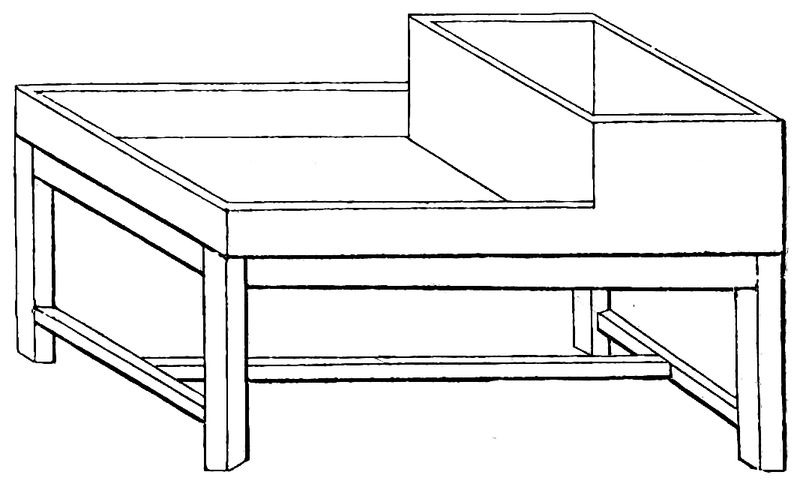
RISE.
A form is said to rise, when in rearing it off the correcting stone no letter or furniture, &c. stay behind.—M. When every thing is properly justified, and the form properly quoined and locked up, so that nothing falls out in lifting it up.
RISERS.
The material upon which stereotype plates are fixed, in order to be printed.
These risers are sometimes made of wood, with the plates screwed, or otherwise fastened upon them; sometimes of brass, bell metal, gun metal, or type metal; and occasionally of gypsum, or Roman cement: but, of whatever substance they may be formed, the riser and the plate together should be of the same height as types.
Mr. James Fergusson took out a patent for risers made of elastic substances, of which he published the following description, or specification:—“Now know ye, that I the said James Fergusson, in compliance with the said Proviso, do hereby declare, that the nature of my said Invention, and the manner in which the same is to be performed, are particularly described and ascertained by the following explanation thereof, that is to say: In the process of printing from Stereotype Plates, the plates are put upon, and fastened to, certain materials or apparatus, called by different names, such as blocks, matrix-plates, risers, &c., which are made either of iron, brass, type-metal, bell-metal, Roman cement, gypsum, wood of various kinds, or some other suitable substance; or, without using any such materials or apparatus, the plates are, or may be, put upon, and fastened to, the coffins or tables of such printing presses as are in general use, or upon cylindrical or any other sort of printing machines. In all cases, however, of printing from Stereotype Plates, it is necessary to apply some remedy to the unequal thickness of the plates; and the operation usually adopted is that of putting layers or pieces of paper, or other material, under the thinner places of the plates, or over the same, upon the tympan, which operation is technically termed underlaying and overlaying. Now, the nature or object of my Invention is that of saving the time and expence unavoidably sacrificed in the operation of underlaying and overlaying; and this object I accomplish by putting elastic substances under the Stereotype Plates, whereby the printed impressions from them are immediately equalized wholly or in part; for the elastic substances yield to the pressure upon the thicker parts of the plates, and at the same time afford the necessary resistance for obtaining sufficient strength of impressions from the thinner parts. It must be evident, that the elastic substances are to be interposed between the Stereotype Plates and whatever solid or firm substance may be made use of, whether blocks, matrix-plates, risers, cylinders, printing presses, printing machines, or any other apparatus whatsoever. So far as I have made experiments and trials of different elastic substances, I have hitherto found Cork to be the best calculated for the purposes of my Invention; but, in virtue of the Letters Patent granted unto me, I claim the exclusive right and privilege of applying Cork, and any other elastic substance, to all kinds of printing apparatus and machines, with the view of remedying the inequalities in the thickness of Stereotype Plates; and I also claim the sole right and privilege of manufacturing the elastic articles requisite for the attainment of this object, of vending such articles, and of granting Licenses for the use of the same. In further explanation of the manner in which my Invention is to be performed, it may be proper to state, that the Cork is prepared by cutting, sawing, rasping, and filing; and by these means it is wrought to such a uniform thickness as is required. I consider a quarter of an inch as a proper thickness, but a lesser or a greater may be adopted. If, when a determinate thickness has been fixed upon, the Cork is to be applied to some apparatus now in use, that apparatus should of course be diminished as much as is the thickness of the Cork, in order that the same height to paper may be preserved. The layers or beds of Cork may be formed either of single pieces, cut to the respective sizes of pages, or made up by several slips, whereby they may be adjusted to various widths and lengths. Whether the Cork be laid loose upon the blocks, &c., or be attached by soft pitch, shoemakers’ wax, or other adhesive substance, is unimportant; but I prefer attaching it, so as to keep it in its place. Although my Invention essentially consists in discovering the applicability of Elastic Substances for the purpose of remedying inequalities in the thickness of Stereotype Plates, yet, in this Specification, I have necessarily given my explanations by particularising Cork, that being the material which I now manufacture and prefer. How to adapt any other elastic substance, which may answer the purpose equally well as Cork, cannot be a matter of doubt or difficulty to any person practically acquainted with apparatus used in Stereotype Press-work.——In witness whereof, &c.”
Mr. T. C. Hansard took out a patent for improvements on, and additions to, Printing Presses, and various processes relative to Printing; these improvements included “Stereotype-Plate Risers, with Holdfasts or Claws,” of which Mr. Hansard published the following description:—“The Risers are made of Type Metal, or with any other metal or substance, cast in a Type-founder’s mould, having somewhat the form of what are called Quotations. I take the usual standard for Printer’s ad-measurement, and cast them quadrilateral to four Pica m’s; then longer ones as parallelograms, four by eight, four by twelve, four by sixteen, and smaller ones, four by two, four by one, and four by a half; in height they are about three-fourths of an inch, or sufficient to raise the Plate to the usual height, or somewhat higher than common Type; these being cast and dressed perfectly true, in body and height, may be easily combined to form the size of any page necessary, with the certainty of having a uniform plain surface for all the plates, however numerous; they are cast as hollow cubes, the larger combinations having divisions to give sufficient support to every square against any pressure which can be brought upon them.
“The Holdfasts or Claws are formed of Brass or other hard metal, accurately adjusted in thickness to a Brevier, or any other body chosen, with a projecting Bevil at the top. They may be of various lengths, as to 4, 8, 16, 24, or more or less, Pica m’s, the elongated parts of the larger ones being to the height of ordinary Reglet, having the Holdfast or Claw in the centre, or towards each end. They may be opened, or pierced, as well to make them lighter, as to cause them, by pressing and indenting into the furniture of the forme, to be less liable to be drawn out: the height of the Claw is about seven-eighths of an inch, or sufficient for the projecting bevil of about one-eighth of an inch to lay upon the flanch of the plate when resting on the Risers. To prepare plates for working, form with the Risers the requisite number of pages for the forme or sheet to the nearest size they may make by the various combinations, and add any difference wanting by reglet, leads, or scale-board; then lay on the Plates, and place at the head, foot, and sides of each plate as many Holdfasts as may, from the size of the plate, be deemed sufficient for proper fastening; thus for small pages, as in Octadecimos and Duodecimos, one at each side and end will be sufficient; for larger pages two or more may be thought necessary; making up the parts which they may be deficient of the length and breadth of the pages with quadrats or reglet of the same body; then proceed to make margin, or dress the formes, and lock-up in the usual mode. To change the Plates; when worked, unlock the forme, draw out the Holdfast at the head or foot of the plate, slide off the done-with plate, replace by the new one; lock up again; and if the Plates have all been cast true to one gauge in thickness, width, and length, you will have throughout the whole work exact and uniform register, and equal impression;—when the Work is completed, the same material of Risers and Holdfasts, by admitting every combination of size, will form into any other sized pages for any other sized plates.”
Robbery. See Stolen Property.
ROLL UP BALL LEATHERS.
When the pressman leaves work at noon he draws half the nails out of the balls, and takes the wool out; then doubles the loose half of the leather over the remaining nailed-on half, with the inky sides of each half next each other, and rolls up the leathers close, and lays them in a bowl or pan of water to soak till he has dined—M. This plan is entirely discontinued; the ball nails now are never drawn nor the covering taken off till it is worn out, owing to the different composition of the ink.
ROLLER.
A cylinder coated with composition, fixed in an iron frame, and revolving upon an iron rod running through it, with which to ink the forms, preparatory to taking an impression.
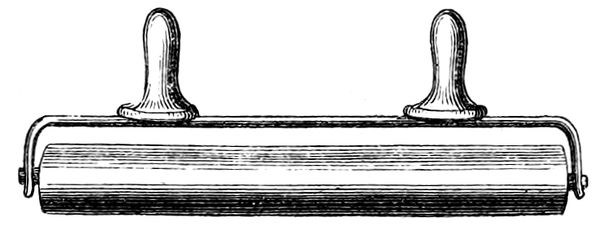
The roller has almost entirely superseded the use of balls in printing; and, since the introduction of composition, I may venture to say it has completely superseded the use of pelts for balls. See Pelts.
The use of the roller is less laborious to the pressman than balls; and for common work, and indeed all work where weak ink is used, it coats the surface of the types, &c. more uniformly, perhaps, than balls; but for fine work, where strong ink must be used, and really fine work cannot be produced without strong ink, the roller is decidedly inferior to the ball, partly owing to the difficulty of taking ink and distributing it on the inking table; and partly owing to the inferiority of rolling to beating with balls, in coating the surface of the types with strong ink.
The introduction of composition in lieu of pelts has been the cause of a complete change in printing; but for this article, machine or cylindrical printing would never have been accomplished, as all the first attempts were made with skins to coat the roller, and all failed, owing to the imperfection of joining the edges; it was this that baffled Nicholson, who died before its introduction; and it was the introduction of this article that enabled König to avail himself of Nicholson’s invention and to reduce it to practice, after he had failed in his project of applying steam to the working of presses.
The composition was first introduced in printing by Mr. B. Foster, who spread it in a melted state on canvass, and then formed it into balls in the usual manner. I have been informed that Mr. Foster obtained his knowledge of its properties from a cotton manufactory, where it was used in some part of the machinery; but Mr. T. C. Hansard says that it was in the Staffordshire potteries, in which they use what are there called dabbers, that Mr. Foster first observed it.
Composition.—Mr. Hansard, a printer of extensive practice, in his Typographia, says, “The composition consists principally of glue and molasses, or treacle. I have seen various receipts of ingredients and proportions, some possessing the recommendations which distinguish the recipes of ancient physicians; namely, a vast variety of articles with counteracting properties. But the simple prescription which my experience has proved best, is, to provide glue of the finest quality, made from the cuttings of parchment or vellum; fine green molasses, pure from the sugar refiner, at least not adulterated for the bakers’ or grocers’ shops; and a small quantity of the substance called Paris-white [carbonate of barytes], and you will have every ingredient requisite for the compo. The proportions have been so variously stated, and so different from what I have found to be eligible, that I am wholly at a loss to account for such differences.
Pounds of
Glue. Molasses.
One receipt which now lies before me in print, says 2 1
Another, MS. 2 3
I find a mixture of 2 6 or 2 7
and about half a pound of the Paris-white, will make the compo of a superior quality to any other proportions, and will be sufficient for two demy rollers. The great disparity which appears in these receipts may perhaps be attributed to a difference in the quality of the materials, and to the mode of management.” Thus far Mr. Hansard on the component parts of the composition.
The late Mr. Robert Branston, an eminent engraver on wood, and who was also very skilful in printing his productions in a superior manner, told me that he made his balls of glue, treacle, and a little shoemakers wax, and that they answered as well as Foster’s. The Cave of Despair, in my Practical Hints on Decorative Printing, will serve as a specimen of his abilities in both these departments.
An ingenious printer in the country, and a good workman, sent me the following receipt, from which he used to make balls for his own use:—Take a pound and a half of glue, let it soak in cold water twelve hours, boil it without any additional water; when it is hot add half a pound of treacle, half an ounce of turpentine, and a quarter of a pound of tar; this quantity is sufficient for a pair of balls. Prepare your canvass or coarse cloth of the size the balls are wanted, by rubbing on it bees wax, (or common paste will answer the purpose after it has been allowed to dry,) to prevent the composition running through the pores; when the mixture is nearly cold, pour it on the canvass, held in a concave manner, in order that it may be the thickest in the middle, and thinner at the edges; then knock up the balls in the usual way.
Another receipt, from which a large establishment in London made their balls and rollers, and the latter both for their machines and presses, is equal parts of glue and treacle; but as the composition is affected by the state of the atmosphere, it is found by experience that in cold weather a greater proportion of treacle is required, and in warm weather a greater proportion of glue.
This establishment was of opinion that the glue known by the name of London Glue is the strongest and best.
These different receipts, each of which was held in high estimation by the party who made use of it on account of its individual superiority over others, tend to show that different proportions of the same materials with different ingredients incorporated with the mixture, produce a composition that possesses all the requisite qualities.
Casting Rollers.—Mr. Hansard gives the following directions:—“The cylinder upon which the compo is cast is made of alder-wood, turned to a requisite diameter, so that the coat of compo which it receives is half an inch. The cylinder is perforated through its centre, having a brass bush or collar driven into each end, through which is passed an iron rod, as an axis, with an enlarged head at one end, and tapped with a screw at the other.
“It is necessary to procure a mould very accurately made and well finished. Mine is made of brass, in two parts, adjusted to each other with rebates, the inside being finely turned and polished, and having flanches projecting by which the parts are screwed together by the screw and lock-burr. To each end is also fitted a collar; and a circular plate of iron is accommodated with great precision to the bore of the mould, having a projection in its centre to enter a cylinder of wood about which the compo is to attach itself, and to hold it exactly in the centre of the mould, and the other end of which is kept in a corresponding position by means of a brass piece to allow of the compo passing down between the interior surface of the mould and the wooden cylinder. There are little projections on the sides of the mould, which serve as feet to support each half in a steady position while lying upon a table or elsewhere. Previous to joining, the parts of the mould must be nicely cleaned and oiled, and the greatest care taken that no particle of compo, grit, or dirt, remain in the rebate. The parts being carefully placed on each other, and the wooden cylinder fixed inside, the screws must be put into their respective places in the flanches, and when all is properly made tight the mould is to be set upright for receiving the compo.
“The next material part of the apparatus is the melting kettle. This must be a double vessel like a glue-kettle, so that the compo in the interior may be melted by the heat of the boiling water in the exterior. For this purpose a strong boiler may be the best or readiest thing found, into which let a tin vessel be fitted, with a flanch to rest on the rim, so as to leave one or two inches clear under it. This vessel may be six or eight inches above the top of the boiler, so that the lid of the one may fit the other; and it must have a handle on each side; also a large lip for pouring out the compo.
“Being thus prepared, put the glue into a little water for a few hours to soak. Pour off all the liquid, and put the glue into the inner vessel, the boiler having in it as much water as it will contain when the inner vessel is in its place. Put it on the fire, and boil the water as quick as you please, the heat of which will soon cause the glue to dissolve, and evaporate part of the water. When the glue is all melted, add the molasses, and let them be well incorporated together for at least an hour, receiving heat from the boiling water, which is an uniform degree that cannot exceed 212° of Fahrenheit. Then with a very fine sieve, mix the white powder, frequently stirring the compo. In another hour, or less, it will be fit to pour off; and when it is, take the inner vessel out of the boiler, and pour the mixture gently into the mould through the opened brass keeper. In about an hour, if the weather be dry and favourable you may take the roller out of the mould; hang it in a cool, dry, situation, or lay it horizontally in a rack made for the purpose, and the next day it will be sufficiently hardened for use. As there will be rather more of the compo at each end of the cylinder than would work clear of the frame in which it is to revolve, cut off from each extremity about half an inch, by encircling it with a piece of fine twine.”
There is a serious practical disadvantage in the mould being formed of two pieces; that of having a seam or ridge running the whole length on both sides of the roller. This seam prevents that accurate distribution of the ink which is essentially necessary, and increases the probability and danger of producing monks in the impression, which ought to be avoided as much as possible, as destructive to good printing.
I have at different times heard complaints of the difficulty of drawing the roller out of the mould, and of the injury it frequently receives from the surface being damaged, which spoils it, and makes it necessary to be recast. This accident occasions disappointment and loss of time; as cleaning the mould from the composition which adheres to it when this happens is tedious. I attribute this to the mould being made too thin, which expands when the hot mixture is poured into it, and contracts as the mixture cools, thus becoming, by the contraction, too small for the roller, and binding it so tight as to prevent its being drawn out with facility, and without great risk of injury.
I know one house in the Metropolis that makes rollers in the most perfect manner, and experiences little or no trouble in drawing them from the mould; and I know a person who had a mould made, with the same result. These moulds were made out of a solid cylinder of metal (tin, or type metal is equally good for the purpose, and more durable), the aperture bored to the size of the required roller, and carefully polished on the inside, the tube being thick, in some instances two inches, so that it was not much affected by the heat of the composition, the expansion being very trifling, and of course the contraction small in proportion; so that the roller when cold was not compressed by the mould, or so slightly as not to cause any inconvenience or damage to it in drawing out. The inside of the mould should be carefully wiped out before using, so as to be perfectly free from dust or dirt, and slightly oiled, which causes the roller to quit it more readily.