M. (continued 2)
Reading edition
It is always presumed that the backing of the book in binding, takes up as much of the margin as is cut off the fore edge, so as to make them both equal.
Having premised these explanatory observations, I shall proceed to describe, in as clear and distinct a manner as I am able, the manner of ascertaining the proper spaces between the pages, for the different sizes of books, in the simplest way that is known, and as it is now generally practised; for the division of the margin by compasses is obsolete.
To facilitate the operation, it will be necessary to keep in mind the observation I made in the article Imposing, that, “when we arrive at a great number of pages in a sheet, they resolve themselves into the same order as quartos, octavos, and duodecimos,” as a recollection of this will tend to simplify the process, and, if the person who has to perform it be not well experienced, it may prevent him from getting confused, by keeping him to a small part of the form, instead of leaving him to attempt doing all at once.
After the pages have been laid upon the imposing stone, and the chases put over them, the first thing to be done is to get a sheet of the proper paper of the work, wet, and to fold it as exactly as possible to the size in which the work is intended to be printed.
If the paper for the work has not been sent in, then a sheet of the same size may be taken from the paper of some other work that is in progress, which will be found to be sufficiently near, inasmuch as a scaleboard or two in the backs and heads, more or less, will make it right; or the first sheet may be imposed temporarily with furniture out of the drawer.
I must here caution the compositor, or the person who has this business to perform, never to cut his furniture till he is certain of the proper distance required between the pages.
To ascertain this distance, take short pieces of furniture out of the drawer, or quotations, or both, and quadrats or reglets to fill up the interspace, between two pages; then push the pages close up to them, and when you have got the right distance between the pages, you can ascertain what furniture will be of the exact width, by trying the ends of different pieces, always measuring from the edges of the types themselves, and not within the page cords.
We will now proceed with making margin, commencing with folio, and proceeding through the various sizes, at least through so many as may be necessary to elucidate the subject.
Folio.—Having folded a sheet of the intended paper exactly in the middle, place the edge of the paper even upon the outer edge of the first page, and move the adjoining page to it till the fold in the paper will lie about half an inch upon it, when the folded sheet is laid upon the face of the first page; the space between the pages on either side of the cross is then to be filled up with furniture, using one piece only on each side where it is practicable, and where there is no reason to the contrary, in order to prevent mistakes in re-imposing. This space, with the addition of one or two scaleboards on each side of the cross, which are to assist in making register at press, will be sufficiently near for a demy folio, where the page is of a fair dimension; but if the page be very large, or if it be a smaller sized paper than demy, I would not allow the back fold of the paper to lie quite so much over the adjoining page, but would lessen it in proportion to the size of the page or paper; if it be very large paper and a corresponding margin, I would allow a little more proportionably; for it is to be observed, that the more the fold of the paper lies over the edge of the adjoining page, the more fore edge is given at the margin than in the back.
The margin for the head of a folio is arranged at press.
After the scaleboards have been put in, the page cords taken off, and the pages pushed up close to the furniture, you should try it again, to see that it is correct. It is a good plan to take a slip of paper, and cut it to a length equal to the width of the back, then to fold it even in the middle so as to make a distinct crease, to open it again and lay it in the back, so that the crease shall be exactly in the middle of the back; then to open out the sheet of paper, and lay it upon the form, with the crease in its middle upon the crease in the slip of paper; the margin in the back may then be compared with the margin in the fore edge as well as if the sheet were printed, and it may be altered if thought necessary by a scaleboard more or less.
If two jobs, that are to be cut up, are worked together, it is usual to impose them so that the margin shall be equal on both sides; to effect this, fold the paper exactly in the middle, and laying it folded upon the left hand page with the edge of the paper even with the edge of the page of types, bring the other page to it till the left hand side fairly touches the fold of the paper; this is termed being out and out; and when the paper is cut evenly in two, after having been printed, the side margins will be found to be equal.
Quarto.—Fold a sheet of paper exactly into quarto; then lay it, thus folded, upon the first page, the fore edge of the paper being even with the left hand edge of the types; bring the adjoining page towards the first page till the fold in the paper lies upon the left hand side of it about as much as a Double Pica body; this will make the back about right: then place the lower edge of the paper even with the foot of the page, and bring the heads of the pages which adjoin at that part towards each other till the fold in the paper covers the head line, and barely the first line of matter; this will make the head right. Then fit the furniture into the spaces; add a scaleboard or two, as the case will admit; and, after cutting and folding slips of paper and laying them in the back and head, open out the sheet of paper, laying the folds in the paper exactly over the folds in the slips, and it will be perceived how the margin is to be for all the pages.
Before I proceed to octavo, it will be necessary to observe, that in all sizes except folio and quarto, if there be not enough in the backs, the raw edge of the paper in the front margin will project beyond the folded margin, and this in proportion to the deficiency in the back; the same will take place in the length in duodecimo, and in smaller sizes where there are offcuts, if there be not enough at the foot of the pages whence the offcut is taken: the effect produced by these deficiencies is, that the binder is obliged to reduce the size of the book both in length and width, when cutting, in order to make the edges smooth.
The French allow the raw edge of the paper in the front to extend considerably beyond the folded edge; and also at the foot in duodecimos: in England we endeavour to give the book the fullest size that the paper will permit, and suffer the raw edge of the front margin to project but a very little beyond the folded edge, to allow for any discrepancy in the size or shape of the paper.
Octavo.—Fold a sheet of paper into octavo, and lay it, thus folded, upon the first page, the fore edge of the paper even with the outer edge of the types: then bring the adjoining page towards it till the other side of the octavo paper lies over the left hand side of this page about a Pica; this will give the width of the gutter: then open the paper out a fold, into quarto, and laying it upon the two pages, bring the third page on the right hand sufficiently near for the right hand side of the paper to lie upon the left hand side of the page about a Long Primer body; this will give the width of the back: then fold the paper up again, and laying it upon the first page, with the foot of the paper even with the direction line, bring the head of the page above it so near that the top of the octavo paper will cover the head line and barely also the first line of matter; this will give the space at the head: then put into all the spaces on one side of the long cross, and into the head, small pieces of furniture from the drawer, or quotations, which are generally used where they will fit, or quadrats, making both the gutters alike, and push the pages up close; cut the slips of paper as before, and fold them; lay them in the gutters, head and back, and open the sheet of paper to its full size; lay it with the crease of the middle fold exactly upon the crease of the slip of paper in the back, and if the margin be right the creases between the other pages will fall exactly upon the creases in the slips of paper laid in the gutters; if they do not, the space in the back must be increased or diminished till they do, when the margin will be right; the furniture may then be cut, and a scaleboard inserted next the crosses at the backs and heads in all the quarters.
Duodecimo.—After folding a sheet of paper exactly into 12mo., proceed as in octavo for the gutter, but let the fold lie rather less over the edge of the adjoining page than a Pica; proceed in the same manner for the back, but that the paper lie on the third page barely a Long Primer body will be sufficient; the fold in the head will just cover the top line of matter in the adjoining page above it, as in octavo, but the pieces of furniture put in there are called bolts. The offcut is now to be considered—this is always imposed on the outside of the short cross, and the back and gutters are the same as those in the other part of the sheet; for the head of the offcut, the space between the running title, or, where there is no running title, the headline, and the middle of the groove in the short cross, must be exactly half the width of the bolts; for as register is made at this part, and the points fall into the groove and there make point holes, the binder folds to these holes, and takes off the offcut in accordance: thus when the sheet is folded, the offcut inserted, and knocked-up, the head lines of the offcut ought to range with the head lines of the other pages, and this should always be kept in view by the printer; the space between the bottom of the other pages and the middle of the groove in the short cross, should be within a Pica of the outer margin at the feet of the pages, which will allow for any little variation in the size of the paper, and not affect the size of the book in cutting the edges: when these distances are thus arranged, put short bits of furniture, quotations, &c., as before directed, between the pages, in the gutters and back in one row, and in the head and both sides of the short cross in another row lengthways, and push the pages of both these rows close up: cut the slips of paper and fold them for the gutters and the back, as also for the bolts: then open out the sheet of paper, and lay the middle crease in it exactly upon the crease in the slip of paper laid in the back; and if the side margin is right, the creases in the sheet of paper between the other pages will fall upon the creases in the slips of paper laid in the gutters; if they do not, the space in the back must be altered till they do: then try it the other way, by laying the crease in the sheet of paper upon the crease in the slip laid in the bolt, and if the crease of the offcut falls exactly in the middle of the groove in the short cross, it is right; if it does not, the space at the feet of the pages next the cross must be altered till it does: it being presumed that the gutters and bolts are right, the only places at which to alter are the back, and the space at the feet of the pages adjoining the offcut; a scaleboard or two, as may be required, must be put into all the quarters next the crosses.
In Duodecimo Music way, the pages are reversed in shape, being so wide as for two of them to occupy the width of the sheet, and so short as to have six in the depth; in this case there are no backs, technically so called, but only gutters; but as the long cross comes between the pages, they must be treated as backs, in the same manner as in folio, and the fold of the paper must be allowed to lie more over the side of the adjoining page, as was described in making margin for folio; if the page be very wide, less than half an inch; if it be narrow, and a large margin, it may be a little more; the head margins or bolts are three in depth, and may be ascertained in the same manner precisely as for octavos or common twelves, which, being done, the foot margins must be ascertained; these, being two, may have a Pica body each less than the outer foot margins, to allow for any inequality in the size of the paper, or in laying on the white paper at press; this will be done by folding the sheet of paper exactly in three portions across it, and extending the pages till one of these portions covers the two outer pages with the gutter, and lies over the third about a Pica body; when this has been performed at one end, repeat the same process at the other end of the form. The margin may then be tried in the manner before described, and any necessary alteration must be made in the space at the feet of the pages, care being taken that both spaces are equal.
In Long Duodecimo, the pages are the same in size as in the preceding, only that they exchange the length for width, and the width for length; the manner of making margin is the same for this size as for the last; the only difference between them being one of words—that which was the gutter in the other being the head in this; and what was the head or bolt, and the foot margin, now becoming the gutter and the back; the spaces between the pages, for heads, for gutters, and for backs, are ascertained in the manner before described.
As the number of pages multiply in a sheet, so the utility of placing slips of paper, folded in the middle, in the gutters, backs, &c., becomes greater, by enabling the person, whose office it is, to know readily the middle of each space when he tries the whole margin with the sheet opened out; to some this may appear unnecessarily minute, but I hold that whatever method tends to facilitate an operation, and enables a person to perform it more correctly, is useful.
Sixteens.—After having described so fully the manner of folding the paper, and ascertaining the spaces between the pages for the gutters, the heads, and the backs, which are required for quartos, octavos, and duodecimos, it appears unnecessary to extend this article by repeating the same thing in every size. For sixteens, fold a quarter of a sheet of paper exactly in four; pursue the foregoing direction for ascertaining the width of the gutter, the back, and the head, in one quarter of the form, and having made these right, arrange the remainder of the form in the same manner, always trying all the pages by the whole sheet opened out, and rectifying any thing wrong by adding or diminishing in the backs, and similarly at the feet of the pages next the short cross.
The greater the number of pages in a sheet, the smaller in proportion does the margin become: it must therefore be evident, that the folded paper should lie proportionably less over the edge of the adjoining page, both for gutter and for back, as the number of pages increases; for as a folio may require the page to be half an inch nearer the back than the fore edge, an eighteens may not require it to be more than a Long Primer; and so in proportion with respect to the size of the page and of the margin.
Eighteens.—A sheet of eighteens is the same as three half sheets of twelves imposed together: there are two backs and three gutters in each form: the other way of the chase it is three pages in depth, having bolts and an offcut the same as twelves; and the process is the same as when making margin for twelves, only ascertaining the first gutter and back by one third of the sheet of paper the long way, instead of one half of it the narrow way: having made the six pages on the left hand of the form right, make the remaining twelve pages like them, and then try the whole with the sheet of paper opened out; the creases in the folds should fall exactly in the middle of the gutters and backs; but as the offcut is not imposed on the side of the short cross with the groove in it, the crease for the offcut should be exactly half the width of the bolt from the running title or headline, or it should fall in the middle of the long cross.
I wish here to impress upon the mind of the person who is making margin, never to attempt doing so with the whole form at once; for if he does, it is more than probable that he will get wrong, cause himself additional trouble, and frequently waste furniture; but let him get one portion right, then make a range of pages through the form one way the same, and then another the contrary way, and afterwards try them with the sheet of paper opened out, when any little variation that may occur will be easily remedied before he cuts the furniture.
Twenties.—A form of this size has four pages in width, and five in length; in width the margin will be made in the same manner as for twelves; in the length there are two heads or bolts, which will be also ascertained as for twelves; the space between the feet of the pages must be out and out, except about a Pica body; and the offcut must be treated the same as for a form of twelves or eighteens.
Twenty-fours.—The side margin will be ascertained just as for eighteens, there being the same number of pages in width; and the head and foot margin as for sixteens; the difference in the size of the pages not affecting the principle of making margin.
Long Twenty-fours.—A form of this size is similar to a sheet of twelves imposed in one chase, the width of the pages being the longest way of the paper: the method of making margin for it will be similar to that for twelves or eighteens.
Square Twenty-fours.—The difference between this size and twenty-fours is, that the width of the pages occupy the sheet the longest way; the margin will be made in the same manner.
Thirty-twos.—One quarter of a form of thirty-twos is similar to a form of octavo; and the margin may be made by folding a quarter of a sheet of paper, and arranging the pages of a quarter of the form only in the first instance: then place the others at the same relative distances, and try the whole with the sheet of paper opened out, before cutting the furniture.
There is no variation in any principle of making margin as to the remaining sizes; and if I were to go into detail for each, it would be but a repetition of the method of ascertaining the width of the gutters, backs, heads or bolts, and of the spaces at the feet of the pages where they either cut up, or fold, at that part, which I think unnecessary; for when a person is competent to make margin correctly for an octavo, a twelves, and an eighteens, he will find no difficulty with respect to the other sizes.
Wherever a half sheet is imposed, or two half sheets to work together, the middle margin, where the sheet is cut in two, should always be made out and out, that both the fore edges may be equal.
When the margin to the first sheet of a work has been made, and the quoins tightened with the fingers, a gauge should be cut for the back and head, for the succeeding sheets. See Alteration of Margin.—Gauge.—Imposing.
MARGINAL NOTES,
generally called side notes by printers, are notes at the fore edge of the page, running from top to bottom, or placed opposite the matter to which they refer, when they are short. They are generally of the width of a broad quotation; in historical works, where there is only a date at the top of each page, a narrow quotation is run down the side. They are always used in acts of parliament, and in law books, and contain a short abstract of the clause to which they are affixed, and should be justified to range with the line to which they refer.
It is usual, where marginal notes are not heavy, to economise the metal quotations by using furniture; in this case I would advise the compositor to select pieces of precisely the same width, but of different short lengths, and to cut their ends square; some should extend the length of the page; and when he uses short pieces, that he always put a metal quotation or a justifier next to the note, which will cause the lines to stand more even; he will then not lose so much time in seeking quotations and justifiers, nor will he be blamed for monopolising them, as they are seldom so plentiful in an office as to allow of being lavishly used.
Marks. See Points, and References.
MATHEMATICAL COMBINATIONS.
This is the name given by Messrs. Thorowgood and Besley to a number of ornamental designs for letter-press printing, which they were, in the first instance, the means of introducing into England from Paris, these being the invention and execution of Mons. Derriey, a French artist. In England, they come under the denomination of what are called Flowers; but Messrs. V. & J. Figgins style them Changeable Borders.
The flowers in the English founderies have received little improvement or addition during the last hundred years, and are not remarkable either for their beauty or taste: the consequence is, that they are seldom used, hardly ever indeed in fine works. It is difficult to account for this apathy of our letter founders and artists, for the few improvements that have been introduced, have generally been copied from French patterns.
The borders in question are a great improvement, and will, by exciting emulation, most probably lead to others still greater. They are of various patterns, formed of straight lines, as well as of diversified curves; the corners are also formed of angles and curves, so that they may be combined into an almost innumerable variety of forms; in addition, there are many detached tasteful pieces, which, when judiciously used, will add greatly to the effect; but unless the workman possess judgment with some taste, it is doubtful whether he will be able to produce a border, or any other subject, that will be gratifying to the eye.
That the reader may himself form an opinion of these borders, I have given two pages in which several of these pieces are arranged so as to show their effect. Those who are desirous of seeing all the varieties, may find them in the type founders specimen books, where there are a number of borders of different forms and patterns, which are combined in such a manner as to convince the beholder of the superiority of these ornaments over our old class of flowers.
As the French and German type founders, when they produce any new devices, sell matrices of them as articles of trade, the ornaments that are now introduced into England, have consequently all been manufactured from the same punches.
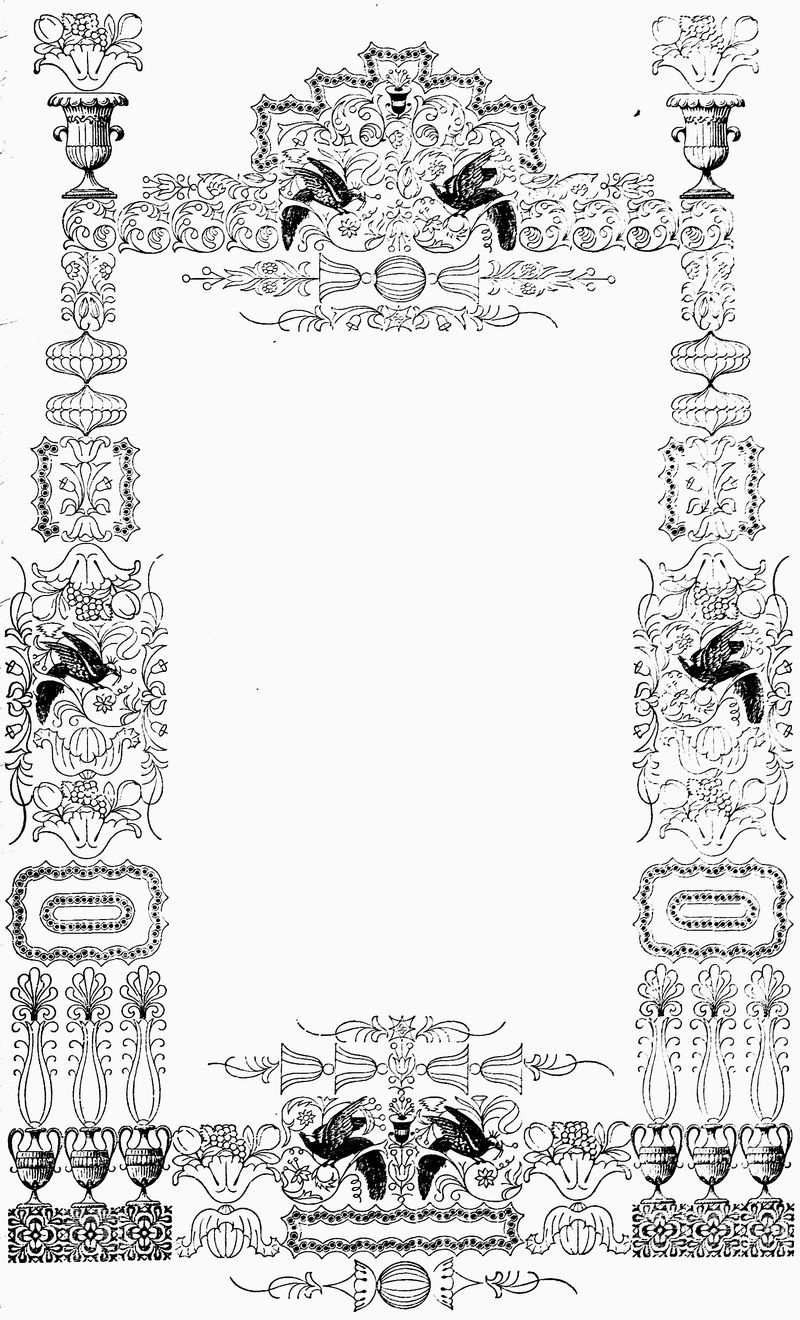
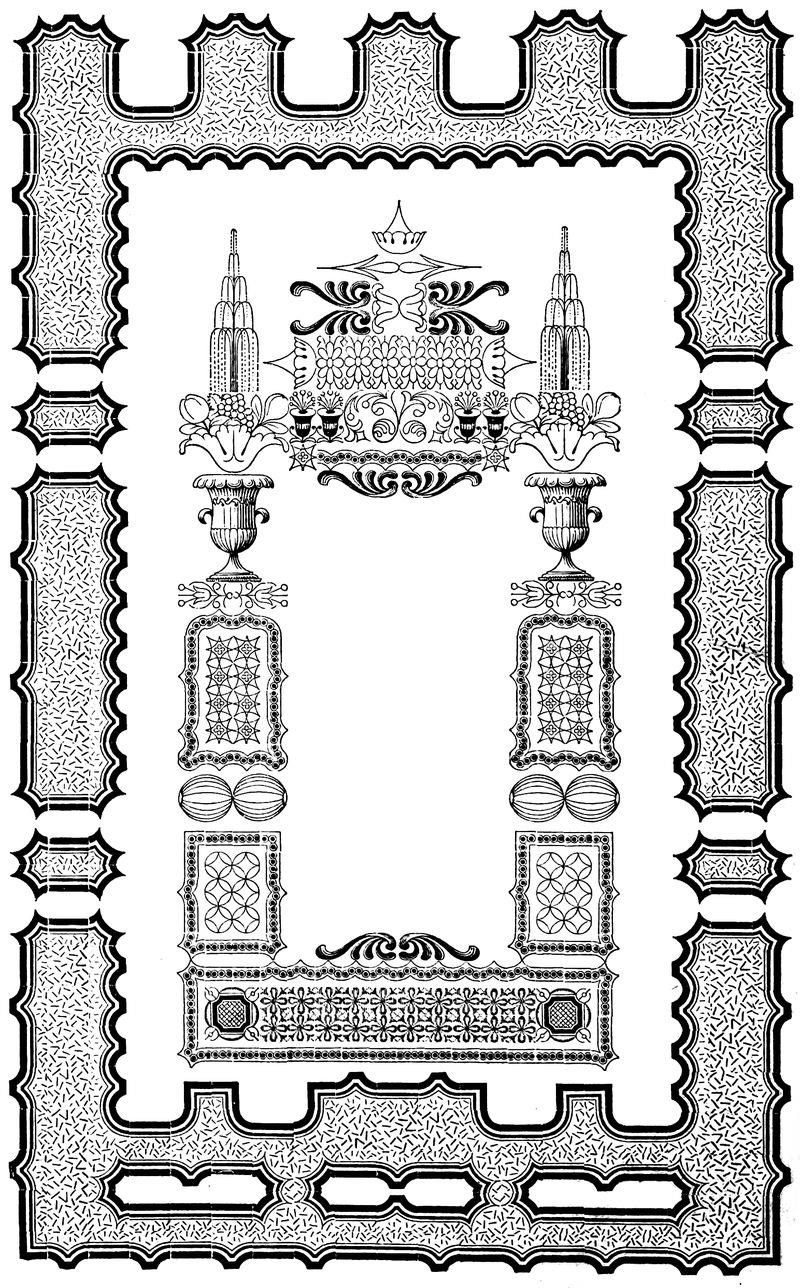
Matrix Plates. For stereotype printing, see Risers.
MATTER.
The series of the discourse of the compositor’s copy.—M. It now also means pages of types composed for any work; thus we have Set Matter, and Matter for Distribution, which see.
Matter for Distribution. Types that, having been composed for a work and printed off, are ready for use in another work, are, collectively, called Matter for Distribution.
MEASURE.
The width of a page. See Composing Stick.—M. See also Justify a Stick.
MEDHURST’S PRESS.
A few years ago, a new press was constructed by Mr. Medhurst, of London, the great recommendation of which was its simplicity, and consequent cheapness. In its general form it much resembled the iron presses in common use, the principal difference being in the manner in which the pressure was produced. This was accomplished by means of an ingenious arrangement of levers, differing so much from every thing previously employed in machinery, that the inventor described his contrivance as one which exhibited a new power in mechanics.
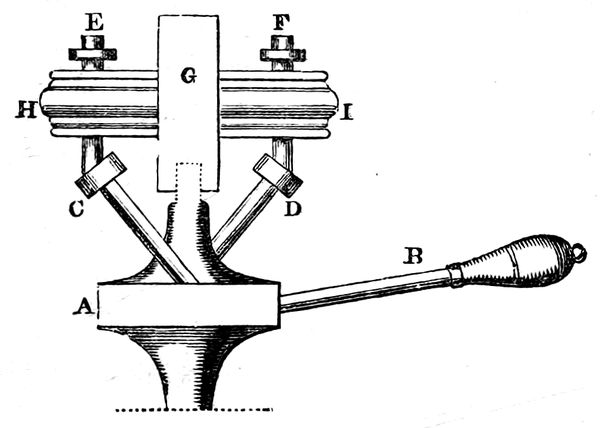
The principle upon which this press acts will be understood from the annexed sketch of the parts by means of which the impression is given. Instead of a screw, a plain spindle is employed: on the lower part of this spindle there is a swell or collar, A, into which the handle, or working bar of the press, B, is fastened. The upper part of this collar has cups or steps for the reception of two short iron props or pins, C, D, which extend up to the head of the press, and are there supported by the points of two screws, E, F, entering sockets cut out in the heads of the pins, which are made of steel. When the platen is up, these pins stand in an inclined position, as represented in the annexed figure: but when the lever handle is pulled towards the spectator, so as to turn the spindle, the two screws remain stationary, while the props come into a vertical position, thus forcing the spindle and attached platen to descend, as if a screw were employed. It may be observed that, in the figure, G is merely a section of the head of the press, which is supposed to be looked at sidewise, to present the back and front projections, H, I, through which the screws pass.—Lardner’s Cabinet Cyclopædia, 1833.
MEDICAL CONTRACTIONS
used in prescriptions, &c., with the words at length, and a translation. From Gray’s Supplement to the Pharmacopœia. 5th edit. 8vo. London, 1831.
A. Aa.—Ana, of each ingredient.
Abdom.—Abdomen, the belly; abdominis, of the belly; abdomini, to the belly.
Abs. febr.—Absente febre, in the absence of the fever.
Ad 2 vic.—Ad duas vices, at twice taking.
Ad gr. acid.—Ad gratam aciditatem, to an agreeable sourness.
Ad libit.—Ad libitum, at pleasure.
Add.—Adde, or addantur, add; addendus, to be added; addendo, by adding.
Admov.—Admoveatur, or admoveantur, apply.
Adst. febr.—Adstante febre, when the fever is on.
Aggred. febre.—Aggrediente febre, while the fever is coming on.
Altern. horis.—Alternis horis, every other hour.
Alvo adst.—Alvo adstricta, when the belly is bound.
Aq. bull.—Aqua bulliens, boiling water.
Aq. ferv.—Aqua fervens, boiling water.
Bis ind.—Bis indies, twice a day.
BB. Bbds.—Barbadensis, Barbadoes.
B. M.—Balneum maris, a sea-water bath.
Bull.—Bulliat, it should boil; bulliant, they should boil.
B. V.—Balneum vaporis, a steam heat.
Cap.—Capiat, take.
C. m.—Cras mane, to-morrow morning.
Coch. ampl.—Cochleare amplum, a large spoon.
Coch. infant.—Cochleare infantis, a child’s spoon.
Coch. magn.—Cochleare magnum, a large spoon.
Coch. mod.—Cochleare modicum, a dessert spoon.
Coch. parv.—Cochleare parvum, a small spoon.
Cœrul.—Cœruleus, blue.
Col.—Colatus, strained.
Colat.—Coletur, it should be strained; colaturæ, of or to the strained liquor.
Colent.—Colentur, they should be strained.
Comp.—Compositus, compounded.
Cont. rem.—Continuentur remedia, the medicines should be continued.
Contr.—Contritus, ground to a fine powder.
Coq.—Coque, boil; coquantur, they should be boiled.
C. P.—Codex of Paris.
Crast.—Crastinus, to-morrow.
Cuj.—Cujus, of which.
Cujusl.—Cujuslibet, of any.
Cyath. theæ.—Cyatho theæ, in a cup of tea.
Deaur. pil.—Deaurentur pilulæ, the pills should be gilt.
Deb. spiss.—Debita spissitudo, a proper consistence.
Decub.—Decubitus, of lying down.
De d. in d.—De die in diem, from day to day.
Dej. alvi.—Dejectiones alvi, stools.
Det.—Detur, it should be given.
Dieb. alt.—Diebus alternis, every other day.
Dieb. tert.—Diebus tertiis, every third day.
Dim.—Dimidius, one half.
Dir. prop.—Directione propria, with a proper direction.
Donec alv. bis dej.—Donec alvus bis dejiciat, until two stools have been obtained.
Donec alv. sol. fuer.—Donec alvus soluta fuerit, until a stool has been obtained.
Ejusd.—Ejusdem, of the same.
Enem.—Enema (en-e-ma), a clyster; enemeta, clysters.
Ext. sup. alut.—Extende super alutam, spread upon leather.
F. pil. xij.—Fac pilulas duodecim, make 12 pills.
Feb. dur.—Febre durante, during the fever.
Fem. intern.—Femoribus internis, to the inner part of the thighs.
F. venæs.—Fiat venæsectio, bleed.
Fist. arm.—Fistula armata, a clyster pipe and bladder fitted for use.
Fl.—Fluidus, liquid; also by measure.
Gel. quav.—Gelatinâ quâvis, in any kind of jelly.
G. G. G.—Gummi guttæ gambiæ, gamboge.
Gr.—Granum, a grain; grana, grains.
Gtt.—Gutta, a drop; guttæ, drops.
Gutt. quibusd.—Guttis quibusdam, with a few drops.
Har. pil. sum. iij.—Harum pilularum sumantur tres, three of these pills should be taken.
Hor. decub.—Hora decubitus, at going to bed.
Hor. som.—Hora somni, just before going to sleep; or on retiring to rest.
Hor. un. spatio.—Horæ unius spatio, at the expiration of an hour.
Hor. interm.—Horis intermediis, at the intermediate hours between what has been ordered at stated times.
Ind.—Indies, from day to day, or daily.
In pulm.—In pulmento, in gruel.
Inj. enem.—Injiciatur enema, a clyster should be given.
Lat. dol.—Lateri dolenti, to the side that is affected.
Lb.—Libra, a pound; or libra, weight, or a wine pint; when preceded by Arabic figures, Avoirdupois weight is generally meant; but when succeeded by Roman numerals, Troy weight, or pint measures.
M.—Misce, mix; mensura, by measure; manipulus, a handful.
Mane pr.—Mane primo, very early in the morning.
Min.—Minimum, the 60th part of a drachm measure.
Mtt.—Mitte, send; mittatur, or mittantur, there should be sent.
Mitt. sang. ad [ounce]xij. saltem.—Mittatur sanguis ad uncias duodecim saltem, blood should be taken away to 12 ounces at least.
Mod. præsc.—Modo præscripto, in the manner directed.
Mor. sol.—More solito, in the usual manner.
Ne tr. s. num.—Ne tradas sine nummo, you should not deliver it without the money: as a caution to the shopman, when the presence of the customer prevents the master giving a verbal direction.
N. M.—Nux moschata, a nutmeg.
O.—Octarius, a wine pint, being 1-8th of a gallon.
Ol. lini s. i.—Oleum lini sine igne, cold drawn linseed oil.
Omn. hor.—Omni hora, every hour.
Omn. bid.—Omni biduo, every two days.
Omn. bih.—Omni bihorio, every two hours.
Omn. man.—Omni mane, every morning.
Omn. noct.—Omni nocte, every night.
Omn. quadr. hor.—Omni quadrante horæ, every quarter of an hour.
O. O. O.—Oleum olivæ optimum, best olive oil.
Oz.—The ounce Avoirdupois, or common weight, as distinguished from that prescribed by physicians in their orders.
P.—Pondere, by weight.
P. Bat.—Pharmacopœia Batava.
P. Belg.—Pharmacopœia Belgica.
P. D.—Pharmacopœia Dublinensis.
P. E.—Pharmacopœia Edinensis.
P. L.—Pharmacopœia Londinensis.
P. L. V.—Pharmacopœia Londinensis [Vetus?] before 1745.
P. U. S.—Pharmacopœia of the United States.
Part. vic.—Partitis vicibus, to be given in divided doses, instead of all at once.
Per. op. emet.—Peracta operatione emetici, when the operation of the emetic is finished.
Post sing. sed. liq.—Post singulas sedes liquidas, after every loose stool.
P. r. n.—Pro re nata, according as circumstances occur.
P. rat. æt.—Pro ratione ætatis, according to the age of the patient.
Pug.—Pugillus, a gripe between the finger and thumb.
Q. p.—Quantum placet, as much as you please.
Q. s.—Quantum sufficit, as much as may suffice.
Quor.—Quorum, of which.
R.—Recipe, take; but for this the old authors, and the French to this day, use this sign ♃, being the old heathen invocation to Jupiter, seeking his blessing upon the formula, equivalent to the usual invocation of the poets and of Mahomedan authors, or the Laus Deo with which book-keepers and merchants clerks formerly began their books of account and invoices, a practice not yet quite extinct
Red. in pulv.—Redactus in pulverem, powdered.
Redig. in pulv.—Redigatur in pulverem, it should be reduced to powder.
Reg. umbil.—Regio umbilici, the parts near the navel.
Repet.—Repetatur, it should be continued; repetantur, they should be continued.
S. A.—Secundum artem, according to art.
Semidr.—Semidrachma, half a dram.
Semih.—Semihora, half an hour.
Sesunc.—Sesuncia, an ounce and a half
Sesquih.—Sesquihora, an hour and a half.
Si n. val.—Si non valeat, if it does not answer.
Si op. sit.—Si opus sit, if need shall be.
Si vir. perm.—Si vires permittant, if the strength will allow.
Sign. n. pr.—Signetur nomine proprio, write upon it the usual name, not the trade name.
Sing.—Singulorum, singularum, of each.
S. S. S.—Stratum super stratum, layer upon layer.
Ss.—Semi, a half.
St.—Stet, it should stand; stent, they should stand.
Sub fin. coct.—Sub finem coctionis, when the boiling is nearly finished.
Sum. tal.—Sumat talem, the patient should take one like this.
S. V.—Spiritus vinosus, ardent spirits of any strength.
S. V. R.—Spiritus vinosus rectificatus, spirit of wine.
S. V. T.—Spiritus vinosus tenuis, proof spirit, or half and half spirit of wine and water.
Temp. dext.—Tempori dextro, to the right temple.
T. O.—Tinctura opii, tincture of opium; generally confounded with laudanum, which is properly the wine of opium.
T. O. C.—Tinctura opii camphorata, paregoric elixir.
Trit.—Tritus, ground to powder.
Ult. præscr.—Ultimo præscriptus, the last ordered.
V. O. S.—Vitello ovi solutus, dissolved in the yelk of an egg.
Vom. urg.—Vomitione urgente, when the vomiting begins.
Z.—A mark in writing that a word is contracted, as in oz. for ounce.
Zz.—Zingiber, ginger.
℈.—Scrupulum, a scruple, equal to 20 grains Troy.
ʒ.—Drachma, a drachm, equal to 3 scruples; or, in liquids, the 8th part of an ounce measure.
℥.—Uncia, an ounce Troy; or, in liquids, the 16th part of a wine pint.
Meredith, Christopher. See Donations.
METAL.
The technical name of a mixture of metals properly so called, with which types and stereotype plates are cast.
In speaking of type metal, I shall first give Moxon’s description of making it, which is curious; and then some interesting observations on the same subject by M. Sage, from the Journal de Physique.
Moxon says—“What the metal founders make printing letters of, is lead hardened with iron: thus, they choose stub nails for the best iron to melt, as well because they are assured stub nails are made of good, soft, and tough iron, as because they (being in small pieces of iron) will melt the sooner.
“To make the iron run, they mingle an equal weight of antimony (beaten in an iron mortar into small pieces) and stub nails together. And preparing so many earthen forty or fifty pounds melting pots (made for that purpose to endure the fire) as they intend to use: they charge these pots with the mingled iron and antimony as full as they will hold.
“Every time they melt metal, they build a new furnace to melt it in: this furnace is called an open furnace; because the air blows in through all its sides to fan the fire: they make it of bricks in a broad open place, as well because the air may have free access to all its sides, as that the vapours of the antimony (which are obnoxious) may the less offend those that officiate at the making of the metal: and also because the violent fire made in the furnace should not endanger the firing any adjacent houses.
“They consider, before they make the furnace, how many pots of metal they intend to melt, and make the furnace sizeable to that number: we will suppose five pots. Therefore they first make a circle on the ground capable to hold these five pots, and wider yet by three or four inches round about: then within this circle they lay a course of bricks close to one another to fill the plain of that platform, with their broad or flat sides downwards, and their ends all one way, and on this course of bricks they lay another course of bricks as before, only the lengths of this course of bricks lies athwart the breadths of the other course of bricks; then they lay a third course of bricks with their lengths cross the breadth of the second course of bricks.
“Having thus raised a platform, they place these five pots in the middle of it close to one another, and then on the foundation or platform raise the furnace round about by laying the bricks of the first lay end to end and flat, close to one another: on the second lay, they place the middle of a brick over a joint (as the bricklayers call it) that is, where the ends of two bricks join together, and so again lay bricks end to end till they trim round the platform. Then they lay a third lay of bricks, covering the joints of the second lay of bricks as before: so is the foundation finished.
“Then they raise the walls to the furnace on this foundation; but do not lay the ends of their bricks close together, but lay the ends of each brick about three inches off each other, to serve for wind holes till they trim round about: then they lay another lay of bricks, leaving other such wind holes over the middle of the last lay of bricks, and so trim as they work round, either with half bricks or bats, that the wind holes of the last lay may be covered: and in this manner and order they lay so many lays, till the walls of the furnace be raised about three bricks higher than the mouths of the melting pots, still observing to leave such wind holes over the middle of every brick that lies under each lay.
“Then they fill the sides of the furnace round about the melting pots, and over them, with charcoal, and fire it at several wind holes in the bottom, till it burn up and all over the furnace, which a moderate wind in about an hour’s time will do: and about half an hour’s time after, they lay their ears near the ground and listen to hear a bubbling in the pots; and this they do so often till they do hear it. When they hear this bubbling, they conclude the iron is melted: but yet they will let it stand, perhaps half an hour longer or more, according as they guess the fire to be hotter or cooler, that they may be the more assured it is all thoroughly melted. And when it is melted, the melting pot will not be a quarter full.
“And in or against that time, they make another small furnace close to the first, (to set an iron pot in, in which they melt lead,) on that side from whence the wind blows; because the person that lades the lead out of the iron pot (as shall be shewed by and by) may be the less annoyed with the fumes of the metal, in both furnaces. This furnace is made of three or four course of bricks open to the windward, and wide enough to contain the designed iron pot, with room between it and the sides to hold a convenient quantity of charcoal under it, and about it.
“Into this iron pot they put for every three pound of iron, about five and twenty pounds of lead. And, setting fire to the coals in this little furnace, they melt and heat this lead red hot.
“Hitherto a man (nay, a boy) might officiate at all this work; but now comes labour would make Hercules sweat. Now they fall to pulling down so much of the side of the open furnace as stands above the mouth of that melting pot next the iron pot, and having a thick strong iron ladle, whose handle is about two yards long, and the ladle big enough to hold about ten pounds of lead, and this ladle red hot that it chill not the metal; they now, I say, with this ladle, fall to clearing this first melting pot of all the coals or filth that lie on the top of the melted metal; while another man at the same time stands provided with a long, strong, round iron stirring poot, the handle of which stirring poot is also about two yards long or more, and the poot itself almost twice the length of the depth of the melting pot: this poot is nothing but a piece of the same iron turned to a square with the handle: and this poot is also in a readiness heated red hot.
“Now one man with the ladle lades the lead out of the iron pot into the melting pot, while the other man with the poot stirs and labours the lead and metal in the melting pot together, till they think the lead and metal in the melting pot be well incorporated: and thus they continue lading and stirring till they have near filled the melting pot.
“Then they go to another next melting pot, and successively to all, and lade and stir lead into them as they did into the first. Which done, the metal is made: and they pull down the walls of the open furnace, and take away the fire that the metal may cool in the pots.
“Now (according to custom) is half a pint of sack mingled with sallad oil, provided for each workman to drink; intended for an antidote against the poisonous fumes of the antimony, and to restore the spirits that so violent a fire and hard labour may have exhausted.”—Moxon.
Smith, who published his Printer’s Grammar about seventy years after the appearance of Moxon’s work, says, “In Germany they use more than three ingredients to their metal, which is there made of steel, iron, copper, brass, tin, and lead; all which they incorporate with each other by means of antimony. This metal, if duly prepared, does not bend, but breaks like glass; it is harder than tin and lead, something softer than copper, and melts sooner than lead. This account I have of Mr. Struke, a printer at Lubec.”
“Observations on the Metallic Mixture made use of for casting Letters, or Characters, for Printing. By M. Sage. From the Journal de Physique.
“Lead and regulus of antimony, melted together in various proportions, form the metal used by letter founders, for casting their different types or characters. When I say that these metals are used in various proportions, I mean, that more or less of the regulus of antimony is mixed with the lead, according to the degree of hardness the types are required to possess. In general, eighty pounds of lead are added to twenty pounds of regulus of antimony, already melted: but, for the small characters, in which a greater degree of hardness is required, seventy-five pounds of lead are used to twenty-five pounds of regulus of antimony; and, for large ones, eighty-five pounds of lead, and fifteen pounds of regulus of antimony.
“These two substances, though of very different specific gravities [Lead, 11·35—Antimony 6·70.—W. S.], remain perfectly combined, and do not separate from each other by fusion, unless the fire made use of is so strong as to burn and volatilize them; in that case, the antimony begins to exhale.
“Letter founders should take care to employ only the purest regulus of antimony, or that which is the most free from sulphur; for, when it contains any of that substance, it acts upon the lead, in the course of time, and forms with it a kind of galena, which acquires a black colour. The letters cast with a mixed metal of that kind, instead of preserving their shining and polished appearance, become dull, and as it were cracked, forming also a sort of efflorescence. When this spontaneous decomposition takes place, the letters become brittle, and lose their form. Of this I have been convinced, by having analysed a mixture of this kind, with which M. Anisson had cast some Arabic characters.
“Having exposed some of the letters, made with this bad metal, to a violent fire, the sulphur it contained burnt, and exhaled, in the form of vitriolic acid. Having then poured the metal remaining in the crucible into an ingot, it acquired a white brilliant colour like silver; which colour did not become sensibly changed, by being left, for the space of six months, in a damp place.
“Regulus of antimony is prepared, in the large way, by melting calcined antimony, in a reverberatory furnace, with dried wine lees; from this is obtained the regulus, which is sold in the form of round cakes, on the surface of which are seen figures like the leaves of fern, &c. which figures are produced from the elements of octoëdral crystals. If the regulus, thus prepared, appears more grey in colour than when it is prepared according to Stahl’s process, it is because it still retains a portion of sulphur.
“At present, there is not found a sufficient quantity of regulus of antimony in commerce to supply the letter founders. It appears to me that, in the place of regulus of antimony prepared as above, we might substitute that which may be prepared with iron. One-fifth part of iron is sufficient to absorb all the sulphur with which antimony is mineralized. When this mixture is melted, it must be poured into a cone: the sulphuretted iron remains upon the surface of the regulus, and is very easily separated from it.
“This process is less expensive, and produces more regulus, than the process made use of by those who work the mines of antimony.
“Regulus of antimony, as we have seen, gives hardness to lead; but a much greater degree of hardness is produced by adding tin to the mixture. I have analysed some nails which were proposed to be used in shipbuilding, and found them to contain three parts of tin, two parts of lead, and one part of regulus of antimony. These nails were sufficiently hard to penetrate oak wood, without being blunted; and this metallic mixture is not acted upon by sea water, which very quickly decomposes iron.”
These observations of M. Sage show the utility of iron in the making of type metal by our predecessors, from its combining with the sulphur contained in the antimony.
Stereotype founders vary considerably the proportions of lead and regulus of antimony in making their metal. The hardest metal made, is in the proportion of ten pounds of regulus of antimony to forty pounds of tea lead; but the general proportions are ten pounds of regulus of antimony to sixty pounds of lead, which are said to make a mixture of a good quality.
METAL RULES.
Straight lines cast on pieces of metal similar to quadrats, but higher; they are rarely cast to founts larger than English. They are used as leaders; to cut off sums of money from the line which contains the sum total; for transverse lines in columns; sometimes for column rules, but very seldom; and for blanks, where the names of persons, &c., are omitted; em metal rules are sometimes used for divisions in a paragraph instead of a point. They are generally of one em, two ems, three ems, and four ems, but in English founts their size does not exceed three ems; sometimes there are en metal rules cast. Metal rules ought to be cast exactly on the middle of the body, and be continued precisely to the sides, so as to join each other at the ends, even if they are placed alternately with the sides reversed; should this not be the case, the continuity of the line must be broken, and it will necessarily have a disagreeable appearance.
Milled Lead. See Space Lines.
MINION.
The name of a type one size larger than Nonpareil, and one smaller than Brevier. Moxon does not enumerate this size in his list.
Modern Gothic. See Black Letter.
MONK.
When the pressman has not distributed his balls, some splotches of ink may lie on one or both of them, which in beating he delivers upon the form, so that the sheet printed on has a black blotch on it, which blotch is called a Monk—M. The same effect will take place also with rollers, if care be not taken to roll them backwards and forwards, as well as crossways on the inking table.
Mould for making Paper.—See Forgery.
MUSIC.
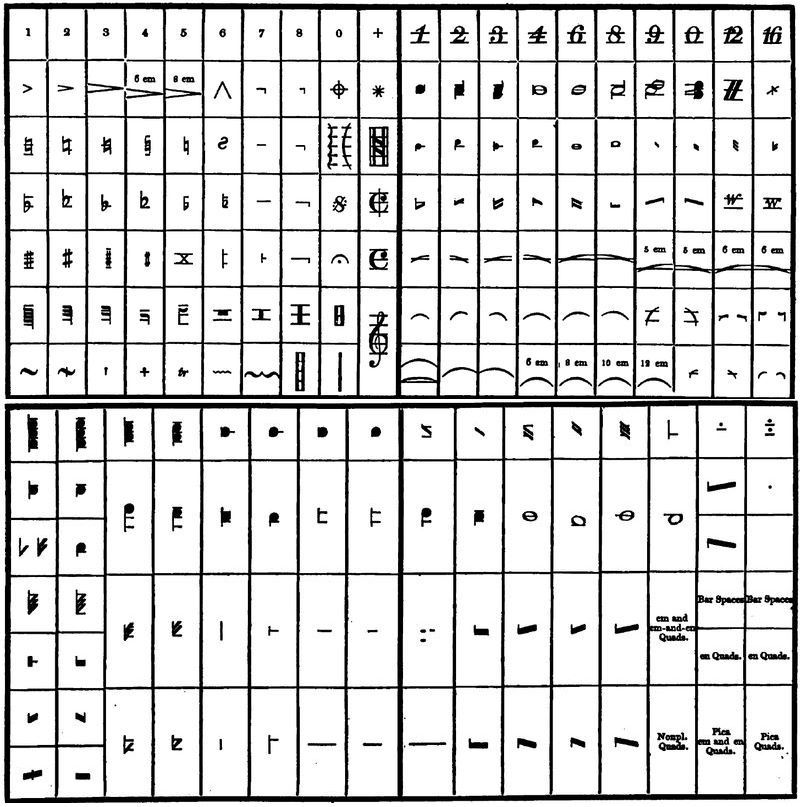
It is not necessary in this work to define what music is, nor enter at all into any disquisition on the subject, as the object is the printing of it only; and all that I shall attempt is to give the plan of a pair of Music Cases, with the characters, and a specimen.
The English musical types have never to my knowledge undergone any improvement, till within a few years, when Mr. Hughes cut two new founts, which are looked upon as the best we have, and the largest of which I have used for this article.
Mr. E. Cowper devised a plan for printing music, in which one page was the lines only, and the other page was the notes, &c. only, and the chase was prepared to turn upon a centre fixed in the table of a press: thus the first impression was that of the lines without the notes, &c. on one page, and the notes, &c. without the lines on the other; the form was then turned half round, and the second impression was, the lines on the notes on one page, and the notes on the lines on the other. There is an objection to this plan for good work, which is, that the page of notes requires a different making ready to the page of lines, and when the two are completed they will be unequal in the effect, for either the lines will be too strong, or the notes have too little impression.
Mr. R. Branston struck out a different mode: he produced his music by the usual process for printing it with the rolling press, only the punches were struck deeper in the plate, and he then took a stereotype plate from it in type metal, and after the white parts were blocked out the music was sufficiently in relief to be printed at the type press. Both these plans were adopted to preserve the continuity of the lines, which in types got rounded off by wear where they joined, and spoiled the appearance.
In distributing music, the compositor should be careful not to injure the corners of the lines.
Music of the Presses. When a house has sufficient business to employ all the presses within it, and a master printer walks through his press room when they are all at work, and hears the creaking of the heads, the thumping of the balls, the noise of the running in and out of the carriage, and all the other miscellaneous, and, to unaccustomed ears, discordant noises, he styles them the music of the presses, which he declares to be the finest music in the world, as it brings grist to his mill.
The Music of the Presses, before the introduction of cylindrical machines worked by steam engines, was a standing toast after dinner at all parties among printers; and I hope it will never be neglected.
C. HANCOCK’S PLAN OF CASES FOR HUGHES’ MUSIC TYPE.
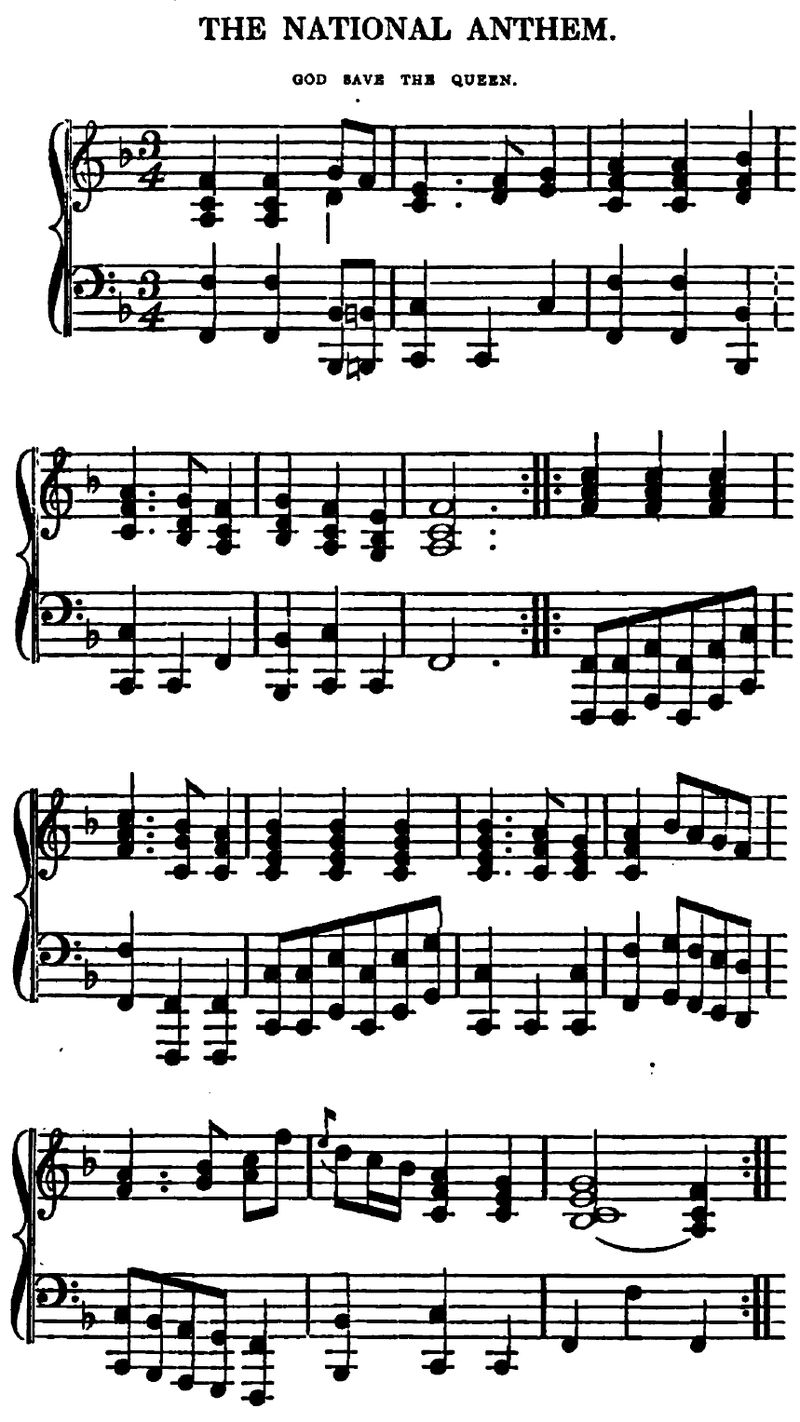
GOD SAVE THE QUEEN.