I.
Reading edition
IDENTIGRAPHY.
The Dutch papers in 1825 mentioned a new discovery in printing, to which the inventor gave the name of Identigraphy. It consists in a new application of the art of lithography, by which a reprint of common letterpress is obtained in a very short time; the inventor undertaking to reprint the foreign journals within two hours after their arrival by the mail.
Illuminator. See Fac.
IMPERFECTIONS.
Books.—In gathering books, when one sheet is off, the surplus of the other sheets is called Imperfections.—M.
We now call this surplus the Waste: and after the work is delivered, or is in a state of delivery, and the bookbinder, or any person in whose possession the book may be, discovers that a sheet, or part of a sheet, or a plate, or any part whatever, is wanting, to make the book complete, he applies for them; or he may apply to change a sheet that is either dirty or torn. These deficiencies, or defects, are now termed Imperfections. See Waste.
Letters.—When the founder has not cast a proportionable number of each sort of letter, the wanting letters are called Imperfections, as making the rest of the fount imperfect. See Sorts.—M.
IMPERFECT PAPER.
Paper sent into a printing office to print upon, without the extra quantity which partly constitutes perfect paper; thus a ream of imperfect paper consists of twenty quires of twenty-four sheets each, which makes a ream containing 480 sheets; in this state it is termed inside quires: sometimes, but rarely, it is sent in with the outside quires, in which case there are not so many sheets in a ream. See Paper; also Perfect Paper.
Imperial Press. See Sherwin and Cope’s Press.
IMPOSING,
is the arrangement of the pages of a sheet, or of a form, in their proper order on the stone, and the wedging of them up in a chase, with a view to their being printed.
The knowledge of thus laying down pages, so that the sheets may fold correctly when printed, is of essential consequence to every compositor engaged on book work.
A workman would be held inexcusable who did not know how to lay down with accuracy all the common sizes; viz. quartos, octavos, and duodecimos: but even with this knowledge he is frequently at a loss when at work upon sizes that do not frequently occur; and more particularly so at the close of a volume where there are fragments, which are required to be imposed together, for the purpose of saving presswork and warehouse work.
A youth, who has just gone to the business, feels a natural pride in showing that he is making progress; and he wishes to improve himself without having continually to appeal to his instructor; but he does not possess the means.
The young man from the country, who has been educated in a house where there has not been much book work done, which is generally the case, and who, of course, is not very expert at his profession, when he comes to work in an extensive book house in town, feels his deficiency, and more particularly if he has to lay down his pages in a large companionship; he does not like to acknowledge his ignorance, nor to ask for information: he has consequently to work his way at a great disadvantage.
Under these circumstances it frequently happens that the pages are laid down wrong, which causes a great deal of trouble and loss of time in their rectification; and this trouble is considerably increased if the work be on a small type and solid. In this case, if the cords have been taken off, it is not advisable to transpose the pages without wetting them, for fear of breaking the matter, or at least squabbling it; the form has then to be dried, before the pressman can pull another proof.
All the works on Printing hitherto published, are deficient in giving a sufficient variety of tables for imposing, as a reference for the workman, as well as for the reader and the master printer. This deficiency of reference occasionally causes the compositor to re-impose his forms, as I just now observed, and also in many instances to cut up new furniture.
To remedy this inconvenience I have considerably exceeded the number of what has been given in any other work, by adding such tables as are likely to occur in practice, and to which there has hitherto been no reference.
I have given all the Tables of Imposition that are in Luckombe and in Stower, except a half-sheet of sixty-fours, although I disapprove of the arrangement of the pages in many of them, from their not cutting up or folding in the most convenient manner; yet, as they have been acted on in a great number of instances, I would not reject them, it being advisable in reprints to preserve uniformity, which may enable the proprietor to make up a few more copies from the waste of both editions. I have added several, in which I think there is an improvement in these particulars.
I have also endeavoured to make each size complete, by giving a sheet, a half sheet, a quarter of a sheet, and the usual fragments that occur; varying the arrangement of the pages in a great number of instances, to suit the different ways of folding the paper.
The whole of the signatures in each form are given, that they may serve as a guide in laying down the pages, particularly where there are a great number in a sheet; they might then all be taken out, if thought proper, except the first, and the first in the offcut, which are the only ones I would retain, and all that are necessary, the others causing the bottoms of the pages to look unsightly; for the person who folds the sheets has only to keep the signature at the outside, and the pages must be folded right.
When works are in half sheets, it is advantageous to work two together, as it enables the bookseller to deliver a single copy in sheets without cutting up the back; and also at the conclusion of a work that is in sheets where there are two half sheets, as it saves time and trouble in the warehouse; it not being necessary to divide the sheet and insert a half in each volume, but the whole sheet may be gathered in the volume to which either of the signatures belongs; by which means there will be fewer mistakes, and fewer imperfections required.
When we arrive at a great number of pages in a sheet, they resolve themselves into the same order as quartos, octavos, and duodecimos; and in these cases I have repeated the imposition rather than refer to another size, which is not always very clearly understood when two, three, or more sheets are combined. Upon this principle I have repeated the half sheets, quarter sheets, and fragments, so as to make each size complete in itself.
It is usual when a fragment at the end of a volume makes six pages to impose it as eight: in this case there are two blank pages. Sometimes the author fills these up, by adding to the text; at other times the bookseller occupies them with advertisements of other publications in which he is interested.
When a compositor lays down his pages, it might prevent mistakes if he looked over them to see that they were right before he untied the page cords; and it is a good check to examine the folios of every two adjoining pages in a quarter, to see that their sum makes one more than the number of pages in the sheet, or half sheet: thus, in a sheet of folio, 1 and 4, equal to 5, are imposed together; in a quarto, 1 and 8; in an octavo, 1 and 16; in a duodecimo, 1 and 24; in sixteens, 1 and 32; in eighteens, 1 and 36; and so in every other size: and this combination continues through all the other adjoining pages, according to the order in which they lie on the stone, calling the first page in the sheet 1, the second 2, and so on in succession.
The short cross is always better in the middle of the chase, if the margin will allow it; as it divides the matter more equally, and the form is safer when it is locked up.
If it be the first sheet of a work that is to be imposed, or it be found necessary to increase the number of sheets in chase, the compositor applies to the overseer, or to the person who has the care of the materials, for a pair of chases.
The pages being laid upon the stone in their proper order, and as near the required distance from each other as can be determined by the eye, the compositor then places his chases; he takes one with both hands and lays the off side or end, as it may be, on the stone at the outer side of his pages, and lowers the near side gradually, till it lies flat on the stone, taking care that the inner edges of the chase and the cross bars do not rest on the face of the pages to injure them, and that the grooves in the short cross are upwards.
The furniture has now to be cut for the sheet; but previous to doing this it is necessary to ascertain what kinds of it will be wanted, by trying the margin with a sheet of paper of the work, otherwise a great risk is run of cutting an expensive article to waste, and of incurring also a loss of time, both of which should be avoided if possible. The manner of making margin will be explained under its proper head. See Margin.
I would recommend that the headsticks in octavos should be in two pieces, each of them a little longer than the page is wide; this will allow the gutters to be a little longer than the page, so that they will come close to the footsticks at the bottom, and at the other end will go between the headsticks, thus securing the inside of the two pages, without any risk of the gutters binding when locked up, which they are apt to do when cut to the precise length of the page, as is the custom when the headsticks for each quarter are in one piece. The gutters thus being equal to about three picas more in length than the page, will answer for other works where the page is of the same width, but different in length.
The headsticks and gutters being arranged, the compositor will cut his backs a little longer than the page, and these abutting against the headsticks that project beyond the page towards the cross, will secure that side. The sidesticks should be of the full length of the page, and abut against the headsticks on the outside of the form. The footsticks may be a trifle shorter than the width of two pages and the gutter; for as there should always be a line of quadrats, or a reglet cut to measure, at the foot of each page, the footstick may be a pica shorter without danger, on this account, of any thing falling out, when the form is lifted, and it thus prevents the side and foot sticks from binding when locked up.
By cutting the furniture in this manner, the compositor will at once perceive that all his pages will be secure, and that the furniture cannot bind in any place when locked up. The gutter is pushed down to the footstick, and extends beyond the top of the pages; the two headsticks abut against the gutter, and project a little beyond the sides of their pages; the back is pushed up to the headstick, and extends a little below the bottom of the page; the footstick abuts against the back, and by being about a pica short prevents the sidestick from binding against it; and the sidestick abuts against the head, and extends the full length of the page: neither is there any impediment to driving the quoins.
I would never cut the heads and the backs of such a length as to project beyond the side and foot sticks; for when they do, they are in the way of the shooting stick, if a quoin has been driven close up, when the form has to be unlocked. Neither should the headstick project so much as the thickness of the back; nor the extra length of the gutter be so much as the headstick; otherwise they will bind and prevent the form from rising.
When the sidestick or footstick is so long as to project one beyond the other, it prevents the quoin from passing, and in unlocking causes a great deal of trouble to get it out; I have, in such cases, frequently seen the sidestick broken or spoiled in the attempt, and a page squabbled or broken. This arises from carelessness or idleness, both which generally cause more trouble ultimately than if the work were properly performed in the first instance. If it be thought unnecessary or wasteful to cut down side or foot sticks for a job, or a pamphlet, when there are none of a proper length in the house, a piece of furniture taken out of the drawer of the proper length and width, and placed inside next the page, will remedy the inconvenience, and cause the quoin to be driven with ease.
When placing the furniture about the pages leave the ends of the page cords out, so that they may be easily taken off, without the necessity of disturbing the pages to find the end, which will be the case if they be tucked in.
The furniture being now round the pages, I would recommend to the compositor to put some quoins round the form, not with any particular care that they fit, but merely to secure the pages, and by their means to push them up close to the heads, backs, and gutters.
After having taken a page cord from a page push up that page close to the furniture at the back and head, by means of the side and foot stick, to prevent the letters at the ends of the lines from falling down, and also tighten the quoins gently with your fingers.
All the page cords being taken off, and the pages pushed up close at the sides and heads, it will next be necessary to examine particularly that the margin be right; as also to put one or two scaleboards in all the backs and the heads between the furniture and the crosses. These scaleboards enable the pressmen to make register if there be any inequality in the furniture or the crosses, by changing their situations, or taking some of them away; they also enable the compositor to make the distance between the pages in the backs and heads uniform, which should always be the case; and no form of book work that has to be printed on both sides of the paper should ever be imposed without them. But scaleboard is never used in the gutters.
The form has now to be quoined, which many compositors are in the habit of doing very carelessly, thinking that if the form lifts it is quite sufficient. This is an erroneous opinion, and frequently causes errors from the slovenly manner in which the quoining is done, letters and even lines dropping out when the form is laid on the press, or taken off, which do not always get replaced correctly; and the pages are more likely to fall out if they stand a few days at the end of a bulk. As I have previously described the imposing of an octavo, I shall continue my observations with respect to that size, but the principle is the same whatever the size may be. I would have two quoins for each sidestick, not put in indiscriminately, but the furthest quoin when driven tight, to be about three quarters of an inch from the broad end of the sidestick, which will allow room for the shooting stick in unlocking, as also for the form being tightened if the furniture shrinks; and the other quoin when driven tight to be its whole length fairly within the sidestick, because this end of the stick being thin, will be liable to spring from the page if the quoin be driven far in, and thus leave the letters behind insecure, and in danger of falling out: I would have two for the footstick in the same situations, and a third in the middle to cover the end of the gutter. Each quarter, of a form of octavo, thus quoined, will be perfectly secure when the quoins are driven tight, provided the pages be made up to the same length, and the lines properly justified; should this not be the case, the compositor will be obliged to vary the quoining, to meet the evil of bad workmanship.
Before he tightens his quoins he examines whether the pages in the same quarter be of equal length, which he does by pressing against the footstick with his thumbs, and raising it a little from the stone; if it lifts up with it equally the ends of both the pages against which it presses, he is satisfied they are right, and tries the other quarters in the same manner; if he finds any of the pages short, he examines them to find out where the deficiency is and supplies it; sometimes a lead is wanting, sometimes a line. This will arise occasionally from the carelessness of some compositors who will not take the trouble of cutting a gauge by which to make up their pages, but do it by counting the lines; they sometimes omit a line, sometimes have a line too much, and sometimes are equally incorrect with their leads: in other cases I have known gauges cut carelessly of an improper length, which causes the same evil; and it also occasionally arises from having the gauges of three or four different works cut on the same piece of reglet, and mistaking one for the other. See Gauge.
I should now push the quoins up all round with my fingers, to confine the pages slightly, and then plane the form down gently by striking the planer with the fist; if any letters stand up they are easily pressed down by this mode of proceeding, without injuring their face; after this is done, it is necessary to examine the sides of the pages, to see that no letters have slipped out of their places at the ends of the lines, which is frequently the case when pages which have been tied up have lain under the frame some time; it may also happen in taking the page cords off, particularly if they be knotted. Having examined the pages, and rectified any thing that was found amiss, which is easily done in this state of the form, I should gently tighten the quoins all round the form in an equal manner with the mallet and shooting stick, and then plane down, but not violently; if any letters stand up, from some substance being underneath, as a space, or a letter, or a bit of the page paper, which will sometimes get torn off and remain, it will be better to omit planing that part down for the present, as it would only injure the type and answer no good purpose: the quoins should then be driven as tight as is necessary, still doing it regularly and equally all round the form, when the form should be planed down again, which may be done with firmer blows than before, still omitting the part where the letters stand up.
The form may now be lifted from the stone at the front edge, just sufficient to allow the compositor to see whether it will rise or not, but not so high as that a letter would drop out; if it dances, it must be dropped down again upon the stone, and the lines tightened by thrusting the point of a bodkin between some of the words, and tightening the quoins; thus bad workmanship causes fudges, and in this case is never safe, for the letters are always in danger of being drawn out at press. But it may arise from a letter having slipped down at the end of a line: in this case the remedy is easy, to unlock the quarter and put the letter in its proper place; when this is done, and the form will rise, take the substance that was under it completely away, lay the form down again, loosen the quoins in that quarter, then plane it down, and lock it up as before directed.
The forms should now be brushed over with the letter brush, and taken to the proof press, and the pressman should be told to pull them,—In some houses the proof press is in the press room, in that case the compositor either calls out “Proof,” or asks, “Who’s in Proofs?” and then tells the party how it is to be pulled, First Proof, or Clean; sometimes the proof press is in the composing room, and the compositor either calls out “Proof” to them, or rings a bell, different houses having different customs in this respect.
I would always put the flat side of the furniture upwards, as it is more convenient for the pressmen, when it is necessary to place bearers on the frisket; since they operate better on this surface than on the hollow side, and can be placed on any part of it.
In my opinion it is preferable to have each part of the furniture in one piece, where it is practicable; as, for instance, the gutters, the backs, and the heads; which prevents the pieces from being transposed, and the margin from getting wrong: but sometimes pieces will be wanted of a width that is not equal to any regular size, and then two must be used.
To prevent as much as possible one piece of furniture from being mistaken for another in the hurry of business, I would cut all the gutters of one sheet of a precise length; so also would I do with the backs, as also with the heads; but each sort should be of a different length from that of the others;—thus, though all the gutters would be exactly of a length, yet would they be of a different length from that of the heads and backs, and so of the others; and thus they would be easily distinguished from each other, and mistakes would be prevented.
The sheet being now imposed, the stone must be cleared; the saw and saw block put in their places—the shears—the mallet, planer, and shooting stick—the surplus furniture—the scaleboard—the quoins—and every other article; for in most houses there is a fine for leaving a foul stone. The compositor will tie up his page cords, and if he has any companions will return to them their proportion.
In imposing a sheet from the furniture of one that has been worked off, in the regular process of business, there are certain circumstances to be attended to, which are frequently omitted:—The chase and furniture of one form should always be used for a similar form; that is, the chase and furniture of the outer form should be again used for an outer form, and the chase and furniture of the inner form should be again used for an inner form; they should also be put round the pages in the same order in which they were put about those of the preceding forms. For want of care or thought in these apparently trifling circumstances a great deal of trouble, inconvenience, and loss of time, are frequently incurred; for the register will be almost sure to be wrong when this is neglected, and then the forms must be unlocked, and the scaleboards changed, some of them having to be taken out, or fresh ones to be inserted, and this accompanied by a great deal of dissatisfaction.
I have found it to be a saving of time to be a little methodical in imposing; I take out my quoins and lay them on the adjoining pages in their regular order, then, after the chase has been put over the pages, and the furniture about them, there is no loss of time in replacing the quoins, or in finding the proper situation for each of them: the page cords are then taken off; the quoins tightened; the form planed down, &c., as detailed in the preceding paragraphs for imposing the first sheet of a work.
It should always be borne in mind that the quoins ought to be tightened regularly and uniformly round the form; for if one quarter be locked up at once before the quoins are tightened in the other quarters, the whole will be distorted, and the pressmen will have great difficulty in making register.
After the furniture has been taken from a form for the purpose of imposing another, it will be the means of preventing the matter for distribution from going into pie if the compositor tie a cord about each page; at least it may prevent an accident, and save him some trouble.
The chases for a sheet ought always to be in pairs; for if they be of different sizes, or the rims of different thickness, it causes the pressmen to lose time in making register, when both forms are worked at the same press, and often occasions the spoiling of two or three sheets of paper before that object is accomplished.
Before the compositor locks up his form, but after the pages are pushed up close to the backs and the heads, he should cut a gauge to fit exactly the intervals between the backs and the heads; and a sheet should never be carried into the press room for press, without the margin having been tried by this gauge to see that it is right, and to correct it, if it should be wrong: for as the pressmen have frequently occasion to alter the scaleboards in working the reiteration, this alteration will necessarily affect the furniture of the succeeding sheet. I have always used two small pieces of clean reglet, brevier or longprimer, and have cut them to the precise length; I wrote on both in ink the name of the work to prevent mistakes, as also the words ‘Back’ and ‘Head’ on each respectively; made a hole through them with my bodkin, tied them together with a piece of page cord, and hung them on a nail within my frame, so that they were always ready for use.
I shall now enumerate the tables of imposition in the following pages, and add observations where it may appear necessary, to make them as clear as it is in my power to do, not only to facilitate the operation, but in many instances to give information that may be of service; and in some cases to accommodate the bookbinder, who is seldom thought of in a printing office, but who, in my opinion, ought to be constantly considered: for I hold that the binding of a book should be always kept in view, as we are all anxious to see how our work looks when it is splendidly dressed by his skill; and it would consequently not be just if we did not do all in our power to accommodate him: stating this opinion will also show my reason for making some of the observations, as it is a point that has hitherto been neglected in all practical works on printing.
I shall also notice the errors, where they occur, of my predecessors, not for the sake of finding fault, or of depreciating their labours, but to save trouble to the workman; for, by some unaccountable cause, wherever Luckombe has made a mistake, or committed an error, it has been copied by subsequent writers, who do not appear to have examined his arrangement of the pages, but to have taken it for granted they were right, and have thus continued his errors.
The writers since Smith have not, I think, reasoned correctly on this part of a practical work; they seem to have made a merit of not adding to this department, by attending too strictly to an observation of his, saying that there may be many more fanciful ways of folding a sheet of paper. So there may, with which it may not be necessary to encumber a book; but why reject those that are useful and of frequent occurrence? why omit giving the mode of imposing fragments that continually occur at the end of a work? and that generally cause loss of time in arranging them, which might easily have been avoided; which omission I have endeavoured to supply: for this is the part of a work on printing that may be equally useful as a reference to the experienced workman as to the novice, and which I have frequently seen much wanted.
Smith’s words are, after enumerating the different Tables of Imposition which he has given—“More Irregular Sizes we have not thought fit to introduce; else we might have drawn out Schemes for Imposing Six’s, 10’s, 14’s, 20’s, 28’s, 30’s, 40’s, 42’s, 50’s, 56’s, 60’s, 80’s, 100’s, and 112’s; these, and several more being Sizes that have been found out not so much for use as out of fancy, to show the possibility of folding a piece of paper into so many various forms.”—p. 257. Upon this passage have all subsequent writers formed their excuse for leaving the different methods of imposing pages in an imperfect and erroneous state: the errors commenced with Luckombe.
As it may facilitate reference, I have given in the following enumeration the initials of the different authors in whose works the same forms will be found.—M. refers to Moxon; Sm. to Smith; L. to Luckombe; St. to Stower; J. to Johnson; H. to Hansard; Ma. to Magrath; and Mas. to Mason. Where there are no initials, the arrangement has not, to my knowledge, been given before in any English book, and is only to be found in this work.
TABLES OF IMPOSITION.
When imposing the first sheet of a new work, it may be serviceable to refer to the preceding observations, for a choice of the best method; and also for directions how to transpose the pages in working the reiteration, when a transposition is required.
The running Number corresponds with that in the Enumeration.
1. ABSTRACT OF TITLE DEEDS.
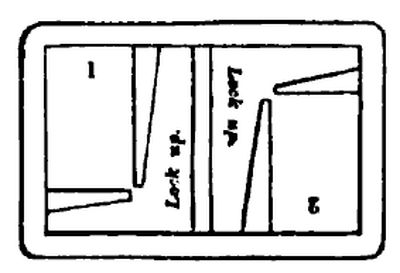
2. SHEET OF FOLIO.
Outer Form. Inner Form.
1 4 3 2
A
3. SHEET OF FOLIO. HEBREW.
Inner Form. Outer Form.
2 3 4 1
A
4. TWO SHEETS OF FOLIO, QUIRED.
Outer Form of the Outer Sheet. Inner Form of the Outer Sheet.
1 8 7 2
A
Outer Form of the Inner Sheet. Inner Form of the Inner Sheet.
3 6 5 4
A2
5. THREE SHEETS OF FOLIO, QUIRED.
Outer Form of the Outer Sheet. Inner Form of the Outer Sheet.
1 12 11 2
B
Outer Form of the Second Sheet. Inner Form of the Second Sheet.
3 10 9 4
B2
Outer Form of the Third Sheet. Inner Form of the Third Sheet.
5 8 7 6
B3
6. HALF A SHEET OF FOLIO.
1 2
7. SHEET OF QUARTO.
Outer Form. Inner Form.
[B2]
[4] [5] [6] [3]
1 8 7 2
B
8. SHEET OF QUARTO. HEBREW.
Inner Form. Outer Form.
[B2]
[3] [6] [5] [4]
2 7 8 1
B
9. TWO HALF SHEETS OF QUARTO, WORKED TOGETHER.
Outer Form. Inner Form.
[B*]
[2*] [3*] [4*] [1*]
1 4 3 2
B
10. HALF A SHEET OF QUARTO. 11. HALF A SHEET OF QUARTO. HEBREW.
[2] [3] [3] [2]
1 4 4 1
B B
12. TWO SHEETS OF QUARTO, QUIRED.
Outer Form of the Outer Sheet. Inner Form of the Outer Sheet.
[B2]
[4] [13] [14] [3]
1 16 15 2
B
click here for larger image.
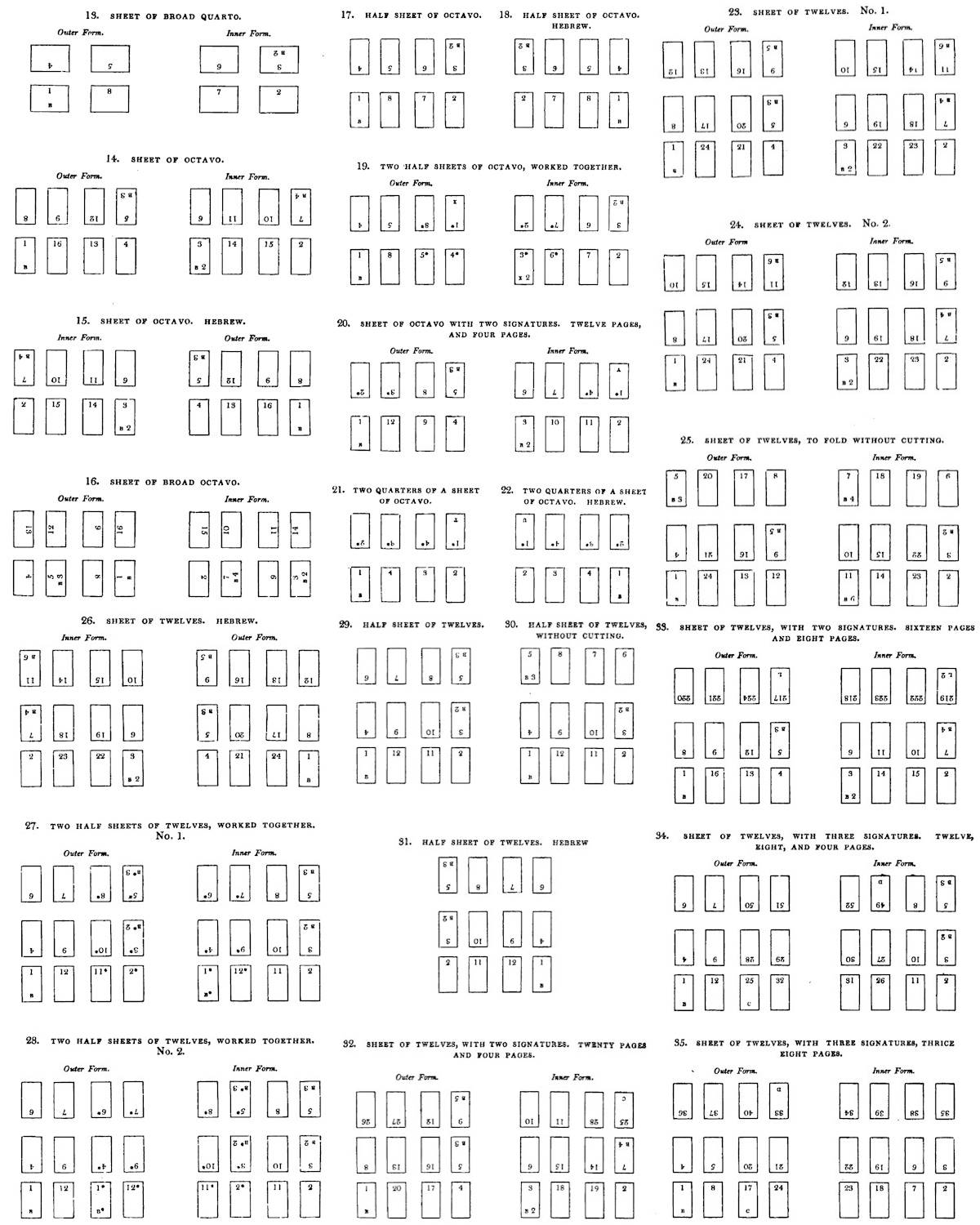
13. SHEET OF BROAD QUARTO. 17. HALF SHEET OF OCTAVO. 23. SHEET OF TWELVES. No. 1.
14. SHEET OF OCTAVO. 18. HALF SHEET OF OCTAVO. HEBREW. 24. SHEET OF TWELVES. No. 2.
15. SHEET OF OCTAVO. HEBREW. 19. TWO HALF SHEETS OF OCTAVO, WORKED TOGETHER. 25. SHEET OF TWELVES, TO FOLD WITHOUT CUTTING.
16. SHEET OF BROAD OCTAVO. 20. SHEET OF OCTAVO WITH TWO SIGNATURES. TWELVE PAGES, AND FOUR PAGES.
21. TWO QUARTERS OF A SHEET OF OCTAVO.
22. TWO QUARTERS OF A SHEET OF OCTAVO. HEBREW.
26. SHEET OF TWELVES. HEBREW. 29. HALF SHEET OF TWELVES. 33. SHEET OF TWELVES, WITH TWO SIGNATURES. SIXTEEN PAGES AND EIGHT PAGES.
27. TWO HALF SHEETS OF TWELVES, WORKED TOGETHER. No. 1. 30. HALF SHEET OF TWELVES, WITHOUT CUTTING. 34. SHEET OF TWELVES, WITH THREE SIGNATURES. TWELVE, EIGHT, AND FOUR PAGES.
28. TWO HALF SHEETS OF TWELVES, WORKED TOGETHER. No. 2. 31. HALF SHEET OF TWELVES. HEBREW 35. SHEET OF TWELVES, WITH THREE SIGNATURES, THRICE EIGHT PAGES.
32. SHEET OF TWELVES, WITH TWO SIGNATURES. TWENTY PAGES AND FOUR PAGES.
click here for larger image.
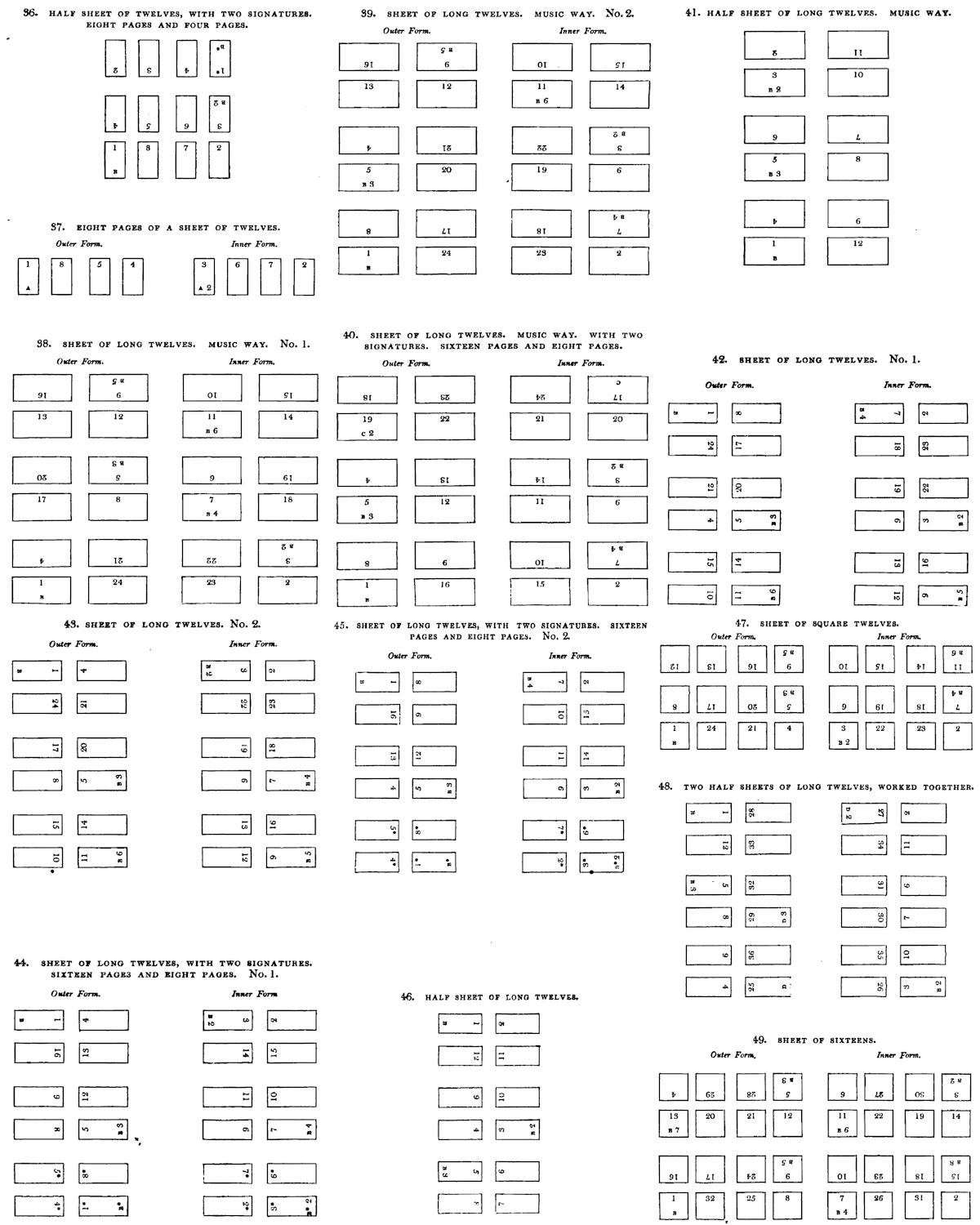
36. HALF SHEET OF TWELVES, WITH TWO SIGNATURES. EIGHT PAGES AND FOUR PAGES. 39. SHEET OF LONG TWELVES. MUSIC WAY. No. 2. 41. HALF SHEET OF LONG TWELVES. MUSIC WAY.
37. EIGHT PAGES OF A SHEET OF TWELVES. 40. SHEET OF LONG TWELVES. MUSIC WAY. WITH TWO SIGNATURES. SIXTEEN PAGES AND EIGHT PAGES. 42. SHEET OF LONG TWELVES. No. 1.
38. SHEET OF LONG TWELVES. MUSIC WAY. No. 1.
43. SHEET OF LONG TWELVES. No. 2. 45. SHEET OF LONG TWELVES, WITH TWO SIGNATURES. SIXTEEN PAGES AND EIGHT PAGES. No. 2. 47. SHEET OF SQUARE TWELVES.
44. SHEET OF LONG TWELVES, WITH TWO SIGNATURES. SIXTEEN PAGES AND EIGHT PAGES. No. 1. 46. HALF SHEET OF LONG TWELVES. 48. TWO HALF SHEETS OF LONG TWELVES, WORKED TOGETHER.
49. SHEET OF SIXTEENS.
click here for larger image.
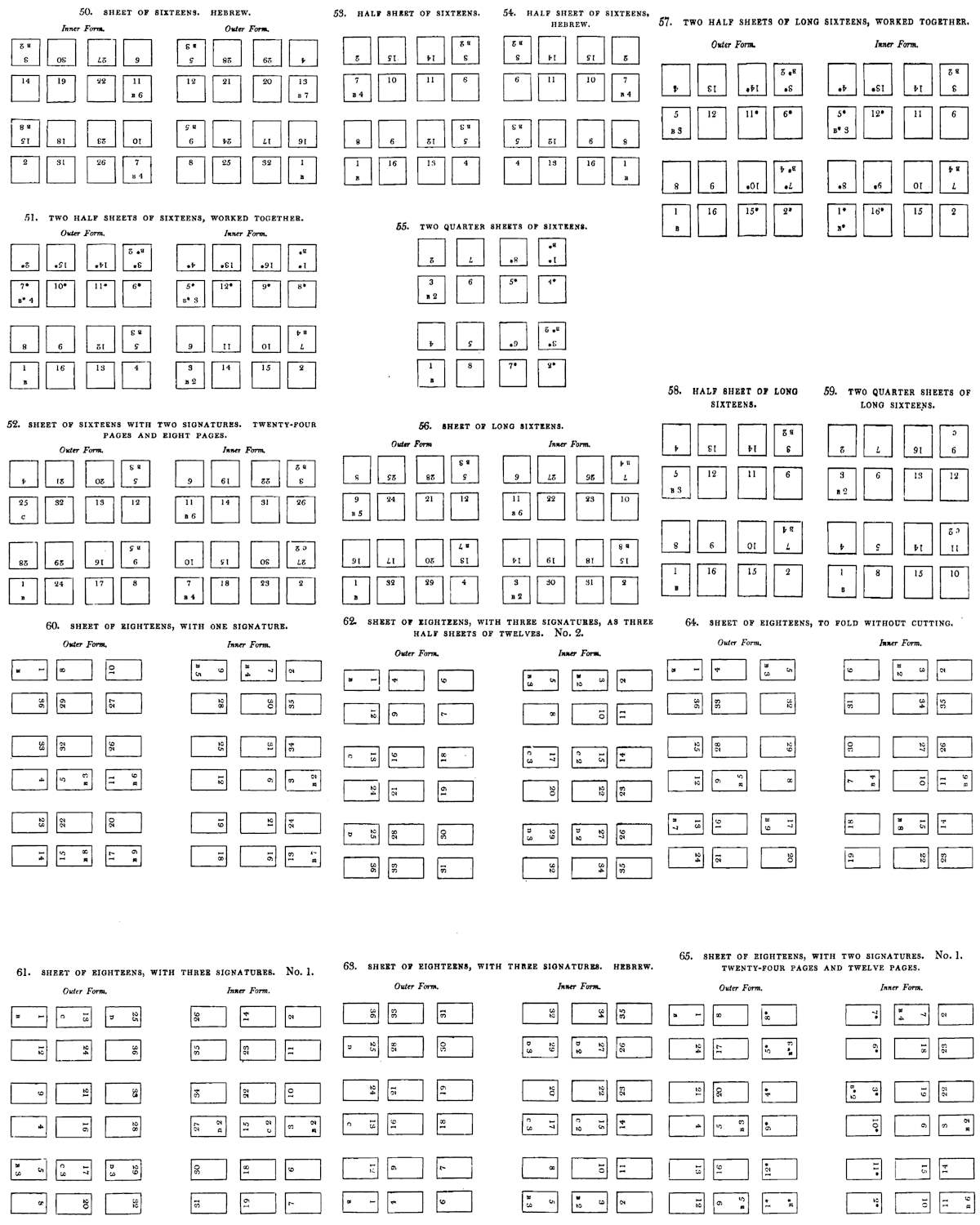
50. SHEET OF SIXTEENS. HEBREW. 53. HALF SHEET OF SIXTEENS. 57. TWO HALF SHEETS OF LONG SIXTEENS, WORKED TOGETHER.
51. TWO HALF SHEETS OF SIXTEENS, WORKED TOGETHER. 54. HALF SHEET OF SIXTEENS, HEBREW. 58. HALF SHEET OF LONG SIXTEENS.
52. SHEET OF SIXTEENS WITH TWO SIGNATURES. TWENTY-FOUR PAGES AND EIGHT PAGES. 55. TWO QUARTER SHEETS OF SIXTEENS. 59. TWO QUARTER SHEETS OF LONG SIXTEENS.
56. SHEET OF LONG SIXTEENS.
60. SHEET OF EIGHTEENS, WITH ONE SIGNATURE. 62. SHEET OF EIGHTEENS, WITH THREE SIGNATURES, AS THREE HALF SHEETS OF TWELVES. No. 2. 64. SHEET OF EIGHTEENS, TO FOLD WITHOUT CUTTING.
61. SHEET OF EIGHTEENS, WITH THREE SIGNATURES. No. 1. 63. SHEET OF EIGHTEENS, WITH THREE SIGNATURES. HEBREW. 65. SHEET OF EIGHTEENS, WITH TWO SIGNATURES. No. 1. TWENTY-FOUR PAGES AND TWELVE PAGES.
click here for larger image.
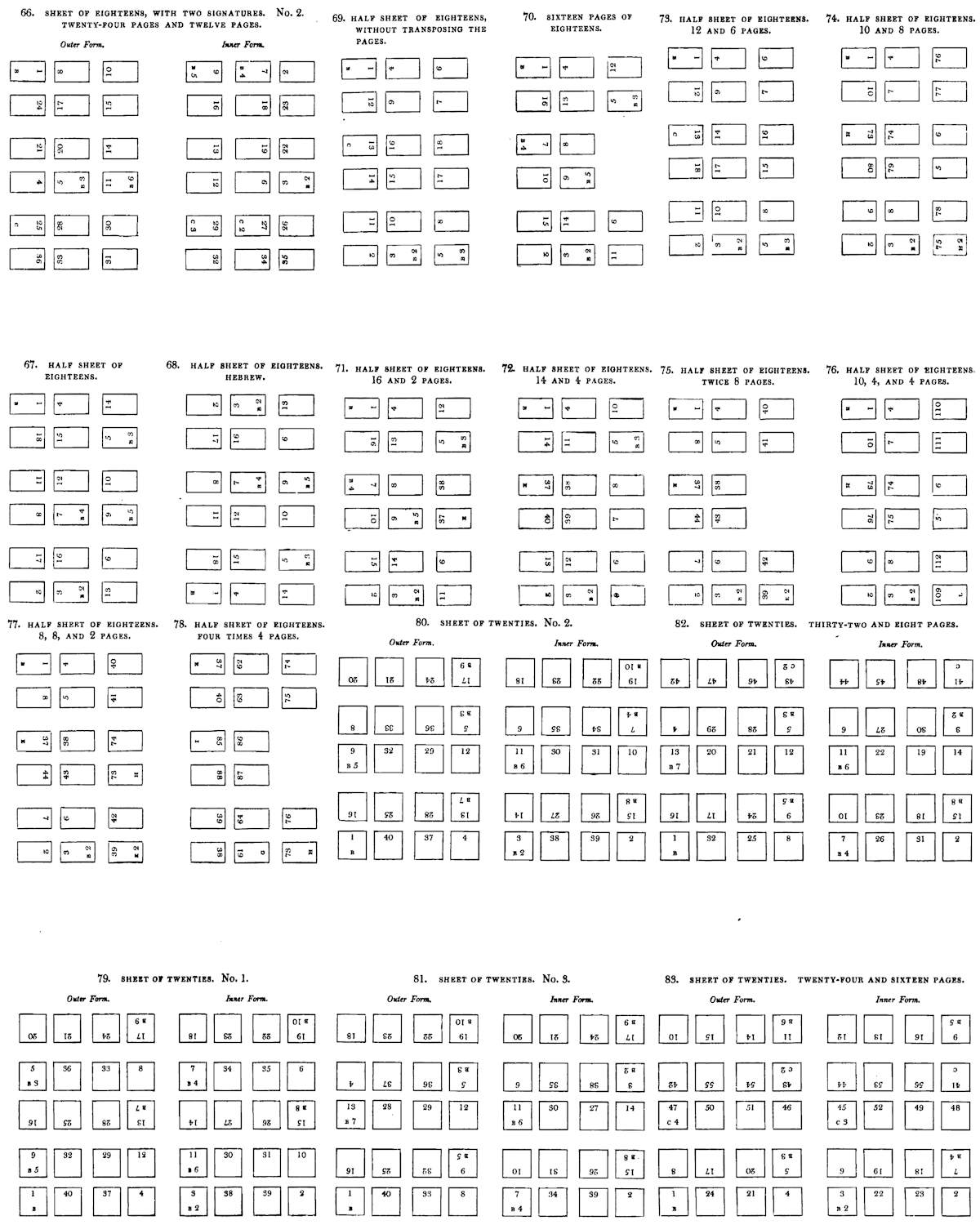
66. SHEET OF EIGHTEENS, WITH TWO SIGNATURES. No. 2. TWENTY-FOUR PAGES AND TWELVE PAGES. 69. HALF SHEET OF EIGHTEENS, WITHOUT TRANSPOSING THE PAGES. 73. HALF SHEET OF EIGHTEENS. 12 AND 6 PAGES.
67. HALF SHEET OF EIGHTEENS. 70. SIXTEEN PAGES OF EIGHTEENS. 74. HALF SHEET OF EIGHTEENS. 10 AND 8 PAGES.
68. HALF SHEET OF EIGHTEENS. HEBREW. 71. HALF SHEET OF EIGHTEENS. 16 AND 2 PAGES. 75. HALF SHEET OF EIGHTEENS. TWICE 8 PAGES.
72. HALF SHEET OF EIGHTEENS. 14 AND 4 PAGES. 76. HALF SHEET OF EIGHTEENS. 10, 4, AND 4 PAGES.
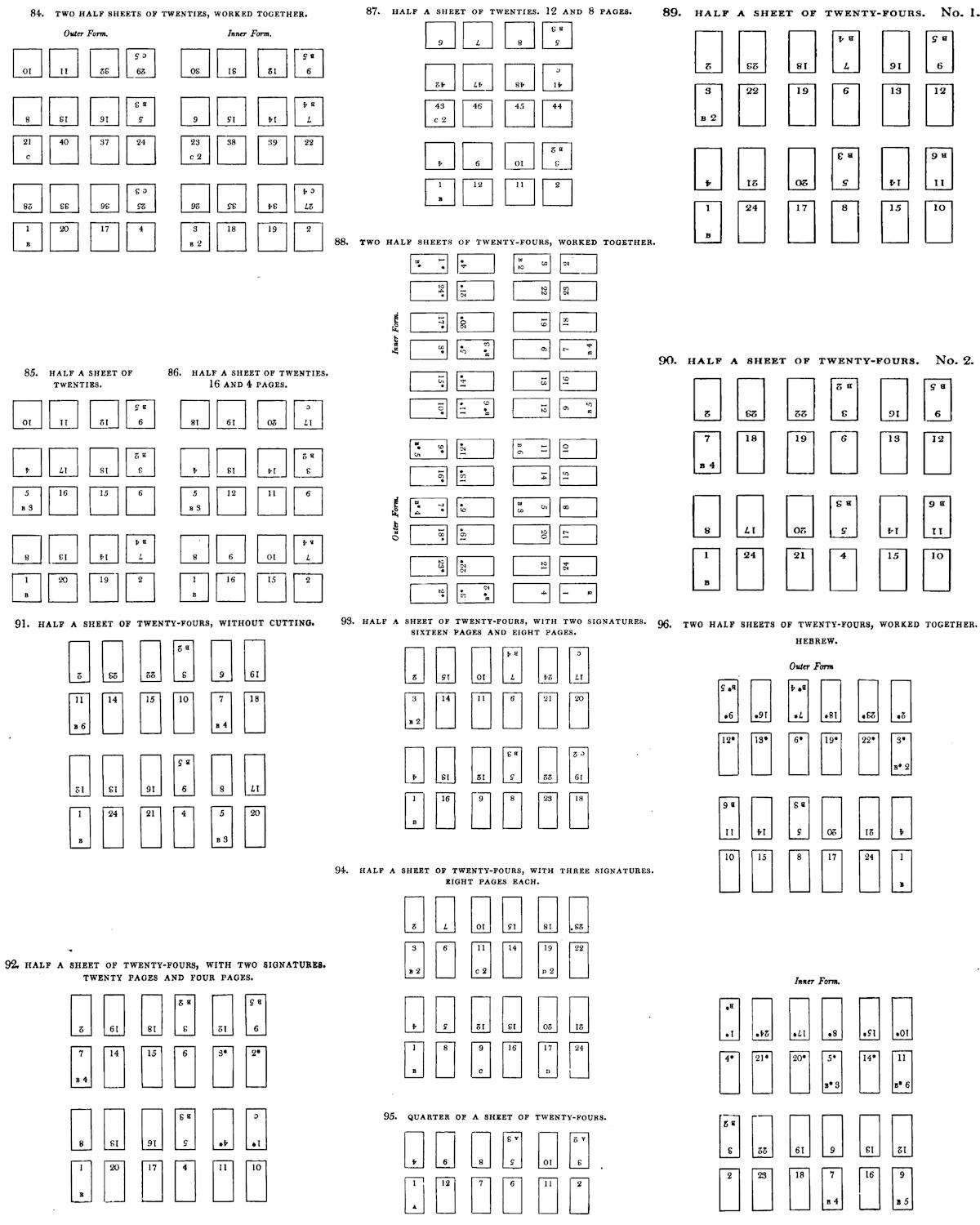
77. HALF SHEET OF EIGHTEENS. 8, 8, AND 2 PAGES. 80. SHEET OF TWENTIES. No. 2. 82. SHEET OF TWENTIES. THIRTY-TWO AND EIGHT PAGES.
78. HALF SHEET OF EIGHTEENS. FOUR TIMES 4 PAGES. 81. SHEET OF TWENTIES. No. 3. 83. SHEET OF TWENTIES. TWENTY-FOUR AND SIXTEEN PAGES.
79. SHEET OF TWENTIES. No. 1.
click here for larger image.
84. TWO HALF SHEETS OF TWENTIES, WORKED TOGETHER. 87. HALF A SHEET OF TWENTIES. 12 AND 8 PAGES. 89. HALF A SHEET OF TWENTY-FOURS. No. 1.
85. HALF A SHEET OF TWENTIES. 88. TWO HALF SHEETS OF TWENTY-FOURS, WORKED TOGETHER. 90. HALF A SHEET OF TWENTY-FOURS. No. 2.
86. HALF A SHEET OF TWENTIES. 16 AND 4 PAGES.
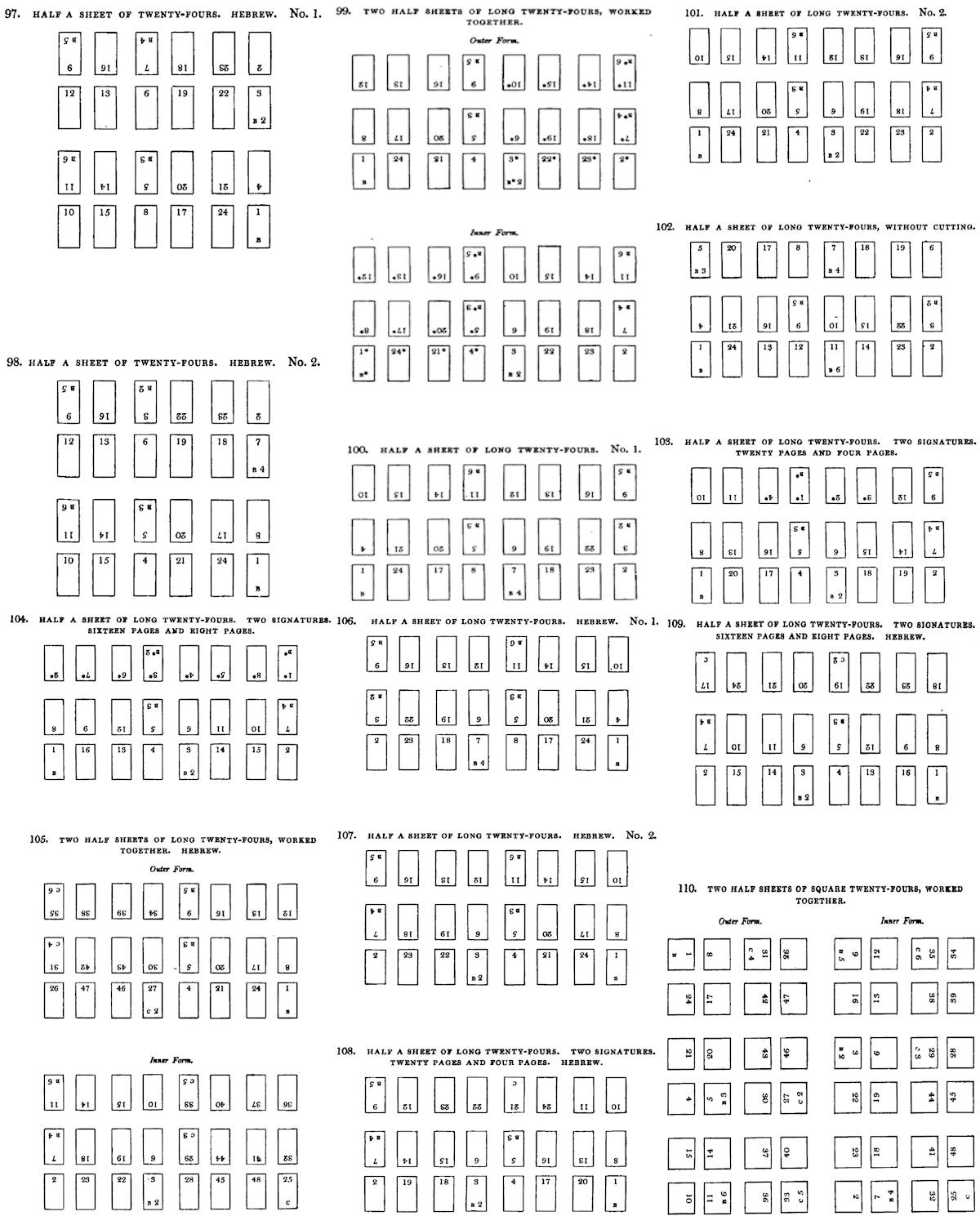
91. HALF A SHEET OF TWENTY-FOURS, WITHOUT CUTTING. 93. HALF A SHEET OF TWENTY-FOURS, WITH TWO SIGNATURES. SIXTEEN PAGES AND EIGHT PAGES. 96. TWO HALF SHEETS OF TWENTY-FOURS, WORKED TOGETHER. HEBREW.
92. HALF A SHEET OF TWENTY-FOURS, WITH TWO SIGNATURES. TWENTY PAGES AND FOUR PAGES. 94. HALF A SHEET OF TWENTY-FOURS, WITH THREE SIGNATURES. EIGHT PAGES EACH.
95. QUARTER OF A SHEET OF TWENTY-FOURS.
click here for larger image.
97. HALF A SHEET OF TWENTY-FOURS. HEBREW. No. 1. 99. TWO HALF SHEETS OF LONG TWENTY-FOURS, WORKED TOGETHER. 101. HALF A SHEET OF LONG TWENTY-FOURS. No. 2.
98. HALF A SHEET OF TWENTY-FOURS. HEBREW. No. 2. 100. HALF A SHEET OF LONG TWENTY-FOURS. No. 1. 102. HALF A SHEET OF LONG TWENTY-FOURS, WITHOUT CUTTING.
103. HALF A SHEET OF LONG TWENTY-FOURS. TWO SIGNATURES. TWENTY PAGES AND FOUR PAGES.
104. HALF A SHEET OF LONG TWENTY-FOURS. TWO SIGNATURES. SIXTEEN PAGES AND EIGHT PAGES. 106. HALF A SHEET OF LONG TWENTY-FOURS. HEBREW. No. 1. 109. HALF A SHEET OF LONG TWENTY-FOURS. TWO SIGNATURES. SIXTEEN PAGES AND EIGHT PAGES. HEBREW.
105. TWO HALF SHEETS OF LONG TWENTY-FOURS, WORKED TOGETHER. HEBREW. 107. HALF A SHEET OF LONG TWENTY-FOURS. HEBREW. No. 2. 110. TWO HALF SHEETS OF SQUARE TWENTY-FOURS, WORKED TOGETHER.
108. HALF A SHEET OF LONG TWENTY-FOURS. TWO SIGNATURES. TWENTY PAGES AND FOUR PAGES. HEBREW.
click here for larger image.
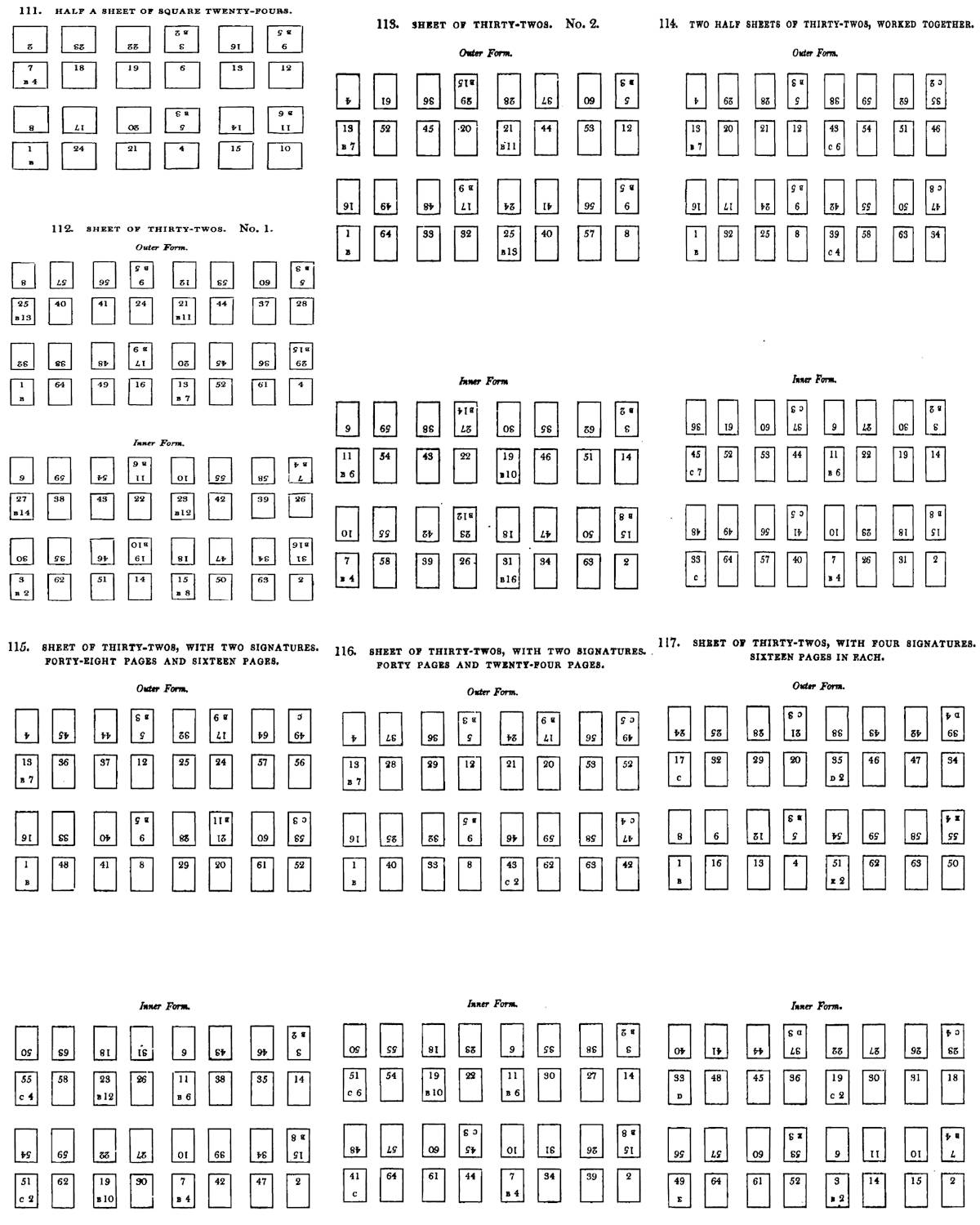
111. HALF A SHEET OF SQUARE TWENTY-FOURS. 113. SHEET OF THIRTY-TWOS. No. 2. 114. TWO HALF SHEETS OF THIRTY-TWOS, WORKED TOGETHER.
112. SHEET OF THIRTY-TWOS. No. 1.
115. SHEET OF THIRTY-TWOS, WITH TWO SIGNATURES. FORTY-EIGHT PAGES AND SIXTEEN PAGES. 116. SHEET OF THIRTY-TWOS, WITH TWO SIGNATURES. FORTY PAGES AND TWENTY-FOUR PAGES. 117. SHEET OF THIRTY-TWOS, WITH FOUR SIGNATURES. SIXTEEN PAGES IN EACH.
click here for larger image.
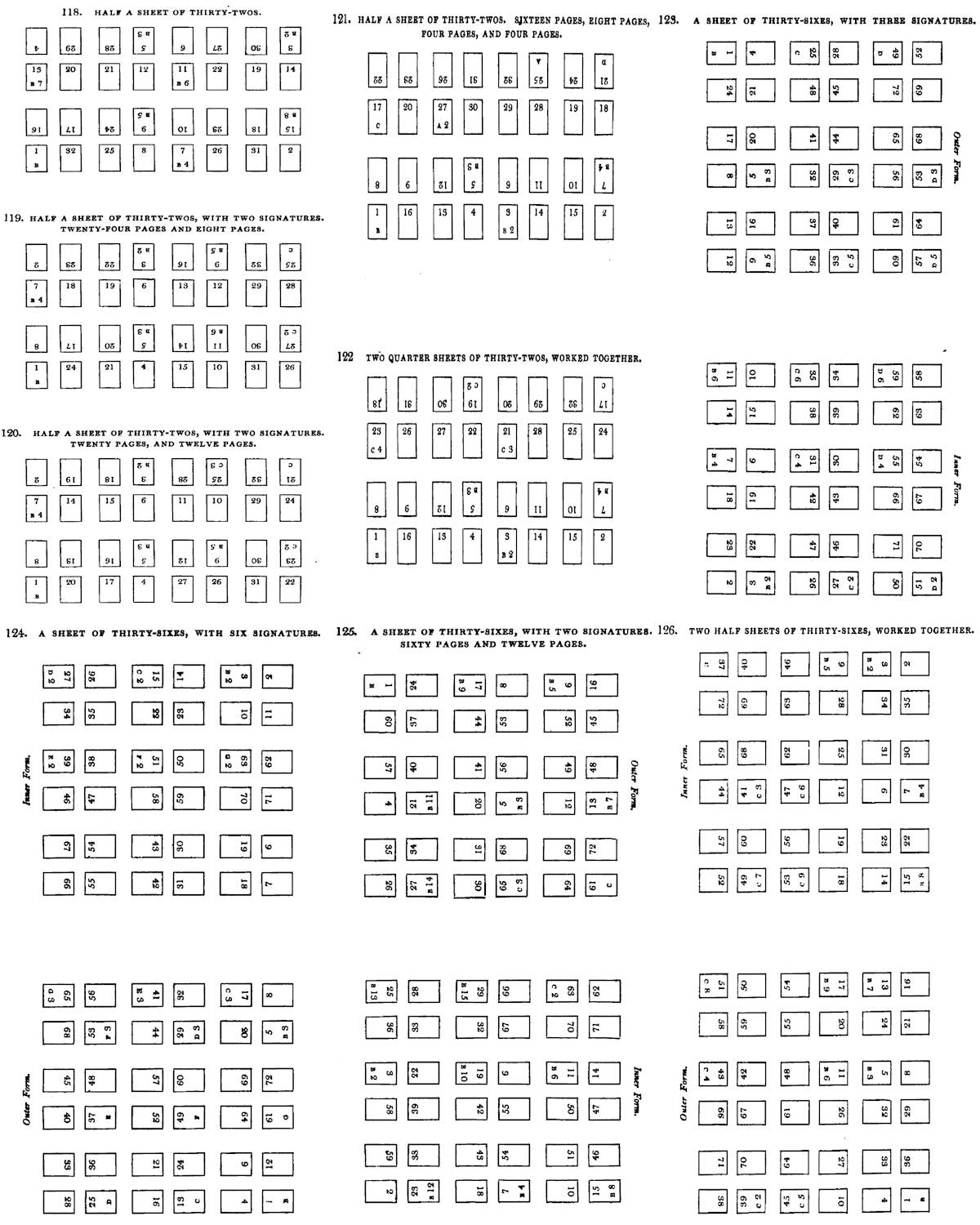
118. HALF A SHEET OF THIRTY-TWOS. 121. HALF A SHEET OF THIRTY-TWOS. SIXTEEN PAGES, EIGHT PAGES, FOUR PAGES, AND FOUR PAGES. 123. A SHEET OF THIRTY-SIXES, WITH THREE SIGNATURES.
119. HALF A SHEET OF THIRTY-TWOS, WITH TWO SIGNATURES. TWENTY-FOUR PAGES AND EIGHT PAGES. 122. TWO QUARTER SHEETS OF THIRTY-TWOS, WORKED TOGETHER.
120. HALF A SHEET OF THIRTY-TWOS, WITH TWO SIGNATURES. TWENTY PAGES, AND TWELVE PAGES.
124. A SHEET OF THIRTY-SIXES, WITH SIX SIGNATURES. 125. A SHEET OF THIRTY-SIXES, WITH TWO SIGNATURES. SIXTY PAGES AND TWELVE PAGES. 126. TWO HALF SHEETS OF THIRTY-SIXES, WORKED TOGETHER.
click here for larger image.
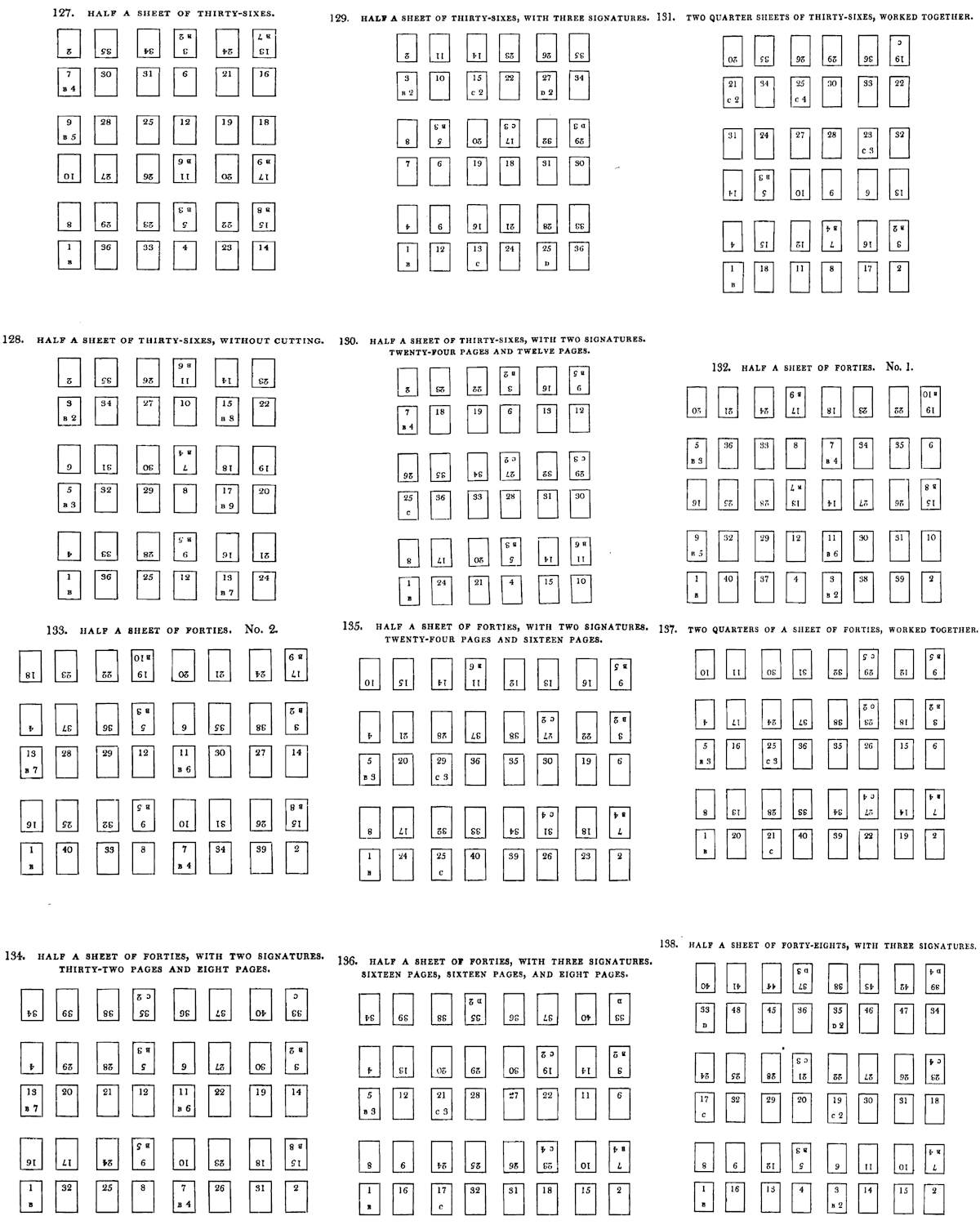
127. HALF A SHEET OF THIRTY-SIXES. 129. HALF A SHEET OF THIRTY-SIXES, WITH THREE SIGNATURES. 131. TWO QUARTER SHEETS OF THIRTY-SIXES, WORKED TOGETHER.
128. HALF A SHEET OF THIRTY-SIXES, WITHOUT CUTTING. 130. HALF A SHEET OF THIRTY-SIXES, WITH TWO SIGNATURES. TWENTY-FOUR PAGES AND TWELVE PAGES. 132. HALF A SHEET OF FORTIES. No. 1.
133. HALF A SHEET OF FORTIES. No. 2. 135. HALF A SHEET OF FORTIES, WITH TWO SIGNATURES. TWENTY-FOUR PAGES AND SIXTEEN PAGES. 137. TWO QUARTERS OF A SHEET OF FORTIES, WORKED TOGETHER.
134. HALF A SHEET OF FORTIES, WITH TWO SIGNATURES. THIRTY-TWO PAGES AND EIGHT PAGES. 136. HALF A SHEET OF FORTIES, WITH THREE SIGNATURES. SIXTEEN PAGES, SIXTEEN PAGES, AND EIGHT PAGES. 138. HALF A SHEET OF FORTY-EIGHTS, WITH THREE SIGNATURES.
click here for larger image.
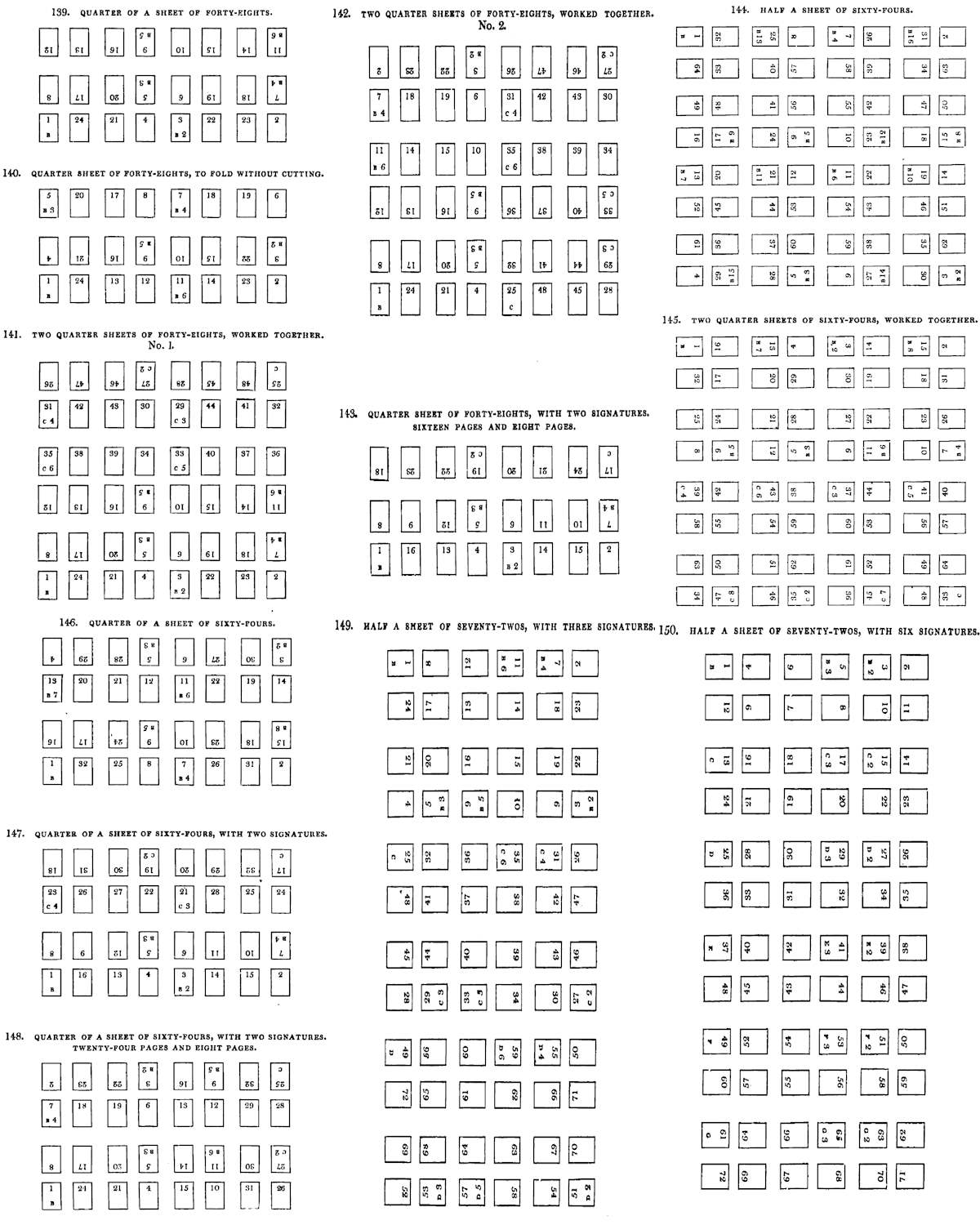
139. QUARTER OF A SHEET OF FORTY-EIGHTS. 142. TWO QUARTER SHEETS OF FORTY-EIGHTS, WORKED TOGETHER. No. 2. 144. HALF A SHEET OF SIXTY-FOURS.
140. QUARTER SHEET OF FORTY-EIGHTS, TO FOLD WITHOUT CUTTING. 143. QUARTER SHEET OF FORTY-EIGHTS, WITH TWO SIGNATURES. SIXTEEN PAGES AND EIGHT PAGES. 145. TWO QUARTER SHEETS OF SIXTY-FOURS, WORKED TOGETHER.
141. TWO QUARTER SHEETS OF FORTY-EIGHTS, WORKED TOGETHER. No. 1.
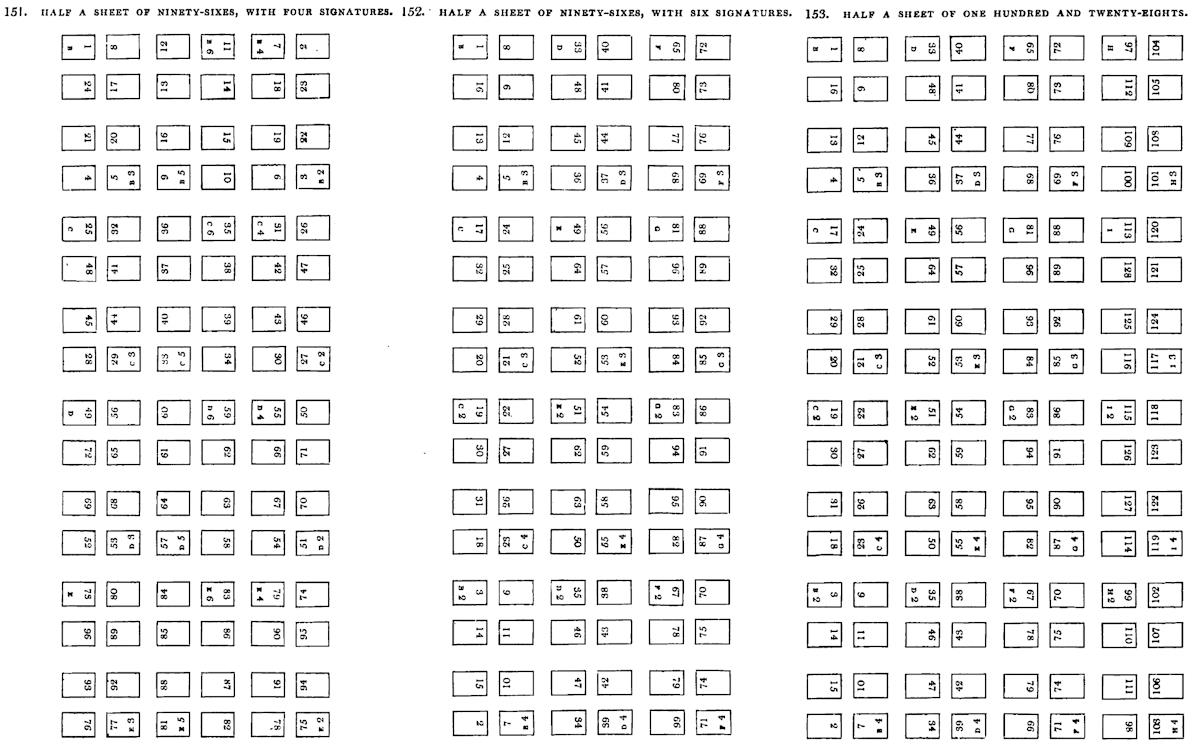
146. QUARTER OF A SHEET OF SIXTY-FOURS. 149. HALF A SHEET OF SEVENTY-TWOS, WITH THREE SIGNATURES. 150. HALF A SHEET OF SEVENTY-TWOS, WITH SIX SIGNATURES.
147. QUARTER OF A SHEET OF SIXTY-FOURS, WITH TWO SIGNATURES.
148. QUARTER OF A SHEET OF SIXTY-FOURS, WITH TWO SIGNATURES. TWENTY-FOUR PAGES AND EIGHT PAGES.
click here for larger image.
151. HALF A SHEET OF NINETY-SIXES, WITH FOUR SIGNATURES. 152. HALF A SHEET OF NINETY-SIXES, WITH SIX SIGNATURES. 153. HALF A SHEET OF ONE HUNDRED AND TWENTY-EIGHTS.
Enumeration of the TABLES OF IMPOSITION in the preceding pages, with Observations, and reference to the page in which each will be found.
1. Abstract of Title Deeds. J.—H.
Page 335
Abstracts of Title Deeds of Estates are in single leaves, and all the margin is on the left side of the paper; they are usually imposed two pages together, to save expense in press-work. They are stitched together at the corner.
2. Sheet of Folio. M.—Sm.—L.—St.—J.—H.—Mas.
335
3. Sheet of Folio. Hebrew
335
4. Two sheets of Folio, Quired. Sm.—L.—St.—J.—H.
335
5. Three sheets of Folio, Quired
336
Imposing in Quires was formerly much used, when books were more commonly printed in folio than they now are. It may be carried to any extent, by taking care that the folios of the two pages in each form of the first Signature make one more than the whole number quired: thus, if the quire consists of 24 pages, the Imposition of each form will be consecutively 1 and 24—23 and 2—3 and 22—21 and 4—5 and 20—19 and 6—7 and 18—17 and 8—9 and 16—15 and 10—11 and 14—13 and 12; and so for the succeeding forms, taking this order of the pages.
6. Half a Sheet of Folio. M.
336
7. Sheet of Quarto M.—Sm.—L.—St.—J.—H.—Mas.
336
8. Sheet of Quarto. Hebrew
336
9. Two Half Sheets of Quarto, worked together. Sm.—L.—St.—J.—H.
337
10. Half Sheet of Quarto. M.—Sm.—St.—J.—H.
337
Half Sheet of Broad Quarto. Sm.—J.—As the pages are laid down as in No. 10, I have not repeated the arrangement.
11. Half Sheet of Quarto. Hebrew
337
12. Two Sheets of Quarto, Quired
337
This Imposition may be useful where a pamphlet makes but two Sheets.
13. Sheet of Broad Quarto. Sm.—L.—St.—J.—H.
338
14. Sheet of Octavo. M.—Sm.—L.—St.—J.—H.—Mas.
338
15. Sheet of Octavo. Hebrew. Sm.—St.—J.—H.
338
16. Sheet of Broad Octavo. Sm.—L.—St.—J.—H.
338
17. Half Sheet of Octavo. M.—Sm.—L.—St.—J.—H.
339
18. Half Sheet of Octavo. Hebrew.
339
19. Two Half Sheets of Octavo, worked together. Sm.—L.—St.—J.—H.—Mas.
339
I prefer this method of imposing two half sheets of Octavo, which cut up in the regular fold of the paper, to having the signatures in slips on each side of the long cross.
20. Sheet of Octavo with two Signatures, 12 pages and 4. St.—J.—H.—Mas.
339
The four pages are here imposed to cut out of the middle of the Sheet: being in the order of the 7th, 8th, 9th, and 10th. They might also be imposed as the 1st, 2d, 15th, and 16th; both these methods are convenient to the bookbinder.
21. Two Quarter Sheets of Octavo, worked together. Sm.—L.—St.—J.—H.—Mas
339
22. Two Quarter Sheets of Octavo. Hebrew. Worked together
339
23. Sheet of Twelves, No. 1. M.—Sm.—L.—St.—J.—H.—Mas.
340
The pages of this sheet are arranged in the customary manner, the first page of the offcut being in the outer form.
24. Sheet of Twelves, No. 2.
340
By imposing a sheet of twelves in this manner, the first signature of the offcut being in the inner form, it rises more conveniently for the bookbinder when folding; as it saves him the trouble of turning the offcut over every sheet, and it is no inconvenience to the printer.
25. Sheet of Twelves, to fold without cutting. L.—St.—J.—H.
340
26. Sheet of Twelves. Hebrew
341
27. Two Half Sheets of Twelves, worked together, No. 1. H.
341
The signatures of these two half sheets when quired, will rise regularly when collated, so as to be easily perceived both by the warehouseman and the bookbinder, and be less liable to be overlooked than the following. I give the preference to this arrangement.
28. Two Half Sheets of Twelves, worked together, No. 2. Sm.—St.—J.—H.—Mas.
341
I give this arrangement of the pages of two half sheets of Twelves to be worked together, because it is generally adopted; but the second signature is hid in the sheet, and may easily be overlooked, so as to cause a mistake, both by the warehouseman and the bookbinder. I prefer the preceding arrangement.
29. Half Sheet of Twelves. M.—Sm.—L.—St.—J.—H.
342
30. Half Sheet of Twelves, to fold without cutting. L.—St.—J.—H.
342
31. Half Sheet of Twelves. Hebrew
342
32. Sheet of Twelves, with two Signatures. 20 pages and 4
342
33. Sheet of Twelves, with two Signatures. 16 pages and 8. Sm.—St.—J.—H.—Mas.
343
34. Sheet of Twelves, with three Signatures. 12, 8, and 4 pages
343
35. Sheet of Twelves, with three Signatures. Thrice 8 pages
343
The offcut forms one of the portions of eight pages; the other two are imposed as two half sheets of octavo.
36. Half Sheet of Twelves, with two Signatures. 8 pages and 4. Sm.—St.—J.—H.—Mas.
344
37. Eight pages of Twelves. St.—J.—H.—Mas.
344
38. Sheet of Long Twelves. Music way, No. 1
344
This sheet cuts into three portions of eight pages each, which are inserted into each other.
39. Sheet of Long Twelves. Music way, No. 2
345
There is an offcut of eight pages in this sheet, which forms the inset.
40. Sheet of Long Twelves. Music way. With two Signatures. 16 pages and 8. S.
345
Stower terms this ‘A Sheet of Long Twelves,’ although it is a sheet with two signatures, composed of sixteen pages and eight pages.
41. Half Sheet of Long Twelves. Music way
346
This half sheet perfects as an octavo, and the four middle pages cut out and form the inset.
42. Sheet of Long Twelves, No. 1.
346
The first page of the offcut in this and the following sheet is imposed in the inner form, for the reason given in No. 24.
43. Sheet of Long Twelves, No. 2.
347
In this and the preceding sheet the paper of the sixteen pages folds differently; the first fold of No. 1. is in the back, as an octavo; the first fold of No. 2. is in the head as a quarto.
44. Sheet of Long Twelves, with two signatures. 16 pages and 8. No. 1. L.—St.—J.—H.
347
Luckombe and the subsequent writers term this a ‘Sheet of Long Twelves;’ it is in fact two fragments, one of sixteen pages, and one of eight pages.
45. Sheet of Long Twelves, with two Signatures. 16 pages and 8. No. 2
348
The sixteen pages of this sheet and the preceding, fold as No. 43. and No. 42.
46. Half Sheet of Long Twelves
348
47. Sheet of Square Twelves
349
A sheet of square twelves is imposed the same as a sheet of common twelves; but I have inserted it, because the chase is laid over the form differently: the short cross should be the same as for octavos, and the long cross should be for the offcut.
Half sheets and fragments are laid down the same as common twelves.
48. Two Half Sheets of Long Twelves, worked together
349
This sheet is perfected as an octavo, and the four middle pages form the inset.
49. Sheet of Sixteens. Sm.—L.—St.—J.—H.
349
50. Sheet of Sixteens. Hebrew
350
This and the preceding sheet fold without cutting.
51. Two Half Sheets of Sixteens worked together
350
52. Sheet of Sixteens, with two Signatures. 24 pages and 8
350
53. Half Sheet of Sixteens. Sm.—St.—J.—H.
351
54. Half Sheet of Sixteens. Hebrew
351
55. Two Quarter Sheets of Sixteens
351
56. Sheet of Long Sixteens
351
57. Two Half Sheets of Long Sixteens, worked together
352
58. Half Sheet of Long Sixteens
352
59. Two Quarter Sheets of Long Sixteens
352
60. Sheet of Eighteens, with one Signature. Sm.—L.—St.—J.—H.
353
Luckombe calls this ‘A common Sheet of Eighteens.’ I suppose at that time it was the customary way of imposing a sheet of eighteens; in my opinion it is inferior to No. 62. There are four insets in it—3 of four pages each, and 1 of eight pages.
61. Sheet of Eighteens with three Signatures. No. 1. Sm.—St.—H.
353
This imposition cuts into three slips the longest way of the sheet of paper; and the heads of the pages on one of them are the raw edge of the paper, which will cause additional trouble to the pressman and to the bookbinder, without being attended with any advantage:—If the compositor have not made his pages up to a precise length, the pressman will have to unlock the forms and rectify them, to make register; and the bookbinder will have to trim each of them with a pair of scissars. It may be avoided by turning the pages of this slip round, and placing the heads against the heads of the other signature, if a sheet should be imposed according to this arrangement. It is certainly inferior to No. 62.
62. Sheet of Eighteens, with three Signatures, as three Half Sheets of Twelves. J.—Mas. No. 2
354
This is now the usual method of imposing a sheet of eighteens; it cuts up equal to three half sheets of twelves, and is the most convenient mode both to the pressman and bookbinder, as it is in the regular way of their business.
63. Sheet of Eighteens, with three Signatures. Hebrew
354
64. Sheet of Eighteens, to fold without cutting. L.—St.—J.—H.
355
Luckombe has reversed every page of this sheet in his work, so that the first page would be at the last end of the sheet, the same as Hebrew. Smith has a sheet of eighteens under this title, but it has three Signatures in it.
65. Sheet of Eighteens, with two Signatures. 24 pages and 12. No. 1. Sm.—St.—J.—H.
355
66. Sheet of Eighteens, with two Signatures. 24 pages and 12, as a Sheet of Twelves and Half Sheet of Twelves. No. 2
356
These two last sheets will only be useful when a volume of eighteens is worked in sheets with one Signature in each, which is not often done; I should give the preference to No. 2.
67. Half Sheet of Eighteens. Sm.—St.—J.—H.—Mas.
356
When the white paper is worked off, transpose the four pages 11, 8 and 7, 12—put 11 and 8 in the place of 7 and 12; and 7 and 12 in the place of 11 and 8.
68. Half Sheet of Eighteens. Hebrew
356
When the white paper is worked off, transpose the four pages, 8, 11 and 12, 7, in the same manner as was directed in No. 67.
69. Half Sheet of Eighteens, without transposing the pages. St.—J.—H.
357
Mr. Stower, in his Printer’s Grammar, says, “We have also given a plan for imposing a half sheet of eighteens, without transposing the pages.”
I acknowledge that much time will be saved in the warehouse work, and that it will be more convenient for the printer to do it in this manner; but the saving of trouble, and the convenience of doing work in a particular way, are not always to be attended to. How will the sheet look when cut up?—There will be three signatures; the first will have twelve pages, the same as half a sheet of twelves; the second will consist of two single leaves; and the third of one leaf, thus having three separate leaves in a half sheet; that is, six single leaves in a sheet, which are charged in binding the same as plates. A collection of plays published separately in eighteens, which is not uncommon, will when completed contain many half sheets, and, if printed in this manner, will be a considerable additional expense in binding a number of complete sets. This will cause dissatisfaction in the master printer’s employers, as it is a principle that ought always to be acted on, not to increase the expenditure, when it can be avoided.
70. Sixteen pages of Eighteens. Sm.—St.—J.—H.
357
When the white paper is worked off, transpose the four pages, 7, 10 and 9, 8; put 7 and 10 in the place of 9 and 8; and 9 and 8 in the place of 7 and 10.
In working sixteen pages, or eight pages, of eighteens, there will be two blank pages in each half of the sheet, except it be filled up with advertisements, catalogue, or other matter.
71. Half a Sheet of Eighteens, with two Signatures. 16 pages and 2
357
When the white paper is worked off, transpose the four pages, 7, 10 and 9, 8, as in No. 70.
72. Half Sheet of Eighteens, with two Signatures. 14 pages and 4
357
After the white paper is printed off, transpose the four pages, 37, 40 and 39, 38, as directed in No. 70.
73. Half Sheet of Eighteens, with two Signatures. 12 pages and 6
358
When the white paper is worked off, transpose the four pages, 13, 18 and 17, 14, as directed in No. 70.
74. Half Sheet of Eighteens, with two Signatures. 10 pages and 8
358
When the white paper is worked off, transpose the four pages, 73, 80 and 79, 74, as directed in No. 70.
75. Half Sheet of Eighteens, with two Signatures. 8 pages and 8
358
When the white paper is worked off, transpose the four pages, 37, 44 and 43, 38, as directed in No. 70.
76. Half Sheet of Eighteens, with three Signatures. 10 pages, 4, and 4
358
When the white paper is worked off, transpose the four pages, 73, 76 and 75, 74, as directed in No. 70.
77. Half Sheet of Eighteens, with three Signatures. 8 pages, 8, and 2
359
When the white paper is worked off, transpose the four pages, 37, 44 and 43, 38, as directed in No. 70.
78. Half Sheet of Eighteens, with four Signatures. Four times 4 pages
359
After the white paper is worked off, transpose the four pages, 85, 88 and 87, 86, as directed in No. 70.
In printing collections of plays in eighteens, where each play has separate folios, fragments in every variety arise. When one of four pages occurs, it will perhaps be adviseable, if the number be large, and the presswork not in a forward state, to make a full form of them, by setting the matter up five times: when the white paper is worked off, transpose the four pages, as directed in No. 70.; also take out the first and fourth pages of one of the portions of four pages which occupy the place of the two blanks in No. 78, and put the third and the second in their place.
79. Sheet of Twenties. No. 1. L.—St.—J.—H.
359
I do not approve of this arrangement; for the sheet cuts into five slips, four of which are insets—otherwise they must have five different signatures.
80. Sheet of Twenties. No. 2
360
After the offcut is separated, the first and second folds of the remainder are the same as a duodecimo.
81. Sheet of Twenties. No. 3
360
After the offcut is separated, the first and second folds of the remainder are the same as a Quarto. I have placed the first signature of the offcut in the inner form, for the reason assigned in No. 23.
This and the preceding arrangement are preferable to No. 1, as there is only one offcut in each, which is inserted in the middle when folded; the other pages are imposed as a sheet of sixteens.
82. Sheet of Twenties, with two Signatures. 32 pages and 8
361
83. Sheet of Twenties, with two Signatures. 24 pages and 16
361
84. Two Half Sheets of Twenties, worked together
362
85. Half a Sheet of Twenties
362
86. Half a Sheet of Twenties, with two Signatures. 16 pages and 4 J.
362
87. Half a Sheet of Twenties, with two Signatures. 12 pages and 8
363
88. Two Half Sheets of Twenty-fours, worked together
363
What Stower calls Twenty-fours are longer and narrower than what he calls Long Twenty-fours: I have reversed the terms, and called his Twenty-fours, Long Twenty-fours, and vice versâ.
89. Half a Sheet of Twenty-fours. No. 1
364
90. Half a Sheet of Twenty-fours. No. 2. Sm.—St.—J.—H.
364
These four writers term this arrangement of the pages, ‘the Sixteen-way.’
The difference between No. 1. and No. 2. is, that, when the inset is taken off, the first fold of No. 1. is in the head; and that of No. 2. is in the back, as a sheet of octavo.
91. Half a Sheet of Twenty-fours, to fold without cutting. L.—S.
365
92. Half a Sheet of Twenty-fours, with two Signatures. 20 pages and 4
365
93. Half a Sheet of Twenty-fours, with two Signatures. 16 pages and 8. L.—St.—J.—H.
366
94. Half a Sheet of Twenty-fours, with three Signatures. 8 pages each
366
95. Quarter of a Sheet of Twenty-fours. H.
366
When the white paper is worked off, transpose the four middle pages; put 5 in the place of 7,—6 in the place of 8,—7 in the place of 5,—and 8 in the place of 6.
96. Two Half Sheets of Twenty-fours, worked together. Hebrew
367
97. Half a Sheet of Twenty-fours. Hebrew. No. 1
368
98. Half a Sheet of Twenty-fours. Hebrew. No. 2
368
99. Two Half Sheets of Long Twenty-fours, worked together. Sm.—L.—St.—J.—H.
369
Luckombe has transposed the pages of this table in his work. I have put the first page of the second signature in the inner form, which causes it to rise better in collating and folding: Stower has it in the outer.
100. Half a Sheet of Long Twenty-fours. No. 1
369
101. Half a Sheet of Long Twenty-fours. No. 2. L.—St.—J.—H.
370
102. Half a Sheet of Long Twenty-fours, to fold without cutting. L.—St.—J.—H.
370
103. Half a Sheet of Long Twenty-fours, with two Signatures. 20 pages and 4
370
104. Half a Sheet of Long Twenty-fours, with two Signatures. 16 pages and 8. Sm.—L.—St.—J.—H.
371
Luckombe has placed the foot of each page where the head should be, in the range commencing with page 1.
105. Two Half Sheets of Long Twenty-fours, worked together. Hebrew
371
106. Half a Sheet of Long Twenty-fours. Hebrew. No. 1
372
107. Half a Sheet of Long Twenty-fours. Hebrew. No. 2
372
108. Half a Sheet of Long Twenty-fours, with two Signatures. 20 pages and 4. Hebrew
372
109. Half a Sheet of Long Twenty-fours, with two Signatures. 16 pages and 8. Hebrew
373
110. Two Half Sheets of Square Twenty-fours, worked together
373
111. Half a Sheet of Square Twenty-fours. L.—St.—J.
374
112. Sheet of Thirty-twos. No. 1
374
113. Sheet of Thirty-twos. No. 2. L.—St.—J.—H.
375
In my opinion No. 1. is a more preferable method of imposing a sheet of 32mo. than No. 2.; as the sheet in the first instance folds into the regular folio, then into quarto, octavo, square sixteens, and thirty-twos; whereas No. 2. folds into long folio, quarto, long octavo, &c.
Both of them would be inconvenient, except for children’s books, tracts, and other temporary articles; as sixty-four pages in one signature would be too many to fold neatly for book work, for such purpose I should prefer four signatures in the sheet, each of which would be equal to a sheet of octavo.
114. Two Half Sheets of Thirty-twos, worked together
376
115. Sheet of Thirty-twos, with two Signatures. 48 pages and 16
377
The sheet in the first instance cuts up in the regular fold; the half sheet with signature B in it, folds into quarto, octavo, square sixteens, and thirty-twos; the other half sheet cuts up lengthways into two equal parts, containing sixteen pages each, one of which is an inset for signature B, the other forms signature C.
116. Sheet of Thirty-twos, with two Signatures. 40 pages and 24
378
The sheet cuts up in the regular fold, and the half sheet folds as No. 115.; the other half sheet cuts in two lengthways, one of which contains sixteen pages of signature C; the other sixteen pages cut in two, eight pages of which are an inset for signature B, the other eight are an inset for signature C.
117. Sheet of Thirty-twos, with four Signatures. 16 pages in each. Sm.—St.—J.—H.
379
I have arranged the signatures of this sheet differently from the preceding writers. They have the two first signatures on different half sheets: I have placed them on the same half sheet, and the third and fourth signatures on the other half sheet, so as to cause them to rise in a regular way.
This sheet is equal to four sheets of octavo; two of which are imposed on each side of the long crosses in a pair of chases: eight pages of the first signature, the same as the outer form of a sheet of octavo, are laid down in the left hand quarter of a chase, the other eight pages, similar to the inner form of a sheet of octavo, are laid down in the right hand quarter of the other chase; the fourth signature is imposed in the two other quarters, which will lie together as the chases are upon the imposing stone; the second and third signatures are imposed in a similar manner on the other sides of the long crosses.
118. Half a sheet of Thirty-twos. L.—St.—J.—H.
380
119. Half a Sheet of Thirty-twos, with two Signatures. 24 pages and 8
380
120. Half a Sheet of Thirty-twos, with two Signatures. 20 pages and 12
380
121. Half a Sheet of Thirty-twos, with four Signatures. 16 pages, 8 pages, 4 pages, and 4 pages. J.—H.
381
122. Two Quarter Sheets of Thirty-twos, worked together. Sm.—L.—St.—J.—H.
381
123. Sheet of Thirty-sixes, with three Signatures
382
This sheet perfects the same as a twelves. It cuts into three equal parts across the sheet, each portion of which contains all the pages in the signature.
124. Sheet of Thirty-sixes, with six Signatures
383
This sheet cuts up into portions of eight pages and four pages each, the four pages forming an inset; so as to make each signature equal to a half sheet of twelves.
125. Sheet of Thirty-sixes, with two Signatures. 60 pages and 12
384
126. Two Half Sheets of Thirty-sixes, worked together
385
127. Half a Sheet of Thirty-sixes. L.—St.—J.—H.
386
128. Half a sheet of Thirty-sixes, to fold without cutting. L.—St.—J.—H.
386
129. Half a Sheet of Thirty-sixes, with three Signatures
387
This form perfects as an octavo. It folds as three half sheets of twelves.
130. Half a Sheet of Thirty-sixes, with two Signatures. 24 pages and 12. Sm.—St.—J.—H.
387
This form perfects as an octavo. The three last writers, in their works on printing, have made the middle twelve pages perfect foot to foot, so that they will be cut out at the head, and fold at the foot; I have reversed them, to cause them to be cut out at the foot, and fold at the head.
131. Two Quarter Sheets of Thirty-sixes, worked together
388
When the white paper is worked off, transpose the four pages, 11, 8, and 7, 12, in signature B, and 29, 26, and 25, 30, in signature C, in the manner directed in No. 67. (half sheet of eighteens), for each of these quarter sheets is similar in arrangement to that form.
132. Half a Sheet of Forties. No. 1. L.—St.—J.—H.
388
The sheet cuts up into five slips of one page in depth, four of which are insets; it appears to me an inconvenient method, which I have endeavoured to improve in the next article. It perfects as an octavo.
133. Half a Sheet of Forties. No. 2
389
In this arrangement the paper folds in the regular way, first into folio, then into quarto, octavo, sixteens, and thirty-twos, with one inset of eight pages. In my opinion it is preferable to the preceding method. It perfects as an octavo.
134. Half a Sheet of Forties, with two Signatures. 32 pages and 8
389
The arrangement of the 32 pages is the same as for half a sheet of thirty-twos, in No. 118. The 8 pages of signature C form the offcut.
135. Half a Sheet of Forties, with two Signatures. 24 pages and 16
390
136. Half a sheet of Forties, with three Signatures. 16 pages, 16 pages, and 8
390
137. Two Quarter Sheets of Forties, worked together
391
138. Half a Sheet of Forty-eights, with three Signatures. Sm.—St.—J.—H.
391
These writers have placed the first signatures on the different half sheets; I have placed them on the same half sheet. It is similar in the arrangement of the pages to three sheets of octavo, and perfects the same as a form of twelves.
139. Quarter of a Sheet of Forty-eights. L.—St.—J.—H.
392
The same arrangement of the pages as a sheet of twelves, and perfects as such.
140. Quarter of a Sheet of Forty-eights, to fold without cutting. L.—St.—J.—H.
392
It is the same as a sheet of twelves without cutting.
141. Two Quarter Sheets of Forty-eights, worked together. No. 1
392
These are equal to two sheets of twelves, and are arranged on each side of the short cross, and perfect as a twelves.
142. Two Quarter Sheets of Forty-eights, worked together. No. 2. L.—St.—J.—H.
393
These two quarter sheets are arranged on each side of the long cross, and perfect as an octavo.
143. Quarter of a Sheet of Forty-eights, with two Signatures. 16 pages and 8. L.—St.—J.—H.
393
Stower imposes this form in three slips, and makes one of them an inset; and the slip with the first signature, has the heads of the pages to the raw edge of the paper: I have arranged the 16 pages as a sheet of octavo, and the 8 pages of signature C form the offcut.
144. Half a Sheet of Sixty-fours
394
However much I disapprove of the arrangement of the pages in many of the Tables of Imposition in Luckombe’s and Stower’s works, on account of the uncustomary and inconvenient manner of the paper folding, yet I have given all that are in their books thus far, for the reason I stated in page 328; but when we come to sixty-fours, a size that is seldom printed, I think it is unnecessary to give more than one mode, and I omit the one that has been usually given, and insert in its place what I conceive to be an improvement. The old plan folded into folio, long quarto, octavo, long sixteens, &c.; the plan here inserted folds into folio, quarto, octavo, sixteens, &c. in the customary way. If any printer choose to adopt the other plan, he will find it in Luckombe, Stower, Johnson, and Hansard.
145. Two Quarter Sheets of Sixty-fours, worked together
394
146. Quarter of a Sheet of Sixty-fours. L.—St.—J.—H.
395
The pages of this form are laid down in the same order as half a sheet of thirty-twos, No. 118.
147. Quarter of a Sheet of Sixty-fours, with two Signatures. 16 pages in each. L.—St.—J.—H.
395
The pages of this form are laid down in the same order as two quarter sheets of thirty-twos, worked together, No. 122.
148. Quarter of a Sheet of Sixty-fours, with two Signatures. 24 pages and 8
395
The pages of this form are laid down in the same order as half a sheet of thirty-twos, with two signatures. 24 pages and 8, No. 119.
149. Half a Sheet of Seventy-twos, with three Signatures. Sm.—L.—St.—J.—H.
396
I have varied from the old plan of imposing half a sheet of seventy-twos, nor did I think it of consequence to crowd the book unnecessarily with giving what I consider inferior modes of imposing in sizes that rarely occur. This form has been usually given to cut up into three slips the longest way of the paper; I have given it in the manner, that when perfected, it will cut up into six portions, with the pages of each the same as a sheet of twelves. It perfects as a twelves.
150. Half a Sheet of Seventy-twos, with six Signatures
397
This sheet when perfected cuts up into twelve portions, each of which is similar in the arrangement of the pages to half a sheet of twelves.
The fragments of No. 149. will be imposed in the same order as those of a sheet of twelves; and those of 150, in the same order as those of half a sheet of twelves.
151. Half a Sheet of Ninety-sixes, with four Signatures
398
When perfected it cuts up into eight portions, each of which is similar to a sheet of twelves. It perfects as a twelves.
152. Half a Sheet of Ninety-sixes, with six Signatures. Sm.—L.—St.—J.—H.
399
I have placed the first signatures on the same half sheet; the preceding writers scattered them on both. It is laid down as six sheets of octavo, and perfects as an octavo.
153. Half a Sheet of One Hundred and Twenty-eights. Sm.—L.—St.—J.—H.
400
It is laid down as eight sheets of octavo, and perfects as an octavo.
IMPOSING STONE.
The stone on which the compositor imposes and corrects his forms. It was formerly called the Correcting Stone.
Imposing stones are of different sizes to suit the business and the situation in which they are placed, as they require a good light. Some are made to hold two demy forms, others to hold three royals. The stone should be of a firm texture, and its upper surface smooth, so as not to wear the bottom of the types. Imposing stones are sometimes saturated with oil, to lessen the friction. Their height is about three feet, and the length of one calculated to contain two demy forms is five feet, and its width two feet two inches.
The frame on which the stone rests, is fitted up with drawers for furniture—one of these is for quoins, always the uppermost, one for side sticks and foot sticks, one for broad and narrow, and one for wider pieces;—these drawers are sometimes made of the whole width of the frame, so as to draw out on either side, and sometimes there are two within this width, one on each side.
Of late years, in some offices, cast iron has been substituted for stone, the upper surface of which has been turned flat and smooth in a lathe; and when a large size is wanted, two are attached together.
Impression holds out. See Holds out.—M.
IMPRESSION SHEET.
A sheet of stout even paper, that fits exactly, without any play, the inside of the outer tympan: this sheet is used in fine work to place the overlays upon next to the parchment, and when a sheet of any work is thus made ready at a press, the succeeding sheets of the same work, at the same press, are made ready much more expeditiously, than if all the overlays have to be placed for each sheet on the tympan sheet.—See Making ready.
IMPRINT.
The name and place of residence of the printer, put to all printed articles, under the Act of Parliament of 39 George 3. c. 79., with certain exemptions.
By the Act of the 39th George 3. c. 79., intituled An Act for the more effectual Suppression of Societies established for seditious and treasonable Purposes, and for the better preventing treasonable and seditious Practices, s. 27. it is enacted, “That, from and after the Expiration of forty Days after the passing of this Act, every Person who shall print any Paper or Book whatsoever, which shall be meant or intended to be published or dispersed, whether the same shall be sold or given away, shall print upon the Front of every such Paper, if the same shall be printed on one Side only, and upon the first and last Leaves of every Paper or Book which shall consist of more than one Leaf, in legible Characters, his, or her Name, and the Name of the City, Town, Parish, or Place, and also the Name (if any) of the Square, Street, Lane, Court, or Place, in which his or her Dwelling House or usual Place of Abode shall be; and every Person who shall omit so to print his Name and Place of Abode on every such Paper or Book printed by him, and also every Person who shall publish or disperse, or assist in publishing or dispersing, either gratis or for Money, any printed Paper or Book, which shall have been printed after the Expiration of forty Days from the passing of this Act, and on which the Name and Place of Abode of the Person printing the same shall not be printed as aforesaid, shall, for every Copy of such Paper so published or dispersed by him, forfeit and pay the Sum of twenty Pounds.
s. 28. “And be it further enacted, That nothing in this Act contained shall extend, or be construed to extend, to any Papers printed by the Authority and for the Use of either House of Parliament.”
s. 31. “Provided always, That nothing herein contained shall extend to the Impression of any Engraving, or to the printing by Letter Press, of the Name, or the Name and Address, or Business or Profession, of any Person, and the Articles in which he deals, or to any Papers for the Sale of Estates or Goods by Auction, or otherwise.”
s. 34. “Provided always, That no Person shall be prosecuted or sued for any Penalty imposed by this Act, unless such Prosecution shall be commenced, or such Action shall be brought, within three Calendar Months next after such Penalty shall have been incurred.”
39 & 40 George 3. c. 95. “An Act to indemnify all Persons who have printed, published, or dispersed, or who shall publish or disperse, any Papers printed under the Authority of the Commissioners or Head Officers of any Publick Boards, from all Penalties incurred by reason of the Name and Place of Abode of the Printer of such Papers not being printed thereon.”
Persons who have printed any Papers under the Authority of Commissioners of Publick Boards, or who have published them, or shall hereafter publish any Paper so printed before the passing of this Act, shall be indemnified from any Penalties incurred by reason of any Offence against the Act of the 39th of George 3. c. 79., intituled, An Act for the more effectual Suppression of Societies established for seditious and treasonable Purposes, and for the better preventing treasonable and seditious Practices.
The Act of the 41st George 3. c. 80., is, “An Act to indemnify all Persons who have printed, published, or dispersed, or who shall publish or disperse, any Papers printed under the Authority of any Head Officer of State, or of Publick Boards, or other Publick Authorities, from all Penalties incurred by reason of the Name and Place of Abode of the Printer of such Papers not being printed thereon.”
Persons who have printed any Papers under the Authority of the Head Officers of any of the principal Offices of State, or of any Board of Revenue, &c., or who have published them, or shall hereafter disperse any Paper so printed before the passing of this Act, shall be indemnified from any Penalties incurred by reason of any Offence against the recited Act; viz. the 39th of George 3. c. 79.
42 George 3. c. 23.—Annual Indemnity Act, s. 9. “And whereas, in an Act passed in the Thirty-ninth Year of the Reign of His present Majesty, intituled An Act for the more effectual Suppression of Societies established for seditious and treasonable Purposes; and for better preventing treasonable and seditious Practices, certain Provisions are contained to restrain the printing or publishing of any Papers or Books whatsoever, which should be meant or intended to be published or dispersed, without the Name and Place of Abode of the Printer thereof being printed thereon, with a certain Penalty on the Person printing, publishing, or dispersing, or assisting in publishing or dispersing the same contrary to the said Act: And whereas divers Papers being, or purporting to be Pleadings, Rules, Orders, Process, or other Proceedings in Courts of Law or Equity, or to be Parts of such Pleadings, Rules, Orders, Process, or other Proceedings, or to be Copies of the same, or of Parts thereof respectively, have, through Inadvertency and Mistake, and on the Supposition that such Papers were not within the Provisions of the said Act, been printed without the Name and Place of Abode of the Person printing the same being printed thereon as required by the said Act; be it further enacted, That every Person who shall, before the passing of this Act, have printed any Paper being, or purporting to be, any Pleading, Rule, Order, or any Process, or other Proceeding of or in any Court of Law or Equity, or to be any Part of such Pleading, Rule, Order, Process, or other Proceeding, or to be a Copy of the same, or of any Part thereof respectively, or shall have published or dispersed, or shall have assisted in publishing or dispersing, or shall hereafter publish or disperse, or assist in publishing or dispersing any such Paper as aforesaid, which shall have been printed before the passing of this Act, shall be, and is hereby declared to be freed and discharged of and from all Suits, Informations, Prosecutions, Judgements, Fines, Imprisonments, Pains, and Penalties whatsoever, commenced, prosecuted, adjudged, or incurred, or which may be commenced, prosecuted, adjudged, or incurred, for or by reason of any Offence alledged to have been committed against the said recited Act, by occasion of such printing, publishing, or dispersing, or assisting in publishing or dispersing any such Paper as aforesaid, as fully, freely, and effectually, as if the same had been printed according to the Provisions of the said Act.”
49 George 3. c. 69., intituled “An Act to indemnify Persons who have inadvertently printed, published, or dispersed Papers or Books without a full Description of the Place of Abode of the Printers thereof, from Penalties incurred under an Act of the Thirty-ninth Year of His Majesty’s Reign.”
s. 1. All Persons having printed Papers or Books with the Name of the Street of their Abode (omitting the Name of the Town or City) indemnified against Penalties under recited Act.
s. 2. Not to affect Convictions or Judgments had before the passing of this Act.
51 George 3. c. 65., intituled “An Act to explain and amend an Act, passed in the Thirty-ninth Year of His Majesty’s Reign, intituled An Act for the more effectual Suppression of Societies established for seditious and treasonable Purposes, and for better preventing treasonable and seditious Practices; so far as respects certain Penalties on Printers and Publishers.”
s. 1. “Whereas an Act was passed in the Thirty-ninth Year of His present Majesty’s Reign, intituled An Act for the more effectual Suppression of Societies established for seditious and treasonable Purposes, and for better preventing treasonable and seditious Practices: And whereas, in and by the Twenty-seventh and Thirty-fifth Sections of the said Act, certain Provisions were made, that every Person who should print any Paper or Book, or publish or disperse, or assist in publishing or dispersing, any printed Paper or Book, without the Name and Place of Abode of the Printer being printed on such Paper or Book, in such Manner as by the said Act is specified, should forfeit and pay the Sum of Twenty Pounds for every Copy of such Paper so published or dispersed by him; to be recovered before any Justice or Justices of the Peace for the County, Stewartry, Riding, City, Town, or Place in which such Penalty should be incurred: Add whereas there is not in the said Act any Provision authorising such Justice or Justices to mitigate the Penalties thereby incurred, or enabling the Party to appeal from any Conviction by or Judgement of such Justice or Justices: And whereas divers Books and Papers have since been printed by several Persons, who, through Inadvertency or Mistake, have neglected to comply with the Provisions of the said Act, and such Persons have thereby become liable to be sued and prosecuted for Penalties to a vast Amount, although such Books and Papers were not of an evil or seditious Tendency: And whereas it is expedient to limit the Amount of Penalties imposed by the said Act; and to enable Magistrates to mitigate the Penalties in such Cases as shall appear to them expedient; and also to give the Party, who may be aggrieved by a Conviction under such Act, a Power of appealing from the same; be it therefore enacted by the King’s most Excellent Majesty, by and with the Advice and Consent of the Lords Spiritual and Temporal, and Commons, in this present Parliament assembled, and by the Authority of the same, That nothing in the Twenty-seventh Section of the said Act contained shall extend to make any Person or Persons offending against the same, liable to more than Twenty-five Forfeitures or Penalties for printing or publishing or dispersing, or assisting in publishing or dispersing, any Number of Copies of one and the same Paper or Book, contrary to the said Section of the said Act.
s. 2. “And be it further enacted, That if any Justice or other Magistrate before whom any Person shall be convicted of any Offence or Offences against the Provisions of the before-mentioned Act shall see Cause to mitigate such Penalty or Penalties, it shall be lawful for such Justice or other Magistrate to mitigate or lessen the same to any Sum not less than Five Pounds, over and above all reasonable Costs and Charges expended or incurred in the Prosecution.
s. 3. “And whereas Doubts have arisen whether the Provisions contained in the said Act may not be considered as extending to Notes and Post Bills of the Governor and Company of the Bank of England, and to Bills of Exchange, Promissory Notes, Bonds, and other Securities for Payment of Money, Bills of Lading, Policies of Insurance, Letters of Attorney, Transfers or Assignments of Public Stocks, Funds, and other Securities, and to Dividend Warrants, Receipts for Money or Goods, Deeds or other Instruments, Proceedings in the Courts of Law and Equity, and other Inferior Courts, Warrants, Orders, and other Papers, printed by the Authority of any Public Board or Public Officer in the Execution of the Duties of their respective Offices, many of which Securities, Instruments, Proceedings and other Matters aforesaid, are usually wholly or in Part printed; be it therefore hereby declared and enacted, That nothing in the said recited Act or in this Act contained shall extend or be construed to extend to require the Name and Residence of the Printer to be printed upon any such Bank Note, Bank Post Bill, Bill of Exchange, or Promissory Note, or upon any Bond or other Security for Payment of Money, or upon any Bill of Lading, Policy of Insurance, Letter of Attorney, Deed or Agreement, or upon any Transfer or Assignment of any Public Stocks, Funds, or other Securities, or upon any Transfer or Assignment of the Stocks of any Public Corporation or Company, authorized or sanctioned by Act of Parliament, or upon any Dividend Warrant of or for any such Public or other Stocks, Funds, or Securities, or upon any Receipt for Money or Goods, or upon any Proceeding in any Court of Law or Equity, or in any Inferior Court, Warrant, Order, or other Papers printed by the Authority of any Public Board or Public Officer in the Execution of the Duties of their respective Offices, notwithstanding the Whole or any Part of the said several Securities, Instruments, Proceedings, Matters, and Things aforesaid, shall have been or shall be printed, any Thing herein or in the said recited Act contained to the contrary thereof in anywise notwithstanding.
s. 4. “And be it further enacted, That if any Person or Persons shall think himself, herself, or themselves aggrieved by any Conviction, Judgement, or Determination, of any Justice or Justices, relating to any Matter or Thing in the before-mentioned Act contained; then and in that Case he, she, or they may appeal to the Justices of the Peace at the General Quarter Sessions to be holden in and for the County, City, or Place, where such Conviction, Judgement, or Determination shall have been made, next after the Expiration of Twenty Days from the making thereof, first giving Six Days Notice of such Appeal to the Person or Persons prosecuting for such Penalty or Penalties; and the said Justices shall hear and determine the said Appeal at such General Quarter Sessions, or, if they think proper, adjourn the Hearing thereof until the next General Quarter Sessions to be holden for such County, Town, or Place; and the said Justices may, in like Manner, if they see cause, mitigate any Penalty or Penalties, and may order any Money to be returned which shall have been paid or levied under any Conviction as aforesaid, and may also order and award such Costs to be paid by either Party to the other, as they shall think and judge reasonable.
s. 5. “And be it further enacted, that this Act shall take Effect from the First Day of March One thousand eight hundred and eleven.”
2 Vict. c. 12. “An Act to amend an Act of the Thirty-ninth Year of King George the Third, for the more effectual Suppression of Societies established for seditious and treasonable Purposes, and for preventing treasonable and seditious Practices, and to put an End to certain Proceedings now pending under the said Act.
s. 1. “Whereas in an Act passed in the Thirty-ninth Year of the Reign of King George the Third, intituled An Act for the more effectual Suppression of Societies established for seditious and treasonable Purposes, and for the better preventing treasonable and seditious Practices, certain Provisions are contained to restrain the printing or publishing of any Papers or Books whatsoever which should be meant or intended to be published or dispersed without the Name and Place of Abode of the Printer thereof being printed thereon in the Manner in the said Act specified: And whereas the said Provisions have given Occasion to many vexatious Proceedings at the Instance of common Informers, and it is expedient to discourage the same: Be it therefore enacted by the Queen’s most Excellent Majesty, by and with the Advice and Consent of the Lords Spiritual and Temporal, and Commons, in this present Parliament assembled, and by the Authority of the same, That so much of the said Act as enacts that every Person who, after the Expiration of Forty Days after the passing of the said Act, shall print any Paper or Book whatsoever which shall be meant or intended to be published or dispersed, whether the same shall be sold or given away, shall print upon the Front of every such Paper, if the same shall be printed on one Side only, and upon the first and last leaves of every Paper or Book which shall consist of more than One Leaf, in legible Characters, his or her Name, and the Name of the City, Town, Parish, or Place, and also the Name (if any) of the Square, Street, Lane, Court, or Place, in which his or her Dwelling House, or usual Place of Abode shall be, and that every Person who shall omit so to print his Name and Place of Abode on every such Paper or Book printed by him, and also every Person who shall publish or disperse, or assist in publishing or dispersing, either gratis or for Money, any printed Paper or Book which shall have been printed after the Expiration of Forty Days from the passing of the said Act, and on which the Name and Place of Abode of the Person printing the same shall not be printed as aforesaid, shall for every Copy of such Paper so published or dispersed by him, forfeit and pay the Sum of Twenty Pounds, shall be and the same is hereby repealed.
s. 2. “And be it enacted, That every Person who after the passing of this Act shall print any Paper or Book whatsoever, which shall be meant to be published or dispersed, and who shall not print upon the Front of every such Paper, if the same shall be printed on One Side only, or upon the first or last Leaf of every Paper or Book which shall consist of more than One Leaf, in legible Characters, his or her Name and usual Place of Abode or Business, and every Person who shall publish or disperse, or assist in publishing or dispersing, any printed Paper or Book on which the Name and Place of Abode of the Person printing the same shall not be printed as aforesaid, shall for every Copy of such Paper so printed by him or her forfeit a Sum not more than Five Pounds: Provided always, that nothing herein contained shall be construed to impose any Penalty upon any Person for printing any Paper excepted out of the Operation of the said Act, either in the said Act or by any Act made for the Amendment thereof.
s. 3. “And be it enacted, That in the Case of Books or Papers printed at the University Press of Oxford, or the Pitt Press of Cambridge, the Printer, instead of printing his Name thereon, shall print the following Words: ‘Printed at the University Press, Oxford,’ or ‘The Pitt Press, Cambridge,’ as the Case may be.
s. 4. “Provided always, and be it enacted, That it shall not be lawful for any Person or Persons whatsoever to commence, prosecute, enter, or file, or cause or procure to be commenced, prosecuted, entered, or filed, any Action, Bill, Plaint, or Information in any of Her Majesty’s Courts, or before any Justice or Justices of the Peace, against any Person or Persons, for the Recovery of any Fine, Penalty, or Forfeiture made or incurred, or which may hereafter be incurred under the Provisions of this Act, unless the same be commenced, prosecuted, entered, or filed in the Name of Her Majesty’s Attorney General or Solicitor General in that Part of Great Britain called England, or Her Majesty’s Advocate for Scotland (as the Case may be respectively); and if any Action, Bill, Plaint, or Information shall be commenced, prosecuted, entered, or filed in the Name or Names of any other Person or Persons than is or are in that Behalf before mentioned, the same, and every Proceeding thereupon had, are hereby declared and the same shall be null and void to all Intents and Purposes.
s. 5. “And be it enacted, That immediately after the passing of this Act it shall be lawful for any Person against whom any original Writ, Suit, Action, Bill, Plaint, or Information shall have been sued out, commenced, or prosecuted, on or before the Day of the passing of this Act, for the Recovery of any pecuniary Penalty or Penalties incurred under the said recited Act, to apply to the Court in which such original Writ, Suit, Action, Bill, Plaint, or Information shall have been sued out, commenced, or prosecuted, if such Court shall be sitting, or, if such Court shall not be sitting, to any Judge of either of the superior Courts at Westminster, or to any Justice of the Peace before whom any such Plaint or Information shall be pending, or any Conviction shall have been had or obtained, or to any other Justice of the Peace acting for the same County, Riding, Division, City, Borough, or Place, as the Justice of the Peace before whom such Plaint or Information shall be pending or such Conviction shall have been had or obtained, for an Order that such Writ, Suit, Action, Bill, Plaint, or Information shall be discontinued, or such Conviction be quashed, upon Payment of the Costs thereof out of Pocket incurred to the Time of such Application being made, such Costs to be taxed according to the Practice of such Court, or in case of any Proceeding before a Justice, to be taxed and ascertained by such Justice; and every such Court or Judge, or Justice of the Peace, as the Case may be, is hereby authorized and required, upon such Application, and Proof that sufficient Notice has been given to the Plaintiff or Informer, or to his Attorney, of the Application, to make such Order as aforesaid; and upon the making such Order, and Payment or Tender of such Costs as aforesaid, such Writ, Suit, Action, Bill, Plaint, or Information shall be forthwith discontinued, or such Conviction shall be quashed, as the Case may be: Provided always, that in all Cases in which any such Writ, Suit, Action, Bill, Plaint, or Information shall have been sued out or commenced subsequently to the Sixteenth Day of April One thousand eight hundred and thirty-nine, it shall be lawful for such Court, Judge, or Justice as aforesaid to make such Order for discontinuing the same, or quashing any Conviction had thereon, without Payment of any Costs, and in every such Case, on the making of such Order, such Writ, Suit, Action, Bill, Plaint, or Information shall be forthwith discontinued, or such Conviction shall be forthwith quashed, as the Case may be: Provided always, that nothing herein contained shall be deemed or taken to enable any Person to recover back any Money paid before the passing of this Act, in pursuance of any Judgment or Conviction duly obtained under the Provisions of the said recited Act.
s. 6. “And be it enacted, That the said Act, and all Acts made for the Amendment thereof, except so far as herein repealed or altered, shall be construed as One Act together with this Act.
s. 7. “And be it enacted, That this Act may be amended or repealed by any Act to be passed in this present Session of Parliament.”
Exemptions.—Articles exempted from penalty for not having the Printer’s Name and Address.
By 39 Geo. 3. c. 79. s. 28.
Any Papers printed by the Authority and for the Use of either House of Parliament.
s. 31. The Impressions of any Engraving.
The printing by Letter Press of the Name, or the Name and Address, or Business or Profession of any Person, and the Articles in which he deals.
Any Papers for the Sale of Estates or Goods by Auction, or otherwise.
39 & 40 Geo. 3. c. 95.—Act of Indemnity.
Any Papers printed under the Authority of Commissioners of Public Boards, and printed before the passing of this Act.
41 Geo. 3. c. 80.—Act of Indemnity.
Any Papers printed under the Authority of the Head Officers of any of the principal Offices of State, or of any Board of Revenue, &c. and printed before the passing of this Act.
42 Geo. 3. c. 23.—Annual Act of Indemnity.
Any Paper being, or purporting to be, any Pleading, Rule, Order, or any Process, or other Proceeding of or in any Court of Law or Equity, or to be any Part of such Pleading, &c., or to be a Copy of the same, or of any Part thereof, which shall have been printed before the passing of this Act.
49 Geo. 3. c. 69.—Act of Indemnity.
51 Geo. 3. c. 65. s. 3.
Any Bank Note, Bank Post Bill, Bill of Exchange, or Promissory Note;