Part 2 — OF INSCRIPTIONS GENERALLY (See also Chapter XIV. and pp. 350–353)
Reading edition
OF INSCRIPTIONS GENERALLY (See also Chapter XIV. and pp. 350–353)
Alphabets.—For practical purposes the best letters are the Roman Capitals, Roman Small-Letters, and Italics. These are susceptible of very decorative treatment without loss of legibility. And there are many varieties of the pure Roman Capital (see figs. 203–207), besides the “Gothicised” Roman and the simple “Gothic” Capitals, which are all essentially readable.
Different Sizes of Capitals in inscriptions in wood, stone, metal, &c., are generally kept approximately equal in “weight” (see p. 328). Note.—A downward decrease in height of the letters is common in early inscriptions (p. 410).
Incising is generally the most simple, and therefore the most natural, method for making an ordinary inscription. The letters should be large rather than small, and be deeply cut. Note, however, an incised stamp or die produces an impression in relief on clay, &c. This may be seen in the lettering on Roman pottery.
Raised Letters.—From the earliest times letters in relief (or litteræ prominentes) have been used for special purposes. They are generally rather more legible than the incised letters, and the difference between “thicks” and “thins” tends to disappear. [p378]
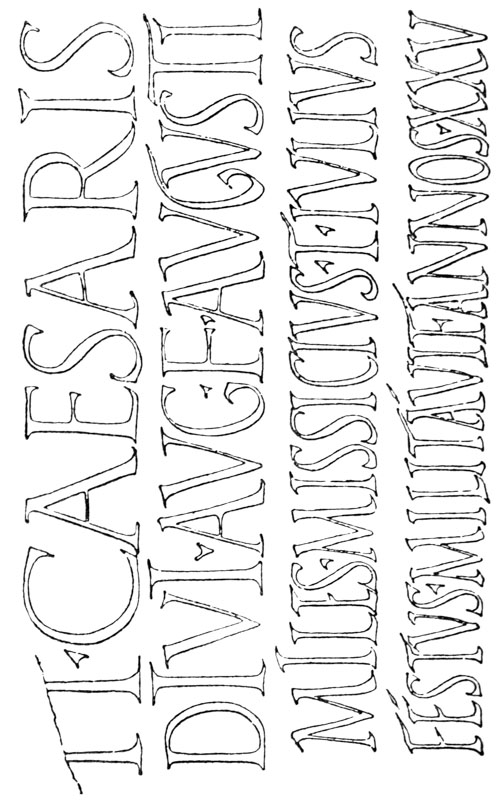
Fig. 203.—Hübner’s Exempla, No. 187 (14 scale of inscription), “Rustic Capitals” (see p. 297) between A.D. 14–37.
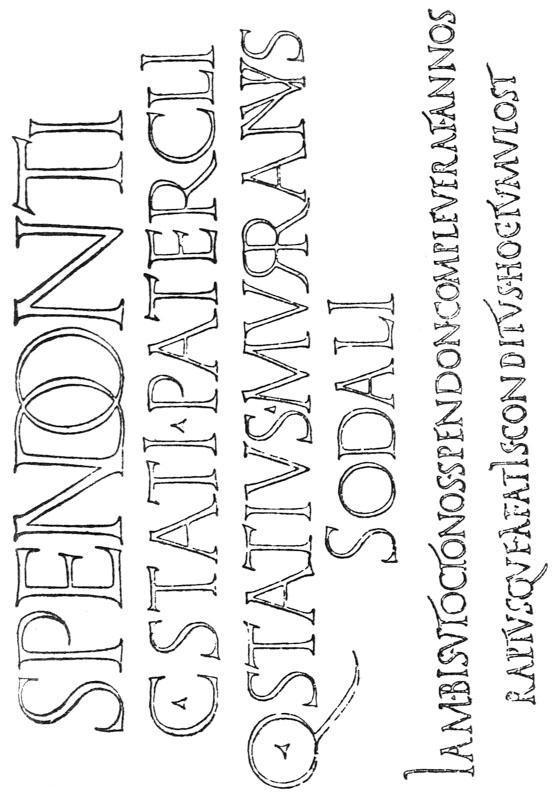
Fig. 204.—Hübner’s Exempla, No. 384 (one-fifth scale of inscription). 1st or 2nd Century, A.D.
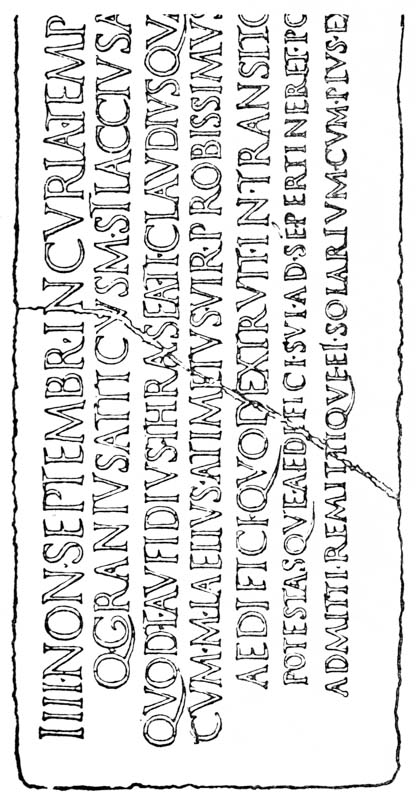
Fig. 205.—Hübner’s Exempla, No. 1084 (one-fourth scale of inscription). 2nd Century, A.D.
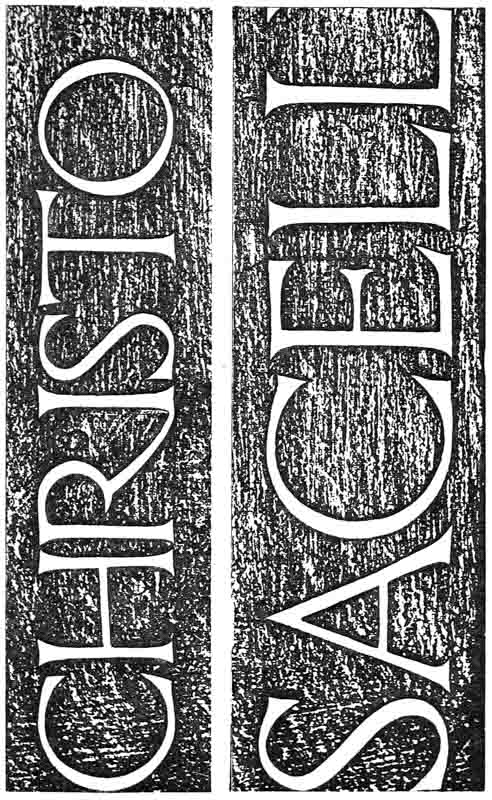
Fig. 206.—(Two portions) From a Rubbing of a Florentine marble dated MCCCCLXVII., slightly reduced (scale twelve-thirteenths). Note the interlinear spaces are 134 inch.
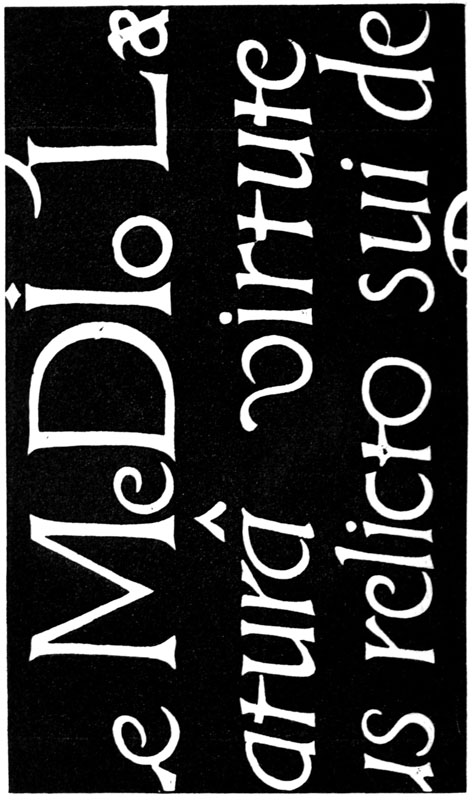
Fig. 207.—From a Rubbing of a Slate at Rye, dated 1655 (see p. 363). Exact size.
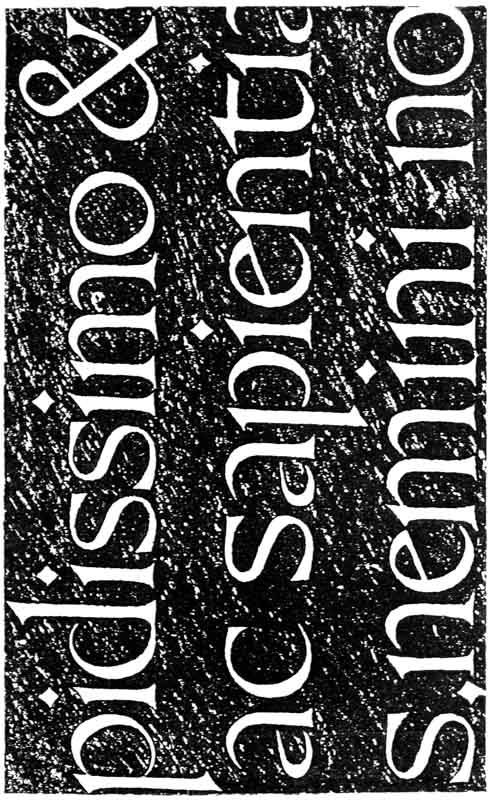
Fig. 208.—From a Rubbing of a Stone at Oxford (by A. E. R. Gill, 1905). Reduced, two-thirds scale.
[p384]
It is quite possible to make a beautiful and characteristic alphabet of equal-stroke letters, on the lines of the so-called “Block Letter” but properly proportioned and finished (such letters may be Raised, or Incised or Painted: see incised form, p. 391).
Raised letters, if exposed to wear or damage, may be protected by being on a sunk panel or having a raised frame or ornament. The background also may be left in raised strips flush with the letters, between the lines of the inscription.
Punctuation.—In early inscriptions the words were separated by points; in the more ancient they are square shaped , , , in the more elaborate, triangular , , , sometimes with curved-in sides (Plate I.). These developed later into the ivy leaf , or “hederæ distinguentes.” Such points may be used occasionally in modern work with fine effect, but should seldom be used between every word, unless the words are necessarily so close that distinguishing marks are required.


Phrasing and Arrangement.—An inscription may be arranged in sentences or phrases, and occasionally, by the use of larger letters, greater prominence is given to a word or phrase (see figs. 197, 204, 211). This method is particularly adapted to the nature of a set inscription (p. 264), and may help both its readableness and its appearance, but it must be borne in mind that to lay stress on any one statement or word may pervert its meaning or attract too much attention to it.
Any confusion of sense, or accidental word (p. 259) or phrase, appearing in the setting-out is [p385] avoided, if possible, by a slight rearrangement of the part, or, if necessary, of the whole inscription. Great care is taken that the spelling is accurate: a pocket dictionary should be carried.
Reading is further facilitated by avoiding, where possible, the dividing of words at the ends of lines. It may be observed that in the more ancient inscriptions words were generally kept entire.
Exercises in letter form and arrangement, more profitable than mere paper “designing,” might be devised by the craftsman. Inscriptions might be cut—on a small scale—in gesso or chalk, or inscriptions might be variously spaced and arranged on a properly coloured surface—such as a drawing-board covered with light or dark cloth—in letters cut out of sheet-lead or card.
BIBLIOGRAPHY, &C.
The few books and pamphlets given below are generally, of recent date, practical, and inexpensive. The prices quoted are, I believe, those at which the books are generally sold (not necessarily their published prices). They are all illustrated, except Nos. *9, 10, 11, and 19.
WRITING, &c. (See also Nos. 8, 12, 14, 19, 28, 29, and 31.) 1. The Story of the Alphabet: Edward Clodd, 1900. 9d. 2. Greek and Latin Palæography: Edward Maunde Thompson. 3s. 9d. (The extracts in these pp. 36, 41, 416, &c., are from the 2nd edition, 1894.) 3. The Journal of the Society of Arts, No. 2726, Feb. 17, 1905; Papers on [p386] Calligraphy and Illumination: Edward Johnston and Graily Hewitt. 6d. 4. Fac-similés de Manuscrits Grecs, Latins et Français du Ve au XIVe Siècle exposés dans la Galerie Mazarine: Bibliothèque Nationale Département des Manuscrits. 5s. 5. “A Guide to the Manuscripts” in the British Museum, 1906 (30 plates). 6d. 6. Bible Illustrations: Oxford University Press, 1896. About 2s.
ILLUMINATION, &c. (See also Nos. 3, 4, 5, 12, 14, 29, and 31.) 7. Illuminated Letters and Borders: John W. Bradley, 1901 (19 plates). (Price at South Kensington Museum) 1s. 8d. 8. English Illuminated Manuscripts: Sir E. M. Thompson, 1895. (Now out of print.) *9. The Journal of the Society of Arts, No. 2368, April 8, 1898; a Paper on English Art in Illuminated Manuscripts: Sir E. M. Thompson. 6d. *10. The Book of the Art of Cennino Cennini (a contemporary practical treatise on 14th-century Italian painting): Translated by Christiana J. Herringham, 1899. 6s. *11. Some Hints on Pattern Designing: (lecture, 1881), William Morris, 1899. 2s. 6d. (11a. “Books for the Bairns.—No. 50,” contains 55 reproductions of Bewick’s Birds. 1d.)
BOOKS—MANUSCRIPT & PRINTING. (See also Nos. 2 to 9, and 29 and 31.) 12. Books in Manuscript: Falconer Madan, 1893. 6s. (Frontispiece drawn from this by permission.) 13. The Story of Books: Gertrude Burford Rawlings, 1901. 9d. [p387] 14. The Old Service-Books of the English Church: Christopher Wordsworth and Henry Littlehales, 1904. 7s. 6d. 15. Early Illustrated Books: Alfred W. Pollard, 1893. 6s. 16. Facsimiles [in colour] from Early Printed Books in the British Museum, 1897. 7s. 6d. 17. A Guide to the Exhibition in the King’s Library (illustrating the History of Printing, Music Printing, and Bookbinding): British Museum, 1901 (36 illustrations). 6d. 18. “Arts and Crafts Essays by Members of the Arts and Crafts Exhibition Society”—Printing: William Morris and Emery Walker—(1st pub. 1893), 1899. 2s. 6d. *19. “Ecce Mundus,” containing The Book Beautiful: T. J. Cobden-Sanderson, 1902. 2s. 6d. 20. Printing (a technological handbook): Charles Thomas Jacobi, 1898. 3s. 9d. 21. Bookbinding and the Care of Books (The Artistic Crafts Series of Technical Handbooks), 1901: Douglas Cockerell. 5s. 22. A Note on Bookbinding: Douglas Cockerell, 1904. 1d.
HERALDRY, SYMBOLISM, &c. (See also Nos. 1, 12, 15, 29, and 31.) 23. The Journal of the Society of Arts, No. 2309, Feb. 19, 1897; A Paper on The Artistic Treatment of Heraldry: by W. H. St. John Hope. 6d. 24. English Heraldry: Charles Boutell, 1867. 6th ed. 1899, about 3s. 9d. 25. The Stall Plates of the Knights of the Garter, 1348–1485: W. H. St. John Hope (90 coloured plates, Imp. 8vo). About £3. [p388] 26. Didron’s Christian Iconography (or the History of Christian Art in the Middle Ages): 2 vols. 3s. 9d. (each).
LETTERING, &c. (See also Nos. 1 to 8, and 12 to 20.) 27. Lettering in Ornament: Lewis F. Day, 1902. 5s. 28. Alphabets: Edward F. Strange (1st ed. 1895). 4th ed., 3s. 9d. 29. The Palæographical Society’s Publications (out of print), containing hundreds of facsimiles (chiefly of MSS.), are of great interest. They may of course be seen in the British Museum Library. The New Palæographical Society publishes a selection of facsimiles annually. 30. Hübner’s Exempla Scripturae Epigraphicae Latinae a Caesaris dictatoris morte ad aetatem Justiniani (Berlin, 1885, price 46s.) contains many fine outline drawings of ancient Roman inscriptions (see figs. 203–5). It is kept with the books of reference in the Reading Room at the British Museum. 31. Photographs of fine pieces of lettering may be obtained at the Book Stall in South Kensington Museum (see footnote, p. 409).
Original MSS. or Inscriptions—from which we can learn much more than from photographs or drawings—may be found in most parts of the country, and in London especially in the British Museum, South Kensington Museum (see p. 391), the Record Office (Rolls Chapel, see p. 11), and Westminster Abbey (MSS. in the Chapter-House).
FOOTNOTES TO APPENDIX A: