Chapter VI
Reading edition
THE "DISCOVERY."
When the conspirators first undertook their enterprise, Parliament was appointed to meet on February 7th, 1604-5, but, as has been seen, it was subsequently prorogued till October 3rd, and then again till Tuesday, November 5th. On occasion of the October prorogation, the confederates employed Thomas Winter to attend the ceremony in order to learn from the demeanour of the assembled Peers whether any suspicion of their design had suggested this unexpected adjournment. He returned to report that no symptom could be discerned of alarm or uneasiness, and that the presence of the volcano underfoot was evidently unsuspected. Thus reassured, his associates awaited with confidence the advent of the fatal Fifth.
monteagle and letter.

Monteagle opened the letter, and, glancing at it, perceived that it bore neither date nor signature, whereupon he handed it to a gentleman of his household, named Ward, to read aloud, an apparently unnatural and imprudent proceeding not easy to explain, but, at least, inconsistent with the conduct of one receiving an obviously important communication in such mysterious circumstances. The famous epistle must be given in its native form.
My lord out of the love i beare to some of youere frends i have a caer of youer preseruacion therfor i would advyse yowe as yowe tender youer lyf to devys some excuse to shift of youer attendance at this parleament for god and man hath concurred to punishe the wickednes of this tyme and think not slightlye of this advertisment but retyre youre self into youre contri wheare yowe may expect the event in safti for thowghe theare be no apparence of anni stir yet i saye they shall receyve a terrible blowe this parleament and yet they shall not seie who hurts them this cowncel is not to be contemned because it maye do yowe good and can do yowe no harme for the dangere is passed as soon as yowe have burnt the letter and i hope god will give yowe the grace to mak good use of it to whose holy proteccion i comend yowe
(Addressed) to the ryht honorable the lord mouteagle
As to what thereafter followed and the manner in which from this clue the discovery was actually accomplished, it is impossible to say more than this, that the accounts handed down cannot by any possibility be true, inasmuch as on every single point they are utterly and hopelessly at variance. We can do no more than set down the particulars as supplied to us on the very highest authority.
A.—The account published in the "King's Book."
1. The letter was received ten days before the meeting of Parliament, i.e., on October 26th.
2. The Earl of Salisbury judged it to be the effusion of a lunatic, but thought it well, nevertheless, to communicate it to the king.
3. This was done five days afterwards, November 1st, when, in spite of his minister's incredulity, James insisted that the letter could intend nothing but the blowing up of the Parliament with gunpowder, and that a search must be made, which, however, should be postponed till the last moment.
4. Accordingly, on the afternoon of Monday, November 4th, the Lord Chamberlain going on a tour of inspection, visited the "cellar" and found there "great store of billets, faggots, and coals," and moreover, "casting his eye aside, perceived a fellow standing in a corner ... Guido Fawkes the owner of that hand which should have acted that monstrous tragedy." Coming back, the chamberlain reported that the provision of fuel appeared extraordinary, and that as to the man, "he looked like a very tall and desperate fellow."
5. Thereupon the king insisted that a thorough scrutiny must be made, and that "those billets and coals should be searched to the bottom, it being most suspicious that they were laid there only for covering of the powder." For this purpose Sir Thomas Knyvet, a magistrate, was despatched with a suitable retinue.
6. Before his entrance to the house, Knyvet found Faukes "standing without the doors, his boots and clothes on," and straightway apprehended him. Then, going into the cellar, he removed the firewood and at once discovered the barrels.
B.—The Account sent by Salisbury to the Ambassadors abroad, and the Deputy in Ireland, November 9th, 1605.
1. The letter was received about eight days before the Parliament.
2. Upon perusal thereof, Salisbury and Suffolk, the chamberlain, "both conceived that it could not be more proper than the time of Parliament, nor by any other way to be attempted than with powder, while the King was sitting in that Assembly." With this interpretation other Lords of the Council agreed; but they thought it well not to impart the matter to the king till three or four days before the session.
3. His Majesty was "hard of belief" that any such thing was intended, but his advisers overruled him and insisted on a search, not however till the last moment.
arrest of guy faukes.
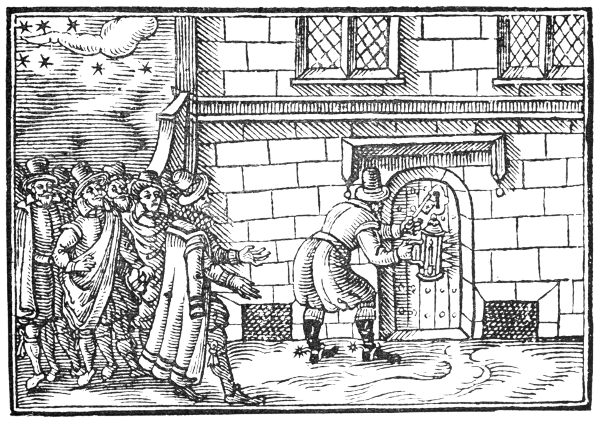
4. About 3 o'clock on the afternoon of Monday, November 4th, the Lord Chamberlain, Suffolk, visited the cellar, and found in it only firewood and not Faukes.
5. The lords however insisting, in spite of the king, that the matter should be probed to the bottom, Knyvet was despatched with orders to "remove all the wood, and so to see the plain ground underneath."
6. Knyvet, about midnight, "going unlooked for into the vault, found that fellow Johnson [i.e., Faukes] newly come out of the vault," and seized him. Then, having removed the wood, he perceived the barrels.
C.—The Account furnished by Salisbury for the information of the King of France, November 6th, 1605. (Original draft, in the P.R.O.)
1. The letter was received some four or five days before the Parliament.
2. This being shown to the king and the lords, "their lordships found not good ... to give much credit to it, nor yet so to contemn it as to do nothing at all."
3. It was accordingly determined, the night before, "to make search about that place and to appoint a watch in the old Palace, to observe what persons might resort thereabouts."
Never, assuredly, was a true story so hard to tell. Contradictions like these, upon every single point of the narrative, are just such as are wont to betray the author of a fiction when compelled to be circumstantial.
To say nothing of the curious discrepancies as to the date of the warning, it is clearly impossible to determine the locality of Guy's arrest. The account officially published in the "King's Book" says that this took place in the street. The letter to the ambassadors assigns it to the cellar and afterwards to the street; that to Parry, to the cellar only. Faukes himself, in his confession of November 5th, says that he was apprehended neither in the street nor in the cellar, but in his own room in the adjoining house. Chamberlain writes to Carleton, November 7th, that it was in the cellar. Howes, in his continuation of Stowe's Annals, describes two arrests of Faukes, one in the street, the other upstairs in his own chamber. This point, though seemingly somewhat trivial, has been invested with much importance. According to the time-honoured story, the baffled desperado roundly declared that had he been within reach of the powder when his captors appeared, he would have applied a match and involved them in his own destruction. This circumstance is strongly insisted on not only in the "King's Book," but also in his Majesty's speech to Parliament on November 9th, which declared, "and in that also was there a wonderful providence of God, that when the party himself was taken he was but new come out of his house from working, having his fire-work for kindling ready in his pocket, wherewith, as he confesseth, if he been taken immediately before, he was resolved to have blown up himself with his takers." We learn, however, from Cecil's earliest version of the history, that Faukes was apprehended in the very situation most suitable for such a purpose, "in the place itself, as he was busy to prepare his things for execution," while Chamberlain adds that he was actually engaged in "making his trains."
Far more serious, to say nothing of the episode of the chamberlain's visit, are the divergencies of the several versions as to the very substance of the story. We are told that King James was the first to understand and interpret the letter which had baffled the sagacity of his Privy Council; that the Lords of the Council had fully interpreted it several days before the king saw it; that the said lords would not credit the king's interpretation; that the king would not believe their interpretation; and that neither the one nor the other ever interpreted it at all; that his Majesty insisted on a search being made in spite of the reluctance of his ministers; that they insisted on the search in spite of the reluctance of their royal master; and that no such search was ever proposed by either; that Knyvet was despatched expressly to look for gunpowder, with instructions to rummage the firewood to the bottom, leaving no cover in which a barrel might lie hid; and that having no instructions to do anything of the kind, nor any reason to suspect the existence of any barrels, he discovered them only by a piece of luck, so purely fortuitous as to be clearly providential. On this last point especially the contradictions are absolutely irreconcilable.
It does not appear why the appearance of erroneous versions of so striking an event should have been thus confidently anticipated if the facts were undeniably established; while, on the other hand, it is not a little remarkable that the narrative thus expressly designed to establish the truth, should have been forthwith abandoned and contradicted by its author in every single particular.
discovery of gunpowder plot, and coins of James i.
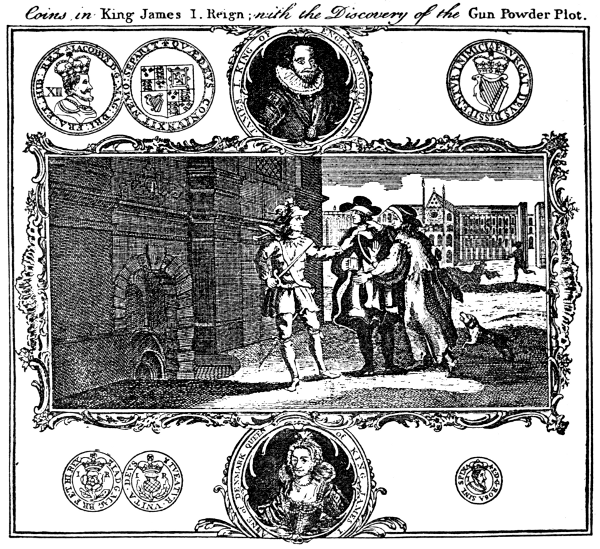
What then, it will be asked, really did occur? What was done by the conspirators? and what by those who discovered them?
Truth to tell, it is difficult, or rather impossible, to answer such questions. That there was a plot of some kind cannot, of course, be doubted; that it was of such a nature as we have been accustomed to believe, can be affirmed only if we are willing to ignore difficulties which are by no means slight. There is, doubtless, a mass of evidence in support of the traditional story upon these points, but while its value has yet to be discussed, there are other considerations, hitherto overlooked, which are in conflict with it.
"guy faukes' lantern."
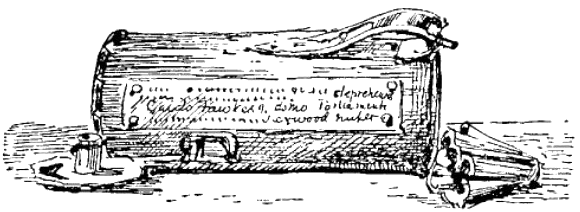
Neither can we overlook sundry difficulties, again suggested by the facts of the case, which make it hard to understand how the plans of the plotters can in reality have been as they are represented.
We have already observed on the nature of the house occupied in Percy's name. If this were, as Speed tells us, and as there is no reason to doubt, at the service of the Peers during a session, for a withdrawing-room, and if the session was to begin on November 5th, how could Faukes hope not only to remain in possession, but to carry on his strange proceedings unobserved, amid the crowd of lacqueys and officials with whom the opening of Parliament by the Sovereign must needs have flooded the premises? How was he, unobserved, to get into the fatal "cellar"?
FOOTNOTES:
The original of Winter's declaration, dated November 25th, which is at Hatfield, contains these and other particulars, which are altogether omitted in a "copy" of the same in the Record Office, dated, remarkably enough, on November the 23rd. It is from the latter that the version in the "King's Book" was printed.
"For thus the Lord in's all-protecting grace, Ten days before the Parliament began, Ordained that one of that most trayterous race Did meet the Lord Mounteagles Serving-man, Who about Seven a clocke at night was sent Upon some errand, and as thus he went, Crossing the street a fellow to him came, A man to him unknowen, of personage tall, In's hand a Letter, and he gave the same Unto this Serving-man, and therewithall Did strictly charge him to take speciall heede To give it into's Masters hand with speede."
Mischeefes Mystery (1617).
"And thus with loyall heart away he goes, Thereto resolved whatever should betide, To th' Court he went this matter to disclose, To th' Earle of Salsb'ryes chamber soone he hide, Whither heavens finger doubtless him directed, As the best meanes to have this fact detected."
Mischeefes Mystery.
It will be remarked that the account of November 6th makes no mention of the visit of the chamberlain to the vault, nor that of November 9th to the presence of Faukes at the time of this visit. The minute of November 7th says that Faukes admitted the chamberlain to the vault.
On this it is enough to remark that when Father Garnet, the chief of the said Jesuits, came afterwards to be tried, no attempt whatever was made to prove any such thing. Cecil therefore wrote thus, and made so grave an assertion, without having any evidence in his hands to justify it.
This "dark phrase" was the sentence—"For the danger is past as soon as you have burnt the letter," which the royal sage interpreted to mean "as quickly," and that by these words "should be closely understood the suddenty and quickness of the danger, which should be as quickly performed and at an end as that paper should be of blazing up in the fire."
Of this famous interpretation Mr. Gardiner says that it is "certainly absurd;" while Mr. Jardine is of opinion that the words in question "must appear to every common understanding mere nonsense."
When it was proposed in the House of Commons (January 31st, 1605-6,) to pass a vote of thanks to Lord Monteagle for his share in the "discovery," one Mr. Fuller objected that this would be to detract from the honour of his Majesty, for "the true discoverer was the king."
The reader will perhaps be reminded of Sir Walter Scott's inimitable picture of the king's satisfaction in this notable achievement.
"Do I not ken the smell of pouther, think ye? Who else nosed out the Fifth of November, save our royal selves? Cecil, and Suffolk, and all of them, were at fault, like sae mony mongrel tikes, when I puzzled it out; and trow ye that I cannot smell pouther? Why, 'sblood, man, Joannes Barclaius thought my ingine was in some manner inspiration, and terms his history of the plot, Series patefacti divinitus parricidii; and Spondanus, in like manner, saith of us, Divinitus evasit."—Fortunes of Nigel, c. xxvii.
Beneath the Painted Chamber was a vaulted cellar, answering to the description we have so frequently heard, whereas under the House of Lords was neither a cellar nor a vault.
This crypt beneath the Painted Chamber has been constantly shown as "Guy Faukes' Cellar."
In prints of the period, Faukes is usually represented as going to blow up this chamber, never the House of Lords.
Gazeau and Prampain (Hist. Mod., tome i.) speak of the conspiracy as "cette plaisanterie;" and say of the conspirators, "Dans une cave, ils avaient déposé 36 barils contenant (ou soi-disant tels) de la poudre."
"Magna cum Pompa, stipatorumque Caterva, Palmatisque, Togis, Gemmis, auroque refulgent: Ingens fit Populi concursus, compita complens, Turbis se adglomerant densis, spectantque Triumphum."
In his will Goodman professed that as he lived, so he died, most constant in all the articles of the Christian Faith, and in all the doctrine of God's holy Catholic and Apostolic Church, "whereof," he says, "I do acknowledge the Church of Rome to be the Mother Church. And I do verily believe that no other church hath any salvation in it, but only so far as it concurs with the faith of the Church of Rome." On this, Mr. Brewer, his editor, observes that a sound Protestant might profess as much, the question being what meaning is to be given to the terms employed. Moreover, the same writer continues, Goodman cannot have imagined that his life had been a constant profession of Roman doctrine, inasmuch as he advanced steadily from one preferment to another in the Church of England, and strongly maintaining her doctrines formally denounced those of Rome. What is certain, however, is this, that in the very work from which his evidence is quoted he speaks in such a manner as to show that whatever were his religious opinions, he was a firm believer in the Royal Supremacy and a lover of King James, whom he thus describes: "Truly I did never know any man of so great an apprehension, of so great love and affection,—a man so truly just, so free from all cruelty and pride, such a lover of the church, and one that had done so much good for the church." (Court of King James, i. 91.)