Chapter VII
Reading edition
PERCY, CATESBY, AND TRESHAM.
thomas percy.
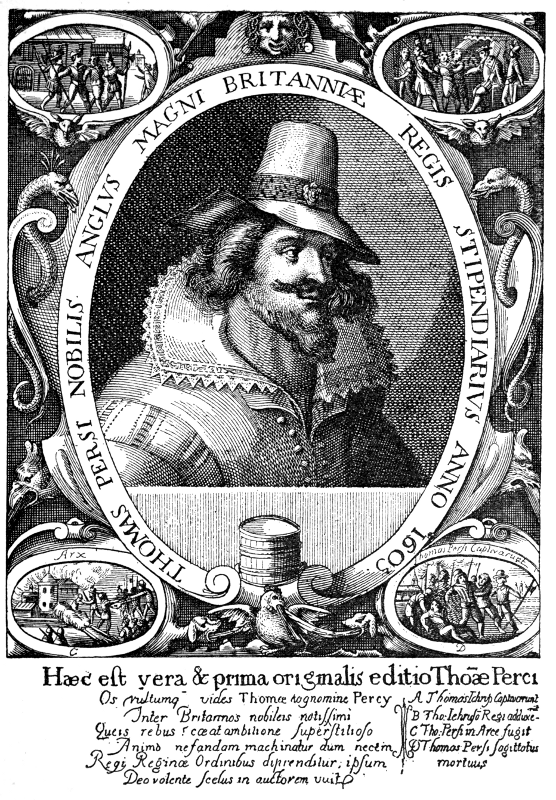
Considerations like these, it will hardly be denied, countenance the notion that Percy was, in King James's own phrase, a tame duck employed to catch wild ones. Against such a supposition, however, a grave objection at once presents itself. Percy was amongst the very first victims of the enterprise, being one of the four who were killed at Holbeche when the conspirators were brought to bay.
This, unquestionably, must at first sight appear to be fatal to the theory of his complicity, and the importance of such a fact should not be extenuated. At the same time, on further scrutiny, the argument which it supplies loses much of its force.
More suspicious still appears the fact that the king's government thought it necessary to explain how it had come to pass that Percy was not secured alive, and to protest that they had been anxious above all for his capture, but had been frustrated by the inconsiderate zeal of their subordinates. In the "King's Book" we read as follows: "Although divers of the King's Proclamations were posted down after those Traitors with all speed possible, declaring the odiousness of that bloody attempt, and the necessity to have Percy preserved alive, if it had been possible, ... yet the far distance of the way (which was above an hundred miles), together with the extreme deepness thereof, joined also with the shortness of the day, was the cause that the hearty and loving affection of the King's good subjects in those parts prevented the speed of his Proclamations."
Such an explanation cannot be deemed satisfactory. The distance to be covered was about 112 miles, and there were three days to do it, for not till November 8th were the fugitives surrounded. They in their flight had the same difficulties to contend with, as are here enumerated, yet they accomplished their journey in a single day, and they had not, like the king's couriers, fresh horses ready for them at every post.
In view of this, and much else of a similar kind, it is difficult to read Father Gerard's Narrative, and more particularly Father Greenway's additions thereto, without a growing feeling that if Catesby sought counsel it was with no intention of being guided by it, and that his sole desire was to get hold of something which might serve his own purposes.
It thus appears, once again, that the more its details are scrutinized, the less does the traditional history of the Plot commend itself to our acceptance. It is hard to believe that within the ranks of the conspirators themselves, there was no treachery, no one who, lending himself to work the ruin of his associates, unwittingly wrought his own.
"I should be glad to understand what your friend driveth at about the Fifth of November. It was, without all peradventure, a State Plot. I have collected many pregnant circumstances concerning it.
"Sir Henry Wotton says 'twas usual with Cecil to create plots, that he might have the honour of the discovery, or to such effect.
"The Lord Mounteagle knew there was a letter to be sent to him before it came. (Known by Edmund Church, Esq., his confidant.)
Then, in answer to an objection of Fulman's, is added: "Catesby, 'tis like, did not mean to betray his friends or his own life—he was drawn in and made believe strange things. All good men condemn him and the rest as most desperate wretches; yet most believed the original contrivance of the Plot was not theirs."
It must also be remarked that we find some traces in the evidence which remains of certain mysterious conspirators of great importance, concerning whom no investigation whatever appears to have been made, they being at once permitted to drop into the profoundest obscurity, in a manner quite contrary to the habitual practice of the authorities.