Chapter VIII
Reading edition
THE GOVERNMENT'S CASE.
We have hitherto confined our attention to sources of information other than those with which the authors of the official narrative have supplied us, and upon which they based the same. It remains to inquire how far the evidence presented by them can avail to substantiate the traditional history, and to rebut the various arguments against its authenticity which have been adduced.
For brevity and clearness' sake it will be advisable to divide this investigation under several heads.
i. The Trial of the Conspirators.
The employment of methods such as these would in any circumstances forfeit all credit on behalf of the story thus presented. In the present instance the presumption raised against it is even stronger than it would commonly be. If the Gunpowder Plot were in reality what was represented, why was it deemed necessary, in Cecil's own phrase, to pervert and disguise its history in order to produce the desired effect? A project so singular and diabolical in its atrocity, prepared for on so large a scale, and so nearly successful, should, it would appear, have needed no fictitious adjuncts to enhance its enormity; and for the conviction of miscreants caught red-handed in such an enterprise no evidence should have been so effectual as that furnished by the facts of the case, which of their nature should have been patent and unquestionable. When we find, on the contrary, a web of falsehood and mystery woven with elaborate care over the whole history of the transaction, it is not unnatural to infer that to have told the simple truth would not have suited the purpose of those who had the telling of the tale; and it is obviously necessary that the evidence whereby their story was supported should be rigorously sifted.
ii. The Fundamental Evidence.
Amongst all the confessions and "voluntary declarations" extracted from the conspirators, there are two of exceptional importance, as having furnished the basis of the story told by the government, and ever since generally accepted. These are a long declaration made by Thomas Winter, and another by Guy Faukes, which alone were made public, being printed in the "King's Book," and from which are gathered the essential particulars of the story as we are accustomed to hear it.
Of Winter's declaration, which is in the form of a letter to the Lords Commissioners, there is found in the State Paper Office only a copy, bearing date November 23rd, 1605, in the handwriting of Levinus Munck, Cecil's private secretary. This copy has been shown to the King, who in a marginal note objects to a certain "uncleare phrase," which has accordingly been altered in accordance with the royal criticism: and from it has evidently been taken the printed version, which agrees with it in every respect, including the above-mentioned emendation of the phraseology.
from winter's confession, november 23.

What, however, is most remarkable is the frank manner in which this document is treated as a draft. Several passages are cancelled and others substituted, sometimes in quite a contrary sense, so that the same deponent cannot possibly have made the statements contained in both versions. Other paragraphs are "ticked off," as the event proves, for omission.
"About Easter, the parliament being prorogued till October next, we dispersed ourselves, and I retired into the Low-countries, by advice and direction of the rest; as well to acquaint Owen with the particulars of the plot, as also, lest, by my longer stay, I might have grown suspicious." But of Owen we shall see more in particular. It must not be forgotten that on several other days besides those named above, Faukes made declarations, still extant, viz., November 5th, 6th, 7th, 9th, and 16th, and January 9th and 20th. The most important items of information furnished by that selected for publication were not even hinted at in any of these.
Moreover, it is apparent that this interrogatory is not founded on information already obtained, but is, in fact, what is known as a "fishing" document, intended to elicit evidence of some kind. In the first place, some of its suggestions are mutually incompatible. Thus in another place it implies that not Elizabeth but her infant sister Mary was the choice of the queen-makers:—"Who should have been protector of the Lady Mary, who, being born in England, they meant to prefer to the crown. With whom should she have married?" (She was then seven months old.) Again it asks: "What should have become of the Prince?" as though he might after all be the sovereign intended.
It is hard to understand how so remarkable an operation should have been totally ignored in all the other confessions and declarations, numerous and various as they are; while, on the other hand, should this striking feature of the Plot prove to be a fabrication, what is there of which to be certain?
iii. The Confession of Thomas Bates (December 4th, 1605).
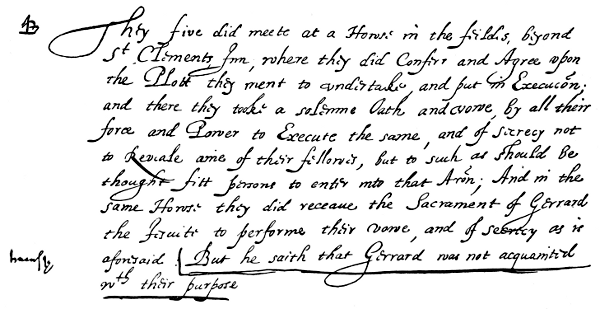
That being introduced and sworn into the conspiracy by his master, Catesby, he was then told that, as a pledge of fidelity, he must receive the sacrament upon his oath, and accordingly he went to confession to Greenway, the Jesuit.
That in his confession he fully informed Greenway of the design, and that Greenway bade him obey his master, because it was for a good cause, and be secret, and mention the matter to no other priest.
That he was absolved by Greenway, and afterwards received Holy Communion.
Here, again, it is impossible to suppose that the all-important point was the one omitted. It is clear, however, that the mention of a confession made to Greenway would primâ facie afford a presumption that this particular matter had been confessed, thus furnishing a foundation whereon to build; and, knowing as we do how evidence was manipulated, it is quite conceivable that the copy now extant incorporates the improved version thus suggested.
He goes on, however, to assure his Majesty that the desired object is now in sight, particularly referring to a confession which can be none other than that of Bates, but likewise cannot be that afterwards given to the world; for it is spoken of as affording promise, but not yet satisfactory in its performance.
"You may tell his Majesty that if he please to read privately what this day we have drawn from a voluntary and penitent examination, the point I am persuaded (but I am no undertaker) shall be so well cleared, if he forbear to speak much of this but few days, as we shall see all fall out to the end whereat his Majesty shooteth."
It seems clear, therefore, that the famous declaration of Bates, like those of Faukes and Winter, tends to discredit the story which in particulars so important rests upon such evidence.
It may be farther observed that if the confession of Bates, as officially preserved, were of any worth, it would have helped to raise other issues of supreme importance. Thus its concluding paragraph runs as follows:
"He confesseth that he heard his master, Thomas Winter, and Guy Fawkes say (presently upon the coming over of Fawkes) that they should have the sum of five-and-twenty thousand pounds out of Spain."
This clearly means that the King of Spain was privy to the design, for a sum equivalent to a quarter of a million of our money could not have been furnished by private persons. The government, however, constantly assured the English ambassadors abroad of the great satisfaction with which they found that no suspicion whatever rested upon any foreign prince.
iv. Robert Winter.
There are various traces of foul play in regard of this conspirator in particular, which serve to shake our confidence as to the treatment of all. Robert Winter was the eldest brother of Thomas, and held the family property, which was considerable. Whether this motive, as Mr. Jardine suggests, or some other, prompted the step, certain it is that the government in their published history falsified the documents in order to incriminate him more deeply. Faukes, in the confession of Nov. 17th, mentioned Robert Keyes as amongst the first seven of the conspirators who worked in the mine, and Robert Winter as one of the five introduced at a later period. The names of these two were deliberately interchanged in the published version, Robert Winter appearing as a worker in the mine, and Keyes, who was an obscure man of no substance, among the gentlemen of property whose resources were to have supported the subsequent rebellion. Moreover, in the account of the same confession sent to Edmondes by Cecil three days before Faukes signed it (i.e., Nov. 14th), the same transposition occurs, Keyes being explicitly described as one of those "who wrought not in the mine," although, as we have seen, he is one of the three who alone make any mention of it.
v. Captain Hugh Owen, Father William Baldwin, and others.
"I will not conceal from your lordship that they have been here so unrespective as to desire for their better satisfaction to have a copy of the information against the said persons to be sent over hither; which I fear will be very displeasing to his Majesty to understand."
"As for the particular depositions against Owen and Baldwin, which the archdukes desire to have a sight of, you may let them know that it is a matter which can make but little to the purpose, considering that his Majesty already upon his royal word hath certified the archdukes of their guilt."
To reinforce this lucid explanation Salisbury sent six days later what had before been refused, an abstract of "confessions against Owen," and a corrected copy of the Act of Attainder. These documents deserve some consideration.
"Sir, although in matter of religion well you know that there are many discords between us, yet sure in your duty and loyalty to my King and Country I find in you so good a concordance I cannot but much reverence and love you, and wish you all the happiness that a man of your sort upon the earth can desire.
"Much am I (I assure you) grieved at your departure, and the more that I was put in so good hope that your journey should have been stayed. The time of the year unpleasant to travel in, your body, as I think, not much accustomed to journeys of so great length, and the great good you did here to your poor countrymen (which now they want) are great motives to make your friends to wish your will in that voyage had been broken.
"If it be not, I shall not believe in words, for many here do greatly desire you for causes spiritual, and some for temporal. In the latter number am I, who, not affecting your spiritualities (for that these in you abound to superfluity), do much reverence and respect your temporal abilities, as wherein I acknowledge much wisdom, temper, and sincerity. So no friends you have shall ever more desire good unto you than myself. And therefore I wish I were able to make so good demonstration as willingly I would that I ever will here and in all places in this world rest
"Your very assured loving friend,
"Ch. Co."
vi. Other Documents.
It is impossible to analyze in detail the evidence supplied by the several conspirators after their capture, or to examine the endless inconsistencies and contradictions with which it abounds. One or two points must, however, be indicated.
1. As we have seen, it is clear that at the beginning an effort was made to invest the Plot with a far wider political significance than was afterwards attempted, and to introduce elements which were soon quietly laid aside. In the interrogatories prepared by Sir E. Coke and Chief Justice Popham, we find it suggested that the death of the Earl of Salisbury was a main feature of the scheme, "absolutely agreed upon" among the conspirators. Also that the titular Earl of Westmoreland, the titular Lord Dacre, the Earl of Northumberland, Sir Walter Raleigh, and others were mixed up in the business.
Nor were such endeavours altogether fruitless, for, supposing the testimony extorted from the prisoners to be worthy of credit, information was obtained altogether changing the character and complexion of the design. This was, however, presently buried in oblivion and treated as of no moment whatever.
from faukes' confession of november 9, 1605.
"While I was writing this, the old man waxed wroth. He shook with passion, and would fain have snatched the paper from me."
"'If you don't want me to write the truth,' said I, 'I'll not write at all.'"
"'Nay,' quoth he, 'write so and so, and I'll copy out what you have written.'"
"'I shall write what I please,' I answered, 'and not what you please. Show what I have written to the Council, for I shall add nothing but my name.'"
"Then I signed so near the writing, that nothing could be put in between. The hot-tempered man, seeing himself disappointed, broke out into threats and blasphemies: 'I'll get you into my power, and hang you in the air, and show you no mercy: and then I shall see what God will rescue you out of my hands.'"
"Your Lordship hath had a present trial of that which none but myself hath done before, to write in another man's hand, and, discovering the secret writing being in blank, to abuse a most cunning villain in his own subtlety, leaving the same at last in blank again, wherein although there be difficulty their answers show they have no suspicion."
Gregory's letter, of which we have been speaking, has appended to it an instructive postscript:
vii. Catholic Testimony.
It will not improbably be urged that the government history is confirmed in all essential particulars by authorities to whom no exception can be taken, namely, contemporary Catholic writers, and especially the Jesuits Gerard and Greenway, whose narratives of the conspiracy corroborate every detail concerning which doubts have been insinuated.
This argument is undoubtedly deserving of all consideration, but upon examination appears to lose much of its force. If the narratives in question agree with that furnished by the government, it is because they are based almost entirely upon it, and upon those published confessions of Winter and Faukes with which we are familiar.
"[The prisoners'] examinations did all agree in all material points, and therefore two only were published in print, containing the substance of the rest. And indeed [this is] the sum of that which I have been able to say in this narration touching either their first intentions or the names or number of the conspirators, or concerning the course they took to keep the matter so absolutely secret, or, finally, touching the manner of their beginning and proceeding in the whole matter; for that—as I noted before—it being kept a vowed secret in the heads and hearts of so few, and those also afterwards apprehended before they could have means to declare the particulars in any private manner, therefore no more can be known of the matter or manner of this tragedy than is found or gathered out of their examinations."
What has been said of Gerard and Greenway may serve also for Father Garnet, who in his various examinations and other utterances assumes the truth of the government story, for neither had he materials to go upon except those officially supplied.
It is obvious that the conclusion to be drawn from the above considerations is chiefly negative. That the conspirators embarked on a plot against the state, is, of course unquestionable. What was the precise nature of that plot is by no means clear, and still less what were the exact circumstances of its initiation and its collapse. This only appears to be certain, that things did not happen as they were officially related, while the elaborate care expended on the falsification of the story seems to indicate that the true version would not have served the purposes to which that story was actually put.
FOOTNOTES:
The Lord Admiral was the Earl of Nottingham, better known as Lord Howard of Effingham, the commander-in-chief against the Spanish Armada. There appears to be no foundation for the supposition that he was a Catholic. Northampton (Henry Howard) was a professing Catholic. The chamberlain was the Earl of Suffolk, the Chief Justice, Popham.
The declaration of November 17th opens: "I confesse that a practise in general was first broken unto me against his Majesty, for releife of the Catholique cause, and not invented or propounded by myself. And this was first propounded unto me about Easter last was twelvemonth, beyond the Seas, in the Low Countries of the Archdukes obeysance, by Thomas Winter, who came thereupon with me into England, and there wee imparted our purpose to three other Englishmen more, namely Robt Catesby, Thos Percy, and John Wright, who all five consulting together," etc. See both documents in full, Appendix N.
The portion within brackets is cancelled, and the following substituted: "He confesseth that if their purpose had taken effect, untill they had power enough, they would not have avowed the deed to be theirs; but if their power ... had been sufficient, they thereafter would have taken it upon them."
The corresponding portion of the declaration of November 17th runs thus: "It was further resolved amongst us, that the same day that this action should have been performed, some other of our confederates should have surprised the person of the L. Elizabeth, the King's eldest daughter, ... and presently proclaimed her for Queene, having a project of a Proclamation ready for the purpose, wherein we made no mention of altering of Religion, nor would have avowed the deed to be ours, untill we should have had power enough to make our partie good, and then we would have avowed both."
Item. Where you have confessed that the L. Elizabeth should have succeeded, and that she should have been brought up as a Catholic, and married to an English Catholic. (1) Who should have had the government of her? (2) Who was nominated to be the fittest to have married her?
Item. Was it not resolved amongst you that after the act done you would have taken the Tower, or any other place of strength, and meant you not to have taken the spoil of London, and whom should you have instantly proclaimed?
Item. By what priests or Jesuits were you resolved that it was godly and lawful to execute the act?
Item. Whether was it not resolved that if it were discovered Catesby and others should have killed the king coming from Royston?
Item. Were not Edw. Neville, calling himself Earl of Westmorland, Mr. Dacre, calling himself Lord Dacre, or any of the Nobility, privy to it? How many of the Nobility have you known at Mass? What persons in the Tower were named to be partakers with you?
It is not impossible that Owen had some knowledge of the conspiracy, though the course adopted by his enemies seems to afford strong presumption to the contrary. It must, moreover, be remembered that, as Father Gerard tells us, he and others similarly accused, vehemently protested against the imputation, while in his case in particular we have some evidence to the same effect. Thomas Phelippes, the "Decipherer," of whom we have already heard, was on terms of close intimacy with Owen, and in December, 1605, wrote to him about the Plot in terms which certainly appear to imply a strong conviction that his friend had nothing to do with it.
"There hath been and yet is still great paynes taken to search to the bottom of the late damnable conspiracy. The Parliamente hit seemes shall not be troubled with any extraordinarie course for their exemplarye punishment, as was supposed upon the Kinges speeche, but onlye with their attaynder, the more is the pitye I saye."—Dom. James I. xvii. 62.
Tanner transcript. "At my going over Mr Catesby charged me two things more: the one to desire of Baldwin & Mr Owen to deal with the Marquis [Spinola] to send over the regiment of which he [Catesby] expected to have been Lieutenant Colonel under Sir Charles [Percy].... He wished me secondly to be earnest with Baldwin to deal with the Marquis to give the said Mr Catesby order for a Company of Horse, thinking by that means to have opportunity to buy Horses and Arms without suspition."
According to Abbot, Faukes was to give instructions that when the time of Parliament approached, Sir Wm. Stanley was on some pretext to lead the English forces in the archduke's service towards the sea, and with them any others he could manage to influence. He also mentions the conspiracy of Morgan, as spoken of by Coke.
In addition to all this, Abbot cites from the same confession the following extraordinary particulars (p. 160): Faukes, when he came to London, with T. Winter, went to Percy's house and found there Catesby and Father Gerard. They talked over matters, and agreed that nothing was to be hoped from foreign aid, nor from a general rising of Catholics, and that the only plan was to strike at the king's person: whereupon Catesby, Percy, John Wright, Winter, and himself, were sworn in by Gerard.
[This is in absolute contradiction to Winter's evidence (November 23rd) that Percy was initiated in the middle of the Easter term, the other four having agreed on the scheme at the beginning of the same term; and to that of Faukes himself (November 17th) that he and Winter first resolved on a plot for the benefit of the Catholic cause, and afterwards imparted their idea to Catesby, Wright, and Percy.]
Sir E. Coke's Version. "After the powder treason was resolved upon by Catesbye, Thomas Winter, the Wrightes, my self, and others, and preparation made by us for the execution of it, by their advise and direction I went into fflanders and had leave given unto me to discover our project in every particular to Hughe Owen and others, but with condicion that they should sweare first to secrecie as we our selves had done. When I arryved in fflanders I found Mr Owen at Bruxelles to whom after I had given the oathe of secrecye I discovered the whole busines, howe we had layed 20 whole barrells of powder in the celler under the parliament howse, and howe we ment to give it fire the first day of the parliament when the King, the prince, the duke, the Lords spirituall and temporall, and all the knights, citizens, and burgesses of parliament should be there assembled. And that we meant to take the Ladye Elizabeth and proclaime hir for we thought most like that the prince and duke would be there with the king. Mr Owen liked the plott very well, and said that Thomas Morgan had once propounded the very same in quene Elizabeth's time, and willed me that by ani meanes we should not make any mencion of religion at the first, and assured me that so soone as he should have certaine newes that this exploit had taken effect that he would give us what assistance he could and that he would procure that Sir Wm Stanley should have leave to come with those English men which be there and what other forces he could procure."
The confession of Faukes in the Record Office, dated the same, January 20th, is thus summarized in the Calendar of State Papers (Dom. James I. xviii. 28): "Talked with Catesby about noblemen being absent from the meeting of Parliament; he said Lord Mordaunt would not be there, because he did not like to absent himself from the sermons, as the king did not know he was a Catholic; and that Lord Stourton would not come to town till the Friday after the opening."
Abbot, whose whole object is to incriminate the Jesuits, does not mention this remarkable statement.
Again we read, November 30th (ibid.): "Father Baldwin told this examinate that about 2,000 horses would be provided by the Catholicks of England to join with the Spanish forces ... and willed this examinate to intimate so much to Father Creswell, which this examinate did."
The facsimile of Faukes' signature, appended to his confession of November 9th, though affording unmistakable evidence of torture, gives no idea of the original, wherein the letters are so faintly traced as to be scarcely visible. It is evident that the writer had been so severely racked as to have no strength left in his hands to press the pen upon the paper. He must have fainted when he had written his Christian name, two dashes alone representing the other.
This signature, with other of the more sensational documents connected with the Plot, is exhibited in the newly established museum at the Record Office.
"Father Oswald [Greenway] went to assist these gentlemen with the Sacraments of the Church, understanding their danger and their need, and this with evident danger to his own person and life: and all those gentlemen could have borne witness that he publicly told them how he grieved not so much because of their wretched and shameful plight, and the extremity of their peril, as that by their headlong course they had given the heretics occasion to slander the whole body of Catholics in the kingdom, and that he flatly refused to stay in their company, lest the heretics should be able to calumniate himself and the other Fathers of the Society."
There is here an evident allusion to the silly story of the "bell in the wall" (related by Greenway and not by Gerard), to which Mr. Jardine gives extraordinary prominence. He does not, however, inform us that Greenway relates this (Narrative, f. 58 b) and some similar matters, on the authority of "an acquaintance to whom Catesby told it shortly before his death," and that he leaves it to the judgment of his readers.
Greenway's frequent and earnest protestations of innocence Mr. Jardine summarily dismisses with the observation that they are "entitled to no credit whatever" (p. xii).