Chapter IV
Reading edition
THE TRADITIONAL STORY.
The history of the Gunpowder Plot prior to its discovery, as related with much circumstantiality by the government of the day, has, in all essential particulars, been accepted without demur by the great majority of modern writers. We have already seen that those who lived nearer to the period in question were less easily convinced; it remains to show that the internal evidence of the story itself is incompatible with its truthfulness.
The point upon which everything turns is the secret, and therefore dangerous, character of the conspiracy, which, as we are told, completely eluded the vigilance of the authorities, and was on the very verge of success before even a breath of suspicion was aroused, being balked only by a lucky accident occurring at the eleventh hour, in a manner fitly described as miraculous.
On the other hand, however, many plain and obvious considerations combine to show that such an account cannot be true. It is not easy to believe that much which is said to have been done by the conspirators ever occurred at all. It is clear that, if such things did occur, they can by no possibility have escaped observation. There is evidence that the government knew of the Plot long before they suddenly "discovered" it. Finally, the story of the said "discovery," and the manner in which it took place, is plainly not only untrue, but devised to conceal the truth; while the elaborate care expended upon it sufficiently indicates how important it was held that the truth should be concealed.
There are, moreover, arguments, which appear to deserve consideration, suggesting the conclusion that the Plot was actually set on foot by the secret instigation of those who designed to make it serve their ends, as in fact it did. For our purpose, however, it is not necessary to insist greatly upon these. It will be enough to show that, whatever its origin, the conspiracy was, and must have been, known to those in power, who, playing with their infatuated dupes, allowed them to go on with their mad scheme, till the moment came to strike with full effect; thus impressing the nation with a profound sense of its marvellous deliverance, and winning its confidence for those to whose vigilance and sagacity alone that deliverance appeared due.
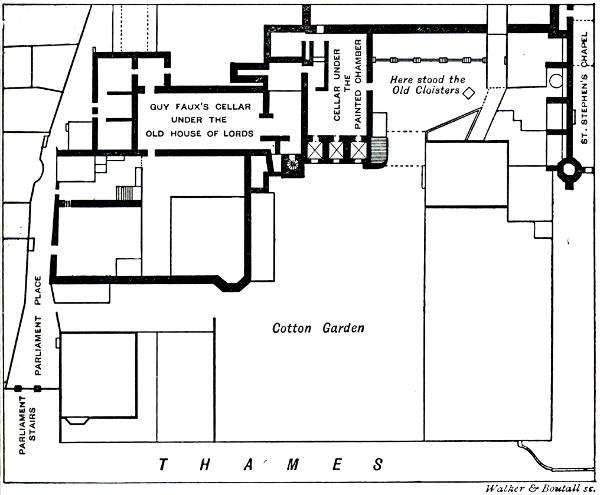
That we may rightly follow the details of the story told to us, we must in the first place understand the topography of the scene of operations, which, with the aid of the illustrations given, will not be difficult.
houses of parliament in the time of James i.
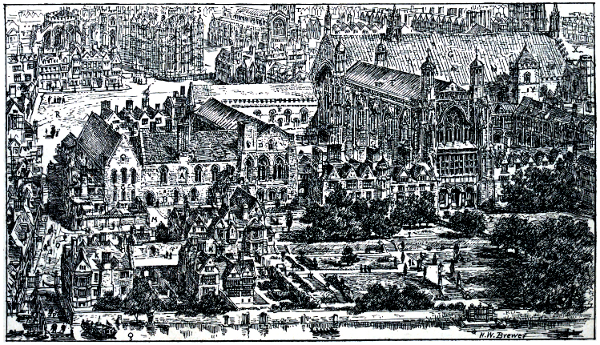
Index. Parliament Houses in the time of James I.
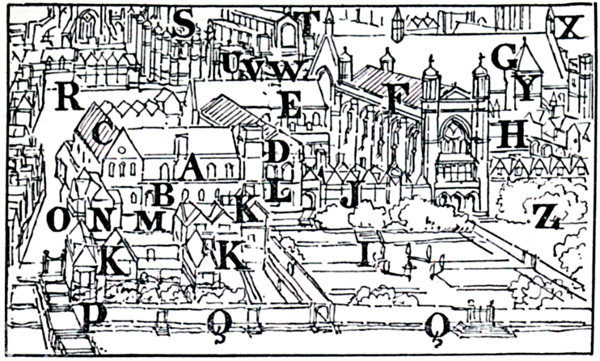
a. The House of Lords. b. Chamber under the House of Lords, called "Guy Faukes' Cellar." c. The Prince's Chamber. d. The Painted Chamber. e. The "White Hall" or Court of Requests. f. The House of Commons (formerly St. Stephen's Chapel). g. Westminster Hall. h. St. Stephen's Cloisters, converted into houses for the Tellers of the Exchequer. i. Garden of the Old Palace (afterwards called "Cotton Garden"). j. House built on the site of the Chapel of "Our Lady of the Pew" (called later "Cotton House"). k k k. Houses built upon ruins of the walls of the Old Palace. l. Vault under the Painted Chamber. m. Yard or Court into which a doorway opened from Guy Faukes' Cellar. n. Passage leading from the same Yard or Court into Parliament Place. o. Parliament Place. p. Parliament Stairs (formerly called "The Queen's Bridge"). q q. The River Thames. r. Old Palace Yard. s. Westminster Abbey. t. St. Margaret's Church. u v w. Buildings of the Old Palace, called "Heaven" (or "Paradise"), "Hell," and "Purgatory." x. New Palace Yard. y. Bell Tower of St. Stephen's. z. The Speaker's Garden.
ground plan of the scene of action.
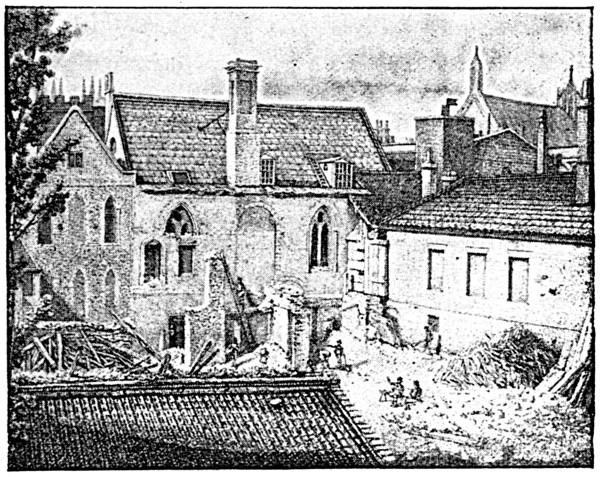
the old house of lords, from the east or river side, showing the garden.
What, above all, of the noise made during the space of a couple of months, in assaulting a wall "very hard to beat through"? It is a matter of common observation how sound travels in the ground, and every stroke of the pick upon the stone must have been distinctly heard for more than a hundred yards all around, constituting a public nuisance. Meanwhile, not only were there people living close by on every side, but men were constantly at work right over the heads of the diggers, and only a few feet from them: yet we are required to believe that neither these nor any others had any notion that anything unusual was going on.
Neither is it easy to understand how these amateurs contrived to do so much without a catastrophe. To make a tunnel through soft earth is a very delicate operation, replete with unlooked-for difficulties. To shore up the roof and sides there must, moreover, have been required a large quantity of the "framed timber" of which Speed tells us, and the provision and importation of this must have been almost as hard to keep dark as the exportation of the earth and stones. A still more critical operation is that of meddling with the foundations of a house—especially of an old and heavy structure—which a professional craftsman would not venture upon except with extreme care, and the employment of many precautions of which these light-hearted adventurers knew nothing. Yet, recklessly breaking their way out of one building, and to a large extent into another, they appear to have occasioned neither crack nor settlement in either.
cellar under house of lords.
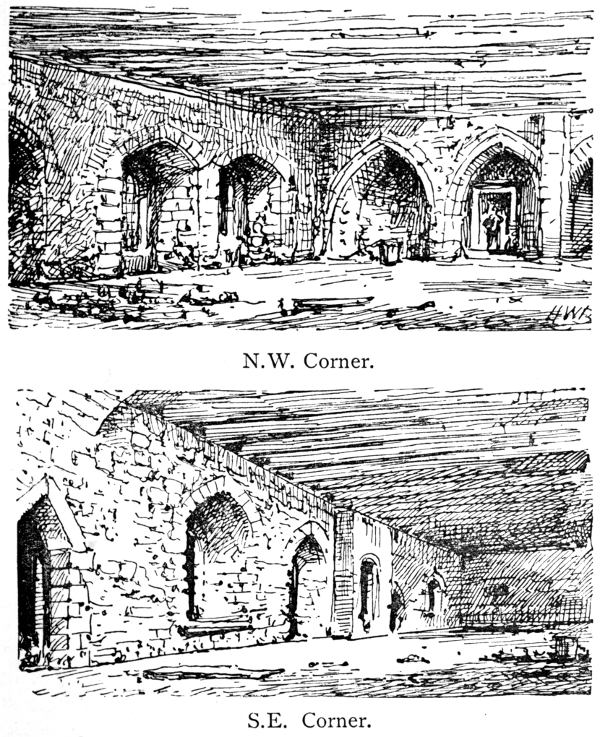
It is obvious that Mr. Bright's men must on this, as presumably upon many previous occasions, have been at work among the coals, while the miners were hammering at the foundations beneath them, and yet have been as little aware of what was going on as were the others of the existence of the "cellar." It must, farther, be noted that the hiring of this receptacle was, in fact, by no means so easy a matter as the accounts ordinarily given would lead us to suppose. Faukes, in the narrative on which the whole history of this episode has been based, is made to say that he found that the coals were a-selling, and the cellar was to be let, whereupon Percy went and hired it. Mrs. Whynniard, however, tells us that the cellar was not to let, and that Bright had not the disposal of the lease, but one Skinner, and that Percy "laboured very earnestly" before he succeeded in obtaining it.
vault, east end of painted chamber, erroneously styled "guy faukes' cellar."
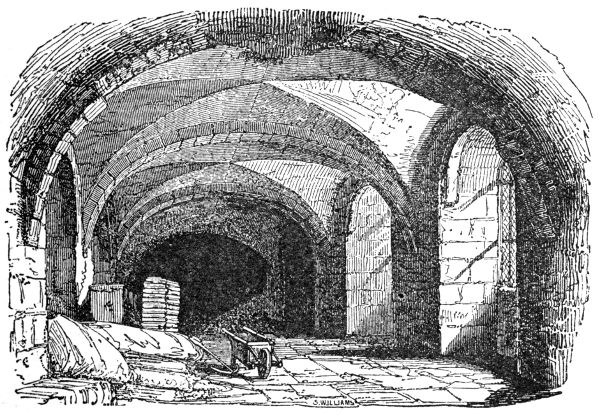
arches from the "cellar" under the house of lords.
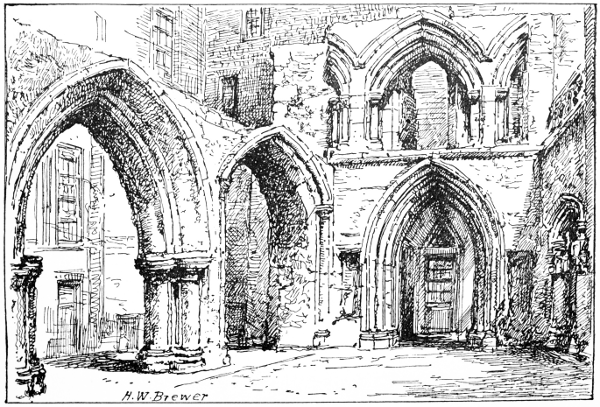
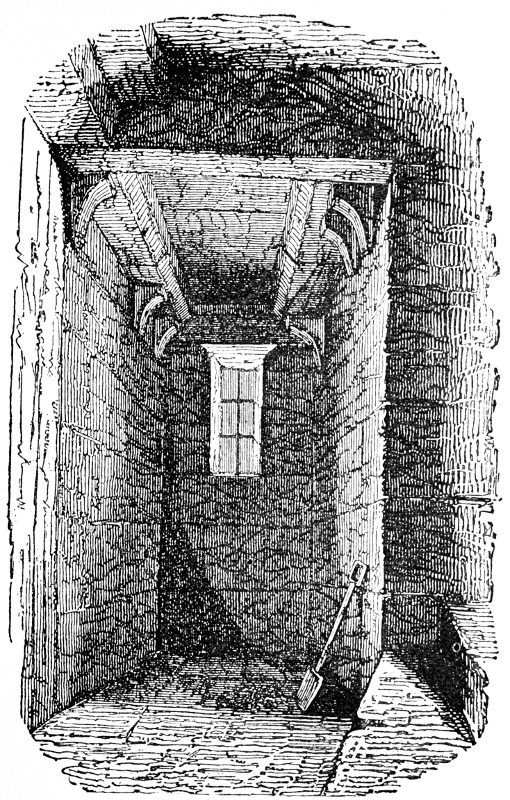
cell in staircase turret, s.e. corner, painted chamber, often called "guy faukes' cell."
On the other hand, it is somewhat startling to find no less a person than the Earl of Salisbury himself ignorant or oblivious of so remarkable a circumstance. In Thomas Winter's lodging was found the agreement between Percy and Ferrers for the lease of the house, which was taken, as has been said, in May, 1604. This is still preserved, and has been endorsed by Cecil, "The bargaine between Percy and Ferrers for the bloody sellar...." But this contract had nothing to do with the "bloody sellar," which was not rented till ten months later. Again, writing November 9th, 1605, to Cornwallis and Edmondes, Cecil says: "This Percy had about a year and a half ago hired a part of Vyniard's house in the old Palace, from whence he had access into this vault to lay his wood and coal, and as it seemeth now [had] taken this place of purpose to work some mischief in a fit time." When this was written the premises had been for four days in the hands of the government. It is clearly impossible that the remains of the mine, had they existed, should not have been found, and equally so that Cecil should not have alluded to the overwhelming evidence they afforded as to the intention of Percy and his associates to "work some mischief," but should, again, have connected the tenancy of the house only with the "cellar."
It will, moreover, be found by investigators that when exceptional stress is laid on any point by Sir E. Coke, the Attorney General, a prima facie case against the genuine nature of the evidence in regard of that point is thereby established. In his speech on the trial of the conspirators we find him declaring that, "If the cellar had not been hired, the mine work could hardly, or not at all, have been discovered, for the mine was neither found nor suspected until the danger was past, and the capital offenders apprehended, and by themselves, upon examination, confessed." That is to say, the government could not, though provided with information that there was a powder-mine under the Parliament House, have discovered this extraordinary piece of engineering; and moreover, after its abandonment, the traces of the excavation were so artfully hidden as to elude observation till the prisoners drew attention to them. Such assertions cannot possibly be true; but they might serve to meet the objection that no one had seen the mine.
We likewise find that in his examination of November 5th, Faukes is made to say: "He confesseth that about Christmas last [1604], he brought in the nighttime Gunpowder to the cellar under the upper house of Parliament," that is some three months before the cellar was hired. Moreover, the words italicised have been added as an interlineation, apparently by Cecil himself. Evidently when this was done the mine was still undiscovered.
Such considerations as the above may well make us sceptical in regard to the mine, and if this element of the story, upon which so much stress has always been laid, prove to be untrustworthy, it must needs follow that grave suspicion will be cast upon the rest.
There are, likewise, various problems in connection with the "cellar," especially as concerns the means of ingress to it, and its consequent privacy or publicity.
(a) Faukes says (November 6th, 1605) that about the middle of Lent of that year Percy caused "a new dore" to be made into it, "that he might have a neerer way out of his own house into the cellar."
This seems to imply that Percy took the cellar for his firewood when there was no convenient communication between it and his house. Moreover it is not very easy to understand how a tenant under such conditions as his was allowed at discretion to knock doors through the walls of a royal palace. Neither did the landlady say anything of this door-making, when detailing what she knew about Percy's proceedings.
(c) We are told by Faukes and others, that either he or Percy always kept the key, and that marks were made to indicate whether anyone had entered the place in their absence.
the powder plot. ii.