Chapter IX
Reading edition
THE SEQUEL.
As we have already seen, the Gunpowder Plot formed no exception to the general law observable in conspiracies of its period, proving extremely advantageous to those against whom it was principally directed. No single individual was injured by it except those concerned in it, or accused of being so concerned. On the other hand, it marked an epoch in public policy, and irrevocably committed the king and the nation to a line of action towards Catholics, which up to that time they had hoped, and their enemies had feared, would not be permanently pursued.
Moreover, the conspirators, except Faukes, escaped from London, and hurried to the intended scene of action, where, though no man voluntarily joined them, they were able at first to collect a certain force of their own retainers and domestics, and began to traverse the shires in which their influence was greatest, committing acts of plunder and violence, and calling on all men to join them for God and the country. For a couple of days the local magistrates did not feel strong enough to cope with them, and forwarded to the capital reports capable, it might be supposed, of alarming those who were bewildered by so totally unexpected an assault, for which the evidence in hand showed preparations of no ordinary magnitude to have been made. The numbers of the insurgents, it was said, were constantly increasing; only a feeble force could be brought against them; they were seizing horses and ammunition, and all this in "a very Catholic country."
Meanwhile, however, the secretary remained imperturbably tranquil as before, and so well aware of the true state of the case that he could afford to make merry over the madcap adventurers. On the same 9th of November he wrote to the ambassadors: "It is also thought fit that some martial men should presently repair down to those countries where the Robin Hoods are assembled, to encourage the good and to terrify the bad. In which service the Earl of Devonshire is used, a commission going forth for him as general: although I am easily persuaded that this Faggot will be burnt to ashes before he shall be twenty miles on his way."
His prescience was not at fault, for before despatching the letter the minister was able to announce the utter collapse of the foolish and unsupported enterprise.
Thus did the Commons set to work, and the other House, though they declined to sanction all that was proposed in the way of exceptional severity towards the actual conspirators, were no wise lacking in zeal against the Catholic body.
the powder plot. iii.
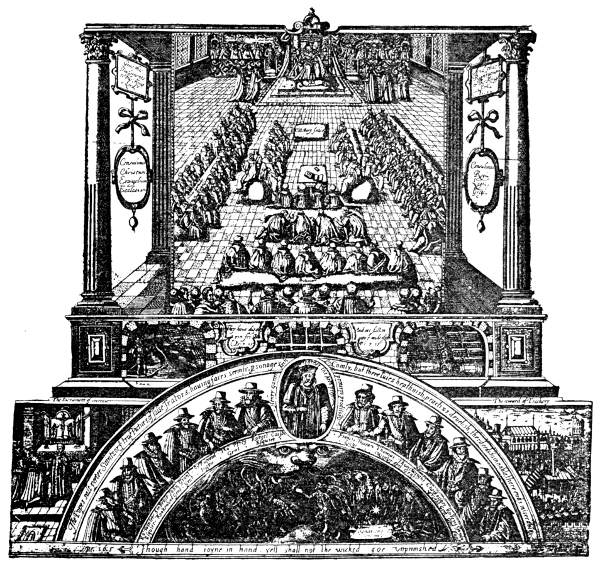
Yet what was the issue? A series of charges were brought against Northumberland, all of which broke down except that of having, as Captain of the Royal Pensioners, admitted Percy amongst them without exacting the usual oath. He in vain demanded an open trial, and was brought before the Star Chamber, by which, after he had been assailed by Coke in the same violent strain previously employed against Raleigh, he was sentenced to forfeit all offices which he held under the Crown, to be imprisoned during the king's pleasure, and to pay a fine of £30,000, equal to at least ten times that sum at the present day.
It is, moreover, evident not only that the great statesman, to use Bishop Goodman's term, actually profited largely by the powder business, but that from the first he saw in it a means for materially strengthening his position; an opportunity which he lost no time in turning to account by making it appear that in such a crisis he was absolutely necessary to the State. This is shown by the remarkable manifesto which he promptly issued, a document which appears to have been almost forgotten, though well deserving attention.
A characteristic feature of the traitorous proceedings of the period was the inveterate habit of conspirators to drop compromising documents in the street, or to throw them into yards and windows. In the court of Salisbury House was found, in November, 1605, a threatening letter, more than usually extraordinary. It purported to come from five Catholics, who began by unreservedly condemning the Gunpowder Plot as a work abhorred by their co-religionists as much as by any Protestants. Since, however, his lordship, beyond all others, seemed disposed to take advantage of so foul a scandal, in order to root out all memory of the Catholic religion, they proceeded to warn him that they had themselves vowed his death, and in such fashion that their success was certain. None of the accomplices knew who the others were, but it was settled who should first make the attempt, and who, in order, afterwards. Moreover, death had no terrors for any of them, two being stricken with mortal sickness, which must soon be fatal; while the other three were in such mental affliction as not to care what became of them.
Having resolved to recall his thoughts from the earthly theatre to higher things, which statesmen are supposed overmuch to neglect, he had felt he could choose no better theme for his meditations than the "King's Book," wherein so many lively images of God's great favour and providence are represented, every line discovering where Apelles' hand hath been; so that all may see there needs now no Elisha to tell the King of Israel what the Aramites do in their privatest councils.
While in this most serious and silent meditation, divided between rapture at God's infinite mercy and justice, and thought of his own happiness to live under a king pleasing to God for his zealous endeavours to cleanse the vessels of his kingdom from the dregs and lees of the Romish grape,—and while his heart was not a little cheered to observe any note of his own name in the royal register, for one that had been of any little use in this so fortunate discovery,—as the poor day labourer who taketh contentment when he passeth that glorious architecture, to the building whereof he can remember to have carried some few sticks and stones,—while thus blissfully engaged, he is grieved to find himself singled out from the honourable body of the council,—why, he knows not, for with it he would be content to be identified—as the author of the policy which is being adopted; and, conscious that in his humble person the Body of Authority is assailed, he thinks it well, for once, to make a reply.
Having recited the threatening letter in full, he presently continues:
"Though I participate not in the follies of that fly who thought herself to raise the dust because she sat on the chariot-wheel, yet I am so far from disavowing my honest ambition of my master's favour, as I am desirous that the world should hold me, not so much his creature, by the undeserved honours I hold from his grace and power, as my desire to be the shadow of his mind, and to frame my judgment, knowledge, and affections according to his. Towards whose Royal Person I shall glory more to be always found an honest and humble subject, than I should to command absolutely in any other calling."
Of those who threaten him he says very little, assuming, however, as self-evident, that they are set on by some priest, who, after the manner of his tribe, doth "carry the unlearned Catholics, like hawks hooded, into those dangerous positions."
Schondonck has, he says, read and re-read Cecil's book, which Baldwin had lent him. If his opinion be required, he finds in it many flowers of wit and eloquence, and it is a composition well adapted for its object; but the original letter which has evoked this brilliant rejoinder is a manifest fraud, not emanating from any Catholic, but devised by the enemies of the Church for her injury. The writers plainly contradict themselves. They begin by denouncing the Powder Plot as impious and abominable, and they do so most righteously, and they declare its authors to have been turbulent spirits and not religious, in which also they are right. But they go on to approve the design of murdering Cecil. What sense is there in this? If the one design be impious and detestable, with what colour or conscience can the other be approved? There is no difference of principle, though in the one case many were to be murdered, in the other but a single man. No one having in him any spark of religion could defend either project, much less approve it. Moreover, much that is set down is simply ridiculous. Men in the last extremity of sickness, or broken down by sorrow, are not of the stuff whereof those are made by whom desperate deeds are done.
"Now these last days we expected some new stratagem, because Salisbury pretended a letter to be brought to his lordship found by chance in St. Clement's Churchyard, written in ciphers, wherein were many persons named, and a question asked, whether there were any concavity under the stage in the court. But belike the device failed, and so we hear no words of it. About this time this house was ransacked, where by chance Blount came late the night before, finding four more, Talbot, N. Smith, Wright, Arnold; being all besieged from morning to night. If things had fallen out as was expected, then that letter would have haply been spoken of, whereas now it is very secret, and only served to pick a thanks of King James, with whom Salisbury keepeth his credit by such tricks, as upon whose vigilancy his majesty's life dependeth."
'Excidat illa dies aevo, ne postera credant Saecula; nos certe taceamus, et obruta multâ Nocte tegi propriae patiamur crimina gentis.'
'Oh, let that day be quite dashed out of time, And not believ'd by the next generation; In night of silence we'll conceal the crime, Thereby to save the credit of the nation.'"
"A wish," he adds, "which in my opinion, hath more of poetry than of piety therein, and from which I must be forced to dissent." Assuredly if it were judged that silence and oblivion should be the lot of the conspiracy, no stranger means were ever adopted to secure the desired object. A public thanksgiving was appointed to be held every year, on the anniversary of the "discovery;" a special service for that day was inserted in the Anglican liturgy, and Gunpowder Plot Sermons kept the memory of the Treason green in the mind not of one but of many generations.
the powder plot. iv.
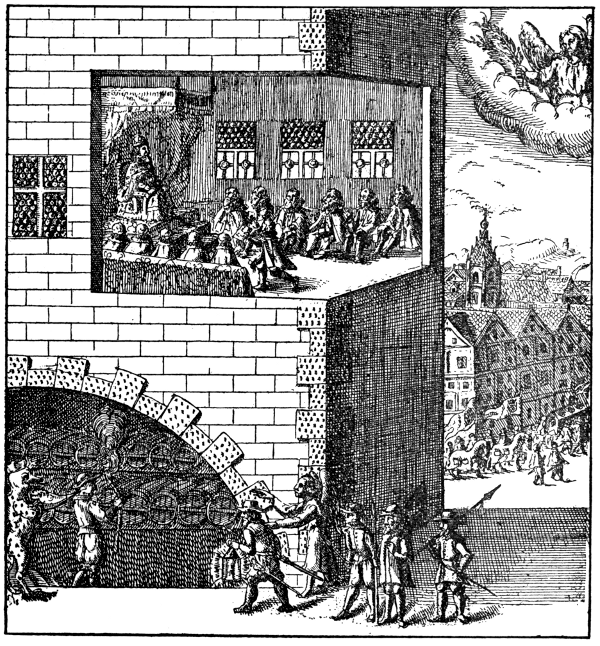
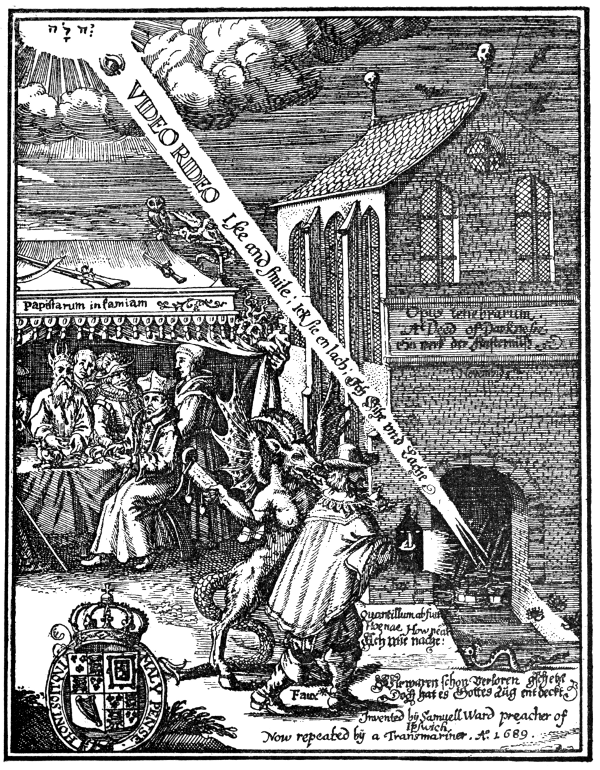
Nor was the pencil less active than the pen in popularizing the same belief. Great was the ingenuity spent in devising and producing pictures which should impress on the minds of the most illiterate a holy horror of the Church which had doomed the nation to destruction. One of the most elaborate of these was headed by an inscription which admirably summarizes the moral of the tale.
The Powder Treason.—Propounded by Satan: Approved by Antichrist [i.e. the Pope]: Enterprised by Papists: Practized by Traitors: Revealed by an Eagle [Monteagle]: Expounded by an Oracle [King James]: Founded in Hell: Confounded in Heaven.
Accordingly we find representations of Lucifer, the Pope, the King of Spain, the General of the Jesuits, and other such worthies, conspiring in the background while the redoubtable Guy walks arm in arm with a demon to fire the mine, the latter grasping a papal Bull (unknown to the Bullarium), expedited to promote the project: or again, Faukes and Catesby stand secretly conspiring in the middle of the street, while Father Garnet, in full Jesuit habit (or what is meant for such) exhorts them to go on: or a priest gives the conspirators "the sacrament of secrecy;" or representative Romish dignitaries blow threats and curses against England and her Parliament House,—or the Jesuits are buried in Hell in recompense of their perfidy.
It cannot, however, escape remark that while the limners have been conscientiously careful in respect of these details, they have one and all discarded accuracy in regard of another matter in which we might naturally have expected it. In no single instance is Guy Faukes represented as about to blow up the right house. Sometimes it is the House of Commons that he is going to destroy, more frequently the Painted Chamber, often a nondescript building corresponding to nothing in particular,—but in no single instance is it the House of Lords.
the powder plot. v.
Whatever were their motive in all this, the action of the government undoubtedly brought it about that the great blow should be struck on a day which not a little enhanced the evidence for the providential character of the whole affair. Tuesday was King James' lucky day, more especially when it happened to be the 5th of the month, for on Tuesday, August the 5th, 1600, he had escaped the mysterious treason of the Gowries.
Whatever may be thought of this particular element of its history, it is perfectly clear that the fashion in which the Plot was habitually set before the English people, and which contributed more than anything else to work the effect actually produced, was characterized from the first by an utter disregard of truth on the part of those whose purposes it so opportunely served, and with such lasting results.
A Summary.
The evidence available to us appears to establish principally two points,—that the true history of the Gunpowder Plot is now known to no man, and that the history commonly received is certainly untrue.
It is quite impossible to believe that the government were not aware of the Plot long before they announced its discovery.
It is difficult to believe that the proceedings of the conspirators were actually such as they are related to have been.
It is unquestionable that the government consistently falsified the story and the evidence as presented to the world, and that the points upon which they most insisted prove upon examination to be the most doubtful.
There are grave reasons for the conclusion that the whole transaction was dexterously contrived for the purpose which in fact it opportunely served, by those who alone reaped benefit from it, and who showed themselves so unscrupulous in the manner of reaping.
FOOTNOTES:
This was published in January, 1605-6, on the 28th of which month Sir W. Browne, writing from Flushing, mentions that "my lord of Salisbury hath lately published a little booke as a kynd of answer to som secrett threatning libelling letters cast into his chamber." (Stowe MSS., 168, 74, f. 308.)
It is somewhat remarkable that the universal Shakespeare should make no allusion to the Plot, beyond the doubtful reference to equivocation in Macbeth (ii. 3). He was at the time of its occurrence in the full flow of his dramatic activity.