Chapter I
Reading edition
THE STATE OF THE QUESTION.
On the morning of Tuesday, the 5th of November, 1605, which day was appointed for the opening of a new Parliamentary session, London rang with the news that in the course of the night a diabolical plot had been discovered, by which the king and legislature were to have been destroyed at a blow. In a chamber beneath the House of Lords had been found a great quantity of gunpowder, and with it a man, calling himself John Johnson, who, finding that the game was up, fully acknowledged his intention to have fired the magazine while the royal speech was being delivered, according to custom, overhead, and so to have blown King, Lords, and Commons into the air. At the same time, he doggedly refused to say who were his accomplices, or whether he had any.
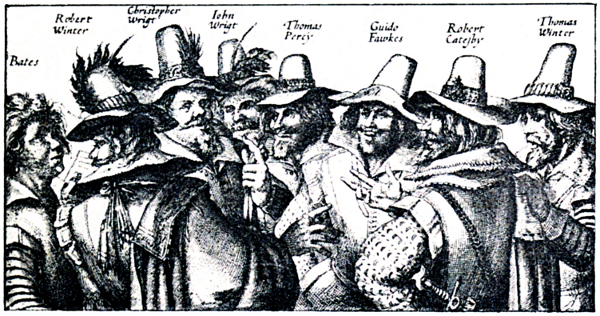
There proved to have been thirteen men in all who had undoubtedly been participators in the treason. Of these Faukes, as we have seen, was already in the hands of justice. Another, Francis Tresham, had not fled with his associates, but remained quietly, and without attempting concealment, in London, even going to the council and offering them his services; after a week he was taken into custody. The eleven who either betook themselves to the country, or were already there, awaiting the issue of the enterprise, and prepared to co-operate in the rising which was to be its sequel, were Robert Catesby, Thomas Percy, Robert and Thomas Winter, John and Christopher Wright, John Grant, Robert Keyes, Ambrose Rokewood, Sir Everard Digby,and Thomas Bates. All were Catholics, and all, with the exception of Bates, Catesby's servant, were "gentlemen of blood and name," some of them, notably Robert Winter, Rokewood, Digby, and Tresham, being men of ample fortune.
the conspirators, from a print published at amsterdam.
In consequence of this Act, was introduced into the Anglican liturgy the celebrated Fifth of November service, in the collect of which the king, royal family, nobility, clergy, and commons are spoken of as having been "by Popish treachery appointed as sheep to the slaughter, in a most barbarous and savage manner, beyond the examples of former ages;" while the day itself was marked in the calendar as the "Papists' Conspiracy."
On the very day upon which the first company suffered, Father Garnet, whose hiding-place was known, and who had been closely invested for nine days, was captured, in company with another Jesuit, Father Oldcorne. The latter, though never charged with knowledge of the plot, was put to death for having aided and abetted Garnet in his attempt to escape. Garnet himself, being brought to London, was lodged first in the Gatehouse and afterwards in the Tower.
Such is, in outline, the course of events which followed the discovery of November 5th, all circumstances being here omitted which are by possibility open to dispute.
It will probably be maintained, as our best and most circumspect historians appear to have assumed, that we are in possession of information enabling us to construct a similar sketch of what preceded and led up to these events,—whatever obscurity there may be regarding the complicity of those whose participation would invest the plot with the significance which has been attributed to it. If it were indeed but the individual design of a small knot of men, acting for themselves and of themselves, then, though they were all Catholics, and were actuated by a desire to aid the Catholic cause, the crime they intended could not justly be charged upon the body of their co-religionists. It would be quite otherwise if Catholics in general were shown to have countenanced it, or even if such representative men as members of the priesthood were found to have approved so abominable a project, or even to have consented to it, or knowingly kept silence regarding it. Of the complicity of Catholics in general or of their priesthood as a body there is no proof whatever, nor has it ever been seriously attempted to establish such a charge. As to the three Jesuits already named, who alone have been seriously accused, there is no proof, the sufficiency of which may not be questioned. But as to the fact that they who originated the Plot were Catholics, that they acted simply with the object of benefiting their Church, and that the nation most narrowly escaped an appalling disaster at their hands, can there be any reasonable doubt? Is not the account of their proceedings, to be read in any work on the subject, as absolutely certain as anything in our history?
Commencing operations about the middle of December, 1604, these confederates first endeavoured to dig a mine under the House of Lords, and afterwards hired a large room, described as a cellar, situated beneath the Peers' Chamber, and in this stored a quantity of gunpowder, which Faukes was to fire by a train, while the King, Lords, and Commons, were assembled above.
Their enemies being thus destroyed, they did not contemplate a revolution, but were resolved to get possession of one of the king's sons, or, failing that, of one of his daughters, whom they would proclaim as sovereign, constituting themselves the guardians of the new monarch. They also contrived a "hunting match" on Dunsmoor heath, near Rugby, which was to be in progress when the news of the catastrophe in London should arrive; the sportsmen assembled for which would furnish, it was hoped, the nucleus of an army.
Nevertheless there appear to be considerations, demanding more attention than they have hitherto received, which forbid the supposition that, in regard of what is most vital, this official story can possibly be true; while the extreme care with which it has obviously been elaborated, suggests the conclusion that it was intended to disguise facts, to the concealment of which the government of the day attached supreme importance.
It must farther be observed that the particular Plot which is our subject was stamped with certain features more than commonly suspicious. Even on the face of things, as will be seen from the summary already given, it was steadily utilized from the first for a purpose which it could not legitimately be made to serve. That the Catholics of England, as a body, had any connection with it there is not, nor ever appeared to be, any vestige of a proof; still less that the official superiors of the Church, including the Pope himself, were concerned in it. Yet the first act of the government was to lay it at the door of all these, thus investing it with a character which was, indeed, eminently fitted to sustain their own policy, but to which it was no-wise entitled. Even in regard of Father Garnet and his fellow Jesuits, whatever judgment may now be formed concerning them, it is clear that it was determined to connect them with the conspiracy long before any evidence at all was forthcoming to sustain the charge. The actual confederates were, in fact, treated throughout as in themselves of little or no account, and as important only in so far as they might consent to incriminate those whom the authorities wished to be incriminated.
The determined manner in which this object was ever kept in view, the unscrupulous means constantly employed for its attainment, the vehemence with which matters were asserted to have been proved, any proof of which was never even seriously attempted—in a word, the elaborate system of falsification by which alone the story of the conspiracy was made to suit the purpose it so effectually served, can inspire us with no confidence that the foundation upon which such a superstructure was erected, was itself what it was said to be.
On the other hand, when we examine into the details supplied to us as to the progress of the affair, we find that much of what the conspirators are said to have done is well-nigh incredible, while it is utterly impossible that if they really acted in the manner described, the public authorities should not have had full knowledge of their proceedings. We also find not only that the same authorities, while feigning ignorance of anything of the kind, were perfectly well aware that these very conspirators had something in hand, but that long before the "discovery," in fact, at the very time when the conspiracy is said to have been hatched, their officials were working a Catholic plot, by means of secret agents, and even making arrangements as to who were to be implicated therein.
Whether it be so or not we have now to inquire.
FOOTNOTES:
[Published in the "King's Book:" copy, or draft, for publication, in the Record Office: original at Hatfield. Copy of original Brit. Mus. Add. MSS., 6178, 75.]