Chapter V
Reading edition
THE GOVERNMENT INTELLIGENCE DEPARTMENT.
Having followed the history of the plotters and their doings, to the point when everything was ready for action, we have now to inquire what, in the meantime, those were about for whose destruction such notable preparations were making, and whether in truth they were, as we are assured, wrapped in a sense of false security, and altogether unconscious of the signs and tokens that should have awakened their suspicion and alarm.
When, by the aid of such evidence as remains to us, we turn to examine the facts of the case, we discover in them, it must be confessed, no symptoms whatever of supineness or lethargy. It appears, on the contrary, that throughout the period when the government are supposed to have been living in a fool's paradise, and tranquilly assuming that all was well, they were in reality busily at work through their emissaries and informers, prying into all the doings of the recusant Catholics, receiving frequent intimation of all that was undertaken, or even projected, and, apparently, regulating the main features of a treasonable conspiracy, which can have been no other than the Powder Plot itself, determining, in particular, what individuals should be implicated therein.
That the treason in question was none other than the Gunpowder Plot there can be no question, unless indeed we are to say that the authorities were engaged in fabricating a bogus conspiracy for which there was no foundation whatever in fact. It was not the way of statesmen of the period, when on the track of sedition, to relinquish the pursuit till they had sifted it to the bottom, and at this juncture, especially, every shred of evidence regarding Catholics and their conduct was threshed out to the uttermost. In consequence, we are able to say with certainty, that besides the enterprise of Catesby and his associates, there was no other conspiracy of any kind on foot. We have, moreover, already seen that the very same point thus by anticipation represented as all important, is that which after the "discovery" every nerve was strained to establish, namely, the complicity of the Catholic clergy. If we had no more than this internal evidence, it would abundantly suffice to assure us that the conspiracy thus sedulously watched was the same as that miraculously "discovered" a year and a half later.
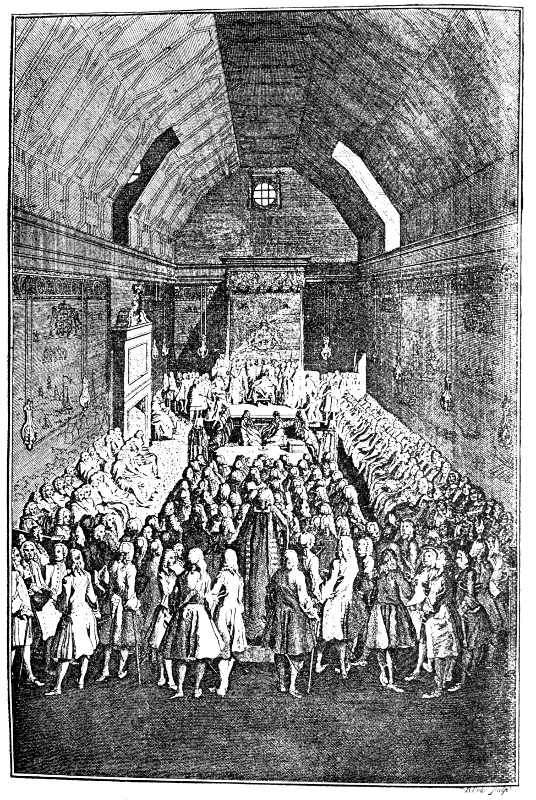
a view of the house of peers, 1755.
There follows a notable suggestion: "If your Lordship would be pleased to set some man to win the Nuncio of the Pope his secretary in Paris, you should receive very direct and sound instructions from him." The writer goes on to speak of an intended rebellion in England, and the kindling of a fire there, and dutifully concludes, "God grant they touch not the person of the King nor of his children."
If such letters proved nothing more, they would abundantly serve to discredit the idea that a government which conducted its operations in such a fashion could be hoodwinked by such clumsy contrivances as those of the cellar and the mine.
Meanwhile the English ambassadors abroad were no less active and vigilant than the informers at home, and while clearly aware that there was some danger on foot, never doubted that the king's government would not be caught napping.
There can be no doubt that the issue of the Gunpowder Plot was eminently calculated to work such an effect; and even more would seem to have been anticipated from it than was actually realized, for the secretary, we are told, promised King James that in consequence of it not a single Jesuit should remain in England.
We shall afterwards have to examine in some detail the divergencies of these several narratives: at present we are concerned only with the intimation which they afford of a previous knowledge of the Plot on the part of the government. In the "King's Book"—which was not only to be disseminated broadcast at home, but to be translated and spread abroad, and, moreover, to be suited to the taste of its supposed author—the preternatural acuteness of the monarch is extolled in terms of most preposterous flattery, and his secretary is represented as altogether incredulous of danger, and unwilling to be convinced even by his royal master's wonderful interpretation of the mysterious warning. Nevertheless, not only is mention parenthetically introduced of the minister's "customable and watchful care of the king and State, boiling within him," of his laying up these things in his heart, "like the Blessed Virgin Mary," and being unable to rest till he had followed the matter farther,—but it is dexterously intimated that, for all his hardness of belief, he was sufficiently well informed before the warning came to hand, and that "this accident did put him in mind of divers advertisements he had received from beyond the seas, wherewith he had acquainted as well the king himself, as divers of his Privy Councillors, concerning some business the Papists were in, both at home and abroad, making combination amongst them for some combination against this Parliament time," their object being to approach the king with a petition for toleration, "which should be delivered in some such order, and so well backed, as the king should be loth to refuse their requests; like the sturdy beggars craving alms with one open hand, but carrying a stone in the other, in case of refusal."
As prepared for the Privy Council, the account, though substantially the same, was somewhat more explicit. The secretary was fully aware, so the Lords were told, "that some practices might be doubted," and he "had, any time these three months, acquainted the King, and some of his Majesty's inward Counsellors, that the priests and laymen abroad and at home were full of the papists of this kingdom, seeking still to lay some plot for procuring at this Parliament exercise of their religion."
In his letter to the ambassadors Cecil was able to speak more plainly, for this document was not to meet the eye of James. Accordingly, he not only acknowledges that on seeing the Monteagle letter he at once divined the truth, and understood all about the powder, and moreover reverses the parts played by his Majesty and himself—making the former incredulous in spite of what he himself could urge in support of his opinion—but he goes on to give his previous information a far more definite complexion: "Not but that I had sufficient advertisement that most of these that now are fled [i.e. the conspirators]—being all notorious Recusants—with many others of that kind, had a practice in hand for some stir this Parliament." He, moreover, describes the plotters, in terms already cited, as "gentlemen spent in their fortunes and fit for all alterations."
"As for Barnes, he is now returning again into Flanders, with many vows and promises to continue to do good service. As he was at Dover with my pass, carrying a letter from Philipps to Owen (of Barnes own handwriting, wherewith I was before acquainted), he was suddenly stayed by order from the Lord Warden, upon suspicion that he was one Acton, a traitor of the late conspiracy.... Whereupon, his papers and letters being sent to my Lord of Northampton, I thought fit not to defer any longer the calling of Philipps into question; which till then I had forborne, hoping by Barnes his means to have discovered some further matter than before I could do."
FOOTNOTES:
In these notes the king explains that the things of greatest import cannot be written, but have been imparted "by tongue" to the envoy, to be delivered to his holiness. Moreover he thus charges Lindsay: "You shall assure him that I shall never be forgetful of the continual proof I have had of his courtesy and long inclination towards me, and especially by this his so courteous and unexpected message, which I shall be careful to requite thankfully by all civil courtesies that shall be in my power, the particulars whereof I remit likewise to your declaration." Besides this, he protests that he will ever inviolably observe two points: first, never to dissemble what he thinks, especially in matters of conscience; secondly, never to reject reason when he hears it urged on the other side.