Chapter IX
Reading edition
THE NIGERIAN TIMBER TREES
INDIGENOUS TREES OF NIGERIA
B. Southern Provinces.
Palmæ.
Raphia Hookeriana. Hooker’s Palm or the Piassava Palm. Aiko (Yoruba); Iya (Efik); Angor (Benin); Ori (Oban, Ekoi).
It is found chiefly in the Calabar, Warri, and Ondo provinces of Nigeria, mixed with R. vinifera at the edges of estuaries and rivers in the evergreen forest zone.
One of the main differences between this palm and R. vinifera is that the fruit is much shorter (at the most 1½ inches long and ¾ inch in diameter) and more stumpy in shape, coming abruptly to a point at the tip. R. vinifera, on the other hand, is much longer, reaching 2½ to 3 inches in length and ¾ inch to an inch in diameter, and it is very elliptical in shape. The bunches of fruit of this palm, R. Hookeriana, are much smaller, rarely exceeding more than a foot in length, and containing 50 to 75 nuts, whereas R. vinifera may have bunches 3 feet long, each containing 500 nuts or more. In the stem, too, this palm is smaller, often not reaching more than 6 to 9 inches in diameter, with a total height of 20 feet, whereas R. vinifera will reach over a foot in diameter and a total height of over 60 feet. The natural cleaning of the stem begins much later in this palm, and does not reach anything like the height of that of R. vinifera. In many specimens, in fact, the stem remains always more or less covered with the very upward tending branches. In this respect it reminds one a little of R. Ruffia. The leaves, however, are more similar to R. vinifera, but only about half the size, especially in length; they are not quite so wide, nor are the leaf stalks quite so large.
The timber is very similar, but more fibrous and of a looser texture than that of R. vinifera. It is a little easier to cut. In the older specimens the foliage still retains its dark green colour compared with the dry, yellowish hue which R. vinifera takes on as it gets older. It is a somewhat slow-growing, shade-bearing tree. It likes a somewhat rich soil, but can, however, stand in water, and apparently withstands floods. Natural regeneration appears to be good.
The timber has not been cut for export nor for local use. The fronds are occasionally used for a similar purpose as that of R. vinifera, and sometimes the leaves also.
Native Use.—The fronds and leaves are used in a similar way to those of R. vinifera. The base of the leaf stalk is cut off into lengths up to 6 feet (it almost encircles the tree and extends much further up than in the case of R. vinifera) and laid in stagnant water. After the intervening substance between the fibres has got more or less soft and partly rotted away, the whole is taken out and the fibres cleaned with a kind of comb. These are then dried, and packed together in bundles of 20 pounds upwards, and sold to the European factory as Piassava. This industry is more widespread in the Eket district of the Calabar province, but it has taken a great number of years of thought and careful attention to bring it up to its present dimensions. The cutting of the leaves is undertaken mostly by the men and the rotting and cleaning of the fibre mostly by the women. Before the war Piassava fibre was rarely worth more than £28 per ton. It is now worth over £70. Unless, however, a price of at least £20 per ton is offered in Liverpool market for this fibre, it is doubtful if the industry can be made profitable for everyone concerned, producers included.
Raphia vinifera. The Palm Wine Tree, or Tombo Palm, or Bamboo, the last named being the name used by the English-speaking Jekris. Ako (Yoruba); Emmaha Augor (Benin); Oukot (Efik).
It is found in the Abeokuta, Ondo, Benin, Warri, Owerri and Calabar provinces and the Colony of Nigeria, at the edges of the streams and rivers in the evergreen forest zone, where it grows in large groups and pure forests.
It is a medium-sized palm, growing separately with one stem, which clears itself of the leaf fronds for about half its height between the twelfth and fifteenth year. The trunk then is comparatively smooth, except for the very large scars of the leaf stalk. The fronds are the longest of any of the African palms, reaching sometimes a length of 40 feet, roughly sickle shaped; in section they reach about 2 inches diameter at the broadest part, and are a yellow-brown colour. The leaves come out from the stalk almost at a right angle, thus making them much wider and, owing to their greater length, much finer and heavier foliage than that of the Oil Palm, or even the Coconut Palm. In fact, an isolated specimen growing well could be not unfavourably compared to the Royal Palm in the grandeur of its spread of leaf and the beauty of the outward-spreading, fan-shaped bold crown. Both the male and the female flowers are very conspicuous. The bunches of fruit, up to 3 feet in length, hang down like enormous elongated bunches of yellow grapes. The nuts are covered with a smooth yellow hard skin, set in scales very similar to those of a cone, except that each scale is tightly joined to the next. When the fruit decays, or is boiled, the scales come off as well as the yellow, fibrous matter, which gives a yellowish tinge to the water. The main difference between the base of the Oil Palm and that of the leaf of this tree is the extension of it more than half round the bole in the case of R. vinifera, and also flatly and smoothly down the stem. On the other hand, in the Oil Palm the leaf grows more abruptly out of and away from the stem. Owing to the Tombo Palm stem being smaller (on the average only 9 inches in diameter), the base of the frond extends nearly all round the tree, the lower one overlapping the higher one, and each placed in revolving fashion round the trunk, one above the other. The leaf scars of the Oil Palm are much smaller. Owing to the greater length of the leaf of this palm, the crown does not appear to be such a tuft of leaves at the top of the tree as in the case of the Oil Palm. In old age it appears more as a cylindrical mass of leaves occupying the upper half or third of the tree.
The timber is more fibrous and soft than that of the Oil Palm. The fibres, however, are dark brown, almost black when very wet or after they have lain in water for any length of time.
On the whole the tree is slow-growing, even slower than the Oil Palm. It stands a good deal of shade in the earlier stages, but later on is apparently a light-demanding tree. It grows in freshwater swamps and at the edges of such places. Although it thrives best in certain localities, it can be planted and does grow on solid and comparatively dry land near Calabar. In the Calabar province they are often planted as an avenue leading up from the main road through the farm to the house. It will stand floods. Natural regeneration is good, and with the spread of propagation it tends to be more widely distributed. In the Calabar and Ogoja provinces seeds were distributed to the natives for planting for the production of palm wine to take the place of that obtained from the Oil Palm. The timber has not been used for export, nor has it been cut for local use. The leaf stalks, however, have been used for building labourers’ lines and in some European houses. In a similar way the leaves themselves have been used as a roofing material after being made up into small mats.
Native Use.—The tree is tapped near the base of the leading leaves, or at the base of the male inflorescence, for the production of the sap, which is collected in calabashes. These are placed in position every evening and emptied every morning, and replaced in position. Occasionally the chimpanzees climb up the palms, drink the wine in the calabash and replace it. A native once shot a chimpanzee, finding it was the thief of his palm wine and not a human being. The wine is of a white, sometimes almost creamy colour, and when fresh is quite thin and foamy. It has a rather pleasant, sweet, and almost sharp taste. After being kept a few days it begins to ferment, and even moderate quantities are intoxicating. Either fresh or fermented, it is sold in bottles or calabashes in the local markets. The supply scarcely, if ever, exceeds the demand. The natives often put pieces of the bark of Tala, Saccoglottis Gabunensis, in the wine to give it a more bitter taste. Occasionally also the bark of mahogany and other trees is used. Tala, however, is the correct bark to use, and it forms an article of local commerce for this purpose. Owing to the comparative inaccessibility of some of the “stands” of this tree away in the swampy regions near the estuaries of some of the larger rivers, such as the Benin and the Siluko, there are still vast areas where neither the leaves are cut nor the palms tapped for wine. The seeds are boiled and placed in the bottom of a canoe, and when sufficient canoes have been got together, each with its quota of boiled nuts, these are trodden with the feet of those in the canoe, and both the nuts and the scaly shell as well as the small amount of yellow flesh are thrown in the water of a half-stagnant river. This yellow substance partly blinds and stupefies the fish, the smaller ones of which come half floating and swimming to the surface, the larger ones being washed along near the bed of the river. These are caught in convenient places where the river has been staked all across its width and bamboo netting put down, except for an opening where a flexible net is used. Some of the people go about in small canoes, netting the fish that come to the surface. One of the most famous spots to see this is in the Osse River, in the reach just below Noami, where the combined fishery forces of the Jekris and, to a lesser extent, Sobos and Ijors, for a day or two in succession in April each year, carry on this work. The catch of fish obtained is enormous. Unless, however, it can be soon smoked and dried, much of it goes bad. This method of getting fish is also used by individual natives in stagnant backwaters of rivers and in isolated pools. The poison apparently does not spoil the taste or other quality of the fish. Occasionally this palm is also used for getting out the Piassava fibre, but it appears to be more difficult, and it is doubtful if it is as valuable as the fibre obtained from R. Hookeriana. Owing, however, to the fact that both species grow in the same locality and often quite mixed together, it is highly probable that part of the Piassava obtained is taken from this palm. In order to stimulate the flow of sap, a fire is often made at the base of the tree, which burns all the lower leaves and even part of the top, and thus induces an extra flow of sap, but of course to the detriment of a continual yield, as the tree subsequently dies.
In many parts of the country there is a regular local industry in the making of roofing mats from the leaves of this palm. The small ones, about 3 feet long, are, however, sold 25 for 3d. and the big ones, over 6 feet long, 25 for 6d. In some places they are cheaper. As a roofing material they are very durable, and will last at least seven years. If, however, they are put on very thickly, overlapping more than two-thirds of their width, and the roof is thoroughly smoked from the inside, it becomes nearly black, and will last fifteen years. For native houses it is one of the most used roofing materials, except in the Benin country, where the large Ewayon leaves are used. Roofing mats are, of course, being superseded by galvanized iron in the more civilized places. The leaf stalk is used both as a pole for pushing lighters or heavily laden canoes through comparatively shallow water, or as a boat-hook, or pushing and guiding pole for the smaller canoes in getting up swift, winding and comparatively narrow rivers.
Raphia Ruffia. Roofing Palm.
Chief Characteristics.—It does not form a proper stem, like other raphias; the long, thin leaves sprout out from the ground, and only when the tree is some years old is there any trace of a stem, which is quite short. The petioles are thin, compared to the length, and the leaflets are thin and narrow.
Distribution.—It is found in the Calabar and Ogoja Provinces of Nigeria. It is often planted near watercourses in damp valleys to provide roofing material for the natives, who make mats from the leaves (Ikom, Obubra districts).
Phœnix reclinata. Swamp Date Palm. Elekikobi (Yoruba); Ukukon (Benin).
A common tree of the Warri province of Nigeria. It is usually found in or at the edge of the mangrove swamp, where it appears to thrive. It is often rather bent in shape, and does not exceed 10 feet in height. It is usually partially gregarious, though the groups of this species are much smaller than those of P. spinosa. The natives in this locality scarcely use it at all. The fruit is rather smaller, and it bears in a less prolific manner than P. spinosa.
Phœnix spinosa. Wild Date Palm. Okun (Yoruba); Ukukon (Benin).
It is a common tree in the Ogoja, Benin, Ondo and Ibadan provinces of Nigeria. In appearance more like a very thin stemmed Oil Palm, on nearer approach the bluish-green, almost silvery, more open, shorter and rather sharply pointed fronds readily distinguish it from the Oil Palm group. The fruit is the shape of a very small date, many of which are borne on thin fibrous twigs of a very stout stalk. It is usually found in the open deciduous or savannah forest zone.
The natives use the stems for rafters and house-posts; the fruit and bark are used medicinally; and the leaves are used for making sieves, hats, mats and bags.
Calamus deerratus. Benin Cane or Rattan. Erogbo (Benin).
It is found in the Benin province of Nigeria. It is one of the rarer canes of the forest, has a yellow flower, and is found near Okenuhen. The canes are used for fences and house-building.
Eremospatha macrocarpa (Mann and Wenal). Small Benin Rattan. Ukan (Yoruba); Ikan (Benin).
It is found in the Benin, Calabar, Ondo and Abeokuta provinces of Nigeria.
It is a common ½-inch thick cane, which attains a length of nearly 200 feet. It grows in clumps and climbs up over the surrounding trees. The fruit is yellow and rather like a small larch cone which has not opened. It is used for making rope and baskets, tying timber rafts, house-building, etc.; in fact, it is the best cane in West Africa.
Eremospatha sp. Large Benin Rattan. Okakan (Benin).
It is found in Ondo, Abeokuta, Benin, Warri, Brass, Owerri, Calabar and Ogoja provinces of Nigeria.
It is a large creeper, nearly an inch in diameter and attaining a length of nearly 200 feet. It is usually found partly growing on other trees in more or less open places at the edge of the forest, near river banks, in the evergreen forest zone; it is also found at the edges of swamps in the same region. It often forms dense cane brakes. One of the most typical features of this cane is the reddish-orange cone-like fruit, which is borne in large clusters on the terminal shoot of the creeper.
The light-yellow, long spikes of the male flowers are most conspicuous early in the season, especially when seen from a canoe when passing down a river like the Osse.
The natives strip off the bark and long shoots of fish-hooklike spines, and use the comparatively smooth canes as supports for the canoe mats and for making tying material for house-building; it is also used for making rope. When whole, it is used in making bridges as well as for joining logs together for rafting purposes. When cut into short lengths and bent at one end, it can be used for walking-sticks.
It is rather a slow-growing creeper, and usually ten or twelve grow out of one root stock. In 1904 this cane was examined in England as a substitute for rattan, but it was found to be more brittle, and the internodes were found to be too close together to be attractive as walking-sticks. Still later, in 1908, it was tried for basket work, but was found to be too coarse both in structure and texture of grain.
Elæis Guineensis. The Oil Palm, the West African Palm. Ope, Ipa ukoro (Yoruba); Udin (Benin).
It is found in all the Southern Provinces of Nigeria and as far North as Zungeru, in the Northern Provinces. It belongs to the evergreen forest zone, though it will spread with cultivation into the mixed deciduous and dry zones.
It is the common palm of all the farms and forests of the moist and mixed zone of Nigeria. It bears a bunch of fruit containing as many as two thousand individual fruits in one drupe. In the drier parts there may be only as many as one hundred seeds. There is one forked palm on the right-hand side of the line about seven miles from Ibadan, just beyond Moor Plantation. This is a very rare occurrence, and I have only seen one in twelve years’ travelling in Nigeria. The male inflorescence is not unlike a very close horse’s tail, turned up on end. The orange-brown-coloured female flowers are very small, and do not last long (a few days). The male flowers always appear first, and above the female in each case. The natives say some trees only bear male flowers, but it is doubtful if this is ever true, except in very isolated cases. It bears fruit in the fifth year, and will go on for about a hundred years. There is a most marked difference in the height of a tree which has grown up in the “high forest” and one which has come up in an old farm, the former being fully 100 or even 150 feet high and the latter only 20 to 30 feet in height. In a similar way the bole of the forest-grown palm is only about 3 feet in girth, whereas the farm-grown palm may be over 6 feet in girth. It goes without saying that the latter bears larger bunches of fruit and the individual nuts are larger and also more numerous.
Between the twelfth and fifteenth year the tree begins to clear itself of the lower leaves, thus forming a clean bole up to the tuft of fronds at the top.
Owing to the fact that the bunches of fruit form in the axis of the leaf stalk, they are compressed very tightly, and thus ripen comparatively slowly. By cutting off the leaf immediately below the fruit, the ripening period is shortened by three weeks. This is, of course, partly due to the increased amount of light. Cutting leaves, however, above the fruit, or at all excessively in number, leads to a deceleration in growth, so that pruning should only be moderate. Both in the forest and in the open, epiphytic ferns, figs, and other plants grow amongst the leaves on the stem, and more especially later at the top of the tree. The trees are rarely, if ever, cleaned of these hindrances to healthy growth, but naturally they retard the flowering and ripening of the fruit. The leaves are also used for making brushes for sweeping the ground.
Native Use.—Oil is made from the pericarp of the fruit, and from the kernels, for rubbing on the skin. The leaf stalk is used for roof-poles.
Natural regeneration is good, although the Oil Palm thrives best in a deep, moist soil with considerable mineral content. It is, however, found growing amongst rocks on laterite and poor sandy land, and that in such case the rainfall is deficient, i.e. below 40 inches. A few small plantations have been made. It is noticeable that self-grown seedlings grow much slower than those transplanted. In the first year the self-sown seedlings grow only one pair of leaves, whereas those transplanted grow five or six in the same period. Apparently the Oil Palm does not thrive unless the soil is kept well covered and a good surface tilth maintained. With a planting distance of 20 to 24 feet there is considerable scope for the planting of other crops between. The chief difficulty appears to be to grow these at a profit without impoverishing the soil or hindering the quick development of the Oil Palm. On suitable soil the most profitable crops appear to be the following: ground-nuts, beans (three or four kinds), Egusi Bara, Citrullus vulgaris.
A fuller consideration of this subject, and the Oil Palm generally, will be found in the separate section about it.
Elæis Guineensis, var. Thompsonii. The Palm of Everlasting Life or King Palm. Eviromilla (Benin). This is the meaning according to the Benin name.
It is found in the Colony of Lagos, and Abeokuta and Benin provinces of Nigeria. On the whole, it is an uncommon tree, but there is no doubt of its being an indigenous tree to this part of Africa. The leaves are long and very compressed, being set at an acute angle to the leaf stalk and of smaller size than in any other species. It gives the palm almost the appearance of a Cycad. It also looks as if the leaves had closed up with the cold or were not fully developed. The leaves also are of a much darker green (almost olive-green) than the ordinary palm. Amongst the Benis it is considered the Sacred Oil Palm Tree, the nut obtained from it being especially revered. From the Resident’s office is seen one of these trees which was planted in the Benin City Arboretum some nine years ago. It is a very slow-growing palm, having scarcely one quarter of the rate of growth of the ordinary oil palm. The stem is much thinner in proportion to the height than the ordinary oil palm; and it does not attain more than half the height of an oil palm. When growing in a group, it gives quite a funereal appearance.
The nuts are used by the natives as “Ju-ju” of divination to see into the future. It is said that “the nuts talk,” in the Benin country, where the tree is held to be that of everlasting life.
Elæis sp. Ope trumfo (Yoruba).
Abeokuta province, Yoruba country.
Elæis sp. Small Oil Palm. Ope Ifu No. I (Yoruba); Ogiedi (Benin).
Abeokuta province, Yoruba country.
Elæis Guineensis, var. Lisombe. Palm, or Lisombe Palm, or Soft-shelled Palm. Ogeddin (Benin).
The main difference of this species is in the small oblong, pointed fruit on a much smaller drupe, and the larger quantity of oil obtained from the pericarp and the very small kernel in the nut. It is also much softer to crack. The foliage looks a fresher green than the ordinary variety; also the leaflets are placed at an acuter angle to the leaf stalk than the other.
It is not very prevalent in the Benin, Abeokuta, Calabar and Ogoja provinces of Nigeria.
Silviculture.—The nuts, when sown, do not germinate true to species, except for a few per cent. It is planted in the Indem country of the Ogoja province.
Native Use.—The oil is collected in a similar way to the other, but is liked more by the natives of Benin. The kernels are used for making oil as well.
Hyphæne. Dum Palm or Forked Palm. Kaba, Kodago, Kwalo (nut), Goriba (Dr. Dalziel’s Hausa list).
It is found in the Zaria and Niger provinces of Nigeria.
The only branched palm in West Africa. It attains a height of 30 feet. It is more or less gregarious in habit, though the individual groups of palms are not very large. It is apparently somewhat fire-resisting, though this may be due to its being found amongst the dry-zone vegetation. The stem is short and the two forks often crooked, so that little or no use is made of the wood by the natives. The seeds are turned into buttons, and so have recently obtained a value for this purpose. They were first sent to England from the Soudan, where apparently the tree is much more common than in West Africa.
Borassus flabelliformis, var. Æthiopica. Palmyra or Black Run Palm, Fan Palm, Bottle Palm, Arac Palm. Agbon, Olodu, Igoti (Yoruba); Oluwa (Benin).
It is a common tree in the dry-zone forest regions of Ibadan, Benin, Onitsha, and Ogoja provinces of Nigeria. This palm, with the swollen upper part of the bole making it appear more like a large inverted bottle, is thus not to be mistaken for any other. The huge fan-shaped leaves distinguish it from either the Coconut Palm or the Oil Palm. In the distance, too, the leaves appear more silvery-green, and not the yellow-green of the Coconut, or the bright, fresh green of the Oil Palm, or the sombre dark green of the Wine Palm. A large mass of coconut-shaped nuts, but with a smoother, more yellow surface, and more cylindrical in shape, without the ridges of the coconut, are another feature of this tree. At the base of each nut the old sepals of the flower remain, appearing like large dark-brown leaf scars. The young seedlings are easily seen amongst the grass, sticking up as they do like little silvery-green fans of varying size, in detail showing the folds of a fan most distinctly, the leaf opening out in a similar way to a fan. The bole is dark brown and practically smooth, showing no leaf scars, and only faintly lined vertically down the stem. The base is only slightly swollen, and the roots do not form a large mound round it, as is the case with the Oil Palm, and to some extent with the Tombo Palm. Inside the fruit there are two or three large, flattish nuts.
The timber is fibrous, hard, but very durable and quite termite proof. Although the upper part of the stem is hollow, long sectional pieces, four by two, and even thicker, can be cut out. It planes up with a smooth surface, and the grain looks very pretty with the thick fibres. It nails fairly well and splits longitudinally.
It is a light-loving tree, moderately fast growing for a palm. It is usually found growing gregariously in groups of a few acres up to hundreds of acres in extent. However, it is rarely thick enough to thoroughly shade the ground. Natural regeneration is good, even though in most areas annual grass-fires run through the trees and to some extent char the fruit. No plantations have been made of these species.
The timber has not been exported, but locally it has been used for house-building, as well as for fences near the railway. The natives occasionally use it for house-building, but they do not know how to tap it for the wine. The leaves are sometimes used for making temporary shelters. The fruit is sometimes eaten, and has a pleasant taste. The nuts might be exported for making into buttons.
Cyanastraceæ.
Cyanastrum cordifolium. Ikoto.
It has an edible fruit. Found in the Benin province of Nigeria.
Liliaceæ.
Dracæna sp. Dragon’s Blood. Ewanenimi (Benin).
It has a very long, thin leaf of the usual monocotyledonous type and with a somewhat branched stem, with thin papery bark.
It is fairly common in the Benin country. It is one of the few monocotyledonous trees of the forest, and thus easily distinguishable from other trees. The parallel veins of the leaf are very long and laid fairly close together. The stem is very porous and not woody, being more fibrous in type. It reaches a girth of about 4 feet and a height of 40 feet.
Native Use.—The leaves are used by the natives medicinally; and occasionally the sap is used to blind people.
Dracæna surculosa. Dragon’s Blood. Ope, Igbo.
Is found in Olokemeji.
Dracæna cylindrica. Boundary tree. Peregun (Yoruba); Ukpogun, Ogihu (Benin).
Found in the Olokemeji Reserve.
Dracæna cylindrica. Boundary tree. Peregun (Yoruba); Ukpogun, Ogihu (Benin).
It has a wider and shorter leaf than the Ewanenimi tree, but again with the parallel veins, which are, of course, typical of the monocotyledon. It does not really form proper timber, but the stem is of a spongy, fibrous nature. It reaches a girth of about 5 feet and a height of about 50 feet. It usually has one stem, which is unbranched for a very considerable length, but sometimes a whole group will grow up in one place.
Both this and the former species are propagated very easily by cuttings. In fact, it is possible to take the end of a branch complete with the leaves and put it in the ground, when it will grow. It likes a comparatively deep moist soil, though it will stand any amount of drought without actually dying. It stands pruning well and grows moderately rapidly.
It is useful for making live fences.
Native Use.—Both Yorubas and Benis use the tree for boundaries, simply sticking cuttings in wherever it is wished to mark a place. “Ju-ju” places are also marked in this way. The leaves are used medicinally in Benin.
Dracæna Perrottetii. Boundary tree. Ope, Kanakan (Yoruba).
Found in the Mamu Forest.
Dracæna sp. Boundary tree. Oro Igbo (Yoruba); Uruaro (Benin).
A common Dracæna found in the Benin and Abeokuta provinces of Nigeria. It is often used for making fences to farms and boundaries for village or farm land, and for marking special “Ju-ju” places. The Benin people state that it has more latex than the other species of this genus.
Marantaceæ.
Clinogyne, syn. Donax cuspidata. Yoruba Soft Cane. Toto (Y.).
It is found in the Abeokuta province of Nigeria. It is a small soft cane which grows gregariously in groups from a quarter to half an acre in extent in the Olokemeji Reserve, to a height of about 5 feet, and has large, alternating, very fine parallel-veined leaves. Inflorescence, raceme or panicle-like bracts, deciduous. Some species yield starch or fibre. Toto is found quite abundantly in the middle of the Olokemeji Reserve. It is used for mat-making, and considered most valuable.
Orchidaceæ.
Polystachya sp. (Lindl.). Eme-ela (Yoruba).
It is found in the Olokemeji Reserve in the Abeokuta province of Nigeria.
Polystachya odorata. Afoma (Yoruba).
This is a parasitic plant, very similar to mistletoe, which attacks many kinds of trees and has recently been found on the six-year-old teak at Mamu and Olokemeji, in the Abeokuta province of Nigeria.
Ulmaceæ.
Celtis solenostigma. Hard Celtis (large). Ita (Yoruba); Ita, Uta (Ikale); Ohianamemme, Ohia (Benin); Omoin, Itako, Ita gangan (Egba).
It is found in the Abeokuta, Ibadan, Ondo, Benin, Owerri, and Ogoja provinces of Nigeria, in the mixed deciduous forest zone, where it is usually very prevalent. In many places it is almost gregarious.
It is a large tree 10 feet in girth, with smooth stem and large, long, thin buttresses. It has a bigger leaf (6 inches) than the other Ita, with a very prominent mid vein on the leaf.
The fruit is dark coloured. The root buttresses are very long and thin, extending sometimes 15 feet up the trunk of the tree. They are, however, shallower and thinner than in the case of mahogany and cotton trees. They merge gradually at an angle of about 15 degrees into the stem. The bole may reach a length of about 90 feet, and is usually very straight. The crown is compressedly spherical, rather shallow in proportion to the size of the tree, but fairly wide-spreading. Occasionally, if the bark has a yellow tinge, especially in smaller specimens, the tree may be mistaken for Opele, Schrebera Golungensis.
Timber is white and very hard, and splits well when it is dry. When dry it is inclined to be brittle, though it shows considerable lateral strength. The texture of the grain is fine, and it planes up with a smooth surface. It is liable to split with nails, but it saws well. Under cover it is durable; in the open, unless very carefully dried, it is liable to decay. When thoroughly dry it hardens very considerably, and is not attacked by white ants, especially when used in a suitable place. When dry it will float, but the wood is liable to become discoloured by contact with water.
As firewood it burns slowly, gently and steadily, giving out much heat. It is a fairly rapid-growing tree, at first shade-bearing and later somewhat light-demanding; in the older stages it scarcely protects the soil. Up to the pole stage it is a soil-improving tree, the leaves making a rich humus. Natural regeneration appears to be good. It does not sprout from the stump. Considering its size it is fairly wind-firm. No plantations have been made of this tree.
The timber has not been exported, not has it been sawn up for local use. Considering its prevalence, it deserves a trial.
Native Use.—It is considered the best firewood in Benin, and also used as firewood among the Yorubas.
Celtis sp.? Soft Celtis (small). Ita ita (Yoruba); Ohia (Benin).
It is found in the Abeokuta, Ibadan, Ondo, Benin, and Ogoja provinces of Nigeria, in the mixed deciduous forest zone, where it is very prevalent.
It is a medium-sized tree up to 4 feet in girth, with medium sized, thin leaves and white-coloured twigs. The stem is slightly scaly and yellowish-green in colour, especially in the upper parts. A very common tree in the deciduous forest. With its yellowish-green bark in the upper part of the bole it is very similar to Opele, Schrebera Golungensis, and can often be mistaken for it. The trunk, however, is not slightly pitted, as is the case with Schrebera. On the whole, this tree is shorter, reaching a height of about 40 feet. The root buttresses are much slighter than in the case of C. solenostigma, though they are of a similar shape, being very thin and merging gradually into the trunk to a height of about 5 feet from the ground.
Timber is white and fairly hard, but not durable. It hardens somewhat on exposure to the air. The texture of the grain is fine, but occasionally cross-grained. It planes moderately well, and takes nails moderately well also, more so than C. solenostigma. It saws easily and splits well.
As a firewood it burns steadily and slowly, giving out great heat. It does not crackle nor cause sparks.
It is a moderately fast growing, at first shade-bearing, and subsequently a light-demanding tree. During most of its life it is a soil-protecting and soil-improving tree. Natural regeneration is good. It sprouts a little from the stump, but not strong enough for purposes of reproduction.
The timber has not been exported, nor has it been sawn up for planks for local use. Being smaller than C. solenostigma, after trial it may not be found so useful, but it could be used for similar purposes.
Native Use.—Firewood of the best kind, and occasionally used as side house-posts.
Trema Africana. African Elm. Ehunogo, Ehrunbogo (Benin); Affi (Ibadan and Oyo); Afoforo (Egba); Offun (Lagos).
It is found in the Abeokuta, Ibadan and Benin provinces of Nigeria, in the mixed deciduous forests, where it is moderately prevalent.
It is a medium-sized tree with nettle-like leaves, which wither rapidly. It has a very thin, smooth bark. The fruit is small, thin and long, and is eaten by pigeons. It grows up where old trees fall in the forest, and is also a common tree in old farms. Medium-sized specimens are in general appearance, from a little distance, very similar to Iroko, and it can be mistaken for this tree. The crown, however, is narrower, and the foliage is somewhat thicker, and the leaves and branches are placed rather closer together than those of Iroko. The bark is slightly fissured, and does not show lenticels like the Iroko, especially not on the roots. In proportion to the size of the tree, the root spurns are larger than in the case of Iroko. It it usually found growing singly, whereas groups of Iroko are often common, or anyhow several are found in one locality.
The timber is white and of medium hardness, but very durable indeed. It is termite proof. It planes well, but does not split easily. It saws well and takes nails fairly easily.
It is of fairly rapid growth, at first shade-bearing, and later a somewhat light-demanding tree, with soil-protecting and soil-improving qualities. Natural regeneration only appears to be moderate. It sprouts from the stump.
The timber has not been exported, not has it been sawn up for local use.
Native Use.—The timber is used amongst the Benis as rafters and ceilings for house-building, as it is uncut or squared.
Trema affinis or T. Africana. African Elm. Afofero (Yoruba).
Found in the Abeokuta province of Nigeria.
Moraceæ.
Antiaris toxiaria. False Oroko. Oro Aiyo, (Egba) (Yoruba); Ogiovu (Benin).
It is a common tree in the Calabar, Ogoja, Owerri, Warri, Benin, Ondo, Ibadan and Abeokuta provinces of Nigeria.
It is a large tree, reaching a girth of 15 feet and a bole length of 70 feet, of very cylindrical shape. There are large surface roots, which stick up out of the ground on roadsides, but form only low root spurns. The bark is grey, smooth and almost shiny in the sun. The crown is heavier and less open than Iroko, but otherwise in habit it is similar. The leaves on the whole are smaller and the foliage generally is of a lighter green than the Iroko, except when the latter puts on new leaves in February or March. The fruit is a little spherically shaped nut with a papery covering easily removed, disclosing a round nut with small markings all round it. Two kernels are found inside on cracking it. The slash is yellowish white, and gradually a little thin white latex exudes. The tree usually appears after a few years on abandoned farms. The leaf is rough to the hand, almost as bad as Ficus asperata, but there are no hairs on the under surface. On the whole the branches are much flatter than Oroko, though the top of the crown is round. The timber is soft and white all through. Termites attack it. It is very light and might almost pass as a substitute for cork. It has large and wide medullary rays, more especially in the root. In cross section the root looks almost porous.
Native Use.—Amongst the Yorubas the bark is used medicinally and the wood for doors, benches and matchet handles.
It grows very fast and likes light. Scale insects like to make their nests in a junction of a branch with the stem, where there is quite a hollow. In youth the firm and almost horizontal branches are quite a contrast to the long, up-shooting or drooping branches of Oroko. It has not been cut either for local use or for export.
The roots are used for making corks in the Calabar district.
It is used often as a “Ju-ju” tree, like the Iroko, chiefly in the Calabar Division. The hunters sit near the tree, when in fruit, because the Maxwell’s Duika, Yellow-backed Duika, Red-headed Duika, etc., eat the fruit. The bark is used in sections for making bags by sewing the two ends together, as well as one side.
Antiaris sp. Ovu (Benin).
It is a common tree in the Benin and Ondo provinces of Nigeria. It is medium-sized, reaching a girth of 9 feet and a bole length of about 50 feet. The leaf is larger, but the crown appears thicker and heavier than Antiaris toxiaria. The seed is the same size as Antiaris T., but the root spurns are very slight, even less than Antiaris T. The branches spread out from the stem, thus making the crown longer and narrower than Antiaris T. In this respect the Antiaris sp. is more like the Oroko than the Antiaris T.
The timber is white and soft. No proper heartwood. It splits well.
It is a shade-bearer and is often found in the thick forest. It grows much slower than Antiaris T.
It has not been cut for local use or exported to Europe. Perhaps it could be tried for wood pulp.
In Benin the branches of this tree are used for making figures of their ancestors, which are placed outside the house. The bark is used for making bags in a similar way to that of Antiaris T. It is also used for making rope or string for tying bags.
Antiaris sp. Cedar-like Lauro. Oregbon I (Yoruba); Opputtu (Benin).
It is a common tree found in the Benin and Abeokuta provinces of Nigeria. It is very similar in habit and shape to the Antiaris toxiaria, but it does not attain nearly such a large size. The tree exudes very fine, white latex in a very small quantity. The timber is soft and white and not durable.
Fig. 53.—Mature Opepe (Sarcocephalus esculentus), in middle of picture, across Ogun River, Olokemeji Forest Reserve.
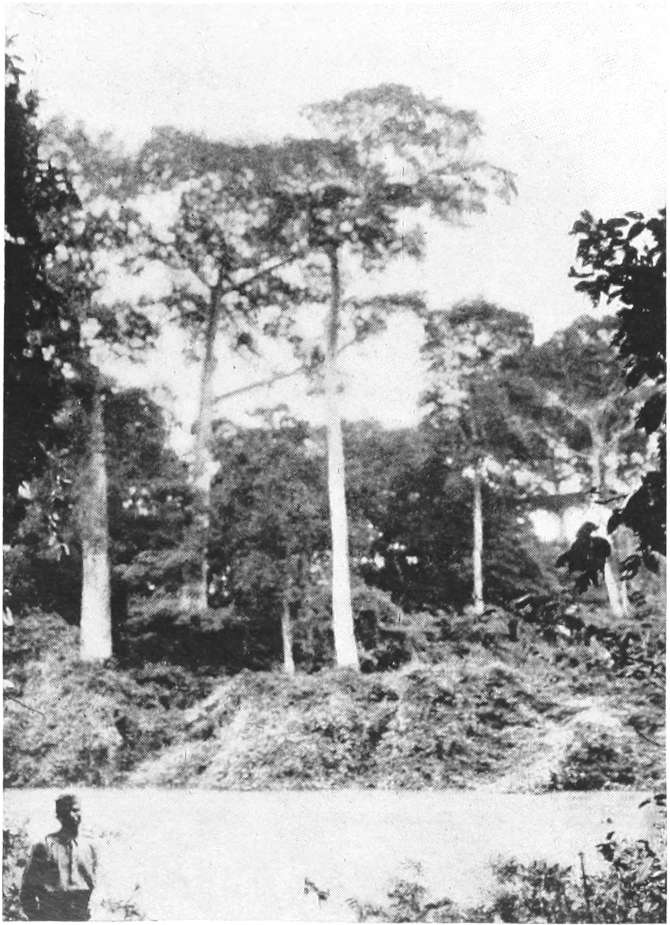
Fig. 54.—Mature Oganwo (Khaya Punchii), near Dajopa, Olokemeji Reserve, showing base of stem for nearly 12 feet stripped of bark.
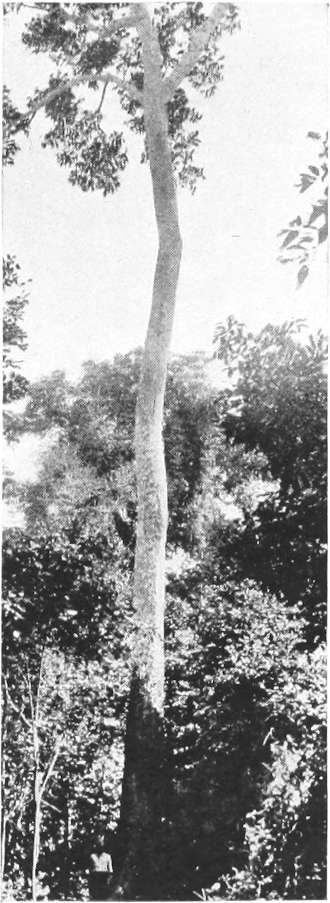
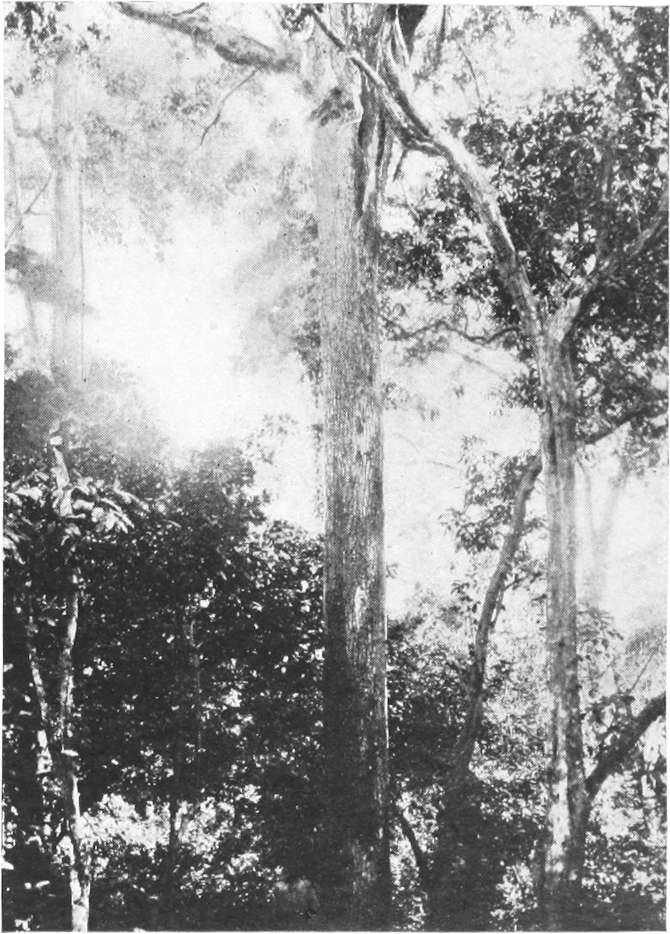
Fig. 55.—Large Emido (Mimusops multinervis), 10 feet in girth, Dajopa, Olokemeji Reserve.
To face p. 250.
It is a soil-protecting and soil-improving tree, and stands a good deal of shade. The tree has not been cut for local use, nor has it been tried as a timber for export.
Ficus sp. Common Fig. Obobo (Yoruba); Ohau (Benin).
It is a common tree of the Calabar, Ogoja, Owerri, Warri, Benin, Ondo, Ibadan and Abeokuta provinces of Nigeria. One of the most typical features of this tree is its free growth, open crown, and green, yellow and orange-coloured bark from the base upwards. It is a medium-sized tree, attaining a girth of 10 feet. The small red-coloured figs attract pigeons especially, as well as other birds, to the trees in the fruiting season. The leaf is small for a Ficus and oval in shape. The wood is white and soft. The white latex which exudes from the trunk when cut distinguishes this tree from the satinwood, Afrormosia laxiflora, with which it might be confused owing to the similar shades of green, yellow and orange-colour of the bark. It is chiefly found in the secondary forest, also near villages in the evergreen forest zone. Owing to the parrots and pigeons carrying the seed, reproduction from this source, both in epiphytic and tree form, is very good, but it is most usually found growing alone in an open place, without any support from other trees. It is very fast growing and impatient of shade.
The wood has not been used locally nor for export, nor does the native apparently have any use for it, as it soon rots when cut down.
The native occasionally eats the ripe fruit.
Ficus exasperata. Emido, Oboba (Yoruba).
This tree is found in the Abeokuta province.
Ficus Thonningii. Opoto (Yoruba).
This is one of the smaller fig-trees of the mixed deciduous zone. As with the others, it is not used as a timber tree, but occasionally for fences.
Ficus triangularis. Abadan (Yoruba); Obadan-nikwi (Benin).
It is a common tree in the Benin, Ibadan and Abeokuta provinces of Nigeria. It is chiefly found in the mixed deciduous forests. It is of no use as a timber tree, but is used occasionally for fences by the natives.
Ficus Vogelii. Lagos, Abba or Abbo Rubber. Abadon (Yoruba); Obadan (Benin).
It is the common tree of the Calabar, Ogoja, Onitsha, Benin, Ondo and Abeokuta provinces of Nigeria. This is the most common fig-tree, and is usually found along the sides of roads in the native villages. The very large, shiny leaf (not quite as glossy as Ficus Indica) is one of the most typical features of this tree. In Benin it is usually deciduous for about thirty-six hours, and the pinkish tips of the fresh leaves and the great rapidity of their development are remarkable. The bark is dark brown and rougher than the other species. In the Benin Forestry Compound there is a large specimen. On the whole, it is less common in the evergreen forest than near villages or roads. In the forest it is most often found as an epiphyte growing on oil palms, Sasswood, and oil-bean trees. The timber is white and soft; it has not been used for local purposes nor for exports. The “Balata rubber” of the Upper Niger district is obtained by roughly coagulating the latex of this tree in the air, with or without reagents, such as the latex of Bauhinia reticulata, or salt. The natives use the tree for making fences by sticking in pieces of the stem of suitable length, and in a similar manner it is used as a shade tree on the sides of roads in the villages. This is more especially the case in the villages in the dry zone, where other shade trees are scarce. Pigeons and parrots spread the seed, and thus its reproduction is assured.
Ficus platyphylla. Gambia Rubber.
It is also found in the upper reaches of the Ogan River, in the Ogo province of Nigeria.
Ficus asperata. Sandpaper Leaf. Ekpin (Yoruba); Ameme (Benin).
It is a common tree in the Ogoja, Owerri, Benin, Onitsha, Ibadan, Ondo and Abeokuta provinces of Nigeria.
It is often found as a small, scrubby tree, though when fully grown it reaches a girth of 8 feet, especially in the Benin province. The rough leaves are harsh to the touch.
The pigeons are very fond of eating the fruit and seeds.
The wood is white and soft.
The leaf is of the usual Ficus style, with a short stalk and deeply dentated, making almost a five-lobed leaf.
The leaves might be useful as a substitute for sandpaper. It has not so far been cut for export or local use.
Native Use.—The leaves are used for cleaning calabashes by the Yorubas and Benin people.
Ficus sp. Ograw (Yoruba).
Found in the Abeokuta province.
Musanga Smithii. Cork-wood or Umbrella Tree. Agbawo or Aga (Yoruba); Ogohen (Benin); Oro (Brass).
It is a very common tree, found growing in new clearings amongst the evergreen and mixed forests of the Calabar, Ogoja, Owerri, Onitsha (?), Warri, Benin, Ondo, Ibadan and Abeokuta provinces of Nigeria.
It is a medium-sized tree with an umbrella-shaped crown. It is the most distinctly gregarious tree of any in the forest, often alone covering many acres of land, supported on a series of aerial roots, the centre one of which is really the tap-root. The tree looks altogether top-heavy when mature (it is short-lived). It reaches a girth of nearly 5 feet. The bark is thin and of a light brown colour, spotted here and there with large yellow lenticels. The large pink sheath containing the immature staminate flower is often found lying on the forest pathway after the storm. The leaf is reminiscent of the horse chestnut, but with about eight digits. The young leaflet is of an orange-red colour. It is doubtful if it passes an age of thirty years.
The timber is white and soft, with no distinguishing heartwood, but with brown pith half an inch in diameter. When properly dried it has a fine, smooth grain and is usually free of knots. It dries much harder than when freshly cut. It splits well, but it is rather brittle.
It is the quickest growing of all the African forest trees, and certainly reaches timber size before any other. Regeneration by seed is prolific, seeds often germinating after lying dormant for over a hundred years, when a heavy forest is cut down. It is a light-lover, protecting the soil with its heavy foliage, and enriching it by making a good mould when it falls to the ground. It will stand a little shade as a young seedling. Very few trees will grow under it, though it is a useful “nurse.”
The timber is used for floating other wood heavier than water, but it has not been exported or cut for local use. The roots are used medicinally, and hunters tap the tree for water in the dry season.
Native Use.—As the Yoruba name implies, a group of the aerial roots is used for a native chair. Young 6-inch stems, split in half, cut about 4 feet long and dried, are used upright to form the walls of temporary farm-buildings. The wood is also used in place of cork, and for making matchets and knife scabbards in the Benin and Ibo countries respectively.
Chlorophora excelsa. African Oak, African Teak. Iroko (male), Iroko (female), Oba’s Tree, Rock Elm. Iroko (Yoruba); Uloko, Oroko Ulokoodigpe, Uloko-nushinogbon (Benin); Odji (Ibo, Asaba); Ofryio (Efik); Nsan (Oban, Ekoi).
It is a very large forest tree, reaching a girth of 30 feet and a bole length of 90 feet under favourable conditions. The male tree is usually thinner and of more compressed build, whereas the female shows more spreading growth and larger size; it is also quicker growing than the male. The female has stout, finger-thick, solid catkins, whereas the male has thin, long, open catkins up to 6 inches long. The timber of the male is darker brown and closer grained than that of the female, and also harder. The sapwood is wider in the female tree, but there is also a very wide difference between trees of both genders when they are grown in the open, old farms, or in dense, high forest, the latter yielding the hardest and closest-grained timber. The crown is almost umbrella-shaped and open, so that the leaves appear large in proportion, and it is usually possible to see through it. Three or four large limbs form the mainstay of it (see plate No. 37). The yellow lenticels on the stem, especially in younger specimens, and also on the red roots, are typical of the tree. The slash is yellowish, with little red spots in it. A little white latex flows out too.
In proportion to the size of the tree the root spurns are not very large, reaching 3 or 4 feet up the tree, and being well rounded, do not spoil the shape of the base of the bole. In older specimens the bark becomes brown, and finally almost grey in colour, and scales off to a slight extent. Although it forms very large side roots, it has a tap-root going to considerable depth. The loose seeds are small and flat, being not unlike those of alder, but rather larger and thinner.
It is found in all the Southern Provinces of Nigeria, both in the evergreen and mixed forest zones, where it is none too prevalent.
Timber.—Sapwood is yellowish white, and the heartwood of a yellow brown to dark brown (oak to teak brown). It is moderately hard, very durable and termite-proof. It does not plane very well, being sometimes cross-grained; it can, however, be worked up to a smooth finish. The grain is rather open and the pores very long. It has, however, an oily feel, and a certain amount of sheen. It takes nails with difficulty, splits moderately well and saws easily. It soon darkens on exposure to the air and light, becoming in this respect much darker than oak in a similar period. When seasoned properly it does not warp excessively. If taken green from the forest zone into a drier climate it will split. In the past a good deal of timber has been used in this state.
It is a moderately fast-growing, at first shade-bearing and subsequently a light-demanding tree, with soil-protecting and soil-improving qualities. It is deciduous for a few weeks in the year, generally in February or March, but specimens vary a great deal in this respect. Natural regeneration is very good, and in suitable localities it tends to spread more and more with the advance of the native farms into the forest. It stands transplanting very badly. Nursery sowings, however, show an enormous percentage of germination, the seedlings often coming up more thickly than grass. The ground pig eats the roots of transplanted seedlings, especially in localities where there are less desirable trees. It will grow as much as 6 feet in one year, and wherever it has much light in the forest, self-sown seedlings will grow 3 or 4 feet each year. The leaves are attacked by a minute coccus which causes them to swell up into an irregular shape, including the bud, thus stopping the growth for that season. Inside each of these swellings there are several of the young insects. Only the younger trees are attacked, and from the pole stage onwards trees do not appear to suffer nearly so much. In localities, too, where the trees grow very rapidly they appear to be less attacked, if at all. It is not very susceptible to fire, though in the mixed deciduous the base of the stem is often burnt. It is one of the most storm-firm of all the African trees. The bole is very cylindrical, especially if the tree which has been growing in the forest is given plenty of space to grow. The increment put on the bole is very great, being as much as 11 inches in circumference in one year.
In 1906 sample logs of this timber were sold in the Liverpool market as Iroko at 5d. per superficial foot, sale measure. Since that date it has been sold as African Oak and African Teak at a similar price, and appears now to be fairly well established in the market. As there are large supplies in many districts, such as the Yoruba country, Onitsha, Ahoada and Ogoja districts, there should be no difficulty in keeping the market supplied with moderate quantities year by year, at perhaps, though, slightly increasing costs. Locally the tree has been felled and sawn up for planks, scantlings, rafters, beams and general constructional work. By the Railway Administration it has thus far been considered the best wood for sleepers. Amongst the natives it is often worth more than it is to the European, the price varying from half a crown to 4s. 6d. per cubic foot for sawn boards 12 feet long, 12 inches wide and 1 inch thick.
Native Use.—The most valued of all woods for wall-plates and door lintels, treasure-boxes, washing-basins for chiefs. Doors, too, are made of it in Benin. Women place little pieces of chalk, yams, plantains, cowries, coco yams at the base of the tree, and it is said they will be blessed with children. Chiefs sacrifice a goat with a mat and a fine white cloth to propitiate the witches, who are supposed to hold their court in the Iroko tree and try to catch one of the sons of the chief.
Treculia Africana (Decne). African Breadfruit. Afon (Yoruba); Ije (Benin); Ijeni (fruit).
This tree is usually found near the edge of the villages of the Calabar, Benin, Ondo and Abeokuta provinces of Nigeria.
It grows to a large size, with a bole length of 20 feet and a girth of 9 feet, but it is usually a rather open-crowned, spreading tree. For its size the foliage is not over-dense. The leaves are single and roughly lanceolate, with a dark-green and rather shiny upper surface. The most conspicuous feature of this tree is the huge green, perfectly spherical-shaped fruit. Immature fruits of all sizes, from a cricket-ball upwards to a size of 18 inches in diameter, are seen growing close against the stem of the trunk and bigger branches of the tree. Some years ago, one of these ripe fruits fell off a tree at the edge of the Benin market and struck a woman on the shoulder with such force that she died a few days later. The natives subsequently cut the tree down.
The chief use of the tree is the fruit, which is placed in water to rot so that the seeds can be more easily extracted from the concentrically arranged fibres growing from the centre of the fruit outwards to the periphery. These are subsequently cooked and eaten, often being beaten up in a soup. From the outside the fruit looks as if it were made up of thousands of little green fibres closely packed together from the centre of the fruit, with the ends sticking out on the surface, thus giving it a rough feeling to the touch and making it appear as if it were full of holes.
The junction of a branch with the stem shows a large swelling all round the base of the branch, which thins out to its regular size about 6 to 9 inches away from the trunk.
The tree is comparatively slow-growing, but of a soil-protecting and light-loving nature. In the dry season, great quantities of dew condense on this tree, so that underneath the soil is kept moist. Probably more dew falls on this tree than Myrianthus arboreus, which shows a similar feature.
Thus far the wood has not been used for any purpose.
Treculia sp. Small-fruited African Breadfruit. Izenagan (Benin).
Found in the Benin province.
Morus sp. Aye (Yoruba).
It is found in the Olokemeji Reserve of the Abeokuta province in Nigeria.
Myrianthus arboreus. Shapo Obibere (Yoruba); Ihege (Benin).
It is a small to medium-sized tree, with short stem rarely exceeding 8 feet in height, and a much-branched, heavy crown, with very large leaf, cut up in the form of a large digit, much more pronounced than the horse chestnut. The leaves, on falling, rot and form a heavy layer of black humus. In the dry season the dew condenses to such an extent on the leaves that the tree drips in the morning, and the neighbourhood of such trees is always moist when the rest of the forest is dry.
The large, rough, elongated, pear-shaped fruit, like an overgrown sweetsop, is quite characteristic of this tree.
It is found in the Ondo, Benin, Owerri, Warri, Calabar and Ogoja provinces of Nigeria.
It is scarcely big enough for timber, but would make a good undergrowth for a light-loving species such as mahogany or teak, and would kill all weeds on good soil. Usually found on good soil. The timber is white and soft.
No botanical name. Iragbo-Amuje (Yoruba); Igogo (Benin).
It is a large tree with almost hard white wood, more the texture of Triplochiton. The fruit is a drupe, with a small nut inside. Termites do not attack the wood. It is a quick-growing tree, which comes up very frequently in old farms.
It is a common tree in the Benin country.
It is a shade-bearer.
Native Use.—In the Benin country it is used for door lintels and cross-pieces in house-building.
Urticaceæ.
Urera. Ela (Yoruba); Akinrankiri (Benin).
Found in the Yoruba and Benin countries.
Proteaceæ.
Faurea speciosa. Red-brown timber.
Found in the Calabar province.
Olacaceæ.
Heisteria parvifolia. White Nut (?). Ikereoha (Benin).
It rarely exceeds the height of about 8 feet and a girth of about 1 foot.
This is a small shrub with red flowers of four petals at right angles to each other, in the middle of which a white-coloured fruit forms. On peeling off the white skin, a black nut is disclosed, which is edible. It tastes more like a hazel-nut. The red flower is the most distinguishing feature, and makes this plant show up amongst the evergreen zone.
It is found in the Ondo, Benin, and Calabar provinces of Nigeria.
It is a shade-bearing and slow-growing shrub, with soil-protecting and soil-improving qualities. It serves a very useful purpose amongst the undergrowth in the forest. Natural regeneration appears to be fair, but no plantations have been made with this species. The nuts have not been tested in the export market. Amongst the natives the nuts are very popular, and it is the only use which they have for this shrub. This chiefly refers to the Benin district.
Heisteria sp.?. Benin Nut, Edible Nut. Evialegbi (Benin).
It is found chiefly in the Benin province of Nigeria, though probably its area of distribution extends to the Ondo and Ogoja provinces as well. It is a tall, comparatively thin-boled tree in proportion to its height. Attaining a girth of about 8 feet, the bole is 40 feet in length. The bark is dull green and not very thick, being more in the nature of cortex than real bark. The most typical feature of the tree is the fruit, which is a spherically-shaped nut with a pointed tip. When dry, it is marked with shallow groves about half a millimetre apart, all converging to the tip. When cracked, the kernel obtained is rather pleasant to the taste, with plenty of oil. The timber is a yellowish colour and moderately hard. It is fairly durable, though it is attacked by a small wood-borer when it is left lying in the forest. It is a moderately fast-growing tree, but is a shade-bearing, soil protecting and improving tree. Natural regeneration appears to be poor. No plantations have yet been made with it, but its yield of nuts should be tested. The timber has not yet been exported, nor has it been cut for local use. So far, the chief use of the tree is the nut, but even here proper tests have not yet been made, and it is only the natives who really know the tree. The exact oil content has yet to be tested.
Coula edulis. Nkula in the Gaboon, Gaboon Nut. Omumu (Benin).
An edible nut containing oil. It is nearly round in shape, but slightly depressed at the top, with a soft shell.
Chief Characteristics.—The tree is of medium size, with narrow crown and small leaves, the fruit being borne on the upper side of the branches. It is moderately common near Ugo and also on the Siluko road (both in Benin). This is apparently a rare tree in reality, and it may be mistaken for Ivialegbi.
The timber is brown with a red tinge, almost hard.
Native Use.—The nut decorticated is sold in the native markets and eaten as a delicacy.
Value.—According to report made some years ago, it was valued at £7 per ton in Liverpool. It was difficult to get sufficient for a sample.
Loranthaceæ.
Loranthus leptolobus. African Mistletoe, or Red-flowering Loranthus.
Found in the Yoruba and Benin country.
Menispermaceæ.
Cissampelos Owariensis. Ebewaki (Benin).
A medicinal plant.
Cissampelos Pareira (L.). Jokoye (Yoruba).
It is found in the Olokemeji Reserve of the Abeokuta province of Nigeria.
Anonaceæ.
Enantia polycarpa (Kew). Abeokuta Bark, Kanda or Canta Bark. Ghido (Yoruba).
Found in the Egba province.
Enantia chlorantha. African Yellow Wood. Yaru (Yoruba); Ehranbabogo (Benin).
It is a common tree of the Ondo, Benin, Owerri, Ogoja and Calabar provinces of Nigeria.
It is a medium-sized tree, attaining a girth of 5 feet and a bole length of 25 feet. The most peculiar feature of the tree is the fruit, a bundle of reddish clubs all coming out of the twig at one point. The stem is dull green, with scattered lenticels here and there. The bole is uneven near the base and almost divided by large spurns, which makes it difficult to cut out a square log. Standing in dense shade usually, and often with a piece of the bark removed, showing the yellow cambium layer or wood, it is easily distinguished from other trees.
The yellow wood is similar both in the sap and in the heartwood. It splits well, even into tiny thin, lath-like pieces. It is soft, but planes up into a smooth surface. The medullary rays are often prominent, and make the wood look very pretty. The sheen of the wood also adds to its appearance.
The tree is a shade-bearer and rather slow-growing; perhaps in more open localities it would grow faster. Natural regeneration does not appear to be good, though more extensive observations on this point may reveal more. Small quantities of seed are borne each year. It sprouts a little from the stump, but this method of reproduction cannot be relied upon. Cuttings have not yet been tried. It likes a good moist soil of the evergreen forest and lower parts of the mixed deciduous forest. It has not yet received a place in the forest plantations.
Samples of the timber have been tried in England and used with good effect as a substitute for American “Whitewood,” to which it is similar in texture. Its small size rather hinders its more extensive use. In the Benin district it is used as cross-pieces and rafters in building; wooden shovels are also made from it. It is occasionally used to make a yellow dye, especially the bark. Native caps are made from the bark, which is fibrous. It is also used for verandah-posts and door-frames.
Dennettia tripetala. Igberi (Yoruba); Ako (Benin).
It is a common tree in the Benin, Ondo (?) and Abeokuta provinces of Nigeria.
It is a medium-sized tree, reaching a maximum girth of 6 feet, with a short bole and a much-branched crown. Most commonly seen as a shrub-like tree in the mixed deciduous forest. The flower has three petals, with red colour inside and brown outside. The flowers grow on the stem or the twigs with little or no stalk, usually two or three in one place.
The timber, which is white and soft, is eaten by termites. There is no proper heartwood.
It is a shade-bearer, and rather slow-growing tree. It likes good soil, and is rather an indication of a loose, good and deep soil.
It has not been exported or used locally.
Native Use.—The fruit, which has a peppery taste, is eaten. The chiefs only eat the fruit after it has become red and really ripe. The small boys use the new young leaves uncooked to make the mouth warm when the rain falls.
Dennettia sp. Agedegbo, Ako (Benin).
This tree was determined from specimens obtained in the early part of 1917 from Olokemeji, where it is somewhat common. Owing to the fact that only immature and mature fruiting specimens were sent, it may be identical with Dennettia tripetala. It is, however, a much smaller tree, and the fruit is not nearly so large and is a more oblong shape than D. tripetala. It is a small, much-branched tree and yields a hard, whitish-yellow wood which might be used as substitute for lancewood. The Benis eat the fruit, but the Yorubas have no use for the tree.
Xylopia Æthiopica. Negro Pepper. Eru (Yoruba); Unie (Benin); Atta (Efik).
Is a medium-sized tree with silvery smooth, grey trunk, and found growing near the banks of rivers in all the southernmost provinces of Nigeria.
Fig. 56.—Large-leaved Mahogany (Khaya grandis), 14 feet in girth, with smaller Iroko (Chlorophora excelsa) standing at the side, Olokemeji Forest Reserve.
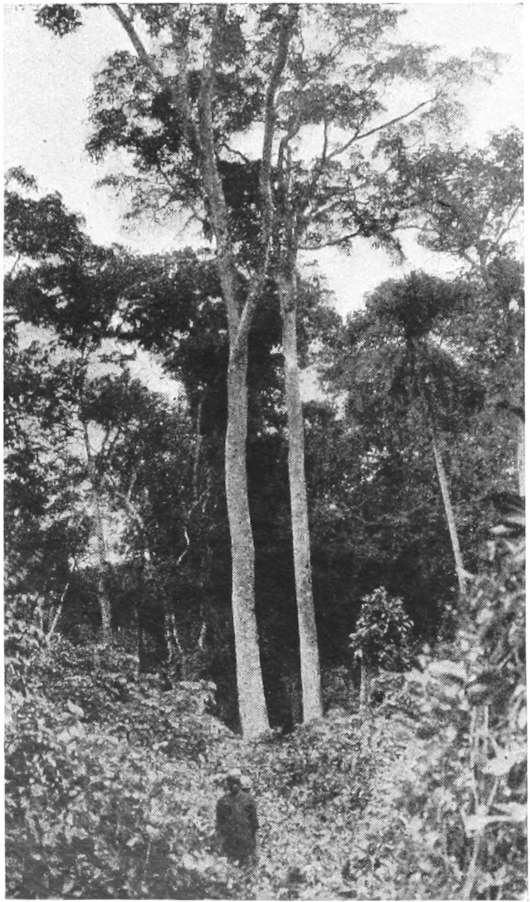
Fig. 57.—Arere (Triplochiton Nigericum), 120 feet high, thirty years old.
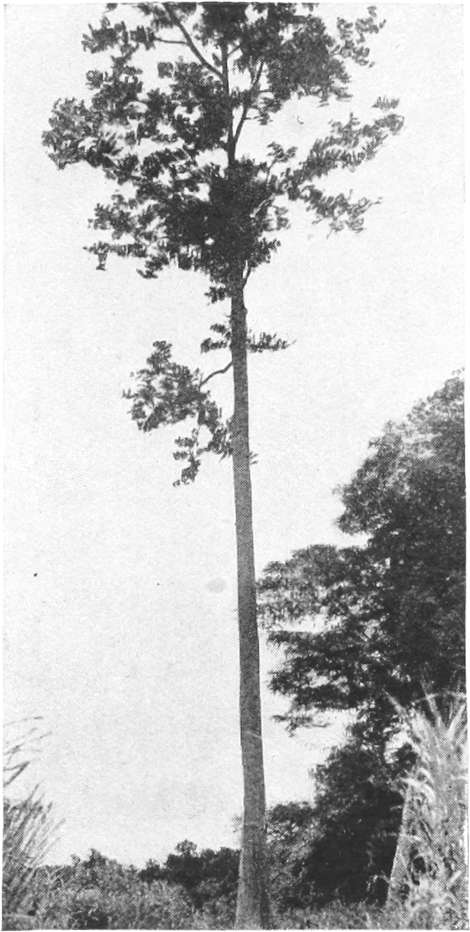
Fig. 58.—Ebony (Diospyros mespiliformis), 7 feet 6 inches in girth, on Dajopa Road, Olokemeji Reserve.
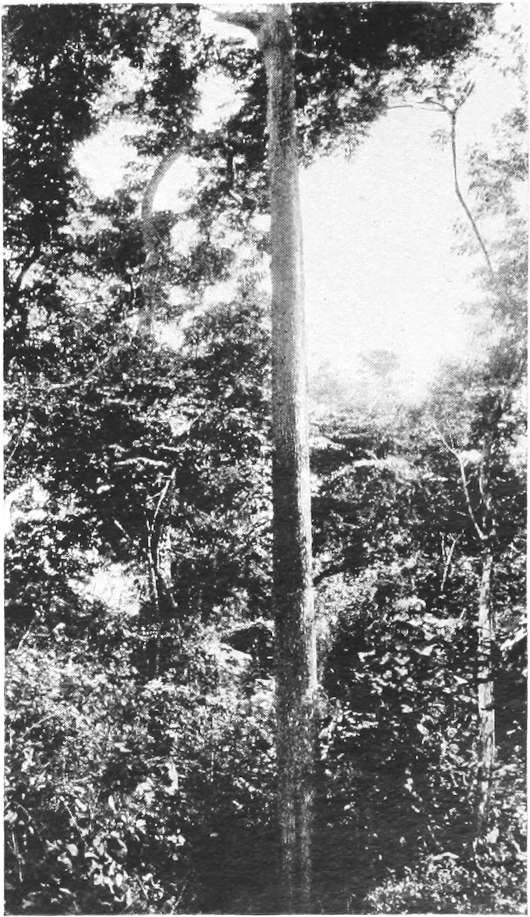
To face p. 260.
It is stated to be useful for oars and masts for small boats, according to the report on the Exhibition of 1867. Since that date, however, it has not been used for this purpose. The bole reaches a girth of about 5 feet and a length of about 45 feet. The crown is narrow and comparatively long, but rather compressed and compact. The foliage is dense and comparatively close together. The root spurns are slight and narrow, not extending very far up the bole. In proportion to its height the trunk is thin and very cylindrical in shape, though occasionally near the base it may not be absolutely round and tends to bulge out rather more on one surface than the other. The fruit, when ripe, is like a bunch of black keys, or little short, round-ended pieces of wood, all projecting out of one central stalk or fork, which is the most typical feature of the tree. The cortex is comparatively thin, and remains smooth even in the mature trees. The bole tapers only very slightly, and does not divide or send out any branches until the crown is reached.
The sapwood is white, as also the heartwood, except that the latter tends to have a very light yellowish-brown tinge, especially as it seasons. It is moderately hard, showing great elasticity, planing with a smooth surface, splitting moderately well, taking nails and not warping or shrinking to any great extent. Even fresh it is comparatively a dry wood. It saws well and shows considerable textile strength, as also strength in compression, is moderately heavy and termite-proof. The texture of the grain is very fine and even, and the grain is very straight.
This tree is somewhat slow-growing, shade-bearing, soil-protecting, and soil-improving. Natural regeneration is moderate. It does not sprout from the stump. It stands a certain amount of flooding, but it seems to demand a good soil with plenty of moisture, including a very moist atmosphere. No plantations have been made of this tree.
The timber has not been felled for export, nor has it been cut for local use, but it appears to deserve a trial as a substitute for lancewood, or other woods which show considerable elasticity. It should be noted that it belongs to the same family as that of the lancewood. Owing to the straightness and comparative evenness of the bole for a very considerable length, it might be suitable for shafts or even telegraph poles.
The fruit is used as a kind of comestible amongst most of the natives, as it has a peppery taste which is not unpleasant.
It is usually dried and sold in the native markets, several bunches for a penny. By some it is almost looked upon as a medicine.
Xylopia parviflora (Eng. and Diels). Small-flowering Negro Pepper. Sesedo, Issa oku (Yoruba); Aghako or Oziza (?) (Benin).
This tree is found in the Abeokuta and Benin provinces of Nigeria, where it is none too prevalent. It is a medium-sized tree with a very straight, thin and tall bole. Except for its size it is very much like X. Æthiopica; the fruit is much smaller and scarcely to be seen from the ground. The timber is grey-white, and the heartwood, though occasionally a light brown, is scarcely to be distinguished from the sapwood. It is hard, durable, and said to be termite-proof. It does not take nails easily, nor does it split well, but it saws comparatively easily. Natural reproduction by seeds appears to be poor. It scarcely sprouts from the stump. It is a shade-bearing, soil-protecting and soil-improving tree.
The timber has not been exported. The bark and roots are used medicinally.
It is used locally for house-building, as verandah-posts or supports for the roof. It has considerable tensile strength and stands compression better still.
Anona Senegalensis (Pers.). Wild Custard Apple. Abo (Yoruba).
This is found in the Oyo and Ogoja provinces of Nigeria. It is a small, shrub-like tree, with a short stem of about 4 or 5 feet, and has a very oval leaf, almost ovate in shape. It bears a yellow fruit which divides up into the typical segments common to this family. It resembles the Sugar Apple, has a delicious taste, and the fruit is most refreshing on a hot day at the end of the dry season. The tree is fire-resisting. Being deciduous, it is not a soil-improving tree. It is soil-exacting, but is also found in rocky localities. The tree is not very prolific, but sprouts very strongly from the stump and to a less extent with root suckers. The small timber is occasionally used for house-building.
Anona palustris (Foster). Alligator Apple. Afe (Yoruba).
The wood is supposed to be soft, and to have been introduced into the country some years ago.
It is found in the Abeokuta province of Nigeria. The fruit is edible, the foliage dense and heavy. In the dry season the dew condenses on the leaves and towards morning drips off on to the ground, thus keeping the immediate vicinity of the tree quite moist. The leaves, when decayed, make a rich humus. It is one of the most valuable soil-improving trees.
Anona Mannii.
It grows in the forest region of the Central and South Provinces of Nigeria. It is a medium-sized tree bearing large green fruit close to the stem.
Popowia Mannii.
A specimen of this Popowia has been found in Alasko, near the Oha River in the Ibadan province of Nigeria.
Anona Afzelii. Probably the same as Dennettia sp. Ako, Aggedegbo (Benin).
It is found in the Abeokuta, Benin and Warri provinces of Nigeria.
It is a medium-sized tree of the more swampy parts or moister regions of the evergreen forest zone. The leaves are a very large size, often reaching a length of 1 foot. The wood is yellowish-white and soft and not very durable. Owing to the very dense foliage, quite a thick layer of humus is formed in the shade of the tree, so that its soil-improving properties are very great. It would be a valuable tree for underplanting mahogany or any deciduous tree, both with a view to providing soil cover and improving the soil.
The natives do not use this wood.
Hexalobus grandiflorus (Benth.) Afara (Yoruba).
Found in the Abeokuta province.
Uvaria Afzelii. Gbogbonshe (Yoruba).
It is found in the Abeokuta province of Nigeria. A small tree with hard wood.
Uvaria Busgenii. Paddlewood. Umaja or Umazza (Benin); Uruiju Arogu (Yoruba).
It is found in the Calabar, Ogoja (?), Benin, Ondo and Abeokuta provinces of Nigeria.
It is a large tree, and reaches a girth of about 10 feet with a good bole and limbs. The crown is narrowish, being formed by many small branches. The bark is light green, scaling off and leaving yellow patches with a red edge to each; otherwise it is smooth and almost shining. It is a common tree of the evergreen forest. With the exception of slight hollows near the base of the stem the bole is quite round.
The timber is a faint orange-colour with a reddish tint. There is very little difference between the heart and sap wood, except that the former is a lighter colour. It splits well and planes into a smooth surface. At the corner of a square block pieces are liable to split off. The grain is a little open and the pores are rather long.
Termites (white ants) make no impression on it. The timber is hard, with a certain amount of rigidity, and yet has no resilience.
It is a slow-growing tree and shade-bearer. Judging by the number of small trees found, reproduction from seed must be good. It does not sprout from the stool, and root suckers are thrown up after the trees have been felled. It likes moist and deep soil, which must be moderately good, e.g. the red soil of Benin and sandy loam of Badagry district.
In 1906 samples of the wood were sold in the Liverpool market as Sabicu and realized 1s. to 2s. per superficial foot. It has also been used for European house-building in the Calabar province.
Native Use.—It is chiefly used for making paddles. It is also used for joists and posts by the Benin people.
Uvaria Chamæ (Kew). Eruju (Yoruba).
It is a large shrub with sweet-scented flowers. Lagos Island.
Artabotrys sp. Ako gbogbonshe (Yoruba).
It is found in the Olokemeji Reserve of the Abeokuta province of Nigeria.
Monodora tenuifolia. African Nutmeg. Lakosin (?) (Yoruba); Unyenghen (Benin).
In younger trees there are a few narrow white streaks in the dull green bark, which gives it quite a distinctive appearance.
Chief Characteristics.—It is a medium-sized tree with yellow flowers tinged with white, most conspicuous after they have fallen to the ground. The flower has three petals with wavy edges, and reminds most people of an orchid. In fact, many have asked whether it is not an orchid. The leaves are light green, especially on the under-side, though darker as the rainy season advances. The fruit is a spherical drupe, containing several small nuts or seeds. The tree flowers before the leaves come fully out, so that it looks very handsome indeed. It is, in fact, one of the prettiest of all the flowering trees. It flowers at the end of February or at the beginning of March. It reaches a girth of about 2 feet and a bole length of about 10 feet, though it is often much branched from about 4 feet from the ground.
It is quite common in the Abeokuta province of Nigeria, especially in the Olokemeji Reserve and on the road between that place and Mamu, in the Benin province, as well as being found in the mixed deciduous forest zone.
The timber is hard and white and fairly durable. It is tough and does not split well.
Although it stands a little shade it is a somewhat slow-growing, light-loving tree, but does not protect the soil. Natural regeneration appears to be fair. It sprouts well from the stump, often in this way forming quite a clump. On these stool shoots it bears flowers and fruit early. It transplants badly, more especially when placed in the open. It is somewhat exacting as to soil, demanding a certain amount of moisture as well as depth. It is somewhat fire-resisting, sprouting out again after such injury.
As it does not really reach timber size, it is not of much use for local constructional purposes.
Native Use.—The smaller trees are used as walking-sticks and the larger ones are sometimes used for hoe and axe handles. In clearing the land for farms, stool shoots are left standing, to act as supports for the tendrils of the yams after they have been planted.
Monodora myristica, var. grandifolia. Calabash Nutmeg. Lakoshe or Abo Lakoshe, Ilakosin, Igbo (Yoruba); Ukposa, Eddo Binoyoba (Benin).
It is found in the mixed deciduous forests of the Ibadan, Ondo, Benin, Owerri, and Ogoja provinces of Nigeria, where it is somewhat prevalent.
Chief Characteristics.—It is a large tree, up to 7 feet in girth, with open crown and thin foliage. The flowers are very conspicuous when they fall, having three very large pointed red petals streaked with white, almost reminiscent of an orchid. The edge of the petal is wavy, too. On the tree, the flowers hang from the under-side of twigs with very short petioles. It is the most handsome and largest flowering tree amongst the Monodoras. It is, however, never quite so much covered with flowers as the M. tenuifolia. The flowers are considerably larger, being quite half to one inch longer. The bole reaches a length of about 15 feet, but is often branched lower down. The fruit is a large drupe, containing a number of small nuts.
The timber is whitish, hard and somewhat tough, and does not split well.
It is a moderately fast-growing, light-demanding tree. With the exception of the period when it loses leaves, it is a soil-protecting and soil-improving tree.
Although it scarcely reaches timber size, it might be tried for smaller constructional purposes, such as handles, posts, or rails. The quantities, however, are not very large.
Native Use.—The nut is ground up and used in soup.
Monodora brevipes. Yellow-flowering Nutmeg. Ause, Lakosin (Yoruba); Iyoha (Benin).
Grows abundantly throughout the Tropics. The seeds are useful as condiments or as medicine.
Myristicaceæ sp.
Pycnanthus Kombo. White Cedar. Akomu (Yoruba); Omocham (Benin).
It is found in the Calabar, Ogoja, Owerri, Benin, Ondo and Abeokuta provinces of Nigeria.
It is a very common tree, especially at the edges of roads and in old farms. It is not so common in the original forest. It grows up to 15 feet in girth. It has a very cylindrical bole, with long, straight, outstanding branches growing close together, more or less forming a flat crown. The leaves are large and pinnate, and the small fruit, which grows in clusters, half opens, disclosing a bright red interior with one round seed covered with pink, mace-like fibre. The slash is pinkish-white, and heavy, sticky white latex streaked with red exudes very freely after it has been cut.
The timber is soft and white and not durable. It has not so far been used either for export or locally.
Lauraceæ.
Ocotea cf. Egg-shaped fruit tree. Agkwokhau (Benin).
Found in the Benin province.
Capparidaceæ.
Cratæva Adansonii (Guill. et Perr.). Egun oran (Yoruba).
Tree 30 feet high with yellow flowers. Found growing at Fiditi, Oyo province.
Capparis Thonningii. Ekkana, Awoa (Yoruba).
It is found in the Olokemeji Reserve of the Abeokuta province of Nigeria.
Rosaceæ.
Parinarium sp. Babu (Yoruba); Oria (Benin); Oko (Ibo, Owerri); Oguru (Brass); Edat (Efik); Ukpoi, Edat, Mpuri (Oban, Ekoi).
It is found in the Olokemeji Reserve of the Abeokuta province of Nigeria, and Asaba district, Benin province.
It is a large tree with irregular surface to the bole, muscular-like protrusions being seen here and there, as well as similar shaped depressions. The crown is wide and flattish, and of light foliage. The fruit is a large, nasty-smelling, apple-shaped drupe.
The timber is white, with apparently little difference between sap and heart wood, and it is hard and tough, not splitting at all easily.
It is a somewhat slow-growing, shade-bearing, soil-protecting and soil-improving tree, said to be termite-proof. It has considerable resiliency, and stands a certain amount of bending strain.
The timber has not been used for export, nor has it been sawn up for planks for local use.
Native Use.—The Yorubas use the timber for making mortars for food.
Parinarium sp. Red Mahogany. Abue (Egbado, Yoruba); Dabadogun (Benin).
It is plentiful in the Benin and the Abeokuta provinces of Nigeria.
Chief Characteristics.—It grows into a large tree, but is often seen as a small tree, suppressed by other quicker-growing trees. The dense, somewhat spreading crown is a typical feature of the tree. Its large leaves attract attention, especially compared to the size of the tree. The bole is often crooked and covered with dark green cortex, with only a limited amount of fine bark.
It has a hard, red wood, not unlike mahogany, but with a more fibrous grain. It is durable, especially when left in a wet place. It works up with a good surface and very pleasing colour, making it thoroughly worthy of being a substitute for mahogany. Being a shade-bearer, soil-protecting and soil-improving tree, it should eventually find a place in the forest plantations. Despite its slow growth, its other silvicultural qualities are worthy of attention.
It has not yet been exported, not has it been felled for local use. For the former it appears to deserve a trial.
Native Use.—It is used for firewood.
Parinarium robustum. Sometimes called Mahogany Nuts, Nikko Nuts; Benin Mahogany. Ugibisaro (Benin); Aiyeni (Egbado); Aiye, Aghaghe, Aiyeni (Yoruba).
It is found in the Abeokuta and Benin provinces of Nigeria, in the evergreen forest zone, where it is not very prevalent. It is a large forest tree, reaching a girth of over 12 feet and a bole length of about 70 feet. In the dry season, in the distance, the leaves show the typical dried-up yellow appearance of the Parinariums, especially being somewhat shiny in appearance. The fruit is not unlike a very large, very dark green plum, but rather more flattened and not so round. The inside nut is compressedly spherical, showing five large eyes or holes out of which seeds germinate.
The sapwood is yellowish-white and somewhat broad in proportion to the size of the tree, and the hard wood is mahogany-red coloured, but with more fibrous grain. It planes up with a smooth surface and splits fairly easily, especially when nailed. It is moderately hard and quite durable, and is not supposed to be attacked by white ants (termites). Like most of the Parinariums, the fresh wood smells something like honey, and the timber tends to darken on exposure to the air, thus improving in colour.
On the whole it is a shade-bearing tree and not very fast-growing. It has soil-protecting and soil-improving qualities. Natural regeneration only appears to be very moderate. Like most of the Parinariums, the kernels of the fruit are pecked out by various birds. No plantations have been made of this tree.
Quite by accident, in 1906 some logs obtained from this tree were cut and exported, and sold in the Liverpool market as Benin mahogany at 4d. per superficial foot. Since then, however, none has been cut.
Amongst the Benin natives the timber is occasionally used for house-building.
Parinarium excelsum. Essago (Benin).
It is found in the Ondo, Benin, Owerri and Calabar provinces of Nigeria, in the evergreen forest zone, where in certain localities it is very prevalent.
In appearance it is like the rough-skin plum of Sierra Leone, but a larger and taller tree. The leaf usually looks dry and grey, especially underneath. The crown is oval and very dense, with a mass of large limbs. The bark is covered with white lenticels, which make it look grey. It usually bears a large crop of fruit each year.
It reaches a girth of over 12 feet and a bole length of about 50. In proportion to the height, the bole is not so long as in the cases of many other forest trees. The fruit is more uneven in surface than that of P. robustum, and the surface is also more or less speckled with little white raised lumps, giving it a roughness to the touch. The fruit inside is yellowish-white, rather hard and not unpleasant to taste. Where it is found, especially in the more swampy parts, it is often almost gregarious in habit. It is an evergreen tree.
The wood when freshly cut smells like honey. The sapwood is yellowish-white and the heartwood is brown. On the whole it is much harder than P. robustum. Occasionally it appears cross-grained, and does not plane up with such a smooth finish. It saws less easily, and it is hard to drive nails into it. It does not split well. It is rather a heavy wood and does not float.
It is a somewhat slow-growing, shade-bearing tree, which thoroughly protects the soil and improves it with its leaf fall. Natural regeneration appears to be none too good. No plantations have been made of this tree.
It has not been felled for local use, but occasionally it has been used for firewood, which is of somewhat high calorific power. The fruit is occasionally useful to temporarily assuage hunger in the forest.
It was sold as African greenheart at 1s. 6d. to 1s. 9d. a cubic foot in the Liverpool market in 1906.
Native Use.—None, and the fruit is not eaten. Elephants eat the fruit.
Parinarium polyandrum (Benth.) (?). Plum. Ako Idofun (Yoruba).
Smaller fruit than P. curatellæfolium and very hard; similar flowers, the leaves rough and only slightly grey-green on the under-surface. Stem reddish-brown with long lenticels, leaves larger and longer.
It is found in the Abeokuta province of Nigeria.
Native Use.—The tree is used by the natives for building farmhouses.
Parinarium curatellæfolium (Planch.). Abo-Idofun (Yoruba).
A small tree 10 feet in height and 1 foot in diameter, with large umbelliferous flowers of a white colour. The leaves are rough and shiny on the upper surface, and with more white underneath than the P. polyandrum.
Native Use.—The fruit is edible, though not usually eaten. No use as firewood. The wood is used for building farm-sheds.
Parinarium Gabunense. Mahogany Nut. Abere (Yoruba).
Found in the Ondo province.
Chrysobalanus sp. Niko Nut. Igata (Yoruba).
Found at Ebuttemetta.
Leguminosæ (Cæsalpineæ).
Cassia Sieberiana. Cassia. Aridan-toro (Yoruba); Ezzi, Apagban (Benin).
It is commonly found in Benin, Ibadan and Abeokuta provinces of Nigeria, more especially in the latter. It is a small tree bearing large and long racemes of yellow flowers in February, making it very reminiscent of the laburnum. The tree is leafless at the time, so that the flowers are all the more conspicuous. The almost rectangular branching habit of this tree, combined with the rather thin twigs, is very typical. It yields a hard, red wood, but the sapwood is yellowish-white. The natives use the fruit medicinally and the timber for house-building. The pods are usually about a foot long and half an inch in diameter.
Cassia tora. Cassia. Ako Kere (Yoruba).
It is found at Olokemeji, in the Abeokuta province of Nigeria. Its medicinal use as a remedy for ringworm is not known to the natives of that locality.
Cassia fistula. Cassia. Bembedo (Yoruba).
It is rather an uncommon tree of the Benin province of Nigeria, one specimen being found in the Idah district; the longer (1 to 2 feet) and stouter (¾ to 1 inch) pod is most typical of this tree. It is otherwise much the same size as Cassia Sieberiana. The natives use the fruit medicinally, but look upon the tree as a “great medicine.”
Cassia podocarpa (G. and P.). Cassia. Asunwon (Yoruba).
It is found in the Olokemeji Reserve.
Shrub with yellow flowers.
Cassia occidentalis. Blackwater Plant. Rere (Yoruba).
It is a small shrub-like herb with large upright flowers, which is usually found growing in waste places at the edge of villages in the Yoruba country, in the mixed deciduous forest zone. A medicine to cure blackwater fever is made from this plant, though doctors now say it is not an infallible cure.
Ormosia laxiflora (Benth.). False Dalbergia. Shedun (Yoruba).
It is found in the Ibadan, Abeokuta, Onitsha and Ogoja provinces of Nigeria, chiefly at the edge of the dry-zone forest.
It is a small tree, 12 feet high and 18 inches in girth, with almost brick-red or orange-coloured bark, which is thin and often scarred by natives. It has a long, thin pod with thin, flat seeds. It reminds one very much of a small Dalbergia. It stands the annual fires well, though it gets singed each year. The base of the bole is often somewhat enlarged with the constant cutting of the bark both of the stem and the uppermost roots.
The timber is yellowish-red and not very hard, but rough to work up, being more in the nature of a turner’s than a joiner’s wood. The grain is often by no means straight, and the wood shows a little figure.
Withstanding the fires so well, it serves, or should serve, as a nurse for the introduction of more valuable species amongst the dry-zone trees, especially on the laterite soils. Natural regeneration is good and it sprouts well from the stump. Root suckers do not appear to be so prevalent as in many dry-zone species. It is a light-loving species, which does not protect the soil properly, though the foliage is comparatively dense for that type of tree. It is slow-growing. No plantations have been made.
It does not attain sufficient size for export, but it might be tried for local turnery work. It is useful for local hut-building.
Native Use.—House-building, and the roots when boiled are used in medicine as a tonic.
Afrormosia elata. African Satinwood, Yellow Satinwood. Ayin (Yoruba); Anyeran, Anyesan, Ehranobapotineddo (Benin); Egbi (Ibadan); Elo Uta (Ibo, Owerri).
A very conspicuous tree, with its orange-red trunk near the base, gradually shading off to yellow higher up, and towards the branches a light-green colour. Large, irregular-shaped pieces of bark fall off from time to time, in a similar way to the plane-tree of Europe, though with its reddish trunk it is not so much like the plane as Afzelia Africana. The root flanges or spurns are very thin and do not extend beyond about three feet up the stem of the tree. In plate No. 82 one of these trees, growing near Benin, shows the open, rather narrow crown with its few main limbs supporting it.
It is commonest in the Benin, but also found in the Ondo, Owerri and Calabar provinces in the moist evergreen forests. It is also seen in secondary forests of the same zone.
The timber planes well, but does not split. It saws easily, but takes nails with difficulty. It is sometimes figured, especially logs from the base of the tree.
It is pretty easily killed by fire at the roots, though otherwise it tends to spread with cultivation. The sapwood is almost white and the heartwood a yellowish-green, when fresh, but a dull yellow when dry. It is very hard and withstands the attacks of white ants (termites). Even the sapwood of a young tree had not rotted after six years near the bank of the Ogba, Benin province. It grows moderately quickly.
The flower is inconspicuous and small, and the pod is also small, being about 2½ inches long and ½ inch broad, containing two or three flat seeds. The tree does not bear very heavily, and in consequence natural regeneration is not very good, though such seeds as actually form properly seem to germinate well. In youth it bears some shade, but in middle age seems to be almost a light-demander.
Although when freshly cut the wood does not float, when thoroughly dry it would not be difficult to float it with a lighter species.
The timber was reported as satinwood and worth 3d. to 1s. per superficial foot in the Liverpool market in 1906, and that moderate quantities (of fair length and squares) would be taken.
Pterocarpus esculentus (Schum. and Thon.). Edible-fruited Padouk. Gbingbindo (Yoruba); Akpanagya, Uruhe (Benin); Nja (Efik).
It is one of the most common waterside trees of all the Southern Provinces of Nigeria; some of the rivers on the banks of which it is found are the Ovia, Ogun and Cross River. Belonging to the mixed deciduous forest zone, it is in the middle reaches of these rivers where it is most prevalent.
A typical feature of this small tree is the bright, yellow-coloured flower, which quite brightens up the banks of the rivers at the end of February or March. Another most peculiar feature is the odd, somewhat kidney-shaped fruit with its rough surface corrugations, containing inside a hardish nut about 1 inch in diameter. Either the nuts or the fruit are often seen floating down the rivers, especially where they are tidal. The leaves are more typical of the Pterocarps, otherwise the fruit is most unlike either those of the genus or even of the family. The bole of the tree is short, smooth and almost silver-grey in colour, though it is often discoloured with the mud from the perennial floods of the river. It is usually seen with more than one stem.
The timber is white and not over-hard. It is not very durable.
The tree is not very fast-growing, but is an evergreen, with a short period in which nearly all the leaves fall. It serves a most useful purpose in holding the banks of the streams wherever it is found, and it is noticeable that its roots appear to extend a long way back and that it is one of the last trees to be washed out by floods. It sprouts fairly well from the stump when cut, unless it is almost at once submerged by the floods, which points to the fact that it should be cut only at the beginning or towards the end of the dry season. Natural regeneration appears to be fair, but no plantations have been tried with this tree.