Chapter IX · (continued 2)
Reading edition
The nuts have not been examined to see what they contain, though they are of nutritive value.
For export it does not yield large timber, and for local use it is rather small, but for local huts it might occasionally be used where other timber is scarce, as in the dry zone. It makes a fair firewood in those places. Although the fruit is supposed to be edible, very few natives have tried it, and apparently it is only used in times of great scarcity.
Fig. 59.—Large Ayin (Anogeissus leiocarpus), 10 feet in girth, Dajopa, Olokemeji Forest Reserve.
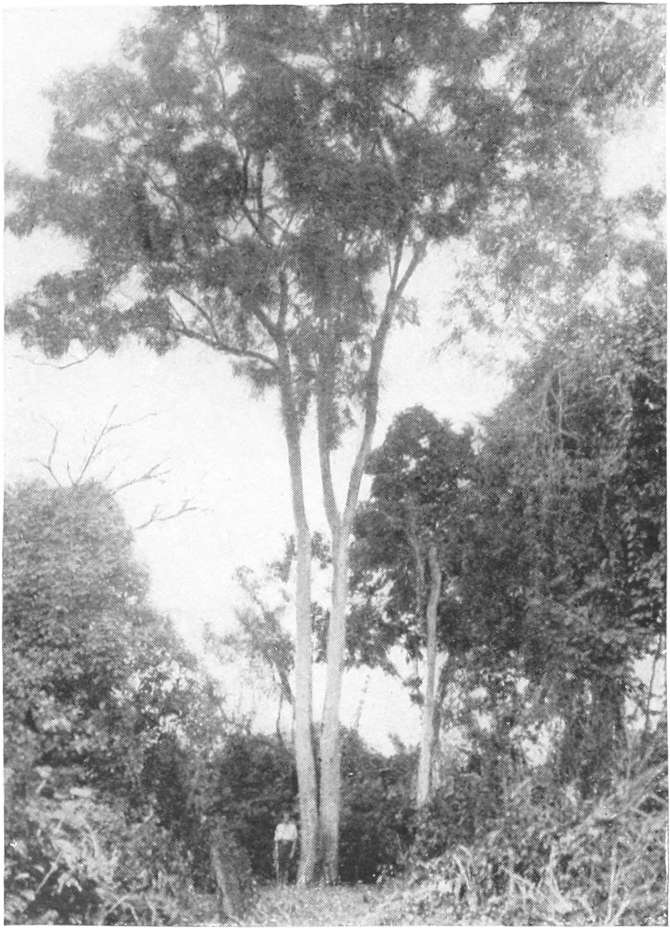
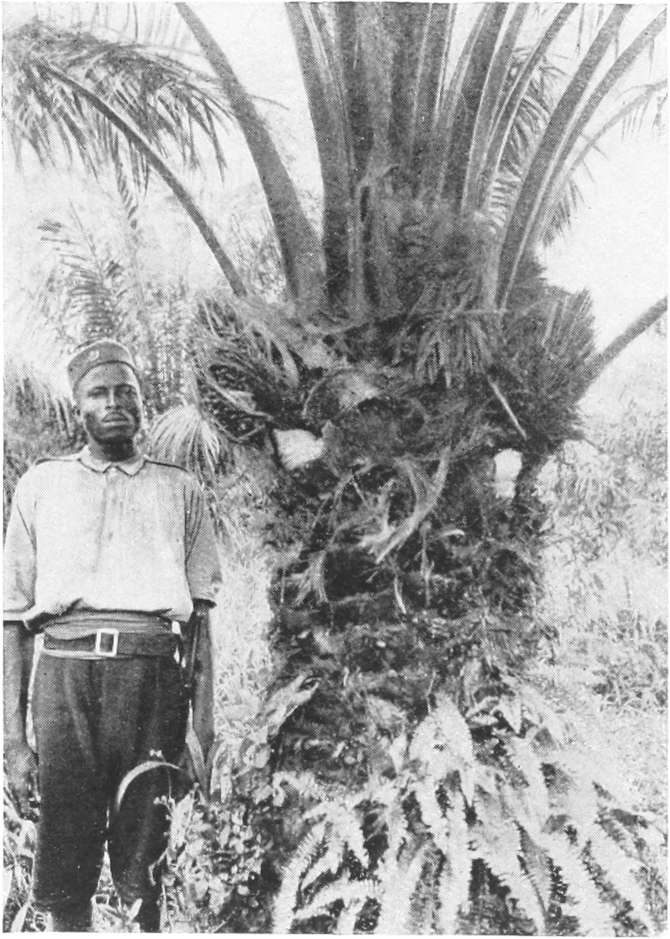
Fig. 60.—Oil Palm in bearing, two bunches of fruit in view, Olokemeji Forest Reserve.
To face p. 272.
Pterocarpus Osun. African Padouk or Barwood. Osun, Osun dudu (Yoruba); Ume, Ureben (Benin); Opepe (Ikala, Ijor).
It is found in the Ogoja and Calabar provinces of Nigeria, in the mixed deciduous forest zone, where it is none too prevalent. A specimen was found near Ibami, in the Obubra district. It is a small tree with small yellow flowers and rather small leaves. The branches are placed close together and the crown is very dark and thick. The bole is short, rarely exceeding 15 feet in length, and the bark a dark brown colour. The bole reaches a girth of about 5 feet.
The sapwood is white and the heartwood of a dull-red colour, but in proportion the sapwood is rather wide. It is moderately hard, fairly durable, but not termite-proof. It planes well, saws easily, takes nails; it does not split very well.
It is a somewhat slow-growing, shade-bearing, soil-protecting and soil-improving tree. Natural regeneration does not appear to be very good. It is doubtful if it sprouts from the stump. It has not been cut for export, nor has it been felled for local use.
On the Cross River the Camwood was sold to the European merchants, at the rate of 409 billets per ton, for £4 10s., so that with the added cost of river and ocean freight and sale charges, there was no profit when it was being sold at £6 10s. per ton in the Liverpool market. Better prices are always secured if it is shipped in squared logs, 24 inches square and 24 to 30 feet in length.
Apparently it is not the Camwood used by the natives, because plenty of trees are seen scattered about in the neighbourhood of Obubra untouched.
Pterocarpus erinaceus. African Rosewood. Apepe, Ara (Yoruba); Oyo, Upeka (Benin).
This tree grows in the dry-zone savannah forests of the Ogoja province of Nigeria. It is of small size; the flowers, which are yellow, appear in March. The timber is of little value, the tree not being large enough to yield a useful timber, but it has been sold as African Rosewood. It has a beautiful rose-red colour.
Pterocarpus sp. So-called Camwood. Osun pupa (Yoruba); Akume (Benin); also spineless fruited Camwood.
It is found in the Calabar, Ogoja, Benin and Ondo provinces of Nigeria. On the bank of the Cross River, near the Ossizza factory, there is a large specimen, standing about 20 feet away from the water’s edge.
It is not very common, and chiefly found near river banks in the evergreen forest towards their northern limit. It is a medium-sized tree, reaching a girth of 9 feet at the most and a height of 70 feet. The bole length does not exceed 40 feet. The bark is light-brown, almost yellow-brown, with rough fissures and fibrous surface, more like an elm, though thinner. The branches are thin and light-coloured. In flower the tree is a mass of little yellow peaflowers, and numerous bees swarm round the crown of the tree, indicating its presence. Again, when the fruit ripens the crown is a mass of yellow-brown winged fruits all fluttering in the wind. They are always in bunches near the ends of the twigs. The fruit is round and flat, with no hairs on it, with a thin papery wing completely surrounding and joined to it, which makes it rather thicker and stiffer than the other species. It is not at all typical of the Pterocarpus genus. The seed in the centre has a rough surface. The trunk usually is not quite straight, having a slight bend or two in its length. In habit, more like a Combretum or young elm to look at. The crown is round, almost spherical, and does not usually occupy more than one-third of the height of the tree.
The sapwood is white; the heartwood is of a dull purply colour, which is inclined to stain into the sapwood after the tree is cut down and exposed to rain. On the whole the colour of the wood is deeper than that of the other Pterocarpus, but it is said to yield a less fast and poorer coloured red dye than that of the other species, P. Osun. It is moderately hard. It planes well, and is sometimes cross-grained. It takes nails easily, but does not split very well, though it saws with comparative ease.
Although it stands a good deal of shade in its youth, it is apparently a light-demanding tree with soil-protecting and soil-improving qualities. It is not very fast-growing. Natural regeneration appears to be poor, chiefly, perhaps, owing to the fact that the seeds are quickly eaten by small boring insects soon after they fall to the ground. It is rather exacting as to soil, and prefers the deep, moist, sandy loam. Only isolated specimens are seen.
The timber has not been exported yet, and despite the fact that it does not reach such a large size as P. Osun, it deserves a trial. For local use it should find a place for house construction in a similar position to which the Osun and others are used by the natives.
It has not been cut or used as a dye root, chiefly owing to its poorer colour. It is, however, used in house-building.
Pterocarpus. Cross River Camwood.
It is found in the Obubra district of the Calabar province of Nigeria. In habit it is very similar to the other Camwoods.
Pterocarpus Soyauxii. Large Fruited Camwood. Arakpa, Ume (Benin); Ukpa (Efik).
It is found in the Ogoja, Benin, Warri (?), Ondo, Ibadan (?) and Abeokuta (?) provinces of Nigeria.
It is a common tree in the mixed deciduous forests, reaching a height of 80 to 100 feet, with a bole length of 50 feet and a girth of 10 feet. The bark is a darker colour than P. Osun, but a little rougher. The leaf is smaller than P. Osun, but is unarmed. The most typical difference in this tree is the fruit, which is the largest of all, 2½ to 3 inches in diameter, with plenty of prickly thorns in the centre of each surface. The wood is a much darker red, quite a dull, almost purple red. The root spurns on the whole extend higher up the trunk than P. Osun (up to 4 feet). The slash is white, but thin red latex soon exudes out of it.
The wood is hardish, but the sapwood is very white and soft. The wood does not make the same kind of stain as P. Osun, though apparently it keeps its colour much better than P. Osun. When exposed to light, P. Osun loses it very quickly and becomes a dull-brown colour. The grain is open and varies a little in colour, giving it a pleasing effect. Termites do not attack it. It splits well.
It sprouts from the stump slightly, but such shoots do not attain any size. Seedlings come up readily from fallen seeds. The seeds are liable to be eaten by the “ground pig” almost at once. It grows moderately quickly, but is a light-lover. It has an undivided stem.
Samples were sent to Liverpool in 1916 and sold as African Padauk, and it was reported that “small quantities sell” satisfactorily. It has been cut for local use for buildings.
Native Use.—It is used for making wooden shovels, all out of one piece. Also in house-building as wall-plates at the top of the mud walls, also in the Oba’s house for uprights.
Erythrophlœum sp. Sasswood. Inyi (Benin).
This tree was determined from material from the Central Circle.
Erythrophlœum Guineense. Sasswood, or Sassy Bark, or Ordeal Bark. Erun obo (Yoruba); Oginyi (Benin); Akpa Etuidiwi (Efik); Arachi (Ibo, Asaba); Inyi, Ibo (Onitsha, Ibo, Owerri).
It is found in the Ibadan, Abeokuta, Ondo, Benin, Onitsha and Ogoja provinces of Nigeria in the mixed deciduous forest zone, where it is often very prevalent, more especially north of Ifon and Alabeta in the Benin province.
It is a large tree, reaching a girth of over 10 feet and a bole length of over 30 feet. The crown, however, is large and wide-spreading, but generally spherical in shape. Comparatively low down, the bole divides up into three or four main limbs. The trunk is seldom very straight, usually having a twist in one direction or another. The root spurns are moderately large, but are rounded in shape. The bark is dark-brown and thick, scaling off to a slight extent in old age. The fruit is a pod about 3 inches long and an inch wide, containing six or eight flattish black beans, black to brown. These burst when ripe, but the seeds only gradually fall to the ground. The fine pinnate leaves are close together and open out into dense foliage most typical of the Leguminoseæ. The upper part of the limbs and trunk is light-brown. The flowers are minute and not often seen.
The sapwood is dull yellow and the heartwood a dull red-brown. It is very heavy and hard, but not as hard as red ironwood or the Yoruba ironwood. It is very durable and quite termite-proof; although sometimes a little cross-grained, with good tools it can be worked up to a smooth finish by planing. Holes have to be made in it for nails. It saws well, but splits only moderately easily. In the saw mill it was found that the hardness of the wood blunted the saws, which needed constantly sharpening.
It is a slow-growing, shade-bearing, soil-protecting, soil-improving tree. Natural regeneration appears to be good, and it is moderately resistant to fire. Tends to condense dew in the dry season. It suppresses most other trees by shade. Amongst the dry-zone vegetation it clings to the banks of rivers, and is common on the upper banks of the upper reaches of the Ogun. No plantations have been made with this tree.
In 1906 sample logs of the sister tree, E. micranthum, were exported and sold in the Liverpool market as a species of oak, so that this timber deserves a trial as a substitute for teak or oak.
It was cut for the Public Works Department at Onitsha and found very suitable for decking of bridges. The small bridge over the Nkissi, near Onitsha, was built entirely with this timber.
Erythrophlœum micranthum. Sasswood or Ordeal Bark. Ovinni (Benin); Erinji (Ijor); Ihi (Ibo, Owerri).
It is found in the Warri, Benin and Calabar provinces of Nigeria.
As a small tree, one of the first to appear when the mangrove swamp gives way to the evergreen rain forest near the coast. On solid land it attains a large size, even larger than that of E. Guineense. The pod is a little larger than that of E. Guineense, and the bark smoother. The crown is dense and very large, almost spherical in shape, and reaching more than one-third down the length of the tree.
The timber is very similar in its qualities to E. Guineense, but has a straighter grain in the larger specimens. It is very durable.
It is a slow-growing, shade-bearing tree, with soil-protecting and soil-improving qualities. Natural regeneration does not appear to be very good, though numerous pods are borne on the tree almost every year. No plantations have yet been made with it.
For local use, it has not been cut in a similar way to E. Guineense. The natives occasionally use this tree for making canoes. In the 1906 timber report from the Liverpool market it was valued as a species of oak at 1s. 9d. per cubic foot, and was not considered so good as either red oak, Lophira procera, or white oak, Ostryoderris impressa.
Native Use.—The bark is boiled in water and a beautiful red-coloured liquid is produced. It is administered as an ordeal trial for witchcraft, and is not poisonous if given in large doses.
Brachystegia spicæformis. Agberigeddi, Ako (Yoruba); Okkwan (Benin); Etare (Oban, Ekoi); Ungu (Ibo, Owerri); Mpanju, Akpanya, Ikpanya (Efik).
This tree is found in the Abeokuta, Ibadan (?), Ondo, Benin, Warri, Owerri, Calabar and Ogoja provinces of Nigeria.
It is a rough, scaly-barked tree of huge size (see illustration), reaching a girth of 30 feet and a height of 150 feet. The crown is flattish, formed by a few wide-spreading limbs and numerous small branches. The foliage is moderate for a Leguminous tree. The yellowish flowers are almost unseen, being placed underneath the leaves. The dark-brown woody pods burst with a bang not unlike a gunshot, and release four or five flat black, shiny beans about ½ inch across. The foliage goes almost black on reaching the ground, killing all the small plants. A brownish gum exudes from the tree when cut, and this hardens into a reddish, opaque mass similar to Almeidina, and in fact is the source of this gutta percha-like substance.
Timber.—It is a rather hard, light-brown wood with pretty, almost evenly distributed streaks of darker brown shade in it. It is very durable. The white sapwood soon rots on exposure to the weather. It is suitable as a furniture wood.
Silvicultural Characteristics.—It bears a good deal of shade. It reproduces almost every year plentiful mature seed; grows fast, but not so rapidly as the cotton-tree, Ricinodendron and others. It is sometimes distinctly gregarious, as, for instance, south-west of Benin City.
European Use.—It has not been exported, but the P.W.D. have used it for verandah-posts and planks. It has been much admired for the good colour of the wood and the streaky grain.
Native Use.—By the Benin people it is not considered a good wood, but the gum is sometimes used.
Daniellia ogea. Gum Copal. Ogea (Yoruba); Ogea (Benin); Udeni (Ibo, Owerri); Mpanju, Ikpanya, Akpanya (Efik). Also known as D. oblonga and Cyanothyrsus ogea, but now called D. ogea.
This tree is found growing in the heavy-rain intermediary forest of Benin, Ondo country and Mamu Reserve. It is a very fine tree with straight rounded bole, often reaching a height of 120 feet before the first branch. The bark is light grey and slightly ringed. The flowers blue and not very noticeable.
Timber.—Of no commercial value, as it is soft and rots quickly.
Uses.—A good gum copal is obtained from it, the best in the ground, after the tree has rotted. It is used for varnish making; worth 30s. to 60s. a hundredweight.
Daniellia Fosteri. Gum Copal. Oguja or Ogea (Yoruba).
Found near Olokemeji and Ijebu-Ode. It yields a third-quality resin according to Holland in The Useful Plants of Nigeria.
Daniellia Punchii (Kew). Gum Copal. Ajia (Yoruba).
Daniellia caudata. Benin Gum Copal. Mogbara, Ashuwole (Yoruba); Ogea (Benin); Agbara (Ikale.)
It is found in the Ondo, Benin and Ogoja provinces of Nigeria. The bole is the straightest and most cylindrical of any of the African forest trees. It often attains a height of over 100 feet before the first branches are reached. The cylindrical shape is further enhanced by the few quite concentric rings on the bark, horizontally arranged round the trunk of the tree. The bark is otherwise quite smooth and of a silvery-green or light-green colour; for the size of the tree it is very thin, and the tree may reach a girth of 25 feet, and the bark then is usually only ½ to ¾ inch thick. The slash is yellowish-white; the sapwood is white and scarcely distinguishable from the heartwood, which gradually takes a pinkish tinge when it is dry. The flowers are blue and not unlike those of the fuchsia, and the tree is easily seen at the end of the dry season by the bare crown with its blue flowers. The path later on is covered with these. There are practically no root spurns, the stem emerging straight away from the ground. The crown is very flat, and does not usually occupy more than one-fifth of the total height of the tree. The branches are few and of slight and almost feathery build. The timber is soft, not durable nor termite-proof. It saws easily, does not split very well, and considering its softness it does not plane at all well nor with a very smooth surface. Natural reproduction by seed appears to be poor, although plenty of seeds seem to ripen; there is one seed in each pod. It is a light-loving, deciduous tree, but for eleven months of the year it is certainly a soil-protecting and soil-improving tree. It demands a deep, moist and somewhat rich soil, though judging by the various localities in which it is found it is doubtful if it is really exacting as to soil.
In 1906 sample logs of this timber were sent to the Liverpool market and considered to be a species of mahogany, but of no value. Natives have not used it to any extent for local purposes.
Piptadenia Africana. Light African Greenheart. Agboin (Yoruba); Sanga (New Calabar); Iteruku (Efik); Ebbome (Oban, Ekoi); Ekhimi (Benin).
This is a common tree in the Abeokuta, Ondo, Benin, Warri, Owerri, Onitsha, Calabar and Ogoja provinces of Nigeria. It is one of the most prevalent trees in the evergreen forests, but is also found in the mixed deciduous forests, especially, in both cases, near the edges of the waterways. It is a very large tree, attaining a height of over 120 feet and a girth of over 12 feet. The bole is often 80 or 90 feet in length and perfectly straight. The crown is thin, ovally flat, but wide-spreading. The thick, heavily foliaged and drooping appearance at the ends of the branches makes the tree a most handsome ornament to a station. At the root, flanges are comparatively long and widespreading, reaching often over 6 feet up the stem, having root spurns quite 12 or 15 feet away from the tree. The stem divides up into a few large branches which form the crown; the bark is yellow-brown and smooth, but when the tree is growing in the sunlight it becomes a much lighter colour and sometimes almost grey. The slash is yellow, with a light-brown tinge; the flowers are quite inconspicuous when they appear in January or February, being formed of little narrow spikes. One of the most conspicuous features of this tree is the thin, flat pod, which may grow as much as 1 foot long and nearly 1 inch broad. Six to eight seeds are contained in each pod, and these, including the wing, are 2 inches in length. The flat seed, which is found in the centre, is brown and shiny, and is only about one-sixteenth to one-eighth of an inch in thickness. It has a tiny string-like attachment to the centre, which distinguishes it from Newtonia on the one hand and Cylicodiscus on the other. The young green foliage is also most distinctive and attractive in its freshly salmon-pink colour, also the greenish tips of the older leaves. The leaves themselves are bipinnate; there are often twenty to twenty-four pairs of pinnæ, each of which is about half an inch long.
The sapwood is white and comparatively wide; the heartwood is a pretty light-brown colour, a little darker when fresh, but still retaining a good light-brown colour when it is dry. Although at first rather heavy and hard, it seasons as a comparatively light and scarcely hard wood; it planes well and saws fairly easily; takes nails moderately well, but does not split at all easily, especially when fresh; has an open grain and the pores are comparatively long. It is a durable wood and is almost termite-proof, especially when it is quite dry. When moderately dry the logs float in water. It weighs 53 pounds per cubic foot.
It is a light-loving species which does not protect or improve the soil, except in so far as it is a leguminous tree and its roots thus improve the ground. It is a moderately rapidly growing tree which stands a little shade in its youth. Natural regeneration appears to be only moderate. It sprouts well from the stump, and stump shoots appear to be very persistent. It is rather sensitive to fire and is easily killed by placing rubbish near its roots and then burning the heap. No plantations have yet been formed for this tree. In the forest the seeds fall to the ground and are soon eaten by a small boring insect. It likes a comparatively good soil, but is found on sandy soil which has great moisture; it does not like flooding, but will stand a little.
Locally, it is occasionally used as a house-building timber. The bark is occasionally chipped off for use medicinally. Europeans have cut it up and used it as verandah-posts, joists and verandah handrails. However, in an unseasoned state the sapwood was attacked by termites, and thus it was not entirely satisfactory. The heartwood when quite dry does not warp and appears to be very durable.
In 1906 sample logs of this timber were sold in the Liverpool market as “Greenheart” at 2s. 9d. per cubic foot. Since that date no regular supplies have been sent to the market, so that it has not been thoroughly tested as to its value as an export timber.
Isoberlinia Doka (Kew).
It is found in the Ogoja, Abeokuta and Owerri provinces of Nigeria.
It is a medium-sized tree with rather large, widespreading pinnate leaves. It is one of the few trees that are gregarious in habit, groups from half an acre to an acre in extent being found. The tree is used for house-building and withstands a certain amount of fire, as it grows at the edge of the dry-zone forest.
Berlinia acuminata. Red Oak. Apado (Abeokuta), Ewon Pala (Ikale), Adugbin (Ibadan) (Yoruba); Ekpagoi (Benin); Ajia (Ibo, Asaba); Obuba (New Calabar); Hanabali (Oban, Ekoi).
This is a common tree in all the Southern Provinces of Nigeria. Although it is found most frequently in the evergreen forest zone, a small, bush-like variety is also found in the open deciduous forest. The most conspicuous features of this tree are the large foot-shaped unripe pods; these stick out, isolated, at right angles to the general direction of the surface of the ground—this makes them appear all the more prominent and most odd in appearance. When the pods burst, the large flat beans are released, and each side of the pod curls up, but appears speckled white with round dull spots along the middle. The flowers are white, nearly 2 inches across, with one red streak in the centre. In the evergreen forest zone these flowers do not seem so conspicuous, but in the dry zone the tree is covered with blossom, making it one of the most beautiful. In the heavy forest zone the bole reaches the length of nearly 80 feet and the girth of over 20. With its smooth, shiny grey bark, at the first glance it is not unlike a beech-tree. The root spurns are usually quite small, and do not extend beyond 2 feet up the stem. The slash is white and of a yellow colour on the inner edge. The leaves are pinnate, with one odd leaf at the end, being usually nearly 3 inches long; the total length of the leaf is often over 1 foot. The freshly ripened beans are almost square in shape, flat, and nearly a quarter of an inch thick. Each side of the pod is usually the size of an average man’s foot, and sometimes larger; it is also not unlike it in shape, but the curve where the instep should be is very slight. The crown is spherical and very large, often occupying one-third of the total height of the tree. The foliage is comparatively dense, and it is not possible to see through the top of it. The tree loses its leaves for a very short time each year. In the dry zone it is often not much more than a shrub, or at most a small tree 35 feet in height.
The sapwood is white and wide. The heartwood is of a deep-red colour, especially when freshly cut; when dry it still retains a good red colour, and from this feature it has been termed “red” oak. The timber saws fairly well, but splits badly; it is somewhat hard to plane it up to a smooth surface, as it is sometimes cross-grained. The heartwood is termite-proof; it takes nails only moderately well. It is a moderately hard and durable wood; it does not warp very much. When the logs are dry they will float in water. The weight of the timber is 55 pounds per cubic foot.
Considering the prevalence of the tree, natural regeneration is poor—rodents may account, of course, for many of the beans; it sprouts well from the stump. In the dry-zone forest region root suckers appear too. It is a shade-bearing and soil-improving tree; it does not grow very fast. No plantations have yet been made with this tree, though it deserves a place in experimental plantations. It demands a good soil, and the roots go down to a greater depth than many of the other trees.
Locally it is used as a house-building timber, and occasionally the dried pods are used as firewood.
In 1906 sample logs of this tree were sold in the Liverpool market as red oak at 2s. per cubic foot. It was not considered as good as Aligna or as Erumacie. Since that date no further shipments of this timber have been made. A further testing of the market by small trial shipments of logs would thoroughly reveal its value as an export timber.
Berlinia auriculata (Benth.). Red Oak. Ekpagoize (Benin).
Found near the Okwo River in the Siluko sub-district of the Benin province. It is not quite such a large species as the B. acuminata.
Parkia biglobosa. African Locust. Aridan Abatta, Irugbo Abatta Iru (Yoruba); Ubgori, Lakobemi, Enymi (Benin); Inya (New Calabar); Ekok (Oban, Ekoi).
It is a very common tree in the Calabar, Owerri, Warri, Benin, Ondo (?) and Abeokuta provinces of Nigeria.
It is a large tree, with wide spreading fruit flanges. It has darker and heavier foliage and a wider crown than Parkia filicoidea. It often shows up on river banks with its light-red young leaves. It should be easily distinguished from other similar trees of this family by its cluster of beans, similar to French beans, when ripe. These are yellow, and the spice-like scent and the round balls of staminate flowers of a crushed strawberry colour are not easily forgotten. Often only the yellow pistil is found lying on the path. It likes a damp to wet soil, and is usually found growing at the edge of, or actually in, freshwater swamps.
Timber.—The wood is hardish, but is said to rot easily, though it appears to be rather doubtful, and probably only applies to unseasoned wood.
Natural regeneration by seed is good. The tree stands a good deal of shade in its younger stages of growth. No other trees will grow under it, and few can stand any or much of its shade.
European Use.—It has not so far been used by Europeans for export or local use.
Native Use.—The seeds are cooked and eaten to some extent by the Yorubas and Benin people.
Parkia filicoidea. African Locust. Irugba (Yoruba name for fruit); Igba the tree (Yoruba); Gumui (Mendi); Olibracha (Egba) (Yoruba).
This is a common tree in Abeokuta, Oyo, Benin, and Ogoja provinces of Nigeria. It is found in the deciduous forests. It reaches a height of over 60 feet, with a girth of 5 feet. One of the most distinguishing features of this tree are the very feathery leaves, which appear after the flowers. The large spherical balls of the red staminate flowers enliven the tree in the early part of the year; later in the year masses of pods, each about 9 inches long, hang down from the ends of the twigs. The base of the bole is often gnarled, partly with the slight root flanges and by the almost continual cutting of the bark by the natives. Normally the bark is brown and comparatively smooth. The bole is short, dividing about 20 feet from the ground into a large number of small branches. On the whole, as the tree advances in age the branches tend to become pendulous. The crown, spherical in shape, is inclined to be irregularly broken up—partly by the different length of the branches.
The sapwood is white and the heartwood a dull-brown colour; for the size of the tree the sapwood is wide. It saws indifferently well, splits badly; it is hard to plane; it is said to be termite-proof. The wood is hard and tough.
The tree is a light-loving but not soil-improving species, except in so far as the root globules take up nitrogen and free it for the use of other plants. Naturally, generation is none too good. Root suckers appear to some extent; it sprouts most readily from the stump. Perhaps the lack of young self-sown seedlings is due to the fact that the seeds are largely used by the natives. In a few places small plantations have been made with this tree. It is very fire-resisting, and apparently the fruit-bearing capacity of the tree is not reduced to any extent by the prevalence of the annual grass-fires in the localities where it is found. During the whole of its life it is a slow-growing tree.
The yellow pulp in the pods is eaten by the natives. The bark at the base of the tree is chipped off and used for making a tonic when infused with water. The tree is occasionally used locally as a house-building timber; for this purpose it is used chiefly as uprights in the main buildings.
The timber has not been tried for export, and it is doubtful whether its size warrants its use for this purpose.
Tetrapleura Thonningii. Angular Pod. Aridan (Yoruba); Igmikkia (fruit), Ikhememi (tree) (Benin); Osshosha (Ibo, Asaba).
The dark-green feathery foliage on its oval crown is very typical of this tree, especially when it is found near a roadside in the mixed forests. It is also often found on river banks at the edge of the dry zone or in other parts of the mixed forests. The indehiscent pods with four edges, leaving practically no centre, are most typical of the tree; they are shiny and have a peculiar medicinal smell. The fruit is known as Igmikkia, by which name the tree is most usually called by Europeans, in the Benin country.
The tree is prevalent in the Abeokuta, Ondo, Oyo, Benin, Onitsha, Owerri, Calabar and Ogoja provinces of Nigeria.
It is a shade-bearer and thoroughly protects the ground all the year round, except for about two weeks when the leaves fall. Natural regeneration does not appear to be good, seedlings being rarely found, and no plantations have been made with it, though if of more value it might be mixed with teak. The seeds always command a ready sale at a low price.
The wood is hard, brown, and splits badly. No use has yet been found for it. It is sometimes cross-grained, the sapwood white.
The natives use the timber for making doors, window-frames and benches. The seeds are sold in the Yoruba, Benin and Ibo markets; they are cooked for soup, which acts as a slight aperient or is of other medicinal value.
Millettia Thonningii (Baker). Ito (Yoruba); Ebakwe (Benin).
It is found in the Benin and Abeokuta provinces of Nigeria. It is a small tree really, reaching a girth of only 4 feet, with a short bole and a few somewhat slender and drooping branches. The twigs and new leaves are distinctly of weeping habit. In February, in the mixed forest, the bare tree shows up with its beautiful clusters of lilac-coloured, pea-shaped flowers, and later in delicate contrast to the fresh, light-green leaves. The trunk is usually not quite straight, being bent about 8 or 10 feet from the ground. The bark is smooth, thin, and almost of a silvery-grey colour. The branches are very whippy and difficult to break.
Timber.—The wide sapwood is white and the narrow heartwood green-brown when freshly cut. It is very hard, of fine grain and texture, and planes with a smooth surface. It does not split; is very rough and flexible.
It is a shade-bearer and grows slowly. The fruit is a small black and pointed pod which opens when ripe, having about three or four beans inside. It is easily killed by fire, but sprouts freely from the stool. It does not crack nor warp.
It has not been exported nor cut for local use, but it should be a good wood for turnery.
Native Use.—It is used for knives and axe-handles.
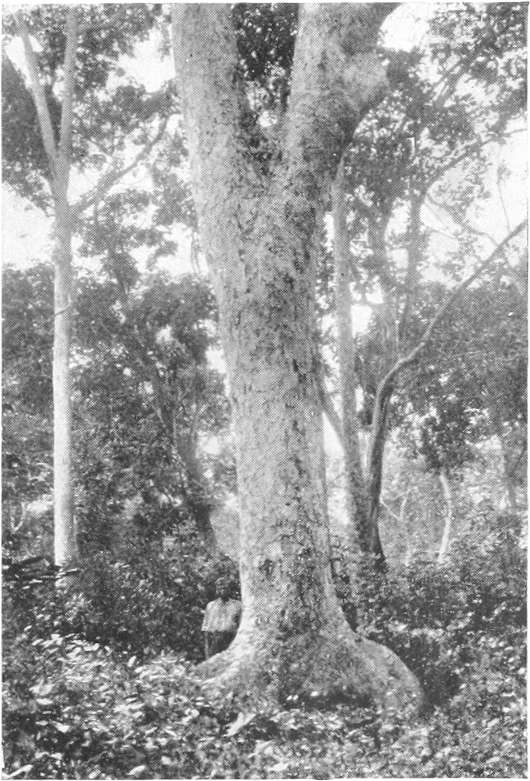
Fig. 61.—Base of Bilinga (Afzelia Africana), 14 feet in girth, Dajopa Forest Reserve Olokemeji Reserve.
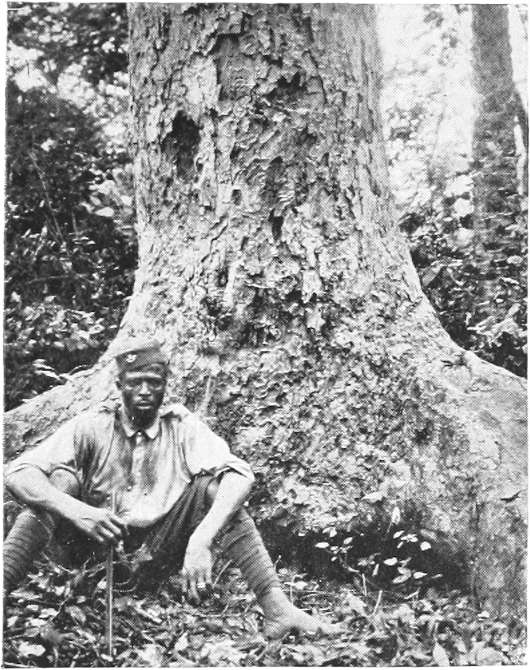
Fig. 62.—Shea Butter (Butyrospermum Parkii), 7 feet in girth, near Oniloku Road, Olokemeji Reserve.
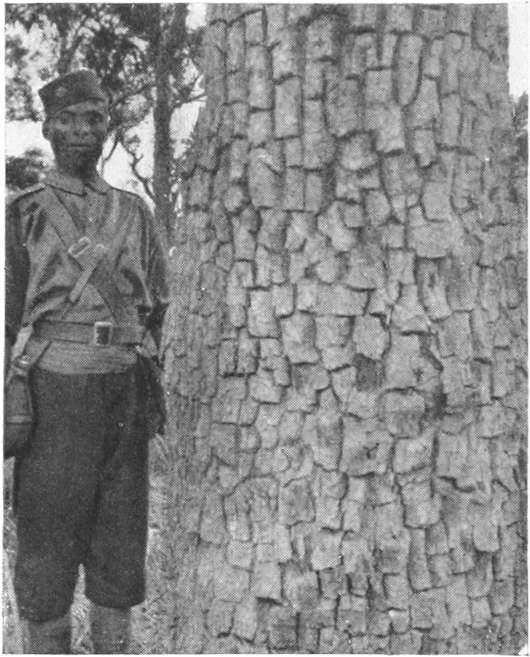
Fig. 63.—Afara (Terminalia superba), base of mature tree over 12 feet in girth, Olokemeji Reserve.
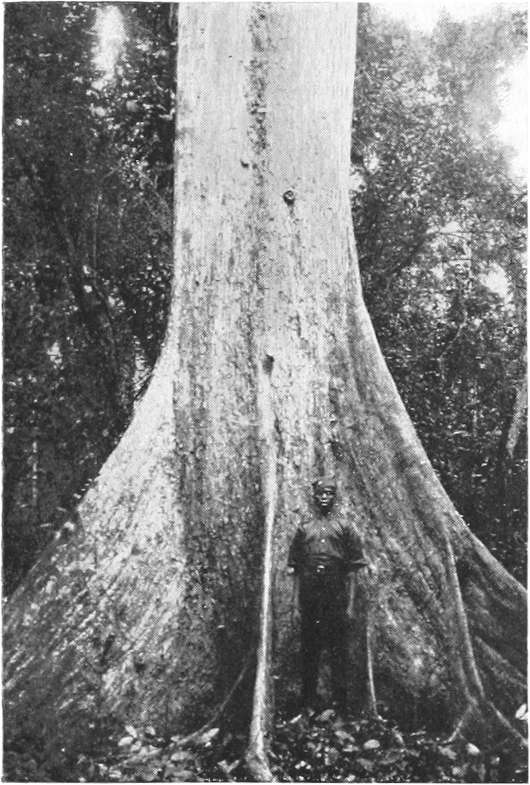
Fig. 64.—Afzelia Africana, 14 feet in girth, showing bole and usual fork, Ijaiye Range, Dajopa, Olokemeji Forest Reserve.
To face p. 284.
Cynometra Afzelii. Waterside Cynometra. Akushunmajadin, Alade (Ikale); Iku (seeds), Aka, Eggi (Yoruba); Ogabezzi, Ogikiomi Upakeka (Benin).
It is a common tree in the Benin province of Nigeria. On the whole it is smaller than C. Mannii, though it has a similar habit. It grows, too, in similar localities, though for the most part it is confined to the evergreen forest zone. It also grows more or less in gregarious groups. The shade of this species is just as dense, if not denser than that of the foregoing. The leaf of the Cynometra is distinguishable from most other leaves because the mid-rib of it is placed towards the inner or almost straight-sided edge of the leaf. In fact, if two leaves are held closely together, they almost look as if they were one which had been cut in half. Benin natives have no use for this tree except as firewood.
Cynometra Mannii. Waterside Cynometra. Ekkun (Yoruba).
It is a common tree on the banks of streams in the Ibadan and Abeokuta provinces of Nigeria. One of the most characteristic features of this tree is the pinkish-red colour of the fresh leaves, hanging at the ends of the drooping branches. In November each year the large, corrugated, single bean in each almost indehiscent pod is another curious feature of this tree. The trunk is usually short—in fact, often divided into three or four separate stems, almost at the base. Narrow fringes consisting almost entirely of this species are found on river banks. The dense shade cast by this tree prevents any other species from growing underneath. The timber is hard and difficult to split, and apparently it is not attacked by white ants. The tree is a shade-bearer. Natural reproduction from the seed is good, it being distributed often by water. It also sprouts from the stump. A few root shoots also appear. The tree has not been cut for local use nor has it been used for export. The natives use the wood for making posts and doors.
Cylicodiscus Gabunensis. African Greenheart. Osho, Aja, Iji (Il.), Ajaigi (Yoruba); Okan (Benin).
Distribution.—In the Abeokuta, Ondo, Benin, Warri, Owerri, Calabar provinces of Nigeria.
Chief Characteristics.—It is a very large tree of the evergreen forest zone, attaining a height of 200 feet and a girth of 30 feet. It is armed in its earlier growth up to the pole stage, when all the brown thorns disappear. Its long, brown pods, up to 3 feet long and 1½ inches wide, opening from one side only, with their long, thin, papery seeds, are most typical of the tree.
Compared to its size the bark is thin, and in old age it is inclined to scale off in small pieces. In the distance it looks practically smooth. This is one of the most gigantic and impressive trees of the forest, with its enormous bole stretching cylindrically up amongst and over the other trees, with a large, widespreading, somewhat flatly shaped spherical crown. The leaves are pinnate, with three of four pairs of little ovate pinnæ, with one odd one at the end. The flowers are minute, forming little, thin, knitting-needle-thick spikes of yellow bloom. These last only a few days, and only once in thirteen years have I seen the flower. The tree and pod are unmistakable, even when it is a large one. The numerous brown pods hang down amongst the foliage and appear to be much longer than those of any other Leguminous tree. This feature alone distinguishes it from any similar species. The bole divides up into a few large limbs and many small branches, making the foliage lighter and thinner than many other Leguminous trees, but not so thin as that of Piptadenia Africana. The root spurns are very slight and rounded, merging into the bole of the tree 1 foot to 3 feet above the surface of the ground. At the base of the bole the bark is sometimes cut off by the natives for “Ju-ju” purposes, and then an additional swelling appears there.
The sapwood is white and narrow, the heartwood greenish-brown when fresh, and yellowish-brown after it has lain in the forest for a few years. It is very hard—in fact, one of the very hardest of African timbers. Under cover it is very durable. In the open it does not last so long. It is termite-proof. The sapwood, however, rots in the open, and the heartwood softens very considerably. It is somewhat fibrous, but it planes up well, with a smooth surface. It does not take nails, saws well, and splits moderately well. It has considerable elasticity. It makes a very hot-burning firewood, but is inclined to crackle and make sparks.
It is a moderately fast-growing, shade-bearing, soil-protecting and soil-improving tree. Natural regeneration appears to be fair, but the seeds are often eaten by little boring insects, soon after they fall to the ground. It appears to be rather exacting as to soil, liking a deep, moist loam sand with good drainage. It is scarcely a fire-resisting tree, but very storm firm—in fact, one of the safest trees.
In 1906 sample logs of this tree were sold in the Liverpool market as African Greenheart at 1s. 8d. per cubic foot, and were stated to be good greenheart. Since then none has been cut or shipped to England. With the exception of its use for verandah-posts for a public building in Benin city, it has not been cut or sawn up in planks for local use. Considering the comparatively large quantity available, it deserves a fair trial both for export and local use, more especially for heavy constructional work, such as bridges, piles, uprights.
Amongst the Benis it is sometimes a “Ju-ju” tree, and is said to impart strength.
Leptoderris.
Owerri province of Nigeria. It is a medium-sized tree found growing near the Imo River, but not very common. It has a hard wood.
Baphia nitida (Afz.). Awenu or Irosun. Borri Borri (Yoruba); Otwa (Benin); Ubara (Efik).
Is a small tree, which is usually found near villages, being left by the natives when land is cleared. The white flowers are almost of pea shape. It has a small leaf, and does not usually get any larger than about four inches in diameter.
It is found in the Ondo, Abeokuta, Benin and Calabar provinces of Nigeria.
The real Camwood of commerce.
It is very slow-growing, and is not a hard wood, with dark-red heartwood of small size in proportion to the size of tree. It forms late, too. If the stem is wounded, even the sapwood becomes a rich red colour like the heartwood.
The probable origin of the word “Camwood” is taken from the Timani name, Cam, of the Baphia nitida tree in Sierra Leone. From another point of view this is all the more interesting, as the original exports of Camwood were made from Sierra Leone in the early part of the nineteenth century, and this name “Cam” brings together the tree from which the Camwood is obtained and the tree botanically known as Baphia nitida.
Native Use.—A piece of the wood and a leaf are placed on the ground where a woman has borne a child, whether it be on a road or in the house. Not used in Benin as a dyewood.
Baphia polygalacea. Walking-stick Camwood. Asana, Ossusu (Yoruba); Aswen (Benin); Mbomokuku (Efik).
It is found in the Abeokuta, Benin and Calabar provinces of Nigeria.
A small tree of typical Baphia habit, which is common in parts of the Benin district of the same named province. It has considerable elasticity, though it dries rather hard and does not give much in that state. It is a rather slow-growing tree, which lights the shade of the forest, and is also a soil-protecting and soil-improving tree. Natural regeneration appears to be good in several places. It sprouts slightly from the stump, when felled. No plantations have yet been made with this tree. The walking-sticks have not been exported to England for trial in the market.
The curiously shaped single root, sticking out almost at right angles to the stem, makes a good walking-stick; it is curved as well slightly, too. When the bark is peeled off and the stem partially charred, it looks very effective.
Baphia pubescens. Benin Camwood. Awewi (Lagos) (Yoruba); Ositwa (Benin).
It is a small tree, 30 feet high and 3 feet in girth, with usually half the bole sapwood white, and dark-red heartwood, which is hard and close-grained. The flowers are white, with yellow tips to the two petals. It is often seen just outside villages, or where two paths meet.
Native Use.—It is not used for dye, though apparently the wood is just as suitable as B. nitida.
Baphia sp. Camwood. Mogbara (Yoruba, Ikale); Owe, Aswen (Benin).
It has also been determined as Carpolobia lutea, and as one of the Oleaceæ.
It is a shrub with a stem of about 4 feet in height. The fruit is a small nut containing three small kernels. The wood is very hard.
Native Use.—The seeds are eaten.
Macrolobium palisoti. Ogaba (Benin); Nya (Efik).
It is a common tree of the Abeokuta, Ibadan, Ondo, Warri, Benin, Owarri and Calabar provinces of Nigeria. It only reaches a girth of about 2 feet and a height of 20 feet. The leaf has two pairs of pinnæ, with one end leaflet. The small pod containing two or three flat seeds is most typical of this tree; the seeds are ¾ inch in diameter and of a dark-brown colour; the flowers are white; the timber is cross-grained and rather hard; the sapwood is white and the heartwood of a dark brown. The tree is a shade-bearer, soil-protecting and improving. It is usually found amongst the undergrowth in the thicker parts of the evergreen forest zone. Natural regeneration is usually good. The wood is used locally in the Yoruba and Benin country for posts; it has not been sawn up for planks, nor has it been exported to England.
Macrolobium stipulaceæ.
It was stated it was found in the Calabar province.
Nr. Macrolobium sp. Ogabeszi (Benin).
It is found in the Benin province of Nigeria. It is a small tree of the evergreen forest zone. The foliage is very dense. The tree has a short bole of about 15 feet, and the crown is much branched; the pod is rather larger than Macrolobium palisoti. According to the natives, this is the “Ogaba” of the waterside. The timber has not been exported to Europe, nor do the natives use this somewhat hard wood to any extent.
Dialium Guineense. Pulley Wood, Velvet Tamarind. Awin (Ib.) (Yoruba); Ohiorme (Benin); Amoyin (Egba).
It is found in the Ibadan, Abeokuta, Benin, Calabar and Ogoja provinces of Nigeria. In the mixed deciduous forests it is very prevalent in certain localities. Of medium size, it rarely exceeds a girth of 5 feet. Where found, it often comprises over 10 per cent. of the standing stock of the forest.
The wood is used for small boats in Senegal. It exudes a red-coloured sap in small quantities.
The fruit, with its flat and round, velvety little pods, is most typical of this tree. These are of a very dark chocolate colour, and in the distance appear almost black. The bole is usually silver-grey. The slash is light-red, and the reddish, latex-like substance exudes when the bark is cut. The crown is dense and compressed, being mainly made up of a number of small branches. In proportion the leaves are small and make a very dense foliage. The rusty-red slashing marks, or other marks caused by damage to the trunk of the tree, show up most distinctively, especially against the grey surface of the cortex, are one of the most distinguishing features of this tree.
The sapwood is white, the heartwood is dull-red, rather larger in proportion than we should suspect, compared with the size of the tree. It is hard and tough, and does not split well. It planes up, however, with a smooth surface, is very durable and termite-proof. It does not take nails well, but saws fairly easily.
It is a somewhat slow-growing, shade-bearing, soil-protecting and soil-improving tree. Natural regeneration appears to be good. It appears to be a little exacting in regard to soil. It is slightly fire-resisting, chiefly, perhaps, owing to the fact that few weeds or grass grow in its shade. No plantations have been made of this tree. It bears a good crop of fruit almost every year.
It has not been felled for export, nor has the timber been sawn up for local use. It was formerly used in the Congo for pulley-blocks, for which purpose it is said to be admirably suited. Amongst the natives it is sometimes used for house-building.
Nr. Newtonia. Boji Albizzia or Giant Pod.
It is rather an uncommon tree of the Boji Hills forest; the enormous flat, papery pod makes it easily distinguishable from any other tree.
The pod is about 15 inches long and 9 inches wide, with a slight depression in the middle of one side.
Pithycolobium altissimum. Bent Pod or Gambia Pod.
It is a medium-sized tree, found at the edge of swamps near the sea coast in the evergreen forest zone. It appears to stand a waterlogged soil.
The pods are used for tanning hides and making ink (Moloney). It has curious semicircular pods, which are typical of the tree, containing eight to ten seeds.
Afzelia sp. Waterside Ekpagoize. Ekpagoize (Benin).
It is found in the Benin province of Nigeria. It is a medium-sized tree, reaching a girth of 7 feet and a bole length of 40 feet.
This tree has often been confused botanically with Berlinia acuminata, but it is undoubtedly an Afzelia. The flowers are of a reddish colour and very pretty; the foliage is not quite so heavy as that of the other Afzelias; the pod is rather smaller than that of either Afzelia Africana or Afzelia cuanzensis. The wood is a reddish-brown colour, a little cross-grained, but more durable than the other Afzelias. It does not split well, and can only be planed with difficulty; the grain is very coarse and fibrous. Samples of this timber have been shipped to England and sold as red oak. The natives scarcely ever use the wood, partly because the tree is not very prevalent.
Afzelia cuanzensis. Bilinga, Red-arilled Afzelia. Aiyo (Yoruba); Aligna (Benin); Igbin (Brass); Onuru, Oshoshi (Ibo, Owerri); Mbarakun (Oban, Ekoi).
It is found in the Benin, Ondo, Abeokuta, Calabar, Owerri and Ogoja provinces of Nigeria.
It is a medium-sized tree, with a pod, which is usually slightly crumpled or bent, containing about six or eight black nuts, with a red aril at the base, and each nut is pointed more, and less rounded, than in A. Africana. On the whole it is found more in the deciduous mixed forest than on the edge or in the dry-zone forest region, where A. Africana abounds. The bark does not scale oft so much as that of A. Africana. It stands more shade than A. Africana. It does not reach such large dimensions, though logs up to 18 inches square and 24 feet in length could be obtained.
Up to the present the tree has not been cut to the same extent as A. Africana, though the wood is very similar and apparently just as durable.
No separate report has been made on the timber as to its value in the European markets.
Afzelia bella. Calabar Afzelia. Aligna (Benin).
It is found in the Calabar province of Nigeria. It is more common in the Cameroons.
It is a small tree, with large white flowers with a pretty, reddish streak in each petal. The pod is of usual Afzelia size and appears rather large for the size of the tree. The type specimen stands on the Calabar Golf Course, between the seventh and eighth holes. It is apparently uncommon, though more may be found on closer study of the forests. The fruits appear to have the same qualities as those of other Afzelias. In Nigeria it has so far not been utilized. The bark is not so scaly as that of A. Africana.
Afzelia pachyloba (nov. sp.). Forest Afzelia or Yellow Aril. Apa (Yoruba); Orodo (Benin).
It is a medium-sized tree, with long, pointed nuts with a bright sulphur-coloured aril instead of the orange-colour of Africana or red of Cuanzensis. It does not appear to be such a common tree as A. Africana, but much the same number of trees as that of A. cuanzensis.
It is found in the evergreen forests of Ondo, Benin and Abeokuta provinces of Nigeria.
The sapwood is white and the heartwood is brown. It is very hard, almost as hard as Lophira, according to the natives. Self-sown seedlings do not appear in large numbers.
It is used for similar purposes as A. Africana. It is a shade-bearing and soil-improving tree.
No separate report has been made on the timber, and so far it has not been exported to the English markets.
This may be the tree which yielded the so-called teak in the Benin forests some years ago, and fetched a price of 5d. per foot superficial.
The bark scales off in a similar way to Afzelia Africana.
Afzelia bracteata (T. Vogel). Benin Bilinga. Ekpagoize (Benin).
It has a red flower, is found in the Benin province, but is apparently rather rare.
The Benin name indicates that it is the Ekpagoi or Berlinia of the waterside. It is usually found near or on the bank of a stream. It is a large tree, which is otherwise similar to the other Afzelias.
The natives have apparently not tried it for building purposes.
Afzelia Africana. Yoruba Bilinga. Apa (Yoruba); Olokokima, Aligna (Benin); Ayibukpo (Efik); Adja, Arachi (Asaba Ibo).
Trade Name.—Bilinga, similar wood from the French Congo, so named for some years.
It is found in the Abeokuta, Ibadan, Ondo, Benin, Owerri, Onitsha and Ogoja provinces of Nigeria.
The round, orange-coloured aril at the base of the black nut is typical of this tree. It sometimes has a reddish tinge, but it is always round and completely surrounds the base of the nut, in contradistinction to A. cuanzensis, in which the aril is red and pointed and much thinner in build.
The spherically-shaped crown with its flattish top is most typical of this tree. The largish leaves and the paucity of their number make the foliage open, so that daylight can be seen through it. In the distance it appears dense.
The sapwood is white, and the heartwood a rich oak-brown colour. It is one of the most durable West African timbers. It planes well and can be worked up with a good finish. It does not split well. It is obtainable in logs up to 30 inches square and 30 feet in length.
Though slow in growth it would average that of many European trees. It stands a good deal of shade in its youth, but it is really more of a light lover than a shade-bearer. Self-sown seedlings are few; apparently rodents eat them. In a similar way it is difficult to make a plantation, many being eaten or dying in the transplanting. One of the most successful methods evolved is that of sowing seeds in lines about 4 feet apart; a large number then come up and provide ample for a crop on the same land. They are not transplanted. When of middle age it will stand fire and the shade of the tree keeps the ground moist.
It is a soil-protecting and soil-improving tree; good crops of seeds are borne almost every year. The flowers are reddish, with white edges to the petals. The reddish tinge is quite distinctive in this genus, the white being that of Berlinia.
The bark drops off in large scales in places on the trunk towards middle and old age, in a similar fashion to the European plane. However, they do not leave the stem as smooth, though the lighter patches where the bark falls off brighten the bole up and make it quite distinctive amongst the other trees.
The timber has been constantly used by the P.W.D. at Onitsha. In the Liverpool market it was stated that it might be marketable as oak, at a low figure, in 1906. A similar species was being shipped from Gaboon in 1914 and fetched a fair price.
Albizzia fastigiata (Oliv.). East Indian Walnut. Ayinre langara, Ayinre ogo (Eg.) (Yoruba); Uwowe Lugu, Uwowelabafun (Benin); Uyat (Efik).
It is a large tree, up to 7 feet in girth and of corresponding height. Fruit narrower than A. sp.; only half an inch, with four or five seeds in each. This species has the most durable wood of all the Albizzias, but is not termite-proof, and has heartwood of a brown colour and white sapwood. The smallest leaf of all the Albizzias is met with in this tree, having very fine pinnæ.
Although not indigenous to Africa, it is now found almost everywhere in all the mixed deciduous forests of the Southern Provinces of Nigeria. The bark is rather rougher than that of A. Brownii. The basal root spurns are narrower, though they do not project more than 2 feet up the stem. On the whole the foliage is thicker, and the crown gives the appearance of being a little denser and not so feathery as that of A. Brownii.
The wood planes well, splits fairly easily, takes nails and saws well. It is what the carpenters would call a wood easy to work. The grain is of fine texture and has a certain amount of lustre.
It is a fast-growing, light-loving tree, which does not protect the soil. The leaves, however, form a rich humus, which enriches the soil. Natural regeneration appears to be good, and with the spread of farms this tree tends to increase its area of distribution. It will stand a little shade in its youth. A few plantations have been made with this tree.
Up to the present the timber has not been exported, but deserves a trial as an African Walnut, though it is difficult to obtain large-sized logs. It has occasionally been cut for local use. It is used by the natives for firewood, and occasionally, when split, for temporary house-building in the farms.
Albizzia Brownii. African Walnut. Ayinre, Ayinre Bona Bona (Yoruba); Owewe nolemare, Ikpawudu (Benin).
It is a large tree, up to 7 feet in girth, with wide fruit 2 inches across, containing four or five seeds. There are three or four pairs of pinnæ to each leaf, which is the largest of all the Albizzia leaves. The heartwood is more like walnut in colour, though of course softer and with more open grain. It could no doubt, however, be used as a substitute for walnut.
It is a common tree in the mixed deciduous forests of the Abeokuta, Ibadan, Benin, Owerri, and Ogoja provinces, where it is tending to widen its area of distribution with the spread of cultivation.
The fruit is very papery and almost transparent. It is rather larger than Albizzia sp., Shemusholoshi, but of about the same length. Its smooth, almost orange-coloured bark in the earlier stages is almost typical of the tree. As it gets older, a somewhat more corky bark forms in large scales which can be stripped off. The lop-sided shape of the pinnæ is very typical of the tree, making the leaves look almost like those of a true Gum Copal. The main vein is near the straighter side of the leaf.
The sapwood is white and the heartwood a mahogany brown. It has rather an open grain, but a good deal of lustre, and is easily worked. It planes well and takes nails easily. It splits fairly well and saws quite easily. It is not quite so durable as A. fastigiata, but it is more durable than the other Albizzias, except A. sp., Shemusholoshi. It is not termite-proof. It has considerable tensile strength compared to the other species, and a certain amount of elasticity.
It is the fastest growing of all the Albizzias and a light-loving tree. It scarcely protects the soil, but the leaf fall makes a good humus. It stands a little shade in its youth. Natural regeneration is very prolific. No plantations have been made with this tree. It appears to be a little more exacting as to soil than the other Albizzias, but will grow on almost any soil.
The timber has not been exported, but deserves a trial as a substitute for walnut. Owing to the fact that there are considerable supplies, and that it reaches a size to produce logs of the requisite dimensions, it appears to offer some possibilities as an export wood. Locally it has often been used for cutting up into planks, and is liked among the Yorubas for this purpose. In other places it has been used as a house-building wood, as well as for firewood. It has also been used for making beams, planks and doors. The roots, leaves and bark have been used amongst the Yorubas for medicinal purposes.
Fig. 65.—Khaya Ivoriensis, 14 feet 8 inches in girth, Ilaro Forest Reserve.
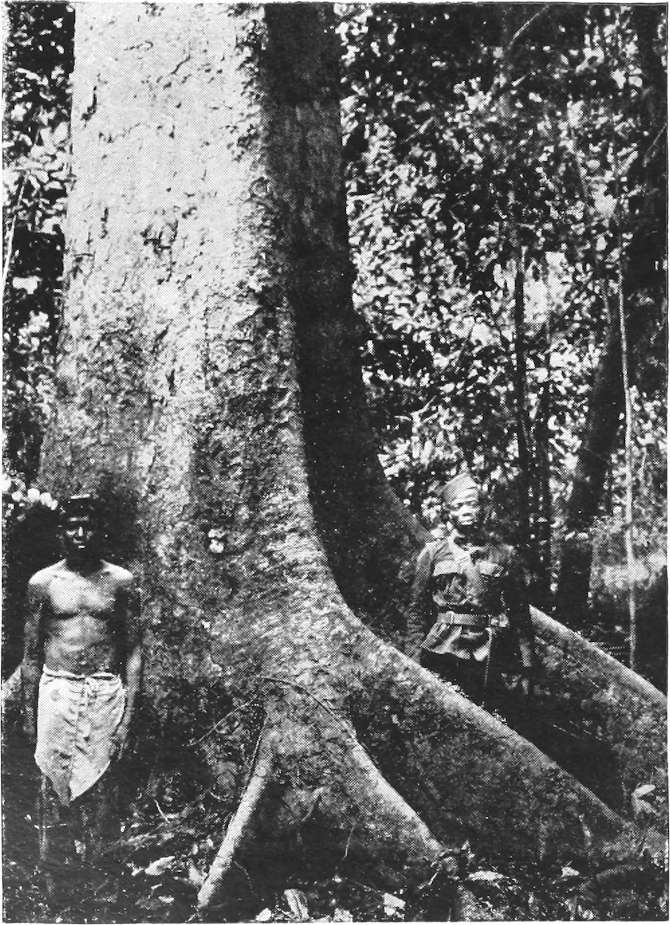
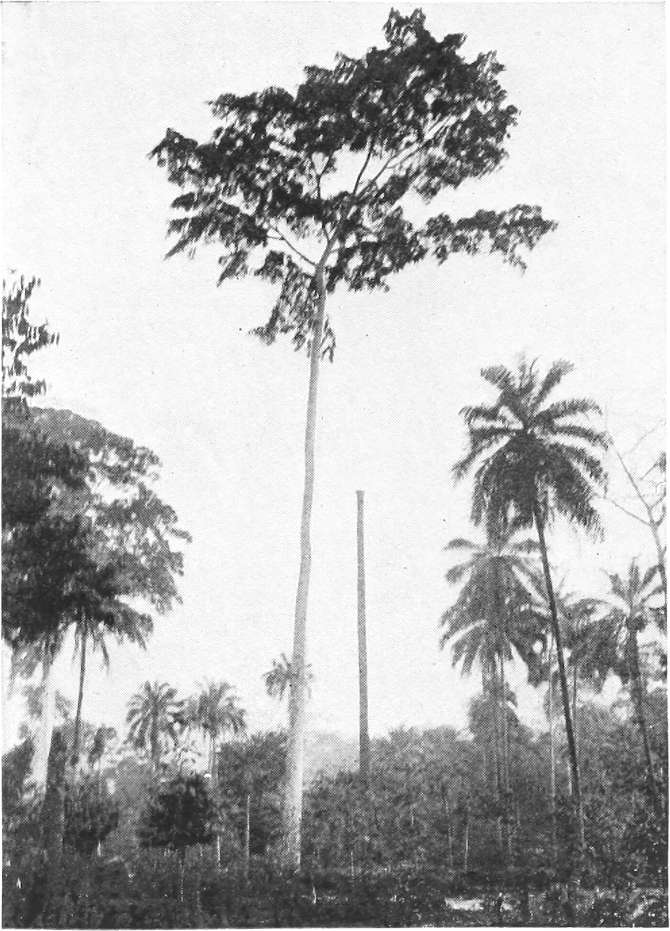
Fig. 66.—Iroko (Chlorophora excelsa), 8 feet in girth, standing in Ilaro Forest Reserve after forest was cleared.
To face p. 294.
Albizzia sp. Walnut. Owewe nolemare (Benin); Ayinre (Yoruba); Semusholoshi (Jebu); Akkihien, also Owewe lagebon (Benin).
According to Mr. H. N. Thompson, Chief Conservator of Forests in Nigeria, who has seen the fruit of this tree, it is most certainly an Albizzia.
Chief Characteristics.—It has been described by a German as not unlike a solitary-standing pine, with its dark foliage of small pinnate leaves, which are larger than Piptadenia Africana and yet smaller than Cylicodiscus Gabunensis. In the above description it is very similar in habit to Piptadenia Kerstingii. The dark brown bark, which is roughish, is light-brown on the upper part of the stem. The crown is flat, consisting of two or three wide, outspreading branches. It has the usual flat, papery pod. The leaves are used by the Benin people for soup.
Distribution.—It is found in the Abeokuta province of Nigeria.
Timber.—It is fairly close-grained, though not nearly so hard as either Piptadenia Africana or Cylicodiscus Gabunensis.
Use.—The Yorubas use the bark medicinally as a stomachic, and the trunk is usually swollen at the base owing to the cortex being removed so often.
Albizzia rhombifolia. Walnut. Ayinre, Ayinre langara, Ayinre ogo (Yoruba); Owowe (Benin).
It is found in the Ibadan and Benin provinces of Nigeria, in the mixed deciduous forests, where it is quite prevalent. It is a medium-sized tree, attaining a girth of about 6 feet and a bole length of 30 feet. It is commonly seen in old farms, and usually more than one is found in the same locality. The thin, yellow, spiky flowers are rather pretty. The fruit is rather smaller than that of the other species.
The sapwood is white, and the heartwood is a light yellow-green. It is soft and not very durable; it is attacked by white ants (termites). However, it saws well, planes well, takes nails easily and splits moderately well. It can be cut into good-sized planks.
Timber, yellowish-green, and yields large planks.
It is a fast-growing, light-loving tree, which scarcely protects the soil, and only slightly improves it with its leaf fall. Natural regeneration is good, the seedlings growing up rapidly in any open place in the mixed deciduous forests.
The timber has not been tried for export, nor has it been used to any extent for local use. It deserves a further trial both as an export wood and as a wood for local floor-boards. Its qualities are far from properly known.
Among the natives it is used as firewood.
Albizzia sp. Walnut. Ayinre Ayinre, Ayinretta (Yoruba); Ikpawudu, Owawelugu (Benin).
It is a large tree, up to 6 feet in girth. It has rather narrower pinnæ, but of similar round shape to A. Brownii.
It is a common tree of the mixed deciduous forests in the Abeokuta, Ibadan, Ondo, Benin, Onitsha, Owerri and Ogoja provinces of Nigeria.
The root spurns are very small. The bark gets rougher than that of A. Brownii in old age, the crown is longer and more feathery, and the leaves appear to be more of a silvery green.
The sapwood is white and the heartwood is of a yellowish-brown colour, tending to become a light brown when exposed to the air. It is comparatively soft; is not termite-proof. It is easy to work, planing and sawing well, and taking nails easily and splitting fairly well. It is, however, less durable than A. Brownii or fastigiata. When split and dried it is more durable than when cut up in the ordinary way. The wood hardens very considerably on exposure to the sun.
It is a light-loving, fast-growing tree. It scarcely protects the soil, but the leaf fall enriches it. Natural regeneration appears to be good. It tends to spread with the increase of farms, more especially on the poorer laterite soils. A few plantations have been made with this tree. The volume of produce per acre is less than in the case of A. Brownii, but apparently greater than any of the others. It is less rapidly growing than A. Brownii, but faster than the others.
The timber has not been used for export, and it is doubtful if it would repay the cost. Locally it has been used for planks, but it is not liked so much as that of A. Brownii or fastigiata. By the local people it is used for firewood, and occasionally for building temporary houses.
Anglocalyx ramiflorus (Taub). Ekiyawa (Benin).
It is a large tree, attaining a girth of 8 feet, but the trunk is not over-long in proportion. It is a shade-bearing, soil-protecting and soil-improving tree. The bark is a dark olive-green and smooth. It is found in the Benin province of Nigeria. Natural regeneration appears to be poor. The wood is yellowish-brown and floats when quite dry. The timber was valued at nothing in 1906 and stated to be a whitewood in the Liverpool market.
Native Use.—None.
Ostryoderris impressa. White Oak. Awaw or Erumacie (Yoruba); Ori, Ehrurumesi, Erurunuesi, Awaw, (Usshin) (Benin).
It is a common tree in the Calabar, Ogoja, Benin, Owerri and Abeokuta provinces of Nigeria. To be seen along the Benin-Siluku Road, as also in the Badagry district on the Ayobo-Osuke Road.
It is a straight-boled, tall tree, with flattish crown made up of few straight branches with large pinnate leaves, making it appear flatter than it really is. The bark is slightly scaly with fine fissures. The slash is red, exuding a red latex. It reaches a height of 150 feet with a girth of 12 feet. The white, papery, pointed, flat, lozenge-shaped fruit, with a small kidney-shaped seed attached to the centre of the surface of one side, is most typical of the tree. The spurns are almost non-existent, so that the tree can be felled near the ground without trouble.
The timber is white in the sap and brown-white in the heartwood, but not over-hard, very tough and not splitting easily. It is hard to fell, being very flexible. It planes moderately well. The colour darkens with age.
It is a light-loving tree after the first few years. It grows moderately rapidly. It is a soil-improving and covering tree. Natural regeneration appears poor, though many seeds are usually seen on the ground. Insects appear to eat them rapidly. No plantations have been made with this tree, but experiments would show whether it grows well from seed.
In 1906 a sample log was exported and sold in the Liverpool market as white oak at 2s. per cubic foot, and it was recommended for shipment by the brokers.
Native Use.—It is used as posts for frames on which yams are tied in the Benin farms. In temporary houses, small trees are trimmed and squared for the forming of the walls, instead of dried mud.
Dalbergia saxatilis. West African Blackwood (?). Awow (Benin).
It is a small tree of the mixed deciduous forest of Benin; it is occasionally used by the natives for hoe and axe handles.
Dalbergia sp. West African Blackwood. Emosobegan, Paran (Yoruba).
Found in the Olokemeji Reserve.
Dalbergia sp. North Benin Blackwood.
This is found near Aroko, in the Onitsha province, and near Ishoka, in the Benin province. It is a small tree with very hard wood. In habit very similar to Ormosia laxiflora, with its orange-coloured bark, which is rougher than O. laxiflora and not so scaly. The wood is used for axe and hoe handles by the natives.
Dalbergia hostilis (Benth.). Yoruba Blackwood. Ogan Oga (Yoruba).
This Dalbergia is fairly common in the Olokemeji Reserve, in the Abeokuta province of Nigeria.
Copaifera sp. True Benin Gum Copal.
This tree is found near the Uhi, close to the source of the Ossiomo River, Benin province. This apparently is rather an uncommon tree. The Benin natives do not know how to tap the tree for gum, nor how to use the gum.
Cf. Copaifera. Enyenewu. Enyenewu (Yoruba).
Found in the Yoruba country.
Copaifera sp. Boji Hills Copaifera.
So far it has not been tapped for the gum, the local people apparently not knowing its value.
Bauhinia rufescens (Kew).
Found in the Oyo province.
Bauhinia reticulata (D.C.). Dry-zone Bauhinia. Abafe (Yoruba).
This Bauhinia grows in dry, open country. It is a small, spreading tree bearing white flowers.
Uses.—The fibrous bark is used for tying, and an infusion from the leaves is used in coagulating rubber latex. The stem is occasionally used for making house-posts. It is a fire-resisting tree and shades the soil.
Bauhinia Thonningii (Schum.).
This is a small shrub-like tree of the upper part of the Benin province of Nigeria. It is found near Agbede. It has red flowers. The sap of this tree has sometimes been used for coagulating rubber.
Physostigma venosum. Calabar Bean or Ordeal Bean. Eseri (Efik).
It is found growing in the Calabar district. The seed is poisonous; used in ordeals and medicinally.
The most noticeable feature is the furrow (about ⅛ inch wide and deep) in the upper side of the bean. None of the closely allied Mimosa species show this peculiarity.
Entada scandens. Sword Bean, Match-box Bean, Mackay Bean. Kakoba, Akhuro (seed) (Benin).
This large creeper is found in the Benin and Calabar provinces of Nigeria. It is not very prevalent. The most remarkable features about it are the stoutness of the stem, which attains a diameter of nearly 1 foot and the total length of over 100 feet, and its immense pod, which is often over 3 feet in length. The pod is divided into segments, each nearly 2 inches square, and each containing one large bean, almost a square in shape, 1½ inches and nearly ¾ inch thick. These beans have occasionally been used for making match-boxes, for which they are admirably suited. The outer part of the stem of the creeper is very rough and almost corrugated, especially near its base; the leaves are very small, considering the size of the whole creeper. It is comparatively slow-growing. It grows in the dense evergreen forest, and when drawn taut over the first branches of one of the large trees it is not unlike the bole of a small tree itself. When cut, the two ends part with a bang, like the breaking of a ship’s hawser. The natives use the smaller parts of the stem for fly-switches, for which they are very good and durable. The creeper is, however, not cultivated.
Entada Soudanica. Ogurohe (Yoruba).
Found in the Ibadan province.
Entada Abyssinica. Unwanwanis (Benin).
It is found in the upper part of the Benin province near Ishoka. It is a large creeper with rather smaller bean than E. scandens. The beans have been used for making small match-boxes in Europe. The natives consider the bean a “Ju-ju.”
Dioclea reflexa. Ishe, Agbarin (Yoruba).
A climber, found in the Ibadan province.
Mucuna urens. Ox-eye Bean. Awipu (Benin).
Found in the Benin and Abeokuta provinces.
Mucuna sp. Preussii. Yerepe (Yoruba).
Found in the Olokemeji Reserve and Benin province.
Acacia pennata (Willd.). Acacia. Okwekwe (Benin).
It is found in the upper part of the Benin, Ibadan, Ogoja and Abeokuta provinces. It is a small, scandent shrub with very sharp thorns, but which yields one of the strongest fibres for making fishing lines or native rope. It forms almost impenetrable masses which are very unpleasant to go through without a matchet.
Acacia Sieberiana. African Rosewood. Sie (Yoruba).
This is a somewhat uncommon Acacia of the Oyo province of Nigeria. Being of medium size, its very handsome racemes of yellow flowers show up to great advantage. The bark is rough, the bole short, and usually divided 8 or 10 feet from the ground. The sapwood is white and the heartwood a rose-pink colour, which makes it not unlike the typical rosewood of commerce. The heartwood is comparatively wide, and it is very hard, durable and termite-proof. It saws well and splits moderately easily, but does not take nails at all well. Reproduction by seed is apparently poor; it sprouts fairly well from the stump. It is a light-loving species, but being of the leguminous family it is a soil-improving tree. The wood has not yet been exported, but locally it has occasionally been used for house-building, the forked stem being much appreciated by the natives.
Acacia Farnesiana (Willd.). Farnesian Acacia. Bonni (Yoruba).
It is found in the Abeokuta province of Nigeria. It is a small tree growing up to 6 feet in girth. It has a small pod containing eight seeds inside. The inside of the pod is white and the seed is brown. The flower is yellow, and is used by girls in decorating their ears. Usually found in towns, where it is planted. The seeds are sold in the market.
The timber is dark-red, surrounded by a narrow white sapwood. It is hard, like ebony. The bark is very much fissured and peels off in large scales.
The seeds of this tree and Jagiri are used with water for scraping the leather for making the fells smooth. Sold at Itaku and Shapon markets.
Acacia campylacantha. Confectioner’s Gum or African Catechu. Ede (Yoruba).
It is found in the Abeokuta, Oyo, Borgu, Niger, and Nassarawa provinces of Nigeria.
It is a very common tree, growing almost everywhere in groups. The stem is of a whitish to slight yellow colour, almost reminding one of the larch, but the whole tree is armed with short, sharp thorns. It reaches a girth of nearly 4 feet and a height of over 50 feet. The slash is light-brown, and a pale, yellowish-pink gum exudes from it. The tree usually forks about 20 or 30 feet from the ground, the other branches being rather crooked in shape. In February or March a mass of small yellow flowers appear, and in the autumn small pods cover the tree. The sapwood is white, and the heartwood varies from a dull red-brown to a rich, almost rosy red. In the latter case it is exceedingly pretty wood. The wood is moderately hard; it splits and planes badly, saws fairly well, and only takes nails indifferently. The wood dries rather harder and is more durable than when freshly cut and than would be expected. It is said to be termite-proof. A reddish colouring matter exudes from the heartwood, but this feature is typical of the cutch which is obtained from a similar tree in India.
Natural regeneration by seed appears to be good, hosts of young trees being found near the older ones. In fact, in localities of low rainfall it is tending to spread and fill up all vacant spaces after the annual grass-fires have burnt all the vegetation. It is a light-loving tree which does not protect the soil. The leaves are not unlike conifer needles, and enrich the soil to a certain extent, more especially as the tree is deciduous.
As a timber it has not been cut for export, but certainly the better-coloured wood, and that which has been more slowly grown, deserve a trial.
So far, the greatest use of this tree has been the production of the pink-coloured transparent gum which is one of the best of the confectioner’s gums in Great Britain. Very large quantities are exported every year from the Northern Provinces. Large round tears or lumps form on the stem of the tree when it is cut. Locally the tree is used for house-building, but it is not considered a durable wood.
Leguminosæ (Mimoseæ).
Acacia ataxacantha. Benin Rope Acacia. Ewon (Yoruba); Okwenkwen (Benin).
A common creeper of the mixed deciduous zone. It is found in the Abeokuta, Oyo, Ibadan, Ondo, Benin, Warri, Onitsha, Owerri, Calabar and Ogoja provinces of Nigeria.
It is usually found growing in large impenetrable masses 3 to 4 feet high. It is armed throughout with short but very sharp, bent prickles.
It often grows up in waste places where the bush has been cleared in the mixed deciduous forest zone.
Both the Yorubas and Benis use the inside fibres of this creeper for making a very strong kind of rope—in fact, it is the strongest of all native-made ropes. It does not get so stiff or harsh as that made of Eso from the Firmania Barteri.
Distemonanthus Benthamianus (?) (Baill.). Alinyan (Benin).
Found in the Benin province.
Erythrina suberifera (Kew). Attagbo (Yoruba).
It is a moderately common tree of the Abeokuta province of Nigeria. Its most distinguishing feature is the size of the leaf, which is similar to the tulip-tree. It reaches a much larger size than E. Senegalensis and has a girth of over 6 feet. The bark is a dark duck-egg-green colour, with a few white, shallow longitudinal fissures. The prickles on the stem are more scattered and much larger than those of E. Senegalensis. The slash is white and the bark thin when compared to the size of the tree. The wood is white and soft, and not durable. It cuts and saws easily, but does not plane well. It is a light-loving tree which does not protect the soil. It has not been cut for local use, nor for export. As a soft whitewood for interior use it ought to find a local market.
Leguminosæ (Papilionaceæ).
Erythrina Senegalensis (D.C.). Coral-flower. Ologun she-she (Yoruba); Esanigbakhehe, Ohehe (Benin).
It is a common tree in the upper part of the Onitsha, Benin, Ondo, Ibadan and Abeokuta provinces of Nigeria. One of the most typical features of this small tree are the small, pink, coral-like flowers which appear in February. The tree is armed with a few thin but very sharp thorns; the foliage is slight and open. On suckers or stool-shoots the leaf is much larger and almost lyre-shaped. It is usually found in waste places or in open clearings in the mixed deciduous forest. It yields a soft wood which is not durable. It is sometimes used for making fences.
Tephrosia Ansellii (Hook). Boro (Yoruba).
It is found in the Olokemeji Reserve of the Abeokuta province of Nigeria.
Tephrosia Vogelii (H. K. F.). Fish-poison. Were, Igun, Laye Igu (Yoruba).
This small shrub is apparently indigenous to Africa, but is usually seen planted in the fields of the Abeokuta, Oyo, Benin, Owerri and Ogoja provinces of Nigeria. It is not unlike a large upright vetch, but with a strong, green stem, almost woody in growth. It reaches a height of about 3 feet and flowers very profusely, and bears a large number of pods, not unlike those of the runner bean. The plant is cut down and placed in the water where it is desired to catch all the fish, chiefly in stagnant pools of rivers or ponds. The effect of the poison from it blinds and stupefies the fish so that they are easily caught. Under the Game Preservation Ordinance, its use has been prohibited, but with its widespread cultivation and general utility it has been found very difficult to eradicate the custom or the plant. Incidentally it is a very good green manuring crop for agricultural land. However, most natives are unaware of this fact, and it is usually only planted for the purpose of using it as a fish-poison.
Burkea.
A species of Burkea was found near the Oyan River in the Oyo province of Nigeria.
Lonchocarpus sericeus. African Wisteria. Ipapo, Apapo (Yoruba).
This tree is found in the Olokemeji, Ibadan, Ilesha and Calabar districts. It is a medium-sized tree, which bears lilac-coloured flowers. As the flowers appear before the leaves in the dry season, it is then very ornamental, and is in fact one of the prettiest flowering trees. The wood is very hard and the heartwood green when freshly cut.
Timber.—This is not of much service.
Uses.—Hoe-handles are made from the branches, and the bark is used in medicine.
Lonchocarpus sp. Mamu Lonchocarpus.
Found in the Mamu Forest.
Lonchocarpus cyanescens. Yoruba Indigo. Elu or Ela (Yoruba).
This is one of the intermediate forest climbing shrubs, but has been cultivated throughout the country.
Uses.—The well-known Yoruba blue dye is made from the leaves. The stem is sometimes used for house-building posts. It is a shade-bearing, soil-improving tree. Natural regeneration appears to be poor.
Cæsalpina Bonducella. Shayo (Yoruba).
The bean of this creeper is used in games amongst the Yoruba boys.
Mundulia suberosa (Benth.). Lakuta (Yoruba); Ugbehen (Benin).
It is rather an uncommon tree, found in the Olokemeji Reserve of the Abeokuta province of Nigeria. It is a small tree, a part of which is used for killing fish.
Indigofera hirsuta. Indigo. Epa ile (Yoruba).
It is found in the Mamu Reserve of the Ibadan province of Nigeria.
Indigofera stenophylla. Indigo. Aro Boro (Yoruba).
It is found in the Olokemeji Reserve of the Abeokuta province of Nigeria.
Pentaclethra macrophylla. The Oil Bean. Apara (Yoruba); Opagga, Ukpagga (Benin); Ataka (Ibo, Asaba); Opochala (Ibo, Niger).
It is a large-sized tree, reaching a girth of about 12 feet and a bole length of 40 feet. The root spurns are very extensive and often reach 4 or 5 feet up the stem, thus quite breaking up the base of the bole. The bark at first is a light yellow-brown, darkening in old age to a deep brown, and scaling off somewhat.
Chief Characteristics.—It has dense foliage and a heavy, branched crown, and very flat pods about 1 foot long and up to 2½ inches broad, containing seven or eight large, flat brown beans about 1 inch in diameter and ¼ inch thick. The pods open with a loud report not unlike the sound of a 12-bore gun.
Distribution.—It is found in the Lower Province of Nigeria, near the watercourses outside Abeokuta, Jebu, Ode, Benin, Onitsha, Owerri, Calabar and Ogoja.
Silvicultural Qualities.—The tree grows readily from self-sown or artificially sown beans, as is seen in the Avenue at Benin City, which was sown at stake in 1904. It bears pods in the twelfth year in the open, but later in the forest. It is usually very prolific, bearing at least some pods every year. The bole is not always very straight, and it has a distinct tendency to form strong side branches, and the crown is therefore a large oval one. The flowers are little yellow spike, which are very inconspicuous; they are borne on the old wood rather on the underside of the twig, in November or December and later. The tree stands dense shade, and it thoroughly covers the ground and prevents the growth of weeds.
It has a tendency to branch comparatively low down, when growing as an avenue tree, and thus does not grow so tall. This, however, has an advantage that the large pods have not so far to fall to the ground, and thus are not so dangerous to passers-by. The oil-beans have been collected and sold in England in small quantities.
The sapwood is of a dirty white colour and the heartwood of a dark brown, forming comparatively early in the life of a tree. The wood is very hard, but sometimes rather soft-grained, rather fibrous in texture, and the pores are somewhat wide and deep. It does not plane well, splits with difficulty; holes have to be made before nails can be put into it, and it saws none too easily. It is very durable and termite-proof. Considering its hard wood and comparatively early production of seed, and the huge pods, it is by no means a slow-growing tree. It reaches a height of 9 to 12 feet in twelve years. The pod is the stoutest and largest, but not the longest, of all African timber trees. The beans are collected in boxes and sold to the factories at 6d. to 9d. each. To be made quite safe for eating they have to be boiled nearly twelve hours, the outer husk of the bean being rather hard, though not very thick. The future will alone show whether this tree will prove of greater value for timber or oil production.
Uses.—The timber has been shipped to Europe and sold as greenheart at 1s. 6d. to 1s. 9d. per cubic foot. Locally, in the Benin City district and elsewhere, it is used for making mortars for beating yams and other food. The beans are eaten by the natives in most parts, though they are not considered a delicacy. The empty pods are used where firewood is scarce, as they burn well. It is, and has been, very extensively used as a shade-tree for public roads in the Owerri district, as well as in Afikpo and Benin. Some people object to the falling pods, but it is an excellent shade-tree, especially in the dry season, as it is an evergreen tree. It is a soil-protector, and would do for underplanting or interplanting teak.
Pterogopodium. Agba, Pink Mahogany. Asokale, Asu Kole (Ikale); Asre (Yoruba) (Egbado); Agba (Benin).
The scattering of the white flowers on the path or roadway is an indication of the presence of the tree, quite apart from the wonderful bole, exceeding nearly all others in cylindrical shape.
Chief Characteristics.—It is a very large forest tree, with clear bole of 90 feet and open crown formed with two or three large, upspreading limbs, flatly oval on the top. It is quite reminiscent of an old elm in the shape of the crown. The single-seeded winged fruit is most typical, no other species of Leguminoseæ having a similar seed except the nearly related Pterolobium (?). The bark is comparatively thin, silvery-grey in colour, with a few more or less well-defined ridges running horizontally round the trunk here and there. These are most typical, and it is the only tree which shows them. In some places they amount to small nodules of bark.
This tree is found commonly in the Benin and Ondo provinces of Nigeria, where it is prevalent, and in the northern part of the Benin province, and seen in almost gregarious patches in the secondary forest. The slash is yellowish-white, and in the younger trees a dirty pinkish sap exudes, but later on, especially from deep cuts, the gum copal forms and gradually hardens into solid lumps of various size.
Silvicultural Peculiarities.—It loves a deep soil with plenty of moisture, which may even be flooded or partially waterlogged during the rainy season. A chalky or limy soil seems to suit it best. It is a fast-growing, light-loving tree, though it stands a little shade in its youth. The light, feathery foliage does not shade the ground, though when in falls it enriches it. The root spurns are most slight, extending only from a few inches to 1 foot above the surface of the ground; in fact, sometimes the trunk appears to come straight out of the ground, like a round log on end. Natural regeneration is none too good, but this is chiefly due to lack of light in the mixed forests. No plantations have yet been made with this tree.
It has not been exported, but it deserves a trial as a furniture-wood for drawing tables and office equipment generally. It is sawn up into planks and boards at Koko Town, and contains a gum which makes the saws stick a little. It makes a good, soft wood for table tops, of a pinkish colour and clear, close grain. The gum is sold.
Native Use.—It has been used for canoe making in the Ondo province. The gum is used for an illuminant, and was at one time used entirely for this purpose. In 1906 logs of this timber were sold in Liverpool market as a kind of mahogany of light colour.
Prosopis oblonga. Yoruba Charcoal Wood.
It is found in the Ibadan and Ogoja provinces of Nigeria, and may yet be found in the Onitsha and northern part of the Benin provinces. On the whole, it is not common, and is seen singly. Two typical specimens of this tree stand in the Olokemeji Reserve Arboretum. It has small, pinnate leaves, very much like tamarind, but they are almost silvery-grey and hang down, instead of being green and rigid, as the tamarind. The twigs and branches are very slight, compared to the thick ones of the tamarind. The bark of the trunk is grey, too, with thin cortex, which becomes slightly fissured in old age. The trunk is straight and tall, compared to tamarind. The crown is longish and thin, with a few small branches. It is somewhat feathery in habit and is delicate in build compared to most dry-zone trees. It is one of the most typical of dry-zone trees. The seed is small, about the size of apple-pips, contained in a papery pod, from 1 inch to 1½ inches long. It stands the annual grass-fires comparatively well, despite the fact that the bark is none too thick.
Timber.—Hard, white wood, termite-proof and very durable. The bark is thin but rough, and small pieces can be pulled off with the fingers. It is a deciduous tree, though it does not lose its leaves for a long period. It is a light-loving tree, which does not protect the soil, though the leaves (few as they are) make a good leaf-mould. It is slow-growing, and does not reach a girth exceeding 5 feet. Natural regeneration appears to be poor, but further observations on this point may disclose more. No plantations have been made with this tree, though, with its desirable qualities, some experiments seem to be indicated. It does not sprout well from the stump, nor do any root shoots appear before or after it is cut down.
It has not been exported, and has only been used occasionally locally.
Use.—The timber has been used for sleepers in Togo, where it has proved the most durable of all timbers for that purpose. In the Yoruba country it has been used for making charcoal of the best kind for iron-smelting.
Detarium Senegalense. Hard Mahogany. Ogwega (Benin).
This is none too prevalent a tree of the Benin and Ogoja provinces, where it is found in the mixed forests. It reaches a girth of over 12 feet and a bole length of over 40 feet, but in proportion to its height, the crown usually occupies more than half of it. The crown is usually widespreading and spherical in shape. The fruit is like a mango in form, but after the surface begins to decay, the fibres, instead of being fine and all coming out from the central nut, as in the mango, spread out vein-shaped all round the nut, starting more or less as thick veins at the base, and then subdividing into thinner ones, spreading round the nut in an irregular manner. The decaying fruit has a most unpleasant, not to say distinguishing, smell. However, this is more than compensated for by the pleasant taste of it when served as stewed fruit.
The sapwood is whitish-yellow, and the heartwood brown-red. It is hard, with somewhat fibrous grain, yet planes up with a good surface. Takes nails, but does not split well. It is durable, and supposed to be termite-proof, except for the sapwood, which the white ants often destroy. It saws moderately easily. In older trees the wood sometimes shows a little figure.
It is a somewhat slow-growing tree and a shade-bearer, with soil-protecting and soil-improving qualities. In fact, in most cases it is only found on comparatively rich soil, and in this respect appears to be more exacting than many other trees. Natural regeneration does not appear to be very good, but this may be due to the fact that animals eat the seeds. No plantations have been made of this tree.
In 1906 samples of this timber were sold in the Liverpool market as mahogany at 2¾d. per superficial foot, 3s. per cubic foot. It was reported to be of very hard texture, a dirty brown colour, and only one log sold. Since that date, however, none has been exported. It has not been felled for local use. The fruit can be stewed, and makes a nice addition to the other African fruits.
Native Use.—The shell of the nut is used for making prayer-beads and strung on a wire.
Ormosia laxiflora. Shedun (Yoruba).
Found in the Olokemeji Reserve and Ibadan province.
Paradaniellia Oliveri. Ilorin Balsam, African Balsam of Copaivi, Balsam. Iya (Yoruba); Osia (Benin); Ozia (Ishan); Ozaba (Ibo Asaba).
Found in the dry zone of the Southern Provinces of Nigeria. A common tree, growing to a height of 40 or 50 feet.
Use.—Balsam of Copaiba.
Xylia Evansii. Bentpod.
It is found in the Ogoja province of Nigeria in the mixed deciduous forest zone, but it is by no means a very common tree.
A medium-sized tree, with the curious bent-shaped pod typical of the Xylia, found in the Obubra and Ikom districts of Nigeria, on the left bank of the Cross River. It has a hard, red wood, which splits well. The sapwood is white, but not very wide in an average-sized tree.
It is a slow-growing, shade-bearing tree, which thoroughly protects the soil and improves it with its leaves decaying year after year.
The natives have not used the tree, nor has it been felled for local use by Europeans. It has also not been tried for export.
Pandanaceæ.
Pandanus candelabrum. Screw Pine. Ebbo (Benin).
In some rivers of the Abeokuta, Ondo, Benin, Warri, Onitsha, Owerri and Calabar provinces of Nigeria it is a common watershrub or small tree. Often it is seen only a tangled mass of long prickly leaves, armed with spikes all down each side and half floating in and above the surface of the water. Sometimes, again, it is seen as a tree with two or three more or less complete whorls of branches on the uppermost part of the stem and a mass of drooping leaves from the crown. The white stem is supported by several soft, corky-looking aerial roots. It seldom exceeds 2 feet in girth and 30 feet in height. The white flower is very conspicuous, with its cone-like shape, which becomes more pronounced as the fruit begins to ripen and turns green. The scent is very pungent and overpowering. The trees form almost impenetrable thickets at the edge of the more sluggishly flowing rivers. These often impede navigation and have to be cut away.
The stem is very porous when dry, and cannot be said to yield timber, though the cork-like material might serve for a light substitute for it.
Natural regeneration appears to be very good.
The fibre has not been exported in any quantity, but it is very tough, and apparently very durable and of moderate length (average 3 feet).
Native Use.—When dried the leaves are used for making mats for wrapping goods as well as for sleeping-mats. In the Benin and Jekri country, long (2 feet) thin receptacles are made which are used for salt, which is sold in these bags in the market. The bag keeps the salt dry. It is sometimes planted near villages in damp places for the purpose of obtaining the mat material locally, where it is not found naturally in the swamps.
Humeriaceæ.
Aubrya Gabunensis. Brass Mahogany-bark Tree.
This is a very large forest tree of the Brass district, with a bark very similar to that of mahogany, but to which it bears no relationship.
Fig. 67.—Khaya Senegalensis, 1910, on bank of Ogun River, near Iporin, Oyo Province.
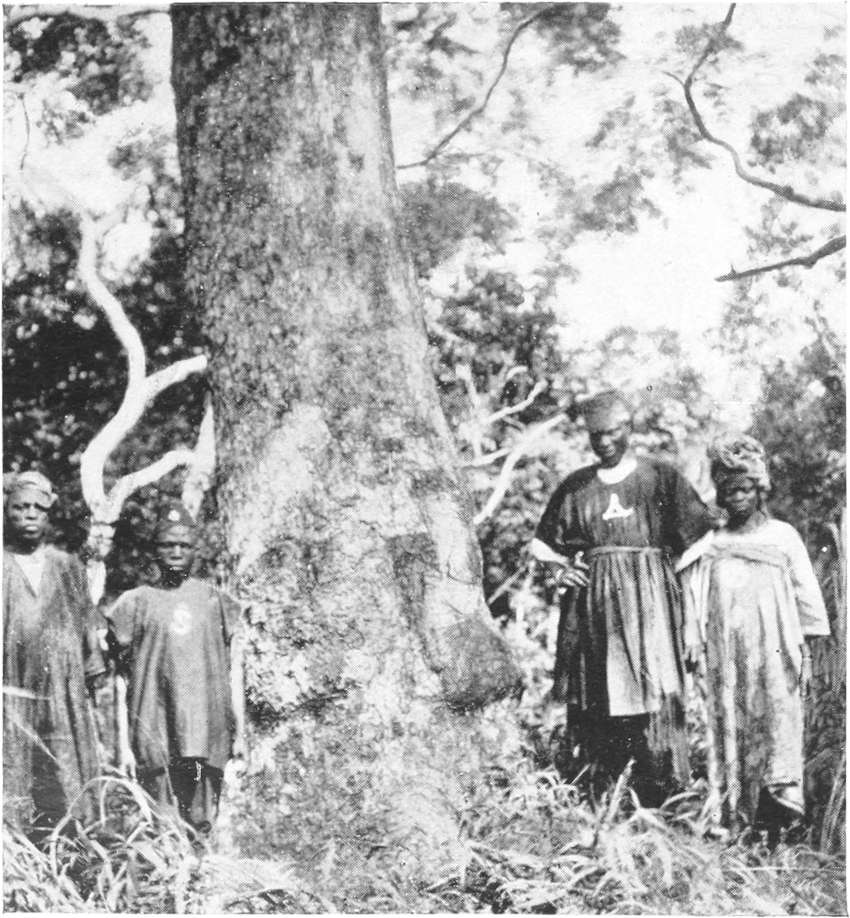
Fig. 68.—Locust Tree (Parkia filicoidea), in bearing, Oyo District, 1910.
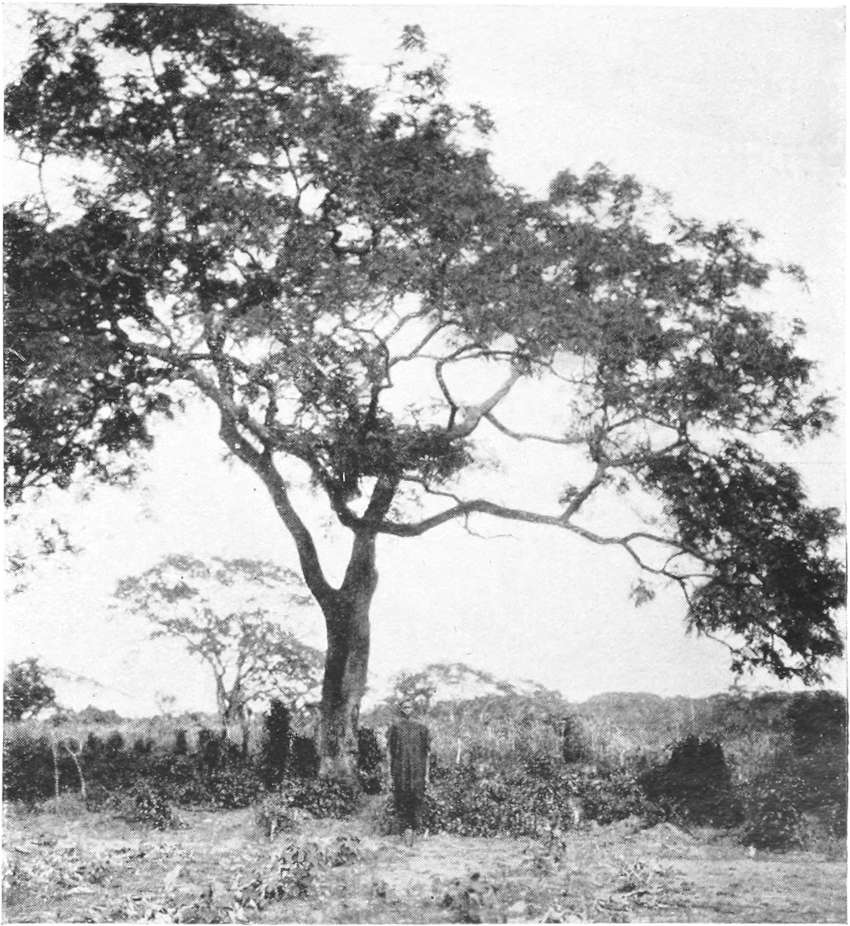
To face p. 308.
The trees are sometimes cut down by the natives and used for large dug-out canoes. The timber is termite-proof, and the natives say that canoes made from this timber are very durable, though rather heavy, and liable to become waterlogged when filled with water. It is of a dull reddish-brown colour and has rather a coarse grain.
Rutaceæ.
Zanthoxylum Senegalense. Dry-zone African Satinwood. Ata, Odan (Yoruba); Ughahan (Benin).
It is found in the Ibadan, Abeokuta, Benin, Onitsha and Ogoja provinces of Nigeria, at the edge of the mixed deciduous zone and the lower part of the dry-zone forest region. It is only a medium-sized tree, attaining a girth of about 4 feet and a height of about 50 feet. The bole always remains armed with short, woody protrusions, each having a black thorn at the apex. In the upper part of the bole and the branches there are only thorns. The pinnate leaf has usually three pairs of pinnæ and one end-leaf. All the leaves are broader and about only half as long as those of Z. macrophyllum. On the whole, this makes the foliage appear thicker, and, in fact, gives greater shade than Z. macrophyllum. In proportion the bole is shorter and the crown larger and more spread out than in the case of Z. macrophyllum. The bole has a greater tendency to divide lower down into three subsidiary stems, thus spoiling the length of it for timber. The bunches of small, black seeds are smaller than those of Z. macrophyllum, and if anything the seeds are also smaller too.
The timber is very similar to that of Z. macrophyllum, the sapwood and heartwood being the same colour, except that the heartwood is often of a little darker shade, and bears a greater proportion to the diameter of the tree than in the case of Z. macrophyllum. On the whole it is harder, and more often shows a little figure. Although it does not reach such a large size, in many ways it is superior, the grain being rather finer, and showing more sheen, and if anything it works up to a finer texture when planed. It is just as durable and termite-proof. It is a light-loving tree, but will stand a certain amount of lateral shade. Owing to the prevalence of grass-fires, it is slower-growing than Z. macrophyllum, but if anything it shades the ground better, and considering where it usually stands, it is a slight soil-improving tree. Natural regeneration is fair. No plantations have been made with this tree. Samples of this timber have not yet been exported, though, as it is a sister tree to the West Indian Satinwood, it ought to command a similar price. It has not been felled for local use. The natives occasionally cut it for house-building timber, but it is not at all popular, owing to its being armed with spikes.