Chapter XI
Reading edition
THE OIL BEANS, SEEDS AND NUTS OF THE FOREST
In a separate chapter the Oil Palm and its produce are more fully considered, so that we give here a detailed account of the other important Oil Seeds and Nuts. Oil-bearing nuts and seeds are usually found in great profusion in the Tropics, and West Africa is no exception to the rule.
Amongst the botanical families in which the plants yield oil-seeds or nuts are the Palmæ, Leguminosæ, Euphorbiaceæ, Ochnaceæ, Sapotaceæ, Rhizophoraceæ, Meliaceæ and Guttiferæ. As far as the Protectorates of Nigeria and Sierra Leone are concerned, the “Oil Bean” (Pentaclethra macrophylla) is one of the most important. According to the data in the Niger district, oil beans have been bought for some ten years from the natives. They are also known as Owala beans. The natives prefer a price of 1s. per case, but the minimum of 6d. and the maximum of 9d. per case was about the limit for the nuts in pre-war days. Even then only a small profit was made by the European merchant at the prices then ruling for the nuts in England. With the much greater, almost universal demand for all kinds of oil-nuts and seeds, it is probable that higher prices will be paid for these nuts now that the war is over, provided a reasonable charge for freight can be arranged. The natives themselves say that the nuts should be cooked for twelve hours to be good for eating. There are six or seven beans in each pod.
Now that many roadsides in the Owerri province and other districts have been planted with Oil-bean trees as a shade tree, there will be a continual supply of nuts each year. The tree starts bearing in the tenth year, and almost every year bears a fair crop. An example of one of these avenues is seen on the Ikpoba Road, just outside Benin City. The pods are used as a firewood, which makes a hot, rapid fire. In Sierra Leone they are known as Fai beans. The beans are large and flattened, covered with a hard brown seed-coat. They may be from one and a half to two and three-quarter inches in length, and from one to one and three-quarter inches in breadth, and one-third to nearly half an inch in thickness. The kernels are white and soft and contain a quantity of oil.
According to the very valuable investigations of the Imperial Institute:
The proportion of hard seed-coat (by weight), 20·7 per cent.
The proportion of kernel in bean (by weight), 79·3 per cent.
The amount of oil contained in the whole, 31·2 per cent.
The amount of oil contained in the kernels, 39 per cent.
When the oil is left to stand it deposits a quantity of solid fat. On trial, the oil was found to yield rather a soft soap, and was stated to be worth only about £21 per ton. The cold-pressed oil was of a golden yellow colour, and the hot-drawn oil a dull yellow and rather thick. From analysis it was found that the meal was very nutritious, containing over 39 per cent. of proteids, and if it could be used as a feeding-cake it would be worth from £5 to £5 10s. per ton (pre-war rates).
The constants of the oil from the Southern Nigerian seeds are:
Iodine value 87·07
Acid value 14·3
Titer test 50·15° C.
The composition of the meal after extraction of the oil is as follows:
Per cent.
Moisture 12·9
Ash 03·5
Proteins 34·8
Fibre 06·8
Sugar (dextrose) 06·2
Carbohydrates (other than sugar) 33·7
The oil on analysis gave the following results:
Specific gravity at 15·5° C. (60° F.) 000·9194
Saponification value 184·2
Free fatty acids, per cent. 000·7
Analysis of pressed cake:
Per cent.
Oil 12·0
Moisture 09·9
Crude proteins 33·2
Carbohydrates 34·8
Fibre 05·7
Ash 04·5
The oil would make a first-class edible oil. The value of the beans is stated to be about £6 per ton c.i.f. London, August 1909, and subject to being shipped in lots of fifty to one hundred tons at a time. No regular plantations have been made with this tree, but it is probable that with cultivation an earlier and quicker yield of nuts could be obtained, also with further grafting and seed selecting the thickness of the shell over the kernel could be considerably reduced, and also the thickness of the pod, and thus make the product more valuable in proportion to its size. A small tree will bear half to one bushel of beans, and a large tree will bear two. On the smaller and younger trees the pods are narrower and shorter than on the older trees, and the beans are much smaller, being only about half the size and a third of the bulk of those from fully-grown trees. The pods, which also contain a certain amount of oil, are not to be despised as a source of fuel, especially as time goes on and the population increases.
In this place also should be considered the beans of Xylia Evansii. This is also a Leguminous tree. The natives apparently have no use for the small, flattened round beans, which are about half to three-quarters of an inch in diameter and an eighth of an inch thick, and sometimes less. The beans have not been collected or sold, neither have they been examined chemically as to their oil or other content.
Another oil-bean-bearing tree of this family is Berlinia acuminata, which has large beans rather more than an inch and a half long, an inch broad, and a third of an inch thick. Further examination would show whether the oil content is such as to justify their commercial exploitation. The Benin name is Ekpagoi and Yoruba Apado.
Closely allied to this one is Macrolobium palisoti, the Ogaba of the Benis, which also yields a flat, almost square-shaped bean, nearly an inch in length and an inch in width. The exact oil content of this bean is unknown.
The beans of Cynometra Afzelii and Cynometra Mannii are much larger and stouter, but also contain a certain amount of oil of unknown value. The Benin name is Upakeka and Yoruba Eggi or Ekku.
Then we have the small, almost black, button-like beans of Brachystegia spicæformis, which, despite their large quantity, have remained uncollected and unused. A proper chemical examination would reveal the oil or other content of the beans. The Benin name is Okwan and the Yoruba Ako.
Still considering this same family of plants, the Leguminoseæ, there are the brown beans of Erythrophlœum Guineense and E. micranthum. These are of a brown colour, about half an inch long, one-third of an inch wide, and an eighth of an inch thick, and of a more or less round shape. Here, again, further investigation would reveal the oil content of these beans. The Yoruba name is Oginni or Inyi and Yoruba Erunor Obo.
It is also not known whether the nuts of the various Afzelias, known as Apa by the Yorubas and Aligna by the Benis, contain a valuable oil or other commercial product.
It has been stated that the beans and pods of Pithecolobium altissimum have been used as a kind of “Dividivi” for tanning leather, but further experiment with these would prove or disprove the point.
Finally, there is the Calabar bean or Eseri bean, Physostigma venenosum. It is known to the Efiks as Eseri. The deep furrow on the upper side of the bean is most typical of it, and differentiates it thus from the various Mucuna species. It contains two alkaloids, Calabarine and Eserine. These beans are comparatively well known. Besides being used locally as a medicine and for witchcraft, they are collected and sold for export. The bean used in games, Mucuna urens, has yet to be examined as to its value.
Amongst the other important families containing nut-bearing trees are the Rhizophoraceæ. The Inoy nut, Poga oleosa, is obtained from a common tree in the Owerri and Calabar provinces of Nigeria. The local people of the Oban and Calabar districts are very fond of the nut, and leave the tree standing when making their farms. The nuts sell in the Calabar market at the rate of 250 for 3d. They were examined in England and favourably reported on by the Imperial Institute in June 1905. The hard shell is against their general use, as it is so particularly tough and hard to crack. The shell on the nut itself is about one-fifteenth of an inch thick. The kernel is soft, white, and very oily. It has a better flavour than even the Brazil nut, and is pale-yellow in colour. The kernels were valued in May 1906 at from £9 to £10 in England. They contain about 60·8 per cent. of oil, which showed the following constants according to the investigations of the Imperial Institute:
Specific gravity of 15° C. 000·896
Saponification value 184·49
Iodine value 089·75
Hehner value 093·00
Reichert-Meissl value 001·45
Acid value 039·7
Titer test 022° C.
After extraction of the oil the meal gave the following result:
Expressed on Dry Material. Per cent.
Proteins 41·51
Sugars, reducing 01·32
„ non-reducing (sucrose) 02·50
Other carbohydrates 36·92
Crude fibre 09·00
Ash 08·75
“Inoy” kernels would yield a nutritious cake for feeding cattle.
Thus far no use has been found for the round small, pear-shaped, nut-like fruits of the Red Mangrove, Rhizophora racemosa. Considering the large quantity found floating about in the creeks and rivers, further investigation seems warranted.
In the Euphorbiaceæ family the Nsa-sana (Efik) or Okkwen nuts of the Benis have been found to contain 45·2 per cent. of oil by the Imperial Institute.[17] This nut is obtained from Ricinodendron Africana and R. Rautenii, and is known to the Yorubas as Erimado. In each fruit there are two, three, or even four nuts. The flesh of the fruit soon dries or rots away, leaving the uncracked nuts among the debris. The shell of these is hard and thick, and the inside a bright white colour. In some experiments carried out on a comparatively large scale at the end of 1907 and at the beginning of 1908, in Benin, it was found that more than half the kernels were broken in the cracking of the nut. However, in the Cameroons, where the nuts are used for alimentary purposes, they are boiled for a short time, and then it is possible to crack them quite easily without damaging the kernel inside. Further experiments at Benin showed that six boxes (gin cases) of green fruit yield one box of nuts containing actually 7,528, which weigh 35 lb. 4 oz. One box of fruit contains 418 seeds and yields 720 nuts. An average of 7,419 seeds is contained in each box, 155 nuts weighing 1 lb. Each fruit contains on the average two and one-ninth seeds. On the average 9d. per box was paid for fruit, and 1s. per box for uncracked nuts. Twenty boys cleaned and got ready 2½ boxes of uncracked nuts per day at the cost of 5s. Paying at the rate of 1s. a case for the uncracked nuts, the cost would be £17 per ton. However, with regular quantities being brought in, no doubt this cost could be reduced. In a similar way, if the nuts were boiled in quantity and immediately cracked, the kernels would be got out at a cheaper rate. The native working for himself, as with the palm nuts, would turn out greater quantities in a shorter time.
The yield of the oil pressed from the kernels was 47 per cent., or 14 per cent. on the whole nut. It is light yellow in colour and has a pleasant taste, very much like that of the ground nut. The chemical examination showed a resemblance to Tsung oil (Chinese wood oil). It possesses the same property of drying on exposure to air under ordinary atmospheric pressure. The oil could be used for similar purposes, or for the making of soft soap, and would be worth from about £18 to £20 per ton for this purpose, and it appears that the oil would have a ready sale in England, and have a value, equal to linseed oil, of about £21 per ton. According to the investigations at the Imperial Institute, the analysis of Nsa-sana kernels and Tsung oil showed:
Oil from Nsa-sana Kernels. Commercial Tsung Oil.
Specific gravity 0·9320 (at 20° C.) 0·933-0·942 (at 15·5° C.)
Saponification value 191·6 190-197
Iodine value 147·7 149-165
Hehner value 95·2 96·3
Titer test 35·7° C. 37·1-37·2° C.
Despite the large quantities of nuts available, especially in the Abeokuta, Benin and Calabar provinces, the difficulty of cracking the nuts satisfactorily and buying them cheap enough has so far precluded an export trade from being built up. Owing to the low percentage of oil in the whole nut it is evident that it would not pay to ship the uncracked nuts. So far no plantations have been made with this tree, but it comes up very readily and plentifully in old abandoned farms of the mixed forest zone. In open localities, with plenty of light, the tree begins to bear between the seventh and tenth year, and almost each year there is a large crop of fruit. From larger trees the yield appears to be over one bushel of nuts per tree per annum.
The curious nut-like fruits of Ubellu, Benin, supposed to be a species of Microdesmis, have not been examined as to their oil or other content. Soon after falling to the ground they break up into a white putty-like substance, which has a very peculiar, almost sulphurous, smell, and sometimes rather phosphoric. The nuts are spherical and rather more than half an inch in diameter. The tree is found chiefly in Benin, also in the Abeokuta and Calabar provinces.
Among the Euphorbiaceæ is the creeper, Manniphyton sp., known as Okwe to the Benis. The spherically shaped fruit with four raised ribs on its surface is cut open and contains one large round nut. It is about one inch in diameter. This is boiled for a few hours and is then edible, after the thin dark-brown husk has been removed. It can be peeled off with the fingers. The nut has a pleasant mealy taste and is very satisfying. Further examination would show whether it contains a valuable oil, and in what quantity. So far it has not been cultivated.
Of the Cucurbitaceæ, the seeds of Citrullus vulgaris, known as Ikpan by the Efiks or Egusi bara by the Yorubas, have been examined at the Imperial Institute[18] and found to contain from 40 to 41 per cent. of a pale-yellow oil. It is a common plant in the more open farms of the forest and does not demand a very high rainfall—45 inches. The natives use the kernels, after they have removed the hard skin, for making soup. It makes an excellent dish with rather a sweet taste. According to the investigations of the Imperial Institute[19] an analysis of the oil gave the following results:
Specific gravity at 15° C. 000·9184
Acid value 005·5000
Saponification value 194·0000
Iodine value 106·0000
Hehner value 095·5000
Titer test 036·0° C.
The oil could be used for soap-making, and was valued at £29 per ton.
In the family Moringeæ there is Moringa pterygosperma, the Ben oil-seed tree. It is a common tree of the upper part of the Oyo, Benin and Ogoja provinces of Nigeria. It is also found in Borgu and other of the Northern Provinces. On examination by the Imperial Institute the kernels were found to contain 38 per cent. of oil, pale-yellow in colour and of a pleasant taste. The kernel is difficult to extract. At the Imperial Institute[19] the analysis showed:
No. 1 from Extracted Oil. No. 2 from Decorticated Seed. No. 3 from Undecorticated Seed.
Liquid. Solid. Cold Pressed. Hot Pressed. Hot Pressed.
Specific gravity at 15/15° C. 000·914 — 000·902 000·898 000·913
Acid value 015·300 — 049·700 100·500 002·300
Saponification value 189·200 194·4 179·200 178·700 186·000
Iodine value 070·700 068·3 100·300 088·000 067·700
Unsaponifiable matter — — 001·670 002·690 —
Composition of Cake from Ben Seeds.
No. 2, Decorticated. No. 3 Undecorticated.
Per cent. Per cent.
Moisture 05·96 07·5
Albuminoids 24·12 } 30·8
Other nitrogenous substances 34·81
Fat 11·27 14·5
Fibre 04·32 21·9
Ash 05·66 04·5
Other non-nitrogenous substances 13·86 20·9
From the Simarubeæ there is Balanites Ægyptica, Betu oil-tree of the Northern Provinces of Nigeria. Although it yields 58·7 per cent. of oil, the exploitation of it is almost impossible, owing to the difficulties in removing the husk, the external sugary pulp, and then the thick fibrous shell under the pulp. At the Imperial Institute,[20] Betu oil on analysis showed:
Specific gravity 000·919
Acid value 005·0
Saponification value 196·7
Iodine value 092·5
Hehner value 092·5
Reichert-Meissl value —
Unsaponifiable matter 000·6
Titer test 034·6° C. (approx.)
The oil is a mixture; the results of analysis are as follows:
Per cent.
Olein 33
Linolein 33
Stearin and palmitin 34
The family of Simarubeæ also contains the trees Irvingia Barteri and I. Smithii. These yield the Dika nut, or, as it is sometimes called, Gaboon chocolate. The sun-dried kernels keep in a perfectly good condition for some time. According to the investigation of the Imperial Institute[20] the kernel contains about 43·5 of “Dika fat.” It would be useful either for soap or for candle making, and be worth from £25 to £27 per ton, and the Dika kernels are valued at from £10 to £12 per ton. Locally, however, they are often worth as much as this, but no doubt increased production would mean a reduction in price. So far the tree has only been planted in isolated instances, and otherwise is a forest tree which has been protected by the native for the value of its fruit. The decortication usually takes place near the tree, or in an open place where the nuts are split in half with a sharp matchet, which releases the kernel in the centre, and though often cut in half by this method, it apparently does not mean a large loss of oil to the kernel. According to the analysis of the Imperial Institute[20] the kernel showed:
Sample No. 1. Sample No. 2. Sample No. 3.
Yield of fat (on kernels) per cent. 054·3 060·100 066·3
Specific gravity at 100/15° C. — 000·863 —
Acid value 006·6 012·600 001·8
Saponification value 244·5 250·000 243·8
Iodine value 005·2 003·300 004·2
Unsaponifiable matter 000·7 — —
Titer test 034·8° C. — —
Melting-point of fat — — 039·2°C.
Apparently an oil seed, probably Philiodiscus, a member of the Sapindaceæ family, has been examined at the Imperial Institute and has been found to contain a non-drying oil, which was free from taste and smell. It should, therefore, be of value for eating or for making a white soap.
Sapotaceæ, Butyrospermum Parkii.—In recent years larger quantities of Shea nuts, which are the product of this tree, have been exported from West Africa, especially Nigeria, as also Shea butter, which is manufactured locally from the nuts. In the varieties Tengba and Bomo the quantity varied from “54·5 per cent. to 48 per cent.,” and these were obtained from the Southern Provinces of Nigeria. In the two varieties exported from the Northern Provinces, those known as Eko showed a length of nut varying from 1·5 to 2·5 inches, and the Giddouchi variety 1·4 inches long. Owing to the wide prevalence of this tree much larger quantities could be exported, but many of the forests containing it are situated far away from means of transport, and no very suitable method has yet been found of manufacturing the butter on a big scale locally. At present it is made by certain women who know the process, which takes nearly three days to complete. According to the Imperial Institute the results of the analysis of Shea butter are:[21]
From Lagos. Fat from Untreated Kernels. Fat from Kiln-dried Kernels.
Specific gravity at 100/15·5° C. 000·862 — —
Acid value 018·000 033·9 026·2
Saponification value 179·000 181·2 180·2
Iodine value 058·700 059·4 055·8
Hehner value 096·500 — —
Unsaponifiable value 001·700 — —
Titer test 052·0° C. — —
The fat obtained from the Northern Provinces and the Gold Coast shows very similar contents.
Mimusops, sp. Djave?.—The nuts of this species closely resemble those of the Shea Butter Tree. The nuts are a light-brown colour, about two inches long, and one to one and a half inches in diameter, with roundly pointed ends. Rather more than half the surface of the nut is smooth and shiny, and the other half is rough and dull, and the whole of it is very hard. When dry it is, however, comparatively easily separated from the kernel. The fresh kernels are cream-coloured. According to the Imperial Institute[21] the yield of fat extracted by solvents is 60·2 per cent., or 37·7 per cent. from the whole nut. The fat is solid at ordinary temperatures. In 1913 some of these nuts were shipped from the Cross River and were valued in Liverpool as Shea nuts, only at a rather lesser rate. According to the Imperial Institute the analysis showed:
Specific gravity at 100/15·5° C. 000·860
Acid value 025·3
Saponification value 187·6
Iodine value 056·2
Hehner value 095·4
Reichert-Meissl value Nil
Unsaponifiable matter 002·6 approx.
Titer test 047·8° C.
Dumoria Heckeli? (Baco or Abaku).—Although the Gold Coast name is given, these nuts are also found in the Oban forest. The nuts are large, considerably longer than those of Mimusops, but rather thinner. They are of a pale-brown colour, with a thick, hard, woody shell, most of which is smooth and shiny, only one small part of the surface being rough and forming almost a nodule. According to the Imperial Institute[22] analysis of the Gold Coast samples, the whole nuts contain 21 per cent. of fat or 60·5 per cent. in the kernels alone. The fat is solid and of a creamy white colour. The soap-makers reported that it was about equal to middling quality palm oil. It is also stated that dried kernels in good condition would be worth £13 per ton. According to the Imperial Institute[22] analysis the fat showed:
Specific gravity at 100/15·5° C. 000·855
Acid value 034·7
Saponification value 188·4
Iodine value 051·3
Titer test 051·2° C.
Unsaponifiable matter 001·3
The small nuts of Mimusops multinervis and M. lacera have not been examined as to their oil or other content. The hard nuts of M. lacera appear to contain a fair proportion of oil.
In this family, too, are the nuts of Chrysophyllum Africanum and other species, for which a use has yet not been found. Finally, there are the numerous and fine seeds of Omphalocarpum elatum, known as Ikassa by the Benis, which are probably also oil-bearing.
The next important family is the Olacaceæ, Heisteria parvifolia, known as Ikereoha by the Benis. It yields an edible nut which is white on the exterior and has a black-coloured shell over the actual nut inside. It has not yet been exported or valued. The Benin and other natives are very fond of eating it.
Then there is the nut of Ivialegbi (Benin), which is edible and has a pleasant taste. It is rather smaller than the Gaboon nut, and its surface is slightly striated from the sharp point of the nut to the base.
In this family is found, too, Coula edulis, or the Gaboon nut. This is chiefly found in the Cameroons, but owing to similarity in the vegetation it is very probably growing in the Oban forest of the Anom range. The shell of the nut is very rough, and the outside is smoother than the inside. The shell can be cracked comparatively easily with a somewhat powerful blow with a hammer or axe-handle.
From the Anonaceæ:
Monodora tenuifolia, African Nutmeg.
M. myristica, var. grandis, Calabar Nutmeg.
M. brevipes, Yellow-flowering Nutmeg.
None of these nutmegs have yet been placed on the European market. Although they are all much smaller in size than the nutmeg of commerce, a proper examination would reveal any value they might possess.
Although the Myristicaceæ, Pycnanthus Kombo, yield fat-bearing nuts, they have not been exported to the English market. The nut is the size of a small oval plum. The outer husk is hard and thick, but is comparatively easily broken. The inner nut is covered with a red aril spread out over it, similar to the mace over the common nutmeg (Myristica fragrans). The kernel is white inside, with dark rays penetrating it from the outside. The tree is very prevalent, and yields a large number of nuts. According to the investigation of the Imperial Institute[23] “the yield of solid fat was 54 per cent. It has an orange colour and a bitter taste.” The fat was stated to be suitable for soap and candle making and the meal as a manure. In Sierra Leone the nuts were known as Kpoye, and are identical with those known as “Kafu.” According to the chemical analysis made at the Imperial Institute the following results were obtained:
Specific gravity at 100/15° C. 00·886
Melting-point 48·5° C.
Saponification value 235 to 245
Acid value 21·0
Hehner value 90·8
Iodine value 48·9
Titer test 45·8° C.
Analysis of Fat from Sierra Leone Kombo Seeds.
Fat as Sent. Fat Extracted from Kernels at Imperial Institute.
Specific gravity 000·887 000·880
Acid value 033·0 031·4
Saponification value 231 236
Iodine value 067·6 059·0
Of the Meliaceæ there is Carapa Guineensis (C. procera, D.C.), which yields the Carapa oil. The nuts are roughly tetrahedral in shape, having a rough reddish-brown shell enclosing one large kernel covered with a pale-brown papery skin. Good kernels yield about 57 per cent. of oil by extraction with solvents and 46·7 per cent. by pressure (27 per cent. on cold and 22 per cent. on heating); it is of a pale-yellow colour and has a bitter taste. The commercial value of the oil was stated in 1907 to be £20 10s. per ton according to the valuations made by the Imperial Institute,[24] and from the same authority we find the Carapa cake is of a very low manurial value, and is only stated to be worth about £2 per ton. Some dark-coloured kernels were bought in 1909 at £11 5s. per ton, and light kernels at £11 10s. per ton. According to the Imperial Institute the results were as follows:
Cold Pressed Oil. Hot Pressed Oil.
Specific gravity at 40° C. 000·9179 000·9174
„ „ 15° C. 000·9272 000·9327
Saponification value 197·1 196·4
Iodine value 075·6 071·2
Reichert-Meissl value 003·5 003·1
Unsaponifiable matter 001·5 002·0
Titer test 035·4° C. 036·1° C.
Carapa Cake.
Per cent.
Moisture 9·8
Ash 5·9
Nitrogen 2·9
The ash contained:
Per cent. (calculated on Cake).
Potash, K₂O 1·91
Lime, CaO 0·18
Phosphoric anhydride, P₂O₅ 0·51
Apocynaceæ.—Although the seeds of Funtumia elastica yield oil, it was not favourably reported on. Perhaps now, with the greater value of all the oil seeds, some use could be made of it.
Ebenaceæ, Diospyros Barteri.—This yields the Ebony nut, which is small, but edible. The Benin natives are very fond of it. It has not been exported.
Diospyros crassiflora or Diospyros dendo have a fruit about the size of a large green plum, which contains four long, thin, almond-like nuts, which have rather a bitter taste. Although evidently oil-bearing, they have not been properly examined or tested as to the exact content of oil or other products.
Rosaceæ.—Although the Chrysobalanus sp., or Niko nut, is comparatively well known, it is by no means fully utilized. Then there is Parinarium Gabunense, yielding the Mahogany nut, of uncertain value.
Anacardiaceæ.—The Anacardium occidentale, yielding the Cashew nut, is so far only utilized near Lagos, where it is growing as a garden escape. No proper plantations have yet been made of this tree.
Amongst the Palmæ, besides the Oil Palm, we have the Bottle Toddy or Fan Palm, Borassus flabellifer, yielding three or four nuts in each fruit. These are oil containing, but of unknown value. Considering the large areas in all the West African Colonies where the Fan Palm is found, some use should be made of the large number of nuts produced.
Then we have Hyphæne, the Doum Palm, which yields a nut used for making buttons. Here, again, the large quantities which are found in Africa ensure a steady amount of produce being placed on the market, provided a remunerative price is always paid for the nuts. Finally there is Phœnix dactylifera, the Date Palm. Although this is more of a fruit than a nut, it is included here, as it is found in the forest groves of the North. Considering the value of its produce and the constant demand there is for it, a wide extension of its area of cultivation is to be recommended.
Ochnaceæ, Lophira alata.—This is the dwarf Red Ironwood tree, which yields the “Niam” fat or “Meni” oil. The fruit is roughly conical, consisting of a reddish-brown fibrous shell, enclosing one kernel. The kernel is conical in shape, and about five-eighths of an inch in width. The inside is a pale-yellow colour. The fruit has two uneven-sized wings, the larger being over an inch in length and nearly half an inch in width. According to the Imperial Institute[25] the fat is semi-solid and of a yellowish colour. The kernel contains 31·1 to 43 per cent. of fat. The fat is suitable for soap-making.
According to the analysis of the Imperial Institute the results were as follows: For soap-making it is considered to be of the same value as palm oil, i.e. in November 1911, at Liverpool, £30 to £31 per ton. The cake obtained from it closely resembled Shea-nut cake and was of a similar value, i.e. about £3 per ton in Liverpool. The decorticated kernels, which contained about 40 per cent. of oil, were valued at about £10 per ton c.i.f. at Liverpool in October 1911. These kernels should find a ready market in Europe for soap-making, and the cake to be used as a manure. As the tree is one of the commonest in the dry-zone forests, ample supplies of the nuts should be always forthcoming, providing an adequate price to pay for the cost of production is paid for them.
Table I.
Yield of Fat.
A. B. C. D. E.
Product received Fruits Kernels Fruits Kernels Kernels
Condition of kernels Mostly sound Good Many partly decomposed Good fairly good
Yield of fat (per cent. calculated on weight of kernels used) 31·19 43·0 39·6 41·16 41·76
Table II.
Constants of Fat.
A. B. C. D. E.
Specific gravity 000·9105 000·9044 000·9044 000·9019 000·9016
Acid value 018·5400 025·9000 033·2000 047·5000 048·0000
Saponification value 195·6000 181·5000 194·6000 180·7000 183·3000
Iodine value 068·4000 069·8000 070·3000 072·1000 072·5000
Reichert-Meissl value — 000·9000 000·9000 000·8000 000·8000
Unsaponifiable matter 001·4900 000·5000 — — 000·8600
Titer test — 049·0°C. 047·0° C. 047·5° C. 048·5° C.
Fig. 102.—Oil Palm (Elæis Guineensis), eight years old, in bearing, showing nine out of the twenty-one bunches of fruit on the tree.
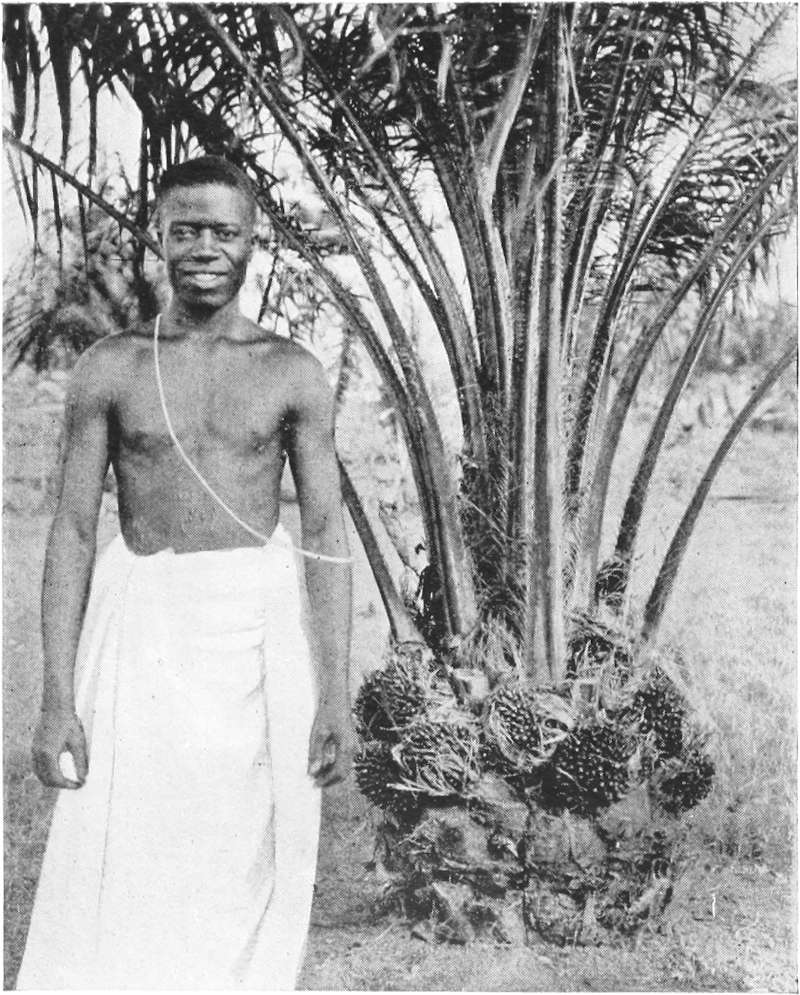
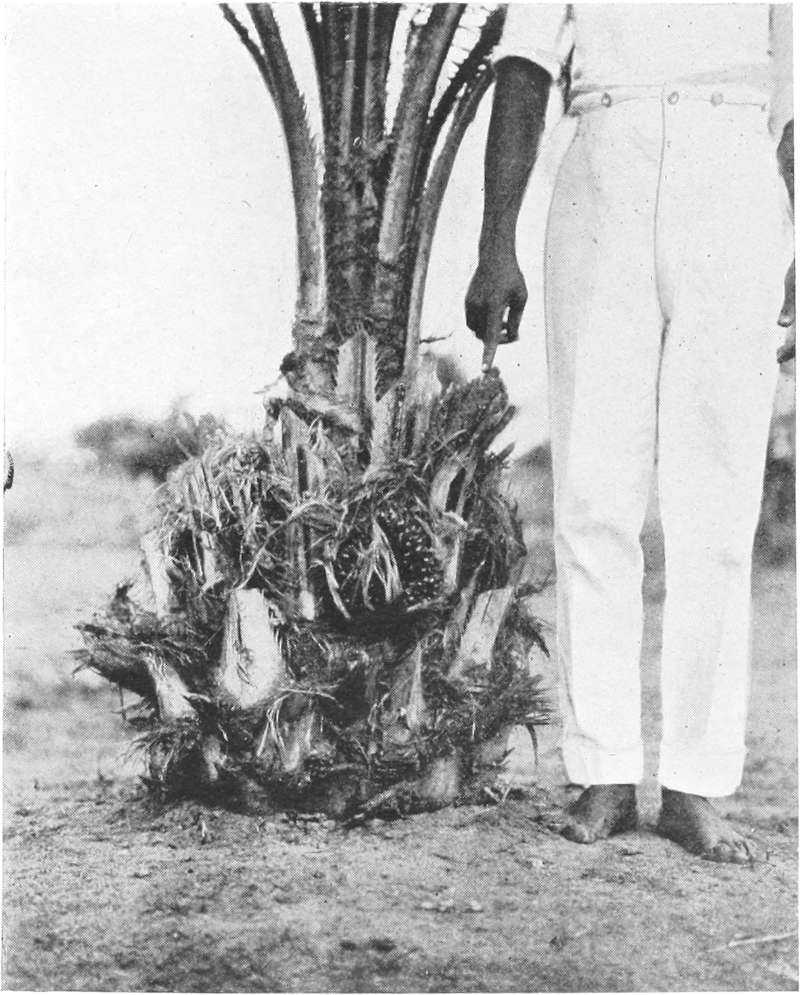
Fig. 103.—Seven-year-old Oil Palm in bearing, rather over-pruned, showing male inflorescence just below boy’s finger and bunch of fruit in the middle of the picture.
To face p. 460.
Closely allied to the above is Lophira procera, the Red Ironwood Tree, which yields the Kaku or Ebba kernels. The fruit is usually more sharply conical in shape than that from L. alata. The fruits are small, owing to the fact that these large forest trees grow closely amongst others, and the fruits are not so fully developed or filled out as those of L. alata. L. alata usually grows in the open freely, or at most only just touching a neighbouring tree, and thus the fruit has ample light for its development. According to the investigations of the Imperial Institute, the nuts were found to yield 55·2 per cent. of fat, which was solid and cream-coloured. Owing to the fact that this is a larger yield than that obtained from the nuts of L. alata, the decorticated kernels were valued at £12 per ton c.i.f. Liverpool. This tree is one of the most prevalent in the evergreen forests of Nigeria, the Gold Coast, and Sierra Leone, so that very considerable amounts of the seeds could be obtained, provided a remunerative price is paid to cover the cost of production. According to the analysis made at the Imperial Institute[26] the kernels contain:
Specific gravity at 100/15·5° C. 000·859
Acid value 011·6
Saponification value 190
Iodine value 060
Unsaponifiable value 000·8
Guttiferæ, Pentadesma Butyracea.—The Tallow Tree. From this a large number of fat-yielding kernels are obtained from each fruit. The nuts are irregular tetrahedral shape. The shell is not very thick and easily broken when the nuts are dry. When fresh the kernel is lightish-yellow in colour, and the nut is brown. According to the investigations of the Imperial Institute the fat obtained is of a pale-yellow colour, and has a pleasant smell and taste. In smell, in fact, it is very much like Shea butter.
On analysis it showed:
Specific gravity at 100/15·5° C. 000·859
Acid value 003·6
Saponification value 190·1
Iodine value 041·8
Titer test 050·7° C.
Hehner value 095·0
Unsaponifiable matter 001·7
Reichert-Meissl value Nil
The samples from the Southern Provinces of Nigeria showed rather a lower saponification and iodine value.
From its appearance and chemical constants it seems possible that this fat might be used in the manufacture of edible fats. The kernels were valued, when in good and dry condition, at from £8 to £10 per ton in the United Kingdom.
Allanblackia floribunda.—The numerous nuts or kernels from the large fruits of this tree have not yet been used for any commercial purpose. They appear to contain an oil. In this family, too, there is Ochrocarpus Africanus, which has the large edible fruit known as the African Mammee Apple. This also yields large nuts of an uncertain value, which are apparently oil or fat bearing.
Garcinia conrauna.—The nuts of this, the false or bitter Cola, besides yielding an edible fruit, are used locally, but further investigations would show whether they would obtain a regular market as an export product.
Polygalaceæ, “Cheyi” seed, Polygala butyracea, Heck.—This is a common herbaceous plant of West Africa. The seeds yield a valuable edible fat. They are about a fifth of an inch long and a tenth of an inch broad. The seeds are of a brownish-black outside and a greenish-yellow inside. According to the investigations of the Imperial Institute “the seeds yielded 39·7 per cent. of a soft yellowish fat. The taste of it was pleasant, and there was no odour.” According to the Imperial Institute analysis the “Cheyi” fat showed:
Present Sample. Results previously Recorded.
Melting-point 036° C. —
Specific gravity at 100/15·5° C. 000·866 —
Acid value 001·24 011·4
Saponification value 251·0 253·0
Iodine value 052·5 049·4
Titer test 037·85° C. —
Hehner value 085·6 —
Reichert-Meissl value 045·6 045·5
“The edible fat manufacturers stated that ‘Cheyi’ fat was suitable for their purpose if it could be proved that it did not contain a poison, and valued the seeds at £13 to £14 per ton. The oil-seed crushers valued the seeds at £12 per ton in the United Kingdom.”
N.O. Bixaceæ, according to Thonner, Flacourtiaceæ, Oncoba echinata, Oliver.—This tree bears a large number of seeds, which are known as “Gorli” seeds. The seeds are long and irregularly shaped, and vary from a quarter to three-eighths of an inch long, and from one-eighth to three-sixteenths of an inch broad. The stiff husk is brown in colour. The seeds without husks are white, waxy and soft. According to the Imperial Institute investigations the seeds contain 46·6 of fat, which is hard, white and crystalline. Although the soap made from it was satisfactory, it did not lose the very peculiar odour which the fat has. The cake and fat cannot be used as a food because of the large amount of chaulmoogric acid contained in it, an acid which causes vomiting. The fat might possibly be of value in candle-making. According to the Imperial Institute analysis the seeds showed:
Analysis of “Gorli” Seeds.
Sample I. Sample II.
Per cent. Per cent.
Moisture 5·8 5·8
Fat 46·6 46·6
Crude proteins 17·5 18·1
Consisting of—
True proteins 11·3 10·2
Other nitrogenous substances 6·2 7·9
Soluble carbohydrates Nil Nil
Starch, etc. 11·8 12·1
Crude fibre 15·6 14·7
Ash 2·7 2·7
Analysis of “Gorli” Fat.
No. I. No. II.
Specific gravity at 15·5° C. 000·898 000·896
Acid value 004·5 022·4
Saponification value 192·4 193·9
Iodine value 099·7 096·8
Titer test 057·8° C. 057·8° C.
Hehner value 096·5 096·5
Reichert-Meissl value Nil Nil
Unsaponifiable matter 001·6 001·3
The nut of Ogbogo, a Benin tree, is as yet unvalued, though it appears to be an oil-yielding fruit. There is, too, the long almond-shaped nut of Oktobun. Although it has a somewhat hard shell, the nut is very large in proportion, and the kernel seems to be rich in oil. So far no use has been made of it.