Chapter VIII · (continued 2)
Reading edition
The forest, too, provides grateful shelter and sanctuary for game animals and birds of all kinds, thus providing, especially in Africa, the largest source of meat which the native has.
When all these indirect advantages and good effects of the forest are added together and a definite value put on them, and then considered in addition to all the timber and firewood the forest produces, it will be seen how wonderfully and providentially beneficial the forests really are, and also how absolutely essential they are in a country like Africa.
Just as effective, and cheaper, except perhaps as regards time, than the artificially made forest plantation, are the protected forests; even in the worst case, starting with a poor country growth and small dry-zone shrubs and trees, after ten years there is a compact, close-growth, medium-sized tree with straightened stem and less branching habit, and the ground comparatively free from grass. During a further period this forest can be thinned out by removing the poorer shrubs and trees and allowing seedlings of more valuable species to come up. They will often do this in the shade of poorer and more hardy trees. Still later, as the soil-moisture conditions improve, the humidity increases as well as the rainfall; still other species come in or can be introduced artificially. Eventually, by the end of the first rotation there is probably quite a different forest to that in existence at the time of the annual grass-fires, and one which is more akin to the original forests before the advent of Man with his firestick.
Quite apart from any money which has been spent on direct forest plantations, the indirect effect of the protection afforded to the trees in the various forest reserves is of almost incalculable value. If the figure should be calculated out even at a low rate of only £1 per acre, then the total value is £768,000 for the Reserves already made. Again, considering this result has only been attained after about fifteen years’ work, it will only go to show the vast potentialities and resources that may be eventually created, or preserved from destruction, in Nigeria.
MEASUREMENTS OF PLANTED TREES IN THE OLOKEMEJI RESERVE
Species. Original Age in 1911. 1911. 1912. 1913. 1911. 1912. 1913. Mean Average Growth in One Year.
Height in feet. Height in feet. Height in feet. Girth in inches. Girth in inches. Girth in inches. Height in feet. Girth in inches.
1. Tectona grandis 3½ 27 30·5 34 15·25 18·25 21 — —
2. „ „ 5½ 32·5 37·25 38 24·25 28 32·5 — —
3. „ „ 3½ 26·5 32·75 34·5 14·75 19·5 23·5 — —
4. „ „ 3½ 25·5 28·75 — 12·25 16·0 18·5 — —
5. „ „ 3½ 25·5 29 — 13 15·5 18·5 — —
6. „ „ 3½ 27 32·35 — 15·25 18·5 21·5 — —
7. „ „ 3½ 11 17 — 08 10 12 — —
8. „ „ 3½ 24 24·75 — 10·5 13 15·5 — —
9. „ „ 3½ 21 21·5 — 12·25 15 19 — —
10. „ „ 3½ 24·5 26·25 — 13 16 18 — —
11. „ „ 3½ 21 26·5 — 14·75 19 22 — —
12. „ „ 3½ 22 28·25 — 12·75 15·5 27 — —
13. „ „ 3½ 23 29·25 — 13·5 15·5 18 — —
14. „ „ 3½ 32 37·25 — 15 19 22·5 — —
15. „ „ 3½ 21 — — 10 — — — —
16. „ „ 3½ 12 — — 04·5 — — — —
17. „ „ 3½ 32·5 — — 12·25 — — — —
18. „ „ 3½ 22 56 — 10·5 45 — — —
19. „ „ 8½ 51 — — 42·75 — 48 — —
20. „ „ 8½ 47·5 51·5 — 37 39 42 07·62* 04·83*
21. Cedrela odorata 6½ 40 43·75 49 36·5 41 45 06·8 06·28
22. „ „ 6½ 35·5 40·50 44 27·25 30·50 34·5 06·15 04·74
23. Chlorophora excelsa 4½ 13 19·75 23·5 15 21 27·75 04·16 04·72
24. Triplochiton Nigericum 2½ 25 31·75 35·5 12 16 19·5 12·3 19·0
25. Terminalia superba 8½ 65 73·0 74 48 51 53 08·31 06·0
26. Eucalyptus sp. 8½ 95·5 90·75 94 34·75 37 37 10·98 04·26
27. Khaya sp. 3½ 22 33·5 39 10 15·5 19 09·0 04·23
28. „ „ 3½ 15 23·5 28 9·75 13 15 06·34 03·59
29. Casuarina sp. — — 22·5 30 — — 11 — —
30. „ „ — — 22·5 30 — — 10·5 — —
V. The Forest Department.[3]
European Forest Officers are of two ranks, the scientifically trained Conservators of Forests and the executively trained Foresters.
The scope of this paper will only cover the former, as very few of the latter are Europeans, and most of them Nigerians.
From Oxford, Cambridge and Edinburgh, graduates in Forestry can usually be procured. The training at these centres covers roughly a year or a year and a half’s work on the elementary subjects, such as Botany, Mathematics, Geology, Mensuration, Surveying, and Political Economy. In addition, a year or two years’ work on the professional subjects, Silviculture or the growing of Forests, Forest Protection, Forest Utilization, Forest Botany, Forest Entomology, Forest History and Forest Policy is required. At the end of the course, six months’ practical work in Scottish or English forests follows, during which period working plans and market conditions are especially studied.
After being accepted for appointment in Nigeria, a further three months’ course is taken at the Royal Gardens, Kew; and six months’ practical work on the Continent was (before the war) usually required. At Kew, the object is to acquire a working knowledge of the most important Botanical Orders which contain the African trees. The continental course shows the student forests which have been under a definite scheme of management for over a hundred years. It takes one, in fact, right through the life-history of a tree from a seedling in the nursery-bed to the well-grown financially mature tree, marked ready for the axe, a period of about eighty years.
The initial appointment is for three years on probation, after which it may be confirmed. The initial salary of an Assistant Conservator of Forests is £300 per annum, rising by increments of £15 to £400 per annum. The first appointment dates from the day of sailing, the passage being paid by the Nigerian Government, and salary on half-pay begins from the date of departure until the arrival in Nigeria, when full salary begins to accrue. Intending candidates should bear in mind that an early selection for appointment entitles them to seniority over other candidates who, owing to their being fully qualified, are appointed immediately, and thus reach the Colony before them. Locally, a commuted travelling allowance of £42 per annum is drawn to compensate for the extra cost entailed in inspecting the forests. A limited number of carriers, or other means of transport, are provided by the Government. For the purpose of more rapidly getting about, a bicycle, motor, or horse may be kept, and an allowance is given for maintenance. The cost of living is high, even when furnished quarters or a bungalow are provided.
Fig. 35.—Teak, six years old, Olokomeji Arboretum.
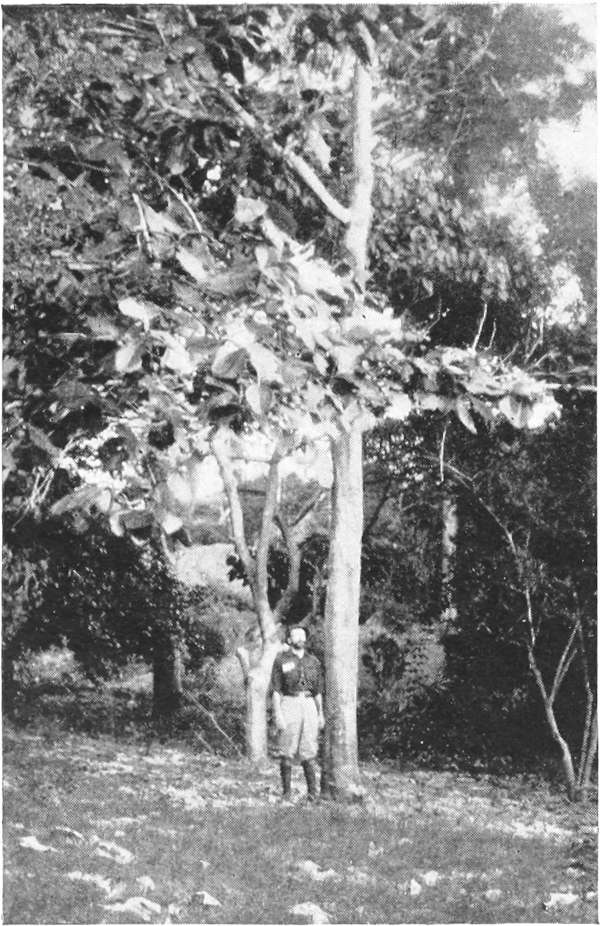
Fig. 36.—Khaya Senegalensis, five years old, from seed obtained by H. N. Thompson, Esq., in Shaki District.
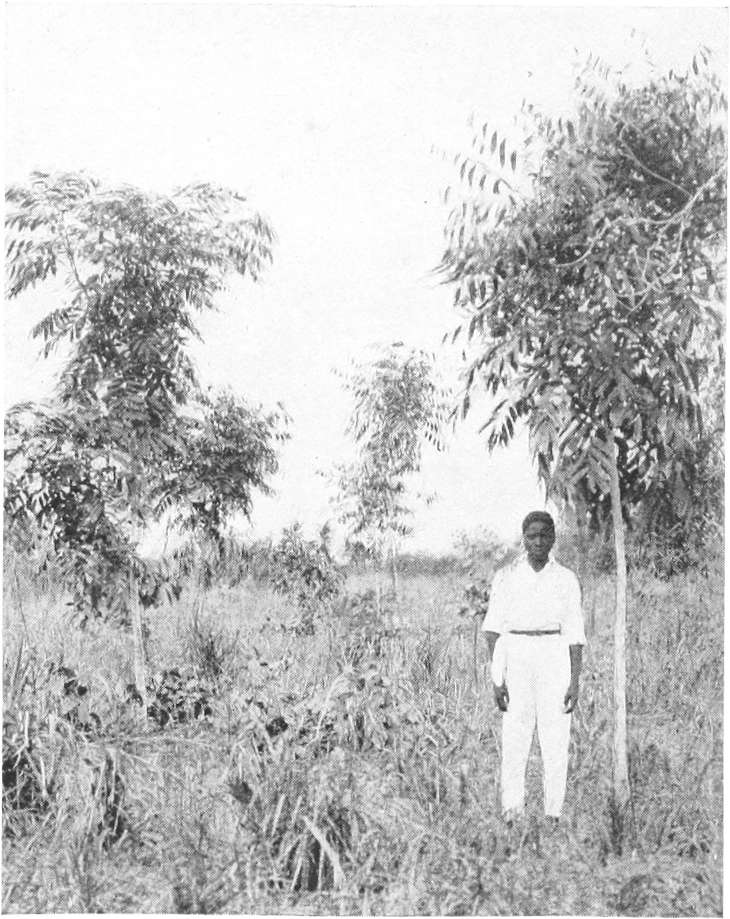
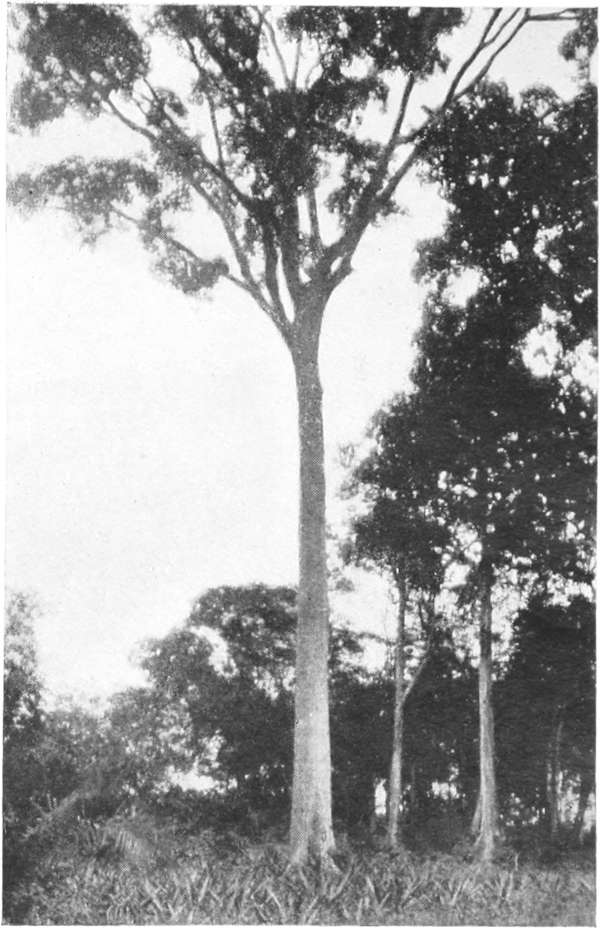
Fig. 37.—Mature Iroko Tree (Chlorophora excelsa), over 12 feet in girth in 1911, since cut down and used for building the Chief Conservator of Forests’ House.
To face p. 184.
Lagos is the first port of call in Nigeria, and there is a railway journey of 123 miles before reaching Ibadan, the temporary headquarters of the Forest Department. Olokomeji, 90 miles from Lagos, is the old headquarters, and from here the forestry work of the Southern Provinces is directed. Zaria, situated some 450 miles from Lagos, is the headquarters of the Forestry Department in the Northern Provinces.
A newly appointed officer would be liable to be sent to either of these last-named places; but owing to the larger number of men being stationed in the Southern Provinces, the majority are sent to that centre. Olokomeji is in the middle of a Forest Reserve 26 square miles in extent, and is also the headquarters both of the Western Circle and of its northern division. In each circle there is a Conservator of Forests in charge, and he has an assistant to manage each division. In the event of a shortage of staff it may happen that a new man is put in charge of a division and thus has an opportunity of learning all about the work much more quickly than would otherwise be the case. In the ordinary way he only corresponds with his Conservator and the timber interests of his division on purely local matters.
Since 1901, a moderately large Arboretum has been planted at Olokomeji, containing quite a number of indigenous trees growing under natural conditions, according to the type of climate found in that locality, and also some exotic trees which grow in similar climates in Asia or South America. In a comparatively short time the new Forest Officer can get a very fair idea of the most important timber trees found locally, as well as elsewhere. In connection with the work of renewing the labels on specimen trees, ocular demonstration of all these trees is obtainable. The local Ranger can usually supply the vernacular names, and here is a wide field for linguistic qualifications. Yoruba is the local language, Benin is spoken by a large number of people in the Central Circle, and Hausa by nearly all itinerant traders throughout the country. Ibo, another language, is spoken by nearly 3,000,000 inhabitants, while many of the Cross River people (Eastern Circle) speak Efik; some, however, speak New Calabar or Ibibio, while again, in a large part of the Niger Delta, Brass or Ijor is spoken. Sooner or later the language of the locality should be acquired, and in fact this is prescribed by Government order as a necessary preliminary to the granting of the first increment.
The routine office work includes simple book-keeping, analysis of records, appointments of staff, the engagement of native labour and all payments. The executive work outside is carried out by the Forest Guards, Foresters, and Rangers, who require constant supervision. Owing to the distance, only some of them can report at Forest Headquarters each month, and the rest must be seen when the Forest Executive Officer makes his tour of inspection. If possible, travelling should take the place of indoor work for at least ten days a month.
At first sight, on examining the tropical forest, it appears like a very mixed collection of different kinds of trees; on closer inspection, however, similarities and contrasts are apparent, such as Ebony, Diospyros mespiliformis, with its thin, black scaly bark, and that of the somewhat regularly, deeply fissured bullet-wood tree, Mimusops multinervis, and its white latex, which the former does not exude.
In walking through a forest, it is normally best to make the carriers precede. Owing to their tendency to lag, and their desire to sit down at inconvenient times, it is an advantage to have them in front. Frequently one may have to stop and examine a flower or leaf, and it only adds to the carriers’ labour if the whole column has to stop whilst seeds and specimens are being collected. A march of about 15 miles is sufficient, and takes up the better part of the day, if an examination of the forests is being made on the way. In most parts villages are eight to ten miles apart, sometimes nearer; so the carriers can stop and purchase food. In the larger forests, however, a distance of over 20 miles is sometimes covered without sight of a house; in that case the people of the last village are asked to bring food for the carriers, and the carriers themselves are given a day’s food as well, which has to be cooked on reaching camp. In some places the chiefs provide food (yams, etc.), which is distributed to the carriers, or in some places 3d. a day per head is allowed them for purchasing food. So long as the carrier gets food and his load is not excessively heavy, he is quite cheerful and walks well. He will pick his way in mud, over roots, and up the steepest rocks in the hill forests.
Current wages vary from 9d. to 1s. a day, the head-man getting from 1s. to 2s. a day. Local felling-permits being issued both by the District and Forest Officers to natives for felling timber for local use, at District Stations a call is paid the District Officer to discuss current forest questions and examine the permit books. At the same time there is an opportunity of seeing what further development of forest work is possible in the district. The local Forest Guards, Foresters, or Forest Rangers report themselves, usually giving a very good account of the local forest conditions. Since the demand for local timber has been growing, a stop may have to be made to supervise the marking or girdling of suitable trees for bridge-building under the auspices of the Public Works Department. On a journey through the mahogany forest, the different camps of the timber firms have to be visited. These firms have hundreds of square miles for the purpose of exploiting mahogany and furniture woods. At the same time the checking and inspecting of the stumps of all the trees felled has to be gone through. The young mahogany seedlings are also seen, and from the number of these it is known whether sufficient have been planted to take the place of those cut down. The very rapid growth of these trees can here be studied to advantage; trees now 40 feet high have only been planted a few years. The relative value of the direct planting of seedling trees as compared with the natural regeneration of the forest by self-sown seedlings can be observed with ocular clearness. In one part of the forest one sees natives standing on a platform hacking away with an axe into a huge 50-feet mahogany; in another place a similar tree, fallen, its 90-feet bole already sawn into three round logs: while in a third locality may be seen a native, axe or adze in hand, squaring mahogany logs with a 4-feet side. Later in the season eighty or more natives are engaged in dragging one of these logs on round billets of wood (for rollers) along a track, roughly cleared to the height of a man, to the nearest natural water-way; still later (that is, in July or August), when the rivers rise, the logs may be seen floating singly down to the rafting-place on the main creek, where rafts are made with logs four or eight abreast, each fastened to the next, from a timber-dog at either end, with cane. From here, riverine natives such as the Ijors take the logs to the nearest river or ocean-going steamer port.
The administrative work of the Department is in the hands of the Senior Conservators of Forests, under whom the Conservators manage their circles. The Chief Conservator of Forests, the head of the Department, initiates and controls the whole policy of the Department, being relieved of all details of administration. In order to ensure continuity of policy and action, a Working-plans Division has been formed. A working plan for the forests is a scheme of management laid down for a number of years; no change can be made in such a plan without special reference both to the head of that division and to the head of the Department. With only one year’s service, followed by leave of absence, continuity of action would be broken if it were not for a definitely approved plan.
The Forest Department has supplied the Railway, Marine, and Public Works Department with timber of various kinds. In some cases the timber is obtained by departmental working, and in others is cut by native contractors under the supervision of the Department. In the first instance, the conditions under which timber is to be supplied to other departments are put before the Secretariat, and when once the work has been begun, the local Forest Officer deals direct with the department concerned.
Forestry progress in Nigeria has been less tardy than in several other Colonies, though many forests have been destroyed owing to lapse of time before the formation of a department. In 1904 there were eight, and there are now twenty-four administrative appointments. The amalgamation of Northern and Southern Nigeria into one administration should accelerate the development of Forestry. It is as yet only in its initial stages, and scarcely more than a thousand square miles of forests, out of nearly a hundred thousand which exist in some form or another, have been permanently set aside for further timber production. The revenue-earning capacity of the Forest Department has been somewhat diminished by the war; but with recent legislation more local revenue should be obtained, which should more than off-set any loss already sustained. Provided the financial position of Nigeria remains strong, the prospects of the Forest Department are quite bright.
Although Nigeria has by far the largest Forest Department, very similar conditions of service obtain in the other West African Colonies of the Gold Coast and Sierra Leone; but there are no Forest Officers in the Gambia.
VI. A Review of the Botanical Features of Northern Nigeria.
By Dr. J. M. Dalziel.
The Northern Provinces of Nigeria exhibit in an interesting manner the transition, now familiar in West Africa, of physical characteristics from the tropical forest to the border region “that just divides the desert from the sown.”
So far as the progressive stages may be stated in terms of geographical latitude, we may place the northern limit of the forest belt at about 8° North latitude. A convenient natural boundary in a portion of the area under consideration may be accepted in the lower course of the Benué River from its tributary, the Katsina River, or even as far up as Ibi, to the Niger at Lokoja. On the other hand, the southern limit of the desert is taken at about 17° North latitude, or higher, and thus falls some three or more degrees beyond the northern boundary.
Between these arbitrary limits lies the greater part of Northern Nigeria and practically the whole of Hausaland, presenting physical features which vary through grassy plains and rolling downs, orchard-bush and thin-crowned forest, laterite plateaux and hilly woodlands, to the mountains of the Bauchi Highlands. The vegetative covering over a very large area can be classed as one or other type of savannah, tree and bush savannah, or open orchard and treeless savannah, with intermediate grades. Local topography alters the type here and there, galleries of evergreen vegetation occupying the intersecting belts of permanent streams or fringing a marsh, wide meadows bordered by low forest, but occupied entirely by grasses of few species, with scattered islets of foliage, or, again, outcrops of bare laterite and isolated domes and turtle-backs of crystalline rock, “inselbergs” and “kopjes,” introducing features of their own.
The Niger Delta displays admirably the high evergreen or moist tropical forest. This probably connects itself through the Kameruns with the great Central African forest of French and Belgian Congo, which is again said to be continuous through the gap between Ruwenzori and Lake Albert with that of British East Africa.
West of the Niger Delta the coast, including Lagos, Dahomey and Togo, is sandy, and bush rather than high forest commences almost on the shore. Ascending the Niger, one finds that the true “rain forest” ends, but not abruptly, in the neighbourhood of Asaba; a gradual transition occurs, first to an intermediate type, partly evergreen with many large trees, but mingled with those that lose their leaves in the months of little rainfall. This change is apparent even on the river-bank, and below Lokoja a more open but still semi-evergreen forest clothes the valleys, but shows already more of the deciduous element on the hills. Farther north the voyage from the mouth of the Kaduna River to the Zungeru light railway terminus at Barijuko, as often experienced in previous years, reveals again the progressively deciduous character of the foliage, resulting in a still more open forest.
The river-bank, however, possessing permanent moisture and its own local climate, is an inadequate index of the general features over the country at large. To travel by land from Baro to Zungeru, and thence either through Kontagora to Sokoto, or by Zaria to Kano and Gummel, is to have the complete vision of the West African savannah in its various degrees, and, except for local interruptions associated with considerations of altitude or geological outcrop, etc., or with the lines of perennial streams, to have it in its regular sequence.
Leaving out of account for the present the region south of Lokoja and of the south bank of the Benué, which in part represents the “Zone Guinéenne” of Chevalier, we find that the two routes suggested above will take one through country almost entirely of the types included by the same writer within the “Zone Soudanienne,” with an approach at places along the Anglo-French boundary to the conditions occurring in his “Zone Sahélienne.” It would be difficult and misleading to express these zones definitely in terms of latitude, but one might hazard the statement that the Guinea Zone passes to the Soudan Zone somewhere between 8° and 10° North, and the latter extends either to the northern boundary or verges on a drier belt beyond the latitude of 12° or 13° North. If a complete botanical survey were possible, one could then subdivide each belt into its different areas and provinces, with their special floral characteristics, but at present one must be content to indicate broadly the general composition.
The Soudan Zone, indeed, includes the greater part of Hausaland and is representative of the typical West African savannah and savannah forest. It merges into the drier sandy “steppe” conditions in the north and into the mixed deciduous and semi-evergreen forests farther south. The only giants in height are the silk-cotton-trees (Eriodendron orientale), but baobabs of enormous girth are common, and the largest timber trees are probably the Maje (Paradaniellia Oliveri) and the Kawo (Afzelia Africana), fair specimens of the dry-zone mahogany, Madachi (Khaya Senegalensis), occurring also in favourable situations.
Across the central part of Northern Nigeria, let us say from Kontagora and South Sokoto through the whole of Zaria and South Kano to South Bornu (but excluding the Bauchi plateau, of which I cannot speak from personal knowledge), the plants named in the list here given might be regarded as the average association of species, trees, shrubs and herbaceous, the chief Natural Orders being represented as follows:
Anonaceæ by the common wild custard apple, Gwandar daji, Anona Senegalensis, a shrub.
Capparidaceæ by the Ingidido, Cratæva Adansonii, by shrubs or woody undershrubs of genera Boscia and Mærua, some thorny scramblers of the genus Capparis, and the familiar weed Gasaya, Gynandropsis pentaphylla.
Bixineæ by the Rawaya, Cochlospermum tinctorium, a shrub.
Hypericineæ by the shrub Kaskawami, Psorospermum Senegalense.
Ochnaceæ by the Namijin kade, Lophira alata, a tree very typical of the region, two or three species of Gomphia, and a new species of Ochna, a small shrub with crenulate leaves.
Malvaceæ by numerous species of Hibiscus, including the cultivated Rama (chiefly K. cannabinus) and Cotton, with the Ramaniya, Urena lobata, and various undershrubs and suffrutescent weeds, mostly of the genus Sida. The Kuka or baobab, Adansonia digitata, and the Rimi or Silk-cotton Tree, Eriodendron orientale, marking the sites of human habitations, past or present, are typical species of this area, as is also the red-flowered Gurjiya, Bombax buonopozense (Bombacaceæ).
Sterculiaceæ by the Kukuki, Sterculia tomentosa, a tree, with which we may place the common undershrub Hankufa, Waltheria Americana.
Tiliaceæ by several species of Grewia, the most familiar being the Dargaza, G. mollis, by two or three species of Corchorus, edible herbs allied to jute, and by shrubby weeds of the genus Triumfetta.
Simarubaceæ by Hannoa undulata, a small-sized tree characteristic of the region, and by Irvingia Smithii, a tree more abundant in the South.
Burseraceæ by two species of frankincense-tree—Boswellia Dalzielii and B. odorata—and by Commiphora Kerstingii, a green-barked tree familiar as an enclosure fence in towns.
Meliaceæ by Khaya Senegalensis, the mahogany of the Soudan Zone, by Trichilia emetica, and by Pseudocedrela Kotschyii; also by the naturalized Kurnan nasara, Melia Azedarach.
Olacaceæ by the Tsada, Ximenia Americana, a shrub with small yellow, acid plums, and by the evergreen climbing shrub, Opilia celtidifolia.
Celastraceæ typically by the shrub Gymnosporia Senegalensis, and less by two or more species of woody twining Hippocrates.
Sapindaceæ by the woody twiner Paullinia pinnata, the 3-foliate shrub Schmidelia Africana, and the world-wide twining weed Cardiospermum Halicacabum.
Anacardiaceæ by the tree Odina Barteri, by other species of Odina of more local distribution, and by two species of Anaphrenium.
Connaraceæ by the abundant little shrub Byrsocarpus coccineus.
Proteaceæ by a single species of Protea, a shrub with large capitate flowers, of local distribution in the Central areas.
Polygalaceæ by Securidaca longipedunculata and the field weed Polygala arenaria.
Leguminosæ by—
Larger trees: the Maji or Kadaura, Paradaniellia Oliveri, and the Kawo, Afzelia Africana.
Medium-sized and smaller trees: Parkia filicoidea, Prosopis oblonga, Pterocarpus erinaceus, Isoberlinia doka, Berlinia acuminata in ravines, Tamarindus Indica; several Acacias, e.g. A. Sieberiana, A. campylacantha, A. Arabica; Albizzia Chevalieri, Entada Sudanica; Afrormosia laxiflora and Burkea Africana.
Small trees and shrubs: Detarium Senegalense, Bauhinia reticulata and B. rufescens, Erythrina Senegalensis, Lonchocarpus laxiflorus, Dichrostachys nutans, Mimosa asperata on stream-banks, Cassia Sieberiana, C. Kotschyana and others, along with several shrubby species of Cassia and the dwarf C. mimosoides, Swartzia Madagascariensis, Ormocarpum bibracteatum.
To these must be added the Zamarke, Sesbania punctata, and other spp., and a host of herbaceous plants or half woody undershrubs, chiefly belonging to the genera Crotalaria, Indigofera, and Tephrosia, others of Desmodium, Eriosema, etc., and twiners of Vigna and Rhynchosia.
The chief cultivated Leguminosæ of the region are: Indigo, Indigofera arrecta and other spp., Arachis hypogæa, Vigna sinensis in numerous varieties, and Voandzeia subterranea.
Rosaceæ mainly by Parinarium curatellæfolium, to which may be added P. polyandrum in the South and P. macrophyllum in the North.
Combretaceæ by several species of Terminalia, of which the commonest are the Baushe (of more than one species) and the Kandari, T. macroptera; more fully by a number of species of Combretum, which are trees often gum-yielding, and very typically by the Marike, Anogeissus leiocarpus.
Myrtaceæ by Eugenia Owariensis, a tree, and E. coronata, a shrub.
Lythraceæ by the “henna” shrub, Lawsonia alba, and the weed of damp places, Ammannia Senegalensis.
Araliaceæ by an interesting species, Cussonia Nigerica, a small tree of peculiar habit.
Rubiaceæ by Adina microcephala, a fair-sized tree by bush streams; by very numerous small trees and shrubs, e.g. Crossopteryx Kotschyana, Sarcocephalus Russegeri, Pavetta Barteri, Feretia canthioides, the Gardenia erubescens and the Gauden kura, G. ternifolia, the Giyaiya, Mitragyne Africana, typical of the islets of foliage clothing the grassy swamps, Morelia Senegalensis on stream-banks, and by more humble but abundant species of Oldenlandia, Spermacoce, Octodon, etc.
Sapotaceæ by the Shea Butter Tree, Butyrospermum Parkii, probably the most characteristic member of the association.
Ebenaceæ by the African Ebony, Diospyros mespiliformis.
Apocynaceæ typically by the arrow-poison woody climber Strophanthus sarmentosus, which is always wild, and S. hispidus, which is generally planted near villages—both species called Kwankwanni; also by the more common and inferior rubber vine, Landolphia florida, and shrubs Carissa edulis and Cryptolepis Nigritiana, the woody twiners Tacazzea Barteri and other spp., with numerous others.
Asclepiadaceæ by the very typical giant milkweed Tumfafiya, Calotropis procera, probably always in association with man, the smaller undershrub Asclepias lineolata, and several suffrutescent herbs with tuberous and sometimes edible rootstocks of the genera Xysmalobium and Schizoglossum.
Loganiaceæ by Strychnos spinosa, S. alnifolia, and S. triclisioides, all shrubs or small trees.
Boraginaceæ by Cordia Abyssinica, a small tree, the undershrub Trichodesma Africanum, three or four weeds of the genus Heliotropium, etc.
Bignoniaceæ by Stereospermum Kunthianum, a small tree, and the Aduruku, Newbouldia lævis, confined to towns and rarely more than a tall, slender shrub; the Rahaina or Rawuya, Kigelia Æthiopica, occurs, but in an interrupted distribution.
Verbenaceæ by Vitex Cienkowskii, a fair-sized tree, V. diversifolia, a small tree or shrub, and undershrubs such as Lantana salvifolia, Lippia Ukambensis, and a few species of Clerodendron, etc.
Euphorbiaceæ by Uapaca Guineense, usually only a rather small tree in the deciduous forest, Bridelia ferruginea and B. scleroneura, both shrubs, Phyllanthus floribundus, forming sometimes thicket-like clumps, P. reticulatus, a shrub, Flueggea microcarpa, a white-berried shrub, Antidesma venosum, and very typically by the Jan yaro, Hymenocardia acida, a shrub which in these open regions has nearly always an ochre-red bark. Numerous herbs and half-woody weeds are common, belonging to the genus Euphorbia (E. pilulifera, E. Ægyptiaca, and congeners), Acalypha, Phyllanthus, etc., the Castor Oil shrub (Ricinus communis) and the Physic Nut (Jatropha curcas) are cultivated, while thoroughly representative through the whole area are the familiar cactus-like Tinya, Euphorbia unispina and E. Poissoni, and the Kerana, E. Barteri, the latter at least never away from habitations.
Moraceæ by a host of species of the genus Ficus (or Urostigma) not yet fully elaborated botanically, e.g. Baure, Chediya, Durumi, Kauriri, Wa, etc.
Ulmaceæ. A representative variety is Celtis integrifolia, a fairly large tree.
Salicaceæ by one species of Salix.
Loranthaceæ by seven or eight species of the parasite Loranthus, called Kauchi, clothing deciduous trees with epiphytic foliage.
Orders represented mainly by flowering herbs, undershrubs, etc., are:
Menispermaceæ by the popular medicinal twiner Jibda kassa, Cissampelos Pareira.
Nympheaceæ by at least four species of Bada or water-lily, Nymphæa.
Papaveraceæ by the Yellow Poppy, Argemone Mexicana.
Caryophyllaceæ by species of Polycarpæa characteristic of the dry zone.
Geraniaceæ by the familiar weed Biophytum sensitivum.
Droseraceæ by the widely distributed Sun-dew, Drosera indica.
Ampelideæ by numerous vines of the genera Vitis, Cissus, and Ampelocissus, of which perhaps the most striking are Dodoriya, Vitis quadrangularis, and Dafara, Vitis pallida, while wild vines with edible berries called Tsiberi kinkini are generally of one or other species of Ampelocissus.
Cucurbitaceæ by the familiar cultivated Kabeova or pumpkin, Cucurbita Pepo, and Duma, the bottle-gourd, Lagenaria vulgaris, with its endless varieties, the Guna or water-melon, Citrullus vulgaris, and by many wild and half-wild species, e.g. the Balsam Apple, Momordica balsamina, the Loofah gourd, Luffa Ægyptiaca and L. acutangula, Cucumis prophetarum, and one or more species of tuberous-rooted Trochomeria.
Ficoideæ by common succulent weeds, e.g. Trianthema monogyna, T. pentandra, and Gisekia pharnaceoides, and by species of Mollugo in river-beds, etc.
Compositæ by some weeds of cosmopolitan distribution, e.g. Ageratum conyzoides, Eclipta alba, etc., and by very numerous herbs and suffrutescent plants, amongst which the genus Vernonia is the most abundantly represented, including one typical of the region, viz. V. nigritiana, with several species of Aspillia, Coreopsis, etc., and the chewstick shrub, Vernonia amygdalina.
Melastomaceæ by a few species of Dissotis and Osbeckia.
Campanulaceæ by a common little blue-flowered weed, Cephalostigma Perrottetii, and a water herb, Sphenoclea Zeylanica.
Hydrophyllaceæ by three or more species of Hydrolea, e.g. H. Guineensis, etc.
Lentibulaceæ by ten or more species of Utricularia.
Convolvulaceæ, a conspicuous order, well represented by numerous species of Ipomæa, a few of Merremia, and a few erect undershrubs of the genus Astrochlæna, to which one may add the little blue-flowered weed Evolvulus alsinoides, of wide distribution in the world.
Solanaceæ by the “Thorn Apple,” Datura Metel, by numerous species of Solanum, some edible, e.g. the several cultivated varieties of the native bitter tomato, Gauta, varieties of S. Melongena; others poisonous, e.g. Gautan kura, Solanum incanum, and others; also by two common weeds of the genus Physalis, and the popular herb simple, Dandana, Schwenkia Americana.
Scrophulariaceæ by Scoparia dulcis, of world-wide distribution, and by several parasitic species of Striga, of which the most familiar is the Makasar adwa, S. Senegalensis. Besides numerous humble weeds of cosmopolitan genera, e.g. Moniera, Ilysanthes, etc., mostly occurring in damp places, two or three species of Sopubia may be taken as characteristic of the bush-lands.
Acanthaceæ by a variety of weeds, etc., of the genera Blepharis, Monechma, Justicia, etc., to which the following may be added as characteristic of the Order in Hausaland: Nelsonia campestris, a soft herb of slightly acid taste, Peristrophe bicalyculata, an occasional fodder plant, and Dyschoriste Perrottetii, the mucilaginous seeds of which are used to remove spicules from the eye.
Pedaliaceæ by the locally cultivated Ridi, Sesamum Indicum, and other wild species of Sesamum, by the weed Ceratotheca sesamoides, and by the half-shrubby Rogeria adenophylla.
Labiatæ by several cultivated tubers, such as the Tumuku and Risga, by odorous species of Ocimum and Æolanthus, e.g. the Dodoya, Ocimum Americanum, the weed Acrocephalus polytrichus, and by many common herbs of various other genera.
Amaranthaceæ by the native spinage, Alayafu, Amaranthus caudatus, the Zaki banza, A. viridis, a wild species sometimes cultivated, and by several of the common weeds found in other countries—Celosia argentea, Pupalia lappacea, etc.
Thymelæaceæ by the poisonous Tururibi, Lasiosyphon Kraussii, a yellow-flowered, low, suffruticose plant with a woody rootstock, and by two of three species of Gnidia.
Aristolochiaceæ by the twiner Aristolochia albida.
Lauraceæ by the leafless twiner Cassytha Guineensis.
The Monocotyledonous Orders may be said to be represented as follows:
Hydrocharitaceæ by the yellow-flowered aquatic herbs Ottelia lancifolia and Boottia Abyssinica.
Orchidaceæ by a fair number of tuberous terrestrial orchids, of which Lissochilus arenarius is the most typical, several Habenarias and Eulophias, and a very few epiphytes, e.g. Ansellia Congoensis.
Scitamineæ abundantly by Kœmpferia Æthiopica in open woods, Costus afer in shady ravines, and Fitta, the food-wrapper leaf, Clinogyne filipes, in streams, etc.
Iridaceæ by several species of Gladiolus, e.g. G. quartinianus, and of Tritonia.
Amaryllidaceæ by Crinum yuccæflorum, the red-flowered Hæmanthus rupestris, Pancratium trianthum, and Curculigo Gallabatensis.
Taccaceæ by the tuberous Tacca involucrata.
Dioscoreaceæ by Dioscorea prehensilis and other cultivated yams, chiefly in the South or on pagan hills, and by some species which are either wild or escapes.
Liliaceæ by several species of Urginea, e.g. U. Nigritiana, U. Indica, etc., by other bulbous species of the genera Anthericum, Dipcadi, etc., by the climbing lily, Gloriosa superba, several species of Chlorophytum, Aloe Barteri, and by prickly scramblers such as Asparagus Pauli-Guilelmi, Smilax Kraussiana, etc.
Alismataceæ by some flowering water-plants, e.g. Burnatia enneandra, Lophotocarpus Guyanensis, etc.
Commelinaceæ by various species of Aneilema—A. lanceolatum, A. Sinicum, etc., of Commelyna—C. nudiflora, C. umbellata, etc., and of Floscopa and Cyanotis.
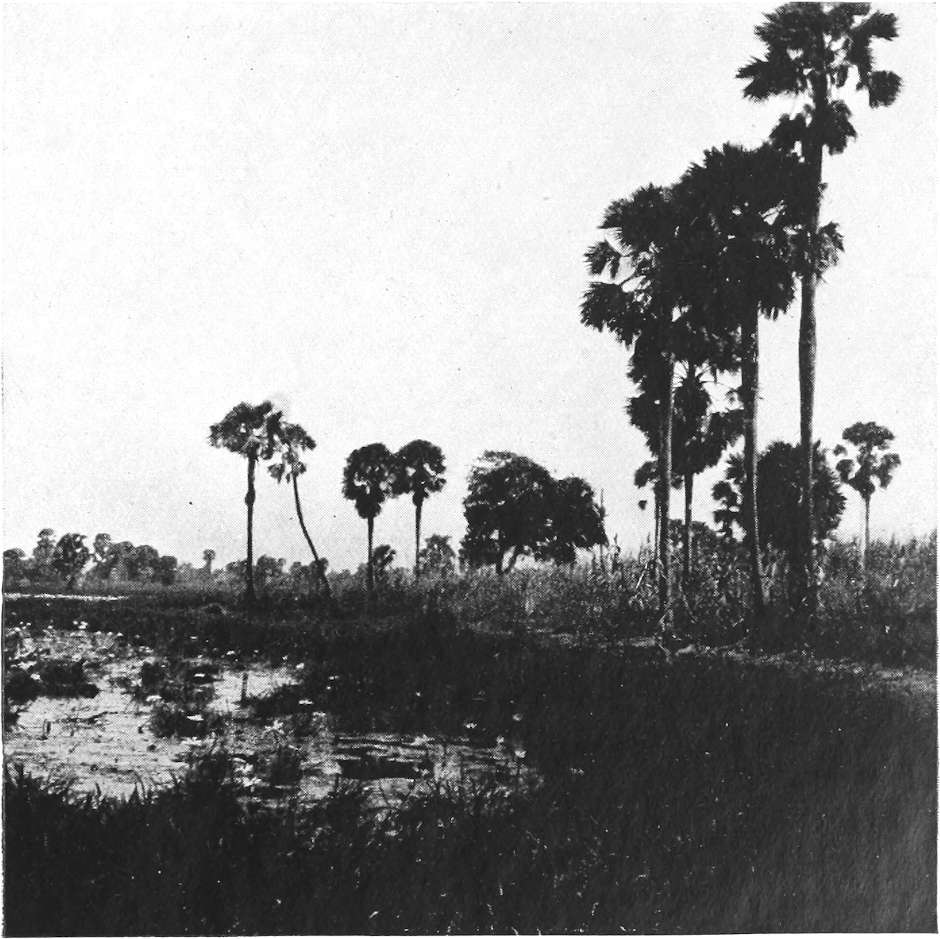
Palmæ by the Giginya, Borassus flabellifer, var. Æthiopum, the Goriba, Hyphæne Thebaica, chiefly in the North, and the Tukuruwa or Bamboo Palm, Raphia vinifera, in ravines only.
Aroideæ by Culcasia scandens, by the Kinchia with yellow rhizome, Stylochiton Dalzielii, Amorphophallus Barteri and A. dracontioides, Anchomanes Dalzielii, and other species.
Cyperaceæ by very numerous species of Cyperus, e.g. the edible Aya, C. esculentus, and the uncultivated Aya aya, C. rotundus, C. Fenzelianus, etc., and several of Pycreus, Fimbristylis, Kyllingia, Bulbostylis, etc.
Gramineæ by the predominant tribe, Andropogoneæ, with numerous other genera—Eragrostis, Aristida, Digitaria, Pennisetum, Chloris, etc., and by a single locally distributed bamboo, Oxytenanthera Abyssinica. The chief cereal is Guinea Corn, Dawa, Sorghum vulgare; both species of sugar-cane, Rake, Saccharum officinarum, and Takanda, Sorghum vulgare, var. saccharatum, are cultivated.
The Filices are poorly represented by the widely distributed Adder’s Tongue, Ophioglossum vulgatum, the water-fern, Cratopteris Thalictroides, by Adiantum lunulatum, A. Schweinfurthii, and a few species of Nephrodium asplenium, etc., by no means typical of the region.
Having thus given a bird’s-eye view of the floral composition in the central region of Hausaland, one may proceed to examine the variations revealed in passing south to the semi-evergreen forests and north to the drier open savannahs.
Southwards the transition is gradual, and nowhere abrupt, from forest savannah with annual bush-fires and consequent tendency to revert to grass, to forests in which the number of species is greater and the deciduous element is more mingled with evergreens, either by the persistence of species which in a drier region are deciduous, but retain their foliage where the increased rainfall allows of this variation, or by the appearance of species which always possess the evergreen habit. Bombax buonopozense is an example of the former and probably also Afzelia Africana and several others.
Some of the added constituents either absent from or more rare in the area of lesser rainfall are:
Anonaceæ: Xylopia parviflora, Hexalobus Senegalensis, Popowia Mannii.
Capparidaceæ: Ritchiea sp., Capparis viminea, etc.
Bixineæ: Oncoba spinosa.
Sterculiaceæ: Cola laurifolia.
Rutaceæ: the Fasa kwari, Zanthoxylum Senegalense.
Meliaceæ: Trichilia retusa.
Anacardiaceæ: Spondias lutea, Hæmatostaphis Barteri, and the cultivated mango.
Sapindaceæ: Blighia sapida.
Connaraceæ: scrambling shrubs, e.g. species of Agelæa and Cnestis.
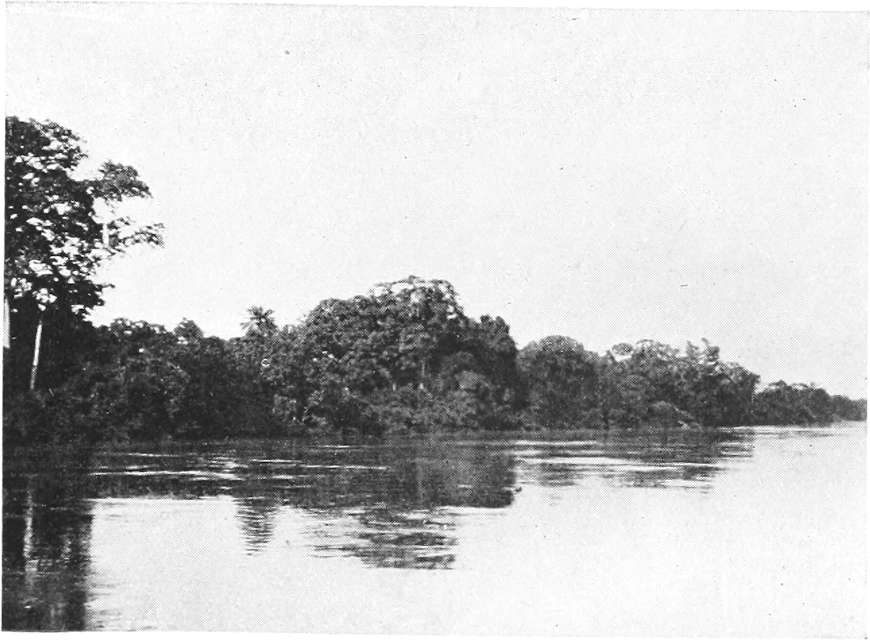
Fig. 38.—Marsh or “Fadama,” with islets of foliage, Benué overflow, near Yola.
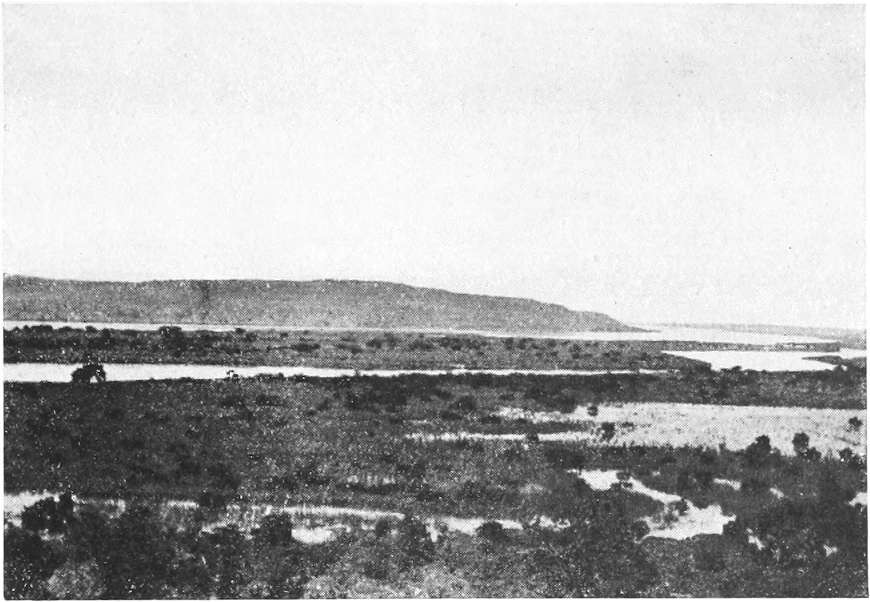
Fig. 39.—The Lower Niger in flood.
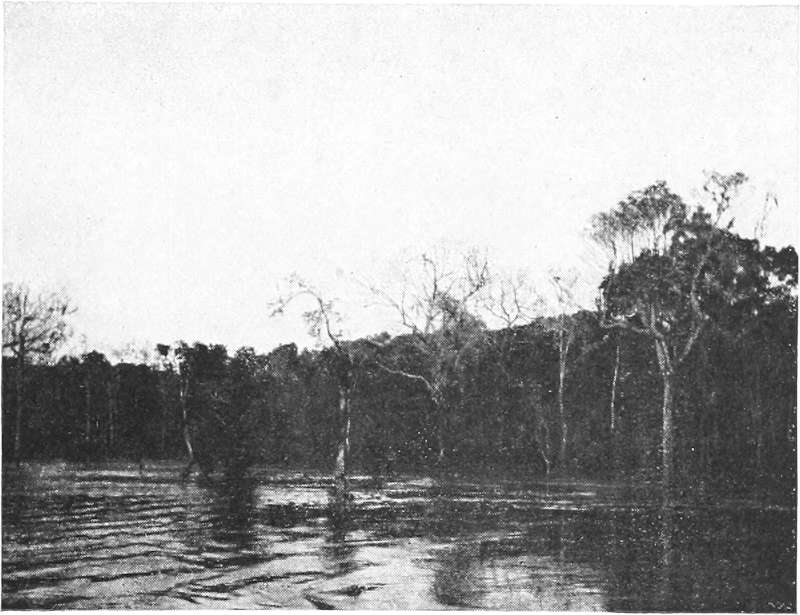
Fig. 40.—Fringing Forest on River Benué in the rainy season.
To face p. 196.
Leguminosæ: Tetrapleura Thonningii, Piptadenia Africana, Erythrophlœum Guineense, Cynometra Vogelii, Pterocarpus esculentus, Dialium Guineense, Millettia sp. near M. Sanagana and other species of Millettia, Cordyla Africana, Berlinia Heudelotii, Cæsalpinia Bonducella, Lonchocarpus cyanescens, Baphia pubescens and B. nitida.
Rosaceæ: Parinarium subcordatum.
Combretaceæ: several species of scarlet-flowered Combretum of climbing habit—C. racemosum, C. constrictum, etc.
Myrtaceæ: Napoleona Vogelii.
Rubiaceæ: Morinda citrifolia, Cuviera acutiflora, Canthium Vanguerioides, Ixora radiata, Uncaria Africana, Oxyanthus unilocularis, some species of Mussænda, etc.
Rhizophoraceæ: Weihea Africana.
Sapotaceæ: Mimusops sp.
Apocynaceæ: Voacanga obtusa and V. Africana, Landolphia Owariensis and other spp., Carpodinus hirsuta, Pleioceras Barteri, and the tree Wadda, Rauwolfia sp. near R. Welwitschii.
Loganiaceæ: Anthocleista Vogelii.
Convolvulaceæ: Calonyction speciosum, Merremia umbellata, etc.
Bignoniaceæ: Spathodea campanulata.
Acanthaceæ: Acanthus montanus, Asystasia Coromandeliana, etc.
Verbenaceæ: Vitex chrysocarpa and V. Angolensis.
Piperaceæ: Piper umbellatum and Piperomia pellucida.
Gesneraceæ: Streptocarpus nobilis.
Euphorbiaceæ: Alchornea cordata, Mallotus oppositifolius.
Moraceæ: Chlorophora excelsa, Ficus Vogelii and other spp., Myrianthus serratus.
Ulmaceæ: Trema Guineensis.
Ampelideæ: Leea Guineensis.
Polygalaceæ: the cultivated Polygala butyracea and the dwarf species, P. Clarkeana.
Balanophoraceæ: the root-parasite Thonningia sanguinea.
Amongst Monocotyledonous Orders the Scitamineæ are more in evidence, Palisota thyrsiflora (Commelinaceæ) appears (along with a Begonia on moist rocks—B. rostrata), and the water-loving Aroid, Cyrtosperma Senegalense.
The Oil Palm, Elæis Guineensis, becomes locally common, ferns become epiphytic, and the Elk’s-horn fern, Platycerium Æthiopicum, appears.
Northwards the savannah forests, with plenty of broad-leaved trees and shrubs, or the open park-like formations with surface well covered with grasses and herbs, give way in some places to still drier Acacia forests, and in others to open areas of scrub, nearly treeless, the soil possessed by grasses and low, scattered shrubs, often thorny. Nevertheless, good pastures are often to be found, frequented by the Fulani in the comparatively short rainy season, and only at some points towards the French boundary do the conditions approach those described by Barth in the latitude of Zinder and Timbuctoo. For example, part of North Bornu, with a rainfall sometimes not exceeding 10 inches, may exhibit features entitling it to rank with the upper region of Chevalier’s “Zone Sahélienne.” A typical association in these scrub regions is familiar to the Hausas in three of the plants mentioned below, viz. the Sabarra, Guiera Senegalensis, the Magariya, Zizyphus jujuba, and the Dashi, Balsamodendron Africanum. Sokoto, with an average rainfall of 25 or more inches, still possesses thinly treed savannahs and bush-lands, with a vegetation composed of grasses, small sedges, low shrubs and the commoner leguminous and other weeds.
Nor does the transition occur evenly across the whole region. In the eastern part between Kano and North Bornu the Acacia type prevails, and whole areas may occur occupied largely by Acacia Seyal, with yellow or rusty ochrey bark. On the western side Acacias, though present, do not appear to prevail, and between Kano and Sokoto there exists a stretch of broad-leaved forest in which most of the species found in Central Hausaland reappear, but after all these differences may be found to hold only over limited areas.
The wide and well populated circle around large northern towns, highly cultivated and more or less stripped of trees to supply fuel does not quite display the natural conditions of the bush, where uncontrolled fires prevent natural regeneration of forest on cleared land, and where open grassy formations with stunted vegetation tend to encroach on the higher types of tree savannah.
The species more characteristic of the northern drier belt within the Soudan Zone—if an arbitrary limit is allowed we may place it about 12° North latitude—may now be briefly indicated, though it will be understood that many of them are already present farther south.
Capparidaceæ: most of the species of Capparis, Boscia and Mærua existing farther south here prevail; the low shrub Boscia Senegalensis is common, while Cadaba farinosa is a characteristic shrub.
Simarubeæ: the Aduwa, Balanites Ægyptiaca, is a typical species of this region.
Burseraceæ: the Dashi, Balsamodendron Africanum, a shrub yielding African Myrrh, is familiar, with its congener B. pedunculatum.
Rhamnaceæ: the Kurna, Zizyphus Spina-Christi, usually planted in towns, the Magariya, Z. jujuba, and the Magariyar kura, Z. mucronata, the last two being very characteristic of the open savannah.
Anacardiaceæ: the Danya, Spondias sp., a fair-sized tree with yellow, plum-like fruit having a leathery rind, is abundant.
Leguminosæ: Acacias are the most typical, but are not as a rule markedly flat-topped, e.g. A. Seyal, A. Senegal, A. albida var. saccharata, Dichrostachys platycarpa, forming thorny thickets, while Entada Sudanica, Acacia Sieberiana, A. campylacantha, Albizzia Chevalieri and others are also evident. Parkinsonia aculeata is found in towns; the Tripoli or Senegal Senna, Filasko, Cassia obovata, is common, and the Tsamiya, Tamarindus Indica, becomes a predominant tree.
Rosaceæ: the Ginger-bread Plum, Gawasa, Parinarium macrophyllum, is more familiar.
Combretaceæ: the Geza, Combretum sp. near C. altum, a shrub or small tree, with several gum-yielding trees of the same genus; the low shrub Sabarra, Guiera Senegalensis, is perhaps the most typical plant of the nearly treeless savannah.
Cucurbitaceæ: the half-wild Gurji, Cucumis Melo, var. agrestis, is common, and the Bambus, a variety of water-melon, is known in the North.
Rubiaceæ: a characteristic species is Randia Nilotica, a thorny shrub; Gardenia Sokotensis is a new species found on low rocky hills.
Apocynaceæ: the Kariya, Adenium Honghel, an unarmed cactus-like shrub, deciduous, with rose-coloured flowers, planted in towns, is characteristic.
Asclepiadaceæ: the small milk-weed, Glossonema Nubicum, and the twiners Oxystelma Bornuense, Pergularia tomentosa and Leptadenia lancifolia, are all abundant, while the Karan masallachi, Caralluma Dalzielii, generally planted farther south, is found wild on bare rocky places.
Euphorbiaceæ: very typical are the two milk hedge Euphorbias, Aguwa, E. sepium, and Fidda sartsi, E. lateriflora.
Moraceæ: species of Ficus planted for shade grow to a large size, especially the Chediya, F. Thonningii, and the Durumi, F. syringifolia; other species generally start as epiphytes.
The Gramineæ is the prevailing Natural Order of Monocotyledons, and includes all types—little annuals, perennial-rooted Andropogons, etc., and the Burugu, Panicum stagninum, which blocks the streams. The fragrant Nobe, Cymbopogon Sennariensis, is a characteristic tufted species, whilst the bur-grass Karangia, Cenchrus catharticus, has long since spread far southward.
Rice and wheat are cultivated; the Bulrush Millet, Gero, Pennisetum typhoideum, tends to displace Sorghum, and a wild rice, Oryza silvestris, is found. The cultivated sugar-cane is the Takanda, Sorghum vulgare, var. saccharatum.
Of Liliaceæ the onion and garlic are features of cultivation. Several bulbous herbs not peculiar to the North are common, e.g. Dipcadi occidentale, Urginea spp., etc.
The Goriba or Dum Palm, Hyphæne Thebaica, is predominant, accompanied also by the Giginya or Deleb Palm, while the Date begins to appear.
Within the limits of the Soudan Zone of vegetation many different types of savannah may be found, besides the expected alterations in botanical groupings resulting from the presence of perennial moisture or due to elevation and rocky outcrop. Leaving the latter out of account, a few notes may be made of some of the varieties familiar to travellers in the Northern Provinces.
1. Tree Savannah or Savannah Forest.
Across a considerable area of Central Hausaland, e.g. occupying a large part of the Zaria plateau west of the Bauchi Highlands, the country, where not cleared for farming, is covered with an open deciduous forest of fair height. This is a fairly closely wooded type, and although it contains few truly evergreen elements apart from those lining the streams, there is, perhaps owing to differing vegetative periods for different species and to the double flowering season noted for many trees in West Africa, practically always a fair amount of foliage present. A proportion of the trees have well developed stems and fairly high crowns, with a leafy canopy which filters but never excludes direct sunlight, and the average height of the larger trees is from 30 to 40 feet. In the best developed portions of such forest the grasses do not predominate, but frequent clearings or patches of stony outcrop lead to the open conditions in which hardy perennial grasses take root, and annual burning results in the encroachment and multiplication of areas of the lower bush savannah referred to below.
This variety of forest is typically seen in Zaria province, e.g. between the village of Ruka and the Koriga stream, near which point a sudden drop in elevation occurs, and is familiar in parts of South Sokoto, Kontagora and Nassarawa, etc. Lophira alata has its chief habitat here, but perhaps the prevailing and most characteristic tree is one called Doka, which has been identified as Isoberlinia doka, Craib, et Stapf. It has broad, shining leaves, and large, flat 5-6 seeded pods which dehisce with curling valves. It seeds abundantly, and young seedlings spring up quickly in the forest or by wayside clearings, etc. Along with it will be found its congener, the Fara doka, Isoberlinia Dalzielii, Craib, et Stapf., less abundant, and differing as to its more obvious features in having leaves not shining, a paler grey bark and a general slight degree of pubescence of all parts. Both species exude a coarse red resin, which does not appear to be of value.
Most of the arborescent species mentioned in the list of the average association detailed above are to be found, sometimes harbouring epiphytic Ansellias and a few woody climbers but no typical lianes, and an undergrowth composed of Leguminous and Composite herbs and undershrubs with some grasses. This type of forest probably at one time covered a much wider area and had a greater extension northward than at present. As mentioned above, a large proportion of its constituents may again be found in the Duru forest between Sokoto and Kano, while within the memory of officials of the present administration areas of woodland previously visible from Sokoto have been denuded for firewood. It tends progressively to give place to the following more open variety of savannah.
2. Bush Savannah.
This is probably the form of “bush” with which travelling officials, hunters, and others are most familiar in every province, and is, when not overloaded with tall grass, deserving of the term “open orchard savannah.” It is composed of scattered shrubs and small trees of short growth and of a considerable sameness, the whole picture being practically filled in with grasses, which may grow to a height of 6 to 8 feet in the rains, but which are swept off by bush-fires in the dry period, leaving bare the intervening spaces, soon to be reoccupied by suffrutescent plants with persistent rootstocks, and later by weeds and the same grasses as before. This resurrection is not due to seeding, which is itself abundant, but mainly to the fact that the majority of bush grasses have perennial underground stems, which, once given occupation, are difficult to dislodge, and, assisted by the recurrent fires, which kill off the seeds and the seedlings of broad-leaved trees, have everything in favour of their natural progress to predominance.
The commoner bush grasses of this habit found here are: Andropogon Gayanus, Cymbopogon Ruprechtii, C. diplandrus, C. giganteum, C. hirtus, C. rufus, Andropogon tectorum, A. apricus, Rottbœllia exaltata, Pennisetum pedicellatum, etc. In clumps, generally found in special situations, e.g. near river banks, etc., are Vetiveria zizanoides, Saccharum spontaneum, Arundo donax, etc. It is possible that some of these species which now cumber the soil might be put to use in supplying the raw material for paper.
The prevailing shrubs and small trees of this formation are generally somewhat as follows: Bauhinia reticulata and B. rufescens, Detarium Senegalense, several species of Combretum with the dwarf C. herbaceum; also Afrormosia laxiflora and occasional Acacias, e.g. A. Sieberiana, Entada Sudanica, Dichrostachys nutans; bright flowering species, such as Cochlospermum tinctorium; several shrubby species of Hibiscus; Cassia Arereh, C. Goratensis and other species, Lonchocarpus laxiflorus, Securidaca longipedunculata, Grewia mollis, Feretia canthioides; the Gardenias—G. ternifolia, G. erubescens, etc.; Stereospermum Kunthianum, Sarcocephalus Russegeri, Parinarium curatellæfolium, Psorospermum Senegalense, Ximenia Americana, Anona Senegalensis, Pseudocedrela Kotschyi, Strychnos spinosa and other spp., Bridelia ferruginea, Hymenocardia acida, Gymnosporia Senegalensis. Occasional larger trees will often be species of Terminalia, Prosopis oblonga, Butyrospermum Parkii, Lophira alata, Vitex Cienkowskii, Sterculia tomentosa, Pterocarpus erinaceus, or even Afzelia Africana and Paradaniellia Oliveri.
In the above association remark must be made of the Taura, Detarium Senegalense, which is here rarely of dimensions meriting the designation of tree, and therefore very different from the large timber known in the southern forests and found also on the forested slopes of Patti at Lokoja; of the Makarfo, a tree of twisted habit, not often over 30 feet high, with flaking bark, apparently much inferior to the Afrormosia laxiflora, if it is this species, in the greater mixed deciduous forests farther south; and of the Tsada, Ximenia Americana, which is here unarmed, has rather thin, glabrous leaves, sometimes almost shining, and thus differs in habit from the coastal variety, if the identity is certain, which is spiny, has dull leaves sometimes half-succulent, and is appropriately called by the French “Citron de la mer.”
3. Park Savannah.
The open park-like formation is another which is typical of this region. It is, perhaps, best seen where the population is not quite sparse, as in the latter case the previous type tends to take possession. The Shea Butter Tree is the one which more than any other gives the tone to this type, but Parkia filicoidea and, especially in the North, the Tamarind are perhaps equally representative. The two first-named, though not necessarily indicating the proximity of a village, have probably in most cases owners, and the intervening spaces may or may not be more or less cultivated. Open park-like country may, however, occur apart from any contemporary interference by man, and wide stretches of it appear alternating with scattered orchard bush or with open grass-land. The grasses are of the previously mentioned types, with many species of Eragrostis, Aristida, small annual tufted grasses and sedges, along with Cassia mimosoides, Oldenlandia grandiflora, O. Senegalensis and other Leguminous and Rubiaceous weeds. Other trees which well maintain the park-like appearance are Terminalia macroptera, occasional species of Ficus, Vitex Cienkowskii, Acacia Arabica and A. Sieberiana.
In flat, wide-stretching meadows which are often marshy in the rains, this formation also maintains its character, single trees or island-like clusters of tree and shrub dotting the expanse of heavy grass which is burnt to desolation by the yearly fires. These islets are generally found to be composed of Giyaiya, Mitragyne Africana, with shrubs such as Feretia canthioides, Sarcocephalus Russegeri, and scrambling undershrubs added thereto, while the edge of such a meadow or “fadama” is in some cases fringed with deciduous high woods, in which occasionally timbers like Khaya Senegalensis and Paradaniellia Oliveri may appear along with the vegetation characteristic of Type 1.
4. Evergreen Fringing Belts.
Along the water-courses which intersect the savannah lands will be found dark evergreen strips of foliage, which, when extending beyond the stream-banks and forming a fairly dense canopy, whatever the nature of the underwood, are generally implied in the Hausa word “kurumi.” The streams may not be always truly perennial, but the verdure remains because the moisture in the soil persists long enough to maintain the non-deciduous type, although bush-fires may reach their very margins. Where a perennial stream of any magnitude occurs, species will be found whose distribution in the Soudan Zone is confined to such localities, but which are widely represented in the South.
Instead of enumerating the constituents of these strips of fringing forest, we may briefly refer to the vegetation of the River Benué, which has been already indicated as in some degree marking the boundary between the semi-evergreen or mixed deciduous forests and the drier tree savannah and open bush lands. The evergreen galleries along the streams or fringing the swampy glades may be taken as on the whole botanically similar to the bank foliage of the Benué and its backwaters, creeks and tributaries. One feature of this type is the abundance of woody climbers, often concealing the foliage of their supports, and conspicuous to the eye in the flowering season are the Combretaceæ, which are here scrambling and climbing shrubs instead of erect trees, e.g. the flame-flowered Combretum racemosum, C. constrictum, etc., Quisqualis Indica and others; also two or three species of Landolphia with other rubber vines, and of Mussænda, scarlet-fruited Connaraceæ, Uncaria Africana, climbing by its old flower-stalks becoming woody hooks, and Alchornea cordata, the most typical liane of these formations. Other twiners are the showy moon-convolvulus, Calonyction speciosum (Ipomæa bona-nox), the Cowhage, Mucuna pruriensis, Dioclea reflexa, Entada scandens and numerous Ampelideæ. These tend to form a dense and sometimes impenetrable tangle, but where trees of timber size occur the undergrowth is more scanty and a variety of forest weeds appear, in which the Scitamineæ may be prominent.
The Benué region is rich in trees, of which the following species may be mentioned: Goron ruwa, Irvingia Smithii, and Gedar kurumi, Pterocarpus esculentus, Trichilia retusa, the large timber tree called Kiriyar kurumi (undetermined), Erythrophlœum Guineense, Millettia sp., Sanagana and M. sericeus, Cynometra Vogelii, Anthocleista nobilis, Berlinia Heudelotii, Baphia nitida, Chlorophora excelsa, Cola laurifolia, Parinarium subcordatum, Kigelia Æthiopica, Uapaca Guineensis (here a large tree and sometimes prop-rooted), Ficus spp. Smaller trees and shrubs are: Spathodea campanulata, Voacanga obtusa and V. Africana, Morinda citrifolia, Xylopia parviflora, Zanthoxylum Senegalense, Oncoba spinosa, Vangueria euonymoides, Ixora radiata, Polysphæria macrostyla, Garcinia ovalifolia, Myrianthus serratus, Elæis Guineensis and Raphia vinifera. Not all of these extend far beyond the Benué, but the majority of them will be found in one or other fringing belt far into the deciduous region, and perhaps the two which best represent this extension of the semi-evergreen to the savannah are the woody climber Alchornea cordata and the tree Irvingia Smithii.
In a general view, Northern Nigeria, thus lying beyond the equatorial belt, possesses plant features which, apart from river and stream fringes, range between the mixed deciduous and xerophilous habit, and in the dry season the prevailing character of the open savannah forests is a monotonous drab or grey, intersected by the dark lines of greenery following the streams or encircling the swamps. The climate is largely of the continental type, with a temperature ranging from 120° F. to 40° or less (exclusive of thermometer readings on the Bauchi plateau), and a rainfall which throughout will usually fall between 30 and 50 or 60 inches, with diminution to 20 or even 10 inches in the most northerly provinces. Such a climate, with the concomitant regularity of two, not four, well marked seasons, the dry and the wet, is entirely that associated with the occurrence of savannah formations, scattered bush with prevailing grasses, suffrutescent herbs and small trees, much open grass or thinly timbered park-land, with stretches of thick woods which are generally not heavily grassed and never cumbered with impenetrable undergrowth.
Trees which are valuable timber species in the moist southern forests often scarcely attain reputable dimensions in the deciduous zone.
These conditions also, which are doubtless partly the result of ill-considered human operations, put certain definite restrictions on cultivated species and determine the character of the natural products of the wild. The staple cereal is Dawa or Sorghum, instead of maize, with Gero or Pennisetum typhoideum in the North. Possibly the limit of Guinea Corn as a staple of native cultivation is also the limit of the savannah forests, i.e. of the region of trees of secondary size, short of the region of Acacias, of Geza, Combretum altum, and of scrub, where Bulrush Millet is the commoner. Both species are generally cultivated along with beans, Vigna Sinensis. The sweet potato displaces the yam and cassava; industrial cultivation is represented by cotton and indigo. Of forest products, the most representative are Shea nuts and gum arabic, rather than rubber and large timber; and lastly, both cattle-grazing and horse-breeding are important industries proper to the region.
VII. Some Trees of Hausaland.
By Dr. J. M. Dalziel.
A few notes on some of the better known trees of Northern Nigeria are here given, the Hausa name being appended in most cases.
Afrormosia laxiflora, Harms (Leguminosæ). Makarfo.
In the mixed deciduous forests towards the coast this appears as a large timber tree, in certain regions dominant both in abundance and size, and is also a constituent of the moist evergreen forests. In Northern Nigeria it never forms a straight stem, never attains the dimensions of a timber tree, and has generally a twisted stem and main branches. Its habit, therefore, rather than its mere presence, affords a striking instance of the changes accompanying the limited rainfall of the savannah forests, and its distribution probably does not extend beyond the northern boundary. The trunk has a somewhat pale piebald appearance, resulting from the flaking of large pieces of the bark exposing lighter portions below. The centre wood is so dark in colour as to have led European foremen of works to report it as lignum vitæ, and the wood is hard enough to earn for it in some districts, along with other trees, the designation “break axe.” It has shining leaves, whitish flowers and thin, flat pods.
Afzelia Africana, Sm. Kawo; “African” or “Rhodesian” Mahogany, “Mahogany Bean,” etc.
A large tree, common to nearly all types of forest in West Africa, tropical high forest, mixed deciduous and savannah. In Northern Nigeria large specimens may still be found, though these do not generally have tall, straight stems, but show the wide-spreading umbrella crown common in drier regions.
Paradaniellia Oliveri, Rolfe. Kadaura or Maje.
This has previously been classed with Daniellia thurifera, Bennett, the so-called West African Copaiba Balsam Tree.
In the Northern Provinces of Nigeria it is one of the largest trees, 50 to 80 feet, with strong, straight stems and affording good timber for local use. The chief native use of the oleo resin is to fumigate garments. Its distribution probably stops short of the northern boundary.
Isoberlinia doka, Craib, et Stapf. Doka.
A tree which is the prevailing type in the savannah forests of Central Hausaland, generally 30 to 40 feet high, with broad, shining leaves, rather small white flowers and large flat pods containing five or six discoid seeds. The valves of the pods curl up after dehiscence, and young seedlings spring up vigorously where not choked by grass, farm clearings in Zaria province being often quickly occupied by them.
A coarse red resin exudes from injuries or punctures of the bark.
Isoberlinia Dalzielii, Craib et Stapf. Fara doka.
Another new species of similar occurrence and habit, differing in having a more grey appearance associated with a slight pubescence, leaves not shining and pods less smooth. A species of the wild silkworm, Anaphe Moloneyi, and perhaps others, are found on them.
Pterocarpus erinaceus, Poir. Madobia; “Senegal Rosewood,” “African Kino,” etc.
A tree generally of 30 to 40 feet or more in open savannah forests, easily recognized by its bright yellow flowers, the regular venation of the leaves, and the bristly, flat, one-seeded pods. The blood-red resin is a variety of Kino, and in districts where the Camwood is not found, the bark of Madobia is sometimes sold as a substitute. The wood is hard and fine-grained.
Cassia Sieberiana, DC. and C.; Kotschyana, Oliv. Marga or Gamafada.
These are small trees with conspicuous yellow flower racemes, having a superficial resemblance to laburnum. They are abundant in the dry savannah regions as well as in savannah forest, and flower freely in the dry season. The pods are long and cylindrical and do not dehisce. Cassia Arereh, Del., is similar, but the leaves are more acuminated and the pods split up longitudinally.
Detarium Senegalense, Gmel. Taura.
A good timber tree in the mixed deciduous and higher savannah forests, as also in the mountainous peninsula of Sierra Leone. Fairly large specimens of timber dimensions occur in the rocky forest overlooking Lokoja, but the Hausa Taura, hitherto identified as botanically the same, is of a very different habit, abundantly represented in the open bush savannah as a shrub or small tree having somewhat flattened fruits, oval, less succulent than, and one-half or one-third the size of, those shed by the forest specimens.
Tamarindus Indica, Zinn. Tsamiya; “Tamarind Tree.”
A very familiar tree in the northern Hausa States and Bornu, as well as in French territory to the north, but much less common on parts of the border-line between Southern and Northern Nigeria, so that probably its actual distribution is local and interrupted. Barth places its limit at Tagalel, in Damerghu, or about 15° North latitude.
In Hausaland it is a conspicuous tree, less from its dimensions than from the beauty of its foliage, sometimes umbrella-spreading and at others compact, and giving a good deal of shade when in full leaf. The ground becomes littered with the small leaflets in the dry months, and as a rule little undergrowth is to be found beneath it.
In Sokoto and Kano provinces, and elsewhere in the North, specimens with a dense, compact and symmetrical crown are common, the branches often reaching to within 3 or 4 feet of the ground. The fruit has familiar medicinal and culinary uses, but rarely develops the soft rich pulp of the Indian specimens. One of the wild silkworms, Anaphe sp., feeds on the leaf, the silken nest being called “Tsamiyar Tsamiya.” A familiar association which did not escape the notice of Dr. Barth is that of tamarind and baobab, in which case the former is often without a proper bole and spreads itself half scandent amongst the stout branches of the baobab.
Parkia filicoidea, Welw. Dorowa; “West African Locust Bean.”
A characteristic tree of the savannah forests, and one of the most typical members of the open park-like formations. It appears to be scarce in Bornu, but abundant from Zaria to Katsina, and its northern limit is probably about 14° North latitude.
The pods afford both food and fodder, the fermented cakes called Daudawa, made from the seeds, being an article of local commerce. In the bush, far from villages, Dorowa trees are ownerless, but elsewhere they are generally private property.
Burkea Africana, Hook. Farin makarfo.
A tree of 30 to 40 feet, of irregular distribution in open savannah forests, fairly common between Yola and Bornu as well as in Southern Sokoto. It has light, silky foliage, flowers in pendulous, creamy spikes, and dark, almost black, bark. The hard wood is used for handles of axes and hoes.
Prosopis oblonga, Benth. Kiriya.
A common tree of the savannah region, extending beyond the Anglo-French boundary, but better developed in the Benué region, where fair timber specimens occur. The wood is hard, with red centre wood, and takes a beautiful polish. It is recognized by its acacia-like foliage, spikes of creamy flowers and stout brown pods, with seeds sometimes used like those of Dorowa.
Bauhinia reticulata, DC. Kargo.
A shrub or small tree, one of the commonest constituents of the bush savannahs; readily recognized by the cleft leaves, rusty bark and flat, twisted pods. The tough bark forms an emergency tie-tie, and its long vast fibres furnish strong cordage, which is its chief use in Northern Nigeria. The bark and leaves, containing tannin, have astringent uses.
Acacia Sieberiana, DC. Fara kaya, or “White Thorn Acacia.”
A very widely distributed species in the deciduous zone, not usually gregarious and occasionally flat-topped. It is easily recognized by its generally dark foliage and pale bark, the flowers not yellow, but in small, creamy-white balls, and by the long white thorns. It yields a soluble gum, which is perhaps not of the best quality.
Acacia Arabica, Willd. Bagaruwa; Indian “Babool.”
One of the commonest species, especially in the northern Hausa States and Bornu, and a source of gum arabic. The flowers are in bright yellow balls and the foliage is a good camel food. The jointed pods are “Sant” or “Gambia” pods, used all over the Soudan for tanning.
Acacia Senegalensis, Willd. Dakwora.
Usually only a shrub, not often over 10 feet, sometimes gregarious, and characteristic of the thin bush savannahs; it has grey bark, flowers in white spikes, and three sharp recurved stipular hooks at the base of each leaf.
This species yields probably the best gum from Senegal to Somali, and the root-bark affords a very tough fibre.
Acacia albida, Del., var. saccharata, Benth. Gawo.
A fair-sized tree, confined to the open dry country in the North, extending into French territory, and an important camel food, but not a gum yielder. The flowers are in creamy-white spikes and the pods are yellow and twisted. It is peculiarly deciduous in the wet season, and bursts into foliage just at the cessation of the rains.
Acacia Seyal, Del. Dussa; “Talh of the Soudan.”
A rather small tree, not often over 20 feet, but gregarious and very abundant in North-east Hausaland and Bornu, less common, but local, in Sokoto, etc. It has a yellow or ochrey bark, white thorns and brilliant yellow balls of flowers, and the pods are narrow, sickle-curved and constricted between the seeds. The gum is of good quality, but not equal to that of A. Senegal.
Acacia campylacantha, Hochst. “Farichin shafu” (= Falcon’s claw).
A fairly tall tree with white flower-spikes and strongly curved spines suggesting the native name. It is sometimes gregarious in limited forest patches, and the gum is said to be good in colour, cleanliness, etc.
Fig. 41.—A Baobab (Adansonia digitata).
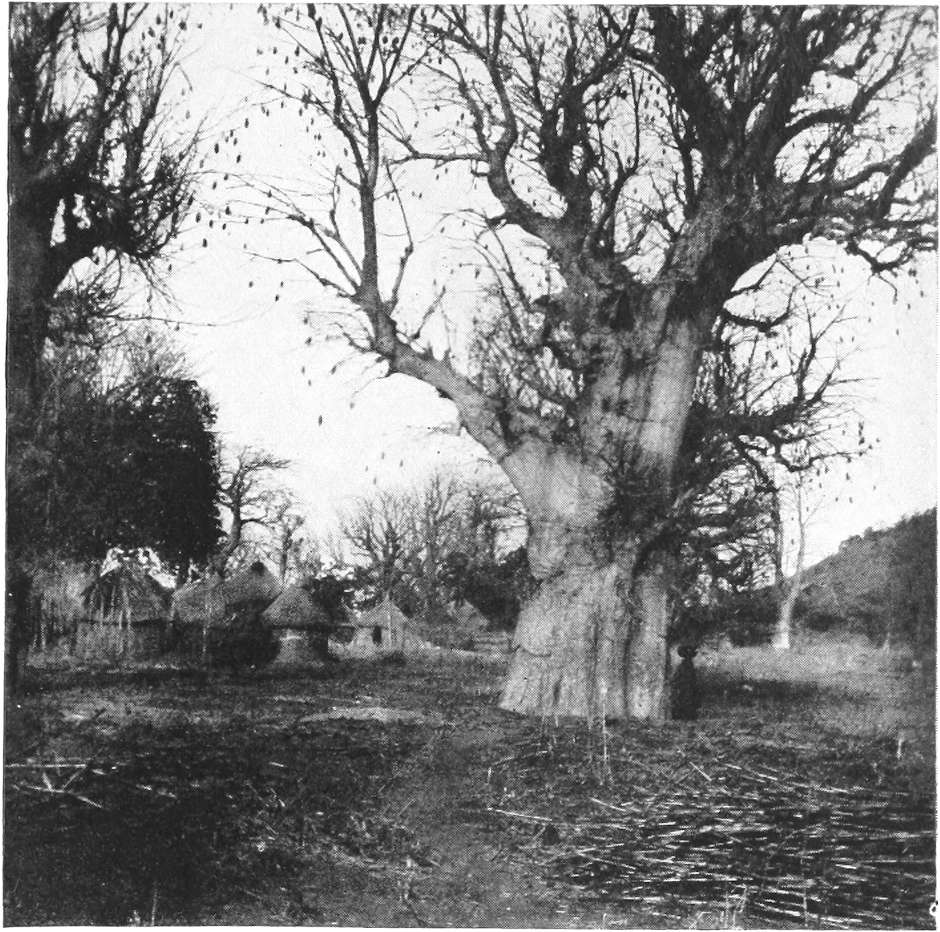
Fig. 42.—Giginya or “Fan Palm” (Borassus flabellifer, var. Æthiopum), with Water-lilies (Nymphæaceæ).
To face p. 208.
Albizzia Chevalieri, G. et P. Katsari.
A tree of 30 to 40 feet, common in the more open savannah formations, especially in the northern districts. It has whitish flower-balls, with long, pinkish stamens and thin, flat pods. The bark is sometimes used for tanning.
Entada Sudanica, Schweinf. Tawatsa.
A small tree of the savannah forests and open plains, easily distinguished by the peculiar jointed pods, each embossed seed section falling out and leaving the empty marginal frame. The flowers are in yellowish axillary spikes, generally two or three together.
Mimosa asperata, Linn. Kaidaji.
Forms dense thorny thickets fringing the open bush streams. The flowers are in pinkish balls, and the leaves possess the sensitive quality in a mild degree.
Lophira alata, Banks (Ochnaceæ). Mijin kade.
An “African Oak” and one of the most familiar trees of the savannah forests and open country. It is apparently very similar to Lophira procera, the “Red Ironwood” timber tree of the southern forests; frequently stunted by forest fires. The seeds yield an oil and the bark is medicinal. The flowers are in handsome white panicles, appearing about November or December, and the leaf and habit often give it an appearance resembling the Shea Butter Tree, but the leaf is beautiful and finely veined. An extraordinary fact is the widespread belief of pagan tribes in the efficiency of the leaf as a charm.
Eriodendron orientale, Steud. (Malvaceæ). Rimi; “Silk-cotton Tree.”
A giant in the evergreen forests, and still a comparative giant in the dry zone. In Northern Hausa towns the only very tall trees are Rimi; the wood is light and the stems are sometimes hollowed out for canoes: the floss of the seeds is Kapok, and has the usual local uses. Barth says its distribution eastwards stops at 11° East longitude, and that it is therefore absent from Bornu proper.
Northwards it apparently scarcely extends beyond the Anglo-French boundary.
Bombax buonopozense, Beauv. Gurjiya; “Red-flowered Silk-cotton Tree.”
A member of the evergreen forests, but quite a common tree of the open country and savannah forests, sometimes more or less gregarious, and extending at least beyond the Anglo-French border. It reaches about 40 feet or more in height, with crowded spines on the bark and tulip-like red flowers appearing during the deciduous period, generally after the middle of December and in January.
Adansonia digitata, B. Juss. Kuka; “Baobab.”
A characteristic tree of the dry savannah regions, often grouped in inhabited areas, with enormously stout stems, but in height limited to 40 to 60 feet. Specimens of 30 to 40 feet girth are not quite uncommon, the swollen stem, with soft, spongy wood, being an adaptation to a dry climate, by storing water to meet excessive transpiration by the leaves.
The bark is smooth and often has a shiny purplish tinge. Apart from fibre from both bark and wood, the dry fruit pulp and the seeds are prepared in various ways as food and drink. Large specimens are still found at Maradi, north of the Sokoto boundary, but chiefly stunted trees are met with at Zinder.
Sterculia tomentosa, G. et P. (Sterculiaceæ). Kukuki.
A member of the semi-evergreen forests and common also in the dry zone as a medium-sized tree with soft, palmate-shaped leaves and pods four or five together, splitting to expose the black seeds with yellow arils. A watery juice from the bark refreshes thirsty travellers and a kind of gum tragacanth exudes from the trunk.
Hannoa undulata, Planch. (Simarubeæ). Namijin gwabsa or Takandar giwa. (One of two species called by the latter name, vide Cussonia.)
A common tree of no great size in the savannah forest. The leaves are pinnate, with five to seven leaflets on long stalks, the flowers, in creamy, fragrant panicles, appearing in October or November, and the fruit is a black plum with unpleasant taste.
Irvingia Smithii, Hook. fil.
A tree of evergreen and mixed deciduous forests which invades the ravines and fringing belts in the savannah region as far at least as Kontagora. In the Benué region it is a fairly large tree of 40 feet or more, often gregarious, as in a patch of moist forest opposite Katsina Allah, along with Pterocarpus esculentus. The scarlet fruits are known as Goron ruwa or Goron biri (i.e. Water or Monkey Kola), and are eaten by monkeys.
Balanites Ægyptiaca, Del. Aduwa; “Desert Date.”
Typical of the Soudan and of the northern drier provinces of Nigeria and extending into French territory; characterized by its bifoliate deciduous leaves, spiny habit in dry soil and evergreen bark. The yellow oval fruit has a thin layer of sugary, bitter-sweet pulp, and the kernel yields Betu oil.
Boswellia odorata, Hutch., and B. Dalzielii, Hutch. (Burseraceæ). Hano or Ararabi.
Two new species of “Frankincense Tree,” yielding a fragrant gum resin. They reach 30 feet or so in height, have white bark which peels off in thin sheets, racemes of white flowers and pinnate leaves with serrate leaflets.
Commiphora Kerstingii, Engl. Dali or Bazana.
A small tree, commonly used as a fence support around native compounds. The bark is smooth and green, and the soft wood can be hollowed out for quivers.
Balsamodendron Africanum, A. Rich. Dashi.
A shrub commoner in the northern regions, extending beyond the Anglo-French boundary. In arid regions it forms a good hedge, with some resemblance to the blackthorn. The leaves and bark are fragrant, and it yields a gum resin which is a variety of African myrrh.
Khaya Senegalensis, A. Juss. (Meliaceæ). Madachi; “West African Mahogany” of the dry zone.
A large tree for the dry savannah region, but one of the smaller of the mahoganies. In the North, where dry conditions prevail, it tends to favour the banks of streams or the edges of marshy meadows, and is never buttressed, but often acquires a good spreading crown. Good timber specimens have been found on the Gurara River, but apart from this, and perhaps some other favoured localities, it does not as a rule exceed about 4 feet to 4½ feet in girth. It occurs from Gambia to Nigeria and Kamerun, and is again found as a West African element in the flora of Uganda and Mozambique. Northwards it reaches North Sokoto, but apparently does not extend to Zinder. The bark is a reputed bitter tonic in native medicine.
Pseudocedrela Kotschyi, Harms. Toman or Tonas; “Dry-zone Cedar.”
In Northern Nigeria this is rarely more than a small to medium-sized tree of 20 to 30 feet, and not usually of good straight growth, probably from the effect of annual fires, but yielding a fine wood. The leaflets are undulate-margined, the flowers are in graceful panicles, appearing about February and March, and the dry, erect capsules, full of winged seeds, split from above downwards in five valves. Occasionally little copses of the species occur, as it seeds freely and numerous seedlings arise—most of them, however, doomed to perish in the next bush-fire. In protected localities it might be fostered into a useful timber tree. Natives find various medicinal uses for the bark.
Trichilia emetica, Vahl. Jan sayi.
A fairly common tree across Central Hausaland, not often much over 20 feet in height. It has medicinal properties; the white flowers are fragrant and used to rub the teeth, and the seeds yield a less important oil.
Trichilia retusa, Oliv.
A large timber tree with tall, straight stems, found in the Benué region. The flowers are white, appearing about January, in axillary racemes or below the leaves; the leaflets are generally five or three, with wide, shallow indentation at the tip.
Odina Barteri (Anacardiaceæ). Faru.
A fair-sized deciduous tree of the savannah forests, with pinnate pubescent leaves and inconspicuous flowers in pendulous, clustered racemes. It yields a sort of resin, and the small fruits, tipped with four sharp points, are eaten by birds.
? Spondias sp. Danya.
A very common tree of the drier savannah forests, very abundant in the North; it has light foliage of pinnate leaves with small leaflets and a yellow, very pleasantly flavoured fruit, with a tough rind like that of the mango. The fruits litter the ground in the months of May and June. The wood is very hard and used for making a heavy kind of basin known as akushi.
Anogeissus leiocarpus, G. et P. (Combretaceæ). Marike.
This is one of the “Chew-sticks” of Yoruba, and while occurring in fringing forests and evergreen patches, it is very common in the open savannah regions, but probably does not extend beyond the northern boundary. It may be 50 feet in height, and possesses light, graceful foliage, pale bark and small yellowish flowers in globose heads, forming tiny dry two-winged fruits. It affords an inferior gum and is much used medicinally.
Terminalia sp., near T. macroptera, G. et P. Baushe.
A fairly large tree, 40 feet or more in height, with the oval winged and embossed fruits of the genus, along with its congeners, e.g. T. Elliotii, Engl. and Diels, T. Baumanii, Engl. and Diels, etc., very abundant and typical of the savannahs of Northern Nigeria. Bows and sticks are made from the roots.
Terminalia macroptera, G. et P. Kandari.
A smaller tree with much broader leaves, typical of open park-like formations.
Combretum spp.
Several arborescent species of Combretum are truly characteristic of the open and bush savannahs, and are well represented even in the northern parts, where, however, in some districts, they are replaced by Acacias. They are practically all gum-bearing; the flowers are small and yellowish in axillary spikes, but the genus is generally easily recognized by the fruits having four papery wings and the usually whorled arrangement of the leaves. The Northern Nigerian species have not all been fully determined, and the native names are at present somewhat confused and may include more than one species. Most of them in this region are shrubs or small trees, occasionally reaching 30 feet or so, with smooth or hoary foliage. The Taramniya is generally C. leonense, Engl. and Diels; the Chiriri of Sogoto includes probably C. Hartmannianum, Schweinf., and other species; the Dalo is C. glutinosum, Perr., or near it.
Parinarium curatellæfolium, Planch (Rosaceæ). Rura.
A small tree, very common in the bush and forest savannah, usually only about 10 to 15 feet high, with pale leaves and a dry, pear-like fruit. Of its congeners, P. macrophyllum, Sabine, the Gawasa or Gingerbread Plum, is its representative in most northerly provinces, and P. polyandrum, Benth., with grape-like bunches of purple not edible fruit, is common in the southern parts of the deciduous region.
Eugenia Owariensis, Beauv. (Myrtaceæ). Malmo.
A small tree, generally about 20 to 30 feet in height and always found in moist places, by streams, etc. It has shining, odorous foliage, white, fragrant flower-clusters, and a small black-purple, succulent fruit.
Cussonia Nigerica, Hutch. (Araliaceæ). Gwabsa or Takandar giwa.
A new species, occurring in the open and bush savannahs as a small tree from 10 to 15 feet in height, with peculiar bare, raking branches, producing at their ends clusters of digitate leaves or of long catkin-like spikes of inconspicuous flowers. Incisions in the rough, fissured bark yield a clear gum. (For the native name compare Hannoa undulata.)
Cratæva Adansonii, G. et P. (Capparideæ). Ingidido.
A small tree, occasionally 20 feet high, fairly abundant in the North, of local distribution and common in towns. The leaves are trifoliate and can be used as a vegetable; the flowers are white and the fruit yellow, spherical, and about the size of a small orange.
Zizyphus spina-Christi, Willd. (Rhamnaceæ). Kurna.
A small tree characteristic of the dry open regions and commonly planted in northern towns. It is generally about 10 to 20 feet high, spiny, with leaves three-nerved, and a rather dry, edible berry of pleasant taste.
Z. jujuba, Lam., is the Magariya, and is similar, but in these regions generally has less of a stem and is more shrubby and thorny, and is not, as a rule, planted, though the fruit is even pleasanter.
Sarcocephalus Russegeri (Rubiaceæ). Tafashia.
A shrub, or occasionally a small tree, common in moist meadows, but found also in the open dry bush. The flowers are in rather large creamy balls, and the coarse red, succulent fruit is the analogue of the Sierra Leone peach, S. esculentus, Afzel, which grows to a large tree in the evergreen forests.
Mitragyne Africana, Korth. Giyaiya.
This is a characteristic tree of swampy areas in the deciduous regions, found by streams and marshes or forming island-clumps with a few lesser shrubs and weeds in the grassy meadows, which dry up in the rainless months. It is generally from 20 to 30 feet in height and has close, spherical heads of whitish flowers and smooth, but not shining, leaves with regular venation.
Crossopteryx Kotschyana, Fenzl. Kasfiya.
A small tree of 15 to 20 feet, with foliage resembling that of Giyaiya, bunches of whitish flowers, and abundant small black, pill-like fruits, which remain attached long after they are ripe.
Adina microcephala, Hiern. Kadanyar rafi.
A fairly tall tree of 30 to 40 feet, found in stream-banks in the savannah region. It has whitish balls of flowers and tapering smooth leaves.
Morelia Senegalensis, A. Rich. Innuwar bauna.
An evergreen shrub 10 to 20 feet high, common on stream-banks, and found both in the semi-evergreen forests and in the fringing belts of the deciduous region. The flowers are white and somewhat fragrant, and the fruit is spherical, tipped by the tubular remains of the calyx.
Butyrospermum Parkii, Kotschii. (Sapotaceæ). Kadanya; “Shea Butter Tree.”
A typical tree of the savannah hinterlands, and one which gives the park-like character to many parts of Northern Nigeria, it barely extends to the northern boundary, and is rarer on the Bornu side. It is generally 25 to 30 feet high or more, with a dense crown and a curiously corrugated bark. Flowers, in white, head-like clusters generally appear about December. The brown, chestnut-like kernels are ripe about July. The milky juice and the coarser venation of the leaves readily distinguish this tree from Lophira alata.
Diospyros mespiliformis, Hochst. (Ebenaceæ). Kanya or Kaiwa; “African Ebony.”
A fairly large tree, up to about 40 feet in height, in the savannah forests and open country, extending north to beyond the Anglo-French boundary, larger in the mixed deciduous forests farther south and in fringing evergreen belts. The foliage is dark and the bark blackish; the inconspicuous whitish flowers, of separate sexes on different trees, are attractive to bees. The wood is white, with a black heartwood, and the spherical yellow fruits (“Monkey Guava”) have a crisp rind and sweet edible pulp, with four or five seeds.
Strychnos spinosa, Lam. (Loganiaceæ). Kokiya.
A small thorny tree with opposite three- to five-nerved leaves, conspicuous by its round yellow fruit, which is orange-like, but has a hard rind and flat seeds embedded in a pleasant acid edible pulp.
Cordia Abyssinica, R. Br. (Boragineæ). Aliliba.
A shrub or small tree with broad leaves and white flowers, valued for the sweet yellow berries, which are used in making sweetmeats.
Kigelia Æthiopica, Decne.; var. Bornuensis, Sprague (Bignoniaceæ). Rahaina or Rawuya.
A species of “Sausage Tree,” of irregular distribution in Northern Nigeria, known in Sokoto, etc., but commoner in the Benué region and in Bornu (possibly more than one species occurring). It grows to a fairly large size, with dense foliage and pendulous racemes of lurid purple and spotted flowers and large, yam-like fruits.
Stereospermum Kunthianum, Cham. Jiri or Sansami.
A small tree of the savannah forests, with smooth pale bark, beautiful pink caducous blossoms and long slender pods.
Vitex Cienkowskii, Kotschii et Peyr. (Verbenaceæ). Dinya.
A fairly large tree, chiefly of open forest country and extending at least as far as the Anglo-French border. The bark is somewhat smooth, the crown of digitate leaves fairly dense, and the black, damson-like fruits are used in making molasses and sweetmeats. The natives value the wood as strong and suitable for local use.
Uapaca Guineensis, Muell. Arg. (Euphorbiaceæ). Ka Jafogo.
In the open country a rather small tree, with the habit of a Ficus, but becoming a large tree, sometimes prop-rooted, in the Benué region and in some ravines.
Chlorophora excelsa, Benth. and Hook. (Moraceæ). The “Iroko” or “Odum.”
Some of the splendid Nupé canoes are made of this, but the tree really belongs to the southern forests, though it occurs in the Benué region and perhaps in some northward extensions in river valleys.
Celtis integrifolia, Lam. Zuwo or Dukki.
This is a fairly large tree of the savannah forest region, found as far north at least as Sokoto. The leaves are edible and are used as fodder.
Ficus or Urostigma spp.
This genus has not yet been fully elaborated, and the native names cannot in all cases be definitely applied to distinct botanical species. The following appear tp be fairly established: Chediya, Ficus Thonningii, Bl., one of the commonest shade trees, planted in towns and abundant far North in French territory; Durumi, F. syringifolia, Warb., perhaps equally common, with shining heart-shaped and pointed leaves; Baure, F. gnaphalocarpa, A. Rich. (the rough-leaved species with soft figs which are sometimes considered edible); Uwar yara, F. Capensis, Thunb. (sensu lato), recognized by the wavy or indented-margined leaves, and especially by the figs being borne in dense clusters on the trunk; Gamji, F. platyphylla, Del. (the source of “Red Kano Rubber” and the host of one of the wild silkworms, Anaphe sp.). Kawuri probably includes F. kawuri, Hutch., and F. glumosa, Del. Wa is a species with broadly cordate leaves, strongly veined, and Shirinya is a narrow-leaved species. F. Vogelii, Mig., is a glossy-leaved rubber-tree, more abundant in ravines and in the moister forests farther South.
The Gamji and Shirinya, and perhaps some of the others, almost invariably begin life as epiphytes.
Most of the species have abundant aerial rootlets, and the latex of F. Vogelii, of Gamji, and perhaps of Kawuri and Shirinya, yields rubber of varying quality.
Raphia vinifera, P. Beauv. (Palmeæ). Tukuruwa; “Bamboo Palm,” “Wine Palm.”
This well-known palm is found in ravines in the savannah region as far as Zaria province, but is a proper member of swampy patches and moist forests of the South. Roofing poles and palm-wine are its products most used in the North.
Borassus flabellifer, var. Æthiopum, Warb. Giginya; “Deleb,” “Palmyra” or “Fan Palm.”
The most characteristic palm of Hausaland, with tall, straight and often beaded stems. The germinating shoots from the planted nuts are a vegetable called muruchi, and the wood and leaves have the familiar uses in house-building, mat and basket weaving, etc.
Hyphæne Thebaica, Mart. Goriba; “Dum” or “Gingerbread Palm.”
The typical palm of the more northerly Hausa provinces, characterized by its forked stems and obliquely fan-shaped leaves. The kernel and the rind of the nut are used in certain food preparations, and the fronds have the usual applications for plaited utensils, etc.
Phœnix dactylifera, Linn. Dabino; “Date Palm.”
Introduced by Arabs and confined (with a few exceptions, e.g. at Yola Mosque) to the Northern towns.
In Kano it may be possible to see the three palms, Deleb, Dum and Date, together, but the last is in no sense a tree of Hausaland.
J. M. Dalziel.
Fig. 43.—Mahogany (Khaya grandis), 6½ years old, showing bent leader, owing to previous one being eaten out by the leading-shoot borer.
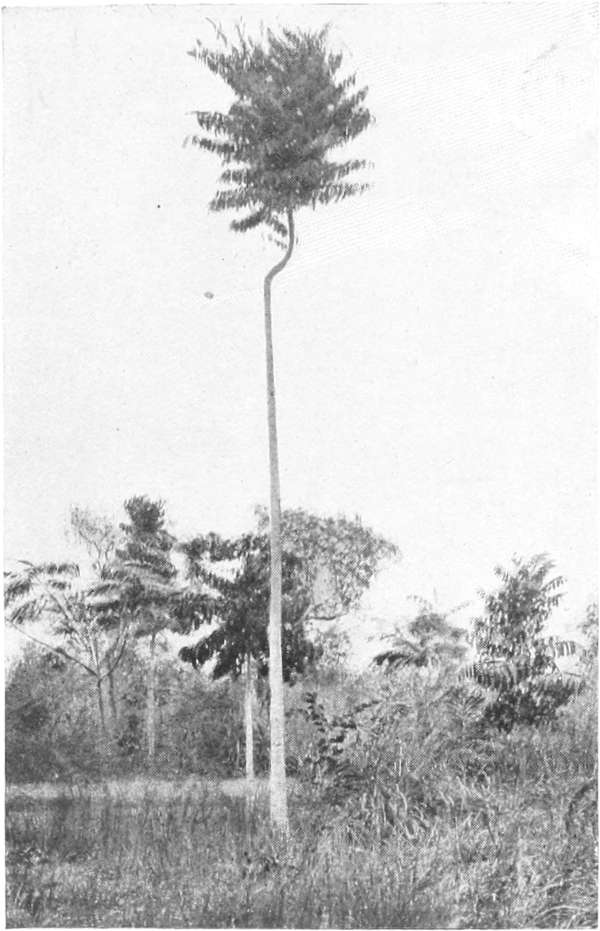
Fig. 44.—1909 Mahogany (Khaya grandis and K. Punchii). Plantation after six years’ growth, near road to Chief Conservator’s House, Olokemeji Arboretum.
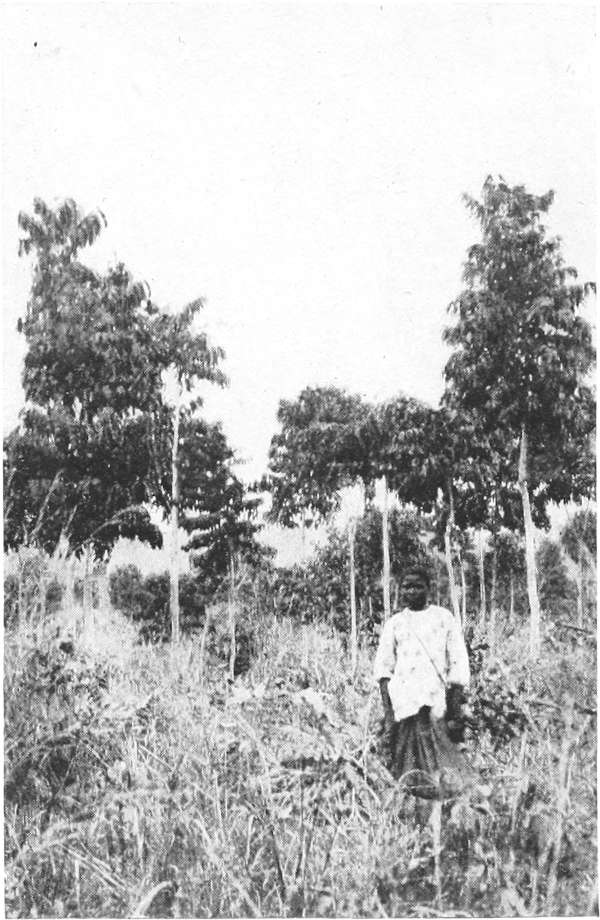
Fig. 45.—The largest Mahogany (Khaya Punchii), seven years old, Olokemeji Arboretum, in the Forest Reserve.
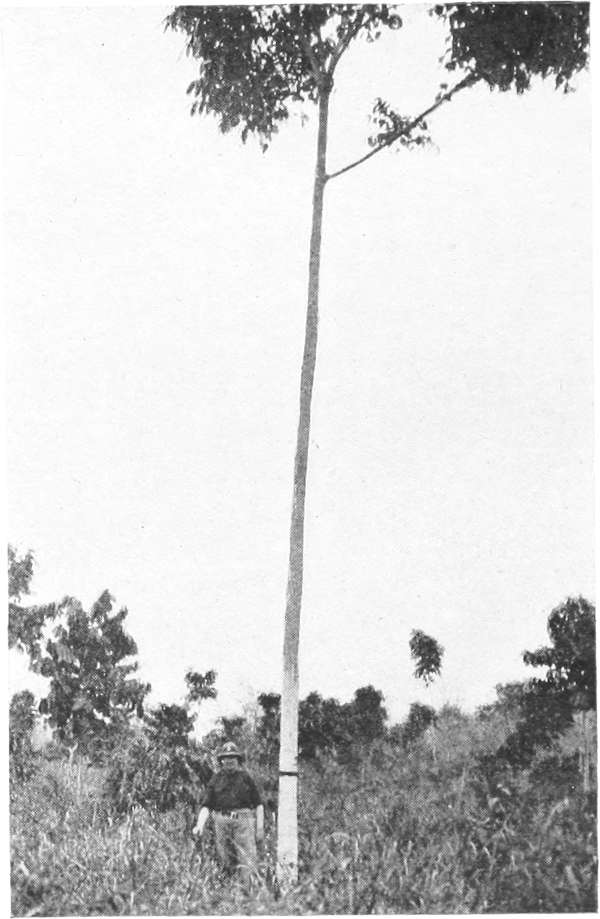
To face p. 216.
APPENDIX I
NIGERIAN TREES.—A LIST OF TREES FOR THE NORTHERN PROVINCES
(Hausa names obtained from Hausa Botanical Vocabulary, by J. M. Dalziel.)
Botanical Name. English Name. Hausa.
Gramineæ.
Oxytenanthera Abyssinica — Gora.
Palmæ.
Raphia vinifera Bamboo Palm, Tukuruwa Palm or Wine Palm Gongola or Gwongola gwangwala (Nupe), Tukuruwa; also Murli, Gangame.
Hyphæne Thebaica Dum Palm or Gingerbread Palm Goriba, Kaba or Kodago and Kwalo (nut).
Elæis Guineensis Oil Palm Kwakwa.
Cocos nucifera Coconut Palm Kwakwar, Attagura.
Borassus flabellifer, var. Æthiopum Deleb Palm, Fan or Palmyra Palm Giginya.
Salicaceæ.
Salix Willow Ba ruwana, syn. Rimni (Sok.).
Ulmaceæ.
Celtis integrifolia Nettle Tree Dukki or Dunki, syn. Zuwo (Kano, Zaria, etc.); also Dinkin.
Moraceæ.
Artocarpus incisa Breadfruit Barabutu (corruption of Breadfruit).
Ficus gnaphalocarpa — Baure, Bauren fadama, Bauren rafi.
Ficus sp. — Bijaje.
Ficus populifolia — Bishiyapl bishiyoyi, generic.
Ficus Thonningii — Chediya, Gazari or Gizeri (Hadeija).
Ficus sp. — Danko maiwari.
Ficus sp. Large Fig Dulu.
Ficus syringifolia Small Fig Durumi.
Ficus platyphylla Guttapercha Tree Gamji or Ganji (Kano).
Ficus Capensis — Garicha (Zanfara), Haguguwa (Kano and Bauchi), Uwar yara (Kano and Katagum).
Ficus Kawuri and Ficus glumosa — Kawuri.
Chlorophora excelsa — Loko.
Ficus sp. — Non gwanki.
Ficus sp. Narrow-leaved Fig Tree Shisinya, syn. Shiriya (Sok.).
Ficus Vogelii — Taba ni ka samu, cf. Kurnan nasara and Zogalagandi.
Ficus sp. — Wa or Ya (Sok.).
Ficus sp. — Wan kurumi.
Ficus Capensis — Uwar yara (Kano, Katagum), syn. Haguguwa (Kano, Bauchi).
Anonaceæ.
Anona Senegalensis Custard Apple Gwandar daji.
Xylopia Æthiopica African, Guinea or Negro Pepper Kimba.
Capparidaceæ.
Mærua Angolensis — Chichiwa (Sok.).
Cratæva Adansonii — Ingidido.
Moringaceæ.
Moringa pterygosperma Horse-radish Tree Samarin danga or Zogalagundi, syn. Bagarumar makka (Sok.), Barambo (Gobir); also Taba ni ka saniu (cf. Kurnan nasara).
Rosaceæ.
Parinarium macrophyllum Gingerbread Plum Gawasa.
Parinarium polyandrum — Kaikai.
Parinarium curatellæfolium — Rura; also Gwanja kusa and Kaikai.
Leguminosæ.
Sesbania leptocarpa — Alambo.
Sesbania aculeata — —
Sesbania Ægyptiaca — Sasabani and Zamarke.
Lonchocarpus cyanescens Yoruba Wild Indigo Bahar tahki.
Acacia Arabica Egyptian Mimosa Bagaruwa, Gabaruwa.
Afrormosia sp. — Ba-jini, syn. Jina-jina (Sok. and Zanf.).
Acacia Sieberiana — Bauji (E. Hausa), syn. Fara kaya.
Swartsia Madagascariensis Cassia Tribe Bogo zage (Zanfare), Bayama (Kontagora), syn. Gwazkiya, Gamma fada.
Cassia Occidentalis — Ba-Zanfare (Katagum), syn. Rai dore, Sanga-sanga (Sok. and West).
Tetrapleura Thonningii — Dawo (Hausa?), Ai-da (Yoruba), cf. Kalangon daji and Sandan mayu.
Isoberlinia doka — Doka.
Isoberlinia Dalzielii — Fara doka.
Parkia filicoidea African Locust Bean Tree Dorowa, Dorawa.
Acacia Seyal “Tall” Gum Acacia Dushe (Kano), Dussa (E. Hausa), syn. Jimshi (Sok.), and (?) Ishishiya (Zanfara).
Acacia Sieberiana Acacia Fara kaya, syn. Bauji (E. Hausa).
Acacia campylacantha Acacia Catechu Farachin shafo or Kumbarshafo. Karkara (Kano), Karki (Sok., Kats., and Zanf.), Kayar rakumi; also Karo (Kano, Sok., and Kats.).
Acacia macrostachys — Gardayi.
Acacia albida — Gawo.
Lonchocarpus laxiflorus — Farin sansami, syn. Shunin Biri Zanfara halshen sa.
Afzelia Africana African Mahogany or Mahogany Bean Fasa-daga, Kawo.
Cassia Kotschyana — Gamma fada hada fuda (Sok.).
Pterocarpus esculentus — Gedar, Kurumi.
Erythrophlœum Guineense Sasswood or Ordeal Tree Gwaska or Itchen gwaska.
Bauhinia rufescens — Jirga (Sok. and Kats.), syn. Tsatsagi (Sok. Zaria, Kano, etc.).
Paradaniellia Oliveri West African or Ilorin Copaiba Balsam Tree Kadaura (Kano, Zaria, etc.).
Mimosa asperata — Kaidaji, Kardaji (Sok.).
Tetrapleura — Kalangen daji.
Ambygonocarpus Schweinfurthii — Kashi Kashi (Kontagora Kols).
Albizzia Chevalieri — Katsari.
Prosopis oblonga — Kiriya, Akiye or Akwiye (seeds), Kokara.
Burkea Africana Break-axe Tree Kurdi, Bakin makarfo, Kariye gatari.
Acacia Caffra? Thorny Acacia Kwandariya.
Pterocarpus erinaceus Africa Rosewood or “Bloodwood” Madobia.
Paradaniellia Oliveri Balsam Tree Maje (Sok.).
Syn. Daniellia Thurifera West African Copaiba Balsam Tree Syn. Kadaura (Kano, Zaria, etc.).
Baphia pubescens Camwood Majigi.
Erythrina Senegalensis Coral Tree Majiriya (Sok. and Kats.), Minjiriya (Kano).
Afrormosia laxiflora Break-axe Tree Makarfo, also called Kariye gatari.
Indigofera secundiflora — Dan marike.
Cassia goratensis — Runhu or Rumfu.
Parkinsonia aculeata Jerusalem Thorn Dan sarikin itatuwa (Sok. and Kats.), Sasabani (Hadeija, etc.), Sharan lobbi (Sokoto), cf. Alambo.
Lonchocarpus laxiflorus — Shunim biri, syn. Farin sansami (Sok. and Kats.), Halshen sa Zanfar.
Lonchocarpus cyanescens West African Indigo or Yoruba Wild Indigo Talaki or Talakin Yarubawa.
Detarium Senegalense — Taura.
Entada Sudanica — Tawatsa or Tawassa.
Tamarindus Indica Tamarind Tree Tsamiya.
Rutaceæ.
Zanthoxylum Senegalense — Fasa-kwari.
Limonia — Kokuwa (Sok. and West).
Simarubaceæ.
Irvingia Smithii — Goron biri or Goron ruwa.
Hannoa undulata — Takandar giwa (Kats., Sok. and Zanf.), syn. Namijin gwabsa (Kontagora, etc.); also Raken giwa.
Burseraceæ.
Canarium Schweinfurthii “African Elemi Tree” Atillis.
Boswellia odorata Frankincense Tree Basamu (Sok. and Zanf.).
Boswellia Dalzielii Frankincense Tree Syn. Hano (Sok. and Kats.), and Ararabi (Kats.).
Commiphora Kerstingii — Dali and Dalu (Kano and Katsina), syn. Bazano (Kano and Zaria), Gurzundali (Katagum), Hana gobard (Zanfara), Ka Ki ganin bula (Zanfara); also Bar nagada.
Balsamodendron myrrha Myrrh Jawul.
Meliaceæ
Melia Azedarach Pride of India, Persian or African Lilac, or Bead Head Itchen kurdi, syn. Kurnan nasara, E. Hausa Kontagora.
Trichilia emetica — Jan saye (Sok., Zanf., Kontaga).
Khaya Senegalensis Species of African Mahogany Madachi or Madwachi (Sok.).
Pseudocedrela Kotschyi — Tuna (often pronounced Tunam or Tunas).
Euphorbiaceæ
Hymenocardia acida — Jan yaro or Jan itache.
Uapaca Guineensis — Ka fafogo.
Euphorbia Barteri — Kerana.
Euphorbia Abyssinica — —
Phyllanthus floribundus — Majiriyar kurumi (Kano); also called Kumchi (Sok. and Zanf.).
Anacardiaceæ.
Spondias sp. Yellow Plum Danya (fruit called Nunu), C. Tsadar Masar.
Odina Barterii — Faru, syn. Tudi (Zanfara), Farum biri (Sok.).
Anacardium Occidentale Cashew Kanju.
Mangifera Indica Mango Mangoro.
Spondias lutea Hog Plum, Yellow Spanish or Jamaica Plum Tsadar Lamarudu or Tsadar Masar.
Hæmatostaphis Barteri Blood Plum Tursuje.
Sapindaceæ.
Blighia sapida Akee Apple Alale, usually called Gwanje kusa.
Rhamnaceæ.
Zizyphus Spina-Christi — Kwina, cf. Magariya.
Zizyphus jujuba Jujube Tree Magariya.
Zizyphus mucronata Buffalo Horn Magariyar kura.
Vitaceæ.
Vitis quadrangularis — Dodoriya or Dadori.
Bombacaceæ.
Bombax buonopozense — Gurjiya, syn. Kuriya (Sok. and Zanf.).
Bombax buonopozense Red-flowered Silk-cotton Tree Kuriya (Sok. and Zanf.), syn. Guriya.
Adansonia digitata Baobab, Monkey-bread Tree, or Sour Gourd. Kuka.
Eriodendron Orientale White Silk-cotton Tree Rimi (Kano) or Rini (Sok.).
Sterculiaceæ.
Cola acuminata Kola Nut Goro or Labuje goriya (largest nuts).
Sterculia tomentosa — Kukudi.
Flacourtiaceæ.
Oncoba spinosa — Kokochiko.
Combretaceæ.
Terminalia sp. — Baushe.
Nr. Terminalia macroptera — Kandari.
Terminalia Elliotti — —
Terminalia Baumanii — —
Terminalia Avicennioides — —
Combretum Kerstingii — Chiriri (Sok. and Zanf.), syn. Dagera and probably also Zindi.
Combretum glutinosum — Dalo.
Combretum sp., probably Combretum altum — Geza.
Combretum sp. (?) Combretum leonense — Goga jiki.
Anogeissus leiocarpus Chew-stick Tree Marike.
Combretum verticillatum — Taramniya.
Combretum geitonophyllum and others — —
Combretum leonense — Wuyan damo.
Combretum sp. near — Zindi (Katagum, Kanuri).
Combretum Hartmannianum, probably same as C. Kerstingii — Chiriri.
Myrtaceæ.
Eugenia caryophyllata Clove Kanumfari.
Eugenia Owariensis — Malmo.
Araliaceæ.
Cussonia Nigerica — Gwabsa (Sok., Kats. and Zanf.), Raken giwa.
Sapotaceæ.
Butyrospermum Parkii Shea Butter Tree Kadanya or Kadai.
Ebenaceæ.
Diospyros mespiliformis — Kaiwa (Sok.) or Kanya (Kano).
Loganiaceæ.
Anthocleista nobilis (G. Don) Cabbage Tree Kwari.
Anthocleista Vogelii (Planch) — Kwari.
Anthocleista parviflora (Baker) — Kwari.
Apocynaceæ.
Voacanga obtusa — Kokiyar biri (Kontagora)
Rauwolfia Welwitschii — Wadda.
Borraginaceæ.
Cordia Abyssinica — Aliliba
Verbenaceæ.
Vitex Cienkowskii — Dinya (Kano), Dumya (Sok.)
Vitex diversifolia — —
Solanaceæ.
Solanum sp. — Jaudari (E. Hausa), syn. Gorgo.
Bignoniaceæ.
Newbouldia lævis — Aduruku, syn. Ba reshe (?).
Stereospermum Kunthianum — Jiri or Sansami or Sasami, syn. Jiri dan sarikin itatuwa (Sok. and Kats.).
Kigelia Æthiopica, var. Bornuensis Sausage Tree Rahaina, syn. Rawuya (Sok.) and Nonon giwa.
Rubiaceæ.
Randia malleifera Gardenia sp. Katambiri.
Randia Nilotica — Barbaji, syn. Tsibra or Tsura (Sok.).
Mitragyne Africana — Giyeya or Giyaiya.
Crossopteryx Kotschyana — Kasfiya (Sok., Kats. and Zanf.).
Sarcocephalus Russegeri A common Chew-stick Tafashia.
Adina microcephala — Kadanyar rafi or Kadanyar kurumi.
Compositæ.
Vernonia amygdalina — Fate fate.
Vernonia sp. — Shiwaka.
APPENDIX II
NIGERIA—FOREST EXPORTS
Products. 1909. 1910. 1911. 1912. 1913.
Qty. £ Qty. £ Qty. £ Qty. £ Qty. £
Palm kernels 158,849 tntons 1,815,967 172,998 tntons 2,450,814 176,389 tntons 2,574,405 184,624 tntons 2,797,411 174,720 tntons 3,109,820
Palm kernel shells 853 tntons 1,512 1,168 tntons 2,070 943 tntons 973 1,472 tntons 3,140 649 tntons 1,313
Palm kernel oil — — — — — — 499 tntons 16,341 3,857 tntons 129,443
Palm oil 6,335 tntons 1,447,163 76,850 tntons 1,742,234 79,336 tntons 1,696,876 76,994 tntons 1,654,933 83,085 tntons 1,854,384
Kernel cake — — — — — — — — — 31,484
Rubber 619 tntons 109,076 1,175 tntons 311,691 961 tntons 179,355 705 tntons 25,022 510 tntons 89,995
Gum arabic — — — — 373 tntons 6,559 307 tntons 1,785 710 tntons 3,133
Gum copal — — — — 10 tntons 362 72 tntons 1,686 19 tntons 322
Gutta-percha — — — — 104 tntons 8,787 106 tntons 5,419 74 tntons 4,424
Shea butter 309 tntons 5,230 340 tntons 6,804 248 tntons 4,978 179 tntons 4,798 120 tntons 4,044
Shea nuts 9,728 tntons 78,029 4,464 tntons 43,510 3,629 tntons 35,518 7,756 tntons 46,609 9,420 tntons 70,427
Kola nuts — — — — 79 tntons 2,377 72 tntons 2,136 48 tntons 1,459
Coconuts 2,240 tntons 71,916 — — 20,500 ntnuts 82 15,550 ntnuts 51 147,745 ntnuts 496
Kapok — — — — 2 tntons 152 1 tnton 69 19 tntons 1,097
Copra 21 tntons 259 — — 96 tntons 1,672 94 tntons 1,628 96 tntons 1,890
Timber, mahogany — 46,372 — 60,191 13,675 lglogs 55,575 15,565 lglogs 78,006 19,152 lglogs 105,440
„ ebony — — — — 74 tntons 266 37 tntons 102 119 tntons 608
„ other than furniture — — — — 3 tntons 1 5 tntons 2 10 tntons 5
Camwood — — — — — 1 13 tntons 46 67 tntons 314
Mangrove bark — — — — 504 tntons 671 213 tntons 448 48 tntons 200
Rafters — — — — 280 pkpkgs. 28 95 pkpkgs. 8 40 pkpkgs. 2
Beeswax — — 256 tntons — 11 tntons 566 4 tntons 247 5 tntons 388
Totals 178,955 tntons 3,574,524 257,252 tntons 4,617,314 262,767 tntons 4,569,211 273,158 tntons 4,639,892 273,583 tntons 5,410,695
20,500 ntnuts 15,550 ntnuts 147,745 ntnuts
13,675 lglogs 15,565 lglogs 19,152 lglogs
280 pkpkgs. 95 pkpkgs. 40 pkpkgs.