Chapter XIV
Reading edition
BIBLIOGRAPHY OF WEST AFRICAN FORESTS
1. Historical.
One of the first books was Forestry in West Africa, by Sir Alfred Maloney, a former Governor of Lagos, which was published in 1887. This is a most interesting and readable book, and, for the time it was written, gives a very good account of many of the forest trees. It is also much to Sir A. Maloney’s credit that teak, Tectona grandis, was introduced into Nigeria at that time.
In The Journal of an Expedition to Explore the Course and Termination of the Niger, by Richard and John Lander, only very vague descriptions of the forests are given, and it is therefore not of much value from the Forestry point of view, though it is a most entertaining description of the people and their doings at that time.
2. Botanical.
From 1868 onwards, Flora of Tropical Africa appeared; so far eight volumes have been published. This work was planned by the late Sir William J. Hooker and edited first of all by Daniel Oliver, and subsequently by Sir W. T. Thistleton-Dyer, K.C.M.G., C.I.E., and now by Lieut.-Colonel D. Prain, the Director of the Royal Botanic Gardens, Kew. It is, of course, very scientific, accurate and botanical, but has very dry descriptions of many of the African trees and plants and no illustrations are contained in these octavo volumes. What also makes it harder to use this Flora is the fact that since 1868 many new plants have been named, and some of the names of the old plants have been altered. A most useful chapter on Elementary Botany is contained at the beginning of Vol. I. This is to some extent also a glossary of botanical terms, but of course it cannot take the place of A Glossary of Botanic Terms, by D. G. Jackson, 1905.
In many ways a much more useful book to the forester is Engler’s Monographien der Pflanzenfamilien, of which eight volumes have appeared:
I. Moraceæ, excluding Ficus.
II. Melastomaceaæ.
III. Combretaceæ Combretum.
IV. Combretaceæ, excluding Combretum.
V. Sterculiaceæ.
VI. Anonaceæ.
VII. Strophanthus.
VIII. Sapotaceæ.
The full-page black-and-white drawings of the various plants are very valuable, and as they are all done on the same system, comparison both with the plants and with other books is not very difficult. The expense of these volumes is not excessive, considering the very large number of illustrations and the authority of the text. It is a pity that this series has for the time being come to an end.
In Engler’s Pflanzenfamilien, of course, a very complete account of all plants is given, and the additions to it made almost monthly make it quite possible to find out the latest-named additions to the plant-world. The only disadvantage to these volumes is their number, size, and lack of illustrations.
Fig. 108.—Shinglewood (Terminalia scutifera), 12 feet in girth, standing in the Ikrigon Forest Reserve, Eastern Circle.
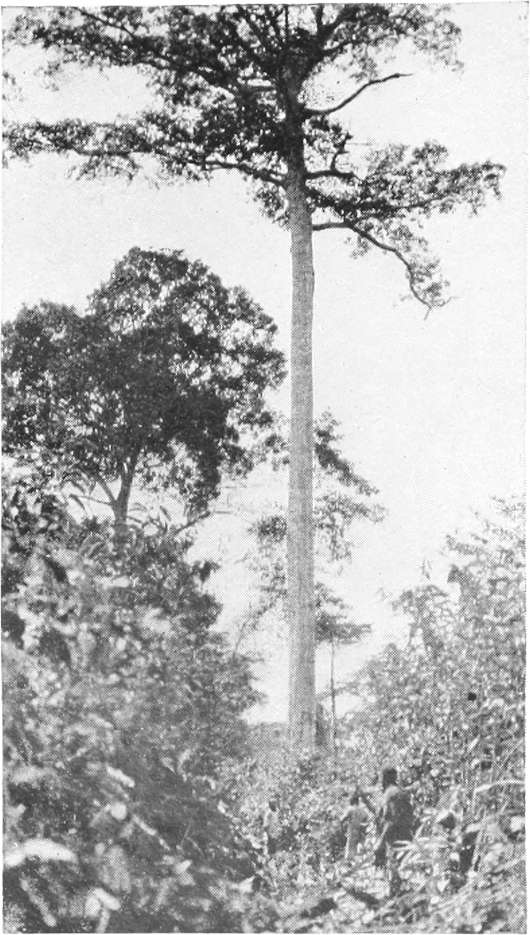
Fig. 109.—Iroko (Chlorophora excelsa), 15 feet in girth, standing in Ikrigon Forest Reserve.
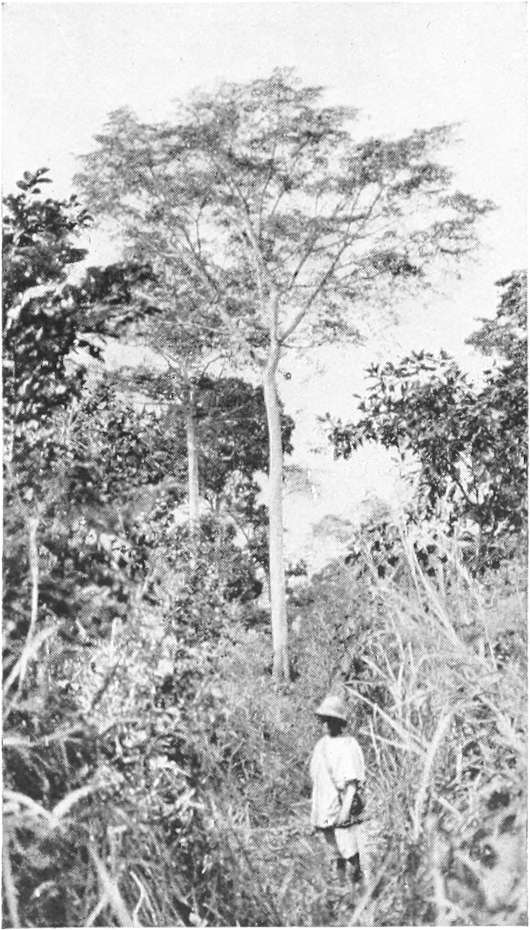
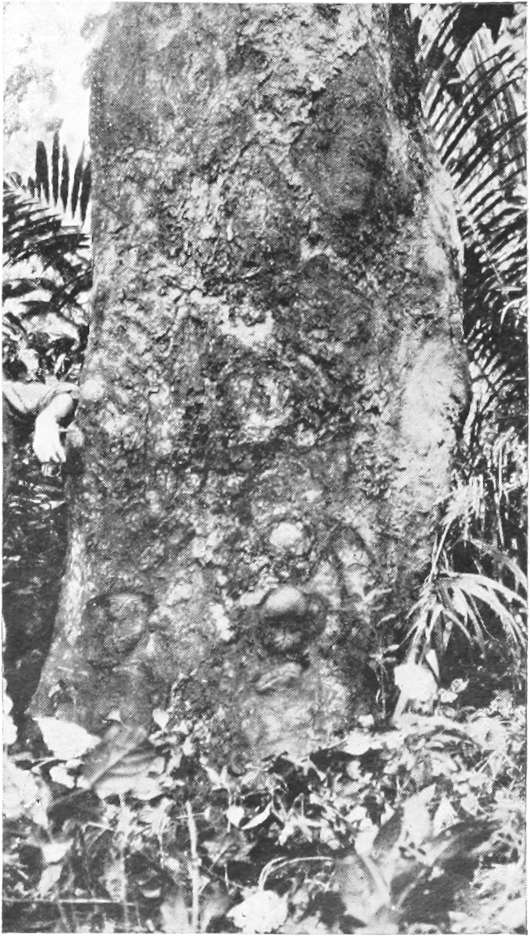
Fig. 110.—Mahogany (Khaya Senegalensis) standing at the edge of Ikrigon Forest Reserve, showing base of trunk with old bark wounds already healed over.
To face p. 496.
In a similar, though in a less complete way The Kew Bulletin gives the latest list of plants identified at Kew, amongst which are usually some from Nigeria, and occasionally special bulletins appear on the plants from Nigeria—as, for instance, Bulletin of Miscellaneous Information, Additional Series No. 9; The Useful Plants of Nigeria, Part I, 1908, Part II, Additional Series No. 10, 1912, Part III.
The Bulletin of the Imperial Institute, edited by Sir W. Dunstan, which appears quarterly, always contains the most recent information with regard to tropical products, including those of the forest. In recent years, too, much more has appeared on the subject of the timber, gum and oil-seed resources of Nigeria.
Die Blütenpflanzen Afrikas, by Franz Thonner, 1908, arranged as it is in the form of a key, is most useful in identifying many of the plants and trees. The black-and-white illustrations add immensely to its value. Additions and corrections to this have also been made in Die Blütenpflanzen Afrikas, 1913. The last edition is in English, and entitled The Flowering Plants of Africa.
Among more recent books is a Catalogue of Plants collected by Mr. and Mrs. Talbot in the Oban district, South Nigeria, identified by A. B. Rendle, M.A., D.Sc., F.R.S., and others, and brought out by the British Museum in 1913. In this book the flora of Oban is specially dealt with, and clearly shows the difference between it and the rest of the flora and silva of Nigeria. Although this is mainly a description of newly discovered plants, the black-and-white illustrations by Mrs. Talbot show most accurately their salient features.
Notes on Nigerian Trees and Plants, by E. W. Foster, late Senior Conservator of Forests, contains accurate descriptions of the most useful trees, and the native names from the Yoruba country will be most useful to anyone working timber in that part of Nigeria.
The Agricultural and Forest Products of British West Africa, by G. C. Dudgeon, Director-General of Agriculture in Egypt, 1911, gives a short description of the main forest and agricultural products of the country, which is more useful to the trader than the forester or timber merchant. The illustrations showing the making of palm oil and other country products are very interesting, but Fig. 21, p. 112, supposed to be of an Iroko tree, is in reality that of Terminalia superba.
For reference purposes Dr. Adolf Engler’s Syllabus der Pflanzenfamilien, 1904, which takes special account of the medicinal and useful plants, is most valuable.
For a proper introduction to Botany, Strasburger’s Text Book of Botany is hard to beat.
Kulturgewächse der Deutschen Kolonien, by R. Sadebeck, 1899, gives a very good account of most of the useful West African forest products; the very clear illustrations add immensely to its value, although the book is now somewhat out of date.
3. Timbers.
In The Timbers of Commerce and their Identification, by Herbert Stone, F.L.S., F.R.C.I., 1904, a few of the West African timber trees are mentioned, but only very cursorily, with but few illustrations.
In Timber, by J. R. Baterden, A.M.I.C., a few of the West African timber trees are described, and a few photographs show how the timber is worked. Their inclusion amongst the South African timbers does not exactly enhance their value or give a true view of their place in the economy of the timber trade.
Wood, by G. S. Boulger, gives an excellent system for classifying woods by using all their various characteristics, such as taste, smell, hardness, structure of the timber, and the various pith rays and other peculiarities. A very complete list of all the various timbers used in commerce is given, together with the various synonyms of each, and the botanical names of each so far as they are known. The uses of the timber and the supplies of each country are given, and in this way it is a most important book of reference for any Forest Officer.
4. Forestry Generally.
In Sylviculture in the Tropics, by A. F. Broun, Director of Woods and Forests, Soudan, 1912, some references are made to West African trees. Some very typical photographs of forest vegetation in various parts of the Tropics are very useful, and demonstrate several forest theories far better than pages of words.
A Dictionary of the World’s Commercial Products, by J. A. Slater, B.A., LL.B., 1907, is very useful for looking up the lesser known forest products. The descriptions have to be used with discrimination, as some of them are rather cursory and no authorities for botanical names are given.
Gold Coast Report of Forests, by Mr. H. N. Thompson, Chief Conservator of Forests, South Nigeria, 1910, is the authoritative work on the Forestry problems of the Gold Coast. Full descriptions of the chief forests are given, together with the important plants and trees found in each. The laws of South Nigeria as modified to suit Gold Coast conditions are also quoted. Forest policy as suitable for this country is given; the different types of forest and their relation to the climatic formations are also mentioned at length. A suitable establishment carrying out these suggestions is laid down. The black-and-white drawings which illustrate this book, especially those of mahogany, are invaluable to either the Forestry student or the timber merchant.
The Oil Palm and its Varieties, by J. H. J. Farquhar, Conservator of Forests, Nigeria, is an interesting and useful preliminary monograph on that most valuable tree. It gives a summary of all the information of the Forest Department on that subject up to that date.
List of Trees, Shrubs and Climbers of the Gold Coast, Ashantee, and North Territories, T. F. Chipp, B.Sc., F.L.S.; Der Tropenwirt, by Dr. S. Loskin, Hinstorff’sche Verlagsbuchhandlung, Wismar i. U., 1913; The Principal Forest Trees, by H. N. Whitford, Ph.D., Bulletin No. 10, Manila Bureau of Printing, 1911, are three useful books.
The Kew Bulletin and the Journal of the Imperial Institute always contain most valuable notes on the botanical and technical qualities of the various African trees and plants.
The Indian Forester, which appears monthly, is a most necessary periodical for every Forest Office or Timber Camp, containing as it does not only original articles on sylvicultural and other forest problems, but also much information on the uses of timbers, similar kinds of which are found here, and thus gives one an indication in what direction to exploit new timbers.
In the Guiana Forest, by Jas. Rodway, is a very readable book on the tropical forest scenery found in Demarara. It is, of course, written in very popular style, but gives one a very good introduction to the tropical forest, showing both by beautiful descriptions and good illustrations what one should observe in these forests. Much tropical scenery is very similar, and therefore, though this book deals with British Guiana, much of it is applicable to West African forests.
Forestry, by Dr. Adam Schwappach, gives a short, concise account of what is included under the term Forestry in Europe. One obtains a clear view of the divisions under which this subject is treated.
The Trees, Shrubs, Herbs and Climbers of Sierra Leone, by C. E. Lane Poole, Government of Sierra Leone, is the most important collection of notes yet issued on this subject. It should prove of greatest use to Forest Officers, and to all others interested in the forests and afforestation.
Much useful information has been obtained from the annual Reports on the administration of the Forest Department from the years 1906 to 1913, more especially from that of 1906, which practically summarized the results of the Department’s work up to that date. Data on Togo are contained in the report of the afforestation of Togo with teak and other African timber trees. This was the result of a long tour in that country made by the author in 1911. From Sierra Leone much valuable knowledge was acquired as a result of a five months’ tour made in 1908-9, and this was embodied in a report which appeared in 1909. Very useful information is contained in the reports by the Conservator of Forests there, which have appeared since. A most extensive account of the forest trees and plants, including the Oil Palm, is given in Les Végétaux utiles de l’Afrique tropicale française, by M. Chevalier, Parts I and II, 1909, 1910 (A. Challamel), chiefly in connection with the Ivory Coast.
In the Notizblatt of the Berlin Botanical Station are some useful notes on Die Nutz Holzer der Kamerun, 1909. Also in the pamphlets Die Nutz Holzer Togos, Parts I and II. In this manner it is possible to make a comparative study of the timber trees found in the different parts of West Africa. The addition of the native names in most cases is also very valuable.