Volume 1 — A
Reading edition
Abhyâgat.—(Sans. “Abhyâgata,” “a guest,” “a visitor”) is hardly a special sect. It is referred generally to mendicants and Brâhmans who live by begging. It is practically synonymous with Atît (q.v.). Some live a solitary life, others associate in monasteries (math) under an abbot (mahant).
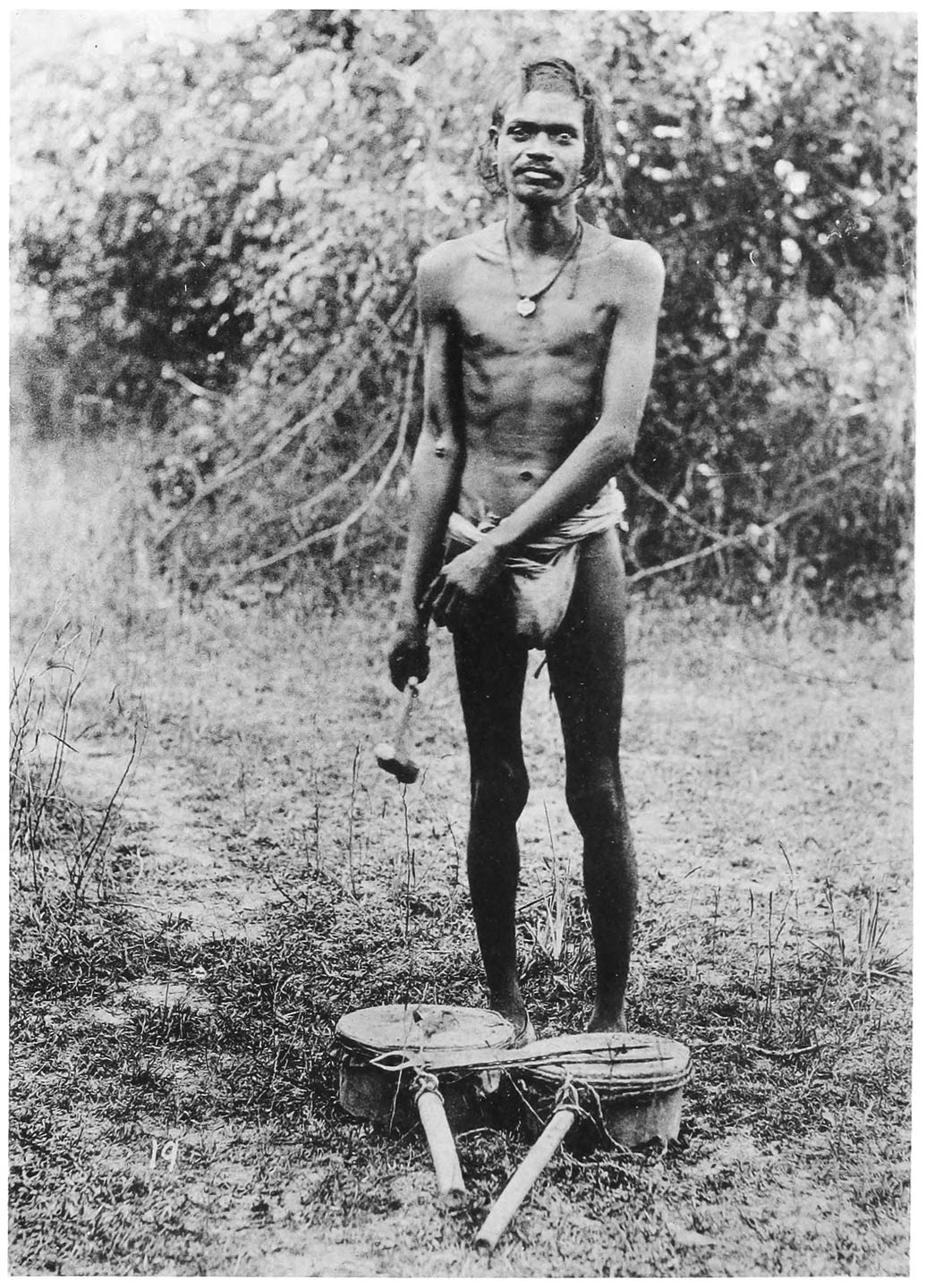
AGARIYA.
Appearance. 2. In appearance the Agariyas approximate very closely to allied Dravidian tribes, such as the Korwas, Parahiyas, etc., but they have a particularly gaunt appearance and worn expression of countenance, which is undoubtedly the result of the severe occupation which they follow.
Tribal council. 4. They have a tribal council (panchâyat) at which all adult males attend. The meetings, in default of any specially urgent business, assemble when the members meet on the occasion of marriages or deaths. The members are summoned by the President of the council (mahto), who circulates a root of turmeric among them. The council deals with caste matters, such as adultery, fornication, and the like. The orders are enforced in the usual way (see Mânjhi, paragraph 9). The office of President is permanent and hereditary. If the incumbent happens to be a minor he can select another clansman to act for him until he becomes competent to fill the post.
Rules of exogamy. 5. The only rule of exogamy is that no one may marry within his sept (kuri). This obviously admits of very close marriage connections, but it is not supplemented by the usual formula which prohibits marriage in the family of both the paternal and maternal uncles and paternal and maternal aunts. It is, in fact, admitted on all sides that a man may marry the daughter of his paternal uncle. It is essential that the bridegroom must not be engaged in any degrading labour, such as shoe-making or groom’s work. There is no restriction as to place of origin or family worship, but he must nominally conform to the tribal religion.
Traditions of origin. 6. The Mirzâpur Agariyas say that some five or six generations ago they emigrated from Rîwa, hearing that they could carry on their business in peace in British territory. Their first settlement was in the village of Khairahi in Pargana Dudhi. Their head-quarters in Rîwa are at the village of Rijaura; they do not make any pilgrimages to their original settlements or draw their priests or tribal officials from there.
Marriage. 7. The bride is purchased and her price by tribal custom is fixed at ten rupees. Polygamy is permitted, and an Agariya may have as many wives as he can afford to purchase and maintain. The senior wife (Jethi Mehrâru) is head of the household; she joins her husband in the family worship and she receives a degree of respect among the clansmen at marriages, etc., which is denied to the junior wives. If there are more wives than one they live in the same house, but in separate huts. Concubinage with women who are not members of the tribe and polyandry are prohibited. The women enjoy a considerable amount of liberty both before and after marriage. If an unmarried girl is detected in an intrigue with a clansman, her father can get her married to her lover on paying a tribal fine of ten rupees and providing a feast for the clansmen to the amount of one goat and the necessary quantity of rice. If she offends with a stranger she is permanently expelled.
Divorce. 9. There is no real divorce: merely expulsion of the faithless wife from hearth and home. The only ground for expulsion is proof of the wife’s adultery to the satisfaction of the clansmen. In fact, it is understood that no proof short of her being caught in the act of adultery will be sufficient. If a woman is put away for adultery, she cannot be remarried in the tribe. Concubinage with strange women is forbidden. All the sons of all the wives rank and share equally. If a woman has a child by a man of another tribe, he is not received into the caste, cannot be married in the tribe, and the clansmen will not eat with him.
Widow Marriage. 10. Widow marriage in the Sagâi form is allowed. When a man proposes to marry a widow, he can do so with the consent of the head of the family. Both parties give a tribal dinner, and the man rubs some oil on the woman’s head and some red lead on the parting of her hair, and brings her home. When he brings her home he has to entertain the clansmen. The levirate is permitted, with the usual restriction that it is only the younger brother of her late husband who is entitled to claim her. It is only on his renouncing his right to her that she can marry an outsider. If she have children by her first husband, they do not accompany her to her new home, but remain with their father’s brother. The widow, on re-marriage, has no rights to her first husband’s property. If the children are very young, the uncle, who maintains them, gets half their property as his remuneration. In the same way if their uncle does not care to look after them, and they go to their step-father, he receives half their inheritance, and in this case the children are considered to be his own.
Adoption. 11. Adoption is permitted to a sonless man or one whose son is permanently expelled from caste; but there is no idea of religious merit in adoption. The son adopted must be of the sept (kuri) of the adopter, and is in most cases a brother’s son. Having once adopted he cannot adopt again as long as the adopted son is alive. A bachelor, an ascetic, or a blind man cannot adopt, nor can a married woman without the leave of her husband, and under no circumstances has the widow this power. A man may give his eldest, but not his only son, in adoption to another. There is no condition of age in the boy to be adopted. Girls cannot be adopted. The adopted son is not excluded from succeeding to his natural father, and will do so if he have no other son. If a natural son be born after adoption, both share equally in the estate.
These are the rules as stated in a meeting of the caste, but they obviously represent the influence of their Hindu neighbours. It is very doubtful if the real Agariyas have any idea of adoption.
Succession. 12. The rules of succession are very similar to those of the Mânjhis (q.v.). When a man dies leaving a widow or widows, a son or sons, a daughter or daughters, brothers or other relatives, the sons alone inherit, and primogeniture is so far observed that the eldest son gets one animal or article, an ox, a brass pot, etc., in excess of the others. The sons take their shares per capita. When a man leaves only a sonless widow, his brothers inherit with the obligation of maintaining the widow for her lifetime or until she marries again. She can be expelled for unchastity. Stepsons inherit only the amount of their father’s property which their step-father may have received, but he is bound to support and marry them. Many of the elaborate rules which the tribe pretend to observe are derived from Hindu practice; and it is obvious that it is seldom difficult for an Agariya to dispose of his simple property.
Relationship. 13. The relations of the husband are regarded as relations of the wife, and vice versâ. The scheme of relationship agrees with that of the Kols (q.v.).
Birth ceremonies. 14. There are no ceremonies during pregnancy. Contrary to ordinary Hindu custom the woman lies on a bed facing east during delivery. She is attended during seclusion by the Chamâin midwife, who cuts the cord and buries it outside under the eaves of the house. The mother is dosed with a decoction of dill (ajwâin), and gets in the evening a mess of boiled sâwân, millet and konhrauri or balls made of urad pulse, and cucumber (konhra). On the sixth day the clothes of the mother and all the household are washed by one of them. They do not employ a Dhobi which, as the birth pollution is much dreaded, marks a very low stage of ceremonial purity. On the same day mother and child are bathed by the midwife, who gets a loin cloth (dhoti) as her fee. The mother then cooks for the family and a few of the neighbouring clansmen. On the same day the delivery room (saur) is cleaned and replastered by the sister of the husband (nanad), who receives a fee of four annas for her trouble. On the twelfth day the clansmen and their wives who live in the neighbourhood are fed.
Couvade. 15. The husband is allowed to do no work on the day his wife is delivered, and has to take the first sip of the cleansing draught which is given her after delivery. He does not cohabit with his wife for a month after her confinement.
Puberty ceremonies. 16. There is no regular ceremony on arrival at puberty. The only rite in the nature of initiation is the ear-boring, which is done both for boys and girls in the fifth year. Up to this they may eat from the hands of a person of any caste. After this ceremony they must conform to tribal usage.
Ancestor worship. 18. On the day of the Phagua (Holi) they feed a fowl with gram and kill it in the name of the sainted dead. But they recognise no deceased ancestor beyond their father and mother, in whose name after the sacrifice they pour a little water on the ground. Only the members of the family eat the flesh of the victim. They do not employ Brâhmans at funerals; they have no Srâddha, and the sister’s son has no special functions on this occasion.
Religion. 19. They call themselves Hindus, but worship none of the regular Hindu deities. In the month of Aghan they get the Baiga to worship the village gods (dih). The offering consists of five fowls and a goat. The Baiga chops off the heads of the victims with his axe and takes the heads as his perquisite, while the worshipper and his family cook and eat the rest of the meat at the shrine. In the month of Pûs they worship the tribal deity—the goddess of iron—Lohâsur Devi. To her is offered a female goat which has never borne a kid and some cakes made of flour and molasses fried in butter. These cakes are broken into pieces before dedication. A fire offering (hom) is lit and some of the scraps of cake are thrown into it. The remainder are eaten by the worshippers. There is no temple or image of this deity. Brâhmans are never employed by them, and they do all their religious business themselves, except the worship of the village gods, which is entrusted to the Baiga. Among them the Baiga is always one of the Parahiya (q.v.) caste. The village gods are worshipped at their special shrine; offerings to Lohâsur Devi and the sainted dead are made in the court-yard of the house. It is only in the case of the sacrifice to the local gods that the Baiga receives the head of the victim; in other cases the whole of the meat is consumed by the worshippers themselves. No substitutes are used in sacrifice, and they do not offer parts of their own bodies, such as locks of hair, drops of blood, etc.
Festivals. 20. Their festivals are the Phagua or Holi and the Baisâkhi called after the months in which they occur. At both they sacrifice to deceased ancestors and drink liquor. Both these are regular fixed feasts. They have no other Hindu holidays, nor at the Phagua do they light the holy fire as Hindus do. Before they offer the black goat to Lohâsur Devi they worship it, and before sacrificing it pour water on its head. Ancestors are worshipped to ward off evil from the household. They do not sacrifice animals at funerals, nor do they make any funeral offerings.
Ghosts. 21. They dread the ghosts of the dead who appear in dreams, not because their obsequies have not been duly performed, but because they have not received their customary periodical worship. They are then appeased by the sacrifice of goats and fowls.
The chief forms of tattoo used by these jungle tribes are as follows:—The elephant; this is the sign of Ganesa, and women have it done on both arms; the sacred book (pothi),—this is done on the shoulders and arms; Mahâdeva,—this represents the name of Siva and is done on the breast; sankha or the conch shell,—this is done on the wrist, but is prohibited to women of the Majhwâr and Patâri tribes. It is the sign of coverture, and the woman who wears it does not become a widow in this world or in the life to come; pahunchi and chûra—these represent bangles or bracelets; the pahunchi is done on the arms, and the chûra below the knee; Jata Mahâdeva—this represents the matted locks of Siva and is done on the breast and other parts of the body; the hansuli or necklace—this is made on the neck in the place where the necklace is worn. While this mark is being tattooed, the mother of the girl seats her daughter on her knee because it is believed that the existence of this mark ensures that they both shall meet in the next world; the person who makes this mark receives extra remuneration. Pân pattar or betel leaf, châwal or rice mark, and the kharwariya are done on the arms in the place where the ornaments known as the bâju or jaushan are worn. Women of the Bhuiya and Parahiya tribes call this mark rijhwâr or “pleasing.” The bhanwara or large bumble bee is done on the knees and thighs. The murli-manohar is the representation of Krishna as the flute-player. It is done on the wrists and arms. The phulwâri or flower garden is done on the breasts and arms. The dharm gagariya is a mark which is supposed to make the wearer holy in the world to come. The râwana is the sign of Rawana, the enemy of Râma Chandra. It is done on the breast and hands. Garur is the sign of the bird Garuda, the vehicle of Vishnu. It is done on the arms chiefly by women of the Majhwâr, Patâri and Panka tribes. Chandrama is the sign of the moon, and is delineated on the breast and arms. Râdha Krishna is the sign of Krishna and his consort, done on the breast, wrist, and arms. The dhandha or “work” is the mark made below the navel by barren women in the hope of obtaining offspring. Muraila is the mark of the peacock made on the breast. Many of these marks are probably totemistic in origin, but the real meaning has now been forgotten, and they are at present little more than charms to resist disease and other misfortunes, and for the purpose of mere ornament.
Tree worship. 23. The only tree they respect is the sâkhu or sâl which is used at these marriages.
Clothes and jewelry. 24. There is nothing peculiar about their clothes, except their extreme scantiness. The men wear rings of brass or gold in the ear-lobes. The women wear ear ornaments made of palm-leaf (tarki), glass bangles (chûri), heavy pewter anklets (pairi), and on the arm brass rings (ragari), with bead necklaces on the throat.
Oaths. 25. They swear on the head of their son and believe that they die if they forswear themselves. They have no form of ordeal.
Food. 27. They eat all kinds of meat, including beef. They will not touch a Dom; they will touch a Chamâr, Dharkâr, Ghasiya, or Dhobi, but will not eat from their hands. They have a special detestation for Doms.
Taboos. 28. They will not touch a menstrual woman or their younger brother’s wife, or mother-in-law, or a connection through the marriage of children (Samdhin). They will not name their wives or elders in the family or the dead. In the morning they will not speak of death or quarrels or unlucky villages or persons of notorious character. They will not eat the flesh of monkeys, horses, crocodiles, lizards or snakes.
Social usages. 29. Children eat first, then the men and women eat together, but in separate vessels. They have no ceremony at eating. They use liquor and chewing tobacco freely; they do not use the huqqa, but smoke out of pipes made of the leaf of the sâl tree. When they cannot get liquor to offer to deceased ancestors they mix flowers of the Mahua (Bassia latifolia) in water. They believe that the use of liquor keeps off sickness, but consider drunkenness disreputable. They salute in the same form as the Mânjhis (q.v.). They will eat food cooked in butter (pakka) from the hands of Kahârs, and boiled rice from Chhatris. There is no caste which will drink water touched by them.
Agariya: Agari.—There is another set of people known under this name who are found in the Central Ganges-Jumna Duâb who have no connection with the Agariyas of Mirzâpur. They claim to be Chauhân Râjputs, and say that they emigrated to Bulandshahr about two centuries ago from Sambhal in the Morâdâbâd district. They are, as a rule, settled, but in the hot weather they migrate to Rohtak, in the Panjab, where they settle in rude huts near villages and pursue their trade of making salt (khâri nimak) and saltpetre. They follow the customs of Râjputs in their marriage ceremonies, except that they levy a bride price from the relations of the bridegroom. They profess not to permit widow marriage, but they recognise the levirate. A wife may be put away for adultery or other misconduct with the sanction of the tribal council, and then she can re-marry by the karâo form. Some of them now live by agriculture. Gûjars, they say, will eat and smoke with them.
2. A caste known as Agari are miners and smelters in the hills: there they are regarded as a branch of the Doms.
4. Another name for them in these provinces is Gola Thâkur, or illegitimate Râjput. At the last Census they were included in the Luniyas.
Gotra. Veda. Sâkha. Sutra.
1. Garga Yajurveda. Mâdhyandina. Kâtyâyana.
2. Gobhila Yajurveda.,, Mâdhyandina.,, Kâtyâyana.,,
3. Gautama Yajurveda.,, Mâdhyandina.,, Kâtyâyana.,,
4. Maitreya Yajurveda.,, Mâdhyandina.,, Kâtyâyana.,,
5. Jaimini Yajurveda.,, Mâdhyandina.,, Kâtyâyana.,,
6. Saingala Sâmaveda. Kausthami. Gobhila.
7. Vâsala Sâmaveda.,, Kausthami.,, Gobhila.,,
8. Aurana Yajurveda. Mâdhyandina. Kâtyâyana.
9. Kausika Yajurveda.,, Mâdhyandina.,, Kâtyâyana.,,
10. Kasyapa Sâmaveda. Kausthami. Gobhila.
11. Tandeya Yajurveda. Mâdhyandina. Kâtyâyana.
12. Mândavya Rigveda. Sakila. Aswilâin.
13. Vasishtha Yajurveda. Mâdhyandina. Kâtyâyana.
14. Mudgala Rigveda. Sakila. Aswilâin.
15. Dhânyâsha Yajurveda. Mâdhyandina. Kâtyâyana.
16. Dhelana Yajurveda.,, Mâdhyandina.,, Kâtyâyana.,,

Dhauma
17. Taitariya Yajurveda.,, Mâdhyandina.,, Kâtyâyana.,,
17½. Nagendra Sâmaveda. Kausthami. Gobhila.
The lists given by both Mr. Risley and Mr. Sherring differ considerably from this. Mr. Risley gives—
(1) Garg; (2) Goil; (3) Gâwâl; (4) Batsil; (5) Kâsil; (6) Singhal; (7) Mangal; (8) Bhaddal; (9) Tingal; (10) Airan; (11) Tairan; (12) Thingal; (13) Tittal; (14) Mittal; (15) Tundal; (16) Tâyal; (17) Gobhil; (17½) Goin.
Mr. Sherring gives the Gotras as follows:—
(1) Garga; (2) Gobhila; (3) Garwâla; (4) Batsila; (5) Kasila; (6) Sinhal; (7) Mangala; (8) Bhadala; (9) Tingala; (10) Erana; (11) Tâyal; (12) Terana; (13) Thingala; (14) Tittila; (15) Nîtal; (16) Tundala; (17) Goila and Goina; (17½) Bindal.
Agarwâlas again have the divisions Dasa and Bîsa, the “tens” and the “twenties” like the Oswâls (q.v.). One account of their origin is that when the daughters of Râja Vâsuki, the king of the snakes, married the sons of Râja Agra Sena, they each brought a handmaid with them, and their descendants are the Dasas. The Bîsa or pure Agarwâlas do not eat, drink or intermarry with the Dasas.
In other words a son belongs to the same gotra as his father, not to the same gotra as his mother, and kinship is no longer reckoned through females alone. Traces of an earlier matriarchal system may perhaps be discerned in the legend already referred to, which represented Râja Agar Nâth as successfully contending with Indra for the hand of the daughters of two Nâga Râjas, and obtaining from Lakshmi the special favor that his children by one of them should bear their father’s name. The memory of this Nâga princess is still held in honor. “Our mother’s house is of the race of the snake” (jât kâ nânihâl nâgbansi hai) say the Agarwâlas of Behâr; and for this reason no Agarwâla, whether Hindu or Jain, will kill or molest a snake. In Delhi Vaishnava Agarwâlas paint pictures of snakes on either side of the outside doors of their houses, and make offerings of fruit and flowers before them. Jaina Agarwâlas do not practise any form of snake-worship. Read in the light of Bachofen’s researches into archaic forms of kinship, the legend and the prohibition arising from it seem to take us back to the prehistoric time when the Nâga race still maintained a separate national existence, and had not been absorbed by the conquering Aryans; when Nâga women were eagerly sought in marriage by Aryan chiefs; and when the offspring of such unions belonged by Nâga custom to their mother’s family. In this view the boon granted by Lakshmi to Râja Agar Nâth that his children should be called after his name, marks a transition from the system of female kinship, characteristic of the Nâgas, to the new order of male parentage introduced by the Brâhmans, while the Behâr saying about the Nânihâl is merely a survival of those matriarchal ideas according to which the snake totem of the race would necessarily descend in the female line. In the last of the six letters entitled “Orestes—Astika, Eine Griechisch—Indische Parallele” Bachofen has the following remarks on the importance of the part played by the Nâga race in the development of the Brâhmanical polity. The connection of Brâhmans with Nâga women is a significant historical fact.
Wherever a conquering race allies itself with the women of the land, indigenous manners and customs come to be respected, and their maintenance is deemed the function of the female sex. A long series of traditions corroborate it in connection with the autochthonous Nâga race. The respect paid to Nâga women, the influence which they exercised, not merely on their own people, but also in no less degree on the rulers of the country, the fame of their beauty, the praise of their wisdom—all this finds manifold expression in the tales of the Kashmîr chronicle, and in many other legends based upon the facts of real life.”
Snake-worship among Agarwâlas. 3. In connection with these speculations it may be noted that Agarwâlas have a special form of worship in honor of the Saint Astika Muni. He was the son of Jaratkâru by the sister of the great serpent Vâsuki and saved the life of the serpent Takshaka, when Janmejaya made his great sacrifice of serpents. This worship appears to be peculiar to the Agarwâlas, and is said to be performed only by Tiwâri Brâhmans. On the fourth day of the light half of Sâwan they bathe in the Ganges and make twenty-one marks on the wall of the house with red lead and butter; and an offering is presented consisting of cocoa-nuts, clothes, five kinds of dry fruits, and twenty-one pairs of cakes (pâpar), some yellow sesamum (sarson) flowers and a lamp lighted with butter. Some camphor is then burnt, and the usual ârti ceremony performed.
These things are all provided by the Agarwâla who does the worship. Astika Muni they believe to have been the preceptor (Guru) of the Nâga, and Agarwâlas call themselves Nâga Upâsaki or snake-worshippers. After this the women of the family come to the house of the officiating Brâhman. The ârti ceremony is again done by burning camphor, and the Brâhman marking their foreheads with red (rori) gives them part of the cakes as a portion of the sacred offering (prasâda). Each woman presents two pice to the Brâhman in return. This sesamum they sprinkle in their houses as a preservative against snake-bite.
They are taught a special mantra or spell for this purpose which is said to run:—“I say that at whosoever’s birth the ceremony of Astika is performed the most poisonous snake runs away when he calls out Snake! Snake!”
This ceremony is performed once a year, and the day after it each person who joins in it gives the officiating Brâhman a present of uncooked grain.
Birth ceremonies. 5. In these Provinces when the moment of delivery comes, it is the etiquette for the husband to go himself and call the Chamârin midwife. This is always so in case of the birth of a son; but if it is a girl he can either go himself or send a servant to fetch her. She comes and cuts the cord, which is not, as is the case with many other castes, buried in the delivery room. A fire (pasanghi) is kept burning near the mother to keep off evil spirits, and guns are fired to scare the dreaded demon Jamhua. After the child is born the mother is given a dose of assafœtida and water, the bitterness and smell of which she is not under the circumstances supposed to be able to feel. The Chamârin remains three days in attendance, and during that time the mother is fed on fruits and not allowed to eat grain in any form. On the third day she is bathed and the Chamârin dismissed. After this she is fed on grain. On the sixth day is the Chamar Chhathiya when the women keep awake all night and have lamps burning. All the women take lamp-black from one of these lamps and mark their eyes with it to bring good luck, and a little is also put on the eyes of the baby. Within fifteen days of delivery when the Pandit fixes an auspicious time the mother is bathed. There is no twelfth day (barahi) ceremony. The astrological (râs) name is fixed by the Pandit; the ordinary name by the head of the family. The mother is again bathed on the fortieth day, and is then pure and can rejoin her family. If the family can afford it, after this the Pandit is sent for and there is a formal naming ceremony (nâma karma), but this is not absolutely necessary.
Marriage ceremonies. 6. There is no fixed age for marriage. The wealthier members of the tribe marry their daughters in infancy; poorer people keep them till they are grown up in default of a suitable match being arranged. The marriage follows the usual high caste form. When the horoscopes agree (râs barag) and the friends are satisfied, a Pandit is asked to fix a lucky day. No bride price is given or received. Then the boy’s father sends to the bride’s house a maund of curds, some sweets and two rupees in cash to clench the proposal. The curds are sent in an earthen pot smeared with yellow; some red cloth is put over the mouth and on this the money is placed. This constitutes the betrothal. When the marriage day approaches the boy’s father sends the bride some ornaments made of alloy (phûl), a silken tassel, some henna and pomegranates, some sweetmeats, toys and a sheet (sâri). The number of trays of presents should be at least eleven and not more than one hundred and twenty-five. The girl’s father keeps for the bride only the shawl, some sweets and flowers, and sends back the rest. Next day these flowers are tied in the bride’s hair. If the marriage takes place in a town she goes to a temple and worships, and there she meets her future mother-in-law for the first time. After this follows the anointing of the bride and bridegroom, known as Tel-hardi. When the bridegroom reaches the house of the bride, he is seated on a wooden stool, and the women of the family take up the bride in their arms and revolve her in the air round the bridegroom. During this the bride sprinkles rice (achhat) over him.
This ceremony is known as Barhi phirâna. Then comes the Sakhran ceremony. Some curds are put in a bag and hung up. When all the whey has escaped, the remainder is mixed with the same quantity of milk and sugar, some cardamoms, pepper and perfume; this is first offered to the family god (kula-deva), the other godlings (deota), and to a Brâhman, and is then distributed in the form of a dinner (jeonâr). This is always given on the day the tilak ceremony is performed. The girl is brought into the marriage pavilion by a near relation (mân), generally her father’s son-in-law, and seated in her father’s lap. He puts her hand in his with some wheat dough and a gold ring. Then he does the Kanyâdân or solemn giving away of the bride to the bridegroom, while the priest reads the formula of surrender (sankalpa). Then a cloth is hung up, and behind it in secret the bridegroom puts five pinches of red-lead on the parting of the bride’s hair, and they march round the pavilion five times. The girls of the family tie the clothes of the pair in a knot. When this is over they are taken to the retiring room (kohabar) where they are escorted by the next-of-kin (mân) of the bride, who sprinkles a line of water on the ground as they proceed. There the bridegroom’s head-dress (sehra) is removed. It is not the custom for the bride to return at once with her husband; there is a separate gauna. This gauna must take place on one of the odd years first, third or fifth after the regular marriage.
Distribution of Agarwâlas by the Census of 1891.
District. Hindus. Jainas. Total.
Dehra Dûn 2,109 234 2,343
Sahâranpur 26,448 5,988 32,436
Muzaffarnagar 28,237 9,029 37,266
Meerut 37,792 16,307 54,099
Bulandshahr 26,272 1,053 27,325
Aligarh 16,083 9 16,092
Mathura 27,323 1,196 28,519
Agra 22,439 1,447 23,886
Farrukhâbâd 2,281 122 2,403
Mainpuri 2,350 157 2,507
Etâwah 2,048 137 2,185
Etah 2,518 69 2,587
Bareilly 7,401 4 7,405
Bijnor 12,222 779 13,001
Budâun 1,968 3 1,971
Murâdâbâd 10,968 255 11,223
Shâhjahânpur 1,065 33 1,098
Pilibhît 2,255 11 2,266
Cawnpur 6,004 70 6,074
Fatehpur 543 543
Bânda 860 … 860
Hamîrpur 1,542 … 1,542
Allahâbâd 3,340 … 3,340
Jhânsi 3,482 14 3,496
Jâlaun 1,907 1,907
Lalitpur 119 119
Benares 2,833 3 2,836
Mirzâpur 1,920 … 1,920
Jaunpur 263 … 263
Ghâzipur 1,067 26 1,093
Ballia 510 … 510
Gorakhpur 1,539 40 1,579
Basti 277 277
Azamgarh 1,049 1,049
Kumâun 260 260
Garhwâl 1,755 1,755
Tarâi 1,348 36 1,384
Lucknow 2,831 422 3,253
Unâo 149 8 157
Râê Bareli 140 23 163
Sîtapur 266 124 390
Hardoi 106 … 106
Kheri 276 … 276
Faizâbâd 1,022 … 1,022
Gonda 802 … 802
Bahrâich 292 30 322
Sultânpur 205 … 205
Partâbgarh 295 … 295
Bâra Banki 500 887 1,387
Grand Total 269,761 38,516 308,277
Agastwâr.—A sect of Râjputs found principally in Pargana Haveli of Benares. They claim to take their name from the Rishi Agastya, who appears to have been one of the early Brâhman missionaries to the country south of the Vindhya range, which he is said to have ordered to prostrate themselves before him.
2. Some time after his own Guru who had initiated him into the Vaishnava sect came to see him. Kinna Râm directed him to go to Delhi, where a number of Sâdhus were then suffering imprisonment at the hands of the Muhammadan Emperor for their faith, and to procure their release by working miracles. The Guru went there and shared their fate. Long after when the Guru did not return Kinna Râm went himself to Delhi in order to effect his release. Kinna Râm, on his arrival, was arrested and sentenced to work on the flour-mills. He asked the Emperor if he would release him and the other Sâdhus, if he was able, by his miraculous power to make the mills move of themselves. The Emperor agreed and he worked the miracle. The Emperor was so impressed by his power that he released the Sâdhus and conferred estates on Kinna Râm. The Sâdhus whom he had released became his disciples, and he returned to Benares, where at Râmgarh he established the Aghori sect and became the first leader. He lived to a good old age, and was succeeded by one of the members elected by general vote of the society.
Form of initiation. 3. The form of initiation into the sect is as follows:—The candidate for initiation places a cup of liquor and a cup of bhang on the stone which covers the tomb of Kinna Râm. It is said that those who wish to become Aughars without losing caste drink only the bhang, while those who desire to be fully initiated drink both the bhang and spirits. Some say that when the candidate has perfect faith, the cups come to his lips of themselves. Then a sacrifice is performed in which various kinds of fruits are thrown into the fire which has been kept alight since it was first lighted by Kinna Râm, and an animal, usually a goat, is sacrificed. It is believed that the animal thus sacrificed often comes to life again when the function is over. After this the hair of the candidate is moistened in urine, by preference that of the head of the sect, and shaved. Subsequently the candidate has to meditate on the precepts and teaching of Kinna Râm, which are recorded in a book known as the Bîjaka. Those who are illiterate have these read over to them by other Aughars. The initiation ceremony ends with a feast to all the disciples present, at which spirits and meat are distributed. This is followed by a probation term of twelve years, during which the initiated eats any kind of filthy food, the flesh of corpses being included. Their life is spent in drinking and smoking intoxicating drugs, and they are most abusive to those who will not give them alms. When they go to beg they carry a bottle either empty or full of spirits. They demand alms in the words Jây Kinna Râm ki (Glory to Kinna Râm). It is said that after leading this life for twelve years they abandon the use of spirits and only eat filthy food.
2. In the plains there are three kinds of Agnihotris: first, hereditary Agnihotris; second, those who commence maintaining the sacred fire from the time they are invested with the Brâhmanical cord; and third, those who commence to do so later on in life. The proper time to begin is the time of investiture. If any one commence it at a later age, he has to undergo certain purificatory rites, and if subsequently the maintenance of the fire is interrupted, the ceremony of purification has to be undergone again. The ceremony of purification is of the kind known as Prajâpatya vrata, which is equal to three times the krichchhra, which latter lasts for four days, and consists in eating the most simple food once in the 24 hours; to eat once at night on the second day; not to ask for food, but to take what is placed before him; to eat nothing on the fourth day. This course, carried out for twelve days, constitutes the Prajâpatya vrata. In default of this the worshipper has to give as many cows to Brâhmans as years have passed since his investiture. In default of this he must tell the gâyatri mantra ten thousand times for every year that has passed since he was invested. Or finally, if he can do none of these, he may place in the sacrificial pit (kunda) as many thousand offerings (âhuti) of sesamum (tila) as years have passed.
3. Agnihotri Brâhmans keep in their houses a separate room, in which is the pit at which the fire sacrifice is performed, and a second pit out of which is taken fire to burn the Agnihotri himself or any of his family when they die; besides these, a third pit is maintained from which fire is taken when it is required for ordinary household work. The first is known as the havaniya kunda, the second dagdha kunda, and the third, grâhya patya. The pit is one cubit in cubic measurement. All three are of the same dimensions. Around it is a platform (vedi), twelve finger breadths in width, and made of masonry or clay. One-third of it is coloured black, and is known as tama, “darkness” or “passion”; one-third, coloured red, is rajas, or “impurity,” and one-third, white, signifying sat, or “virtue.” Sometimes the pit is made in the form of the leaf of a pîpal tree and has the mouth in the shape of the yoni. In the morning the Agnihotri should place in the pit an oblation (âhuti) of ghi: this should be the product of the cow; if this be not procurable, it may be replaced with buffalo ghi, or that of the goat, sesamum oil, curds, milk, or, in the last resort, pottage (lapsi). On certain occasions an offering of rice-milk (khîr) is allowed. Some also offer incense.
4. The sacrifice is made in this way: First of all the pit should be swept with a bundle of kusa grass, and the ashes and refuse thrown into a pure place in the house facing the north-east; next the pit is plastered with cow-dung; then three lines are drawn in the middle with a stalk of kusa grass; from these lines three pinches of dust are collected and thrown towards the north-east. The pit and altar are then sprinkled with water from a branch of kusa grass. Fire is then kindled with the arani, or sacred drill, and lighted with wood of the sandal tree, or palâsa, which are also used for replenishing the fire. After this is performed the nândi srâddha, or commemorative offering to the manes preliminary to any joyous occasion, such as initiation, marriage, etc., when nine balls (pinda) are offered in threes—three to the deceased father, his father, and grandfather; three to the maternal grandfather, great-grandfather, and great-great-grandfather; three to the mother, paternal grandmother, and great-grandmother. Water is then filled into the sacrificial vessel (pranîta), and twenty blades of kusa grass are arranged round the altar, so that the heads of all be facing the east. All the sacrificial vessels (pâtra) are arranged north of the pit and the altar. First of all the pranîta is so placed; then three blades of kusa grass; then another sacrificial vessel called the prokshani pâtra; then the âjya or ajyasthalipâtra, which holds the offering of ghi; after these the samârjana, or brush, the sruva, or sacrificial ladle, and the pûrna pâtra, another vessel. The vessels are purified with aspersion from a bunch of kusa grass dipped in water, after which the ghi is poured on the fire out of a bell-metal cup, and, with a prayer to Prajâpati, the fire is replenished with pieces of wood soaked in ghi.
5. Certain ceremonies (sanskâra) are incumbent on Agnihotris. On the fifteenth of every Hindu month they must perform the srâddha for their deceased ancestors: on the last day of every month they must do the srâddha and fire sacrifice (homa) every day during the four months of the rainy season. They must do the homa on a large scale: they must do the srâddha on the eighth day of both the fortnights in Sâwan and Chait: they must do a great fire sacrifice in Aghan and feed Brâhmans. Whenever a man begins to perform the fire sacrifice he always starts on the Amâvas, or fifteenth day of the month. There is a special elaborate ritual when an offering of rice-milk is made, in which sacred mortars and pestles and sacred winnowing fans are used with special mantras in extracting the rice from the husk.
The Agnihotris of the Hills. 6. Of these, Pandit Janardan Datta Joshi writes:—“They originally came from Gujarât, and are worshippers of the Sâma Veda. An Agnihotri commences fire worship from the date of his marriage. The sacred fire of the marriage altar is carried in a copper vessel to his fire-pit. This fire is preserved by a continual supply of fuel, and when the Agnihotri dies this fire alone must be used for his funeral pyre. He takes food once a day only and bathes three times. He must not eat meat, masûr pulse, the baingan, or egg-plant, or other impure articles of food. He never wears shoes: he performs the fire sacrifice (homa) daily with ghi, rice, etc., and recites the mantra of the Sâma Veda. The fire-pit which I have seen was forty feet long and fifteen broad, and is known as Agni Kunda. He has to feed one Brâhman daily before he can take his food, and he eats always in the afternoon. Generally, the eldest son alone is eligible for this office, but other sons may practise it if they choose.
7. “The method of producing fire by the arani is as follows:—The base is formed of sami wood one cubit long, one span broad and eight finger breadths deep. In the block a small hole is made four finger breadths deep, emblematical of the female principle (sakti yoni). The middle arani is a shaft eighteen inches long and four finger breadths in diameter. An iron nail, one finger breadth long, is fixed to its end as an axis or pivot. The top arani, which is a flat piece of wood, is pressed on this nail, and two priests continue to press the bottom arani and maintain them in position. The point in the drill where the rope is applied to cause it to revolve, is called deva yoni. Before working the rope the gâyatri must be repeated, and a hymn from the Sâma Veda in honour of the fire god Agni. After repeating this hymn the fire produced by the friction is placed in a copper vessel, and powdered cowdung is sprinkled over it. When it is well alight it is covered with another copper vessel, and drops of water are sprinkled over it while the gâyatri is recited three times. The sprinkling is done with kusa grass. Again a Sâma Veda hymn in honour of Agni is recited. It is then formally consigned to the fire-pit. If the Agnihotri chance to let his fire go out he must get it from the pit of another Agnihotri, or produce it by means of the arani.”
Internal organisation. 2. They have a large number of exogamous groups (gotra), the names of which are known only to a few of their more learned Bhâts. In Mirzapur they name seven—Sonwân; Payagwâr or Prayâgwâl; Lakhmi; Chauhatt; Gangwâni; Sethrâê; and Ajudhyabâsi. There are also the Purbiya or Purabiya, “those of the East;” Pachhiwâha, “those of the West,” and Nariyarha. To these Mr. Sherring adds, from Benares, Uttarâha, “Northern;” Tanchara; Dâlamau from the town of Dalmau, in the Râê Bareli District; Mâhuli from the Pargana of Mâhul, in Azamgarh; Ajudhyabâsi, from Ajudhya, and Chhiânawê, from a Pargana of the name in Mirzapur. In Mirzapur they regard the town of Kantit, near Bindhâchal, as their head-quarters. The levirate is recognised, but is not compulsory on the widow.
Religion. 3. Some of them are initiated in the Sri Vaishnava sect and some are Nânakpanthis. To the east of the Province their clan deities are the Pânchonpîr and Mahâbîr, and, as a rule, the difference of worship is a bar to intermarriage. Their family priests are Sarwariya Brâhmans. The use of meat and spirits is prohibited; but a few are not abstainers, and these do not intermarry with the more orthodox families.
Occupation. 4. They are principally dealers in provisions (khichari-farosh) and they have acquired some discredit as compared with their kinsfolk the Agarwâlas by not isolating their women and allowing them to attend the shop. They also specially deal in various sweet-smelling woods which are used in religious ceremonies, such as agara or aloe-wood and sandal-wood (chandana), besides various medicines and simples. The richer members of the caste are bankers, dealers in grain, etc., or pawnbrokers. All Banyas, but not Brâhmans, or Kshatriyas, will eat pakki from their hands; only low castes, like Kahârs or Nâis, will eat kachchi cooked by them, and they will themselves eat kachchi only if cooked by one of their own caste or by their Brâhman Guru.
Distribution of the Agrahari Banyas according to Census, 1891.
District. Numbers.
Dehra Dûn 4
Meerut 26
Farrukhâbâd 1
Cawnpur 856
Fatehpur 5,708
Bânda 3,605
Allahâbâd 5,871
Benares 2,984
Mirzapur 6,354
Jaunpur 9,600
Ghâzipur 744
Ballia 11
Gorakhpur 6,106
Basti 17,256
Azamgarh 3,564
Lucknow 898
Unâo 42
Râê Bareli 7,439
Faizâbâd 9,713
Gonda 796
Bahrâich 88
Sultânpur 14,944
Partâbgarh 4,597
Bârabanki 21
Total 1,01,228
2. At the last census the Ahars were recorded under the main sub-castes of Bâchar, or Bâchhar, Bhirgudi, Deswâr, Guâlbans, and Jâdubans. In the returns they were recorded under no less than 976 sub-castes, of which the most numerous in Bulandshahr are the Nagauri and Rajauliya; in Bareilly the Alaudiya, Baheriya, Banjâra, Bharthariya, Bhusangar, Bhijauriya, Dirhwâr, Mundiya, Ora, Rajauriya, and Siyârmâr, or “Jackal killers;” in Budâun the Alaudiya, Baisgari, Bareriya, Bhagrê, Chhakrê, Doman, Gochhar, Ghosiya, Kara, Kathiya, Mahâpachar, Mahar, Murarkha, Ora, Rahmaniyân, Rajauriya, Sakariya, Sansariya and Warag; in Morâdâbâd the Alaudiya, Bagarha, Baksiya, Bhadariya, Bhosiya, Chaudhari, Janghârê, Mahar, Nagarha, Ora, Rajauriya, Râwat, Saila and Sakoriya; in Pilibhît the Bharthariya and Dhindhor. The analogy of many of these with the Ahîrs is obvious, and many of the names are taken from Râjput and other sources.
Distribution of the Ahars according to the Census of 1891.
District. Sub-Castes. Total.
Bâchar. Bhirgudi. Deswâr. Guâlbans. Jâdubans. Others.
Meerut … … … … … 2,632 2,632
Bulandshahr … 1,953 2 78 1,420 1,765 5,218
Etah … 1,414 … … 298 102 1,814
Bareilly 5,291 335 2,040 360 649 36,083 44,758
Bijnaur … … … … … 3 3
Budâun … … 1,514 97 7 137,846 139,464
Morâdâbâd … 60 2,163 203 712 31,913 35,051
Pilibhît 2,419 221 74 3,789 767 5,447 12,717
Kumâon … … … … … 36 36
Tarâi 8 … 145 243 856 1,221 2,473
Total 7,718 3,983 5,938 4,770 4,709 217,048 244,166
4. In Sîtapur they generally supply brides to the Tomar and occasionally to the Gaur septs, while they marry girls of the Bâchhal, Janwâr, and occasionally of the Gaur. In Kheri their daughters many Chauhâns, Kachhwâhas, Bhadauriyas, Râthaurs, and Katheriyas, and their sons marry girls of the Janwâr, Punwâr, Bais Nandwâni or Bâchhal septs. In Hardoi their gotra is Garga, and they give brides to the Sômbansi, Chauhân, Dhâkrê and Râthaur septs, and take brides from the Dhâkrê, Janwâr, Kachhwâha, Râikwar and Bâchhal.
Distribution of the Ahban Râjputs according to the Census of 1891.
District. Number.
Agra 1
Farrukhâbâd 125
Shâhjahânpur 116
Pilibhît 52
Bânda 1
Ballia 16
Lucknow 333
Râê Bareli 30
Sîtapur 998
Hardoi 2,413
Kheri 1,331
Bahrâich 71
Sultânpur 3
Partâbgarh 2
Bârabanki 520
Total 6,012
The Aligarh tradition. 2. In Aligarh they seem to be known indifferently by the names of Aheriya, Bhîl, or Karol. They call themselves the descendants of Râja Piryavart, who (though the Aheriyas know nothing about him) is probably identical with Priyavrata, who was one of the two sons of Brahma and Satarûpa. According to the mythology he was dissatisfied that only half the earth was illuminated at one time by the sun’s rays; so he followed the sun seven times round the earth in his own flaming car of equal velocity, like another celestial orb, resolved to turn night into day. He was stopped by Brahma, and the ruts which were formed by his chariot wheels were the seven oceans; thus the seven continents were formed. The Aheriyas say that the son of the solar hero, whose name they have forgotten, was devoted to hunting, and for the purpose of sport took up his abode on the famous hill of Chitrakût, in the Bânda District. Here he became known as Aheriya, or “sportsman,” and was the ancestor of the present tribe. Thence they emigrated to Ajudhya, and, after the destruction of that city, spread all over the country. They say that they came to Aligarh from Cawnpur some seven hundred years ago. They still keep up this tradition of their origin by periodical pilgrimages to Chitrakût and Ajudhya.
Tribal council. 3. They have a tribal council (panchâyat), constituted partly by election and partly by nomination among the members or the tribe. They decide all matters affecting the tribe, but are not empowered to take up social questions suo motu. They have a permanent, hereditary chairman (sarpanch). If the son of a deceased chairman happen to be a minor, one of the members of the council is appointed to act for him during his minority. At the same time, if the new chairman, on coming of age, is found to be incompetent, he may be removed, and a new candidate selected by the votes of the council.
Marriage rules. 4. They have no exogamous or endogamous sub-divisions. The marriage of first cousins is prohibited, and a man cannot be married in a family to which during memory a bride from his family has been married. Difference of religious belief is no bar to marriage, provided there has been no conversion to another faith, such as that of Christians or Muhammadans. They can have as many as four wives at the same time, and may marry two sisters together. An apparent survival of marriage by capture is found in the ceremony which follows marriage when the newly-married pair are taken to a tank. The wife strikes her husband with a thin switch of the acacia (babûl). She is then brought into the house, where the relations of her husband give her presents for letting them see her face (munh-dikhâi). The senior wife rules the household, and those junior to her have to do her bidding. They live, as a rule, on good terms, and it is only under very exceptional circumstances that separate houses are provided for them. The age for marriage varies from seven to twenty. Any marriage is voidable at the wish of the parties with the approval of the tribal council. The match is arranged by some relation of the youth with the help of a Brâhman and barber. When the parties are grown up, their wishes are considered, but in the case of minors the match is arranged by their friends or guardians. There is no regular bride price; but if the girl’s father is very poor the friends of the boy assist him to defray the cost of the marriage feast. In other cases the girl’s father is supposed to give something as dowry (jahez). As to the ownership of this there is no fixed rule; but it is understood that the presents which the bride receives at the munh-dikhâi ceremony, above described, become her private property. Leprosy, impotency, idiocy, or mutilation occurring after marriage are considered reasonable grounds for its annulment; but if any physical defects were disclosed before the marriage, they are not held to be a ground for dissolving the union. Charges of adultery are brought before the tribal council, and, if proved, a divorce is declared. Divorced women can marry again by the karâo form; but women divorced for adultery, though such a course is possible, are seldom remarried in the tribe. Children born of a father or mother who are not members of the tribe are called lendra, and are not admitted to caste privileges.
Widow marriage. 5. When a man desires to marry a widow, he provides for her a suit of clothes, a set of glass bangles (chûri) and a pair of toe-rings (bichhua). The council is assembled and the woman is asked if she accepts her suitor. If she agrees, an auspicious day is selected by the advice of a Brâhman, and the new husband dresses her in the clothes and ornament and takes her home. After this he gives a feast to the brotherhood. In this form of marriage, known as karâo or dhareja, there is no procession (bârât), and no walking round the sacred fire (bhanwar). The levirate is enforced unless the younger brother of her late husband is already married, in which case the widow may live with an outsider. If she marries a stranger she loses her right to maintenance from the estate of her first husband, and also the guardianship of his children, unless they are of tender age. There is no trace of the fiction that children of the levir are attributed to his deceased brother.
Birth ceremonies. 6. When pregnancy is ascertained the caste men are assembled and some gram and wheat boiled with molasses is distributed. Contrary to prevailing Hindu custom the woman is delivered on a bed with her feet turned towards the Ganges. The midwife is usually a sweeper woman, and after delivery her place as nurse is taken by a barber woman. When the child is born molasses is distributed to friends; and women sing songs and play on a brass tray (thâli). On the sixth day (chhathi) they worship Sati, and throw a little cakes and incense into the fire in her honour. On the twelfth day the mother is bathed, and seated in the court-yard inside a sacred square (chauk) made by a Brâhman, with wheat-flour. He then names the child, and purifies the house by sprinkling water all about it and reciting texts (mantra). The caste-men are feasted, and the women sing and dance. This is known as the Dashtaun. But if the child happen to be born in the asterism (nakshatra) of Mûl the Dashtaun is performed on the nineteenth or twenty-first day. Leaves of twenty-one trees or plants, such as the lime, mango, siras, jâmun, pomegranate, nîm, custard apple, etc., are collected. They also bring water from twenty-one wells, and little bits of lime stone (kankari) from twenty-one different villages. These things are all put into an earthen jar which is filled with water, and with this the mother is bathed. Grain and money are given to Brâhmans, and the purification is concluded. If twins are born, the father and mother sit together inside the sacred square on the day of the Dashtaun, and the Brâhman ties an amulet (râkhi), made of thread, round the wrists of both to keep off ill-luck.
Adoption. 7. On an auspicious day selected by a Pandit the father of the boy makes him over to the person adopting him. The adopter then dresses the boy in new clothes and gives him sweetmeats. A feast is then given to the clansmen. The child to be adopted must be under the age of ten.
Marriage ceremonies. 8. The marriage ceremonies begin with the betrothal, which is finished by the boy eating some betel sent to him by a barber from the house of the bride. It seems to be the custom in many cases to betroth children in their infancy. Then comes the lagan, consisting of cash, clothes, a cocoanut and sweets sent by the father of the bride with a letter fixing the marriage day; inside this is placed some dûb grass. The Brâhman recites verses (mantra) as he gives these things to the boy seated in a sacred square, while the women beat a small drum and sing songs. This goes on the whole night (ratjaga). Next follows the anointing (ubtana) of the bride and bridegroom. During this time the pair are not allowed to leave the house through fear of the Evil Eye and the attacks of malignant spirits. On the day fixed in the lagan some mango and chhonkar leaves, some turmeric and two pice are tied on a bamboo, which is fixed in the court-yard by some relation on the female side, or by the priest. He is given some money, clothes, or grain, which is called neg. Then a feast of food, cooked without butter, known as the marhwa, or “pavilion,” is given to the friends. The bridegroom is dressed in a coat (jâma) of yellow-coloured cloth, and wears a head-dress (maur) made of palm leaves. When they reach the bride’s village, they are received in a hut (janwânsa), prepared for them. The bridegroom’s father sends, by a connection (mân), some sharbat to the bride, and she sends food in return: this is known as barauniya. After this the pair walk seven times round the sacred fire, and a fire sacrifice (homa) is offered. Then follows the “giving away” of the bride (kanyâdân), and the pair are taken into an inner room, where they eat sweetmeats and rice together; this is known as sahkaur, or confarreatio. A shoe is tied up in cloth, and the women try to induce the boy to worship it as one of the local godlings. If he falls into the trap there is great merriment. The knot which has been tied in the clothes of the bride and bridegroom is then untied, his crown is taken off, and the marriage being over he returns to the janwânsa. Among poor people there is no lagan and no betrothal. Some money is paid to the bride’s father, and the girl is taken to her husband’s house and married there. No pavilion is erected, and the ceremony consists in making the girl and boy walk round the sacred fire, which is lighted in the court-yard. Girls that are stolen or seduced are usually married in this way, which is known as dola.
Disposal of the dead. 9. Rich people cremate the dead; poorer people bury, or consign the corpse to some river. The dead are buried face downwards to bar the return of the ghost; the feet face the north; some bury without a shroud. After cremation the ashes are usually taken to the Ganges, but some people leave them at the pyre. Fire is provided by a sweeper, who gets a small fee and the bamboos of the bier as his perquisite. After the cremation is over, some on their way home bathe, but this is not essential. After they bathe they collect a little kusa grass and throw it on the road by which the corpse was removed. Then they throw some pebbles in the direction of the pyre. The popular explanation of this practice is, in order that “affection for the dead may come to an end” (moh chhût jâwê); the real object is to bar the return of the ghost. On the third or seventh day after the cremation the son or person who has lighted the pyre shaves; then he has some large cakes (tikiya) cooked, and some is placed on a leaf of the dhâk tree (butea frondosa), and laid in a barley field for the support of the ghost. The clansmen are feasted on the thirteenth day; thirteen pieces of betel-nut and thirteen pice are placed, one in each of thirteen pots, and this, with some grain, is divided among thirteen Brâhmans. Then a fire-sacrifice is made. There is no regular srâddha; but they worship the souls of the dead collectively in the month of Kuâr, and throw cakes to the crows, who represent the souls of the dead.
Ceremonial pollution. 10. The death pollution lasts for thirteen days; after child-birth for ten, and after menstruation for three days. The first two are removed by regular purification; the third by bathing and washing the hair of the head.
Religion. 11. Devi is their special object of worship, but Mekhâsur is the tribal godling. His name means “Ram demon,” but they can give no account of him. His shrine is at Gangîri, in the Atraula Tahsîl. He is worshipped on the eighth and ninth of Baisâkh, with sweets and an occasional goat. An Ahîr takes the offering. Zâhir Pîr is the well known Gûga. His day is the ninth of the dark half of Bhâdon, and his offering cloth, cloves, ghi and cash, which are taken by a Muhammadan Khâdim. Miyân Sâhib, the saint of Amroha, in the Morâdâbâd District, is worshipped on Wednesday and Saturday with an offering of five pice, cloves, incense, and cakes, which are taken by the faqîrs who are the attendants (mujâwir) at his tomb. They also make a goat sacrifice known as kandûri, and consume the meat themselves. Jakhiya has a square platform at Karas, in the Iglâs Tahsîl, at the door of a sweeper’s hut. His day is the sixth of the dark half of Mâgh, and his offering is two pice and some betel and sweets. These are taken by the sweeper officiant. They also sometimes sacrifice a pig, and the sweeper rubs a little of the blood on the children’s foreheads in order to ward off evil spirits. Barai is a common village godling. He is represented by a few stones under a tree; his offering is a chhakka or six cowries, some betel and sweets, which are taken by a Brâhman Panda. This godling is the special protector of women and children. His days are the seventh of the light half of Chait and the seventh of the light half of Kuâr. Mâta, the small-pox goddess, and Masâni, the spirit of the burning ground, are represented by some stones placed on a platform under a tree. They are worshipped on the same days as Barai by women and children, and a Brâhman takes the offerings. Châmar also has his abode under a tree, and is worshipped on the first Monday of every Hindu month. His offering is a wheat cake; and a ram is offered in serious cases, and consumed by the worshippers. When cattle are sick or lose their milk, a little unboiled milk is poured on the shrine. Bûrha Bâba has his shrine at Chândausi, in the Khair Tahsîl. His day is the third of the light half of Baisâkh, and he is presented with cloth, betel and sweets, which are taken by a Brâhman. Sâh Jamâl, who appears to be one of the Pânch Pîr, has a shrine near the city of Aligarh. The offerings here are taken by a Muhammadan Khâdim.
Patron Saint. 12. Vâlmîki, the author of the Râmâyana, is a sort of patron saint of the tribe. According to the Aheriya legend Vâlmîki was a great hunter and robber. After he had taken many lives he one day met the saint Nârada Muni in the jungle. As he was aiming his arrow at the Rishi, Nârada asked him if he knew what a sin he was committing. At last Nârada convinced him of his wickedness and tried to teach him to say Râma! Râma! but for a long time he could get no nearer it than Mâra! Mâra! (Kill! kill!) Finally his devotion won him pardon, and he became learned enough to compose the Râmâyana. Hence he is the saint of the Aheriyas.
House worship. 13. Some make a house shrine dedicated to Mekhâsur in a room set apart for the purpose. Women regularly married are permitted to join in this worship, but unmarried girls and karâo wives are excluded. The sacrifices to these tribal godlings are done by some member of the family, not by a regular priest. In the case of Miyân Sâhib and Jakhiya they sometimes release the victim after cutting its ear; in all other cases the animal is killed, and the flesh eaten by the worshippers. Most of their festivals are those common to all Hindus, which will be often mentioned. There is a curious survival of human sacrifice in the observance at the festival known as the Sakat Chauth, when they make the image of a human being of boiled rice, and at night cut it up and eat it. They venerate the pîpal tree, and have a special worship of the âonla (phyllanthus emblica) on the eleventh of the light half of Phâlgun. Women bow down before the tree and offer eight small cakes and water at noon. At the Nâgpanchami women draw pictures of snakes on the walls of their houses and throw milk over them. Men take milk to the jungle and place it near the hole of a snake. Their favourite tattoo mark is Sîtâ ki rasoi, or a representation of the cooking room of Sîta, which is still shown on the Chitra Kûta hill. Their chief oath is on the Ganges, and this is made more binding if the person taking it stands under a pîpal tree or holds a leaf of it in his hand.
Social rules. 14. They cannot eat or drink with any other caste; but they will eat kachchi cooked by Ahîrs, Barhais, Jâts, and Kahârs; they eat pakki, cooked by a Nâi, but he will not eat pakki cooked by them.
Distribution of Aheriyas according to the Census of 1891.
District. Number.
Muzaffarnagar 125
Meerut 1,437
Bulandshahr 2,905
Aligarh 9,877
Mathura 765
Agra 4
Mainpuri 781
Bijnor 229
Morâdâbâd 481
Pilibhît 29
Hamîrpur 73
Benares 668
Mirzapur 6
Jaunpur 129
Lucknow 2,266
Faizâbâd 4
Total 19,779
Internal structure. 5. At the last Census the Ahîrs were recorded in eighteen main sub-castes—Benbansi, the offspring of Râja Vena, the famous sinner of the mythology; Bhirgudi; Dauwa; Dhindhor; Gaddi; Gamel; Ghorcharha, “riders on horses;” Ghosi, or “Shouters;” Gûjar; Guâlbans; Jâdubans, “of the Yâdava race;” Kamariha; Khunkhuniya; Kur; Nandabans, “of the race of Nanda,” the foster-father of Krishna; Pâthak; Rajauriya, and Râwat. The internal classification of the Ahîrs was very carefully worked out by Sir H. M. Elliot, who writes:—“There appear to be three grand divisions among them,—the Nandbans, the Jâdubans and the Guâlbans, which acknowledge no connection except that of being all Ahîrs. Those of the Central Duâb usually style themselves Nandbans; those to the west of the Jamuna and the Upper Duâb, Jâdubans; and those in the Lower Duâb and Benares, Guâlbans. The latter seem to have no sub-divisions or gotras. The principal gotras of the Nandbans are Samarphalla, Kishnaut, Bhagta, Bilehniya, Diswâr, Nagauwa, Kanaudha, Dûnr, Râwat, Tenguriya, Kur, Kamariya, Barausiya, Mujwâr, Dahima, Nirban, Kharkhari, Dirhor, Sitauliya, Jarwariya, Barothi, Gonda and Phâtak—amounting in all to eighty-four. In Bighoto, besides many of these there are the Molak, Santoriya, Khosiya, Khalliya, Loniwâl, Aphariya or Aphiriya, Maila, Mhaila, Khoro, Sesotiya, Gandwâl, Gird, Bhamsara, Janjariya, Kankauriya and Niganiya, amounting in all to sixty-four. Many of the two last-named clans have been converted to the Muhammadan faith, and are known as Rângars. The two villages whence they derive their name are celebrated in local legends for turbulence and contumacy.
Dihli ten paintîs kos Kanhaur Nigâna; Apni boi âp khâen, hâkim ne na den dâna.—“Thirty-five kos from Delhi are Kanhaur and Nigâna. There the people eat what they sow, and do not give a grain to the Government.”
6. Amongst these the Khoro rank first; but their claim to superiority is denied by the Aphiriya, who have certainly in modern times attained the highest distinction. They all, including the Khoro, intermarry on terms of equality, avoiding, like all other Ahîrs, only the four gotras nearest related. A man, for instance, cannot marry into his father’s, mother’s paternal or maternal gotras; and no intermarriages take place between distant clans. Thus those of the Duâb and Bighoto hold little or no personal intercourse, and each declares the other an inferior stock.”
7. In Agra we find the Guâlbans, Nandbans, Kamariha and Ghusiya. The Nandbans call themselves the offspring of Nanda, the foster-father of Krishna, and the Guâlbans say that they are descended from the Gopis who danced with the god in the woods of Brindâban and Gokul. The Nandbans women wear bangles (chûri) of glass (kâncha) and white clothes. Those of the Guâlbans wear bangles of lac and coloured or embroidered dresses. All of them, at the time of marriage, except the Ghusiya, wear a nuptial crown (maur) made of paper. That of the Ghusiyas is made of the leaves of the palm (khajûr). The Kamariya sub-caste have a curious custom of hanging up cakes made of wheat-flour in the marriage pavilion while the ceremony is going on. All of them admit widow marriage, and these sub-castes are strictly endogamous. In Cawnpur the sub-castes are Nandbans, Jâdubans, Kishnaut, Kanaujiya, Ghosi, Guâlbans and Illahâbâsi, or residents of Allahâbâd. In the east of the Province there is a different set of sub-castes. Thus in Mirzapur they are divided into the Churiya Guâl, who are so called because their women wear bangles (chûri); Mathiya, who wear brass rings (mâthi); Kishnaut; Maharwa, or Mahalwa; Dharora; Bhurtiya; and Bargâhi. The Kishnaut sub-caste allege that it was among them that the infant Krishna was nursed. The Maharwas or Mahalwas tell the following story to account for their name:—“Once upon a time there lived an Ahîr at Agori, the famous fortress of the Chandel Râjputs, on the river Son. He was rich and devoted to gambling. The Râja of Agori also loved the dice. One day they were playing, when the Ahîr lost all his property, and, finally, staked his unborn child. He lost this also. When the Ahîr’s wife brought forth a girl the Râja claimed her, and the Ahîr was called Maharwa, because his daughter had to enter the harem (mâhal) of the Râja.” Another version of the legend connects it with the celebrated Lorik cycle. The Ahîr maiden is said to have been saved by the hero, and took the name of Maharwa because she was saved from the harem.
8. Another legend tells the origin of the Bhurtiyas in this way:—“Once upon a time Sri Krishna blew his flute in the forest and all the girls of Brindâban rushed to meet him. They were so excited at the prospect of meeting him that they did not wait to adjust their dress or jewelry. One of them appeared with brass rings (mâthi) on one wrist and lac bangles (chûri) on the other; so she was called by way of a joke Bhurtiya or ‘careless,’ and the name has clung to her descendants ever since.” In memory of this the women of this sub-caste wear both kinds of ornaments.
9. Bargâhi is said, again, in Persian to mean “one who attends a royal court,” and the name is derived from the fact that the women of this sub-caste used to serve as wet-nurses in the families of noblemen. Among these the Churiya and Maharwa intermarry; all the others are endogamous.
10. The detailed Census returns enumerate no less than 1,767 varieties of Ahîrs. Of these, those most largely represented are—in Bulandshahr, the Bhatti, Nirban and Ahar; in Aligarh, the Chakiya, Garoriya; in Mainpuri, the Girdharpuriya and Tulasi; in Etah, the Barwa, Bharosiya, Deswâr, Dholri, Kanchhariya, and Siyarê; in Bareilly, the Chaunsathiya or “sixty-fours;” in Morâdâbâd, the Deswâr; in Shâhjahânpur, the Bâchhar, which is the name of a well-known Râjput sept, Bakaiya, Birhariya, Chanwar, Darswâr, Dohar, Kharê, Katha, Katheriya, Manhpachchar, Râna, Rohendi and Sisariya; in Cawnpur, the Darswâr and Sakarwâr, the latter of which is the title of a Râjput sept; in Fatehpur, the Raghubansi; in Bânda, the Bharauniya; in Hamîrpur, the Rautela; in Jhânsi, the Gondiya, Mewâr and Rautela; in Mirzapur, the Kishnaut; in Ballia, the Kanaujiya, Kishnaut, Majraut; in Gorakhpur, the Bargâh, Kanaujiya, Kishnaut, and Majnûn; in Basti, the Kanaujiya; in Lucknow, the Raghubansi; in Unâo, the Gel, Gokuliya, and Guâlbansi; in Sîtapur, the Râjbansi; in Hardoi, the Kauriya; in Sultânpur, the Dhuriya; in Partâbgarh, the Sohar; in Bârabanki, the Bâchhar, Dharbansi, Muriyâna and Râjbansi.
The Lorik legend. 11. No account of the Ahîrs would be complete without some reference to the famous tribal legend of Lorik, which is most popular among them and is sung at all their ceremonies. There are various recensions of it, and it is most voluminous and embodies a number of different episodes. In what is, perhaps, the most common form of the legend, Siudhar, an Ahîr of the East country, marries Chandain, and is cursed with the loss of all passion by Pârvati. His wife forms an attachment for a neighbour named Lorik and elopes with him. The husband pursues, fails to induce her to return, and fights Lorik, by whom he is defeated. The pair then go on and finally meet Mahâpatiya, a Dusâdh, the chief of the gamblers. He and Lorik play till the latter loses everything, including his mistress. She urges that her jewels did not form part of the stake, and induces them to try another throw of the dice. She stands opposite Mahâpatiya and distracts his attention by exposing her person to him. Finally Lorik wins everything back. The girl then tells Lorik how she had been insulted by the low-caste man, who saw her exposed, and Lorik with his two-maund sword cuts off the gambler’s head, when it and his body were turned into stone, and are to be seen to this day. Lorik and Chandain then continued their wanderings, and he attacks and defeats the King of Hardui near Mongir. The Râja is afterwards assisted by the King of Kalinga, defeats Lorik, and imprisons him in a dungeon, whence he is released by the intercession of the goddess Durga, recovers the kingdom and his mistress Chandain, and after some years of happiness returns to his native land.
Marriage rules. 13. As has been already said, the sub-castes are endogamous. To the west the gotra system is in full force and marriage is barred in the four gotras of father, mother, grand-father, and grand-mother. To the east few of the rural Ahîrs seem to know anything about their gotras. They will not marry in a family to which a sister has been given in marriage until three generations have passed. In Behâr, according to Mr. Risley, “the Brâhmanical gotras are unknown, and marriage among the Guâlas is regulated by a very large number of exogamous groups (mûl) of the territorial type. In some places where the existing mûls have been found inconveniently large, and marriage has been rendered unduly difficult, certain mûls have broken up into purukhs or sub-sections. Where this has taken place a man may marry within the mûl, but not within the purukh, the smaller and more convenient group.” He goes on to explain at length how this rule of exogamy works in practice, and how it is necessary to supplement it by the standard formula of exogamy common to many of the lower tribes. Of this elaborate system no trace has been found as yet among the western Ahîrs, but it is quite possible that further local enquiry may supply examples of this, or some analogous rule of exogamy prevailing in these Provinces.
Tribal council. 14. The internal affairs of the caste are managed by a panchâyat or tribal council. As an instance of its working, in Mirzapur it is presided over by a permanent chairman (chaudhari) and, as a rule, meets only on the occasion of weddings and funeral ceremonies, when current business is brought before it. The cases usually heard are connected with immorality, eating with a prohibited caste, and family disputes about inheritance and property. The accused person during the hearing of the case is not allowed to sit on the tribal mat with his brethren. The president uses the members only as assessors, and after enquiry announces the decision. A person found guilty of immorality is usually fined eight rupees, and has to supply two feasts for the brethren. Out of the fine the chairman receives one rupee, and the rest is spent in purchasing vessels and other furniture for use at the meetings. If a man is convicted of an intrigue with a woman of the tribe, he is fined only one rupee and has to give two dinners to the brotherhood. Any one who disobeys the orders of the chairman is beaten with shoes in the presence of the council and is excluded from all caste privileges until he submits. Instances of the contempt of the orders of the council are seldom heard of.
Marriage. 15. To the west of the Province polygamy is allowed, but it is discouraged. In Mirzapur it is said to be prohibited without the express sanction of the council, which is given only in exceptional cases, such as the hopeless illness or barrenness of the first wife, and if a man ventures to take a second wife without sanction, he is very severely dealt with. There seems to be very little doubt that along the banks of the Jumna polyandry prevails in the fraternal form. That it does exist among some of these tribes is shown by the common saying, Do khasam ki joru chausar ki got (“The wife of two husbands is no better than a draught in backgammon”). Among the Ahîrs of this part of the country it has doubtless originated in the custom of one member of the family remaining away grazing cattle often for a long time. It is very difficult to obtain information about it, as, wherever it exists, the custom is strongly reprobated. The eastern Ahîrs agree in denying its existence, and express the utmost horror at the very idea of such a family arrangement.
Adoption. 17. Adoption prevails; and, as long as there is a sister’s son available for adoption, no other relative can be selected. A man may adopt, if his only son is disqualified from succession by being permanently excluded from caste, or if he have lost his faith (dharm). Adoption, while a son is alive, is forbidden. A widower may adopt, but it is forbidden in the case of a woman, a bachelor, or a man who is blind, impotent, or crippled. A widow can adopt only with the express permission of her late husband, and not if her husband have adopted a son during his lifetime. A man may adopt his nephew at any age; but in the case of an outsider the child adopted must not be more than twelve years of age. The boy adopted must, in any case, be of the same gotra as his adoptive father. The adoption of a sister’s son is prohibited; as a rule a man adopts the son of his brother or daughter. Adoption is performed in the presence of and with the advice and approval of, the assembled brethren. The man and his wife take their seats in the assembly, and the wife takes the boy into her lap and acknowledges him as her own child. A distribution of food or sweetmeats follows and concludes the ceremony. There is no custom analogous to Beena marriage recognised where the bridegroom is taken into the household of his father-in-law and serves for his bride. They follow, as a rule, the Hindu law of succession.
Domestic ceremonies. Birth. 18. There are no observances during pregnancy. When the child is born the Chamârin midwife is called in; she cuts the umbilical cord and buries it on the spot where the birth occurred, lighting a fire and fixing up a piece of iron—a guard against evil spirits. The mother gets no food that day, and next morning she is dosed with a mixture of ginger, turmeric and treacle. The Chamârin attends for six days, and after bathing the mother and child she is dismissed with a present of two-and-a-half sers of grain and two annas in cash. Then the barber’s wife attends, who cuts the nails of the mother and child and dyes the soles of their feet with lac. The purification of the confinement room is done by the sister of the father of the child, who gets a present for the service. The father does not cohabit with his wife for two months after her delivery.
Marriage ceremonies. 19. The following describes a marriage as carried out in the Mirzapur District. When the match is settled the father of the boy pays a visit to the girl’s father to make the final preparations. Next follows the betrothal (sa’at), which is carried out on a day fixed by the Pandit, who gets a fee of two annas. The father of the boy goes to the house of the bride with the bride price already described, pays it over, eats there, and returns next morning. Next follows the matmangar or collection of the sacred earth, which is done exactly as in the case of the Dravidian Bhuiyas, in the article on which tribe the ritual is described. When the earth is brought back to the house it is placed under the sacred water vessel (kalsa) near the pole of siddh wood fixed up in the centre of the marriage shed. This vessel is decorated with lumps of cowdung stuck in a line all round it, and over these grains of barley are sprinkled. The mouth is filled with mango leaves, and over them is placed an earthen saucer (kosa) full of the sânwân millet or barley. When this is completed all the women present are given some parched grain, which they receive in the part of their sheet covering the breast.
20. When this is over the anointing (telhardi) of the bride and bridegroom commences. This goes on every evening till the day before the wedding (Bhatwân). Next morning the boy is bathed by the barber, and the water is carefully kept for use in bathing the bride. The boy is dressed in a yellow loin cloth and a red turban and coat, when his mother takes him in her lap and five unmarried boys make him chew some cakes folded up in mango leaves. Then he spits on the palm of his mother’s hand and she licks it up, when the father and mother, with their hands covered with a cloth so that no one may see them, grind some urad pulse on the family curry stone (sil). This is made into lumps and offered to the sainted dead of the household with the prayer “Come and help us to bring the marriage to a successful issue!” Then the boy gets into the litter, while his mother waves a pestle over his head to drive off evil spirits. When the litter is raised the mother is obliged to creep beneath it, and as she attempts to do so the Kahârs put it down, and will not raise it until they receive a present. This present is called pilâi or “a drink.” It is customary with them that the procession should reach the house of the bride after nightfall, a survival of marriage by capture. They then go to the house of the headman of the village and present him with five chhatânks of betel-nut and curd—a possible sign of the commutation of the jus prima noctis, but more probably one of the ordinary dues taken by the village landlord at marriages. They stay some time at his door and dance and sing their own tribal song, the birha. Then they go to the reception place (janwânsa), which is usually arranged under a tree near the village. Then the bride’s barber appears and washes the feet of the party, and a relative of the bride comes and feeds five boys of the gotra of the bridegroom with him on curds and treacle. After this the boy’s father sends to the bride the water in which the bridegroom had been washed; in this she gets the marriage bath. This done the bridegroom goes to the house of the bride, and is received at the door by the mother of the bride, who waves over his head a piece of dough, on which is laid a silver coin and a lighted lamp. This is the parachhan ceremony, and is intended to scare away the evil spirits, which are most to be dreaded at any crisis of life such as marriage. Then the barber’s wife brings out the bride, who is seated on the thigh of her father. The pair worship Gauri and Ganesa, of whom flour images are made. The father then gives away his daughter in the regular kanyâdân form, holding a bunch of kusa grass, water, and rice, in his right hand. Then the bridegroom first performs the emblematical marriage with the siddh tree forming the central pole of the marriage shed, and he then marks the parting of the bride’s hair. The pair next make five circuits round the siddh tree, and the ceremony ends with a salute to the officiating Brâhman.
21. Next the bridegroom walks with the bride into the retiring room (kohabar), an obvious survival of the custom still prevailing among some of the Dravidian tribes, where consummation follows immediately on the marriage ceremony. The sister-in-law of the bride attempts to obstruct his passage, and he is obliged to carry in the bride by force. The walls of the retiring room are decorated with rude drawings in red, of elephants and horses. Over these the bridegroom is made to pour a little butter. Then the women crack jokes with the boy. Pointing to a rice pestle they say “That is your father! Salute him!” and taking up a lamp they say, “That is your mother! Salute her!” On this he breaks the lamp with the pestle. Then the knot joining the clothes of the pair is opened and the boy returns to his own party.
22. Next morning the bridegroom is brought with two or three other boys to go through the confarreatio or khichari rite. When he is asked to eat in the house of the bride he holds out for some time, and will not touch the food until he gets a present from his father-in-law; then his party are feasted. Next morning the boy goes again into the marriage shed, and his mother-in-law, as before, waves a pestle over his head and gives him a present. This done, his father shakes one of the poles of the shed and receives a present for so doing, which is known as mânro hilâi. On this, the relations on both sides embrace, and the wedding party start for home. If the bride be nubile she accompanies her husband; if not, in the first, third, or fifth year there is the gauna, when she is brought to the house of her husband. After the party return, a burnt offering (hom) is made in honour of the village godlings (dih), and the barber’s wife takes the marriage jar (kalsa) to a neighbouring stream, where she washes it, and then, filling it with water, pours the contents over the head of the mother of the bridegroom, and asks her if she feels refreshed, meaning thereby if she is satisfied with the marriage of her son. Of course she says that she is satisfied, and blesses him and his wife.
Death ceremonies. 23. The married dead are cremated; children and those who die of epidemic disease are buried. The cremation is carried out in the orthodox way. After it is over the chief mourner plants by the side of a river, or tank, a bunch of the jurai grass, as an abode for the soul until the funeral rites are completed. He cooks for himself, and daily places on a dung-hill a leaf platter (dauna) full of food for the ghost of the dead man. On the tenth day he throws into a tank ten balls of rice boiled in milk (khîr) in honour of the dead. During this the Brâhman repeats texts; and the relatives, after shaving, come home and offer a burnt offering. Clothes, vessels, a cow, and other articles are given to a Mahâbrâhman in the belief that they will pass for the use of the dead man in the next world.
Religion. 24. Ahîrs are all Hindus, but are seldom initiated into any of the regular sects. To the east of the Province they worship, by preference, Mahâdeva. They also worship the Pânchonpîr and Birtiya. The latter, they say, was one of their forefathers, who fell in some fight at Delhi. He is worshipped in the month of Sâwan, or at the Holi festival, with a burnt offering, which is made either in the courtyard of the house where the churn is kept, or in the cow-house. They also pour spirits on the ground in his honour. They worship the Pânchonpîr during the Naurâtri or first nine days of Chaitra. Birtiya is regarded as the special guardian of cattle. The only one of the regular pantheon, to whom they offer regular sacrifices, is the Vindhyabâsini Devi, of Vindhyâchal, to whom they occasionally sacrifice a goat. In other parts of the Province they seem, as a rule, to worship Devi. They are served by Brâhmans of all the ordinary priestly classes.
Worship of Kâsinâth. 25. To the east of the province the worship of Kâsinâth is very popular. In most of their villages there is a man who is supposed to be possessed by this deity, who is generally a young, strong man, who lets his hair grow. Once or twice a year Kâsinâth “comes on his head,” as the phrase is. Then he begins to move his hands and shakes his head, and in this state utters prophecies of the prospects of the crops and other matters affecting the village. Then they all assemble in some open ground, outside the village, and arrange for the worship of the godling. They light several fires in a row, and on each a pot of milk is set to boil. Opposite these a pile of parched barley (bahuri) is collected. As soon as the milk begins to boil over, the man possessed of the spirit of Kâsinâth, rushes up and pours the contents of all the pots in succession over his shoulders. It is said that he is never scalded. The rite concludes with the distribution of the barley among the congregation.
Social position and occupation. 28. In Cawnpur they will eat kachchi and pakki with all Brâhmans; pakki, with Râjputs and Banyas, and drink and smoke with none but members of their own caste. In Mirzapur they drink water from the hands of Brâhmans, Kshatriyas, and all Vaisyas, except Kalwârs. They will eat Kachchi cooked by a Brâhman, but only if they are well acquainted with him. In Behâr, according to Mr. Risley, they rank with Kurmis and similar castes, from whose hands a Brâhman can drink water. Towards Delhi, Sir H. M. Elliot states, that they eat, drink, and smoke in common, not only with Jâts and Gûjars, but also under a few restrictions with Râjputs. In other places Râjputs would indignantly repudiate all connection with Ahîrs. In rural belief the Ahîr is a boor, faithless, greedy, and quarrelsome. Like Gadariyas and Gûjars, they are naturally dwellers in the jungle—
Ahîr, Gadariya, Gûjar,
Ye tînon châhen ûjar.
The other local proverbs are not much more complimentary to them—Ahîr se jab gun niklê, jab bâlu se ghi—“You can as soon get good out of an Ahîr as butter from sand”; “Blood out of a stone.” Ahîr dekh Gadariya mastâna—“If the Gadariya gets drunk he learns it from the Ahîr.” Ahîr ka pet gahir, Brâhman ka pet madar—“The Ahîr’s belly is deep, but the Brâhman’s a bottomless pit.” Ahîr ka kya jajmân, aur lapsi ka kya pakwân—“As soon be an Ahîr’s client as hold gruel a dainty.” His primary business is the tending of cattle and making of ghi, and selling milk. He is not above the suspicion of adulterating his ghi with substances which are an abomination to orthodox Hindus or Musalmâns. As a cultivator he does not take a high place, as he depends more on his cattle than on his field, and in some places he is not free from the suspicion of cattle stealing.
Distribution of Ahîrs according to the Census of 1891.
District. Sub-Castes. Total.
Benbansi. Bhirgudi. Dauwâ. Dhindhor. Gaddi. Gamel. Ghorcharha. Ghosi. Gûjar. Guâlbans. Jâdubans. Kamariha. Khunkhuniya. Kur. Nandbans. Pâthak. Rajauriya. Râwat. Others.
Dehra Dûn … … … … 3 25 … 1 … 1,782 103 … … … … … … … 371 2,285
Sahâranpur … … … 11 … … … … … 2,594 3,241 … … … … … … … 151 5,997
Muzaffarnagar … … … … … … … … … 246 307 … … … 38 22 … … 382 995
Meerut 463 … … … … … … 139 … 3,180 12,841 … … … 463 … … … 1,413 18,499
Bulandshahr … … … … 8 … … 289 … 165 3,539 … … … 618 … … … 4,779 9,398
Aligarh … … … … … … … 753 … 327 8,977 … … … 5,840 … … 4 13,149 29,050
Mathura … … … … … … … 50 … 884 1,557 1 … … 2,716 17 … … 946 6,171
Agra … 8 2 … … … … 1,474 5 979 627 59 … … 29,778 62 … 42 1,640 34,676
Farrukhâbâd … 12,884 … … … … 1,133 48,703 32 4,460 407 4,202 35 30 6,753 801 3,775 168 2,520 85,903
Mainpuri … 1 4 … … 28 … 69,554 … 99 27 48,392 14 1 5,833 6,406 7,984 34 2,532 1,40,909
Etâwah … … … … … … … 29,504 … 941 4 53,078 … … 5,571 … … … 1,691 90,789
Etah … 2,875 … 218 … … … 23,973 … 621 470 14,572 … 2,153 23,434 160 … 2,197 8,234 78,907
Bareilly … 1 … … … … … … … 38 816 … … … … … … … 5,316 6,171
Bijnor … … … … … … 7 … … 239 5,182 … … … … … … … 248 5,676
Budâun … … … … … … … 159 … 210 36 … … … 102 … … … 354 861
Morâdâbâd … 6 … … … … … 700 … 139 14,293 5 … … 3 … … … 3,530 18,676
Shâhjahânpur 9 10,487 168 322 … 1,849 1,970 8,514 40 19,088 6,683 1,350 … 11 193 218 4 1,039 20,273 72,218
Pilibhît … … … … … … … 5 34 48 257 … … … 1 … … 8 728 1,081
Cawnpur … 1,027 22 26,634 … 4 43 64,709 12 5,756 199 … 14 … 447 … … 33 20,483 1,19,383
Fatehpur … … … 14,239 … 121 20 2,535 158 35,375 262 … 24 … 34 … … … 7,275 60,033
Bânda … 1 74 9,534 … … … 3,669 133 49,022 1 58 18 … 11 … … … 7,131 69,652
Hamîrpur … … 50 5,383 … … … 11,910 … 1,906 118 1,809 9 … 4,219 … … … 4,307 29,711
Allahâbâd … … … 247 … 83 … 78 2 1,38,413 11,297 … 1 … 142 … … … 1,186 1,51,449
Jhânsi … … 9 … … … … 1,442 68 852 381 1,489 … 408 17,831 26 … … 10,579 33,085
Jâlaun … … 69 2,902 … … … 2,850 8 541 24 760 … … 5,042 … … … 2,393 14,589
Lalitpur … 48 46 1 … … … 618 2 21 75 20 … … 25,275 … … … 1,408 27,514
Benares … … … 10,581 … … … 3 5 72,539 13 … … … … … … … 2,303 85,449
Mirzapur … … … … … … … … 1 1,11,821 … … … … … … … … 1,416 1,13,238
Jaunpur … … … 18,669 … … … … … 1,76,827 … … … … 201 … … … 1,031 1,96,723