Volume 1 — B
Reading edition
4. In Sultânpur they are said to take brides from the Bilkhariya, Tashaiya, Chandauriya, Kath Bais, Bhâlê Sultân, Raghubansi, Gargbansi; and to give girls to the Tilokchandi Bais, Mainpuri Chauhâns, Sûrajbansis of Mahul, Gautams of Nagar, Bisens of Majhauli and Bandhalgoti. Their gotra is said to be Vatsa. In Jaunpur they take girls from the Raghubansi, Bais, Chaupat Khambh, Nikhumb, Dhanmast, Gautam, Gaharwâr, Panwâr, Chandel, Saunak, Drigbansi; and give them to the Kalhans, Sirnet, Gautam, Sûrajbansi, Rajwâr, Bisen, Kânhpuriya, Gaharwâr, Baghel, and Bais. In Azamgarh they take girls from the Chandel, Karmwâr, Kâkan, Birwâr, Râthaur, and Udmatiya, and give them to the Bais, Kausik, and Gautam.
Distribution of the Bachgoti Râjputs according to the Census of 1891.
District. Number.
Sahâranpur 1
Meerut 1
Agra 1
Bareilly 2
Budâun 75
Morâdâbâd 6
Pilibhît 1
Cawnpur 3
Bânda 41
Allahâbâd 1,893
Lalitpur 1
Benares 141
Mirzapur 911
Jaunpur 2,969
Ghâzipur 968
Ballia 7
Gorakhpur 390
Basti 695
Azamgarh 1,048
Lucknow 81
Unâo 31
Râê Bareli 797
Hardoi 1
Faizâbâd 1,949
Gonda 129
Bahrâich 20
Sultânpur 15,186
Partâbgarh 8,644
Total 35,992
2. General Cunningham says:—“It is admitted by every one that the Katehriyas succeeded the Bâchhils; but the Katehriyas themselves state that they did not settle in Katehar till A.D. 1174. Up to this date, therefore, the Bâchhil Râjas may be supposed to have possessed the dominant power in Eastern Rohilkhand, beyond the Râmganga; while Western Rohilkhand was held by the Bhidar, Guâla, and other tribes, from whom the Katehriyas profess to have wrested it. Gradually the Bâchhils must have retired before the Katehriyas, until they had lost all their territory west of the Deoha or Pilibhît river. Here they made a successful stand, and though frequently afterwards harried by the Muhammadans, they still managed to hold their small territory between the Deoha river and the primeval forests of Pilibhît. When hard pressed they escaped to the jungle, which still skirts their ancient possessions of Garh Ganjana, and Garh Khera. But their resistance was not always successful, as their descendants confess that some 300 or 400 years ago, when their capital, Nigohi, was taken by the King of Delhi, the twelve sons of Râja Udarana, or Aorana, were all put to death. The twelve cenotaphs of these princes are still shown at Nigohi. Shortly after this catastrophe, Chhavi Râna, the grandson of one of the murdered princes, fled to the Lakhi jungle, where he supported himself by plundering. But when orders were given to exterminate his band, he presented himself before the King of Delhi, and obtained the district of Nigohi as jâgîr. The gotrâchârya of the Bâchhil Râjputs declares them to be Chandravansis, and their high social position is attested by their daughters being taken in marriage by Chauhâns, Râthaurs, and Kachhwâhas. The race is even more widely spread than the Gangetic Bâchhils are aware of, as Abul Fazl records that the port of Arâmrâj, in the peninsula of Gujarât, is a very strong place, inhabited by the tribe of Bâchhil. Of the origin of the name nothing is known, but it is probably connected with bâchhna ‘to select or choose.’ The title of Chhindu, which is given in the inscription, is also utterly unknown to the people, and I can only guess that it may be the name of one of the early ancestors of the race.”
4. In Sîtapur the Bâchhals give brides to the Gaur and Tomar septs, and take girls from the Janwârs. In Kheri they marry their sons to girls of the Gaur, Nikumbh, Janwâr, Ahban, Pramâr, and Kâsib septs: and their daughters marry with the Râthaur, Bhadauriya, and Kachhwâha.
Distribution of the Bâchhal Râjputs according to the Census of 1891.
District. Hindus. Muhammadans. Total.
Sahâranpur … 10 10
Muzaffarnagar 13 … 13
Meerut 125 … 125
Bulandshahr 1,680 102 1,782
Aligarh 402 … 402
Mathura 1,701 215 1,916
Agra 197 1 198
Farrukhâbâd 643 … 643
Mainpuri 904 … 904
Etâwah 111 … 111
Etah 252 … 252
Bareilly 431 … 431
Bijnor 74 … 74
Budâun 2,341 … 2,341
Morâdâbâd 185 … 185
Shâhjahânpur 7,794 119 7,913
Pilibhît 298 … 298
Cawnpur 28 … 28
Fatehpur 31 … 31
Allahâbâd 5 1 6
Jâlaun 8 … 8
Benares 1 … 1
Jaunpur … 90 90
Tarâi 6 … 6
Gorakhpur … 70 70
Lucknow 205 … 205
Unâo 390 … 390
Râê Bareli 749 109 858
Sîtapur 2,285 267 2,552
Hardoi 1,287 30 1,317
Kheri 1,496 … 1,496
Faizâbâd … 264 264
Gonda 1 … 1
Bahrâich 382 22 404
Sultânpur 129 1 130
Partâbgarh 657 1 658
Bârabanki 611 62 673
Total 25,422 1,364 26,786
The Gorakhpur Colony. 2. Of the Gorakhpur colony Mr. D. T. Roberts writes in a note prepared for the recent Police Commission:—“The notorious dakaits known as Badhiks were suppressed like the Thags by the capture and imprisonment of all their leaders. This done, a colony of them was settled on waste land belonging to Government in the Gorakhpur District in 1844. They evinced for a long time the greatest repugnance to honest work, and even now a good portion of the lands held by them are sublet at higher rates to other castes. The larger proportion of their holdings are let at very low rates, but some land is taken up by them at the current rates of the neighbourhood. The net profits of the estate on which they are located are paid over to the family of the original dakait leader. Surveillance, which at one time may have been very strict, has been much relaxed of late years, but there is a constable or two posted over them; a register is kept, and they require permission from the Magistrate before they can leave the District. Dakaiti has long been given up by them, or rather was never resumed at the colony. In 1871 the Deputy Inspector-General of Police visited them, and found the colony in a very backward state. In consequence of his representations the District authorities began to take more interest in them, and they have been fairly well looked after since. The number then was 209, and the Deputy Inspector-General remarked:—“There is little doubt the tribe carries on thieving, but no cases for some time past have been brought home to them.” Twenty years later, it may be said, that they are not even suspected of thieving. Though not a very advanced or industrious community, they may now be instanced as a case of successful repression and reformation. Their number has not increased since 1871, and was, in 1890, 203 in all. One of their chief offences in the Gorakhpur colony used to be illicit manufacture of spirits.”
4. There can be very little doubt that the tribe is of mixed origin, and is on the same grade as the Kanjars, Sânsiyas, and similar vagrants. It constitutes, in fact, a sort of Cave of Adullam for the reception of vagrants and bad characters of different tribes.
Distribution of Badhiks according to the Census of 1891.
District. Number.
Mathura 79
Pilibhît 46
Gorakhpur 1
Total 126
Bâghbân.—(Persian, a gardener.)—A class of cultivators in the Kheri District who grow vegetables. They are practically the same caste as the Kâchhi (q.v.) and the Murâo. They claim to have three endogamous sub-castes—Kâchhi, Murâo, and Sâni, the last being derived from the Hindi sânna, to mix up, used in connection with their careful preparation of the soil. Their manners, customs, religion, etc., correspond in every way with those of the Kâchhis.
4. The Baghels, south of the Jumna, usually give brides to the Parihâr and Gaharwâr septs; and take wives from the Bais, Gautam, and Gaharwâr.
Distribution of the Baghel Râjputs according to the Census of 1891.
District. Number.
Farrukhâbâd 2,381
Mainpuri 123
Etâwah 187
Etah 26
Cawnpur 236
Fatehpur 77
Bânda 1,017
Hamîrpur 24
Allahâbâd 1,619
Jâlaun 24
Lalitpur 30
Benares 40
Mirzapur 503
Jaunpur 10
Ghâzipur 114
Ballia 251
Gorakhpur 1,350
Basti 444
Azamgarh 21
Partâbgarh 291
Total 8,768
Tribal council. 3. Their tribal council (panchâyat) is presided over by a hereditary chairman known as Sakhi, “the person who gives testimony.” They, as usual, decide on cases of adultery, seduction, and breaches of caste rules regarding food, etc. Offences, when proved, are punished by a fine ranging from five rupees down to paying for the tobacco consumed by the clansmen at the meeting. Now-a-days the refreshment served round at the meetings of the council is what is called mirchwân, a mixture of bhang, chillies, sugar, and water. This has been recently substituted for liquor, either through some idea of teetotalism, or, as others say, on account of the poverty of the caste.
BAHELIYA.
Marriages rules. 4. The sub-castes already named are endogamous, and they observe, in the eastern districts, the ordinary formula of exogamy, which prohibits marriage in one’s own family, or that of the maternal uncle or father’s sister, as long as relationship is remembered. In Oudh they will not give a bride to a family in which, within the memory of man, a son has been married. A man cannot have two sisters to wife at the same time, but he may marry one sister on the death of another. Sameness of occupation and the use of, or abstinence from, wine are carefully regarded in forming marriage connections. A man can take a second wife in the lifetime of the first wife provided the council give permission; but this is not usually granted unless she is barren or incapacitated by some disease from cohabitation. If an unmarried girl is detected in an intrigue, her parents are fined five rupees, and have to feast the clansmen. Girls are usually married at the age of seven or eight. The negotiations are conducted by a Brâhman and barber. Once concluded, no physical defect is a sufficient cause for the annulment of a marriage. Wives can be put away by order of the council for adultery; but if the paramour be a member of the tribe, the offence is usually condoned by a money fine. Widows can marry by sagâi, but such marriages are generally made with widowers. The only ceremony is eating with the relations of the woman and making her put on new clothes and jewelry provided by her future partner. On his return home with his bride he is obliged to feast his clansmen.
Birth ceremonies. 5. During pregnancy an old woman of the family waves a pice or a handful of grain round the head of the patient and vows to present an offering to a deified ghost called Kâlu Bîr, and Niman Parihâr, who is one of the quintette of the Pânchonpîr, and is supposed to have some special connection with the use of spirituous liquors. The woman is attended by the Chamâin midwife, who cuts the cord and buries it outside the house. At the entrance of the delivery room a fishing net, a branch of the thorny bel tree (Aegle marmelos) and the family pestle are placed to keep off malignant spirits; and a fire is kept lighting there during the period of impurity with the same object. They have the usual dread of menstrual impurity common to all these races. On the day her child is born the mother gets no food, except a mixture of ginger and coarse sugar mixed up in water. From the next day she receives her usual food. Those who have lost their children get the baby’s ears bored before it leaves the delivery room. On the sixth day is the Chhathi, when mother and child are bathed. From this time the place of the midwife is taken by the barber’s wife, who attends till the twelfth day, when the barahi ceremony is performed. The house is plastered and the earthen vessels replaced. The nails of the mother and all the family are cut, mother and child are bathed, and the clansmen are feasted on wine and cakes (pûri). When the mother first visits the well after her confinement she bows down to it and offers fried gram (ghughuri) on the platform, which she also marks with a little red lead, a practice which may be a survival of some form of sacrifice, human or animal. If the child is a boy the midwife receives four annas and two sers of grain: for a girl, two annas and the same amount of grain. They so far practise the couvade that the husband does not work on the day his child is born. The original motive has been forgotten, and the explanation given is that he does so to express his joy at his wife’s safe delivery. At the age of five or seven the child’s ears are bored, and this is considered an initiation into caste: after this the child must observe the caste regulations regarding food.
Marriage ceremonies. 6. The marriage ceremonies are of the ordinary low-caste type. A Brâhman is consulted as to whether the union is likely to be propitious (garna ganna). The betrothal is concluded by giving the bride’s father a rupee or less to clench the bargain. Baheliyas appear invariably to marry their brides by the dola form, in which the ceremonies are performed at the house of the bridegroom. Some eight days before the wedding the bride is brought over to the bridegroom’s house. Two or three days before the wedding day a pavilion (mânro) is erected, in the centre of which a ploughshare (haris), the stalk of a plantain tree and a bamboo are fixed. Under these are placed the family pestle and mortar and grindstone for spices. Besides these are placed a water jar (kalsa) covered with a saucer (parai) filled with barley and decorated with lumps of cowdung and splashes of red lead. The same evening the matmangar ceremony is performed in the usual way. The day before the wedding is the bhatwân, when the clansmen are feasted. On the wedding day the bridegroom is bathed, his nails are pared, and he is dressed in a red coat with a yellow loin cloth. He then parades on horseback through the village, and on his return sits down with his clansmen. At night he is called into the house, and he and the bride are seated in a square in a courtyard, when the bride’s father washes their feet with water (pânw-pûja). The Brâhman then recites the verses (mantra), and the pair worship Gauri and Ganesa. The bride’s father, then taking some kusa grass and water, gives his daughter to the bridegroom (kanyâdân). He next applies red lead to the parting of her hair: their clothes are knotted together, and they move five times round the centre pole of the pavilion, while parched maize is thrown over them (lawa parachhan). The pair go into the retiring room (kohabar), where his brother-in law’s wife (sarhaj) plays jokes on the bridegroom by sitting on his back and refusing to release him until she receives a present. A lighted lamp with two wicks is placed there, and the bridegroom joins the two wicks together as an emblem of union with the bride. Next follows a feast to the clansmen, who return next day. After the marriage is concluded Kâlu Bîr and Parihâr are worshipped. On the fourth day after the wedding, the bride and bridegroom, accompanied by the barber’s wife, go to a neighbouring tank or stream and then drown the sacred water jar (kalsa) and the marriage festoons (bandanwâr). On their way home they worship the old fig trees of the village, which are supposed to be the abode of evil spirits, with an offering of water and washed rice (achchhat). Some offer also sweetmeats and grain. The binding part of the marriage ceremony is the washing of the bridegroom’s feet by the bride’s father, and the rubbing of red lead by the bridegroom on the parting of the bride’s hair.
Death ceremonies. 7. When a man is dying he is taken into the open air and gold, Ganges water, and leaves of the tulasi (ocymum sanctum) put into his mouth. If these things are not procurable, curds and coarse sugar are used. Four men carry the corpse to the cremation ground, where the body is washed, shrouded in new cloth, and the hair shaved. It is then laid on the pyre, with the legs turned towards the south. The next-of-kin walks round five times and burns the mouth with a torch of straw, and then fires the pyre. On their return home the mourners chew the leaves of the bitter Nîm tree, and pass their feet through the smoke of burning oil. Next day the Pandit gets the barber to hang a water jar from the branch of a pîpal tree. That day the clansmen are fed. The feast is known as “the boiled rice of milk” (dûdh ka bhât). The period of mourning is ten days, during which the chief mourner keeps apart, and always carries a water vessel (lota) and a knife to protect him from evil spirits. He cooks for himself, and, before eating, lays a little food outside the house for the use of the dead. He bathes daily and renews the water in the pot (ghant) hung up for the dead man. On the tenth day the clansmen assemble at a tank, shave, bathe, and throw the rice balls (pinda) in the water. The Mahâbrâhman receives the clothes and personal effects of the dead man, which he is supposed to pass on for his use in the next world. A feast to the clansmen concludes the period of mourning. They make the usual offerings to the dead (srâddha) in the first fortnight of Kuâr.
Religion. 8. Baheliyas are seldom regularly initiated into any Hindu sect. Their clan deities, in the Eastern Districts, are Kâlu Bîr and Parihâr, who are worshipped at the Kajari festival, in the month of Sâwan. To Kâlu Bîr a young pig is offered, and wine poured on the ground. Parihâr receives a sacrifice of fowls and cakes. In Oudh they worship Hardeo or Hardaur Lâla, the cholera godling. His offering consists of cakes, fruit, etc. To Kâlê Deo a goat is sacrificed, and a pig to Miyân. Men alone join in this worship. Parched grain and milk are offered to the household snake at the Nâgpanchami festival. They respect the Sun and Moon, bow to them, but do not give them any special worship. The ordinary low village Brâhmans act as their priests at domestic ceremonies. They consume the animals they sacrifice, except pigs, from which most abstain. They have the usual Hindu festivals—the Phagua, Kajari and Dasami.
Social habits and customs. 9. The women wear nose rings (nathiya), ear ornaments (karanphûl), necklaces, wristlets (dharkaua), arm ornaments (bâju), and anklets (pairi, kara). Like other Hindus they give two names to their children. They swear by the Ganges, on their own heads, and on those of their sons. They believe in magic and witchcraft, but do not practise these arts themselves. They will not kill a cow, monkey, or squirrel; they will not touch a Bhangi, Dom, Dhobi, or the wife of their younger brother or nephew. They drink liquor freely, and eat the flesh of fowls, goats, deer, and sheep, but not pork or beef. Men eat first, and women after them. They salute by the form pailagi or the ordinary salâm; Brâhmans and Râjputs drink water from their hands; Banyas eat pakki cooked by them; Chamârs and other menials eat kachchi.
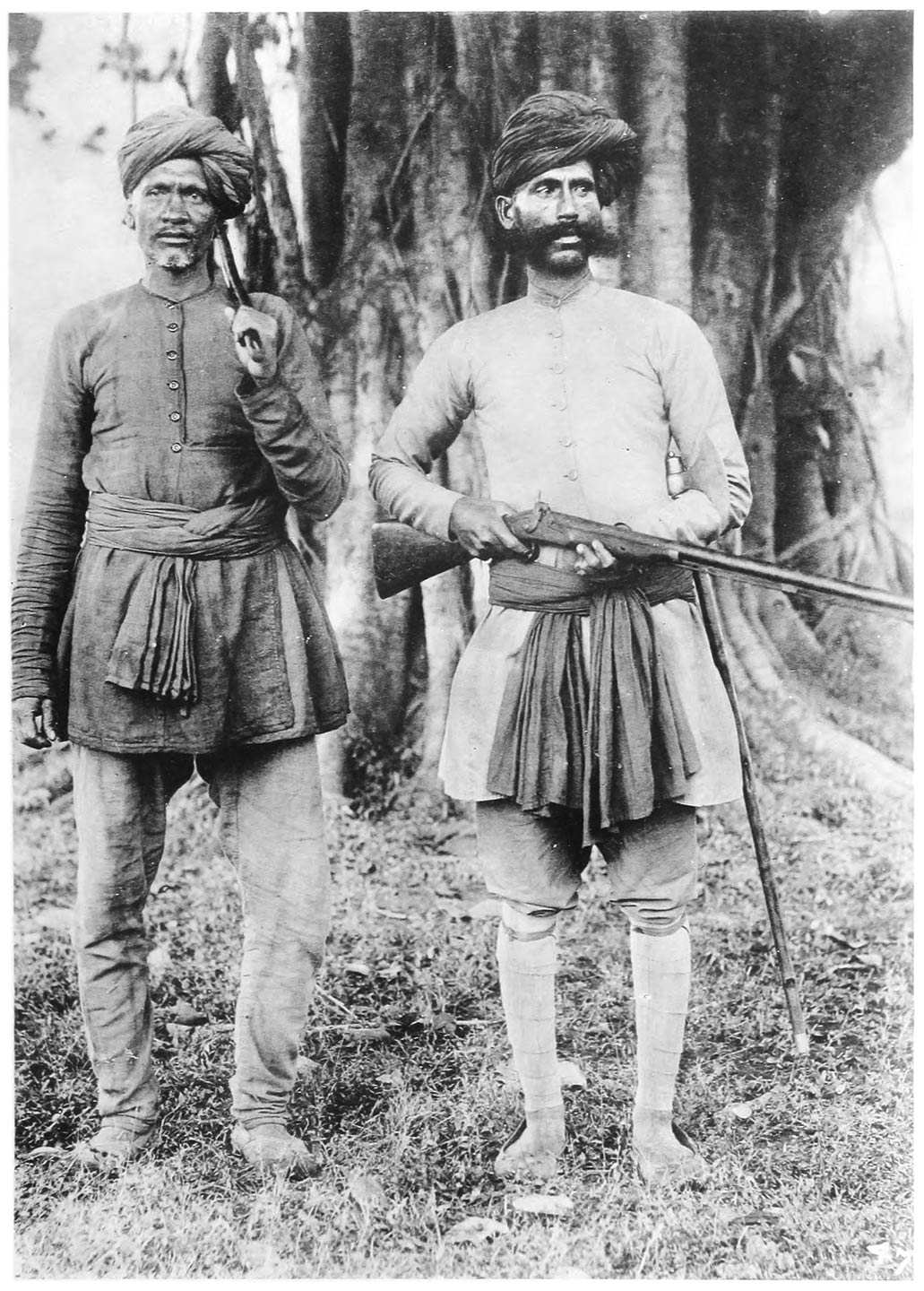
Occupation. 10. Their occupation is hunting and trapping birds. Those who live by bird-catching are often known as Miskâr, said to be a corruption of mîr shikâr, “head huntsman,” or mâskâr, “eater of meat.” They have a most ingenious mode of trapping birds with a series of thin bamboos, like a fishing rod, on which bird-lime (lâsa) is smeared. This they push with great adroitness through the branches and leaves where a bird is sitting, and entangle his wings and feathers. They make excellent shikâris, and are noted for their skill in tracking game. Some work in the Mirzapur lac factories, and a few cultivate as non-occupancy tenants. They are a fine, active, manly race, but notoriously untrustworthy.
Distribution of Baheliyas according to the Census of 1891.
District. Hindus. Muhammadans. Total.
Karaul. Raghubansi. Sûrajbansi. Others.
Sahâranpur … … … 2 … 2
Muzaffarnagar … … … … 229 229
Meerut … … … 20 4 62
Bulandshahr … … … 38 12 50
Mathura … … … 199 12 211
Agra 354 80 … 131 … 565
Farrukhâbâd 1,279 1,149 … 655 21 3,104
Mainpuri 753 414 … 403 10 1,580
Etâwah 325 630 … 332 1 1,288
Etah … 247 … 47 … 294
Bareilly … … … 41 232 273
Bijnor … … … 31 … 31
Morâdâbâd … … … 53 7 60
Shâhjahânpur 251 2,108 … 712 … 3,071
Pilibhît … 870 … 132 116 1,118
Cawnpur 2,482 33 5 456 … 2,976
Fatehpur 1 … 132 162 … 295
Bânda … … 24 86 … 110
Allahâbâd 25 1 355 912 33 1,326
Jhânsi … … 4 40 … 44
Jâlaun … … … 36 … 36
Lalitpur … … … 17 … 17
Benares 16 … … 541 20 577
Mirzâpur … … … 1,152 4 1,156
Jaunpur … … … 322 … 322
Ghâzipur 11 … … 80 … 91
Ballia … … … 1 … 1
Gorakhpur 2 … 223 1,222 2 1,449
Basti … 56 422 … 205 683
Azamgarh … … 30 256 … 286
Tarâi … … … 11 100 111
Lucknow 19 … 226 501 176 922
Unâo … … … 151 143 294
Râê Bareli … … … 524 … 524
Sîtapur … … 31 866 18 915
Hardoi … … 203 136 … 339
Kheri … … … 617 … 617
Faizâbâd … … 923 408 … 1,331
Gonda 4 … 86 956 171 1,217
Bahrâich 44 … 615 1,310 106 2,075
Sultânpur … … 571 582 … 1,153
Partâbgarh … … 1,186 1,264 … 2,450
Bârabanki … … 262 237 … 499
Total 5,566 5,588 5,298 15,642 1,660 33,754
Baidguâr.—A small Muhammadan caste shown at the last Census only in Morâdâbâd (173) and Pilibhît (247). The information obtained about them is not very precise; but there can be little doubt that they are an off-shoot of the Baid Banjâras. It is said that formerly the Baid followed the occupation of carrying grain on pack animals: while the Guâr used to make hemp matting (tât), and tend cattle. Since their conversion to Islâm they are known collectively as Baidguâr, but the two divisions do not intermarry. The Census returns give their sections as Baghâri, Chauhân, Mahrora, Nahar, Sadîqi, Shaikh, and Tomar.
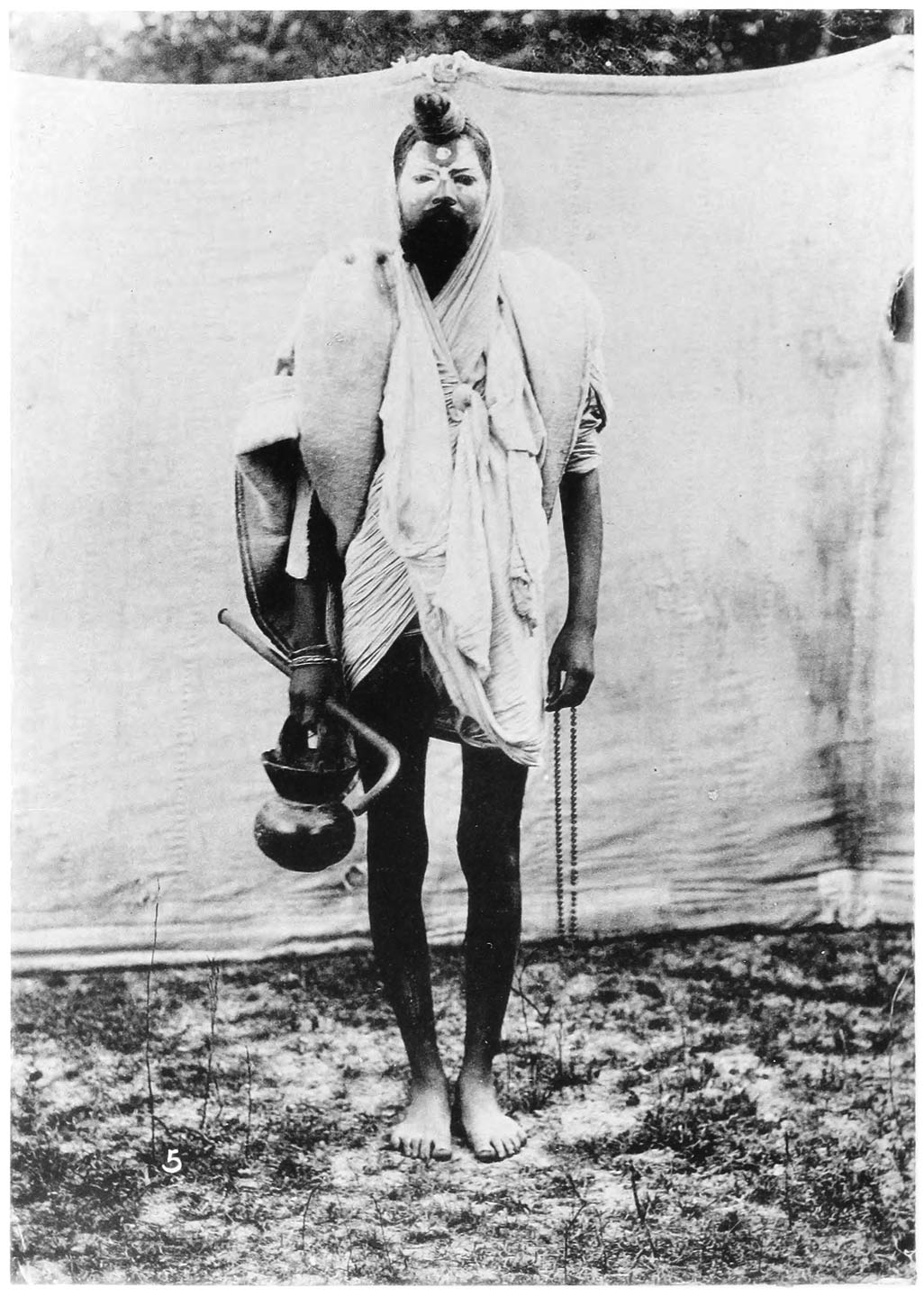
“The history of the Bairâgis commences with Ramânuja, who taught in the south of India, and who is supposed to have lived in the eleventh and twelfth centuries. But it is not till the time of Râmanand, that is until the end of the fourteenth century, that the sect was in any way powerful or important in Northern India; and, indeed, it is only to the followers of Râmanand or his contemporaries that the term Bairâgi is properly applied. The split occasioned by the secession of Râmanand was, like most of the movements in modern Hinduism, a revulsion of the more liberal Northern thinkers against the stricter doctrines of Southern Hindustân. The sect founded by Râmanand was, nominally at least, open to all castes, whereas previous to his time Brâhmans and Kshatriyas alone were admitted, and many of his followers, who founded important schools of doctrine, were men of the humbler classes. The movement started by Râmanand was essentially popular, and the books published by his adherents were written in the tongue of the people, no longer in Sanskrit, but in Hindi—a departure which has been very far-reaching in its results, and which has led in the Panjâb to a new scripture, and a new national religion of a very clear and vigorous type.”
BAIRÂGI.
Divisions of the Bairâgis. 2. At the last Census in these Provinces the Bairâgis were classed in three great sub-divisions—Mâdhavachârya, Nimâwat, and Râmanandi. On this Mr. Maclagan writes:—“The Bairâgis have, however, been so far outdone by the newer sects which have sprung from the original stock, that they may be now looked upon as representing orthodox Hinduism, in contrast to the more independent schools of thought. As a rule they venerate both Krishna and Râma, but there are sections of them which pay more reverence to the one, and others that pay more reverence to the other. There are always supposed to have been four sections of Bairâgis, but it appears a little uncertain what the four sections are. There are at least four enumerations:—
“(a) Râmanandi; Nîmanandi; Vishnuswâmi; Mâdhavachârya.
“(b) Ramânuja; Mâdhavachârya; Vishnuswâmi; Nimikharakswâmi.
“(c) Râmanandi; Nimânuja; Mâdhavachârya; Vallabhachârya.
“(d) Râmanandi; Biganandi; Mâdhavachârya; Vishnuswâmi.
BAIRÂGI RÂMÂNANDI.
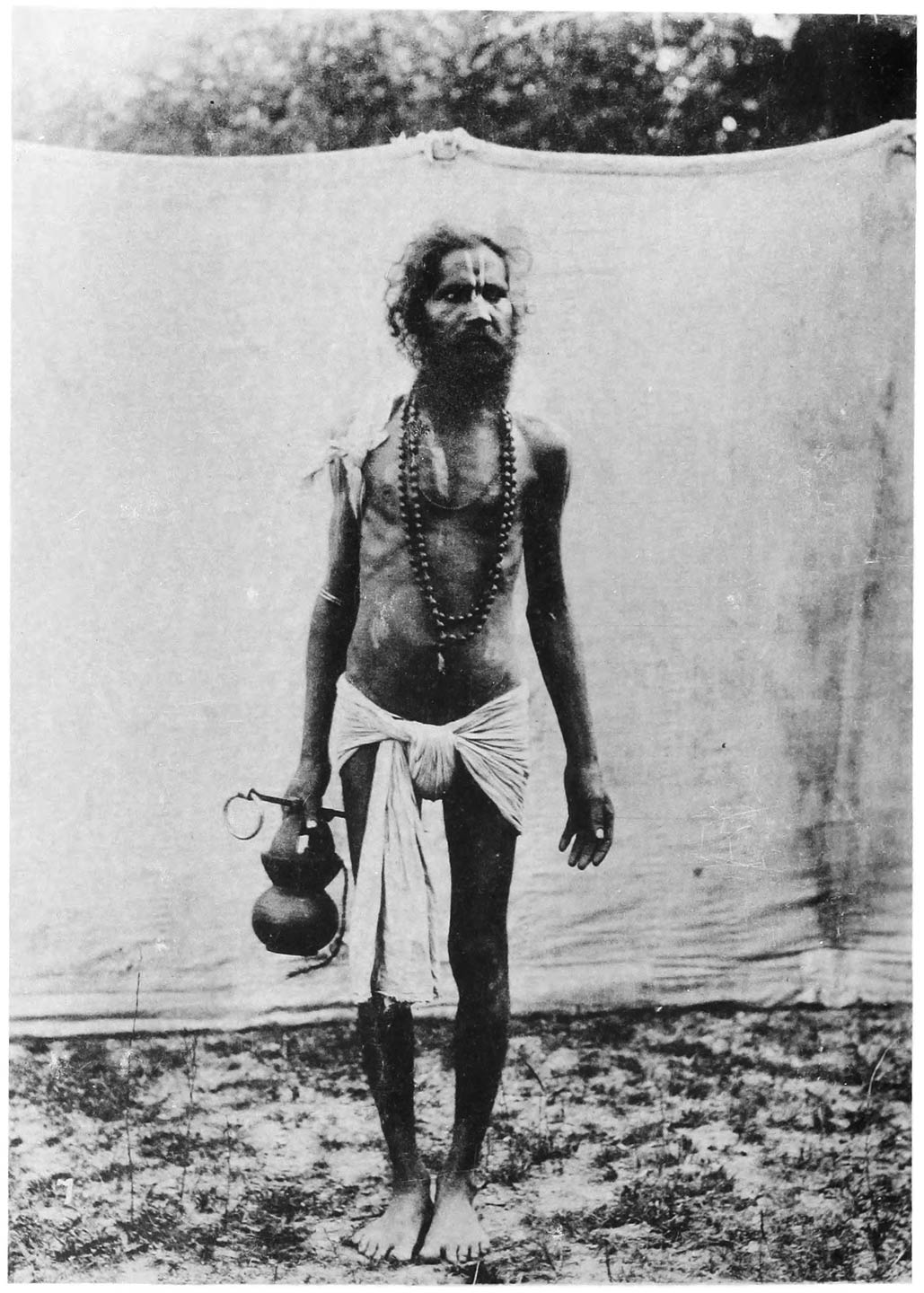
“In the Panjâb there are practically two main sections only, namely, the Râmanandi and Nîmanandi, of whom the former are more specially addicted to the worship of Râma, and the latter to that of Krishna. They both hold a great feast on the death of a fellow devotee, and also on the Râmnaumi, the day of the incarnation of Râmchandra, and on the eighth day of Bhâdon, the incarnation day of Krishna. But the Râmanandis study the Râmâyana, and look on Ajudhya and Râmnâth as places of pilgrimage, while the Nîmanandis study the books relating to Krishna, and consider Mathura, Brindâban and Dwârikanâth to be sacred places. The forehead marks of the Râmanandis are in the form of a trident, of which the two outer prongs are white, and the central one white or red; while those of the Nîmanandis are two-forked only, and entirely in white. The shape of the latter emblem is said to be derived from the figures of the Narasinha Avatâra, and the Nîmanandis are stated to be special worshippers of this incarnation.”
Distribution of the Bairâgis according to the Census of 1891.
District. Mâdhava Achârya. Nimâwat. Râmanandi. Others. Total.
Dehra Dûn … … 530 139 669
Sahâranpur … … … 43 43
Muzaffarnagar … … 541 446 987
Meerut … 156 1,586 2,396 4,138
Bulandshahr … … 429 2,279 2,708
Aligarh … … 974 3,183 4,157
Agra 4 … 496 1,259 1,769
Farrukhâbâd … 12 60 233 305
Mainpuri … 9 … 89 98
Etâwah … … 22 268 290
Etah 1 1 35 160 197
Bareilly … … 148 610 758
Bijnor … … … 539 539
Budâun … 2 120 397 519
Morâdâbâd 3 … 1 239 243
Shâhjahânpur … … 241 600 841
Pilibhît … 12 57 335 404
Cawnpur … … 61 389 450
Fatehpur … … 17 128 145
Bânda 1 … 52 … 53
Hamîrpur … … 45 163 208
Allahâbâd 2 1 58 312 373
Jhânsi … 3 58 109 170
Jâlaun 2 28 22 183 234
Lalitpur … 4 39 224 267
Benares … … … 141 141
Mirzapur … … 28 149 177
Jaunpur … … … 204 204
Ghâzipur … … 82 826 908
Ballia … … … 257 257
Gorakhpur … 33 295 1,122 1,450
Basti … … 1 1,286 1,287
Azamgarh … … … 9 9
Kumâun … … … 25 25
Garhwâl … … … 105 165
Tarâi … … 24 24 48
Lucknow … … 291 1,439 1,730
Unâo … … 17 … 17
Râê Bareli … … 27 6 33
Sîtapur … … 161 335 496
Hardoi … … … 337 337
Kheri … … 348 396 744
Faizâbâd … … 1,474 543 2,017
Gonda … … 877 64 941
Bahrâich … … 19 201 220
Sultânpur … … 47 69 116
Total 13 261 9,283 22,321 31,878
Râê Bareli and Unâo Districts:—Dundiya Khera, Unchhgâon, Kumhi, Bâr, Kahanjar, Ghâtampur, Serhupur, Makraid, Dalmau, Bareli, Bihâr, Pathân, Panhan, Sathanpur, Harha, Purwa, Morâwan, Sirwan, Asoha, Gorinda, Parsandan.
Lucknow District:—Bijnaur.”
Tilok Chand was the premier Râja of Oudh, and his descendants are never weary of telling stories of his almost divine and unequalled power. He once turned the Kahârs, who carried his palanquin, into Râjputs; and one account of the Bhâlê Sultân sept in Faizâbâd is that they were Bâris, or link-boys, in his service.
Customs. 3. Of the sept in Râê Bareli we read:—“The Bais clan differ from all other Râjputs somewhat in their customs. Neither men nor women, rich or poor, will put a hand to cultivation or labour of any sort; the women wear one long cloth, which is fastened round their waists about the middle, the lower folds covering the lower portions of the person, and the upper parts being thrown over the shoulders. They are supposed to be more addicted to the crime of infanticide than other Râjputs, and they divide their inheritance according to a system of primogeniture by which the three elder sons receive larger shares than the younger ones.”
Religion and social standing. 8. There is nothing peculiar about the religion of the Bais except their tribal worship of the snake, and their reverence for a clan goddess, Mathotê, who is worshipped at the Mathotepur fair, in the Sîtapur District. She became a Sati at the death of her consort. The ordinary Bais give their daughters in marriage, amongst others, to the Sengar, Bhadauriya, Chauhân, Kachhwâha, Gautam, Parihâr, Dikhit and Gaharwâr Râjputs, and receive daughters in marriage from the Banâphar, Janwâr, Khîchar, Raghubansi, Raikwâr, Karchauli, and Gahlot. The Tilokchandi Bais ally themselves only with septs of the bluest blood. The Bais in Faizâbâd take brides from the Bachgoti, Bhâlê Sultân, Kalhans, and Kânhpuriya septs, and they give their daughters to the Gaharwâr, Bisen, Sombansi, Bhadauriya, Chauhân, and Kachhwâha septs. In Ballia they take wives from the Ujjaini, Haihobans, Kinwâr, Nikumbh, Sengar, Kausik, Râghubansi, Sûrajbansi, Bhrigubansi, Barhauliya, Gaharwâr, Gautam, Kâkan, Donwâr, Jâdon, Kachhwâha, Chauhân, Bisen, Nâgbansi, Sakarwâr, Baghel, Sombansi, Udmatiya, Solankhi, Chandel, Parihâr, and give brides to the Sirnet, Râjkumâr, Drigbansi, Maunas, Kachhwâha, and, in rare cases, to the Ujjaini. Their gotra is Bhâradwâja.
Distribution of the Bais Râjputs according to the Census of 1891.
District. Hindus. Muhammadans. Total.
Dehra Dûn 1 48 49
Sahâranpur 185 65 250
Muzaffarnagar 109 250 359
Meerut 578 … 578
Bulandshahr 178 197 375
Aligarh 707 11 718
Mathura 231 16 247
Agra 1,022 4 1,026
Farrukhâbâd 6,688 10 6,698
Mainpuri 4,073 5 4,078
Etâwah 1,828 9 1,837
Etah 2,050 80 2,130
Bareilly 1,673 15 1,688
Bijnor 678 … 678
Budâun 8,301 212 8,513
Morâdâbâd 819 1 820
Shâhjahânpur 1,111 173 1,284
Pilibhît 315 … 315
Cawnpur 6,323 15 6,338
Fatehpur 7,495 672 8,167
Bânda 15,857 224 16,081
Hamîrpur 14,285 24 14,309
Allahâbâd 11,882 60 11,942
Jhânsi 703 … 703
Jâlaun 1,133 21 1,154
Lalitpur 1,097 … 1,097
Benares 11,225 125 11,350
Mirzapur 5,844 … 5,844
Jaunpur 13,863 258 14,121
Ghâzipur 6,329 375 6,704
Ballia 9,334 59 9,393
Gorakhpur 12,246 1,708 13,954
Basti 5,873 9,954 15,827
Azamgarh 24,730 2,091 26,821
Tarâi 47 … 47
Lucknow 3,898 23 3,921
Unâo 10,319 376 10,695
Râê Bareli 27,022 1,141 28,163
Sîtapur 3,887 309 4,196
Hardoi 4,408 90 4,498
Kheri 1,073 503 1,576
Faizâbâd 18,126 1,734 19,860
Gonda 55 146 201
Bahrâich 3,896 1,239 5,135
Sultânpur 6,447 2,514 8,961
Partâbgarh 8,339 560 8,899
Bârabanki 12,171 1,254 13,425
Total 278,454 26,571 305,025
BAISWÂR.
Tribal organization. 2. Besides this, their sub-divisions, some of which are totemistic, point to a non-Aryan origin. The Khandit take their name from the sword (Khanda), which they hold in great respect. The Bansit respect the bamboo (bâns), from which they say the ancestor of this sept was produced. These, they say, are the two original septs, out of which the remaining five have been derived. The Chaudharis are said to be the offspring of a connection between a Kurmi man and a Baiswâr woman. The Bannait say they are so called because they were residents in the forest. The remaining three septs—Rautiha, Sohâgpuriha, and Piparaha—are said to take their names from three villages in which they settled in Bundelkhand, Revati, Sohâgpur, and Pipara. The Khandit is the most respectable sept, and the others by the rule of hypergamy pay to get wives from them. The septs are exogamous in theory, but apparently the rule is not certain. When one daughter has been married into a family other daughters are, if possible, married into the same family, but this is not the case with sons. The tribal council (panchâyat) is presided over by a headman (mahto), who is of the Khandit sept. The offence of adultery is dealt with much less severely than that of eating with another caste. The tribal punishments are to give seven recitations of parts of the Bhâgavata, to bathe in the Ganges, or to undertake a pilgrimage to Benares, Prayâg, or Mathura. Polygamy is allowed, but monogamy is the rule. The head wife alone joins in family worship. Concubinage and polyandry are prohibited. The marriage age for boys or girls is ten or twelve. There is no purchasing of brides, but her relations have to give a dowry, and it is considered discreditable not to provide this to a suitable amount. Adultery in husband or wife, and eating or smoking with a strange caste, are grounds for divorce. A divorced woman cannot re-marry. Widow marriage in the sagâi form is allowed. The only ceremony is that with a recitation of the Satya Nârâyana the clothes of the pair are knotted together in the presence of the clansmen. Widow marriage outside the family is allowed only if the levir does not claim his sister-in-law under the usual restrictions. Adoption and succession are recognized under the usual local rules of Hindu law.
Death. 4. The dead are cremated in the standard Hindu form. After the cremation all the mourners touch fire with the eight parts of their bodies, and sit for an hour in silence with the chief mourner. Next morning the chief mourner goes to the pyre, collects the ashes, and throws them into an adjoining stream. They set up an earthen vessel on a pîpal tree through which water drops for the refreshment of the thirsty spirit. While in the state of impurity, the chief mourner is armed with a stick, pointed with iron, to enable him to keep off ghosts. Every day he lays out food for the ghost along the road to the cremation ground. On the tenth day he offers lumps of rice and milk, which he throws into a tank, and all the mourners shave. On the eleventh day the Mahâpâtra receives all the personal effects of the dead man, which he is supposed to pass on to the deceased in the land of the dead. On the twelfth day the chief mourner offers sixteen balls (pinda) to ancestors, and returning, feasts the Mahâpâtra and gives him a cow and a loin cloth. On the thirteenth day Brâhmans are fed. During the fortnight (pitri-paksha), sacred to the manes, in the month of Kuâr, the ground under the eaves of the house is plastered, and some water and a tooth brush stick is left out; and flowers and rice are scattered about for the use of the dead visitors. On the fifteenth day of Kuâr Brâhmans are feasted.
Religion. 5. They principally worship Devi through Brâhmans. The local gods (dih) they worship through the Baiga with sacrifices of pigs and goats.
Superstitions. 6. Their superstitions are similar to those of the surrounding castes. They swear by touching their sons’ heads, the feet of a Brâhman, the tail of a cow, or by standing in running water. They believe in the Evil-eye, which is obviated by an Ojha blowing on some dust, and sprinkling it over the person attacked, and repeating appropriate spells (mantra).
Taboos. 7. Very few drink liquor: none eat beef or pork. They will not touch the wife of a younger brother or the wife of an elder brother-in-law. They will not eat the flesh of the lizard, alligator, snake, jackal, or rat. The women eat separate from the men.
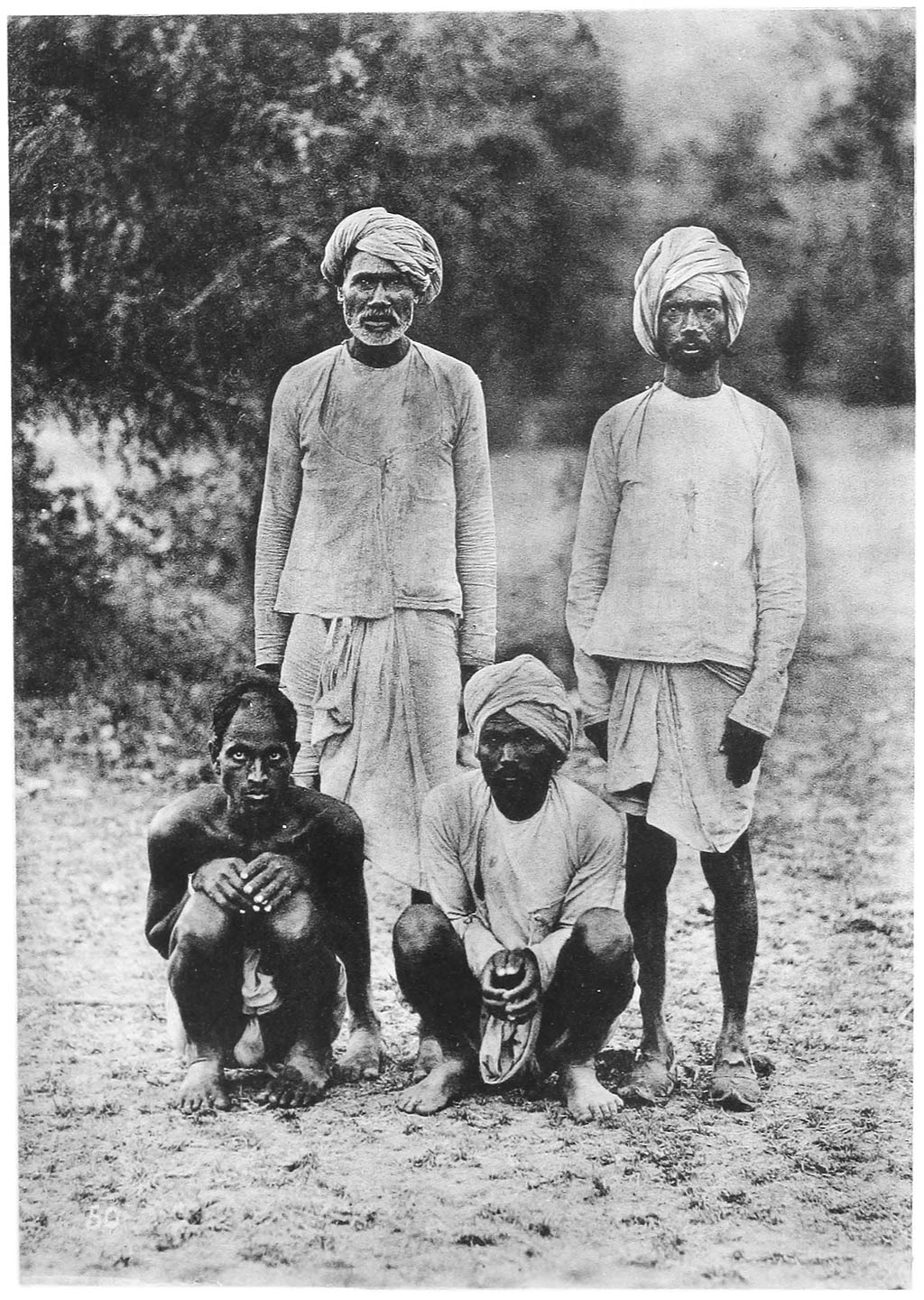
Status. 8. They rank as respectable high caste Hindus. They are either landholders or tenants with occupancy rights. They dress and wear ornaments like ordinary Râjputs, and among the low tribes around them their claim to that rank is generally accepted.
Marriage rules. 2. They have several exogamous gotras, and are not allowed to marry in their own gotra, or in the family of the maternal uncle, until at least two generations have passed since the last connection by marriage. A man may have as many wives as he can support. Widows of the tribe may be married in the karâo form. Marriages take place when the parties attain the age of puberty. The parents and guardians of the boy have to pay a bride price which varies from forty to fifty rupees, and the price rises according to the youth and beauty of the bride. If a marriage is annulled after consummation, and she marries another man she has to repay the bride price, or as much of it as the tribal council award as compensation to the first husband. Children by a karâo marriage rank equally for inheritance with the offspring of a regular marriage. It has been asserted that the rule of the levirate is so far relaxed that the widow can be claimed by the elder as well as by the younger brother of her late husband; but this assertion is in such direct opposition to the practice current among allied tribes that it is probably incorrect.
Birth. 3. There are no ceremonies during pregnancy. The women act as midwives to their own people as well as to other castes; and they have no custom of adoption, initiation, or betrothal.
Marriage. 4. The marriage ceremonies are of the most simple type. The boy’s father pays the bride price, and forthwith takes the girl home; and the marriage is recognised when a few of the clansmen have been fed.
Death. 5. Persons who die of cholera, small-pox, or snake-bite, are buried, because they are supposed to be under the direct influence of the deities who rule these diseases, and no purification by fire is necessary. Persons who die a natural death in other ways are cremated. They do not use a regular pyre, but make a thatch of bamboos, and under it light some wood; when the fire is well alight they put on it the body, covered with a white cloth, and let it burn. They have no special cremation places, but consume the corpse wherever it is most convenient, and pay no regard to the ashes, which are left on the site of the cremation.
Impurity. 6. Women remain impure after childbirth for seven days, and the person who sets fire to the pyre for three days. As long as a woman has not given birth to a child she is considered impure during her menses; but once she is a mother her menstruation is disregarded, and she is not kept apart or prevented from doing her ordinary house work.
Religion. 7. Bâjgis consider themselves to be Hindus. They chiefly reverence Devi, and her worship is carried on by a tribal subscription with which goats, rams, and spirits are bought and used in sacrifice. A little of the blood and spirits is poured upon the ground, and the rest is consumed by the worshippers. They have no priests or temples, but each household has a shelf, on which is placed a trident (trisûl) with an iron lamp and an earthenware vessel containing some beads, which represent the goddess. These articles serve as a representation of Nâga Râja, the serpent godling, who is regarded as their tribal deity. Nâga Râja is a most powerful godling, and, unless he is propitiated, brings misfortune, disease, and death. The special offering to Nâga Râja and Devi is a goat, while Nar Sinh Deo is worshipped with the sacrifice of fowl. Any adult member of the tribe may make these offerings.
Festivals. 8. They have only two festivals, the Naurâtra and the Basant Panchami. Some of them regard Makar-ki-Sankrânt, or the passage of the sun into the sign of Capricornus, a holiday. On these days they eat meat and drink spirits. Of ancestor worship they know little; but they are, like similar races, in great dread of the spirits of the departed, and do not care to say much about them. Like the Doms of Dehra Dûn, they keep in their houses, as a sort of household guardian, some rude wooden images representing the five Pândavas—Yudhishthira, Bhîma, Arjuna, Nakula and Sahadeva. They know little of omens.
Oaths. 9. Their chief oath is on the cow; in less serious cases they swear on the bamboo. The violation of an oath is believed to cause the death of the eldest son of the perjurer.
Demonology. 10. They have the usual beliefs characteristic of races in the same phase of culture regarding dreams, the Evil-eye, and demoniacal possession, leading to disease and death.
Social rules. 11. They will not eat beef; but as to any other kind of food they have no scruples. Men and women eat apart. They will eat pakki and kachchi from any one but a Dom or a Chamâr. No other caste will eat or drink from their hands.
Occupation. 12. Their occupation is singing and dancing, and their women, as has been said already, act as midwives.
The Census returns record 85 sections. Many of these are taken from well-known tribes, such as Baghel, Bais, Bâhman Gaur, Chamar Gaur, Khatîk; others are of local origin, like Abâdpura, Baksariya, Indauriya, Purabiya. Curiously enough they do not seem to have retained the distinctively totemistic sections of the Doms, Bânsphors, and Basors.
Marriage rules. 2. Besides the rule that a man cannot marry within his sept he cannot marry in a family which is known to be descended from the same parents as his own, or which can be traced to a common ancestor. He cannot marry in the family of his maternal uncle or of his father’s sister. He cannot marry two sisters at the same time, but he can marry the younger sister of his deceased wife.
Traditions. 3. Their traditions show clearly that they are a branch of the great Dom tribe, and they refer their origin to Sûpa Bhagat, who, in Bengal, is regarded more as the Guru than the progenitor of the Doms.
Marriage. 4. Marriage is both infant and adult. Sexual license before marriage is neither recognised nor tolerated. Polyandry is repudiated; polygamy without any condition or limit is allowed. They marry by the ordinary low caste form. Widows are married by the form known as Dola or Dharauna. The levirate, on the usual conditions, is recognised; but it is not compulsory on the widow to marry the younger brother of her late husband. At the Dola marriage the binding part of the ceremony is the feast to the brethren. A woman can be turned out of the house for infidelity, and this is the only form of divorce. A divorced woman can marry again like a widow.
Religion. 5. They are not initiated into any sect, but are commonly classed as Sâktas. Their tribal godling is Jakhaiya, to whom pigs are offered on a Monday. On Monday and Friday goats are sacrificed to Devi. There appears to be no worship special to women and children.
Death ceremonies. 6. Some of them bury and some burn the dead. The corpse is buried with the feet to the south. When cremation is performed the ashes are thrown into some river. They have no particular ceremony to appease the spirits of the dead. Some of them do the ordinary srâddha.
Occupation. 7. Their occupation is to act as village messengers (gorait). They blow the long trumpet at marriages and festivals. Some make bamboo baskets; some are pure village menials, and work in consideration of receiving a small patch of rent-free land.
Social rules. 8. They eat meat and drink spirits. They practically eat anything, even the leavings of other people. They will eat kachchi only with their own castes; they take pakki from sweepers. No other caste will touch anything from their hands.
Distribution of Balâhars according to the Census of 1891.
Mathura 509
Cawnpur 1,428
Hamîrpur 105
Jâlaun 317
Total 2,359
Marriage. 2. The marriage is celebrated in the usual way, and the binding part of it is the seven perambulations (bhanwar) round the sacred fire. A Brâhman priest officiates. Marriage under the form known as Dharaicha is also permitted. This is the form used in widow marriage. The widow can, if she please, live with the younger brother of her late husband; but she can, if she chooses, marry an outsider to the family, and her right of choice is fully recognized. A woman can be expelled for infidelity, and she has the right of appeal to the tribal council. Such a divorced woman can marry again by the Dharaicha form.
Religion. 3. They are Hindus of the Vaishnava sect, and their chief god is Bhagwân. They worship Hanumân every Tuesday and Saturday, and Devi in the months of Chait and Kuâr. Zâhir Pîr is venerated on the ninth of the first half of Bhâdon. The offerings consist of flowers, sweetmeats, fruits, etc., and after presentation they are consumed by the worshippers. They employ Brâhmans as priests who do not incur any social discredit by serving them.
Disposal of the dead. 4. The dead are cremated. Poor people leave the ashes at the pyre; wealthier people send them to the Ganges. They perform the usual annual srâddha in the month of Kuâr.
Occupation. 5. Weaving is their main occupation, but some of them work as masons and day-labourers.
Social rules. 6. They eat pork and flesh of cloven-footed animals, except the cow. They drink spirits. They will not eat the flesh of monkeys, fish, fowls, crocodiles, lizards, snakes, rats or other vermin, or the leavings of other people. The lowest well known caste with which the caste will eat pakki is the Nâi. They eat kachchi cooked by Kâyasths, Gûjars or Ahîrs.
2. “And it is these left-hand worshippers who, I repeat, devote themselves to the exclusive worship of the female side of Siva and Vishnu; that is the goddess Durga or Kâli (Amba Devi) rather than to Siva; to Râdha rather than to Krishna; to Sîta rather than to Râma; but above all to Amba or Devi, the mother goddess, sometimes confounded with Siva’s consort, but rather, in her more comprehensive character, the great power (Sakti) of Nature, the one mother of the Universe (Jaganmâta, Jagadamba), the mighty mysterious force, whose function is to direct and control two quite distinct operations; namely, first, the working of the natural appetites and passions, whether for the support of the body by eating and drinking, or for the propagation of living organisms through sexual cohabitation; secondly, the acquisition of supernatural faculties (Siddhi), whether for man’s own individual exaltation or for the annihilation of his opponents.”
The sect devotes itself to what are technically known as the five Ms. which are named in the verse,—
Madyam mânsam cha minam cha mudrâ maithun mewa cha;
Êtê pânch makârasyur mokshadâ hi yuge yuge.
“Wine, fish, flesh, enjoyment and cohabitation—these are the givers of salvation in every age.” For each of these there is a slang or technical term. Thus wine is tîrtha or “pilgrimage;” flesh, sudhi or “pure;” fish, pushpa or “flowers;” mudra is chaturthi or “fourth;” and cohabitation, panchami or “fifth.” Their principal form of worship is known as Bhairavi chakra or “the wheel of Bhairava;” and they assert that whoever takes part in it becomes for the time a Brâhman. A jug of spirits is placed within the figure of a triangle or quadrangle, and worshipped with the mantra, Brahm shapam bimocha tha—“O wine! thou art free from the curse of Brahma.” Again the secret form of the ritual consists in the worship of a naked woman, and similarly, a naked man is worshipped by the women. A vessel is filled with water and a large dish with meat, and the leader, the wine cup in his hand, says, Bhairavoham Sivoham, “I am Bhairava and Siva.” He drinks first, and all the congregation does the same. A man and woman stand naked with swords in their hands, and are worshipped. The pair are supposed to represent Devi and Mahâdeva. Then follows indiscriminate license, and the subsequent ritual takes even more disgusting forms. To free themselves from the risk of subsequent transmigration, they perform a particular charm (prayoga), which consists in placing bottles of liquor at separate places in the house and drinking till intoxication results. The mantra of initiation is said to be Dam Durge namah, or Bham Bhairavâya namah, “I salute Durga. I salute Bhairava.” In Bengal they also use the mystic formula Hrin, Srin, Klin. Another of their mystic formulas is Hram, hrim, hrum, bagala muhhai phat swâha, or Hum phat swâha. The charm to kill an enemy is to make an image of flour or earth and stick razors into the breast, navel and throat, with pegs in the eyes, hands and feet. Then they make an image of Bhairava or Durga, holding a three-pronged fork (trisûl) in the hand, and place it so close to the image of the person to whom evil is intended that the fork pierces its breast. A fire sacrifice is made with meat and a charm recited, which runs—“Kill, kill; estrange, and make him hated of all; make him subservient to my will; devour him, consume him, break him, destroy him; make my enemies obey me.” At one time they were supposed to make human sacrifices to Kâli, and the records of our Criminal Courts show that such practices have not entirely ceased. In this they are closely connected with the Aghoris, who eat human flesh. One division of them the Choli-mârgi, make the women place their boddices (choli) in a jar, and thus allot them by chance to the male worshippers. Of another, the Bîjmârgi, the bestiality of the ritual defies description.
3. There seems, unhappily, reason to believe that this brutal form of so-called worship is spreading in Upper India under the example of Bengâli immigrants, who have introduced it from its head-quarters in Bengal. At the last census, 1,576 persons avowed themselves worshippers of the left-hand path.
2. The Banâphars hold only a moderately respectable rank among Râjputs. In Jâlaun they will, it is said, take brides by the dola form from all the poor Râjputs of the District, and receive the bride price. They marry their sons to the girls of the Bais, Gautam, Dikhit, and Bisen septs. In Hamîrpur they profess to belong to the Kasyapa gotra, and give brides to the Gautam, Dikhit Bais, and Chandel, while they take wives from the Nandwâni, Bâhman Gaur, and Bais. In Bânda they give brides to the Dikhit, Gautam, Gaur, and Kachhwâha; and take girls of the Panwâr Bais, Dikhit, and Sombansi septs.
Distribution of the Banâphar Râjputs according to the Census of 1891.
District. Number.
Mathura 8
Farrukhâbâd 3
Mainpuri 15
Etah 1
Shâhjahânpur 36
Pilibhît 8
Cawnpur 123
Bânda 510
Hamîrpur 828
Allahâbâd 340
Jhânsi 34
Jâlaun 722
Lalitpur 59
Benares 1,447
Mirzapur 191
Ghâzipur 629
Ballia 473
Azamgarh 35
Lucknow 1
Râê Bareli 2
Total 5,465
Banarwâr, Bandarwâr.—A sub-caste of Banyas found principally in the Benares Division. They have thirty-six sections, which are thus given in Mirzapur—Mâlhan, Sothiyân, Sanbhariya, Abakahon, Rupiya, Katariya, Patsariya, Thagwariya, Manihariya, Narihiya, Nakthariya, Khatwatiya, Khelaniya, Burbak, Manipariya, Jhatwatiya, Purwar, Deriya, Puriya, Kalyâniya, Dhângar, Sonmukhiya, Chaudhariya, Sethiyân, Bairah, Naiphiriya, Katholiya, Beriya, Kakariya, Badana, Kasauliya, Lohkhariya, Panchlatiya, Dhenk, Bajâj, Motariya, and lastly those who have no knowledge of their gotra call themselves Akâsh Bhânwari. These sections marry indiscriminately. They are often initiated into the Râmanandi sect of Vaishnavas. To the East they worship, as a sort of fetish (apparently from some fancied connection of name), the bandi or chain worn by women on the forehead. To this on the day of the Nâgpanchami they offer prayers, cakes (pûri), usually one hundred and eight in number, and garlands of flowers. They worship Mahâbîr and the Pânchonpîr in the usual way. Their priests are Tiwâri Brâhmans who are said to serve the royal family of Rîwa. They make their living as brokers, and by selling brass vessels, cloth, money-changing and similar mercantile business. Those who live towards the North eat meat, but the others do not. Drinking is prohibited. They eat pakki cooked by Brâhmans, Kshatriyas and Vaisyas. They will eat kachchi cooked only by members of their own sub-caste. Some Brâhmans, and Kshatriyas will eat pakki cooked by them. Kahârs and Nâis will eat kachchi cooked by them.
5. In Sultânpur they are reported to take brides from the Bilkhariya, Tashaiya, Chandauriya, Kath Bais, Bhâlê Sultân, Raghubansi, Gargbansi, Râjkumâr, and Bachgoti; and to give girls to the Tilokchandi Bais, Mainpuri Chauhâns, Mahûl Sûrajbansis, Nagar Gautams, and Bisens of Majhauli; and that their gotra is Bandhal. In Gonda, it is said that their gotra is Vatsya, and that they give girls to the Panwâr, Bisen, Sirnet, Raikwâr, Bhadauriya, Bais, Kalhans and Chauhân; and take brides from the Sûrajbans, Bachgoti, Barwâr, Gaharwâr, and other high caste Râjputs.
Distribution of the Bandhalgoti Râjputs according to the Census of 1891.
District. Number.
Agra 9
Fatehpur 115
Lalitpur 6
Benares 27
Gorakhpur 48
Basti 257
Azamgarh 4
Lucknow 17
Râê Bareli 129
Sîtapur 35
Kheri 11
Faizâbâd 495
Gonda 407
Sultânpur 9,831
Partâbgarh 3
Bârabanki 42
Total 11,436
Bândi.—A small tribe living as drummers and bird-catchers in the Himalayan Tarâi. Their chief business is catching birds for sale. They also make a living by catching birds and bringing them into cities where pious people, such as Jain Banyas, pay them to release a bird as an act of piety or as a charm to take away disease from a sick person. In their habits and occupation they resemble the Baheliya.
The Census returns record four sections,—Gaur, Mathuriya, Odrain and Serain.
Distribution of the Bândi according to the Census of 1891.
District. Number.
Bareilly 105
Morâdâbâd 5
Total 110
Bangâli, Bengâli.—A resident of Bengal, Vanga or Bang Desa. It is not quite clear whether some of these recorded in the census lists are not the familiar Bengâli Bâbu who has not been entered in his regular caste, Brâhman, Kâyasth, etc. At any rate there is a recognised tribe of vagrants known as Bengâli, Naumuslim Bengâli or Singiwâla, the last because they use a kind of horn in cupping.
2. From reports from the District Superintendents of Police at Sahâranpur, Meerut, and Aligarh, it appears that these people wander all over the Upper Duâb and the Panjab and Native States. They disclaim any direct connection with Nats, Kanjars, and similar vagrants; but they are obviously closely related. Among the Hindu branch there appear to be at least three exogamous sections, Negiwâla, Teli, and Jogeli. The Census returns show 54 sections of the Hindu and four of the Muhammadan branch, but it is impossible to say how many of these belong to the vagrant Bengâlis. The Hindu branch call themselves the descendants of one Siwâi Râm, Râjput, who was a Bengâli and elephant driver, and in the time of Aurangzeb learnt the art of bleeding and cupping from a native physician or Hakîm, and taught it to his descendants. The Muhammadan branch usually call themselves Lodi Pathâns from Bengal. They do not admit outsiders to their caste; marry in the usual form, if Muhammadans, through the Qâzi, but as might have been expected their religious practices are vague. The Muhammadans are said never to be circumcised, and they as well as the Hindus worship Devi and Zâhir Pîr.
3. From Meerut it is reported the Hindu branch will eat meat of all kinds, the flesh of cloven or uncloven footed animals, fowls, all kinds of fish and crocodiles, and the leavings of other people. Though this is not quite certain, it would appear that the Muhammadan branch generally abstain from pork.
4. The Bengâli is a loafer and vagabond, prone to commit petty theft, a beggar, and a rustic surgeon as far as bleeding and cupping go. In their manner of life they much resemble the Mâl and Bediya of Bengal, and, if there is anything in the name, they are possibly akin to their tribes.
Distribution of Bengâlis according to the Census of 1891.
District. Hindus. Musalmâns. Total.
Dehra Dûn … 16 16
Sahâranpur 65 160 225
Bulandshahr 235 1 236
Aligarh 1 … 1
Mathura 64 … 64
Agra 40 … 40
Farrukhâbâd 5 … 5
Mainpuri 2 … 2
Bareilly 25 … 25
Budâun … 25 25
Cawnpur 31 4 35
Fatehpur 16 … 16
Bânda 4 … 4
Allahâbâd 65 4 69
Jhânsi 8 … 8
Benares 219 … 219
Mirzapur 12 … 12
Ghâzipur 28 … 28
Gorakhpur 41 … 41
Kumâun 15 … 15
Lucknow 61 30 91
Râê Bareli 75 17 92
Faizâbâd 5 … 5
Gonda … 16 16
Sultânpur 2 … 2
Partâbgarh 51 7 58
Total 1,070 280 1,350
The Rârhi Brâhmans. 2. “The Rârhi Brâhmans derive their name from the Rârh, or the high-lying alluvial tract on the west bank of the river Bhagîrathi. Their claim to be of comparatively pure Aryan descent is to some extent borne out by the results of anthropometric enquiries. The current tradition is that early in the eleventh century A.D. Adisura or Adisvara, King of Bengal, finding the Brâhmans, then settled in Bengal, too ignorant to perform for him certain Vedic ceremonies, applied to the Râja of Kanauj for priests thoroughly conversant with the sacred ritual of the Aryans. In answer to this request five Brâhmans of Kanauj were sent to him, Bhatta Nârâyana, of the Sândilya section, or gotra; Daksha, of the Kasyapa gotra; Vedagarbha or Vidagarbha, of the Vatsa gotra, or, as others say, from the family of Bhrigu; Chandra or Chhandara, of the Savarna gotra; and Sri Harsa of the Bhâradvâja gotra. They brought with them their wives, their sacred fire and their sacrificial implements. It is said that Adisura was at first disposed to treat them with scanty respect, but he was soon compelled to acknowledge his mistake, and to beg the Brâhmans to forgive him. He then made over to them five populous villages, where they lived for a year. Meanwhile the king was so impressed with the superhuman virtue of Bhatta Nârâyana, who was a son of Kshitisa, King of Kanauj, that he offered him several more villages. The Brâhman, however, declined to take these as a gift, but bought them, as the story goes, at a low price.
3. “Although the immigrant Brâhmans brought their wives with them, tradition says that they contracted second marriages with the women of Bengal, and that their children by the latter were the ancestors of the Barendra Brâhmans. The Barendra, on the other hand, claim to represent the offspring from the original Hindustâni wives, and allege that the Rârhi Brâhmans are themselves sprung from the mésalliance contracted in Bengal.
4. “By the middle of the eleventh century, when Ballâl Sen, the second of the Sen Kings of Bengal, instituted his famous enquiry into the personal endowments of the Rârhi Brâhmans, their numbers seem to have increased greatly. They are represented as divided into fifty-six headships of villages (gâin), which were reserved for them, and might not be encroached on by Brâhmans of other orders.
5. “It is interesting to trace in Ballâl Sen’s enquiry the survival or reassertion of the principle that the Brâhmanhood of the Brâhmans depends not merely on birth but upon personal endowments. It is a question of virtue, not a question of descent. Ballâl Sen, of course, could not go as far as this. The time had long passed when a Kshatriya could transform himself into a Brâhman by penance and self-denial. But the Sen Monarch sought to reaffirm the ancient principle, so far as was then possible, by testing the qualifications of each Rârhi family for the priestly office, and classifying them, in the order of their virtue, according to the results of this examination. Thus two grades of sacerdotal virtue were formed, the Kulin being those who had observed the entire nine counsels of perfection, and the Srotiya, who, though regular students of the Vedas, had lost status by intermarrying with families of inferior birth. The Srotiya were again divided into Siddha or ‘perfect,’ Sâdhya or ‘capable of attaining purity,’ and Kashta or ‘difficult.’ The last-named group was also called Ari or ‘enemy,’ because a Kulin marrying a daughter of that group was disgraced.”
The Barendra Brâhmans. 6. As above stated, there is a difference of opinion as to their origin. “The sub-caste takes its name from the tract or country known as Barendra, lying north of the river Padma and corresponding roughly to the Districts of Pabna, Râjshâhi, and Bogra. Of these there are three hypergamous classes—Kulin, Suddha or ‘pure,’ Srotiya and Kashta, or bad Srotiya.” Of their rules of intermarriage Mr. Risley gives full details.
The Vaidik Brâhmans. 7. “Concerning the origin of the Vaidik Brâhmans some differences of opinion exist. All agree in honouring them for their adherence to Vedic rites, their zeal for Vedic study, their social independence, and their rejection of polygamy. From the fact that some of the most important settlements of the sub-caste are formed in the outlying districts of Orissa and Sylhet, some authorities are led to describe them as descendants of the original Brâhmans of Bengal, who refused to accept the reforms of Ballâl Sen, and took refuge in regions beyond his jurisdiction. The theory that they came from Kanauj derives support from Mr. Sherring’s statement that the Kanaujiya Brâhmans of Benares recognise the Vaidik as a branch of their own tribe, who settled in Bengal. There are two main divisions of Vaidik Brâhmans,—Paschâtya or ‘Western,’ claiming to have come from Kanauj, and Dakshinatya or ‘Southern,’ tracing their origin to the original Bengal stock.”
The Saptasati Brâhmans. 8. “According to popular tradition, the Saptasati Brâhmans are descended from the seven hundred ignorant Brâhmans sent by Adisur to the Court of Kanauj for the purpose of learning their priestly duties. Others trace their origin to certain Brâhmans who were exiled beyond the Brahmaputra river for resisting the innovations of Ballâl Sen. It seems to be certain that they are peculiar to Bengal, and that they cannot claim connection with any of the ten standard Brâhmanical tribes. They virtually admit their inferiority to the other orders of Brâhmans. Men of education and respectability are reluctant to admit that they belong to this sub-caste, all distinctive practices are being abandoned, and the entire group seems likely to be absorbed in the Srotiya grade of Rârhi Brâhmans.”
The Madhyasreni Brâhmans. 9. The Madhyasreni Brâhmans profess to derive their name from the fact of their original settlement being in the District of Midnapur, lying midway (Madhyadesa) between Bengal and Orissa. It is conjectured that they may be a composite group made up of members of the Rârhi, Utkal, and Saptasati sub-castes, who for some reason broke off from their own classes, settled in an outlying district, and in course of time formed a new sub-caste.
10. Further elaborate details of the Bengal Brâhmans will be found in Mr. Risley’s excellent account of them.
Distribution of Bengâli Brâhmans according to the Census of 1891.
District. Number.
Sahâranpur 13
Muzaffarnagar 3
Bulandshahr 30
Aligarh 8
Mathura 505
Agra 106
Farrukhâbâd 11
Etâwah 27
Etah 3
Morâdâbâd 26
Cawnpur 189
Allahâbâd 1,167
Jhânsi 30
Lalitpur 22
Benares 2,362
Mirzapur 3
Ghâzipur 119
Ballia 84
Gorakhpur 108
Lucknow 289
Râê Bareli 16
Sîtapur 12
Kheri 50
Faizâbâd 26
Gonda 9
Bahrâich 11
Sultânpur 22
Total 5,251
Males 2,372
Females 2,879
The Châran Banjâras of the Dakkhin. 3. “Of the Châran tribe the Râthaur family,” says Mr. Cumberlege, “is the strongest, and holds sway in Berâr, for all the Dakkhin is parcelled out among different Banjâra tribes, and no camp (tânda) trades or grazes cattle beyond its own border. The Chârans evidently came to the Dakkhin with Âsaf Jân, sometimes called Âsa Khân, the Wazîr Shâhjahân; and in the year 1630, or thereabouts, Bhangi and Jhangi Nâiks (represented to have been brothers, but certainly not such, though perhaps related) had with them 180,000 bullocks, and Bhagwân Dâs, the Burthiya Nâik, only 52,000. They accompanied Âsaf Jân, carrying his provisions during his raid into the Dakkhin. It was an object of Âsaf Jân to keep these bullocks well up with his force, and he was induced to give an order to Bhangi and Jhangi Nâiks, as they put forward excuses regarding the difficulty of obtaining grass and water for their cattle. This order was engraved on copper and in gold letters as follows:—
Ranjan ka pâni,
Chhappar ka ghâs,
Din ka tîn khûn mu’âf;
Aur jahân Âsaf Jân kê ghorê,
Wahan Bhangi Jhangi kâ bail.
This is still in the possession of the descendants of Bhangi, who are still recognised by the Haidarâbâd Court; and on the death of the representative of the family his successor receives a dress of honor (khillat) from His Highness the Nizâm. The meaning of the inscription seems to be—“If you can find no water elsewhere, you may even take it from the pots of my followers; grass you may take from the roofs of their huts; and if you commit three murders a day I will even pardon this, provided that where I find my cavalry I can always find Bhangi Jhangi’s bullocks.”
Witchcraft among the Dakkhin Banjâras. 4. On this Mr. Cumberlege writes:—“Though not to such an extent as in former years, witchcraft still obtains in Berâr. I can confidently say this, as I had a case in this district wherein all the features coincided exactly with what I am told is still the practice of Banjâras when they fancy a woman a sorceress. The woman was knocked down and strangled by three or four men deputed by the Nâik of the camp, on her husband refusing to kill her, to kill and bury her: this they did, and the husband had afterwards to appear before the council (panchâyat), where he was mulcted of all he possessed, amounting in cattle and cash to about Rs.2,000. Even when attacked by a bad fever or determined dysentery, they often put it down to foul play by some sorceress, and on such occasions the sufferer sends for some one who knows some spell (mantra) or is supposed to know something of sorcery (jâdu). A betel-quid is given to the sufferer and some spell is repeated. Should the sufferer not recover now, he sends for the Nâik, mentions the name of the person he suspects, or not, as the case may be, who sends five or six men, taken from each family in the camp, to any Châran Bhagat to enquire of him who is the sorceress; and, to place this fact beyond doubt, as this deputation goes along they bury a bone or any other article on the road, and make the Bhagat presently state where it was buried, and what the article was. On arriving at the Bhagat’s residence, he tells each man his name, class, gotra, and denomination; that he knows they have come to enquire what has caused the illness of the person (mentioning his name and caste) who is suffering. This he must do directly after the salâms are exchanged, and before the others speak again. A relative of the sick man now places a rupee before a lighted wick; the Bhagat takes it up, looks steadily at it, and begins to sway about, make contortions of the face and body, etc., while the goddess Mariyâi (Mahâ Kâli) is supposed to have entered his body. He now puts down the rupee, and, being inspired, commences to state the date and hour on which the sick man got ill, the nature of the complaint, etc., and in an indignant tone asks them why they buried a certain article (mentioning it) on the road. Sometimes they acknowledge that he is a true Bhagat now, but generally the men call for some further proofs of his abilities. A goat in kid is then brought, the Bhagat mentions the sex of, and any distinguishing marks upon the kid; the goat is then killed, and if he has guessed right the deputation becomes clamorous and requires the name of the sorceress. But the Bhagat keeps them waiting now and goes on to mention the names of other people residing in their camp, their children, and sometimes the names of any prized cows or bullocks; he also tells the representative of what family he has married into, etc. On this the latter presents his nazar; this was fixed at Rs.25 formerly, but greed dictates the sum now, which is often as much as Rs.40.
5. “The Bhagat now begins chanting some song, which he composes as he goes on, and introduces into it the names of the different families in the camp, having a word or two to say about each. The better portion get vile abuse, are called a bad lot, and disposed of quickly; but he now assumes an ironical appearance, begins to extol the virtues of a certain family, becomes facetious, and praises the representative of that family who is before him. All know that the sorceress is a member of that family; and its representative puts numberless questions to the Bhagat relative to his family and connections, his worldly goods, and what gods he worships; the name of the sorceress he calls for; inquires who taught her sorcery (jâdu); and how and why it was practised in this particular instance. The business is now closed by a goat being killed and offered up to Biroliya, and then all return to their camp.
6. “Even now a man may refuse to acknowledge this Bhagat, and will, if the sorceress be a wife or daughter to whom he is attached, should he have money to take the business on to another tribunal. But as he has to pay the expenses of all the men who accompany him, all cannot afford to question a Bhagat’s decision. Sometimes the man will tell his wife, if he is certain she will obey him, to commit suicide; and as she knows full well the punishment is death, and that she must meet it in some form almost at once, when thus enjoined she will obey generally. Otherwise the husband with a witness or two, taking advantage of the first opportunity when she has left the camp, kills and buries her with all her clothing and ornaments. A meeting of the council is held, the witnesses declare the business has been completed satisfactorily, and the husband may or may not agree to the judgment of the council with regard to his pecuniary liabilities. He has to pay all the expenses of the deputation; by the Bhagat is fined Rs.100 or Rs.150; and if he has refused to do the deed himself, and others have had to do it for him, or the sick man dies, he has to give a large sum besides to the man’s family for their support. This fine originally belonged to Bhangi Nâik’s representative, Râmu Nâik; but it is often kept by the different Nâiks themselves now. Râmu has still great influence; but he has used his power so cruelly that many have seceded from his control, and have Nâiks of their own, whom they now obey almost implicitly. There are men in this district well known to me who have been fined six or eight thousand rupees for small misdemeanours, and it is hardly to be wondered at that this thing could not continue for ever.” It is satisfactory to note that under the influence of British law these cruel proceedings are now practically unknown; but those best acquainted with the facts are certain that there would be an immediate recrudescence of it if the pressure of our administration were relaxed.
Religion of the Dakkhin Banjâras. 8. According to Mr. Cumberlege, “the Chârans are all deists. There are Hindu gods they worship as having been holy men; but they only acknowledge one God, and look on Guru Nânak as the propagandist of their religion; Guru Nânak is supreme; but they worship Bâlaji, Mariyâi (Mahâ Kâli), Tulja Devi, Siva Bhaiya, Mitthu Bhûkiya, and Sati. There are smaller gods worshipped also, but the above are the only gods worshipped by the Chârans of Berâr. They have heard of Siva Dâs, but do not worship him as the men of the Telinga country and Central Provinces do. The reason is seen at a glance. Ours is the Râthaur country, those parts belong mostly to the Burthiya class; in fact the Telinga country is entirely theirs, and Siva Dâs was a Burthiya, not a Râthaur, I believe. The oath most sacred to them is taken in the name of Siva Bhaiya, a holy man who resided at Pohora, in the Wûn District, where there are still temples, I believe, to Siva Bhaiya and Mariyâi, and where a nephew of Siva Bhaiya, by name Sûka Bhaiya, still officiates. There are numbers of Bhagats, of varied celebrity, to whom they go on any serious difficulty; otherwise their own Nâiks, or the Nâik to whom the former is subordinate, adjudicates.”
Ceremonies prior to crime. 9. “There is a hut set apart in every camp and devoted to Mitthu Bhûkiya, an old free-booter. No one may eat, drink, or sleep in this hut; and it is simply used for devotional purposes. In front of this hut is a flag-staff, to which a piece of white cloth is attached. By all criminals Mitthu Bhûkiya is worshipped as a clever free-booter; but he is more thought of on the other side of the Wârdha than here. However, where the white flag is seen in front of the hut, it is a sign that the camp worships Mitthu Bhûkiya, and should, therefore, be watched carefully when they are suspected of having committed crime. The men who have agreed and arranged the particulars regarding the carrying out of their scheme meet at night at this hut, where an image of Sati is produced; clarified butter (ghi) is put into a saucer, and into this a wick is placed, very broad at the bottom and tapering upwards: this wick, standing erect, is lit, an appeal is made to Sati for an omen, those worshipping mentioning in a low tone to the god where they are going and what the purpose. The wick is then carefully watched, and should it drop at all the omen is propitious. All immediately get up and make an obeisance to the flag, and start then and there for the business they have agreed on. They are unable to return to their homes before they start, because they must not speak to any one till their business has been carried through. And here we have a reason why Banjâras are rarely known to speak when engaged in a robbery, for, if challenged, these men, who have gone through the ceremony, may not reply. Should they have reached their destination, whether a village, hamlet, or unprotected cart, and are challenged, if any one of them reply, the charm is broken and all return home. They must again take the omens now and worship again or give up the attempt altogether. But, I am told, they generally prefer to make certain of the man who is venturesome enough to challenge them by knocking him down and either killing him or injuring him so severely that he cannot interfere, and would not wish to meddle with their other arrangements. If one of the gang sneezes on the road it is also fatal; they must return to their camp at once.” For further details regarding the methods of criminality of these Dakkhin Banjâras a reference may be made to Major E. J. Gunthorpe’s “Notes on the Criminal Tribes residing in or frequenting the Bombay Presidency, Berâr and the Central Provinces.”
Tribal organisation of the North-Western Provinces Banjâras. 12. The best account of the Banjâra tribes of these provinces is that given by Sir H. M. Elliot. He divides them into five great tribes as follows:—
(1) The Turkiya, “Turkish” or Muhammadan, with thirty-six sub-tribes or gotras, viz., Tomar or Tunwar, Chauhân, Gahlot, Dilwâri, Alwi, Kanothi, Burki, Durki, Shaikh, Nathamîr, Aghwân, Badan, Chakirâha, Bahrâri, Padar, Kanîkê, Gharê, Chandaul, Teli, Charkha, Dhangya, Dhankikya, Gaddi, Tîtar, Hindiya, Râha, Marauthiya, Khakhara, Kareya, Bahlîm, Bhatti, Bandwâri, Bargadda, Aliya, Khilji. “These assert that they came originally from Multân, and left their newly-chosen country of the Dakkhin under a leader called Rustam Khân, and first of all took up their abode at Badli Tânda, near Morâdâbâd, from which they have gradually spread to Bilâspur, Richho, and the neighbouring tracts. They are for the most part occupied as carriers.”
(2) “The Baid Banjâras came from Bhatner under a leader called Dualha. Of them are eleven gotras—Jhaloi, Tandar, Hatâr, Kapâhi, Danderi, Kachni, Tarîn, Dharpâhi, Kîri, and Bahlîm. Their occupations are more various than those of the Turkiyas, as they are occasionally employed as doctors and weavers. They are found in Pilibhît, Kant, and in the neighbourhood of those places.”
Bahrûp Banjâras. (5) Of whom Sir H. M. Elliot says:—“They are, for the most part, Hindus, and lead a more wandering life than the Musalmâns. They are divided into the tribes of Râthaur, Chauhân or Kuri, Panwâr, Tomar, and Bhurtiya. The origin of the first four is sufficiently apparent from their names. The fifth is said to be derived from a Gaur Brâhman. Of these tribes again there are several ramifications. Of the Râthaur there are four—Muchhâri, Bâhuki, Murhâwat, and Panot: of the Muchhâri there are fifty-two divisions; of the Bâhuki there are twenty-seven; of the Murhâwat there are fifty-six; and of the Panot there are twenty-three. The Chauhâns, who have forty-two gotras, are unanimous in saying that they came from Mainpuri. The Panwârs have twenty gotras, and state that they came from Delhi. The Bhurtiya have fifty-two gotras. They claim Chithor as their original seat. The Bahrûp Banjâras, like all the other clans, intermarry, but do not allow of any connection between members of the same gotra. They receive the daughters of Nats in marriage, but do not allow their own daughters to marry into Nat families; and they have some curious customs at their marriages which need not be detailed in this place.”
The Mukeri Banjâras. 14. We have already seen that they claim to have originally come from Makka. Another story told in Mirzapur is that their ancestor was one Makka Banjâra, who helped Father Abraham to build Mecca; and that they emigrated into India with the armies of the early Muhammadan invaders. Another name which they arrogate to themselves is Ahl-i-Quraish, or that of the Arabian tribe, from which Muhammad was descended (see Shaikh). They have two endogamous sub-castes—the Purbiya or “Eastern,” and the Pachhiwâha or “Western.” The Purbiya Mukeris have two sections, Banaudhiya and Malwariya, which they derive from two towns named Banaudh and Malwar, in the Arrah District of Bengal. From this it may be gathered that their last movement was from East to West, and that they have forgotten their real origin, which was probably from the West; the Malwariyas being from Mârwâr, and the Banaudhiyas from Banaudh, which included Southern Oudh and the Districts of Jaunpur, Azamgarh and Benares. The Pachhiwâhas are also divided into two sections, Khân and Shaikh. They do not, now at least, admit outsiders into their community. Marriage among them usually takes place at the age of seven. They follow the Muhammadan religious and social rules, and, of course, allow widow marriage. They have, however, the Hindu rules of succession to property. They are professedly Muhammadans of the Sunni sect, but they retain many Hindu usages. They worship the Pânchonpîr in the manner common to all the inferior Muhammadan tribes of the Eastern Districts; but they also make sacrifices to Kâli Bhawâni at the Naurâtra of Chait. They bury their dead and offer to them sweets (halwa) and cakes at the Shab-i-barât. Their occupation is grinding and selling flour and other provisions, and dealing in grain. They follow the Muhammadan rules regarding food, and drink spirits.
Other Hindu Banjâras of the North-Western Provinces and Oudh. 15. In Kheri they are known as Banjâra and Byopâri or “dealer.” They trace their origin to Jaypur and Jodhpur. They have three endogamous sections—Kora, Muchhâri and Miyân. They visit periodically a temple of Lalita Devi, at a place called Tilokpur, somewhere in the Râjputâna country. There also, when they can afford it, they get the birth hair of their children shaved. In Cawnpur they give their endogamous sub-castes as Râthaur, Panwâr-Chauhân, Gaur, and Kachhwâha, which are all the names of well-known Râjput septs. Their rule of exogamy is stated to be that they cannot marry within a family which is known to be descended from the same parents, or which can be traced to a common ancestor; nor in the family of the maternal uncle or father’s sister; nor two sisters at the same time; but a man may marry the sister of his deceased wife. When the bride is introduced into the family of her husband she has to cook sweetened rice, with which she feeds all the clansmen. A man may marry as many wives as he can afford to keep. There is no bride price, except in the case of elderly men, who have a difficulty in finding wives. Widow marriage and the levirate are both allowed under the usual conditions.
16. In Kheri at the marriage ceremony they place four pitchers (ghara) one on the top of the other in seven piles, and in the centre two pestles (mûsar), and a water jar (kalsa). Close to this the Pandit makes a holy square (chauk), and performs the fire sacrifice (hom). After this the pair, with their clothes tied, walk seven times round the pestles, and the father of the bride worships the feet of the bridegroom and makes him an offering of two or four rupees. This is the respectable form. In the inferior form, known as Dharauna, the bride is taken to the house of the bridegroom, and the marriage is completed by a feast given to the brotherhood.
17. The funeral ceremonies are of the normal type. The Kheri Banjâras are reported not to perform the srâddha or to employ Brâhmans at death; in Cawnpur, on the contrary, they carry out the orthodox ritual.
Religion. 18. In Cawnpur they worship Hardeo or Hardaur Lâla, Zâhirpîr, the Miyân of Amroha, and Kâlu Deo, who is said to have a shrine somewhere in the Dakkhin. Goats are offered to Kâlu Deo and Miyân by any one but women. Sometimes only the ear of the animal is cut and a drop or two of blood sprinkled on the altar, and sometimes a cocoanut is substituted for a goat. In Kheri they are reported to prefer the worship of Bhagwân and Parameswara, and to be initiated in a temple in the Sahâranpur District. Their religious guides are Brâhmans of their own, who teach them only to worship Bhagwân and not to tell lies. They occasionally offer goats to Devi. They swear on the Ganges or by standing in water or walking through fire.
Social customs of Hindu Banjâras. 19. In Kheri they eat the flesh of wild pigs and goats, but not fowls. They drink spirits and use opium, and the hemp intoxicants bhang and gânja, freely. In Cawnpur they will eat kachchi and pakki with Brâhmans, and will smoke only with their brethren. Some of them are traders, and a few are now taking to agriculture, as the profits of the carrying trade are gradually becoming reduced.
Cattle trade. 22. One of the most important trades carried on in the present day by the Banjâras is that of the purchase and sale of cattle used for agricultural purposes. Cattle are largely bred along the Jumna in the direction of Agra and Mathura. These are bought up by Banjâras, who drive them in large herds to great distances about the time when the agricultural seasons are commencing. They sell them on credit with a promise of payment when the crop is ripe. At such times they come round to realise their debts. They seldom or never take bonds or resort to the law courts; but they appear at the houses of their creditors, and if not promptly paid, practise a form of coercion known as dharna, by encamping close to the house of the defaulter and using vile language to his womenkind wherever they venture to show themselves. This form of pressure appears to be effective with even the most callous debtor, and it is understood that they generally succeed in realising their money. This result is brought about by the popular fear felt for the Banjâra, who is a wild-looking semi-savage who can make his presence most disagreeably felt.
Distribution of Banjâras according to the Census of 1891.
District. Chauhân. Bahrûp. Guâr. Jâdon. Panwâr. Râthaur. Tunwar. Others. Muhammadans. Total.
Dehra Dûn 2 … … … … … … 936 939 1,877
Sahâranpur 578 1,865 … … 178 528 10 3,836 3,494 10,489
Muzaffarnagar 380 112 … 53 769 637 107 1,708 88 3,854
Meerut … … … … … 98 … 253 353 704
Bulandshahr 356 … … 1 1 95 … 27 83 563
Aligarh 102 … 123 2 50 1,146 363 844 17 2,647
Mathura 166 … 1 21 78 205 2 108 770 1,351
Agra 140 … 6 347 92 319 … 225 207 1,336
Farrukhâbâd 215 … … 23 50 31 3 353 170 875
Mainpuri … … … 94 … 281 … 311 31 717
Etâwah 550 … 1 352 204 538 … 763 28 2,436
Etah 393 … 2 43 166 590 21 617 50 1,882
Bareilly … … 67 … … … … … 7,915 7,982
Bijnor … … 154 … 335 966 … 1,126 2,606 5,187
Budâun … … … … … … … … 13 13
Morâdâbâd … … 189 … … … … 375 2,598 3,162
Shâhjahânpur … … 1 … 8 53 3 45 149 259
Pilibhît 99 31 459 23 270 1,343 … 1,664 5,506 9,395
Cawnpur 25 … 124 2 112 154 … 11 2 430
Allahâbâd … … … … … … … 3 … 3
Jhânsi … … … … … … … 16 … 16
Ghâzipur … … … … … … … … 1 1
Ballia … … … … … … … 10 … 10
Gorakhpur 6 … 10 … … … … 63 36 115
Basti 3 68 … … … 39 … 1 48 159
Tarâi … … 36 … … 190 3 2,747 911 38,887
Lucknow … … … … … … … 34 … 34
Unâo … … … … … … … … 142 142
Râê Bareli … … … … … … … 2 42 44
Sîtapur 16 … 2 … … … … 27 199 244
Hardoi … … … … … … … … 25 25
Kheri 40 102 918 … 465 1,273 … 1,422 407 4,627
Faizâbâd … … … … … … … 8 … 8
Gonda … … … … … … … 5 43 48
Bahrâich 64 … 56 … 685 446 6 934 80 2,271
Partâbgarh 33 … … … … 2 … … … 35
Total 3,198 2,178 2,149 961 3,463 8,934 518 18,474 26,953 66,828
Tribal Council. 3. The Bânsphors on the whole agree with the customs of the Doms and Dharkârs, of whom an account has been separately given; but, as might be expected from their living a more settled life than the vagrant Doms, they are more completely Hinduised. Their caste council, under a hereditary president (Chaudhari), is a very powerful and influential body, the members of which are, however, only a sort of assessors to the president, who, after consultation with them, gives any orders he pleases. If a man is caught in an intrigue with a Dhobin or Domin he is permanently excommunicated, and the same rule applies to a woman detected in an amour with a man of either of these castes. Intrigues with persons of more respectable castes involve expulsion only until the necessary feasts of expiation are given to the brethren. In addition to the feast the offender has always, in Mirzapur, to pay a cash fine of one-and-a-quarter rupees. Monogamy is the rule, but there is no restriction against a man having as many wives as he can marry and support. Concubinage with a woman of another caste is prohibited, and the caste look on the very idea of polyandry with such horror that it is more than doubtful if it could ever have been a tribal institution. If an unmarried girl is detected in an intrigue with a clansman she is married to him by order of the council, and her father has to give a dinner to the brethren. When a married woman offends in this way, both her husband and father have to give a feast; but, as among all these tribes, inter-tribal infidelity is lightly regarded; a woman is not condemned except on the actual evidence of eye-witnesses.
Marriage rules. 4. Marriage takes place usually in infancy; and, in Mirzapur, if a girl is not married by the time she comes to puberty, her parents are put out of caste. Marriages are arranged by the brother-in-law of the boy’s father, and the bride-price is fixed in Mirzapur by tribal custom at four-and-a-quarter rupees, four annas being added as siwâi for good luck. If a wife habitually commit adultery, eat with a low-caste person, or give her husband food in an impure dish, she is put away with the sanction of the council. A woman is allowed to leave her husband only if he be put out of caste. It is said, in Mirzapur, that a divorced wife cannot marry again. This is true, so far as that, of course, she cannot go through the regular service which is restricted to virgin brides; but she can live with a man by the sagâi form, and the connection, after it has been ratified by a feast, is binding, and her children are legitimate. Widows are married by the sagâi, or dharauna form, generally to a widower, and their children are recognised as heirs. The only ceremony is that the husband gives the woman a new suit of clothes, which are put on her inside the house at night, in secret, and he then eats with the family of his father-in-law. Next day he takes his bride home, and feeds his clansmen, on which the union is recognised. The levirate prevails under the usual restrictions. Even if a widow be taken over by the younger brother, her children by the first marriage inherit the estate of their father. A man may adopt his brother’s, or daughter’s, not his sister’s, son. A woman can adopt if there be no one in her husband’s family to support her.
Birth ceremonies. 5. In their birth ceremonies the Bânsphors agree with the Dharkârs. The mother, during her confinement is, in Mirzapur, attended by a woman of the Basor caste. There is no rite performed on the sixth day, and the mother is impure till the twelfth day (barahi). They have the usual dread of the menstrual and parturition impurity. On the twelfth day a hog is sacrificed to the deceased ancestors of the family, and the brethren eat the flesh boiled with rice. The woman has to worship the well from which water is drawn for the use of the family by walking five times round it in the course of the sun and marking it with red lead. A man does not cohabit with his wife for two months after her confinement. The only approach to a puberty ceremony is the ear-boring, which takes place at the age of three or five, but in some cases is delayed to a later date, and it marks an approach to Hinduism, that they ask the Pandit to fix a lucky time for its performance. From that time the child is regarded as a member of the tribe and must conform to caste usages regarding food.
Marriage. 6. In the same way the Pandit draws auspices (ganana ganna) of marriages. The betrothal is settled by the father of the boy exchanging with the girl’s father a leaf platter full of liquor in which a rupee is placed, and the brother-in-law of the bridegroom ties a turban on the head of the bride’s father. The marriage ceremony resembles that of Dharkârs (q.v.). It is preceded by the matmangara ceremony. The earth is dug by the bridegroom’s mother, who offers a burnt sacrifice (homa) to the village deities (dih). In the centre of the marriage shed (mânro) is fixed up a branch of the fig tree (gûlar) and the cotton tree (semal). The usual anointing precedes the marriage. The bride’s nails are solemnly cut (nahchhu) and her feet are coloured with lac dye (mahâwar). The usual wave ceremony (parachhan) is done with a pestle (mûsar) and a water jar (kalsa). At the bride’s door her father makes a mark (tîka) on the forehead of the bridegroom with rice and curds. The bride’s father washes the feet of the bride and bridegroom in a square in the court-yard. They sit facing east, and the bride’s father worships the fig tree branch, and then, in imitation of Hindus, Gauri and Ganesa. Then holding some kusa grass in his hand he formally gives away the bride (kanyâdâna). The clothes of the pair are knotted together, and they walk five times round the fig and cotton branches, while at each revolution the girl’s brother sprinkles a little parched rice into a sieve which the bridegroom holds. This he scatters on the ground, and the ceremony ends by the bridegroom marking the girl’s head with red lead, which is the binding portion of the ceremony. Then they go into the retiring room (kohabar), where jokes are played on the bridegroom, and he receives a present from his mother-in-law. As is usual with these tribes they have the ceremony of plunging the wedding jars (kalsa dubâna) into water a day or two after the wedding.
Death ceremonies. 7. The dead are cremated, except young children or those who die of epidemic disease, whose bodies are thrown into a river or buried. After the cremation they chew leaves of the nîm tree as a mark of mourning. The death pollution lasts ten days, during which the mourner every night lays out a platter of food on the road by which the corpse was removed for its use. On the tenth day the chief mourner throws five lumps (pinda) of rice boiled in milk (khîr) into water in the name of the dead, and, on returning home, sacrifices a hog in the name of the deceased, which is boiled with rice and eaten by the clansmen. No Brâhmans are employed at any of these ceremonies. In the festival of the dead (pitripaksha) in Kuâr they pour off water on the ground every day for fifteen days in honour of deceased ancestors; and on the ninth day they offer cakes (pûri), sweet rice (bakhîr), and pork, to their ancestors. These are laid out in the court-yard for their use. On the fifteenth day they offer rice, pulse, bread, and pork, if obtainable, in the same way. Any senior member of the family presents the offering.