Volume 1 — CHAPTER V. (continued 2)
Edward William Lane translation
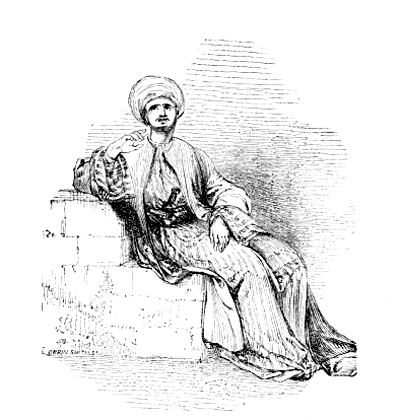
On hearing this, my disorder increased: after some days, however, the old woman came again, and said, O my son, I desire of thee a reward for good tidings. My soul returned to my body at these words, and I replied, Thou shalt receive from me everything that thou canst wish. She then said, I went yesterday to the damsel, and when she beheld me with broken heart and weeping eye, she said to me, O my aunt, wherefore do I see thee with contracted heart?—and when she had thus said, I wept, and answered, O my daughter and mistress, I came to thee yesterday from visiting a youth who loveth thee, and he is at the point of death on thy account:—and, her heart being moved with compassion, she asked, Who is this youth of whom thou speakest? I answered, He is my son, and the child that is dear to my soul: he saw thee at the window some days ago, while thou wast watering thy flowers; and when he beheld thy face, he became distracted with love for thee: I informed him of the conversation that I had with thee the first time; upon which his disorder increased, and he took to his pillow: he is now dying, and there is no doubt of his fate.—And upon this, her countenance became pale, and she said, Is this all on my account?—Yea, by Allah, I answered; and what dost thou order me to do?—Go to him, said she; convey to him my salutation, and tell him that my love is greater than his; and on Friday next, before the congregational prayers, let him come hither: I will give orders to open the door to him, and to bring him up to me, and I will have a short interview with him, and he shall return before my father comes back from the prayers.
When I heard these words of the old woman, the anguish which I had suffered ceased; my heart was set at rest, and I gave her the suit of clothes which I was then wearing, and she departed, saying to me, Cheer up thy heart. I replied, I have no longer any pain. The people of my house, and my friends, communicated, one to another, the good news of my restoration to health, and I remained thus until the Friday, when the old woman came in to me, and asked me respecting my state: so I informed her that I was happy and well. I then dressed and perfumed myself, and sat waiting for the people to go to prayers, that I might repair to the damsel; but the old woman said to me, Thou hast yet more than ample time, and if thou go to the bath and shave, especially for the sake of obliterating the traces of thy disorder, it will be more becoming.—It is a judicious piece of advice, replied I; but I will shave my head first, and then go into the bath.
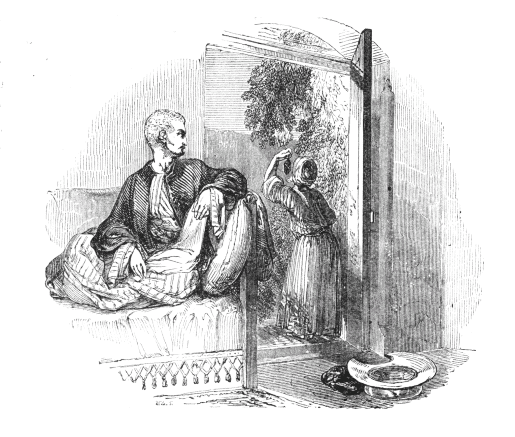
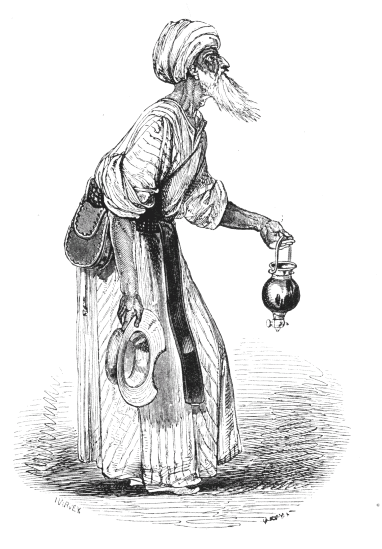
So I sent for a barber to shave my head, saying to the boy, Go to the market, and bring me a barber, one who is a man of sense, little inclined to impertinence, that he may not make my head ache by his chattering. And the boy went, and brought this sheykh, who, on entering, saluted me; and when I had returned his salutation, he said to me, May God dispel thy grief and thine anxiety, and misfortunes and sorrows! I responded, May God accept thy prayer! He then said, Be cheerful, O my master, for health hath returned to thee. Dost thou desire to be shaved or to be bled?—for it hath been handed down, on the authority of Ibn-'Abbás,56 that the Prophet said, Whoso shorteneth his hair on Friday, God will avert from him seventy diseases;—and it hath been handed down also, on the same authority, that the Prophet said, Whoso is cupped on Friday will not be secure from the loss of sight and from frequent disease.—Abstain, said I, from this useless discourse, and come immediately, shave my head, for I am weak. And he arose, and, stretching forth his hand, took out a handkerchief, and opened it; and lo, there was in it an astrolabe, consisting of seven plates;57 and he took it, and went into the middle of the court, where he raised his head towards the sun, and looked for a considerable time; after which he said to me, Know that there have passed, of this our day, which is Friday, and which is the tenth of Ṣafar,58 of the year 26359 of the Flight of the Prophet,—upon whom be the most excellent of blessings and peace!—and the ascendant star of which, according to the required rules of the science of computation, is the planet Mars,—seven degrees60 and six minutes; and it happeneth that Mercury hath come in conjunction with that planet; and this indicateth that the shaving of hair is now a most excellent operation: and it hath indicated to me, also, that thou desirest to confer a benefit upon a person: and fortunate is he!—but after that, there is an announcement that presenteth itself to me respecting a matter which I will not mention to thee.
By Allah, I exclaimed, thou hast wearied me, and dissipated my mind, and augured against me, when I required thee only to shave my head: arise, then, and shave it; and prolong not thy discourse to me. But he replied, By Allah, if thou knewest the truth of the case, thou wouldst demand of me a further explication; and I counsel thee to do this day as I direct thee, according to the calculations deduced from the stars: it is thy duty to praise God, and not to oppose me; for I am one who giveth thee good advice, and who regardeth thee with compassion: I would that I were in thy service for a whole year, that thou mightest do me justice; and I desire not any pay from thee for so doing.—When I heard this, I said to him, Verily thou art killing me this day, and there is no escape for me.—O my master, he replied, I am he whom the people call Eṣ-Ṣámit,61 on account of the paucity of my speech, by which I am distinguished above my brothers; for my eldest brother is named El-Baḳbooḳ;62 and the second, El-Heddár; and the third, Baḳbaḳ; and the fourth is named El-Kooz el-Aṣwánee; and the fifth, El-Feshshár; and the sixth is named Shaḳáliḳ; and the seventh brother is named Eṣ-Ṣámit; and he is myself.
Now when this barber thus overwhelmed me with his talk, I felt as if my gall-bladder had burst, and said to the boy, Give him a quarter of a piece of gold, and let him depart from me for the sake of Allah: for I have no need to shave my head. But the barber on hearing what I said to the boy, exclaimed, What is this that thou hast said, O my lord? By Allah, I will accept from thee no pay unless I serve thee; and serve thee I must; for to do so is incumbent on me, and to perform what thou requirest; and I care not if I receive from thee no money. If thou knowest not my worth, I know thine; and thy father—may Allah have mercy upon him!—treated us with beneficence; for he was a man of generosity. By Allah, thy father sent for me one day, like this blessed day, and when I went to him, he had a number of his friends with him, and he said to me, Take some blood from me. So I took the astrolabe, and observed the altitude for him, and found the ascendant of the hour to be of evil omen, and that the letting of blood would be attended with trouble: I therefore acquainted him with this, and he conformed to my wish, and waited until the arrival of the approved hour, when I took the blood from him. He did not oppose me; but, on the contrary, thanked me; and in like manner all the company present thanked me; and thy father gave me a hundred pieces of gold for services similar to the letting of blood.—May God, said I, shew no mercy to my father for knowing such a man as thou!—and the barber laughed, and exclaimed, There is no deity but God! Moḥammad is God's Apostle! Extolled be the perfection of Him who changeth others, but is not changed! I did not imagine thee to be otherwise than a man of sense; but thou hast talked nonsense in consequence of thine illness. God hath mentioned, in his Excellent Book, those who restrain their anger, and who forgive men:63—but thou art excused in every case. I am unacquainted, however, with the cause of thy haste; and thou knowest that thy father used to do nothing without consulting me; and it hath been said, that the person to whom one applies for advice should be trusted: now thou wilt find no one better acquainted with the affairs of the world than myself, and I am standing on my feet to serve thee. I am not displeased with thee, and how then art thou displeased with me? But I will have patience with thee on account of the favours which I have received from thy father.—By Allah, said I, thou hast wearied me with thy discourse, and overcome me with thy speech! I desire that thou shave my head and depart from me.
I gave vent to my rage; and would have risen, even if he had wetted my head, when he said, I knew that displeasure with me had overcome thee; but I will not be angry with thee, for thy sense is weak, and thou art a youth: a short time ago I used to carry thee on my shoulder,64 and take thee to the school.—Upon this, I said to him, O my brother, I conjure thee by Allah, depart from me that I may perform my business, and go thou thy way. Then I rent my clothes; and when he saw me do this, he took the razor, and sharpened it, and continued to do so until my soul almost parted from my body; then advancing to my head, he shaved a small portion of it; after which he raised his hand, and said, O my lord, haste is from the Devil;—and he repeated this couplet:—
Deliberate, and haste not to accomplish thy desire; and be merciful, so shalt thou meet with one merciful: For there is no hand but God's hand is above it;65 nor oppressor that shall not meet with an oppressor.
O my lord (he then continued), I do not imagine that thou knowest my condition in society; for my hand lighteth upon the heads of kings and emeers and wezeers and sages and learned men; and of such a one as myself hath the poet said,—
The trades altogether are like a necklace, and this barber is the chief pearl of the strings. He excelleth all that are endowed with skill, and under his hands are the heads of Kings.
—Leave, said I, that which doth not concern thee! Thou hast contracted my heart, and troubled my mind.—I fancy that thou art in haste, he rejoined. I replied, Yes! Yes! Yes!—Proceed slowly, said he; for verily haste is from the Devil, and it giveth occasion to repentance and disappointment; and he upon whom be blessing and peace66 hath said, The best of affairs is that which is commenced with deliberation:—and, by Allah, I am in doubt as to thine affair: I wish, therefore, that thou wouldst make known to me what thou art hasting to do; and may it be good; for I fear it is otherwise.
There now remained, to the appointed time, three hours; and he threw the razor from his hand in anger, and, taking the astrolabe, went again to observe the sun; then after he had waited a long time, he returned, saying, There remain, to the hour of prayer, three hours, neither more nor less. For the sake of Allah, said I, be silent; for thou hast crumbled my liver!—and thereupon, he took the razor, and sharpened it as he had done the first time, and shaved another portion of my head. Then stopping again, he said, I am in anxiety on account of thy hurry: if thou wouldst acquaint me with the cause of it, it would be better for thee; for thou knowest that thy father used to do nothing without consulting me.
I perceived now that I could not avoid his importunity, and said within myself, The time of prayer is almost come, and I desire to go before the people come out from the service: if I delay a little longer, I know not how to gain admission to her. I therefore said to him, Be quick, and cease from this chattering and impertinence; for I desire to repair to an entertainment with my friends. But when he heard the mention of the entertainment, he exclaimed, The day is a blessed day for me! I yesterday conjured a party of my intimate friends to come and feast with me, and forgot to prepare for them anything to eat; and now I have remembered it. Alas for the disgrace that I shall experience from them!—So I said to him, Be in no anxiety on this account, since thou hast been told that I am going to-day to an entertainment; for all the food and drink that is in my house shall be thine if thou use expedition in my affair, and quickly finish shaving my head.—May God recompense thee with every blessing! he replied: describe to me what thou hast for my guests, that I may know it. I have, said I, five dishes of meat, and ten fowls fricandoed, and a roasted lamb.—Cause them to be brought before me, he said, that I may see them. So I had them brought to him, and he exclaimed, Divinely art thou gifted! How generous is thy soul! But the incense and perfumes are wanting.—I brought him, therefore, a box containing nedd67 and aloes-wood and ambergris and musk, worth fifty pieces of gold.—The time had now become contracted, like my own heart; so I said to him, Receive this, and shave the whole of my head, by the existence of Moḥammad, God bless and save him! But he replied, By Allah, I will not take it until I see all that it contains.—I therefore ordered the boy, and he opened the box to him; whereupon the barber threw down the astrolabe from his hand, and, seating himself upon the ground, turned over the perfumes and incense and aloes-wood in the box until my soul almost quitted my body.
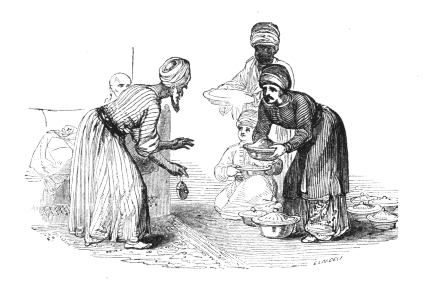
He then advanced, and took the razor, and shaved another small portion of my head; after which he said, By Allah, O my son, I know not whether I should thank thee or thank thy father; for my entertainment to-day is entirely derived from thy bounty and kindness, and I have no one among my visiters deserving of it; for my guests are, Zeytoon the bath-keeper, and Ṣaleeạ the wheat-seller, and 'Owkal the bean-seller, and 'Akresheh the grocer, and Ḥomeyd the dustman, and 'Akárish the milk-seller, and each of these hath a peculiar dance which he performeth, and peculiar verses which he reciteth; and the best of their qualities is, that they are like thy servant, the memlook who is before thee; and I, thy slave, know neither loquacity nor impertinence. As to the bath-keeper, he saith, If I go not to the feast, it cometh to my house!—and as to the dustman, he is witty, and full of frolick: often doth he dance, and say, News, with my wife, is not kept in a chest!—and each of my friends hath jests that another hath not: but the description is not like the actual observation. If thou choose, therefore, to come to us, it will be more pleasant both to thee and to us: relinquish, then, thy visit to thy friends of whom thou hast told us that thou desirest to go to them; for the traces of disease are yet upon thee, and probably thou art going to a people of many words, who will talk of that which concerneth them not; or probably there will be among them one impertinent person; and thy soul is already disquieted by disease.—I replied, If it be the will of God, that shall be on some other day:—but he said, It will be more proper that thou first join my party of friends, that thou mayest enjoy their conviviality, and delight thyself with their salt. Act in accordance with the saying of the poet:—
Defer not a pleasure when it can be had; for fortune often destroyeth our plans.
Upon this I laughed from a heart laden with anger, and said to him, Do what I require, that I may go in the care of God, whose name be exalted! and do thou go to thy friends, for they are waiting thine arrival. He replied, I desire nothing but to introduce thee into the society of these people; for verily they are of the sons of that class among which is no impertinent person; and if thou didst but behold them once, thou wouldst leave all thine own companions.—May God, said I, give thee abundant joy with them, and I must bring them together here some day.—If that be thy wish, he rejoined, and thou wilt first attend the entertainment of thy friends this day, wait until I take this present with which thou hast honoured me, and place it before my friends, that they may eat and drink without waiting for me, and then I will return to thee, and go with thee to thy companions; for there is no false delicacy between me and my companions that should prevent my leaving them: so I will return to thee quickly, and repair with thee whithersoever thou goest.—Upon this I exclaimed, There is no strength nor power but in God, the High, the Great! Go thou to thy companions, and delight thy heart with them, and leave me to repair to mine, and to remain with them this day, for they are waiting my arrival.—But he said, I will not leave thee to go alone.—The place to which I am going, said I, none can enter except myself.—I suppose then, he rejoined, that thou hast an appointment to-day with some female: otherwise, thou wouldst take me with thee; for I am more deserving than all other men, and will assist thee to attain what thou desirest. I fear that thou art going to visit some strange woman, and that thy life will be lost; for in this city of Baghdád no one can do anything of this kind, especially on such a day as this; seeing that the Wálee of Baghdád is a terrible, sharp sword.—Wo to thee, O wicked old man! I exclaimed, what are these words with which thou addressest me?—And upon this, he kept a long silence.
The time of prayer had now arrived, and the time of the Khuṭbeh68 was near, when he had finished shaving my head: so I said to him, Go with this food and drink to thy friends, and I will wait for thee until thou return, and thou shalt accompany me:—and I continued my endeavours to deceive him, that he might go away; but he said to me, Verily thou art deceiving me, and wilt go alone, and precipitate thyself into a calamity from which there will be no escape for thee: by Allah! by Allah! then, quit not this spot until I return to thee and accompany thee, that I may know what will be the result of thine affair.—I replied, Well: prolong not thine absence from me. And he took the food and drink and other things which I had given him, but intrusted them to a porter to convey them to his abode, and concealed himself in one of the by-streets. I then immediately arose. The muëddins on the menárehs had chanted the Selám of Friday;69 and I put on my clothes, and went forth alone, and, arriving at the by-street, stopped at the door of the house where I had seen the damsel: and lo, the barber was behind me, and I knew it not. I found the door open, and entered; and immediately the master of the house returned from the prayers, and entered the saloon, and closed the door; and I said within myself, How did this devil discover me?
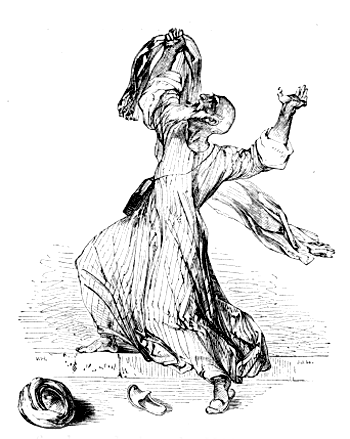
Now it happened, just at this time, for the fulfilment of God's purpose to rend the veil of protection before me, that a female slave belonging to the master of the house committed some offence, in consequence of which he beat her, and she cried out; whereupon a male slave came in to him to liberate her; but he beat him also, and he likewise cried out; and the barber concluded that he was beating me; so he cried, and rent his clothes, and sprinkled dust upon his head, shrieking, and calling for assistance. He was surrounded by people, and said to them, My master hath been killed in the house of the Ḳáḍee! Then running to my house, crying out all the while, and with a crowd behind him, he gave the news to my family; and I knew not what he had done when they approached, crying, Alas for our master!—the barber all the while being before them, with his clothes rent, and a number of the people of the city with them. They continued shrieking, the barber shrieking at their head, and all of them exclaiming, Alas for our slain!—Thus they advanced to the house in which I was confined; and when the Ḳáḍee heard of this occurrence, the event troubled him, and he arose, and opened the door, and seeing a great crowd, he was confounded, and said, O people, what is the news? The servants replied, Thou hast killed our master.—O people, rejoined he, what hath your master done unto me that I should kill him; and wherefore do I see this barber before you?—Thou hast just now beaten him with miḳra'ahs, said the barber; and I heard his cries.—What hath he done that I should kill him? repeated the Ḳáḍee. And whence, he added, came he; and whither would he go?—Be not an old man of malevolence, exclaimed the barber; for I know the story, and the reason of his entering thy house, and the truth of the whole affair: thy daughter is in love with him, and he is in love with her; and thou hast discovered that he had entered thy house, and hast ordered thy young men, and they have beaten him. By Allah, none shall decide between us and thee except the Khaleefeh; or thou shalt bring forth to us our master that his family may take him; and oblige me not to enter and take him forth from you: haste then thyself to produce him.
Upon this, the Ḳáḍee was withheld from speaking, and became utterly abashed before the people: but presently he said to the barber, If thou speak truth, enter thyself, and bring him forth. So the barber advanced, and entered the house; and when I saw him do so, I sought for a way to escape; but I found no place of refuge except a large chest which I observed in the same apartment in which I then was: I therefore entered this, and shut down the lid, and held in my breath. Immediately after, the barber ran into the saloon, and, without looking in any other direction than that in which I had concealed myself, came thither: then turning his eyes to the right and left, and seeing nothing but the chest, he raised it upon his head; whereupon my reason forsook me. He quickly descended with it; and I, being now certain that he would not quit me, opened the chest, and threw myself upon the ground. My leg was broken by the fall; and when I came to the door of the house, I found a multitude of people: I had never seen such a crowd as was there collected on that day; so I began to scatter gold among them, to divert them; and while they were busied in picking it up, I hastened through the by-streets of Baghdád, followed by this barber; and wherever I entered, he entered after me, crying, They would have plunged me into affliction on account of my master! Praise be to God who aided me against them, and delivered my master from their hands! Thou continuedst, O my master, to be excited by haste for the accomplishment of thine evil design until thou broughtest upon thyself this event; and if God had not blessed thee with me, thou hadst not escaped from this calamity into which thou hast fallen; and they might have involved thee in a calamity from which thou wouldst never have escaped. Beg, therefore, of God, that I may live for thy sake, to liberate thee in future. By Allah, thou hast almost destroyed me by thine evil design, desiring to go alone: but we will not be angry with thee for thine ignorance, for thou art endowed with little sense, and of a hasty disposition.—Art thou not satisfied, replied I, with that which thou hast done, but wilt thou run after me through the market-streets?—And I desired for death to liberate me from him; but found it not; and in the excess of my rage I ran from him, and, entering a shop in the midst of the market, implored the protection of its owner; and he drove away the barber from me.
I then seated myself in a magazine belonging to him, and said within myself, I cannot now rid myself of this barber; but he will be with me night and day, and I cannot endure the sight of his face. So I immediately summoned witnesses, and wrote a document, dividing my property among my family, and appointing a guardian over them, and I ordered him to sell the house and all the immoveable possessions, charging him with the care of the old and young, and set forth at once on a journey in order to escape from this wretch. I then arrived in your country, where I took up my abode, and have remained a considerable time; and when ye invited me, and I came unto you, I saw this vile wretch among you, seated at the upper end of the room. How, then, can my heart be at ease, or my sitting in your company be pleasant to me, with this fellow, who hath brought these events upon me, and been the cause of the breaking of my leg?
The young man still persevered in his refusal to remain with us; and when we had heard his story, we said to the barber, Is this true which the young man hath said of thee?—By Allah, he answered, it was through my intelligence that I acted thus towards him; and had I not done so, he had perished: myself only was the cause of his escape; and it was through the goodness of God, by my means, that he was afflicted by the breaking of his leg instead of being punished by the loss of his life. Were I a person of many words, I had not done him this kindness; and now I will relate to you an event that happened to me, that ye may believe me to be a man of few words, and less of an impertinent than my brothers; and it was this:—
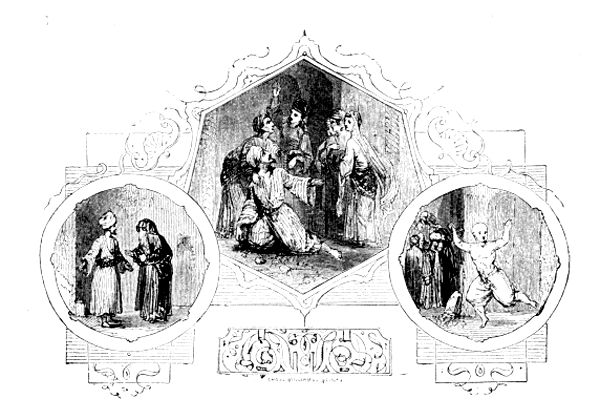
THE BARBER'S STORY OF HIMSELF
I was living in Baghdád, in the reign of the Prince of the Faithful El-Muntaṣir bi-lláh,70 who loved the poor and indigent, and associated with the learned and virtuous; and it happened, one day, that he was incensed against ten persons, in consequence of which, he ordered the chief magistrate of Baghdád to bring them to him in a boat. I saw them, and I said within myself, These persons have assembled for nothing but an entertainment, and, I suppose, will pass their day in this boat eating and drinking; and none shall be their companion but myself:71—so I embarked, and mixed myself among them; and when they had landed on the opposite bank, the guards of the Wálee came with chains, and put them upon their necks, and put a chain upon my neck also.—Now this, O people, is it not a proof of my generosity, and of my paucity of speech? For I determined not to speak.—They took us, therefore, all together, in chains, and placed us before El-Muntaṣir bi-lláh, the Prince of the Faithful; whereupon he gave orders to strike off the heads of the ten; and the executioner struck off the heads of the ten, and I remained. The Khaleefeh then turning his eyes, and beholding me, said to the executioner, Wherefore dost thou not strike off the heads of all the ten? He answered, I have beheaded every one of the ten.—I do not think, rejoined the Khaleefeh, that thou hast beheaded more than nine; and this who is before me is the tenth. But the executioner replied, By thy beneficence, they are ten.—Count them, said the Khaleefeh. And they counted them; and lo, they were ten. The Khaleefeh then looked towards me, and said, What hath induced thee to be silent on this occasion; and how hast thou become included among the men of blood?—And when I heard the address of the Prince of the Faithful, I said to him, Know, O Prince of the Faithful, that I am the sheykh Eṣ-Ṣámit (the silent): I possess, of science, a large stock; and as to the gravity of my understanding, and the quickness of my apprehension, and the paucity of my speech, they are unbounded: my trade is that of a barber; and yesterday, early in the morning, I saw these ten men proceeding to the boat; whereupon I mixed myself with them, and embarked with them, thinking that they had met together for an entertainment; but soon it appeared that they were criminals; and the guards came to them, and put chains upon their necks, and upon my neck also they put a chain; and from the excess of my generosity I was silent, and spoke not: my speech was not heard on that occasion, on account of the excess of my generosity; and they proceeded with us until they stationed us before thee, and thou gavest the order to strike off the heads of the ten, and I remained before the executioner, and acquainted you not with my case. Was not this great generosity which compelled me to accompany them to slaughter? But throughout my life I have acted in this excellent manner.
When the Khaleefeh heard my words, and knew that I was of a very generous character, and of few words, and not inclined to impertinence as this young man, whom I delivered from horrors, asserteth, he said, Hast thou brothers? I answered, Yes: six.—And are thy six brothers, said he, like thyself, distinguished by science and knowledge, and paucity of speech? I answered, They lived not so as to be like me: thou hast disparaged me by thy supposition, O Prince of the Faithful, and it is not proper that thou shouldst compare my brothers to me; for through the abundance of their speech, and the smallness of their generous qualities, each of them experienced a defect: the first was lame; the second, deprived of many of his teeth; the third, blind; the fourth, one-eyed; the fifth, cropped of his ears; and the sixth had both his lips cut off:72 and think not, O Prince of the Faithful, that I am a man of many words: nay, I must prove to thee that I am of a more generous character than they; and each of them met with a particular adventure, in consequence of which he experienced a defect: if thou please, I will relate their stories to thee.
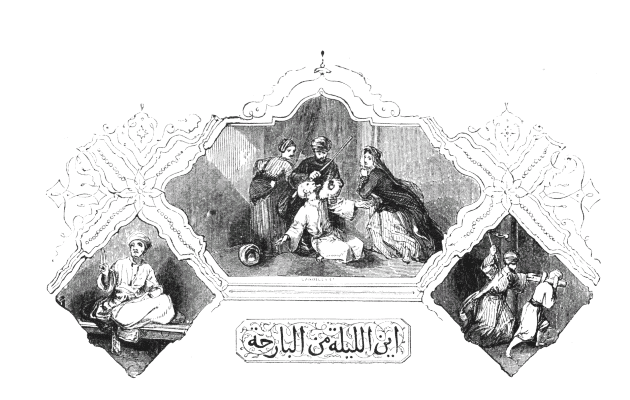
THE BARBER'S STORY OF HIS FIRST BROTHER.
Know, O Prince of the Faithful, that the first (who was named El-Baḳbooḳ) was the lame one. He practised the art of a tailor in Baghdád, and used to sew in a shop which he hired of a man possessing great wealth, who lived over the shop, and who had, in the lower part of his house, a mill. And as my lame brother was sitting in his shop one day, sewing, he raised his head, and saw a woman like the rising full moon, at a projecting window of the house, looking at the people passing by; and as soon as he beheld her, his heart was entangled by her love. He passed that day gazing at her, and neglecting his occupation, until the evening; and on the following morning he opened his shop, and sat down to sew; but every time that he sewed a stitch, he looked towards the window; and in this state he continued, sewing nothing sufficient to earn a piece of silver.73
On the third day he seated himself again in his place, looking towards the woman; and she saw him, and, perceiving that he had become enslaved by her love, laughed in his face, and he, in like manner, laughed in her face. She then disappeared from before him, and sent to him her slave-girl, with a wrapper containing a piece of red flowered silk; and the girl, coming to him, said to him, My mistress saluteth thee, and desireth thee to cut out for her, with the hand of skill, a shirt of this piece, and to sew it beautifully. So he answered, I hear and obey:—and he cut out for her the shirt, and finished the sewing of it on that day; and on the following day the slave-girl came to him again; and said to him, My mistress saluteth thee, and saith to thee, How didst thou pass last night?—for she tasted not sleep, from her passion for thee.—She then placed before him a piece of yellow satin, and said to him, My mistress desireth thee to cut out for her, of this piece, two pairs of trousers, and to make them this day. He replied, I hear and obey. Salute her with abundant salutations, and say to her, Thy slave is submissive to thine order, and command him to do whatsoever thou wilt.—He then busied himself with the cutting out, and used all diligence in sewing the two pairs of trousers; and presently the woman looked out at him from the window, and saluted him by a sign, now casting down her eyes, and now smiling in his face, so that he imagined he should soon obtain possession of her. After this, she disappeared from before him, and the slave-girl came to him; so he delivered to her the two pairs of trousers, and she took them and departed: and when the night came, he threw himself upon his bed, and remained turning himself over in restlessness until the morning.
On the following day, the master of the house came to my brother, bringing some linen, and said to him, Cut out and make this into shirts for me. He replied, I hear and obey:—and ceased not from his work until he had cut out twenty shirts by the time of nightfall, without having tasted food. The man then said to him, How much is thy hire for this?—but my brother answered not; and the damsel made a sign to him that he should receive nothing, though he was absolutely in want of a single copper coin. For three days he continued scarcely eating or drinking anything, in his diligence to accomplish his work, and when he had finished it, he went to deliver the shirts.
Now the young woman had acquainted her husband with the state of my brother's mind, but my brother knew not this; and she planned with her husband to employ him in sewing without remuneration, and moreover to amuse themselves by laughing at him: so, when he had finished all the work that they gave him, they contrived a plot against him, and married him to their slave-girl; and on the night when he desired to introduce himself to her, they said to him, Pass this night in the mill, and to-morrow thou shalt enjoy happiness. My brother, therefore, thinking that their intention was good, passed the night in the mill alone. Meanwhile, the husband of the young woman went to the miller, and instigated him by signs to make my brother turn the mill. The miller, accordingly, went in to him at midnight, and began to exclaim, Verily this bull is lazy, while there is a great quantity of wheat, and the owners of the flour are demanding it: I will therefore yoke him in the mill, that he may finish the grinding of the flour:—and so saying, he yoked my brother, and thus he kept him until near morning, when the owner of the house came, and saw him yoked in the mill, and the miller flogging him with the whip; and he left him, and retired. After this, the slave-girl to whom he had been contracted in marriage came to him early in the morning, and, having unbound him from the mill, said to him, Both I and my mistress have been distressed by this which hath befallen thee, and we have participated in the burden of thy sorrow. But he had no tongue wherewith to answer her, by reason of the severity of the flogging. He then returned to his house; and lo, the sheykh who had performed the marriage-contract came and saluted him, saying, May God prolong thy life! May thy marriage be blessed!—May God not preserve the liar! returned my brother: thou thousandfold villain! By Allah, I went only to turn the mill in the place of the bull until the morning.—Tell me thy story, said the sheykh:—and my brother told him what had happened to him: upon which the sheykh said, Thy star agreeth not with hers: but if thou desire that I should change for thee the mode of the contract, I will change it for another better than it, that thy star may agree with hers.74—See then, replied my brother, if thou hast any other contrivance to employ.
My brother then left him, and repaired again to his shop, hoping that somebody might give him some work, with the profit of which he might obtain his food; and lo, the slave-girl came to him. She had conspired with her mistress to play him this trick, and said to him, Verily, my mistress is longing for thee, and she hath gone up to look at thy face from the window. And my brother had scarcely heard these words when she looked out at him from the window, and, weeping, said, Wherefore hast thou cut short the intercourse between us and thee? But he returned her no answer: so she swore to him that all that had happened to him in the mill was not with her consent; and when my brother beheld her beauty and loveliness, the troubles that had befallen him became effaced from his memory, and he accepted her excuse, and rejoiced at the sight of her. He saluted her, therefore, and conversed with her, and then sat a while at his work; after which the slave-girl came to him, and said, My mistress saluteth thee, and informeth thee that her husband hath determined to pass this next night in the house of one of his intimate friends; wherefore, when he hath gone thither, do thou come to her.—Now the husband of the young woman had said to her, How shall we contrive when he cometh to thee that I may take him and drag him before the Wálee? She replied, Let me then play him a trick, and involve him in a disgrace for which he shall be paraded throughout this city as an example to others:—and my brother knew nothing of the craftiness of women. Accordingly, at the approach of evening, the slave-girl came to him, and, taking him by the hand, returned with him to her mistress, who said to him, Verily, O my master, I have been longing for thee.—Hasten then, said he, to give me a kiss, first of all. And his words were not finished, when the young woman's husband came in from his neighbour's house, and, seizing my brother, exclaimed to him, By Allah, I will not loose thee but in the presence of the chief magistrate of the police. My brother humbled himself before him; but, without listening to him, he took him to the house of the Wálee, who flogged him with whips, and mounted him upon a camel, and conveyed him through the streets of the city, the people crying out, This is the recompense of him who breaketh into the ḥareems of others!—and he fell from the camel, and his leg broke: so he became lame. The Wálee then banished him from the city; and he went forth, not knowing whither to turn his steps: but I, though enraged, overtook him, and brought him back; and I have taken upon myself to provide him with meat and drink unto the present day.
The Khaleefeh laughed at my story, and exclaimed, Thou hast spoken well:—but I replied, I will not accept this honour until thou hast listened to me while I relate to thee what happened to the rest of my brothers; and think me not a man of many words.—Tell me, said the Khaleefeh, what happened to all thy brothers, and grace my ears with these nice particulars: I beg thee to employ exuberance of diction in thy relation of these pleasant tales.
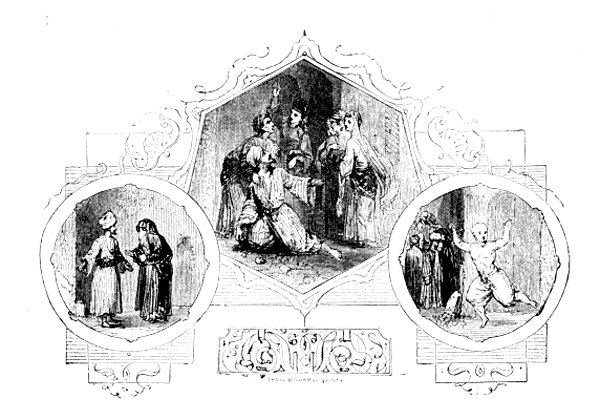
THE BARBER'S STORY OF HIS SECOND BROTHER.
So I said, Know, O Prince of the Faithful, that my second brother, whose name was El-Heddár,75 was going one day to transact some business, when an old woman met him, and said to him, O man, stop a little, that I may propose to thee a thing, which, if it please thee, thou shalt do for me. My brother, therefore, stopped; and she said to him, I will guide thee to a thing, and rightly direct thee to it, on the condition that thy words be not many. So he said, Communicate what thou hast to tell me:—and she proceeded thus:—What sayest thou of a handsome house, with running water, and fruit and wine, and a beautiful face to behold, and a smooth cheek to kiss, and an elegant form to embrace; and to enjoy all these pleasures without interruption? Now, if thou wilt act agreeably with the condition that I have imposed upon thee, thou wilt see prosperity.—When my brother had heard her words, he said to her, O my mistress, how is it that thou hast sought me out in preference to all the rest of the creation for this affair; and what is there in me that hath pleased thee? She replied, Did I not say to thee that thou must not be a person of many words? Be silent then, and come with me.
The old woman then went her way, my brother following her, eager to enjoy the pleasures which she had described to him, until they had entered a spacious house, when she went up with him to an upper story, and my brother perceived that he was in a beautiful palace, in which he beheld four damsels, than whom none more lovely had ever been seen, singing with voices that would charm a heart as insensible as stone. One of these damsels drank a cup of wine; and my brother said to her, May it be attended with health and vigour!—and advanced to wait upon her; but she prevented his doing so, giving him to drink a cup of wine; and as soon as he had drunk it, she slapped him on his neck. When he found that she treated him thus, he went out from the chamber in anger, and with many words; but the old woman, following him, made a sign to him with her eye that he should return: so he returned, and seated himself, without speaking; and upon this, the damsel slapped him again upon the back of his neck until he became senseless; after which, recovering, he withdrew again. The old woman, however, overtook him, and said to him, Wait a little, and thou shalt attain thy wish.—How many times, said he, shall I wait a little before I attain it? The old woman answered, When she hath become exhilarated with wine thou shalt obtain her favour. He therefore returned to his place, and resumed his seat. All the four damsels then arose, and the old woman directed them to divest my brother of his outer clothes, and to sprinkle some rose-water upon his face; and when they had done so, the most beautiful one among them said to him, May Allah exalt thee to honour! Thou hast entered my abode, and if thou have patience to submit to my requisitions, thou wilt attain thy wish.—O my mistress, he replied, I am thy slave, and under thy authority.—Know then, said she, that I am devotedly fond of frolic, and he who complieth with my demands will obtain my favour. Then she ordered the other damsels to sing; and they sang so that their hearers were in an ecstasy; after which the chief lady said to one of the other damsels, Take thy master, and do what is required, and bring him back to me immediately.
Accordingly, she took him away, ignorant of that which she was about to do; and the old woman came to him, and said, Be patient; for there remaineth but little to do. He then turned towards the damsel, and the old woman said to him, Be patient: thou hast almost succeeded, and there remaineth but one thing, which is, to shave thy beard.—How, said he, shall I do that which will disgrace me among the people? The old woman answered, She desireth this only to make thee like a beardless youth, that there may be nothing on thy face to prick her; for her heart is affected with a violent love for thee. Be patient, therefore, and thou shalt attain thy desire.—So my brother patiently submitted to the damsel's directions: his beard was shaven, and he was shorn also of his eyebrows and mustaches, and his face was painted red, before the damsel took him back to the chief lady, who, when she saw him, was at first frightened at him, and then laughed until she fell backwards, and exclaimed, O my master, thou hast gained me by these proofs of thine amiable manners! She then conjured him by her life to arise and dance; and he did so; and there was not a single cushion in the chamber that she did not throw at him. In like manner also the other damsels threw at him various things, such as oranges, and limes, and citrons, until he fell down senseless from the pelting, while they slapped him incessantly upon the back of his neck, and cast things in his face. But at length the old woman said to him, Now thou hast attained thy wish. Know that there remaineth to thee no more beating, nor doth there remain for thee to do more than one thing, namely, this: it is her custom, when she is under the influence of wine, to suffer no one to come near her until she hath taken off her outer clothes; thou, being prepared in the like manner, must run after her, and she will run before thee as though she were flying from thee; but cease not to follow her from place to place until thou overtake her. He arose, therefore, and did so: the lady ran before, and as he followed her, she passed from chamber to chamber, and he still ran after her. At last he heard her utter a slight sound as she ran before him, and, continuing his pursuit, he suddenly found himself in the midst of the street.
This street was in the market of the leather-sellers, who were then crying skins for sale; and when the people there collected saw him in this condition, almost naked, with shaven beard and eyebrows and mustaches, and with his face painted red, they shouted at him, and raised a loud laugh, and some of them beat him with the skins until he became insensible. They then placed him upon an ass, and conducted him to the Wálee, who exclaimed, What is this?—They answered, This descended upon us from the house of the Wezeer, in this condition. And the Wálee inflicted upon him a hundred lashes, and banished him from the city: but I went out after him, and brought him back privately into the city, and allotted him a maintenance. Had it not been for my generous disposition, I had not borne with such a person.
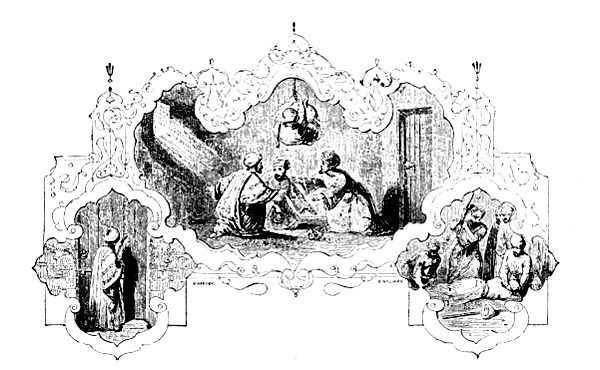
THE BARBER'S STORY OF HIS THIRD BROTHER.
As to my third brother (the blind man, Baḳbaḳ), who was also surnamed Ḳuffeh,76 fate and destiny impelled him one day to a large house, and he knocked at the door, hoping that its master would answer him, and that he might beg of him a trifle. The owner called out, Who is at the door?—but my brother answered not; and then heard him call with a loud voice, Who is this? Still, however, he returned him no answer; and he heard the sounds of his footsteps approaching until he came to the door and opened it, when he said to him, What dost thou desire? My brother answered, Something for the sake of God, whose name be exalted!—Art thou blind? said the man; and my brother answered, Yes.—Then give me thy hand rejoined the master of the house;—so my brother stretched forth to him his hand, and the man took him into the house, and led him up from stair-case to stair-case until he had ascended to the highest platform of the roof: my brother thinking that he was going to give him some food or money: and when he had arrived at this highest terrace, of his house, the owner said, What dost thou desire, O blind man!—I desire something, he answered again, for the sake of God, whose name be exalted!—May God, replied the man, open to thee some other way!—What is this! exclaimed my brother: couldst thou not tell me so when I was below?—Thou vilest of the vile! retorted the other: why didst thou not ask of me something for the sake of God when thou heardest my voice the first time, when thou wast knocking at the door?—What then, said my brother, dost thou mean to do to me?—The man of the house answered, I have nothing to give thee.—Then take me down the stairs, said my brother. The man replied, The way is before thee. So my brother made his way to the stairs, and continued descending until there remained, between him and the door, twenty steps, when his foot slipped and he fell, and, rolling down, broke his head.77
He went forth, not knowing whither to direct his steps, and presently there met him two blind men, his companions, who said to him, What hath happened to thee this day? My brother, therefore, related to them the event that had just befallen him: and then said to them, O my brothers, I desire to take a portion of the money now in our possession, to expend it upon myself.—Now the owner of the house which he had just before entered had followed him to acquaint himself with his proceedings, and without my brother's knowledge he walked behind him until the latter entered his abode; when he went in after him, still unknown. My brother then sat waiting for his companions; and when they came in to him, he said to them, Shut the door, and search the room, lest any stranger have followed us. When the intruder, therefore, heard what he said, he arose, and clung to a rope that was attached to the ceiling; and the blind men went feeling about the whole of the chamber, and, finding no one, returned and seated themselves by my brother, and brought forth their money, and counted it; and lo, it was more than ten thousand pieces of silver. Having done this, they laid it in a corner of the room, and each of them took of the surplus of that sum as much as he wanted, and they buried the ten thousand pieces of silver in the earth; after which, they placed before themselves some food, and sat eating; but my brother heard the sound of a stranger by his side, and said to his friends, Is there a stranger among us? Then stretching forth his hand, it grasped the hand of the intruder; whereupon he cried out to his companions, saying, Here is a stranger!—and they fell upon him with blows until they were tired, when they shouted out, O Muslims!78 a thief hath come in upon us, and desireth to take our property!—and immediately a number of persons collected around them.
Upon this, the stranger whom they accused of being a thief shut his eyes, feigned to be blind like themselves, so that no one who saw him doubted him to be so; and shouted, O Muslims! I demand protection of Allah and the Sulṭán! I demand protection of Allah and the Wálee! I demand protection of Allah and the Emeer! for I have important information to give to the Emeer!—and before they could collect their thoughts, the officers of the Wálee surrounded them and took them all, including my brother, and conducted them before their master. The Wálee said, What is your story?—and the stranger replied, Hear my words, O Wálee; the truth of our case will not become known to thee but by means of beating;79 and if thou wilt, begin by beating me before my companions. The Wálee therefore said, Throw down this man, and flog him with whips:—and accordingly they threw him down and flogged him; and when the stripes tortured him, he opened one of his eyes; and after they had continued the flogging a little longer, he opened his other eye; upon which the Wálee exclaimed, What meaneth this conduct, O thou villain?—Grant me indemnity, replied the man, and I will acquaint thee:—and the Wálee having granted his request, he said, We four pretend that we are blind, and, intruding among other people, enter their houses, and see their women, and employ stratagems to corrupt them, and to obtain money from them. We have acquired, by these means, vast gain, amounting to ten thousand pieces of silver; and I said to my companions, Give me my due, two thousand and five hundred; and they rose against me and beat me, and took my property. I beg protection, therefore, of Allah and of thee; and thou art more deserving of my share than they. If thou desire to know the truth of that which I have said, flog each of them more than thou hast flogged me, and he will open his eyes.
So the Wálee immediately gave orders to flog them, and the first of them who suffered was my brother. They continued beating him until he almost died; when the Wálee said to them, O ye scoundrels! do ye deny the gracious gift of God, feigning yourselves to be blind? My brother exclaimed, Alláh! Alláh! Alláh! there is none among us who seeth!—They then threw him down again, and ceased not to beat him until he became insensible, when the Wálee said, Leave him until he shall have recovered, and then give him a third flogging:—and in the meantime, he gave orders to flog his companions, to give each of them more than three hundred stripes; while the seeing man said to them, Open your eyes, or they will flog you again after this time. Then addressing himself to the Wálee, he said, Send with me some person to bring thee the property; for these men will not open their eyes, fearing to be disgraced before the spectators. And the Wálee sent with him a man, who brought him the money; and he took it, and gave to the informer, out of it, two thousand and five hundred pieces of silver, according to the share which he claimed, in spite of the others (retaining the rest), and banished from the city my brother and the two other men; but I went forth, O Prince of the Faithful, and, having overtaken my brother, asked him respecting his sufferings; and he acquainted me with that which I have related unto thee. I then brought him back secretly into the city, and allotted him a supply of food and drink as long as he lived.
The Khaleefeh laughed at my story, and said, Give him a present, and let him go:—but I replied, I will receive nothing until I have declared to the Prince of the Faithful what happened to the rest of my brothers, and made it manifest to him that I am a man of few words:—whereupon the Khaleefeh said, Crack our ears, then, with thy ridiculous stories, and continue to us thy disclosure of vices and misdeeds. So I proceeded thus:—
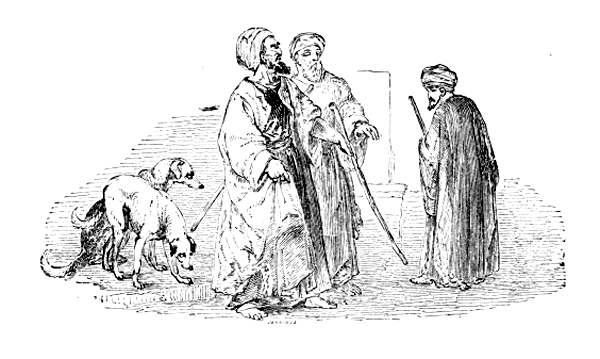
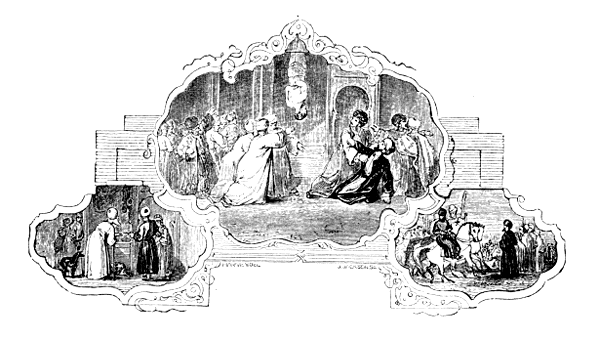
THE BARBER'S STORY OF HIS FOURTH BROTHER.
My fourth brother, O Prince of the Faithful, was the one-eyed (named El-Kooz el-Aṣwánee): he was a butcher in Baghdád, and both sold meat and reared lambs; and the great and the rich had recourse to him to purchase of him their meat; so that he amassed great wealth, and became possessor of cattle and houses. Thus he continued to prosper for a long time; and as he was in his shop, one day, there accosted him an old man with a long beard, who handed to him some money, saying, Give me some meat for it. So he took the money, and gave him the meat; and when the old man had gone away, my brother looked at the money which he had payed him, and, seeing that it was of a brilliant whiteness, put it aside by itself. This old man continued to repair to him during a period of five months, and my brother always threw his money into a chest by itself; after which period he desired to take it out for the purpose of buying some sheep; but on opening the chest, he found all the contents converted into white paper, clipped round; and he slapped his face, and cried out; whereupon a number of people collected around him, and he related to them his story, at which they were astonished.
He then went again, as usual, into his shop, and, having killed a ram, and hung it up within the shop, he cut off some of the meat, and suspended it outside, saying within himself, Perhaps now this old man will come again, and if so, I will seize him:—and very soon after, the old man approached with his money; upon which my brother arose, and, laying hold upon him, began to cry out, O Muslims, come to my aid, and hear what this scoundrel hath done unto me! But when the old man heard his words, he said to him, Which will be more agreeable to thee—that thou abstain from disgracing me, or that I disgrace thee, before the people?—For what wilt thou disgrace me? said my brother. The old man answered, For thy selling human flesh for mutton.—Thou liest, thou accursed! exclaimed my brother.—None is accursed, rejoined the old man, but he who hath a man suspended in his shop. My brother said, If it be as thou hast asserted, my property and blood shall be lawful to thee:—and immediately the old man exclaimed, O ye people here assembled! verily this butcher slaughtereth human beings, and selleth their flesh for mutton; and if ye desire to know the truth of my assertion, enter his shop! So the people rushed upon his shop, and beheld the ram converted into a man, hung up; and they laid hold upon my brother, crying out against him, Thou infidel! Thou scoundrel!—and those who had been his dearest friends turned upon him and beat him; and the old man gave him a blow upon his eye, and knocked it out. The people then carried the carcass, and took with them my brother, to the chief magistrate of the police; and the old man said to him, O Emeer, this man slaughtereth human beings, and selleth their flesh for mutton; and we have therefore brought him to thee: arise, then, and perform the requisition of God, whose might and glory be extolled! Upon this, the magistrate thrust back my brother from him, and, refusing to listen to what he would have said, ordered that five hundred blows of a staff should be inflicted upon him, and took all his property. Had it not been for the great amount of his wealth, he had put him to death.80 He then banished him from the city.
My brother, therefore, went forth in a state of distraction, not knowing what course to pursue; but he journeyed onwards until he arrived at a great city, where he thought fit to settle as a shoemaker: so he opened a shop, and sat there working for his subsistence. And one day he went forth on some business, and, hearing the neighing of horses, he inquired respecting the cause, and was told that the King was going forth to hunt; whereupon he went to amuse himself with the sight of the procession: but the King happening to look on one side, his eye met that of my brother, and immediately he hung down his head, and exclaimed, I seek refuge with God from the evil of this day! He then turned aside the bridle of his horse, and rode back, and all his troops returned with him; after which, he ordered his pages to run after my brother, and to beat him; and they did so, giving him so severe a beating that he almost died; and he knew not the cause. He returned to his abode in a miserable plight, and afterwards went and related his misfortune to one of the King's attendants, who laughed at the recital until he fell backwards, and said to him, O my brother, the King cannot endure the sight of a one-eyed person, and especially when the defect is that of the left eye;81 for in this case, he faileth not to put the person to death.
When my brother heard these words, he determined to fly from that city; and forthwith departed from it, and repaired to another city, where there was no King. Here he remained a long time; and after this, as he was meditating upon his adventure in the former city, he went out one day to amuse himself, and heard again the neighing of horses behind him; upon which he exclaimed, The decree of God hath come to pass! and ran away, seeking for a place in which to conceal himself; but he found none, until, continuing his search, he saw a door set up as a barricade: so he pushed this, and it fell down; and, entering the doorway, he beheld a long passage, into which he advanced. Suddenly, however, two men laid hold upon him, and exclaimed, Praise be to God who hath enabled us to take thee, O thou enemy of God! For these three nights thou hast suffered us to enjoy neither quiet nor sleep, and we have found no repose: nay, thou hast given us a foretaste of death!—O men, said my brother, what hath happened unto you? They answered, Thou keepest a watch upon us, and desirest to disgrace us, and to disgrace the master of the house! Is it not enough for thee that thou hast reduced him to poverty, thou and thy companions? Produce now the knife wherewith thou threatenest us every night.—And so saying, they searched him, and found upon his waist the knife with which he cut the shoe-leather.—O men, he exclaimed, fear God in your treatment of me, and know that my story is wonderful. They said, What then is thy story? So he related it to them, in the hope that they would liberate him: but they believed not what he said; and, instead of shewing him any regard, they beat him, and tore his clothes; whereupon, his body becoming exposed to their view, they discovered upon his sides the marks of beating with miḳra'ahs, and exclaimed, O wretch! these scars bear testimony to thy guilt. They then conducted him before the Wálee, while he said within himself, I am undone for my transgressions, and none can deliver me but God, whose name be exalted! And when he was brought before the Wálee, the magistrate said to him, O thou scoundrel! nothing but a heinous crime hath occasioned thy having been beaten with miḳra'ahs:—and he caused a hundred lashes to be inflicted upon him; after which, they mounted him upon a camel, and proclaimed before him, This is the recompense of him who breaketh into men's houses!—But I had already heard of his misfortunes, and gone forth, and found him; and I accompanied him about the city while they were making this proclamation, until they left him; when I took him, and brought him back secretly into Baghdád, and apportioned him a daily allowance of food and drink.
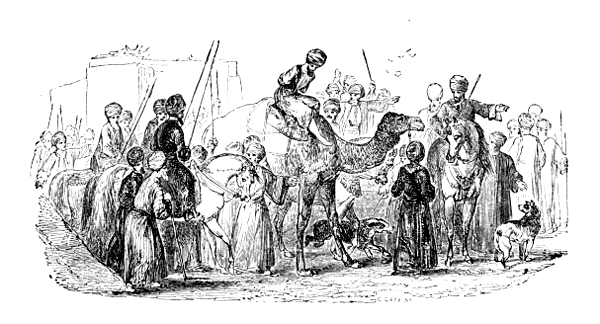
THE BARBER'S STORY OF HIS FIFTH BROTHER.82
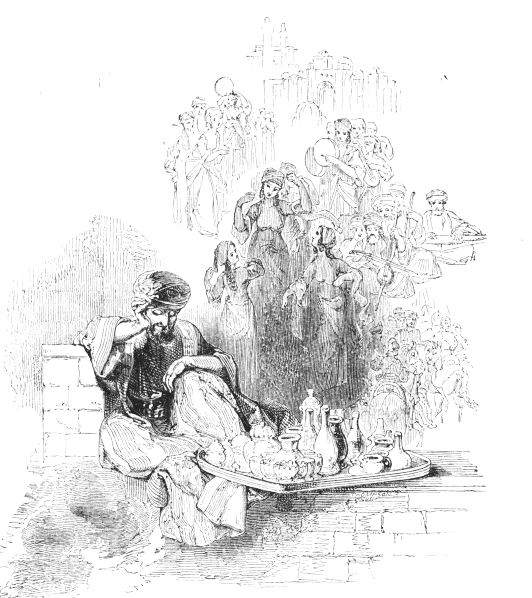
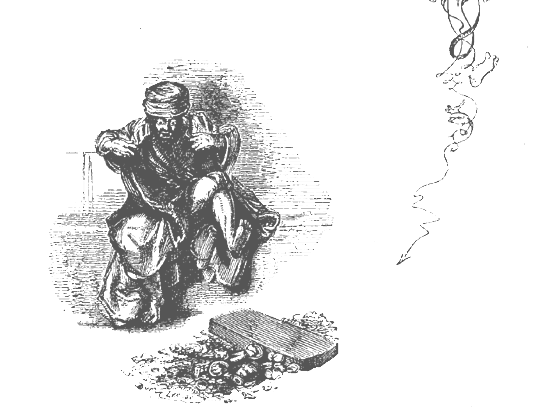
My fifth brother (El-Feshshár83) was cropped of his ears, O Prince of the Faithful. He was a pauper, who begged alms by night, and subsisted upon what he thus acquired by day: and our father was a very old man, and he fell sick and died, leaving to us seven hundred pieces of silver, of which each of us took his portion; namely, a hundred pieces. Now my fifth brother, when he had received his share, was perplexed, not knowing what to do with it; but while he was in this state, it occurred to his mind to buy with it all kinds of articles of glass, and to sell them and make profit; so he bought glass with his hundred pieces of silver, and put it in a large tray, and sat upon an elevated place, to sell it, leaning his back against a wall. And as he sat, he meditated, and said within himself, Verily my whole stock consisteth of this glass: I will sell it for two hundred pieces of silver; and with the two hundred I will buy other glass, which I will sell for four hundred; and thus I will continue buying and selling until I have acquired great wealth. Then with this I will purchase all kinds of merchandise and essences and jewels, and so obtain vast gain. After that, I will buy a handsome house, and memlooks, and horses, and gilded saddles; and I will eat and drink; and I will not leave in the city a single female singer but I will have her brought to my house that I may hear her songs.—All this he calculated with the tray of glass lying before him.—Then, said he, I will send all the female betrothers to seek in marriage for me the daughters of Kings and Wezeers; and I will demand as my wife the daughter of the chief Wezeer;84 for I have heard that she is endowed with perfect beauty and surprising loveliness: and I will give as her dowry a thousand pieces of gold. If her father consent, my wish is attained; and if he consent not, I will take her by force, in spite of him: and when I have come back to my house, I will buy ten young eunuchs, and I will purchase the apparel of Kings and Sulṭáns, and cause to be made for me a saddle of gold set with jewels: after which I will ride every day upon a horse, with slaves behind me and before me,85 and go about through the streets and markets to amuse myself, while the people will salute me and pray for me.86 Then I will pay a visit to the Wezeer, who is the father of the maiden, with memlooks behind me and before me, and on my right hand and on my left; and when he seeth me, he will rise to me, in humility, and seat me in his own place; and he himself will sit down below me,87 because I am his son-in-law. I will then order one of the servants to bring a purse containing the pieces of gold which compose the dowry; and he will place it before the Wezeer; and I will add to it another purse, that he may know my manly spirit and excessive generosity, and that the world is contemptible in my eye: and when he addresseth me with ten words, I will answer him with two. And I will return to my house; and when any person cometh to me from the house of the Wezeer, I will clothe him with a rich dress: but if any come with a present, I will return it: I will certainly not accept it.88 Then, on the night of the bridal display, I will attire myself in the most magnificent of my dresses, and sit upon a mattress covered with silk; and when my wife cometh to me, like the full moon, decked with her ornaments and apparel, I will command her to stand before me as stands the timid and the abject; and I will not look at her, on account of the haughtiness of my spirit and the gravity of my wisdom; so that the maids will say, O our master and our lord, may we be thy sacrifice! This thy wife, or rather thy handmaid, awaiteth thy kind regard, and is standing before thee: then graciously bestow on her one glance; for the posture hath become painful to her.89—Upon this, I will raise my head, and look at her with one glance, and again incline my head downwards; and thus I will do until the ceremony of displaying her is finished; whereupon they will conduct her to the sleeping-chamber; and I will rise from my place, and go to another apartment, and put on my night-dress, and go to the chamber in which she is sitting, where I will seat myself upon the deewán; but I will not look towards her. The tire-women will urge me to approach her; but I will not hear their words, and will order some of the attendants to bring a purse containing five hundred pieces of gold for them, and command them to retire from the chamber.90 And when they have gone, I will seat myself by the side of the bride; but with averted countenance, that she may say, Verily this is a man of a haughty spirit. Then her mother will come to me, and will kiss my hands, and say to me, O my master, look upon thy handmaid with the eye of mercy; for she is submissively standing before thee. But I will return her no answer. And she will kiss my feet, again and again, and will say, O my master, my daughter is young, and hath seen no man but thee; and if she experience from thee repugnance, her heart will break: incline to her, therefore, and speak to her, and calm her mind. And upon this I will look at her through the corner of my eye, and command her to remain standing before me, that she may taste the savour of humiliation, and know that I am the Sulṭán of the age. Then her mother will say to me, O my master, this is thy handmaid: have compassion upon her, and be gracious to her:—and she will order her to fill a cup with wine, and to put it to my mouth. So her daughter will say, O my lord, I conjure thee by Allah that thou reject not the cup from thy slave; for verily I am thy slave. But I will make her no reply; and she will urge me to take it, and will say, It must be drunk:—and will put it to my mouth: and upon this, I will shake my hand in her face, and spurn her with my foot, and do thus.—So saying, he kicked the tray of glass, which, being upon a place elevated above the ground, fell, and all that was in it broke: there escaped nothing: and he cried out and said, All this is the result of my pride! And he slapped his face, and tore his clothes; the passengers gazing at him, while he wept, and exclaimed, Ah! O my grief!
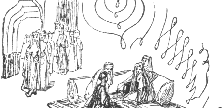
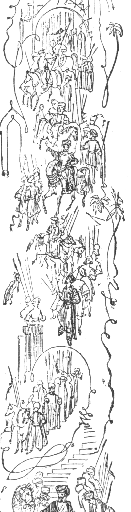
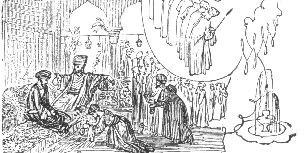
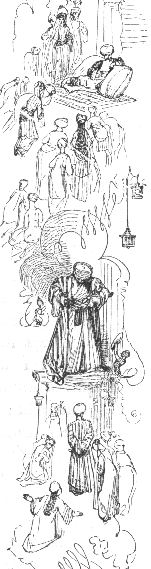
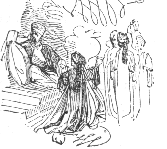
The people were now repairing to perform the Friday-prayers; and some merely cast their eyes at him, while others noticed him not: but while he was in this state, deprived of his whole property, and weeping without intermission, a female approached him, on her way to attend the Friday-prayers: she was of admirable loveliness; the odour of musk was diffused from her; under her was a mule with a stuffed saddle covered with gold-embroidered silk; and with her was a number of servants; and when she saw the broken glass, and my brother's state and his tears, she was moved with pity for him, and asked respecting his case. She was answered, He had a tray of glass, by the sale of which to obtain his subsistence and it is broken, and he is afflicted as thou seest:—and upon this, she called to one of the servants, saying, Give what thou hast with thee to this poor man. So he gave him a purse, and he took it, and when he had opened it, he found in it five hundred pieces of gold, whereupon he almost died from excessive joy, and offered up prayers for his benefactress.
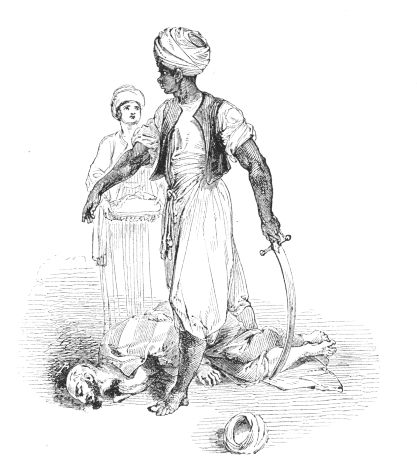
He returned to his house a rich man, and sat reflecting, and lo, a person knocked at the door: he rose, therefore, and opened it; and beheld an old woman whom he knew not, and she said to him, O my son, know that the time of prayer hath almost expired, and I am not prepared by ablution; wherefore I beg that thou wilt admit me into thy house, that I may perform it. He replied, I hear and obey;—and, retiring within, gave her permission to enter; his mind still wandering from joy on account of the gold; and when she had finished the ablution, she approached the spot where he was sitting, and there performed the prayers of two rek'ahs. She then offered up a supplication for my brother; and he thanked her, and offered her two pieces of gold; but when she saw this, she exclaimed, Extolled be God's perfection! Verily I wonder at the person who fell in love with thee in thy beggarly condition! Take back thy money from me, and if thou want it not, return it to her who gave it thee when thy glass broke.—O my mother, said he, how can I contrive to obtain access to her? She answered, O my son, she hath an affection for thee; but she is the wife of an affluent man; take then with thee all thy money, and when thou art with her be not deficient in courteousness and agreeable words; so shalt thou obtain of her favours and her wealth whatever thou shalt desire. My brother, therefore, took all the gold, and arose and went with the old woman, hardly believing what she had told him; and she proceeded, and my brother behind her, until they arrived at a great door, at which she knocked; whereupon a Greek damsel came and opened the door, and the old woman entered, ordering my brother to do the same. He did so, and found himself in a large house, where he beheld a great furnished chamber, with curtains hung in it; and, seating himself there, he put down the gold before him, and placed his turban on his knees;91 and scarcely had he done so, when there came to him a damsel, the like of whom had never been seen, attired in most magnificent apparel. My brother stood up at her approach; and when she beheld him, she laughed in his face, and rejoiced at his visit: then going to the door, she locked it; after which she returned to my brother, and took his hand, and both of them went together into a private chamber, carpeted with various kinds of silk, where my brother sat down, and she seated herself by his side, and toyed with him for a considerable time. She then rose, saying to him, Move not from this place until I return to thee;—and was absent from him for a short period;—and as my brother was waiting for her, there came in to him a black slave, of gigantic stature, with a drawn sword, the brightness of which dazzled the sight; and he exclaimed to my brother. Wo to thee! Who brought thee to this place? Thou vilest of men! Thou misbegotten wretch, and nursling of impurity!—My brother was unable to make any reply; his tongue was instantly tied; and the slave laid hold upon him, and stripped him, and struck him more than eighty blows with the flat of his sword, until he fell sprawling upon the floor; when he retired from him, concluding that he was dead, and uttered a great cry, so that the earth trembled, and the place resounded at his voice, saying, Where is El-Meleeḥah?92—upon which a girl came to him, holding a handsome tray containing salt; and with this she forthwith stuffed the flesh-wounds with which my brother's skin was gashed until they gaped open; but he moved not, fearing the slave would discover that he was alive, and kill him. The girl then went away, and the slave uttered another cry, like the first, whereupon the old woman came to my brother, and, dragging him by the feet to a deep and dark vault, threw him into it upon a heap of slain.93 In this place he remained for two whole days; and God (whose perfection be extolled!) made the salt to be the means of preserving his life, by stanching the flow of blood from his veins; so, when he found that he had strength sufficient to move, he arose, and, opening a shutter in the wall, emerged from the place of the slain; and God (to whom be ascribed all might and glory!) granted him his protection. He therefore proceeded in the darkness, and concealed himself in the passage until the morning, when the old woman went forth to seek another victim, and my brother, going out after her, without her knowledge, returned to his house.
He now occupied himself with the treatment of his wounds until he was restored; and continued to watch for the old woman, and constantly saw her taking men, one after another, and conducting them to the same house. But he uttered not a word on the subject; and when his health returned, and his strength was completely renewed, he took a piece of rag, and made of it a purse, which he filled with pieces of glass: he then tied it to his waist, and disguised himself so that no one would know him, in the dress of a foreigner; and, taking a sword, placed it within his clothes; and as soon as he saw the old woman, he said to her, in the dialect of a foreigner, Old woman, hast thou a pair of scales fit for weighing nine hundred pieces of gold? The old woman answered, I have a young son, a money-changer, and he hath all kinds of scales; therefore accompany me to him before he go forth from his abode, that he may weigh for thee thy gold. So my brother said, Walk on before me:—and she went, and my brother followed her until she arrived at the door, and knocked; upon which the girl came out, and laughed in his face; and the old woman said to her, I have brought you to-day some fat meat. The girl then took my brother's hand, and conducted him into the house (the same which he had entered before), and after she had sat with him a short time, she rose, saying to him, Quit not this place until I return to thee:—and she retired; and my brother had remained not long after when the slave came to him with the drawn sword, and said to him, Rise, thou unlucky! So my brother rose, and, as the slave walked before him, he put his hand to the sword which was concealed beneath his clothes, and struck the slave with it, and cut off his head; after which he dragged him by his feet to the vault, and called out, Where is El-Meleeḥah? The slave-girl, therefore, came, having in her hand the tray containing the salt; but when she saw my brother with the sword in his hand, she turned back and fled: my brother, however, overtook her, and struck off her head. He then called out, Where is the old woman?—and she came; and he said to her, Dost thou know me, O malevolent hag? She answered, No, O my lord.—I am, said he, the man who had the pieces of gold, and in whose house thou performedst the ablution and prayedst; after which, devising a stratagem against me, thou betrayedst me into this place.—The old woman exclaimed, Fear God in thy treatment of me!—but my brother, turning towards her, struck her with the sword, and clove her in twain. He then went to search for the chief damsel, and when she saw him, her reason fled, and she implored his pardon; whereupon he granted her his pardon, and said to her, What occasioned thy falling into the hands of this black? She answered, I was a slave to one of the merchants, and this old woman used to visit me; and one day she said to me, We are celebrating a festivity, the like of which no one hath seen, and I have a desire that thou shouldst witness it. I replied, I hear and obey:—and arose, and clad myself in the best of my attire, and, taking with me a purse containing a hundred pieces of gold,94 proceeded with her until she entered this house, when suddenly this black took me, and I have continued with him in this state three years, through the stratagem of the old witch.—My brother then said to her, Is there any property of his in the house?—Abundance, she answered; and if thou canst remove it, do so:—and upon this, he arose and went with her, when she opened to him chests filled with purses, at the sight of which he was confounded; and she said to him, Go now, and leave me here, and bring some person to remove the property. So he went out, and, having hired ten men, returned; but on his arrival at the door, he found it open, and saw neither the damsel nor the purses; he found, however, some little money remaining, and the stuffs. He discovered, therefore, that she had eluded him; and he took the money that remained, and, opening the closets, took all the stuffs which they contained, leaving nothing in the house.
He passed the next night full of happiness; but when the morning came, he found at the door twenty soldiers, and on his going forth to them, they laid hold upon him, saying, The Wálee summoneth thee. So they took him, and conducted him to the Wálee, who, when he saw him, said to him, Whence obtainedst thou these stuffs?—Grant me indemnity, said my brother:—and the Wálee gave him the handkerchief of indemnity;95 and my brother related to him all that had befallen him with the old woman from first to last, and the flight of the damsel; adding,—and of that which I have taken, take thou what thou wilt; but leave me wherewith to procure my food. The Wálee thereupon demanded the whole of the money and the stuffs; but fearing that the Sulṭán96 might become acquainted with the matter, he retained a portion only, and gave the rest to my brother, saying to him, Quit this city, or I will hang thee. My brother replied, I hear and obey:—and went forth to one of the surrounding cities. Some robbers, however, came upon him, and stripped and beat him, and cut off his ears; and I, having heard of his situation, went forth to him, taking to him some clothes; and brought him back privily into the city, and supplied him with daily food and drink.

THE BARBER'S STORY OF HIS SIXTH BROTHER
My sixth brother (Shaḳáliḳ), O Prince of the Faithful, had his lips cut off. He was in a state of extreme poverty, possessing nothing of the goods of this perishable world; and he went forth one day to seek for something with which to stay his departing spirit, and on his way he beheld a handsome house, with a wide and lofty vestibule, at the door of which were servants, commanding and forbidding; whereupon he inquired of one of the persons standing there, who answered, This house belongeth to a man of the sons of the Barmekees.97 My brother, therefore, advanced to the door-keepers, and begged them to give him something; and they said, Enter the door of the house, and thou wilt obtain what thou desirest of its master. So he entered the vestibule, and proceeded through it a while until he arrived at a mansion of the utmost beauty and elegance, having a garden in the midst of it, unsurpassed in beauty by anything that had ever been seen: its floors were paved with marble, and its curtains were hanging around. He knew not in which direction to go; but advanced to the upper extremity, and there he beheld a man of handsome countenance and beard, who, on seeing my brother, rose to him, and welcomed him, inquiring respecting his circumstances. He accordingly informed him that he was in want; and when the master of the house heard his words, he manifested excessive grief, and, taking hold of his own clothes, rent them, and exclaimed, Am I in the city, and thou in it hungry? It is a thing that I cannot endure!—Then promising him every kind of happiness, he said, Thou must stay and partake of my salt. But my brother replied, O my master, I have not patience to wait; for I am in a state of extreme hunger.
Upon this, the master of the house called out, Boy, bring the basin and ewer!—and he said, O my guest, advance, and wash thy hand. He then performed the same motions as if he were washing his hand; and called to his attendants to bring the table; whereupon they began to come and go as though they were preparing it; after which the master of the house took my brother, and sat down with him at this imaginary table, and proceeded to move his hands and lips as if he were eating; saying to my brother, Eat, and be not ashamed, for thou art hungry, and I know how thou art suffering from the violence of thy hunger. My brother, therefore, made the same motions, as if he also were eating, while his host said to him, Eat, and observe this bread and its whiteness. To this, my brother at first made no reply; but observed in his own mind, Verily this is a man who loveth to jest with others:—so he said to him, O my master, in my life I have never seen bread more beautifully white than this, or any of sweeter taste:—on which the host rejoined, This was made by a female slave of mine whom I purchased for five hundred pieces of gold. He then called out, Boy, bring to us the sikbáj,98 the like of which is not found among the dishes of Kings!—and, addressing my brother, he said, Eat, O my guest; for thou art hungry, vehemently so, and in absolute want of food. So my brother began to twist about his mouth, and to chew, as in eating. The master of the house now proceeded to demand different kinds of viands, one after another; and, though nothing was brought, he continued ordering my brother to eat. Next he called out, Boy, place before us the chickens stuffed with pistachio-nuts:—and said to his guest, Eat of that which thou hast never tasted the like.—O my master, replied my brother, verily this dish hath not its equal in sweetness of flavour:—and the host, thereupon, began to put his hand to my brother's mouth as though he were feeding him with morsels; and proceeded to enumerate to him the various different kinds of viands, and to describe their several excellencies; while his hunger so increased that he longed for a cake of barley-bread. The master of the house then said to him, Hast thou tasted anything more delicious than the spices in these dishes?—No, O my master, answered my brother.—Eat more then, resumed the host; and be not ashamed.—I have eaten enough of the meats, replied the guest. So the man of the house called to his attendants to bring the sweets; and they moved their hands about in the air as if they were bringing them; whereupon the host said to my brother, Eat of this dish; for it is excellent; and of these ḳaṭáïf,99 by my life! and take this one before the sirup runs from it.—May I never be deprived of thee, O my master! exclaimed my brother, proceeding to inquire of him respecting the abundance of musk in the ḳaṭáïf.—This, answered the host, is my usual custom in my house: they always put for me, in each of the ḳaṭáïf, a mithḳál100 of musk, and half a mithḳál of ambergris.—All this time my brother was moving his head and mouth, and rolling about his tongue between his cheeks, as if he were enjoying the sweets. After this, the master of the house called out to his attendants, Bring the dried fruits!—and again they moved about their hands in the air as though they were doing what he ordered; when he said to my brother, Eat of these almonds, and of these walnuts, and of these raisins;—and so on; enumerating the various kinds of dried fruits; and added again, Eat, and be not ashamed.—O my master, replied my brother, I have had enough, and have not power to eat anything more:—but the host rejoined, If thou desire, O my guest, to eat more, and to delight thyself with extraordinary dainties, by Allah! by Allah! remain not hungry.
My brother now reflected upon his situation, and upon the manner in which this man was jesting with him, and said within himself, By Allah, I will do to him a deed that shall make him repent before God of these actions! The man of the house next said to his attendants, Bring us the wine:—and, as before, they made the same motions with their hands in the air as if they were doing what he commanded; after which he pretended to hand to my brother a cup, saying, Take this cup, for it will delight thee:—and his guest replied, O my master, this is of thy bounty:—and he acted with his hand as though he were drinking it.—Hath it pleased thee? said the host.—O my master, answered my brother, I have never seen anything more delicious than this wine.—Drink then, rejoined the master of the house, and may it be attended with benefit and health:—and he himself pretended to drink, and to hand a second cup to my brother, who, after he had affected to drink it, feigned himself intoxicated, and, taking his host unawares, raised his hand until the whiteness of his arm-pit appeared, and struck him such a slap upon his neck that the chamber rang at the blow; and this he followed by a second blow; whereupon the man exclaimed, What is this, thou vilest of the creation?—O my master, answered my brother, I am thy slave, whom thou hast graciously admitted into thine abode, and thou hast fed him with thy provisions, and treated him with old wine, and he hath become intoxicated, and committed an outrage upon thee; but thou art of too exalted dignity to be angry with him for his ignorance.
When the master of the house heard these words of my brother, he uttered a loud laugh, and said to him, Verily for a long time have I made game of men, and jested with all persons accustomed to joking and rudeness, but I have not seen among them any who could endure this trick, nor any who had sagacity to conform to all my actions, except thee: now, therefore, I pardon thee; and be thou my companion in reality, and never relinquish me. He then gave orders to bring a number of the dishes above mentioned, and he and my brother ate together to satisfaction; after which they removed to the drinking-chamber, where female slaves like so many moons sang all kinds of melodies, and played on all kinds of musical instruments. There they drank until intoxication overcame them: the master of the house treated my brother as a familiar friend, became greatly attached to him, and clad him with a costly dress; and on the following morning they resumed their feasting and drinking. Thus they continued to live for a period of twenty years: the man then died, and the Sulṭán101 seized upon his property, and took possession of it.