Volume 1 — CHAPTER III. (continued 2)
Edward William Lane translation
When I heard this, I was filled with wonder, and said within myself, I am King 'Ajeeb, the son of King Khaṣeeb, and it was I who threw down the horseman; but, by Allah, I will neither kill him nor do him any injury. Then said I to the youth, Far from thee be both destruction and harm, if it be the will of God, whose name be exalted: thou hast nothing to fear: I will remain with thee to serve thee, and will go forth with thee to thy father, and beg of him to send me back to my country, for the which he will obtain a reward. The youth rejoiced at my words, and I sat and conversed with him until night, when I spread his bed for him, and covered him, and slept near to his side. And in the morning I brought him water, and he washed his face, and said to me, May God requite thee for me with every blessing. If I escape from King 'Ajeeb, I will make my father reward thee with abundant favours.—Never, I replied, may the day arrive that would bring thee misfortune. I then placed before him some refreshments, and after we had eaten together, we passed the day conversing with the utmost cheerfulness.
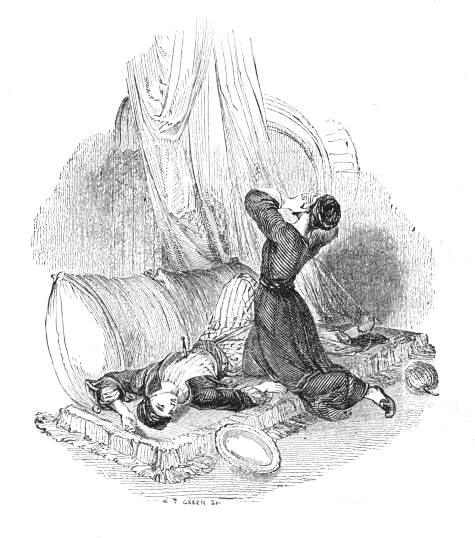
I continued to serve him for nine days; and on the tenth day the youth rejoiced at finding himself in safety, and said to me, O my brother, I wish that thou wouldst in thy kindness warm for me some water, that I may wash myself and change my clothes; for I have smelt the odour of escape from death, in consequence of thy assistance. —With pleasure, I replied;—and I arose, and warmed the water; after which, he entered a place concealed from my view, and, having washed himself and changed his clothes, laid himself upon the mattress to rest after his bath. He then said to me, Cut up for me, O my brother, a water-melon, and mix its juice with some sugar:—so I arose, and, taking a melon, brought it upon a plate, and said to him, Knowest thou, O my master, where is the knife?—See, here it is, he answered, upon the shelf over my head. I sprang up hastily, and took it from its sheath, and as I was drawing back, my foot slipped, as God had decreed, and I fell upon the youth, grasping in my hand the knife, which entered his body, and he died instantly. When I perceived that he was dead, and that I had killed him, I uttered a loud shriek, and beat my face, and rent my clothes, saying, This is, indeed, a calamity! O what a calamity! O my Lord, I implore thy pardon, and declare to Thee my innocence of his death! Would that I had died before him! How long shall I devour trouble after trouble!
With these reflections I ascended the steps, and, having replaced the trap-door, returned to my first station, and looked over the sea, where I saw the vessel that had come before, approaching, and cleaving the waves in its rapid course. Upon this I said within myself, Now will the men come forth from the vessel, and find the youth slain, and they will slay me also:—so I climbed into a tree, and concealed myself among its leaves, and sat there till the vessel arrived and cast anchor, when the slaves landed with the old sheykh, the father of the youth, and went to the place, and removed the earth. They were surprised at finding it moist, and, when they had descended the steps, they discovered the youth lying on his back, exhibiting a face beaming with beauty, though dead, and clad in white and clean clothing, with the knife remaining in his body. They all wept at the sight, and the father fell down in a swoon, which lasted so long that the slaves thought he was dead. At length, however, he recovered, and came out with the slaves, who had wrapped the body of the youth in his clothes. They then took back all that was in the subterranean dwelling to the vessel, and departed.
I remained, O my mistress, by day hiding myself in a tree, and at night walking about the open part of the island. Thus I continued for the space of two months; and I perceived that, on the western side of the island, the water of the sea every day retired, until, after three months, the land that had been beneath it became dry. Rejoicing at this, and feeling confident now in my escape, I traversed this dry tract, and arrived at an expanse of sand; whereupon I emboldened myself, and crossed it. I then saw in the distance an appearance of fire, and, advancing towards it, found it to be a palace, overlaid with plates of copper, which, reflecting the rays of the sun, seemed from a distance to be fire: and when I drew near to it, reflecting upon this sight, there approached me an old sheykh, accompanied by ten young men who were all blind of one eye, at which I was extremely surprised. As soon as they saw me, they saluted me, and asked me my story, which I related to them from first to last; and they were filled with wonder. They then conducted me into the palace, where I saw ten benches, upon each of which was a mattress covered with a blue stuff;78 and each of the young men seated himself upon one of these benches, while the sheykh took his place upon a smaller one; after which they said to me, Sit down, O young man, and ask no question respecting our condition, nor respecting our being blind of one eye. Then the sheykh arose, and brought to each of them some food, and the same to me also; and next he brought to each of us some wine: and after we had eaten, we sat drinking together until the time for sleep, when the young men said to the sheykh, Bring to us our accustomed supply:—upon which the sheykh arose, and entered a closet, from which he brought, upon his head, ten covered trays. Placing these upon the floor, he lighted ten candles, and stuck one of them upon each tray; and, having done this, he removed the covers, and there appeared beneath them ashes mixed with pounded charcoal. The young men then tucked up their sleeves above the elbow, and blackened their faces, and slapped their cheeks,79 exclaiming, We were reposing at our ease, and our impertinent curiosity suffered us not to remain so! Thus they did until the morning, when the sheykh brought them some hot water, and they washed their faces, and put on other clothes.
On witnessing this conduct, my reason was confounded, my heart was so troubled that I forgot my own misfortunes, and I asked them the cause of their strange behaviour; upon which they looked towards me, and said, O young man, ask not respecting that which doth not concern thee; but be silent; for in silence is security from error.—I remained with them a whole month, during which, every night they did the same; and at length I said to them, I conjure you by Allah to remove this disquiet from my mind, and to inform me of the cause of your acting in this manner, and of your exclaiming, We were reposing at our ease, and our impertinent curiosity suffered us not to remain so!—if ye inform me not, I will leave you, and go my way; for the proverb saith, When the eye seeth not, the heart doth not grieve.—On hearing these words, they replied, We have not concealed this affair from thee but in our concern for thy welfare, lest thou shouldst become like us, and the same affliction that hath befallen us happen also to thee. I said, however, Ye must positively inform me of this matter.—We give thee good advice, said they, and do thou receive it, and ask us not respecting our case; otherwise thou wilt become blind of one eye, like us:—but I still persisted in my request; whereupon they said, O young man, if this befall thee, know that thou wilt be banished from our company. They then all arose, and, taking a ram, slaughtered and skinned it, and said to me, Take this knife with thee, and introduce thyself into the skin of the ram, and we will sew thee up in it, and go away; whereupon a bird called the rukh'80 will come to thee, and, taking thee up by its talons, will fly away with thee, and set thee down upon a mountain: then cut open the skin with this knife, and get out, and the bird will fly away. Thou must arise, as soon as it hath gone, and journey for half a day, and thou wilt see before thee a lofty palace, encased with red gold, set with various precious stones, such as emeralds and rubies, &c.; and if thou enter it thy case will be as ours; for our entrance into that palace was the cause of our being blind of one eye; and if one of us would relate to thee all that hath befallen him, his story would be too long for thee to hear.
They then sewed me up in the skin, and entered their palace; and soon after, there came an enormous white bird, which seized me, and flew away with me, and set me down upon the mountain; whereupon I cut open the skin, and got out; and the bird, as soon as it saw me, flew away. I rose up quickly, and proceeded towards the palace, which I found to be as they had described it to me; and when I had entered it, I beheld, at the upper end of a saloon, forty young damsels, beautiful as so many moons, and magnificently attired, who, as soon as they saw me, exclaimed, Welcome! Welcome! O our master and our lord! We have been for a month expecting thee. Praise be to God who hath blessed us with one who is worthy of us, and one of whom we are worthy!—After having thus greeted me, they seated me upon a mattress, and said, Thou art from this day our master and prince, and we are thy handmaids, and entirely under thy authority. They then brought to me some refreshments, and, when I had eaten and drunk, they sat and conversed with me, full of joy and happiness. So lovely were these ladies, that even a devotee, if he saw them, would gladly consent to be their servant, and to comply with all that they would desire. At the approach of night they all assembled around me, and placed before me a table of fresh and dried fruits, with other delicacies that the tongue cannot describe, and wine; and one began to sing, while another played upon the lute. The wine-cups circulated among us, and joy overcame me to such a degree as to obliterate from my mind every earthly care, and make me exclaim, This is indeed a delightful life! I passed a night of such enjoyment as I had never before experienced; and on the morrow I entered the bath; and, after I had washed myself, they brought me a suit of the richest clothing, and we again sat down to a repast.
In this manner I lived with them a whole year; but on the first day of the new year, they seated themselves around me, and began to weep, and bade me farewell, clinging to my skirts.—What calamity hath befallen you? said I. Ye have broken my heart.—They answered, Would that we had never known thee; for we have associated with many men, but have seen none like thee. May God, therefore, not deprive us of thy company.—And they wept afresh. I said to them, I wish that you would acquaint me with the cause of this weeping.—Thou, they replied, art the cause; yet now, if thou wilt attend to what we tell thee, we shall never be parted; but if thou act contrary to it, we are separated from this time; and our hearts whisper to us that thou wilt not regard our warning.—Inform me, said I, and I will attend to your directions:—and they replied, If then thou wouldst inquire respecting our history, know that we are the daughters of Kings: for many years it hath been our custom to assemble here, and every year we absent ourselves during a period of forty days; then returning, we indulge ourselves for a year in feasting and drinking. This is our usual practice; and now we fear that thou wilt disregard our directions when we are absent from thee. We deliver to thee the keys of the palace, which are a hundred in number, belonging to a hundred closets. Open each of these, and amuse thyself, and eat and drink, and refresh thyself, excepting the closet that hath a door of red gold; for if thou open this, the consequence will be a separation between us and thee. We conjure thee, therefore, to observe our direction, and to be patient during this period.—Upon hearing this, I swore to them that I would never open the closet to which they alluded; and they departed, urging me to be faithful to my promise.
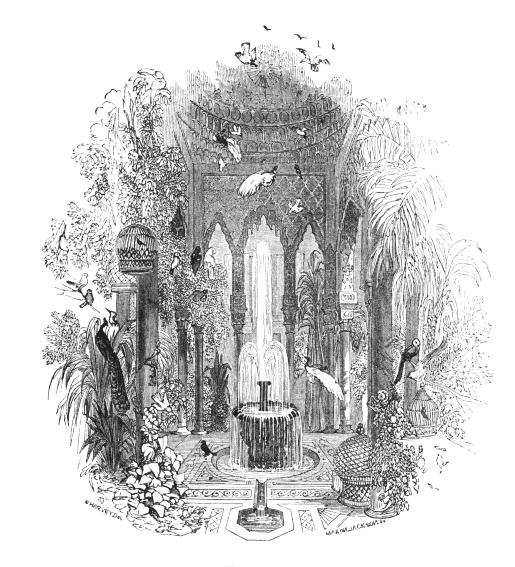
I remained alone in the palace, and at the approach of evening I opened the first closet, and, entering it, found a mansion like paradise, with a garden containing green trees loaded with ripe fruits, abounding with singing birds, and watered by copious streams. My heart was soothed by the sight, and I wandered among the trees, scenting the fragrance of the flowers, and listening to the warbling of the birds as they sang the praises of the One, the Almighty.81 After admiring the mingled colours of the apple resembling the hue upon the cheek of a beloved mistress and the sallow countenance of the perplexed and timid lover, the sweet-smelling quince diffusing an odour like musk and ambergris, and the plum shining as the ruby, I retired from this place, and, having locked the door, opened that of the next closet, within which I beheld a spacious tract planted with numerous palm-trees, and watered by a river flowing among rose-trees, and jasmine, and marjoram, and eglantine, and narcissus, and gilliflower, the odours of which, diffused in every direction by the wind, inspired me with the utmost delight. I locked again the door of the second closet, and opened that of the third. Within this I found a large saloon, paved with marbles of various colours, and with costly minerals and precious gems, and containing cages constructed of sandal and aloes-wood with singing birds within them, and others upon the branches of trees which were planted there. My heart was charmed, my trouble was dissipated, and I slept there until the morning. I then opened the door of the fourth closet, and within this door I found a great building in which were forty closets with open doors; and, entering these, I beheld pearls, and rubies, and chrysolites, and emeralds, and other precious jewels such as the tongue cannot describe. I was astonished at the sight, and said, Such things as these, I imagine, are not found in the treasury of any King. I am now the King of my age, and all these treasures, through the goodness of God, are mine, together with forty damsels under my authority who have no man to share them with me.
Thus I continued to amuse myself, passing from one place to another, until thirty-nine days had elapsed, and I had opened the doors of all the closets excepting that which they had forbidden me to open. My heart was then disturbed by curiosity respecting this hundredth closet, and the Devil, in order to plunge me into misery, induced me to open it. I had not patience to abstain, though there remained of the appointed period only one day: so I approached the closet, and opened the door; and when I had entered, I perceived a fragrant odour, such as I had never before smelt, which intoxicated me so that I fell down insensible, and remained some time in this state: but at length recovering, I fortified my heart, and proceeded. I found the floor overspread with saffron, and the place illuminated by golden lamps and by candles, which diffused the odours of musk and ambergris; and two large perfuming-vessels filled with aloes-wood and ambergris, and a perfume compounded with honey, spread fragrance through the whole place. I saw also a black horse, of the hue of the darkest night, before which was a manger of white crystal filled with cleansed sesame, and another, similar to it, containing rose-water infused with musk: he was saddled and bridled, and his saddle was of red gold. Wondering at the sight of him, I said within myself, This must be an animal of extraordinary qualities;—and, seduced by the Devil, I led him out, and mounted him; but he moved not from his place: I kicked him with my heel; but still he moved not: so I took a miḳra'ah and struck him with it; and as soon as he felt the blow he uttered a sound like thunder, and, expanding a pair of wings, soared with me to an immense height through the air, and then alighted upon the roof of another palace, where he threw me from his back, and, by a violent blow with his tail upon my face, as I sat on the roof, struck out my eye, and left me.82
In this state I descended from the roof, and below I found the one-eyed young men before mentioned, who, as soon as they beheld me, exclaimed, No welcome to thee!—Receive me, said I, into your company:—but they replied, By Allah, thou shalt not remain with us:—so I departed from them, with mournful heart and weeping eye, and, God having decreed me a safe journey hither, I arrived at Baghdád, after I had shaved my beard, and become a mendicant.83
CONTINUATION OF THE STORY OF THE LADIES OF BAGHDÁD, &c.
The mistress of the house then looked towards the Khaleefeh and Jaạfar and Mesroor, and said to them, Acquaint me with your histories:—upon which Jaạfar advanced towards her, and related to her the same story that he had told to the portress before they entered; and when she had heard it, she liberated them all. They accordingly departed, and when they had gone out into the street, the Khaleefeh inquired of the mendicants whither they were going. They answered that they knew not whither to go: whereupon he desired them to accompany his party; and then said to Jaạfar, Take them home with thee, and bring them before me to-morrow, and we will see the result. Jaạfar, therefore, did as he was commanded, and the Khaleefeh returned to his palace; but he was unable to sleep during the remainder of the night.
On the following morning he sat upon his throne, and when his courtiers had presented themselves before him, and departed, excepting Jaạfar, he said to him, Bring before me the three ladies and the two bitches and the mendicants. So Jaạfar arose, and brought them, and, placing the ladies behind the curtains, said to them, We have forgiven you on account of your previous kindness to us, and because ye knew us not; and now I acquaint you that ye are in the presence of the fifth of the sons of El-'Abbás, Hároon Er-Rasheed; therefore relate to him nothing but the truth. And when the ladies heard the words which Jaạfar addressed to them on the part of the Khaleefeh, the eldest of them advanced, and thus related her story:—
THE STORY OF THE FIRST OF THE THREE LADIES OF BAGHDÁD.
O Prince of the Faithful, my story is wonderful; for these two bitches84 are my sisters, born to my father, but of another mother; and I am the youngest of the three. After the death of our father, who left us five thousand pieces of gold, these my two sisters married, and when they had resided some time with their husbands, each of the latter prepared a stock of merchandise, and received from his wife a thousand pieces of gold, and they all set forth on a journey together, leaving me here; but after they had been absent four years, my sisters' husbands lost all their property, and abandoned them in a strange land, and they returned to me in the garb of beggars. When I first saw them in this state, I knew them not; and, as soon as I recognised them, I exclaimed, How is it that ye are in this condition?—O our sister, they answered, thy inquiry now is of no use: the Pen hath written what God hath decreed.85—I sent them, therefore, to the bath, and, having clad them in new apparel, said to them, O my sisters, ye are my elders, and I am young; so ye shall be to me in the places of my father and mother. The inheritance which I shared with you God hath blessed; partake then of its increase, for my affairs are prosperous; and I and ye shall fare alike.—I treated them with the utmost kindness, and during a whole year they remained with me, and enriched themselves by the money that I had given them; but after this period they said to me, It will be more agreeable to us to marry again, for we can no longer abstain from doing so.—O my sisters, I replied, ye have seen no happiness in marriage: a good husband in this age is rarely found, and ye have already had experience of the marriage-state. They, however, heeded not my words; but married against my consent: yet I gave them dowries from my own property, and continued to them my protection. They went to their husbands, and the latter, after they had resided with them a short time, defrauded them of all that they possessed, and, setting forth on a journey, left them destitute: so again they returned to me, and, in a state of nudity, implored my forgiveness, saying, Be not angry with us; for though thou art younger than we, thou hast more mature sense; and we promise thee that we will never again mention the subject of marriage. I replied, Ye are welcome, O my sisters; for I have no one dearer to me than yourselves:—and I received them, and treated them with every kindness, and we remained happily together for the space of a year.
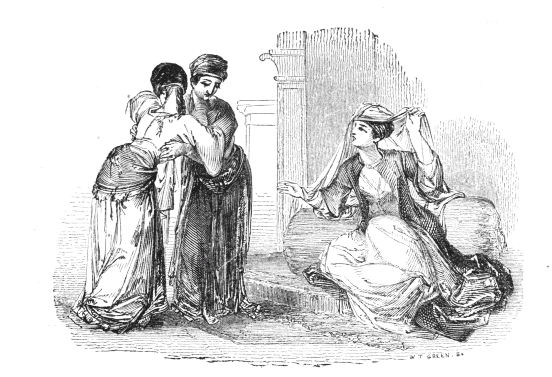
After this I resolved to fit out a vessel for a mercantile voyage:86 accordingly, I stocked a large ship with various goods and necessary provisions, and said to my sisters, Will ye rather stay at home during my voyage, or will ye go with me?—to which they answered, We will accompany thee during the voyage, for we cannot endure to be separated from thee. I therefore took them with me, and we set sail; but first I divided my property into two equal portions; one of which I took with me, and the other I concealed, saying within myself, Perhaps some evil accident may happen to the ship, and our lives may be prolonged; in which case, when we return we shall find that which will be of service to us.—We continued our voyage by day and night, till at length the vessel pursued a wrong course, and the captain knew not whither to steer. The ship had entered a different sea from that which we wished to cross, and for some time we knew it not; but for ten days we had a pleasant wind, and after this, a city loomed before us in the distance. We asked the captain what was the name of this city; and he answered, I know it not; I have never seen it till this day, nor have I ever before in the course of my life navigated this sea: but as we have come hither in safety, ye have nothing to do but to enter this city and land your goods, and, if ye find opportunity, sell or exchange there: if not, we will rest there two days, and take in fresh provisions. So we entered the port of the city, and the captain landed, and after a while returned to us, saying, Arise, and go up into the city, and wonder at that which God hath done unto his creatures, and pray to be preserved from his anger. And when we had entered the city, we found all its inhabitants converted into black stones. We were amazed at the sight, and as we walked through the market-streets, finding the merchandise and the gold and silver remaining in their original state, we rejoiced, and said, This must have been occasioned by same wonderful circumstance. We then separated in the streets, each of us attracted from his companions by the wealth and stuffs in the shops.
As for myself, I ascended to the citadel, which I found to be a building of admirable construction; and, entering the King's palace, I found all the vessels of gold and silver remaining in their places, and the King himself seated in the midst of his Chamberlains and Viceroys and Wezeers, and clad in apparel of astonishing richness. Drawing nearer to him, I perceived that he was sitting upon a throne adorned with pearls and jewels, every one of the pearls shining like a star: his dress was embroidered with gold, and around him stood fifty memlooks, attired in silks of various descriptions, and having in their hands drawn swords. Stupefied at this spectacle, I proceeded, and entered the saloon of the Ḥareem, upon the walls of which were hung silken curtains; and here I beheld the Queen, attired in a dress embroidered with fresh pearls, and having upon her head a diadem adorned with various jewels, and necklaces of different kinds on her neck. All her clothing and ornaments remained as they were at first, though she herself was converted into black stone. Here also I found an open door, and, entering it, I saw a flight of seven steps, by which I ascended to an apartment paved with marble, furnished with gold-embroidered carpets, and containing a couch of alabaster, ornamented with pearls and jewels; but my eyes were first attracted by a gleam of light, and when I approached the spot whence it proceeded, I found a brilliant jewel, of the size of an ostrich's egg, placed upon a small stool, diffusing a light like that of a candle. The coverings of the couch above mentioned were of various kinds of silk, the richness of which would surprise every beholder; and I looked at them with wonder. In this apartment I likewise observed some lighted candles, and reflected that there must then have been some person there to light them. I passed thence to another part of the palace, and continued to explore the different apartments, forgetting myself in the amazement of my mind at all these strange circumstances, and immersed in thoughts respecting what I beheld, until the commencement of night, when I would have departed; but could not find the door: so I returned to the place in which were the lighted candles, and there I laid myself upon the couch, and, covering myself with a quilt, repeated some words of the Ḳur-án, and endeavoured to compose myself to sleep; but I could not. I continued restless: and at midnight I heard a recitation of the Ḳur-án, performed by a melodious and soft voice; upon which I arose, and, looking about, saw a closet with an open door, and I entered it, and found that it was an oratory: lighted lamps were suspended in it, and upon a prayer-carpet spread on the floor sat a young man of handsome aspect. Wondering that he had escaped the fate of the other inhabitants of the city, I saluted him; and he raised his eyes, and returned my salutation: and I then said to him, I conjure thee by the truth of that which thou art reading in the Book of God, that thou answer the question which I am about to ask thee:—whereupon he smiled, and replied, Do thou first acquaint me with the cause of thine entrance into this place, and then I will answer thy question: so I told him my story, and inquired of him the history of this city. Wait a little, said he;—and he closed the Ḳur-án, and, having put it in a bag of satin, seated me by his side. As I now beheld him, his countenance appeared like the full moon, and his whole person exhibited such perfect elegance and loveliness, that a single glance at him drew from me a thousand sighs, and kindled a fire in my heart. I repeated my request that he would give me an account of the city; and, replying, I hear and obey, he thus addressed me:—
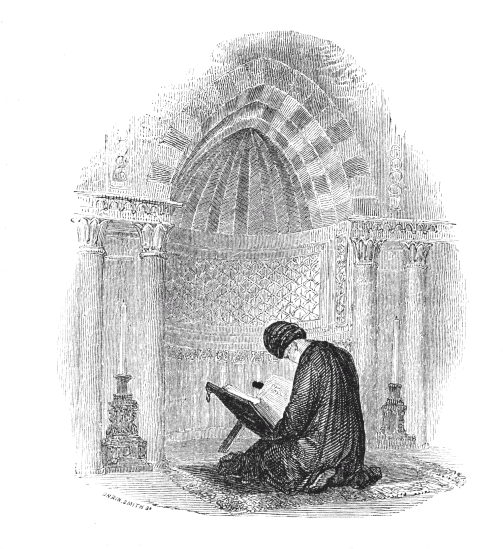
Know that this city belonged to my father and his family and subjects; and he is the King whom thou hast seen converted into stone; and the Queen whom thou hast seen is my mother. They were all Magians, worshipping fire in the place of the Almighty King;87 and they swore by the fire and the light, and the shade and the heat, and the revolving orb. My father had no son, till, in his declining years, he was blest with me, whom he reared until I attained to manhood. But, happily for me, there was, in our family, an old woman, far advanced in age, who was a Muslimeh, believing in God and his Apostle in her heart, though she conformed with my family in outward observances; and my father confided in her, on account of the faithfulness and modesty that he had observed in her character, and shewed her great favour, firmly believing that she held the same faith as himself; therefore, when I had passed my infancy, he committed me to her care, saying, Take him, and rear him, and instruct him in the ordinances of our faith, and educate him and serve him in the best manner. The old woman accordingly received me, but took care to instruct me in the faith of El-Islám, teaching me the laws of purification, and the divine ordinances of ablution, together with the forms of prayer; after which she made me commit to memory the whole of the Ḳur-án. She then charged me to keep my faith a secret from my father, lest he should kill me; and I did so; and a few days after, the old woman died. The inhabitants of the city had now increased in their impiety and arrogance, and in their dereliction of the truth; and while they were in this state, they heard a crier proclaim with a voice like thunder, so as to be audible to both the near and the distant, O inhabitants of this city, abstain from the worship of fire, and worship the Almighty King!—The people were struck with consternation, and, flocking to my father, the King of the city, said to him, What is this alarming voice which hath astounded us by its terrible sound?—but he answered them, Let not the voice terrify you, nor let it turn you from your faith:—and their hearts inclined to his words; so they persevered in the worship of fire, and remained obstinate in their impiety during another year, until the return of the period at which they had heard the voice the first time. It was then heard a second time; and again, in the next year, they heard it a third time; but still they persisted in their evil ways, until, drawing down upon themselves the abhorrence and indignation of Heaven, one morning, shortly after daybreak, they were converted into black stones, together with their beasts and all their cattle. Not one of the inhabitants of the city escaped, excepting me; and from the day on which this catastrophe happened, I have continued occupied as thou seest, in prayer, and fasting, and reading the Ḳur-án: but I have become weary of this solitary state, having no one to cheer me with his company.
On hearing these words, I said to him, Wilt thou go with me to the city of Baghdád, and visit its learned men and lawyers, and increase thy knowledge? If so, I will be thy handmaid, though I am the mistress of my family, and have authority over a household of men. I have here a ship laden with merchandise, and destiny hath driven us to this city, in order that we might become acquainted with these events: our meeting was predestined.—In this manner I continued to persuade him until he gave his consent. I slept that night at his feet, unconscious of my state through excessive joy; and in the morning we rose, and, entering the treasuries, took away a quantity of the lighter and most valuable of the articles that they contained, and descended from the citadel into the city, where we met the slaves and the captain, who were searching for me. They were rejoiced at seeing me, and, to their questions respecting my absence, I replied by informing them of all that I had seen, and related to them the history of the young man, and the cause of the transmutation of the people of the city, and of all that had befallen them, which filled them with wonder. But when my two sisters saw me with the young man, they envied me on his account, and malevolently plotted against me.
We embarked again, and I experienced the utmost happiness, chiefly owing to the company of the young man; and after we had waited a while till the wind was favourable, we spread our sails, and departed. My sisters sat with me and the young man; and, in their conversation with me, said, O our sister, what dost thou purpose to do with this handsome youth? I answered, I desire to take him as my husband:—and, turning to him, and approaching him, I said, O my master, I wish to make a proposal to thee, and do not thou oppose it. He replied, I hear and obey:—and I then looked towards my sisters, and said to them, This young man is all that I desire, and all the wealth that is here is yours.—Excellent, they replied, is thy determination:—yet still they designed evil against me.—We continued our voyage with a favourable wind, and, quitting the sea of peril, entered the sea of security, across which we proceeded for some days, until we drew near to the city of El-Baṣrah, the buildings of which loomed before us at the approach of evening; but as soon as we had fallen asleep, my sisters took us up in our bed, both myself and the young man, and threw us into the sea. The youth, being unable to swim, was drowned: God recorded him among the company of the martyrs;88 while I was registered among those whose life was yet to be preserved; and, accordingly, as soon as I awoke and found myself in the sea, the providence of God supplied me with a piece of timber, upon which I placed myself, and the waves cast me upon the shore of an island.
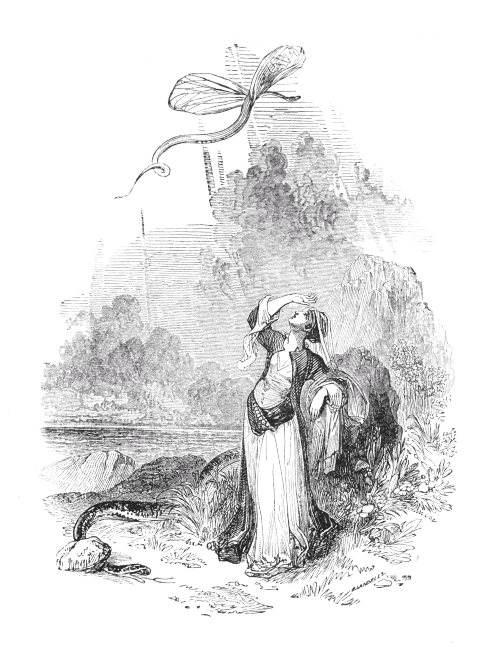
During the remainder of the night I walked along this island, and in the morning I saw a neck of land, bearing the marks of a man's feet, and uniting with the main land. The sun having now risen, I dried my clothes in its rays, and proceeded along the path that I had discovered until I drew near to the shore upon which stands the city, when I beheld a snake approaching me, and followed by a serpent which was endeavouring to destroy it; the tongue of the snake was hanging from its mouth in consequence of excessive fatigue, and it excited my compassion; so I took up a stone, and threw it at the head of the serpent, which instantly died: the snake then extended a pair of wings, and soared aloft into the sky, leaving me in wonder at the sight. At the time of this occurrence I had become so fatigued, that I now laid myself down and slept; but I awoke after a little while, and found a damsel seated at my feet, and gently rubbing them with her hands; upon which I immediately sat up, feeling ashamed that she should perform this service for me, and said to her, Who art thou, and what dost thou want?—How soon has thou forgotten me! she exclaimed: I am she to whom thou hast just done a kindness, by killing my enemy: I am the snake whom thou savedst from the serpent; for I am a Jinneeyeh, and the serpent was a Jinnee at enmity with me; and none but thou delivered me from him: therefore, as soon as thou didst this, I flew to the ship from which thy sisters cast thee, and transported all that it contained to thy house: I then sunk it; but as to thy sisters, I transformed them by enchantment into two black bitches; for I knew all that they had done to thee: the young man, however, is drowned.—Having thus said, she took me up, and placed me with the two black bitches on the roof of my house: and I found all the treasures that the ship had contained collected in the midst of my house: nothing was lost. She then said to me, I swear by that which was engraved upon the seal of Suleymán, that, if thou do not inflict three hundred lashes upon each of these bitches every day, I will come and transform thee in the like manner:—so I replied, I hear and obey:—and have continued ever since to inflict upon them these stripes, though pitying them while I do so.
The Khaleefeh heard this story with astonishment, and then said to the second lady, And what occasioned the stripes of which thou bearest the marks? She answered as follows:—
THE STORY OF THE SECOND OF THE THREE LADIES OF BAGHDÁD.
O Prince of the Faithful, my father, at his death, left considerable property; and soon after that event I married to one of the wealthiest men of the age, who, when I had lived with him a year, died, and I inherited from him eighty thousand pieces of gold, the portion that fell to me according to the law;89 with part of which I made for myself ten suits of clothing, each of the value of a thousand pieces of gold. And as I was sitting one day, there entered my apartment an old woman, disgustingly ugly, who saluted me, and said, I have an orphan daughter whose marriage I am to celebrate this night, and I would have thee obtain a reward and recompense in heaven by thy being present at her nuptial festivity; for she is broken-hearted, having none to befriend her but God, whose name be exalted. She then wept, and kissed my feet; and, being moved with pity and compassion, I assented, upon which she desired me to prepare myself, telling me that she would come at the hour of nightfall and take me; and so saying, she kissed my hand, and departed.
I arose immediately, and attired myself, and when I had completed my preparations, the old woman returned, saying, O my mistress, the ladies of the city have arrived, and I have informed them of thy coming, and they are waiting with joy to receive thee:—so I put on my outer garments, and, taking my female slaves with me, proceeded until we arrived at a street in which a soft wind was delightfully playing, where we saw a gateway over-arched with a marble vault, admirably constructed, forming the entrance to a palace which rose from the earth to the clouds.90 On our arrival there, the old woman knocked at the door, and, when it was opened, we entered a carpeted passage, illuminated by lamps and candles, and decorated with jewels and precious metals.91 Through this passage we passed into a saloon of unequalled magnificence, furnished with mattresses covered with silk, lighted by hanging lamps and by candles, and having, at its upper end, a couch of alabaster decorated with pearls and jewels, and canopied by curtains of satin, from which there came forth a lady beautiful as the moon, who exclaimed to me, Most welcome art thou, O my sister: thou delightest me by thy company, and refreshest my heart. She then sat down again, and said to me, O my sister, I have a brother who hath seen thee at a festivity: he is a young man, more handsome than myself, and, his heart being violently inflamed with love of thee, he hath bribed this old woman to go to thee, and to employ this artifice in order to obtain for me an interview with thee. He desireth to marry thee according to the ordinance of God and his Apostle, and in that which is lawful there is no disgrace.—When I heard these words, and saw myself thus confined in the house so that I could not escape, I replied, I hear and obey:—and the lady, rejoicing at my consent, clapped her hands, and opened a door, upon which there came out from it a young man so surpassingly handsome, that my heart immediately inclined to him. No sooner had he sat down than the Ḳáḍee and four witnesses entered, and saluted us, and proceeded to perform the ceremony of the marriage-contract92 between me and the young man; which having done, they departed; and when they had retired, the young man looked towards me, and said, May our night be blessed. He then informed me that he desired to impose a covenant upon me, and, bringing a copy of the Ḳur-án, said, Swear that thou wilt not indulge a preference, nor at all incline, to any man but me:—and when I had sworn to this effect, he rejoiced exceedingly, and embraced me; and the love of him took entire possession of my heart.
We lived together in the utmost happiness for the space of a month, after which I begged that he would allow me to go to the bázár, in order to purchase some stuffs for dress, and, having obtained his permission, went thither in company with the old woman, and seated myself at the shop of a young merchant with whom she was acquainted, and whose father, as she informed me, had died and left him great wealth. She desired him to shew me his most costly stuffs; and while he was occupied in doing so, she began to utter various flattering expressions in praise of him; but I said to her, We have no concern with the praises that thou bestowest upon him; we desire only to make our purchase, and to return home. Meanwhile he produced to us what we wanted, and we handed him the money: he refused, however, to take it, saying, It is an offering of hospitality to you for your visit this day:—whereupon I said to the old woman, If he will not take the money, return to him his stuff. But he would not receive it again, and exclaimed, By Allah, I will take nothing from you: all this is a present from me for a single kiss, which I shall value more than the entire contents of my shop.—What will a kiss profit thee? asked the old woman. Then, turning to me, she said, O my daughter, thou hast heard what the youth hath said: no harm will befall thee if he give thee a kiss, and thou shalt take what thou wantest.—Dost thou not know, said I, that I have taken an oath? She answered, Let him kiss thee then without thy speaking, and so it will be of no consequence to thee, and thou shalt take back thy money. Thus she continued to palliate the matter until I put my head (as it were) into the bag, and consented: so I covered my eyes, and held the edge of my veil in such a manner as to prevent the passengers from seeing me, whereupon he put his mouth to my cheek beneath the veil, but instead of merely kissing me, he lacerated my cheek by a violent bite. I fell into a swoon from the pain, and the old woman laid me on her lap till I recovered, when I found the shop closed, and the old woman uttering expressions of grief, and saying, What God hath averted would have been a greater calamity; let us return home, and do thou feign to be ill, and I will come to thee and apply a remedy that shall cure the wound, and thou wilt quickly be restored.
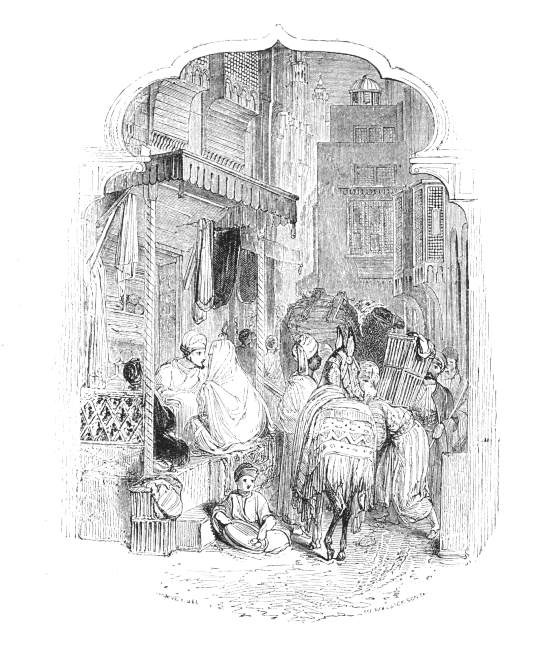
After remaining there some time longer, I rose, and, in a state of great uneasiness and fear, returned to the house, and professed myself ill, upon which my husband came in to me, and said, What hath befallen thee, O my mistress, during this excursion? I answered, I am not well.—And what is this wound, said he, that is upon thy cheek, and in the soft part? I answered, When I asked thy permission, and went out to-day to purchase some stuff for dress, a camel loaded with firewood drove against me in the crowd, and tore my veil, and wounded my cheek as thou seest, for the streets of this city are narrow.93—To-morrow, then, he exclaimed, I will go to the governor, and make a complaint to him, and he shall hang every seller of firewood in the city.—By Allah, said I, burden not thyself by an injury to any one; for the truth is, that I was riding upon an ass, which took fright with me, and I fell upon the ground, and a stick lacerated my cheek.—If it be so, then, he replied, I will go to-morrow to Jaạfar El-Barmekee, and relate the matter to him, and he shall kill every ass-driver in this city.—Wilt thou, said I, kill all those men on my account, when this which befell me was decreed by God?—Undoubtedly, he answered; and, so saying, he seized me violently, and then sprang up, and uttered a loud cry, upon which the door opened, and there came forth from it seven black slaves, who dragged me from my bed, and threw me down in the middle of the apartment; whereupon he ordered one of them to hold me by my shoulders and to sit upon my head; and another, to sit upon my knees and to hold my feet. A third then came, with a sword in his hand, and said, O my lord, shall I strike her with the sword, and cleave her in twain, that each of these may take a half and throw it into the Tigris for the fish to devour?94 For such is the punishment of her who is unfaithful to her oath and to the laws of love.—My husband answered, Strike her, O Saạd:95—and the slave, with the drawn sword in his hand, said, Repeat the profession of the faith, and reflect what thou wouldst have to be done, that thou mayest give thy testamentary directions, for this is the end of thy life.—Good slave, I replied, release me for a while that I may do so:—and I raised my head, and, weeping as I spoke, addressed my husband with these verses:—
You render me lovelorn, and remain at ease. You make my wounded eyelid to be restless, and you sleep. Your abode is between my heart and my eyes; and my heart will not relinquish you, nor my tears conceal my passion. You made a covenant with me that you would remain faithful; but when you had gained possession of my heart you deceived me. Will you not pity my love for you and my moaning? Have you yourself been secure from misfortunes? I conjure you, by Allah, if I die, that you write upon my tombstone, This was a slave of love. That, perchance, some mourner who hath felt the same flame may pass by the lover's grave, and pity her.96
But on hearing these verses, and witnessing my weeping, he became more incensed, and replied in the words of this couplet:—
I reject not the beloved of my heart from weariness: her own guilty conduct is the cause of her punishment. She desired that another should share with me her love; but the faith of my heart inclineth not to partnership.97
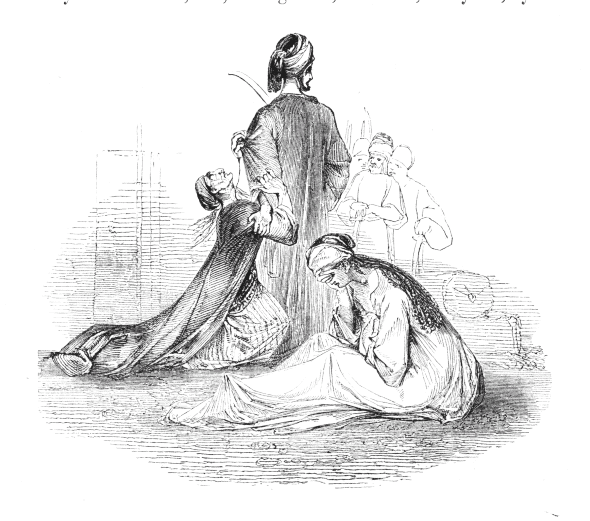
I continued to weep, and to endeavour to excite his compassion, saying within myself, I will humble me before him, and address him with soft words, that he may at least refrain from killing me, though he take all that I possess;—but he cried out to the slave, Cleave her in twain; for she is no longer of any value to us.—So the slave approached me, and I now felt assured of my death, and committed myself to God; but suddenly the old woman came and threw herself at my husband's feet, and, kissing them, exclaimed, O my son, by the care with which I nursed thee, I conjure thee to pardon this damsel, for she hath committed no offence that deserveth such a punishment: thou art young, and I fear the effect of the imprecations that she may utter against thee:—and after she had thus addressed him, she wept, and continued to importune him, until, at length, he said, I pardon her, but must cause her to bear upon her person such marks of her offence as shall last for the remainder of her life. So saying, he commanded the slaves to strip off my vest, and, taking a stick cut from a quince-tree, he beat me upon my back and my sides until I became insensible from the violence of the blows, and despaired of my life. He then ordered the slaves to take me away as soon as it was night, accompanied by the old woman, and to throw me into my house in which I formerly resided. They accordingly executed their lord's commands, and when they had deposited me in my house, I applied myself to the healing of my wounds; but, after I had cured myself, my sides still bore the appearance of having been beaten with miḳra'ahs. I continued to apply remedies for four months before I was restored, and then repaired to view the house in which this event had happened; but I found it reduced to ruin, and the whole street pulled down; the site of the house I found occupied by mounds of rubbish, and I knew not the cause.
Under these circumstances, I went to reside with this my sister, who is of the same father as myself, and I found with her these two bitches. Having saluted her, I informed her of all that had befallen me; to which she replied, Who is secure from the afflictions of fortune? Praise be to God who terminated the affair with safety to thy life!—She then related to me her own story, and that of her two sisters, and I remained with her, and neither of us ever mentioned the subject of marriage. Afterwards we were joined by this our other sister, the cateress, who every day goes out to purchase for us whatever we happen to want.
CONCLUSION OF THE STORY OF THE LADIES OF BAGHDÁD, &c.
The Kaleefeh was astonished at this story, and ordered it to be recorded in a book, as an authentic history, and deposited the book in his library. And he said to the first lady, Knowest thou where the Jinneeyeh98 who enchanted thy sisters is to be found? She answered, O Prince of the Faithful, she gave me a lock of her hair, and said, When thou desirest my presence, burn a few of these hairs, and I will be with thee quickly, though I should be beyond Mount Ḳáf.—Bring then the hair, said the Khaleefeh. The lady, therefore, produced it; and the Khaleefeh, taking it, burned a portion of it, and, when the odour had diffused itself, the palace shook, and they heard a sound of thunder, and lo, the Jinneeyeh appeared before them. She was a Muslimeh, and therefore greeted the Khaleefeh by saying, Peace be on thee, O Khaleefeh of God!—to which he replied, On you be peace, and the mercy of God, and his blessings!99—She then said, Know that this lady hath conferred on me a benefit for which I am unable to requite her; for she rescued me from death, by killing my enemy; and I, having seen what her sisters had done to her, determined to take vengeance upon them; therefore I transformed them by enchantment into two bitches; and, indeed, I had wished rather to kill them, fearing lest they should trouble her; but now, if thou desire their restoration, O Prince of the Faithful, I will restore them, as a favour to thee and to her; for I am one of the true believers.—Do so, said the Khaleefeh; and then we will enter upon the consideration of the affair of the lady who hath been beaten, and examine her case, and if her veracity be established, I will take vengeance for her upon him who hath oppressed her. The Jinneeyeh replied, O Prince of the Faithful, I will guide thee to the discovery of him who acted thus to this lady, and oppressed her, and took her property: he is thy nearest relation. She then took a cup of water, and, having pronounced a spell over it, sprinkled the faces of the two bitches, saying, Be restored to your original human forms!—whereupon they became again two young ladies.—Extolled be the perfection of their Creator!100 Having done this, the Jinneeyeh said, O Prince of the Faithful, he who beat the lady is thy son El-Emeen, who had heard of her beauty and loveliness:—and she proceeded to relate what had happened. The Khaleefeh was astonished, and exclaimed, Praise be to God for the restoration of these two bitches which hath been effected through my means!—and immediately he summoned before him his son El-Emeen, and inquired of him the history of the lady; and he related to him the truth. He then sent for Ḳáḍees and witnesses, and the first lady and her two sisters who had been transformed into bitches he married to the three mendicants who had related that they were the sons of Kings; and these he made chamberlains of his court, appointing them all that they required, and allotting them apartments in the palace of Baghdád. The lady who had been beaten he restored to his son El-Emeen, giving her a large property, and ordering that the house should be rebuilt in a more handsome style. Lastly, the lady-cateress he took as his own wife; he admitted her at once to his own apartment, and, on the following day, he appointed her a separate lodging for herself, with female slaves to wait upon her: he also allotted to her a regular income; and afterwards built for her a palace.
NOTES TO CHAPTER THIRD.
It appears that the kind of face-veil mentioned in the same passage (in Arabic, "ḳináạ,") is a piece of muslin, about a yard or more in length, and somewhat less in width, a portion of which is placed over the head, beneath the izár, the rest hanging down in front, to the waist, or thereabout, and entirely concealing the face. I have often seen Arab women, particularly those of the Wahhábees, wearing veils of this kind composed of printed muslin, completely concealing their features, yet of sufficiently loose fabric to admit of their seeing their way. But the more common kind of Arab face-veil is a long strip of white muslin, or of a kind of black crape, covering the whole of the face excepting the eyes, and reaching nearly to the feet. It is suspended at the top by a narrow band, which passes up the forehead, and which is sewed, as are also the two upper corners of the veil, to a band that is tied round the head. This veil is called "burḳo'." The black kind is often ornamented with gold coins, false pearls, &c., attached to the upper part. It is not so genteel as the white veil, unless for a lady in mourning.
The word in the original text which I translate "saloon," is "ḳá'ah." This term is applied to a large and lofty apartment, commonly having two leewáns, on opposite sides of the durḳá'ah. One of these is, in most instances, larger than the other, and is held to be the more honourable part. Some ḳá'ahs, containing three leewáns, one of these being opposite the entrance, or four leewáns composing the form of a cross with the durḳá'ah in the centre, communicate with small chambers or closets, or have elevated recesses which are furnished in the same manner as the leewáns. That part of the roof which is over the durḳá'ah rises above the rest, sometimes to nearly twice the height of the latter, and is generally surmounted by a lantern of wooden lattice-work to admit the air.
According to the account of them generally received as correct, these two angels, in consequence of their want of compassion for the frailties of mankind, were rendered, by God, susceptible of human passions, and sent down upon the earth to be tempted: they both sinned; and, being permitted to choose whether they would be punished in this life or in the other, chose the former; but they were sent down not merely to experience temptation, being also appointed to tempt others by means of their knowledge of magic; though it appears that they were commanded not to teach this art to any man "until they had said, Verily we are a temptation; therefore, be not an unbeliever."176-–The celebrated traditionist Mujáhid is related to have visited them, under the guidance of a Jew. Having removed the mass of rock from the mouth of the pit, or well, they entered. Mujáhid had been previously charged by the Jew not to mention the name of God in their presence; but when he beheld them, resembling in size two huge mountains, and suspended upside-down, with irons attached to their necks and knees, he could not refrain from uttering the forbidden name; whereupon the two angels became so violently agitated that they almost broke the irons which confined them, and Mujáhid and his guide fled back in consternation.177
The prohibition of wine, or, rather, of fermented and intoxicating liquors, being one of the most remarkable and important points of the Mohammadan religion, it might be imagined that the frequent stories in this work, describing parties of Muslims as habitually indulging in the use of forbidden beverages, are scandalous misrepresentations of Arab manners and customs. There are, however, many similar anecdotes interspersed in the works of Arab historians, which (though many of them are probably untrue in their application to particular individuals) could not have been offered to the public by such writers if they were not of a nature consistent with the customs of a considerable class of the Arab nation.
In investigating this subject, it is necessary, in the first place, to state, that there is a kind of wine which Muslims are permitted to drink. It is properly called "nebeedh" (a name which is now given to prohibited kinds of wine), and is generally prepared by putting dry grapes, or dry dates, in water, to extract their sweetness, and suffering the liquor to ferment slightly, until it acquires a little sharpness or pungency. The Prophet himself was in the habit of drinking wine of this kind, which was prepared for him in the first part of the night; he drank it on the first and second days following; but if any remained on the morning of the third day, he either gave it to his servants or ordered it to be poured out upon the ground.178 Such beverages have, therefore, been drunk by the strictest of his followers; and Ibn-Khaldoon strongly argues that nebeedh thus prepared from dates was the kind of wine used by the Khaleefehs Hároon Er-Rasheed and El-Ma-moon, and several other eminent men, who have been commonly accused of habitually and publicly indulging in debauches of wine properly so called; that is, of inebriating liquors.179
Nebeedh, prepared from raisins, is commonly sold in Arab towns, under the name of "zebeeb," which signifies "raisins." This I have often drunk in Cairo; but never could perceive that it was in the slightest degree fermented. Other beverages, to which the name of "nebeedh" has been applied (though, like zebeeb, no longer called by that name), are also sold in Arab towns. The most common of these is an infusion of licorice, and called by the name of the root, "'erḳ-soos." The nebeedh of dates is sold in Cairo with the dates themselves in the liquor; and in like manner is that of figs. Under the same appellation of "nebeedh" have been classed the different kinds of beer now commonly called "boozeh," which have been mentioned in former pages. Opium, hemp, &c., are now more frequently used by the Muslims to induce intoxication or exhilaration. The young leaves of the hemp are generally used alone, or mixed with tobacco, for smoking; and the capsules, without the seeds, enter into the composition of several intoxicating conserves. Some remarks upon this subject have been inserted in a former note.
By my own experience I am but little qualified to pronounce an opinion respecting the prevalence of drinking wine among the Arabs; for, never drinking it myself, I had little opportunity of observing others do so during my residence among Muslims. I judge, therefore, from the conversations and writings of Arabs, which justify me in asserting that the practice of drinking wine in private, and by select parties, is far from being uncommon among modern Muslims, though certainly more so than it was before the introduction of tobacco into the East, in the beginning of the seventeenth century of our era; for this herb, being in a slight degree exhilarating, and at the same time soothing, and unattended by the injurious effects that result from wine, is a sufficient luxury to many who, without it, would have recourse to intoxicating beverages merely to pass away hours of idleness. The use of coffee, too, which became common in Egypt, Syria, and other countries, besides Arabia, a century earlier than tobacco, doubtless tended to render the habit of drinking wine less general. That it was adopted as a substitute for wine appears even from its name, "ḳahweh," an old Arabic term for wine; whence the Turkish "ḳahveh," the Italian "caffe," and our "coffee."
There is an Arabic work of some celebrity, and not of small extent, entitled "Ḥalbet el-Kumeyt,"180 apparently written shortly before the Arabs were in possession of the first of the above-mentioned substitutes for wine, nearly the whole of which consists of anecdotes and verses relating to the pleasures resulting from, or attendant upon, the use of wine; a few pages at the end being devoted to the condemnation of this practice, or, in other words, to prove the worthlessness of all that precedes. Of this work I possess a copy, a quarto volume of 464 pages. I have endeavoured to skim its cream; but found it impossible to do so without collecting, at the same time, a considerable quantity of most filthy scum; for it is characterised by wit and humour plentifully interlarded with the grossest and most revolting obscenity; yet it serves to confirm what has been above asserted. The mere existence of such a work (and it is not the only one of the kind), written by a man of learning, and I believe a Ḳáḍee, a judge, or one holding the honourable office of a guardian of religion and morality,181—written, too, evidently with pleasure, notwithstanding his assertion to the contrary,—is a strong argument in favour of the prevalence of the practice which it paints in the most fascinating colours, and then condemns. Its author terminates a chapter (the ninth), in which many well-known persons are mentioned as having been addicted to wine, by saying, that the Khaleefehs, Emeers, and Wezeers, so addicted, are too numerous to name in such a work; and by relating a story of a man who placed his own wife in pledge in the hands of a wine-merchant, after having expended in the purchase of the forbidden liquor all the property that he possessed. He excuses himself (in his preface) for writing this book, by saying that he had been ordered to do so by one whom he could not disobey; thus giving us a pretty strong proof that a great man in his time was not ashamed of avowing his fondness for the prohibited enjoyment. If, then, we admit the respectable authority of Ibn-Khaldoon, and acquit of the vice of drunkenness those illustrious individuals whose characters he vindicates, we must still regard most of the anecdotes relating to the carousals of other persons as being not without foundation.
One of my friends, who enjoys a high reputation, ranking among the most distinguished of the 'Ulamà of Cairo, is well known to his intimate acquaintances as frequently indulging in the use of forbidden beverages with a few select associates. I disturbed him and his companions by an evening visit on one of these occasions, and was kept waiting within the street-door while the guests quickly removed everything that would give me any indication of the manner in which they had been employed; for the announcement of my (assumed) name, and their knowledge of my abstemious character, completely disconcerted them. I found them, however, in the best humour. They had contrived, it appeared, to fill with wine a china bottle, of the kind used at that season (winter) for water; and when any one of them asked the servant for water, this bottle was brought to him; but when I made the same demand, my host told me that there was a bottle of water on the sill of the window behind that part of the deewán upon which I was seated. The evening passed away very pleasantly, and I should not have known how unwelcome was my intrusion had not one of the guests with whom I was intimately acquainted, in walking part of the way home with me, explained to me the whole occurrence. There was with us a third person, who, thinking that my antipathy to wine was feigned, asked me to stop at his house on my way, and take a cup of "white coffee," by which he meant brandy.
Another of my Muslim acquaintances in Cairo I frequently met at the house of a mutual friend, where, though he was in most respects very bigoted, he was in the habit of indulging in wine. For some time he refrained from this gratification when I was present; but at length my presence became so irksome to him, that he ventured to enter into an argument with me on the subject of the prohibition. The only answer I could give to his question, "Why is wine forbidden?"—was in the words of the Ḳur-án, "Because it is the source of more evil than profit."182 This suited his purpose, as I intended it should; and he asked, "What evil results from it?" I answered, "Intoxication and quarrels, &c."—"Then," said he, "if a man take not enough to intoxicate him there is no harm;"—and finding that I acquiesced by silence, he added, "I am in the habit of taking a little; but never enough to intoxicate. Boy, bring me a glass."—He was the only Muslim, however, whom I have heard to argue against the absolute interdiction of inebriating liquors.
Histories tell us that some of the early followers of the Prophet indulged in wine, holding the text above referred to as indecisive; and that Moḥammad was at first doubtful upon this subject appears from another text, in which his followers were told not to come to prayer when they were drunk, until they should know what they would say;183 an injunction somewhat similar to one in the Bible;184 but when frequent and severe contentions resulted from their use of wine, the following more decided condemnation of the practice was pronounced:—"O ye who have become believers, verily wine and lots and images and divining-arrows are an abomination of the work of the Devil; therefore, avoid them, that ye may prosper."185 This law is absolute: its violation in the smallest degree is criminal. The punishment ordained by the law for drinking (or, according to most doctors, for even tasting) wine or spirits, or inducing intoxication by any other means, on ordinary occasions, is the infliction of eighty stripes in the case of a free man, and forty in that of a slave; but if the crime be openly committed in the course of any day of the month of Ramaḍán, when others are fasting, the punishment prescribed is death!
The prohibition of wine hindered many of the Prophet's contemporaries from embracing his religion. It is said that the famous poet El-Aạshà, who was one of them, delayed to join his cause on this account, until death prevented him. A person passing by his tomb (at Menfooḥáh, in El-Yemámeh), and observing that it was moist, asked the reason, and was answered, that the young men of the place, considering him still as their cup-companion, drank wine over his grave, and poured his cup upon it.186 Yet many of the most respectable of the pagan Arabs, like certain of the Jews and early Christians, abstained totally from wine, from a feeling of its injurious effects upon morals, and, in their climate, upon health; or, more especially, from the fear of being led by it into the commission of foolish and degrading actions. Thus, Ḳeys the son of 'Áṣim, being one night overcome with wine, attempted to grasp the moon, and swore that he would not quit the spot where he stood until he had laid hold of it: after leaping several times with the view of doing so, he fell flat upon his face; and when he recovered his senses, and was acquainted with the cause of his face being bruised, he made a solemn vow to abstain from wine ever after.187 A similar feeling operated upon many Muslims more than religious principle. The Khaleefeh 'Abd-El-Melik Ibn-Marwán took pleasure in the company of a slave named Naṣeeb, and one day desired him to drink with him. The slave replied, "O Prince of the Faithful, I am not related to thee, nor have I any authority over thee, and I am of no rank or lineage: I am a black slave, and my wit and politeness have drawn me into thy favour: how then shall I take that which will plunder me of these two qualities; and by what shall I then propitiate thee?" The Khaleefeh admired and excused him.188
It was the custom of many Muslim princes, as might be inferred from the above anecdote, to admit the meanest of their dependants to participate in their unlawful carousals when they could have no better companions; but poets and musicians were their more common associates on these occasions; and these two classes, and especially the latter, are in the present day the most addicted to intoxicating liquors. Few modern Arab musicians are so well contented with extraordinary payment and mere sweet sherbet as with a moderate fee and plenty of wine and brandy; and many of them deem even wine but a sorry beverage.
It was usual with the host and guests at wine-parties to wear dresses of bright colours, red, yellow, and green;189 and to perfume their beards and mustaches with civet, or to have rose-water sprinkled upon them; and ambergris or aloes-wood, or some other odoriferous substance, placed upon burning coals in a censer, diffused a delicious fragrance throughout the saloon of the revels.
The wine, it appears, was rather thick; for it was necessary to strain it:190 it was probably sweet, and not strong; for it was drunk in large quantities. Frequently, perhaps, it was nebeedh of dry raisins kept longer than the law allows. It was usually kept in a large earthen vessel, called "denn," high, and small at the bottom, which was partly imbedded in the earth to keep it upright. The name of this vessel is now given to a cask of wood; but the kind above mentioned was of earth; for it was easily broken.—A famous saint, Abu-l-Ḥoseyn En-Nooree, seeing a vessel on the Tigris containing thirty denns belonging to the Khaleefeh El-Moạtaḍid, and being told that they contained wine, took a boat-pole, and broke them all, excepting one. When brought before the Khaleefeh to answer for this action, and asked by him, "Who made thee Moḥtesib?"191 he boldly answered, "He who made thee Khaleefeh!"—and was pardoned.192—Pitch was used by the Arabs, as it was by the Greeks and Romans, for the purpose of curing their wine; the interior of the denn being coated with it. A smaller kind of earthen jar, or amphora,193 and a bottle of leather,194 or of glass,195 were also used. The wine was transferred for the table to glass jugs, or long-spouted ewers.196 These and the cups were placed upon a round embroidered cloth spread on the floor, or upon a round tray. The latter now is in general use, and is supported on a low stool, described in a former note, as being used at ordinary meals. The guests sat around, reclining against pillars; or they sat upon the deewán, and a page or slave handed the cup, having on his right arm a richly-embroidered napkin: the person after drinking took the end of this to wipe his lips. The cups are often described as holding a fluid pound, or little less than an English pint; and this is to be understood literally, or nearly so: they were commonly of cut glass; but some were of crystal, or silver, or gold.197 With these and the ewers or jugs were placed several saucers, or small dishes,198 of fresh and dried fruits;199 and fans and fly-whisks, of the kinds described on a former occasion, were used by the guests.
The most common and esteemed fruits in the countries inhabited by the Arabs may here be mentioned.
The date200 deserves the first place. The Prophet's favourite fruits were fresh dates201 and water-melons; and he ate them both together.202 "Honour," said he, "your paternal aunt, the date-palm; for she was created of the earth of which Adam was formed."203 It is said that God hath given this tree as a peculiar favour to the Muslims; that he hath decreed all the date-palms in the world to them, and they have accordingly conquered every country in which these trees are found; and all are said to have derived their origin from the Hejáz.204 The palm-tree has several well-known properties that render it an emblem of a human being; among which are these; that if the head be cut off, the tree dies; and if a branch be cut off, another does not grow in its place.205 Dates are preserved in a moist state by being merely pressed together in a basket or skin, and thus prepared are called "'ajweh." There are many varieties of this fruit. The pith or heart of the palm206 is esteemed for its delicate flavour.
The water-melon,207 from what has been said of it above, ought to be ranked next; and it really merits this distinction. "Whoso eateth," said the Prophet, "a mouthful of water-melon, God writeth for him a thousand good works, and cancelleth a thousand evil works, and raiseth him a thousand degrees; for it came from Paradise;"—and again, "The water-melon is food and drink, acid and alkali, and a support of life," &c.208 The varieties of this fruit are very numerous.
The banana209 is a delicious fruit. The Prophet pronounced the banana-tree to be the only thing on earth that resembles a thing in Paradise; because it bears fruit both in winter and summer.210
The pomegranate211 is another celebrated fruit. Every pomegranate, according to the Prophet, contains a fecundating seed from Paradise.212
The other most common and esteemed fruits are the following:—the apple, pear, quince, apricot, peach, fig, sycamore-fig, grape, lote, jujube, plum, walnut, almond, hazel-nut, pistachio-nut, orange, Seville-orange, lime and lemon, citron, mulberry, olive, and sugar-cane.213
Of a selection of these fruits consists the dessert which accompanies the wine; but the table is not complete without a bunch or two of flowers placed in the midst.
Though the Arabs are far from being remarkable for exhibiting taste in the planning of their gardens, they are passionately fond of flowers, and especially of the rose.214—The Khaleefeh El-Mutawekkil monopolized roses for his own enjoyment; saying, "I am the King of Sulṭáns, and the rose is the king of sweet-scented flowers; therefore each of us is most worthy of the other for a companion." The rose, in his time, was seen nowhere but in his palace: during the season of this flower he wore rose-coloured clothes; and his carpets, &c., were sprinkled with rose-water.215 A similar passion for the rose is said to have distinguished a weaver, in the reign of El-Ma-moon. He was constantly employed at his loom every day of the year, even during the congregational prayers of Friday, excepting in the rose-season, when he abandoned his work, and gave himself up to the enjoyment of wine, early in the morning and late in the evening, loudly proclaiming his revels by singing,—
"The season has become pleasant! The time of the rose has come! Take your morning potations, as long as the rose has blossoms and flowers!"
When he resumed his work, he made it known by singing aloud,—
"If my Lord prolong my life until the rose-season, I will take again my morning potations: but if I die before it, alas! for the loss of the rose and wine! "I implore the God of the supreme throne, whose glory be extolled, that my heart may continually enjoy the evening potations to the day of resurrection."
—The Khaleefeh was so amused with the humour of this man, that he granted him an annual pension of ten thousand dirhems to enable him to enjoy himself amply on these occasions.216—Another anecdote may be added to shew the estimation of the rose in the mind of an Arab. It is said that Rowḥ Ibn-Ḥátim, the governor of the province of Northern Africa, was sitting one day, with a female slave, in an apartment of his palace, when a eunuch brought him a jar full of red and white roses, which a man had offered as a present. He ordered the eunuch to fill the jar with silver in return; but his concubine said, "O my lord, thou hast not acted equitably towards the man; for his present to thee is of two colours, red and white." The Emeer replied, "Thou hast said truly;" and gave orders to fill the jar for him with silver and gold (dirhems and deenárs) intermixed.217—Some persons preserve roses during the whole of the year, in the following manner. They take a number of rose-buds, and fill with them a new earthen jar, and, after closing its mouth with mud, so as to render it impervious to the air, bury it in the earth. Whenever they want a few roses, they take out some of these buds, which they find unaltered, sprinkle a little water upon them, and leave them for a short time in the air, when they open, and appear as if just gathered.218—The rose is even a subject of miracles. It is related by Ibn-Ḳuteybeh, that there grows in India a kind of rose upon the leaves of which is inscribed, "There is no deity but God."219 But I find a more particular account of this miraculous rose. A person, who professed to have seen it, said, "I went into India, and I saw, at one of its towns, a large rose, sweet-scented, upon which was inscribed, in white characters, 'There is no deity but God; Moḥammad is God's apostle: Aboo-Bekr is the very veracious: 'Omar is the discriminator;' and I doubted of this, whether it had been done by art; so I took one of the blossoms not yet opened, and in it was the same inscription; and there were many of the same kind there. The people of that place worshipped stones, and knew not God, to whom be ascribed might and glory."220—Roses are announced for sale in the streets of Cairo by the cry of "The rose was a thorn: from the sweat of the Prophet it blossomed!" in allusion to a miracle recorded of Moḥammad. "When I was taken up into heaven," said the Prophet, "some of my sweat fell upon the earth, and from it sprang the rose; and whoever would smell my scent, let him smell the rose." In another tradition it is said, "The white rose was created from my sweat on the night of the Meạráj;221 and the red rose, from the sweat of Jebraeel;222 and the yellow rose, from the sweat of El-Buráḳ."223—The Persians take especial delight in roses; sometimes spreading them as carpets or beds on which to sit or recline in their revellings.
But there is a flower pronounced more excellent than the rose; that of the Egyptian privet, or Lawsonia inermis.224 Moḥammad said, "The chief of the sweet-scented flowers of this world and of the next is the fághiyeh;" and this was his favourite flower.225 I approve of his taste; for this flower, which grows in clusters somewhat like those of the lilac, has a most delicious fragrance. But, on account of discrepancies in different traditions, a Muslim may, with a clear conscience, prefer either of the two flowers next mentioned.
The Prophet said of the violet,226 "The excellence of the extract of violets, above all other extracts, is as the excellence of me above all the rest of the creation: it is cold in summer and hot in winter:" and, in another tradition, "The excellence of the violet is as the excellence of El-Islám above all other religions."227 A delicious sherbet is made of a conserve of sugar and violet-flowers.
The myrtle228 is the rival of the violet. "Adam," said the Prophet, "fell down from Paradise with three things; the myrtle, which is the chief of sweet-scented flowers in this world; an ear of wheat, which is the chief of all kinds of food in this world; and pressed dates, which are the chief of the fruits of this world."229
The anemone230 was monopolized for his own enjoyment by Noạmán Ibn-El-Mundhir (King of El-Ḥeereh, and contemporary of Moḥammad), as the rose was afterwards by El-Mutawekkil.231
Another flower much admired and celebrated in the East is the gilliflower.232 There are three principal kinds; the most esteemed is the yellow, or golden-coloured, which has a delicious scent both by night and day; the next, the purple, and other dark kinds, which have a scent only in the night; the least esteemed, the white, which has no scent. The yellow gilliflower is an emblem of a neglected lover.233
The narcissus234 is very highly esteemed. Galen says, "He who has two cakes of bread, let him dispose of one of them for some flowers of the narcissus; for bread is the food of the body, and the narcissus is the food of the soul." Hippocrates, too, gave a similar opinion.235
The following flowers complete the list of those celebrated as most appropriate to add to the delights of wine:—the jasmine, eglantine, Seville-orange-flower, lily, sweet-basil, wild thyme, buphthalmum, chamomile, nenuphar, lotus, pomegranate-flower, poppy, ketmia, crocus or saffron, safflower, flax, the blossoms of different kinds of bean, and those of the almond.236
A sprig of Oriental willow237 adds much to the charms of a bunch of flowers, being the favourite symbol of a graceful female.
But I have not yet mentioned all that contributes to the pleasures of an Eastern carousal. For the juice of the grape is not fully relished without melodious sounds. "Wine is as the body; music, as the soul; and joy is their offspring."238 All the five senses should be gratified. For this reason, an Arab toper, who had nothing, it appears, but wine to enjoy, exclaimed,—
"Ho! give me wine to drink; and tell me, 'This is wine.'"
For, on drinking, his sight and smell and taste and touch would all be affected; but it was desirable that his hearing should also be pleased.239
Music was condemned by the Prophet almost as severely as wine. "Singing and hearing songs," said he, "cause hypocrisy to grow in the heart, like as water promoteth the growth of corn:"240—and musical instruments he declared to be among the most powerful means by which the Devil seduces man. An instrument of music is the Devil's muëddin, serving to call men to his worship, as stated in a former note. Of the hypocrisy of those attached to music, the following anecdote presents an instance:—A drunken young man with a lute in his hand was brought one night before the Khaleefeh 'Abd-El-Melik the son of Marwán, who, pointing to the instrument, asked what it was, and what was its use. The youth made no answer; so he asked those around him; but they also remained silent, till one, more bold than the rest, said, "O Prince of the Faithful, this is a lute: it is made by taking some wood of the pistachio-tree, and cutting it into thin pieces, and glueing these together, and then attaching over them these chords, which, when a beautiful girl touches them, send forth sounds more pleasant than those of rain falling upon a desert land; and my wife is separated from me by a triple divorce if every one in this council is not acquainted with it, and doth not know it as well as I do, and thou the first of them, O Prince of the Faithful." The Khaleefeh laughed, and ordered that the young man should be discharged.241
The latter saying of the Prophet, respecting the Devil, suggests to me the insertion of another anecdote, related of himself by Ibráheem El-Móṣilee, the father of Is-ḥáḳ; both of whom were very celebrated musicians. I give a translation of it somewhat abridged.—"I asked Er-Rasheed," says Ibráheem, "to grant me permission to spend a day at home with my female slaves and brothers; and he gave me two thousand deenárs, and appointed the next Saturday for this purpose. I caused the meats and wine and other necessaries to be prepared, and ordered the chamberlain to close the door, and admit no one: but while I was sitting, with my attendants standing in the form of a curved line before me, there entered, and approached me, a sheykh, reverend and dignified and comely in appearance, wearing short khuffs,242 and two soft gowns, with a ḳalensuweh243 upon his head, and in his hand a silver-headed staff; and sweet odours were diffused from his clothes. I was enraged with the chamberlain for admitting him; but on his saluting me in a very courteous manner, I returned his salutation, and desired him to sit down. He then began to repeat to me stories, tales of war, and poetry; so that my anger was appeased, and it appeared to me that my servants had not presumed to admit him until acquainted with his politeness and courteousness; I therefore said to him, 'Hast thou any inclination for meat?' He answered, 'I have no want of it.'—'And the wine?' said I. He replied, 'Yes.' So I drank a large cupful, and he did the same, and then said to me, 'O Ibráheem, wilt thou let us hear some specimen of thy art in which thou hast excelled the people of thy profession?' I was angry at his words; but I made light of the matter, and, having taken the lute and tuned it, I played and sang; whereupon he said, 'Thou hast performed well, O Ibráheem.' I became more enraged, and said within myself, 'He is not content with coming hither without permission, and asking me to sing, but he calls me by my name, and proves himself unworthy of my conversation.' He then said, 'Wilt thou let us hear more? If so, we will requite thee.' And I took the lute, and sang, using my utmost care, on account of his saying, 'we will requite thee.' He was moved with delight, and said, 'Thou hast performed well, O my master Ibráheem:'—adding, 'Wilt thou permit thy slave to sing?' I answered, 'As thou pleasest:'—but thinking lightly of his sense to sing after me. He took the lute, and tuned it; and, by Allah! I imagined that the lute spoke in his hands with an eloquent Arab tongue. He proceeded to sing some verses commencing,—
'My heart is wounded! Who will give me, for it, a heart without a wound?'
The narrator continues by saying, that he was struck dumb and motionless with ecstasy; and that the strange sheykh, after having played and sung again, and taught him an enchanting air (with which he afterwards enraptured his patron, the Khaleefeh), vanished. Ibráheem, in alarm, seized his sword; and was the more amazed when he found that the porter had not seen the stranger enter or leave the house; but he heard his voice again, outside, telling him that he was Aboo-Murrah (the Devil).244—Two other anecdotes of a similar kind are related in the work from which the above is taken.
Ibráheem El-Móṣilee, his son Is-ḥáḳ, and Mukháriḳ (a pupil of the former), were especially celebrated among the Arab musicians, and among the distinguished men of the reign of Hároon Er-Rasheed. Is-ḥáḳ El-Móṣilee relates, of his father Ibráheem, that when Er-Rasheed took him into his service, he gave him a hundred and fifty thousand dirhems, and allotted him a monthly pension of ten thousand dirhems, besides occasional presents [one of which is mentioned as amounting to a hundred thousand dirhems for a single song], and the produce of his (Ibráheem's) farms: he had food constantly prepared for him; three sheep every day for his kitchen, besides birds; three thousand dirhems were allowed him for fruits, perfumes, &c., every month, and a thousand dirhems for his clothing; "and with all this," says his son, "he died without leaving more than three thousand deenárs, a sum not equal to his debts, which I paid after his death."245—Ibráheem was of Persian origin, and of a high family. He was commonly called the Nedeem (or cup-companion), being Er-Rasheed's favourite companion at the wine-table; and his son, who enjoyed the like distinction with El-Ma-moon, received the same appellation, as well as that of "Son of the Nedeem." Ibráheem was the most famous musician of his time, at least till his son attained celebrity.246
Is-ḥáḳ El-Móṣilee was especially famous as a musician; but he was also a good poet, accomplished in general literature, and endowed with great wit. He was honoured above all other persons in the pay of El-Ma-moon, and enjoyed a long life; but for many years before his death he was blind.247
Mukháriḳ appears to have rivalled his master Ibráheem. The latter, he relates, took him to perform before Er-Rasheed, who used to have a curtain suspended between him and the musicians. "Others," he says, "sang, and he was unmoved; but when I sang, he came forth from behind the curtain, and exclaimed, 'Young man, hither!' and he seated me upon the sereer [a kind of couch], and gave me thirty thousand dirhems."248 The following anecdote (which I abridge a little in translation) shews his excellence in the art which he professed, and the effect of melody on an Arab:—"After drinking with the Khaleefeh249 a whole night, I asked his permission," says he, "to take the air in the Ruṣáfeh,250 which he granted; and while I was walking there, I saw a damsel who appeared as if the rising sun beamed from her face. She had a basket, and I followed her. She stopped at a fruiterer's, and bought some fruit; and observing that I was following her, she looked back and abused me several times; but still I followed her until she arrived at a great door, after having filled her basket with fruits and flowers and similar things. When she had entered, and the door was closed behind her, I sat down opposite to it, deprived of my reason by her beauty; and knew that there must be in the house a wine-party. The sun went down upon me while I sat there; and at length there came two handsome young men on asses, and they knocked at the door, and when they were admitted I entered with them; the master of the house thinking that I was their companion, and they imagining that I was one of his friends. A repast was brought, and we ate, and washed our hands, and were perfumed. The master of the house then said to the two young men, 'Have ye any desire that I should call such a one?' (mentioning a female name). They answered, 'If thou wilt grant us the favour, well:'—so he called for her, and she came, and lo, she was the maiden whom I had seen before, and who had abused me. A servant-maid preceded her, bearing her lute, which she placed in her lap. Wine was then brought, and she sang while we drank, and shook with delight. 'Whose air is that?' they asked. She answered, 'Seedee251 Mukháriḳ's.' She then sang another air, which, also, she said was mine; while they drank by pints; she looking aside and doubtfully at me until I lost my patience, and called out to her to do her best: but in attempting to do so, singing a third air, she overstrained her voice, and I said, 'Thou hast made a mistake:'—upon which she threw the lute from her lap, in anger, so that she nearly broke it; saying, 'Take it thyself, and let us hear thee.' I answered, 'Well;' and, having taken it and tuned it perfectly, sang the first of the airs which she had sung before me; whereupon all of them sprang upon their feet, and kissed my head. I then sang the second air, and the third; and their reason almost fled, from ecstasy. The master of the house, after asking his guests, and being told by them that they knew me not, came to me, and, kissing my hand, said, 'By Allah, my master, who art thou?' I answered, 'By Allah, I am the singer Mukháriḳ.'—'And for what purpose,' said he, kissing both my hands, 'camest thou hither?' I replied, 'As a spunger;'—and related what had happened with respect to the maiden: whereupon he looked towards his two companions, and said to them, 'Tell me, by Allah, do ye not know that I gave for that girl thirty thousand dirhems, and have refused to sell her?' They answered, 'It is so.' Then said he, 'I take you as witnesses that I have given her to him.'—'And we,' said the two friends, 'will pay thee two-thirds of her price.' So he put me in possession of the girl, and in the evening, when I departed, he presented me also with rich dresses and other gifts, with all of which I went away; and as I passed the places where the maiden had abused me, I said to her, 'Repeat thy words to me;' but she could not, for shame. Holding the girl's hand, I went with her immediately to the Khaleefeh, whom I found in anger at my long absence; but when I related my story to him he was surprised, and laughed, and ordered that the master of the house and his two friends should be brought before him, that he might requite them: to the former he gave forty thousand dirhems; to each of his two friends, thirty thousand; and to me, a hundred thousand; and I kissed his feet, and departed."252