Volume 1 — CHAPTER IV. (continued 2)
Edward William Lane translation
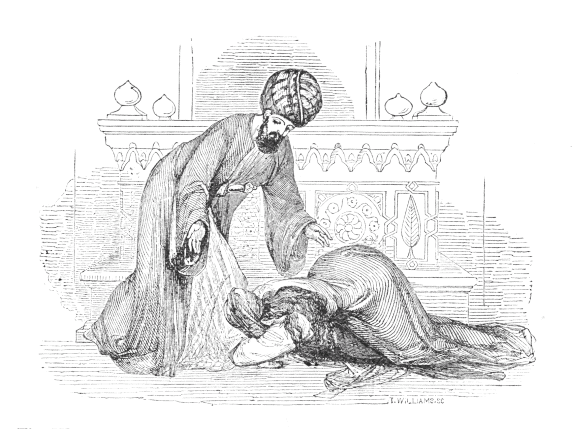
The Wezeer departed without delay, accompanied by his brother's wife, and continued his journey until he arrived at the city of Damascus, where he alighted again, and encamped, and said to his attendants, We will remain at Damascus a week, to buy, for the Sulṭán, presents and rarities. 'Ajeeb then said to the eunuch, Boy,62 I long for a little diversion: arise, therefore, and let us go to the market of Damascus, and see what is going on there, and what hath happened to that cook whose confection we ate and whose head we broke, notwithstanding he had treated us with kindness: we acted ill towards him. The eunuch replied, I hear and obey:—and 'Ajeeb went forth with him from the tents, the tie of blood inciting him to visit his father and they entered the city, and proceeded to the shop of the cook, whom they found standing there. It was then near the time of afternoon-prayers; and it happened that he had again just prepared a confection of pomegranate-grains; and when they drew near to him, the heart of 'Ajeeb yearned towards him when he saw him, and he perceived the scar occasioned by the stone that he had thrown. He said to him, Peace be on thee! Know that my heart is with thee.—And when Bedr-ed-Deen beheld him, his affections were engrossed by him, and his heart throbbed with emotion towards him, and he hung down his head, desiring to adapt his tongue to speech, and unable to do so: but presently he raised his head, and, looking towards the youth in an humble and abject manner, recited these verses:—
I wished for my beloved; but when I beheld him I was confounded and possessed neither tongue nor eye. I hung down my head in honour and reverence, and would have hidden what I felt; but it would not be concealed. I had prepared a volume of expostulation; but when we met I remembered not a word.
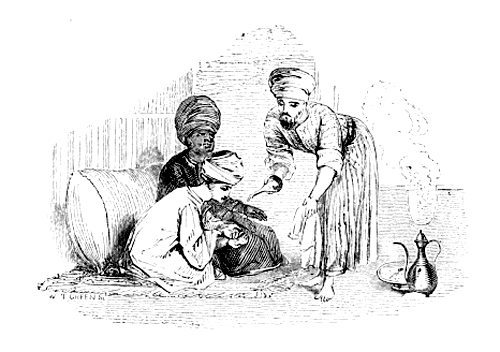
He then said to them, Refresh ye my heart, and eat of my food; for, by Allah, as soon as I beheld thee, my heart yearned towards thee, and I had not followed thee unless I had been deprived of my reason.—By Allah, replied 'Ajeeb, thou dost indeed love us, and we ate a morsel with thee; but after it thou keptest close behind us and wouldst have disgraced us: we will not eat again with thee, therefore, but on the condition of thy swearing that thou wilt not follow us; and otherwise we will not come to thee again henceforth; for we are staying at this city a week, in order that my grandfather may procure presents for the King.—I bind myself, said Bedr-ed-Deen, to do as ye desire. So 'Ajeeb entered the shop with the eunuch, and Bedr-ed-Deen placed before them a saucer filled with the confection of pomegranate-grains; upon which 'Ajeeb said to him, Eat with us; and may God dispel our affliction:—and Bedr-ed-Deen was delighted, and he ate with them; but he turned not his eyes from the youth; for his heart and all his faculties were captivated by him. 'Ajeeb, observing this, said to him, Knowest thou not that I told thee thou wast a rude doter? Enough of this: continue not to gaze at my face.—Bedr-ed-Deen, therefore, apologized to him, and began to put morsels into the mouth of 'Ajeeb, and then did the same to the eunuch. Afterwards he poured the water upon their hands, and when they had washed he loosed a napkin of silk from his waist and wiped them with it. He next sprinkled rose-water upon them from a bottle that was in his shop, and went out, and returned with two cups of sherbet prepared with rose-water infused with musk, and, placing these before them, he said, Complete your kindness. So 'Ajeeb took a cup and drank; and Bedr-ed-Deen handed the other to the eunuch; and both drank until their stomachs were full, and gratified their appetites to a degree beyond their usual habit.
They then departed, and hastened back to the tents, and 'Ajeeb went in to his grandmother, the mother of his father Ḥasan Bedr-ed-Deen; and she kissed him, and said, Where hast thou been? He answered, In the city. And she arose, and brought him a saucer of confection of pomegranate-grains, which happened to be somewhat deficient in sweetness; and she said to the eunuch, Sit down with thy master. The eunuch said within himself, By Allah, we have no appetite. He, however, seated himself, and 'Ajeeb did the same, though satiated with what he had eaten and drunk, and dipped a morsel of bread in the confection, and ate it; but it seemed to him insipid, on account of his being thus cloyed, and he loathed it, and said, What is this nasty dish?—O my child, said his grandmother, dost thou find fault with my cookery? It was I who prepared it; and, except thy father, Ḥasan Bedr-ed-Deen, there is none who can cook it as well as myself.—By Allah, O my mistress, replied 'Ajeeb, This thy dish is not well prepared: we have just now seen in the city a cook who had prepared a confection of pomegranate-grains, but its odour was such as to dilate the heart, and the confection itself, such as to excite appetite in one already satiated: as to thine, in comparison with his, it is good for nothing.
His grandmother, on hearing this, fell into a violent rage, and turning towards the eunuch, said to him, Wo to thee! Hast thou corrupted my child? Thou hast taken him into the shops of the cooks!—The eunuch feared, and denied, saying, We did not enter the shop, but only passed by it:—but 'Ajeeb said, By Allah, we entered and ate, and what we ate was better than this mess of thine. And upon this his grandmother arose, and informed her husband's brother, and incensed him against the eunuch. The slave was therefore brought before the Wezeer, and he said to him, Wherefore didst thou take my child into the cook's shop? The eunuch, fearing, said again, We did not enter.—Nay, said 'Ajeeb, we did enter, and ate of a confection of pomegranate-grains until we were satiated, and the cook gave us to drink sherbet with ice and sugar. The Wezeer's anger with the eunuch now increased, and he asked him again; but still he denied. Then said the Wezeer, If thine assertion be true, sit down and eat before us. The eunuch therefore advanced, and would have eaten; but he could not; and he threw down the morsel that was in his hand, and said, O my master, I am satiated since yesterday. And by this the Wezeer knew that he had eaten in the shop of the cook: so he ordered the female slaves to throw him down upon the ground, and they did so, and he gave him a severe beating, while the slave cried for mercy, but still saying, I am satiated since yesterday! The Wezeer then interrupted the beating, and said to him, Declare the truth. And at length the eunuch said, Know that we did enter the shop of the cook while he was cooking pomegranate-grains, and he ladled out for us some of the confection, and, by Allah, I never in my life ate any like it, or any more detestable than this which is before us.
The mother of Bedr-ed-Deen, enraged at this, said, Thou shalt go to this cook and bring us a saucerful of his confection and shew it to thy master, that he may say which of the two is the better and the more delicious.—Well, replied the eunuch: and immediately she gave him a saucer, and half a piece of gold; and he went to the shop, and said to the cook, We have laid a wager respecting thy confection at the tent of our master; for there is a mess of pomegranate-grains cooked by the family: give us, therefore, for this half-piece of gold, and apply thyself to prepare it perfectly; for we have received an excruciating beating on account of thy cookery. Laughing at these words, Bedr-ed-Deen replied, By Allah, none excelleth in the preparation of this confection except myself and my mother, and she is now in a distant country. And he ladled out as much as filled the saucer, and perfected it by the addition of some musk and rose-water. The eunuch then hastened back with it to the family; and the mother of Ḥasan took it, and, tasting its delicious flavour, immediately knew who had prepared it, and shrieked, and fell down in a swoon. The Wezeer was amazed at the event; and they sprinkled some rose-water upon her, and when she recovered she said, If my son be yet in the world, no one but he cooked this confection: he is my son Ḥasan Bedr-ed-Deen without doubt: for none but he can prepare this, except myself, and it was I who taught him to do it.
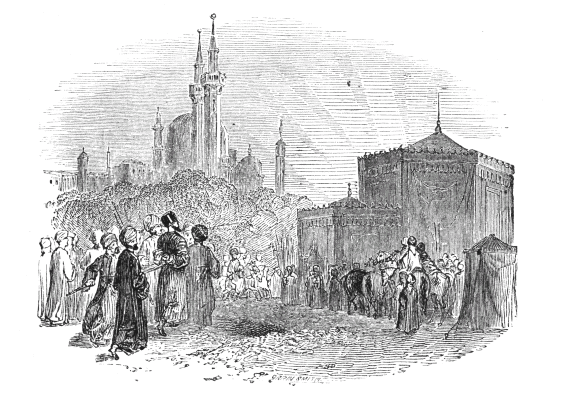
When the Wezeer heard these words, he rejoiced exceedingly, and exclaimed, Oh, how I long to behold my brother's son! Will fortune, indeed, unite us with him? But I look not for our union from any but God, whose name be exalted!—And he instantly arose, and called out to his male attendants, saying, Let twenty men of you go to the shop of the cook, and demolish it, and bind his hands behind him with his turban, and drag him hither by force, but without any injury to his person. They replied, Well. The Wezeer then rode immediately to the palace, and, presenting himself before the Viceroy of Damascus, shewed him the contents of the letters which he had brought from the Sulṭán; and the Viceroy, after kissing them, put them to his head, and said, Who is thine offender? He answered, A man who is by trade a cook. And instantly the Viceroy ordered his Chamberlains to repair to his shop; and they went thither; but found it demolished, and everything that had been in it broken; for when the Wezeer went to the palace, his servants did as he had commanded them. They were then waiting his return from the palace; and Bedr-ed-Deen was saying within himself, What can they have discovered in the confection, that such an event as this should have befallen me? And when the Wezeer returned from the Viceroy, and had received his permission to take his offender and to depart with him, he entered the encampment, and called for the cook. They brought him, therefore, with his hands bound behind him with his turban; and when he saw his uncle he wept bitterly, and said, O my master, what crime have ye found in me? The Wezeer said to him, Art thou he who cooked the confection of pomegranate-grains? He answered, Yes: and have ye found in it anything that requires one's head to be struck off? This, replied the Wezeer, is the smallest part of thy recompense.—Wilt thou not, said Bedr-ed-Deen, acquaint me with my crime? The Wezeer answered, Yea, immediately. And forthwith he called out to the young men, saying, Bring the camels!
They then took Bedr-ed-Deen, and put him in a chest, and, having locked him up in it, commenced their journey, and continued on their way till the approach of night, when they halted and ate, and, taking out Bedr-ed-Deen, fed him; after which they put him again into the chest, and in like manner proceeded to another station. Here also they took him out; and the Wezeer said to him, Art thou he who cooked the confection of pomegranate grains? He answered, Yes, O my master. And the Wezeer said, Shackle his feet. And they did so, and restored him to the chest. They then continued their journey to Cairo; and when they arrived at the quarter called Er-Reydáneeyeh,63 the Wezeer commanded to take out Bedr-ed-Deen again from the chest, and to bring a carpenter, to whom he said, Make, for this man, a cross.64—What, said Bedr-ed-Deen, dost thou mean to do with it? The Wezeer answered, I will crucify thee upon it, and nail thee to it, and then parade thee about the city.—Wherefore, demanded Bedr-ed-Deen, wilt thou treat me thus?—The Wezeer replied, For thy faulty preparation of the confection of pomegranate-grains, because thou madest it deficient in pepper.—Because of its deficiency in pepper, exclaimed Bedr-ed-Deen, wilt thou do all this to me? Art thou not satisfied with having thus imprisoned me, and fed me every day with only one meal?—The Wezeer answered, For its deficiency in pepper, thy recompense shall be nothing less than death. And Bedr-ed-Deen was amazed, and bewailed his lot, and remained a while absorbed in reflection. The Wezeer, therefore, said to him, Of what art thou thinking? He answered, Of imbecile minds, such as thine; for if thou wert a man of sense thou wouldst not have treated me in this manner on account of the deficiency of pepper.—It is incumbent on us, replied the Wezeer, to punish thee, that thou mayest not do the like again:—to which Bedr-ed-Deen rejoined, The least of the things thou hast done to me were a sufficient punishment. The Wezeer, however, said, Thy death is unavoidable.—All this conversation took place while the carpenter was preparing the cross; and Bedr-ed-Deen was looking on.
Thus they both continued until the approach of night, when Bedr-ed-Deen's uncle took him and put him again into the chest, saying, To-morrow shall be thy crucifixion. He then waited until he perceived that he was asleep; upon which he remounted, and, with the chest borne before him, entered the city, and repaired to his house: and when he had arrived there he said to his daughter Sitt-el-Ḥosn, Praise be to God who hath restored to thee the son of thine uncle! Arise, and furnish the house as it was on the night of the bridal display.—She therefore ordered her female slaves to do so; and they arose, and lighted the candles; and the Wezeer brought out the paper upon which he had written his inventory of the furniture of the house, and read it, and ordered them to put every thing in its place, so that the beholder would not doubt that this was the very night of the bridal display. He directed them to put Bedr-ed-Deen's turban in the place where its owner had deposited it, and in like manner the trousers, and the purse which was beneath the mattress, and ordered his daughter to adorn herself as she was on the bridal night, and to enter the bride-chamber; saying to her, When the son of thine uncle comes into thy chamber, say to him, Thou hast loitered since thou withdrewest from me this night:—and request him to return and converse with thee till day.—Having thus arranged everything, the Wezeer took out Bedr-ed-Deen from the chest, removed the shackles from his feet, and stripped him of his outer clothes, leaving him in his shirt.
All this was done while he was asleep, unconscious of what was passing; and when he awoke, and found himself in an illuminated vestibule, he said, within himself, Am I bewildered by dreams, or am I awake? Then rising, he advanced a little way to an inner door, and looked, and lo, he was in the house in which the bride had been displayed, and he beheld the bride-chamber and the couch and his turban and clothes. Confounded at the sight of these things, he took one step forwards and another backwards, thinking, Am I asleep or awake? And he began to wipe his forehead, and exclaimed in his astonishment,
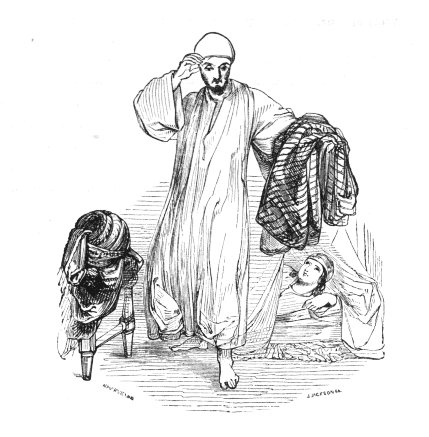
By Allah, this is the dwelling of the bride who was here displayed before me: and yet I was just now in a chest. And while he was addressing himself, behold Sitt-el-Ḥosn lifted up the corner of the musquito curtain, and said, O my master, wilt thou not come in? for thou hast loitered since thou withdrewest from me this night. When he heard these words he looked at her face, and laughed, and said, Verily, these appearances are bewildering illusions of a dream! Then entering, he sighed; and as he reflected upon what had happened to him, he was perplexed at his situation, and his case seemed involved in obscurity. Looking at his turban and trousers, and the purse containing the thousand pieces of gold, he exclaimed, Allah is all-knowing!—but it seemeth to me that I am bewildered by dreams!—And he was confounded in the excess of his astonishment. Upon this, therefore, Sitt-el-Ḥosn said to him, Wherefore do I behold thee thus astonished and perplexed? Thou wast not so in the commencement of the night.—And he laughed, and asked her, How many years have I been absent from thee?—Allah preserve thee! she exclaimed. The name of Allah encompass thee!65 Thou hast only withdrawn to yonder apartment. What hath passed in thy mind?—On hearing this he smiled, and replied, Thou hast spoken truth; but when I withdrew from thee, sleep overcame me, and I dreamt that I was a cook in Damascus, and that I lived there twelve years;66 and I thought that a youth of the sons of the great came to me, accompanied by a eunuch,—and he proceeded to relate what had happened to him in consequence of this youth's visit: then drawing his hand over his forehead, he felt the scar occasioned by the blow, and exclaimed, By Allah, O my mistress, it seemeth as though it were true; for he struck me with a stone upon my forehead, and cut it open: it seemeth, therefore, as though this had really happened when I was awake: but probably this dream occurred when we were both asleep. I imagined in my dream that I was transported to Damascus, without ṭarboosh or turban or trousers, and that I followed the occupation of a cook.—And again, for a while, he remained utterly confounded. He then said, By Allah, I imagined that I made a confection of pomegranate-grains containing but little pepper. Verily I must have been asleep, and in my sleep have seen all this.—I conjure thee by Allah, said Sitt-el-Ḥosn, tell me what more thou sawest? And he related to her the whole; and added, If I had not awaked, they would have crucified me upon a wooden cross.—On account of what? said she. He answered, On account of the deficiency of pepper in the confection of pomegranate-grains; and I imagined that they demolished my shop, and broke all my vessels, and put me in a chest, and brought the carpenter to make a cross of wood; for they intended to crucify me upon it. Praise be to God, therefore, who caused all this to occur to me in sleep, and caused it not to happen to me when I was awake!—Sitt-el-Ḥosn, laughing at his words, pressed him to her bosom, and he in like manner embraced her. Then reflecting again, he said, By Allah, it seems as if it had happened when I was awake; and I knew not the reason, nor the truth of the case.—And he composed himself to sleep, perplexed with his case, and sometimes saying, I saw it in my sleep,—and other times, I experienced it awake.
Thus he continued until the morning, when his uncle, the Wezeer Shems-ed-Deen, came in to him, and saluted him; and Bedr-ed-Deen, as soon as he beheld him, exclaimed, I conjure thee by Allah, tell me art not thou he who gave orders to bind my hands behind me, and to nail up my shop, on account of the confection of pomegranate-grains, because it was deficient in pepper? The Wezeer answered, Know, O my son, that the truth hath appeared, and what was hidden hath been manifested. Thou art the son of my brother; and I did not this but to know if thou wert he who visited my daughter on that night. I was not convinced of this until I saw that thou knewest the house, and thy turban and trousers and gold, and the two papers; namely, the one which thou wrotest, and that which thy father, my brother, wrote: for I had never seen thee before, and therefore knew thee not; and as to thy mother, I have brought her with me from El-Baṣrah.—Having thus said, he threw himself upon him, and wept; and Bedr-ed-Deen, full of astonishment at his uncle's words, embraced him, and in like manner wept from excess of joy. The Wezeer then said to him, O my son, the cause of all this was what passed between me and thy father. And he related to him the circumstances of their case, and the cause of his father's departure to El-Baṣrah; after which he sent for 'Ajeeb; and when the father of the youth saw him, he exclaimed, This is he who threw the stone at me.—This, said the Wezeer, is thy son. And Bedr-ed-Deen cast himself upon him, and recited the following verses:—
Long have I wept on account of our disunion; the tears overflowing from my eyelids; And I vowed that if Providence should bring us together, I would never again mention our separation. Joy hath overcome me to such a degree that by its excess it hath made me weep. O eye, thou hast become so accustomed to tears that thou weepest from happiness as from grief.67
And when he had uttered these words, his mother, beholding him, threw herself upon him, and repeated this couplet:—
Fortune made a vow to torment me incessantly; but thine oath hath proved false, O Fortune; therefore expiate it.68 Happiness hath arrived, and the beloved is come to my relief: repair then to the messenger of festivity, and hasten.
She afterwards related to him everything that had happened to her; and he also acquainted her with all that he had suffered; and they offered up thanks to God for their union. The Wezeer then went up to the Sulṭán, and informed him of these occurrences; and the King was astonished, and ordered that a statement of them should be inserted in the records, to be preserved to future ages. And the Wezeer resided with his brother's son, and his own daughter and her son, and with the wife of his brother; and all of them passed their lives in the enjoyment of the utmost happiness until they were visited by the terminator of delights, and the separator of companions.69
Such, O Prince of the Faithful, said Jaạfar, were the events that happened to the Wezeer Shems-ed-Deen and his brother Noor-ed-Deen.—By Allah, exclaimed the Khaleefeh Hároon Er-Rasheed, this story is wonderful! And he gave one of his own concubines to the young man who had killed his wife, and appointed him a regular maintenance; and the young man became one of his companions at the table.
NOTES TO CHAPTER FOURTH.
I have now given several data upon which to found a reasonable opinion as to the age when these tales, in the states in which they are known to us, were composed or compiled or remodelled. First, in Note 55 to Chapter ii., I have shewn that a fiction in one of the tales is framed in accordance with the distinction of Muslims, Christians, and Jews, by the colours of their turbans, which mode of distinction originated in the beginning of the eighth century of the Flight. Secondly, in the present note, I have mentioned a fact which affords some reason for inferring that there had been a long series of Sulṭáns in Egypt before the age of the writer or writers. In the third place, I must remark, that all the events described in this work are said to have happened in ages which, with respect to that of the writer or writers, were ancient, being related to an ancient king; from which I think we may infer its age to have been at least two centuries posterior to the period mentioned in the first of these data. Fourthly, in Note 22 to Chapter iii., I have shewn that the state of manners and morals described in many of these tales agrees, in a most important point of view, with the manners and morals of the Arabs at the commencement of the tenth century of the Flight. This I regard as an argument of great weight, and especially satisfactory as agreeing with the inference just before drawn. Fifthly, from what I have stated in the note immediately preceding, I incline to the opinion that few of the copies of this work now known to us, if any, were written until after the conquest of Egypt by the Turks, in the year 1517 of our era. This opinion, it should be remarked, respects especially the early portion of the work, which is the least likely to have been interpolated, as later parts evidently have been. At the last-mentioned period, a native of Cairo (in which city I believe the principal portion of the work to have been written) might, if about forty years of age, retain a sufficient recollection of the later Memlook Sulṭáns and of their ministers to describe his kings and courts without the necessity of consulting the writings of historians; deriving his knowledge of early times not from the perusal of any regular record, but only from traditions or from works like the present.—I should have delayed the insertion of the foregoing remarks, had I not considered it a point of some importance to suggest to the reader, as early as possible, that the manners and customs, and in general even the dresses and dwellings, described in most of the present tales, are those of a very late period. The lax state of morals which appears to have prevailed among the Arabs in the time of the writer or writers probably continued at least until the period when coffee became a common beverage, about the middle of the tenth century of the Flight (or near the middle of the sixteenth century of our era), and perhaps considerably later, until some years after the introduction of tobacco into the East. The researches of Von Hammer have satisfactorily shewn that the Thousand and One Nights, in the states in which it is known to us, is based upon a very old work, in Persian; an Arabic translation of which bore a similar, or perhaps the same, title as that which we are considering; but I believe the last to be, in its best features, a very late production.
In few cases are the Mohammadans so much fettered by the directions of their Prophet and other religious institutors as in the rearing and educating of their children. In matters of the most trivial nature, religious precedents direct their management of the young. One of the first duties is, to wrap the new-born child in clean white linen, or in linen of some other colour; but not yellow. After this, some person [not a female] should pronounce the adán278 in the ear of the infant, because the Prophet did so in the ear of El-Ḥasan when Fátimeh gave birth to him; or he should pronounce the adán in the right ear, and the iḳameh (which is nearly the same) in the left.279
It was formerly a custom of many of the Arabs, and perhaps is still among some, for the father to give a feast to his friends on seven successive days after the birth of a son; but that of a daughter was observed with less rejoicing. The general modern custom is, to give an entertainment only on the seventh day, which is called "Yóm es-Subooạ." On this occasion, the mother, having left her bed, receives her guests; the child is exhibited to them; and they give presents of gold or silver coins, which are generally used to decorate the infant's head-dress. The father entertains his friends in the evening.
On this day, or on the fourteenth, twenty-first, twenty-eighth, or thirty-fifth day after the birth, several religious ceremonies are required to be performed; but they are most approved if observed on the seventh day. One of these is the naming. I believe, however, that it is a more common custom to give the name almost immediately after the birth, or about three hours after. Astrologers were often consulted on this occasion; but the following directions are given on higher authority, and are generally observed.—"The father should give his son a good name, ... not a name of self-praise, as Rasheed [Orthodox], Emeen [Faithful], &c.... The prophet said, 'The names most approved by God are 'Abd-Allah [Servant of God] and 'Abd-Er-Raḥmán [Servant of the Compassionate], and such like.' He also said, 'Give my name, but do not distinguish by my surname of relationship:' but this precept, they say, respects his own life-time, ... because he was addressed, 'O Abu-l-Ḳásim!' and now it is not disapproved; but some disapprove of uniting the name and surname, so as to call a person Mohammad and Abu-l-Ḳásim. And if a son be called by the name of a prophet it is not allowable to abuse or vilify him, unless the person so named be facing his reproacher, who should say, 'Thou' [without mentioning his name]: and a child named Moḥammad or Aḥmad should be [especially] honoured.... The Prophet said, 'There is no people holding a consultation at which there is present one whose name is Moḥammad or Aḥmad, but God blesseth all that assembly:' and again he said, 'Whoever nameth his child by my name, or by that of any of my children or my companions, from affection to me or to them, God (whose name be exalted!) will give him in Paradise what eye hath not seen nor ear heard.' And a son should not be named King of kings, or Lord of lords; nor should a man take a surname of relationship from the name of the eldest of his children; nor take any such surname before a child is born to him."280—The custom of naming children after prophets, or after relations or companions of Moḥammad, is very common. No ceremony is observed on account of the naming.
On the same day, however, two practices which I am about to mention are prescribed to be observed; though, as far as my observations and inquiries allow me to judge, they are generally neglected by the modern Muslims. The first of these is a sacrifice. The victim is called 'aḳeeḳah. It should be a ram or goat; or two such animals should be sacrificed for a son, and one for a daughter. This rite is regarded by Ibn-Ḥambal as absolutely obligatory: he said, "If a father sacrifice not for his son, and he [the son] die, that son will not intercede for him on the day of judgment." The founders of the three other principal sects regard it in different and less important lights, though Mohammad slew an 'aḳeeḳah for himself after his prophetic mission. The person should say, on slaying the victim, "O God, verily this aḳee[.]kah is a ransom for my son such a one; its blood for his blood, and its flesh for his flesh, and its bone for his bone, and its skin for his skin, and its hair for his hair. O God, make it a ransom for my son from Hell-fire." A bone of the victim should not be broken.281 The midwife should receive a leg of it. It should be cooked without previously cutting off any portion of it; and part of it should be given in alms.—After this should be performed the other ceremony above alluded to, which is this. It is a sunneh ordinance, incumbent on the father, to shave, or cause to be shaved, the head of his child, and to give, in alms to the poor, the weight of the hair in gold or silver. This should also be done for a proselyte.282 On the subsequent occasions of shaving the head of a male child (for the head of the male is frequently shaven), a tuft of hair is generally left on the crown, and commonly, for several years, another also over the forehead.
Circumcision is most approved if performed on the same day:283 but the observance of this rite is generally delayed until the child has attained the age of five or six years, and sometimes several years later. I shall therefore delay mentioning the ceremonies with which it is celebrated.
The Muslims rightly regard a child as a trust committed by God to its parents, who, they hold, are responsible for the manner in which they bring it up, and will be examined on this subject on the day of judgment. But they further venture to say, that "the first who will lay hold of a man on the day of judgment will be his wife and children, who [if he have been deficient in his duty to them] will present themselves before God, and say, 'O our Lord, take for us our due from him; for he taught us not that of which we were ignorant, and he fed us with forbidden food, and we knew not:' and their due will be taken from him."284 By this is meant, that a certain proportion of the good works which the man may have done, and his children and wife neglected, will be set down to their account; or that a similar proportion of their evil works will be transferred to his account.
The mother is enjoined by the law to give suck to her child two full years, unless she have her husband's consent to shorten the period, or to employ another nurse. "For suckling the child, a virtuous woman, who eateth only what is lawful, should be chosen; for the unlawful [food] will manifest its evil in the child: as the Prophet ... said, 'Giving suck altereth the tempers.' But it is recommended by the sunneh that the mother herself suckle the child; for it is said in a tradition, 'There is nothing better for a child than its mother's milk.' 'If thou wouldst try,' it is added,'whether a child be of an ingenuous disposition in its infancy, or not, order a woman who is not its mother to suckle it after its mother has done so; and if it drink of the milk of the woman who is not its mother, it is not of an ingenuous disposition.'"285
Children, being regarded by Muslim parents as enviable blessings, are, to them, objects of the most anxious solicitude. To guard them from the supposed influence of the envious or evil eye, they have recourse to various expedients. When they are taken abroad, they are usually clad in the most slovenly manner, and left unwashed, or even purposely smeared with dirt; and as a further precaution, a fantastic cap is often put upon the child's head, or its head-dress is decorated with one or more coins, a feather, a gay tassel, or a written charm or two sewed up in leather or encased in gold or silver, or some other appendage to attract the eye, that so the infant itself may pass unnoticed. If a person express his admiration of another's child otherwise than by some pious ejaculation, as, for instance, by praising its Creator (with the exclamation of "Subḥána-lláh!" or, "Má sháa-lláh!" &c.) or invoking a blessing on the Prophet, he fills the mind of the parent with apprehension; and recourse is had to some superstitious ceremony to counteract the dreaded influence of his envious glance. The children of the poor are less exposed to this imaginary danger from their unattractive appearance: they generally have little clothing, or none whatever, and are extremely dirty. It is partly with the view of protecting them from the evil eye, that those of the rich are so long confined to the ḥareem: there they are petted and pampered for several years; at least until they are of age to go to school; but most of them are instructed at home.
The children of the Muslims are taught to shew to their fathers a degree of respect which might be deemed incompatible with the existence of a tender mutual affection; but I believe that this is not the case. The child greets the father in the morning by kissing his hand, and then usually stands before him in a respectful attitude, with the left hand covered by the right, to receive any order or to await his permission to depart; but after the respectful kiss, is often taken on the lap. After the period of infancy, the well-bred son seldom sits in the presence of his father; but during that period he is generally allowed much familiarity. A Syrian merchant, who was one of my near neighbours in Cairo, had a child of exquisite beauty, commonly supposed to be his daughter, whom, though he was a most bigoted Muslim, he daily took with him from his private house to his shop. The child followed him, seated upon an ass, before a black slave; and, until about six years old, was dressed like most young ladies, but without a face-veil. The father then thinking that the appearance of taking about with him a daughter of that age was scandalous, dressed his pet as a boy, and told his friends that the female attire had been employed as a protection against the evil eye; girls being less coveted than boys. This indeed is sometimes done; and it is possible that such might have been the case in this instance; but I was led to believe that it was not so. A year after, I left Cairo: while I remained there, I continued to see the child pass my house as before; but always in boy's clothing.
It is not surprising that the natives of Arabian countries, where a very trifling expense is required to rear the young, should be generally desirous of a numerous offspring. A motive of self-interest conduces forcibly to cherish this feeling in a wife, for she is commonly esteemed by her husband in proportion to her fruitfulness; and a man is seldom willing to divorce a wife, or to sell a slave, who has borne him a child. A similar feeling also induces in both parents a desire to obtain offspring, and renders them at the same time resigned to the loss of such of their children as die in tender age. This feeling arises from their belief of certain services, of greater moment than the richest blessings this world can bestow, which children who die in infancy are to render to their parents. The Prophet is related to have said, "The infant children [of the Muslims] shall assemble at the scene of judgment on the day of the general resurrection, when all creatures shall appear for the reckoning, and it will be said to the angels, 'Go ye with these into Paradise:' and they will halt at the gate of Paradise, and it will be said to them, 'Welcome to the offspring of the Muslims! enter ye Paradise: there is no reckoning to be made with you:' and they will reply, 'Yea, and our fathers and our mothers:' but the guardians of Paradise will say, 'Verily your fathers and your mothers are not with you because they have committed faults and sins for which they must be reckoned with and inquired of.' Then they will shriek and cry at the gate of Paradise with a great cry; and God (whose name be exalted!) and who is all-knowing respecting them will say, 'What is this cry?' It will be answered, 'O our Lord, the children of the Muslims say, We will not enter Paradise but with our fathers and our mothers.' Whereupon God (whose name be exalted!) will say 'Pass among them all, and take the hands of your parents, and introduce them into Paradise.'" The children who are to have this power are such as are born of believers, and die without having attained to the knowledge of sin; and according to one tradition, one such child will introduce his parents into Paradise. [Such infants only are to enter Paradise; for, of the children who die in infancy, those of believers alone are they who would believe if they grew to years of discretion.] On the same authority it is said, "When a child of the servant [of God] dies, God (whose name be exalted!) saith to the angels, 'Have ye taken the child of my servant?' They answer, 'Yea.' He saith, 'Have ye taken the child of his heart?' They reply, 'Yea.' He asketh them, 'What did my servant say?' They answer, 'He praised thee, and said, Verily to God we belong, and verily unto Him we return!' Then God will say, 'Build for my servant a house in Paradise, and name it the House of Praise.'" To these traditions, which I find related as proofs of the advantages of marriage, the following anecdote, which is of a similar nature, is added. A certain man, who would not take a wife, awoke one day from his sleep, and demanded to be married, saying, as his reason, "I dreamt that the resurrection had taken place, and that I was among the beings collected at the scene of judgment, but was suffering a thirst that stopped up the passage of my stomach; and lo, there were youths passing through the assembly, having in their hands ewers of silver, and cups of gold, and giving drink to one person after another; so I stretched forth my hand to one of them, and said, 'Give me to drink; for thirst overpowereth me:' but they answered, 'Thou hast no child among us: we give drink only to our fathers.' I asked them, 'Who are ye?' They replied, 'We are the deceased infant children of the Muslims.'"286 Especial rewards in heaven are promised to mothers. "When a woman conceives by her husband," said the Prophet, "she is called in heaven a martyr [i.e. she is ranked as a martyr in dignity]; and her labour in child-bed, and her care for her children, protect her from Hell-fire.'"287
"When the child begins to speak, the father should teach him first the kelimeh [or profession of faith], 'There is no deity but God: [Moḥammad is God's apostle:]'—he should dictate this to him seven times. Then he should instruct him to say, 'Wherefore, exalted be God, the King, the Truth! There is no deity but He, the Lord of the honourable throne."288 He should teach him also the Throne-verse,289 and the closing words of the Ḥashr, 'He is God, beside whom there is no deity, the King, the Holy,'" &c.290
As soon as a son is old enough, his father should teach him the most important rules of decent behaviour: placing some food before him, he should order him to take it with the right hand (the left being employed for unclean purposes), and to say, on commencing, "In the name of God;" to eat what is next to him, and not to hurry, nor spill any of the food upon his person or dress. He should teach him that it is disgusting to eat much. He should particularly condemn to him the love of gold and silver, and caution him against covetousness as he would against serpents and scorpions; and forbid his spitting in an assembly, and committing any similar breach of good manners, talking much, turning his back upon another, standing in an indolent attitude, and speaking ill of any person to another. He should keep him from bad companions, teach him the Ḳur-án and all requisite divine and prophetic ordinances, and instruct him in the arts of swimming and archery, and in some virtuous trade; for trade is a security from poverty. He should also command him to endure patiently the chastisements of his teacher. In one tradition it is said, "When a boy attains the age of six years he should be disciplined; and when he attains to nine years he should be put in a separate bed; and when he attains to ten years he should be beaten for [neglecting] prayer:" in another tradition, "Order your children to pray at seven [years], and beat them for [neglecting] it at ten, and put them in separate beds."291
Circumcision, which has before been mentioned, is generally performed before the boy is submitted to the instruction of the schoolmaster.292 Previously to the performance of this rite, he is, if belonging to the higher or middle rank of society, usually paraded about the neighbourhood of his parents' dwelling, gaily attired, chiefly with female habits and ornaments, but with a boy's turban on his head, mounted on a horse, preceded by musicians, and followed by a group of his female relations and friends. This ceremony is observed by the great with much pomp and with sumptuous feasts. El-Jabartee mentions a fête celebrated on the occasion of the circumcision of a son of the Ḳáḍee of Cairo, in the year of the Flight 1179 (A.D. 1766), when the grandees and chief merchants and 'ulamà of the city sent him such abundance of presents that the magazines of his mansion were filled with rice and butter and honey and sugar; the great hall, with coffee; and the middle of the court, with firewood: the public were amused for many days by players and performers of various kinds; and when the youth was paraded through the streets he was attended by numerous memlooks with their richly-caparisoned horses and splendid arms and armour and military band, and by a number of other youths who, from compliment to him, were circumcised afterwards with him. This latter custom is usual on such occasions; and so also is the sending of presents, such as those above mentioned, by friends, acquaintances, and tradespeople.' At a fête of this kind, when the Khaleefeh El-Muḳtedir circumcised five of his sons, the money that was scattered in presents amounted to six hundred thousand pieces of gold, or about £300,000. Many orphans were also circumcised on the same day, and were presented with clothes and pieces of gold.293 The Khaleefeh above mentioned was famous for his magnificence, a proof of which I have given in a former note. At the more approved entertainments which are given in celebration of a circumcision, a recital of the whole of the Ḳur-án, or a zikr, is performed: at some others, male or female public dancers perform in the court of the house, or in the street before the door.
Few of the children of the Arabs receive much instruction in literature, and still fewer are taught even the rudiments of any of the higher sciences; but there are numerous schools in their towns, and one at least in almost every moderately large village. The former are mostly attached to mosques and other public buildings, and, together with those buildings, endowed by princes or other men of rank, or wealthy tradesmen. In these, the children are instructed either gratis or for a very trifling weekly payment, which all parents, except those in indigent circumstances, can easily afford. The schoolmaster generally teaches nothing more than to read, and to recite by heart the whole of the Ḳur-án. After committing to memory the first chapter of the sacred volume, the boy learns the rest in the inverse order of their arrangement, as they generally decrease in length. Writing and arithmetic are usually taught by another master; and grammar, rhetoric, versification, logic, the interpretation of the Ḳur-án, and the whole system of religion and law, with all other knowledge deemed useful, which seldom includes the mere elements of mathematics, are attained by studying at a collegiate mosque, and at no expense; for the professors receive no pay either from the students, who are mostly of the poorer classes, or from the funds of the mosque.
The wealthy often employ for their sons a private tutor; and, when he has taught them to read, and to recite the Ḳur-án, engage for them a writing-master, and then send them to the college. But among this class, polite literature is more considered than any other branch of knowledge, after religion. Such an acquaintance with the works of some of their favourite poets as enables a man to quote them occasionally in society, is regarded by the Arabs as essential to a son who is to mix in genteel company; and to this acquirement is often added some skill in the art of versification, which is rendered peculiarly easy by the copiousness of the Arabic language, and by its system of inflection. These characteristics of their noble tongue (which are remarkably exhibited by the custom, common among the Arabs, of preserving the same rhyme throughout a whole poem), while on the one hand they have given an admirable freedom to the compositions of men of true poetic genius, have on the other hand mainly contributed to the degradation of Arabic poetry. To an Arab of some little learning it is almost as easy to speak in verse as in prose; and hence he often intersperses his prose writings, and not unfrequently his conversation, with indifferent verses, of which the chief merit often consists in puns, or in an ingenious use of several words nearly the same in sound, but differing in sense. To a reader unacquainted with the Arabic language it is necessary to explain this custom; otherwise he would imagine that the author of the present work is merely indulging in a dramatic licence inconsistent with a true delineation of manners, when he makes a person suddenly change the style of his speech from prose to verse, and then revert to the former.
One more duty of a father to a son I should here mention: it is, to procure for him a wife as soon as he has arrived at a proper age. This age is decided by some to be twenty years; though many young men marry at an earlier period. It is said, "When a son has attained the age of twenty years, his father, if able, should marry him, and then take his hand, and say, 'I have disciplined thee, and taught thee, and married thee: I now seek refuge with God from thy mischief in the present world and the next.'" To enforce this duty, the following tradition is urged: "When a son attains to the age of puberty, and his father does not marry him, and yet is able to do so, if the youth commit an improper act in consequence, the sin of it is between the two,"—or, as in another report,—"on the father."294 The same is held to be the case with respect to a daughter who has attained the age of twelve years.295
The female children of the Arabs are seldom taught even to read. Though they are admissible at the daily schools in which the boys are instructed, very few parents allow them the benefit of this privilege; preferring, if they give them any instruction of a literary kind, to employ a sheykhah (or learned woman) to teach them at home. She instructs them in the forms of prayer, and teaches them to repeat by heart a few chapters of the Ḳur-án; very rarely the whole book. Parents are indeed recommended to withhold from their daughters some portions of the Ḳur-án; to "teach them the Soorat en-Noor [or 24th chapter], and keep from them the Soorat-Yoosuf [12th chapter]; on account of the story of Zeleekhà and Yoosuf in the latter, and the prohibitions and threats and mention of punishments contained in the former."296
Needlework is not so rarely, but yet not generally, taught to Arab girls: the spindle frequently employs those of the poorer classes; and some of them learn to weave. The daughters of persons of the middle and higher ranks are often instructed in the art of embroidery, and in other ornamental work, which are taught in schools and in private houses. Singing, and playing upon the lute, which were formerly not uncommon female accomplishments among the wealthy Arabs, are now almost exclusively confined, like dancing, to professional performers and a few of the slaves in the ḥareems of the great: it is very seldom now that any musical instrument is seen in the hand of an Arab lady, except a kind of drum called darabukkeh, and a ṭár (or tambourine), which are found in many ḥareems, and are beaten with the fingers.297 Some care, however, is bestowed by the ladies in teaching their daughters what they consider an elegant gait and carriage, as well as various alluring and voluptuous arts with which to increase the attachment of their future husbands.
Marriage is regarded by the Muslims in general as a positive duty; and to neglect it, without a sufficient excuse, subjects a man to severe reproach. "When a servant [of God]," said the Prophet, "marries, verily he perfects half his religion."298 He once asked a man, "Art thou married?" The man answered, "No." "And art thou," said he, "sound and healthy?" The answer was, "Yes." "Then," said Moḥammad, "thou art one of the brothers of the devils; for the most wicked among you are the unmarried; and the most vile among your dead are the unmarried; moreover the married are those who are acquitted of filthy conversation; and by Him in whose hand is my soul, the devil hath not a weapon more effective against the virtuous, both men and women, than the neglect of marriage."299 Some remarks on this subject, and on the advantages of marriage, have been made in a preceding note on infancy and education.
The number of wives whom a Muslim may have at the same time is four. He may marry free women, or take concubine slaves, or have of both these classes. It is the opinion of most persons, I believe, among the more strictly religious, that a man may not have more than four women, whether they be wives alone, or concubine slaves alone, or of both classes together; but the practice of some of the Companions of the Prophet, who cannot be accused of violating his precepts, affords a strong argument to the contrary. 'Alee, it is said, "was the most devout of the Companions; but he had four wives and seventeen concubines besides, and married, after Fáṭimeh (may God be well pleased with her!), among all that he married and divorced, more than two hundred women: and sometimes he included four wives in one contract, and sometimes divorced four at one time, taking other four in their stead."300 This may perhaps be an exaggerated statement: but it is certain that the custom of keeping an unlimited number of concubines was common among wealthy Muslims in the first century of the Mohammadan era, and has so continued. The famous author of the work above quoted urges the example of Solomon to prove that the possession of numerous concubines is not inconsistent with piety and good morals; not considering that God made but one wife for Adam.
It has been mentioned in the first of the notes to this work, that a Muslim may divorce his wife twice, and each time take her back. This he may do, even against her wish, during a fixed period, which cannot extend beyond three months, unless she be enceinte, in which latter case she must wait until the birth of her child before she will be at liberty to contract a new marriage. During this period the husband is obliged to maintain her. If he divorce her a third time, or by a triple sentence, he cannot take her again unless with her own consent, and by a new contract, and after another marriage has been consummated between her and another husband, and this husband also has divorced her.
It is not a common custom, especially among the middle ranks, for an Arab to have more than one wife at the same time; but there are few of middle age who have not had several different wives at different periods, tempted to change by the facility of divorce. The case of 'Alee has been mentioned above. Mugheyreh Ibn-Sheạbeh married eighty women in the course of his life;301 and several more remarkable instances of the love of change are recorded by Arab writers: the most extraordinary case of this kind that I have met with was that of Moḥammad Ibn-Eṭ-Ṭeiyib, the Dyer, of Baghdád, who died in the year of the Flight 423, aged eighty-five years; of whom it is related, on most respectable authority, that he married more than nine hundred women!302—Supposing, therefore, that he married his first wife when he was fifteen years of age, he must have had, on the average, nearly thirteen wives per annum. The women, in general, cannot of course marry so many successive husbands, not only because a woman cannot have more than one husband at a time, but also because she cannot divorce her husband. There have been, however, many instances of Arab women who have married a surprising number of men in rapid succession. Among these may be mentioned Umm-Khárijeh, who gave occasion to a proverb on this subject. This woman, who was of the tribe of Bejeeleh, in El-Yemen, married upwards of forty husbands; and her son Khárijeh knew not who was his father. She used to contract a marriage in the quickest possible manner: a man saying to her, "Khiṭbun" (betrothal), she replied, "Nik-ḥun" (marriage), and thus became his lawful wife. She had a very numerous progeny; several tribes originating from her.303
For the choice of a wife, a man generally relies on his mother, or some other near female relation, or a professional female betrother (who is called "kháṭibeh"); for there are many women who perform this office for hire. The law allows him to see the face of the female whom he proposes to marry, previously to his making the contract; but in the present day this liberty is seldom obtained, except among the lower orders. Unless in this case, a man is not allowed to see unveiled any woman but his own wife or slave, and those women to whom the law prohibits his uniting himself in marriage: nay, according to some, he is not allowed to "see" his own niece unveiled, though he may not marry her. It should be added, that a slave may lawfully see the face of his own mistress; but this privilege is seldom granted in the present day to any slave but a eunuch. An infringement of the law above mentioned is held to be extremely sinful in both parties: "The curse of God," said the Prophet, "is on the seer and the seen:" yet it is very often disregarded in the case of women of the lower orders.
A man is forbidden, by the Ḳur-án304 and the Sunneh, to marry his mother, or other ascendant; daughter, or other descendant; his sister, or half-sister; the sister of his father or mother or other ascendant; his niece, or any of her descendants; his foster-mother who has suckled him five times in the course of the first two years, or a woman related to him by milk in any of the degrees which would preclude his marriage with her if she were similarly related to him by consanguinity; the mother of his wife, even if he has not consummated his marriage with this wife; the daughter of his wife, if he has consummated his marriage with the latter (but if he has not done so, and this wife is divorced from him, or dead, he may marry her daughter); his father's wife, and his son's wife; and to have at the same time two wives who are sisters, or aunt and niece: he is forbidden also to marry his unemancipated slave, or another man's slave if he has already a free wife; and to marry any woman but one of his own faith, or a Christian, or a Jewess. A Mohammadan woman, however, may only marry a man of her own faith. An unlawful intercourse with any woman prevents a man from marrying any of her relations who would be forbidden to him if she were his wife.
The reader has already seen that a cousin (the daughter of a paternal uncle) is often chosen as a wife, on account of the tie of blood, which is likely to attach her more strongly to her husband, or on account of an affection conceived in early years. Parity of rank is generally much regarded; and a man is often unable to obtain as his wife the daughter of one of a different profession or trade, unless an inferior; or a younger daughter when an elder remains unmarried. A girl is often married at the age of twelve years, and sometimes at ten, or even nine: the usual period is between twelve and sixteen years. At the age of thirteen or fourteen she may be a mother. The young men marry a few years later.
The most important requisite in a wife is religion. The Prophet said, "A virtuous wife is better than the world and all that it contains." "A virtuous wife," said Luḳmán, "is like a crown on the head of a king; and a wicked wife is like a heavy burden on the back of an old man." Among the other chief requisites are agreeableness of temper, and beauty of form (undiminished by any defect or irregularity of features or members), moderation in the amount of dowry required, and good birth. It is said, "if thou marry not a virgin, [which is most desirable,] marry a divorced woman, and not a widow; for the divorced woman will respect thy words when thou sayest, 'If there were any good in thee thou hadst not been divorced;' whereas the widow will say, 'May God have mercy on such a one! he hath left me to one unsuited to me.'" But according to another selfish maxim, the woman most to be avoided is she who is divorced from a man by whom she has had a child; for her heart is with him, and she is an enemy to the man who marries her after.305—Modesty is a requisite upon which too much stress cannot be laid; but this, to an English reader, requires some explanation. 'Alee asked his wife Fáṭimeh, "Who is the best of women?" She answered, "She who sees not men, and whom they see not."306 Modesty, therefore, in the opinion of the Muslims, is most eminently shown by a woman's concealing her person, and restraining her eyes, from men. "The best rank of men [in a mosque]," said the Prophet, "is the front; and the best rank of women is the rear:"307 that is, those most distant from the men: but better than even these are the women who pray at home.308—Fruitfulness is also a desirable qualification to be considered in the choice of a wife: "it may be known in maidens," says the Prophet, "from their relations; because, generally speaking, kindred are similar in disposition, &c."309 Lastly, contentment is to be enumerated among the requisites. It is said, on the same authority, "Verily the best of women are those that are most content with little."310 To obtain a contented and submissive wife, many men make their selection from among the classes inferior to them in rank. Others, with a similar view, prefer a concubine slave in the place of a wife.
The consent of a girl not arrived at the age of puberty is not required: her father, or, if he is dead, her nearest adult male relation, or a guardian appointed by will or by the Ḳáḍee, acts as her wekeel, or deputy, to effect the marriage-contract for her. If of age, she appoints her own deputy. A dowry is required to legalize the marriage; and the least dowry allowed by the law is ten dirhems, or drachms of silver; about five shillings of our money. Moḥammad married certain of his wives for a dowry of ten dirhems and the household necessaries, which were a handmill to grind the corn, a water-jar, and a pillow of skin or leather stuffed with the fibres of the palm-tree, which are called "leef:" but some he married for a dowry of five hundred dirhems.311 With the increase of wealth and luxury, dowries have increased in amount; but, to our ideas, they are still trifling; a sum equivalent to about twenty pounds sterling being a common dowry among Arabs of the middle classes for a virgin, and half or a third or quarter of that sum for a divorced woman or a widow. Two-thirds of the sum is usually paid before making the contract, and the remaining portion held in reserve to be paid to the woman in case of her divorce or in case of the husband's death. The father or guardian of a girl under age receives the former portion of her dowry; but it is considered as her property, and he generally expends it, with an additional sum from his own purse, in the purchase of necessary furniture, dress, &c., for her, which the husband can never take from her against her own wish.
The marriage-contract is generally, in the present day, merely verbal; but sometimes a certificate is written, and sealed by the Ḳáḍee. The most approved or propitious period for this act is the month of Showwál: the most unpropitious, Moḥarram. The only persons whose presence is required to perform it are the bridegroom (or his deputy), the bride's deputy (who is the betrother), two male witnesses, if such can be easily procured, and the Ḳáḍee or a schoolmaster or some other person to recite a khuṭbeh, which consists of a few words in praise of God, a form of blessing on the Prophet, and some passages of the Ḳur-án, respecting marriage. They all recite the Fát'ḥah (or opening chapter of the Ḳur-án), after which the bridegroom pays the money. The latter and the bride's deputy then seat themselves on the ground, face to face, and grasp each other's right hand, raising the thumbs, and pressing them against each other. Previously to the khuṭbeh, the person who recites this formula places a handkerchief over the two joined hands; and after the khuṭbeh he dictates to the two contracting parties what they are to say. The betrother generally uses the following or a similar form of words: "I betroth to thee my daughter [or her for whom I act as deputy] such a one [naming the bride], the virgin, [or the adult virgin, &c.,] for a dowry of such an amount." The bridegroom answers, "I accept from thee her betrothal to myself." This is all that is absolutely necessary; but the address and reply are usually repeated a second and third time, and are often expressed in fuller forms of words. The contract is concluded with the recital of the Fát'ḥah by all persons present.
This betrothal, or marriage-contract, is often performed several years before the consummation, when the two parties are yet children; or during the infancy of the girl; but generally not more than about eight or ten days before the former event. The household furniture and dress prepared for the bride are sent by her family to the bridegroom's house, usually conveyed by a train of camels, two or three or more days before she is conducted thither.
The feasts and processions which are now to be mentioned are only observed in the case of a virgin bride; a widow or divorced woman being remarried in a private manner. I describe them chiefly in accordance with the usages of Cairo, which appear to me most agreeable, in general, with the descriptions and allusions in the present work.—The period most commonly approved for the consummation of marriage is the eve of Friday, or that of Monday. Previously to this event, the bridegroom once or twice or more frequently gives a feast to his friends; and for several nights, his house and the houses of his near neighbours are usually illuminated by numerous clusters of lamps, or by lanterns, suspended in front of them; some, to cords drawn across the street. To these or other cords are also suspended small flags, or square pieces of silk, each of two different colours, generally red and green. Some say that the feast or feasts should be given on the occasion of the contract; others, on the consummation; others, again, on both these occasions.312 The usual custom of the people of Cairo is to give a feast on the night immediately preceding that of the consummation, and another on the latter night; but some commence their feasts earlier. Respecting marriage-feasts, the Prophet said, "The first day's feast is an incumbent duty; and the second day's, a sunneh ordinance; and the third day's, for ostentation and notoriety:" and he forbade eating at the feast of the ostentatious.313 It is a positive duty to accept an invitation to a marriage-feast or other lawful entertainment; but the guest is not obliged to eat.314 The persons invited, and all intimate friends, generally send presents of provisions of some kind a day or two before. The Prophet taught that marriage-feasts should be frugal: the best that he gave was with one goat.315 He approved of demonstrations of joy at the celebration of a marriage with songs, and, according to one tradition, by the beating of deffs (or tambourines); but in another tradition the latter practice is condemned.316 The preferable mode of entertaining the guests is by the performance of a zikr.
The bride is conducted to the bridegroom's house in the afternoon immediately preceding the night of consummation. On the day next preceding that on which she is conducted thither, she goes to the public bath, accompanied by a number of her female relations and friends. The procession generally pursues a circuitous route, for the sake of greater display; and on leaving the house, turns to the right. In Cairo, the bride walks under a canopy of silk borne by four men, with one of her near female relations on each side of her. Young unmarried girls walk before her; these are preceded by the married ladies; and the procession is headed and closed by a few musicians with drums and hautboys. The bride wears a kind of pasteboard crown, or cap; and is completely veiled from the view of spectators by a Kashmeer shawl placed over her crown and whole person; but some handsome ornaments of the head are attached externally. The other women are dressed in the best of their walking-attire. In the case, however, of a bride of high rank, or of wealth, and often in the case of one belonging to a family of the middle class, the ladies ride upon high-saddled asses, without music or canopy; and the bride is only distinguished by a Kashmeer shawl instead of the usual black silk covering; one or more eunuchs sometimes riding at the head. In the bath, after the ordinary operations of washing, &c., a feast is made, and the party are often entertained by female singers. Having returned in the same manner to her home, the bride's friends there partake of a similar entertainment with her. Her hands and feet are then stained with ḥennà, and her eyes ornamented with koḥl; and her friends give her small presents of money, and take their leave. "It is a sunneh ordinance that the bride wash her feet in a clean vessel, and sprinkle the water in the corners of the chamber, that a blessing may result from this. She should also brighten her face, and put on the best of her apparel, and adorn her eyes with koḥl, and stain [her hands and feet] with ḥennà [as above mentioned]; and she should abstain, during the first week, from eating anything that contains mustard, and from vinegar, and sour apples."317
The bride is conducted to the house of the bridegroom (on the following day) in the same manner as to the bath, or with more pomp. In Cairo, the bridal processions of persons of very high rank are conducted with singular display. The train is usually headed by buffoons and musicians, and a water-carrier loaded with a goat's-skin filled with sand and water, of very great weight, which is often borne for many hours before, as well as during, the procession, merely to amuse the spectators by this feat of strength. Then follow (interrupted by groups of male or female dancers, jugglers, &c.) numerous decorated open waggons, or cars, each of which contains several members of some particular trade or art engaged in their ordinary occupations, or one such person with attendants: in one, for instance, a ḳahwejee (or ḳahvejee), with his assistants and pots and cups and fire, making coffee for the spectators: in a second, makers of sweetmeats: in a third, makers of pancakes (faṭeerehs): in a fourth, silk-lace manufacturers: in a fifth, a silk-weaver, with his loom: in a sixth, tinners of copper vessels, at their work: in a seventh, white-washers, whitening over and over again a wall: in short, almost every manufacture, &c., has its representatives in a different waggon. El-Jabartee describes a procession of this kind in which there were upwards of seventy parties of different trades and arts, each party in a separate waggon, besides buffoons, wrestlers, dancers, and others; followed by various officers, the eunuchs of the bride's family, ladies of the ḥareem with their attendants, then the bride, in a European carriage, a troop of memlooks clad in armour, and a Turkish band of music. It was a procession of which the like had not before been seen.318
The bride and her party, having arrived at the house, sit down to a repast. The bridegroom does not yet see her. He has already been to the bath, and at nightfall he goes in procession with a number of his friends to a mosque, to perform the night-prayers; he is accompanied by musicians and singers, or by chanters of lyric odes in praise of the Prophet; and by men bearing cressets (poles with cylindrical frames of iron at the top filled with flaming wood); and on his return, most of his other attendants bear lighted wax candles, and bunches of flowers.
Returned to his house, he leaves his friends in a lower apartment, and goes up to the bride, whom he finds seated, with a shawl thrown over her head, so as to conceal her face completely, and attended by one or two females. The latter he induces to retire, by means of a small present. He then gives a present of money to the bride, as "the price of uncovering the face," and having removed the covering (saying, as he does so, "In the name of God, the Compassionate, the Merciful"), he beholds her, generally, for the first time. On the occasion of this first visit, which is called the "dukhool," or "dukhleh," he is recommended "to perfume himself, and to sprinkle some sugar and almonds on the head of the bride and on that of each woman with her; this practice being established by existing usage and by traditions: also, when he approaches her, he should perform the prayers of two rek'ahs; and she should do the same if able: then he should take hold of the hair over her forehead, and say, 'O God, bless me in my wife, and bless my wife in me! O God, bestow upon me [offspring] by her, and bestow upon her [offspring] by me! O God, unite us, as Thou hast united, happily; and separate us, when Thou separatest, happily!'"319
"Nescio quis teneros oculus mihi fascinat agnos,"
which, like many other allusions in works of ancient authors, shews how long and how extensively this superstition has been entertained. How deeply it is rooted in the minds of Arabs, even the most religious and learned, may be inferred from this saying of their Prophet: "The eye has a complete influence; because verily, if there were a thing to overcome fate, it most certainly would be a malignant eye."320 Hence he permitted charms (which he disallowed in almost every other case) to be employed for the purpose of counteracting its influence.321 The following observation, selected from several of a similar nature in my work on the Modern Egyptians, aptly illustrates the passage to which this note immediately refers. "It is a custom among the higher and middle classes in Cairo, on the occasion of a marriage, to hang chandeliers in the street before the bridegroom's house; and it often happens that a crowd is collected to see a very large and handsome chandelier suspended: in this case, it is a common practice to divert the attention of the spectators by throwing down and breaking a large jar, or by some other artifice, lest an envious eye should cause the chandelier to fall."