Volume 1 — CHAPTER VI. (continued 2)
Edward William Lane translation
The grave-clothing of a poor man consists of a piece or two of cotton, or a kind of bag: but the corpse of a man of wealth is generally wrapped first in muslin; then, in cotton cloth of a thicker texture; next, in a piece of striped stuff of silk and cotton intermixed, or in a ḳafṭán (a long vest) of similar stuff, merely stitched together; and over these is wrapped a Kashmeer shawl. The colours most approved for the grave-clothes are white and green. The body thus shrouded is placed in a bier, which is usually covered with a Kashmeer shawl, and borne on the shoulders of three or four men, generally friends of the deceased.
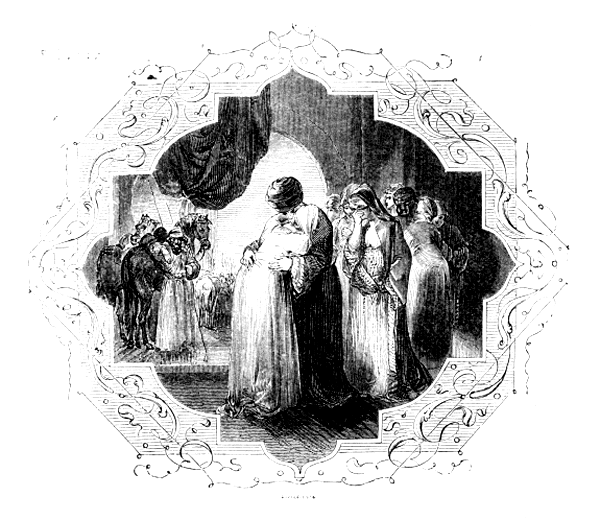
There are some slight differences in the funeral-ceremonies observed in different Arab countries; but a sufficient notion of them will be conveyed by briefly describing those which prevail in Cairo. The procession to the tomb is generally headed by a number of poor men, mostly blind, who, walking two and two, or three and three, together, chant, in a melancholy tone, the profession (or two professions) of the faith, mentioned above (in Note 9), or sometimes other words. They are usually followed by some male relations and friends of the deceased; and these, by a group of schoolboys, chanting in a higher tone, and one of them bearing a copy of the Ḳur-án, or of one of its thirty sections, placed upon a kind of desk formed of palm-sticks, and covered with an embroidered kerchief. Then follows the bier, borne head-foremost. Friends of the deceased relieve one another in the office of carrying it; and casual passengers often take part in this service, which is esteemed highly meritorious. Behind the bier walk the female mourners, composing a numerous group, often more than a dozen; or, if of a wealthy family, they ride. Each of those who belong to the family of the deceased has a strip of cotton stuff or muslin, generally blue, bound round her head, over the head-veil, and carries a handkerchief, usually dyed blue (the colour of mourning), which she sometimes holds over her shoulders, and at other times twirls with both hands over her head or before her face, while she cries and shrieks almost incessantly; and the hired female mourners, accompanying the group, often celebrate the praises of the deceased in the manner described in the preceding tale, though this was forbidden by the Prophet.—The funeral-procession of a man of wealth is sometimes preceded by several camels, bearing bread and water to give to the poor at the tomb; and closed by the led horses of some of the attendants, and by a buffalo or other animal to be sacrificed at the tomb, where its flesh is distributed to the poor, to atone for some of the minor sins of the deceased.349
The bier used for conveying the corpse of a boy or a female has a cover of wood, over which a shawl is spread; and at the head is an upright piece of wood: upon the upper part of this, in the case of a boy, is fixed a turban, with several ornaments of female head-dress; and in the case of a female, it is similarly decked, but without the turban.
A short prayer is recited over the dead, either in a mosque or in a place particularly dedicated to this service in, or adjacent to, the burial-ground. The body is then conveyed, in the same manner as before, to the tomb. This is a hollow, oblong vault, one side of which faces the direction of Mekkeh, generally large enough to contain four or more bodies, and having an oblong monument of stone or brick constructed over it, with a stela at the head and foot. Upon the former of these two stelæ (which is often inscribed with a text from the Ḳur-án, and the name of the deceased, with the date of his death), a turban, cap, or other head-dress, is sometimes carved, shewing the rank or class of the person or persons buried beneath; and in many cases, a cupola supported by four walls, or by columns, &c., is constructed over the smaller monument. The body is laid on its right side, or inclined by means of a few crude bricks, so that the face is turned towards Mekkeh; and a person is generally employed to dictate to the deceased the answers which he should give when he is examined by the two angels Munkar and Nekeer, whom I have mentioned in No. 21 of the Notes to the Introduction. If the funeral be that of a person of rank or wealth, the bread and water &c. before mentioned are then distributed to the poor.350
The principal ceremonies observed after the funeral have been described in Note 15 to Chapter iv.