Volume 1 — CHAPTER V. (continued 3)
Edward William Lane translation
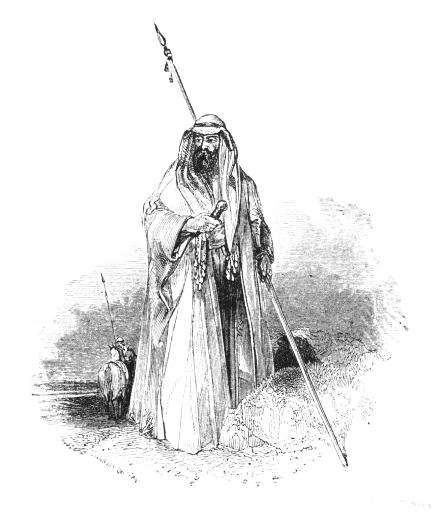
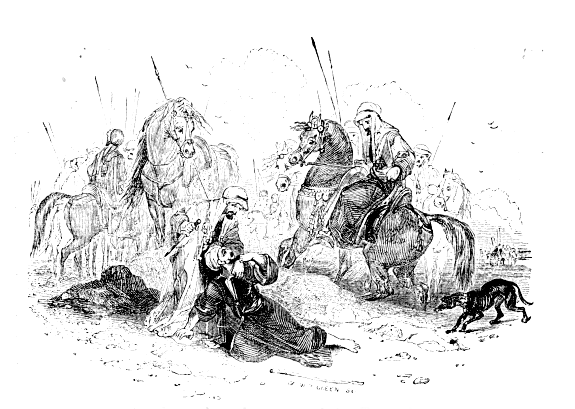
My brother, upon this, went forth from the city, a fugitive; and upon his way, a party of Arabs102 came upon him. They made him a captive; and the man who captured him tortured him with beating, and said to him, By Allah, purchase thyself of me by wealth, or I will kill thee:—but my brother, weeping, replied, By Allah, I possess nothing, O Sheykh of the Arabs; nor do I know the means of obtaining any property: I am thy captive; I have fallen into thy hands, and do with me what thou wilt. And immediately the tyrannical Bedawee drew forth from his girdle a broad-bladed knife (such as, if plunged into the neck of a camel, would cut it across from one jugular vein to the other), and, taking it in his right hand, approached my poor brother, and cut off with it his lips; still urging his demand.—Now this Bedawee had a handsome wife, who, when he was absent, used to manifest a strong affection for my brother; though he observed a proper decorum towards her, fearing God (whose name be exalted!); and it happened, one day, that she had called him, and seated him with her; but while they were together, lo, her husband came in upon them; and when he beheld my brother, he exclaimed, Wo to thee, thou base wretch! Dost thou desire now to corrupt my wife?—Then drawing his knife, he inflicted upon him another cruel wound; after which he mounted him upon a camel, and, having cast him upon a mountain, left him there, and went his way. Some travellers, however, passed by him, and when they discovered him, they gave him food and drink, and acquainted me with his case: so I went forth to him, and conveyed him back into the city, and allotted him a sufficient maintenance.
Now I have come unto thee, O Prince of the Faithful, continued the barber, and feared to return to my house without relating to thee these facts; for to neglect doing so had been an error. Thus thou hast seen that, although having six brothers, I am of a more upright character than they.—But when the Prince of the Faithful had heard my story, and all that I had related to him respecting my brothers, he laughed, and said, Thou hast spoken truth, O Ṣámit (O silent man); thou art a person of few words, and devoid of impertinence; now, however, depart from this city, and take up thine abode in another. So he banished me from Baghdád; and I journeyed through various countries, and traversed many regions, until I heard of his death, and of the succession of another Khaleefeh; when, returning to my city, I met with this young man, unto whom I did the best of deeds, and who, had it not been for me, had been slain: yet he hath accused me of that which is not in my character; for all that he hath related of me, with respect to impertinence, and loquacity, and dulness, and want of taste, is false, O people.
CONTINUATION OF THE STORY TOLD BY THE TAILOR.
The tailor then proceeded thus:—When we heard the story of the barber, and were convinced of his impertinence and loquacity, and that the young man had been treated unjustly by him, we seized hold upon him, and put him in confinement, and, seating ourselves to keep watch over him, ate and drank; and the feast was finished in the most agreeable manner. We remained sitting together until the call to afternoon-prayers, when I went forth, and returned to my house; but my wife looked angrily at me, and said, Thou hast been all the day enjoying thy pleasure while I have been sitting at home sorrowful; now if thou go not forth with me and amuse me for the remainder of the day, thy refusal will be the cause of my separation from thee. So I took her and went out with her, and we amused ourselves until nightfall, when, returning home, we met this humpback, full of drink, and repeating verses; upon which I invited him to come home with us, and he consented. I then went forth to buy some fried fish, and having bought it and returned, we sat down to eat; and my wife took a morsel of bread and a piece of fish, and put them into his mouth, and choked him, so that he died; whereupon I took him up, and contrived to throw him into the house of this physician, and he contrived to throw him into the house of the steward, and the steward contrived to throw him in the way of the broker.—This is the story of what happened to me yesterday. Is it not more wonderful than that of the humpback?
CONTINUATION OF THE STORY OF THE HUMPBACK.
When the King had heard this story, he ordered certain of his chamberlains to go with the tailor, and to bring the barber; saying to them, His presence is indispensable, that I may hear his talk, and it may be the cause of the deliverance of you all: then we will bury this humpback decently in the earth, for he hath been dead since yesterday; and we will make him a monument around his grave, since he hath been the occasion of our acquaintance with these wonderful stories.
The chamberlains and the tailor soon came back, after having gone to the place of confinement and brought the barber, whom they placed before the King; and when the King beheld him, he saw him to be an old man, passed his ninetieth year, of dark countenance, and white beard and eyebrows, with small ears, and long nose, and a haughty aspect. The King laughed at the sight of him, and said to him, O silent man, I desire that thou relate to me somewhat of thy stories.—O King of the age, replied the barber, what is the occasion of the presence of this Christian and this Jew and this Muslim, and this humpback lying dead among you; and what is the reason of this assembly?—Wherefore dost thou ask this? said the King. The barber answered, I ask it in order that the King may know me to be no impertinent person, nor one who meddleth with that which doth not concern him, and that I am free from the loquacity of which they accuse me: for I am fortunate in my characteristic appellation, since they have surnamed me Eṣ-Ṣámit; and, as the poet hath said,—
Seldom hast thou seen a person honoured with a surname, but thou wilt find, if thou search, that his character is expressed by it.
The King therefore said, Explain to the barber the case of this humpback, and what happened to him yesterday evening, and explain to him also what the Christian hath related, and the Jew and the steward and the tailor. So they repeated to him the stories of all these persons.
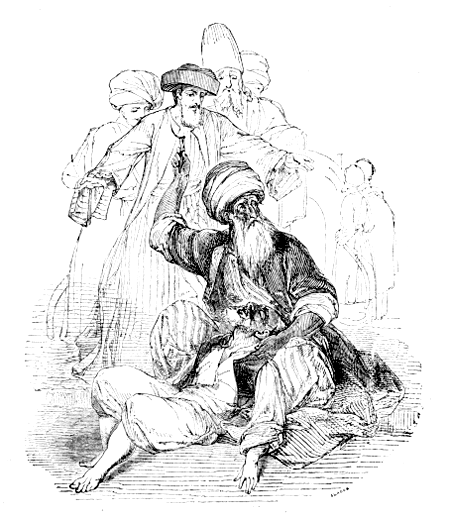
The barber, thereupon, shook his head, saying, By Allah, this is a wonderful thing! Uncover this humpback, that I may examine him.—And they did so. He then seated himself at his head, and, taking it up, placed it upon his lap, and looked at his face, and laughed so violently that he fell backwards, exclaiming, For every death there is a cause; and the death of this humpback is most wonderful: it is worthy of being registered in the records, that posterity may be instructed by this event!—The King, astonished at his words, said, O Ṣámit, explain to us the reason of thy saying this.—O King, replied the barber, by thy beneficence, life is yet in the humpback! He then drew forth from his bosom a pot containing some ointment, and with this he anointed the neck of the humpback; after which he covered it up until it perspired; when he took forth an iron forceps, and put it down his throat, and extracted the piece of fish with its bone, and all the people saw them. The humpback now sprang upon his feet, and sneezed, and, recovering his consciousness, drew his hands over his face, and exclaimed, There is no Deity but God! Moḥammad is God's Apostle! God bless and save him!—and all who were present were astonished at the sight, and the King laughed until he became insensible; as did also the other spectators. The King exclaimed, By Allah, this accident is wonderful! I have never witnessed anything more strange!—and added, O Muslims! O assembly of soldiers! have ye ever in the course of your lives seen any one die and after that come to life? But had not God blessed him with this barber, the humpback had been to-day numbered among the people of the other world; for the barber hath been the means of restoring him to life.—They replied, This is indeed a wonderful thing!
The King then gave orders to record this event; and when they had done so, he placed the record in the royal library; and he bestowed dresses of honour upon the Jew and the Christian and the steward; upon each of them, a costly dress: the tailor he appointed to be his own tailor, granting him regular allowances, and reconciling him and the humpback with each other: the humpback he honoured with a rich and beautiful dress, and with similar allowances, and appointed him his cup-companion; and upon the barber also he conferred the like favours, rewarding him with a costly dress of honour, regular allowances, and a fixed salary, and appointing him state-barber, and his own cup-companion: so they all lived in the utmost happiness and comfort until they were visited by the terminator of delights and the separator of friends.
NOTES TO CHAPTER FIFTH.
Among other calculations of the same kind is the following, which my sheykh has mentioned in a marginal note on this passage, in the copy from which I translate.—The numerical values of the letters composing the name of each of the two parties are added together, and one of these two sums is subtracted from the other: if the remainder is an uneven number, the inference is unfavourable; but if even, the reverse.
In the present instance, the dupe, knowing that there are various modes of divining whether he will be happy with his wife, is made to believe that his fortune depends upon the mode, instead of the result, of the calculation.