Volume 1 — CHAPTER III.
Edward William Lane translation
COMMENCING WITH PART OF THE NINTH NIGHT, AND ENDING WITH PART OF THE EIGHTEENTH.
THE STORY OF THE PORTER AND THE LADIES OF BAGHDÁD, AND OF THE THREE ROYAL MENDICANTS, &c.
There was a man of the city of Baghdád, who was unmarried, and he was a porter; and one day, as he sat in the market, reclining against his crate,1 there accosted him a female wrapped in an izár2 of the manufacture of El-Móṣil,3 composed of gold-embroidered silk, with a border of gold lace at each end, who raised her face-veil, and displayed beneath it a pair of black eyes, with lids bordered by long lashes, exhibiting a tender expression, and features of perfect beauty; and she said, with a sweet voice, Bring thy crate, and follow me.
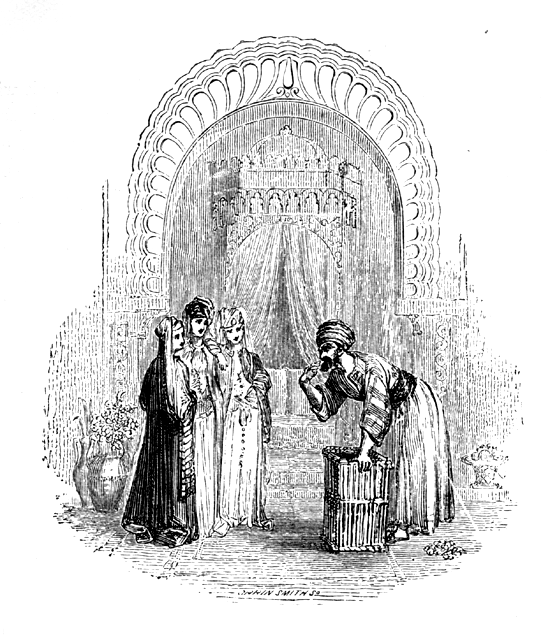
The porter had scarcely heard her words when he took up his crate, and he followed her until she stopped at the door of a house, and knocked; whereupon there came down to her a Christian, and she gave him a piece of gold, and received for it a quantity of olives, and two large vessels of wine,4 which she placed in the crate, saying to the porter, Take it up, and follow me. The porter exclaimed, This is, indeed, a fortunate day!—and he took up the crate, and followed her. She next stopped at the shop of a fruiterer, and bought of him Syrian apples, and 'Othmánee quinces,5 and peaches of 'Omán, and jasmine of Aleppo, and water-lilies of Damascus, and cucumbers of the Nile, and Egyptian limes, and Sulṭánee citrons, and sweet-scented myrtle, and sprigs of the ḥennà-tree, and chamomile, and anemones, and violets, and pomegranate flowers, and eglantine: all these she put into the porter's crate, and said to him, Take it up. So he took it up, and followed her until she stopped at the shop of a butcher, to whom she said, Cut off ten pounds of meat;—and he cut it off for her, and she wrapped it in a leaf of a banana-tree, and put it in the crate, and said again, Take it up, O porter:—and he did so, and followed her. She next stopped at the shop of a seller of dry fruits, and took some of every kind of these, and desired the porter to take up his burden. Having obeyed, he followed her until she stopped at the shop of a confectioner, where she bought a dish, and filled it with sweets of every kind that he had,6 which she put into the crate; whereupon the porter ventured to say, If thou hadst informed me beforehand, I had brought with me a mule to carry all these things. The lady smiled at his remark, and next stopped at the shop of a perfumer, of whom she bought ten kinds of scented waters; rose-water, and orange-flower-water, and willow-flower-water,7 &c.; together with some sugar, and a sprinkling-bottle8 of rose-water infused with musk, and some frankincense, and aloes-wood, and ambergris, and musk, and wax candles; and, placing all these in the crate, she said, Take up thy crate, and follow me. He, therefore, took it up, and followed her until she came to a handsome house, before which was a spacious court. It was a lofty structure, with a door of two leaves, composed of ebony, overlaid with plates of red gold.9
The young lady stopped at this door, and knocked gently; whereupon both its leaves were opened, and the porter, looking to see who opened it, found it to be a damsel of tall stature, high-bosomed, fair and beautiful, and of elegant form, with a forehead like the bright new moon, eyes like those of gazelles, eyebrows like the new moon of Ramaḍán,10 cheeks resembling anemones, and a mouth like the seal of Suleymán:11 her countenance was like the full moon in its splendour, and the forms of her bosom resembled two pomegranates of equal size. When the porter beheld her, she captivated his reason, the crate nearly fell from his head, and he exclaimed, Never in my life have I seen a more fortunate day than this! The lady-portress, standing within the door, said to the cateress and the porter, Ye are welcome:—and they entered, and proceeded to a spacious saloon,12 decorated with various colours, and beautifully constructed, with carved wood-work, and fountains, and benches of different kinds, and closets with curtains hanging before them; there was also in it, at the upper end,13 a couch of alabaster inlaid with large pearls and jewels, with a musquito-curtain of red satin suspended over it, and within this was a young lady with eyes possessing the enchantment of Bábil,14 and a figure like the letter Alif,15 with a face that put to shame the shining sun: she was like one of the brilliant planets, or rather, one of the most high-born of the maidens of Arabia. This third lady,16 rising from the couch, advanced with a slow and elegant gait to the middle of the saloon, where her sisters were standing, and said to them, Why stand ye still? Lift down the burden from the head of this poor porter:—whereupon the cateress placed herself before him, and the portress behind him, and, the third lady assisting them, they lifted it down from his head. They then took out the contents of the crate, and, having put every thing in its place, gave to the porter two pieces of gold, saying to him, Depart, O porter.
The porter, however, stood looking at the ladies, and admiring their beauty and their agreeable dispositions; for he had never seen any more handsome; and when he observed that they had not a man among them, and gazed upon the wine, and fruits, and sweet-scented flowers, which were there, he was full of astonishment, and hesitated to go out; upon which one of the ladies said to him, Why dost thou not go? dost thou deem thy hire too little? Then turning to one of her sisters, she said to her, Give him another piece of gold.—By Allah, O my mistress, exclaimed the porter, my hire is but two half-dirhems,17 and I thought not what ye have given me too little; but my heart and mind were occupied with reflections upon you and your state, ye being alone, with no man among you, not one to amuse you with his company; for ye know that the menáreh18 standeth not firmly but on four walls: now ye have not a fourth, and the pleasure of women is not complete without men: ye are three only, and have need of a fourth, who should be a man, a person of sense, discreet, acute, and a concealer of secrets. We are maidens, they replied; and fear to impart our secret to him who will not keep it; for we have read, in a certain history, this verse:—
Guard thy secret from another: intrust it not: for he who intrusteth a secret hath lost it.
—By your existence, said the porter, I am a man of sense, and trustworthy: I have read various books, and perused histories: I make known what is fair, and conceal what is foul, and act in accordance with the saying of the poet:—
None keepeth a secret but a faithful person: with the best of mankind it remaineth concealed. A secret is with me as in a house with a lock, whose key is lost, and whose door is sealed.19
When the ladies heard the verses which he quoted, and the words with which he addressed them, they said to him, Thou knowest that we have expended here a considerable sum of money: hast thou then wherewith to requite us? We will not suffer thee to remain with us unless thou contribute a sum of money; for thou desirest to sit with us, and to be our cup-companion, and to gaze upon our beautiful faces.—If friendship is without money, said the mistress of the house, it is not equivalent to the weight of a grain:—and the portress added, If thou hast nothing, depart with nothing:—but the cateress said, O sister, let us suffer him; for, verily, he hath not been deficient in his services for us this day: another had not been so patient with us: whatever, therefore, falls to his share of the expense, I will defray for him.—At this the porter rejoiced, and exclaimed, By Allah, I obtained my first and only pay this day from none but thee:—and the other ladies said to him, Sit down: thou art welcome.
The cateress then arose, and, having tightened her girdle, arranged the bottles, and strained the wine, and prepared the table by the pool of the fountain. She made ready all that they required, brought the wine, and sat down with her sisters; the porter also sitting with them, thinking he was in a dream. And when they had seated themselves, the cateress took a jar of wine, and filled the first cup, and drank it:20 she then filled another, and handed it to one of her sisters; and in like manner she did to her other sister; after which she filled again, and handed the cup to the porter, who, having taken it from her hand, repeated this verse:—
I will drink the wine, and enjoy health; for, verily, this beverage is a remedy for disease.
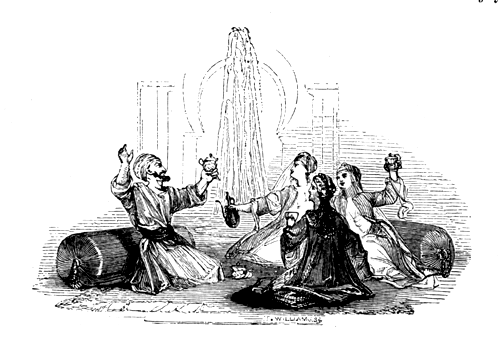
The wine continued to circulate among them, and the porter, taking his part in the revels, dancing and singing with them, and enjoying the fragrant odours, began to hug and kiss them, while one slapped21 him, and another pulled him, and the third beat him with sweet-scented flowers, till, at length, the wine made sport with their reason; and they threw off all restraint, indulging their merriment with as much freedom as if no man had been present.22
Thus they continued until the approach of night, when they said to the porter, Depart, and shew us the breadth of thy shoulders;23—but he replied, Verily the departure of my soul from my body were more easy to me than my departure from your company; therefore suffer us to join the night to the day, and then each of us shall return to his own, or her own, affairs. The cateress, also, again interceded for him, saying, By my life I conjure you that ye suffer him to pass the night with us, that we may laugh at his drolleries, for he is a witty rogue. So they said to him, Thou shalt pass the night with us on this condition, that thou submit to our authority, and ask not an explanation of anything that thou shalt see. He replied, Good.—Rise then, said they, and read what is inscribed upon the door. Accordingly, he went to the door, and found the following inscription upon it in letters of gold, Speak not of that which doth not concern thee, lest thou hear that which will not please thee:—and he said, Bear witness to my promise that I will not speak of that which doth not concern me.
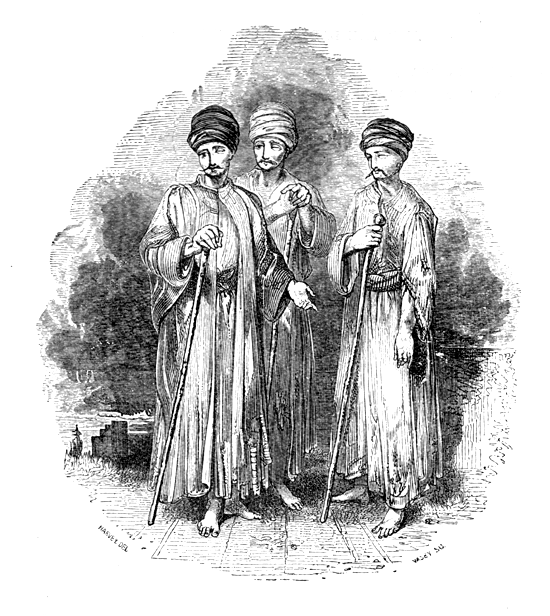
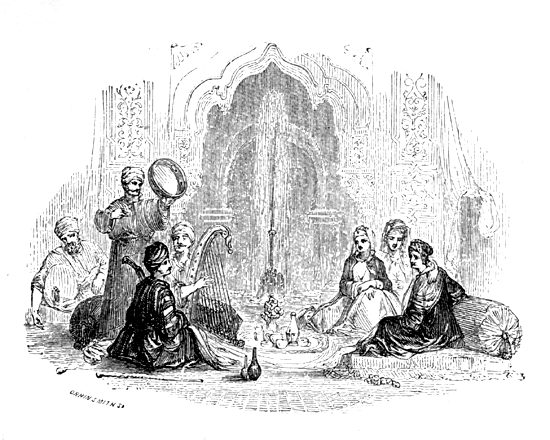
The cateress then rose, and prepared for them a repast; and, after they had eaten a little, they lighted the candles and burnt some aloes-wood. This done, they sat down again to the table; and, while they were eating and drinking, they heard a knocking at the door; whereupon, without causing any interruption to their meal, one of them went to the door, and, on her return, said, Our pleasure this night is now complete, for I have found, at the door, three foreigners24 with shaven chins, and each of them is blind of the left eye: it is an extraordinary coincidence. They are strangers newly arrived,25 and each of them has a ridiculous appearance: if they come in, therefore, we shall be amused with laughing at them.—The lady ceased not with these words, but continued to persuade her sisters until they consented, and said, Let them enter; but make it a condition with them that they speak not of that which doth not concern them, lest they hear that which will not please them. Upon this she rejoiced, and, having gone again to the door, brought in the three men blind of one eye and with shaven chins, and they had thin and twisted mustaches. Being mendicants, they saluted and drew back; but the ladies rose to them, and seated them; and when these three men looked at the porter, they saw that he was intoxicated; and, observing him narrowly, they thought that he was one of their own class, and said, He is a mendicant like ourselves, and will amuse us by his conversation:—but the porter, hearing what they said, arose, and rolled his eyes, and exclaimed to them, Sit quiet, and abstain from impertinent remarks. Have ye not read the inscription upon the door?—The ladies, laughing, said to each other, Between the mendicants and the porter we shall find matter for amusement. They then placed before the former some food, and they ate, and then sat to drink. The portress handed to them the wine, and, as the cup was circulating among them, the porter said to them, Brothers, have ye any tale or strange anecdote wherewith to amuse us? The mendicants, heated by the wine, asked for musical instruments; and the portress brought them a tambourine of the manufacture of El-Móṣil, with a lute of El-'Eráḳ, and a Persian harp;26 whereupon they all arose; and one took the tambourine; another, the lute; and the third, the harp: and they played upon these instruments, the ladies accompanying them with loud songs; and while they were thus diverting themselves, a person knocked at the door. The portress, therefore, went to see who was there; and the cause of the knocking was this.
The Khaleefeh27 Hároon Er-Rasheed had gone forth this night to see and hear what news he could collect, accompanied by Jaạfar28 his Wezeer, and Mesroor29 his executioner. It was his custom to disguise himself in the attire of a merchant; and this night, as he went through the city, he happened to pass, with his attendants, by the house of these ladies, and hearing the sounds of the musical instruments, he said to Jaạfar, I have a desire to enter this house, and to see who is giving this concert.—They are a party who have become intoxicated, replied Jaạfar, and I fear that we may experience some ill usage from them;—but the Khaleefeh said, We must enter, and I would that thou devise some stratagem by which we may obtain admission to the inmates. Jaạfar therefore answered, I hear and obey:—and he advanced, and knocked at the door; and when the portress came and opened the door, he said to her, My mistress, we are merchants from Tabareeyeh,30 and have been in Baghdád ten days; we have brought with us merchandise, and taken lodgings in a Khán;31 and a merchant invited us to an entertainment this night: accordingly, we went to his house, and he placed food before us, and we ate, and sat awhile drinking together, after which he gave us leave to depart;32 and going out in the dark, and being strangers, we missed our way to the Khán: we trust, therefore, in your generosity that you will admit us to pass the night in your house; by doing which you will obtain a reward in heaven.—The portress, looking at them, and observing that they were in the garb of merchants, and that they bore an appearance of respectability, returned, and consulted her two companions; and they said to her, Admit them:—so she returned, and opened to them the door. They said to her, Shall we enter with thy permission? She answered, Come in. The Khaleefeh, therefore, entered, with Jaạfar and Mesroor; and when the ladies saw them, they rose to them, and served them, saying, Welcome are our guests; but we have a condition to impose upon you, that ye speak not of that which doth not concern you, lest ye hear that which will not please you. They answered, Good:—and when they had sat down to drink, the Khaleefeh looked at the three mendicants, and was surprised at observing that each of them was blind of the left eye; and he gazed upon the ladies, and was perplexed and amazed at their fairness and beauty. And when the others proceeded to drink and converse, the ladies brought wine to the Khaleefeh; but he said, I am a pilgrim;33—and drew back from them. Whereupon the portress spread before him an embroidered cloth, and placed upon it a China bottle, into which she poured some willow-flower-water, adding to it a lump of ice, and sweetening it with sugar, while the Khaleefeh thanked her, and said within himself, To-morrow I must reward her for this kind action.
The party continued their carousal, and, when the wine took effect upon them, the mistress of the house arose, and waited upon them; and afterwards, taking the hand of the cateress, said, Arise, O my sister, that we may fulfil our debt. She replied, Good. The portress then rose, and, after she had cleared the middle of the saloon, placed the mendicants at the further end, beyond the doors; after which, the ladies called to the porter, saying, How slight is thy friendship! thou art not a stranger, but one of the family. So the porter arose, and girded himself, and said, What would ye?—to which one of the ladies answered, Stand where thou art:—and presently the cateress said to him, Assist me:—and he saw two black bitches, with chains attached to their necks, and drew them to the middle of the saloon; whereupon the mistress of the house arose from her place, and tucked up her sleeve above her wrist, and, taking a whip, said to the porter, Bring to me one of them. Accordingly, he dragged one forward by the chain. The bitch whined, and shook her head at the lady; but the latter fell to beating her upon the head, notwithstanding her howling, until her arms were tired, when she threw the whip from her hand, and pressed the bitch to her bosom, and wiped away her tears, and kissed her head; after which she said to the porter, Take her back, and bring the other;—and he brought her, and she did to her as she had done to the first. At the sight of this, the mind of the Khaleefeh was troubled, and his heart was contracted, and he winked to Jaạfar that he should ask her the reason; but he replied by a sign, Speak not.
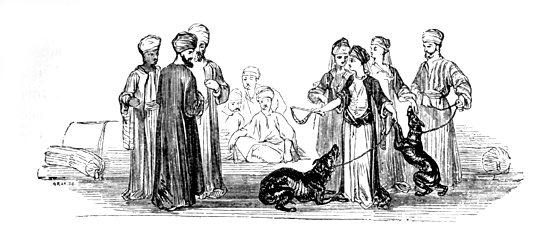
The mistress of the house then looked towards the portress, and said to her, Arise to perform what thou hast to do. She replied, Good:—and the mistress of the house seated herself upon a couch of alabaster, overlaid with gold and silver, and said to the portress and the cateress, Now perform your parts. The portress then seated herself upon a couch by her; and the cateress, having entered a closet, brought out from it a bag of satin with green fringes, and, placing herself before the lady of the house, shook it, and took out from it a lute; and she tuned its strings, and sang to it these verses:—
Restore to my eyelids the sleep which hath been ravished; and inform me of my reason, whither it hath fled. I discovered, when I took up my abode with love, that slumber had become an enemy to my eyes. They said, We saw thee to be one of the upright; what, then, hath seduced thee? I answered, Seek the cause from his glance. Verily I excuse him for the shedding of my blood, admitting that I urged him to the deed by vexation. He cast his sun-like image upon the mirror of my mind, and its reflection kindled a flame in my vitals.34
When the portress35 had heard this song, she exclaimed, Allah approve thee!—and she rent her clothes, and fell upon the floor in a swoon; and when her bosom was thus uncovered, the Khaleefeh saw upon her the marks of beating, as if from miḳra'ahs36 and whips; at which he was greatly surprised. The cateress37 immediately arose, sprinkled water upon her face, and brought her another dress, which she put on. The Khaleefeh then said to Jaạfar, Seest thou not this woman, and the marks of beating upon her? I cannot keep silence respecting this affair, nor be at rest, until I know the truth of the history of this damsel, and that of these two bitches. But Jaạfar replied, O our lord, they have made a covenant with us that we shall not speak excepting of that which concerneth us, lest we hear that which will not please us.—The cateress then took the lute again, and, placing it against her bosom, touched the chords with the ends of her fingers, and thus sang to it:—
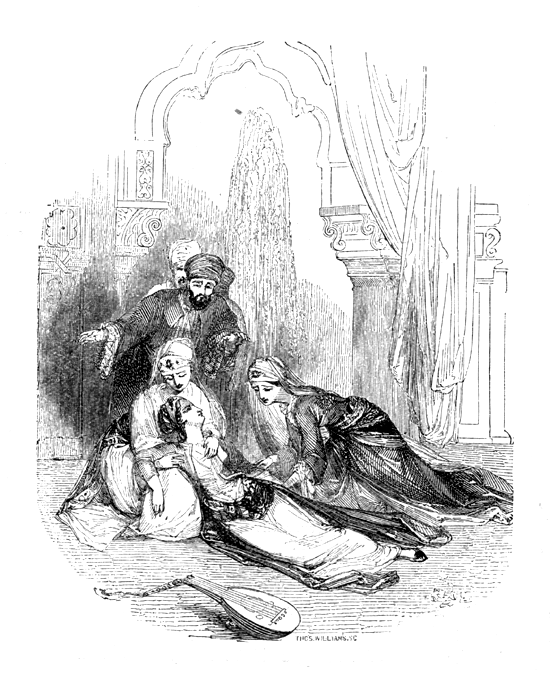
If of love we complain, what shall we say? Or consuming through desire, how can we escape? Or if we send a messenger to interpret for us, he cannot convey the lover's complaint. Or if we would be patient, short were our existence after the loss of those we love. Nought remaineth to us but grief and mourning, and tears streaming down our cheeks. O you who are absent from my sight, but constantly dwelling within my heart! Have you kept your faith to an impassioned lover, who, while time endureth, will never change? Or, in absence, have you forgotten that lover who, on your account, is wasting away? When the day of judgment shall bring us together, I will beg of our Lord a protractive trial.38
On hearing these verses of the cateress, the portress again rent her clothes, and cried out, and fell upon the floor in a swoon; and the cateress, as before, put on her another dress, after she had sprinkled some water upon her face.39
The mendicants, when they witnessed this scene, said, Would that we had never entered this house, but rather had passed the night upon the mounds;40 for our night hath been rendered foul by an event that breaketh the back! The Khaleefeh, looking towards them, then said, Wherefore is it so with you? They answered, Our hearts are troubled by this occurrence.—Are ye not, he asked, of this house?—No, they answered; nor did we imagine that this house belonged to any but the man who is sitting with you:—upon which the porter said, Verily, I have never seen this place before this night; and I would that I had passed the night upon the mounds rather than here. They then observed, one to another, We are seven men, and they are but three women; we will, therefore, ask them of their history; and if they answer us not willingly they shall do it in spite of themselves:—and they all agreed to this, excepting Jaạfar, who said, This is not a right determination; leave them to themselves, for we are their guests, and they made a covenant with us which we should fulfil: there remaineth but little of the night, and each of us shall soon go his way. Then, winking to the Khaleefeh, he said, There remaineth but an hour; and to-morrow we will bring them before thee, and thou shalt ask them their story. But the Khaleefeh refused to do so, and said, I have not patience to wait so long for their history.—Words followed words, and at last they said, Who shall put the question to them?—and one answered, The porter.
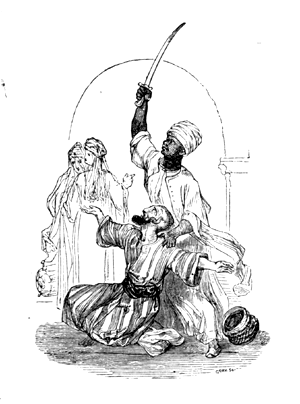
The ladies then said to them, O people, of what are ye talking?—whereupon the porter approached the mistress of the house, and said to her, O my mistress, I ask thee, and conjure thee by Allah, to tell us the story of the two bitches, and for what reason thou didst beat them, and then didst weep, and kiss them, and that thou acquaint us with the cause of thy sister's having been beaten with miḳra'ahs: that is our question, and peace be on you.—Is this true that he saith of you? inquired the lady, of the other men; and they all answered, Yes,—excepting Jaạfar, who was silent. When the lady heard their answer, she said, Verily, O our guests, ye have wronged us excessively; for we made a covenant with you beforehand, that he who should speak of that which concerned him not should hear that which would not please him. Is it not enough that we have admitted you into our house, and fed you with our provisions? But it is not so much your fault as the fault of her who introduced you to us.—She then tucked up her sleeve above her wrist, and struck the floor three times, saying, Come ye quickly!—and immediately the door of a closet opened, and there came forth from it seven black slaves, each having in his hand a drawn sword. The lady said to them, Tie behind them the hands of these men of many words, and bind each of them to another:—and they did so, and said, O virtuous lady, dost thou permit us to strike off their heads? She answered, Give them a short respite, until I shall have inquired of them their histories, before ye behead them.—By Allah, O my mistress, exclaimed the porter, kill me not for the offence of others: for they have all transgressed and committed an offence, excepting me. Verily our night had been pleasant if we had been preserved from these mendicants, whose presence is enough to convert a well-peopled city into a heap of ruins!—He then repeated this couplet:—
How good is it to pardon one able to resist! and how much more so, one who is helpless! For the sake of the friendship that subsisted between us, destroy not one for the crime of another!
On hearing these words of the porter, the lady laughed after her anger. Then approaching the men, she said, Acquaint me with your histories, for there remaineth of your lives no more than an hour. Were ye not persons of honourable and high condition, or governors,41 I would hasten your recompense.—The Khaleefeh said to Jaạfar, Wo to thee, O Jaạfar! make known to her who we are; otherwise she will kill us.—It were what we deserve, replied he.—Jesting, said the Khaleefeh, is not befitting in a time for seriousness: each has its proper occasion.—The lady then approached the mendicants, and said to them, Are ye brothers? They answered, No, indeed; we are only poor foreigners.42 She said then to one of them, Wast thou born blind of one eye?—No, verily, he answered; but a wonderful event happened to me when my eye was destroyed, and the story of it, if engraved on the understanding, would serve as a lesson to him who would be admonished. She asked the second and the third also; and they answered her as the first; adding, Each of us is from a different country, and our history is wonderful and extraordinary. The lady then looked towards them and said, Each of you shall relate his story, and the cause of his coming to our abode, and then stroke his head,43 and go his way.
The first who advanced was the porter, who said, O my mistress, I am a porter; and this cateress loaded me, and brought me hither, and what hath happened to me here in your company ye know. This is my story; and peace be on you.—Stroke thy head, then, said she, and go:—but he replied, By Allah, I will not go until I shall have heard the story of my companions.—The first mendicant then advanced, and related as follows:—
THE STORY OF THE FIRST ROYAL MENDICANT.
Know, O my mistress, that the cause of my having shaved my beard, and of the loss of my eye was this:—My father was a King, and he had a brother who was also a King, and who resided in another capital. It happened that my mother gave birth to me on the same day on which the son of my uncle was born; and years and days passed away until we attained to manhood. Now, it was my custom, some years, to visit my uncle, and to remain with him several months; and on one of these occasions my cousin paid me great honour; he slaughtered sheep for me, and strained the wine for me, and we sat down to drink; and when the wine had affected us, he said to me, O son of my uncle, I have need of thine assistance in an affair of interest to me, and I beg that thou wilt not oppose me in that which I desire to do. I replied, I am altogether at thy service:—and he made me swear to him by great oaths, and, rising immediately, absented himself for a little while, and then returned, followed by a woman decked with ornaments, and perfumed, and wearing a dress of extraordinary value. He looked towards me, while the woman stood behind him, and said, Take this woman, and go before me to the burial-ground which is in such a place:—and he described it to me, and I knew it. He then added, Enter the burial-ground, and there wait for me.
I could not oppose him, nor refuse to comply with his request, on account of the oaths which I had sworn to him; so I took the woman, and went with her to the burial-ground; and when we had sat there a short time, my cousin came, bearing a basin of water, and a bag containing some plaster, and a small adze. Going to a tomb in the midst of the burial-ground, he took the adze, and disunited the stones, which he placed on one side; he then dug up the earth with the adze, and uncovered a flat stone, of the size of a small door, under which there appeared a vaulted staircase. Having done this he made a sign to the woman, and said to her, Do according to thy choice:—whereupon she descended the stairs. He then looked towards me, and said, O son of my uncle, complete thy kindness when I have descended into this place, by replacing the trap-door and the earth above it as they were before: then, this plaster which is in the bag, and this water which is in the basin, do thou knead together, and plaster the stones of the tomb as they were, so that no man may know it, and say, This hath been lately opened, but its interior is old:—for, during the space of a whole year I have been preparing this, and no one knew it but God: this is what I would have thee do. He then said to me, May God never deprive thy friends of thy presence, O son of my uncle!—and, having uttered these words, he descended the stairs.
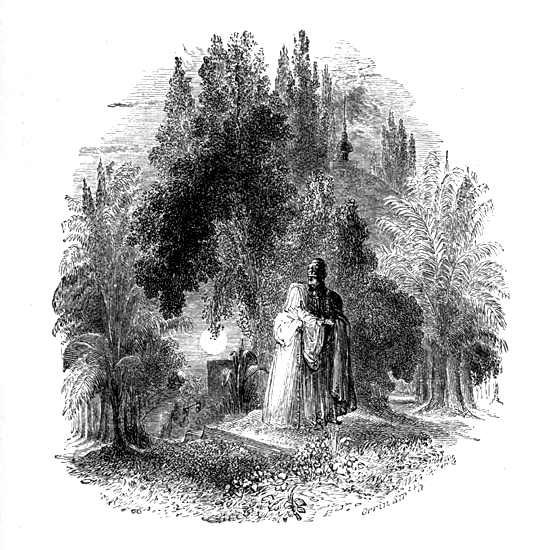
When he had disappeared from before my eyes, I replaced the trap-door, and busied myself with doing as he had ordered me, until the tomb was restored to the state in which it was at first; after which I returned to the palace of my uncle, who was then absent on a hunting excursion. I slept that night, and when the morning came, I reflected upon what had occurred between me and my cousin, and repented of what I had done for him, when repentance was of no avail. I then went out to the burial-ground, and searched for the tomb; but could not discover it. I ceased not in my search until the approach of night; and, not finding the way to it, returned again to the palace; and I neither ate nor drank: my heart was troubled respecting my cousin, since I knew not what had become of him; and I fell into excessive grief. I passed the night sorrowful until the morning, and went again to the burial-ground, reflecting upon the action of my cousin, and repenting of my compliance with his request; and I searched among all the tombs; but discovered not that for which I looked. Thus I persevered in my search seven days without success.44
My trouble continued and increased until I was almost mad; and I found no relief but in departing, and returning to my father; but on my arrival at his capital, a party at the city-gate sprang upon me and bound me. I was struck with the utmost astonishment, considering that I was the son of the Sulṭán of the city, and that these were the servants of my father and of myself: excessive fear of them overcame me, and I said within myself, What hath happened to my father? I asked, of those who had bound me, the cause of this conduct; but they returned me no answer, till after a while, when one of them, who had been my servant, said to me, Fortune hath betrayed thy father, the troops have been false to him, and the Wezeer hath killed him; and we were lying in wait to take thee.—They took me, and I was as one dead, by reason of this news which I had heard respecting my father; and I stood before the Wezeer who had killed my father.
Now, there was an old enmity subsisting between me and him; and the cause of it was this:—I was fond of shooting with the cross-bow; and it happened, one day, that as I was standing on the roof of my palace, a bird alighted on the roof of the palace of the Wezeer, who was standing there at the time, and I aimed at the bird; but the bullet missed it, and struck the eye of the Wezeer, and knocked it out, in accordance with the appointment of fate and destiny, as the poet hath said:—
We trod the steps appointed for us: and the man whose steps are appointed must tread them. He whose death is decreed to take place in one land will not die in any land but that.
When I had thus put out the eye of the Wezeer, he could say nothing, because my father was King of the city. This was the cause of the enmity between him and me: and when I stood before him, with my hands bound behind me, he gave the order to strike off my head. I said to him, Wouldst thou kill me for no offence?—What offence, he exclaimed, could be greater than this?—and he pointed to the place of the eye which was put out. I did that, said I, unintentionally. He replied, If thou didst it unintentionally, I will do the same to thee purposely:—and immediately he said, Bring him forward to me:—and, when they had done so, he thrust his finger into my left eye, and pulled it out. Thus I became deprived of one eye, as ye see me. He then bound me firmly, and placed me in a chest, and said to the executioner, Take this fellow, and draw thy sword, and convey him without the city; then put him to death, and let the wild beasts devour him.
Accordingly, he went forth with me from the city, and, having taken me out from the chest, bound hand and foot, was about to bandage my eye, and kill me; whereupon I wept, and exclaimed,—
How many brothers have I taken as armour! and such they were; but to guard my enemies. I thought they would be as piercing arrows: and such they were; but to enter my heart!
The executioner, who had served my father in the same capacity, and to whom I had shewn kindnesses, said, on hearing these verses, O my master, what can I do, being a slave under command?—but presently he added, Depart with thy life, and return not to this country, lest thou perish, and cause me to perish with thee. The poet saith,—
Flee with thy life if thou fearest oppression, and leave the house to tell its builder's fate. Thou wilt find, for the land that thou quittest, another: but no soul wilt thou find to replace thine own.
As soon as he had thus said, I kissed his hands, and believed not in my safety until I had fled from his presence. The loss of my eye appeared light to me when I considered my escape from death; and I journeyed to my uncle's capital, and, presenting myself before him, informed him of what had befallen my father, and of the manner in which I had lost my eye: upon which he wept bitterly, and said, Thou hast added to my trouble and my grief; for thy cousin hath been lost for some days, and I know not what hath happened to him, nor can any one give me information respecting him. Then he wept again, until he became insensible; and when he recovered, he said, O my son, the loss of thine eye is better than the loss of thy life.
Upon this I could no longer keep silence respecting his son, my cousin; so I informed him of all that happened to him; and on hearing this news he rejoiced exceedingly, and said, Shew me the tomb.—By Allah, O my uncle, I replied, I know not where it is; for I went afterwards several times to search for it, and could not recognise its place. We, however, went together to the burial-ground, and, looking to the right and left, I discovered it; and both I and my uncle rejoiced. I then entered the tomb with him, and when we had removed the earth, and lifted up the trap-door, we descended fifty steps, and, arriving at the bottom of the stairs, there issued forth upon us a smoke which blinded our eyes; whereupon my uncle pronounced those words which relieve from fear him who uttereth them,—There is no strength nor power but in God, the High, the Great!—After this, we proceeded, and found ourselves in a saloon, filled with flour and grain, and various eatables; and we saw there a curtain suspended over a couch, upon which my uncle looked, and found there his son and the woman who had descended with him, lying side by side, and converted into black charcoal, as if they had been thrown into a pit of fire. And when he beheld this spectacle, he spat in his son's face, and exclaimed, This is what thou deservest, O thou wretch! This is the punishment of the present world, and there remaineth the punishment of the other world, which will be more severe and lasting!—and he struck him with his shoes. Astonished at this action, and grieved for my cousin, seeing him and the damsel thus converted into charcoal, I said, By Allah, O my uncle, moderate the trouble of thy heart, for my mind is perplexed by that which hath happened to thy son, and by thinking how it hath come to pass that he and the damsel are converted into black charcoal. Dost thou not deem it enough for him to be in this state, that thou beatest him with thy shoes?
O son of my brother, he replied, this my son was, from his early years, inflamed with love for his foster-sister,45 and I used to forbid him from entertaining this passion for her, and to say within myself, They are now children, but when they grow older a base act will be committed by them:—and, indeed, I heard that such had been the case, but I believed it not. I, however, reprimanded him severely, and said to him, Beware of so foul an action, which none before thee hath committed, nor will any commit after thee: otherwise we shall suffer disgrace and disparagement among the Kings until we die, and our history will spread abroad with the caravans: have a care for thyself that such an action proceed not from thee; for I should be incensed against thee, and kill thee. I then separated him from her, and her from him: but the vile woman loved him excessively; the Devil got possession of them both; and when my son saw that I had separated him, he secretly made this place beneath the earth, and, having conveyed hither the provisions which thou seest, took advantage of my inadvertence when I had gone out to hunt, and came hither: but the Truth46 (whose perfection be extolled, and whose name be exalted!) was jealously vigilant over them, and consumed them by fire; and the punishment of the world to come will be more severe and lasting.—He then wept, and I wept with him; and he said to me, Thou art my son in his stead.—I remained a while reflecting upon the world and its vicissitudes, upon the murder of my father by the Wezeer, and his usurping his throne, and the loss of my eye, and the strange events which had happened to my cousin, and I wept again.
We then ascended, and, having replaced the trap-door and the earth above it, and restored the tomb to its former state, returned to our abode; but scarcely had we seated ourselves when we heard the sounds of drums and trumpets, warriours galloped about, and the air was filled with dust raised by the horses' hoofs. Our minds were perplexed, not knowing what had happened, and the King, asking the news, was answered, The Wezeer of thy brother hath slain him and his soldiers and guards, and come with his army to assault the city unawares; and the inhabitants, being unable to withstand, have submitted to him:—whereupon I said within myself, If I fall into his hand, he will slay me.—Griefs overwhelmed me, and I thought of the calamities which had befallen my father and my mother, and knew not what to do; for if I appeared, the people of the city would know me, and the troops of my father would hasten to kill and destroy me. I knew no way of escape but to shave off my beard:47 so I shaved it, and, having changed my clothes, departed from the city, and came hither, to this abode of peace, in the hope that some person would introduce me to the Prince of the Faithful, the Khaleefeh of the Lord of all creatures, that I might relate to him my story, and all that had befallen me. I arrived in this city this night; and as I stood perplexed, not knowing whither to direct my steps, I saw this mendicant, and saluted him, and said, I am a stranger. He replied, And I, too, am a stranger:—and while we were thus addressing each other, our companion, this third person, came up to us, and saluting us, said, I am a stranger. We replied, And we, also, are strangers. So we walked on together, and darkness overtook us, and destiny directed us unto your abode.—This was the cause of the shaving of my beard, and of the loss of my eye.
The lady then said to him, Stroke my head, and depart:—but he replied, I will not depart until I have heard the stories of the others. And they wondered at his tale; and the Khaleefeh said to Jaạfar, Verily I have never known the like of that which hath happened to this mendicant.
The second mendicant then advanced, and, having kissed the ground, said,—
THE STORY OF THE SECOND ROYAL MENDICANT.
O my mistress, I was not born with only one eye; but my story is wonderful, and, if written, would serve as a lesson to him who would be admonished. I am a King, and son of a King: I read the Ḳurán according to the seven readings,48 and perused various works under the tuition of different learned professors of their subjects: I studied the science of the stars,49 and the writings of the poets, and made myself a proficient in all the sciences; so that I surpassed the people of my age. My hand-writing50 was extolled among all the scribes, my fame spread among all countries, and my history among all Kings; and the King of India, hearing of me, requested my father to allow me to visit him, sending him various gifts and curious presents, such as were suitable to Kings. My father, therefore, prepared for me six ships, and we proceeded by sea for the space of a whole month, after which we came to land; and, having disembarked some horses which we had with us in the ship, we loaded ten camels with presents, and commenced our journey; but soon there appeared a cloud of dust, which rose and spread until it filled the air before us, and, after a while, cleared a little, and discovered to us, in the midst of it, sixty horseman like fierce lions whom we perceived to be Arab highwaymen; and when they saw us, that we were a small company with ten loads of presents for the King of India, they galloped towards us, pointing their spears at us. We made signs to them with our fingers, and said, We are ambassadors to the honoured King of India; therefore do us no injury:—but they replied, We are not in his territories, nor under his government. They slew certain of the young men, and the rest fled. I also fled, after I had received a severe wound; the Arabs being employed, without further regard to us, in taking possession of the treasure and presents which we had with us.
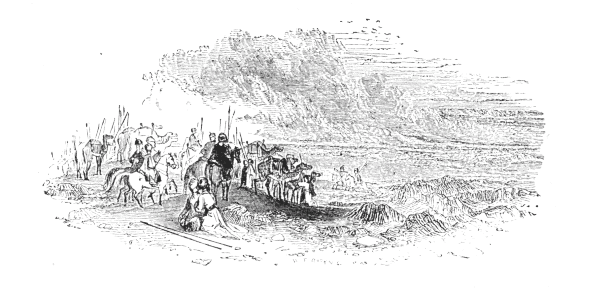
I proceeded without knowing whither to direct my course, reduced from a mighty to an abject state, and journeyed till I arrived at the summit of a mountain, where I took shelter in a cavern until the next morning. I then resumed my journey, and arrived at a flourishing city: the winter, with its cold, had passed away, and the spring had come, with its flowers; and I rejoiced at my arrival there, being wearied with my journey, anxious and pallid. My condition being thus changed, I knew not whither to bend my steps; and, turning to a tailor sitting in his shop, I saluted him, and he returned my salutation, and welcomed me, and wished me joy, asking me the reason of my having come thither. I acquainted him, therefore, with what had befallen me from first to last, and he was grieved for me, and said, O young man, reveal not thy case, for I fear what the King of this city might do to thee, since he is the greatest of thy father's enemies, and hath a debt of blood against him. He then placed some food and drink before me, and we ate together, and I conversed with him till night, when he lodged me in a place by his shop, and brought me a bed and coverlet; and, after I had remained with him three days, he said to me, Dost thou not know any trade by which to make gain?51 I answered, I am acquainted with the law, a student of sciences, a writer, and an arithmetician.—Thy occupation, he said, is profitless in our country: there is no one in our city acquainted with science or writing, but only with getting money. Verily, I replied, I know nothing but what I have told thee.—Gird thyself, then, said he, and take an axe and a rope, and cut firewood in the desert, and so obtain thy subsistence until God dispel thy affliction; but acquaint no one with thy history, else they will kill thee. He then bought for me an axe and a rope, and sent me with a party of wood-cutters, giving them a charge respecting me. Accordingly, I went forth with them, and, cut some wood, and brought back a load upon my head, and sold it for half a piece of gold, part of which I expended in food, laying by the remainder.
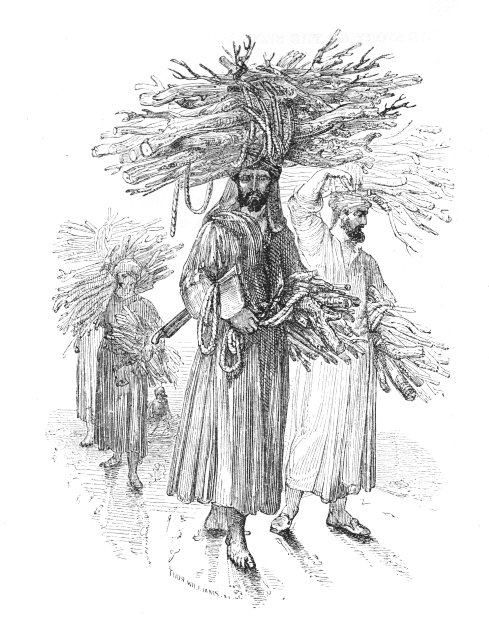
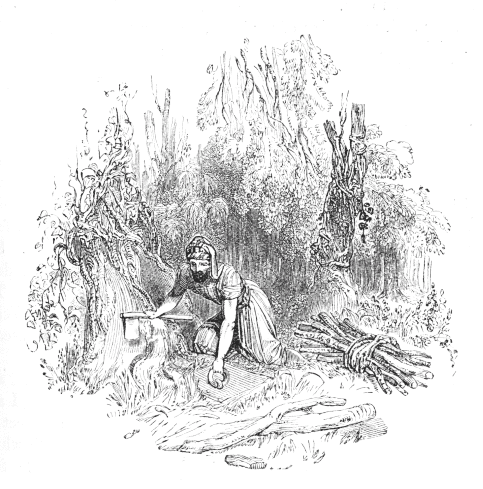
Thus I continued for the space of a year, after which I went one day into the desert, according to my custom, to cut firewood; and, finding there a tract with abundance of wood, I entered it, and came to a tree, around which I dug; and as I was removing the earth from its roots, the axe struck against a ring of brass; and I cleared away the earth from it, and found that it was affixed to a trap-door of wood, which I immediately removed. Beneath it appeared a staircase, which I descended; and at the bottom of this I entered a door, and beheld a palace, strongly constructed, where I found a lady, like a pearl of high price, whose aspect banished from the heart all anxiety and grief and affliction. At the sight of her I prostrated myself in adoration of her Creator for the fairness and beauty which He had displayed in her person; and she, looking towards me, said, Art thou a man or a Jinnee? I answered her, I am a man.—And who, she asked, hath brought thee to this place, in which I have lived five and twenty years without ever seeing a human being?—Her words sounded sweetly to me, and I answered her, O my mistress, God hath brought me to thy abode, and I hope will put an end to my anxiety and grief:—and I related to her my story from beginning to end. She was grieved at my case, and wept, and said, I also will acquaint thee with my story. Know that I am the daughter of the King of the further parts of India, the lord of the Ebony Island. My father had married me to the son of my uncle; but on the night of my bridal festivities, an 'Efreet namad Jarjarees, the son of Rejmoos, the son of Iblees, carried me off, and, soaring with me through the air, alighted in this place, to which he conveyed all things necessary for me, such as ornaments, and garments, and linen, and furniture, and food, and drink; and once in every ten days he cometh to me, and spendeth a night here;52 and he hath appointed with me, that, in case of my wanting any thing by night or day, I should touch with my hand these two lines which are inscribed upon the ḳubbeh,53 and as soon as I remove my hand I see him before me. Four days have now passed since he was last with me, and there remain, therefore, six days before he will come again; wilt thou then remain with me five days, and depart one day before his visit?—I answered, Yes; rejoicing at the proposal; and she arose, and taking me by the hand, conducted me through an arched door to a small and elegant bath, where I took off my clothes, while she seated herself upon a mattress. After this, she seated me by her side, and brought me some sherbet of sugar infused with musk,54 and handed it to me to drink: she then placed some food before me, and after we had eaten and conversed together, she said to me, Sleep, and rest thyself; for thou art fatigued.
I slept, O my mistress, and forgot all that had befallen me; and when I awoke, I found her rubbing my feet;55 upon which I called to her, and we sat down again and conversed a while; and she said to me, By Allah, I was straitened in my heart, living here alone, without any person to talk with me, five and twenty years. Praise be to God who hath sent thee to me.—I thanked her for her kind expressions; and love of her took possession of my heart, and my anxiety and grief fled away. We then sat down to drink together; and I remained by her side all the night, delighted with her company, for I had never seen her like in my whole life; and in the morning, when we were both full of joy, I said to her, Shall I take thee up from this subterranean place, and release thee from the Jinnee? But she laughed, and replied, Be content, and hold thy peace; for, of every ten days, one day shall be for the 'Efreet, and nine for thee. I persisted, however, being overcome with passion: and said, I will this instant demolish this ḳubbeh upon which the inscription is engraved, and let the 'Efreet come, that I may slay him: for I am predestined to kill 'Efreets. She entreated me to refrain; but, paying no attention to her words, I kicked the ḳubbeh with violence; upon which she exclaimed, The 'Efreet hath arrived! Did I not caution thee against this? Verily thou hast brought a calamity upon me; but save thyself, and ascend by the way that thou camest.
In the excess of my fear I forgot my sandals and my axe, and when I had ascended two steps, turning round to look for them, I saw that the ground had opened, and there rose from it an 'Efreet of hideous aspect, who said, Wherefore is this disturbance with which thou hast alarmed me, and what misfortune hath befallen thee? She answered, No misfortune hath happened to me, excepting that my heart was contracted, and I desired to drink some wine to dilate it, and, rising to perform my purpose, I fell against the ḳubbeh.—Thou liest, vile woman, he exclaimed;—and, looking about the palace to the right and left, he saw the sandals and axe; and said to her, These are the property of none but a man. Who hath visited thee?—I have not seen them, she answered, until this instant: probably they caught to thee.—This language, said he, is absurd, and will have no effect upon me, thou shameless woman!—and, so saying, he stripped her of her clothing, and tied her down, with her arms and legs extended, to four stakes, and began to beat her, urging her to confess what had happened.
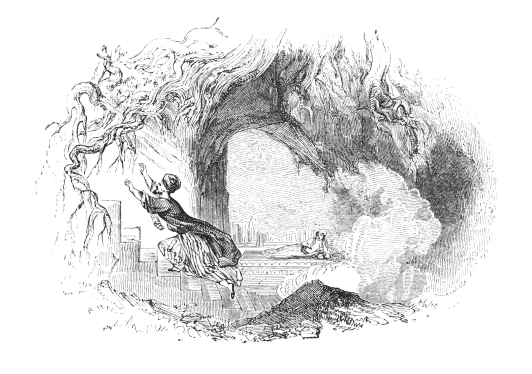
For myself, being unable to endure her cries, I ascended the stairs, overpowered by fear, and, arriving at the top, replaced the trap-door as it was at first, and covered it over with earth. I repented bitterly of what I had done, and reflecting upon the lady and her beauty, and how this wretch was torturing her after she had lived with him five and twenty years, and that he tortured her only on my account, and reflecting also upon my father and his kingdom, and how I had been reduced to the condition of a wood-cutter, I repeated this verse:—
When fortune bringeth thee affliction, console thyself by remembering that one day thou must see prosperity, and another day, difficulty.
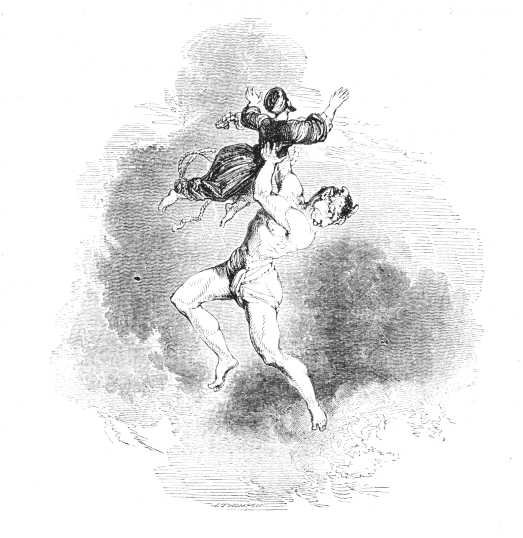
Returning to my companion, the tailor, I found him awaiting my return as if he were placed in a pan upon burning coals. I past last night, said he, with anxious heart on thy account, fearing for thee from some wild beast or other calamity. Praise be to God for thy safe return.—I thanked him for his tender concern for me, and entered my apartment; and as I sat meditating upon that which had befallen me, and blaming myself for having kicked the ḳubbeh, my friend the tailor came in to me, and said, In the shop is a foreigner, who asks for thee, and he has thy axe and sandals; he came with them to the wood-cutters,56 and said to them, I went out at the time of the call of the Muëddin to morning-prayer, and stumbled upon these, and know not to whom they belong: can ye guide me to their owner?—The wood-cutters, therefore, directed him to thee: he is sitting in my shop; so go out to him and thank him, and take thy axe and thy sandals.—On hearing these words, my countenance turned pale, and my whole state became changed; and while I was in this condition, the floor of my chamber clove asunder, and there rose from it the stranger, and lo, he was the 'Efreet; he had tortured the lady with the utmost cruelty; but she would confess nothing: so he took the axe and the sandals, and said to her, If I am Jarjarees, of the descendants of Iblees, I will bring the owner of this axe and these sandals. Accordingly, he came, with the pretence before mentioned, to the wood-cutters, and, having entered my chamber, without granting me any delay, seized me, and soared with me through the air: he then descended, and dived into the earth, and brought me up into the palace where I was before.
Here I beheld the lady stripped of her clothing, and with blood flowing from her sides; and tears trickled from my eyes. The 'Efreet then took hold of her, and said, Vile woman, this is thy lover:—whereupon she looked at me, and replied, I know him not, nor have I ever seen him until this instant. The 'Efreet said to her, With all this torture wilt thou not confess? She answered, Never in my life have I seen him before, and it is not lawful in the sight of God that I should speak falsely against him.57—Then, said he, if thou know him not, take this sword and strike off his head. She took the sword, and came to me, and stood over my head: but I made a sign to her with my eyebrow, while tears ran down my cheeks. She replied in a similar manner, Thou art he who hath done all this to me:—I made a sign to her, however, that this was a time for pardon, conveying my meaning in the manner thus described by the poet:—58
Our signal in love is the glance of our eyes; and every intelligent person understandeth the sign. Our eyebrows carry on an intercourse between us: we are silent; but love speaketh.
And when she understood me, she threw the sword from her hand, O my mistress, and the 'Efreet handed it to me, saying, Strike off her head, and I will liberate thee, and do thee no harm. I replied, Good:—and, quickly approaching her, raised my hand; but she made a sign as though she would say, I did no injury to thee:—whereupon my eyes poured with tears, and, throwing down the sword, I said, O mighty 'Efreet, and valiant hero, if a woman, deficient in sense and religion,59 seeth it not lawful to strike off my head, how is it lawful for me to do so to her, and especially when I have never seen her before in my life? I will never do it, though I should drink the cup of death and destruction.—There is affection between you, said the 'Efreet, and, taking the sword, he struck off one of the hands of the lady; then, the other; after this, her right foot; and then, her left foot: thus with four blows he cut off her four extremities, while I looked on, expecting my own death. She then made a sign to me with her eye; and the 'Efreet, observing her, exclaimed, Now thou hast been guilty of incontinence with thine eye!—and, with a blow of his sword, struck off her head; after which, he turned towards me, and said, O man, it is allowed us by our law, if a wife be guilty of incontinence, to put her to death. This woman I carried off on her wedding-night, when she was twelve years of age, and she was acquainted with no man but me; and I used to pass one night with her in the course of every ten days in the garb of a foreigner; and when I discovered of a certainty that she had been unfaithful to me, I killed her: but as for thee, I am not convinced that thou hast wronged me with respect to her; yet I must not leave thee unpunished: choose, therefore, what injury I shall do to thee.
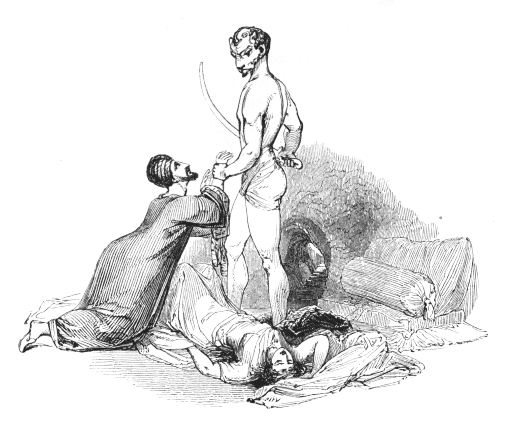
Upon this, O my mistress, I rejoiced exceedingly, and, eager to obtain his pardon, I said to him, What shall I choose from thy hands?—Choose, he answered, into what form I shall change thee; either the form of a dog, or that of an ass, or that of an ape. I replied, in my desire of forgiveness, Verily, if thou wilt pardon me, God will pardon thee in recompense for thy shewing mercy to a Muslim who hath done thee no injury:—and I humbled myself in the most abject manner, and said to him, Pardon me as the envied man did the envier.—And how was that? said he. I answered as follows:—60
THE STORY OF THE ENVIER AND THE ENVIED.
Know, O my master, that there was a certain man who had a neighbour that envied him; and the more this person envied him, so much the more did God increase the prosperity of the former. Thus it continued a long time; but when the envied man found that his neighbour persisted in troubling him, he removed to a place where there was a deserted well; and there he built for himself an oratory, and occupied himself in the worship of God. Numerous Faḳeers61 assembled around him, and he acquired great esteem, people repairing to him from every quarter, placing firm reliance upon his sanctity; and his fame reached the ears of his envious neighbour, who mounted his horse, and went to visit him; and when the envied man saw him, he saluted him, and payed him the utmost civility. The envier then said to him, I have come hither to inform thee of a matter in which thou wilt find advantage, and for which I shall obtain a recompense in heaven. The envied man replied, May God requite thee for me with every blessing. Then, said the envier, order the Faḳeers to retire to their cells, for the information that I am about to give thee I would have no one overhear. So he ordered them to enter their cells; and the envier said to him, Arise, and let us walk together, and converse; and they walked on until they came to the deserted well before mentioned, when the envier pushed the envied man into this well, without the knowledge of any one, and went his way, imagining that he had killed him.
But this well was inhabited by Jinn, who received him unhurt, and seated him upon a large stone; and when they had done this, one of them said to the others, Do ye know this man? They answered, We know him not.—This, said he, is the envied man who fled from him who envied him, and took up his abode in this quarter, in the neighbouring oratory, and who entertaineth us by his zikr62 and his readings; and when his envier heard of him, he came hither to him, and, devising a stratagem against him, threw him down here. His fame hath this night reached the Sulṭán of this city, who hath purposed to visit him to-morrow, on account of the affliction which hath befallen his daughter.—And what, said they, hath happened to his daughter? He answered, Madness; for Meymoon, the son of Demdem, hath become inflamed with love for her; and her cure is the easiest of things. They asked him, What is it?—and he answered, The black cat that is with him in the oratory hath at the end of her tail a white spot, of the size of a piece of silver; and from this white spot should be taken seven hairs, and with these the damsel should be fumigated, and the Márid would depart from over her head, and not return to her; so she would be instantly cured. And now it is our duty to take him out.
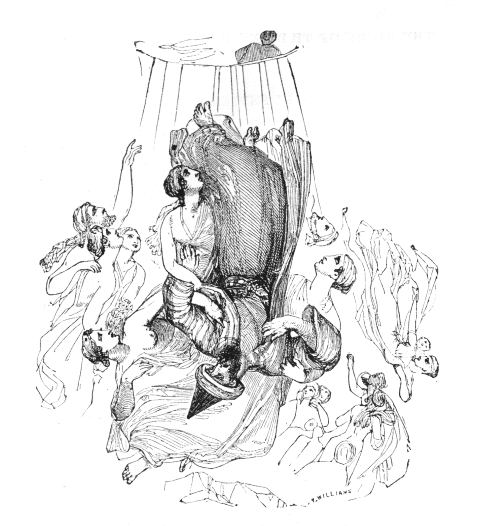
When the morning came, the Faḳeers saw the Sheykh rising out of the well; and he became magnified in their eyes. And when he entered the oratory, he took from the white spot at the end of the cat's tail seven hairs, and placed them in a portfolio by him; and at sunrise the King came to him, and when the Sheykh saw him, he said to him, O King, thou hast come to visit me in order that I may cure thy daughter. The King replied. Yes, O virtuous Sheykh.—Then, said the Sheykh, send some person to bring her hither; and I trust in God, whose name be exalted, that she may be instantly cured. And when the King had brought his daughter, the Sheykh beheld her bound, and, seating her, suspended a curtain over her, and took out the hairs, and fumigated her with them; whereupon the Márid cried out from over her head, and left her; and the damsel immediately recovered her reason, and, veiling her face, said to her father, What is this, and wherefore didst thou bring me to this place? He answered her, Thou hast nothing to fear;—and rejoiced greatly. He kissed the hand of the envied Sheykh, and said to the great men of his court who were with him, What shall be the recompense of this Sheykh for that which he hath done? They answered, His recompense should be that thou marry him to her.—Ye have spoken truly, said the King:—and he gave her in marriage to him, and thus the Sheykh became a connection of the King; and after some days the King died, and he was made King in his place.
And it happened one day that this envied King was riding with his troops, and he saw his envier approaching; and when this man came before him he seated him upon a horse with high distinction and honour, and, taking him to his palace, gave him a thousand pieces of gold, and a costly dress; after which he sent him back from the city, with attendants to escort him to his house, and reproached him for nothing.—Consider, then, O 'Efreet, the pardon of the envied to the envier, and his kindness to him, notwithstanding the injuries he had done him.63
CONTINUATION OF THE STORY OF THE SECOND ROYAL MENDICANT.
The 'Efreet, when he had heard this story, replied, Lengthen not thy words to me: as to my killing thee, fear it not; and as to my pardoning thee, covet it not; but as to my enchanting thee, there is no escape from it;—and, so saying, he clove the earth asunder, and soared with me through the sky to such a height that I beheld the world beneath me as though it were a bowl of water: then, alighting upon a mountain, he took up a little dust, and, having muttered and pronounced certain words over it, sprinkled me with it, saying, Quit this form, and take the form of an ape!—whereupon I became like an ape of a hundred years of age.
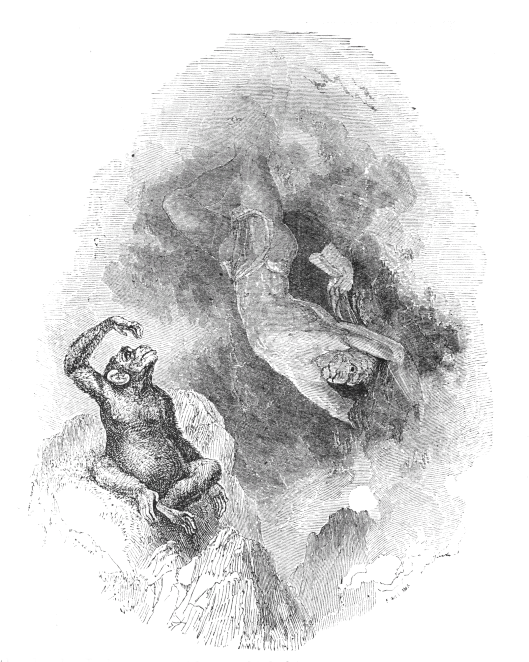
When I saw myself changed into this ugly form, I wept for myself, but determined to be patient under the tyranny of fortune, knowing it to be constant to no one. I descended from the summit of the mountain, and, after having journeyed for the space of a month, arrived at the sea-shore; and, when I had stood there a short time, I saw a vessel in the midst of the sea, with a favourable wind approaching the land; I therefore hid myself behind a rock on the beach, and when the ship came close up, I sprang into the midst of it. But as soon as the persons on board saw me, one of them cried, Turn out this unlucky brute from the ship:—another said, Let us kill him:—and a third exclaimed, I will kill him with this sword. I, however, caught hold of the end of the sword, and tears flowed from my eyes; at the sight of which the captain took compassion on me, and said to the passengers, O merchants, this ape hath sought my aid, and I give it him; he is under my protection; let no one, therefore, oppose or trouble him. He then treated me with kindness, and whatever he said to me I understood, and all that he required to be done I performed as his servant.
We continued our voyage for fifty days with a fair wind, and cast anchor under a large city containing a population which no one but God, whose name be exalted, could reckon; and when we had moored our vessel, there came to us some memlooks from the King of the city, who came on board the ship, and complimented the merchants on their safe arrival, saying, Our King greeteth you, rejoicing in your safety, and hath sent to you this roll of paper, desiring that each of you shall write a line upon it; for the King had a Wezeer who was an eminent caligraphist, and he is dead, and the King hath sworn that he will not appoint any person to his office who cannot write equally well.64 Though in the form of an ape, I arose and snatched the paper from their hands; upon which, fearing that I would tear it and throw it into the sea, they cried out against me, and would have killed me; but I made signs to them that I would write, and the captain said to them, Suffer him to write, and if he scribble we will turn him away; but if he write well I will adopt him as my son; for I have never seen a more intelligent ape. So I took the pen, and demanded the ink, and wrote in an epistolary hand this couplet:—
Fame hath recorded the virtues of the noble; but no one hath been able to reckon thine. May God not deprive mankind of such a father; for thou art the parent of every excellence.
Then, in a more formal, large hand, I wrote the following verses:—
There is no writer that shall not perish; but what his hand hath written endureth ever. Write, therefore, nothing but what will please thee when thou shalt see it on the day of resurrection.
Two other specimens I wrote, in two different and smaller hands, and returned the paper to the memlooks, who took it back to the King; and when he saw what was written upon it, the hand of no one pleased him excepting mine; and he said to his attendants, Go to the author of this hand-writing, put upon him this dress, and mount him upon a mule, and conduct him, with the band of music before him, to my presence. On hearing this order, they smiled; and the King was angry with them, and said, How is it that I give you an order, and ye laugh at me? They answered, O King, we laugh not at thy words, but because he who wrote this is an ape, and not a son of Adam: he is with the captain of the ship newly arrived.
The King was astonished at their words; he shook with delight, and said, I would purchase this ape. He then sent some messengers to the ship, with the mule and the dress of honour, saying to them, Ye must clothe him with this dress, and mount him upon the mule, and bring him hither. So they came to the ship, and, taking me from the captain, clad me with the dress; and the people were astonished, and flocked to amuse themselves with the sight of me. And when they brought me to the King, and I beheld him, I kissed the ground before him three times, and he ordered me to sit down: so I sat down upon my knees;65 and the persons present were surprised at my polite manners, and especially the King, who presently ordered his people to retire. They, therefore, did so; none remaining but the King, and a eunuch, and a young memlook, and myself. The King then commanded that a repast should be brought; and they placed before him a service of viands, such as gratified the appetite and delighted the eye; and the King made a sign to me that I should eat; whereupon I arose, and, having kissed the ground before him seven times, sat down to eat with him; and when the table was removed, I washed my hands, and, taking the ink-case, and pen and paper, I wrote these two verses:—
Great is my appetite for thee, O Kunáfeh!66 I cannot be happy nor endure without thee. Be thou every day and night my food; and may drops of honey not be wanting to moisten thee.
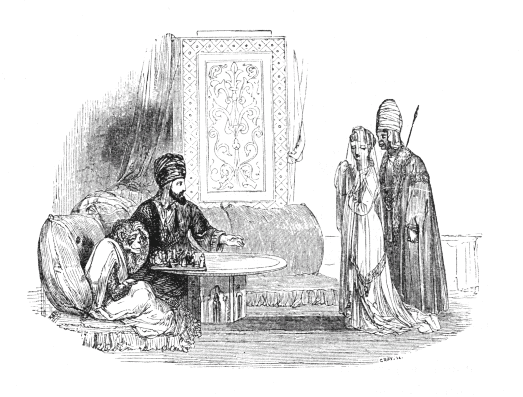
Having done this, I arose, and seated myself at a distance; and the King, looking at what I had written, read it with astonishment, and exclaimed, Can an ape possess such fluency and such skill in caligraphy? This is, indeed, a wonder of wonders!—Afterwards, a chess-table was brought to the King, and he said to me, Wilt thou play? By a motion of my head I answered, Yes:—and I advanced, and arranged the pieces.67 I played with him twice, and beat him; and the King was perplexed, and said, Were this a man, he would surpass all the people of his age.
He then said to his eunuch, Go to thy mistress, and say to her, Answer the summons of the King:—that she may come and gratify her curiosity by the sight of this wonderful ape. The eunuch, therefore, went, and returned with his mistress, the King's daughter, who, as soon as she saw me, veiled her face, and said, O my father, how is it that thou art pleased to send for me, and suffer strange men to see me?—O my daughter, answered the King, there is no one here but the young memlook, and the eunuch who brought thee up, and this ape, with myself, thy father: from whom, then, dost thou veil thy face?—This ape, said she, is the son of a King, and the name of his father is Eymár:68 he is enchanted, and it was the 'Efreet Jarjarees, a descendant of Iblees, who transformed him, after having slain his own wife, the daughter of King Aḳnámoos. This, whom thou supposedst to be an ape, is a learned and wise man.—The King was amazed at his daughter's words, and, looking towards me, said, Is it true that she saith of thee? I answered, by a motion of my head, Yes:—and wept. The King then said to his daughter, By what means didst thou discover that he was enchanted?—O my father, she answered, I had with me, in my younger years, an old woman who was a cunning enchantress, and she taught me the art of enchantment: I have committed its rules to memory, and know it thoroughly, being acquainted with a hundred and seventy modes of performing it, by the least of which I could transport the stones of thy city beyond Mount Ḳáf, and make its site to be an abyss of the sea, and convert its inhabitants into fish in the midst of it.—I conjure thee, then, by the name of Allah, said her father, to restore this young man, that I may make him my Wezeer. Is it possible that thou possessedst this excellence, and I knew it not? Restore him, that I may make him my Wezeer, for he is a polite and intelligent youth.
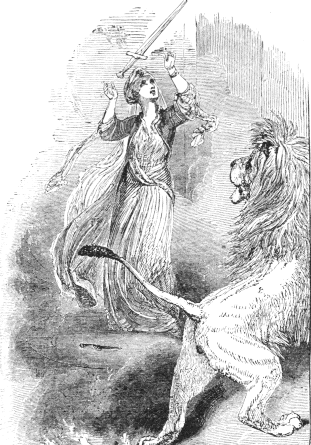
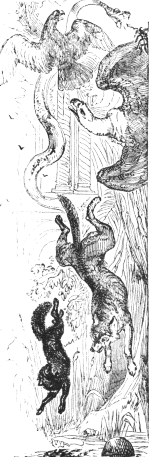
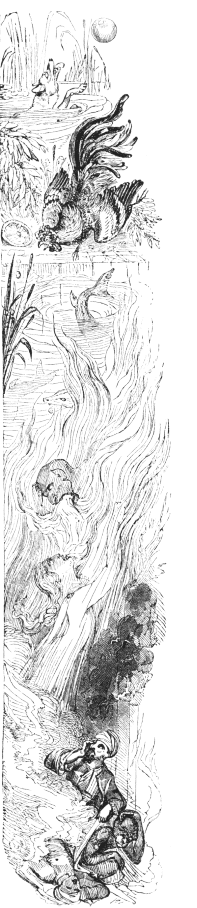
She replied, With pleasure:—and, taking a knife upon which were engraved some Hebrew names, marked with it a circle in the midst of the palace. Within this she wrote certain names and talismans, and then she pronounced invocations, and uttered unintelligible words; and soon the palace around us became immersed in gloom to such a degree, that we thought the whole world was overspread; and lo, the 'Efreet appeared before us in a most hideous shape, with hands like winnowing-forks, and legs like masts, and eyes like burning torches; so that we were terrified at him. The King's daughter exclaimed, No welcome to thee!—to which the 'Efreet, assuming the form of a lion, replied, Thou traitress, how is it that thou hast broken thine oath? Did we not swear that we would not oppose one another?—Thou wretch, said she, when didst thou receive an oath?—The 'Efreet, still in the form of a lion, then exclaimed, Take what awaiteth thee!—and, opening his mouth, rushed upon the lady: but she instantly plucked a hair from her head and muttered with her lips, whereupon the hair became converted into a piercing sword, with which she struck the lion, and he was cleft in twain by the blow; but his head became changed into a scorpion. The lady immediately transformed herself into an enormous serpent, and crept after the execrable wretch in the shape of a scorpion, and a sharp contest ensued between them; after which, the scorpion became an eagle, and the serpent, changing to a vulture, pursued the eagle for a length of time. The latter then transformed himself into a black cat, and the King's daughter became a wolf, and they fought together long and fiercely, till the cat, seeing himself overcome, changed himself into a large red pomegranate, which fell into a pool; but, the wolf pursuing it, it ascended into the air, and then fell upon the pavement of the palace, and broke in pieces, its grains becoming scattered, each apart from the others, and all spread about the whole space of ground enclosed by the palace. The wolf, upon this, transformed itself into a cock, in order to pick up the grains, and not leave one of them; but, according to the decree of fate, one grain remained hidden by the side of the pool of the fountain. The cock began to cry, and flapped its wings, and made a sign to us with its beak; but we understood not what it would say. It then uttered at us such a cry, that we thought the palace had fallen down upon us; and it ran about the whole of the ground, until it saw the grain that had lain hid by the side of the pool, when it pounced upon it, to pick it up; but it fell into the midst of the water, and became transformed into a fish, and sank into the water; upon which the cock became a fish of a larger size, and plunged in after the other. For a while it was absent from our sight; but, at length, we heard a loud cry, and trembled at the sound; after which, the 'Efreet rose as a flame of fire, casting fire from his mouth, and fire and smoke from his eyes and nostrils: the King's daughter also became as a vast body of fire; and we would have plunged into the water from fear of our being burnt and destroyed; but suddenly the 'Efreet cried out from within the fire, and came towards us upon the leewán,69 blowing fire at our faces. The lady, however, overtook him, and blew fire in like manner in his face; and some sparks struck us both from her and from him: her sparks did us no harm; but one from him struck me in my eye, and destroyed it, I being still in the form of an ape; and a spark from him reached the face of the King, and burned the lower half, with his beard and mouth, and struck out his lower teeth: another spark also fell upon the breast of the eunuch; who was burnt, and died immediately. We expected destruction, and gave up all hope of preserving our lives; but while we were in this state, a voice exclaimed, God is most great! God is most great! He hath conquered and aided, and abandoned the denier of the faith of Moḥammad, the chief of mankind!70—The person from whom this voice proceeded was the King's daughter: she had burnt the 'Efreet; and when we looked towards him, we perceived that he had become a heap of ashes.
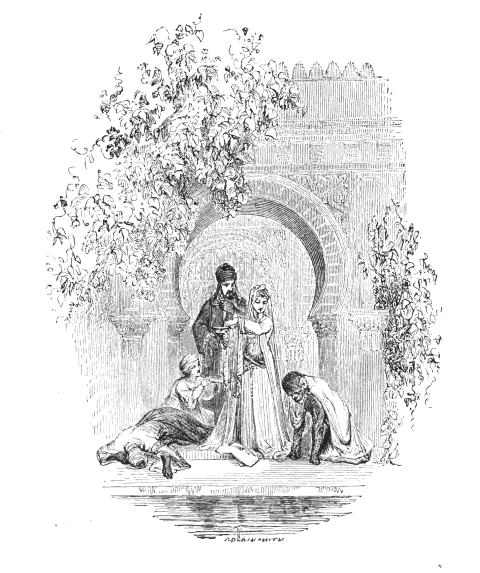
The lady then came to us, and said, Bring me a cup of water:—and when it was brought to her, she pronounced over it some words which we understood not, and, sprinkling me with it, said, Be restored, by virtue of the name of the Truth, and by virtue of the most great name of God, to thy original form!—whereupon I became a man as I was at first, excepting that my eye was destroyed. After this, she cried out, The fire! the fire! O my father, I shall no longer live, for I am predestined to be killed. Had he been a human being, I had killed him at the first of the encounter. I experienced no difficulty till the scattering of the grains of the pomegranate, when I picked them up excepting the one in which was the life of the Jinnee: had I picked up that, he had instantly died; but I saw it not, as fate and destiny had appointed; and suddenly he came upon me, and a fierce contest ensued between us under the earth, and in the air, and in the water; and every time that he tried against me a new mode, I employed against him one more potent, until he tried against me the mode of fire; and rarely does one escape against whom the mode of fire is employed. Destiny, however, aided me, so that I burned him first; but I exhorted him previously to embrace the faith of El-Islám. Now I die; and may God supply my place to you.—Having thus said, she ceased not to pray for relief from the fire; and lo, a spark ascended to her breast, and thence to her face; and when it reached her face, she wept, and exclaimed, I testify that there is no deity but God, and I testify that Moḥammad is God's Apostle!—We then looked towards her, and saw that she had become a heap of ashes by the side of the ashes of the 'Efreet.
We were plunged into grief on her account, and I wished that I had been in her place rather than have seen that sweet-faced creature who had done me this kindness reduced to a heap of ashes: but the decree of God cannot be averted. The King, on beholding his daughter in this state, plucked out what remained of his beard, and slapped his face, and rent his clothes; and I also did the same, while we both wept for her. Then came the chamberlains and other great officers of the court, who, finding the King in a state of insensibility, with two heaps of ashes before him, were astonished, and remained encompassing him until he recovered from his fit, when he informed them of what had befallen his daughter with the 'Efreet; and great was their affliction. The women shrieked, with the female slaves, and continued their mourning seven days. After this, the King gave orders to build, over the ashes of his daughter, a great tomb with a dome, and illuminated it with candles and lamps: but the ashes of the 'Efreet they scattered in the wind, exposing them to the curse of God. The King then fell sick, and was near unto death: his illness lasted a month; but after this he recovered his health, and, summoning me to his presence, said to me, O young man, we passed our days in the enjoyment of the utmost happiness, secure from the vicissitudes of fortune, until thou camest to us, when troubles overcame us. Would that we had never seen thee, nor thy ugly form, on account of which we have been reduced to this state of privation: for, in the first place, I have lost my daughter, who was worth a hundred men; and, secondly, I have suffered this burning, and lost my teeth: my eunuch also is dead: but it was not in thy power to prevent these afflictions: the decree of God hath been fulfilled on us and on thee; and praise be to God that my daughter restored thee, though she destroyed herself. Now, however, depart, O my son, from my city. It is enough that hath happened on thy account; but as it was decreed against us and thee, depart in peace.
So I departed, O my mistress, from his presence; but before I quitted the city, I entered a public bath, and shaved my beard. I traversed various regions, and passed through great cities, and bent my course to the Abode of Peace,71 Baghdád, in the hope of obtaining an interview with the Prince of the Faithful, that I might relate to him all that had befallen me.
The third mendicant then advanced, and thus related his story:—
THE STORY OF THE THIRD ROYAL MENDICANT.
O illustrious lady, my story is not like those of my two companions, but more wonderful: the course of fate and destiny brought upon them events against which they could not guard; but as to myself, the shaving of my beard and the loss of my eye were occasioned by my provoking fate and misfortune; and the cause was this:—
I was a King, and the son of a King; and when my father died, I succeeded to his throne, and governed my subjects with justice and beneficence. I took pleasure in sea-voyages; and my capital was on the shore of an extensive sea, interspersed with fortified and garrisoned islands, which I desired, for my amusement, to visit; I therefore embarked with a fleet of ten ships, and took with me provisions sufficient for a whole month. I proceeded twenty days, after which there arose against us a contrary wind; but at daybreak it ceased, and the sea became calm, and we arrived at an island, where we landed, and cooked some provisions and ate; after which we remained there two days. We then continued our voyage; and when twenty days more had passed, we found ourselves in strange waters, unknown to the captain, and desired the watch to look out from the mast-head: so he went aloft, and when he had come down he said to the captain, I saw, on my right hand, fish floating upon the surface of the water; and looking towards the midst of the sea, I perceived something looming in the distance, sometimes black, and sometimes white.
When the captain heard this report of the watch, he threw his turban on the deck, and plucked his beard, and said to those who were with him, Receive warning of our destruction, which will befall all of us: not one will escape! So saying, he began to weep; and all of us in like manner bewailed our lot. I desired him to inform us of that which the watch had seen. O my lord, he replied, know that we have wandered from our course since the commencement of the contrary wind that was followed in the morning by a calm, in consequence of which we remained stationary two days: from that period we have deviated from our course for twenty-one days, and we have no wind to carry us back from the fate which awaits us after this day: to-morrow we shall arrive at a mountain of black stone, called loadstone: the current is now bearing us violently towards it, and the ships will fall in pieces, and every nail in them will fly to the mountain, and adhere to it; for God hath given to the loadstone a secret property by virtue of which everything of iron is attracted towards it. On that mountain is such a quantity of iron as no one knoweth but God, whose name be exalted; for from times of old great numbers of ships have been destroyed by the influence of that mountain.72 There is, upon the summit of the mountain, a cupola of brass supported by ten columns, and upon the top of this cupola is a horseman upon a horse of brass, having in his hand a brazen spear, and upon his breast suspended a tablet of lead, upon which are engraved mysterious names and talismans: and as long, O King, as this horseman remains upon the horse, so long will every ship that approaches be destroyed, with every person on board, and all the iron contained in it will cleave to the mountain: no one will be safe until the horseman shall have fallen from the horse.—The captain then wept bitterly; and we felt assured that our destruction was inevitable, and every one of us bade adieu to his friend.
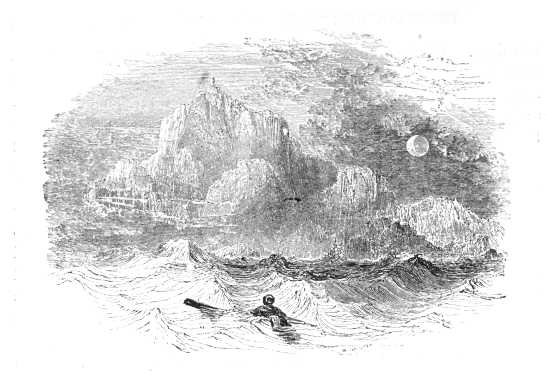
On the following morning we drew near to the mountain; the current carried us towards it with violence, and when the ships were almost close to it, they fell asunder, and all the nails, and every thing else that was of iron, flew from them towards the loadstone. It was near the close of day when the ships fell in pieces. Some of us were drowned, and some escaped; but the greater number were drowned, and of those who saved their lives none knew what became of the others, so stupefied were they by the waves and the boisterous wind. As for myself, O my mistress, God, whose name be exalted, spared me on account of the trouble and torment and affliction that He had predestined to befall me. I placed myself upon a plank, and the wind and waves cast it upon the mountain; and when I had landed, I found a practicable way to the summit, resembling steps cut in the rock: so I exclaimed, In the name of God!—and offered up a prayer, and attempted the ascent, holding fast by the notches; and presently God stilled the wind and assisted me in my endeavours, so that I arrived in safety at the summit. Rejoicing greatly in my escape, I immediately entered the cupola, and performed the prayers of two rek'ahs73 in gratitude to God for my preservation; after which I slept beneath the cupola, and heard a voice saying to me, O son of Khaṣeeb,74 when thou awakest from thy sleep, dig beneath thy feet, and thou wilt find a bow of brass, and three arrows of lead, whereon are engraved talismans: then take the bow and arrows and shoot at the horseman that is upon the top of the cupola, and relieve mankind from this great affliction; for when thou hast shot at the horseman he will fall into the sea; the bow will also fall, and do thou bury it in its place; and as soon as thou hast done this, the sea will swell and rise until it attains the summit of the mountain; and there will appear upon it a boat bearing a man, different from him whom thou shalt have cast down, and he will come to thee, having an oar in his hand: then do thou embark with him; but utter not the name of God; and he will convey thee in ten days to a safe sea, where, on thy arrival, thou wilt find one who will take thee to thy city. All this shall be done if thou utter not the name of God.
Awaking from my sleep, I sprang up, and did as the voice had directed. I shot at the horseman, and he fell into the sea; and the bow having fallen from my hand, I buried it: the sea then became troubled, and rose to the summit of the mountain, and when I had stood waiting there a little while, I beheld a boat in the midst of the sea, approaching me. I praised God, whose name be exalted, and when the boat came to me, I found in it a man of brass, with a tablet of lead upon his breast, engraven with names and talismans. Without uttering a word, I embarked in the boat, and the man rowed me ten successive days, after which I beheld the islands of security, whereupon, in the excess of my joy, I exclaimed, In the name of God! There is no deity but God! God is most great!—and as soon as I had done this, he cast me out of the boat, and sank in the sea.
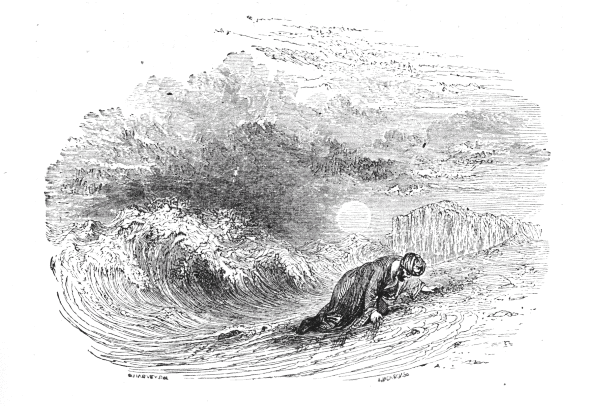
Being able to swim, I swam until night, when my arms and shoulders were tired, and, in this perilous situation, I repeated the profession of the faith, and gave myself up as lost; but the sea rose with the violence of the wind, and a wave like a vast castle threw me upon the land, in order to the accomplishment of the purpose of God. I ascended the shore, and after I had wrung out my clothes, and spread them upon the ground to dry, I slept; and in the morning I put on my clothes again, and, looking about to see which way I should go, I found a tract covered with trees, to which I advanced; and when I had walked round it, I found that I was upon a small island in the midst of the sea; upon which I said within myself, Every time that I escape from one calamity I fall into another that is worse:—but while I was reflecting upon my unfortunate case, and wishing for death, I beheld a vessel bearing a number of men. I arose immediately, and climbed into a tree; and lo, the vessel came to the shore, and there landed from it ten black slaves bearing axes. They proceeded to the middle of the island, and, digging up the earth, uncovered and lifted up a trap-door, after which they returned to the vessel, and brought from it bread and flour and clarified butter and honey and sheep and everything that the wants of an inhabitant would require, continuing to pass backwards and forwards between the vessel and the trap-door, bringing loads from the former, and entering the latter, until they had removed all the stores from the ship. They then came out of the vessel with various clothes of the most beautiful description, and in the midst of them was an old sheykh, enfeebled and wasted by extreme age, leading by the hand a young man cast in the mould of graceful symmetry, and invested with such perfect beauty as deserved to be a subject for proverbs. He was like a fresh and slender twig, enchanting and captivating every heart by his elegant form. The party proceeded to the trap-door, and, entering it, became concealed from my eyes.75
They remained beneath about two hours, or more; after which, the sheykh and the slaves came out; but the youth came not with them; and they replaced the earth, and embarked and set sail. Soon after, I descended from the tree, and went to the excavation. I removed the earth, and, entering the aperture, saw a flight of wooden steps, which I descended; and, at the bottom, I beheld a handsome dwelling-place, furnished with a variety of silken carpets; and there was the youth, sitting upon a high mattress, with sweet-smelling flowers and fruits placed before him. On seeing me, his countenance became pale; but I saluted him, and said, Let thy mind be composed, O my master: thou hast nothing to fear, O delight of my eye; for I am a man, and the son of a King, like thyself: fate hath impelled me to thee, that I may cheer thee in thy solitude. The youth, when he heard me thus address him, and was convinced that I was one of his own species, rejoiced exceedingly at my arrival, his colour returned, and, desiring me to approach him, he said, O my brother, my story is wonderful: my father is a jeweller: he had slaves who made voyages by his orders, for the purposes of commerce, and he had dealings with Kings; but he had never been blest with a son; and he dreamt that he was soon to have a son, but one whose life would be short; and he awoke sorrowful.76 Shortly after, in accordance with the decrees of God, my mother conceived me, and when her time was complete, she gave birth to me; and my father was greatly rejoiced: the astrologers, however, came to him, and said, Thy son will live fifteen years: his fate is intimated by the fact that there is, in the sea, a mountain called the Mountain of Loadstone, whereon is a horseman on a horse of brass, on the former of which is a tablet of lead suspended to his neck; and when the horseman shall be thrown down from his horse, thy son will be slain: the person who is to slay him is he who will throw down the horseman, and his name is King 'Ajeeb,77 the son of King Khaṣeeb. My father was greatly afflicted at this announcement; and when he had reared me until I had nearly attained the age of fifteen years, the astrologers came again, and informed him that the horseman had fallen into the sea, and that it had been thrown down by King 'Ajeeb, the son of King Khaṣeeb; on hearing which, he prepared for me this dwelling, and here left me to remain until the completion of the term, of which there now remain ten days. All this he did from fear lest King 'Ajeeb should kill me.