OCTOBER.
Reading edition
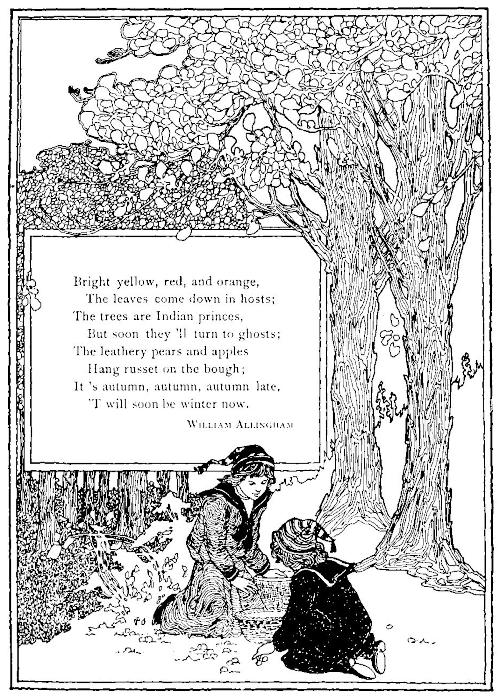
Bright yellow, red, and orange, The leaves come down in hosts; The trees are Indian princes, But soon they’ll turn to ghosts; The leathery pears and apples Hang russet on the bough; It’s autumn, autumn, autumn late, ’Twill soon be winter now. William Allingham.
HIAWATHA’S CANOE.
Hiawatha, the young Indian chief, lived in the woods, by the Big Sea Water. He wanted to make a canoe.
He said to the Birch-tree, “Take off your white cloak, for the summer is coming, and you will not need it.”
The Birch-tree waved its branches in the wind and said, “Take my cloak, O Hiawatha!”
So Hiawatha cut the beautiful white bark from the tree.
Then he said to the Cedar, “Give me your branches, so my canoe will be strong.”
There was a cry from the top of the Cedar, but it said, “Take my branches, O Hiawatha!”
So Hiawatha cut them off and bent them, to make a frame for his canoe.
“Give me your roots, O Larch-tree,” Hiawatha said, “to hold the ends of my canoe together.”
The Larch-tree said sadly, “Take them all, O Hiawatha!”
Hiawatha pulled up the roots of the Larch-tree, and sewed the bark together. Then he said to the Fir-tree, “Give me your balm, so that the water may not come into my canoe.”
And the tall dark Fir-tree said, “Take my balm, O Hiawatha!”
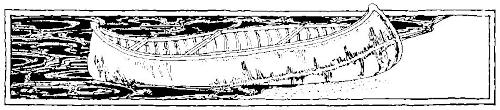
So Hiawatha made his birch canoe. And it lay upon the water like a yellow leaf in autumn.
Henry W. Longfellow’s “Hiawatha.” (Adapted).
HIAWATHA’S SAILING.
“Give me of your bark, O Birch-Tree! Of your yellow bark, O Birch-Tree! Growing by the rushing river, Tall and stately in the valley! I a light canoe will build me, That shall float upon the river Like a yellow leaf in Autumn, Like a yellow water-lily!” Henry Wadsworth Longfellow.
LADY GRAY.
One summer Robert and his father and mother lived in a little house in the woods.
They saw a squirrel running about in the trees.
Robert put some nuts on the ground and hid behind a tree. Soon the squirrel came and carried them away.
The next day he put the nuts nearer the house. The squirrel came again and carried them away.
So it went on for some time. Each day Robert put the nuts nearer the house.
They named the squirrel Lady Gray.
One day Robert’s mother sat down in a chair on the porch. She put some nuts on the floor and kept very still.
After a while Lady Gray came up on the porch. She looked at Robert’s mother, then she took a nut and ran away as fast as she could.
By and by Lady Gray became so gentle that she would hunt for nuts in their pockets.
One morning Father put a nut on his shoulder. Lady Gray jumped on Father’s shoulder and ate the nut. How they all laughed.
II
The next summer Robert went again to the little house in the woods.
Robert’s father wanted the house to look pretty, so he painted it white and green.
In the morning Robert called out, “Mother! Mother! See what the squirrels have done!”
The porch was covered with marks of little feet.
Lady Gray saw Robert and came up on the porch. A baby squirrel was with her. They named it Little Son.
Soon Little Son was as gentle as Lady Gray. Sometimes he would let them put their hands on his soft fur.
One day Robert was out walking with his father. They saw a hole in an old tree.
Robert’s father held him up so that he could put his hand in the hole. The squirrel’s nest was almost full of nuts.
All summer Robert had good times, playing with Lady Gray and Little Son.
THE ELVES AND THE SHOEMAKER.
There was once a kind old shoemaker who was very poor. He had leather to make only one pair of shoes.
He cut these out and went to bed. The next morning the shoes were standing ready upon the table.
The shoemaker sold them and bought leather to make two pairs of shoes.
He cut these out, and again found the shoes made when he got up in the morning.
He sold the shoes and bought leather to make four pairs. The work he cut out was always done in the morning.
One evening the shoemaker said to his wife, “I should like to sit up to-night and see who it is that makes the shoes.”
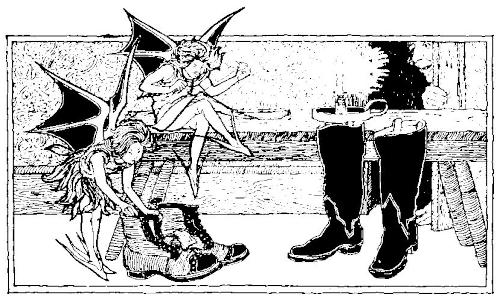
In the night two little elves ran in. They sewed and rapped and tapped so quickly that the shoes were made long before morning. Then the elves ran away.
The next day the shoemaker’s wife said, “These elves have made us rich. I should like to do something for them. You make each of them a little pair of shoes, and I will make them some clothes.”
On Christmas eve they put the shoes and the clothes on the table. Then they hid behind the door to see what the elves would do.
When the elves saw the clothes, they quickly put them on. They laughed and danced and jumped about.
At last they danced out of the door and across the grass and were seen no more. But the kind shoemaker and his wife lived a long and happy life.
Jacob and William Grimm (Adapted).
HALLOWE’EN.
Big Brother Ben, Sister Polly and little Martha sat talking together under the old oak-tree.
Father went out to see what the children were doing.
“Oh, Father,” said Polly, “to-night is Hallowe’en!”
“May we have some pumpkins to make Jack-o’-lanterns?” asked Ben.
“Yes,” said Father. “Come with me.”
They went down to the corn-field and each chose a yellow pumpkin.
Brother Ben cut a round piece out of the stem-end of each pumpkin. The little girls then went to work to dig out the pumpkins.
After this Brother Ben cut eyes, nose, and mouth on the outside. The last thing was to make a little hole in which to set a candle.
“How would you like a bonfire to-night?” asked Father.
This pleased Brother Ben so much that he threw his cap in the air and cried,
“Hurrah! Hurrah! Hurrah!”
II
When evening came Father and Brother Ben made a large bonfire near the corn-field.
They all sat around the bonfire and ate the good things which Mother and Sister Polly carried down in a basket.
Father showed them how to toast apples, pop corn and roast nuts in the fire.
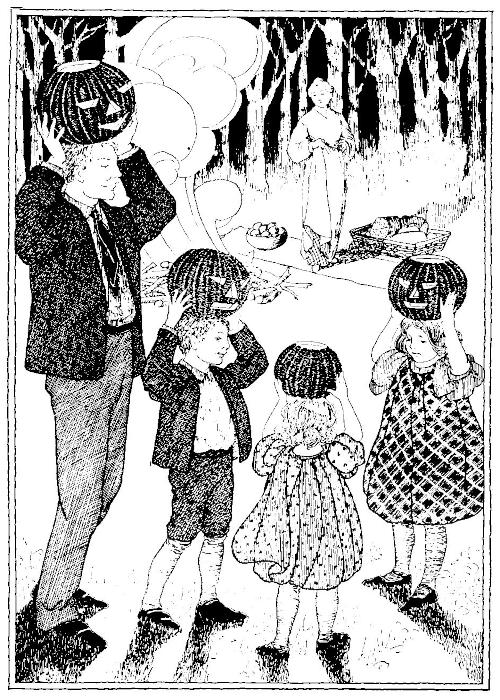
“Now let us march around with the pumpkins on our heads,” said Brother Ben.
Mother sat on a rug and watched them. After a while little Martha joined her and soon the rug held them all.
“Please, Mother, tell us a story,” said little Martha.
Mother told them about the brownies and elves who come out on Hallowe’en to help the farmer, and all the busy people who work for us.
“I know a story about them, Mother,” said little Martha.
“Let us hear it, dear,” said Mother.
So little Martha told them about the Elves and the Shoemaker.
“I’ll tell about Cinderella and her Pumpkin Coach,” said Polly.
Father told them the story of Mondamin and his gift of corn to the Indians.
“I can say the poem,” said Brother Ben. “We learned it in school.”
Brother Ben gave the poem so well that they were all very still for a few moments.
Then Mother said softly, “It is bedtime now.”
As they turned away from the fire Polly said, “The Jack-o’-lanterns were fun, but I like the stories best of all.”
POP-CORN SONG.
In they drop with a click, clack, click, Kernels so hard and yellow; ’Round they whirl with a hop, skip, hop, Each little dancing fellow. Up they leap, with a snap, crack, snap, Tossing so light and airy; Out they pour with a soft, swift rush, Snowballs fit for a fairy. Sophia T. Newman.
PHILEMON AND BAUCIS.
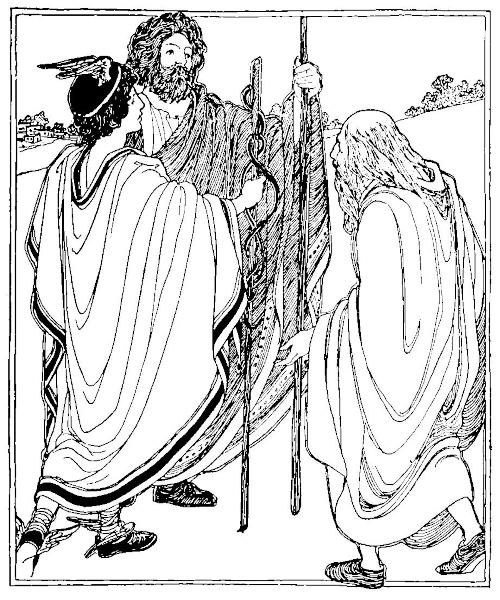
A long time ago, on a high hill, lived old Philemon and his good wife Baucis.
They were poor, but they were two of the kindest old people that ever lived. Often they went without their supper to give it to some traveler.
One evening, Philemon and Baucis sat on their door-step looking at the sunset.
Soon they saw two travelers coming up the hill. Some children ran after them, shouting and setting their dogs on them.
“Come, Wife,” said Philemon. “Let us go and meet these travelers.”
“You go to them,” said Baucis, “while I get them some bread and milk.”
Philemon went to meet the travelers and said, “Welcome, strangers! Welcome!”
He asked them to come in to supper. Baucis gave the travelers bread and milk and honey.
On the table stood a pitcher half full of milk.
The travelers quickly drank the milk.
“What good milk!” said one of them. “May I have a little more, kind Baucis?”
“I am sorry,” said Baucis, “but there is no more milk.”
“Why,” said the traveler, “here is more milk!”
He took the pitcher and filled both bowls.
Baucis looked into the pitcher, and saw the white milk running in from the side. Soon it was full.
“May I have some bread, Mother Baucis,” said the traveler, “and a little of that honey?”
Baucis cut him some and found that the bread was no longer old and hard as it was when she and Philemon ate of it.
And, oh, the honey! It was better than any honey they had ever eaten.
“Who are you, wonderful travelers?” said Philemon.
“Your friends, my good Philemon. After this the pitcher will always be full of milk for you and Baucis, and for poor travelers.”
II
The next morning the travelers asked Philemon and Baucis to walk with them and show them the road.
When Philemon and Baucis turned to go back, the older traveler said, “Good Philemon and Baucis, you gave us not only milk and bread but also a kind welcome. Ask for anything you want, and you shall have it.”
Philemon and Baucis looked at each other and said, “Grant that we may die together.”
“You shall have your wish,” said the traveler. “Now look at your home.”
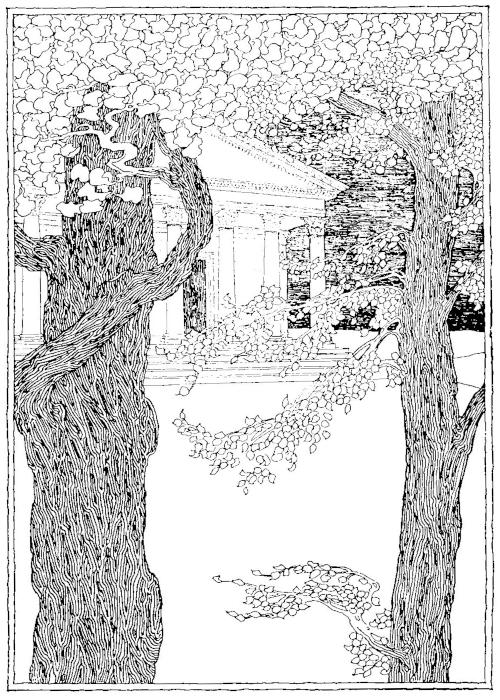
They saw a beautiful white castle standing where their little house had been.
The old people fell on their knees to give thanks. When they looked up, the travelers were not there.
Philemon and Baucis lived in the castle a long, long time. One morning they could not be found.
The people looked everywhere for them. At last they saw two large trees standing in front of the castle.
One was an oak, the other was a linden-tree. The people wondered where they came from. Just then the wind began to blow, and the trees seemed to be talking.
“I am Philemon,” said the Oak.
“I am Baucis,” said the Linden.
Whenever a traveler rested under the trees, the leaves seemed to say, “Welcome, dear traveler! Welcome!”
Nathaniel Hawthorne (Adapted).