JUNE.
Reading edition
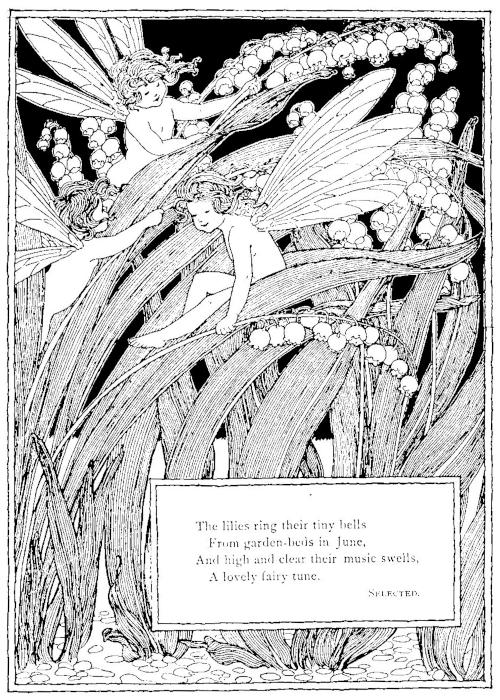
The lilies ring their tiny bells From garden-beds in June, And high and clear their music swells, A lovely fairy tune. Selected.
THUMBLING.
There was once a woman who had no little child. So one day she went to see a Wise Fairy.
“I wish for a tiny, little child,” she said. “Can you tell me where I can get one?”
“Here is a grain of corn,” said the Wise Fairy. “Plant it in a flower-pot. Then you will see what is to be seen.”
“Thank you,” said the woman.
Then she went home and planted the corn in a flower-pot.
The next day a large flower came up. It looked like a tulip bud.
The woman kissed the red and yellow leaves. As she kissed it the flower opened with a loud snap.
In the middle of the tulip there was a little tiny girl. She was only an inch high. So they named her Thumbling.
II
“Thumbling must have a cradle,” said the woman. So she made her one out of a walnut shell.
Thumbling slept on the blue velvet leaves of a violet. Her cover was a pink rose leaf.
One night a great Ugly Toad hopped in at the window.
“What a pretty little girl!” she said. The Ugly Toad took the walnut shell and hopped down into the garden. A brook ran through the garden.
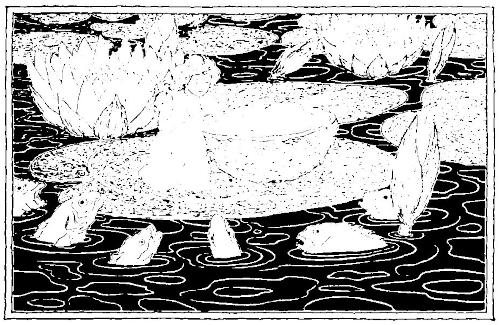
“I will put her out in the brook on a water-lily leaf,” said the Ugly Toad. “Then she cannot get away.”
On the largest leaf the Toad laid the walnut shell. Thumbling was in it fast asleep.
In the morning Thumbling awoke and began to cry. The Fishes looked up and saw poor little Thumbling.
“Why are you crying, little girl?” they said.
“I do not want to live with the Ugly Toad,” said Thumbling.
“Live with the Toads?” said the Fishes. “No, that must never be.”
They cut the stem of the lily leaf with their sharp teeth.
The lily leaf floated down the brook and carried Thumbling away from the Ugly Toads.
III
By and by a large May-bug came flying along.
He caught Thumbling with his long claws. Then he flew with her into a tree. How frightened little Thumbling was!
Soon many other May-bugs came into the tree, to look at poor frightened little Thumbling.
“Why!” said one. “She has no claws.”
“She has only two legs,” said another. “She should have six.”
“How ugly she is!” said all the others.
When the May-bug heard this he flew down with her from the tree. He set her upon a large daisy and left her there.
All summer Thumbling lived alone in the great woods.
She wove a bed out of the leaves of grass. She hung the bed under a large leaf to keep out the rain.
Thumbling ate the honey from the flowers. She drank the dew that stood every morning upon the leaves.
Then winter came, and it began to snow. Poor little Thumbling! She was very cold.
IV
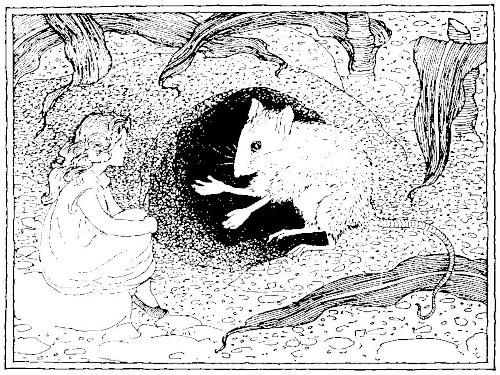
A Field Mouse lived in a corn-field close to the woods.
“I will ask the Field Mouse for something to eat,” she said.
Poor Thumbling stood at the door like a little beggar girl.
“You dear child!” said the Field Mouse. “Come into my warm house. You may eat dinner with me.”
“Would you like to stay with me all winter?” said the Field Mouse.
“You may keep my house clean, and you may tell me pretty stories.”
The winter was long and cold. But Thumbling was happy with the kind Field Mouse.
V
One day Thumbling found a poor bird lying near the Field Mouse’s door. Thumbling was very sorry. She thought the bird was dead.
“Poor little Swallow!” she said. “You must not lie on the cold snow.”
Thumbling wove a mat of hay. Then she laid it over the Swallow. She found some soft wool and made a warm bed.
“Good-by, you pretty little Swallow,” she said.
Then Thumbling laid her head against the bird. The Swallow moved. It was not dead. It was only cold.
The Swallow opened its eyes and looked at Thumbling.
“Thank you, pretty child,” he said. “I am warm now. Soon I shall fly about in the bright sunshine.”
“Oh!” said Thumbling. “You cannot live out of doors. Cold winter is here. You must stay in the Field Mouse’s home.”
The Field Mouse did not like birds. But she liked Thumbling and wished to make her happy.
So all winter the Swallow lived in the Field Mouse’s warm home.
VI
At last spring came.
“I must go now,” said the Swallow. “Will you go with me, Thumbling? You may sit upon my back and I will fly out into the bright sunshine.”
“No!” said Thumbling. “The kind Field Mouse will be sorry to have me leave her.”
“Good-by, then, dear little Thumbling,” said the Swallow.
“No, no!” said Thumbling. “I will go with you. I do not like to live in the dark ground when it is so beautiful above.”
Thumbling sat upon the Swallow’s back. Then he flew high up into the air.
By and by they came to a warm country.
A large white flower was growing in a garden. The Swallow flew down and set Thumbling upon one of its broad leaves.
VII
In the middle of the flower she saw a little tiny man. He was no larger than Thumbling.
The tiny man was as pure and white as if made of glass. He had a gold crown on his head and bright wings on his shoulders.
He was the King of the flower fairies.
“Oh, how beautiful he is!” said Thumbling to the Swallow.
The fairy King was glad to see Thumbling. He took off his crown and put it on her head.
“You shall be Queen of all the flower fairies,” he said.
How happy every one was! Out of every flower came a tiny flower fairy.
Each one brought the Queen a gift, but the one she liked best was a pair of golden wings.
When she put these on she could fly from flower to flower.
“You shall not be called Thumbling,” said the fairy King. “That is an ugly name. We will call you Maia.”
Hans Christian Andersen (Adapted).
MIDSUMMER NIGHT.
When the moon shines, and the stars are bright, and the warm winds blow, the fairies meet together. They come from everywhere.
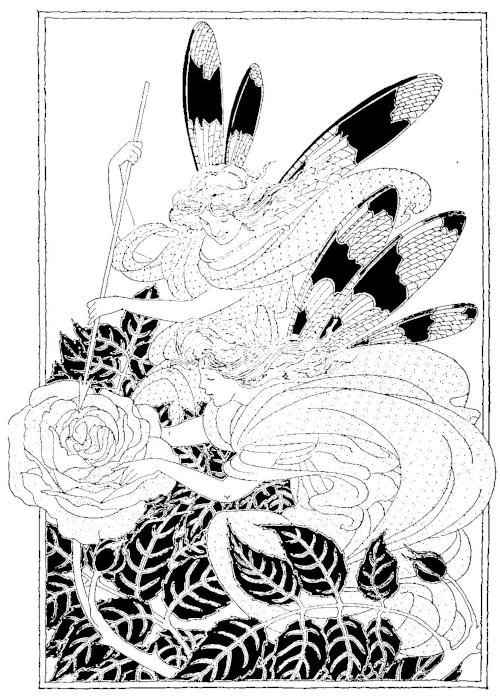
The fairy queen, Titania, sends one to hang pearls of dew on the flowers. She sends another to kill the worms that are eating the roses. She sends others to frighten away the birds that cry at night.
When Titania lies down upon a bed of cowslips, the fairies sing her to sleep.
Other fairies wait upon Oberon, the king. The one he likes best is Puck.
Puck is the merriest fairy of all. He plays all sorts of tricks to make the king laugh.
The fairies dance merrily together in the moonlight. But when they are frightened they hide in acorn cups.
The king and the queen and all their fairies stay in the woods through the summer night. But when they first see the sunlight, they fly away, and follow darkness around the world.
Shakespeare’s “Midsummer Night’s Dream” (Adapted).
THE TEETER.
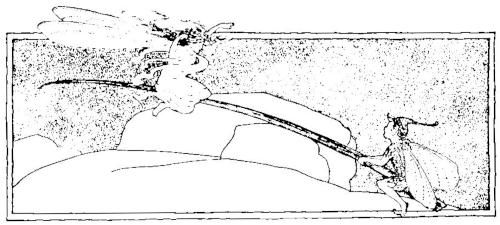
Said the brownest little Brownie, To the weest little Fairy, “Won’t you come along And play a while with me?” Said the weest little Fairy To the brownest little Brownie, “Tell me what you want to play, Then I will see!” So this sprightly happy fellow Found the broadest blade of grass, And balanced it upon a mossy stone. And those little fairy children Teetered gaily up and down, Up and down all the afternoon alone. Maud Burnham.
THE NIXIE’S MUSIC.
Little Nils was born on Sunday.
His mother told him that the fairies always liked a Sunday child. They would help him to be a great and good man.
She said that if he were kind and true, he would see the Nixie sometime. Then the Nixie would grant him three wishes.
Nils wanted to see the Nixie more than anything else. Many a time he sat by the water where the Nixie lived and listened for her music.
Sometimes on midsummer nights he thought he could hear it. But he could not see the Nixie nor tell her his three wishes.
“Perhaps I am not good enough,” thought Nils. Then he tried to be kind to the birds and animals. He was also very gentle with his little sister.
He knew what his three wishes would be, when he saw the Nixie.
First he wanted to be wise; then he wanted to be famous. But most of all he wanted a violin, so that he could play the Nixie’s music.
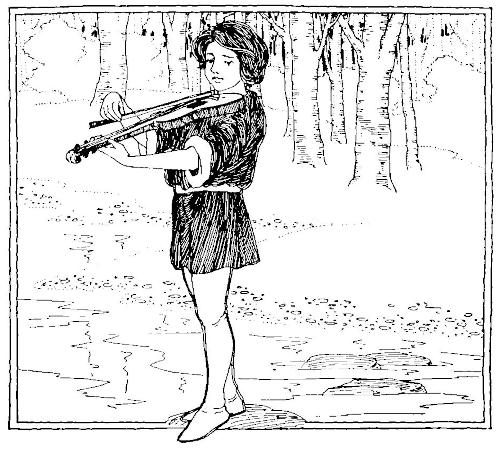
One day he asked the schoolmaster to let him take his violin.
The kind old man listened to Nils’s story. Then he said, “I will teach you to play the violin.”
After a few lessons, Nils tried to play the Nixie’s music. But though his ears could hear it, his fingers could not play it.
II
After a while the old schoolmaster died and left his violin to Nils.
Nils played on it all the time when he was not at work in the woods with his father.
The people said that he could play the Nixie’s music. They came from far and near to hear it. But Nils knew that he could not play it, although he could still hear it.
He played at all the feasts. He made more money with his violin than he did when he worked in the woods.
When he grew to be a man, he was very gentle and kind. People came to him when they were sad and wanted help. They called him Wise Nils.
Once two men were traveling through the country. They came to hear Nils play.
The travelers had never heard such beautiful music. They asked Nils to go with them and play in many countries.
“No!” Nils answered. “I must stay here. My people need me.”
III
A few weeks after the men went away, a large box came to Nils. He opened it and found that the travelers had sent him a beautiful violin.
As he drew the bow over the strings, Nils said, “Now I can play the Nixie’s music.”
He ran down to the water, for it was Midsummer Night. That is the time when Nixie always plays the loudest.
After a while he heard the soft music. But when he tried to play it the music was gone. Sadly he put his violin down.
Should he never see the Nixie and tell her his three wishes?
Then he said to himself, “But I have my first wish, for the people call me Wise Nils. And I might have been famous, if I had gone with the men.”
Then he thought of his third wish. He picked up his dear violin, and held it lovingly in his arms.
Hjalmar Hjorth Boyesen (Adapted).