MAY.
Reading edition
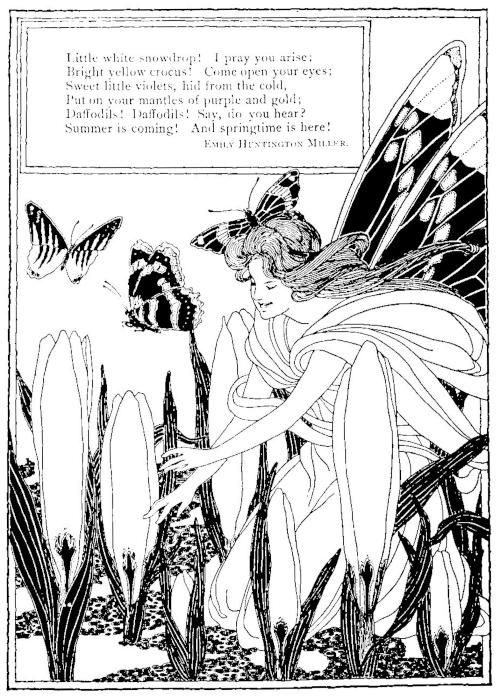
Little white snowdrop! I pray you arise; Bright yellow crocus! Come open your eyes; Sweet little violets, hid from the cold, Put on your mantles of purple and gold; Daffodils! Daffodils! Say, do you hear? Summer is coming! And springtime is here! Emily Huntington Miller.
MARY’S MEADOW.
Mary liked to plant flowers beside the road and in the fields.
She told her father that she wanted to make people happy who had no gardens. So Father called her The Traveler’s Joy.
But Mary liked best of all to play in the Squire’s meadow. It was filled with beautiful flowers and singing birds.
Mary cried when her father told her that he and the Squire were no longer friends. He said she must not play in the meadow with the Squire’s great dog, Saxon.
One day, the gardener gave Mary some pretty cowslips. She forgot what her father had told her, and ran down to the Squire’s meadow to plant them.
Soon she heard a loud shout. She looked up and saw the old Squire running toward her. With one hand he held his dog, Saxon, who was trying to get away.
Mary was so frightened that she did not hear what the Squire was saying. She told him that she was not digging up his cowslips, but planting them.
Just then Saxon came running toward her. The Squire stopped shouting to her, and called to Saxon. He did not know that Mary and Saxon were such good friends.
Mary threw her arms around Saxon’s neck, and began to cry. Then she picked up her basket and ran home as fast as she could.
Every day she thought the old Squire would come and tell her father. But he never came.
II
The next spring it was great fun to look for the flowers which The Traveler’s Joy had planted.
One day Mary’s father sent for her. When she came home, she found the old Squire talking to her father. He held some cowslips in his hand.
He gave them to Mary, and said, “My dear, I am sorry that I sent you out of the meadow.”
“But I was not digging up your cowslips,” Mary said.
The old Squire put his hand on her head. “I know, my child,” he said. “You are The Traveler’s Joy.”
“I am glad the cowslips grew,” Mary said. “I hope they will grow all over your meadow.”
Then the Squire said, “It is not my meadow now. I have given it away.”
“Oh, please, please, do not give it away!” cried Mary. “Can’t I play there with Saxon, and plant flowers?”
The Squire smiled at her father, and said, “Yes, Mary! You may play, and plant, and do what you like there.”
Father put his arm around the little girl. “You do not know what the Squire means. Do you, dear?” he said. “The Squire has given it to you. Now we shall always call it Mary’s Meadow.”
Juliana Horatio Ewing’s “Mary’s Meadow” (Adapted).
THE MAY PARTY.
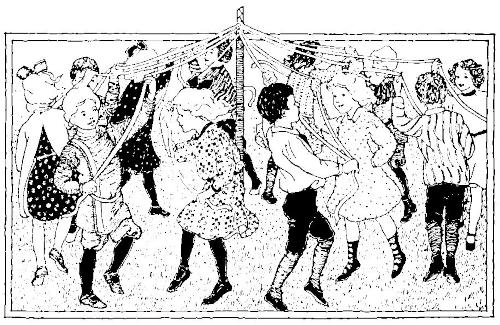
A bright, happy crowd of children marched to the woods for a May party.
First came two boys carrying a May-pole to which bright ribbons were tied.
Then came the May Queen with a crown of flowers on her head, and a long wand in her hand.
The girls marched behind the May Queen, carrying the pretty May baskets which they had made. The boys were waving flags and blowing horns.
When they came to the woods, the boys set up the May-pole and all the children danced around it.
In and out they went weaving the bright ribbons. The girls went to the left, the boys to the right. They bowed as they passed each other, and sang the pretty May-pole song.
Soon the pole was wound with the bright ribbons.
Then some of the children ran down to the water to sail boats, and others went up, up, in the swings.
The older girls set the table. What a beautiful table it was! There were sandwiches, and oranges, and cakes, and nuts, and candy.
After the children had eaten all the good things, they went through the woods gathering flowers.
They filled the pretty baskets with flowers, and stood them side by side. But the children could not tell which they liked the best.
That night, when it was dark, each girl and boy put a basket on the door-step of a friend, then rang the bell and ran away.
They had such a good time that they wished May-day came oftener than once a year.
COME, MY DOLLY.
Come, my Dolly, come with me, Dance beneath the apple-tree. See the blossoms flying down, Wings of pink and rosy crown. Catch them, Dolly, in your gown, While the sun sees you and me Dancing ’neath the apple-tree. Some day, Dolly, you will see Snow upon the apple-tree; White wings then will flutter down, Covering leaves all dry and brown. But, my Dolly, do not frown; When spring comes again, you’ll see Pink wings on the apple-tree. Lydia Avery Coonley-Ward.
PROSERPINA.
It was harvest-time and the grain was ready to be gathered.
Mother Ceres was very busy, for she had the care of every seed that grows.
She put on her hat made of poppies. Then she stepped into a chariot drawn by a pair of winged dragons.
“Dear Mother,” said Proserpina, “may I go down to the shore and play with the sea-maids?”
“Yes, child,” answered Mother Ceres, “but you must not go alone into the fields.”
The sea-maids heard Proserpina calling. Soon she saw them coming up out of the water. They made a chain of beautiful shells and hung it around Proserpina’s neck.
“How pretty it is!” said Proserpina. “Wait for me here while I run into the fields. I want to make each of you a chain of flowers.”
Proserpina’s hands were soon full of flowers. She was turning to go back, when she saw a beautiful plant near her.
“I will put it in my garden,” said Proserpina. She pulled and pulled. Soon Proserpina held the plant in her hands. She was surprised to see the deep hole which its roots left in the ground.
II
The hole grew deeper and wider, and Proserpina heard a loud noise under the ground.
Four black horses jumped out of the hole, drawing a golden chariot. In it sat a very dark man, with a crown of diamonds on his head.
The man caught Proserpina in his arms, and shouted to his horses. They went so fast that they seemed to fly through the air.
Proserpina was frightened and called out, “Mother! Mother Ceres! Come quickly and help me!”
But Mother Ceres was a great way off, and could not hear her cry.
“I will not harm you,” said the man. “I am King Pluto. All the gold and silver under the ground belong to me.
“I will give you a garden full of prettier flowers than those in your hand. Where I live all the flowers are made of pearls and rubies.”
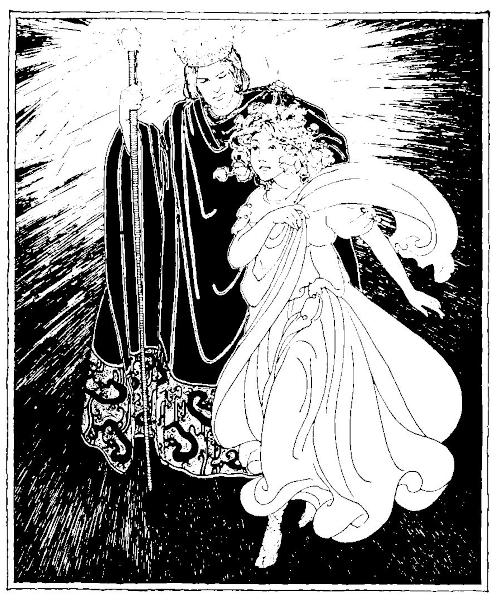
Just then Proserpina saw Mother Ceres in a field far away. She gave a loud cry, but King Pluto only made the horses go faster.
As they went under the earth it grew darker and darker. By and by they came to his castle. It was made of gold and lighted with lanterns made of diamonds. There was no sunshine in King Pluto’s country.
“Try to be happy, little Proserpina,” he said. “You may have my crown to play with. If you like, you may sit beside me and be my little queen.”
“I do not want golden castles and crowns,” sobbed Proserpina. “Please carry me back to my mother.”
Dinner was ready for them but Proserpina would eat nothing. She knew that if she ate the food or drank the water of King Pluto’s country, she could never see her mother again.
III
Mother Ceres heard Proserpina’s loud cry. She looked all around but could not see her. Then she drove home quickly, but she could not find her in the house.
She heard the sea-maids singing, and ran down to ask them about Proserpina.
“She left us this morning to gather flowers,” said one of them. “We have not seen her since.”
It was now almost dark. Mother Ceres lighted her torch, and went from house to house asking every one about her child.
Day and night for six long months she hunted for her little girl. Her torch burned dimly by day but at night it lighted her path.
At last some one told her that Proserpina had been carried off by King Pluto.
Then Mother Ceres said, “The grain shall not grow, nor the flowers bloom, until my little girl is given back to me.”
The earth turned brown, and there was no food for men nor animals. So they asked King Pluto to make the earth green by sending Proserpina home.
IV
Proserpina had grown very hungry. She had just begun to eat some fruit when King Pluto told her she could go back to her mother.
As she walked along, everything turned green. Beautiful flowers grew in her path. The cows and the sheep began to eat the grass and the birds to sing in the trees.
Mother Ceres was sitting on the door-step when she heard Proserpina say, “Here I am, Mother dear.”
How happy Mother Ceres was, to hold her little girl in her arms once more. Proserpina told her all about King Pluto’s castle.
“I was so unhappy, Mother dear,” she said, “that I did not eat anything until to-day. Then King Pluto gave me some fruit that had grown in one of your gardens.”
“Oh, my little Proserpina!” said Mother Ceres. “Why did you eat it?”
“I did not eat all of it,” said the little girl. “I swallowed only six seeds.”
“My child,” said Mother Ceres sadly, “you ate those six seeds in King Pluto’s castle. So you will have to spend six months of every year under the ground with him. While you are gone nothing shall grow. But when you come back to me in the spring, we will make the world beautiful.”
Nathaniel Hawthorne (Adapted).
HAWTHORNE AND HIS CHILDREN.
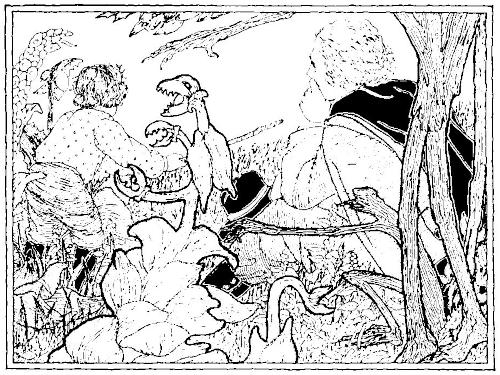
Nathaniel Hawthorne had three children. They had great fun together.
In the spring he made them boats to sail on the lake, and kites to fly in the air.
In the summer he went fishing with them and took them into the woods to gather flowers.
In the autumn they went nutting.
One day the children were standing at the foot of a tall walnut tree. Soon they heard a shout.
When they looked up the children saw their father high up in the top of the tree. Then down came the nuts! The children put them into bags and carried them home.
When the snow came, their father took them coasting. Sometimes as they went down the hill they fell into the snow.
Then how they shouted and laughed!
Hawthorne liked to take long walks with his son. The little boy thought that his father was the best playmate in the world.
Once when they were out walking, they passed through some tall grass and weeds. They played these were giants and dragons which had to be cut down.
Hawthorne struck so hard that he broke his cane. Then he sat down and watched the little boy fighting with the giants and dragons.
Hawthorne loved children so much that he wrote books for them.
His three children loved his stories. They read his Wonder Book and Tanglewood Tales so often that they knew them almost by heart.