APRIL.
Reading edition
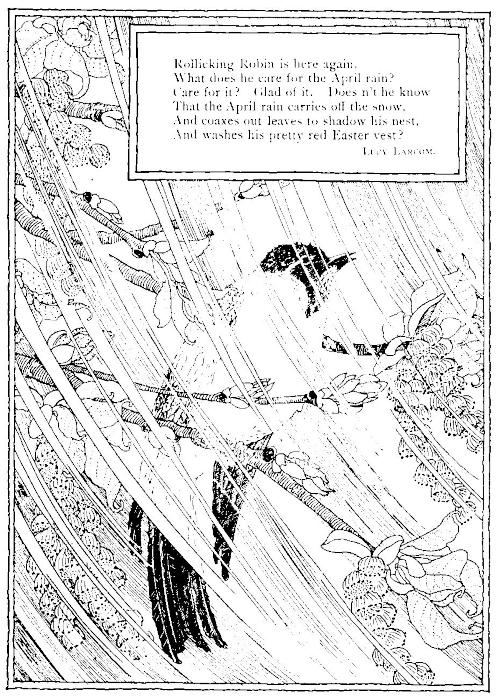
Rollicking Robin is here again. What does he care for the April rain? Care for it? Glad of it. Doesn’t he know That the April rain carries off the snow. And coaxes out leaves to shadow his nest, And washes his pretty red Easter vest? Lucy Larcom.
THE SLEEPING PRINCESS.
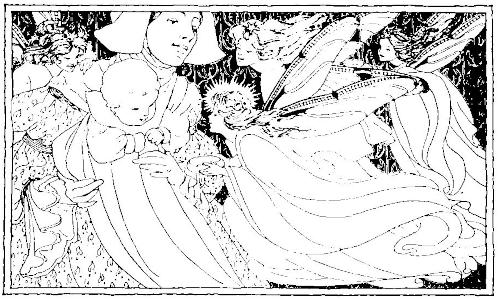
Once upon a time there lived a king and a queen who had no children.
They were so happy when a little daughter came that they gave a great feast.
The king asked the fairies to come because he wished them to be kind and good to the little princess.
There were thirteen fairies in the land. But the king had only twelve golden dishes. So one fairy was not asked to come to the feast. This made her very angry.
The twelve fairies came and gave all their best gifts to the little princess.
Just then the door opened and the angry fairy came into the room.
“When the princess is fifteen years old she shall prick her finger with a spinning needle and die,” said the angry fairy.
But there was one kind fairy who had not made her wish.
“No!” she said. “The princess shall not die. She shall fall asleep for a hundred years.”
The king and the queen were frightened. So they said that no spinning-wheel should be used in all the land.
II
One day, when the princess was fifteen years old, she went into a high tower of the castle. There sat an old woman spinning.
“Good morning,” said the princess. “What are you doing?”
“I am spinning,” said the old woman.
“Oh,” cried the princess, “how I should like to spin!”
The old woman gave the needle to the princess. She pricked her finger and fell back fast asleep.
The king and the queen and every one in the castle fell asleep.
The fire in the kitchen stopped burning and the cook fell asleep.
The horses in the barn went to sleep.
The dogs stopped barking and fell asleep.
The doves on the housetop put their heads under their wings and went to sleep.
Even the flies on the walls stopped buzzing and fell asleep.
A hedge of thorns soon grew around the castle. It was so high and thick that no one could pass through it.
III
One hundred years after, a king’s son was hunting. He saw the towers of a castle far away.
He rode toward the castle and at last came to the hedge of thorns. As the prince looked he saw that it was not a hedge of thorns, but a hedge of beautiful flowers.
The prince passed through the hedge of flowers and followed a path to the castle.
He went into the castle and saw the king and the queen fast asleep.
Then he looked in all the rooms. By and by the prince came to the high tower.
There lay the princess fast asleep. She was so beautiful that the prince kissed her hand.
The princess opened her eyes and said, “My prince, I have waited for you here a hundred years.”
Then the prince and the princess went out of the high tower together.
At once the king and the queen and every one in the castle awoke.
The fire in the kitchen burned, and the cook began to get the dinner.
The horses in the barn awoke, and the dogs jumped about and barked.
The flies on the wall buzzed, and the doves flew about the housetop.
That night there was a great feast in the castle. Ever after the prince and the princess lived happily together.
Jacob and William Grimm (Adapted).
AN OPEN SECRET.
Pussy Willow had a secret That the snowdrops whispered her, And she purred it to the south wind While it stroked her velvet fur; And the south wind hummed it softly To the busy honey-bees, And they buzzed it to the blossoms On the scarlet maple-trees. And these dropped it to the wood brooks Brimming full of melted snow, And the brooks told Robin Redbreast As he chattered to and fro; Little Robin could not keep it, So he sang it loud and clear To the sleepy hills and meadows “Wake up! Cheer up! Spring is here!” Unknown.
THE FEAST OF EGGS.
There was once a princess who left her beautiful castle. She went to live in a little house in the country.
One day she told her servant to go to the village and buy some eggs for supper.
“Eggs!” said the servant. “There are no birds’ eggs.”
“I did not ask for birds’ eggs,” said the princess. “Buy hens’ eggs, of course.”
The servant shook her head and said, “We have no hens. I do not know what kind of birds they are.”
The princess thought that she would surprise the boys and the girls of the village. So she sent an old man far away.
When he came back the old man carried a chicken coop on his head.
All the children of the village ran after him. They wanted to know what he was carrying on his head.
The old man set the coop down, opened the little door, and a large rooster stepped out.
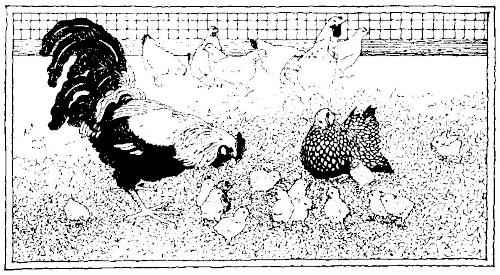
The children all cried, “Oh, what a wonderful bird that is!” They did not know what to call him.
Then out stepped the hens. There was a white one, and one that was brown, and one that had tall red combs.
The princess gave the chickens some corn. When they had eaten it the rooster crowed.
How the children laughed! “Ki-ki-ri-ki!” they cried, like the rooster.
II
The children ran home to tell about the wonderful birds that had come to live in the village.
Not long after, the princess showed the children one of the hens that was sitting.
“Fifteen eggs!” they cried. “The doves lay only two, and the other birds only five. How will the hens feed so many little ones?”
The children watched the chickens when they came out of the eggs. They were surprised that the little chickens were covered with yellow down.
“It is wonderful!” they cried. “Other little birds have no feathers. And see! They know how to run. Oh, there are no birds like them!”
By and by the princess asked the people of the village to a feast of eggs. They all sat down at a long table in the garden.
The eggs were in large baskets on the table. They were as white as snow.
The princess showed them how to break the eggs. Then she cooked them in many ways.
The people of the village liked the feast of eggs. When they went home, the princess gave them some chickens.
After that the children had merry times hunting for the white eggs.
From the German of Christoph Schmid (Adapted).
THE EASTER EGG.
On Easter Day, a princess gave a party to the children of the village.
She had no apples and nuts to give them. So she colored some eggs red, blue, and yellow.
When the children came, the princess took them into the woods. She told them to make nests out of the grass and leaves.
They left the nests under the trees. Then they went into the garden where a feast was waiting for them.
While they were eating, the princess carried the colored eggs into the woods. She filled the nests with them.
Then she went back to the children and said, “Come, now! Let us look for our nests.”
The children hunted everywhere. When they found the nests, they clapped their hands for joy. In each nest lay five colored eggs.
“Red eggs! Red eggs!” cried one. “In my nest all are red!”
“In mine are blue ones,” cried another. “All blue like the sky!”
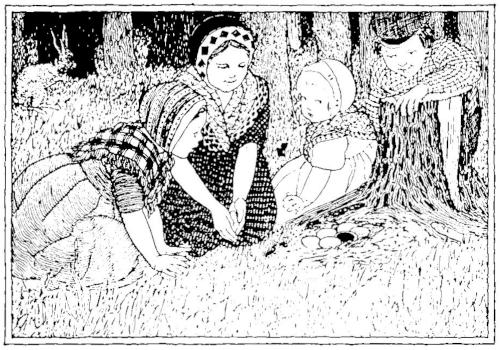
“And mine are as yellow as the butterfly that is flying around us,” said another.
“Oh,” they all cried, “how we should like to see the chickens that lay such beautiful eggs!”
“Of course hens do not lay them,” said one little girl. “Hens’ eggs are white.”
“I saw a rabbit running away from my nest,” said another. “I believe a little rabbit laid them.”
All the children laughed and said, “Yes, yes! The rabbits laid the colored eggs!”
From the German of Christoph Schmid (Adapted).
THE FARMER AND THE BIRDS.
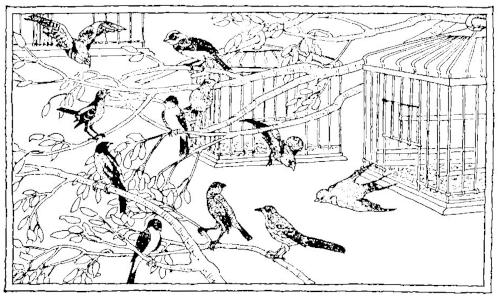
It was springtime. The birds were singing merrily as they built their nests.
But the farmers were angry. They did not want the birds to eat the corn in the fields, and the cherries on the trees.
The farmers said that all the birds must be killed. But the birds had one friend.
This friend stood up before the farmers and said, “Think of your woods and fields without the birds! Who will drive the worms from your fields and gardens?
“The birds pay you well for the grain and the cherries that they eat. What will you do without their sweet music?”
The farmers laughed and would not listen to the friend.
They sent men and boys into the fields and the woods to kill the birds. The little ones were left to die in their nests.
When summer came, there was not a bird to be seen. Hundreds of worms ate everything that grew in the gardens and fields.
That autumn there were no red and yellow leaves on the trees. The branches were dry and brown.
Then the farmers were sorry. The next spring they sent a man away to bring the birds from all the country around.
One day the man drove a wagon covered with green branches into the village. Cages filled with singing birds hung upon the branches.
The farmers opened the doors, and the birds flew out.
Once more the woods and the fields were filled with sweet music.
Suggested by Longfellow’s poem, “The Birds of Killingworth.”