DECEMBER.
Reading edition
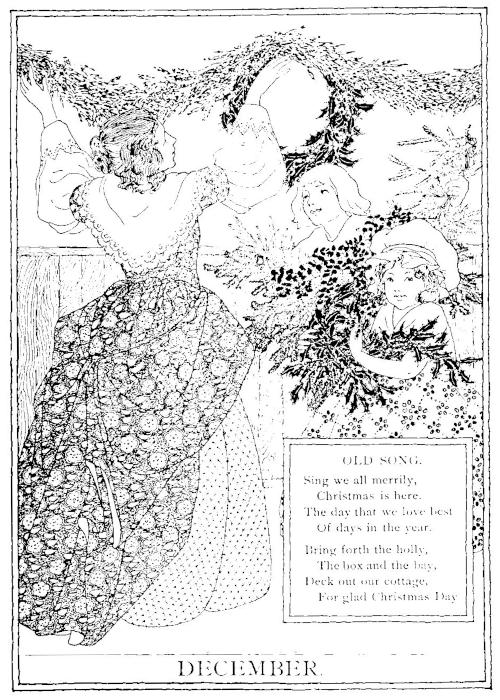
OLD SONG.
Sing we all merrily, Christmas is here. The day that we love best Of days in the year. Bring forth the holly, The box and the bay, Deck out our cottage, For glad Christmas Day.
CHRISTMAS CAROL.
And all the bells on earth shall ring, On Christmas Day, on Christmas Day, And all the bells on earth shall ring, On Christmas Day in the morning. And all the angels in heaven shall sing, On Christmas Day, on Christmas Day, And all the angels in heaven shall sing, On Christmas Day in the morning. And all the souls on earth shall sing, On Christmas Day, on Christmas Day, And all the souls on earth shall sing, On Christmas Day in the morning. Old Song.
THE BIRDS’ CHRISTMAS FEAST.
Far away across the sea, there is a very cold country.
The ground is covered with snow almost all the year, and the birds cannot get enough to eat.
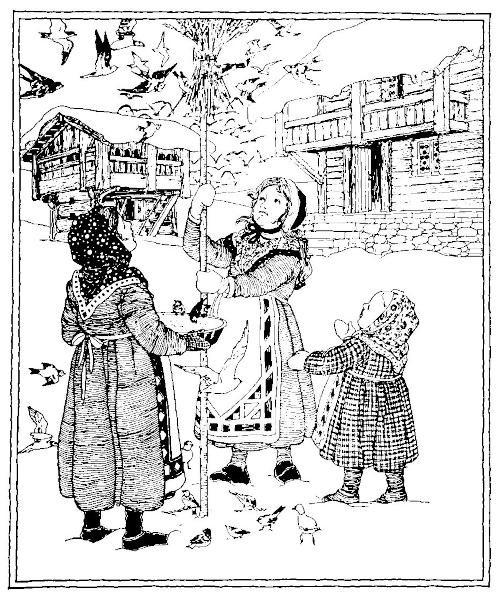
So every Christmas the children are the birds’ Santa Claus.
In the summer the children go into the fields and gather grain for the birds.
The day before Christmas such a wonderful thing happens!
Over the snow the birds come from north, south, east, and west.
They sit upon the porch, upon the roof of the house, and sometimes look in at the windows.
“Here we are, little friends!” they seem to say.
On Christmas morning, a tall pole with a bunch of grain on the top is set before every door.
Then such a twittering is heard from the birds, and such merry shouts from the children!
It would be hard to tell which has the better time, the birds or the happy children.
Suggested by Celia Thaxter’s Poem, “The Sparrows.”
PICCOLA.
Fred and May lived one winter in a country where the sun was always bright and warm.
What good times they had playing in the garden!
One day they saw a queer little girl watching them. She did not look like the little girls they played with at home.
She wore a long red dress. On her feet were little wooden shoes.
She said that her name was Piccola. She told them that she was alone all day, because her mother went out to work.
Fred and May asked her to come and play with them in the garden.
One day the children were talking about Santa Claus.
“Who is that?” asked Piccola.
“Why, Piccola!” said May. “Did you never hear of Christmas?”
“Yes,” said Piccola. “We go to church on Christmas Day, and hear beautiful singing.”
Then the children told her all about Santa Claus.
“Hang up your stocking on Christmas Eve,” said May. “He will come down the chimney and fill it with toys.”
Piccola could hardly wait to tell her mother about Santa Claus.
“I wonder what he will give me,” she said.
“Do not look for him this year, little daughter,” said her mother. “I shall be thankful if we have enough to eat.”
But Piccola knew that Santa Claus would not forget her.
II
On Christmas Eve Piccola did not have any stocking to hang up. So she put her little wooden shoe in front of the fireplace.
“I’m sure Santa Claus will not care if it is a shoe,” she said.
The next morning Piccola awoke before it was light. She ran softly to the fireplace to see what was in her shoe.
“Oh, Mother, Mother!” cried the happy little girl. “See what Santa Claus has given me!”
She ran to her mother with the shoe in her hand. A little bird had come down the chimney. There it lay in the shoe, looking up at her with its two bright eyes.
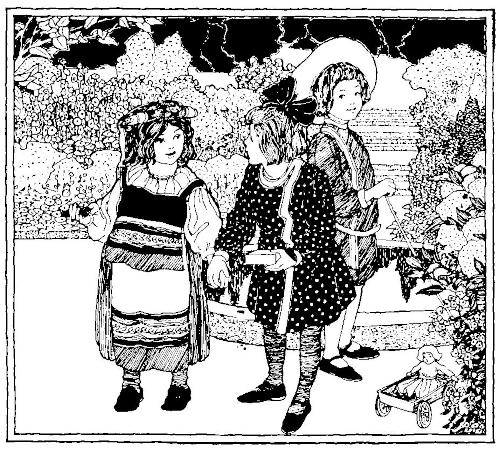
Piccola fed it and warmed it. Then she carried it into the garden to show it to Fred and May.
They gave her candy, and toys, and a doll. But Piccola liked the gift of Santa Claus best of all.
Suggested by Celia Thaxter’s Poem, “Piccola.”
THE STAR-CHILDREN.
Queen Sunshine lived in a wonderful red and blue castle.
She wore a dress of gold. Whenever she came out from her castle everything became light.
She had many children whom she loved very dearly, and they also wore dresses of gold.
Their good servant, the Moon, who followed after them, wore a dress of shining silver.
In another country across the sea lived Queen Darkness.
She always wore the same black dress. Wherever she went all things became dark.
She was alone and unhappy and often wished that she had children like those of Queen Sunshine.
One day when Queen Sunshine’s children were playing on the seashore, a little boy fell into the water.
“Oh, help me! Help me!” he cried.
One of his sisters tried to help him, and she, too, fell into the sea.
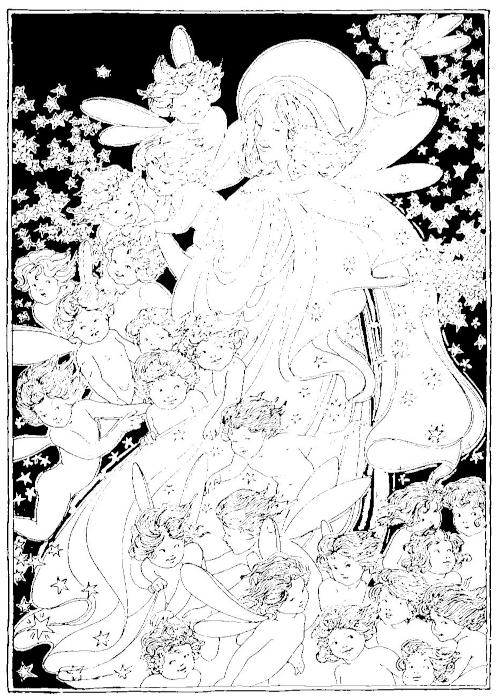
By and by, when the Moon came to take them home, not one child was on the shore. They had all fallen into the water.
The Moon looked at the sea, and saw that it was black.
“Oh!” she cried. “Queen Darkness is there! She has taken all the dear children.”
II
The Moon was so sorry for Queen Sunshine that she would not go home and tell her that Queen Darkness had taken the children.
She said to Queen Darkness, “Let me go with the children.”
Queen Darkness gladly carried their good servant, the Moon, to her dark castle to live with Queen Sunshine’s children.
She named them the Star-children. Queen Darkness always keeps the Star-children near her. The little ones are so close together that they look like a silver ribbon on her dress.
Ever since, their mother, Queen Sunshine, has been looking for her children.
Whenever she comes in her golden dress to the shore of the sea, the water is so bright that she cannot find them.
Queen Darkness does not let the Star-children go out when it is light, but once every night she leads them across the sky.
Their mother always follows after them. Sometimes she sees one of her children far away.
The kind old servant, the Moon, sometimes runs away and comes to Queen Sunshine to tell her about her children.
From the German of Fraulein Meissner (Adapted).
THE STARS.
Do you know what the little stars do at night? They play on a deep blue hill. Mother Moon watches to keep them in sight, For they’re never, never still. Do you know what the little stars do at dawn? They sink in a sun-kissed sea, And there they sleep till the day is gone, As still as still can be. May Moore Jackson.
RAPHAEL.
Long, long ago, across the sea, there lived a master artist.
He made, in clay, such beautiful bowls and vases, that people came from far and near to buy them.
Some young men lived with him. The master artist taught them how to make the same beautiful things.
One summer day, one of these young men was very sad. A little boy with golden hair ran up to him and said, “Dear Luca, why are you so unhappy?”
“Oh, Raphael!” said Luca. “The great duke wants us to paint him a bowl and a vase. The master says that the artist who makes the most beautiful one may live with him always. He will also have a gift from the duke.”
“When must the bowl and the vase be ready?” said Raphael.
“In three months,” answered Luca.
Raphael threw his arms around Luca’s neck.
“Let me try to paint them for you,” said the little boy with golden hair.
“You dear child!” cried Luca. “You are only seven years old. You cannot help me.”
Raphael was very sorry for his dear Luca.
“Oh, Luca, I love you so! Please let me try,” he said again.
Then Luca said, “You may try, Raphael. It can do no harm. I can never paint the vase and the bowl.”
II
Raphael was glad now that his father had taught him how to draw.
He was glad, too, that the master artist had taught him how to put the colors on the clay.
All through the long summer days the child worked alone. He would not let any one see his painting till it was done.
One day he showed Luca his work.
“Dear Luca, see!” he said. “There are the vase and the bowl for you to give the duke!”
Luca fell on his knees before the little boy.
“Wonderful child!” he said. “I cannot call this beautiful work mine. It would not be right.”
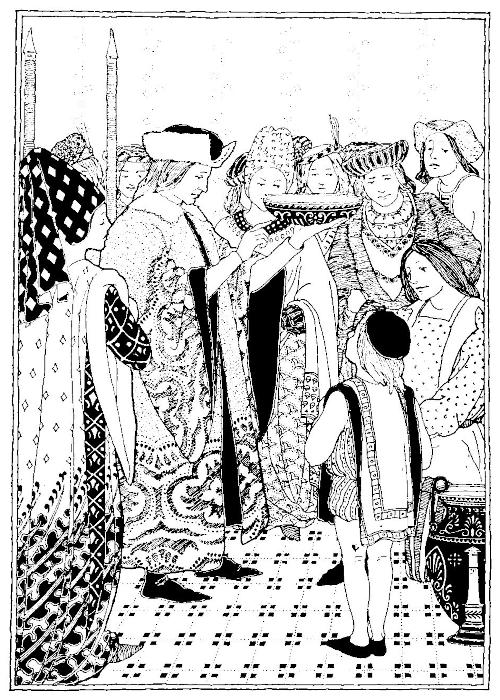
The next day the duke came to look at all the vases and the bowls.
“Here is something very beautiful,” he said, taking a bowl in his hand. “Who painted this?”
The master artist turned to the young men and said, “Who did this work?”
But no one answered.
Then a little boy with golden hair went to him. “I painted it,” he said. “I, Raphael.”
Tears of joy came into the great duke’s eyes. He took a golden chain from around his neck and gave it to Raphael.
The little boy said, “But it is Luca’s. I painted the bowl for him to give to you.”
But Luca did not hear him. He was kneeling again at the feet of the wonderful child.
Louise de la Ramée’s “The Child of Urbino” (Adapted).