JULY.
Reading edition
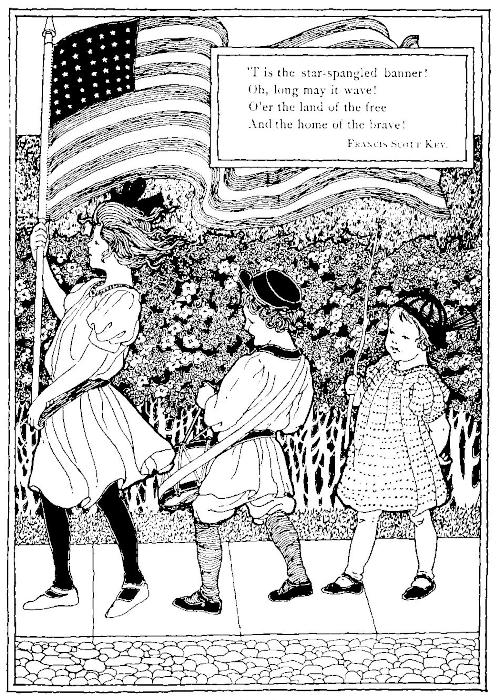
’Tis the star-spangled banner! Oh, long may it wave! O’er the land of the free And the home of the brave! Francis Scott Key.
AMERICA.
(To be memorized)
My country! ’tis of thee, Sweet land of liberty, Of thee I sing; Land where my Fathers died, Land of the Pilgrims’ pride, From ev’ry mountain side Let freedom ring. My native country, thee, Land of the noble free, Thy name I love; I love thy rocks and rills, Thy woods and templed hills, My heart with rapture thrills, Like that above. Let music swell the breeze, And ring from all the trees Sweet freedom’s song; Let mortal tongues awake, Let all that breathe partake, Let rocks their silence break, The sound prolong. Our Fathers’ God, to thee; Author of liberty, To thee we sing; Long may our land be bright With freedom’s holy light, Protect us by thy might, Great God, our King! Samuel F. Smith.
THE LIBERTY BELL.
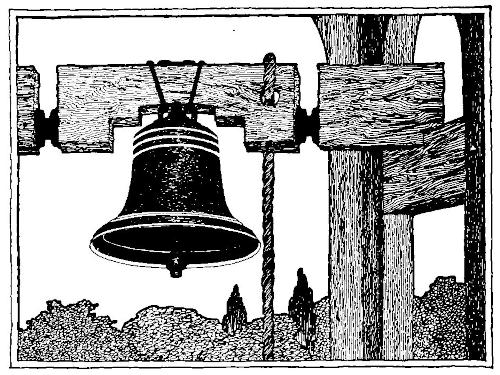
It was the Fourth of July, 1776.
For more than a year America had been at war with England.
A great and good man had written a paper saying that America must be free.
On the Fourth of July a number of wise men met in Philadelphia, to see about signing this paper.
Many people stood around the house where they met.
“Will they sign it? Will they sign it?” the people asked.
An old bell-man was in the tower ready to ring the bell. His little grandson stood below to tell him when to ring it.
Hour after hour passed, but still the old man and the little boy waited.
At last the boy shouted, “Ring, Grandpa! Ring! Oh, ring for liberty!”
The old bell rang out loud and clear. How the people shouted! Cheer after cheer went up.
For two hours the old bell-man sent out the glad news. America was free!
This was the first Fourth of July.
For many years the old bell rang out merrily on all great days. But at last a sad thing happened. A large crack was found in it.
The old bell could never ring any more. But the people loved it better than ever.
They gave it a home in Independence Hall in Philadelphia, where every year travelers go to see it.
THE SOLDIER BIRD.
One day, Chief Sky, an Indian, found an eagle’s nest with a baby eagle in it.
The Indian was poor, so he sold the eagle to a white man for some corn.
The man took it into a village where some soldiers were getting ready to go to the war.
“Here is a new soldier,” he said.
“An eagle! An eagle!” shouted the soldiers. “Let us take him to the war.”
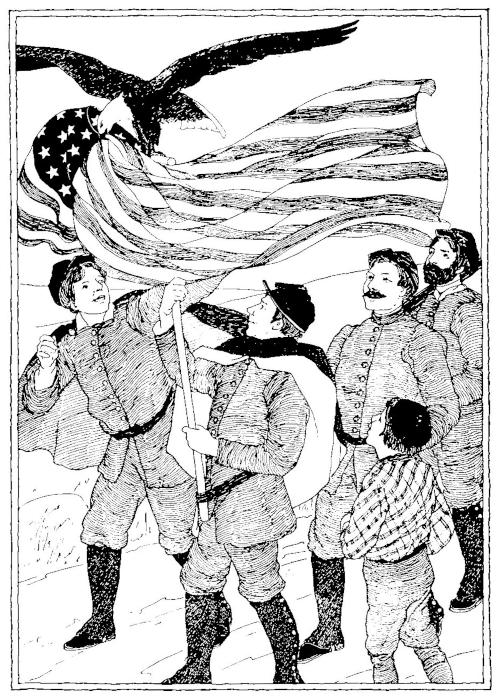
They put red, white, and blue ribbons around his neck, and named him Old Abe. They covered his perch with the American flag and marched into camp.
When the eagle heard the people cheer, he took the flag in his beak and spread his wings.
“The bird of America! The eagle of freedom!” shouted the soldiers.
II
Old Abe was carried in front of the soldiers.
Often he would spread his wings and fly far up into the sky. Then how the men cheered!
Sometimes Old Abe flew away to look for food and he would be gone for two or three days. But he always found his soldiers again.
At one time the soldiers’ food was nearly gone. For two days Old Abe had nothing to eat.
The soldiers of the other army were very near. No one could leave the camp.
Tom, the man who carried Old Abe, felt very sorry. He went to his captain and begged him to let him go out and get food for poor Old Abe.
Soon Tom came back with a good supper for his pet.
Old Abe was very fond of music, and liked to drill with the soldiers. He watched the captain and did as he was told.
At last the war came to an end. The brave eagle that had been in so many battles was taken home.
A large house was built for him. The soldier who had carried him through the war took care of him.
In this pleasant home Old Abe lived a long and happy life.
THE CALICO’S STORY.
Once I was a tiny seed covered over with a brown coat. I had many brothers and sisters.
We lived in the warm South and were kept in a strong bag.
One morning the people who lived in the house were up very early.
I heard the master say, “Tom, you may plant that cotton seed to-day.”
Cotton Seed was my name. Tom picked me up and I was soon put into a little bed close to a great river. I began to feel larger and larger.
One day my coat burst and I came up out of the ground. Wasn’t I happy then!
I had a green body and two green leaves. I stretched my head higher and higher.
II
At last I had three beautiful blossoms. Soon all my pretty leaves left me, to go with Mr. Wind.
One day the buds left by the blossoms burst open. I was covered with cotton as white as snow and as soft as silk.
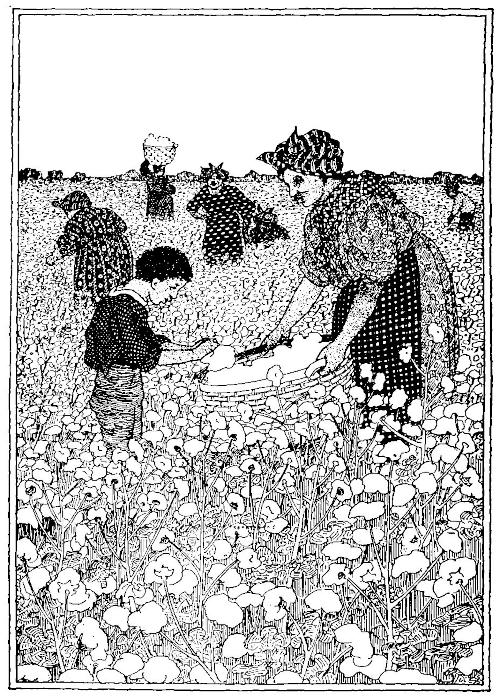
“Come, children!” I heard some one call. “We must pick the cotton.”
And the children did come. They had woolly heads and shining eyes.
One little boy cried out, “Oh! Did you ever see prettier cotton?”
His little black fingers soon picked all my white cotton.
Next I was riding in a basket on Tom’s head.
I was sorry to leave the fields, and said, “Good-by, dear old body and leaves! Good-by, dear river!”
III
A machine took away from me many little hard seeds. They looked just as I did before I went to sleep in Mother Earth.
After a while I was loaded on a ship which sailed on a great sea. By and by the ship stopped.
I was carried to a large house where I heard, “Buzz, buzz, buzz!”
A great many strange things were done to me. I was cleaned, and twisted, and spun, and woven.
At last I had become white cloth.
IV
Next I went through a printing-machine.
This machine sent me under a roller which left little red cherries all over me.
Then I went under another roller which put green stems on the cherries. It left green leaves close to the stems.
Prettier cherries you never saw!
After I left the roller I was dried, folded, and sent to a store in a city.
One day a little girl from the country came into the store. She had a basket of eggs. When she saw me she gave all of her eggs for me.
Then I was made into a pretty dress. I gave much joy to the little girl who liked to wear me to school.
The Youths’ Companion (Adapted).