FEBRUARY.
Reading edition
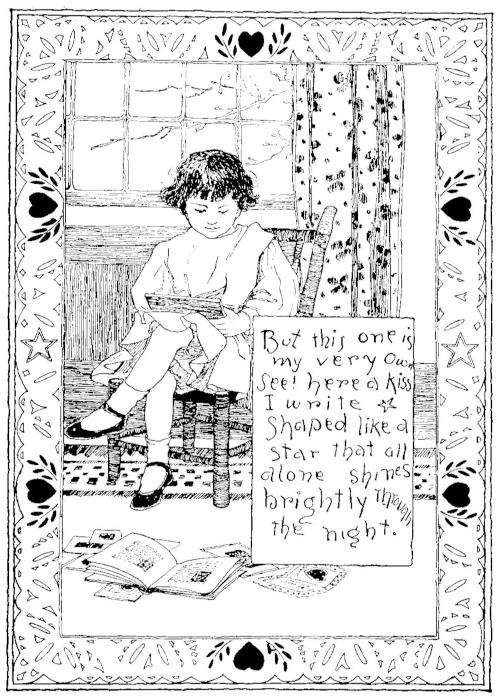
But this one is my very own. See! here a kiss I write Shaped like a star that all alone Shines brightly through the night.
A VALENTINE.
I’m making you a valentine, At least, I’m going to try, Because they don’t seem really mine Those valentines I buy. But this one is my very own. See! Here a kiss I write Shaped like a star that all alone Shines brightly through the night. Now something blue, just like the sky. And this—green like a tree, And this thing—oh, so very high!— Is just some love from me! Eve Brodlique Summers.
ABRAHAM LINCOLN.
When Abraham Lincoln was a little boy, he lived in a log house in the woods.
He could not go to school, for he worked on a farm with his father. He went to school only one year.
His mother taught him how to read and write in the evenings. When everybody had gone to bed, he would sit and read by the light of a log fire.
There were only two or three books in the house. Lincoln read them over and over.
One day a man let him take a book about George Washington. When he went to bed, Lincoln put it between the logs of the house.
When he awoke he found that the snow had fallen upon the book and spoiled it. He took it back to the man and told him he was very sorry.
The man said, “You must either pay for the book, or work three days in my corn-field.”
At the end of the three days the man said, “You are an honest boy, Abe. You may keep the book.”
II
Lincoln did not like to see any one unkind to animals.
Once, when he was a boy, Lincoln was standing on a log making a speech. The boys were clapping their hands and shouting.
One of the boys saw a turtle. He picked it up and threw it down at Lincoln’s feet. The poor turtle could not crawl away with its broken shell.
Lincoln did not like this. He jumped off the log and said, “Whoever did that is a coward!”
The boys were sorry for the poor turtle. They gently picked it up and carried it down to the water.
One day when Lincoln was a man, he saw a pig trying to get out of the mud.
Lincoln had on some new clothes. He did not want to get them muddy, so he passed on.
But he could not help thinking about the poor pig. He turned back and helped the pig out.
Lincoln became a very great man. He was so wise and kind that the people made him President.
He did so much for his country that we keep his birthday on the 12th of February.
THE FIRST FLAG.
Over one hundred years ago, there lived in Philadelphia a young woman named Betsy Ross.
From the time she was a little girl she liked to sew. When her husband died she made money by her needlework.
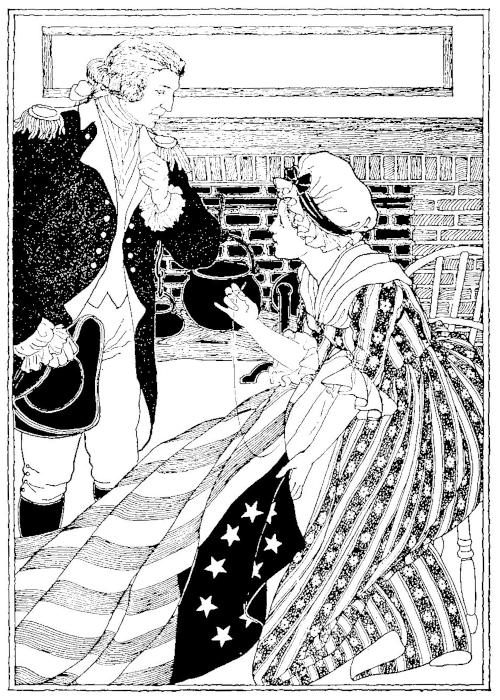
One day there came to her little brown house the great General Washington.
He wanted a new flag for his soldiers to carry in their war against the King of England.
When he heard of the beautiful needlework of Betsy Ross, he came to ask her to help him.
Together they planned a flag that had thirteen stripes and thirteen stars.
A few days later Betsy Ross showed General Washington the flag. She had cut it and sewed it with her own hands.
General Washington was so pleased that he told his soldiers to have their flags made at once.
Soon the beautiful stars and stripes were flying all over the country.
In Philadelphia, the little house where Betsy Ross lived is still standing.
LONGFELLOW’S ARM-CHAIR.
Near the poet Longfellow’s home there was a blacksmith shop. A beautiful chestnut tree grew beside it and spread its branches over the shop.
Little children often looked in at the open door on their way home from school. They liked to see the sparks fly from the anvil.
The poet Longfellow sometimes passed by the shop. He thought it was such a pretty picture that he wrote a poem about it. He called the poem “The Village Blacksmith.”
Longfellow loved the tree and felt sorry when it was cut down. He and the chestnut tree had grown old together.
About that time Longfellow had a birthday. He was an old, white-haired man.
The children wanted to show their love for him. They had the wood from the tree made into a chair and gave their pennies to pay for it.
This gift made Longfellow very happy. He thanked the children by writing a beautiful poem, called “From My Arm-Chair.”
THE ROAD OF THE LOVING HEART.
Robert Louis Stevenson wrote the beautiful poem called “Singing.” It is in a book which he named “A Child’s Garden of Verses.”
He was sick much of the time and had to live in a warm country. His home was far away in the South Seas on a beautiful island.
Robert Louis Stevenson built his house on a hillside among the large forest trees. Here the flying foxes came to rest. At night great bats flew about.
The house was three miles from the nearest town. The trees grew close and high along the path that led to it. They used packhorses to carry things from the town to the house.
A beautiful stream ran through the ground. Orange trees grew along the banks. Here Robert Louis Stevenson came to bathe and swim.
Mrs. Stevenson had a garden in which grew oranges, lemons, bananas, and breadfruit trees.
She had cows, and pigs, and chickens in the barn-yard.
Robert Louis Stevenson had a brown pony named Jack. He and Jack were great friends and had many fine rides together.
In this warm country Robert Louis Stevenson grew so much better that he once said,
“It is like a fairy story that I should become well and strong. I go boating, riding, bathing, and work hard with my wood-knife in the forest.”
II
The people on the island do not look as we do. Their skin is brown. Many bright flowers grow on the island. The women always wear flowers in their hair.
The people loved Mr. Stevenson very dearly. When they learned that he wrote stories, they named him Tusitala. That means The Story Writer.
Once some of the chiefs were put in prison. Robert Louis Stevenson did not think this was right.
He went to the prison to see the chiefs and was very kind to them.
At last the chiefs were set free. They wanted to show their love for Mr. Stevenson, so they made a road from the town to his house.
It was a hard piece of work. It took many men a long time to do it.
When the road was made the chiefs gave a great feast. All the people on the island came to it.
These are some of the words which they put on a board beside the road,
“To show our great love for Tusitala we have made this gift. It shall never be muddy. It shall go on forever, this road that we have dug.”
SINGING.
Of speckled eggs the birdie sings And nests among the trees; The sailor sings of ropes and things In ships upon the seas. The children sing in far Japan, The children sing in Spain; The organ with the organ man Is singing in the rain. Robert Louis Stevenson.