AUGUST.
Reading edition
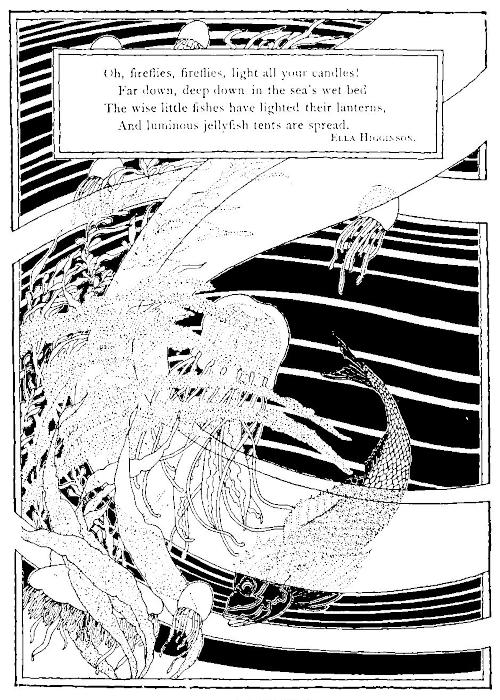
Oh, fireflies, fireflies, light all your candles! Far down, deep down in the sea’s wet bed The wise little fishes have lighted their lanterns, And luminous jellyfish tents are spread. Ella Higginson.
THE SIX LITTLE SEA-MAIDS.
Deep down in the sea, there was a beautiful red and yellow castle. Its roof was made of shells which opened and shut to let the water in and out.
There the sea king lived with his six daughters. They were pretty little girls, with long, golden hair, and blue eyes. They had no feet, but they had tails like fishes.
The sea-maids were very happy playing all day deep down in the water.
Sometimes the fish would swim through the windows of the castle. They often ate out of the hands of the little sea-maids.
Outside the castle, the sisters had a garden, where flowers grew in the blue sand.
On her fifteenth birthday, each of the little sea-maids went up through the water for the first time. The sisters promised to tell what they liked best in the world above.
The oldest sister came down to the castle and said, “I liked best to watch the lights on the land, and to hear the bells ring.”
When the second sister was fifteen years old, she went up through the water at sunset.
“I think the golden clouds are the most beautiful things in the world,” said the second sister.
The third sister went up a wide river, with green woods and hills along the shore. “I watched some children in the water,” said the sea-maid. “How can they swim? Children have no fish tails.”
The fourth sister said, “The sea is more beautiful than the land. There are white ships, and large fishes, and many strange things to be seen here.”
The birthday of the fifth sister came in the winter. The sea was green. There were large pieces of ice in it, which seemed to frighten the sailors.
The sea-maid sat down on a piece of ice, and let the wind play with her long hair.
II
The youngest sister wanted to see the world above more than any of her sisters.
When she went up through the water, she saw a large white ship filled with people.
A young prince was on the ship. It was his birthday, so there were fireworks, and music, and dancing.
The little sea-maid had never seen men and women before. So she rode on the high waves and watched them.
By and by there was a storm, and the people on the ship were frightened. Soon the ship parted, and the sea-maid saw the young prince fall into the water.
She knew that he could not live in the water. So the sea-maid went up to him and held his head above the waves. When the storm was over, she laid him down on the yellow sand.
Soon the prince opened his eyes. He was very glad to be on the land once more. He did not know that he had been saved by a little sea-maid.
Often at evening the six little sisters joined hands and went up through the water. They sang to the sailors in the ships.
“Do not be afraid,” sang the sea-maids. “It is very beautiful far down under the blue water.”
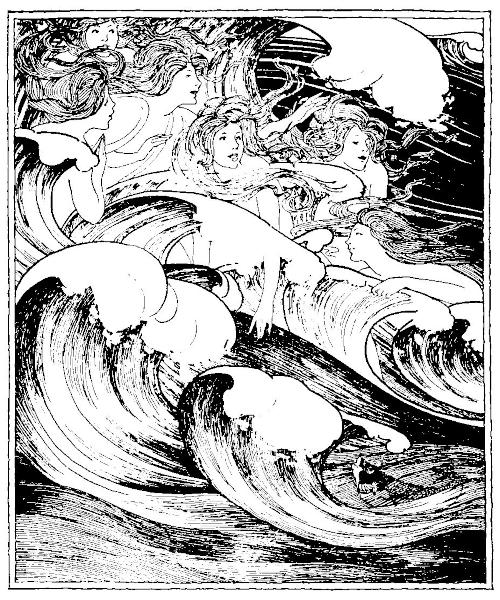
But the sailors could not hear what the sea-maids were saying. They thought the sweet music was the sound of the wind.
Hans Christian Andersen’s “A Little Sea-maid” (Adapted).
THE SINGER AND THE CRICKET.
One summer day, long ago, a great many people came together to listen to a festival of song. They sat around in bright colored tents, laughing and feasting.
By and by some one shouted, “The Mastersingers! The Mastersingers!” The people cheered them as they passed to their places.
First one and then another of the Mastersingers came forward and sang.
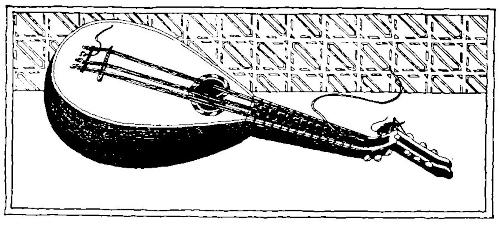
At last a young man took his lute and stood before the people. While he was singing a beautiful song of spring, one of the strings of his lute broke.
Just then a cricket jumped upon the lute. Whenever the singer touched the broken string, the cricket sang.
Those who listened did not know of the broken string. The song of the cricket was like the music of the lute.
When the song was ended, the women clapped their hands. The men waved their hats and cheered.
No one had ever heard such beautiful music. The Mastersong had been sung. They crowned the singer with flowers and hung a gold chain around his neck.
In the city where he lived there stands a beautiful statue of the Mastersinger.
In his left hand the Mastersinger holds a lute. The other hand points to a cricket that stands beside a broken string.
The statue tells us that the great man did not forget the little friend that helped him sing the Mastersong.
Suggested by Robert Browning’s poem, “The Two Poets of Crosie.”
KING SOLOMON AND THE BEES.
King Solomon was the wisest man in the world.
One day a beautiful queen came to his castle.
She had heard that King Solomon was very wise. But she did not believe that he knew everything.
The queen gave him a red rose which she had brought from the garden. She also gave him a rose that was made of red paper. They looked just alike.
“King Solomon,” she said, “you are very wise. Can you tell me at once which rose is made of paper, and which grew in the garden?”
King Solomon looked at them, but he could not tell. So he said to his servants, “Open the windows.”
Some bees flew into the room. They buzzed around the rose that grew in the garden.
King Solomon pointed to the other one. “That rose,” said he, “is made of paper.”
Then the queen thought King Solomon the wisest man in the world.
Suggested by John Saxe’s poem, “King Solomon and the Bees.”
THE LITTLE MAID OF THE LIGHTHOUSE.
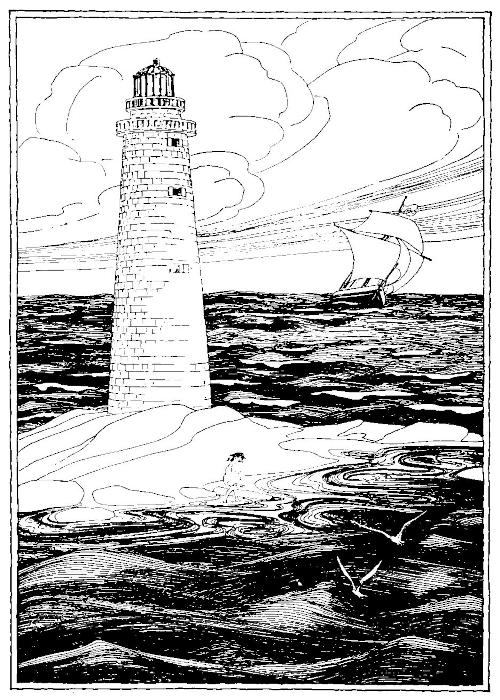
A tall lighthouse stood far out at sea, on a white rock. Once upon a time a little girl lived there with her father, mother, and two brothers.
There were no children for her to play with, and she could not go to school. But she was never sad and lonely.
She loved her rocky home, with the bright light above it, and the great sea roaring around it. She loved the sky, the sun, the moon, the stars, and the clouds.
On summer mornings, she liked to go out on the rocks and see the sun rise.
Often she made herself a crown of pink morning-glories. She put this on her head, and danced about on the rocks like a flower-fairy.
Sometimes she made chains of gold-colored shells to hang about her neck.
She liked to run into the green water in her bare feet. What fun it was!
She laughed, and sang, and danced about in the waves like a little sea-maid.
II
The winter seemed very long to the little maid in the lighthouse.
Often, when the windows were covered with frost, she put her pennies against them. Then she blew on the pennies till they were warm.
The warm pennies made holes in the frost, so that the little maid could look out on the deep blue sea.
How happy she was if a ship passed by! She wondered where it came from and where it was going.
Sometimes a sea-bird flew past, high in the sky.
Then she would call out, “Take me to ride with you, sea-bird, between your wide wings!”
Every evening she watched the lighting of the great lantern in the tower of the lighthouse. She was a proud little girl when she was old enough to light it.
Best of all she liked the evenings by the fireside with her books and playthings.
The wind roared, and the waves dashed against the rocks, but she was safe and warm.
III
When the first warm days of spring came, she made her garden.
She could hardly wait for the dry, brown seeds to grow into the flowers she loved so well.
Sometimes she made boats out of the pieces of wood on the shore.
Then she cut sailor boys out of sea wood, and put them in the boats. With merry shouts she sent them out on the great sea.
Often she sailed shell boats in the pools of water which she found in the rocks.
These pools were filled with wonderful sea plants and animals. She called them the gardens of the sea.
Celia Thaxter was the name of the little maid of the lighthouse.
When she grew to be a woman she went to live on the mainland. But the sea was always singing in her ears like a hollow shell.
She wanted others to know how beautiful it was, so she wrote many poems about the sea.
GOOD NIGHT AND GOOD MORNING.
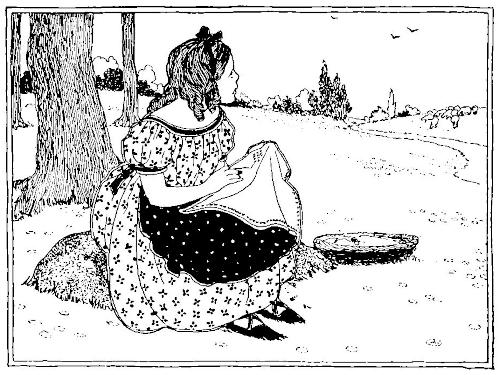
A fair little girl sat under a tree Sewing as long as her eyes could see; Then she smoothed her work and folded it right, And said, “Dear work, good night! Good night!” Such a number of rooks came over her head, Crying “Caw! Caw!” on their way to bed; She said as she watched their curious flight, “Little black things, good night! Good night!” The horses neighed and the oxen lowed, The sheep’s “Bleat! Bleat!” came over the road; All seeming to say, with a quiet delight, “Good little girl, good night! Good night!” She did not say to the sun, “Good night!” Though she saw him there like a ball of light; For she knew he had God’s time to keep All over the world, and never could sleep. The tall pink fox-glove bowed his head, The violet curtsied and went to bed; And good little Lucy tied up her hair, And said on her knees her favorite prayer. And while on her pillow she softly lay, She knew nothing more till again it was day; And all things said to the beautiful sun, “Good morning! Good morning! Our work is begun.” Lord Houghton.