JANUARY.
Reading edition
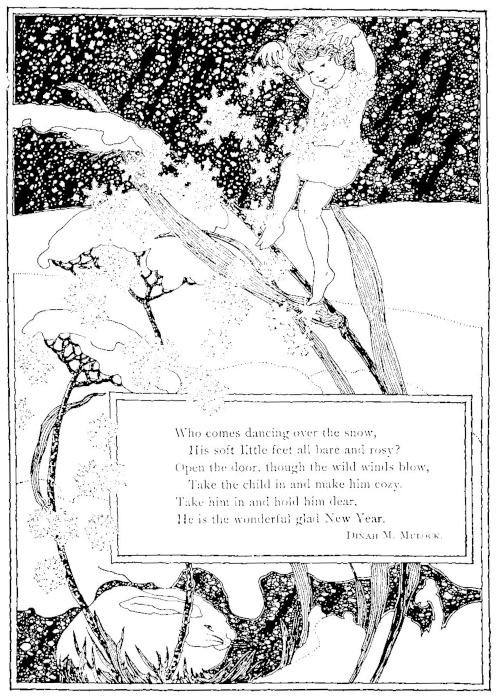
Who comes dancing over the snow, His soft little feet all bare and rosy? Open the door, though the wild winds blow, Take the child in and make him cozy. Take him in and hold him dear, He is the wonderful glad New Year. Dinah M. Mulock.
THE GREAT WHITE STOVE.
Karl had no mother and his father was very poor.
The only beautiful thing in their little house was a white stove. It was very large, and it had wonderful colored pictures all over it.
Karl and his brothers and sisters loved it dearly. In the summer they covered it with flowers.
In the winter the children sat around the stove, while Karl drew them pictures and told them stories.
One cold winter night the father came home very late. He could not find work, and the children had not enough to eat.
By and by the little ones went to bed.
Then the father told Karl and his sister that he had sold the great white stove.
“Oh, no, Father!” cried Karl. “You will not send our dear stove away.”
“I must,” said his father. “It is a wonderful stove. There is a man who will give me a great deal of gold for it. I must have gold to buy bread for my little ones.”
“Wait awhile,” said Karl. “I will help. I am sure there is work I can do.”
Karl’s father shook his head and went away. He thought such a very little boy could not help him.
All that night Karl lay on the floor beside his dear white stove.
II
In the morning the man came and carried the stove away in a wagon. Karl was so unhappy that he could do nothing but cry and cry.
“I love it so,” he said. “Better than anything on earth.”
Then he said, “I will go with it.”
He ran quickly after the wagon and climbed into it.
By and by when no one was looking, he hid inside the great white stove. It was very dark, but it was warm, and soon he was fast asleep.
When Karl opened his eyes, he wondered where he could be. He lay quite still and listened.
He traveled a long, long time. At last the stove was set down on a soft rug. Then some one said, “What a wonderful stove!”
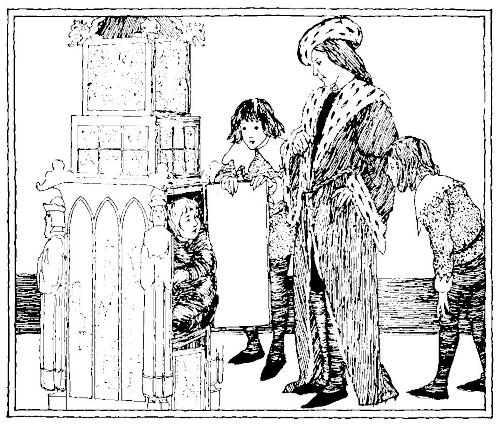
The door was opened, and Karl jumped out. He fell on his knees before a man who had a very kind face.
“Oh,” cried he, “please do not send me away! Let me stay here with my dear white stove.”
“Poor child!” said the man, as he laid his hand on Karl’s hand. “Why did you hide in the stove? Tell me for I can help you. I am the king.”
III
Karl was glad to tell the king all about the great white stove. He told him how much they all loved it. He said that they had to send it away because they had no bread to eat.
“Do let me stay with it,” he said again. “I will cut wood for it and feed it. The stove loves to have me feed it, for I have done it so long.”
“But what else do you wish to do?” said the king.
“I should like to paint pictures, beautiful pictures, like those on the stove,” said the little boy.
So the king told Karl that he could stay in the castle with the great white stove.
Karl became a great artist and painted beautiful pictures. Then the king gave him the stove.
Karl sent it back to the little house where his father still lived. He often went there to see his father and the great white stove.
He was thankful that he had traveled so far inside of the stove that winter day.
Louise de la Ramée’s “The Nurnberg Stove” (Adapted).
THE FLOCK OF DOVES.
The world was like a wilderness Of soft and downy snow; The trees were plumed with feathery flakes, And the ground was white below. Came the little mother out to the gate To watch for her children three; Her hood was red as a poppy-flower, And rosy and young was she. She took the snow in her cunning hands, As waiting she stood alone, And lo! in a moment, beneath her touch, A fair white dove had grown. A flock she wrought, and on the fence Set them in bright array, With folded wings, or pinions spread, Ready to fly away. And then she hid by the pine-tree tall, For the children’s tones rang sweet, As home from school through the drifts so light, They sped with merry feet. “O Nannie, Nannie! See the fence Alive with doves so white! Oh, hush! don’t frighten them away!” They whisper with delight. They crept so soft, they crept so still, The wondrous sight to see, The little mother pushed the gate, And laughed out joyfully. She clasped them close, she kissed their cheeks, And lips so sweet and red. “The birds are only made of snow! You are my doves,” she said. Celia Thaxter.
THE MIDNIGHT SUN.
Naka lives where it is very cold. There is snow and ice nearly all the year.
Naka lives in a queer little round house made of cakes of snow. The door is so close to the ground that she has to creep in and out on her hands and knees.
One day Naka’s mother dressed the little girl in her warm fur clothes.
She first put on stockings made of bird skins. The soft feathers kept her feet very warm. Over the stockings she wore another pair made of bearskin.
Next she put on a white bearskin coat. This had a hood which she put over Naka’s short, dark hair.
It was almost noon when they crept out into the dim light.
They climbed a hill and saw the sun just rising; the beautiful, bright sun which they had not seen for so long!
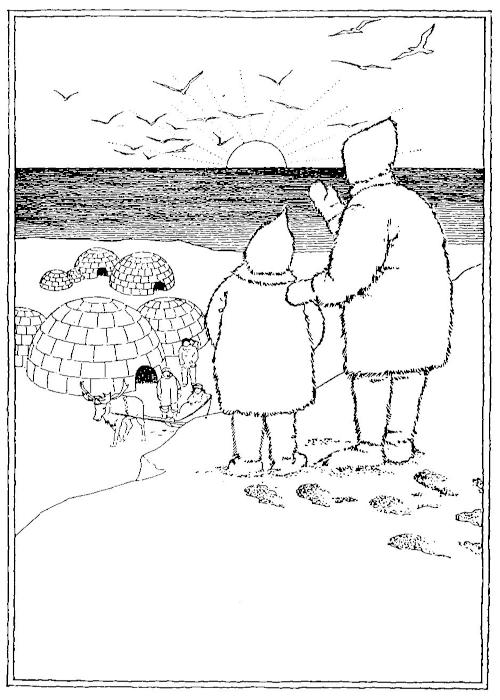
It soon went away, but the next day it came again and stayed longer. After a while it did not go away at all.
All day and all night the bright sun was shining on the earth. Naka had a merry time playing in the warm sunshine.
She ran about on the soft green grass and picked the pretty flowers.
She found some berries one day and carried them home to her mother.
She watched the great white birds that came to lay their eggs among the rocks.
Best of all, the reindeer came back and gave her milk to drink.
By and by the sun went slowly away. But Naka was happy.
In the winter she had no sun. But the moon and the stars were bright.
Then, too, she saw again the beautiful northern lights, which are brighter than fireworks.
MICHAEL ANGELO.
Long ago in a country over the sea there lived a Grand Duke.
He had a garden in which he put some beautiful statues.
A boy artist named Michael Angelo often came there to study. One day he saw across the garden the statue of a faun that had no head.
“I will make a head for that statue,” said Angelo.
He made a head of a laughing faun. The mouth was open so that the teeth could be seen.
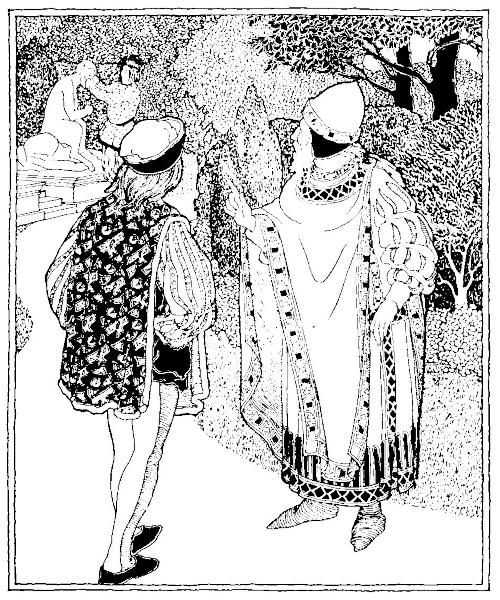
About this time the Grand Duke was walking in his garden. He stopped to look at the statue made by the boy artist.
“Well done, Angelo!” said the Grand Duke. “But, see! You have made an old faun. He should not have all his teeth.”
“That is so,” said Angelo, and he quickly took out some of the teeth.
This pleased the Grand Duke so much that he asked Angelo to live with him in his castle.
The years Michael Angelo spent among the beautiful statues in the Grand Duke’s garden helped him to become a great artist.