Chapter XVI · ZINC, CADMIUM, AND MERCURY
George Kamensky translation
These three metals give, like magnesium, oxides RO, which form feebly energetic bases, and like magnesium they are volatile. The volatility increases with the atomic weight. Magnesium can be distilled at a white heat, zinc at a temperature of about 930°, cadmium about 770°, and mercury about 351°. Their oxides, RO, are more easily reducible than magnesia, and mercuric oxide is the most easily reducible. The properties of their salts RX2 are very similar to the properties of MgX2. Their solubility, power of forming double and basic salts, and many other qualities are in many respects identical with those of MgX2. The greater or less ease with which they are oxidised, the instability of their compounds, the density of the metals and their compounds, their scarcity in nature, and many other properties gradually change with the increase of atomic weight, as might be expected from the periodicity of the elements. Their principal characteristics, as contrasted with magnesium, find a general expression in the fact that zinc, cadmium, and mercury are heavy metals.
Zinc stands nearest to magnesium in atomic weight and in properties. Thus zinc sulphate, or white vitriol, easily crystallises with seven molecules of water, ZnSO4,7H2O. It is isomorphous with Epsom salts, and parts with difficulty with the last molecule of water; it forms double salts—for instance, ZnK2(SO4)2,6H2O—exactly as magnesium sulphate does.[1] Zinc oxide, ZnO, is a white powder, almost insoluble in water,[2] like magnesia, from which, however, it is distinguished by its solubility in solutions of sodium and potassium hydroxides.[3] Zinc chloride[4] is decomposed by water, combines with ammonium chloride, potassium chloride, &c., just like magnesium chloride, forms an oxychloride, and also combines with zinc oxide.[4 bis]
Zinc, like many heavy metals, is often found in nature in combination with sulphur, forming the so-called zinc blende,[5] ZnS. It sometimes occurs in large masses, often crystallised in cubes; it is frequently translucent, and has a metallic lustre, although this is not so clearly developed as in many other metallic sulphides with which we shall hereafter become acquainted. The ores of zinc also comprise the carbonate, calamine, and silicate, siliceous calamine.
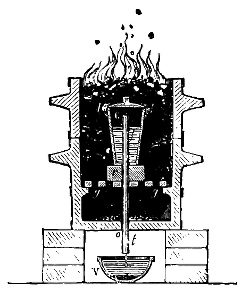
Fig. 80.—Distillation of zinc in a crucible placed in a furnace. o c, tube along which the vapour passes and condenses.
Metallic zinc (spelter) is most frequently obtained from the ores containing the carbonate[6]—that is, from calamine, which is sometimes found in thick veins: for instance, in Poland, Galicia, in some places on the banks of the Rhine, and in considerable masses in Belgium and England. In Russia beds of zinc ore are met with in Poland and the Caucasus, but the output is small. In Sweden, as early as the fifteenth century, calamine was worked up into an alloy of zinc and copper (brass), and Paracelsus produced zinc from calamine; but the technical production of the metal itself, long ago practised in China, only commenced in Europe in 1807—in Belgium, when the Abbé Donnet discovered that zinc was volatile. From that time the production increased until it is now about 150 million kilograms in Germany alone.
The reduction of metallic zinc from its ores is based on the fact that zinc oxide[7] is easily reduced by charcoal at a red heat: ZnO + C = Zn + CO. The zinc thus obtained is in a finely divided state and impure, being mixed with other metals reduced with it, but the greater portion is converted into vapour, from which it easily passes into a liquid or solid state. The reduction and distillation are carried on in earthenware retorts, filled with a mixture of the divided ore and charcoal. The vapours of zinc and gases formed during the reaction escape by means of a pipe leading downwards, and are led to a chamber where the vapours are cooled. By this means they do not come into contact with the air, because the neck of the retort is filled with gaseous carbonic oxide, and therefore the zinc does not oxidise; otherwise its vapour would burn in the air.[7 bis] The vapours of zinc, entering into the cooling chamber, condense into white zinc powder or zinc dust. When the neck of the retort is heated the zinc is obtained in a liquid state, and is cast into plates, in which form it is generally sold.
Commercial zinc is generally impure, containing a mixture of lead, particles of carbon, iron, and other metals carried over with the vapours, although they are not volatile at a temperature approaching 1000°. If it be required to obtain pure zinc from the commercial article, it is subjected to a further distillation in a crucible with a pipe passing through the bottom, the vapours formed by the heated zinc only having exit through the pipe cemented into the bottom of the crucible. Passing through this pipe, the vapours condense to a liquid, which is collected in a receiver. Zinc thus purified is generally re-melted and cast into rods, and in this form is often used for physical and chemical researches where a pure article is required.[8]
Metallic zinc has a bluish-white colour; its lustre, compared with many other metals, is insignificant. When cast it exhibits a crystalline structure. Its specific gravity is about 7—that is, varies from 6·8 to 7·2, according to the degree of compression (by forging, rolling, &c.) to which it has been subjected. It is very ductile, considering its hardness. For this reason it chokes up files when being worked. Its malleability is considerable when pure, but in the ordinary impure condition in which it is sold, it is impossible to roll it at the ordinary temperature, as it easily breaks. At a temperature of 100°, however, it easily undergoes such operations, and can then be drawn into wire or rolled into sheets. If heated further it again becomes brittle, and at 200° may be even crushed into powder, so completely does it lose its molecular cohesion. It melts at 418°, and distils at 930°.
Zinc does not undergo any change in the atmosphere. Even in very damp air it only becomes slowly coated with a very thin white coating of oxide. For this reason it is available for all objects which are only in contact with air. Therefore sheet zinc may be used for roofing and many other purposes.[9] This great unchangeability of zinc in the air shows its slight energy with regard to oxygen compared with the metals already mentioned, which are capable of reducing zinc from solutions. But zinc plays this part with regard to the remaining metals—for example, it reduces salts of lead, copper, mercury, &c. Although zinc is an almost unoxidisable metal at the ordinary temperature, it burns in the air on being heated, particularly when in the form of shavings or in the condition of vapour. At the ordinary temperature zinc does not decompose water—at any rate, if the metal be in a dense mass. But even at a temperature of 100° zinc begins little by little to decompose water; it easily displaces the hydrogen of acids at the ordinary temperature, and of alkalis on being heated.
In this respect the action of zinc varies a great deal with the degree of its purity. Weak sulphuric acid (corresponding with the composition H2SO4,8H2O) at the ordinary temperature does not act at all on chemically pure zinc, and even a stronger solution acts very slowly. If the temperature be raised, and particularly if the zinc be previously slightly heated, so as to cover the surface with a film of oxide, chemically pure zinc acts on sulphuric acid. Thus, for example, one cubic centimetre of zinc in sulphuric acid having a composition H2SO4,6H2O at the ordinary temperature in two hours only dissolves to the extent of 0·018 gram, and at a temperature of 100° about 3·5 grams. If we compare this slow action with that rapid evolution of hydrogen which occurs in the case of commercial zinc, we see that the influence of those impurities in the zinc is very great. Every particle of charcoal or iron introduced into the mass of the zinc, and likewise the connection of the zinc with a piece of another electro-negative metal, assists such a dissolution. The slowness of the action of sulphuric acid on pure zinc (and likewise on amalgamated zinc) may also be explained by the fact that a layer of hydrogen[10] collects on the surface of the metal, preventing contact between the acid and the metal.[10 bis]
The action of zinc on acids, and the consequent formation of zinc salts, interferes with its application in many cases, particularly for the preservation of liquids either containing or capable of developing acid. For this reason zinc vessels ought not to be used for the preparation or preservation of food, as this often contains acids which form poisonous salts with the zinc. Even ordinary water, containing carbonic acid, slowly attacks zinc.
Finely divided zinc, or zinc dust, obtained in the distillation of the metal when the receiver is not heated up to the melting point, on account of its presenting a large surface of contact and containing foreign matter (particularly zinc oxide), has in the highest degree the property of decomposing acids, and even water, which it easily decomposes, particularly if slightly heated. On this account zinc dust is often used in laboratories and factories as a reducing agent. A similar influence of the finely divided state is also noticed in other metals—for instance, copper and silver—which again shows the close connection between chemical and physico-mechanical phenomena. We must first of all turn to this close connection for an explanation of the widely spread application of zinc in galvanic batteries, where the chemical (latent, potential) energy of the acting substances is transformed into (evident, kinetic) galvanic energy, and through this latter into heat, light, or mechanical work.
Hermann and Stromeyer, in 1819, showed that cadmium is almost always found with zinc, and in many respects resembles it. When distilled the cadmium volatilises sooner, because it has a lower boiling point. Sometimes the zinc dust obtained by the first distillation of zinc contains as much as 5 per cent. of cadmium. When zinc blende, containing cadmium, is roasted, the zinc passes into the state of oxide, and the cadmium sulphide in the ore oxidises into cadmium sulphate, CdSO4, which resists tolerably well the action of heat; therefore if roasted zinc blende be washed with water, a solution of cadmium sulphate will be obtained, from which it is very easy to prepare metallic cadmium. Hydrogen sulphide may be used for separating cadmium from its solutions; it gives a yellow precipitate of cadmium sulphide, CdS (according to the equation CdSO4 + H2S = H2SO4 + CdS),[11] which, on account of its characteristic colour, is used as a pigment.[11 bis] Cadmium sulphide, when strongly heated in air, leaves cadmium oxide, from which the metal may be obtained in precisely the same way as in the case of zinc.
Cadmium is a white metal, and when freshly cut is almost as white and lustrous as tin. It is so soft that it may be easily cut with a knife, and so malleable that it can be easily drawn into wire, rolled into sheets, &c. Its specific gravity is 8·67, melting point 320°, boiling point 770°; its vapours burn, forming a brown powder of the oxide.[12] Next to mercury it is the most volatile metal; hence Deville determined the density of its vapours compared with hydrogen, and found it to be equal to 57·1; therefore the molecule contains one atom whose weight = 112. V. Meyer found the like for zinc; the molecule of mercury also contains one atom.
Mercury resembles zinc and cadmium in many respects, but presents that distinction from them which is always noticed in all the heaviest metals (with regard to atomic weight and density) compared with the lighter ones—namely, that it oxidises with more difficulty, and its compounds are more easily decomposed.[12 bis] Besides compounds of the usual type RX2, it also gives those of the lower type, RX, which are unknown for zinc and cadmium.[13] Mercury therefore gives salts of the composition HgX (mercurous salts) and HgX2 (mercuric salts), the oxides having the formulæ Hg2O and HgO respectively.
Mercury is found in nature almost exclusively in combination with sulphur (like zinc and cadmium, but is still rarer than them) in the form known as cinnabar, HgS (Chapter XX., Note 29). It is far more rarely met with in the native or metallic condition, and this in all probability has been derived from cinnabar. Mercury ore is found only in a few places—namely, in Spain (in Almaden), in Idria, Japan, Peru, and California. About the year 1880 Minenkoff discovered a rich bed of cinnabar in the Bahmout district (near the station of Nikitovka), in the Government of Ekaterinoslav, so that now Russia even exports mercury to other countries. Cinnabar is now being worked in Daghestan in the Caucasus. Mercury ores are easily reduced to metallic mercury, because the combination between the metal and the sulphur is one of but little stability. Oxygen, iron, lime, and many other substances, when heated, easily destroy the combination. If iron is heated with cinnabar, iron sulphide is formed; if cinnabar is heated with lime, mercury and calcium sulphide and sulphate are formed, 4HgS + 4CaO = 4Hg + 3CaS + CaSO4. On being heated in the air, or roasted, the sulphur burns, oxidises, forming sulphurous anhydride, and vapours of metallic mercury are formed. Mercury is more easily distilled than all other metals, its boiling point being about 351°, and therefore its separation from natural admixtures, decomposed by one of the above-mentioned methods, is effected at the expense of a comparatively small amount of heat. The mixture of mercury vapour, air, and products of combustion obtained is cooled in tubes (by water or air), and the mercury condenses as liquid metal.[14]
Mercury, as everybody knows, is a liquid metal at the ordinary temperature. In its lustre and whiteness it resembles silver.[15] At -39° mercury is transformed into a malleable crystalline metal; at 0° its specific gravity is 13·596, and in the solid state at -40° it is 14·39.[16] Mercury does not change in the air—that is to say, it does not oxidise at the ordinary temperature—but at a temperature approaching the boiling-point, as was stated in the Introduction, it oxidises, forming mercuric oxide. Both metallic mercury and its compounds in general produce salivation, trembling of the hands, and other unhealthy symptoms which are found in the workmen exposed to the influence of mercurial vapours or the dust of its compounds.
As many of the compounds of mercury decompose on being heated—for instance, the oxide or carbonate[17]—and as zinc, cadmium, copper, iron, and other metals separate mercury from its salts,[18] it is evident that mercury has less chemical energy than the metals already described, even than zinc and cadmium. Nitric acid, when acting on an excess of mercury at the ordinary temperature, gives mercurous nitrate, HgNO3.[19] The same acid, under the influence of heat and when in excess (nitric oxide being liberated), forms mercuric nitrate, Hg(NO3)2. This,[20] both in its composition and properties, resembles the salts of zinc and cadmium. Dilute sulphuric acid does not act on mercury, but strong sulphuric acid dissolves it, with evolution of sulphurous anhydride (not hydrogen), and on being slightly heated with an excess of mercury it forms the sparingly soluble mercurous sulphate, Hg2SO4; but if mercury be strongly heated with an excess of the acid, the mercuric salt, HgSO4,[21] is formed. Alkalis do not act on mercury, but the non-metals chlorine, bromine, sulphur, and phosphorus easily combine with it. They form, like the acids, two series of compounds, HgX and HgX2. The oxygen compound of the first series is the suboxide of mercury, or mercurous oxide, Hg2O, and of the second order the oxide HgO, mercuric oxide. The chlorine compound corresponding with the suboxide is HgCl (calomel), and with the oxide HgCl2 (corrosive sublimate or mercuric chloride). In the compounds HgX, mercury resembles the metals of the first group, and more especially silver. In the mercuric compounds there is an evident resemblance to those of magnesium, cadmium, &c. Here the atom of mercury is bivalent, as in the type RX2.[22] Every soluble mercurous compound (corresponding with the type of the suboxide of mercury), HgX, forms a white precipitate of calomel, HgCl, with hydrochloric acid or a metallic chloride, because HgCl is very slightly soluble in water, HgX + MCl = HgCl + MX. In soluble mercuric compounds, HgX2, hydrochloric acid and metallic chlorides do not form a precipitate, because corrosive sublimate, HgCl2, is soluble in water. Alkali hydroxides precipitate the yellow mercuric oxide from a solution of HgX2, and the black mercurous oxide from HgX. Potassium iodide forms a dirty greenish precipitate, HgI, with mercurous salts, HgX, and a red precipitate, HgI2, with the mercuric salts, HgX2. These reactions distinguish the mercuric from the mercurous salts, which latter represent the transition from the mercuric salts to mercury itself, 2HgX = Hg + HgX2. The salts, HgX, as well as HgX2, are reduced by nascent hydrogen (e.g. from Zn + H2SO4), by such metals as zinc and copper, and also by many reducing agents—for example, hypophosphorous acid, the lowest grade of oxidation of phosphorus, by sulphurous anhydride, stannous chloride, &c. Under the action of these reagents the mercuric salts are first transformed into the mercurous salts, and the latter are then reduced to metallic mercury. This reaction is so delicate that it serves to detect the smallest quantity of mercury; for instance, in cases of poisoning, the mercury is detected by immersing a copper plate in the solution to be tested, the mercury being then deposited upon it (more readily on passing a galvanic current). The copper plate, on being rubbed, shows a silvery white colour; on being heated, it yields vapours of mercury, and then again assumes its original red colour (if it does not oxidise). The mercurous compounds, HgX, under the action of oxidising agents, even air, pass into mercuric compounds, especially in the presence of acids (otherwise a basic salt is produced), 2HgX + 2HX + O = 2HgX2 + H2O; but the mercuric compounds, when in contact with mercury, change more or less readily, and turn into mercurous compounds, HgX2 + Hg = 2HgX. For this reason, in order to preserve solutions of mercurous salts, a little mercury is generally added to them.
The lowest oxygen compound of mercury—that is, mercurous oxide, Hg2O—does not seem to exist, for the substance precipitated in the form of a black mass by the action of alkalis on a solution of mercurous salts gradually separates on keeping into the yellow mercuric oxide and metallic mercury, as does also a simple mechanical mixture of oxide, HgO, with mercury (Guibourt, Barfoed). The other compound of mercury with oxygen is already known to us as mercuric oxide, HgO, obtained in the form of a red crystalline substance by the oxidation of mercury in the air, and precipitated as a yellow powder by the action of sodium hydroxide on solutions of salts of the type HgX2. In this case it is amorphous and more amenable to the action of various reagents (Chap. XI., Note 32) than when it is in the crystalline state. Indeed, on trituration, the red oxide is changed into a powder of a yellow colour. It is very sparingly soluble in water, and forms an alkaline solution which precipitates magnesia from the solution of its salts.
Mercury combines directly with chlorine, and the first product of combination is calomel or mercurous chloride, Hg2Cl2. This is obtained, as above stated, in the form of a white precipitate by mixing solutions of mercurous salts with hydrochloric acid or with metallic chlorides. A precipitate of calomel is also obtained by reducing a boiling aqueous solution of corrosive sublimate, HgCl2, with sulphurous anhydride. It is likewise produced by heating corrosive sublimate with mercury.[22 bis] Calomel may be distilled (although in so doing it decomposes and recombines on cooling from a state of vapour); its vapour density equals 118 compared with hydrogen (= 1) (see Note 23). In the solid state its specific gravity is 7·0; it crystallises in rhombic prisms, is colourless, but has a yellowish tint, turns brown from the action of light, and when boiled with hydrochloric acid decomposes into mercury and corrosive sublimate. It is used as a strong purgative. Corrosive sublimate or mercuric chloride, HgCl2, can be obtained from or converted into calomel by many methods.[23] An excess of chlorine (for instance, aqua regia) converts calomel and also mercury into corrosive sublimate. It owes its name corrosive sublimate to its volatility, and, in medicine up to the present day, it is termed Mercurius sublimatus seu corrosivus. The vapour density, compared with hydrogen (= 1) is 135; therefore its molecule contains HgCl2. It forms colourless prismatic crystals of the rhombic system, boils at 307°, and is soluble in alcohol. It is usually prepared by subliming a mixture of mercuric sulphate with common salt, HgSO4 + 2NaCl = Na2SO4 + HgCl2. Corrosive sublimate combines with mercuric oxide, forming an oxychloride or basic salt,[23 bis] of the composition HgCl2,2HgO (magnesium and zinc form similar compounds). This compound is obtained by mixing a solution of corrosive sublimate with mercuric oxide or with a solution of sodium bicarbonate. In general, with both mercurous and mercuric salts, there is a marked tendency to form basic salts.[24]
Mercury has a remarkable power of forming very unstable compounds with ammonia, in which the mercury replaces the hydrogen, and, if a mercuric compound be taken, its atom occupies the place of two atoms of the hydrogen in the ammonia. Thus Plantamour and Hirtzel showed that precipitated mercuric oxide dried at a gentle heat, when continuously heated (up to 100°-150°) in a stream of dry ammonia, leaves a brown powder of mercuric nitride, N2Hg3, according to the equation 3HgO + 2NH3 = N2Hg3 + 3H2O.[24 bis] This substance, which is attacked by water, acids, and alkalis (giving a white powder), is very explosive when struck or rubbed, evolving nitrogen, proving that the bond between the mercury and the nitrogen is very feeble.[25] By the action of liquefied ammonia on yellow mercuric oxide Weitz also obtained an explosive compound, dimercurammonium hydroxide, N2Hg4O, which corresponds with an ammonium oxide, (NH4)2O, in which the whole of the hydrogen is replaced by mercury. A solution of ammonia reacts with mercuric oxide, forming the hydroxide, NHg2.OH, to which a whole series of salts, NHg2X, correspond; these are generally insoluble in water and capable of decomposing with an explosion. But salts of the same type, but with one atom of mercury, NH2HgX, are more frequently and more easily formed; they were principally studied by Kane, although known much earlier. Thus, if ammonia be added to a solution of corrosive sublimate (or, still better, in reverse order), a precipitate is obtained known as white precipitate (Mercurius præcipitatus albus) or mercurammonium chloride, NH2HgCl, which may also be regarded not only as sal-ammoniac with the substitution of H2 by mercury, but also as HgX2, where one X represents Cl and the other X represents the ammonia radicle, HgCl2 + 2NH3 = NH2.HgCl + NH4Cl. When heated, mercurammonium chloride decomposes, yielding mercurous chloride; when heated with dry hydrochloric acid it forms ammonium chloride and mercuric chloride. Other simple and double salts of mercurammonium, NH2HgX, are also known. Pici (1890) showed that all the compounds HgH2NX may be regarded as compounds of the above-named Hg2NX with NH4X because their sum equals 2HgH2X.[25 bis]
Mercury as a liquid metal is capable of dissolving other metals and forming metallic solutions. These are generally called ‘amalgams.’ The formation of these solutions is often accompanied by the development of a large amount of heat—for instance, when potassium and sodium are dissolved (Chapter XII., Note 39); but sometimes heat is absorbed, as, for instance, when lead is dissolved. It is evident that phenomena of this kind are exceedingly similar to the phenomena accompanying the dissolution of salts and other substances in water, but here it is easy to demonstrate that which is far more difficult to observe in the case of salts: the solution of metals in mercury is accompanied by the formation of definite chemical compounds of the mercury with the metals dissolved. This is shown by the fact that when pressed (best of all in chamois leather) such solutions leave solid, definite compounds of mercury with metals. It is, however, very difficult to obtain them in a pure state, on account of the difficulty of separating the last traces of mercury, which is mechanically distributed between the crystals of the compounds. Nevertheless, in many cases such compounds have undoubtedly been obtained, and their existence is clearly shown by the evident crystalline structure and characteristic appearance of many amalgams. Thus, for instance, if about 2½ p.c. of sodium be dissolved in mercury, a hard, crystalline amalgam is obtained, very friable and little changeable in air. It contains the compound NaHg5 (Chapter XII., Note 39). Water decomposes it, with the evolution of hydrogen, but more slowly than other sodium amalgams, and this action of water only shows that the bond between the sodium and the mercury is weak, just like the connection between mercury and many other elements—for instance, nitrogen. Mercury directly and easily dissolves potassium, sodium, zinc, cadmium, tin, gold, bismuth, lead, &c., and from such solutions or alloys it is in most cases easy to extract definite compounds—thus, for instance, the compounds of mercury and silver have the compositions HgAg and Ag2Hg3. Objects made of copper when rubbed with mercury become covered with a white coating of that metal, which slowly forms an amalgam; silver acts in the same way, but more slowly, and platinum combines with mercury with still greater difficulty. This metal only readily forms an amalgam when in the form of a fine powder. If salts of platinum in solution are poured on to an amalgam of sodium, the latter element reduces the platinum, and the platinum separated is dissolved by the mercury. Almost all metals readily form amalgams if their solutions are decomposed by a galvanic current, where mercury forms the negative pole. In this way an amalgam may even be made with iron, although iron in a mass does not dissolve in mercury. Some amalgams are found in nature—for instance, silver amalgams. Amalgams are used in considerable quantities in the arts. Thus the solubility of silver in mercury is taken advantage of for extracting that metal from the ore by means of amalgamation, and for silvering by fire. The same is the case with gold. Tin amalgam, which is incapable of crystallising and is obtained by dissolving tin in mercury, composes the brilliant coating of ordinary looking-glasses, which is made to adhere to the surface of the polished glass by simply pressing by mechanical means sheets of tin foil bathed in mercury on to the cleansed surface of the glass.[26] (See ‘The Nature of Amalgams,’ by W. L. Dudley; Toronto, 1889.)
Footnotes: