LIST OF PLATES.
Reading edition
Number of Plate. Title of Medal. Designer and Engraver. Number of Text. Page of Text.
I GENERAL GEORGE WASHINGTON. [Boston retaken.] Georgio Washington svpremo dvci exercitvvm adsertori libertatis Comitia Americana. ℞. Hostibus primo fugatis.
DUVIVIER. 1 1
II MAJOR-GENERAL HORATIO GATES. [Surrender of the British Army at Saratoga.] Horatio Gates duci strenuo Comitia Americana. ℞. Salus regionum septentrional.
N. GATTEAUX. 2 8
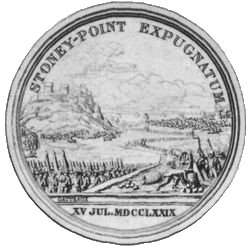
III BRIGADIER-GENERAL ANTHONY WAYNE. [Taking of Stony Point.] Antonio Wayne duci exercitus Comitia Americana. ℞. Stoney-Point expugnatum.
GATTEAUX. 3 14
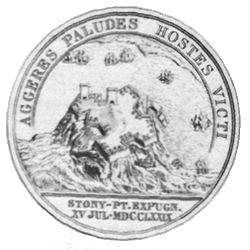
IV LIEUTENANT-COLONEL DE FLEURY. [Taking of Stony Point.] Virtutis et audaciæ monum. et præmium. ℞. Aggeres paludes hostes victi.
DUVIVIER. 4 22
V MAJOR JOHN STEWART. [Taking of Stony Point.] Joanni Stewart cohortis præfecto Comitia Americana. ℞. Stoney-Point oppugnatum.
GATTEAUX. 5 28
VI MAJOR HENRY LEE. [Surprise of Paulus Hook.] Henrico Lee legionis equit. præfecto. Comitia Americana. ℞. Non obstantib fluminibus vallis, etc.
J. WRIGHT. 6 29
VII JOHN PAULDING, DAVID WILLIAMS, ISAAC VAN WART. [Capture of Major André.] Fidelity. ℞. Vincit amor patriæ. 7 37
VIII BRIGADIER-GENERAL DANIEL MORGAN. [Victory of the Cowpens.] Danieli Morgan duci exercitus Comitia Americana. ℞. Victoria libertatis vindex.
DUPRÉ. 8 40
IX LIEUTENANT-COLONEL WILLIAM AUGUSTINE WASHINGTON. [Victory of the Cowpens.] Gulielmo Washington legionis equit. præfecto Comitia American. ℞. Quod parva militum manu, etc.
DUVIVIER. 9 46
X LIEUTENANT-COLONEL JOHN EAGER HOWARD. [Victory of the Cowpens.] Joh. Egar. Howard legionis peditum præfecto Comitia Americana. ℞. Quod in nutantem hostium aciem, etc.
DUVIVIER. 10 48
XI MAJOR-GENERAL NATHANIEL GREENE. [Victory of Eutaw Springs.] Nathanieli Green egregio duci Comitia Americana. ℞. Salus regionum australium.
DUPRÉ. 11 50
XII ACKNOWLEDGMENT OF THE UNITED STATES OF AMERICA BY THE UNITED NETHERLANDS. [Libera Soror.] Libera soror. ℞. Tyrannis virtute repulsa.
I. G. HOLTZHEY. 12 57
XIII TREATY OF AMITY AND COMMERCE BETWEEN THE UNITED STATES OF AMERICA AND THE UNITED NETHERLANDS. [Faustissimo Foedere Junctæ.] Faustissimo foedere junctæ. die VII Octob. MDCCLXXXII. ℞. Justitiam et non temnere divos.
I. G. HOLTZHEY. 13 74
XIV LIBERTAS AMERICANA. [Surrender of the British Armies at Saratoga and at Yorktown.] Libertas Americana. ℞. Non sine diis animosus infans.
DUPRÉ. 14 86
XV BENJAMIN FRANKLIN. Benj. Franklin natus Boston. XVII Jan. MDCCVI. ℞. Eripuit cœlo fulmen sceptrum que tyrannis.
AUG. DUPRÉ. 16 95
XVII CAPTAIN JOHN PAUL JONES. [Capture of the Serapis.] Joanni Paulo Jones classis præfecto. Comitia Americana. ℞. Hostium navibus captis aut fugatis.
DUPRÉ. 17 97
XVIII XIX PRESIDENT GEORGE WASHINGTON. [First President of the United States of America.] George Washington President. 1792. 18 113
XX CAPTAIN JOHN PAUL JONES. To peace and commerce. ℞. The United States of America.
DUPRÉ. 19 115
XXI PRESIDENT JOHN ADAMS. [Second President of the United States of America.] John Adams President of the U.S. A.D. 1797. ℞. Peace and friendship. 20 127
XXII CAPTAIN THOMAS TRUXTUN. [Action with the Vengeance.] Patriæ. patres. filio. digno. Thomas Truxtun. ℞. United States frigate Constellation of 38 guns, &c. 21 128
XXIII PRESIDENT THOMAS JEFFERSON. [Third President of the United States of America.] Th. Jefferson President of the U.S. A.D. 1801. ℞. Peace and friendship.
REICH. 22 133
XXIV COMMODORE EDWARD PREBLE. [Naval operations against Tripoli.] Edwardo Preble duci strenuo Comitia Americana. ℞. Vindici commercii Americani.
REICH. 23 135
XXV PRESIDENT JAMES MADISON. [Fourth President of the United States of America.] James Madison President of the U.S.A. D. 1809. ℞. Peace and friendship.
REICH. 24 151
XXVI CAPTAIN ISAAC HULL. [Capture of the Guerrière.] Isaacus Hull peritos arte superat Jul. MDCCCXII Aug. certamine fortes. ℞. Horæ momento victoria.
REICH. 25 153
XXVII CAPTAIN JACOB JONES. [Capture of the Frolic.] Jacobus Jones virtus in ardua tendit. ℞. Victoriam hosti majori celerrime rapuit.
FÜRST. 26 160
XXVIII CAPTAIN STEPHEN DECATUR. [Capture of the Macedonian.] Stephanus Decatur navarchus, pugnis pluribus, victor. ℞. Occidit signum hostile sidera surgunt.
FÜRST. 27 163
XXIX CAPTAIN WILLIAM BAINBRIDGE. [Capture of the Java.] Gulielmus Bainbridge patria victisque laudatus. ℞. Pugnando.
FÜRST. 28 166
XXX LIEUTENANT EDWARD RUTLEDGE McCALL. [Capture of the Boxer.] Edward R. McCall navis Enterprise præfectus. Sic itur ad astra. ℞. Vivere sat vincere.
FÜRST. 29 171
XXXI LIEUTENANT WILLIAM BURROWS. [Capture of the Boxer.] Victoriam tibi claram. patriæ mæstam. ℞. Vivere sat vincere.
FÜRST. 30 174
XXXII CAPTAIN OLIVER HAZARD PERRY. [Victory of Lake Erie.] Oliverus H. Perry, princeps stagno Eriense. classim totam contudit. ℞. Viam invenit virtus aut facit.
FÜRST. 31 176
XXXIII CAPTAIN JESSE DUNCAN ELLIOTT. [Victory of Lake Erie.] Jesse D. Elliott. Nil actum reputans si quid superesset agendum. ℞. Viam invenit virtus aut facit.
FÜRST. 32 183
XXXIV CAPTAIN JAMES LAWRENCE. [Capture of the Peacock.] Jac. Lawrence dulce et decorum est pro patria mori. ℞. Mansuetud. maj. quam victoria.
FÜRST. 33 185
XXXV CAPTAIN THOMAS MACDONOUGH. [Victory of Lake Champlain.] Tho. Macdonough. Stagno Champlain clas. Reg. Brit. superavit. ℞. Uno latere percusso. alterum impavide vertit.
FÜRST. 34 189
XXXVI CAPTAIN ROBERT HENLEY. [Victory of Lake Champlain.] Rob. Henley Eagle præfect. palma virtu. per æternit. florebit. ℞. Uno latere percusso. alterum impavide vertit.
FÜRST. 35 193
XXXVII LIEUTENANT STEPHEN CASSIN. [Victory of Lake Champlain.] Step. Cassin Ticonderoga præfect. Quæ regio in terris nos. non plena lab. ℞. Uno latere percusso. alterum impavide vertit.
FÜRST. 36 195
XXXVIII CAPTAIN LEWIS WARRINGTON. [Capture of the Épervier.] Ludovicus Warrington dux navalis Ameri. ℞. Pro patria paratus aut vincere aut mori.
FÜRST. 37 197
XXXIX CAPTAIN JOHNSTON BLAKELEY. [Capture of the Reindeer..] Johnston Blakeley Reip. Fæd. Am. nav. Wasp dux. ℞. Eheu! bis victor patria tua te luget plauditq.
FÜRST. 38 200
XL MAJOR-GENERAL JACOB BROWN. [Victories of Chippewa, Niagara, and Erie..] Major General Jacob Brown. ℞. Resolution of Congress November 3. 1814.
FÜRST. 39 203
XLI MAJOR-GENERAL PETER BUEL PORTER. [Victories of Chippewa, Niagara, and Erie..] Major General Peter B. Porter. ℞. Resolution of Congress November 3. 1814.
FÜRST. 40 215
XLII BRIGADIER-GENERAL ELEAZER WHEELOCK RIPLEY. [Victories of Chippewa, Niagara, and Erie..] Brig. General Eleazer W. Ripley. ℞. Resolution of Congress Novemb. 3. 1814.
FÜRST. 41 219
XLIII BRIGADIER-GENERAL JAMES MILLER. [Victories of Chippewa, Niagara, and Erie..] Brigadier Genl. James Miller. ℞. Resolution of Congress November 3. 1814.
FÜRST. 42 223
XLIV MAJOR-GENERAL WINFIELD SCOTT. [Victories of Chippewa and Niagara.] Major General Winfield Scott. ℞. Resolution of Congress November 3. 1814. etc.
FÜRST. 43 224
XLV MAJOR-GENERAL EDMUND P. GAINES. [Victory of Erie..] Major General Edmund P. Gaines. ℞. Resolution of Congress November 3. 1814.
FÜRST. 44 226
XLVI MAJOR-GENERAL ALEXANDER MACOMB. [Victory of Plattsburgh.] Major General Alexander Macomb. ℞. Resolution of Congress November 3. 1814.
FÜRST. 45 233
XLVII MAJOR-GENERAL ANDREW JACKSON. [Victory of New Orleans.] Major General Andrew Jackson. ℞. Resolution of Congress February 27. 1815.
FÜRST. 46 238
XLVIII CAPTAIN CHARLES STEWART. [Capture of the Cyane and of the Levant.] Carolus Stewart navis Amer. Constitution dux. ℞. Una victoriam eripuit ratibus binis.
FÜRST. 47 245
XLIX CAPTAIN JAMES BIDDLE. [Capture of the Penguin.] The Congress of the U.S. to Capt. James Biddle. etc. ℞. Capture of the British ship Penguin by the U.S. ship Hornet.
FÜRST. 48 249
L PRESIDENT JAMES MONROE. [Fifth President of the United States of America.] James Monroe President of the U.S.A. D. 1817. ℞. Peace and friendship.
FÜRST. 49 253
LI MAJOR-GENERAL WILLIAM HENRY HARRISON. [Victory of the Thames.] Major General William H. Harrison. ℞. Resolution of Congress April 4. 1818.
FÜRST. 50 254
LII GOVERNOR ISAAC SHELBY. [Victory of the Thames.] Governor Isaac Shelby. ℞. Battle of the Thames. Octo. 5. 1813.
FÜRST. 51 265
LIII TREATY OF COMMERCE WITH FRANCE. Lvdovicvs. XVIII Franc. et. Nav. rex. ℞. Gallia. et. America. foederata.
ANDRIEU. GAYRARD. 52 266
LIV PRESIDENT JOHN QUINCY ADAMS. [Sixth President of the United States of America.] John Quincy Adams President of the United States 1825. ℞. Peace and friendship.
FÜRST. 53 270
LV PRESIDENT ANDREW JACKSON. [Seventh President of the United States of America.] Andrew Jackson President of the United States A.D. 1829. ℞. Peace and friendship.
FÜRST. 54 271
LVI COLONEL GEORGE CROGHAN. [Defence of Fort Stephenson.] Presented by Congress to Colonel George Croghan 1835. ℞. Pars magna fuit.
FÜRST. 55 272
LVII PRESIDENT MARTIN VAN BUREN. [Eighth President of the United States of America.] Martin Van Buren President of the United States A.D. 1837. ℞. Peace and friendship.
FÜRST. 56 275
LVIII PRESIDENT JOHN TYLER. [Tenth President of the United States of America.] John Tyler, President of the United States. 1841. ℞. Peace and friendship. 57 276
LIX PRESIDENT JAMES KNOX POLK. [Eleventh President of the United States of America.] James K. Polk President of the United States. 1845. ℞. Peace and friendship.
PEALE. 58 280
LX MAJOR-GENERAL ZACHARY TAYLOR. [Victories on the Rio Grande.] Major General Zachary Taylor. ℞. Resolution of Congress July 16th 1846, etc. 59 281
LXI MAJOR-GENERAL ZACHARY TAYLOR. [Taking of Monterey.] Major General Zachary Taylor. ℞. Resolution of Congress March 2nd 1847, etc. 60 290
LXII LOSS OF THE UNITED STATES BRIG-OR-WAR SOMERS. [For Having Saved the Lives of Americans.] Somers navis Americana. ℞. Pro vitis Americanorum conservatis.
C. C. WRIGHT. 61 299
LXIII MAJOR-GENERAL WINFIELD SCOTT. [Mexican Campaign.] Major General Winfield Scott. ℞. Vera Cruz. Cerro Gordo. Contreras, etc.
S. ELLIS. G. C. HUMPHRIES. C. C. WRIGHT. 62 394
LXIV MAJOR-GENERAL ZACHARY TAYLOR [Victory of Buena Vista.] Major General Zachary Taylor, etc. ℞. Buena Vista Feb. 22 & 23, 1847.
S. ELLIS. F. A. SMITH. C. C. WRIGHT. 63 336
LXV PRESIDENT ZACHARY TAYLOR [Twelfth President of the United States of America.] Zachary Taylor President of the United States 1849. ℞. Peace and friendship.
F. PEALE. 64 348
LXVI PRESIDENT MILLARD FILLMORE. [Thirteenth President of the United States of America.] Millard Fillmore President of the United States 1850. ℞. Labor virtue honor.
S. ELLIS. J. WILLSON. 65 349
LXVII PRESIDENT FRANKLIN PIERCE. [Fourteenth President of the United States of America.] Franklin Pierce, President of the United States. 1853. ℞. Labor virute honor.
S. ELLIS. J. WILLSON. 66 351
LXVIII COMMANDER DUNCAN NATHANIEL INGRAHAM. [Release of Martin Coszta.] Smyrna. American sloop of war St. Louis. Austrian brig of war Hussar. ℞. Presented by the President of the United States to Commander Duncan N. Ingraham, etc.
S. EASTMAN. P. F. CROSS. J. B. LONGACRE. 67 352
LXIX PRESIDENT JAMES BUCHANAN. [Fifteenth President of the United States of America.] James Buchanan, President of the United States 1857. ℞. Labor virtue honor.
S. ELLIS. J. WILLSON. 68 361
LXX DOCTOR FREDERICK HENRY ROSE. [Kindness and Humanity of Doctor Rose.] James Buchanan, President of the United States. ℞. To Dr. Frederick Rose, Assistant Surgeon, Royal Navy, G.B.
PAQUET. 69 362
LXXI PRESIDENT ABRAHAM LINCOLN. [Sixteenth President of the United States of America.] Abraham Lincoln, President of the United States 1862.
S. ELLIS. 70 366
LXXIIa NAVY MEDAL OF HONOR.
PAQUET. 71 367
LXXIIb ARMY MEDAL OF HONOR.
PAQUET. 72 368
LXXIII MAJOR-GENERAL ULYSSES SIMPSON GRANT. [Victories of Fort Donelson, Vicksburg, and Chattanooga.] Major General Ulysses S. Grant. Joint Resolution of Congress December 17. 1863. ℞. Donelson, Vicksburg, etc.
ANTROBUS. PAQUET. 73 370
LXXIV CORNELIUS VANDERBILT. [Free Gift of Steamship Vanderbilt.] A grateful country to her generous son Cornelius Vanderbilt. ℞. Bis dat qui tempori dat. 1865.
LEUTZE. S. ELLIS. 74 406
LXXV PRESIDENT ANDREW JOHNSON. [Seventeenth President of the United States of America.] Andrew Johnson, President of the United States. 1865. ℞. Peace.
PAQUET. 75 410
LXXVI WRECK OF THE STEAMSHIP SAN FRANCISCO. [Testimonial of National Gratitude.] By joint resolution of Congress to the rescuers of the passengers officers and men of steamship San Francisco, etc. ℞. July 26 1866.
PAQUET. 75 410
LXXVII CYRUS WEST FIELD. [Laying of the Atlantic Telegraph Cable.] Honor and fame are the reward. ℞. By resolution of the Congress of the United States. March 2, 1867. to Cyrus W. Field, of New York, etc.
J. G. BRUFF. BARBER. 77 418
LXXVIII GEORGE PEABODY. [Promotion of Universal Education.] ℞. The people of the United States to George Peabody, etc. 78 421
LXXIX PRESIDENT ULYSSES SIMPSON GRANT. [Eighteenth President of the United States of America.] United States of America. Liberty justice and equality "Let us have peace." ℞. On earth peace good will toward men.
PAQUET. 79 429
LXXX GEORGE FOSTER ROBINSON. [Heroic Conduct.] To George F. Robinson. Awarded by the Congress of the United States, March 1, 1871.
G. Y. COFFIN. PAQUET. 80 430
LXXXI LOSS OF THE STEAMER METIS. [Courage and Humanity.] By Resolution of Congress February 24, 1873.
W. & C. BARBER. 81 434
LXXXII CENTENNIAL MEDAL. [Hundredth Anniversary of American Independence.] These United Colonies are, and of right ought to be, free and independent States. ℞. In commemoration of the hundredth anniversary.
W. BARBER. 82 438
LXXXIII CENTENNIAL MEDAL. [Hundredth Anniversary of American Independence.] These United Colonies are, and of right ought to be, free and independent States. ℞. By authority of the Congress, etc.
W. BARBER. 83 440
LXXXIV LIFE SAVING MEDAL OF THE FIRST CLASS. [Saving Life from the Perils of the Sea.] Life Saving medal of the first class. United States of America. ℞. In testimony of heroic deeds, etc.
PAQUET. 84 441
LXXXV LIFE SAVING MEDAL OF THE SECOND CLASS. [Saving Life from the Perils of the Sea.] Life Saving medal of the second class. United States of America. ℞. In testimony of heroic deeds, etc.
PAQUET. 85 453
LXXXVI JOHN HORN, JR. [Heroic Exploits.] John Horn, Jr. ℞. By Act of Congress June 20th 1874. In recognition of his heroic exploits, etc.
C. BARBER. 86 457
THE MEDALLIC HISTORY OF THE UNITED STATES OF AMERICA. 1776-1876.
Plate I. No. 1.
March 17, 1776.
GENERAL GEORGE WASHINGTON.
[Boston retaken.]
GEORGIO WASHINGTON SVPREMO DVCI EXERCITVVM ADSERTORI LIBERTATIS COMITIA AMERICANA. (The American Congress to George Washington, commander-in-chief of the armies, the assertor of liberty.) Undraped bust of General Washington, facing the right. Duvivier. Paris. F. (fecit).
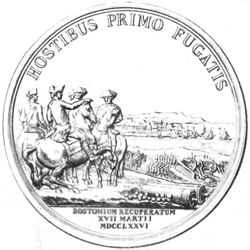
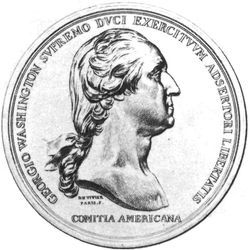
Although this medal was the first one voted by Congress, it was not struck until after that of the Chevalier de Fleury, which was voted three years later. Its designs, and those of the medals awarded to General Horatio Gates for Saratoga, General Nathaniel Greene for Eutaw Springs, General Daniel Morgan, Lieutenant-Colonels William Augustine Washington and John Eager Howard for the Cowpens, General Anthony Wayne and Major John Stewart for Stony Point, and Captain John Paul Jones for the capture of the Serapis, were composed by commissioners appointed by the French Academy of Inscriptions and Belles-Lettres, at the request of Colonel David Humphreys and of Mr. Jefferson. The legend of the reverse of the General Washington medal, as originally proposed, was hostibus or anglis primum fugatis. Several of the medals are treated of at length in the Introduction, to which, to avoid repetition, the reader is referred.
Pierre Simon Duvivier was born in Paris, November 5, 1731. He was the son of Jean Duvivier, a member of the Royal Academy of Painting and Sculpture, and the grandson of Jean Duvivier, known as Duvivier "le père," the first of this distinguished family of medal engravers, who lived in Liège at the beginning of the 17th century. Pierre Simon Duvivier was engraver-general of the Paris Mint prior to 1793, and executed medals of many eminent persons. America is indebted to him for those of General Washington, Lieutenant-Colonel de Fleury, Lieutenant-Colonel William Augustine Washington, and Lieutenant-Colonel John Eager Howard. He was a member of the Academy of Fine Arts, and died June 10, 1819.
George Washington was born near Pope's Creek, Westmoreland County, Virginia, February 22, 1732. He lost his father when but ten years of age, and in 1752, in consequence of the death of his elder brother, came into possession of the estate of Mount Vernon, on the Potomac River, and other property. The same year he received a commission as major of militia, and in 1755 became colonel and aid-de-camp to General Braddock. On the death of that officer in the disastrous march against Fort Duquesne, Washington conducted the retreat, and was shortly afterward appointed commander of the Virginia troops. In 1774 he was elected member of the first Continental Congress, held in Philadelphia, and in the following year was appointed commander-in-chief of the Continental Army, taking command of the forces at Cambridge, July 3, 1775. On March 17, 1776, he compelled the British forces to evacuate Boston, for which Congress gave him a vote of thanks and a gold medal. He was commander-in-chief throughout the War of Independence, and resigned his commission as such, December 23, 1783, when he retired to Mount Vernon. He was delegate from Virginia to the National Convention which met in Philadelphia in May, 1787, to frame the Constitution of the United States, and was chosen its president. He was afterward unanimously elected first President of the United States, and was inaugurated in New York city, April 30, 1789. He was re-elected, and inaugurated a second time, March 4, 1793; refused a third term of office, and issued a farewell address, September 17, 1796. When a war with France was expected, in 1797, he was re-appointed commander-in-chief. General Washington died at Mount Vernon, December 14, 1799.
ORIGINAL DOCUMENTS.
Resolution of Congress Voting a Medal to General Washington.
In Congress.
Monday, March 25, 1776.
General Washington to the President of Congress.
To John Hancock, Esq. President of Congress. Headquarters, Cambridge, March 19, 1776.
Sir: It is with the greatest pleasure I inform you that, on Sunday last, the seventeenth instant, about nine o'clock in the forenoon, the ministerial army evacuated the town of Boston, and that the forces of the United Colonies are now in actual possession thereof. I beg leave to congratulate you, Sir, and the honourable Congress, on this happy event, and particularly as it was effected without endangering the lives and property of the remaining unhappy inhabitants.
I have great reason to imagine their flight was precipitated by the appearance of a work which I had ordered to be thrown up last Saturday night on an eminence at Dorchester, which lay nearest to Boston Neck, called Nook's Hill.
The town, although it has suffered greatly, is not in so bad a state as I expected to find it; and I have a particular pleasure in being able to inform you, Sir, that your house has received no damage worth mentioning. Your furniture is in tolerable order, and the family pictures are all left entire and untouched. Captain Cazeneau takes charge of the whole until he shall receive further orders from you.
As soon as the ministerial troops had quitted the town, I ordered a thousand men (who had had the small-pox), under command of General Putnam, to take possession of the heights, which I shall endeavour to fortify in such a manner as to prevent their return, should they attempt it. But as they are still in the harbour, I thought it not prudent to march off with the main body of the army until I should be fully satisfied they had quitted the coast. I have, therefore, only detached five regiments, besides the rifle battalion, to New York, and shall keep the remainder here till all suspicion of their return ceases.
The situation in which I found their works evidently discovered that their retreat was made with the greatest precipitation. They have left their barracks, and other works of wood at Bunker Hill, &c., all standing, and have destroyed but a small part of their lines. They have also left a number of fine pieces of cannon which they first spiked up, also a very large iron mortar, and, as I am informed, they have thrown another over the end of your wharf. I have employed proper persons to drill the cannon, and doubt not I shall save the most of them. I am not yet able to procure an exact list of all the stores they have left. As soon as it can be done, I shall take care to transmit it to you. From an estimate of what the quartermaster-general has already discovered, the amount will be twenty-five or thirty thousand pounds.
Part of the powder mentioned in yours of the sixth instant has already arrived. The remainder I have ordered to be stopped on the road, as we shall have no occasion for it here. The letter to General Thomas I immediately sent to him. He desired leave for three or four days to settle some of his private affairs, after which he will set out for his command in Canada. I am happy that my conduct in intercepting Lord Drummond's letter is approved of by Congress.
I have the honour to be, &c., Geo. Washington.
The President of Congress to General Washington.
To General Washington. Philadelphia, April 2, 1776.
Sir: It gives me the most sensible pleasure to convey to you, by order of Congress, the only tribute which a free people will ever consent to pay—the tribute of thanks and gratitude to their friends and benefactors. The disinterested and patriotic principles which led you to the field have also led you to glory; and it affords no little consolation to your countrymen to reflect that, as a peculiar greatness of mind induced you to decline any compensation for serving them, except the pleasure of promoting their happiness, they may, without your permission, bestow upon you the largest share of their affections and esteem.
Those pages in the annals of America will record your title to a conspicuous place in the temple of fame which shall inform posterity that, under your direction, an undisciplined band of husbandmen, in the course of a few months, became soldiers; and that the desolation meditated against the country by a brave army of veterans, commanded by the most experienced generals, but employed by bad men in the worst of causes, was, by the fortitude of your troops, and the address of their officers, next to the kind interposition of Providence, confined for near a year within such narrow limits as scarcely to admit more room than was necessary for the encampments and fortifications they lately abandoned. Accept, therefore, Sir, the thanks of the United Colonies, unanimously declared by their delegates to be due to you and the brave officers and troops under your command; and be pleased to communicate to them this distinguished mark of the approbation of their country. The Congress have ordered a golden medal, adapted to the occasion, to be struck, and, when finished, to be presented to you.
I have the honour to be, with every sentiment of esteem, Sir, your most obedient and very humble servant, John Hancock, President.
John Adams to General Washington.
To General Washington. Philadelphia, April 2, 1776.
Sir: I congratulate you, as well as all the friends of mankind, in the reduction of Boston, an event which appeared to me of so great and decisive importance, that, the next morning after the arrival of the news, I did myself the honour to move for the thanks of Congress to Your Excellency, and that a medal of gold should be struck in commemoration of it. Congress have been pleased to appoint me, with two other gentlemen, to prepare a device. I should be very happy to have Your Excellency's sentiments concerning a proper one.
I have the honour to be, with great respect, Sir, your most obedient and affectionate servant,
John Adams.
General Washington to John Adams.
New York, April 15, 1776. To John Adams, Esq., In Congress.
Sir: I am impressed with the deepest gratitude for the high honour intended me by Congress. Whatever devices may be determined upon by the respectable committee they have chosen for that purpose will be highly agreeable to me.
I have the honour to be, most respectfully, Sir, your most obedient and affectionate humble servant, Geo. Washington.
Colonel Humphreys to General Washington.
Paris, May, 1785. To General Washington.
My dear General: Upon leaving America Mr. Morris invested me with the power of procuring the several honourary presents which have been voted by Congress to different officers in their service during the late war. The Royal Academy of Inscriptions and Belles-Lettres, to whom I addressed a letter on the subject, have furnished me with the following device and inscriptions for the gold medal which is to be executed for Your Excellency:
"On one side, the head of the general. Legend: 'georgio washington supremo duci exercituum adsertori libertatis comitia americana.' On the reverse: Taking possession of Boston. The American army advances in good order toward the town, which is seen at a distance, while the British army flies with precipitation toward the shore, to embark on board the vessels, with which the harbour is covered. In the front of the American army appears the general on horseback, in a group of officers, whom he seems to make observe the flight of the enemy. Legend: 'hostibus primo fugatis.' Exergue: 'bostonium recuperatum die xvii martii, mdcclxxvi.'"
I think it has the character of simplicity and dignity which is to be aimed at in a memorial of this kind, which is designed to transmit the remembrance of a great event to posterity. You really do not know how much your name is venerated on this side of the Atlantic.
I have the honour to be, my dear General, your sincere friend and humble servant, D. Humphreys.
Colonel Humphreys to Thomas Jefferson.
London, January 30, 1786. To Thomas Jefferson, Esq., Paris.
Dear Sir: Gatteaux, the engraver, lives in the street St. Thomas du Louvre, opposite the Treasury of the Duke de Chartres.
Now that there is no obstacle to commencing the medal for General Washington, since Houdon's return, I could wish, should it not be giving you too much trouble, that you would send for Duvivier, who lives in the old Louvre, and propose to him undertaking it upon exactly the terms he had offered, which, I think, were 2,400 livres, besides the gold and expense of coinage. If he should not choose it, we must let it rest until Dupré shall have finished General Greene's. Gatteaux has a paper on which is the description of General Washington's medal.
I am, Sir, your most obedient and humble servant, D. Humphreys.
Thomas Jefferson to Colonel Humphreys.
Paris, May 7, 1786. To Colonel Humphreys, London.
Dear Sir: I have received the books and papers you mention, and will undertake to have finished what you left undone of the medals, or, at least, will proceed in it till the matter shall be put into better hands.
I am, dear Sir, your friend and servant, Th: Jefferson.
Plate II. No. 2.
October 17, 1777.
Horatio Gates duci strenuo Comitia Americana. ℞. Salus regionum septentrional.
MAJOR-GENERAL HORATIO GATES.
[Surrender of the British Army at Saratoga.]
HORATIO GATES DUCI STRENUO COMITIA AMERICANA. (The American Congress to Horatio Gates, a valiant general.) Bust of General Gates, in uniform, facing the left. N. GATTEAUX.
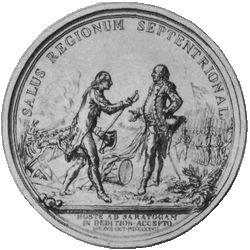
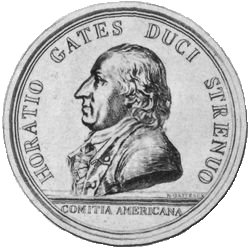
The legend of the obverse of this medal, originally proposed by the French Academy of Inscriptions and Belles-Lettres, was horatio gates duci provido comitia americana; and that of the reverse, salus provinciarum septentrionalium.
Nicolas Marie Gatteaux was born in Paris, August 2, 1751, and in the latter part of the reign of Louis XVI. was appointed engraver of medals to the king. During the French Revolution he was intrusted with the execution of various works of art for different branches of the public service. The process followed in the printing of assignats, of bills of exchange, and of lottery tickets, as well as the printing-press which works at the same time with the dry and wet stamp, were his inventions. He designed and engraved a number of medals representing eminent persons, or important events of the period, including three relating to the War of Independence, viz., those of General Gates, General Wayne, and Major John Stewart He died in Paris, June 24, 1832.
ORIGINAL DOCUMENTS.
Resolution of Congress Voting a Medal to General Gates.
in Congress.
Resolved, That the thanks of Congress, in their own name, and in behalf of the inhabitants of the thirteen United States, be presented to Major-General Gates, commander-in-chief in the northern department, and to Major-Generals Lincoln and Arnold, and the rest of the officers and troops under his command, for their brave and successful efforts in support of the independence of their country, whereby an army of the enemy, of ten thousand men, has been totally defeated; one large detachment of it, strongly posted and intrenched, having been conquered at Bennington; another repulsed with loss and disgrace from Fort Schuyler; and the main army of six thousand men, under Lieutenant-General Burgoyne, after being beaten in different actions, and driven from a formidable post and strong intrenchments, reduced to the necessity of surrendering themselves upon terms honourable and advantageous to these States, on the 17th day of October last, to Major-General Gates; and that a medal of gold be struck, under the direction of the Board of War, in commemoration of this great event, and in the name of these United States presented by the President to Major-General Gates.
Tuesday, November 4, 1777.
General Gates to the President of Congress.
To His Excellency John Hancock, Esq., Camp Saratoga, President of Congress. October 18, 1777.
Sir: I have the satisfaction to present Your Excellency with the convention of Saratoga, by which His Excellency Lieutenant-General Burgoyne has surrendered himself and his whole army into my hands, and they are now upon their march for Boston. This signal and important event is the more glorious, as it was effected with so little loss to the army of the United States.
This letter will be presented to Your Excellency by my adjutant-general, Colonel Wilkinson, to whom I must beg leave to refer Your Excellency for the particulars that brought this great business to so happy and fortunate a conclusion.
I desire to be permitted to recommend this gallant officer in the warmest manner to Congress, and entreat that he may be continued in his present office, with the brevet of a brigadier-general.
The honourable Congress will believe me when I assure them that, from the beginning of this war, I have not met with a more promising military genius than Colonel Wilkinson, and whose services have been of the greatest importance to this army.
I am, Sir, Your Excellency's most obedient and humble servant, Horatio Gates.
Articles of Convention between Major-General Gates and Lieutenant-General Burgoyne.
I.
The troops under Lieutenant-General Burgoyne to march out of their camp, with the honours of war and the artillery of the intrenchments, to the verge of the river, where the old fort stood, where the arms and artillery are to be left, the arms to be piled by word of command from their own officers.
II.
A free passage to be granted to the army under Lieutenant-General Burgoyne to Great Britain, on condition of not serving again in North America during the present contest; and the port of Boston is assigned for the entry of transports to receive the troops whensoever General Howe shall so order.
III.
Should any cartel take place by which the army under General Burgoyne, or any part of it, may be exchanged, the foregoing article to be void, as far as such exchange be made.
IV.
The army under Lieutenant-General Burgoyne to march to Massachusetts Bay by the easiest, most expeditious and convenient route, and to be quartered in, near, or as convenient as possible to, Boston, that the march of the troops may not be delayed when transports arrive to receive them.
V.
The troops to be supplied, on their march and during their being in quarters, with provisions, by General Gates's orders, at the same rate of rations as the troops of his own army; and, if possible, the officers' horses and cattle are to be supplied with forage at the usual rates.
VI.
All officers to retain their carriages, bathorses, and other cattle, and no baggage to be molested or searched, Lieutenant-General Burgoyne giving his honour that there are no public stores secreted therein. Major-General Gates will, of course, take the necessary measures for the due performance of this article. Should any carriages be wanted, during the march, for the transportation of officers' baggage, they are, if possible, to be supplied by the country at the usual rates.
VII.
Upon the march, and during the time the army shall remain in quarters in Massachusetts Bay, the officers are not, as far as circumstances admit, to be separated from their men. The officers are to be quartered according to rank, and are not to be hindered from assembling their men for roll-call, and other necessary purposes of regularity.
VIII.
All corps whatsoever of Lieutenant-General Burgoyne's army, whether composed of sailors, bateaumen, artificers, drivers, independent companies, and followers of the army, of whatever country, shall be included in the fullest sense and the utmost extent of the above articles, and comprehended in every respect as British subjects.
IX.
All Canadians and persons belonging to the Canadian establishment, consisting of sailors, bateaumen, artificers, drivers, independent companies, and many other followers of the army, who come under no particular description, are to be permitted to return there; they are to be conducted immediately, by the shortest route, to the first British post on Lake George, are to be supplied with provisions in the same manner as the other troops, and are to be bound by the same condition of not serving during the present contest in North America.
X.
Passports to be immediately granted for three officers, not exceeding the rank of captains, who shall be appointed by Lieutenant-General Burgoyne to carry despatches to Sir William Howe, Sir Guy Carleton, and to Great Britain, by the way of New York; and Major-General Gates engages the public faith that these despatches shall not be opened. These officers are to set out immediately after receiving their despatches, and are to travel the shortest route and in the most expeditious manner.
XI.
During the stay of the troops in Massachusetts Bay the officers are to be admitted on parole, and are to be allowed to wear their side arms.
XII.
Should the army under Lieutenant-General Burgoyne find it necessary to send for their clothing and other baggage to Canada, they are permitted to do it in the most convenient manner, and the necessary passports granted for that purpose.
XIII.
These articles are to be mutually signed and exchanged to-morrow morning at nine o'clock, and the troops under Lieutenant-General Burgoyne are to march out of their intrenchments at three o'clock in the afternoon.
Horatio Gates, Major-General. J. Burgoyne, Lieutenant-General. Saratoga, October 16, 1777.
To prevent any doubts that might arise from Lieutenant-General Burgoyne's name not being mentioned in the above treaty, Major-General Gates hereby declares that he is understood to be comprehended in it as fully as if his name had been specifically mentioned.
Horatio Gates.
Thomas Jefferson to Colonel Humphreys.
Paris, December 4, 1785. To Colonel Humphreys, London.
Dear Sir: I inclose a letter from Gatteaux, observing that there will be an anachronism if, in making a medal to commemorate the victory of Saratoga, he puts on General Gates the insignia of the Cincinnati, which did not exist at that date. I wrote him, in answer, that I thought so, too, but that you had the direction of the business; that you were now in London; that I would write to you, and probably should have an answer within a fortnight; and that, in the mean time, he could be employed on other parts of the die. I supposed you might not have observed on the print of General Gates the insignia of the Cincinnati, or did not mean that that particular should be copied. Another reason against it strikes me: Congress have studiously avoided giving to the public their sense of this institution. Should medals be prepared to be presented from them to certain officers, and bearing on them the insignia of the order, as the presenting them would involve an approbation of the institution, a previous question would be forced on them, whether they would present these medals. I am of opinion it would be very disagreeable to them to be placed under the necessity of making this declaration. Be so good as to let me know your wishes on this subject by the first post, and be assured of the esteem with which I am, dear Sir, your friend and servant,
Th: Jefferson.
Colonel Humphreys to Thomas Jefferson.
London, Leicester Square, No. 18. To Thomas Jefferson, Esq., Paris.
Dear Sir: I have been honoured with your favour of December 4th, and on the subject of Gatteaux' application take the liberty to inform you that I never had an idea of his engraving the insignia of the Cincinnati. I clearly see the impropriety of it. I should, therefore, be much obliged if you would take the trouble of giving him definitive instructions on this and any other points that may occur in the execution of the medal....
I am, with the sincerest affection, dear Sir, your most obedient and humble servant,
D. Humphreys.
Plate III. No. 3.
July 15, 7779.
Antonio Wayne duci exercitus Comitia Americana. ℞. Stoney-Point expugnatum.
BRIGADIER-GENERAL ANTHONY WAYNE.
[Taking of Stony Point.]
ANTONIO WAYNE DUCI EXERCITUS COMITIA AMERICANA. (The American Congress to General Anthony Wayne.) America, personified as an Indian queen, standing, and having at her feet a bow, an alligator, and the American shield, presents to General Wayne a laurel and a mural crown. Gatteaux.
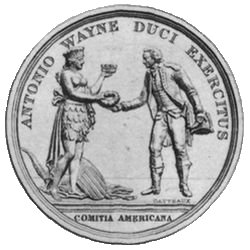
Anthony Wayne was born at Waynesborough, Chester County, Pennsylvania, January 1, 1745. He was educated in Philadelphia. In 1774 he was elected a member of the Pennsylvania Convention, and in 1775 was appointed colonel of a regiment under General Thomas in Canada, and took part in the engagements at Three Rivers and at Ticonderoga. In 1777 he was promoted to the rank of brigadier-general under Washington, and fought at the Brandywine, Germantown, and Monmouth. On the night of July 15, 1779, he surprised and took Stony Point, on the Hudson River, for which gallant deed Congress gave him a vote of thanks and a gold medal. He afterward served in the South, occupied Savannah, July 11, 1782, and Charleston, South Carolina, on the 14th of December following, and retired to his estate at the close of the war. On April 3, 1792, he was appointed major-general and commander-in-chief in the war against the western Indians, and in 1794 gained an important victory over the Miami tribe of Indians. He died at Presque Isle, now Erie, Pennsylvania, December 14, 1796. In 1809, his son, Colonel Wayne, removed his remains to the cemetery of Radnor church, near Waynesborough, where the Pennsylvania State Society of the Cincinnati caused a handsome monument to be erected to his memory. He was known during the Revolutionary War by the sobriquet of "Mad Anthony."
ORIGINAL DOCUMENTS.
Resolutions of Congress Voting Medals to General Wayne, to Lieutenant Colonel de Fleury, and to Major Stewart, etc.
In Congress Assembled.
Resolved unanimously, That the thanks of Congress be given to His Excellency General Washington for the vigilance, wisdom, and magnanimity with which he hath conducted the military operations of these States, and which are among many other signal instances manifested in his orders for the late glorious enterprize and successful attack on the enemy's fortress on the bank of Hudson's river.
Resolved unanimously, That the thanks of Congress be presented to Brigadier-General Wayne for his brave, prudent, and soldierly conduct in the spirited and well-conducted attack of Stony Point.
Resolved unanimously, That Congress entertain a proper sense of the good conduct of the officers and soldiers under the command of Brigadier-General Wayne, in the assault of the enemy's works at Stony Point, and highly commend the coolness, discipline, and firm intrepidity exhibited on that occasion.
Resolved unanimously, That Lieutenant-Colonel Fleury and Major Stewart, who by their situation in leading the two attacks had a more immediate opportunity of distinguishing themselves, have, by their personal achievements, exhibited a bright example to their brother soldiers, and merit in a particular manner the approbation and acknowledgment of the United States.
Resolved unanimously, That Congress warmly approve and applaud the cool determined spirit with which Lieutenant Gibbons and Lieutenant Knox led on the forlorn hope, braving danger and death in the cause of their country.
Resolved unanimously, That a medal, emblematical of this action, be struck:
That one of gold be presented to Brigadier-General Wayne, and a silver one to Lieutenant-Colonel Fleury and Major Stewart respectively.
Resolved unanimously, That brevets of captain be given to Lieutenant Gibbons and Lieutenant Knox.
That the brevet of captain be given to Mr. Archer, the bearer of the general's letter, and volunteer aid to Brigadier-General Wayne.
That Congress approve the promises of reward made by General Wayne, with the concurrence of the commander-in-chief, to the troops under his command.
That the value of the military stores taken at Stony Point be ascertained, and divided among the gallant troops by whom it was reduced, in such manner and proportion as the commander-in-chief shall prescribe.
Monday, July 26, 1779.
General Washington to the President of Congress.
New Windsor, half-past nine o'clock, July 16, 1779. To the President of Congress.
Sir: I have the pleasure to transmit to Your Excellency the inclosed copy of a letter from Brigadier-General Wayne, which this moment came to hand. I congratulate Congress upon our success, and what makes it still more agreeable from the report of Captain Fishbourn, who brought me General Wayne's letter, the post was gained with but very inconsiderable loss on our part. As soon as I receive a particular account of the affair, I shall transmit it.
I have the honour to be, etc., Geo. Washington.
General Wayne to General Washington.
Stony Point, two o'clock a.m., July 16, 1779. To General Washington.
Dear General: The fort and garrison with Colonel Johnson are ours. Our officers and men behaved like men who are determined to be free.
Yours, most sincerely, Anthony Wayne.
General Washington to the President of Congress.
New Windsor, July 20, 1779. To the President of Congress.
Sir: On the 16th instant I had the honour to inform Congress of a successful attack upon the enemy's post at Stony Point, on the preceding night, by Brigadier-General Wayne and the corps of light infantry under his command. The ulterior operations on which we have been engaged have hitherto put it out of my power to transmit the particulars of this interesting event. They will now be found in the inclosed report, which I have received from General Wayne. To the encomiums he has deservedly bestowed on the officers and men under his command, it gives me pleasure to add, that his own conduct throughout the whole of this arduous enterprize merits the warmest approbation of Congress. He improved upon the plan recommended by me, and executed it in a manner that does signal honour to his judgment and to his bravery. In a critical moment of the assault, he received a flesh wound in the head with a musket ball, but continued leading on his men with unshaken firmness.
I now beg leave, for the private satisfaction of Congress, to explain the motives which induced me to direct the attempt. In my former letters I have pointed out the advantages which the enemy derived from the possession of this post and the one on the opposite side, and the inconveniences resulting from it to us. To deprive them of the former, and to remove the latter, were sufficient inducements to endeavour to dispossess them. The necessity of doing something to satisfy the expectations of the people, and reconcile them to the defensive plan we are obliged to pursue, and to the apparent inactivity which our situation imposes upon us; the value of the acquisition in itself, with respect to the men, artillery, and stores, which composed the garrison; the effect it would have upon the successive operations of the campaign, and the check it would give to the immediate depredations of the enemy at the present season; all these motives concurred to determine me to the undertaking. The certain advantages of success, even if not so extensive as might be hoped, would, at all events, be very important; the probable disadvantages of a failure were comparatively inconsiderable, and, on the plan which was adopted, could amount to little more than the loss of a small number of men.
After reconnoitering the post myself, and collecting all the information I could get of its strength and situation, I found that, without hazarding a greater loss than we were able to afford, and with little likelihood of success, the attempt to carry it could only be by way of surprize. I therefore resolved on this mode, and gave my instructions to General Wayne accordingly, in hopes that Verplanck's Point might fall in consequence of the reduction of the other. Dispositions were made for the purpose, which unluckily did not succeed. The evening appointed for the attack, I directed Major-General McDougall to put two brigades under marching orders to be moved down toward Verplanck's, as soon as he should receive intelligence of the success of the attempt on this side, and requested General Wayne to let his despatches to me pass through General McDougall, that he might have the earliest advice of the event. But by some misconception, they came directly to headquarters, which occasioned a loss of several hours. The next morning Major-General Howe was sent to take the command of those troops, with orders to advance to the vicinity of the enemy's works, and open batteries against them. I was in hopes that this might either awe them, under the impression of what had happened on the other side, to surrender, or prepare the way for an assault. But some accidental delays, in bringing on the heavy cannon and intrenching tools necessary for an operation of this kind, unavoidably retarded its execution, till the approach of the enemy's main body made it too late. General Howe, to avoid being intercepted, found himself under the necessity of relinquishing his project and returning to a place of security. I did not unite the two attacks at the same time and in the same manner, because this would have rendered the enterprize more complex, more liable to suspicion, and less likely to succeed for want of an exact co-operation, which could hardly have been expected. When I came to examine the post at Stony Point, I found it would require more men to maintain it than we could afford, without incapacitating the army for other operations. In the opinion of the engineer, corresponding with my own and that of all the general officers present, not less than fifteen hundred men would be requisite for its defence; and, from the nature of the works, which were opened toward the river, a great deal of labour and expense must have been incurred, and much time employed to make them defensible by us. The enemy, depending on their shipping to protect their rear, had constructed the works solely against an attack by land. We should have had to apprehend equally an attack by water, and must have inclosed the post. While we were doing this, the whole army must have been in the vicinity, exposed to the risk of a general action, on terms which it would not be our interest to court, and too distant to assist in carrying on the fortifications at West Point, or to support them in case of necessity. These considerations made it a unanimous sentiment to evacuate the post, remove the cannon and stores, and destroy the works, which was accomplished on the night of the 18th, one piece of heavy cannon only excepted. For want of proper tackling within reach to transport the cannon by land, we were obliged to send them to the fort by water. The movements of the enemy's vessels created some uneasiness on their account, and induced me to keep one of the pieces for their protection, which finally could not be brought off without risking more for its preservation than it was worth. We also lost a galley, which was ordered down to cover the boats. She got under way on her return the afternoon of the 18th. The enemy began a severe and continued cannonade upon her, from which having suffered some injury she was run on shore, which disabled her from proceeding. As she could not be got afloat till late in the flood-tide, and one or two of the enemy's vessels under favour of the night passed above her, she was set on fire and blown up.
Disappointed in our attempt on the other side, we may lose some of the principal advantages hoped from the undertaking. The enemy may re-establish the post at Stony Point, and still continue to interrupt that communication. Had both places been carried, though we should not have been able to occupy them ourselves, there is great reason to believe the enemy would hardly have mutilated their main body a second time, and gone through the same trouble to regain possession of posts where they had been so unfortunate. But though we may not reap all the benefits which might have followed, those we do reap are very important. The diminution of the enemy's force, by the loss of so many men, will be felt in their present circumstances. The artillery and stores will be a valuable acquisition to us, especially in our scarcity of heavy cannon for the forts. The event will have a good effect upon the minds of the people, give our troops greater confidence in themselves, and depress the spirits of the enemy proportionably. If they resolve to re-establish the post, they must keep their force collected for the purpose. This will serve to confine their ravages within a narrower compass, and to a part of the country already exhausted. They must lose part of the remainder of the campaign in rebuilding the works; and when they have left a garrison for its defence, their main body, by being lessened, must act with so much the less energy, and so much the greater caution.
They have now brought their whole force up the river, and yesterday they landed a body at Stony Point. It is supposed not impossible that General Clinton may retaliate by a stroke upon West Point; and his having stripped New York and its dependencies pretty bare, and brought up a number of small boats, are circumstances that give a colour to the surmise. Though all this may very well be resolved into different motives, prudence requires that our dispositions should have immediate reference to the security of this post; and I have, therefore, drawn our force together, so that the whole may act in its defence on an emergency. To-morrow I shall remove my own quarters to the fort.
It is probable Congress will be pleased to bestow some marks of consideration upon those officers who distinguished themselves upon this occasion. Every officer and man of the corps deserves great credit; but there were particular ones, whose situation placed them foremost in danger, and made their conduct most conspicuous. Lieutenant-Colonel Fleury and Major Stewart commanded the two attacks. Lieutenants Gibbons and Knox commanded the advanced parties, or forlorn hope; and all acquitted themselves as well as possible. These officers have a claim to be more particularly noticed. In any other service promotion would be the proper reward, but in ours it would be injurious. I take the liberty to recommend in preference some honourary present, especially to the field-officers. A brevet captaincy to the other two, as it will have no operation in regimental rank, may not be amiss.
Congress will perceive that some pecuniary rewards were promised by General Wayne to his corps. This was done with my concurrence; and in addition to them, as a greater incitement to their exertions, they were also promised the benefit of whatever was taken in the fort. The artillery and stores are converted to the use of the public, but, in compliance with my engagements, it will be necessary to have them appraised, and the amount paid to the captors in money. I hope my conduct in this instance will not be disapproved. Mr. Archer, who will have the honour of delivering these despatches, is a volunteer aid to General Wayne, and a gentleman of merit. His zeal, activity, and spirit are conspicuous on every occasion.
I have the honour to be, &c., Geo. Washington.
P.S. Congress may be at a loss what to do with Mr. Archer. A captain's brevet, or commission in the army at large, will be equal to his wishes; and he deserves encouragement on every account. Lest there should be any misapprehension as to what is mentioned about the manner of sending despatches through General McDougall, I beg leave to be more explicit. I directed General Wayne, when he marched from his ground, to send his despatches in the first instance to the officer of his baggage guard, left at the encampment from which he marched, who was to inform his messenger where I was to be found. I left word with this officer to forward the messenger to General McDougall, and I desired General McDougall to open the despatches. The messenger, who was Captain Fishbourn, came directly on, either through misconception in General Wayne, in the officer of the guard, or in himself.
I forgot to mention that there are two standards taken, one belonging to the garrison and one to the Seventeenth regiment; these shall be sent to Congress by the first convenient opportunity.
General Wayne to General Washington.
Stony Point, July 17, 1779. To General Washington.
Sir: I have the honour to give you a full and particular relation of the reduction of this Point, by the light infantry under my command.
On the 15th instant, at twelve o'clock, we took our line of march from Sandy Beach, distant fourteen miles from this place; the roads being exceedingly bad and narrow, and having to pass over high mountains, through deep morasses and difficult defies, we were obliged to move in single files the greatest part of the way. At eight o'clock in the evening the van arrived at Mr. Springsteel's, within one mile and a half of the enemy, and formed into columns as fast as they came up, agreeably to the order of battle annexed; namely, Colonels Febiger's and Meigs' regiments, with Major Hull's detachment, formed the right column; Colonel Butler's regiment and Major Murfey's two companies the left. The troops remained in this position until several of the principal officers with myself had returned from reconnoitering the works. At half-past eleven o'clock, being the hour fixed on, the whole moved forward. The van of the right consisted of one hundred and fifty volunteers, properly officered, who advanced with unloaded muskets and fixed bayonets, under the command of Lieutenant-Colonel Fleury; these were preceded by twenty picked men, and a vigilant and brave officer, to remove the abatis and other obstructions. The van of the left consisted of one hundred volunteers, under the command of Major Stewart, with unloaded muskets and fixed bayonets, also preceded by a brave and determined officer with twenty men, for the same purpose as the other.
At twelve o'clock, the assault was to begin on the right and left flanks of the enemy's works, while Major Murfey amused them in front; but a deep morass covering their whole front, and at this time overflowed by the tide, together with other obstructions, rendered the approaches more difficult than was at first apprehended, so that it was about twenty minutes after twelve before the assault began. Previously to which I placed myself at the head of Febiger's regiment, or the right column, and gave the troops the most pointed orders not to fire on any account, but place their whole dependence on the bayonet, which order was literally and faithfully obeyed. Neither the deep morass, the formidable and double rows of abatis, nor the strong works in front and flank, could damp the ardour of the troops, who, in the face of a most tremendous and incessant fire of musketry, and from cannon loaded with grape-shot, forced their way at the point of the bayonet through every obstacle, both columns meeting in the centre of the enemy's works nearly at the same instant. Too much praise cannot be given to Lieutenant-Colonel Fleury (who struck the enemy's standard with his own hand) and to Major Stewart, who commanded the advanced parties, for their brave and prudent conduct.
Colonels Butler, Meigs, and Febiger conducted themselves with that coolness, bravery, and perseverance that will ever insure success.
Lieutenant-Colonel Hay was wounded in the thigh, bravely fighting at the head of his battalion. I should take up too much of Your Excellency's time were I to particularize every individual who deserves it, for his bravery on this occasion. I cannot, however, omit Major Lee, to whom I am indebted for frequent and very useful intelligence, which contributed much to the success of the enterprize, and it is with the greatest pleasure I acknowledge to you, that I was supported in the attack by all the officers and soldiers under my command, to the utmost of my wishes. The officers and privates of the artillery exerted themselves in turning the cannon against Verplanck's Point, and forced the enemy to cut the cables of their shipping, and run down the river.
I should be wanting in gratitude were I to omit mentioning Captain Fishbourn and Mr. Archer, my two aids-de-camp, who, on every occasion, showed the greatest intrepidity, and supported me into the works after I received my wound in passing the last abatis.
Inclosed are the returns of the killed and wounded of the light infantry, as also of the enemy, together with the number of prisoners taken; likewise of the ordnance and stores found in the garrison.
I forgot to inform Your Excellency that, previously to my marching, I had drawn General Muhlenberg into my rear, who, with three hundred men of his brigade, took post on the opposite side of the marsh, so as to be in readiness either to support me, or to cover a retreat, in case of accident; and I have no doubt of his faithfully and effectually executing either, had there been any occasion for him.
The humanity of our brave soldiery, who scorned to take the lives of a vanquished foe calling for mercy, reflects the highest honour on them, and accounts for the few of the enemy killed on the occasion.
I am not satisfied with the manner in which I have mentioned the conduct of Lieutenants Gibbons and Knox, the two gentlemen who led the advanced parties of twenty men each. Their distinguished bravery deserves the highest commendation. The former belongs to the Sixth Pennsylvania regiment, and lost seventeen men killed and wounded in the attack; the latter belongs to the Ninth Pennsylvania regiment, and was more fortunate in saving his men, though not less exposed.
I have the honour to be, &c., Anthony Wayne.
Plate IV. No. 4.
July 15, 1779.
Virtutis et audaciæ monum. et præmium. ℞. Aggeres paludes hostes victi.
LIEUTENANT-COLONEL DE FLEURY.
[Taking of Stony Point.]
VIRTUTIS ET AUDACIÆ MONUM. ET PRÆMIUM. (Virtutis et audaciæ monumentum et præmium: A memorial and reward of courage and boldness.) Lieutenant-Colonel de Fleury, as a Roman soldier, helmeted, stands amidst the ruins of a fort, holding in his right hand a sword, and in his left the staff of an enemy's flag, which he tramples under his right foot Exergue: D. (sic) DE FLEURY EQUITI GALLO PRIMO SUPER MUROS RESP. AMERIC. D.D. (D. de Fleury equiti gallo primo super muros Respublica Americana dono dedit: The American Republic presented this gift to D. de Fleury, a French knight, the first to mount the walls.) DUVIVIER.
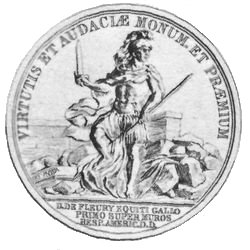
I give an extended biography of the Chevalier de Fleury, the only foreigner to whom a medal was awarded during the Revolutionary War, because no accurate account of him has hitherto been published. The facts were obtained partly from the archives of the French Ministry of War, through the politeness of M. Camille Roussel, member of the French Academy, and at the time historiographer of the Ministry of War, and partly from the archives of the Ministry of Marine. I am also indebted to M. Roussel for the memorial (petition) of M. de Fleury, a translation of which is given below.
François Louis Teisseidre de Fleury, son of François Teisseidre, Seigneur de Fleury, was born at St. Hippolyte, Languedoc, France, August 28, 1749. He entered the French army as a volunteer in the regiment of Rouergue infantry, May 15, 1768; became second-lieutenant, September 15, 1768; lieutenant second class, of rifles, June 11, 1776; first lieutenant, June 2, 1777; major of Saintonge infantry, March 19, 1780; colonel of the Pondichéry (India) regiment, January 16, 1784; maréchal-de-camp, June 30, 1791; and resigned, June 24, 1792. He was made a knight of St. Louis, December 5, 1781. The Chevalier de Fleury served in Corsica during the campaigns of 1768, 1769, and 1770. Having been commissioned a captain of engineers in 1776, he obtained a furlough and entered the American army as a volunteer, was appointed by Congress a captain of engineers, May 22, 1777, and was sent first to General Washington's army, and toward the end of the campaign to Fort Mifflin, where he was wounded. At the battle of the Brandywine, he had a horse shot under him, and was again wounded. Congress presented him with a horse, "as a testimonial of the sense they had of his merits," September 13, 1777, and promoted him to a lieutenant-colonelcy, "in consideration of the disinterested gallantry he had manifested in the service of the United States," November 26, 1777. In the assault on Stony Point, July 15, 1779, he commanded one of the attacks, was the first to enter the main works, and struck the British flag with his own hands, for which gallant deed Congress voted him a silver medal. On Friday, October 1, 1779, Congress passed the following resolution concerning Lieutenant-Colonel de Fleury: "Resolved, That Congress entertain a high sense of the zeal, activity, military genius, and gallantry of Lieutenant-Colonel Fleury, which he has exhibited on a variety of occasions during his service in the armies of these States, wherein, while he has rendered essential benefit to the American cause, he has deservedly acquired the esteem of the army and gained unfading reputation for himself." He continued in America after General Count de Rochambeau's arrival, serving under him in the campaigns of 1780, 1781, and 1782; and received a pension of four hundred livres by royal decree of May 8, 1783, in consideration of his distinguished services, especially at the siege and taking of Yorktown, October 19, 1781. He afterward served in India, commanded in chief the islands of Mauritius and of Bourbon from May to November, 1785, obtained a pension of one thousand livres, in consideration of his services, November, 1786, and returned to France in April, 1790. He held the rank of maréchal-de-camp in the army of the North, and commanded at Montmédy after General de Bouillé's flight in 1791, and at Givet and Cambray in 1791 and 1792. At the breaking out of the war he was at Valenciennes, and served under Marshals de Rochambeau and de Luckner. During the retreat from Mons his horse, which had been shot under him, fell upon him, and, while lying helpless in that position, he was ridden over by the enemy's cavalry. After a long illness he left the army, June 24, 1792, and retired to Rebais, in the Department of Seine-et-Oise.
ORIGINAL DOCUMENTS.[34]
General Washington to the President of Congress.
Headquarters, West Point, July 25, 1779. To The President of Congress.
Sir: Lieutenant-Colonel Fleury having communicated to me his intention to return to France at the present juncture, on some matters interesting to himself, I have thought proper to give him this letter to testify to Congress the favourable opinion I entertain of his conduct. The marks of their approbation which he received on a former occasion have been amply justified by all his subsequent behaviour. He has signalized himself in more than one instance since; and in the late assault on Stony Point he commanded one of the attacks, was the first that entered the enemy's works, and struck the British flag with his own hands, as reported by General Wayne. It is but justice to him to declare that, in the different stations in which he has been employed, he has rendered services of real utility, and has acquitted himself in every respect as an officer of distinguished merit, one whose talents, zeal, activity, and bravery alike entitle him to particular notice. He has intimated to me a desire to obtain a furlough for a few months. I doubt not Congress will be disposed to grant him every indulgence which can be granted with propriety.
I have the honour to be, &c., Geo. Washington.
General Washington to the President of Congress.
Certificate.
West Point, July 28, 1779. To The President of Congress.
I certify that Lieutenant-Colonel Fleury has served in the army of the United States since the beginning of the campaign of 1777, to the present period, and has uniformly acquitted himself as an officer of distinguished merit for talents, zeal, activity, prudence, and bravery; that he first obtained a captain's commission from Congress, and entered as a volunteer in a corps of riflemen, in which, by his activity and bravery, he soon recommended himself to notice; that he next served as brigade-major, with the rank of major, first in the infantry and then in the cavalry, in which stations he acquired reputation in the army, and the approbation of his commanding officers, of which he has the most ample testimonies; that, toward the conclusion of the campaign of 1777, he was sent to the important post of Fort Mifflin in quality of engineer, in which he rendered essential services, and equally signalized his intelligence and his valour.
That, in consequence of his good conduct on this and on former occasions, he was promoted by Congress to the rank of lieutenant-colonel, and has been since employed in the following stations, namely, as a sub-inspector, as second in command in a corps of light infantry in an expedition against Rhode Island, and lastly as commandant of a battalion of light infantry in the army under my immediate command; that in each of these capacities, as well as the former, he has justified the confidence reposed in him, and acquired more and more the character of a judicious, well-informed, indefatigable, and brave officer. In the assault of Stony Point, a strong fortified post of the enemy on the North River, he commanded one of the attacks, was the first that entered the main works, and struck the British flag with his own hands.
I have the honour to be, &c., Geo. Washington.
A Memorial for M. de Fleury, an Officer in the Regiment of Rouergue for twelve years; a Captain of Engineers in the Service of France for three years; and a Lieutenant-Colonel in the Service of the United States for two years.
M. de Fleury left France with M. du Coudray in 1776.
He obtained a furlough and was commissioned as a captain of engineers.
Congress having refused to employ M. du Coudray and the officers who came over with him, almost all of them were discouraged; but M. de Fleury joined the army and served as a volunteer private during a part of the campaign of 1777.
At the fight of Piscataqua he had the good fortune to be remarked while in performance of his duty, and he was promoted to the rank of captain. (Certified by Colonel Morgan).
He was afterward employed to make a survey of the environs of Philadelphia, which was to be the seat of the approaching campaign, to take soundings in the Delaware, and to fortify Billingsport. (Certified by General Washington).
The enemy having landed at Hith, he joined the army and acted as major of brigade.
At the battle of the Brandywine, he remained on the field after his brigade had been routed, had a horse shot under him, and carried off a piece of ordnance.
On the report of General Washington to Congress, it was ordered that a horse be presented to M. de Fleury "as a mark of the high sense Congress entertained of his merits." (Certified by General Washington and General Sullivan).
N.B. This honour has been paid only to General Arnold and M. de Fleury.
At the battle of Germantown he acted as brigade-major of dragoons, charged several times, and made several prisoners. The horse which had been given to him by Congress was shot under him, and he himself was wounded in the leg. (Certified by General Count Pulaski).
Fort Mifflin, on Mud Island, the only defence of the Delaware, was threatened by the British army and squadron. It was a post of the greatest importance, and M. de Fleury was sent there as chief engineer. He sustained a siege of six weeks behind a stockade. A ship of sixty-four guns, the Augusta, and one of 22 guns, the Merlin, blew up under fire from the fort. The commandant and the garrison, numbering 600 men, were relieved three times, but M. de Fleury refused to leave the fort. He was wounded October 15th, and the fort was evacuated that same night. For this action he was made a lieutenant-colonel, and a letter of thanks was addressed to him by the President of Congress. (Certified by Congress, the General-in-chief, and M. de la Fayette).
During the winter of 1778 he formed the project of crossing the ice and setting fire to the English squadron. The Delaware not being frozen that year hard enough for his purpose, he invented explosive boats, and he was engaged in constructing them when he received orders to join the Army of the North. (Certified by General Washington and Commodore Hasilwood).
The Canadian expedition did not take place, and on his return M. de Fleury was appointed inspector and charged with forming, instructing, and disciplining the troops. (Certified by General Washington).
At the opening of the campaign of 1778 he was second in command of a select corps (in which was the general's body-guard) of 600 men, 2 pieces of ordnance, and 50 cavalry. He served in this capacity at the battle of Monmouth and afterward.
On the arrival of the French squadron, he was sent to meet Count d'Estaing by General Washington, and he went with him to Rhode Island, where an attack was expected.
It was by his advice that the fruitless siege of Newport was raised, and that the retreat to the north part of the island was resolved upon. The corps in which he served repulsed the enemy and covered the retreat. (Certified by General Sullivan).
When he returned to the Army of the South, Count d'Estaing kindly wrote to General Washington: "Allow me to recommend particularly to your favour M. de Fleury. General Sullivan will tell you what he did at Rhode Island; he is an excellent officer and a useful Frenchman. I should be happy, if the occasion offered, to serve again with him. He is fitted to bring about good feeling among private individuals, and to make them as friendly as our two nations are." (Letter of M. d'Estaing).
At the opening of the campaign of 1779 M. de Fleury was in command of a corps of light infantry; he was the first to mount the ramparts of Stony Point, and he took the enemy's flag with his own hand. (Certified by the General and by Congress).
On this occasion the President of Congress wrote that Congress hoped he would receive some reward from his own country, and the French minister also expressed a hope that his Court would give America, through M. de Fleury, some token of the satisfaction with which the services of a French officer to America were viewed in France. (Letter from Mr. Jay).
When M. de la Luzerne arrived, General Washington requested him to call the attention of the French Court to the conduct of M. de Fleury.
At the close of the campaign, by the advice of his general, he asked for nine months' leave. At his departure, General Washington wrote to Congress that he desired the return of an officer who had rendered such important services. (Letter of General Washington).
Though far from rich, M. de Fleury declined any pecuniary recompense on leaving America.
M. de Fleury, having thus by his services risen from the ranks to a lieutenant-colonelcy, and having been honoured by the good will of the nation and of the army, the esteem of Congress and the confidence of his general, ventures to solicit some mark of the approbation of his Prince and of the minister under whose auspices he entered the service of an ally of France.
Though convinced that he owes his success to his good fortune rather than to his talents, and that by his zeal he has alone been enabled to make up for his deficiency, he ventures to hope that his country will not overlook his services, and that his return to a beloved land—which is a source of happiness to every Frenchman—will not prove in his case a misfortune and a loss.
P.S. M. de Fleury has made some surveys and written reports which have met with the approbation of M. Girard; he begs to be allowed to present them to the Minister. (Letter of M. Girard).
Plate V. No. 5.
July 15, 1779.
Joanni Stewart cohortis præfecto Comitia Americana. ℞. Stoney-Point oppugnatum.
MAJOR JOHN STEWART.
[Taking of Stony Point.]
JOANNI STEWART COHORTIS PRÆFECTO COMITIA AMERICANA. (The American Congress to Major John Stewart.) America, personified as an Indian queen, leaning on the American shield, and having at her feet an alligator, presents a palm branch to Major Stewart. gatteaux.
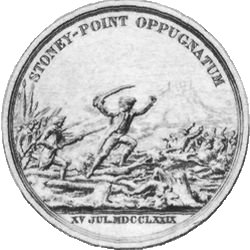
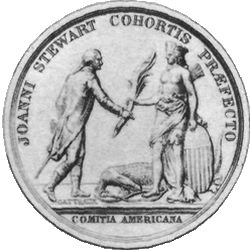
John Stewart was a major of infantry, served under General Wayne, and for his gallantry at the storming of Stony Point, on the Hudson River, July 15, 1779, Congress voted him a silver medal. No trustworthy information can be found concerning him. He is reported to have died near Charleston, South Carolina, from injuries caused by a fall from his horse.
Plate VI. No. 6.
August 19, 1779.
Henrico Lee legionis equit. præfecto. Comitia Americana. ℞. Non obstantib fluminibus vallis, etc.
MAJOR HENRY LEE.
[Surprise of Paulus Hook.]
HENRICO LEE LEGIONIS EQUIT. PRÆFECTO. COMITIA AMERICANA. (Henrico Lee legionis equitum præfecto Comitia Americana: The American Congress to Henry Lee, major of cavalry.) Bust of Major Lee, facing the right. On edge of bust, J. WRIGHT.
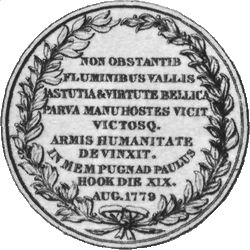
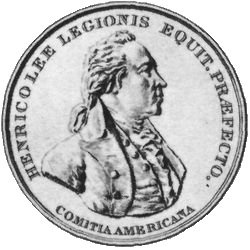
The original die of the obverse of this medal is in the Mint at Philadelphia, but the original die of the reverse is not to be found there. A new one was engraved for the Mint, some time ago, by Mr. Wm. Barber.
Joseph Wright was born in Bordentown, New Jersey, in 1756. He studied painting in England and France, and, after his return to America, painted a portrait of General Washington. He was appointed first draughtsman and die sinker to the United States Mint, and made the dies of a medal, the bust on the obverse of which was considered to be the best medallic profile likeness of Washington. He also made the medal voted by Congress to Major Lee. He died in Philadelphia in 1793.
Henry Lee was born in Stratford, Westmoreland County, Virginia, January 29, 1756. He was graduated at Princeton College, New Jersey, in 1773; was appointed captain in 1777, and major in 1778. He surprised Paulus Hook, August 19, 1779, and received for the "prudence, address, and bravery" displayed by him on that occasion the thanks of Congress and a gold medal; he became lieutenant-colonel, November 6, 1780, and joined the southern army under General Greene, greatly distinguished himself in various engagements, and resigned in 1782. In 1786 he was chosen one of the delegates to Congress from Virginia; was governor of that State, 1791-1794; member of Congress, 1799; and on the death of Washington was selected to pronounce his eulogium, in which he embodied the memorable words: "First in war, first in peace, first in the hearts of his countrymen." He wrote, in 1809, "Memoirs of the War in the Southern Department of the United States." He died on Cumberland Island, Georgia, March 25, 1818. He was known during the Revolutionary War by the sobriquet of "Light Horse Harry."
ORIGINAL DOCUMENTS.
Resolutions of Congress Voting a Medal to Major Henry Lee, etc.
By the United States in Congress Assembled.
Resolved, That the thanks of Congress be given to Major-General Lord Stirling for the judicious measures taken by him to forward the enterprize and to secure the retreat of the party.
Resolved, That the thanks of Congress be given to Major Lee for the remarkable prudence, address and bravery displayed by him on the occasion; and that they approve the humanity shown in circumstances prompting to severity, as honourable to the arms of the United States, and correspondent to the noble principles on which they were assumed.
Resolved, That Congress entertain a high sense of the discipline, fortitude, and spirit manifested by the officers and soldiers under the command of Major Lee in the march, action and retreat; and while with singular satisfaction they acknowledge the merit of these gallant men, they feel an additional pleasure by considering them as part of an army, in which very many brave officers and soldiers have proved, by their cheerful performance of every duty under every difficulty, that they ardently wish to give the truly glorious examples they now receive.
Resolved, That Congress justly esteem the military caution so happily combined with daring activity by Lieutenants McAllister and Rudolph in leading on the forlorn hope.
Resolved, That a medal of gold, emblematical of this affair, be struck, under the direction of the Board of Treasury, and presented to Major Lee.
Resolved, That the brevet, and the pay and subsistence of captain, be given to Lieutenant McAllister and to Lieutenant Rudolph respectively.
Resolved, That the sum of 15,000 dollars be put into the hands of Major Lee, to be by him distributed among the non-commissioned officers and soldiers of the detachment he commanded at the attack and surprize of Powles Hook, in such manner as the commander-in-chief shall direct.
Friday, September 24, 1779.
General Washington to the President of Congress.
Head Quarters, West Point, August 23, 1779. To The President of Congress.
Sir: I have the honour to enclose to Your Excellency Major Lee's report of the surprize and capture of the garrison of Powles Hook. The Major displayed a remarkable degree of prudence, address, enterprize and bravery, upon this occasion, which does the highest honour to himself and to all the officers and men under his command. The situation of the post rendered the attempt critical and the success brilliant. It was made in consequence of information that the garrison was in a state of negligent security, which the event has justified. I am much indebted to Lord Stirling for the judicious measures he took to forward the enterprize, and to secure the retreat of the party. Lieutenant McAllister, who will have the honour of delivering these despatches, will present Congress with the standard of the garrison, which fell into his possession during the attack. Major Lee speaks of this gentleman's conduct in the handsomest terms.
I have the honour to be, &c., Geo. Washington.
P.S. The report not having been received till this day, prevented a speedier transmission. Major Lee mentions twenty men lost on our side. Captain Rudolph informs me that, since the report was concluded, several of the missing had returned, which will lessen the supposed loss near one half.
Major Henry Lee to General Washington.
Paramus, August 22, 1779. To His Excellency General Washington.
Sir: Lord Stirling was pleased to communicate to Your Excellency my verbal report to his Lordship of the 19th instant. I now do myself the honour to present a particular relation of the enterprize Your Excellency was pleased to commit to my direction.
I took command of the troops employed on this occasion on the 18th. They amounted to four hundred infantry, composed of detachments from the Virginia and Maryland divisions, and one troop of dismounted dragoons.
The troops moved from the vicinity of the New Bridge about four o'clock p.m. Patrols of horse being detached to watch the communication with the North River, and parties of infantry stationed at the different avenues leading to Powles Hook. My anxiety to render the march as easy as possible, induced me to pursue the Bergen road lower than intended. After filing into the mountains, the timidity or treachery of the principal guide prolonged a short march into a march of three hours; by this means the troops were exceedingly harassed, and being obliged, through deep mountainous woods, to regain our route, some parties of the rear were unfortunately separated. This affected me most sensibly, as it not only diminished the number of men destined for the assault, but deprived me of the aid of several officers of distinguished merit.
On reaching the point of separation, I found my first disposition impracticable, both from the near approach of day and the rising of the tide. Not a moment being to spare, I paid no attention to the punctilios of honour or rank, but ordered the troops to advance in their then disposition. Lieutenant Rudolph, whom I had previously detached to reconnoitre the passages of the canal, returned to me at this point of time and reported that all was silence within the works, that he had fathomed the canal and found the passage on the centre route still admissible. This intervening intelligence was immediately communicated from front to rear, and the troops pushed on with that resolution, order, and coolness which insures success.
The forlorn hopes, led by Lieutenant McAllister, of the Maryland, and Lieutenant Rudolph, of the dragoons, marched on with trailed arms, in most profound silence. Such was the singular address of these two gentlemen, that the first notice to the garrison was the forlorns plunging into the canal. A firing immediately commenced from the block-houses and along the line of the abatis, but did not in the least check the advance of the troops. The forlorns, supported by Major Clarke, at the head of the right column, broke through all opposition, and found an entrance into the main work. So rapid was the movement of the troops, that we gained the fort before the discharge of a single piece of artillery. The centre column, conducted by Captain Forsyth, on passing the abatis, took a direction to their left. Lieutenant Armstrong led on the advance of this column. They soon possessed themselves of the officers and troops posted at the house No. 6, and fully completed every object of their destination. The rear column, under Captain Handy, moved forward in support of the whole. Thus were we completely victorious in the space of a few moments.
The appearance of daylight, my apprehension lest some accident might have befallen the boats, the numerous difficulties of the retreat, the harassed state of the troops, and the destruction of all our ammunition by passing the canal, conspired in influencing me to retire in the moment of victory. Major Clarke, with the right column, was immediately put in motion with the greater part of the prisoners. Captain Handy followed on with the remainder. Lieutenants Armstrong and Reed formed the rear guard.
Immediately on the commencement of the retreat, I sent forward Captain Forsyth to Prior's Mill to collect such men from the different columns as were most fit for action, and to take post on the heights of Bergen to cover the retreat.
On my reaching this place I was informed by Cornet Neill (who had been posted there during the night for the purpose of laying the bridge and communicating with the boats), that my messenger, directed to him previous to the attack, had not arrived, nor had he heard from Captain Peyton, who had charge of the boats.
Struck with apprehension that I should be disappointed in the route of retreat, I rode forward to the front, under Major Clarke, whom I found very near the point of embarkation, and no boats to receive them. In this very critical situation I lost no time in my decision, but ordered the troops to regain Bergen road and shove on to the New Bridge; at the same time I communicated my disappointment to Lord Stirling by express, then returned to Prior's Bridge to the rear-guard.
Oppressed by every possible misfortune, at the head of troops worn down by a rapid march of thirty miles, through mountains, swamps, and deep morasses, without the least refreshment during the whole march, ammunition destroyed, incumbered with prisoners, and a retreat of fourteen miles to make good, on a route admissible of interception at several points, by a moving in our rear, and another (from the intelligence I had received from the captured officers) in all probability well advanced on our right; a retreat naturally impossible to our left; under all these distressing circumstances, my sole dependence was in the persevering gallantry of the officers and obstinate courage of the troops. In this I was fully satisfied by the shouts of the soldiery, who gave every proof of unimpaired vigour the moment that the enemy's approach was announced.
Having gained the point of intersection opposite Weehawken, Captain Handy was directed to move with his division on the mountain road, in order to facilitate the retreat. Captain Catlett, of the Virginia regiment, fortunately joined me at this moment, at the head of fifty men, with good ammunition. I immediately halted this officer, and having detached two parties, the one on the Bergen road in the rear of Major Clarke, the other on the banks of the North River, I moved with the party under the command of the captain on the centre route. By these precautions a sudden approach of the enemy was fully prevented. I am very much indebted to this officer, and the gentlemen under him, for their alacrity and vigilance on this occasion.
On the rear's approach to the Fort Lee road, we met a detachment under the command of Colonel Ball, which Lord Stirling had pushed forward, on the first notice of our situation, to support the retreat. The colonel moved on, and occupied a position which effectually covered us.
Some little time after this, a body of the enemy (alluded to in the intelligence I mentioned to have received from the officers while in the fort) made their appearance, issuing out of the woods on our right, and moving through the fields directly to the road. They immediately commenced a fire upon my rear. Lieutenant Reed threw himself, with a party, into a stone house which commanded the road. These two officers were directed mutually to support each other, and give time for the troops to pass the English Neighbourhood Creek, at the liberty pole. On the enemy's observing this disposition, they immediately retired by the same route they had approached, and gained the woods. The precipitation with which they retired, preventing the possibility of Colonel Ball's falling in with them, saved the whole.
The body which moved in our rear, having excessively fatigued themselves by the rapidity of their march, thought prudent to halt before they came in contact with us.
Thus, Sir, was every attempt to cut off our rear completely baffled. The troops arrived safe at the New Bridge, with all the prisoners, about one o'clock p.m. on the nineteenth.
I should commit the highest injustice was I not to assure Your Excellency that my endeavours were fully seconded by every officer in his station; nor can any discrimination justly be made but what arose from opportunity. The troops vied with each other in patience under their many sufferings, and conducted themselves in every vicissitude of fortune with a resolution which reflects the highest honour on them.
During the whole action not a single musket was fired on our side—the bayonet was our sole dependence.
Having gained the fort, such was the order of the troops, and attention of the officers, that the soldiers were prevented from plundering, although in the midst of every sort.
American humanity has been again signally manifested. Self-preservation strongly dictated, on the retreat, the putting the prisoners to death, and British cruelty fully justified it, notwithstanding which, not a man was wantonly hurt.
During the progress of the troops in the works, from the different reports of my officers, I conclude not more than fifty of the enemy were killed, and a few wounded. Among the killed is one officer, supposed (from his description) to be a captain in Colonel Buskirk's regiment. Our loss, on this occasion, is very trifling. I have not yet had a report from the detachment of the Virginians; but as I conclude their loss to be proportionate to the loss of the other troops, I can venture to pronounce that the loss of the whole, in killed, wounded, and missing, will not exceed twenty. As soon as the report comes to hand, I will transmit to headquarters an accurate return. I herewith enclose a return of the prisoners taken from the enemy.
At every point of the enterprize I stood highly indebted to Major Clarke for his zeal, activity, and example. Captains Handy and Forsyth have claim to my particular thanks for the support I experienced from them on every occasion. The Captains Reed, McLane, Smith, Crump, and Wilmot, behaved with the greatest zeal and intrepidity. I must acknowledge myself very much indebted to Major Burnet and Captain Peyton, of the dragoons, for their counsel and indefatigability in the previous preparations to the attack. The premature withdrawal of the boats was owing to the non-arrival of my despatches; and, though a most mortifying circumstance, can be called nothing more than unfortunate. Lieutenant Vanderville, who was to have commanded one of the forlorns, but was thrown out by alteration of the disposition of battle, conducted himself perfectly soldier-like. The whole of the officers behaved with the greatest propriety; and, as I said before, no discrimination can justly be made, but what arose from opportunity.
The Lieutenants McAllister, Armstrong, Reed, and Rudolph distinguished themselves remarkably. Too much praise cannot be given to those gentlemen for their prowess and example. Captain Bradford, of the train, who volunteered it with me, for the purpose of taking direction of the artillery, deserves my warmest thanks for his zeal and activity. I am personally indebted to Captain Rudolph and Dr. Irvine, of the dragoons, who attended me during the expedition, for their many services.
I beg leave to present Your Excellency with the flag of the fort by the hands of Mr. McAllister, the gentleman into whose possession it fell.
It is needless for me to explain my reasons for the instantaneous evacuation of the fort. Your Excellency's knowledge of the post will suggest fully the propriety of it. The event confirms it.
Among the many unfortunate circumstances which crossed our wishes, none was more so than the accidental absence of Colonel Buskirk and the greatest part of his regiment. They had set out on an expedition up the North River the very night of the attack. A company of vigilant Hessians had taken their place in the fort, which rendered the secrecy of approach more precarious, and, at the same time, diminished the object of the enterprize by a reduction of the number of the garrison. Major Sutherland fortunately saved himself by a soldier counterfeiting his person. This imposition was not discovered until too late.
I intended to have burned the barracks, but on finding a number of sick soldiers and women with young children in them, humanity forbade the execution of my intention. The key of the magazine could not be found, nor could it be broken open in the little time we had to spare, many attempts having been made to that purpose by the Lieutenants McAllister and Reed. It was completely impracticable to bring off any pieces of artillery. I consulted Captain Bradford on the point, who confirmed me in my opinion. The circumstance of spiking them being trivial it was omitted altogether.
After most of the troops had retired from the works, and were passed and passing the canal, a fire of musketry commenced from a few stragglers, who had collected in an old work, on the right of the main fort. Their fire being ineffectual, and the object trifling, I determined not to break in upon the order of retreat, but continued passing the defile in front. I cannot conclude this relation without expressing my wannest thanks to Lord Stirling, for the full patronage I received from him in every stage of the enterprize. I must also return my thanks to the cavalry, for their vigilant execution of the duties assigned them.
Captain Rudolph waits on Your Excellency with these despatches. I beg leave to refer to this officer for any further explanation that may be required.
I have the honour to be, Sir, with the most perfect respect, Your Excellency's most obedient and humble servant, Henry Lee, Jr.
Plate VII. No. 7.
September 23, 1780.
Fidelity. ℞. Vincit amor patriæ.
JOHN PAULDING, DAVID WILLIAMS, ISAAC VAN WART.
[Capture of Major André.]
FIDELITY. Field embossed in and wreathed with two branches, one of laurel, the other of palm, united by a ribbon.
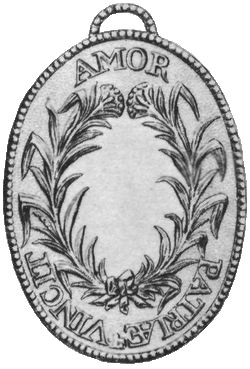
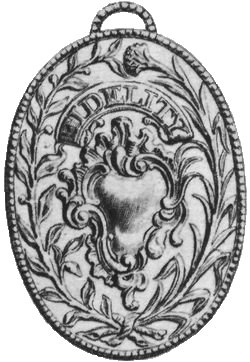
This is not properly a medal, but a repoussé, made by a silversmith.
John Paulding was born in New York in 1759; and died in Westchester County, New York, February 18, 1848.
David Williams was born in Tarrytown, October 21, 1754, and died in Broome, Schoharie County, New York, August 2, 1831.
Isaac Van Wart was born in New York in 1750, and died in Westchester County, New York, May 23, 1818.
These three militiamen captured Major André, of the British Army, September 23, 1780, and refusing his large offers of money, delivered him up to the American commanding officer of the district. Thus the treasonable intentions of General Arnold to surrender West Point to the enemy were frustrated. For this great service to their country they each received the thanks of Congress and a silver medal.
ORIGINAL DOCUMENTS.
Resolution of Congress Voting Medals to John Paulding, David Williams, and Isaac Van Wart.
By The United States in Congress Assembled.
Whereas, Congress have received information that John Paulding, David Williams, and Isaac Van Wart, three young volunteer militiamen of the State of New York, did, on the 23d day of September last, intercept Major John André, adjutant-general of the British army, on his return from the American lines, in the character of a spy; and, notwithstanding the large bribes offered them for his release, nobly disdaining to sacrifice their country for the sake of gold, secured and conveyed him to the commanding officer of the district, whereby the dangerous and traitorous conspiracy of Benedict Arnold was brought to light, the insidious designs of the enemy baffled, and the United States rescued from impending danger:
Resolved, That Congress have a high sense of the virtuous and patriotic conduct of the said John Paulding, David Williams, and Isaac Van Wart. In testimony whereof,
Ordered, That each of them receive annually, out of the public treasury, 200 dollars in specie, or an equivalent in the current money of these States, during life; and that the Board of War procure for each of them a silver medal, on one side of which shall be a shield with this inscription: "Fidelity," and on the other the following motto: "Vincit amor patriæ," and forward them to the commander-in-chief, who is requested to present the same, with a copy of this resolution, and the thanks of Congress for their fidelity, and the eminent service they have rendered their country.