LIST OF PLATES. (continued 8)
Reading edition
The main object proposed in the morning had been effected. A powerful diversion had been made to favor the operations of the 2d Division, one of the enemy's advanced works had been carried, and we now had a strong foot-hold in the town. But this had not been accomplished without a heavy loss, embracing some of our gallant and promising officers. Captain Williams, Topographical Engineers, Lieutenants Terrett and Dilworth, 1st Infantry, Lieutenant Woods, 2d Infantry, Captains Morris and Field, Brevet-Major Barbour, Lieutenants Irwin and Hazlitt, 3d Infantry, Lieutenant Hoskins, 4th Infantry, Lieutenant-Colonel Watson, Baltimore battalion, Captain Allen and Lieutenant Putman, Tennessee regiment, and Lieutenant Hett, Ohio regiment, were killed, or have since died of wounds received in this engagement, while the number and rank of the officers wounded gives additional proof of the obstinacy of the contest, and the good conduct of our troops. The number of killed and wounded incident to the operations in the lower part of the city on the 21st is 394.
Early in the morning of this day (21st), the advance of the 2d Division had encountered the enemy in force, and after a brief but sharp conflict, repulsed him with heavy loss. General Worth then succeeded in gaining a position on the Saltillo road, thus cutting the enemy's line of communication. From this position the two heights south of the Saltillo road were carried in succession, and the gun taken in one of them turned upon the Bishop's Palace. These important successes were fortunately obtained with comparatively small loss; Captain McKavett, 8th Infantry, being the only officer killed.
The 22d day of September passed without any active operations in the lower part of the city. The citadel and other works continued to fire at parties exposed to their range, and at the work now occupied by our troops. The guard left in it the preceding night, except Captain Ridgely's company, was relieved at midday by General Quitman's brigade. Captain Bragg's battery was thrown under cover in front of the town to repel any demonstration of cavalry in that quarter. At dawn of day the height above the Bishop's Palace was carried, and soon after meridian the palace itself was taken, and its guns turned upon the fugitive garrison. The object for which the 2d Division was detached had thus been completely accomplished, and I felt confident that with a strong force occupying the road and heights in his rear, and a good position below the city in our possession, the enemy could not possibly maintain the town.
During the night of the 22d the enemy evacuated nearly all his defences in the lower part of the city. This was reported to me early in the morning of the 23d by General Quitman, who had already meditated an assault upon those works. I immediately sent instructions to that officer, leaving it to his discretion, to enter the city, covering his men by the houses and walls, and advance carefully as far as he might deem prudent. After ordering the remainder of the troops as a reserve, under the orders of Brigadier-General Twiggs, I repaired to the abandoned works and discovered that a portion of General Quitman's brigade had entered the town, and were successfully forcing their way towards the principal plaza. I then ordered up the 2d regiment of Texas mounted volunteers, who entered the city dismounted, and, under the immediate orders of General Henderson, co-operated with General Quitman's brigade. Captain Bragg's battery was also ordered up, supported by the 3d Infantry; and after firing for some time at the cathedral, a portion of it was likewise thrown into the city. Our troops advanced from house to house, and from square to square, until they reached a street but one square in rear of the principal plaza, in and near which the enemy's force was mainly concentrated. This advance was conducted vigorously, but with due caution, and although destructive to the enemy, was attended with but small loss on our part. Captain Ridgely, in the mean time, had served a captured piece in battery No. 1 against the city, until the advance of our men rendered it imprudent to fire in the direction of the cathedral. I was now satisfied that we could operate successfully in the city, and that the enemy had retired from the lower portion of it to make a stand behind his barricades. As General Quitman's brigade had been on duty the previous night, I determined to withdraw the troops to the evacuated works, and concert with General Worth a combined attack upon the town. The troops accordingly fell back deliberately, in good order, and resumed their original positions, General Quitman's brigade being relieved after nightfall by that of General Hamer. On my return to camp, I met an officer with the intelligence that General Worth, induced by the firing in the lower part of the city, was about making an attack at the upper extremity, which had also been evacuated by the enemy to a considerable distance. I regretted that this information had not reached me before leaving the city, but still deemed it inexpedient to change my orders, and accordingly returned to the camp. A note from General Worth written at eleven o'clock p.m., informed me that he had advanced to within a short distance of the principal plaza, and that the mortar (which had been sent to his division in the morning) was doing good execution within effective range of the enemy's position.
Desiring to make no further attempt upon the city without complete concert as to the lines and mode of approach, I instructed that officer to suspend his advance until I could have an interview with him on the following morning at his head-quarters.
Early on the morning of the 24th, I received, through Colonel Moreno, a communication from General Ampudia, proposing to evacuate the town; which, with the answer, were forwarded with my first despatch. I arranged with Colonel Moreno a cessation of fire until twelve o'clock, at which hour I would receive the answer of the Mexican general at General Worth's head-quarters, to which I soon repaired. In the mean time, General Ampudia had signified to General Worth, his desire for a personal interview with me, to which I acceded, and which finally resulted in a capitulation, placing the town and the material of war, with certain exceptions, in our possession. A copy of that capitulation was transmitted with my first despatch.
Upon occupying the city, it was discovered to be of great strength in itself, and to have its approaches carefully and strongly fortified. The town and works were armed with forty-two pieces of cannon, well supplied with ammunition, and manned with a force of at least 7000 troops of the line, and from 2000 to 3000 irregulars. The force under my orders before Monterey, was 425 officers and 6220 men. Our artillery consisted of one ten-inch mortar, two twenty-four-pounder howitzers, and four light field batteries of four guns each; the mortar being the only piece suitable to the operations of a siege.
Our loss is twelve officers and one hundred and eight men killed; thirty-one officers and three hundred and thirty-seven men wounded. That of the enemy is not known, but is believed considerably to exceed our own.
I take pleasure in bringing to the notice of the government the good conduct of the troops, both regulars and volunteers, which has been conspicuous throughout the operations. I am proud to bear testimony to their coolness and constancy in battle, and the cheerfulness with which they have submitted to exposure and privation. To the general officers commanding divisions, Major-Generals Butler and Henderson, and Brigadier-Generals Twiggs and Worth, I must express my obligations for the efficient aid which they have rendered in their respective commands. I was unfortunately deprived, early on the 21st, of the valuable services of Major-General Butler, who was disabled by a wound received in the attack on the city. Major-General Henderson, commanding the Texan volunteers, has given me important aid in the organization of the command, and its subsequent operations. Brigadier-General Twiggs rendered important services with his division, and as the second in command after Major-General Butler was disabled. Brigadier-General Worth was intrusted with an important detachment which rendered his operations independent of my own. These operations were conducted with ability, and crowned with complete success.
I desire also to notice Brigadier-Generals Hamer and Quitman, commanding brigades in General Butler's division; Lieutenant-Colonels Garland and Wilson, commanding brigades in General Twiggs' division; Colonels Mitchell, Campbell, Davis, and Wood, commanding the Ohio, Tennessee, Mississippi, and 2d Texas regiments, respectively; and Majors Lear, Allen, and Abercrombie, commanding the 3d, 4th, and 1st regiments of infantry; all of whom served under my eye, and conducted their commands with coolness and gallantry against the enemy. Colonel Mitchell, Lieutenant-Colonel McClung, Mississippi regiment, Major Lear, 3d Infantry, and Major Alexander, Tennessee regiment, were all severely wounded, as were Captain Lamotte, 1st Infantry, Lieutenant Graham, 4th Infantry, Adjutant Armstrong, Ohio regiment, Lieutenants Scudder and Allen, Tennessee regiment, and Lieutenant Howard, Mississippi regiment, while leading their men against the enemy's position, on the 21st and 23d. After the fall of Colonel Mitchell, the command of 1st Ohio regiment devolved upon Lieutenant-Colonel Weller; that of the 3d Infantry, after the fall of Major Lear, devolved in succession upon Captain Bainbridge and Captain Henry, the former being also wounded. The following named officers have been favorably noticed by their commanders: Lieutenant-Colonel Anderson, and Adjutant Heiman, Tennessee regiment; Lieutenant-Colonel McClung, Captains Cooper and Downing, Lieutenants Patterson, Calhoun, Moore, Russell, and Cook, Mississippi regiment; also Sergeant-Major Hearlan, Mississippi regiment, and Major Price, and Captain J. Smith, unattached, but serving with it. I beg leave also to call attention to the good conduct of Captain Johnston, Ohio regiment, and Lieutenant Hooker, 1st Artillery, serving on the staff of General Hamer, and of Lieutenant Nichols, 2d Artillery, on that of General Quitman. Captains Bragg and Ridgely served with their batteries during the operations under my own observation, and in part under my immediate orders, and exhibited distinguished skill and gallantry. Captain Webster, 1st Artillery, assisted by Lieutenants Donaldson and Bowen, rendered good service with the howitzer battery, which was much exposed to the enemy's fire on the 21st.
From the nature of the operations, the 2d Dragoons were not brought into action, but were usefully employed under the direction of Lieutenant-Colonel May, as escorts, and in keeping open our communications. The 1st Kentucky regiment was also prevented from participating in the action of the 21st, but rendered highly important services under Colonel Ormsby, in covering the mortar battery, and holding in check the enemy's cavalry during the day.
I have noticed above the officers whose conduct either fell under my immediate eye, or is noticed only in minor reports which are not forwarded. For further mention of individuals, I beg leave to refer to the reports of division commanders. I fully concur in their recommendations, and desire that they may be considered as a part of my own report.
From the officers of my personal staff, and of the engineers, topographical engineers, and ordnance, associated with me, I have derived valuable and efficient assistance during the operations. Colonel Whiting, assistant quartermaster-general, Colonels Croghan and Belknap, inspector generals, Major Bliss, assistant adjutant general, Captain Sibley, assistant quartermaster, Captain Waggaman, commissary of subsistence, Captain Eaton and Lieutenant Garnett, aids-de-camp, and Major Kirby and Van Buren, pay department, served near my person, and were ever prompt, in all situations, in the communication of my orders and instructions. I must express my particular obligations to Brevet-Major Mansfield and Lieutenant Scarritt, corps of Engineers. They both rendered most important services in reconnoitring the enemy's positions, conducting troops in attack, and strengthening the works captured from the enemy. Major Mansfield, though wounded on the 21st, remained on duty during that and the following day, until confined by his wound to camp. Captain Williams, Topographical Engineer, to my great regret and the loss of the service, was mortally wounded while fearlessly exposing himself in the attack of the 21st. Lieutenant Pope, of the same corps, was active and zealous throughout the operations. Major Munroe, chief of the Artillery, Major Craig and Captain Ramsay, of the Ordnance, were assiduous in the performance of their proper duties. The former superintended their mortar service on the 22d, as particularly mentioned in the report of General Worth, to which I also refer for the services of the engineer and topographical officers detached with the second division.
Surgeon Craig, medical director, was actively employed in the important duties of his department, and the medical staff generally were unremitting in their attentions to the numerous wounded; their duties with the regular regiments being rendered uncommonly arduous by the small number serving in the field.
I respectfully enclose herewith, in addition to the report of division commanders, a field return of the force before Monterey on the 21st of September; a return of killed, wounded and missing during the operations, and two topographical sketches, one exhibiting all the movements around Monterey, the other on a large scale illustrating more particularly the operations in the lower quarters of the city, prepared respectively by Lieutenants Meade and Pope, Topographical Engineers.
I am, Sir, very respectfully, your obedient servant,
Z. Taylor, Major-General U. S. A., commanding.
Plate LXII. No. 61.
December 10, 1846.
Somers navis Americana. ℞. Pro vitis Americanorum conservatis.
LOSS OF THE UNITED STATES BRIG-OF-WAR SOMERS.
[for Having Saved the Lives of Americans.]
SOMERS NAVIS AMERICANA. (The American vessel Somers.) The United States brig-of-war Somers knocked down at sea. Exergue: ANTE VERA CRUZ DEC. 10th 1846. (Off Vera Cruz, December 10th, 1846.) C. C. WRIGHT. F. (fecit).
PRO VITIS AMERICANORUM CONSERVATIS. (For having saved the lives of Americans.) Three men-of-war's boats, English, Spanish, and French, pulling for the Somers. Exergue: A vacant space for the name of the recipient. ENG. (engraved) BY C. C. WRIGHT.
I saw, in 1872, in the office of the chief clerk of the Navy Department, Washington, two small paintings of both sides of this medal. They were signed: Butterworth, pinxit.
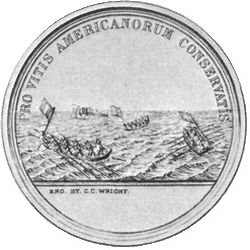
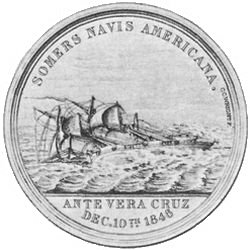
Charles Cushing Wright was born in Maine in 1796. He was a bank note engraver and a die sinker, and made several medals, among others those voted to General Taylor for Buena Vista, to General Scott for Mexico, to Colonel Bliss by the State of New York, to General Taylor by the State of Louisiana, to the Volunteers in Mexico by the City of New York, and the Somers medal. He died in New York, June 7, 1854.
ORIGINAL DOCUMENTS.
Resolution of Congress Voting Medals to British, French, and Spanish Officers, etc.
Resolved by the Senate and House of Representatives of the United States of America in Congress assembled: That the President of the United States is hereby authorized and requested to cause suitable gold and silver medals to be prepared and presented to the officers and men belonging or attached to the French, British, and Spanish ships of war in the harbor of Vera Cruz, who so gallantly and at the imminent peril of their lives, aided in rescuing from a watery grave many of the officers and crew of the United States brig Somers.
Approved March 3d, 1847.
Lieutenant Semmes to Commodore M. C. Perry.
U. S. frigate Raritan, Anton Lizardo, December 10, 1846. To Commodore M. C. Perry, Second in command, Home Squadron.
Sir: It becomes my painful duty to inform you of the loss of the U.S. brig Somers, late under my command, and of the drowning of more than half of her crew. The details of this sad catastrophe are briefly as follows:
After having been forty-five days maintaining the blockade off Vera Cruz, I anchored on the evening of the 7th instant under Verde Island, where it had been my practice to take shelter from the N. W. gales, which blow with such frequency and violence along this coast at this season of the year. Soon after sunrise the next morning, a sail having been descried from the masthead, I immediately got under way, and commenced beating up between the Verde Island and Pascoros reefs. In a short time I was enabled, with my glass, to make out the strange sail to be a man of war, whereupon I hoisted my number, and had the satisfaction in fifteen or twenty minutes more to see the stranger show that of the "John Adams." The wind, which had been blowing from the W. N. W. when we got under way, gradually hauled to the northwest and settled for a while at N. N. E. The barometer having fallen the night previous to 29.80 in., and being still down, and the weather looking still unsettled, I was apprehensive of a gale. As soon, therefore, as the "John Adams" showed her number, I wore round and ran down towards Verde Island, with a view of coming to, and getting my vessel snug before the gale should come on. When I had nearly approached the anchorage, the look-out at the masthead cried "Sail ho!" a second time. On applying my glass to the direction indicated from aloft, I perceived this second sail to be a brig in the N. E., standing apparently for Vera Cruz (she did afterwards run between the inner Anegada and the Blanquilla). I immediately abandoned my intention of anchoring, as the gale had not yet set in, and hauling on a wind, under top-sails and courses, commenced to beat up the passage a second time, with the view of placing myself between the strange sail and the Port, to prevent the possibility of her running the blockade, if she should be so inclined. I made one tack towards the Pascoros reefs, and at the time of the catastrophe, was standing on the larboard tack, with the northern point of the Verde Island reef a couple of points on my lee bow. We were still under topsails, courses, jib and spanker, and the Brig did not appear too much pressed. I was myself standing on the lee arm-chest, having just passed over from the weather quarter, and, with my spy-glass in hand, was observing the reef on our lee bow to see whether it were possible to weather it, or in the event of our not being able to do this, to give timely notice to the officer of the deck to tack ship. I had not been long in this position before the officer of the deck, 2d Lieut. Jas. L. Parker, remarked to me that he thought it looked a little squally to windward. I immediately passed over to the weather side, and as it looked a little darker than it had done, I ordered him to haul up the mainsail, and brail up the spanker, and directed the helm to be put up. These orders were promptly obeyed. Lieut. Parker took the mainsail off her, and had got the spanker about half brailed up, when the squall struck us. It did not appear to be very riotous, nor was its approach accompanied by any foaming of the water, or other indications which usually mark the approach of heavy squalls. But the Brig being flying light, having scarcely any water or provisions, and but six tons of ballast on board, she was thrown over almost instantly, so far as to refuse to obey her helm, the pressure of the water on the lee bow rather inclining her to luff; seeing which, I directed the helm to be put down, hoping that I might luff and shake the wind out of her sails, until the force of the squall should be spent. The quartermaster at the helm had hardly time to obey this order, before the brig was on her beam ends, and the water pouring into every hatch and scuttle. Being now convinced that she must speedily go down unless relieved, I ordered the masts to be cut away. The officers and men, who, with few exceptions, had, by this time, gained the weather bulwarks of the vessel, immediately began to cut away the rigging. But as this was a forlorn hope, the brig filling very fast, and her masts and yards lying flat upon the surface of the sea, I placed no reliance whatever on their efforts. A few moments more, and I was convinced that, in spite of all our exertions, she must inevitably go down in a very short time. I accordingly turned my attention to the saving of as many lives as possible. The boats secured in the grips amidships, and the starboard-quarter boat, were already several feet under water, so that it was impossible to reach them, but we succeeded in disengaging the larboard-quarter boat from her davits, a small boat pulling five oars, and dropped her, fortunately, to leeward of the brig to prevent her being thrown upon the vessel's side, and crushed by the sea. I ordered Midshipman F. G. Clark to take charge of this boat, and with the purser, surgeon, and seventeen men, make for Verde Island, if possible, and after having landed all but the boat's crew, to return and save others. It was now blowing a strong gale, with a heavy sea running, and I deemed it imprudent to trust more men in so small a boat. Besides, I was anxious to shove her off, before the vessel should sink, lest there might be a rush for her, and no life at all should be saved. I cannot refrain from expressing, in this place, my admiration of the noble conduct of several of the men embarked in this boat, who implored the officers by name to take their places, saying they would willingly die by the wreck, if the officers would but save themselves. Of course, none of the generous fellows were permitted to come out, and they were all subsequently safely landed, as they deserved to be. Midshipman Clark fortunately succeeded in shoving off, and pulling some twenty paces from the brig before she went down. When she was on the point of sinking beneath us, and engulfing us in the waves, I gave the order: "Every man save himself who can." Whereupon there was a simultaneous plunge into the sea, of about sixty officers and men, each one trying to secure some frail object that had drifted from the wreck, for the purpose of sustaining himself in the awful struggle with the sea, which awaited him. Some reached a grating, some an oar, some a boat's mast, some a hen-coop, &c., but many poor fellows sprang into the sea to perish in a few minutes, not being able to find any object of support. Lieut. Parker and myself, being both swimmers, were fortunate enough to reach one of the arm-chest gratings, which afforded us partial support, but on which we should inevitably have been drowned, if we had not, when we had swam some twenty or thirty paces, secured an upper half port which came drifting by us. We lashed this with lanyards attached to it to our grating, and thenceforth got along much better. Midshipman Clark, after he had landed the officers and men under his charge at Verde Island, shoved off a second time, in obedience to the orders I had given him, at the imminent peril of his life, for the gale was now blowing with such violence, and the sea running so heavy, that it seemed impossible that so small a boat could live, and skirted the Verde Island to see if it were possible to rescue any of us from the waves. His efforts were rewarded with partial success, as he picked up Lieutenant Parker and myself and one of the seamen. As soon as I landed I sent Midshipman Clark out again, who ventured as far from the island as he thought his boat would live, but this time he returned unsuccessful, having been able to descry no floating object whatever. Lieutenant Claiborne saved himself on a small hatch about two feet square, used for covering the pump-well, and which he found floating near the wreck. He was thrown with great violence upon a reef near Sacrificios, but fortunately escaped without serious injury. As strange as it may appear to you, there could not have elapsed more than ten minutes between our being struck with the squall and the total disappearance of the "Somers." I feel that I would not be doing justice to the officers and men who were under my command on this melancholy occasion, if I were to close this report without bearing testimony to their uniform coolness and self-possession under the trying circumstance under which we were placed, the alacrity with which they obeyed my orders, and when all was over the generosity with which they behaved to each other in the water, where the struggle was one of life and death. I have thus concluded what I had to say in relation to the causes of the disaster, and our own exertions; but with heartfelt acknowledgments, it remains for me to inform you of the gallant and feeling manner in which all the foreign men-of-war lying at Sacrificios came to our rescue. They hoisted out and manned boats immediately, and at the hazard of their lives, put out towards the wreck. They were at first driven back by the violence of the wind and sea, but renewed their efforts upon the first lull, and had the unhoped for satisfaction of saving fourteen more of our unfortunate companions. To Captain Lambert, of the English frigate "Endymion;" Captain Frankland, of the English corvette "Alarm;" Commander Matson, of the English brig "Daring;" Captain Dubut, of the French brig "Mercure;" Captain de Labédoyère, of the French brig "Pylade;" and Captain Puente, of the Spanish corvette "Louisa Fernandez;" who all sent boats, and supplied us with clothing, and hospitably entertained us on board their ships, we owe a lasting debt of gratitude.
In conclusion, I respectfully request that at as early a date as convenient you will order a Court of Inquiry to investigate my conduct in this unfortunate affair.
R. Semmes, Lieutenant commanding.
Plate LXIII. No. 62.
1847.
Major General Winfield Scott. ℞. Vera Cruz. Cerro Gordo. Contreras, etc.
MAJOR-GENERAL SCOTT.
[Mexican Campaign.]
In a pendant: MAJOR GENERAL WINFIELD SCOTT. Undraped bust of General Scott, facing the left. Fifteen stars on each side. Exergue: RESOLUTION OF CONGRESS MARCH 9. 1848. S. ELLIS DEL. (delineavit.) On the edge of bust, C. C. WRIGHT, F. (fecit.)
Six crowns of laurel and oak intertwined; in each the name of one of the Mexican victories of General Scott: VERA CRUZ. CERRO GORDO. CONTRERAS. SAN ANTONIO & CHURUBUSCO. MOLINO DEL REY. CHAPULTEPEC. In the centre is the taking of the capital, CITY OF MEXICO, which General Scott is observing on horseback. G. C. HUMPHRIES DEL. (delineavit.) C. C. WRIGHT FECt. (fecit.)
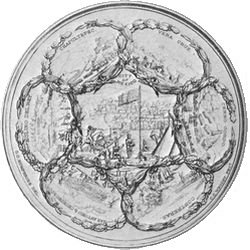
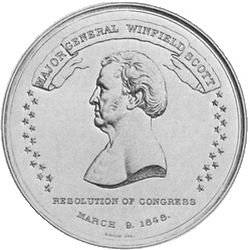
Salathiel Ellis was born in Vermont in 1806, and followed his parents to St. Lawrence County, New York. He became a portrait painter, cameo cutter and die sinker. He settled in New York city about 1842, and designed the obverses of the medals awarded to General Taylor for Buena Vista, and to General Scott for Mexico; he engraved the obverses of the medals of Presidents Fillmore, Pierce, Buchanan, and Lincoln, and also of that given to Cornelius Vanderbilt.
G. C. Humphries, who designed the reverse of this medal, died in London, England.
ORIGINAL DOCUMENTS.
Resolution of Congress Voting a Medal to General Scott.
Resolved unanimously by the Senate and House of Representatives of the United States of America in Congress assembled: That the thanks of Congress be, and they are hereby, presented to Winfield Scott, Major-General commanding-in-chief the army in Mexico, and through him to the officers and men of the regular and volunteer corps under him, for their uniform gallantry and good conduct, conspicuously displayed at the siege and capture of the city of Vera Cruz and castle of San Juan d'Ulloa, March 29, 1847; and in the successive battles of Cerro Gordo, April 18; Contreras, San Antonio, and Churubusco, August 19 and 20; and for the victories achieved in front of the city of Mexico, September 8, 11, 12, and 13; and the capture of the metropolis, September 14, 1847; in which the Mexican troops, greatly superior in numbers, and with every advantage of position, were in every conflict signally defeated by the American arms.
Resolved, That the President of the United States be, and he is hereby, requested to cause to be struck a gold medal, with devices emblematical of the series of brilliant victories achieved by the army, and presented to Major-General Winfield Scott, as a testimony of the high sense entertained by Congress of his valor, skill, and judicious conduct in the memorable campaign of 1847.
Resolved, That the President of the United States be requested to cause the foregoing resolutions to be communicated to Major-General Scott in such terms as he may deem best calculated to give effect to the objects thereof.
Approved March 9, 1848.
General Scott to the Secretary of War.
Headquarters of the Army, Camp Washington, before Vera Cruz, March 12, 1847. To the Honorable William L. Marcy, Secretary of War, Washington, D. C.
Sir: The colors of the United States were triumphantly planted ashore, in full view of the city and castle, and under the distant fire of both, in the afternoon of the 9th inst. Brevet Brigadier-General Worth's brigade of regulars led the descent, quickly followed by the division of United States volunteers under Major-General Patterson, and Brigadier-General Twiggs' reserve brigade of regulars. The three lines successively landed in sixty-seven surf-boats, each boat conducted by a naval officer, and rowed by sailors from Commodore Conner's squadron, whose lighter vessels flanked the boats so as to be ready to protect the operation by their cross-fire. The whole army reached the shore in fine style, and without direct opposition (on the beach), accident or loss, driving the enemy from the ground to be occupied.
The line of investment, according to General Orders, No. 47, was partially taken up the same night; but has only been completed to-day, owing to most extraordinary difficulties: 1. The environs of the city, outside of the fire of its guns and those of the castle, are broken into innumerable hills of loose sand, from 20 to 250 feet in height, with almost impassable forests of chapparal between; and 2. Of all our means, of land transportation: wagons, carts, pack-saddles, horses and mules, expected to join us from Tampico and the Brazos, weeks ago, but fifteen carts and about one hundred draught-horses have yet arrived. Three hundred pack-mules are greatly needed to relieve the troops in taking subsistence alone, along the line of investment of more than five miles, as, at present, our only depot is south of the city. On the cessation of the present raging norther, which almost stifles the troops with sand, sweeping away hills and creating new, I hope to establish a second depot north of the city, which will partially relieve the left wing of the army.
In extending the line of investment around the city, the troops for three days have performed the heaviest labors in getting over the hills and cutting through the intervening forests, all under the distant fire of the city and castle, and in the midst of many sharp skirmishes with the enemy. In these operations we have lost in killed and wounded several valuable officers and men. Among the killed I have to report Brevet Captain Alburtis, of the United States 2d Infantry, much distinguished in the Florida war, and a most excellent officer. He fell on the 11th inst., and Lieutenant-Colonel Dickenson, of the South Carolina Regiment, was badly wounded in a skirmish the day before. Two privates have been killed in these operations, and four or five wounded. As yet I have not been able to obtain their names.
As soon as the subsistence of the troops can be assured, and their positions are well established, I shall, by an organized movement, cause each brigade of regulars and volunteers to send detachments, with supports, to clear its front, including sub-bourgs, of the enemy's parties, so as to oblige them to confine themselves within the walls of the city.
I have heretofore reported that but two-sevenths of the siege-train and ammunition had reached me. The remainder is yet unheard of. We shall commence landing the heavy metal as soon as the storm subsides, and hope that the five-sevenths may be up in time.
The city being invested, would, no doubt, early surrender, but for fear that, if occupied by us, it would immediately be fired upon by the castle. I am not altogether without hope of finding the means of coming to some compromise with the city on this subject.
So far, the principal skirmishing has fallen to the lot of Brigadier-General Pillow's and Quitman's brigades. Both old and new volunteer regiments have conducted themselves admirably. Indeed, the whole army is full of zeal and confidence, and cannot fail to acquire distinction in the impending operations.
To Commodore Conner, the officers and sailors of his squadron, the army is indebted for great and unceasing assistance, promptly and cheerfully rendered. Their co-operation is the constant theme of our gratitude and admiration. A handsome detachment of marines, under Captain Edson, of that corps, landed with the first line, and is doing duty with the army.
March 13th. The enemy, at intervals, continues the fire of heavy ordnance, from the city and castle, upon our line of investment, both by day and night, but with little or no effect.
The norther has ceased, which has renewed our communication with the storeships at anchor under Sacrificios. We shall immediately commence landing the few pieces of heavy ordnance, with ordnance stores, at hand, and hope soon to have the necessary draught mules to take them to their positions. Any further delay in the arrival of those means of transportation will be severely felt in our operations.
I have the honor to remain, Sir, with high respect, your obedient servant,
Winfield Scott.
General Scott to the Secretary of War.
Headquarters of the Army, Camp Washington, before Vera Cruz, March 23, 1847. To the Honorable William L. Marcy, Secretary of War, Washington, D. C.
Sir: Yesterday, seven of our 10-inch mortars being in battery, and the labors for planting the remainder of our heavy metal being in progress, I addressed, at two o'clock p.m., a summons to the Governor of Vera Cruz, and within the two hours limited by the bearer of the flag, received the governor's answer. Copies of the two papers (marked respectively A and B) are herewith enclosed.
It will be perceived that the Governor, who, it turns out, is the commander of both places, chose, against the plain terms of the summons, to suppose me to have demanded the surrender of the castle and of the city; when, in fact, from the non-arrival of our heavy metal, principally mortars, I was in no condition to threaten the former.
On the return of the flag with the reply, I at once ordered the seven mortars, in battery, to open upon the city. In a short time the smaller vessels of Commodore Perry's squadron, two steamers and five schooners, according to previous arrangement with him, approached the city within about a mile and an eighth, whence, being partially covered from the castle, an essential condition to their safety, they also opened a brisk fire upon the city. This has been continued uninterruptedly by the mortars, and only with a few intermissions, by the vessels, up to 9 o'clock this morning, when the commodore, very properly, called them off from a position too daringly assumed.
Our three remaining mortars are now (12 o'clock a.m.) in battery, and the whole ten in activity. To-morrow, early, if the city should continue obstinate, batteries Nos. 4 and 5 will be ready to add their fire; No. 4 consisting of four 24-pounders and two 8-inch Paixhan guns, and No. 5 (naval battery) of three 32-pounders and three 8-inch Paixhans: the guns, officers, and sailors, landed from the squadron; our friends of the navy being unremitting in their zealous co-operation, in every mode and form.
So far, we know that our fire upon the city has been highly effective, particularly from the battery of 10-inch mortars, planted at about 800 yards from the city. Including the preparation and defence of the batteries, from the beginning, now many days, and notwithstanding the heavy fire of the enemy, from city and castle, we have only had four or five men wounded and one officer and one man killed, in or near the trenches. That officer was Captain John R. Vinton, of the United States third Artillery, one of the most talented, accomplished, and effective members of the army, and who was highly distinguished in the brilliant operations at Monterey. He fell last evening in the trenches, where he was on duty as field and commanding officer, universally regretted. I have just attended his honored remains to a soldier's grave, in full view of the enemy and within reach of his guns.
Thirteen of the long needed mortars, leaving twenty-seven, besides heavy guns, behind, have arrived, and two of them landed. A heavy norther then set in (at meridian) that stopped that operation, and also the landing of shells. Hence the fire of our mortar batteries has been slackened since two o'clock to-day, and cannot be reinvigorated until we shall again have a smooth sea. In the mean time I shall leave this report open for journalizing events that may occur up to the departure of the steam ship-of-war, the Princeton, with Commodore Conner, who, I learn, expects to leave the anchorage off Sacrificios, for the United States, the 25th instant.
March 24th. The storm having subsided in the night, we commenced this forenoon, as soon as the sea became a little smooth, to land shot, shells, and mortars.
The naval battery, No. 5, was opened with great activity, under Captain Aulick, the second in rank of the squadron, at about 10 a.m. His fire was continued to 2 o'clock p.m., a little before he was relieved by Captain Mayo, who landed with a fresh supply of ammunition, Captain Aulick having exhausted the supply he had brought with him. He lost four sailors, killed, and had one officer, Lieutenant Baldwin, slightly hurt.
The mortar batteries Nos. 1, 2, and 3, have fired but languidly during the day for want of shells, which are now going out from the beach.
The two reports of Colonel Bankhead, chief of artillery, both of this date, copies of which I enclose, give the incidents of those three batteries.
Battery No. 4, which will mount four 24-pounders and two 8-inch Paixhan guns, has been much delayed in the hands of the indefatigable engineers by the norther that filled up the work with sand nearly as fast as it could be opened by the half-blinded laborers. It will, however, doubtless be in full activity early to-morrow morning.
March 25th. The Princeton being about to start for Philadelphia, I have but a moment to continue this report.
All the batteries, Nos. 1, 2, 3, 4, and 5, are in awful activity this morning. The effect is, no doubt, very great, and I think the city cannot hold out beyond to-day. To-morrow morning many of the new mortars will be in a position to add their fire, when, or after the delay of some twelve hours, if no proposition to surrender should be received, I shall organize parties for carrying the city by assault. So far the defence has been spirited and obstinate.
I enclose a copy of a memorial received last night, signed by the consuls of Great Britain, France, Spain, and Prussia, within Vera Cruz, asking me to grant a truce to enable the neutrals, together with Mexican women and children, to withdraw from the scene of havoc about them. I shall reply, the moment an opportunity may be taken, to say: 1. That a truce can only be granted on application of Governor Morales, with a view to surrender. 2. That in sending safeguards to the different consuls, beginning so far back as the 13th inst., I distinctly admonished them, particularly the French and Spanish consuls, and of course through the two, the other consuls, of the dangers that have followed. 3. That although at that date I had already refused to allow any person whatever to pass the line of investment either way, yet the blockade had been left open to the consuls and other neutrals to pass out to their respective ships of war up to the 22d instant; and 4. I shall enclose to the memorialists a copy of my summons to the Governor, to show that I had fully considered the impending hardships and distresses of the place, including those of women and children, before one gun had been fired in that direction. The intercourse between the neutral ships of war and the city was stopped at the last mentioned date by Commodore Perry, with my concurrence, which I placed on the ground that that intercourse could not fail to give to the enemy moral aid and comfort.
It will be seen from the memorial that our batteries have already had a terrible effect on the city (also known through other sources), and hence the inference that a surrender must soon be proposed. In haste,
I have the honor to remain, Sir, with respect, your most obedient servant,
Winfield Scott.
General Scott to the Secretary of War.
Head-Quarters of the Army, Vera Cruz, March 29, 1847. To the Honorable William L. Marcy, Secretary of War, Washington, D. C.
Sir: The flag of the United States of America floats triumphantly over the walls of the city and castle of San Juan d'Ulloa.
Our troops have garrisoned both since 10 o'clock; it is now noon. Brigadier-General Worth is in command of the two places.
Articles of capitulation were signed and exchanged at a late hour night before last. I enclose a copy of the document.
I have heretofore reported the principal incidents of the siege up to the 25th instant. Nothing of striking interest occurred till early in the morning of the next day, when I received overtures from General Landero, on whom General Morales had devolved the principal command. A terrible storm of wind and sand made it difficult to communicate with the city, and impossible to refer to Commodore Perry. I was obliged to entertain the proposition alone, or to continue the fire upon a place that had shown a disposition to surrender; for the loss of a day, or perhaps several, could not be permitted. The accompanying papers will show the proceedings and results.
Yesterday, after the norther had abated, and the commissioners appointed by me early the morning before had again met those appointed by General Landero, Commodore Perry sent ashore his second in command, Captain Aulick, as a commissioner on the part of the navy. Although not included in my specific arrangement with the Mexican commander, I did not hesitate, with proper courtesy, to desire that Captain Aulick might be duly introduced and allowed to participate in the discussions and acts of the commissioners who had been reciprocally accredited. Hence the preamble to his signature. The original American commissioners were Brevet Brigadier-General Worth, Brigadier-General Pillow, and Colonel Totten. Four more able or judicious officers could not have been desired.
I have to add but little more. The remaining details of the siege; the able co-operation of the United States squadron, successively under the command of Commodores Conner and Perry, the admirable conduct of the whole army, regulars and volunteers, I should be happy to dwell upon as they deserve; but the steamer Princeton, with Commodore Conner on board, is under way, and I have commenced organizing an advance into the interior. This may be delayed a few days, waiting the arrival of additional means of transportation. In the mean time, a joint operation, by land and water will be made upon Alvarado. No lateral expedition, however, shall interfere with the grand movement towards the capital.
In consideration of the great services of Colonel Totten, in the siege that has just terminated most successively, and the importance of his presence at Washington, as the head of the engineer bureau, I intrust this despatch to his personal care, and beg to commend him to the very favorable consideration of the department.
I have the honor to remain, Sir, with high respect, your most obedient servant,
Winfield Scott.
Terms of Capitulation agreed upon for the surrender to the arms of the United States of America of Vera Cruz, the castle of San Juan d'Ulloa and their dependencies, with their armaments, munitions of war, garrisons, and arms.
I.
The whole garrison, or garrisons, to be surrendered to the arms of the United States of America, as prisoners of war, the 29th instant at 10 o'clock a.m., the garrisons to be permitted to march out with all the honors of war, and to lay down their arms to such officers as may be appointed by the general-in-chief of the United States army, and at a point to be agreed on by the commissioners.
II.
Mexican officers shall preserve their arms and private effects, including horse and horse furniture, and to be allowed, regular and irregular officers and also the rank and file, five days to retire to their respective homes, on parole, as hereinafter prescribed.
III.
Coincident with the surrender, as stipulated in Article I, the Mexican flags of the various forts and stations shall be struck, saluted by their own batteries; and, immediately thereafter, forts Santiago and Conception and the castle of San Juan d'Ulloa, occupied by the forces of the United States.
IV.
The rank and file of the regular portion of the prisoners to be disposed of, after surrender and parole, as their general-in-chief may desire, and the irregular to be permitted to return to their homes. The officers, in respect to all arms and descriptions of force, giving the usual parole, that the said rank and file, as well as themselves, shall not serve again until duly exchanged.
V.
All the materiel of war, and all public property of every description found in the city, the castle of San Juan d'Ulloa, and their dependencies, to belong to the United States; but the armament of the same (not injured or destroyed in the further prosecution of the actual war) may be considered as liable to be restored to Mexico by a definite treaty of peace.
VI.
The sick and wounded Mexicans to be allowed to remain in the city, with such medical officers of the army as may be necessary to their care and treatment.
VII.
Absolute protection is solemnly guaranteed to persons in the city, and property, and it is clearly understood that no private building or property is to be taken or used by the forces of the United States, without previous arrangement with the owners, and for a fair equivalent.
VIII.
Absolute freedom of religious worship and ceremonies is solemnly guaranteed.
General Scott to the Secretary of War.
Headquarters of the Army, Plan del Rio, 50 miles from Vera Cruz, April 19, 1847. To the Honorable William L. Marcy, Secretary of War, Washington, D. C.
Sir: The plan of attack, sketched in General Orders, No. 111, forwarded herewith, was finely executed by this gallant army before two o'clock p.m. yesterday. We are quite embarrassed with the results of victory, prisoners of war, heavy ordnance, field batteries, small arms and accoutrements.
About three thousand men laid down their arms, with the usual proportion of field and company officers, besides five generals, several of them of great distinction: Pinson, Yarrero, La Vega, Noriega, and Obardo. A sixth general, Vasquez, was killed in defending the battery (tower) in the rear of the whole Mexican army, the capture of which gave us these glorious results.
Our loss, though comparatively small in numbers, has been serious. Brigadier-General Shields, a commander of activity, zeal and talent, is, I fear, if not dead, mortally wounded. He is some five miles from me at the moment. The field of operations covered many miles, broken by mountains and deep chasms, and I have not a report, as yet, from any division or brigade.
Twiggs' division, followed by Shields' (now Colonel Baker's) brigade, are now at Xalapa, and Worth's division is en route thither, all pursuing, with good results, as I learn, that part of the Mexican army, perhaps six or seven thousand men, who had fled before our right had carried the tower, and gained the Xalapa road.
Pillow's brigade alone is near me at this depot of wounded, sick, and prisoners; and I have time only to give from him the names of 1st Lieutenant F. B. Nelson, and 2d Lieutenant C. J. Hill, both of the 2d Tennessee foot (Haskell's regiment), among the killed, and in the brigade one hundred and six, of all ranks, killed or wounded.
Among the latter, the gallant Brigadier-General himself has a smart wound in the arm, but not disabled; and Major R. Farqueson, 2d Tennessee, Captain H. F. Murray, 2d Lieutenant G. T. Sutherland, 1st Lieutenant W. P. Hale, Adjutant, all of the same regiment, severely, and 1st Lieutenant W. Yearwood, mortally wounded. And I know, from personal observation on the ground, that 1st Lieutenant Ewell, of the Rifles, if not now dead, was mortally wounded in entering, sword in hand, the intrenchments around the captured tower.
Second Lieutenant Derby, Topographical Engineers, I also saw, at the same place, severely wounded, and Captain Patten, 2d United States Infantry, lost his right hand. Major Sumner, 2d United States Dragoons, was slightly wounded the day before, and Captain Johnston, Topographical Engineers (now Lieutenant-Colonel of Infantry), was very severely wounded some days earlier while reconnoitering. I must not omit to add that Captain Mason, and 2d Lieutenant Davis, both of the rifles, were among the very severely wounded in storming the same tower.
I estimate our total loss, in killed and wounded, may be about two hundred and fifty, and that of the enemy at three hundred and fifty. In the pursuit toward Xalapa (25 miles hence), I learn, we have added much to the enemy's loss in prisoners, killed and wounded. In fact, I suppose his retreating army to be nearly disorganized, and hence my haste to follow, in an hour or two, to profit by events.
In this hurried and imperfect report I must not omit to say that Brigadier-General Twiggs, in passing the mountain range beyond Cerro Gordo, crowned with the tower, detached from his division, as I suggested the day before, a strong force to carry that height, which commanded the Xalapa road at the foot, and could not fail, if carried, to cut off the whole, or any part of the enemy's forces, from a retreat in any direction.
A portion of the 1st Artillery, under the often distinguished Brevet-Colonel Childs, the 3d Infantry, under Captain Alexander, the 7th Infantry, under Lieutenant-Colonel Plympton, and the Rifles, under Major Loring, all under the temporary command of Colonel Hamey, 2d Dragoons, during the confinement to his bed of Brevet Brigadier-General P. F. Smith, composed that detachment. The style of execution, which I had the pleasure to witness, was most brilliant and decisive.
The brigade ascended the long and difficult slope of Cerro Gordo, without shelter, and under the tremendous fire of artillery and musketry, with the utmost steadiness, reached the breastworks, drove the enemy from them, planted the colors of the 1st Artillery, 3d and 7th Infantry, the enemy's flag still flying, and, after some minutes' sharp firing, finished the conquest with the bayonet.
It is a most pleasing duty to say that the highest praise is due to Harney, Childs, Plympton, Loring, Alexander, their gallant officers and men, for this brilliant service, independent of the great results which soon followed.
Worth's division of regulars coming up at this time, he detached Brevet Lieutenant-Colonel C. F. Smith, with his light battalion, to support the assault, but not in time. The general, reaching the tower a few minutes before me, and observing a white flag displayed from the nearest portion of the enemy towards the batteries below, sent out Colonels Harney and Childs to hold a parley. The surrender followed in an hour or two.
Major-General Patterson left a sick bed to share in the dangers and fatigues of the day; and after the surrender went forward to command the advance forces towards Xalapa.
Brigadier-General Pillow and his brigade twice assaulted with great daring the enemy's line of batteries on our left; and though without success, they contributed much to distract and dismay their immediate opponents.
President Santa Anna, with Generals Canalizo and Almonte, and some six or eight thousand men, escaped toward Xalapa just before Cerro Gordo was carried, and before Twiggs' division reached the national road above.
I have determined to parole the prisoners, officers and men, as I have not the means of feeding them here, beyond to-day, and cannot afford to detail a heavy body of horse and foot, with wagons, to accompany them to Vera Cruz. Our baggage train, though increasing, is not half large enough to give an assured progress to this army.
Besides, a greater number of prisoners would, probably, escape from the escort in the long and deep sandy road without subsistence, ten to one, than we shall find again, out of the same body of men, in the ranks opposed to us. Not one of the Vera Cruz prisoners is believed to have been in the lines of Cerro Gordo. Some six of the officers, highest in rank, refuse to give their paroles, except to go to Vera Cruz, and thence, perhaps, to the United States.
The small arms and accoutrements, being of no value to our army here or at home, I have ordered them to be destroyed, for we have not the means of transporting them. I am, also, somewhat embarrassed with the pieces of artillery, all bronze, which we have captured. It would take a brigade, and half the mules of our army, to transport them fifty miles.
A field battery I shall take for service with the army; but the heavy metal must be collected and left here for the present. We have our own siege-train and the proper carriages with us.
Being much occupied with the prisoners and all the details of a forward movement, besides looking to the supplies which are to follow from Vera Cruz, I have time to add no more, intending to be at Xalapa early to-morrow. We shall not, probably, again meet with serious opposition this side of Perote; certainly not, unless delayed by the want of the means of transportation.
I have the honor to remain, Sir, with high respect, your most obedient servant,
Winfield Scott.
General Orders No. 111.
Headquarters of the Army, Plan del Rio, April 17, 1847.
The enemy's line of intrenchments and batteries will be attacked in front, and at the same time turned, early in the day, to-morrow, probably before ten o'clock a.m.
The second (Twiggs') division of regulars is already advanced within easy turning distance towards the enemy's left. That division has instructions to move forward before daylight to-morrow and take up a position across the national road in the enemy's rear, so as to cut off a retreat towards Xalapa. It may be reinforced to-day if unexpectedly attacked in force, by regiments, one or two taken from Shields' brigade of volunteers. If not, the two volunteer regiments will march for that purpose at daylight to-morrow morning, under Brigadier-General Shields, who will report to Brigadier-General Twiggs, on getting up with him, or the general-in-chief, if he be in advance.
The remaining regiment of that volunteer brigade will receive instructions in the course of this day.
The first division of regulars (Worth's) will follow the movement against the enemy's left at sunrise to-morrow morning.
As already arranged, Brigadier-General Pillow's brigade will march at six o'clock to-morrow morning along the route he has carefully reconnoitered, and stand ready as soon as he hears the report of arms on our right, or sooner if circumstances should favor him, to pierce the enemy's line of batteries at such point, the nearer the river the better, as he may select. Once in the rear of that line, he will turn to the right or left, or both, and attack the batteries in reverse; or, if abandoned, he will pursue the enemy with vigor until further orders.
Wall's field battery and the cavalry will be held in reserve on the national road, a little out of view and range of the enemy's batteries. They will take up that position at nine o'clock in the morning.
The enemy's batteries being carried or abandoned, all our divisions and corps will pursue with vigor.
This pursuit may be continued many miles, until stopped by darkness or fortified positions, towards Xalapa. Consequently the body of the army will not return to this encampment, but be followed to-morrow afternoon, or early the next morning, by the baggage trains of the several corps. For this purpose, the feebler officers and men of each corps will be left to guard its camp and effects, and to load up the latter in the wagons of the corps. A commander of the present encampment will be designated in the course of this day.
As soon as it shall be known that the enemy's works have been carried, or that the general pursuit has been commenced, one wagon for each regiment and one for the cavalry will follow the movement, to receive, under the direction of medical officers, the wounded and disabled, who will be brought back to this place for treatment in general hospital.
The Surgeon-General will organize this important service and designate that hospital, as well as the medical officers to be left at it.
Every man who marches out to attack or pursue the enemy will take the usual allowance of ammunition and subsistence for at least two days.
By command of Major-General Scott. H. L. Scott, Acting Assistant Adjutant-General.
General Scott to the Secretary of War.
Headquarters of the Army, Tacubaya, at the Gates of Mexico, August 28th, 1847. To the Honorable William L. Marcy, Secretary of War, Washington, D. C.
Sir: My report, No. 31, commenced in the night of the 19th instant, closed with the operations of the army on that day.
The morning of the 20th opened with one of a series of unsurpassed achievements, all in view of the capital, and to which I shall give the general name: Battles of Mexico.
In the night of the 19th, Brigadier-Generals Shields, P. F. Smith, and Cadwallader, and Colonel Riley with their brigades, and the 15th Regiment, under Colonel Morgan, detached from Brigadier-General Pierce, found themselves in and about the important position, the village, hamlet or hacienda, called indifferently, Contreras, Ansalda, San Geronimo, half a mile nearer to the city than the enemy's intrenched camp, on the same road, towards the factory of Magdalena.
That camp had been, unexpectedly, our formidable point of attack in the afternoon before, and we had now to take it, without the aid of cavalry or artillery, or to throw back our advanced corps upon the direct road from San Augustin to the city, and thence force a passage through San Antonio.
Accordingly, to meet contingencies, Major-General Worth was ordered to leave early in the morning of the 20th, one of his brigades to mask San Antonio, and to march with the other six miles, via San Augustin, upon Contreras. A like destination was given to Major-General Quitman and his remaining brigade in San Augustin, replacing, for the moment, the garrison of that important depot with Harney's brigade of cavalry, as horse could not pass over the intervening lava, etc., to reach the field of battle.
A diversion for an earlier hour (daylight) had been arranged the night before, according to the suggestion of Brigadier-General P. F. Smith, received through the engineer, Captain Lee, who conveyed my orders to our troops remaining on the ground, opposite to the enemy's centre, a point for the diversion or the real attack, as circumstances might allow.
Guided by Captain Lee, it proved the latter, under the command of Colonel Ransom of the 9th, having with him that regiment and some companies of three others, the 3d, 12th, and Rifles.
Shields, the senior officer of the hamlet, having arrived in the night, after Smith had arranged with Cadwallader and Riley the plan of attack for the morning, delicately waived interference; but reserved to himself the double task of holding the hamlet with his two regiments (South Carolina and New York Volunteers) against ten times his numbers on the side of the city, including the slopes to his left, and in case the enemy's camp in his rear should be carried, to face about and cut off the flying enemy.
At three a.m., the great movement commenced on the rear of the enemy's camp, Riley leading, followed successively by Cadwallader's and Smith's brigades, the latter temporarily under the orders of Major Dimick of the 1st Artillery, the whole force being commanded by Smith, the senior in the general attack, and whose arrangements, skill and gallantry always challenge the highest admiration.
The march was rendered tedious by the darkness, rain, and mud; but about sunrise, Riley, conducted by Lieutenant Turner, Engineer, had reached an elevation behind the enemy, whence he precipitated his columns; stormed the intrenchments, planted his several colors upon them, and carried the work, all in seventeen minutes.
Conducted by Lieutenant Beauregard, Engineer, and Lieutenant Brooks of Twiggs' staff, both of whom, like Lieutenant Tower, had, in the night, twice reconnoitred the ground; Cadwallader brought up to the general assault two of the regiments: the Voltigeurs and the 11th, and at the appointed time Colonel Ransom, with his temporary brigade, conducted by Captain Lee, Engineer, not only made the movement in front, to divert and to distract the enemy, but, after crossing the deep ravine, advanced, and poured into the works and upon the fugitives many volleys from his destructive musketry.
In the mean time Smith's own brigade, under the temporary command of Major Dimick, following the movements of Riley and Cadwallader, discovered, opposite to, and outside of the works, a long line of Mexican cavalry, drawn up as a support. Dimick having at the head of the brigade the company of Sappers and Miners, under Lieutenant G. W. Smith, engineer, who had conducted the march, was ordered by Brigadier-General Smith to form his line, faced to the enemy, and in a charge against the flank, routed the cavalry.
Shields, too, by the wise disposition of his brigade and gallant activity, contributed much to the general results. He held masses of cavalry and infantry, supported by artillery, in check below him, and captured hundreds, with one general (Mendoza), of those who fled from above.
I doubt whether a more brilliant or decisive victory, taking into view ground, artificial defences, batteries, and the extreme disparity of numbers, without cavalry or artillery on our side, is to be found on record. Including all our corps directed against the intrenched camp, with Shields' brigade at the hamlet, we positively did not number over four thousand five hundred rank and file; and we knew by sight, and since, more certainly, by many captured documents and letters, that the enemy had actually engaged on the spot seven thousand men, with at least twelve thousand more hovering within sight and striking distance, both on the 19th and 20th. All, not killed or captured, now fled with precipitation.
Thus was the great victory of Contreras achieved; one road to the capital opened; seven hundred of the enemy killed; eight hundred and thirteen prisoners, including, among eighty-eight officers, four generals; besides many colors and standards; twenty-two pieces of brass ordnance, half of large calibre; thousands of small arms and accoutrements; an immense quantity of shot, shells, powder, and cartridges; seven hundred pack mules, many horses, etc., etc., all in our hands.
It is highly gratifying to find that, by skillful arrangement and rapidity of execution, our loss, in killed and wounded, did not exceed, on the spot, sixty; among the former the brave Captain Charles Hanson, of the 4th Infantry, not more distinguished for gallantry than for modesty, morals, and piety. Lieutenant J. P. Johnstone, 1st Artillery, serving with Magruder's battery, a young officer of the highest promise, was killed the evening before.
One of the most pleasing incidents of the victory is the recapture, in their works, by Captain Drum, 4th Artillery, under Major Gardner, of the two brass 6-pounders, taken from another company of the same regiment, though without the loss of honor, at the glorious battle of Buena Vista; about which guns the whole regiment had mourned for so many long months! Coming up a little later I had the happiness to join in the protracted cheers of the gallant 4th on the joyous event; and, indeed, the whole army sympathizes in its just pride and exultation.
The battle being won before the advancing brigades of Worth's and Quitman's divisions were in sight, both were ordered to their late positions: Worth, to attack San Antonio, in front, with his whole force, as soon as approached in the rear by Pillow's and Twiggs' divisions; moving from Contreras, through San Angel and Coyoacan. By carrying San Antonio, we knew that we should open another, a shorter and better road to the capital for our siege and other trains.
Accordingly, the two advanced divisions and Shields' brigade marched from Contreras, under the immediate orders of Major-General Pillow, who was now joined by the gallant Brigadier-General Pierce of his division, personally thrown out of activity, late the evening before, by a severe hurt received from the fall of his horse.
After giving necessary orders on the field, in the midst of prisoners and trophies, and sending instructions to Harney's brigade of cavalry (left at San Augustin) to join me, I personally followed Pillow's command.
Arriving at Coyoacan, two miles by a cross road, from the rear of San Antonio, I first detached Captain Lee, Engineer, with Captain Kearny's troop, 1st Dragoons, supported by the Rifle regiment, under Major Loring, to reconnoitre that strong point; and next despatched Major-General Pillow, with one of his brigades (Cadwallader's), to make the attack upon it, in concert with Major-General Worth on the opposite side.
At the same time, by another road to the left, Lieutenant Stevens of the Engineers, supported by Lieutenant G. W. Smith's company of sappers and miners, of the same corps, was sent to reconnoitre the strongly fortified church or convent of San Pablo, in the hamlet of Churubusco, one mile off, Twiggs with one of his brigades (Smith's, less the Rifles) and Captain Taylor's field battery, were ordered to follow and to attack the convent. Major Smith, senior Engineer, was despatched to concert with Twiggs the mode and means of attack, and Twiggs' other brigade (Riley's) I soon ordered up to support him.
Next (but all in ten minutes) I sent Pierce (just able to keep the saddle) with his brigade (Pillow's division), conducted by Captain Lee, Engineer, by a third road a little farther to our left, to attack the enemy's right and rear, in order to favor the movement upon the convent, and to cut off a retreat toward the capital. And finally, Shields, senior brigadier to Pierce, with the New York and South Carolina Volunteers (Quitman's division), was ordered to follow Pierce closely, and to take the command of our left wing. All these movements were made with the utmost alacrity by our gallant troops and commanders.
Finding myself at Coyoacan, from which so many roads conveniently branched, without escort or reserve, I had to advance for safety close upon Twiggs' rear. The battle now raged from the right to the left of our whole line.
Learning on the return of Captain Lee, that Shields in the rear of Churubusco was hard pressed, and in danger of being outflanked, if not overwhelmed, by greatly superior numbers, I immediately sent under Major Sumner, 2d Dragoons, the Rifles (Twiggs' reserve) and Captain Sibley's troop, 2d Dragoons, then at hand, to support our left, guided by the same engineer.
About an hour earlier, Worth had, by skillful and daring movements upon the front and right, turned and forced San Antonio: its garrison, no doubt, much shaken by our decisive victory at Contreras.
His second brigade (Colonel Clarke's) conducted by Captain Mason, Engineer, assisted by Lieutenant Hardcastle, Topographical Engineer, turned to the left, and by a wide sweep came out upon the high road to the capital. At this point the heavy garrison (three thousand men) in retreat was, by Clarke, cut in the centre: one portion, the rear, driven upon Dolores, off to the right, and the other upon Churubusco, in the direct line of our operations. The first brigade (Colonel Garland's), same division, consisting of the 2d Artillery, under Major Gait, the 3d Artillery, under Lieutenant-Colonel Belton, and the 4th Infantry, commanded by Major F. Lee, with Lieutenant-Colonel Duncan's field battery (temporarily) followed in pursuit through the town, taking one general prisoner, the abandoned guns (five pieces), much ammunition and other public property.
The forcing of San Antonio was the second brilliant event of the day. Worth's division being soon reunited in hot pursuit, he was joined by Major-General Pillow, who, marching from Coyoacan and discovering that San Antonio had been carried, immediately turned to the left according to my instructions, and, though much impeded by ditches and swamps, hastened to the attack of Churubusco.
The hamlet or scattered houses bearing this name, presented besides the fortified convent, a strong field-work (tête-de-pont) with regular bastions and curtains, at the head of a bridge over which the road passes from San Antonio to the capital.
The whole remaining forces of Mexico, some twenty-seven thousand men, cavalry, artillery and infantry, collected from every quarter, were now in, on the flanks, or within supporting distance of those works, and seemed resolved to make a last and desperate stand; for if beaten here, the feebler defences at the gates of the city, four miles off, could not, as was well known to both parties, delay the victors an hour. The capital of an ancient empire, now of a great republic, or an early peace, the assailants were resolved to win. Not an American, and we were less than a third of the enemy's numbers, had a doubt as to the result.
The fortified church or convent, hotly pressed by Twiggs, had already held out about an hour, when Worth and Pillow, the latter having with him Cadwallader's brigade, began to manœuvre closely upon the tête-de-pont, with the convent at half gunshot to their left. Garland's brigade (Worth's division), to which had been added the light battalion under Lieutenant-Colonel C. F. Smith, continued to advance in front and under the fire of a long line of infantry off on the left of the bridge; and Clarke, of the same division, directed his brigade along the road or close by its side. Two of Pillow's and Cadwallader's regiments, the 11th and 14th, supported and participated in this direct movement; the other (the Voltigeurs) was left in reserve. Most of these corps, particularly Clarke's brigade, advancing perpendicularly, were made to suffer much by the fire of the tête-de-pont, and they would have suffered greatly more by flank attacks from the convent, but for the pressure of Twiggs on the other side of that work.
This well-combined and daring movement at length reached the principal point of attack, and the formidable tête-de-pont was at once assaulted and carried by the bayonet. Its deep wet ditch was first gallantly crossed by the 8th and 5th Infantry, commanded respectively by Major Waite and Lieutenant-Colonel Martin Scott, followed closely by the 6th Infantry (same brigade), which had been so much exposed on the road, the 11th regiment, under Lieutenant-Colonel Graham, and the 14th, commanded by Colonel Trousdale, both of Cadwallader's brigade, Pillow's division. About the same time the enemy in front of Garland, after a hot conflict of an hour and a half, gave way in a retreat toward the capital.
The immediate result of this third signal triumph of the day were three field pieces, one hundred and ninety-two prisoners, much ammunition, and two colors taken at the tête-de-pont.
Lieutenant I. F. Irons, 1st Artillery, aid-de-camp to Brigadier-General Cadwallader, a young officer of great merit and conspicuous in battle on several previous occasions, received in front of the work a mortal wound. (Since dead.)
As the concurrent attack upon the convent favored physically and morally the assault upon the tête-de-pont, so reciprocally, no doubt, the fall of the latter contributed to the capture of the former. The two works were only some four hundred and fifty yards apart; and as soon as we were in possession of the tête-de-pont, a captured four-pounder was turned and fired, first by Captain Larkin Smith, and next by Lieutenant Snelling, both of the 8th Infantry, several times upon the convent. In the same brief interval, Lieutenant-Colonel Duncan (also of Worth's division) gallantly brought two of his guns to bear at a short range from the San Antonio road, upon the principal face of the work and on the tower of the church, which in the obstinate contest, had been often refilled with some of the best sharpshooters of the enemy.
Finally, twenty minutes after the tête-de-pont had been carried by Worth and Pillow, and at the end of a desperate conflict of two hours and a half, the church or convent, the citadel of the strong line of defence along the rivulet of Churubusco, yielded to Twiggs' division, and threw out on all sides signals of surrender. The white flags, however, were not exhibited until the moment when the 3d Infantry, under Captain Alexander, had cleared the way by fire and bayonet, and had entered the work. Captain I. M. Smith and Lieutenant O. L. Shepherd, both of that regiment, with their companies, had the glory of leading the assault. The former received the surrender, and Captain Alexander instantly hung out from the balcony the colors of the gallant 3d. Major Dimick, with a part of the 1st Artillery, serving as infantry, entered nearly abreast with the leading troops.
Captain Taylor's field battery, attached to Twiggs' division, opened its effective fire at an early moment upon the outworks of the convent and the tower of its church. Exposed to the severest fire of the enemy, the captain, his officers and men, won universal admiration; but at length, much disabled in men and horses, the battery was by superior orders withdrawn from the action thirty minutes before the surrender of the convent.
Those corps, excepting Taylor's battery, belonged to the brigade of Brigadier-General P. F. Smith, who closely directed the whole attack with his habitual coolness and ability: while Riley's brigade, the 2d and 7th Infantry, under Captain T. Morris and Lieutenant-Colonel Plympton respectively, vigorously engaged the right of the work and part of its rear. At the moment the Rifles, belonging to Smith's, were detached in support of Brigadier-General Shields on our extreme left, and the 4th Artillery, acting as infantry, under Major Gardner, belonging to Riley's brigade, had been left in charge of the camp, trophies, etc., at Contreras. Twiggs' division at Churubusco had thus been deprived of the services of two of its most gallant and effective regiments.
The immediate results of this victory were: the capture of seven field pieces, some ammunition, one color, three generals, and one thousand two hundred and sixty-one prisoners, including other officers.
Captains E. A. Capron and M. J. Burke, and Lieutenant G. Hoffman, all of the 1st Artillery, and Captain J. W. Anderson and Lieutenant Thomas Easley, both of the 2d Infantry, five officers of great merit, fell gallantly before this work.
The capture of the enemy's citadel was the fourth great achievement of our arms in the same day.
It has been stated that some two hours and a half before, Pierce's, followed closely by the volunteer brigade, both under the command of Brigadier-General Shields, had been dispatched to our left to turn the enemy's works; to prevent the escape of the garrisons and to oppose the extention of the enemy's numerous corps from the rear upon and around our left.
Considering the inferior numbers of the two brigades, the objects of the movement were difficult to accomplish. Hence the re-enforcement (the Rifles, etc.,) sent forward a little later.
In a winding march of a mile around to the right, this temporary division found itself on the edge of an open wet meadow, near the road from San Antonio to the capital, and in the presence of some four thousand of the enemy's infantry, a little in rear of Churubusco, on that road. Establishing the right at a strong building, Shields extended his left parallel to the road, to outflank the enemy toward the capital. But the enemy extending his right, supported by three thousand cavalry, more rapidly (being favored by better ground) in the same direction, Shields concentrated the division about a hamlet and determined to attack in front. The battle was long, hot and varied; but, ultimately, success crowned the zeal and gallantry of our troops, ably directed by their distinguished commander, Brigadier-General Shields. The 9th, 12th and 15th regiments, under Colonel Ransom, Captain Wood, and Colonel Morgan respectively, of Pierce's brigade (Pillow's division), and the New York and South Carolina Volunteers, under Colonels Burnett and Butler respectively, of Shields' own brigade (Quitman's division), together with the mountain howitzer battery, now under Lieutenant Reno of the Ordnance Corps, all shared in the glory of this action, our fifth victory in the same day.
Brigadier-General Pierce, from the hurt of the evening before, under pain and exhaustion, fainted in the action. Several other changes in command occurred on this field. Thus Colonel Morgan being severely wounded, the command of the 15th Infantry devolved on Lieutenant-Colonel Howard; Colonel Burnett receiving a like wound, the command of the New York Volunteers fell to Lieutenant-Colonel Baxter; and, on the fall of the lamented Colonel P. M. Butler, earlier badly wounded, but continuing to lead nobly in the hottest of the battle, the command of the South Carolina Volunteers devolved, first, on Lieutenant-Colonel Dickenson, who being severely wounded (as before in the siege of Vera Cruz), the regiment ultimately fell under the orders of Major Gladden.
Lieutenants David Adams and W. R. Williams of the same corps; Captain Augustus Quarks and Lieutenant J. B. Goodman of the 15th, and Lieutenant E. Chandler, New York Volunteers, all gallant officers, nobly fell in the same action.
Shields took three hundred and eighty prisoners, including officers; and it cannot be doubted that the rage of the conflict between him and the enemy, just in the rear of the tête-de-pont and the convent, had some influence on the surrender of those formidable defences.
As soon as the tête-de-pont was carried, the greater part of Worth's and Pillow's forces passed that bridge in rapid pursuit of the flying enemy. These distinguished generals, coming up with Brigadier-General Shields, now also victorious, the three continued to press upon the fugitives to within a mile and a half of the capital. Here, Colonel Harney, with a small part of his brigade of cavalry, rapidly passed to the front, and charged the enemy up to the nearest gate.
The cavalry charge was headed by Captain Kearny, of the 1st Dragoons, having in squadron with his own troop, that of Captain M'Reynolds of the 3d making the usual escort to general headquarters; but, being early in the day detached for general service, was now under Colonel Hamey's orders. The gallant captain not hearing the recall, that had been sounded, dashed up to the San Antonio gate, sabring in his way all who resisted. Of the seven officers of the squadron, Kearny lost his left arm; M'Reynolds and Lieutenant Lorimer Graham were both severely wounded, and Lieutenant R. S. Ewell, who succeeded to the command of the escort, had two horses killed under him. Major F. D. Mills of the 15th Infantry, a volunteer in this charge, was killed at the gate.
So terminated the series of events which I have but feebly presented. My thanks were freely poured out on the different fields, to the abilities and science of generals and other officers, to the zeal and prowess of all, the rank and file included. But a reward infinitely higher, the applause of a grateful country and government, will, I cannot doubt, be accorded in due time to so much merit of every sort displayed by this glorious army, which has now overcome all difficulties: distance, climate, ground, fortifications, numbers.
It has in a single day, in many battles, as often defeated thirty-two thousand men; made about three thousand prisoners, including eight generals (two of them ex-presidents), and two hundred and five other officers; killed or wounded four thousand of all ranks, besides entire corps dispersed and dissolved; captured thirty-seven pieces of ordnance, more than trebling our siege train and field batteries, with a large number of small arms, a full supply of ammunition of every kind, etc. etc.
These great results have overwhelmed the enemy. Our loss amounts to one thousand and fifty-three: killed, one hundred and thirty-nine, including sixteen officers; wounded, eight hundred and seventy-six, with sixty officers. The greater number of the dead and disabled were of the highest worth. Those under treatment, thanks to our very able medical officers, are doing well.
I regret having been obliged, on the 20th, to leave Major-General Quitman, an able commander, with a part of his division, the fine 2d Pennsylvania Volunteers, and the veteran detachment of United States marines, at our important depot, San Augustin. It was there that I had placed our sick and wounded, the siege, supply and baggage trains. If these had been lost, the army would have been driven almost to despair; and considering the enemy's very great excess of numbers, and the many approaches to the depot, it might well have become, emphatically, the post of honor.
After so many victories, we might, with but little additional loss, have occupied the capital the same evening. But Mr. Trist, commissioner, etc., as well as myself, had been admonished by the best friends of peace, intelligent neutrals, and some American residents, against precipitation, lest, by wantonly driving away the government and others, dishonored, we might scatter the elements of peace, excite a spirit of national desperation and thus indefinitely postpone the hope of accommodation.
Deeply impressed with this danger, and remembering our mission, to conquer a peace, the army very cheerfully sacrificed to patriotism, to the great wish and want of our country, the éclat that would have followed an entrance, sword in hand, into a great capital. Willing to leave something to this republic, of no immediate value to us, on which to rest her pride, and to recover temper, I halted our victorious corps at the gates of the city (at least for a time), and have them now cantoned in the neighboring villages, where they are well sheltered and supplied with all necessaries.
On the morning of the 21st, being about to take up battering or assaulting position, to authorize me to summon the city to surrender, or to sign an armistice with a pledge to enter at once into negotiations for peace, a mission came out to propose a truce. Rejecting its terms, I dispatched my contemplated note to President Santa Anna, omitting the summons. The 22d, commissioners were appointed by the commanders of the two armies; the armistice was signed the 23d, and ratifications exchanged the 24th.
All matters in dispute between the two governments have been thus happily turned over to their plenipotentiaries, who have now had several conferences, and with, I think, some hope of signing a treaty of peace.
There will be transmitted to the adjutant-general reports from divisions, brigades, etc., on the foregoing operations, to which I must refer, with my hearty concurrence in the just applause bestowed on corps and individuals by their respective commanders. I have been able, this report being necessarily a summary, to bring out, comparatively, but little of individual merit not lying directly in the way of the narrative. Thus I doubt whether I have, in express terms, given my approbation and applause to the commanders of divisions and independent brigades; but left their fame upon higher grounds, the simple record of their great deeds and the brilliant results.
To the staff, both general and personal, attached to general headquarters, I was again under high obligations for services in the field, as always in the bureau, I add their names, etc.: Lieutenant-Colonel Hitchcock, Acting Inspector General; Major J. L. Smith, Captain R. E. Lee (as distinguished for felicitous execution as for science and daring), Captain Mason, Lieutenants Stevens, Beauregard, Tower, G. W. Smith, George B. McClellan, and Foster, all of the Engineers; Major Turnbull, Captain J. McClellan, and Lieutenant Hardcastle, Topographical Engineers; Captain Huger and Lieutenant Hagner, of the Ordnance; Captains Irwin and Wayne, of the Quartermaster's Department; Captain Grayson, of the Commissariat; Surgeon-General Lawson, in his particular department; Captain H. L. Scott, Acting Adjutant-General; Lieutenant T. Williams, Aid-de-Camp, and Lieutenant Lay, Military Secretary.
Lieutenant Schuyler Hamilton, another aid-de-camp, had a week before been thrown out of activity by a severe wound received in a successful charge of cavalry against cavalry, and four times his numbers; but on the 20th, I had the valuable services, as volunteer aids, of Majors Kirby and Van Buren, of the Pay Department, always eager for activity and distinction, and of a third, the gallant Major J. P. Gaines, of the Kentucky Volunteers.
I have the honor to be, Sir, with high respect, your most obedient servant, Winfield Scott.
General Scott to the Secretary of War.
Headquarters of the Army, Tacubaya, near Mexico, September 11, 1847. To the Honorable William L. Marcy, Secretary of War, Washington, D. C.
Sir: I have heretofore reported that I had, August 24, concluded an armistice with President Santa Anna, which was promptly followed by meetings between Mr. Trist and Mexican commissioners appointed to treat of peace.
Negotiations were actively continued with, as was understood, some prospect of a successful result, up to the 2d instant, when our commissioner handed in his ultimatum (on boundaries), and the negotiators adjourned to meet again on the 6th.
Some infractions of the truce in respect to our supplies from the city, were earlier committed, followed by apologies on the part of the enemy. These vexations I was willing to put down to the imbecility of the government, and waived any pointed demands of reparation while any hope remained of a satisfactory termination of the war. But on the 5th, and more fully on the sixth, I learned that as soon as the ultimatum had been considered in a grand council of ministers and others, President Santa Anna on the 4th or 5th, without giving me the slightest notice, actively recommenced strengthening the military defences of the city, in gross violation of the 3d article of the armistice.
On that information, which has since received the fullest verification, I addressed to him my note of the 6th. His reply, dated the same day, received the next morning, was absolutely and notoriously false, both in recrimination and explanation. I enclose copies of both papers, and have had no subsequent correspondence with the enemy.
Being delayed by the terms of the armistice more than two weeks, we had now, late on the 7th, to begin to reconnoitre the different approaches to the city, within our reach, before I could lay down any definitive plan of attack.
The same afternoon a large body of the enemy was discovered hovering about the Molinos del Rey, within a mile and a third of this village, where I am quartered with the general staff and Worth's division.
It might have been supposed that an attack upon us was intended; but knowing the great value to the enemy of those mills (Molinos del Rey), containing a cannon foundry, with a large deposit of powder in Casa Mata near them, and having heard two days before that many church bells had been sent to be cast into guns, the movement was easily understood, and I resolved at once to drive him early the next morning, to seize the powder, and to destroy the foundry.
Another motive for this decision, leaving the general plan of attack upon the city for full reconnoissance, was, that we knew our recent captures had left the enemy not a fourth of the guns necessary to arm, all at the same time, the strong works at each of the eight city gates; and we could not cut the communication between the foundry and the capital without first taking the formidable castle on the heights of Chapultepec, which overlooked both and stood between.
For this difficult operation we were not entirely ready, and moreover we might altogether neglect the castle, if, as we then hoped, our reconnoissances should prove that the distant southern approaches to the city were more eligible than this southwestern one.
Hence the decision promptly taken, the execution of which was assigned to Brevet Major-General Worth, whose division was re-enforced with Cadwallader's brigade of Pillow's division, three squadrons of dragoons under Major Sumner, and some heavy guns of the siege train under Captain Huger of the Ordnance, and Captain Drum of the 4th Artillery, two officers of the highest merit.
For the decisive and brilliant results, I beg to refer to the report of the immediate commander, Major-General Worth, in whose commendations of the gallant officers and men, dead and living, I heartily concur, having witnessed, but with little indifference, their noble devotion to fame and to country.
The enemy having several times re-enforced his line, and the action soon becoming much more general than I had expected, I called up, from the distance of three miles, first Major-General Pillow, with his remaining brigade (Pierce's), and next Riley's brigade of Twiggs' division, leaving his other brigade (Smith's) in observation at San Angel. Those corps approached with zeal and rapidity, but the battle was won just as Brigadier-General Pierce reached the ground, and had interposed his corps between Garland's brigade (Worth's division) and the retreating enemy.
The accompanying report mentions, with just commendation, two of my volunteer aids: Major Kirby, Paymaster, and Major Gaines, of the Kentucky Volunteers. I also had the valuable services, on the same field, of several officers of my staff, general and personal: Lieutenant-Colonel Hitchcock, Acting Inspector-General; Captain R. E. Lee, Engineer; Captain Irwin, Chief Quartermaster; Captain Grayson, Chief Commissary; Captain H. L. Scott, Acting Adjutant-General; Lieutenant Williams, Aid-de-Camp; and Lieutenant Lay, Military Secretary.
I have the honor to be, Sir, with high respect, your obedient servant, Winfield Scott.
General Scott to the Secretary of War.
Headquarters of the Army, National Palace of Mexico, September 18th, 1847. To the Honorable William L. Marcy, Secretary of War, Washington, D. C.
Sir: At the end of another series of arduous and brilliant operations of more than forty-eight hours' continuance, this glorious army hoisted, on the morning of the 14th, the colors of the United States on the walls of this palace.
The victory of the 8th, at the Molinos del Rey, was followed by daring reconnaissances on the part of our distinguished engineers, Captain Lee, Lieutenants Beauregard, Stevens, and Tower: Major Smith, senior, being sick, and Captain Mason, third in rank, wounded. Their operations were directed principally to the south, towards the gates of the Piedad, San Angel, (Nino Perdido,) San Antonio, and the Paseo de la Viga.
This city stands on a slight swell of ground, near the centre of an irregular basin, and is girdled with a ditch in its greater extent, a navigable canal of great breadth and depth, very difficult to bridge in the presence of an enemy, and serving at once for drainage, custom-house purposes, and military defence; leaving eight entrances or gates, over arches, each of which we found defended by a system of strong works, that seemed to require nothing but some men and guns to be impregnable.
Outside and within the cross-fires of those gates, we found to the south other obstacles but little less formidable. All the approaches near the city are over elevated causeways, cut in many places (to oppose us), and flanked on both sides by ditches, also of unusual dimensions. The numerous cross-roads are flanked in like manner, having bridges at the intersections, recently broken. The meadows thus checkered are, moreover, in many spots, under water or marshy; for, it will be remembered, we were in the midst of the wet season, though with less rain than usual, and we could not wait for the fall of the neighboring lakes and the consequent drainage of the wet grounds at the edge of the city, the lowest in the whole basin.
After a close personal survey of the southern gates, covered by Pillow's division and Riley's brigade of Twiggs', with four times our numbers concentrated in our immediate front, I determined on the 11th to avoid that network of obstacles, and to seek, by a sudden diversion to the southwest and west, less unfavorable approaches.
To economize the lives of our gallant officers and men, as well as to ensure success, it became indispensable that this resolution should be long masked from the enemy; and again, that the new movement, when discovered, should be mistaken for a feint, and the old as indicating our true and ultimate point of attack.
Accordingly, on the spot, the 11th, I ordered Quitman's division from Coyoacan, to join Pillow, by daylight, before the southern gates, and then that the two major-generals, with their divisions, should, by night, proceed (two miles) to join me at Tacubaya, where I was quartered with Worth's division. Twiggs, with Riley's brigade and Captain Taylor's and Steptoe's field batteries, the latter of twelve-pounders, was left in front of those gates to manœuvre, to threaten, or to make false attacks, in order to occupy and deceive the enemy. Twiggs' other brigade (Smith's) was left at supporting distance, in the rear, at San Angel, till the morning of the 13th, and also to support our general depot at Miscoac. The stratagem against the south was admirably executed throughout the 12th and down to the afternoon of the 13th, when it was too late for the enemy to recover from the effects of his delusion.
The first step in the new movement was to carry Chapultepec, a natural and isolated mound of great elevation, strongly fortified at its base, on its acclivities and heights. Besides a numerous garrison, here was the military college of the republic, with a large number of sub-lieutenants and other students. Those works were within direct gun-shot of the village of Tacubaya, and, until carried, we could not approach the city on the west without making a circuit too wide and too hazardous.
In the course of the same night (that of the 11th) heavy batteries, within easy ranges, were established. No. 1, on our right, under the command of Captain Drum, 4th Artillery (relieved late next day, for some hours, by Lieutenant Andrews, of the 3d), and No. 2, commanded by Lieutenant Hagner, Ordnance, both supported by Pillow's division, were commanded, the former, by Captain Brooks and Lieutenant S. S. Anderson, 2d Artillery, alternately, and the latter by Lieutenant Stone, Ordnance. The batteries were traced by Captain Huger and Captain Lee, Engineer, and constructed by them with the able assistance of the young officers of those corps and the Artillery.